Every Week It's Wibbley-Wobbley Timey-Wimey Pookie-Reviewery...

Saturday, 11 December 2021

A Narrative Mecha Quick-Start

The Salvage Union Beta Quick-Start Guide is an introduction to the new mecha roleplaying game from Leyline Press, best known for its post-apocalypse, post-BREXIT roleplaying game, Shadow of Mogg. Traditionally mecha roleplaying games and mecha games in general are very technical and tactical, of which BattleTech and its roleplaying game, MechWarrior, are perhaps the best known. Not so 
Salvage Union, which forgoes the tactical and the technical elements of the game play typically found in the genre, in favour of more narrative play. There are different mech types and different weapons and pieces of equipment, as well as different types of mech Pilots in Salvage Union—and in the Salvage Union Beta Quick-Start Guide, but there are no points of armour to scour off in a firefight and keep track off and there is not a detailed resolution system, or even an initiative mechanic! The Salvage Union Beta Quick-Start Guide comes with six Pilots and their mechs, the core mechanics, advice for the Mediator—as the Game Master is known, rules for scrap and salvage, and a sample scenario. All of this in a digest-sided booklet, nearly ninety pages long.

Salvage Union and the Salvage Union Beta Quick-Start Guide takes place on a colony world in the far future which has been heavily scarred by the effects of global warming, deforestation, pollution, nuclear fallout, and several conflicts. The luckiest and the wealthiest live in Corporate Arcologies—each one run by a different corporation, but most are Wastelanders, living in scattered settlements or in the case of a relative few, as members of self-sufficient communities living in gigantic mechs called Union Crawlers. From these roam bands known as Salvage Unions, made up of workers, salvagers, Pilots, and free spirits, each Piloting their scrap-built or former corporate mech, in search of scrap and salvage to keep their machines and the Union Crawler running, and even upgrade their machines. To some the Salvage Unions are folk heroes, to the corporations they are greedy opportunists and recalcitrant rebels, part of the growing Resistance against the corporations taking control of the planet. In 
Salvage Union and the Salvage Union Beta Quick-Start Guide, the Player Characters are part of one such Salvage Union.

At the core of Salvage Union is a Pilot and his Mech. Each Pilot has a Profile, three Stats, three pieces of equipment, and three Abilities. The Profile includes a callsign, background, ideal, flaw, keepsake, and motto, whilst the three Stats are Health, Ability Points, and Stress. Health is how much physical damage a mech Pilot can suffer, Ability Points are expended on Abilities, and Stress is how much mental damage he can take, which can be generated via a player Pushing his Pilot, using certain Abilities and items of equipment. Health, Ability Points, and Stress are the same for each of the six pre-generated Pilot in the Salvage Union Beta Quick-Start Guide. For example, the Engineer archetype has the Callsign of Twitch, the Freelancer Background, her Ideal is Pragmatism and her Flaw is Judgemental, her Keepsake is a Red Toy Car, and her Motto is ‘Call me, or screw it up yourself’. Her three pieces of equipment are Riveting Gun, which when the safety is switched off, can inflict damage, a Wrench that can be used as a melee weapon, and a Portable Arc Welder. Her three Abilities are ‘If I cut this wire…’, ‘Field Repair’, and ‘Talk Shop’. ‘If I cut this wire…’ allows her to pinpoint a System or Module on a Mech and disable it. This can be done in person and requires her player to expend two Action Points, or aboard her Mech with a Welding Laser, in which case it costs two Energy Points to use. Similarly, ‘Field Repair’, which enables her to repair a damaged Module or System, and costs either two Action Points or two Energy Points depending whether she is conducting the repairs in person or in her Mech. Lastly, ‘Talk Shop’ just costs one Action Point to use and means she can engage in conversations other Mechanics, Salvagers, workers, and the like, and they will share information with her.

A Mech has several Systems, its hardware and weapons, and Modules, its software, electronic warfare systems, and the like, as well as three ratings for its Spec—Structure Points, Energy Points, and Heat Capacity. Structure Points are how much damage it can take, Energy Points are expended to power a Mech’s Systems and Modules, and Heat Capacity is how much Heat it can generate before a Reactor Overload Check is required and the Mech either shuts down, loses Systems or Modules, or simply blows up! For example, the Engineer’s Mech is a Type 43 ‘Magpie’, a Medium Class worker Mech developed by the Stefanus Corporation. It features Hot Swap Universal Mounts for easy change of Systems and Modules, and its Systems include a Rigging Arm, Locomotion System, and Welding Laser, which when at Engaged range, can be used a weapon. Other Systems include ‘Repair’, allowing the Pilot to repair a Mech or Structure for two Structure Points—even in combat, and ‘Mass Field Repair’, an out-of-combat which enables the Pilot to repair up to ten Structure Points across any number of Mechs. Both ‘Repair’ and ‘Mass Field Repair’ cost two Energy Points to use. The Type 43 ‘Magpie’ also has a Mini Mortar, an Emergency Hatch, and a Transport Hold. Its Modules include a Comms Module and an EM Shield Projector, which can be projected around itself or another Mech and provides protection against lasers and ballistics. It costs two Energy Points to use and requires a roll on its own table to determine its effectiveness.

There are six pre-generated Pilots and their Mechs in the Salvage Union Beta Quick-Start Guide. They include Hauler, who can intimidate her enemies or make a deal with them and her Mk8 ‘Atlas’, a heavy supply Mech which can also lay a minefield; Scout, a tracker and sniper, whose agile ‘TC40’ Gopher can track and survey targets; Soldier Pilots a GCC21 ‘Brawler’, a combat Mech; Hacker, whose MCS-1337 ‘Mantis’ Mech is designed for stealth and hacking into enemy Mechs; Engineer and her Type 43 ‘Magpie’ repair Mech; and Salvager with his BG-288 ‘Jackhammer’, a sturdy mining Mech intended to survey deep underground, excavate rock, and survive a cave-in! Together, these six are all different and they nicely showcase the range of characters and Mechs possible in Salvage Union.

Mechanically, the Salvage Union Beta Quick-Start Guide and thus, 
Salvage Union, is built around a small set of tables, upon which a player will roll a twenty-sided die. There are no bonuses applied to the roll, but simply an outcome. On a one, the Player Character suffers a ‘Cascade Failure’, meaning that not only has he failed, but has done so spectacularly, or something else has gone wrong. A result of a two to five means a simple ‘Failure’, whilst that of six to ten, means the Player Character has succeeded, but with a consequence. A roll of eleven to nineteen is a ‘Success’ and means that he has succeeded without any penalties, and a roll of a twenty means he has ‘Nailed it’ and succeeded beyond his expectations.

A Pilot can push both himself and his Mech. Pushing his Mech generates Heat and too much can result in a roll on the Reactor Overload Table to see what happens, but it also allows a player to re-roll any check involved with his Pilot’s Mech. Venting Heat is possible, but requires the Mech to be completely shutdown for ten minutes and is therefore vulnerable. If a Pilot pushes himself, he generates Stress and can result in a roll needing to be made on the Stress Overload Table. Similarly, resting for ten minutes will get rid of all of a Pilot’s Stress.

Other tables cover Critical Damage to a Mech and Critical Injury to a Pilot, and there are Modules and Systems which have their own tables, but 
Salvage Union is not much more complex than this. This is because it is actually a resource management roleplaying game—not a complex one, but a resource management roleplaying game nonetheless, with players keeping track of Energy Points and Action Points for their Mechs and Pilots respectively, and deciding where and when to use them. Although both Stress and Heat can be reduced during play, Action Points and Energy Points cannot, Pilots and Mechs needing to speed a week back in their Union Crawler to recover both. This shifts play in Salvage Union to more of a narrative structure, with even combat initiative being handled narratively rather than via random dice rolls, and makes knowing when to use a System, Module, or Action much more important. Similarly, knowing when to Push a Pilot or a Mech for that all important reroll is also important, and is effectively the nearest thing to a skill system that Salvage Union has.

The Salvage Union Beta Quick-Start Guide also includes rules for salvaging and what can be done with salvage, whether that is paying for Downtime aboard the Union Crawler, making repairs to Mechs, or even building new Modules and Systems and upgrading a Mech. There is good advice for the Mediator too, especially on game structure and handling consequences—especially since this is a quick-start. The Mediator is also provided with sample enemy Mechs, a glossary of terms, and several table of salvage. With a bit of care, the Mediator could even design a few Mechs of her own to field against those of the Player Character Pilots.

Lastly in the Salvage Union Beta Quick-Start Guide, there is a short scenario. This is ‘The Downing Of The Atychos’ and sees the Player Characters tracking down a corporation air transport ship which has crashed. It belongs to Evantis Industries, which manufactures experimental heavy mechs and weaponry, and that means potentially good salvage. Unfortunately, the transport has crashed in the city ruins of Hope Falls, thought to be home to outlaws, and there are going to be rival Salvage Unions interested. The Pilots will need to fight and possibly negotiate their way across the area and conduct a survey in order to locate the downed transport, facing some interesting threats and situations along the way. Several fun NPCs are provided too, as well as some different Mechs. It is a decently done adventure which should take a couple of sessions to play, but could easily be developed by the Mediator to run a mini-campaign if the players and their Pilots wanted to explore the area further and scour it empty of salvage.

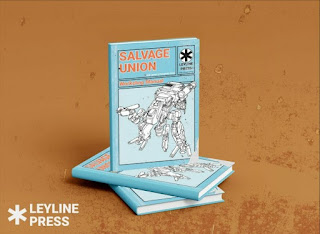
Physically, the Salvage Union Beta Quick-Start Guide is a decently presented digest-sized book, whose cover is reminiscent of a Haynes manual. Inside, the artwork varies in style, from fully painted vistas to line art drawings of the Mechs with cartoon-like illustrations of the pre-generated Pilots in-between. The layout is clean and tidy, and the quick-start is easy to read through.

The Salvage Union Beta Quick-Start Guide does an excellent job of introducing Salvage Union and how it is played. It not only comes with everything necessary to play its scenario, but a bit extra with which the Mediator can expand play beyond the scope of the scenario, providing a broader look at the core game. Some adjustment is necessary in terms of play since although this is a Mecha-style game, as it emphasises narrative play rather than tactical, for both the roleplaying and the Mech combat. Overall, the Salvage Union Beta Quick-Start Guide is an impressive introduction to Mecha-style games and settings, but without resorting to a lot of stats and wargames style play.

—oOo—

Salvage Union is currently being funded via Kickstarter.

Friday, 10 December 2021

[Free RPG Day 2021] Talisman Adventures – Quick Start Guide: Curse of the Rat Queen

Now in its fourteenth year, Free RPG Day in 2021, after a little delay due to the global COVID-19 pandemic, took place on Saturday, 16th October. As per usual, it came with an array of new and interesting little releases, which traditionally would have been tasters for forthcoming games to be released at GenCon the following August, but others are support for existing RPGs or pieces of gaming ephemera or a quick-start. Of course, in 2021, Free RPG Day took place after GenCon despite it also taking place later than its traditional start of August dates, but Reviews from R’lyeh was able to gain access to the titles released on the day due to a friendly local gaming shop and both Keith Mageau and David Salisbury of Fan Boy 3 in together sourcing and providing copies of the Free RPG Day 2020 titles. Reviews from R’lyeh would like to thank all three for their help.

—oOo—

Talisman Adventures – Quick Start Guide: Curse of the Rat Queen is the introduction to the Talisman Adventures Fantasy Roleplaying Game. Published by Pegasus Press, this is actually the roleplaying adaptation of Talisman: The Magical Quest Game, the classic fantasy board game originally published by Games Workshop in 1983. Like the board game, the Talisman Adventures Fantasy Roleplaying Game and thus Talisman Adventures – Quick Start Guide: Curse of the Rat Queen takes place in the in the Realm, a land of deadly creatures and ancient dragons and wondrous magic and fell curses, born in ages past after the Great Wizard cleansed the land of its many threats. Yet the Great Wizard did not stay, leaving behind the Crown of Command, talismans of great power, and perturbed peoples. Without the presence of the Great Wizard, vile monsters and other evil servants of Oblivion have begun to regain their power across the Realm, and now it is up to Heroes to step up and make a name for themselves.

The Talisman Adventures – Quick Start Guide: Curse of the Rat Queen comes with everything necessary to play. This includes an explanation of the setting, the core mechanics—including combat and spellcasting, four pre-generated Player Characters, and a short three-act scenario. To play, each player, including the Game Master, will need four six-sided dice, one of which must be a different colour to the others. This die of a different is the Kismet Die. Each player will also need five or six tokens, whilst the Game Master will also need five or six of her own, but of a different colour. These represent tokens Fate—Light Fate for the Player Characters, but Dark Fate for the Game Master.

The Talisman Adventures – Quick Start Guide: Curse of the Rat Queen quickly leaps into an explanation of the mechanics—the 3D6 Adventures System—and how tests work. However, to understand how they work, both Game Master and her players need to know what makes up a Player Character. Each Player Character has two Attributes, Strength and Craft. The former represents a character’s physical capability, and has three Aspects—Brawn, Agility, and Mettle, whilst the latter represents a character’s mental capability, and also has three Aspects—Insight, Wits, and Resolve. For the pre-generated Player Characters provided with the Talisman Adventures – Quick Start Guide: Curse of the Rat Queen, both Attributes and Aspects range between one and five. A Player Character can also have Skills, for example, Decipher, Entertain, Melee, or Psychic, and some Skills can have Specialisations, such as Mystic for Spellcasting, Axe for Melee, or Forest for Survival.

When a Player Character wants to undertake an action, his player rolls three six-sided dice, one of which must be a different colour, and thus the Kismet die, hoping to beat a given Difficulty, for example, an Average Difficulty might be eleven. If the Player Character has an appropriate Skill, then an associated Attribute or Aspect can be added to the total. More than the one Attribute or Aspect can be associated with the Skill, for example, Entertain Skill is associated with Wits, Insight, and Agility. Obviously, Agility for physical performances such as dancing or juggling, Insight for singing and playing a musical instrument, and Wits for reciting a saga or performing in a play. Further, if the Player Character has a Focus for the Skill, the player receives a flat +2 bonus to the roll. The outcome of the roll generates a Degree of Success. If the combined result—including the dice roll plus appropriate Attribute, Aspect, and Focus—is equal to, or greater than the Difficulty, then that is a Standard Success. If doubles are rolled on any of the three dice, and the combined result is equal to, or greater than the Difficulty, then that is a Great Success. If triples are rolled on any of the three dice, and the combined result is equal to, or greater than the Difficulty, then that is an Extraordinary Success.

A result is less than the Difficulty, then the Player Character has failed. In combat this means that not only has the Player Character failed to strike his opponent, that opponent has struck back and inflicted full damage. A Standard Success means that the Player Character has succeeded in the Test, but at a cost or with a complication. This then, is a classic, ‘Yes, but…’ result. In combat, this means that a Player Character has managed to attack an opponent, but said opponent strikes back and inflicts half damage. A Great Success means that the Player Character has succeeded without any beneficial or detrimental effect. This is complete success. An Extraordinary Success means that the Player Character has succeeded and done so with great effect. In combat, that might be to inflict extra damage or another effect. This is a classic ‘Yes and…’ result.

Further, if a one is rolled on the Kismet Die, the Game Master gains one Dark Fate, whilst if a six is rolled, the Player Character gains one Light Fate. Rolling a one on the Kismet Die, can also trigger the Special Ability for an NPC or Enemy, whilst rolling a six can trigger a Player Character’s Special Ability. Light Fate points can be spent to add a bonus six-sided die to a Test, reroll a single die after a Test roll has been made, activate a Special Ability or an item’s Special Quality, and to avoid dying following a failed death test. The Game Master can spend Dark Fate to increase an Enemy, activate an Enemy’s Special Ability, activate effects in special areas, and activate an item’s curse effects. Both the Player Characters and the Game Master have a limited supply of their respective Fate, but more is generated throughout play.

Combat in Talisman Adventures is player facing, with each player making a Test with a Difficulty equal to the Threat of the Enemy faced by his Player Character. What this means is that the Player Characters act first and the Degrees of Success their players generate determine exactly how the Enemy react. So if an attack fails, the Opponent will attack, inflicting full damage or a Special Attack, whilst with a Success, the Player Character inflicts full damage, but suffers half damage from his Opponent in return. Only with a Great Success will full damage be inflicted without any comeback, whilst an Extraordinary Success does that and more. Numerous options are given for what that ‘more’ might be, depending whether the Player Character’s action is a Melee or Ranged Attack, a Psychic Attack, a Spell being cast, and so on… Once the Player Characters have acted, any Enemy who have not been engaged in combat, are free to act. In this case, any Player Character attacked must make a Defence Test, again against the Enemy’s Threat, and again, the Degree of Success determines the outcome, even to potentially stopping the attack and riposting with half damage on an Extraordinary Success.

Armour in Talisman Adventures is ablative, but can be repaired between encounters. However, armour always suffers a single permanent point of damage in combat which requires repair with a full set of tools. What this means is that the effectiveness of armour degrades over the course of an adventure, from encounter to encounter. When armour has been rendered useless in an encounter, any further damage is inflicted as Wounds. Successive Wounds also inflict increasing penalties to Tests and if a Player Characters suffers too many Wounds, his player must begin making Death Tests—or die!

The Talisman Adventures – Quick Start Guide: Curse of the Rat Queen comes with four pre-generated Player Characters. They include a brawny, axe-wielding Troll Warrior; an unarmed and unarmoured Dwarf Priest who can heal and bless, plus banish spirits; an Elf Scout, good with a bow and moving in the forest; and a Ghoul Assassin (!) who is incredibly sneaky and can even turn a dead Enemy temporarily against his former companions. In general, the Player Characters are clearly laid out and easy to read, though players should note that the Dwarf Priest has no armour and the Ghoul Assassin has the Soul Drinker Special Ability, but not the Psychic Assault Special Ability necessary to initiate a psychic attack.

The adventure, ‘Curse of the Rat Queen’, in the Talisman Adventures – Quick Start Guide: Curse of the Rat Queen runs to ten pages. A three-act affair, it sees the Player Characters travelling to the village of Jellico which requires their help. After the cliché of a barroom brawl to get the players used to the dice mechanics, the village elders summon the Player Characters and explain the problem besetting the village. It has been beset by a plague of rats, and naturally, the elders hired a Pied Piper and his tunes drew all of the rats out of the village. However, now they are returning, and the elders cannot not find the piper, so they want the Player Characters to find him, get their money back, and hopefully put an end to the rat menace. This will take them out of the village and into the surrounding wilderness to the Whispering Woods where the piper led the rats… Even if the start is a cliché, ‘Curse of the Rat Queen’ is a decent adventure, supported with good advice and optional content that the Game Master can add if she wants to. It adds a couple of rules of play along the way, so the Game Master will need to the adventure through thoroughly as part of the preparation. The adventure is not necessarily straightforward, but should be fun to play and adds several extra monsters which the Game Master could use to expand upon the adventure. Overall, a decent adventure which should provide two or so sessions’ worth of play.

Physically, the Talisman Adventures – Quick Start Guide: Curse of the Rat Queen is decently presented. The artwork varies a little in quality, but the writing is clear and easy to understand. The Game Master will need to conduct a careful read through as it does leap straight into the rules and there are extra rules explained later in the scenario. This does mean that The Talisman Adventures – Quick Start Guide: Curse of the Rat Queen is not quite suited to the novice Game Master as intended, but anyone with a little experience will pick the rules up fairly quickly. Also, the phrasing of the Degrees of Success feels slightly odd in that a Standard success is one with an element of failure. Adjust to that—and of course, the player facing mechanics which do make the Game Master’s task much easier, and Talisman Adventures serves up a mix of the traditional and the slightly lesser than traditional fantasy. Overall, the Talisman Adventures – Quick Start Guide: Curse of the Rat Queen is a solid introduction to Talisman Adventures combined with fairly simple mechanics and a fun adventure.

Monday, 6 December 2021

[Free RPG Day 2021] Victoriana: Going Underground

Now in its fourteenth year, Free RPG Day in 2021, after a little delay due to the global COVID-19 pandemic, took place on Saturday, 16th October. As per usual, it came with an array of new and interesting little releases, which traditionally would have been tasters for forthcoming games to be released at GenCon the following August, but others are support for existing RPGs or pieces of gaming ephemera or a quick-start. Of course, in 2021, Free RPG Day took place after GenCon despite it also taking place later than its traditional start of August dates, but Reviews from R’lyeh was able to gain access to the titles released on the day due to a friendly local gaming shop and both Keith Mageau and David Salisbury of Fan Boy 3 in together sourcing and providing copies of the Free RPG Day 2020 titles. Reviews from R’lyeh would like to thank all three for their help.

—oOo—

Cubicle7 Entertainment Ltd. offered two titles for Free RPG Day 2021. One is Reap and Sow, a scenario and quick-start for Warhammer Age of Sigmar Soulbound. The other is Going Underground, an adventure for the forthcoming version of Victoriana, the roleplaying game of intrigue, sorcery, and steam for Dungeons & Dragons, Fifth Edition. This is the roleplaying game of gothic fantasy magic and steampunk engineering set at the height of the reign of Queen Victoria and the British Empire. Magic is commonplace and even powers many of the new technological advances, such as the clockwork automata and prosthetic limbs, the latter often replacing those lost through industrial accidents or war. However, there is tension between maintaining the old ways of magic and embracing the optimism which comes with the new technology and the speed of change. The world of Victoriana is also inhabited by different species too. The Duine are much like Humanity, but there are also Púca—humans with animal traits; Muirlochs—nocturnal Humans with batlike ears and an affinity for technology; Khald—short, stout, and stubborn professionals known for their craftsmanship; Gruagach—tall, muscled, and honestly direct of opinion; and Elderen—elegant psychics said to have connections to the fae. There are numerous sources of magic too. These include the Aluminat faith which the Luminous Host and works to keep Humanity from becoming embroiled in the dangers of Entropy—which is thought to have lead to the apocalyptic magical event known as the Great Cataclysm in the past; the Thaumturge’s Guild which has legitimised and industrialised magic; Animism is drawn from the Otherworld which is home to the fae and harnesses the quintessence of nature to create talismans; and Maleficium is dark magic—necromancy and diabolism—taught by the Pallid Ones, fallen Archons. Magic is also another source of tension since it was once the sole purview of the nobility, but this is no longer the case as it has been industrialised and democratised. 

Victoriana: Going Underground is a preview of the forthcoming new edition of Victoriana, effectively the fourth edition, which is designed for use with Dungeons & Dragons, Fifth Edition. It moves the setting on two decades from just after the Crimean War to the Queen’s Golden Jubilee in 1877. After a solid introduction which explains the setting, it quickly throws both players and Game Master into the adventure itself, ‘Going Underground’. Designed for four players—the quick-start includes four pre-generated Player Characters—it is a short, direct, and linear adventure. They include Adelaide Finch, a Muirloch Sleuth, Theodore Gatesly, a Noble Gruagach Confidante, Sam Urmacher, a Púca gadgeteer, and Charalata Rathmore, an Elderen Animist. Each of the four comes with a full colour portrait and a clearly presented set of stats and abilities. All four are attending the opening and inaugural running of the deepest and newest underground train line built and run by the City & South London Subway. As detailed in the opening explanation for the players and their characters, Adelaide Finch has learned that someone is planning to sabotage the opening of the line, Theodore Gatesly used his connections to get the quartet tickets to the event, Sam Urmacher is along to investigate and write an article for periodical about trains, and Charalata Rathmore may help soothe the proletariat’s objections to the newly dug line.

The adventure itself is direct. The Player Characters alight from their carriage, descend into the London Underground, interact with the other guests and the staff, before boarding the train, and making the journey from Cannon Street to Stockwell and back (the alternate history of Victoriana means that the two are connected via the same line, when at the time they would have completely separate, unconnected lines). On the way something strange happens and it appears to be pulling the train through a portal. The question is, what caused this, and how do the Player Characters and everyone aboard the tube train get back? Throughout there are moments when the adventure puts each of the Player Characters in the spotlight, mostly to learn new information rather than act, and it is not until the strange event occurs that they really have the chance to do anything and be more proactive. Up until this point it does feel as if the Player Characters are in the background of the adventure, often reacting to the sometimes-clichéd actions and utterances of the NPCs. Once the train is thrown into the portal, the Player Characters have more opportunities to act—mostly combat and making repairs, but definitely more than the initial parts of the adventure.

Mechanically, there are relatively few changes between Victoriana and Dungeons & Dragons, Fifth Edition—at least in Victoriana: Going Underground. The most notable is the list changes to various skills, of which the Social Class skill, with its specialisations of Noble, Bourgeoisie, and Proletariat, figure prominently in the play of the scenario. The other is the addition of Quintessence, which is used to power spells, special abilities, and devices. This replaces the traditional Vancian spell slots of Dungeons & Dragons with what is in effect, a spell point system.

Physically, Victoriana: Going Underground is decently presented and written, with decent artwork—especially those of the Player Characters. It is a pity that none of the NPCs are illustrated.

Victoriana: Going Underground is short and direct and playable in a single session. As an example adventure, it is not that engaging, often relying upon clichés for its presentation of its NPCs and having a tightly plotted script. The latter though, is primarily due to the length of the scenario—a little over six pages in a fourteen-page booklet—and the fact that it is set in a tube train! Nevertheless, there are opportunities for the Player Characters to interact with the NPCs, shine a little, and the scenario does go out of its way to spotlight each of the four pre-generated Player Characters, and there is also scope for players to roleplay as well. However, as an introduction to the new edition of Victoriana, the scenario in Victoriana: Going Underground is too limited and too linear—certainly to stand on its own as a memorable adventure. As the opening chapter or prequel to a fuller, deeper, and proper scenario, Victoriana: Going Underground is serviceable enough, but not much more.

Sunday, 5 December 2021

Hexagonal Horror

Best Left Buried is a fantasy horror roleplaying game in which characters venture into the crypts and caves below the earth in search of secrets and treasures and there face unnameable monsters, weird environments, eldritch magic, and more… Whilst deep underground, they will be under constant stress, face fears hitherto unknown, and the likelihood is that they will return from the depths physically and mentally scarred, the strangeness they have seen and the wounds they have suffered separating them from those not so foolish as to descend into the dark. Published by Soul Muppet Publishing, one of the more accessible versions of the roleplaying game is Best Left Buried: The ZiniEdition or A Doom to Speak – The Crypt Collection 1: Rules because it presents  its contents in discrete, self-contained chapters or ‘Zinis’. This includes an anthology too of fifteen mini-dungeons and mini-locales reduced to the ‘Zini’ format, just four pages per entry, many of which can be found in this A Doom To Speak Megabundle.

Released at DragonMeet 2021, A Garden Most Foul: A rot-choked fever-nightmare adventure for Best Left Buried is the newest zini, another four-page pamphlet scenario. This takes the Player Characters into the Garden of the Demon Postulix, deep in the wilderness, part of an expedition led by Lord Amador Gregory to discover the Tree of Life and its miraculous fruit. It begins with the Player Characters, having been told that the Demon Postulix grants eternal life, standing at the entrance to a low tunnel which runs through the high hedge of thick thorns surrounding the garden. The inside consists of a mini-hexcrawl of a single hex containing seven smaller hexes. The terrain under foot and the general conditions is mostly foul—as the title promises—ranging from thick, boot-sucking mud to fields of jagged boulders which almost seem to want to bite passers-by. In between are landscapes which resemble acres of rolling slabs of muscle and fat, copses of trees from which hang strange pods, a fungus infested cave, abscesses containing hives of rotten insects, and freshly tilled fields sown with fragments of bone…

A Garden Most Foul is a relatively light mini-adventure and there is a sparseness to it—no surprise given its length. Nevertheless, it possesses a weird and disturbing atmosphere, which comes of its disparately themed hexes being mashed up against each other. The location is also sparsely populated, with just the one NPC, two singular monsters, and the one monster type. There is room too for the Game Master to expand the fungus infested cave, perhaps connecting it into any one of the fungal-themed and Mushroom Men populated adventures written for the Old School Renaissance. There are moments too when the Cryptdiggers will find themselves being hunted, likely leading to clash between a great abomination and the unwholesome beast it rides. The story though suffers from a paucity of plot and what there is perhaps a little too obvious. Plus the personalities involved are underwritten. On the plus side, this does mean that there is plenty of scope in the zini for the Game Master to expand and develop A Garden Most Foul where necessary, whether that is expanding the plot or adding an NPC or two—with there being room aplenty for both.

Physically, A Garden Most Foul is also fairly unpossessing. The only illustration is on the front cover and is that of the two singular monsters—an abomination and the beast it rides. It nicely captures the utterly unwholesome nature of both. The zini is well written and easy to grasp, so that the Game Master could prepare with very minimal preparation.

A Garden Most Foul is short, weird, and self-contained. All features which make it easy to run, with very little preparation time—though perhaps in terms of plot and personalities, if the Game Master has some time, then she should develop both. The minimal preparation time and the self-contained nature means that for Best Left Buried, it is incredibly easy to pick up and get to the table. It also means that it is easily dropped into any distant wilderness location and it can be just as easily adapted to the fantasy roleplaying game of the Game Master’s choice, especially ones which embrace the weird and the horrifying—for example, Warhammer Fantasy Roleplay or Shadow of the Demon Lord. Simple and sparse, A Garden Most Foul: A rot-choked fever-nightmare adventure for Best Left Buried is ready to fill in a space when the Game Master needs it, or waiting for development to bring out little more personality and plot.