Every Week It's Wibbley-Wobbley Timey-Wimey Pookie-Reviewery...
Showing posts with label EDGE Studio. Show all posts

Sunday, 11 October 2026

[Free RPG Day 2026] Three Days to the Big Easy

Now in its nineteenth year, Free RPG Day for 2026 took place on Saturday, June 27th. As per usual, Free RPG Day consisted of an array of new and interesting little releases, which are traditionally tasters for forthcoming games to be released at GenCon the following August, but others are support for existing RPGs or pieces of gaming ephemera or a quick-start. This included dice, miniatures, vouchers, and more. Unfortunately, due to vagaries of International Customs, Free RPG Day in the UK did not take place until Saturday, 22nd August.

This review is possible due to the generosity of
Waylands Forge in Birmingham.

—oOo—

Quick-starts are a means of trying out a roleplaying game before you buy. Each should provide a Game Master with sufficient background to introduce and explain the setting to her players, the rules to run the scenario included, and a set of ready-to-play, pre-generated characters that the players can pick up and understand almost as soon as they have sat down to play. The scenario itself should provide an introduction to the setting for the players as well as to the type of adventures that their characters will have and just an idea of some of the things their characters will be doing on said adventures. All of which should be packaged up in an easy-to-understand booklet whose contents, with a minimum of preparation upon the part of the Game Master, can be brought to the table and run for her gaming group in a single evening’s session—or perhaps two. And at the end of it, Game Master and players alike should ideally know whether they want to play the game again, perhaps purchasing another adventure or even the full rules for the roleplaying game.

Alternatively, if the Game Master already has the full rules for the roleplaying game the quick-start is for, then what it provides is a sample scenario that she still run as an introduction or even as part of her campaign for the roleplaying game. The ideal quick-start should entice and intrigue a playing group, but above all effectively introduce and teach the roleplaying game, as well as showcase both rules and setting.

—oOo—

What is it?
The Three Days to the Big Easy: A Quickstart Adventure is the quick-start for the Arkham Horror: The Roleplaying Game, the roleplaying game of Lovecraftian investigative horror derived from Arkham Horror board game and Arkham Horror Living Card game from Fantasy Flight Games, both of which are derived from the original version of the Arkham Horror board game published by Chaosium, Inc. in 1987. It is published by EDGE Studio.

The
Three Days to the Big Easy: A Quickstart Adventure is a thirty-two page, full colour booklet.

How long will it take to play?
The Three Days to the Big Easy: A Quickstart Adventure includes the scenario, ‘Three Days to the Big Easy’, a short scenario which can be played through in one session.

What else do you need to play?
The Three Days to the Big Easy: A Quickstart Adventure needs a set of six six-sided per player, plus a lot more for the Keeper and some dice of a different colour.

Who do you play?
The Three Days to the Big Easy: A Quickstart Adventure includes six pre-generated Investigators. They consists of a bruising gangster with connections to the O’Bannion connections; a larcenous White Russian countess; an African American trumpet player (who has the Knack ‘Dead Man’s Stomp’ in a nice nod to Lovecraftian investigative roleplaying); a supernaturally resilient singer; an intuitive violinist; and a magician who knows a little too much lore.

How is an Investigator defined?
An Investigator in Arkham Horror: The Roleplaying Game is primarily defined by ten skills—Agility, Athletics, Intuition, Knowledge, Lore, Melee Combat, Presence, Ranged Combat, Resolve, and Wits. Of these, Lore is how much an Investigator knows about the occult and how to apply it, if necessary. Skills are rated between two and six. He has a variety of Knacks, special abilities that might grant him extra dice, alter the number of dice rolled, allow special actions, cast spells, rerolls of the dice, and more. There is a wide variety of Knacks, even presented in the six pre-generated Investigators in Three Days to the Big Easy: A Quickstart Adventure.

An Investigator also has a Personality Trait, such as ‘Reserved’, ‘Ambitious’, or ‘Outgoing’. These can have a positive and a negative effect in play.

Lastly, an Investigator has a pool of six-sided dice, typically six. These are used and refreshed from one scene to the next and they represent a combination of an Investigator’s effort and health. In the case of the latter, when an Investigator is injured, he loses dice, limiting his actions until he can rest, heal, and receive medical attention.

How do the mechanics work?
When a player wants his Investigator to undertake a Complex action, such as climbing a fence in a chase, shooting cultist in a gunfight, researching a newspaper morgue for clues, or casting a spell, he takes as many dice as he wants from his pool and rolls them, comparing the results with the skill being used. For each die result equal to, or greater than, the value of the skill, a success is scored. In general, only a single success is required to achieve whatever an Investigator wants to do, but more successes are needed to trigger the effects of some Knacks.

In general, only a single success is required to achieve whatever an Investigator wants to do. Complex actions can also be rolled with Advantage or Disadvantage, rolling with one more or one less die in either case, but removing the lowest result on any die if at Advantage or the highest if at Disadvantage.

In addition, an Investigator has a supply of Insight points. These can be spent to add an additional success to a complex action, take a Complex Action with Advantage, to add a narrative element to a scene, or to avoid certain trauma.

Play itself in Arkham Horror: The Roleplaying Game is handled as a series of scenes, either Narrative or Structured scenes in which Simple and Complex Actions are attempted. Narrative scenes rarely involve peril, and allow an Investigator to undertake Simple Actions without his player needing to roll dice, whereas Structured scenes do involve peril or great difficulty, such as a combat scene or a confrontation with the Mythos, require a player to roll for both Simple and Complex Actions.

How does combat work?
Combat uses the same mechanics, with damage being inflicted in two ways. Primarily by reducing a defendant’s dice pool, limiting his capacity to act, wounding him if the dice pool is reduced to zero, after which he can strain himself to restore his dice pool to full at the cost of suffering an Injury. The other way is by a weapon specifically inflicting an Injury. Injuries are determined by rolling on the Injury Table. These are rolled on a single die, to which are added the number of injuries already suffered. Since the Injury roll is made on a single die, it takes a lot of injuries—at least five—before someone can be killed straight off. There is no little grievous Injury in the meantime, but it is difficult to kill a defendant and certainly an Investigator.

How does Horror work?
The way of handling Horror Damage or exposure to the cosmic truths of the universe is more interesting, though similar to that used for injuries. When an Investigator suffers Horror Damage—whether from a spell cast at him, seeing a creature of the Mythos, or reading a horrific tome—his player replaces a number of dice in his dice pool with Horror Dice equal to the Horror Damage suffered. Horror Dice work exactly like normal dice in a player’s dice pool and can be lost if an Investigator suffers damage. However, should a player roll a one on any single Horror Die, his Investigator gains a Trauma. The rolls a single die and consults the Trauma Table, adding one for each one rolled on the Horror Dice. Where an Investigator is physically resilient, the same cannot be said mentally. It is a lot easier in comparison to get Horror Dice, roll ones, and suffer Trauma and since there are fewer results on the Trauma Table, for an Investigator to be ‘Lost Forever’.

Horror Dice can be healed from one round to the next, as well as by certain Knacks and spells, replacing them with standard dice. This is an action though and in a Structured Scene, the Investigators might not have the opportunity. Whereas injuries can be healed though, traumas cannot, although they can recede over time. The combination of Horror Dice and Trauma is intriguing as a means of handling the escalating danger of being exposed to cosmic threat, but it does feel undercut by the ability to heal Horror Dice within a scene.

What do you play?
The Three Days to the Big Easy: A Quickstart Adventure includes the scenario, ‘Three Days to the Big Easy’, a short scenario which can be played through in one session. The scenario primarily focuses on interaction and action in terms of its play and there is not a great deal of scope for investigation. In the main, the Investigators are reacting to violent events, appearing to discover the culprit, only for it to occur again. This is interesting, but not interesting enough. There is never really a chance for the Investigators to fully work out what the cause of the situation, only identify its source. And that source is another of the problems with scenario. The source is a vengeful spirit in a cigarette lighter. There is no denying that ‘Three Days to the Big Easy’ is a horror story and the situation is horrifying, yet at the same time, its source is so ordinary, it feels banal. Anyone playing the scenario and expecting a Lovecraftian source or threat is going to extremely disappointed.

Is there anything missing?
No. The Three Days to the Big Easy: A Quickstart Adventure is complete as is.

Is it easy to prepare?
Yes. The Three Days to the Big Easy: A Quickstart Adventure is easy to grasp and prepare.

Is it worth it?
Yes and no. The Three Days to the Big Easy: A Quickstart Adventure is playable and presents an engaging set-up and potentially horrifying scenario. Ultimately, the repetitive structure of the scenario and its avoidance of anything Lovecraftian and satisfying explanation as to the situation for the players and their Investigators—especially in what is a one-shot
—means that it does not fulfil its set-up as much as it should.

The Three Days to the Big Easy: A Quickstart Adventure
is available from EDGE Studio.

Saturday, 10 October 2026

[Free RPG Day 2026] An Afternoon Outing

Now in its nineteenth year, Free RPG Day for 2026 took place on Saturday, June 27th. As per usual, Free RPG Day consisted of an array of new and interesting little releases, which are traditionally tasters for forthcoming games to be released at GenCon the following August, but others are support for existing RPGs or pieces of gaming ephemera or a quick-start. This included dice, miniatures, vouchers, and more. Unfortunately, due to vagaries of International Customs, Free RPG Day in the UK did not take place until Saturday, 22nd August.

This review is possible due to the generosity of
Waylands Forge in Birmingham.

—oOo—

Quick-starts are a means of trying out a roleplaying game before you buy. Each should provide a Game Master with sufficient background to introduce and explain the setting to her players, the rules to run the scenario included, and a set of ready-to-play, pre-generated characters that the players can pick up and understand almost as soon as they have sat down to play. The scenario itself should provide an introduction to the setting for the players as well as to the type of adventures that their characters will have and just an idea of some of the things their characters will be doing on said adventures. All of which should be packaged up in an easy-to-understand booklet whose contents, with a minimum of preparation upon the part of the Game Master, can be brought to the table and run for her gaming group in a single evening’s session—or perhaps two. And at the end of it, Game Master and players alike should ideally know whether they want to play the game again, perhaps purchasing another adventure or even the full rules for the roleplaying game.

Alternatively, if the Game Master already has the full rules for the roleplaying game the quick-start is for, then what it provides is a sample scenario that she still run as an introduction or even as part of her campaign for the roleplaying game. The ideal quick-start should entice and intrigue a playing group, but above all effectively introduce and teach the roleplaying game, as well as showcase both rules and setting.

—oOo—

What is it?
The Dungeons & Kittens Quick Start: An Afternoon Outing is the quick-start for the Dungeons & Kittens RPG, published by EDGE Studio.

The
Dungeons & Kittens Quick Start: An Afternoon Outing is a thirty-two page, full colour booklet.

How long will it take to play?
The Dungeons & Kittens Quick Start: An Afternoon Outing includes the scenario, ‘An Afternoon Outing’, a short scenario which can be played through in one session.

What else do you need to play?
The Dungeons & Kittens Quick Start: An Afternoon Outing needs three six-sided dice per player.

Who do you play?
The Dungeons & Kittens Quick Start: An Afternoon Outing includes five pre-generated Player Kittens. These are presented on bright and breezy character sheets which include an explanation of the basic rules, the background for each Player Kitten, and explanations for their spells.

How is a Player Kitten defined?
A Player-Kitten in Dungeons & Kittens has three abilities—Strong, Smart, and Cute—and one or more skills. These include ‘Draw & Paint’, ‘Hiss & Growl’ (brawling and intimidation), ‘Read Sky & Stars’, ‘Scratch!’ (for melee combat) and ‘Shake Your Booty’ (for athletics and acrobatics). A Player-Kitten either has a skill or he does not, and if he does, it gives Advantage on a roll. He will also have a Character Trait, a descriptor that can work as an advantage or disadvantage. He can carry up to five ‘Purr-ecious’ items in his backpack and can use ‘Meowgic’ and thus can cast spells.

How do the mechanics work?
When a player wants his Kitten to undertake an action, the Storyteller—as the Game Master is known in Dungeons & Kittens—selects the appropriate ability and the player rolls three six-sided dice. Each die result that is equal to or less than the ability counts as a Success. An Easy action requires one Success, a Medium action requires two Successes, a Difficult action requires three Successes, and a Legendary action requires four Successes. If the player rolls a number of Successes equal to the difficulty of the action, his Kitten succeeds. Fewer Successes than the difficulty and the player has a choice of simply failing to succeed without consequences, whereas no Success and the action is definitely a failure. If a player rolls three of the same number, his Kitten gains an edge, whether the roll was a success or failure. If a Kitten has Advantage, his player rolls four dice, but only two dice if he is at Disadvantage. A player can re-roll one or more dice with the right ‘Purr-ecious’ items.

Each Player Kitten has a Trait, such as Brave or Curious. It can be used in two ways, once ach session. One is to grant Advantage, the other, when it gets a Kitten into a dangerous situation, his player can give a Furr-endship point to another player. A Furr-endship point can be spent on one of two ways. First, to ensure that a single dice roll succeeds. Second, with a big hug and purring in their ear, to give one Heart—the equivalent of Hit Points in Dungeons & Kittens—to another Player Kitten. To regain spent Furr-endship points, a Player Kitten must spend time with his fellow Player Kittens away from adventuring and doing other things.

How do catfights work?
Combat or ‘Catfights’ in Dungeons & Kittens consist of two types. In a ‘Fang Catfight’, a Player Kitten attempts to intimidate, frighten, or convince another rather than hurt them, whereas in a ‘Claw Fight’, the aim is to hurt them. When a Player Kitten enters a ‘Claw Fight’, the stress causes him to lose a Furr-endship point due to the stress! Without a Furr-endship point, a Player Kitten cannot fight. In general, the Player Kittens act before anyone else, but if a Player Kitten takes an aggressive action, the Storyteller chooses who acts nest. If a Kitten takes a non-aggressive or helpful action, his player decides who acts next. Possible actions include Help to give Advantage to another Kitten; Hinder to give Disadvantage; Attack to reduce an enemy’s Heart points, whether in a ‘Fang Catfight’ or a ‘Claw Fight’; and Interact and Move. 

At any point, anyone caught in a Catfight can surrender and that is always respected. However, an opponent must surrender if his Heart points are reduced to zero in a ‘Fang Catfight’, but in a ‘Claw Fight’, he may seriously injured.

How does Meowgic work?
Every Player Kitten knows some Meowgic, has a spellbook, and can cast spells. To have his Kitten cast a spell, a player rolls dice against the Ability given for the spell. For example, the spell Slipper Patrol, requires a single Success against the Strong Ability and with a success, the caster and his fellow kittens can walk and run without hurting their legs or paws.

What do you play?
Dungeons & Kittens Quick Start: An Afternoon Outing provides plenty of support for its scenario, ‘An Afternoon Outing’. This includes a description of the background, that it is post-apocalyptic setting in which mankind has long since disappeared, leaving some animals with the gift of speech and imagination, the ability to anticipate and predict, and the capacity to invent. It is set in and around the Kingdom of Cats, ruled by the insatiably large and lazy King Walter from his tower in Cat Tree City. King Walter’s most unfair law is the ‘Exile of Kittens’. This exiles young kittens from the kingdom on the pretence of an initiation quest, supposedly to return to King Walter with a great treasure in hand. King Walter supposedly draws the names of the young kittens to be exiled at random, but everyone knows this is a lie. The Player Kittens are the latest to have their names drawn by King Walter.

In addition, Dungeons & Kittens Quick Start: An Afternoon Outing provides advice on being a Storyteller and being a good player. These are both well written sections and easy to grasp, but unlike almost any other quick-start, they need to be read by all of the players. This is because in Dungeons & Kittens Quick Start: An Afternoon Outing, more than one player will take a turn being the Storyteller. However, the scenario is short and it only includes two points when the it instructs the current Storyteller to handover the scenario to another player and at each point, the new Storyteller has to go and read the advice on being a Storyteller and then prepare the next scene. It is a nice idea, but does not quite work. There are five Player Characters and only three opportunities to be the Storyteller, so not everyone is going to get a go. Plus, there is going to be delay in play as the new Storyteller prepares to run the next scene. Not so much of a problem for the experienced Game Master, but for anyone new, they are being put on the spot.

The ‘An Afternoon Outing’ scenario is a flashback to an event early in the Player Kittens’ exile and consists of two scenes in which problems have to be solved with a confrontation in the third. In the opening scene, one of the Player Kittens falls into the pool of water around which they are all playing. The idea here is that the player of the Kitten who falls into the water is actually the first Storyteller, which gets around the problem of that player and his Kitten not having as much agency since his Kitten has fallen into the water. It also means that running it with a single Storyteller sets up a scene one player can do anything because his Kitten has fallen into the pool and is drowning. Effectively, ‘An Afternoon Outing’ is built around a good idea, but limits who can participate in it, and if the Storyteller wants to run the scenario because it limits the opportunity for everyone to have a go at being Storyteller, it introduces the problem of a lack of agency.

In spite of this problematic set-up, ‘An Afternoon Outing’ is well written with lots of advice for running each of its three scenes, whether that is making suggestions as what the Player Kittens might do in all three scenarios and how the NPCs that arrive might act in the third scene. Where the Player Kittens have to solve problems in the first two scenes, in the third scene, they confront minions of King Walter and ultimately decide the fate of the item that caused the situation in the first place. The advice is also good in that it has lots of questions that the Storyteller can ask her players and the situations are nicely detailed. The tone is also friendly and positive, making it suitable to be run for younger players.

Is there anything missing?
No. Dungeons & Kittens Quick Start: An Afternoon Outing is complete as is. 

Is it easy to prepare?
Yes. Dungeons & Kittens Quick Start: An Afternoon Outing is easy to grasp and prepare.

Is it worth it?
No. Dungeons & Kittens Quick Start: An Afternoon Outing is really a likeable quick-start, easy to learn and teach, and suitable for younger players. Even the included scenario is a good introduction to Dungeons & Kittens, but unfortunately, the design structure does not deliver its core concept to every player, and in adhering to its design structure, it makes it challenging for it to be run as a standard scenario.

The Dungeons & Kittens Quick Start: An Afternoon Outing 
is available from EDGE Studio.

Thursday, 1 January 2026

Reviews from R’lyeh Post-Christmas Dozen 2025

Since 2001, Reviews from R’lyeh have contributed to a series of Christmas lists at Ogrecave.com—and at RPGaction.com before that, suggesting not necessarily the best board and roleplaying games of the preceding year, but the titles from the last twelve months that you might like to receive and give. Continuing the break with tradition—in that the following is just the one list and in that for reasons beyond its control, OgreCave.com is not running its own lists—Reviews from R’lyeh would once again like present its own list. Further, as is also traditional, Reviews from R’lyeh has not devolved into the need to cast about ‘Baleful Blandishments’ to all concerned or otherwise based upon the arbitrary organisation of days. So as Reviews from R’lyeh presents its annual (Post-)Christmas Dozen, I can only hope that the following list includes one of your favourites, or even better still, includes a game that you did not have and someone was happy to hide in gaudy paper and place under that dead tree for you. If not, then this is a list of what would have been good under that tree and what you should purchase yourself to read and play in the months to come.

—oOo—

Darrington Press ($59.99/£59.99)
2025 was the year of the fantasy heartbreaker seeing the release of several roleplaying games written in wake of the Wizards of the Coast’s proposed re-writing of the Open Game Licence that underpinned so many of the industry’s titles. Designed to appeal to players of Dungeons & Dragons, Fifth Edition, there can be no doubt that Daggerheart was the most prominent of these. It offers similar heroic fantasy roleplaying, but with an emphasis on the narrative as much as the action with its Hope die and Fear die mechanics. Both are rolled together, and when the Hope die is higher, it generates Hope that can be used to activate various character abilities, whilst when the Fear die is higher, it generates Fear for the Game Master who can use it to power up her NPCs and make things more challenging for the Player Characters. Actual Player Character creation is made easy by the roleplaying game’s cards that detail its Ancestry and Community cards that define background and culture, and Domain cards that define abilities and spells. These come with the core rulebook in their own box and enable easy reference in play as well. Daggerheart makes heroic fantasy roleplaying easy and fun once again.

Tales of the Old West
Effekt Publishing ($60/£48)
Tales of the Old West brings capital and community—as well as faith—to the American frontier of 1873, in a treatment of classic Cowboys & Indians that is more history than Hollywood. It uses the Year Zero engine and a simple lifepath system to create interesting and fully rounded Player Characters who can do all of the things that you expect of a Wild West roleplaying game. Duels, gambling, chases, cattle rustling, bank robberies, and more. However, where it really begins to shine is in its support and capacity for long term play, because it wants the Player Characters to generate Capital and then invest it in their community. The players get to choose the type of community, where their character invest, and how it grows. The community becomes the Player Characters’ home, somewhere to protect, and somewhere for the Game Master to build stories and hooks around, whether in the community or from outside it. Tales of the Old West can do one-shot scenarios, but is really designed for long term play where the Player Characters can live and die on the American frontier, so can their communities.

Since it was first published in 2008, there have been numerous themes and threats applied to the classic co-operative mechanics against the game itself of Pandemic. In 2025, it has to face the biggest theme and biggest threat of them all—J.R.R. Tolkien’s The Lord of the Rings. In previous board games set in Middle-earth, one player has to control Sauron and the forces of Mordor’s shadow. In The Lord of the Rings: Fate of the Fellowship, the forces of Sauron, the nine Nazgûl and the seemingly endless armies of Orcs, as well as his baleful, lidless eye, are controlled by the game itself. Just as in the trilogy, Frodo and Sam must set for Mount Doom and there, drop the One Ring into the volcano, returning to where it was forged, but the others of the Fellowship must set out hither and thither, essentially to run interference on Sauron’s efforts to find Frodo and Sam and invade Middle-earth. While someone always has to play Frodo and Sam, the other members of the Fellowship are not set in stone and further, every player controls two members of the Fellowship, giving everyone more options and greater ability to cover the threats posed by Sauron. As with other Pandemic titles, the same threats will keep appearing again and again over the course of play, but a mix of careful play and luck on the dice rolls—yes, this is a Pandemic game that involves dice rolls—careful play can thwart them. The best bit about the dice rolls is that you get to use the dice tower shaped like Barad-dûr that looms over the board, to roll the dice. There is a lot of depth and detail to this co-operative version of Middle-earth, along with the replay value of new attempts by Sauron and playing different versions of The Fellowship of the Ring.

Mythic Bastionland – Before Into the Odd
Bastionland Press ($69.99/£49.99)
Mythic Bastionland combines brutality and folklore in an Arthurian Age when knights, each knighted by a different seer, seek Glory, explore the Realm, and confront Myths. In a world of brutal and bloody medievalism, they must prove themselves worthy of their status, but that can only be done by resolving Myths, public duelling or jousting, entering tournaments, and fighting battles that history will remember. By proving themselves worthy of their rank, they be ready to prove themselves ready for greater duties, of taking a seat in Council or at Court, ruling a Holding, and even a Seat of Power. First, they will search their realm for its greatest myths and resolve them, perhaps at the point of a sword, by negotiating, or simply doing nothing, facing other situations and perhaps, brutal, bloody combat along the way. Mythic Bastionland details some seventy-two knights, including The True Knight, The Trail Knight, The Story Knight, The Rune Knight, The Mask Knight, and The Silk Knight, and every single one of them is different and interesting and will present a different way of playing a Knight. Mythic Bastionland details seventy-two Myths for the Game Master to populate the Realm with, including The Wurm, The Tower, The Spider, The Toad, The Hole, and The Rock, and every single one of them will present the players and their Knights with a different challenge. Each includes a simple description, a set of omens that trigger as the Knights discover more signs of the Myth, a set of NPCs, and a table of random details that the Referee can use to detail parts of the Myth. This gives Mythic Bastionland plenty of replay value in an age of glorious myth and brutality.

Ace/Michael Joseph ($30/£22)
The LitRPG—or ‘Literary Role Playing Game’—comes of age in this first of this eight book series that asks the question, “What would you do if aliens had flattened everything on Earth and turned the inside of the planet into an eighteen-level dungeon, and the only way to save the planet is to fight your way all the way the down?” Fortunately, Carl the protagonist is not totally un-nerdy, so has played a few roleplaying games—both tabletop and computer—and so knows his way around the format. Unfortunately, it is not as simple as it sounds, because the dungeon-that-was-once-Earth is also a reality television series watched across the galaxy and so Carl has to play the fame game as well literally kicking dungeon denizen butt. However, although Carl is the main protagonist of the book, for the watchers of the reality television series, the real hero is Princess Donut the Queen Anne Chonk, the prize-winning show cat belonging to Beatrice, Carl’s late girlfriend, who has been magically uplifted from a pet into a Dungeon Crawler and an ace wizard! This is definitely a novel for the roleplayer and player of Dungeons & Dragons, who will get the most out of this knowing poke at traditional roleplaying.

Exalted Funeral ($150/£110)
To be blunt, Land of Eem had the best elevator pitch of 2025—“The Lord of the Rings meets The Muppets”—and if that does not get your roleplaying juices going, then the question is, what will? This is a game of light-hearted fantasy based on the graphic novel series Rickety Stitch and the Gelatinous Goo, and the book series Dungeoneer Adventures, that is both family friendly and fun enough for the experienced roleplayer to play too. It offers the brave adventurers the opportunity to explore the Mucklands, a region once under the heel of the Gloom King, but barely had time to recover before the corporations moved in and began exploiting it and so giving the name it has today. There are opportunities to delve into dungeons and strike it rich, even find Magnificent magical items of yesteryore and become filthy rich. Alternatively, being heroes, the Player Characters could keep such items safe from those that would exploit them, or indeed, put them to good use and help the people of the Mucklands from being oppressed by the tycoons and perhaps save them if the rumours are true about the return of the Gloom King. Land of Eem is illustrated with delightfully whimsical artwork, has simple mechanics, fun character types, and a richly detailed hexcrawl to explore.

The Op Games ($14.99/£14.99)
TACTA is a simple card game that simply looks great. Strong neon colours in dots, rectangles, squares, and triangles on jet black divided into six decks. It can be played on any flat surface and all a player has to do is place a card on the table so that one of its features, whether a triangle, square, or rectangle, covers up a feature on a card belonging to another player. Ideally this should with the dots showing and if it covers up another player’s feature with dots, then all the better, but a blank feature will still cover another player’s feature with dots and prevent them from being adding to that player’s final score. A player will also be thinking about how he can protect the features with dots on his cards from being covered over by the other players, so that there is defensive element to placement as well. There are few limits on card placement, the primary being that a card cannot cover another card when played and cannot connect to features that do not perfectly match. And that it is it to TACTA. Short, simple, and elegant, it is easy to teach and suitable for all ages.

Dolmenwood: Adventure and Peril in Fairytale Woods
Dolmenwood—consisting of the Dolmenwood Player’s Book, Dolmenwood Monster Book, and Dolmenwood Campaign Book—is another consequence of Wizards of the Coast’s proposed re-writing of the Open Game Licence that underpinned so many of the industry’s titles. Previously seen in the Wormskin fanzine and scenarios from the publisher, brings the setting together and presents it as a weird fairy tale adventure game, conjuring the wonder, horror, whimsy, and strangeness of British folklore in a land of standing stones, ley lines, lost shrines, fairy roads, Wood Gods, fairy nobles, and ancient history. All of this is brought together in a three volume set that presents this expansive woodlands in a style that William Morris, Aubrey Beardsley, and the ‘Arts & Crafts’ movement of the Victorian era with a shot of Lord Dunsay.


Dungeons & Kittens: Starter Set
Edge Studio ($39.99/£29.99)
Dungeons & Kittens: Starter Set is yet one more great starter set from 2025, this time perfect for introducing younger players to the hobby. Some time in the future, humans have disappeared following an apocalypse that has let nature grow back in its wake. In time, animals have evolved, including cats, rats, and dogs, who are beginning to explore the world, scavenge the technology left behind by humanity, and for the cats, command meowgic! The Player Characters are kittens exiled from the Kingdom of Cats who have set out to find their way and explore the world. The starter set includes lots of maps and dice and game accessories, as well as a total of five adventures. Three of these are learning adventures, each designed to be played in a single session or less, whilst the other two are full length adventures. The result is a light-hearted, even whimsical roleplaying game that can be run for the family or younger players, but also enjoyed by veteran players too. Plus it even came with its own colouring book!

Caesar Ink. ($65/£50)
The world of Painmye cries out in pain and screams for absolution as the Last Day draws near. Death has already closed the First Gate to Heall and turned the dead away, leaving the unquiet dead to wander… A crusade has been declared against the Traitor Gods and the Templars have already killed their first Traitor God. Day by day, more and more heretics give themselves up to or are thrown on the Pyre, but even those who have been given a chance for absolution for their heresies upon joining a guild by the Church of the Divine Corpse are being tempted once again by the gifts that Traitor Gods promise. Just as those who seek absolution join guilds for the safety in numbers they offer, so too do those who accept such gifts join cults for the protection they offer. This is Doomsong, an eschatological, pre-apocalyptic ‘Roleplay Macabre’ of heretical temptation and divine punishment and survival horror. It is a great looking book and like the best looking books makes the reader want to play on the art alone. The random character generation creates interesting, if desperate Player Characters that you want to find what happens to them. Doomsong does lack a scenario, so the Lord Have Mercy Upon Us campaign is a must.

DeadFellas
Chaosium, Inc. ($4.69/£3.48)
New York, winter, 1982. A black Cadillac, northbound. Four mafiosi inside. A body in the trunk. Their job? Get rid of the body and be home in time for Christmas. One wants to survive. One wants out. One wants to kill. One wants to avoid doing any crimes. One wants a victim. All have secrets. Highly atmospheric four-hander that plays out mostly within the confines of a car as something prods and pulls at the minds of the occupants and secrets and motivations are revealed and their consequences play out. A cracking one-shot scenario for Call of Cthulhu, Seventh Edition, this is best run in LARP fashion, with players sat in chairs placed in the same positions as their mafiosi are in the car to impart the claustrophobia and physical space in which they can act as the Keeper moderates the interplay and moves between them, whispering secrets and memories into their ears. Tense and unnerving, and perfect for a single evening’s worth of play, this scenario that showcases the creativity of the Miskatonic Repository community content programme.

The Imago Cult ($45/£33)
Another late trend in 2025 was the release of starter sets, the biggest and most of which were the Dungeons & Dragons Heroes of The Borderlands Starter Set and the Stranger Things: Welcome to The Hellfire Club set, both from Wizards of the Coast, whilst elsewhere the Dungeons & Kittens Starter Set from EDGE looked the most fun and Free League Publishing’s Vaesen – Starter Set provided utility in the long term as well as a solid introduction. The starter set that outdid them all in 2025 was Archeterica: The Invitation from Ukrainian publisher, The Imago Cult. Described as The X-Files in an alternate Napoleonic era of magic and conspiracies and revolution, it comes with the means to create Player Characters, an introduction to the setting, and three scenarios, what really sets it apart are its production values. Archeterica: The Invitation is simply beautiful, an alabaster artefact that you are going to want to own for its looks alone, let alone the intriguing setting.

Saturday, 16 August 2025

[Free RPG Day 2025] Arkham Horror: Comets of Kingsport – A Quickstart Adventure

Now in its eighteenth year, Free RPG Day for 2025 took place on Saturday, June 21st. As per usual, Free RPG Day consisted of an array of new and interesting little releases, which are traditionally tasters for forthcoming games to be released at GenCon the following August, but others are support for existing RPGs or pieces of gaming ephemera or a quick-start. This included dice, miniatures, vouchers, and more. Thanks to the generosity of Waylands Forge in Birmingham, Reviews from R’lyeh was able to get hold of many of the titles released for Free RPG Day.

—oOo—

Arkham Horror: Comets of Kingsport – A Quickstart Adventure is the contribution to Free RPG Day 2025 from Edge Studio. It is a quick-start and scenario for Arkham Horror: The Roleplaying Game, the roleplaying game of Lovecraftian investigative horror derived from Arkham Horror board game and Arkham Horror Living Card game from Fantasy Flight Games, both of which are derived from the original version of the Arkham Horror board game published by Chaosium, Inc. in 1987. Ultimately, Arkham Horror: The Roleplaying Game shares a great deal of setting elements with Call of Cthulhu, but they are not the same roleplaying game. Mechanically, Arkham Horror: The Roleplaying Game has more in common with the GUMSHOE System of Trail of Cthulhu from Pelgrane Press, but plays very differently. Whilst Trail of Cthulhu leans more into a Purist style of play emphasising an atmosphere of menace and growing as a default, Arkham Horror: The Roleplaying Game—at least as far as the Arkham Horror: Comets of Kingsport – A Quickstart Adventure is concerned—is more of a Pulp affair, playing up action and adventure and including Investigators who are not only aware of the Mythos, but also know a few spells too. There are elements too, drawn from EDGE Studio’s Genesys System, used to handle the perils of investigating the Mythos.

Arkham Horror: Comets of Kingsport – A Quickstart Adventure includes everything that a gaming group needs. It explains the rules, provides a full scenario that can be played in a single session or so, and gives a set of six pre-generated Investigators. Apart from copies of the pre-generated Investigators, the only thing it needs is a set of six six-sided per player, plus a lot more for the Keeper and some dice of a different colour. Arkham Horror: Comets of Kingsport – A Quickstart Adventure and Arkham Horror: The Roleplaying Game use what is called the ‘Dynamic Pool System’. An Investigator is primarily defined by ten skills—Agility, Athletics, Intuition, Knowledge, Lore, Melee Combat, Presence, Ranged Combat, Resolve, and Wits. Of these, Lore is how much an Investigator knows about the occult and how to apply it, if necessary. Skills are rated between two and six. He has a variety of Knacks, special abilities that might grant him extra dice, alter the number of dice rolled, allow special actions, cast spells, rerolls of the dice, and more. There is a wide variety of Knacks, even presented in the six pre-generated Investigators in Arkham Horror: Comets of Kingsport – A Quickstart Adventure.

Lastly, an Investigator has a pool of six-sided dice, typically six. These are used and refreshed from one scene to the next and they represent a combination of an Investigator’s effort and health. In the case of the latter, when an Investigator is injured, he loses dice, limiting his actions until he can rest, heal, and receive medical attention.

When a player wants his Investigator to undertake a Complex action, such as climbing a fence in a chase, shooting cultist in a gunfight, researching a newspaper morgue for clues, or casting a spell, he takes as many dice as he wants from his pool and rolls them, comparing the results with the skill being used. For each die result equal to, or greater than, the value of the skill, a success is scored. In general, only a single success is required to achieve whatever an Investigator wants to do, but more successes are needed to trigger the effects of some Knacks. For example, Silas Marsh has ‘Skilled Shot’ and can throw a harpoon as a ranged combat action, and if his player rolls three successes, the target cannot use a reaction to avoid the attack. (This is in addition to the weapon itself, which inflicts a base of two damage—most weapons inflict one or two points of damage, and if three or more success are rolled on an attack, in Injury is inflicted and extra damage is inflicted per Injury, making it a very deadly weapon.) Complex actions can also be rolled with Advantage or Disadvantage, rolling with one more or one less die in either case.

In addition, an Investigator has a supply of Insight points. These can be spent to add an additional success to a complex action, take a Complex Action with Advantage, to add a narrative element to a scene, or to avoid certain trauma.

Play itself in Arkham Horror: The Roleplaying Game is handled as a series of scenes, either Narrative or Structured scenes in which Simple and Complex Actions are attempted. Narrative scenes rarely involve peril, and allow an Investigator to undertake Simple Actions without his player needing to roll dice, whereas Structured scenes do involve peril or great difficulty, such as a combat scene or a confrontation with the Mythos, require a player to roll for both Simple and Complex Actions. Although a player only has access to six dice in his pool—or less depending upon trauma and Injury, this pool refreshes from one scene to the next, and in combat, they are refreshed at the start of an Investigator’s turn. In combat, damage is inflicted in two ways. Primarily by reducing a defendant’s dice pool, limiting his capacity to act, wounding him if the dice pool is reduced to zero, after which he can strain himself to restore his dice pool to full at the cost of suffering an Injury. The other way is by a weapon specifically inflicting an Injury. Injuries are determined by rolling on the Injury Table. These are rolled on a single die, to which are added the number of injuries already suffered. Since the Injury roll is made on a single die, it takes a lot of injuries—at least five—before someone can be killed straight off. There is no little grievous Injury in the meantime, but it is difficult to kill a defendant and certainly an Investigator.

The way of handling Horror Damage or exposure to the cosmic truths of the universe is more interesting, though similar to that used for injuries. When an Investigator suffers Horror Damage—whether from a spell cast at him, seeing a creature of the Mythos, or reading a horrific tome—his player replaces a number of dice in his dice pool with Horror Dice equal to the Horror Damage suffered. Horror Dice work exactly like normal dice in a player’s dice pool and can be lost if an Investigator suffers damage. However, should a player roll a one on any single Horror Die, his Investigator gains a Trauma. The rolls a single die and consults the Trauma Table, adding one for each one rolled on the Horror Dice. Where an Investigator is physically resilient, the same cannot be said mentally. It is a lot easier in comparison to get Horror Dice, roll ones, and suffer Trauma and since there are fewer results on the Trauma Table, for an Investigator to be ‘Lost Forever’.

Horror Dice can be healed from one round to the next, as well as by certain Knacks and spells, replacing them with standard dice. This is an action though and in a Structured Scene, the Investigators might not have the opportunity. Whereas injuries can be healed though, traumas cannot, although they can recede over time. The combination of Horror Dice and Trauma is intriguing as a means of handling the escalating danger of being exposed to cosmic threat, but it does feel undercut by the ability to heal Horror Dice within a scene.

In terms of pre-generated Investigators, Arkham Horror: Comets of Kingsport – A Quickstart Adventure gives six. They include a clever and helpful postal woman; strong sailor armed with a harpoon; a student with first aid skills and good at improvising weapons; a librarian who can cast spells and draw upon the horrors she has seen to gain Horror Dice and bonus dice to a roll; a prepared researcher who is good with people; and a professor who can choose to suffer an Injury or Horror Dice and who is also a skilled shot. All also have a section of equipment and besides a short background, there is also an explanation of the basic rules and the use of Insight on the back. All of the Investigators have travelled to Kingsport, some of them from Arkham’s Miskatonic University, to conduct an anthropological survey in the New England port. Players with a bit of history with roleplaying games of Lovecraftian investigative horror will appreciate that the professor in the included Investigators is none other than Harvey Walters, who appeared as the sample Investigator for the first time all the way back in the first edition of Call of Cthulhu.

The included scenario in Arkham Horror: Comets of Kingsport – A Quickstart Adventure opens with the Investigators visiting the Hall School in Kingsport to examine its rare book collection. Both the school secretary and the headmaster are welcoming, but they are concerned about a member of staff, Cecil Blackburn, who has been behaving oddly, even erratically. When they encounter him, he is found in a bath of salt water, weirdly mishappen, and rage-fuelled! The question is, what has happened to him? The plot and clues link to other citizens of Kingsport acting strangely and ultimately to somewhere otherworldly and further confrontation with something even stranger. It is a solid mix of investigation and interaction leavened with some action, decently presented and written. The primary difficulty with the scenario is the need to make slight adjustments to the plot links with fewer players and Investigators.

Physically, Arkham Horror: Comets of Kingsport – A Quickstart Adventure is decently presented and written. The artwork is disappointingly restricted to just the front cover and the Investigator illustrations, but still very good. A map or two might have been useful, whether of Kingsport or the scene of the scenario’s climax, and it does feel odd that the scenario is presented before the rules are explained.

Arkham Horror: Comets of Kingsport – A Quickstart Adventure provides everything that a group will need to try out Arkham Horror: The Roleplaying Game. It is accessible and comes with a decent investigative and interactive scenario that has a certain weirdness to it. The rules are clearly explained and easy to grasp with a good explanation of the ‘Dynamic Pool System’ on the back of each Investigator sheet, making them also easily accessible. The ‘Dynamic Pool System’ itself lies at the lighter and Pulpier end of the Lovecraftian investigative horror spectrum, both mechanically and thematically. The Investigators are tougher and even augmented in comparison to other roleplaying games of Lovecraftian investigative horror spectrum and because of this, the likelihood is that Arkham Horror: Comets of Kingsport – A Quickstart Adventure is going to divide its intended audience very much along the Purist-Pulp faultline.

Saturday, 19 August 2023

[Free RPG Day 2023] Adventures in Rokugan: Storm Eel’s Rest

Now in its sixteenth year, Free RPG Day for 2023 took place on Saturday, June 24th. As per usual, Free RPG Day consisted of an array of new and interesting little releases, which are traditionally tasters for forthcoming games to be released at GenCon the following August, but others are support for existing RPGs or pieces of gaming ephemera or a quick-start. Thanks to the generosity of David Salisbury of Fan Boy 3, Fil Baldowski at All Rolled Up, and others, Reviews from R’lyeh was able to get hold of many of the titles released for Free RPG Day, both in the USA and elsewhere.

—oOo—

Adventures in Rokugan: Storm Eel’s Rest
is a scenario for Adventures in Rokugan, the Dungeons & Dragons, Fifth Edition compatible version of Legends of the Five Rings. Originally published by Alderac Entertainment Group in 1997, but now published by EDGE Studio, Legends of the Five Rings and thus Adventures in Rokugan is set in Rokugan, a setting similar to feudal Japan, but with influences and elements of other Asian cultures, as well as magic and mythical beasts. The setting for Legend of the Five Rings, Fifth Edition is Rokugan. It is Known as the Emerald Empire and has been ruled for a thousand years by the Hantei emperors—the current emperor is Hantei XXXVIII—who have divided it between seven Great Clans. These are the Crab, Crane, Dragon, Lion, Phoenix, Scorpion, and Unicorn clans. Although each is comprised of Samurai—the bushi warriors, mannered courtiers, and shugenja, priests who pray to the kami, or spirits, for aid, each is different in character. The Crab Clan use its strength to man the wall that protects the Empire from the Shadowlands, but its members are regarded as uncouth and ill mannered; the Crane Clan is known as the Left Hand of the Emperor and has many wealthy and influential politicians; the Dragon Clan remains aloof from most affairs in its mountain fast, but has sallied forth to aid the empire several times; the Lion Clan is the Right Hand of the Emperor, being devoted bushi; the Phoenix Clan is known for its shugenja and primarily concerns itself with spiritual matters; the Scorpion Clan is the Emperor’s Underhand and revels in its villainous status and reputation; and lastly, the Unicorn Clan is Rokugan’s cavalry, having spent several centuries in the Gaijin lands to the West. The Mantis are a minor clan of seafarers and traders, most notable having travelled far beyond Rokugan by sea.

Adventures in Rokugan: Storm Eel’s Rest requires the Adventures in Rokugan rules and includes six pre-generated Player Characters. These consist of a Crane bushi and bodyguard, a Crab infiltrator, a Crane ritualist or shugenja, a Mantis clan duellist, a Crab clan courtier/bushi, and a Ningyo Ritualist. These are very detailed Player Characters, and notably, not all of the Player Characters are Human as is the norm in Legends of the Five Rings. This includes a Spectre, a Mazoku or demon, and a Ningyo or ‘human-fish’. All six have detailed backgrounds and motivations.

Adventures in Rokugan: Storm Eel’s Rest is designed to be played in a single four-hour session and is set on Earthquake Fish Bay, which is known for its storms and being administered by the Yasuki, the Crab Clan courtiers and merchants who once part of the Crane Clan. Consequently, the Crane still view both the land and its administrators as belonging to it. The main village in the region, Storm Eel’s Rest, also supports a monastery on Unnamed Island, an island wracked by storms. The tension between the Crab and the Crane Clans is what drives much of the scenario.

The scenario begins en media res. The Player Characters are aboard the Spider Lily, sailing across Earthquake Fish Bay in search of a missing vessel. After the Game Master reads out the general introduction and the introduction for each of the Player Character—which oddly, does give away some of the secrets about each Player Character—they set out across the bay. After a random encounter, they locate the missing vessel, driven onto Unnamed Island by the storms. The Player Characters will quickly discover that the ship is under attack as is the monastery by various aquatic monsters—crab horrors, amphibious horrors, and stinging horrors. The monastery is under assault because it hides a secret. They are Stormkeepers, protectors of the bay from the spirit of the great beast which centuries before stalked the bay bringing down storms and lightning from its body and the sky. Its skull is kept warded, but spirits are assaulting the monastery as well as many aquatic minions!

Adventures in Rokugan: Storm Eel’s Rest is short and it is combat focused. There is a lot of flavour to it and there is some interesting detail to the pre-generated Player Characters. However, there is relatively little scope for these details to come out in play rather than be read out at the start of the scenario by the Game Master. The latter is odd and it feels only necessary because the scenario is intended to be played in a four-hour slot. If the scenario is run beyond that time limit, then the introductions for the Player Characters could be kept for the players to reveal through play and roleplaying and perhaps a better and simpler introduction be created in order to speed up play and the beginning of the scenario.

Physically, Adventures in Rokugan: Storm Eel’s Rest is well presented. The map is excellent and artwork superb. The scenario is well written.

Adventures in Rokugan: Storm Eel’s Rest is a solid scenario that fits within a single session and nicely showcases the setting of Rokugan, such as the tensions between the Crab and the Crane Clans. It is playable in the intended four-hour slot, but to really bring out the Player Character backgrounds through roleplaying, it needs more time and to shift the Player Character introductions to under their control and better introductions supplied.

Friday, 24 December 2021

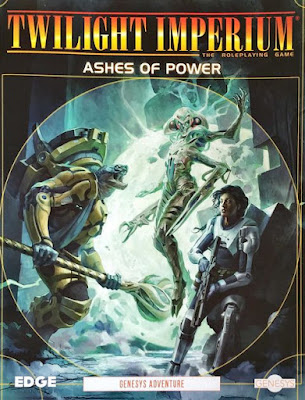
[Free RPG Day 2021] Twilight Imperium: Ashes of Power

Now in its fourteenth year, Free RPG Day in 2021, after a little delay due to the global COVID-19 pandemic, took place on Saturday, 16th October. As per usual, it came with an array of new and interesting little releases, which traditionally would have been tasters for forthcoming games to be released at GenCon the following August, but others are support for existing RPGs or pieces of gaming ephemera or a quick-start. Of course, in 2021, Free RPG Day took place after GenCon despite it also taking place later than its traditional start of August dates, but Reviews from R’lyeh was able to gain access to the titles released on the day due to a friendly local gaming shop and both Keith Mageau and David Salisbury of Fan Boy 3 in together sourcing and providing copies of the Free RPG Day 2020 titles. Reviews from R’lyeh would like to thank all three for their help.

—oOo—

For Free RPG Day 2021, EDGE Studio offered Twilight Imperium: Ashes of Power. This is a quick-start for Embers of the Imperium, the roleplaying game based on Twilight Imperium, the classic ‘4x’ (eXplore, eXpand, eXploit, and eXterminate) board game. It uses the Genesys Narrative Dice System—first seen in Warhammer Fantasy Roleplay, Third Edition—but ultimately derived from the original Doom and Descent board games. Twilight Imperium: Ashes of Power comes with everything necessary to play—an explanation of the rules, four pregenerated characters, and an exciting, action-packed scenario for the Game Master to run. What it does not come with is dice and the fact that both the Genesys Narrative Dice System and Embers of the Imperium—and therefore Twilight Imperium: Ashes of Power—use propriety dice is a small problem. Not an insurmountable one, but a small problem, nonetheless. Fortunately, EDGE Studio has made available a Genesys Dice App free to download which will alleviate that problem unless one or of the players lacks a mobile device.

Twilight Imperium: Ashes of Power opens with a rules summary. The core mechanic requires a player to roll a pool of dice to generate successes and should the roll generate enough successes, his character succeeds in the action being attempted. The complexity comes in the number of dice types and the number of symbols that the players need to keep track of. On the plus side, a player will be rolling Ability dice to represent his character’s innate ability and characteristics, Proficiency dice to represent his skill, and Boost dice to represent situational advantages such as time, assistance, and equipment. On the negative side, a player will be rolling Difficulty dice to represent the complexity of the task being undertaken, Challenge dice if it is a particularly difficult task, and Setback dice to represent hindrances such as poor lighting, difficult terrain, and lack of resources. Ability and Difficulty dice are eight-sided, Proficiency and Challenge dice are twelve-sided, and Boost and Setback dice are six-sided.

When rolling, a player wants to generate certain symbols, whilst generating as few as possible of certain others. Success symbols will go towards completing or carrying out the task involved, Advantage symbols grant a positive side effect, and Triumph symbols not only add Successes to the outcome, but indicate a spectacularly positive outcome or result. Failure symbols indicate that the character has not completed or carried out the task, and also cancel out Success symbols; Despair symbols count as Failure symbols indicate a spectacularly negative outcome or result, and cancel out Triumph symbols; and Threat symbols grant a negative side effect and cancel out Advantage symbols. Only Success and Failure results indicate whether or not a character has succeeded at an action—the effects of the Advantage, Triumph, Despair, and Threat symbols come into play regardless of whether the task was a success or not. Task difficulties range from one Difficulty die for easy tasks up to five for Formidable tasks, and in addition, certain abilities enable dice to be upgraded or downgrade, so an Ability die to a Proficiency die or a Challenge die down to a Difficulty die.

In general, the dice mechanics in the Genesys Narrative Dice System—and thus, Twilight Imperium: Ashes of Power—are straightforward enough despite their complexity. They are perhaps a little fiddly to assemble and may well require a little adjusting to, especially when it comes to narrating the outcome of each dice roll.

Combat is more complex. Initiative is handled by a skill roll—using Cool or Vigilance, and attack difficulties by range and whether or not the combatants are engaged in melee combat. Damage is inflicted as either Strain, Wounds, or Critical Injuries. Strain represents mental and emotional stress, Wounds are physical damage, as are Critical Injuries, but they have a long effect that lasts until a Player Character receives medical treatment. When a Player Character suffers more Wounds than his Wound Threshold, he suffers a Critical Injury, and when he suffers Strain greater than his Strain Threshold, he is incapacitated. The various symbols on the dice can be spent in numerous ways in combat to achieve an array of effects. So a Triumph symbol or enough Advantage symbols could inflict a Critical Injury, allow a Player Character to perform an extra manoeuvre that round, and so on, whilst Threat and Failure symbols inflict Strain on a Player Character, three Threat symbols could be spent to knock a Player Character prone, and so on. Twilight Imperium: Ashes of Power includes a table of options for spending Advantage, Triumph, Threat, and Despair in combat, as well as a table of critical Injury results. It does not, however, include a table for spending Advantage, Triumph, Threat, and Despair out of combat—a disappointing omission for anyone wanting to do a bit more with their character’s skills. That said, the Game Master should be able to adjust some of the options on the table to non-combat situations.

Lastly, the rules in Twilight Imperium: Ashes of Power cover NPCs and Story points. Apart from nemesis-type NPCs, most NPCs treat any Strain they suffer as equal to Wounds, and Minions work together as a group. In Twilight Imperium: Ashes of Power, there are two pools of Story Points—one for the Player Characters, one for the GM. They can be used to upgrade a character’s dice pool or the difficulty of a skill check targeting a character—NPC or Player Character in either case, or to add an element or aspect to the ongoing story. The clever bit is that when a Story Point is spent, it does not leave the game, but is shifted over to the pool of Story Points. So if the Game Master spends a Story Point to increase the difficulty of a Player Character’s Perception check to determine the motives of an NPC, she withdraws it from her own Game Master pool of Story Points and adds it to the players’ pool of Story Points. As a game proceeds and Story Points are spent and move back and forth, it adds an elegant narrative flow to the mechanics and will often force the players to agonise whether they should spend a Story Point or not as they know it is going to benefit the Game Master and her NPCs before it comes back to them.

A character in Twilight Imperium: Ashes of Power has six characteristics—Agility, Brawn, Cunning, Intellect, Presence, and Willpower, plus a range of skills from Charm, Computers, and Cool to Ranged (attacks), Skulduggery, and Vigilance, as well as range of special abilities. The four pre-generated Player Characters include a reptilian Xxcha, an overly optimistic liaison who carries an antique Lazax grav-mace; a Human Orbital Drop Soldier with a dislike of the L1Z1X; a curious Hylar Field Scholar who travels in an exosuit which enables him to survive out of water; and a Hacan Wayfarer merchant captain looking to restore her family fortune and is an expert negotiator with word and gun. All four Player Characters are nicely presented in a busy, but easy to access character sheet which gives a clear explanation of the character background, roleplaying notes, skills, equipment, abilities, and so on—plus each comes with a decent illustration of the character. Of note, each Player Character has an agenda, for example, the Hylar Field Scholar’s requirement to record and gather all data and samples they can of new or archaic technologies. There are boxes throughout the scenario which inform the Game Master when each of the Player Characters has an opportunity to fulfil their agenda, and notably, it is not up to the player to remember to bring it into play, but rather that the Game Master should remind the player. As such, there is no benefit in game to fulfilling an agenda, but it does provide roleplaying opportunities and motivation, and provides a chance for each player to showcase his character.

The setting for Twilight Imperium and thus for Embers of the Imperium and Twilight Imperium: Ashes of Power, is a space opera in a vast, sprawling galaxy. For twenty thousand years, the galaxy prospered under the Lazax Empire, governed by a Galactic Council which gave everyone a voice. Both the Lazax and the empire would be destroyed in a series of wars that would culminate in the bombardment of Mecatol Rex, glittering throne world of the Lazax and the seat of Council, by the reviled Mahact Kings. The subsequent Twilight Wars lasted for millennia, but more recently, the great galactic powers have come together—warily, and established a Galactic Council amidst the ruins of Mecatol City. There is peace, measured diplomacy, and careful co-operation, but in a new age when the members of the councils do not yet fully trust each other, there remain threats which would return the galaxy to chaos once more—the L1Z1X Mindnet, Vuil’Raith Cabal, Mahact Gene-Sorcerers, and Nekro Virus. In response, the Galactic Council established the Keleres, an agency dedicated to dealing with threats larger than any one faction can effectively deal with. Though dedicated to the safety of the galaxy, the Keleres is dependent on the factions for support and resources, as well as for its members—also known as Keleres—and most of them have to answer to their sponsors as well as the agency. The Player Characters are of course, members of the Keleres.

The scenario in the quick-start, ‘Ashes of Power’, sends the Keleres to Herool’s Truce, a tidally locked world which has only regained contact with the rest of galaxy in recent years and from where a Keleres informant has reported the possible discovery of unknown, Imperial-era technology and the presence of unsanctioned L1Z1X agents. There they are to investigate the possible disappearance of the informant, confirm the discovery of the ancient technology, and if they do, prevent it from falling into the hands of the L1Z1X agents. It sounds a simple enough mission, but the Player Characters will need to find the ship they have been assigned, get to the planet, deal with it bureaucracy, follow up on a rumour or two, all before facing off against the cybernetically enhanced L1Z1X agents. Divided into three acts, in the first act, the Player Characters will be briefed about their mission and find their ship; in the second, they will conduct their investigation on Herool’s Truce; whilst in the third, they will confront the L1Z1X team and discover whether or not the rumours of ancient technology are true. The scenario takes its time to help the Game Master, clearly indicating skills necessary and their possible outcomes, as well as presenting numerous ways in which the Keleres can approach the mission. They can be open about it with the local authorities, they can try and avoid getting the authorities involved, and although there are numerous opportunities for combat and conflict, with many of them, the scenario also suggests other ways of dealing with the situations. Along the way, there are opportunities for each of the Player Characters to fulfil their personal agendas and explore an interesting world which has been cut off from the rest of the galaxy for centuries and consequently has an interesting society and geography. There are lots of chances to roleplay too, which is helped by the succinctly done backgrounds for each of the Player Characters. 

The scenario concludes with notes as to what happens next. This takes into account the fact that the Player Characters might not succeed or might even side with the L1Z1X agents! There are consequences to both outcomes as well as their being successful, and these could play out should the Game Master continue with an Embers of the Imperium campaign. In addition, the PDF version of Twilight Imperium: Ashes of Power comes with support that includes two extra Player Characters, their agendas, and extra encounters for the scenario’s third act. Also included is a map—which was not in the Free RPG Day release. The extras increase the number of players possible or character choices available.

Physically, Twilight Imperium: Ashes of Power is as nicely done as you would expect from the publisher. It is well written, the full artwork is good, and the sample Player Characters are excellent. If there is a downside perhaps it is that few of the NPCs are illustrated, and there are no maps or illustrations of the world of Herool’s Truce, both of which would have helped the Game Master portray the world for her players.

Ultimately, if there is an issue with Twilight Imperium: Ashes of Power, it is that it uses the Genesys Narrative Dice System and that does take some adjusting to. Get past that though, and Twilight Imperium: Ashes of Power offers up not just a solid introduction to the system, but a thoroughly entertaining and exciting introduction to Embers of the Imperium with a really good scenario and some nicely done pre-generated Player Characters.