Every Week It's Wibbley-Wobbley Timey-Wimey Pookie-Reviewery...
Showing posts with label Free RPG 2023. Show all posts

Saturday, 16 December 2023

[Free RPG Day 2023] Root: Hacksaw Dell Quickstart

Now in its sixteenth year, Free RPG Day for 2023 took place on Saturday, June 24th. As per usual, Free RPG Day consisted of an array of new and interesting little releases, which are traditionally tasters for forthcoming games to be released at GenCon the following August, but others are support for existing RPGs or pieces of gaming ephemera or a quick-start. Thanks to the generosity of David Salisbury of Fan Boy 3, Fil Baldowski at All Rolled Up, and others, Reviews from R’lyeh was able to get hold of many of the titles released for Free RPG Day, both in the USA and elsewhere.

—oOo—

Published by Magpie Games, Root: The Tabletop Roleplaying Game is a roleplaying game based on the award-winning Root: A Game of Woodland Might & Right board game, about conflict and power, featuring struggles between cats, birds, mice, and more. The Woodland consists of dense forest interspersed by ‘Clearings’ where its many inhabitants—dominated by foxes, mice, rabbits, and birds live, work, and trade from their villages. Birds can also be found spread out in the canopy throughout the forest. Recently, the Woodland was thrown into chaos when the ruling Eyrie Dynasties tore themselves apart in a civil war and left power vacuums throughout the Woodland. With no single governing power, the many Clearings of the Woodland have coped as best they can—or not at all, but many fell under the sway or the occupation of the forces of the Marquise de Cat, leader of an industrious empire from far away. More recently, the civil war between the Eyrie Dynasties has ended and is regroupings its forces to retake its ancestral domains, whilst other denizens of the Woodland, wanting to be free of both the Marquisate and the Eyrie Dynasties, have formed the Woodland Alliance and secretly foment for independence.

Between the Clearings and the Paths which connect them, creatures, individuals, and bands live in the dense, often dangerous forest. Amongst these are the Vagabonds—exiles, outcasts, strangers, oddities, idealists, rebels, criminals, freethinkers. They are hardened to the toughness of life in the forest, but whilst some turn to crime and banditry, others come to Clearings to trade, work, and sometimes take jobs that no other upstanding citizens of any Clearing would do—or have the skill to undertake. Of course, in Root: The Tabletop Roleplaying Game, Vagabonds are the Player Characters.

Root: The Tabletop Roleplaying Game is ‘Powered by the Apocalypse’, the mechanics based on the award-winning post-apocalyptic roleplaying game, Apocalypse World, published by Lumpley Games in 2010. At the heart of these mechanics are Playbooks and their sets of Moves. Now, Playbooks are really Player Characters and their character sheets, and Moves are actions, skills, and knowledges, and every Playbook is a collection of Moves. Some of these Moves are generic in nature, such as ‘Persuade an NPC’ or ‘Attempt a Roguish Feat’, and every Player Character or Vagabond can attempt them. Others are particular to a Playbook, for example, ‘Silent Paws’ for a Ranger Vagabond or ‘Arsonist’ for the Scoundrel Vagabond.

To undertake an action or Move in a ‘Powered by the Apocalypse’ roleplaying game—or Root: The Tabletop Roleplaying Game, a character’s player rolls two six-sided dice and adds the value of an attribute such as Charm, Cunning, Finesse, Luck, or Might, or Reputation, to the result. A full success is achieved on a result of ten or more; a partial success is achieved with a cost, complication, or consequence on a result of seven, eight, or nine; and a failure is scored on a result of six or less. Essentially, this generates results of ‘yes’, ‘yes, but…’ with consequences, and ‘no’. Notably though, the Game Master does not roll in ‘Powered by the Apocalypse’ roleplaying game—or Root: The Tabletop Roleplaying Game.

So for example, if a Player Character wants to ‘Read a Tense Situation’, his player is rolling to have his character learn the answers to questions such as ‘What’s my best way out/in/through?’, ‘Who or what is the biggest threat?’, ‘Who or what is most vulnerable to me?’, ‘What should I be on the lookout for?’, or ‘Who is in control here?’. To make the Move, the player rolls the dice and his character’s Cunning to the result. On a result of ten or more, the player can ask three of these questions, whilst on a result of seven, eight, or nine, he only gets to ask one.

Moves particular to a Playbook can add to an attribute, such as ‘Master Thief’, which adds one to a character’s Finesse or allow another attribute to be substituted for a particular Move, for example, ‘Threatening Visage’, which enables a Player Character to use his Might instead of Charm when using open threats or naked steel on attempts to ‘Persuade an NPC’. Others are fully detailed Moves, such as ‘Grab and Smash’. When a Player Character wants to smash through some scenery to reach someone or something, his player rolls the character’s Might in a test. The Move enables the character to reach the target on a hit. However, this is not without its consequences. This can the character hurting himself and the player marking an injury, break an important part of his surroundings, or damage or leave behind a piece of gear. One a roll of 10+, the character suffers one of these consequences; on a roll of 7-9, he suffers two; and on a miss, he smashes but is left totally vulnerable on the other side.

Root: Hacksaw Dell Quickstart is the Free RPG Day 2023 from Magpie Games for Root: The Tabletop Roleplaying Game. It includes an explanation of the core rules, six pregenerated Player Characters or Vagabonds and their Playbooks, and a complete setting or Clearing for them to explore. From the overview of the game and an explanation of the characters to playing the game and its many Moves, the introduction to the Root: The Tabletop Roleplaying Game in Root: Hacksaw Dell Quickstart is well-written. It is notable that all of the Vagabonds are essentially roguish in nature, so in addition to the Basic Moves, such as ‘Figure Someone Out’, ‘Persuade an NPC’, ‘Trick an NPC’, ‘Trust Fate’, and ‘Wreck Something’, they can ‘Attempt a Roguish Feat’. This covers Acrobatics, Blindside, Counterfeit, Disable Device, Hide, Pick Lock, Pick Pocket, Sleight of Hand, and Sneak. Each of these requires an associated Feat to attempt, and each of the six pregenerated Vagabonds has one, two, or more of the Feats depending just how roguish they are. Otherwise, a Vagabond’s player rolls the ‘Trust to Fate’ Move.

The six pre-generated Vagabonds include Laeliana the Arbiter, an experienced Mole mercenary who is looking for the right battles to fight; Jexri the Champion, a Lizard who is devout follower of the Great Wyrm and defender of those who need it; Yates the Envoy, a Toad envoy who works as a diplomat for hire; Mint the Prince, a young Fox trying to live up to the reputation of her mother; Rackham the Thief, a bird thief who has returned to Hacksaw Dell to show off their expertise as a burglar; and Knohadd the Vagrant, a Possum ex-Riverfolk Company captain, who comes with plenty of baggage. All six of these Vagabonds have links to the given Clearing and its NPCs in Root: Hacksaw Dell Quickstart, and all six are complete with Natures and Drives, stats, backgrounds, Moves, Feats, and equipment. All a player has to do is decide on a couple of connections and each Playbook is ready to play.

As its title suggests, the given Clearing in Root: Hacksaw Dell Quickstart is Hacksaw Dell. Its description comes with an overarching issue and conflicts within the Clearing, important NPCs, places to go, and more. The situation in Hacksaw Dell is different to that of most Clearings. Until recently, the Marquisate operated a lumbermill in the Clearing, but this was targeted by the Woodland Alliance and burnt down, only a month ago. An Assembly of Citizens has been established to create a charter to govern the newly freed Clearing, but progress is not fast enough for some. This is includes the Woodland Alliance provocateurs who liberated the Clearing, some of whom want to repeat the action they took in liberating the Clearing and many other citizens who have found succour in the Lizard Cult. Others want to install a prince like they had in the days when the Eyrie Dynasties ruled the Clearing. These four Conflicts make up the plots to be explored and developed in the Clearing and each is fully detailed and includes notes on what happens if the vagabonds do not get involved and leave the Conflict to develop on its own. For the Game Master there is a good overview of the Clearing and notes of where to begin when running the Root: Hacksaw Dell Quickstart and getting the Vagabonds involved. There suggestions also as to how escalate the situation for each of the Vagabonds to draw them further into the ongoing events in Hacksaw Dell.

Physically, Root: Hacksaw Dell Quickstart is a fantastic looking booklet, done in full colour and printed on heavy paper stock. It is well written and the artwork, taken from or inspired by the Root: A Game of Woodland Might & Right board game, is bright and breezy, and really attractive. Even cute. Simply, just as Root: The Pellenicky Glade Quickstart was for Free RPG Day 2020, Root: The Bertram’s Cove Quickstart was for Free RPG Day 2021, and Root: Talon Hill Quickstart for Free RPG 2022, so too Root: Hacksaw Dell Quickstart is physically the most impressive of all the releases for Free RPG Day 2023.

If there is an issue with Root: Hacksaw Dell Quickstart it is that it looks busy and it looks complex—something that often besets ‘Powered by the Apocalypse’ roleplaying games. Not only do players need their Vagabond’s Playbooks, but also reference sheets for all of the game’s Basic Moves and Weapon Moves—and that is a lot of information. However, it means that a player has all of the information he needs to play his Vagabond to hand, he does not need to refer to the rules for explanations of the rules or his Vagabond’s Moves. That also means that there is some preparation required to make sure that each player has the lists of Moves his Vagabond needs. Another issue is that the relative complexity and the density of the information in Root: Hacksaw Dell Quickstart means that it is not a beginner’s game and the Game Master will need a bit of experience to run Hacksaw Dell and its conflicts.

Ultimately, the Root: Hacksaw Dell Quickstart comes with everything necessary to play and keep the attention of a playing group for probably three or four sessions, possibly more. Although it needs a careful read through and preparation by the Game Master, Root: Hacksaw Dell Quickstart is a very good introduction to the rules, the setting, and conflicts in Root: The Tabletop Roleplaying Game—and it looks damned good too. For the Game Master who is already running a Root: The Tabletop Roleplaying Game campaign, the Root: Hacksaw Dell Quickstart provides another Clearing that she can add to her campaign with the others available in the proper quick-start for the roleplaying game as well as releases for previous Free RPG Days.

Sunday, 10 December 2023

[Free RPG Day 2023] Animal Adventures: Apocalypse Miaow

Now in its sixteenth year, Free RPG Day for 2023 took place on Saturday, June 24th. As per usual, Free RPG Day consisted of an array of new and interesting little releases, which are traditionally tasters for forthcoming games to be released at GenCon the following August, but others are support for existing RPGs or pieces of gaming ephemera or a quick-start. Thanks to the generosity of David Salisbury of Fan Boy 3, Fil Baldowski at All Rolled Up, and others, Reviews from R’lyeh was able to get hold of many of the titles released for Free RPG Day, both in the USA and elsewhere.

—oOo—

Animal Adventures: Apocalypse Miaow
is the release from Steamforged Games Ltd for Free RPG Day 2023. It is a scenario and preview of Animal Adventures: The Faraway Sea, the new expansion to the publisher’s Animal Adventures: Secrets of Gullet Cove, the cats and dogs anthropomorphic campaign and setting for Dungeons & Dragons, Fifth Edition. Where Animal Adventures: Secrets of Gullet Cove takes place in and around an English style port, Animal Adventures: The Faraway Sea moves the action and story to sea where the Player Characters, based in the floating city of Flotsam, set sail to explore the nearby islands that shift in and out of a magical vortex which lies a few miles travel from the Flotsam. Designed for group of three to six awakened animal Player Characters of Second and Third Levels, it is a short, intriguing affair combining action and mystery that can be played in a single session or so...

Animal Adventures: Apocalypse Miaow lets the Player Characters ‘Journey to the Heart of Barkness’* on the trail of Sadie the Corgi, an explorer of legendary repute, who led an expedition to explore the recently appeared Spine Fish Island. Unfortunately, only a few of her companions have returned, battered and bruised, with strange tales of ‘Clawptain Katz’ and the ‘spine fish’. Brave adventurers—in this case the Player Characters—are wanted to sail out to the island to discover what has happened to Sadie, and hopefully rescue her.

* Publisher’s pun, not mine.

The Player Characters do have the opportunity to prepare for the voyage, both by taking some expert advice about Spine Fish Island and asking the survivors of the expedition led by Sadie the Corgi. Armed with this, the voyage itself is easy and the seas are calm. The Player Characters’ trouble begin when they reach the island, which turns out to be mostly desert, but there is a river running through it, which is only accessible by trekking overland. The initial problem is the welcoming committee, a bunch of poorly armed cats who shout at the Player Characters to leave the island, but are otherwise not aggressive. Which seems odd given that both they and Clawptain Katz want the Player Characters to leave the island. Whether the Player Characters decide to attack or negotiate, the defending cats quickly reveal their true character and turn tail, almost apologetically, as if they have no fight in them. This encounter is staged on the map included in the centre of Animal Adventures: Apocalypse Miaow.

With the knowledge gained from the cats and likely a clearer explanation of what is going on, the Player Characters can make their way to the encampment of Clawptain Katz and there confront him. This requires them to cross a short stretch of the desert and then travel along the river, on which they will have to protect their boat from the predating Spine Fish. At Clawptain Katz’s encampment, it is quickly clear that he is holding Sadie the Corgi prisoner—but not so that she is unable to shout a few hints—and that Clawptain Katz seems to have the rest of the cats held under his rather selfish and autocratic sway. Has he turned dictator whilst he has been on the island, or is there another explanation?

Animal Adventures: Apocalypse Miaow is a likeable affair. It is more about the investigation and the interaction than the fight necessarily as the confrontation when the Player Characters land on the island might not result in a fight. Overall, it showcases some of basic details to Animal Adventures: The Faraway Sea and provides a good solid, session’s worth of play.

Friday, 24 November 2023

[Free RPG Day 2023] Heist at the Museum

Now in its sixteenth year, Free RPG Day for 2023 took place on Saturday, June 24th. As per usual, Free RPG Day consisted of an array of new and interesting little releases, which are traditionally tasters for forthcoming games to be released at GenCon the following August, but others are support for existing RPGs or pieces of gaming ephemera or a quick-start. Thanks to the generosity of David Salisbury of Fan Boy 3, Fil Baldowski at All Rolled Up, and others, Reviews from R’lyeh was able to get hold of many of the titles released for Free RPG Day, both in the USA and elsewhere.

—oOo—

Heist At The Museum! is a one-shot scenario for Dungeons & Dragons, Fifth Edition published by Loke BattleMats. It is a preview for the publisher’s Big Book of Battle Mats: Rooms, Vaults, & Chambers, it comes with two battlemats from that book, four detailed pre-generated Player Characters, tokens for the scenario’s for the Player Characters, NPCs, adversaries, and monsters, and six handouts. It also includes ‘5E in 5 Minutes’, a quicker primer on Dungeons & Dragons, Fifth Edition and there are several tips on how to run the adventure as well. A seasoned Dungeon Master will be able to prepare the adventure and run it in a single session. It could also be adapted to an ongoing campaign, especially for a group of thieves, rogues, and ne’er-do-wells, though that will require some adjustment upon the part of the Dungeon Master to fit her campaign.

The set-up for Heist At The Museum! is simple. The Player Characters are a gang of thieves known as the ‘Magpies’ which specialises in acquiring historical artefacts. They are hired Braurius Malifont, a wealthy collector of exotic antiquities. Four such items, known as the ‘Tetrad’, are being held by the ‘Storied Chronicles’, the city museum which holds and displays antiquities from all over the world. Malifont gives the four a guide to getting into the museum and the clues he has uncovered to date as to the location of the artefacts he wants. The adventure itself begins en media res, with the Player Characters about to break in. They can access various routes, but once inside they must search the main display area to locate the items and not activate the guards. Their most obvious problem is not toppling the complete dinosaur skeleton of a triceratops! The encounter involves a mix of stealth, combat, and a big puzzle. This relies very much on player general knowledge, but the scenario allows for straight skill rolls should they come up lacking. The scene is as tense as any robbery should be, and ideally, it should end as the guards swarm into the main display area…

The second scene is at the home of Braurius Malifont. He welcomes the Player Characters to his home and congratulates them on their success. There is meant to be twist here—and there is. It is, however, an obvious one. For starters, the surname of the Player Characters’ employer is ‘Malifont’. ‘M-a-l-ifont’. It just sounds evil. Then, Malifont’s other guests are all there at the reception party, sipping wine and enjoying cheesy nibbles, all wear scarlet robes. It is intentional and not designed to be particularly subtle, and of course, Braurius Malifont will turn the tables on the Player Characters and a big fight will ensue.

The four Player Characters in Heist At The Museum! are thieves, all of Third Level. They include a scholarly thief who can step into the shadows, a street blade handy with paired scimitars, a swift thief capable of hit and run attacks, and a trickster who can grant Advantage to his allies and Disadvantage to his adversaries. All four are clearly presented and easy to read, and they come with a detailed background and equipment list. Their portraits are also replicated on their tokens for the scenario.

Heist At The Museum! comes with two maps from the publisher’s Big Book of Battle Mats: Rooms, Vaults, & Chambers. One is a museum location complete with display cases, carpet, stairs, and dinosaur skeleton, the other is personal study and connected bedroom. Both maps are presented in full colour, in one-inch squares. The tokens—which the Dungeon Master will have to cut out as part of the preparation—are also done in full colour and fit the maps.

Physically, Heist At The Museum! is well presented and written. Coloured text is used to indicate that the Dungeon Master refer to the monsters and NPCs and magic items. The two handouts are nicely done.

Heist At The Museum! is quick and easy to prepare and run. If it is obvious in its plotting, Heist At The Museum! is at least short, serviceable, and exciting enough for a single session.

Friday, 17 November 2023

[Free RPG Day 2023] Heckin’ Good Doggos

Now in its sixteenth year, Free RPG Day for 2023 took place on Saturday, June 24th. As per usual, Free RPG Day consisted of an array of new and interesting little releases, which are traditionally tasters for forthcoming games to be released at GenCon the following August, but others are support for existing RPGs or pieces of gaming ephemera or a quick-start. Thanks to the generosity of David Salisbury of Fan Boy 3, Fil Baldowski at All Rolled Up, and others, Reviews from R’lyeh was able to get hold of many of the titles released for Free RPG Day, both in the USA and elsewhere.

—oOo—

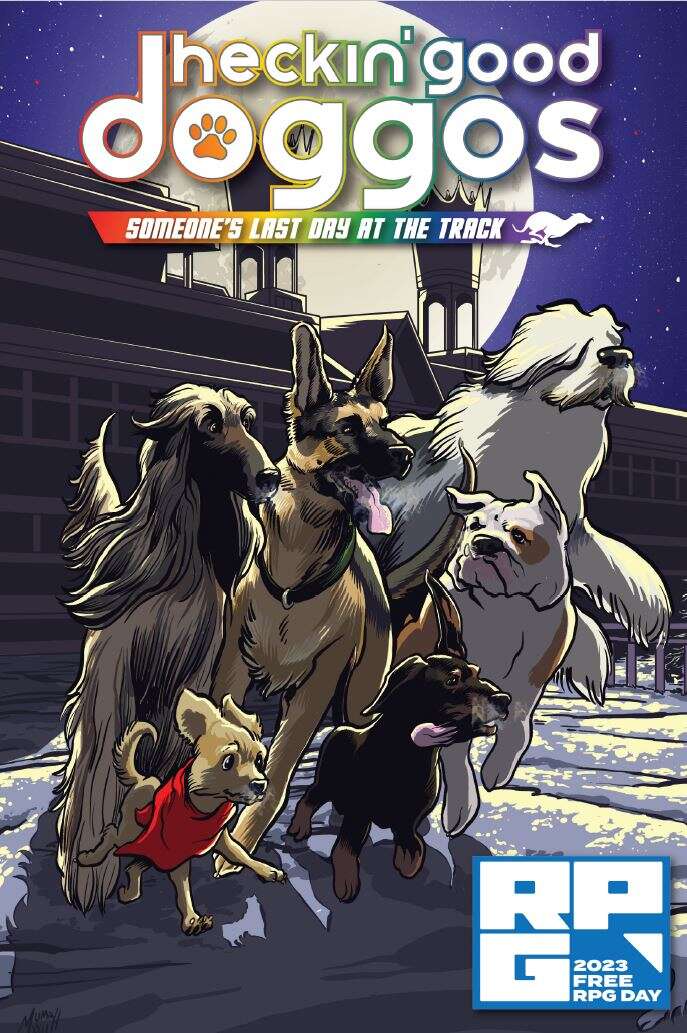
Heckin’ Good Doggos – Someone’s Last Day at the Track is the contribution to Free RPG Day 2023 from Wet Ink Games, best known as the publisher of horror roleplaying games, Never Going Home and Jiangshi: Blood in the Banquet Hall. In comparison, Heckin’ Good Doggos – Someone’s Last Day at the Track is anything other a horror roleplaying game. Heckin’ Good Doggos is a light, family friendly roleplaying game of canine anthropomorphism in which the player take the roles of family dogs who go on adventures which involve ‘Dogs doin’ Dog Stuff’ and being a ‘good doggo’, and Heckin’ Good Doggos – Someone’s Last Day at the Track is the quick-start for it. It contains the quick-start rules for the roleplaying game’s +One System, six ready-to-play pre-generated dog characters, and a full adventure, ‘Someone’s Last Day at the Track’. In order to play, a group will need a pool of six-sided dice and at least one deck of ordinary playing cards. One if there are less than five players, two if there are six players. In general, the +One System is not too complex, the idea of playing dogs will be familiar to almost everyone, and the scenario is fairly simple. The only possible downside to the scenario is that it takes place at a dog track, that is, a track where dogs are raced and there is gambling on the winners of each race. What this means is that the scenario takes place in a more adult setting than may be suitable for younger participants and that not everyone is going to familiar with what a dog track is.

A Good Doggo in Heckin’ Good Doggos is defined by his Breed, his Best Friend, three Attributes, Training, Paw Size, and Character Growth. Breed can be Cute, Friendly, Big, and Fast, and this allows the player to add a card to a Conflict without playing a card. For example, the Cute Breed allows a Heart card to be played and Fast a Club card. His Best Friend is his human owner or a human the dog knows and who has an occupation or equipment which the dog can call upon the human to use if necessary. Attributes are Brawn, Smarts, and Guts, each of which has three associated areas of Training. For example, ‘Sensing’, ‘Knowing’, and ‘Fiddling’ for Smarts. His Paw Size indicates how many cards his player can hold in his hand during play. Attributes range between one and ten, skills between one and five, and Paw Size between four and seven. Character growth is achieved at the end of an adventure and can give a dog a new skill, or improve an Attribute, Skill, or Paw Size. A dog also has a note to indicate how he helps and what his neighbourhood is like.

Mechanically, Heckin’ Good Doggos – Someone’s Last Day at the Track and thus Heckin’ Good Doggos uses the +One System. This involves rolling a number of six-sided dice each to the skill being used. Each five or six rolled is a success. Harder tasks require more Successes. ‘+One Manipulations’ enable a player to change the outcome using points from the Attribute associated with the Skill. Prior to a roll, a manipulation can be made to add a die to a roll or even gain a skill in a previously untrained skill, if only temporarily. After the roll, to increase the value of a die roll by one—typically from a four to a five—and to reroll any number of dice. In addition to skill rolls, dogs can face Challenges, which are attempted by the whole pack as a group effort. They simply need to roll a number of Successes equal to the target number for the Challenge for the whole pack to succeed.

Playing cards in the +One System are played on a one-for-one basis rather than their value with each suite being tied to a narrative theme. These are Spades to friends and relationships, Hearts to cutes and being cute, Diamonds to Teeth and direct physical attacks, and Clubs to Paws and overcoming physical obstacles. Jokers can substitute for anyone of these and players begin play with four cards. All cards can be spent to help heal a dog, but normally they are used to resolve a conflict or add a Success. A player has to narrate how his dog takes advantage of the card’s theme in helping his dog overcome the conflict or Challenge.

Conflicts are like Challenges, but do not use dice, only the cards. Conflicts are also not necessarily fights, but situations that the dogs might have to defeat, escape, or otherwise end the conflict. The Narrator sets a Target Number in terms of the number of cards required, and the Target Number can vary not only in terms of difficulty, but also in how the Conflict can be resolved. For example, the dogs wants to get into a building where dog fights are being held. The Narrator might suggest that the dogs push past the bouncers on the door (three Clubs or Paws), but the bouncers will know they have got in; sneak in via a broken widow (four Clubs or Paws) and nobody knows they are in the building; and being friendly with the bouncers (four Spades or Friends). The objective is to provide the players and their Pack with options, and if the Pack lacks the right cards, they can play any card and narrate how its suit works to overcome the Conflict. However, this is likely to come at the cost of a consequence suffered.

In general, the rules are clearly explained and there are plenty of examples play as well. There is advice also on setting the tone of play and on using Safety Tools such as the X-Card.

Heckin’ Good Doggos – Someone’s Last Day at the Track comes with six pre-generated dog Player Characters. There is a good mix of dog types, but the Narrator should be careful to makes sure that there are as many areas as possible of Training covered if there are fewer than five or six players.

The scenario in Heckin’ Good Doggos – Someone’s Last Day at the Track is the eponymous ‘Someone’s Last Day at the Track’ It takes place at the local dog track on the biggest race day of the year, the State Derby. The dogs have the opportunity to get in on their day, ideally with their Best Friends, mooch around for a bit, being a good doggo, sniffing about, and hopefully finding some good, if not necessarily wholesome treats to scarf down. There are the kennels to investigate, the concessions area, and the race track itself, but very quickly, the dogs will run into the track’s criminal fraternity—the dog gang under the stands! The leader of the dog gang wants to know who the fastest runner is going to be in the State Derby. Can the Player Character dogs find out or do they have other plans? It is a fairly simply plot, but this combined with the other doggy activities and learning the mechanics will provide a gaming group with a single session’s worth of play.

Physically, Heckin’ Good Doggos – Someone’s Last Day at the Track is brightly, cheerfully presented. The writing is clear and the illustrated of the various dogs are excellent. It is a pity that none of the character sheets for the dogs have illustrations, although it does leave room for the players to decide their own dog species. 

Heckin’ Good Doggos – Someone’s Last Day at the Track is a good quick-start and a good introduction to Heckin’ Good Doggos. Its setting and its mechanics make it suitable for younger teenagers and older players and an experienced Narrator, especially one who has run some storytelling style games, will be able to grasp the +One System and explain how it works with ease. Overall, the setting and theme to Heckin’ Good Doggos – Someone’s Last Day at the Track will be familiar to almost everyone, making it very accessible, because everyone knows how to be a good dog, if only for an evening.

Sunday, 20 August 2023

[Free RPG Day 2023] Piercing the Demon’s Eye

Now in its sixteenth year, Free RPG Day for 2023 took place on Saturday, June 24th. As per usual, Free RPG Day consisted of an array of new and interesting little releases, which are traditionally tasters for forthcoming games to be released at GenCon the following August, but others are support for existing RPGs or pieces of gaming ephemera or a quick-start. Thanks to the generosity of David Salisbury of Fan Boy 3, Fil Baldowski at All Rolled Up, and others, Reviews from R’lyeh was able to get hold of many of the titles released for Free RPG Day, both in the USA and elsewhere.

—oOo—

Piercing the Demon’s Eye is Goodman Games’ only contribution to Free RPG Day 2023. It is a scenario for use with the publisher’s highly popular Dungeon Crawl Classics Role Playing Game. Designed for a party of six to eight Second Level Player Characters, it is both designed and intended to be played in four hours and in-game explored in four hours. What this means is that once the four-hour playing time ends, the game is not only over for the players, but also for the Player Characters. Piercing the Demon’s Eye is set in the Demon’s Eye, the vault of the ancient wizard, Monath Ot. Said to contain great treasures and secrets, the entrance to the vault unseals and grants access for exactly four hours, once every ten years. Then the entrance will reseal itself again, only to open again in another ten years and again exactly for four hours. Whilst the game is over for the players, for their characters, trapped inside the Demon’s Eye, their fates are sealed just as much as the entrance is. Ideally, the Player Characters should at least be armed with one or two magical weapons. The scenario does not involve a great many fights, but those it does are challenging. Lastly, Piercing the Demon’s Eye does contain links to Tomb of the Savage Kings, the scenario published by Goodman Games for Free RPG Day 2021. However, the links are insubstantial and the Judge does not need to have run or have access to Tomb of the Savage Kings in order to run Piercing the Demon’s Eye.

As a tomb adventure, Piercing the Demon’s Eye contains more traps than fights. There is an interesting counterweight puzzle from the start, but others like a corridor with a pivoting floor and a room with spikes that extend out of the floors and walls and a room of skeletons that reanimate and self-replicate upon death a la the film Jason and the Argonauts, are all classics and clichés of the genre. This does not mean that they feel out of place. Similarly, neither does the inclusion of false vaults. With care though, the Player Characters should not only be able to find their way around the tomb, but also locate two major treasure vaults, one of scrolls and one of coin and magical items. What will hamper the Player Characters progress is a rival team also looking to loot the tomb complex. Consisting of three NPCs, these can be used to taunt the Player Characters, act as replacement Player Characters as necessary, or simply show the characters and their players how the scenario’s traps work.

There is also a hidden element to Piercing the Demon’s Eye. Use of Spell Burn can trigger an even bigger event. This is the release of the being trapped within the tomb. It is not the ancient wizard, Monath Ot, but something else. In true tomb in the Pulp genre, this triggers an immediate effect and a long-term effect. The long-term effect is left up to the Judge to determine and then only if the scenario is being run as part of a campaign. In the short term, the Player Characters will find they have very little time left before the tomb collapses…

If there is a problem with Piercing the Demon’s Eye, it is the connections to Tomb of the Savage Kings and the lack of connections to Tomb of the Savage Kings. To suggest that there are connections and not develop them is a missed opportunity. The lack of them makes it difficult to connect the scenarios and to build them into a setting, whether a published one or one devised by the Judge. So this scenario is more of standalone adventure than not.

Physically, Piercing the Demon’s Eye is very well presented. It is easy to read and the map is easy to use. The scenario is lightly illustrated, but the pieces of art are very good, capturing the mishaps and misadventures of a band of adventurers.

Piercing the Demon’s Eye is easy to set up and run, and works better as a convention scenario rather than an addition to a campaign, although with some effort upon the part of the Judge, this should not be an issue. Piercing the Demon’s Eye is a short, but fun one-shot that neatly fits a four-hour convention game slot too. All the Judge has to do is add Player Characters.

Saturday, 19 August 2023

[Free RPG Day 2023] Adventures in Rokugan: Storm Eel’s Rest

Now in its sixteenth year, Free RPG Day for 2023 took place on Saturday, June 24th. As per usual, Free RPG Day consisted of an array of new and interesting little releases, which are traditionally tasters for forthcoming games to be released at GenCon the following August, but others are support for existing RPGs or pieces of gaming ephemera or a quick-start. Thanks to the generosity of David Salisbury of Fan Boy 3, Fil Baldowski at All Rolled Up, and others, Reviews from R’lyeh was able to get hold of many of the titles released for Free RPG Day, both in the USA and elsewhere.

—oOo—

Adventures in Rokugan: Storm Eel’s Rest
is a scenario for Adventures in Rokugan, the Dungeons & Dragons, Fifth Edition compatible version of Legends of the Five Rings. Originally published by Alderac Entertainment Group in 1997, but now published by EDGE Studio, Legends of the Five Rings and thus Adventures in Rokugan is set in Rokugan, a setting similar to feudal Japan, but with influences and elements of other Asian cultures, as well as magic and mythical beasts. The setting for Legend of the Five Rings, Fifth Edition is Rokugan. It is Known as the Emerald Empire and has been ruled for a thousand years by the Hantei emperors—the current emperor is Hantei XXXVIII—who have divided it between seven Great Clans. These are the Crab, Crane, Dragon, Lion, Phoenix, Scorpion, and Unicorn clans. Although each is comprised of Samurai—the bushi warriors, mannered courtiers, and shugenja, priests who pray to the kami, or spirits, for aid, each is different in character. The Crab Clan use its strength to man the wall that protects the Empire from the Shadowlands, but its members are regarded as uncouth and ill mannered; the Crane Clan is known as the Left Hand of the Emperor and has many wealthy and influential politicians; the Dragon Clan remains aloof from most affairs in its mountain fast, but has sallied forth to aid the empire several times; the Lion Clan is the Right Hand of the Emperor, being devoted bushi; the Phoenix Clan is known for its shugenja and primarily concerns itself with spiritual matters; the Scorpion Clan is the Emperor’s Underhand and revels in its villainous status and reputation; and lastly, the Unicorn Clan is Rokugan’s cavalry, having spent several centuries in the Gaijin lands to the West. The Mantis are a minor clan of seafarers and traders, most notable having travelled far beyond Rokugan by sea.

Adventures in Rokugan: Storm Eel’s Rest requires the Adventures in Rokugan rules and includes six pre-generated Player Characters. These consist of a Crane bushi and bodyguard, a Crab infiltrator, a Crane ritualist or shugenja, a Mantis clan duellist, a Crab clan courtier/bushi, and a Ningyo Ritualist. These are very detailed Player Characters, and notably, not all of the Player Characters are Human as is the norm in Legends of the Five Rings. This includes a Spectre, a Mazoku or demon, and a Ningyo or ‘human-fish’. All six have detailed backgrounds and motivations.

Adventures in Rokugan: Storm Eel’s Rest is designed to be played in a single four-hour session and is set on Earthquake Fish Bay, which is known for its storms and being administered by the Yasuki, the Crab Clan courtiers and merchants who once part of the Crane Clan. Consequently, the Crane still view both the land and its administrators as belonging to it. The main village in the region, Storm Eel’s Rest, also supports a monastery on Unnamed Island, an island wracked by storms. The tension between the Crab and the Crane Clans is what drives much of the scenario.

The scenario begins en media res. The Player Characters are aboard the Spider Lily, sailing across Earthquake Fish Bay in search of a missing vessel. After the Game Master reads out the general introduction and the introduction for each of the Player Character—which oddly, does give away some of the secrets about each Player Character—they set out across the bay. After a random encounter, they locate the missing vessel, driven onto Unnamed Island by the storms. The Player Characters will quickly discover that the ship is under attack as is the monastery by various aquatic monsters—crab horrors, amphibious horrors, and stinging horrors. The monastery is under assault because it hides a secret. They are Stormkeepers, protectors of the bay from the spirit of the great beast which centuries before stalked the bay bringing down storms and lightning from its body and the sky. Its skull is kept warded, but spirits are assaulting the monastery as well as many aquatic minions!

Adventures in Rokugan: Storm Eel’s Rest is short and it is combat focused. There is a lot of flavour to it and there is some interesting detail to the pre-generated Player Characters. However, there is relatively little scope for these details to come out in play rather than be read out at the start of the scenario by the Game Master. The latter is odd and it feels only necessary because the scenario is intended to be played in a four-hour slot. If the scenario is run beyond that time limit, then the introductions for the Player Characters could be kept for the players to reveal through play and roleplaying and perhaps a better and simpler introduction be created in order to speed up play and the beginning of the scenario.

Physically, Adventures in Rokugan: Storm Eel’s Rest is well presented. The map is excellent and artwork superb. The scenario is well written.

Adventures in Rokugan: Storm Eel’s Rest is a solid scenario that fits within a single session and nicely showcases the setting of Rokugan, such as the tensions between the Crab and the Crane Clans. It is playable in the intended four-hour slot, but to really bring out the Player Character backgrounds through roleplaying, it needs more time and to shift the Player Character introductions to under their control and better introductions supplied.

Friday, 18 August 2023

[Free RPG Day 2023] Level 1 Volume 4

Now in its sixteenth year, Free RPG Day for 2023 took place on Saturday, June 24th. As per usual, Free RPG Day consisted of an array of new and interesting little releases, which are traditionally tasters for forthcoming games to be released at GenCon the following August, but others are support for existing RPGs or pieces of gaming ephemera or a quick-start. Thanks to the generosity of David Salisbury of Fan Boy 3, Fil Baldowski at All Rolled Up, and others, Reviews from R’lyeh was able to get hold of many of the titles released for Free RPG Day, both in the USA and elsewhere.

—oOo—

The most radical release for Free RPG 2023 is as in previous years, Level 1. Published by 9th Level Games, Level 1 is an annual RPG anthology series of ‘Independent Roleplaying Games’ specifically released for Free RPG Day. Where the other offerings for Free RPG Day 2023—or any other Free RPG Day—provide one-shots, one use quick-starts, or adventures, Level 1 is something that can be dipped into multiple times, in some cases its contents can played once, twice, or more—even in the space of a single evening! The subject matters for these entries ranges from the adult to the kid friendly and from action to cozy, and back again, but what they have in common is that they are non-commercial in nature and they often tell stories in non-commercial fashion compared to the other offerings for Free RPG Day 2023. The entries in the anthology often ask direct questions of the players, deal with mature subjects, and involve varying degrees of introspection, and for some players, this may be uncomfortable or simply too different from traditional roleplaying games. So the anthology includes ‘Be Safe, Have Fun’, a set of tools and terms for ensuring that everyone can play within their comfort zone. It is a good essay and useful not just for the games presented in the pages of LEVEL 1 – Volume 1, Level 1 Volume 2, and Level 1 Volume 3, which were published for their Free RPG Day events in 2020, 2021, and 2023 respectively, but for any roleplaying game.

The games in Level 1 Volume 4 all together require dice, tokens, a deck of ordinary playing cards, a tarot deck, and even gifts such as incense, drinks, food, oils or lotions, or a song. It should also be noted that many of the entries include a solo option. The anthology features fourteen roleplaying games all with the theme of ‘endings’. This does not necessarily mean the end, though it does in several of the titles in the anthology, but the end of situations and circumstances. Consequently, the ‘Be Safe, Have Fun’ safety tools are perhaps more pertinent than in previous issues of the anthology.

The first entry in Level 1 Volume 4 though, does deal with a finality. Mark Kennedy’s ‘Hero Catastrophe’ is a storytelling game of the last hurrah of classic epic fantasy genre heroes. They are lost in a magical wilderness with no hope of escape, but armed with four Moves in common—‘Manifest’, ‘Manipulate’, ‘Master’, and ‘Master’—and a weapon and a Heroic Silhouette, such as Warrior, Rogue, Mage, Druid, or Bard, they will be faced with catastrophe after catastrophe, and whilst they can make changes to the world around them, will ultimately fail, wrestling with their fate. They have limited Harm they can suffer and a Fate number and a Death Roll. When this Fate number is rolled on Move, something tied to the Player Character’s Fate will happen to his benefit, whilst when the Death Roll is rolled, it indicates a Fail and each Fail necessitates a roll on the ‘Catastrophes’ table. Procedural in nature, ‘Hero Catastrophe’ is designed to have the players and their heroes ultimately fail, but how they fail and what their last stories are is what matters.

If ‘Hero Catastrophe’ deals with imminent death, ‘Filling an empty breath’ by Dustin Blottenberger deals with a failed funeral ceremony to deal with a death, leaving one of the undead at the Player Characters’ feet. This is the roleplaying game where the gifts are partaken of and the aim is to break the curse that left the deceased one of the restless dead, first establishing connections to the deceased and thus each other, write a eulogy for them, and then describe what went wrong, how the revenant has changed and what their wishes are, and ultimately what rituals need to be performed to put them to rest. This creates a set of written artefacts, which each player must decide if he wants to sacrifice or not. If everyone does, the revenant is laid to rest, but not if a player decides not to. ‘Filling an empty breath’ is storytelling game, primarily driven by prompts, that will see the Players Characters decide the fate of the revenant and the consequences of that fate.

‘Daiquiris and Drunk Girls’ by K.J. and C.J. Lappin is the most fun of the entries in the anthology. It enables the players to roleplay the events of a hen do or bachelorette party and the end of the bride being single. As the players describe their character’s activities, such as karaoke or discovering that really is Elvis who turned up at the bar, they attempt to collect enough Cool Points to actually look cool and be remembered for the great party everyone had before the Mean Bartender accrues too many Anger Points or the characters too many Drunk Points and the Mean Bartender throws them out. ‘Daiquiris and Drunk Girls’ is simple and easy to play, but in embracing the clichés of the situation, there is scope too for some fun roleplaying.

The earlier ‘Hero Catastrophe’ explored the afterlife of heroes. M. Belanger’s ‘Rainbow Bridge’ does the same for household pets. In comparison, this is a safe space, with the pets going on a journey together and having two types of encounters along the way. A Memory is of their past life, a good time which can be shared with others, whilst a Passage gives a character the opportunity to move on to a new life. The players share these until all of the characters have taken advantage of a Passage. ‘Rainbow Bridge’ is the simplest and lightest of the entries in Level 1 Volume 4. ‘Live Without Warning’ is a solo game which explores the last day of the character. Written by Rue Dickey, the character uses Comfort to make his life and those others easier, Thrill to add excitement, and Recompense to address regrets and become a better person. The player draws from a tarot deck to determine a prompt and rolls the dice to determine whether the character struggles with the event or learns from it. This occurs once an hour over the course of twelve hours until an attribute is reduced to zero or the day is over. At which point, the player takes the time to reflect upon the day. Like the earlier ‘Rainbow Bridge’, ‘Live Without Warning’ is simple, but it is more reflective and mature in tone.

Nat Mesnard’s ‘Adventurer’s Respite’ returns to the subject matter of the earlier ‘Hero Catastrophe’. Rather than taking place in an afterlife, the adventurers have come to a valley known for its restorative benefits. Arriving at the Last Homely Hall, the Player Characters realise how tired they are, but want to share what brought them to the valley. In turn, the Player Characters will visit various locations in the valley and attempt to finding healing here. This can be positive or negative, the player narrating the outcome, with the aim being not to lose any Health. If all of the Player Characters lose all of their Health, they are lost to the valley, but a Player Character can sacrifice his own Health to restore others. Players are free to reflect on what their characters gained from the respite if anything, determined mostly by their Health.

‘A Necessary Miracle’ by Gabrielle Rabinowitz is a journaling game in a similar style to Thousand Year Old Vampire. It is about recovering an important treasure which has been lost to you. The player has coins he can spend to gain Miracles in the hunt for the lost object and can effectively never run out, though he not have enough coins to gain the benefit of the greater miracles. ‘A Necessary Miracle’ is short and sweet and benefits from an example of play even for a game as small as this.

Two of the roleplaying games in Level 1 Volume 4 deal with getting lost as much as with endings. Noah Lemelson’s ‘Labyrinth’ is about searching for endless maze whilst being chased by the equivalent of a Minotaur. It is not necessarily the half-man, half-bull of classic Greek mythology, but still a guardian of the Labyrinth which hunt the Wanderers. Both the players and the Spirit of the Labyrinth—the Game Master—define Character Trait cards and Revelation Cards. Character Traits are divided between Traits which define facts about them and Regrets, vague memories of something wrong they did in the past. They also define Revelation Cards, each of which consist of cards for Memory, Object, Location and a Fact About the Minotaur. The Spirit of the Labyrinth reassigns the Character Trait cards randomly to the players and their Wanderers, and will give out the Revelation Cards during play. Wanderers also have a Class—‘The Muscle’, ‘The Survivor’, ‘The Intellectual’, and ‘The Strange’—which defines their die type when rolling Actions. If a player successfully rolls an Action, he narrates the outcome of the Action. Otherwise, the Spirit of the Labyrinth does it. As the Wanderers explore the ever-changing sections of the labyrinth, they begin to recall memories, triggered by the Revelation Cards the Spirit of the Labyrinth hands out. Eventually, all of the Revelation Cards will be given out, memories regained and explored, and full facts known about the Minotaur, leading to a confrontation with the beast. This can be played out in any fashion, narratively or mechanically. Part of the challenge of ‘Labyrinth’ is playing with its randomly assigned Traits and revealed Revelation Cards, and the desire to escape does give it a decent drive.

‘Are You Lost, Traveller?’ by H.L. Black has a labyrinthine quality to it, but has a more interesting set-up than ‘Labyrinth’ does. The Player Characters are both players and their Avatars, playing or exploring one last virtual world before it is shut down. Each Aavatar has a Connection, a combination health and Wi-Fi strength, which if reduced to zero, boots them from the server. It includes a sample world/game called ‘Eternal Realm ’98’ and without that, ‘Are You Lost, Traveller?’ is underwritten, neither Game Master or nor player not knowing quite what to do with the mechanics. A lost opportunity and done better with .Dungeon.

‘Dear Marley’ takes the players back to high school. It can be their high school or a high school of their imagination, but Brigitte Winter’s game take place on the last day. Everyone is friends—more or less-with Marley, the heart of their social group. The game establishes their relationship with Marley and then as they reflect on the end of their time at high school, tell the stories of four yearbook photos in which they and Marley both appear. In the process, they leave messages in in the yearbook and the tells the story of the relationship. This is developed until the yearbook is full and the class song is sung and then everyone has the chance to reflect upon what they created. The connections and relationships are created randomly and that is what prompts the changes to the relationships over the course of the game.

Sylvia Gimenez’s ‘Hauntrification’ is about ghosts. The players take the roles of a Wraith, Poltergeist, Banshee, or Maze, and have to learn to deal with the arrival of mortal Newcomers in their Home, both controlled by the Game Master or Voice of the Living. As Ghosts they have a background in both life and death plus a Binding which ties them to the Home and Bonds with each other. ‘Hauntrification’ is primarily set-up in that it establishes the Ghosts, their Home, and the Newcomers, and then leaves what happens next up to the players. Do the Ghosts want to drive the interlopers from their Home, come to some arrangement, and do something else? Supplied with an example scenario, ‘Hauntrification’ does feel like the BBC and CBS television series Ghosts, although the Newcomers can only sense the Ghosts and possibly their emotions. The Ghosts have a surprising degree of agency, but affecting the living is hard work in this fun roleplaying game.

‘ARC – A Game About The End’ by Zak Eidsvoog & Ian Rickett is a storytelling game about the story of a Subject, from beginning to end. The Subject could be the life of one person or of a whole empire. Players take it in turns to define the Subject and then in turn a Desire that the Subject wants. Whether or not the Subject gets a Desire is determined by a vote, which is held once each Desire is established. The outcome is narrated and a new Desire chosen. Once four or more Desires have been voted on and their outcome narrated, the game ends with each player narrating a Legacy based on the completed story of the Subject. Several sample Subjects and Desires are suggested, but it is easy to create these in play. Being played without cards or dice, ‘ARC – A Game About The End’ is an easy, straightforward framework with which to tell stories almost anywhere.

The penultimate roleplaying game in Level 1 Volume 4 is ‘Atop the Burning Heap’. Designed by Goat Song Publishing, this is a single player game of pyrrhic victory. It uses the Spades cards from a standard deck of playing cards to represent obstacles the player has overcome, whilst the other cards—Diamonds are resources, Clubs are people, and Hearts are morals—represent the costs paid or sacrifices made to overcome these obstacles. Their values determine if they overcome the value of the Spades cards. The player does not name or identify the exact nature of the costs or sacrifices at the time they are made in play. Instead, this is done in the epilogue when the player also asks if they were worth making. The setting for ‘Atop the Burning Heap’ is a city rife with crime and political infighting and comes with tables corresponding to the four suites in the deck of playing cards, but the player could easily create tables of his own. This is another relatively short roleplaying game, but one that intentionally saves the shock of the player’s failure until the very end.

The last entry in Level 1 Volume 4 is ‘An Epic Ending – A Game About Dying For What’s Right’ by Helena Real. It returns to the subject of fantasy heroes and their final chapter. It uses the Powered by the Apocalypse mechanics to tell their desperate self-sacrifice which if successful, will stop a villain threatening all of reality. Consequently, it is the closest to a traditional roleplaying game in the anthology, but still intended to be played in a single session. Anyone familiar with Powered by the Apocalypse will have no issue setting this up and running it, but for anyone coming to the roleplaying game and its rules anew, ‘An Epic Ending – A Game About Dying For What’s Right’ will feel very incomplete. Even the author recommends reading a Powered by the Apocalypse to understand the mechanics. Consequently, the setting or settings possible in ‘An Epic Ending – A Game About Dying For What’s Right’ feel underwritten or incomplete and it brings Level 1 Volume 4 to a close in an underwhelming fashion.

Physically, Level 1 Volume 4 is a slim, digest-sized book. Although it needs an edit in places, the book is well presented, and reasonably illustrated. In general, it is an easy read, and most of it is easy to grasp. It should be noted that the issue carries advertising, so it does have the feel of a magazine.

As with previous issues, Level 1 Volume 4 is the richest and deepest of the releases for Free RPG Day 2023, is not as rich or as deep as the entries in previous volumes. Several of the roleplaying games in the anthology feel incomplete or use very similar mechanics and themes so that those which do often play out in a similar fashion, which means a lack of variety, at least on one level. However peruse the pages of the anthology and there are some interesting games to read about and play. These include ‘Filling an Empty Breath’, ‘Daiquiris and Drunk Girls’, and ‘A Necessary Miracle’, which stand out from the rest because they are different. Overall, despite the varying quality and playability of the games in Level 1 Volume 4, its pages still present interesting and challenging storytelling games that are worth playing and an session or so contemplating the end.

Saturday, 12 August 2023

[Free RPG Day 2023] Losing Face

Now in its sixteenth year, Free RPG Day for 2023 took place on Saturday, June 24th. As per usual, Free RPG Day consisted of an array of new and interesting little releases, which are traditionally tasters for forthcoming games to be released at GenCon the following August, but others are support for existing RPGs or pieces of gaming ephemera or a quick-start. Thanks to the generosity of David Salisbury of Fan Boy 3, Fil Baldowski at All Rolled Up, and others, Reviews from R’lyeh was able to get hold of many of the titles released for Free RPG Day, both in the USA and elsewhere.

—oOo—

Losing Face
is a quick-start and adventure for Swords of the Serpentine, the swords and sorcery roleplaying game using the GUMSHOE System. Published by Pelgrane Press, this is a roleplaying game of daring heroism, sly politics, and bloody savagery, set in a fantasy city full of skullduggery and death, inspired by the Fafhrd and the Gray Mouser and Thieves’ World stories. Since, it uses the GUMSHOE System, Swords of the Serpentine is an investigation-orientated roleplaying game, which means that if a Hero has points in a particular Investigative Ability, he will always be able to find clues related to the ability, and if he has points in that ability, can gain further clues, and then it is up to the players to interpret the clue or clues found to push the story along. Alongside that though, it mixes in social and physical combat so that the Heroes can defeat their opponents through wit, guile, and intimidation as well as with a blade, and sorcery powerful and easy enough to tear a tower apart, if the sorcerer is prepared to accept the corruption to both his body and soul. Losing Face presents the rules for Swords of the Serpentine sufficient enough to play through the scenario, a five-scene mystery which has scope for expansion by the Game Master and for plenty of input by the players, and six pre-generated Heroes ready to be played as part of the scenario.

A Hero in Losing Face and thus Swords of the Serpentine is defined by his Investigative Abilities and their associated pools of points, General Abilities, Allegiances, and Corruption. Investigative Abilities, such as Charm, Vigilance, Forgotten Lore, and Skulduggery, enable a Hero to find clues related to the ability and when spending points from their associated pools, to gain bonuses of various types. This includes increasing the amount of damage inflicted, increase the effectiveness of a General Ability, gain temporary Armour or Grit, create a unique special effect, and more. Investigative Abilities are divided between four categories or roles—Sentinel (a cross between a private investigator and a ghost hunter, because they can sometimes see ghosts), Sorcerer, Thief, and Warrior—and a Hero can rating in any of the Investigative Abilities across the four categories or roles, or specialise in one or two. Allegiances are with factions within the city, like the Ancient Nobility or The Guild of Architects and Canal-Watchers, and can be spent like Investigative Abilities. General Abilities require a six-sided die to be rolled and a player can expend points from the General Ability pool to improve the roll. Typically, the target for this roll is three or four, and for each three points the roll exceeds the target, the attack can affect an extra target. A result of five or more higher than the target indicates an attack is a critical and inflicts an extra die’s worth of damage. Attacks use Warfare, Sway, or Sorcery depending on whether they are physical, social, or sorcerous. These three can also be used to perform Manoeuvres, which do not inflict damage, but do have an effect, like disarming a foe, persuading them, and more.

Corruption represents a Player Character’s capacity to perform sorcery. Points from its pool can be spent to cast powerful spells, but expending Corruption like this triggers a Health check. Whether this fails or succeeds, it causes Corruption, either ‘Internalised’ or ‘Externalised’. If Internalised, it changes something physical about the Player Character, but if ‘Externalised’, it can affect the other Player Characters’ morale or sickens and pollutes the reality in the immediate area. Overall, there is a lot of flexibility to how the players describe their Heroes’ using their Investigative Abilities and General Abilities, and so on.

‘Losing Face’ is the eponymous scenario in the quick-start. It takes place in the constantly sinking city of Eversink where funerary statuary ensures the deceased persons’ place in heaven, but if broken, their spirit is broken or flung out of heaven. Unfortunately, the statues are everywhere and breaking them is both a sin and a crime. The scenario begins with a contact or patron bring them the body of a woman who is all but lifeless, and left without a face! Who is she and how did she end up like this? Numerous clues are provided as to what and who she is. Plus, who did this to her and why? The antagonist of the scenario does indeed have a grand plan, and determining what that is and stopping it will challenge the Player Characters. It is a really good piece of investigative fantasy that should take a session or two to play through and in the process show of the investigative process of Swords of the Serpentine.

Losing Face also includes six pre-generated characters. These include an ageless warrior, a retired church prophet, an under-acolyte in training, a likeable thief, a disinherited noble sorcerer, and an intimidating inquisitor or sentinel. These are slimmed down versions of the full character sheets, but more than adequate for the scenario.

Physically, Losing Face is speedily presented. It rushes through the rules for Swords of the Serpentine in six pages, including quick reference tables for difficulty numbers, sorcery, health, and morale. These are quite handy, as the rules will need careful study to comprehend as there is fair number of options in the terms of ways that the players can spend their characters’ Investigative Ability and General Ability points.

Losing Face is a good introduction to Swords of the Serpentine. The rules are presented in handy, if speedy fashion, and once the players grasp how they work, they provide scope for improvising details and aspects about their Heroes and bringing dynamic action—whether physical, social, or sorcerous—into play. This is packaged with an engaging scenario which again allows scope for some improvisation whilst still having plenty of meaty investigation to get involved in.

Friday, 11 August 2023

[Free RPG Day 2023] Movers & Shakers

Now in its sixteenth year, Free RPG Day for 2023 took place on Saturday, June 24th. As per usual, Free RPG Day consisted of an array of new and interesting little releases, which are traditionally tasters for forthcoming games to be released at GenCon the following August, but others are support for existing RPGs or pieces of gaming ephemera or a quick-start. Thanks to the generosity of David Salisbury of Fan Boy 3, Fil Baldowski at All Rolled Up, and others, Reviews from R’lyeh was able to get hold of many of the titles released for Free RPG Day, both in the USA and elsewhere.

—oOo—

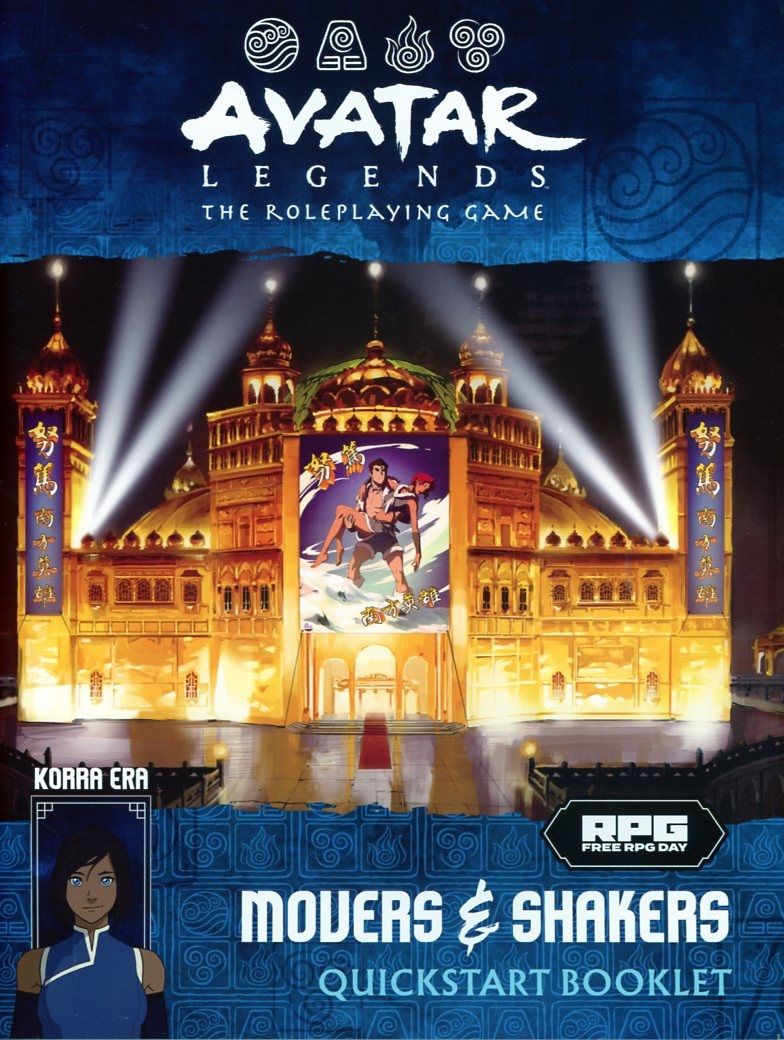
The Movers & Shakers Free RPG Day Booklet is the quick-start for Avatar Legends: The Roleplaying Game, one of the most successful Kickstarter campaigns for any roleplaying game. Published by Magpie Games, this is the roleplaying adaptation of Avatar: The Last Airbender and The Legend of Korra, animated series which are inspired by the indigenous cultures of North America and Asia, in particular, China, Chinese martial arts, and the ability to ‘bend’ or manipulate the four elements—water, earth, fire, and air. Only one person can bend all four elements, and he is known as the ‘Avatar’, and not only does he serve as the link between the physical world and the spirit world, but he is also responsible for maintaining harmony between the world’s four nations. In the roleplaying game, the players roleplay characters, or companions, who are capable of bending one of the elements as well as practising martial arts, all with the aim of protecting the world from harm and those unable to stand up to misuse of power. The Movers & Shakers Free RPG Day Booklet is designed for three to six players, one of whom will be the Game Master, and includes five pre-generated Player Characters, rules and advice for the Game Master, and a situation or scenario, the ‘Movers & Shakers’, of the title.

The Movers & Shakers Free RPG Day Booklet and thus Avatar Legends: The Roleplaying Game is ‘Powered by the Apocalypse’, the mechanics based on the award-winning post-apocalyptic roleplaying game, Apocalypse World, published by Lumpley Games in 2010. At the heart of these mechanics are Playbooks and their sets of Moves. Now, Playbooks are really Player Characters and their character sheets, and Moves are actions, skills, and knowledges, and every Playbook is a collection of Moves. Some of these Moves are generic in nature, such as ‘Guide and Comfort’ or ‘Rely on your Skill and Training’, and every Player Character can attempt them. Others are particular to a Playbook, for example, Qacha, the Guardian, one of the five pre-generated Player Characters, has the Moves, ‘Catch a Liar’, ‘Suspicious Mind’, ‘Martyr Complex’, and ‘A Warrior’s Heart’.

To undertake an action or Move in a ‘Powered by the Apocalypse’ roleplaying game—or Avatar Legends: The Roleplaying Game, a character’s player rolls two six-sided dice and adds the value of an attribute such as Creativity, Focus, Harmony, and Passion, to the result. A full success is achieved on a result of ten or more; a partial success is achieved with a cost, complication, or consequence on a result of seven, eight, or nine; and a failure is scored on a result of six or less. Essentially, this generates results of ‘yes’, ‘yes, but…’ with consequences, and ‘no’. Notably though, the Game Master does not roll in ‘Powered by the Apocalypse’ roleplaying game—or Avatar Legends: The Roleplaying Game, although she does have Moves of her own.

So, for example, if Erdene, the Prodigy, wants to assess an opponent, her player will select the ‘Judging a Rival’ Move. The aim is to have Erdene determine the rival’s strengths and weaknesses, how she can show dominance or submission to the rival, what the rival intends to do next, and what the rival wishes that Erdene would do next. To make the Move, the player rolls the dice and his Erdene’s Focus to the result. On a result of ten or more, the player can ask two of these questions, whilst on a result of seven, eight, or nine, he only gets to ask one.

Besides the four stats, a Player Character has Backgrounds, for example, Urban and Military, Demeanours like Confident and Warm, and a Training, such as Airbending. He also has a Fighting Style, like ‘Strong individual streams of air, like a Firebender’s flame jets’. His Balance is represented by a track, which runs from ‘+3’ to ‘-3’, for example, between the Principles of Excellence and Community. Events and the effects of Moves can shift the Player Character’s Balance up and down the track. This represents a Player Character’s core personality and if this Balance is pushed off the track, which can lead to a loss of a Player Character’s powers, his acting against his principles, or even give in to the enemy. A Player Character’s Balance can be restored through rest and reflection, but this takes time. In addition, a Player Character has an aspect that adds depth and detail, as well as motivation. For example, Thi, the Hammer, has ‘Bringing Them Down’ which sets him up to confront a single enemy. In his case, it is Amrita, the lieutenant of the Creeping Crystal Triad that Thi once worked for and is trying to make up for having done so. When facing Amrita, Thi has a penalty to all interactive Moves, but when fighting Amrita, becomes Inspired and clears all fatigue. A Player Character has two or three ‘Fighting Techniques’ and notes on connections, a Moment of Balance when he can restore his Balance, and a Background.

As the quick-start for Avatar Legends: The Roleplaying Game, the Movers & Shakers Free RPG Day Booklet provides both an introduction to the setting and the mechanics. The former includes a basic overview of the setting, the ‘Avatarverse’ and its five ages and four nations, plus descriptions of Airbending, Earthbending, Firebending, and Waterbending, followed by Weapons and Technology, and the roles that they all play in the ‘Avatarverse’. It provides a short, basic introduction to the setting, whilst the scenario gives more setting specific details. The explanation of the rules is more extensive, covering what a roleplaying game is, the need for safety tools, how to frame scenes, and more, all before going into detail about Moves. This includes the Basic Moves common to every character, plus Balance Moves, which affects the Balance Track, as well as Combat Exchanges. In general, combat in the Movers & Shakers Free RPG Day Booklet and in Avatar Legends: The Roleplaying Game is run as a series of one-on-one combats rather than mass brawls, no matter the number of combatants. They require combatant to first select an approach, either ‘Defend and Manoeuvre’, ‘Advance and Attack’, or ‘Evade and Observe’, this being the basic style the character wants to assume. After that, a combatant can select a Fighting Technique associated with the approach. For example, Erdene, the Prodigy, has three Fighting Techniques. Both ‘Steady Stance’ and ‘Air Swipe’ are associated with the ‘Defend and Manoeuvre’ approach and ‘Small Vortex’ with the ‘Evade and Observe’ approach.

What there is not in Avatar Legends: The Roleplaying Game is any Moves connected to Bending, or the manipulation of an element. A Player Character needs to be trained in Bending, whether Airbending, Earthbending, Firebending, or Waterbending, and these colours what he does and the Moves he makes. For example, Meeka, the Idealist, is a Waterbender and she has the fighting style involving ice spikes, either flung or driven up from the ground or through the walls. With the ‘Disorient’ Fighting Technique, she pummels the foe with quick blows, in this case a flurry of ice shards, but with ‘Slip Over ice’, she slides around the environment with ease to put off an enemy off-balance, this could be over the ice she creates or the water from partly melted ice she has created.

The scenario in the Movers & Shakers Free RPG Day Booklet is the eponymous ‘Movers & Shakers’, which is set during the Korra Era of Avatar: The Last Airbender and The Legend of Korra. The Player Characters are hired to protect the production of a new mover—or film—called ‘Sengo: lady of the Winds’. It has been plagued with equipment malfunctions and breakdowns, and an executive at Varrimovers International Studios fears that someone is attempting to sabotage the production of a mover that could restore the studio’s fortunes. This is certainly the case and that someone is connected to the backstory of one of the five pre-generated Player Characters. Over the course of four days, the Player Characters must protect the film, its production, its crew, and its cast from attacks from without by members of the Creeping Crystal Triad and tensions from within between the cast and crew. With the latter there is scope for investigation and roleplay and with the former, there is scope for roleplaying and combat. Like the publisher’s scenarios for Root: The Tabletop Roleplaying Game, ‘Movers & Shakers’ is not a linear scenario. Rather it is a situation or scenario, comprised of detailed descriptions of the various locations and NPCs, that the players and their characters can explore, the Game Master reacting to their decisions and making Moves of her own to keep up the tension, the storyline, and the action as necessary. It is primarily player-driven and the Game Master will need to understand all of the scenario’s elements to run it properly. This does mean that the scenario—and also the Movers & Shakers Free RPG Day Booklet—are really designed for the beginning Game Master. She is accorded good advice on how to run the scenario, but for someone new to the hobby, it is likely to be daunting prospect.

The five pre-generated Player Characters include a rash airbender with great airbending ability who exasperates her sister, who has sworn to protect her. The others are a former triad employee who is good with technology, who is trying to redeem himself; a former soldier and waterbender who wants to help and heal the world; and an earthbender who wants to live up his father’s skill, but not his reputation. All five pre-generated Player Characters are nicely designed, capable, and interesting, and include backgrounds and connections to one or more of the other Player Characters.

Physically, the Movers & Shakers Free RPG Day Booklet is well presented, sturdy booklet. Running to some fifty-pages, there is plenty of advice and help for the Game Master, including summaries of the Moves, Combat Exchanges, Fighting Techniques, and more at the back. Although it needs a slight edit in places, the main issue perhaps is the lack of examples that would ease the learning of the ‘Powered by the Apocalypse’ mechanics, especially the Combat Exchanges of Avatar Legends: The Roleplaying Game. The detailed nature of the Movers & Shakers Free RPG Day Booklet also means that the Game Master does have a lot to learn and prepare.

The density of Movers & Shakers Free RPG Day Booklet and the non-linear, sandbox style nature of its scenario, ‘Movers & Shakers’, means that Game Master needs to study the booklet in order to prepare and run the adventure. For anyone new to roleplaying, perhaps fans of Avatar: The Last Airbender and The Legend of Korra and having picked up the Movers & Shakers Free RPG Day Booklet to find out what roleplaying is, this is too dense and not supported with examples that would have made the learning process easier. For the more experienced roleplayer, and certainly anyone with experience of ‘Powered by the Apocalypse’, this will be very much less of an issue.

The Movers & Shakers Free RPG Day Booklet is a fun, entertaining introduction to Avatar Legends: The Roleplaying Game and the worlds of Avatar: The Last Airbender and The Legend of Korra. Fans of both will enjoy this, as will any player who enjoys anime and martial arts, but Movers & Shakers Free RPG Day Booklet definitely benefits from an experienced Game Master.