Every Week It's Wibbley-Wobbley Timey-Wimey Pookie-Reviewery...
Showing posts with label Godlike. Show all posts

Sunday, 19 December 2021

2001: Godlike

1974 is an important year for the gaming hobby. It is the year that Dungeons & Dragons was introduced, the original RPG from which all other RPGs would ultimately be derived and the original RPG from which so many computer games would draw for their inspiration. It is fitting that the current owner of the game, Wizards of the Coast, released the new version, Dungeons & Dragons, Fifth Edition, in the year of the game’s fortieth anniversary. To celebrate this, Reviews from R’lyeh will be running a series of reviews from the hobby’s anniversary years, thus there will be reviews from 1974, from 1984, from 1994, and from 2004—the thirtieth, twentieth, and tenth anniversaries of the titles. These will be retrospectives, in each case an opportunity to re-appraise interesting titles and true classics decades on from the year of their original release.

—oOo—
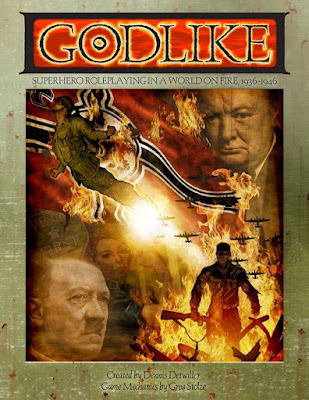
As much as the noughties was a decade dominated by the d20 System and the rise and fall of the third-party Dungeons & Dragons publisher, it was also the decade of two genres. One was pirates, the other was World War 2. The former was certainly given a big push by the release in 2003 of Pirates of the Caribbean, and would see titles such as Swashbuckling Pirates, Pirates of the Spanish Main, and Swashbucklers of the 7 Skies being published. The latter was spurred on by the anniversary of the USA’s entry into World War 2 with the attack on Pearl Harbour, and indeed, in that sixtieth anniversary three World War 2 roleplaying games would be published—Gear Krieg The Roleplaying Game from Dream Pod 9, GURPS WWII from Steve Jackson Games, and Godlike: Superhero Roleplaying in a World on Fire, 1936-1946. Over the course of the next decade, numerous World War 2 themed roleplaying games, from the small such as Battleforce Bravo from Deep7 Press to Weird War Two D20: Blood on the Rhine from Pinnacle Entertainment. These five represent the differing approaches taken to what is a defining period in twentieth century history. Both Battleforce Bravo and GURPS WWII played it straight and kept it to the history (that is, until GURPS WWII Classic: Weird War II), but the others would go in a different direction, adding another genre. Weird War Two D20: Blood on the Rhine added horror, Gear Krieg The Roleplaying Game added combat walkers, and Godlike added superheroes.

Godlike: Superhero Roleplaying in a World on Fire, 1936-1946 did superhero roleplaying and superheroes in World War 2 like no other. In supplements like Glory Days for Brave New World and scenarios like All This and World War II for Marvel Super Heroes, the focus is traditionally on the superhero first, not the soldier. Although Godlike was a superhero roleplaying game and an alternate history game in which superheroes existed and influenced the course of the war—and beyond, they would not change the outcome of the war. The World War 2 of Godlike would still be won by men and machinery, by grit and determination, and when the Talents—those blessed with the superpowers or miracles which set them apart from ordinary men—of the Allies met the Übermensch of the Axis powers, they were soldiers first, superheroes second. Godlike is not a superhero setting in which the superheroes, the Talents, wear spandex. Instead, they wear a uniform and they serve their country. It is also not a Four Colour setting, but gritty. Despite their amazing abilities, Talents do die, whether that is due to combat with an Übermensch or an artillery barrage.

The alternate history of Godlike begins in 1936 when Der Flieger—‘The Airman’—appeared in the skies over the Berlin Olympics. He was the first Talent, and as Europe moved towards war, more would appear. Pevnost, a Czechoslovakian resistance fighter who could step through one door and out of any door he had previously stepped through, enabling him to traverse hundreds of miles in an instance. He would support the underground resistance throughout the war. As Der Flieger destroyed the Polish airforce, a Polish Talent, Cien appeared, who was capable of manipulating objects touched by his shadow, the Finnish Viljo, became one with the arctic snow and fought the Soviet invaders, and the Danish schoolboy, Vogel, found himself invulnerable to any attack he was aware of. As the Nazis occupied more and more of Europe, more Talents appeared amongst the local populations, many of whom would become heroes of their nations. The first British Talent was Jumping Johnny, capable of leaping twenty-seven miles in a single bound and land with a destructive bang, whilst The Indestructible Man, the USA’s first Talent, immune to any damage he was aware of, up to and including as was tested after the war, a ten-megaton nuclear bomb. More and more Talents would manifest throughout the war and around the world, as men and women were subject to the stresses and strains of the war. Despite the Soviet attempts to ‘biologically re-educate’ subjects into manifesting as Talents, the resulting Baba Yaga escaped, mad and willing to attack Soviet and Nazi forces alike. The Nazis conscripted its Übermensch into special SS brigades, whilst the Allies transferred its Talents into Talent Operations Command and trained them as commandos before organising them into Talent Operation Groups, or squads, which would typically be attached to standard forces or used on special missions.

In Godlike, player take the roles of Talents, soldiers with superpowers or miracles who serve in Talent Operation Groups. A character has six stats, Body, Brains, Command, Cool, Coordination, and Sense, rated between one and five, with two being average. Similarly, skills are rated between one and five. Beyond this, stats and skills can have Hyperstats and Hyperskills, so a Talent can have Hyper-Body and be super strong, or Hyper-Intimidation, and be incredibly imposing! Then there are Miracles. Certain traditional superpowers are unknown in the world of 
Godlike: Superhero Roleplaying in a World on Fire, 1936-1946—mind control or reading, absorption or imitation of other Talents, the ability to create Talents, time travel, unlimited healing powers, and actual super-science—though Goldberg Science and the creation of gadgets is possible. A wide array of cafeteria-style Miracles is given. This ranges from Aces, which makes the Talent incredibly lucky, Break, which enables a Talent to puncture or smash objects beyond Human capability, and Dampen, which allows him to reduce or negate a physical effect of a Talent to Side Step, with which a Talent can avoid a disaster or attack, Time Fugue, which enables a Talent to stop time for a single object or creature, and Zed, which can be used to negate the ability of another Talent. All of the Miracles come with Power Stunts, Extras, and Flaws, which all adjust the cost of the Talents, and there are also prebuilt, ready-to-play, Cafeteria Power-Sets—though only a handful of them. They include The Blaster, The Brain, The Bruiser, The Flyer, and so on.

There is also the option for a player to build his Talent’s Miracles as per other point-buy systems in other superhero roleplaying games. Fundamentally though, the tone and power level of Godlike means that certain superhero archetypes are challenging, even impossible to build. To build a Talent with the powers of flight and blast rays is possible, but expensive, but add in invulnerability, and it becomes prohibitively expensive. This is because Miracles—and also Hyperstats and Hyperskills—are bought as die types. Standard dice are the least expensive, Wiggle dice the most expensive, and Hard dice in between. Figure in Qualities—Attacks, Defends, Useful out of Combat, and Robust—and the cost also goes up, although a player could remove them to reduce the cost, but with the loss of utility. Miracles can also be modified by Extra, Flaws, and Power Stunts, which in turn adjusted the cost. Another limiting factor is the number of Will Points a Talent is built on. Godlike gives the stats for the first ten Talents to appear, their costs ranging from twenty-five to one-hundred-and-fifty Will Points, but the majority have Miracles way out of the league of beginning Talents. In the default campaign setting of the Talent Operations Group, a player is given twenty-five Will Points with which to purchase Hyperstats, Hyperskills, and Miracles. It is not a lot and it makes it challenging to create Talents without resorting to Hyperstats or Hyperskills. Nevertheless, it is possible to create interesting Talents, not all of them necessarily designed for combat.

To create a Talent, a player assigns six points to his Talent’s stats—which already begin at one, assigns twenty points to skills, and if playing in the Talent Operations Group campaign, receives training in another eighteen points’ worth of skills. Lastly, he has twenty-five Will Points to spend on Hyperstats, Hyperskills, and Miracles. As well this, a player should determine his Talent’s background, nationality, age, family, education, motivations, and so on, to flesh out the character.

Our sample Talent is Technician Third Grade Theodore Huffman, who was studying piano at the Juilliard School of Music in New York when his draft number came up 1943. After basic training he was assigned to Special Services and performed piano concerts in the USA, and then England and North Africa. In early 1944, the convoy he was in, was ambushed by the Germans and the truck he was driving blown up. He was thrown from the vehicle and knocked unconscious. It was then that his Talent manifested—Billy Bones. Whilst Theodore was unconscious, his skeleton got up, grabbed a machine gun and proceeded to fight the ambushers, killing most of them, and driving the rest off. When relief arrived, they discovered Huffman asleep and Billy Bones brashly playing jazz on the piano and smoking a cigar. As a Talent, Billy Bones fights when Huffman cannot, and is stronger and faster than Huffman. He also smokes when Huffman does not, and whilst Huffman is a classical pianist, Billy Bones plays music more popular with his fellow soldiers.

Technician Third Grade Theodore Huffman, ‘Billy Bones’, TOG-242
Body 2 Coordination 2 Sense 2
Brains 2 Command 3 Cool 1
Base Will 4
Current Will 4
Motivations: Survive the war; Become a better musician
Skills: Brawling 1 (3d), Climb 1 (3d), Cryptography 2 (4d), Dodge 1 (3d), Drive (Automobile) 1 (3d), Education 2 (4d), Endurance 1 (3d), Explosives 1 (3d), Grenade 1 (3d), Hearing 2 (4d), Knife Fighting 1 (3d), Language (French) 2 (4d), Machine Gun 1 (3d), Map Reading 1 (3d), Navigation (Land) 1 (3d), Perform (Piano) 3 (6d), Perform (Sing) 1 (4d), Pistol 1 (3d), Radio Operation 1 (3d), Rifle 1 (3d), Sailing (Sailboat) 1 (3d), Stealth 1 (3d), Submachine Gun 1 (3d), Survival 1 (3d), Swim 1 (3d), Tactics 1 (3d)

Talents (25 Will Points)
Alternate Form 2hd (Qualities: Attacks, Defends, Robust, Useful Outside of Combat. Base Cost: 5/10/20. Extra: Endless +1/+2/+4, Extra: Unconscious +1/+2/+4; Flaw: Peace of Mind (Asleep) -2/-4/-8; Flaw: Mental Strain -2/-4/-8; Final Cost 3/6/12; 12 points).
Hyperstat: Body +3d (Base Cost: 2/5/10. Flaw: Attached to Alternate Form -1/-2/-4; Final Cost 1/3/6; 3 points).
Hyperstat: Coordination +3d (Base Cost: 2/5/10. Flaw: Attached to Alternate Form -1/-2/-4; Final Cost 1/3/6; 3 points).
Hyperstat: Cool +3d (Base Cost: 2/5/10. Flaw: Attached to Alternate Form -1/-2/-4; Final Cost 1/3/6; 3 points).
Hyperskill: Submachine Gun +2hd (Base Cost: 1/3/7. Flaw: Attached to Alternate Form -1/-2/-4; Final Cost 1/1/3; 2 points).
Hyperskill: Perform (Piano) +2hd (Base Cost: 1/3/7. Flaw: Attached to Alternate Form -1/-2/-4; Final Cost 1/1/3; 2 points).

Although there is a wide range of Miracles listed in Godlike, the list is not extensive, and it would not be until the supplement, Will to Power when the roleplaying game received Miracles such as Size Shift and Unconventional Move. (The supplement also added a range of aircraft which were not included in the core rules—an issue potentially if one of the player Talents could fly.) Nevertheless, between the Godlike and Will to Power, both Game Master and player had access to a decent range of Miracles, enabling both to create interesting Talents. (The following example Talent was created using the extra content from Will to Power.)

Dorothy Murray was fourteen when she was evacuated from London. Unhappy with life away from her parents she ran away and returned to life in the capital. When the family house was bombed, and she found herself buried under rubble, her Talent manifested—she was able to tunnel her way out. At first she thought it was luck, but during later raids, she could hear the cries of those trapped and knew where they were. She began to experiment her powers and by the height of the Blitz, was going out nightly to tunnel into the rubble of bombed houses to rescue the survivors. Anyone pulled free always remembered the glow of the girl who came to rescue them and carry them to safety. The newspapers nicknamed her the ‘Angel of the Blitz’.

Dorothy Murray ‘Angel of the Blitz
Body 2 Coordination 2 Sense 2
Brains 2 Command 2 Cool 2
Base Will 4
Current Will 4
Motivations: Help people with her Talent; Finish school
Skills: Athletics 1 (3d), Education 1 (3d), First Aid 1 (3d), Health 1 (3d), Hearing 1 (3d), Inspire 1 (3d), Language (Latin) 1 (1d), Mental Stability 1 (3d), Perform (Violin) 1 (3d), Run 1 (3d)

Talents (25 Will Points)
Unconventional Move: Tunnelling 4d+2wd (Qualities: Attacks, Defends, Robust, Useful Outside of Combat. Base Cost: 5/10/20. Extra: Endless +1/+2/+4, Extra: Passenger +1/+2/+4. Flaw: Beacon -4/-8/-16, Flaw: Glows -1/-2/-4, Flaw: Specific Material (Rubble) -1/-2/-4; Final Cost 1/2/4; 12 points).
Hyperstat: Body +8d (Base Cost: 2/5/10. Flaw: Attached to Unconventional Move -1/-2/-4; Final Cost 1/3/6; 8 points).
Detection: Humans 4d (Qualities: Defends, Robust, Useful Outside of Combat. Base Cost: 4/8/16. Flaw: Human Trapped in Rubble/Underground -1/-2/-4; Flaw: Attached to Alternate Form -1/-2/-4; Final Cost 2/4/8; 4 points).

Mechanically, Godlike uses what would become known as ‘Ore’ or the ‘One-Roll Engine’. This is a dice pool system, usually formed of the appropriate Stat plus Skill, for example, Coordination plus Rifle or Command plus Perform (Piano), the aim being not to roll successes, but get matches—pairs, triples, and so on. Neither player nor Game Master roll more than ten dice—although actually rolling that many dice is not common. If any of the dice match, then the character has succeeded. However, the more successes rolled, the wider the result is and the faster it is, and the higher the set of matches, the more effective it is. Carried over into combat, the width of the roll will determine the speed of the attack and how much damage is inflicted, whilst its height will determine exactly where the hit was made. Taking damage is not only physically injurious, but will negate dice in an attacker’s pool, so going first is almost a must, but dodging can ‘gobble’ up dice if successful, potentially breaking up matching sets. Although damage inflicted can be stunning, killing, or stunning and killing, combat can be brutal in Godlike, so players had better be warned ahead of play. Leaping into a game and expecting bullets to bounce off your hero’s chest just because is a sure-fire way to get him killed. Overall, the system is elegant, easily handles multiple actions, and plays fast, although it does take some adjustment from the traditional rote of rolling for initiative, rolling to hit, rolling for damage, and so on.

However, there are a couple interesting wrinkles which comes into play once Hyperstats, Hyperskills, and Miracles are figured. There are two other die types beyond the standard type. The medium cost die type is the Hard die. When this is in a pool and rolled, it is always set at a ten. This means that with a pair of Hard dice, a Talent will not always succeed, he will always do so with the maximum effect possible. The most expensive die type is also the most flexible. The Wiggle die can be set to any number, either to create a set or widen a set. Effectively, both give a player more control over his Talent’s ability to bring his Hyerstats, Hyerskills, and Miracles into play, especially as the dice pools for these increase in size—and it is generally easier to improve an already existing Talent rather than select a completely new one.

Perhaps the most enjoyable aspect of Godlike is the extensive timeline which covers the ten years from the Berlin Olympics of 1936 to the beginning the Cold War in 1946. It is richly detailed, mixing in both the actual history with the alternate history of Godlike, but keeping the two sperate. The entries which involve Talents are clearly marked with a bullet hole. This is supported by an equally interesting exploration of the wider background to Godlike and the appearance of Talents, especially how society at large reacted to them. The racism and sexism rampant throughout societies in the period is also acknowledged, but notes that despite that the targets of both played major roles in the global conflict. In the main, the role of Talents in Godlike—at least in 
Godlike: Superhero Roleplaying in a World on Fire, 1936-1946—is focused upon military and special operations style campaigns. This is understandable given that it is the major role of Talents throughout the war, and perhaps other types of campaigns, perhaps with a more diverse range of characters might have come had the publisher had the opportunity. Nevertheless, there is nothing to stop the Game Master using the content in Godlike: Superhero Roleplaying in a World on Fire, 1936-1946 and backed up with research of her own from running other types of campaigns set within the Godlike universe.

Godlike: Superhero Roleplaying in a World on Fire, 1936-1946 is further supported with a wide arsenal of equipment used by both the Allied and Axis powers, from small arms to armoured vehicles. The Game Master is given good advice on running a Godlike campaign, and the following details of the Talent Operations Group campaign is accompanied by a complete write-up of a sample TOG squad. This nicely showcases some of the possibilities using the Miracle creation rules earlier in the book. Alternatives and options suggest ways in which a campaign can be adjusted to allow Talents to be even more ‘godlike’, right up to a Four Colour-style campaign, but these do push the setting away from its gritty and very much soldier-first feel. Rounding out the book are the aforementioned write-ups of the first ten Talents to appear and since the book was published in 2001, rules for running a Godlike campaign under the d20 System. These are decently done, but feel superfluous now.

Physically, 
Godlike: Superhero Roleplaying in a World on Fire, 1936-1946 is sturdy black and white hardback. It perhaps feels a little odd in its ordering of its content, with explanations of the rules, mechanics, and character creation coming before the roleplaying game’s detailed background. Without the latter, the rules do lack context, but with perseverance the reader will get to the richly detailed background and begin to put everything together. The book is well written and illustrated throughout with black and photographs manipulated to add in the presence of the Talents in each and everyone. There is something quite odd about many of them, their slightly off kilter perspective giving them a sense of the unearthly.

Godlike is lacking a number of elements. Mostly obviously a scenario, but World War 2 is such a familiar setting that a Game Master should be able to develop something of her own with relative ease. It is lacking details of the aircraft—of either side, but that would be addressed in Will to Power. Perhaps its major omissions are the lack of perspectives from either a female point of view or a non-American point of view—and to be fair, there is some truth to both omissions. Yet the focus of Godlike: Superhero Roleplaying in a World on Fire, 1936-1946 is on the soldier on the front lines and beyond them, and not necessarily on the home front, and the role might very well have been more fully explored in subsequent supplements—for example, if a supplement devoted to the Russian Front had been published. The authors did publish scenarios in which women played a significant role, and to be fair, there is only just so much that can be covered in a book, even a core book like Godlike. Plus again, there is nothing to stop the Game Master, backed up with some research from running a campaign where women can play a major role. The other emphasis, that of the US soldier and the role of the USA in World War 2 is present in Godlike, but again to be fair, the roleplaying game was published in a year which was the anniversary of the entry of the USA into World War 2 and that emphasis could be found across all media. However, throughout the alternate history of Godlike, the roles of non-US Talents and their stories and contributions are highlighted again and again, each time working as potential inspiration for stories and scenarios which do not necessarily involve the USA. So ultimately, that emphasis is not strong as it could have been.

Godlike: Superhero Roleplaying in a World on Fire, 1936-1946 would go on to spawn a number of supplements and scenarios, including Will to Power and the campaign, Black Devils Brigade: The First Special Service Force and the Italian Campaign, 1943–1944. Its mechanics would have a wider influence, the One-Roll Engine appearing eventually on its own in Wild Talents, a sequel of sorts to Godlike, but which also stood alone and enabled a Game Master to run a more traditional style of superhero campaign. It in turn would give rise to some wildly imaginative campaign settings, including Wild Talents: Progenitor, Wild Talents: The Kerberos Club, and Wild Talents: This Favored Land.

Then published by Hawthorn Hobgoblynn Press, but later Arc Dream Publishing, 
Godlike: Superhero Roleplaying in a World on Fire, 1936-1946 would be one of the first roleplaying games I reviewed and certainly the first I reviewed after being contacted directly by the publisher and asked to review. I can remember the surprise when it happened, even when it happens today, I am still surprised and even humbled by the trust that publishers place in me in asking me to review their books. Godlike was worth that trust, because it was a great game in 2001 and it still is in 2021. The combination of Greg Stolze’s elegant mechanics with Dennis Detwiller’s richly developed background is a grim and gritty take upon the superhero genre, something that still stands out today as being different and stood out even more in 2001 against the backdrop of the d20 System boom and the tone taken by the other World War 2 roleplaying games then being released. Godlike: Superhero Roleplaying in a World on Fire, 1936-1946 is an amazing piece of writing and design which shows how even as miraculous powers change the world, the soldier—even the soldier Talent, not only has to survive that world, but stand up and still be a hero in that world.

Sunday, 22 October 2017

Robbing the Reich of Rommel

Published by Arc Dream Publishing, Fox Hunt: A Godlike adventure is a short scenario for one of the best roleplaying games to come out of the 2001 and 2002 boom in World War II roleplaying games. This is Godlike: Superhero Roleplaying in a World on Fire, 1936-1946, a game in which the player characters are Talents, members of the Allied forces who have been ‘blessed’ with an amazing ability such as lowering the temperature around him, open any lock by pointing a finger, or simply picking up a Tiger tank throwing it at the enemy! The player characters are soldiers first before being trained to use their Talent effectively in battle, but as more and more of them appear, fewer and fewer lack the experience of using their Talent in battle, especially against the Übermenschen, the Nazi Talents who are part of the SS and who many of them revel in their powers and the Aryan ideals of the ‘Super Race’. There is also the matter of each Talent’s Will, for it is his Will that fuels a Talent’s powers and his ability to cancel out another Talent’s powers that can be lost in a contest of Wills with an enemy Talent. This is the situation that TOG-151 (Talent Operation Group-151) finds itself in the very early morning of June 6th, 1944 as it parachutes into enemy-occupied France.

Fox Hunt: A Godlike adventure originally appeared in issue #5 of Gygax Magazine, the late lamented magazine published by TSR, Inc.. It is the fourth in the publisher’s Pantheon line of digest-sized set of adventures reminiscent of the early days of role-playing, which also included the fantasy setting, Gnatdamp; They All Died at the International Space Station, for use with Metamorphosis Alpha; and Operation Rendezvous Oasis, for use with Top Secret. Like the other entries in the line, Fox Hunt comes as a digest-sized book containing the adventure itself and a seperate fold-out A3 sheet which serves as a ‘Godlike Boot Camp’. The sheet folds out to give the base rules for running Godlike and the six members of TOG-151, ready to play. What this means is that Fox Hunt can be run without reference to the core Godlike rulebook.

The title of Fox Hunt suggests the mission assigned to TOG-151. Its members are to drop into France on the morning of D-Day and take advantage of the poor reaction to the invasion upon the part of the occupying forces in France. With the forces under his command in disarray, Rommel is racing back to Normandy after having celebrated his wife’s birthday in Germany—and the Allies know which route he is taking. TOG-151 is assigned the mission of ambushing his convoy, kidnapping him, and returning him to England. This is a challenging mission, not least because the TOG will need to avoid the local soldiery—initially the French Milice or militia, rather than the German garrison—if it is to make contact the French Resistance. Their help is required if the TOG is to execute its mission.

The problem with a lot of military adventures, especially commando missions like this one, is that they can be very linear and straightforward, and so it is with Fox Hunt. Yet some solid hooks and wrinkles have been thrown in along the way to make things interesting. These begin with a scene setting introduction when the members of the TOG have the opportunity to establish themselves as members of the squad, and continue with the interaction with the members of the French Resistance cell, including rivalry and romance. The ambush and its consequences are also interesting in that the man in the car might not be Rommel himself—perhaps a situation similar to that of General Bernard Montgomery and M. E. Clifton James—and the Übermenschen assigned as his bodyguards might have divided loyalties. If the player characters succeed, then the rewards are incredible and the members of TOG-151 have a tale to dine out on for the rest of their lives! That said, the scenario does not shy away from the consequences of the TOG’s mission on the local population.

The members of TOG-151 include ‘Broadway Jay’, the commanding officer, a small town lawyer capable of stepping out of harm’s way; ‘Suds’, a dentist who can create a forcefield shaped like a soap bubble; ‘FUBAR’, a New York taxi driver who can telekinetically throw objects; ‘Plaster’, a salesman with the gift of the gab who can regenerate his wounds; ‘Mark Two 2’, a hyper machinist who can also shoot flames from his hands; and ‘Boston’, an ex-sailor who fly at near the speed of sound. These are all decent characters and they exhibit a good mix of Talent abilities, not always something that has occurred in previous releases for Godlike. One of the characters is not quite correct and a corrected version has been provided here. All of the Talents were created using the Godlike: Talent Power Generator, including those of the Übermenschen, so one issue is that there is repeition in talent abilities between the Allied Talents and the Übermenschen.

Another issue is that the ‘Godlike Boot Camp’ is cramped, despite it folding out to the size of an A3 sheet of paper. This is particularly so in the case of the pre-generated Talents, whose details are just a little too small to read easily. Otherwise, the Fox Hunt book is an easy read with decent illustrations and nice maps. The Übermenschen are better presented, but they do need an edit to be easier to read.

Fox Hunt: A Godlike adventure works as a one-shot and will work as a convention scenario. It works well with the pre-generated Talents provided, but there is nothing to stop a group of players playing it with their existing characters or ones they create for this scenario. The scenario presents a highly memorable situation and some good opportunities for roleplaying, combining to make Fox Hunt: A Godlike adventure a challenging and enjoyable one-shot or addition to a Godlike campaign.

Friday, 21 March 2014

The TALENT Campaign II

The popularity of genres wax and wane as time passes, and so it is that the superhero genre is no longer as popular as it once was. Certainly not popular to be supported with regular supplements, but one exception to that is GODLIKE: Superhero Roleplaying in a World on Fire, 1936-1946. Originally published in 2002, Arc Dreams' RPG is supported by various supplements including a full campaign in the form of Black Devils Brigade: The First Special Service Force and the Italian Campaign, 1943–1944. This is now followed by a companion mini-campaign, Combat Orders No. 4 - The Courtyard of Hell. What separates the two are the Apennine Mountains and their differing scopes.

As its title suggests, Black Devils Brigade concerns the whole of the Italian Campaign, including the battle for Anzio and the eventual drive on Rome. Geographically, it is set entirely on the western side of the Apennine Mountains. The Courtyard of Hell takes place on the eastern side of the Apennine on the Adriatic Coast, in just the one location, that of the port town of Ortona. Located on a steep-sided plateau and comprised of narrow streets lined with stone buildings, the town was the site of fierce street fighting between the defending Fallschirmjäger troops and the attacking Canadians in the final weeks of 1943 that Winston Churchill came to call the battle for the town, ‘Little Stalingrad’.

In The Courtyard of Hell as in GODLIKE, the player characters are Talents, members of the Allied forces who have been ‘blessed’ with an amazing ability such as controlling the blood flow of the wounded, being able to map out a location with a shout, or smash open the armour on a Tiger tank with a single punch! The player characters are soldiers first before being trained to use their Talent effectively in battle, but as more and more Talents manifest on the battlefield, there is not always the time or the chance for newly expressed Talents to receive this training before being thrown back into fray. This often means that they will be prepared to face the Übermenschen, the Nazi Talents who are part of the SS and who revel in their powers and the Aryan ideals of the ‘Super Race’. This will be an issue in The Courtyard of Hell as will be a Talent’s Will. It is his Will that fuels a Talent’s powers and his ability to cancel out another Talent’s powers that can be lost in a contest of Wills with an enemy Talent.

The Courtyard of Hell takes place in the last week of December, 1943. The soldiers of the 2nd Brigade, the Loyal Edmonton Regiment, the Seaforth Highlanders of Canada, and Princess Patricia’s Canadian Light Infantry have recently made a hard fought and bloody crossing of the Moro River and now need Talent support in taking Ortona. The battle is depicted in thirteen scenes that take place between December 20th and December 27th, as the Talents, being among the first Canadians to manifest as Talents, are thrown into support the assault on the town. This will see them leading the attack on Ortona’s outskirts before becoming embroiled in street fighting against troops of the 1st Fallschirmjäger Division. Intelligence reports that there are Übermenschen in the town, including at least one flyer. What is curious about these Übermenschen is that they are not members of the SS as are most Nazi Übermenschen, but have remained with the elite Fallschirmjäger troops rather than transferring to the SS as is expected of all Übermenschen. Technically then, these Übermenschen are members of the Luftwaffe!

In the seven days of the battle for Ortona, the Talents will support tanks, fight from one building to the next, move heavy artillery, and come to the rescue of their comrades and civilians alike. They will also find themselves fighting Übermenschen other than Fallschirmjäger as the intensity of the fighting increases and Übermenschen of the SS are brought into to support the German defence of the town. Throughout, the Talents will be shadowed by newsmen and photographers who are eager to report on the success and activities of Canada’s first Talents in battle.

Based on a real battle, with two of the battle’s actual participants being included in the seven pre-generated Canadian Talents, The Courtyard of Hell is a combat intensive affair. Designed to be played by between six and seven players, guidelines are included to help the GM adjust the difficulty of the scenario’s encounters so that they can be played by a smaller group. Further support comes in the form of descriptions of the weapons and vehicles used by both sides; guidelines for handling large battles as well as a means to quickly set up interesting encounters using the ‘One Roll Cityfight’ rules; full stats for both the Canadian and Fallschirmjäger troops; and some twenty-four fully detailed and described Übermenschen in addition to the six pre-generated Canadian Talents.

In previous releases for Godlike, the design of the Übermenschen and the Allied Talents has been somewhat underwhelming, perhaps even unimaginative. Admittedly, it is not easy to come up with interesting Talent concepts, let alone create them on the limited number of points available during character creation. With over thirty presented in the pages of The Courtyard of Hell, there is a surprisingly degree of invention on show.

Physically, The Courtyard of Hell is generally well presented. In places it needs another edit and in places the text has faded to the point of near illegibility. The maps are also hard to read in places, primarily because of the difficulty of depicting the necessary detail in grayscale rather than colour. Otherwise, The Courtyard of Hell is decently illustrated.

The Courtyard of Hell is much more focused and much shorter affair than Black Devils Brigade, though the possibility of soldiers from the First Special Service Force being sent over the Apennines to fight in the battle for Ortona is discussed. It could thus be used as an extension to the campaign presented in Black Devils Brigade: The First Special Service Force and the Italian Campaign, 1943–1944, but even if not, it should offer several sessions of challenging combat. Well-researched, solidly-presented, Combat Orders No. 4 - The Courtyard of Hell presents the opportunity for the players to explore a heroically tough if little known battle of World War Two.

Saturday, 22 October 2011

The TALENT Campaign

For a game as old as Arc Dream Publishing’s GODLIKE: Superhero Roleplaying in a World on Fire, 1936–1946, it seems a shame that there is so little support for it, let alone the fact that for a game with a setting – the whole of the Second World War – as rife with possibilities, it has never been given a campaign of its own. All that changes with the release of Black Devils Brigade: The First Special Service Force and the Italian Campaign, 1943–1944, the first full length adventure campaign for the GODLIKE, the RPG that took Talents or the common soldiery with an amazing abilities to war against the Axis Powers. In GODLIKE the player characters are soldiers first, not only highly trained, but also trained in how to use talents such as being able to open any locked door simply by pointing at it, momentarily freeze time and sidestep bullets, or go to sleep and have their skeleton climb out of their body to fight for them. Not only are the Allied Talents up against the military might of Nazi Germany, but also the Übermenschen, the Nazi Talents who are part of the SS and who revel in their powers and the Aryan ideals of the “Super Race.” At the heart of the game lies each Talent’s Will, this fuels his powers and his ability to cancel out another Talent’s powers, but which can be lost if he loses a contest of Wills with an enemy Talent. In Black Devils Brigade: The First Special Service Force and the Italian Campaign, 1943–1944, this will all come to the fore as the Talents are taken from training right through the length of the Italian campaign.

The Talents in Black Devils Brigade are members of the First Special Service Force (FSSF), a joint American-Canadian unit raised and trained as commandoes specialising in winter warfare, their intended mission to carry out strike missions behind enemy lines in Norway and Romania. When this became impossible, the unit was first sent to the Pacific to help re-capture the Aleutians from the Japanese, before being going to Italy and fighting at Anzio. Many of the initial recruits were originally miners, mountaineers, and lumberjacks, tough outdoorsmen who were also expected to speak a second language. This is reflected in the extra points that a Forceman receives for his Stats. One factor reflected in character generation in this alternate world is the fact that the First Special Service Force kept its Talents when they manifested and did not send them to train with Talent Operations Group at its Achnacarry Commando Training School. Thus a player receives just twenty points with which to create the abilities of his FSSF Talent.

Our sample FSSF Talent is Henning Huber, a Canadian who as the son of German immigrants wants to prove himself to be a Canadian rather than a German. He trained as a telephone engineer, which often meant repairing telephone lines in all weathers and which resulted in him being assigned to the FSSF’s Communication Detachment, part of its Service Section. His Talent manifested during a live fire exercise when one of his detachment was wounded and he found himself without sufficient medical equipment to treat the wound. With no one else available, he literally grabbed other kits from Forcemen elsewhere on the battlefield. He can grab objects vital to his survival or that of others, but only if he is scared and he has no control over what item he gets. In recent battles he has managed grab weapons from both his colleagues and his enemies, and even one occasion, a whole tank! For his reason, he is known as “Lucky Dip.”

Corporal Henning Huber, “Lucky Dip,” Talent Section, FSSF
Body 3 Coordination 3 Sense 2
Brains 3 Command 2 Cool 2
Base Will 4
Current Will 8
Motivations: Prove himself to be Canadian, not German; Force Esprit des Corps
Skills: Anti-Tank Rocket 1 (4d), Bluff 1 (3d), Brawling 1 (4d), Climb 2 (5d), Drive (Automobile) 1 (4d), Electronics 2 (5d), Endurance 2 (5d), Explosives 1 (4d), Forward Observer 1 (4d), French 1 (4d), German 2 (5d), Grenade 1 (4d), Instrument (Piano) 1 (4d), Knife Fighting 2 (5d), Machine Gun 1 (4d), Map Reading 1 (4d), Mechanics 1 (4d), Mortar 1 (4d), Navigation (Land) 1 (4d), Parachuting 1 (4d), Pistol 1 (4d), Radio Operation 2 (5d), Rifle 2 (5d), Sight 1 (3d), Skiing 1 (4d), Stealth 2 (5d), Submachine Gun 2 (5d), Survival 2 (5d), Tactics 1 (4d), Telephony 2 (5d)
Talents (16 Will Points)
Fetch: Reflexively grab what he needs when in an emergency 8d+1wd (Qualities: Attacks, Robust, Useful Outside of Combat. Base Cost: 4/8/16. Extra: Reflexive +2/+4/+8; Flaw: Peace of Mind – Scared -2/-4/-8; Flaw: Uncontrollable -3/-6/-12; Final Cost 1/4/8; 16 points).

So a Forceman Talent character can be created with twenty points, but this is a real problem for Black Devils Brigade as a supplement. In a standard game of GODLIKE, Talent Operations Group characters receive twenty-five points to spend on their Talent abilities and it can be challenging enough to create interesting characters on this point total. On the twenty points that an FSSF Talent gets it is very difficult without resorting to the common default of buying Super Stats and Super Skills. In play, this disparity widens when the FSSF Talents face the Übermenschen, who are often built on as many as eighty or more points. To an extent this is a feature of the game, pitching the better trained Allied Talents with less effective abilities against the Übermenschen with emphasis on powers over training. It forces a player to be inventive, not just in creating the character, but also in playing the game. Now while the inclusion of the FSSF’s first eight Talents as playable characters is laudable, it would have been useful to have if not more characters, then at least some ready-to-play, Talent packages built on twenty points.

Although the bulk of Black Devils Brigade is devoted the FSSF’s time in Italy, it includes enough background information with which the GM could run the Talents through some sessions training stateside or the anti-climax that was the recapture of the Aleutians. Once in Italy, the Talents will naturally find themselves constantly at the centre of the action, being called upon to perform scouting missions, assaults, patrols, and more over mountain, rural, and urban terrain. Not only will they face normal veterans of both the Wehrmacht and the SS, but also the Übermenschen, who are also members of the SS. More specifically, the Talents will often themselves sent out to deal with the threats posed by the Übermenschen. The campaign details some fifty of them, complete with fully worked powers and personalities, both of which vary widely. It should be made clear that not every of the Übermenschen is an avowed Nazi – many are simply trying to survive, while others have second thoughts.

Naturally, the focus in Black Devils Brigade is on combat, and plenty of it, with the player characters finding themselves being tested again and again. That said, the campaign includes several situations that do not involve combat, including comfort missions, relationships with civilians, inter-unit rivalries, and army politics. These both break up what could have been a very one-note campaign and provide yet more opportunities for roleplaying. Throughout the campaign, the Talents are at the centre of the attention and the action, reflecting the fact of their importance in the war fought in GODLIKE and the need to keep the player characters at that centre of attention.

Rounding out the campaign is a lengthy appendix that not only includes the pre-generated Talents but also several sets of rules. These cover making Sneak Attacks – a common tactic used by the Forcemen in their raids across enemy lines; Bombardment – artillery is a constant threat; One Roll Patrols – a means of generating random patrol missions from the type, terrain, and complications with a single roll of eleven dice; Minefields – laid by both sides; and FUBAR situations. The latter dealing with the random bad things that can happen on the battlefield, coming into play only when a player rolls poorly.

Physically, Black Devils Brigade is well laid out and well written with decent artwork. In places the GM will need to pay careful attention to the maps and their descriptions in the text as it is not always easy for the GM to visualise the battlefield, and this may well be a problem in trying to impart the lay of the land to the players. Even though the campaign does work hard to keep the emphasis in the battles on the player characters, there is the feeling that miniatures would help in order to have both players and GM visualise and interact with the battlefield, though in bringing them to the game would make it much more expensive.

In truth, we have been waiting for Black Devils Brigade for quite some time now. To date we have had excursions for GODLIKE to the Pacific and Western Europe, but for the most part, the Italian Campaign has been ignored. Not now though, for Black Devils Brigade: The First Special Service Force and the Italian Campaign, 1943–1944 does it full justice in presenting a challenging, sometimes too challenging, a roleplaying campaign that will give months of play.

Saturday, 6 August 2011

Wild, Yet Not Without Focus


Back in 2001 there was a rash of RPGs devoted to World War II, of which my favourite was GODLIKE: Superhero Roleplaying in a World on Fire, 1936-1946 from Arc Dream Publishing. It presented a desperate time of men at war wielding small, focused, even odd talents or powers through Will alone, such as being able to open any lock by pointing at it, falling asleep and having your bones go fight for you, or being able to fly, but only whilst praying. Allied characters or Talents, were soldiers first, because whilst every Talent was amazing in some way, unless he had armoured skin or was invulnerable in some way, bullets could still kill him. Worse a Talent’s super abilities could be literally switched off if he lost a battle of will with another Talent or a German Übermenschen.

In addition to being an interesting setting, GODLIKE also introduced what would become known as employ the ORE or “One Roll Engine” System. With a single roll of a pool of ten-sided dice, it determined both how fast and how well a character performed, whilst in combat it also determined where he hit his target and how hard. All this could be drawn from the value (Height) and number (Width) of just matched results. For example, Private Maxwell takes a shot at a German soldier. With Body 2 and Rifle 3, Maxwell rolls 5d or five dice. His results of 1, 3, 5, 10, and 10 reads as Width 2, Height 10, or 2x10. The Width of 2 means that it was not a very quick shot, but the Height of 10 means that the German has been shot in the head and will suffer Width+2 or 3 killing damage.

Larger dice pools increase the possibility of rolling matches in what is otherwise a gritty set of mechanics. Where the ORE System gets interesting is in the addition of two extra dice types. The first is Hard Dice, which always have a value of 10. Any Hard Dice represent both the maximum of any skill or ability and an unconscious inflexible action. It would mean for example, that if Private Maxwell had any Hard Dice in his Rifle skill, say 5d+2hd, he would instinctively aim for the target’s head every time. In the encounter above, the result would be 1, 3, 5, 10, and 10, plus the two Hard Dice of 10 each, which would read as Width 4, Height 10, or 4x10. With the rifle inflicting Width+2 in Killing Damage, the likelihood is that the German is dead, even with protection of his steel helmet.

The second type is Wiggle Dice. Instead of always being set at 10, a Wiggle Die can be any value as determined by the player, and represents more carefully judged skill or ability use. If Private Maxwell had a single Wiggle Die in his Rifle skill, say 5d+1wd, he would have made the roll above and could have attached the Wiggle Die to any of the results, so that he could shot the German in the left foot (2x1), left (2x3) or right (2x5) arm, or head (3x10). Further, if Maxwell had been using a Thompson SMG, he could have used the 2x10 and whatever number the Wiggle Die was attached to in order to achieve multiple hits. Either way, with a Wiggle Die, Maxwell has greater control over where his shot goes and can fire with intent to wound rather than kill.

Mere humans under the ORE System are rated between one and five, but it is possible to have stats or Hyperstats and skills or Hyperskills above this – as high as ten. With a Rifle skill of 5, any dice of any type – ordinary, Hard, or Wiggle Dice – would make Maxwell’s skill a Hyperskill. In addition to these, the ORE System has Miracles, the term it uses for superpowers. Character creation under the ORE System involves buying dice for the Stats, Skills, and Miracles, with Hard and Wiggle Dice being progressively more expensive.

All right, so far it has been all about the ORE System. This is intentional as it is its mechanics that really do set the feel of any game they are used for. They are designed to be fast – “ORE” does stand for “One-Roll Engine” after all, but they are also gritty, not to say dangerous. This was certainly the case with GODLIKE: Superhero Roleplaying in a World on Fire, 1936-1946, and it is so with Wild Talents: Superhero Roleplaying in a World Gone Mad, the RPG that let gamers do more with superheroes and the ORE System than have them participate in World War II.

Originally published in a limited run in 2007, but now available in an expanded Second Edition from Cubicle Seven Entertainment, Wild Talents was always more than just a set of detailed superhero RPG rules. As with the original, Wild Talents Second Edition provides a guide to creating superhero worlds based on our own; pushes the world of GODLIKE into the twenty-first century; and presents a scenario to a low-powered Wild Talents game. There are also one or two additions that I will come to in a bit.

In presenting a “generic” superhero RPG, there are a number of differences between GODLIKE and Wild Talents. The first of these is what powers a character’s super abilities. In both RPGs, it is Will, which when lost in both games means that a character cannot use his super abilities. In GODLIKE, it is usually won or lost following contests of wills with opposing Talents or Übermenschen to try and negate his power. In Wild Talents, Willpower use is more flexible providing a range of benefits when spent and can be more easily gained or lost, ranging being Heroic and rolling matching 10s to suffering failure or tragedy. Underlying a character’s Willpower in Wild Talents are his Motivations, the Loyalties and Passions that drive him. Playing to and against these Motives will usually have a role in how many points of Willpower a character possesses at any one time.

The second difference is the amount of points a player has to spend on his character. The GODLIKE base character, a trained soldier, is worth one hundred points in Wild Talents, on top of which his player has another twenty-five points to spend on his actual Talent. The result is invariably a relatively powerful, narrowly focused ability. In Wild Talents, a player has a total of between two hundred and five hundred points to spend, the suggested total being two-hundred-and fifty points. The third difference is that characters now have one or more Archetypes, each the source of a character’s powers and also defining what he can have. The samples given include Adept (essentially Hypertrained), Alien, Artificial, Mutant, and Mystic.

Guidelines allow a GM or player to not only create his own Archetype, but also his own Miracles. Miracles are built with up to four Qualities -- Attacks, Defends, Robust (Miracle works regardless of distraction), and Useful Outside of Combat. The number of Qualities sets a Miracle’s base dice cost to which can be assigned cost increasing Extras like Locked On and Radioactive, and Flaws such as Attached and Touch Only that decrease it. Dice pool size determines range, spread, and capacity, so Flight 6d gives a flight speed of 64mph, whilst Body 6d lifting power of 1,600 pounds. Power Stunts can also be bought for most Miracles, for example Barnstormer adds dice to roll when maneuvering through a city skyscraper canyons. Other Miracles are straight level based, for example Heavy Armor and Immunity.

Wild Talents includes the usual superpowers, from Absorption to Unconventional move, the player having to the exact nature and parameter of each Miracle, the point being that a power is not going to be the same for every hero. Sidebars suggest how Miracles might be used to simulate powers of the comics, such as using Containment and Attach with Heavy Armor to create Force Fields, or Extra Tough, Flight, Harm, Hyperbody, and Immunity all Attached to Heavy Armor to do Power Armor.

Wild Talents introduces several Miracles not found in GODLIKE -- Telepathy, Cosmic Power/Spell Casting and Gadgeteering/Enchanting. These last two work to simulate other Miracles and can be very expensive in terms of Will. Although the designers go to great lengths to explain how each works, some examples would have helped. This is an issue throughout the book, but primarily with character generation which is not a simple process. To some extent, the selection of pre-built Miracles eases it a little, but Wild Talents is not a game in which a character can be created on the fly.

Except in the Second Edition, such a character can be. In an idea first seen in Reign, the ORE System fantasy RPG in which the players played not just characters, but organisations too, Wild Talents includes a “One-Roll Talents” set of tables. With the roll of nine dice a whole character can be created in a few minutes. For example, a roll of 1, 2, 2, 2, 2, 5, 5, 7, and 9 gives the following results, with the matched sets deciding the Miracles and the single dice his Events or backgrounds.

Arkadi Quayn
Body 2 Coordination 2 Sense 2
Mind 2 Charm 2 Command 1
Base Will:
Willpower: +1
Skills: Athletics 1d, Brawl 1d, Endurance 1d, Intimidate 1d, Knowledge (Engineering) 4d, Perception 2d, Research 3d, Scrutiny 1d, Stability 1d

Superpowers
Flight 8d+1wd with Power Booster/9; Light Armour 4hd; Immunity (high altitude and suffocation) +2hd
Power Blast (Defends) 10d
Precognition 8d

Events: Librarian, Stranded Time Traveller From The Future, Unjustly Convicted

Now this character is far from complete, a few details are needed here and there, primarily his Archetype. As to Quayn’s background, the Events suggest the following. Quayn was a technician working on a time travel program led by Doctor Tempuso, who was using the technology to his own ends and set Quayn up to take the blame. He was convicted of the crime, but escaped and attempted to stop Doctor Tempuso. Although successful, Quayn was flung back into the past with a device that that Doctor Tempuso had stolen from the future. This is what gives Quayn his powers.

Given the complexity of building characters in Wild Talents, it is pleasing that the section on creating worlds is as elegant as the ORE System mechanics. In “Building Superheroic Histories” Ken Hite starts with one simple question – “How much do you want the existence of superheroes to change the world?” Then with four design axes, he takes the GM through how to set the parameters for his campaign. The Axes are Red, Historical Inertia measuring how much Talents can change history; Gold, Talent Inertia or how much the Talents change themselves; Blue or how much paranormal and alien influence there is; and Black, Moral Clarity, is the world morally black and white, or does it contain shades of grey? Push all four to the maximum to get a Four Color world. The essay also discusses the nature of realism in a Talent setting and how Talents fit into it before exploring common trigger points for Alternate Histories, coming right up to date with 2001.

The setting for Wild Talents is “A World Gone Mad,” a development of the history first seen in GODLIKE. Whilst it parallels our own modern history, it makes a number of switches to the politics of the Cold War, with the Soviets and the Americans backing different nations in the Middle East -- Israel is Soviet backed, Syria U.S. backed, and so on. In this history, Talents were used in a militarized Space Race, reaching Mars in 1969; and it culminates in secret interstellar in the first decade of the twenty-first century. Other notable differences include a united India as a world power that leads the computer industry, and the Talent volunteers, a non-political organization that helps worldwide. Campaign suggestions are given throughout the history, decade by decade.

Wild Talents is rounded out with four appendices. The first of these gives the full stats for many of the Talents that have appeared elsewhere in the book. The second and third appendices present well-written guides to both roleplaying and how to be a GM, whilst the last looks at adventures, scenes, and challenges. At just two pages in length, it is a bit too short to be anything more than a cursory look at all three.

When I originally reviewed the First Edition of Wild Talents it included a complete adventure. The Second Edition does not, and is the better for it. The issue was that the scenario was not set in the Wild Talents setting “A World Gone Mad,” which meant that the book contained a set of rules, a guideline to superhero setting creation, a given setting, and a generic scenario, four elements that did not sit well together. Had the scenario been set “A World Gone Mad,” then the book would have been more cohesive and more focused.

The same effect, that of being more focused, is achieved in the Second Edition of Wild Talents with a set of detailed, gritty rules; a superb essay on setting creation; and an interesting setting itself. While the rules for running the game are simple, those for character creation are excellent for anyone wanting to detail their superhero’s powers in exact terms. These are rules in which you can get under the hood and tinker, but this demands time and effort upon the part of both and GM. Wild Talents is not necessarily a casual superhero RPG.

The effect of the rules though, is fantastic, and particularly so in genres other than the Four Colour of mainstream superhero comics. This is not to say that Wild Talents cannot do Four Colour, but it has to work harder to do so. Where its strengths lie is portraying grittier settings such as The Dark Knight Returns, Top 10, The Ultimates, Watchmen, and even the Wild Cards setting. In doing so, Wild Talents: Superhero Roleplaying in a World Gone Mad brings a harsher edge to roleplaying the superhero genre, yet still has room aplenty to be flexible.

Monday, 11 April 2011

Bursting the Bubble


In RPGs that focus on combat, it is up to both the GM and the writer to create situations that do two things. The first is to make the combat itself both interesting and challenging. The second is make the players think. Arc Dream Publishing’s GODLIKE: Superhero Roleplaying in a World on Fire, 1936–1946 is certainly a game that focuses on combat. After all, it is set during the greatest conflict that mankind has ever known, the Second World War. To the standard set up of man-to-man conflict, GODLIKE adds a second element, that of superheroes, but not superheroes in the traditional sense. The player characters are Talents, trained commandos or marines who have amazing abilities or talents, such as being able to send your skeleton to fight for you whilst you sleep, force any mechanical object that can to open at your will, or turn into a gorilla G.I. All of these talents are fuelled by the possessor’s own willpower and can literally be turned off if an enemy breaks a Talent’s will. The standard set up in GODLIKE demands that the players be inventive in creating their Talent’s talents, usually because they only have a few points to spend just on powers. So, in its own way, GODLIKE asks much more of both the GM and the writer because it has to take account of the superpowers in order to present more interesting and more challenging situations.

Fortunately, GODLIKE: The Invasion of Jericho Bay, the latest scenario from writer, Dennis Detwiller, to be made freely available after a KickStarter programme, does both. As with Combat Orders No. 2: Saipan, this is another scenario set in the Pacific, late into the campaign against the Japanese. As it opens, the player characters are involved in the invasion of Okinawa in April, 1945. They are summoned to a briefing and given new orders: explore a new object that has appeared on the battlefield and is not only stalling the American invasion efforts, but will threaten those efforts if it is some kind of Japanese beachhead capable of delivering reinforcements. The object in question is the Yae-Take Bubble, a giant black bubble over a mile high. All efforts to penetrate the bubble so far have failed, and because it registers as having been created through Talent means, the invasion commander requests the services of the player Talents.

Investigating the Yae-Take Bubble sets up its interesting situation. Once inside, the Talents find themselves not on the island of Okinawa in the Far East, but thousands of miles away back on home soil. Which is probably something of a welcome situation for the player characters, since the last time that they will have been back in the USA would have been months, if not years ago, whilst at the same time be a perplexing situation – why exactly are they in the USA? The Yae-Take Bubble also creates the scenario’s combat challenge – the player Talents arrive without weapons. In order to explore and resolve the situation inside the Yae-Take Bubble, they are either going to have to rely solely on their talents – and remember, unless those talents involve armour, force fields, or toughness, the Talents can still be killed by bayonets, bullets, and bombs; or they are going to have to find firearms from somewhere…

The situation that is described in GODLIKE: The Invasion of Jericho Bay is actually really very simple, but the twists placed in way of the player characters make it more interesting and more challenging. This situation is made all the more complex with the addition of several NPCs that the player Talents can interact with. These NPCs are relatively simply drawn, but there is enough detail given for each for the purposes of the scenario. If there is an issue with the NPCs, it is perhaps that the Japanese enemy are relegated to the status of a faceless foe. That said, this scenario is all about the situation rather than the enemy.

Four pre-generated US Talents are given for use as either player characters, as replacement player characters, or as NPCs. All four are designed using just the standard twenty-five character points, so their talents are not particularly powerful. It would have been nice if more player Talents had been included, but player created ones will need to be built on the same number of character points. In creating these, if the GM were to give his players some advice, it would be that not Hyper- or super skill is going to work in the situation given in GODLIKE: The Invasion of Jericho Bay.

It is fantastic that this scenario is available for free. It is worth just downloading just to get an idea of what a scenario for GODLIKE: Superhero Roleplaying in a World on Fire, 1936–1946 looks and feels like. If the GM already runs a GODLIKE campaign, particularly one set in the Pacific Theatre, GODLIKE: The Invasion of Jericho Bay is an excellent scenario to add to that campaign.

Friday, 17 September 2010

Pacific, But Not Peaceful...

Back in May of 2010, I talked about how you get trends in gaming with a review of Operation Rascal, a scenario for Godlike: Superhero Roleplaying in a World on Fire, 1936-1946 from Arc Dream Publishing. This time in a review of another supplement for Godlike, I am going to start with trends in history, or rather trends about history. Right now here in the United Kingdom, the trends have been about World War II, specifically the Blitz and the Battle of Britain, both of which took place seventy years ago this year. If you follow these anniversaries, then there are going to be a lot of them about World War II in the next few years, just in time for the seventy-fifth anniversary to be celebrated. It should be pointed out that Godlike itself came out in an anniversary year, 2001, the sixtieth anniversary of the USA’s entry into World War II. As did a number of other World War II themed adventures.

Not all of these trends are dictated by anniversaries, some are determined by other media sources. One such was The Pacific, the HBO television series that followed the story of three marines as they fought against the Empire of Japan from basic training right up to the Battle of Iwo Jima. Accompanying the broadcast were several books on the history of the conflict, yet in gaming, the war in the Pacific rarely receives any attention. Not so in the miniatures or board wargaming hobbies, but certainly when it comes to roleplaying. This is due to two reasons. The first being that when most people think of World War II, they think of the war in Europe and against the Nazis, and if ever there was an easier enemy to beat up it, it was the Nazis. Second, the Japanese as an enemy are not as well known and not as knowable. Then there is the danger that in portraying the Japanese adversely you stray dangerously close to racism.

Fortunately, this does not happen in Combat Orders No. 2: Saipan, a scenario for Godlike that takes place during the Battle for Saipan in mid 1944. It is part of the Southern island hopping campaign through the Marianas that will drive the Japanese back across the Pacific to their home island. Two Marine divisions and one Army division have been assigned to take Saipan, with one of the ten USMC Talent squads being assigned to the Army division on Saipan to support its efforts during the invasion and beyond. This is the players’ squad, Combat Orders No. 2: Saipan providing SIS 308, a complete, ready-to-play nine member set of player characters.

If the players decide not to use the squad provided in Combat Orders No. 2: Saipan, then in order to create their own marines, they should have access to Talent Operations Command Intelligence Bulletin No. 3: Marine Talents in the Pacific. This specifically describes USMC operations Talent operations in the Pacific Theatre and gives the rules for creating marines who become Talents or Talents who become marines. Either way, the USMC talents who graduate from the Corps’ Special Instruction School -- “Hell’s Motel” – are a cut above most soldiers.

All nine members of SIS 308 were born south of the Mason-Dixon line, so its new commanding officer has nicknamed the squad, “The Confederacy.” All nine are nicely detailed, and all of their talents are built using the standard twenty-five point allocation for characters. This allocation showcases both the limits of the superpowers that can be built for the characters and a certain mechanical artifice to design the powers in question. It also demands a degree of inventiveness, to come up with interesting powers, and while the author is inventive in terms of character background and history, the powers he has created not necessarily so. Most of them are very physical in nature – hyperskills, hyperbody, heavy armour, and so on, though some will have to call upon a certain degree of inventiveness upon the part of the player if they are to use them during the game. Especially the Talent with the ability break anything with his teeth.

The scenario starts with the squad aboard the USS Fremont, the only marines attached to the 27th Army Division awaiting deployment while the landing takes place. Very quickly the Talents find themselves ashore and supporting the Marines and later the Army as their units got bogged down. Initially, their opposition will be ordinary Japanese Imperial soldiers, but as the Americans advance across the island, the situation for the Japanese grows ever more desperate and members of the Japanese Imperial Army manifest as Talents or Gaki. There are plenty of opportunities for heroics, but the adventure is not all combat.

There is at least one moment of quiet terror where the best thing that the Squad can do is nothing. There are opportunities for roleplaying and character interaction, and although not many of them, they are a welcome diversion from the dangers of the fight. There is also a particularly nasty morale conundrum at the scenario’s end, which is something of a grim anti-climax, but then this is in keeping with the whole of Combat Orders No. 2: Saipan. The GM will be kept busy throughout the adventure. Not just in running the scenario itself, but also in running innumerable enemies, the US squads, the Gaki, and the NPCs.

It might well be just coincidence to note that the climax to the scenario is similar to that of Combat Orders No. 1: Donar’s Hammer. In that scenario an Allied ship is threatened by an Axis Talent and it is up to the player Talents to stop him. In Combat Orders No. 2: Saipan, an American ship is threatened by a Gaki and it is up to the Player Talents. The nature of the Allied Talent or Gaki is different in both cases, but given the number of supplements and scenarios for Godlike, or rather the lack of, it seems an odd coincidence.

Physically, Combat Orders No. 2: Saipan is a well presented book. The text is easy to read, the choice of photographs is decent, and the maps and tables of organisation are all very clear. If I have a complaint here it is that the non-historical elements are not illustrated. In general the house style for Godlike avoids the use of illustrations over the use of period photographs that are often reworked to add a Talent element. What this is means is that there are no illustrations of the members of SIS 308 or the Gaki, and in the case of the latter, they might have helped.

Combat Orders No. 2: Saipan should provide at least two good sessions of tense play. Even the non-combat scenes are tense, and it is in these scenes where this scenario shines. World War II scenarios are never easy to write, but Combat Orders No. 2: Saipan is an example of how to do it well and is an excellent addition to the Godlike: Superhero Roleplaying in a World on Fire, 1936-1946 line.

Saturday, 8 May 2010

Naughty Boys Before D-Day

You get trends in gaming. For example, after the release of
Pirates of the Caribbean back in 2003, there was a rash of piratically themed RPGs, and before that in 2001, there was a number of World War II themed RPGs, inspired of course, by the sixtieth anniversary of the USA’s entry into the conflict. Trends come and go, so it is no surprise that few of those games for either print remain in print, although many of them are available as PDFs. In fact, until the publication of Weird Wars: Weird War 2 – the Savage Worlds and thus better redevelopment of the Weird War II: Blood on the Rhine RPG for the d20 System – the only survivor from that spate of World War II themed RPGs was Godlike: Superhero Roleplaying in a World on Fire, 1936-1946 from Arc Dream Publishing. As its title suggests, this was an alternate take upon the war, one in which super powered individuals participated on all sides. The designer’s approach saw the player characters not as traditional superheroes, all spandex and gung ho, but as ordinary soldiers and civilians who through some stressful situation, were granted a power of some kind. Such powers might be the traditional ones of speed, flight, invulnerability, and so on, but they really could be anything. Sample powers or “Talents” as they are known might include being able to tunnel through rubble unimpeded, to fire your fingernails to deadly effect, to turn into a circus gorilla, to fall asleep and be able to send your skeleton to fight for you, and to be able to open any lock. All it takes is willpower. The Allies organised their super powered soldiers or Talents into small units and gave them commando training – soldiers first, Talents second, whilst Nazi Germany “recruited” its Übermenschen into the SS and focused on their powers. Lastly, Willpower plays an important role because normally one Talent can spot another using his abilities and if they can see each other, one can contest the other’s use of his power on the strength of his will alone.

The other thing that Godlike introduced was the “ORE” or “One Roll Engine” system, which has since powered games such as Reign, Wild Talents, and Monsters and Other Childish Things. At its heart, the rules are simple. Roll handfuls of ten sided dice and hope to get matches, the result being read with both height and the width. The height being the highest number rolled in the match, the width being the number of matches. Thus if a player rolled seven dice and got a result of one, three, three, three, three, eight, and nine, the result would be four (width) by three (height). In combat, the result would be interpreted as, for example, a shot to the target’s left leg (determined by the height) with a base damage of four (the width) plus whatever damage bonus the weapon provides. In Godlike, two extra dice types are added. The first type is Hard Dice, which are always equal to ten, while Wiggle Dice, the second, can be set at any number. Other ORE games use different dice types, but whatever the game, these dice are more expensive to buy for attributes, skills, and powers.

The point of this lengthy explanation of Godlike and how it works is to give you some background for the review in question, which is of the latest release for the game. Despite the game being nearly a decade old, there are only a few scenarios available for the roleplaying game, so the release of Operation Rascal is all the more welcome. The fact that Operation Rascal is a scenario is all the more welcome. Coming as a 2.23 MB, thirty-nine page PDF, Operation Rascal takes place during the run up to D-Day in 1944 and details one of those clever stratagems with which the Allies were able to pull the wool over the Axis’ eyes.

Although we know where D-Day landings took place – on and behind the beaches of Normandy – the point is that Germany did not, and that was how the Allies wanted to keep it. To that end, Allied intelligence ran all sorts of intelligence operations to persuade the Germans that they would land anywhere other than in North West France. “Operation Rascal” is one such stratagem. Through the use of Talents, the Allies plan to pull off an operation that would have been very difficult otherwise – to teleport Talent squads deep into northern France where they can attack specific targets, disrupt the activities of the occupying forces, and otherwise draw attention to themselves and their activities and so away from the actual landing sites.

The scenario lays the ground work for an attack on one such target in northern France, describing the location, the forces guarding it, and their response – including Übermenschen – to the attack by the player characters and their Talent squad. In fact, the scenario describes in detail the one night. First, the set up in which numerous Talent squads are assembled, briefed, and prepared; then transportation to France and the getting to the target; and lastly, the actual attack. Each of the steps is gone into in detail, the detail managing to provide the GM with just about everything that he needs to know, but also giving him quite a lot to keep track of. This issue is exacerbated later in the scenario as the GM has to control an increasing number of NPCs. Fortunately, the tactics employed by each group is clearly explained and where necessary, is supported with a round by round breakdown of their actions.

The location in question is a munitions factory. Initially it is lightly defended, no surprise given the number of other Talent squads sowing discord across northern France. This will change though, and this being a scenario for Godlike, the new opposition will involve Übermenschen. Though the player characters will not be facing a complete squad of the Nazi supermen at any one time, they will be dealing with some very nasty customers. It is always interesting to see what someone else comes up with in terms of Übermenschen as the game demands a inventiveness upon the part of the GM to design something more than a series blue-eyed, blonde Aryan clones. Curiously, the author of Operation Rascal has hewn towards that cliché just a little, with perhaps the slight overuse of Talents involving either strength or teleportation. Fortunately, this overuse is leavened with some interesting creations that will present a real challenge to the Allied Talents.

Where Operation Rascal really shines though, is in the opening scenes and in later scenes that present the Talents with a moral dilemma. Its opening scenes not only nicely capture the hurried feel of the mission to a tee, but they also provide the player characters with the opportunity to interact and shine. The nature of Talent abilities in Godlike is that while they will be regularly used in combat, they are not necessarily combat orientated and to get the most out of his powers, whether in combat or not, a player will have to be inventive. If his powers are not combat orientated, then a non-combat scene is exactly one place they can shine. The moral dilemmas come during combat and present the players with some tough choices, ones that are likely to be deleterious to their Talents’ Willpowers. In this the situations make use the rules from the supplement, Will to Power, but the guidelines given are enough for the GM to handle the situation.

Physically, Operation Rascal is well presented with nicely done maps, although a larger area map would have been helpful. It needs a little editing here and there, but the writing is never less than clear and there is advice aplenty for the GM on staging the adventure and how to handle certain Talent types. Lastly, fine use is made of the interactive PDF functions. If there is an issue, it is that the stats for the NPCs could have been more fully written out including their point costs as they are a little too abbreviated in the form given here.

Although it covers just the events of the one night, Operation Rascal should give a couple of good sessions of play, and hard ones at that. It is also open ended, with room for the player Talents to continue sowing discord and dissension behind enemy lines until they can link up with the advancing Allied lines in the weeks following D-Day, or if the GM so desires, room to get them home to prepare for a mission on D-Day itself. Modesty forbids my suggesting that he run my own scenario in such a case. Even if the GM does not run the scenario, it is decent enough for a GM to plunder for ideas and Übermenschen. Overall, Operation Rascal provides solid support for Godlike, a challenge for the GM, and an even bigger challenge for his players and their Talents.