Every Week It's Wibbley-Wobbley Timey-Wimey Pookie-Reviewery...
Showing posts with label Judges Guild. Show all posts

Friday, 3 February 2023

Friday Faction: Judges Guild’s Bob & Bill – A Cautionary Tale

Judges Guild is rightly renowned for its innovation in the hobby industry. It pioneered the concept of supplementary support for roleplaying games when those in charge at TSR, Inc. believed that there would be no demand for them. The publisher’s Judges Shield would be first Game Master’s screen, City State of the Invincible Overlord would be one of the first great city settings combined with the Wilderlands of High Fantasy setting, Tegel Manor the first haunted house as a dungeon adventure, and Dark Tower, the only scenario published by someone other than TSR to appear in ‘The 30 Greatest D&D Adventures of All Time’ in Dungeon #116 (November, 2004). Unfortunately, Judges Guild’s legacy has been tarnished by the social attitudes and comments of Robert Bledsaw II, son of the late Robert Bledsaw, one of the co-founders of Judges Guild. However, Robert Bledsaw did not start Judges Guild alone and had a partner, Bill Owen, who has a memoir, Judges Guild’s Bob & Bill – A Cautionary Tale, which covers the period in which he was involved in the company, and more. Originally published in 2008, it has been updated with addenda, not once, but twice. It would be fair to say Owen’s involvement is little known outside of the devotees of Judges Guild and hobby historians, but Judges Guild’s Bob & Bill – A Cautionary Tale is his chance to tell that story.

There is a certain familiarity in how the author began gaming. Later influxes to the hobby would begin with Dungeons & Dragons, a Fighting Fantasy solo adventure book, or even Vampire: The Masquerade, but Owen, like all gamers of his age, began with wargames and in particular, Avalon Hill titles like Africa Korps, before moving onto miniatures wargaming played across the traditional sand tray to simulate terrain. It would remain a hobby for all of his life and heavily influence his career working in the family travel business. As a travel agent, Owen was able to ease some of the logistics that Judges Guild would face in its first few years in terms of travel and printing, but it was his father’s first businesses—a regional chain of toyshops and a mall—that would arguably prepare him for the hobby market that burgeoned in the years following the publication of Dungeons & Dragons. Indeed, the Franklin Mall would be first headquarters for Judges Guild.

Owen’s involvement with Robert Bledsaw and Dungeons & Dragons begin when he ran his first dungeon using the Dungeons & Dragons boxed set that he had acquired at Gen Con in 1974. Bledsaw would borrow Owen’s copy and run his own campaign, heavily drawing from and influenced by Tolkien. Eventually, and now friends, Owen and Bledsaw would go into business as Judges Guild with their first products being play aids for Dungeons & Dragons—the Ready Ref Sheets and the Dungeon Tac Cards—that collated and better presented the charts for the roleplaying game, followed by the map and booklet for City State of the Invincible Overlord. Initially, these and other releases would be distributed via subscriptions. Owen reveals some of the challenges that he and Bledsaw faced in bring Judges Guild titles to print. Not just the fact that they were doing on it a budget, but also the technology involved. The initial difficulties of drawing and printing the map for the City State of the Invincible Overlord in colour that would push Bledsaw to redraw the whole map in black, and the Dungeon Tac Cards being typeset at a printing company between the time that its employees opened up and the office staff arrived! There are endearing tales of the first two times that Judges Guild was at Gen Con in 1976 and 1977. The first visit was done almost guerrilla style, selling subscriptions for future releases and even a few map 
sets of City State of the Invincible Overlord out of the back of the car that Owen and a friend drove to Wisconsin in. The second visit has an even greater unreality to it, being hosted in the Playboy Mansion in Lake Geneva, which turned out to be an eyeopener for all concerned.

Yet Owen’s time with Judges Guild and as partner to Robert Bledsaw quickly comes to an end. By 1978, he had burnt himself out and lost the energy and drive that would keep Bledsaw in the hobby games industry for another five or so years. He sold his share of the business to Bledsaw and returned to the family travel business. Owen has not been involved in the roleplaying industry since, although he has remained a keen wargamer, both in terms of miniatures and wargames. It is at this point that the reader’s interest in Judges Guild’s Bob & Bill – A Cautionary Tale is likely to wane…

Updated and expanded in 2014, the third edition of Judges Guild’s Bob & Bill – A Cautionary Tale, which includes addenda for both the second and third editions, is some one-hundred-and-forty-eight pages long, but Owen’s direct involvement with Judges Guild ends at page sixty. Much of the longer rest of the book consists of rambling reminiscences and reflections. Most notably these look back upon the combined wargaming and World War II battlefields of Europe tour that Owen arranged, discuss some of the author’s favourite games, and so on, but there are snippets of interest to the Judges Guild and roleplaying fan here too. For example, Owen muses not just whether was paid enough when he sold his half of Judges Guild to Bledsaw, but more interestingly, what if he had remained at the company and sold it to E. Gary Gygax later on when Gygax began to have difficulties at TSR. Inc.? The author does not explore this idea very far, but there is the possibility of an interesting ‘What if?’ scenario there. Elsewhere, Owen provides a close up look at the original map for Tegel Manor; looks at early, pre-print history of City State of the Invincible Overlord when it was ‘No Name City’ located in Middle-earth; and just how the Bledsaw got away with some of the names of the shops and stores in the city, such as ‘Beat-a-Slave’ and ‘Messy Massage’… These are intermittent throughout the book though.

Perhaps one of the pleasures of the book is its many photographs. Judges Guild’s Bob & Bill – A Cautionary Tale is profusely illustrated with photographs from the author’s time with Judges Guild, the games he played, and much more. They are not always as clear or as light as the reader might want them to be, but they are included and they are all each clearly described by the author.

Perhaps one reason why a modern gamer might want to read Judges Guild’s Bob & Bill – A Cautionary Tale is the fact that it subtitled, ‘A Cautionary Tale’. Owen clearly faced the challenges of any young, fresh start-up business. A combination of long hours, great effort, and having to find its own way in an industry that had no precedent, that enthusiasm will only carry you so far in overcoming. Bill Owen burned out and left the industry after two years, and whilst his story of what happened and the mistakes the company made are now over forty years old, they retain some validity today.

Physically, Judges Guild’s Bob & Bill – A Cautionary Tale is presented as series of short essays accompanied by handfuls of photographs. It is an amiable enough read, often slipping into digression, and not always coming to any clear conclusion.

Judges Guild’s Bob & Bill – A Cautionary Tale is a rambling affair that is far from being an official history of Judges Guild. Of course, it does not set out to be, but if the author’s reminisces about his time at Judges Guild are the most interesting sections in the book, they are also the shortest. Meaning that for the roleplaying historian and devotee of Judges Guild there is not as much within its pages to really interest them as perhaps there could have been. Ultimately, what comes across from the amiable reminisces in the pages of Judges Guild’s Bob & Bill – A Cautionary Tale, is that Bill Owen does look back upon his time with Judges Guild and the late Robert Bledsaw with great fondness, as well as having greatly enjoyed his gaming.

Saturday, 6 August 2022

Goodman Games Gen Con Annual V

Since 2013, Goodman Games, the publisher of the Dungeon Crawl Classics Role Playing Game and Mutant Crawl Classics Roleplaying Game – Triumph & Technology Won by Mutants & Magic has released a book especially for Gen Con, the largest tabletop hobby gaming event in the world. That book is the Goodman Games Gen Con Program Book, a look back at the previous year, a preview of the year to come, staff biographies, and a whole lot more, including adventures and lots tidbits and silliness. The first was the Goodman Games Gen Con 2013 Program Book, but not being able to pick up a copy from Goodman Games when they first attended 
UK Games Expo in 2019, the first to be reviewed was the Goodman Games Gen Con 2014 Program Book. Fortunately, a little patience and a copy of the Goodman Games Gen Con 2013 Program Book was located and reviewed, so now in 2021, normal order is resumed with the Goodman Games Gen Con 2016 Program Book.

The Goodman Games Gen Con 2017 Program Book is a slimmer, more focused edition than in previous years, with a double combination of source material and scenarios, not once, but twice, another scenario, as well as the usual mix of Goodman Games community content. The first of the source material/scenario combinations is ‘Dinosaur Crawl Classics’ and ‘The Return of Scravis’ both by Marc Bruner, adapts an earlier setting published by Goodman Games to the Dungeon Crawl Classics Role Playing Game. This is Dinosaur Planet: Broncosaurus Rex, the setting which Goodman Games published for the d20 System back in 2991. This is a Science Fiction setting in which mankind went to the stars in a timeline where the American Civil War ended in stalemate and two factions—the Federal Union of Planets and the Confederate States of America—are the leading powers. When dinosaurs are discovered on the Earth-like world of Cretasus, they rush to exploit it. Adventurers come for the wealth and glory; industrialists for the mineral wealth; colonists for the new world; and hunters for the biggest game of all—dinosaurs! Putting aside the fact that the setting draws from the American Civil War for some of its background, the obvious problem with ‘Dinosaur Crawl Classics’ is that it is a Science Fiction setting and Dungeon Crawl Classics is not. ‘Dinosaur Crawl Classics’ does not wholly address this as it is only a partial adaptation. What it suggests instead is using Cretasus and ‘Dinosaur Crawl Classics’ as a ‘Lost World’ a made mage’s experiment that perhaps the adventurers from a Dungeon Crawl Classics campaign end up on. However, that is not the default set-up in ‘Dinosaur Crawl Classics’.

In ‘Dinosaur Crawl Classics’, the players take the role of Velociraptor tribesmen! Options are given for playing at Zero Level, perhaps in Character Funnel, but the primary focus is on the five new Classes. These are Velociraptor Warrior, Velociraptor Tactician, Velociraptor Shaman, Velociraptor Exile, and the Wild One. These are mini Classes, just five Levels each. The Velociraptor Warrior is like the Warrior Class of the Dungeon Crawl Classics Role Playing Game; the Velociraptor Tactician lays traps, uses stealth, and can co-ordinate others in battle with tactics; the Velociraptor Shaman knows alchemy, casts Clerical spells, and can often predict the actions of a creature with natural premonitions; the Velociraptor Exile live apart from any tribe and have a greater understanding of the wider world and human technology—both of which the Velociraptor Shaman does value them for; and the Wild One is a human who feels a tighter bond with nature than with technology, has a greater understanding of nature, and is uncomfortable around other humans. The Velociraptor Shaman also has ‘Ways’, reflecting how they bond with one particular type of dinosaur, like the ‘Way of the Tyrannosaur’, Way of the Triceratops’, and ‘Way of the Pteranodon’, which grants them spells and other abilities. There are notes too on human technology and writeups of various dinosaurs.

‘The Return of Scravis’ is the accompanying scenario, written for use with Second Level Velociraptor Player Characters. The Player Characters are members of the L’dena tribe whose hunters have reported that their traditional hunting herds in the East Valley have been disrupted from their traditional hunting grounds. The scenario is quite short, a mini-sandbox, which shows off the potential of the ‘Dinosaur Crawl Classics’ setting. Hopefully Goodman Games will find the time to revisit this entertaining update of a title deep out of its back catalogue.

The second of the source material/scenario combinations in the Goodman Games Gen Con 2017 Program Book is ‘Lovecraftian Monsters for Dungeon Crawl Classics’ and the scenario ‘The Thing That Should Not Be’ both by Jon Hook. The author of course has history with Call of Cthulhu, in particular, the Age of Cthulhu line. With ‘Lovecraftian Monsters for Dungeon Crawl Classics’ provides stats and descriptions for twenty-two of the classic Lovecraftian creatures, from Byakhee and Colour Out of Space to Star Vampire and Yithian. In terms of fantasy, this is a good treatment of them, though of course it does lose some of the horror elements traditionally seen in their gaming versions. Nevertheless, this opens up options for the Dungeon Crawl Classics Roleplaying Game and the Judge who wants to take her game into Cosmic Horror.

The scenario, ‘The Thing That Should Not Be’, is for Third Level Player Characters and sees them entering the Black Moss Woods and heading for a landmark known as the Screaming Ash to find out why local farmers were slaughtered and kidnapped. In the caverns below the Screaming Ash they discover the lair of a dread cult dedicated to the Great old One, Nyogtha. The cavern complex is relatively short and firmly steps into a territory that would normally be eschewed by roleplaying games of Lovecraftian investigative horror—the Cthuloid dungeon—because the result is invariably a Mythos mishmash. Here though, it works because of the format and the fact that the Player Characters are better equipped to handle monsters, whether of the Mythos variety or not. ‘The Thing That Should Not Be’ though, is a nasty and weird slice of pulp, fantasy horror.

The third and final scenario in the Goodman Games Gen Con 2017 Program Book is ‘Sisters of the Moon Furnace’ by Marc Bishop. This is a classic Character Funnel, one of the features of both the Mutant Crawl Classics Roleplaying Game and the Dungeon Crawl Classics Role Playing Game—in which initially, a player is expected to roll up three or four Level Zero characters and have them play through a generally nasty, deadly adventure, which surviving will prove a challenge. Those that do survive receive enough Experience Points to advance to First Level and gain all of the advantages of their Class. Here the Player Characters awake to find themselves atop a strange complex amidst the clouds, from which they must descend to find out where they are and what they are doing there. There is the sense that they are being gently manipulated and then rewarded and penalised for their choices, suggesting perhaps that the Player Characters have a special destiny. The Player Characters need not fulfil the destiny in the scenario, and the likelihood is that it will be interesting if they do not, especially if the scenario is being used as a campaign starter. ‘Sisters of the Moon Furnace’ is an excellent example of the Character Funnel.

Also included in the Goodman Games Gen Con 2017 Program Book is more of ‘The Dungeon Alphabet’ by Michael Curtis, exploring particular aspects of dungeon delving and encounters and providing a table for each of ideas and encounter possibilities. Thus, we have ‘Q for Quests’ and ‘U for Underwater’ and simple tables for each that the Judge can pick and choose from. As expected, Goodman Games Gen Con 2017 Program Book very much focuses on the community aspect of being part of the Goodman Games family. ‘2016-2017 Mailing Labels’ by Stefan Poag and Brad McDevitt highlight the artwork which appeared on the mailing labels for anyone who ordered from Goodman Games; Doug Kovacs’ ‘A Visual History of the Band’ continues the history of the characters who continue to appear in Dungeon Crawl Classics scenarios, this time running from Dungeon Crawl Classics #68: People of the Pit to Dungeon Crawl Classics #93: Moon Slaves of the Cannibal Kingdom; and ‘Goodman Games Poster Contest’ by the Goodman Games Community collects all of the entries from the Road Crew Flyer Design Contest 2016.

Three entries in the Goodman Games Gen Con 2017 Program Book capture the energy Judges Crew and the Goodman Games community. ‘Real Life Adventures: The Alamo’ by Marc Bruner takes some inspiration from history and backs that up with several suggestions on using the Alamo—or situation like it—for the Judge, whilst Company owner Joseph Goodman recalls the ‘Real Life Adventures: The Goodman Games 2017 Creative Retreat’ and the ‘Con and Event Recap’ by the Goodman Games Community provide a fantastic range of photographs of both events. These bring the Goodman Games Gen Con 2017 Program Book to a colourful close, with the ‘Con and Event Recap’ giving a great feel for what just a little bit of Gen Con can be like.

Physically, the Goodman Games Gen Con 2017 Program Book is a slim softback book. It is decently laid out, easy to read, lavishly illustrated throughout, and a good-looking book both in black and white, and in colour.

On one level, the Goodman Games Gen Con 2017 Program Book, as with other entries in the annual series, is an anthology of magazine articles, but in this day and age of course—as well as 2016—there is no such thing as the roleplaying magazine. So what you have instead is the equivalent of a comic book’s Christmas annual—but published in the summer rather than in the winter—for fans of Goodman Games’ roleplaying games. The Goodman Games Gen Con 2017 Program Book differs from previous entries in the series, there being no gaming history or previews, instead focusing on solid gaming content, whether revisiting an old setting or taking fantasy in the direction of cosmic horror. The Goodman Games Gen Con 2017 Program Book is leaner and cleaner and all the better for it with some entertaining gaming content.

Monday, 3 January 2022

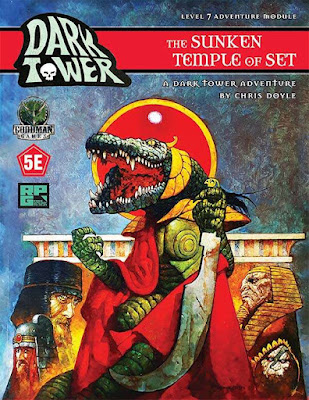
[Free RPG Day 2021] Dark Tower: The Sunken Temple of Set

Now in its fourteenth year, Free RPG Day in 2021, after a little delay due to the global COVID-19 pandemic, took place on Saturday, 16th October. As per usual, it came with an array of new and interesting little releases, which traditionally would have been tasters for forthcoming games to be released at GenCon the following August, but others are support for existing RPGs or pieces of gaming ephemera or a quick-start. Of course, in 2021, Free RPG Day took place after GenCon despite it also taking place later than its traditional start of August dates, but Reviews from R’lyeh was able to gain access to the titles released on the day due to a friendly local gaming shop and both Keith Mageau and David Salisbury of Fan Boy 3 in together sourcing and providing copies of the Free RPG Day 2020 titles. Reviews from R’lyeh would like to thank all three for their help.

—oOo—

Goodman Games provided two titles to support Free RPG 2021, both of which were highly anticipated. One was Tomb of the Savage Kings, an adventure for the Dungeon Crawl Classics Role Playing Game. The other was potentially much more interesting. As its name suggests, Dark Tower: The Sunken Temple of Set is an expansion for 
Dark Tower, the scenario written by Jennell Jaquays and published by Judges Guild in 1979. The scenario details a dungeon built around two buried towers contested over by followers of Set and Mitra and the surrounding lands and has a strong Eastern Mediterranean and Egyptian flavour. Regarded as a classic, Dark Tower was included in ‘The 30 Greatest D&D Adventures of All Time’ at number twenty-one in the ‘Dungeon Design Panel’ in Dungeon #116 (November 2004)—notable because it was the only third-party scenario to be included on the list. In March, 2021, Goodman Games announced it had acquired Dark Tower from the Judges’ Guild, and would republish it for use with both Dungeons & Dragons, Fifth Edition and the Dungeon Crawl Classics Role Playing Game.

Dark Tower: The Sunken Temple of Set is a mini-adventure for Dungeons & Dragons, Fifth Edition which adds an extra area which can be added to the new edition of the Dark Tower scenario. This is a flooded box canyon to the east of the village of Mitra’s Fist at the far end of which stands a partially flooded, and as the Player Characters will discover, cursed temple. At first, it appears to be abandoned, but as they explore further, they are warned off, and then ultimately, will find signs of occupation. Here resides more agents of Set and their allies, each pursuing their own agenda—whether for or against the god of deserts, storms, disorder, violence, and foreigners. And that agenda may even see them giving aid to the invading Player Characters. The valley and temple complex are described in just eleven locations, but each location is highly detailed and easy to place on the nicely done map. The temple itself contains a good mix of traps, secret doors, a puzzle or two, and of course, nasty crocodilian and serpentine threats, many of which will be a challenge to defeat by the Player Characters. There is a decent amount of treasure to be found, as well as some singular magical items which do tie with the Dark Tower scenario.

Dark Tower: The Sunken Temple of Set is designed to be played by four to sixth Player Characters of Seventh and Eighth Level. In addition to the nasty reptilian threats they will encounter, the main challenge in the scenario is the environment—much of the temple is flooded. This will make fighting and exploring in those locations difficult. The scenario includes a decent background and several hooks which the Dungeon Master can use to persuade her players and their characters to investigate the valley and the temple. These work even if Dark Tower: The Sunken Temple of Set is not used as an expansion to Dark Tower, but work better if they are. In addition to detailing new weapons and magical items, the module details two new spells—Snake Charm and Ticks to Snakes.

Physically, Dark Tower: The Sunken Temple of Set is decently presented. The artwork is excellent, the cartography good, and whilst it needs a slight edit in places, the scenario is well written. Dark Tower: The Sunken Temple of Set is a good module which should challenge the Player Characters and provide everyone with a session or two’s worth of play. Dark Tower: The Sunken Temple of Set will make a fine addition to Goodman Games’ new version of Dark Tower, and is probably worth putting on hold until the two can be run together.

Saturday, 18 September 2021

Goodman Games Gen Con Annual IV

Since 2013, Goodman Games, the publisher of the Dungeon Crawl Classics Role Playing Game and Mutant Crawl Classics Roleplaying Game – Triumph & Technology Won by Mutants & Magic has released a book especially for Gen Con, the largest tabletop hobby gaming event in the world. That book is the Goodman Games Gen Con Program Book, a look back at the previous year, a preview of the year to come, staff biographies, and a whole lot more, including adventures and lots tidbits and silliness. The first was the Goodman Games Gen Con 2013 Program Book, but not being able to pick up a copy from Goodman Games when they first attended 
UK Games Expo in 2019, the first to be reviewed was the Goodman Games Gen Con 2014 Program Book. Fortunately, a little patience and a copy of the Goodman Games Gen Con 2013 Program Book was located and reviewed, so now in 2021, normal order is resumed with the Goodman Games Gen Con 2016 Program Book.

The Goodman Games Gen Con 2016 Program Book is a double anniversary and warrants a double cover. In fact, it is a double fortieth anniversary. The Goodman Games Gen Con 2016 Program Book celebrates not just forty years since the publication of Metamorphosis Alpha, but also forty years since the founding of Judges Guild. To celebrate, it includes not just content dedicated to Metamorphosis Alpha and Judges Guild, but sports a handsome double cover—one for Metamorphosis Alpha and one for Judges Guild. In addition to the celebrations, the anthology includes support for the Dungeon Crawl Classics Role Playing Game, the Appendix N, and more, along with the usual fripperies and fancies to be found in each volume of the Goodman Games Gen Con Program Book. Which means scenarios, articles, histories, quizzes, and more. After all, Goodman Games Gen Con Program Book is not just for Christmas, it is for Gen Con!

The Metamorphosis Alpha support begins with ‘Forty Years of Metamorphosis Alpha: A Legacy of Innovation’ by Craig Brain. This charts the history of the roleplaying game across numerous and not always successful editions, and is a nice accompaniment to the anniversary edition of Metamorphosis Alpha. If there is a major omission to the article it that it should have included images of the covers of these editions. That would have given the article some context and tied it more into the individual editions. It is followed by ‘Metamorphosis Alpha: 4 Tables 40’, a quartet of tables by the roleplaying game’s designer, James M. Ward. The tables, each with forty entries, cover ‘GEL Nanobots’, ‘Surprisingly Good Things’, ‘Traps for the Unwary’, and ‘Unusual Things’, and all provide good inspiration. For all that Goodman Games Gen Con 2016 Program Book celebrates the fortieth anniversary of Metamorphosis Alpha, the actual gaming content for it is thin. A scenario or an area aboard the Starship Warden fully detailed, would perhaps have served as a better selling point for Metamorphosis Alpha.

The fantasy gaming content begins with more letters for The Dungeon Alphabet: An A-Z Reference for Classic Dungeon Design by Michael Curtis. These are ‘G is also for Guardians’ and ‘H is also for Hazard’ and just like the supplement they are inspired by and written for, they consist of tables devoted to their subjects. Both are generic fantasy, but easily adapted to the retroclone—or even not of the Game Master’s choice. This is as entertaining and as inspirational as the original book, and perhaps Goodman Games should think about returning to original supplement, if not in a reprint then in a full sequel with another twenty-six entries.

As expected for a volume in the Goodman Games Gen Con Program Book series, the majority of the gaming content is designed for use with the Dungeon Crawl Classics Role Playing Game. It begins with Michael Curtis’ ‘The Return of the Wild’, which gives a new Patron god for his Shudder Mountains setting from The Chained Coffin campaign. This is Nengal the Wild One, a primal force of raw nature, and comes complete with tables for Invoke Patron checks and Patron Taint. The Patron spells feel somewhat underwritten, but the unfettered and raw nature of the god and his faith should provide some fun roleplaying opportunities.

Dieter Zimmerman contributes the first scenario in the anthology, a wholly new, and weirder introduction to the Dungeon Crawl Classics Role Playing Game. The scenario is a Character Funnel, one of the signature features of the Dungeon Crawl Classics Role Playing Game in which initially, a player is expected to roll up three or four Level Zero characters and have them play through a generally nasty, deadly adventure, which surviving will prove a challenge. Those that do survive receive enough Experience Points to advance to First Level and gain all of the advantages of their Class. Typically, such Player Characters are peasants and the like from the average fantasy world, but here Zimmerman takes the idea of the ordinary person from Earth being transported to a fantasy world where he or she becomes a great hero the Dungeon Crawl Classics Role Playing Game

So first, in ‘1970’s Earth Characters for DCC’, Zimmerman gives tables for Occupations, Personal Items, and Astrology so that the players can create some funky characters ready for their strange encounter in the accompanying scenario. This is ‘Not in Kansas Anymore’, co-authored with Matt Spengler, a reverse dungeon up through Ezaurack’s Volcano Fortress in which the would-be heroes not only have to save the day against a viscous dragon cult, but do so whilst avoiding rising lava! The scenario is as over the top as you would expect and best played as if the Player Characters—let alone the players—have no idea as to what is going on. Indeed, the scenario is intended as an introduction to the roleplaying game. It is as fun and as gonzo as you would expect, and all it needs is a dose of Doug McClure.

Another then new would-be licence comes under the spotlight with Michael Curtis, not once but twice. First with ‘Rat-Snake: A Lankhmar Wagering Game with Dice’ provides the full rules for a gambling game set in Fritz Leiber’s Nehwon and the tales of Fafhrd and the Gray Mouser. Prefiguring the release of Dungeon Crawl Classics Lankhmar the year  following the Goodman Games Gen Con 2016 Program Book, this is an immersive addition to the setting and should find its way into the Player Characters’ adventures in the city of thieves. Second, with ‘The Hand of St. Heveskin’, which details an artefact sacred to the Rat God, but which anyone can use—though there is some danger in doing so. Although presented for Lankhmar, this would work in almost any fantasy setting and is a very well done and themed item. The adjacent list of publication dates for the Fafhrd and the Gray Mouser stories is also welcome.

Gen Con is of course, a very big event, and Goodman Games supports it with a tournament adventure that both fans of the publisher and attendees in general can join in and play. Instead of the typical adventure, in 2015, Goodman games offered ‘The Way of the Dagon’, a spell duelling tourney. Instead of a party of adventurers delving into deep, dark hole, this has wizards and sorcerers throwing spells at each other for the pleasure of Father Dagon. Spelling duelling is part of the Dungeon Crawl Classics Role Playing Game and this module gives the full rules for such arcane battling in the realm of Father Dagon. It works a little different to standard spell duelling, adjusting counterspell power and adding the Wrath of Dagon, plus a little bit of randomness to play. This would be fun to play at the table with a normal group as change, but really comes into its own as a big event. The notes on how the event’s origins and the report on some of the game play are entertaining also.

However, the Goodman Games Gen Con 2016 Program Book includes a Dungeon Crawl Classics Role Playing Game Tournament Funnel too. Written by Jim Wampler, Stephen Newton, Daniel J. Bishop, Jeffrey Tadlock, Jon Marr, and Bob Brinkman, ‘Death by Nexus’, which as the title suggests, is another Character Funnel. However, instead of three or four Level Zero Player Characters per player, each only has one, and when a character dies, his player is out and replaced by another player and his character, and this goes on until the end of the scenario. In ‘Death by Nexus’ nine such characters, three each for the three Alignments—Law, Neutrality, and Chaos—are thrown into six different and increasingly challenging arenas for the entertainment of the Primal Ones. Each written by a different author, the arenas vary wildly, from a combination of ice, wind, and fire to a giant sandbox via the end times. Combat focused instead of the spelling-slinging focus of the earlier ‘The Way of the Dagon’, this Tournament Funnel is again fun and silly and over-the-top.

Harley Stroh expands on his ‘Glossography of Ythoth’ from the campaign, Perils on the Purple Planet (now sadly out of print), with ‘Appendix D: Ythothian Liche Kings’ with a guide to the corpse kings who prey on dimensional travellers and possess various psychic powers. This is a nasty monster which no player would his character to encounter, but the dimensional originals means that one of these could turn up anywhere.

Appendix N is an important facet of the Old School Renaissance since its original list of books in the back in the Dungeon Master’s Guide for Advanced Dungeons & Dragons, First Edition showcased the inspiration for original roleplaying game. The Goodman Games Gen Con 2016 Program Book shows how the authors of various titles for Dungeon Crawl Classics Role Playing Game have delved into its equivalent of Appendix N in search of their own inspiration. It opens though with ‘The Way of Serpents’, a short story by Howard Andrew Jones which is also inspired by Appendix N fiction. This is nicely enjoyable piece in the Swords & Sorcery vein, which tells of a priestess and a veteran soldier forced to seek aid from a dragon to save a kingdom not his own. The short story is accompanied by some game content, in particular stats for the creatures encountered in the story.

In ‘Appendix N Inspiration’, sources are in turn discussed for Peril on the Puppet Planet, DCC #87 Against the Atomic Overlord, The Chained Coffin, The 998th Wizards’ Conclave, and Doom of the Savage Kings. All provide insights as to the creative process and suggest authors and their works that would be worth reading prior to running any one of them. Those for DCC #87 Against the Atomic Overlord and The Chained Coffin are longer, more detailed, and more interesting for it. In hindsight, the inspiration for The 998th Wizards’ Conclave is the most interesting because it prefigures the recent development of Jack Vance’s The Dying Earth for the Dungeon Crawl Classics Role Playing Game.

Perhaps the highlight of the Goodman Games Gen Con 2016 Program Book is ‘An illustrated interview with Errol Otus’. This runs to almost forty pages and covers the classic fantasy gaming artist’s time at TSR, his time after, and his return to the hobby industry with both the Dungeon Crawl Classics Role Playing Game and then the Old School Renaissance. It is an entertaining read and is profusely illustrated with paintings and drawings from across his career, serving as a showcase for both. The only disappointment is that the covers that Otus did for Goodman Games have not been reproduced in colour. All it would have taken is another two pages of colour and it would have pleasingly rounded off his contributions up to 2016.

The other half of the fortieth anniversary celebrations in the Goodman Games Gen Con 2016 Program Book is dedicated to Judges Guild and this is celebrated by another pair of articles. It is an unfortunate truth that the reputation of the publisher has been greatly damaged in the years since the publication of these two articles, but this should not mean that the contributions to the hobby by Judges Guild should be ignored. ‘Forty Years Judges Guild: A Legacy of Awesome’ by Jeff Rients—author of Broodmother Skyfortress—presents a history of the publisher from founding to closure, along with a look at a few of the releases over that history... It is informative, but this is very much written from a personal rather than an objective point of view, accompanied with a discussion of the author’s favourite titles. There are of course, more objective histories of Judges Guild available, such as the Judges Guild Deluxe Oversized Collector’s Edition and Designers & Dragons: the ‘70s. Ultimately, what lets this article down is the lack of captions for its various photographs taken from Judges Guild history.

It is followed by ‘Unknown Gods: Revised and Expanded’, by Robert Bledsaw, Sr. and Robert Bledsaw, Jr. This presents an expansion to The Unknown Gods, the 1980 supplement supplement of grandiose gods and deities which would have been particular to the Wilderlands of High Fantasy setting. From Grunchak, Markab God of Technology to Margonne, God of Evil Plans, the Devious Ones, they are all quite detailed and quite different to the gods seen elsewhere in fantasy, as well as each possessing a certain weirdness. That weirdness applies to the statistics given for each god, which use a different system singular to the original supplement rather than any variant of Dungeons & Dragons. It would be fascinating to see the whole of the supplement updated with this content for a game system that was more accessible.

Rounding out the Goodman Games Gen Con 2016 Program Book is the usual collection of fripperies and fancies. The silliness includes the advice column, ‘Dear Archmage Abby’, in which the eponymous agony aunt gives guidance on life, love, and the d20 mechanics in an entertaining fashion—this time what t do about rules lawyers, whilst the fripperies includes artwork for the ‘2015 to 2016 Mailing Labels’, which capture a bit more of Goodman Games in 2015. Elsewhere there is a quiz or two, interviews with several of the Judges who work as the Goodman Games Road crew, a photographic recap of Gen Con 2015, and more.

Physically, the Goodman Games Gen Con 2016 Program Book is a thick softback book. It is decently laid out, easy to read, lavishly illustrated throughout, and a good-looking book both in black and white, and in colour.

On one level, the Goodman Games Gen Con 2016 Program Book, as with other entries in the annual series, is an anthology of magazine articles, but in this day and age of course—as well as 2016—there is no such thing as the roleplaying magazine. So what you have instead is the equivalent of a comic book’s Christmas annual—but published in the summer rather than in the winter—for fans of Goodman Games’ roleplaying games. The Goodman Games Gen Con 2016 Program Book follows closely the format of the previous entries in the series, so there is bit of everything in its pages—gaming history, adventures, previews, catch-ups, and more. Its celebrations of the two fortieth anniversaries—Metamorphosis Alpha and Judges Guild—are underwhelming, but everything else in the Goodman Games Gen Con 2016 Program Book is either fun or entertaining, sometimes even both. As ever the Goodman Games Gen Con 2016 Program Book is a must for devotees of the Dungeon Crawl Classics Role Playing Game, but there is plenty in the annual supplement for fantasy gamers to enjoy or be inspired by.

Sunday, 22 April 2018

Retrospective: Broken Tree Inn

As one of the first licensees, Judges Guild was in its heyday, a highly prolific publisher, releasing not only scenarios and supplements for Dungeons & Dragons and Advanced Dungeons & Dragons, but also Traveller, Chivalry & Sorcery, DragonQuest, Tékumel: Empire of the Petal Throne, Tunnels and Trolls, RuneQuest, Superhero 2044, and Villains and Vigilantes. Since its heyday of the late 1970s and early 1980s, quite a few of those products have remained held in high regard, such as City State of the Invincible Overlord, Tegel Manor, Dark Tower, and so on, these titles often being brought back into print by other publishers. That said, given the sheer number of titles published by Judges Guild, the truth is that the quality of a very great many of them was far from being professional by the standards of the day, let alone by those of today. Nevertheless, there are many that are worth examining almost four decades after they were first published and many worth bringing to your table almost four decades after they were first published. One of these is Broken Tree Inn.

Broken Tree Inn is a scenario written for use with RuneQuest, Chaosium, Inc.’s roleplaying game of myth, faith, and heroism set in Glorantha. That said, it is not specifically set in Glorantha, but uses a lot of details which would otherwise be found in Dragon Pass—the Aldryami, Trollkin and Zorak Zoran, Issaries, and so on. Notably, Broken Tree Inn is written by Rudy Kraft, the co-designer of RuneQuest, and with Greg Stafford, the co-author of Snakepipe Hollow. Indeed, it is from this last scenario that the contents of Broken Tree Inn were cut and semi-deGlorantha’ed.

Instead, Broken Tree Inn is set in a disputed area, an area which was only relatively recently occupied by The Human Empire which established a series of forts to protect itself against a perceived threat from Tall Seed Forest, home to many thousands of Aldryami and Elves. Tensions of late have risen between the Aldryami and The Human Empire because the forts were built from wood cut from Tall Seed Forest, but the magical protections woven into the forts during their construction means that the Elves cannot attack them. Enter the player characters…

Designed to be played novice adventurers as well as Rune level adventurers, Broken Tree Inn essentially presents two locations and three factions in quite some detail. They include the Broken Tree Inn of the title, a wayside inn noted for the twisted and bent tree outside its doors, which stands amidst farmland on the frontier with The Human Empire and a fairly rough fortress garrisoned by soldiers of The Human Empire. The factions include the owners of the Broken Tree Inn, the garrison at the fort, and just some of the Aldryami and Elves of Tall Seed Forest. In the case of the first and the third, the author presents quite a lot of detail about them, their background and history, and what they might do should they be attacked.

In terms of scenarios, Broken Tree Inn offers three hooks. In the first, the Aldryami of Tall Seed Forest hire mercenaries to help destroy the forts and so take revenge upon The Human Empire. In the second, the player characters are spending the night at the fort when the Aldryami attack, whilst in the third, The Human Empire is looking to hire mercenaries to capture one of the Aldryami and return them for questioning. Of the three hooks, the first has the most gaming potential as written, but all three options are supported with extensive stats for the various factions as well as the staff of the Broken Tree Inn and various wandering monsters. There are also a few suggestions as to what to do with the setting beyond the gaming possibilities of the three scenarios.

Physically, Broken Tree Inn is surprisingly impressive. Not fantastic necessarily, but not as rough and rushed as other titles from Judges Guild. The maps are clear if a little bland in paces; the cover by Paul Jaquays is good; the internal artwork—some of it by Kevin Siembieda—is also fairly good; and the writing is generally good. Overall, the production values of Broken Tree Inn are pretty good given its publisher.

The one significant review of Broken Tree Inn at the time of its release, appeared in The Space Gamer No. 30 (August 1980). Forrest Johnson wrote, “Unfortunately the designer spends a lot of time giving elaborate histories and details which give more depth than variety.” before concluding, “BROKEN TREE INN will work for almost any GM, but it could be a dull adventure in the hands of a novice.” This is a fair assessment, and it certain goes against the publisher’s description of the book as a ‘RuneQuest Gateway Adventure’, because the designer never really presents an adventure in the sense of plot, events, and above all, story. Now Broken Tree Inn is of course, a product from a time when such things relatively new and novel, but within a year or two of this supplement’s release they would be standard with modules such as U1 Sinister Secret of Saltmarsh for Advanced Dungeons & Dragons, First Edition. What this means is that the Judge—or Game Master—will have some story development or improvising to do of her own to effectively run these adventure ideas, and that is before she develops further adventures around the region.

By modern standards, Broken Tree Inn is more of a sourcebook than an adventure and so a little underwhelming. In some ways, there is more scope for development in the material presented in its pages than this than there is roleplaying to be gamed off the page. A good Judge could certainly develop further the region and more adventures, whilst a good Game Master could take the contents of Broken Tree Inn and slip back into Glorantha where it belongs. Whilst it may be no Dark Tower, or indeed, Duck Tower, overall, Broken Tree Inn is a good example of a supplement of its time.

Sunday, 26 February 2017

A Treasury Relic

As one of the first licensees, Judges Guild was in its heyday, a highly prolific publisher, releasing not only scenarios and supplements for Dungeons & Dragons and Advanced Dungeons & Dragons, but also Traveller, Chivalry & Sorcery, DragonQuest, Empire of the Petal Throne, Tunnels and Trolls, RuneQuest, Superhero 2044, and Villains and Vigilantes. Since its heyday of the late 1970s and early 1980s, quite a few of those products have remained held in high regard, such as City State of the Invincible Overlord, Tegel Manor, Dark Tower, and so on, these titles often being brought back into print by other publishers. That said, given the sheer number of titles published by Judges Guild, the truth is that the quality of a very great many of them was far from being professional by the standards of the day, let alone by those of today. Nevertheless, there are many that are worth examining almost four decades after they were first published and many worth bringing to your table almost four decades after they were first published. One of these is The Book of Treasure Maps.

The Book of Treasure Maps was designed, written, and illustrated by Paul Jaquays, the designer best known for the dungeons Dark Tower and Caverns of Thracia. Published in 1979, The Book of Treasure Maps was a first in two ways. The first and obvious is its cover, which is not an illustration, but a photograph, this of the author and his friends engaging in a LARP. The second is that The Book of Treasure Maps contains not one, but five adventures or dungeons. Since the publication of G1, Steading of the Hill Giant Chief by TSR, Inc. in 1978, dungeons or adventures had been singular affairs, but The Book of Treasure Maps is an anthology, a quintet of mini-dungeons, the only connection between the five being that they are set in the Wilderlands of High Fantasy, Judges Guild’s campaign world. Of course, the DM need not set any one of the five dungeons in the Wilderlands of High Fantasy, but he will need to adjust their accompanying clues to fit the campaign world of his choosing.

It is a format that Judges Guild would return to with the publication of The Book of Treasure Maps II and The Book of Treasure Maps III, and TSR, Inc. would visit the concept itself in 1992 with the release of GR3 Treasure Maps for use with Advanced Dungeons & Dragons, Second Edition. The origins of the concept lie in the fact that in the 1970s, treasure in Dungeons & Dragons did not consist of just jewels, gems, and coins, but would often include a treasure map. This would be lure enough for the players and their adventurers to follow the clues that such a map would present to an adventure that the DM had prepared. What The Book of Treasure Maps contains then, are treasure maps and their associated dungeons. The treasure maps in this anthology include not only maps but scrolls and book excerpts, notably with permission given to photocopy them and use them as handouts for the players to pore over. Of course the fact that the players were being given a handout in 1979 was rarity enough to ensure their interest. The dungeons themselves are designed for characters of medium to high level, so roughly Sixth, Seventh, and Eighth Levels.

The Book of Treasure Maps begins with ‘The Lost Temple’. Located on a map in The Fantastic Wilderlands Beyonde supplement, the clue to this dungeon comes from a journal entry describing a long and ultimately failed journey. Its thirteen room complex details an abandoned oracle, rumoured to be home to a demon. It is a relatively straightforward affair, but what it illustrates is that there is still plenty of play to be got out of a dungeon even if the players and their characters have been already been given most of its locations on the map. Despite the book being written for use with Dungeons & Dragons, there is a nice nod in the adventure to David A. Trampier’s iconic cover for the Player’s Handbook which was published the year before and depicts the attempted theft of the giant gems used as eyes in the statue of a demon. Although ‘The Lost Temple’ harks back to an era when a dungeon was a dungeon for a dungeon’s sake, it is nevertheless a short and serviceable affair.

There is no lack of purpose to ‘The Tomb of Aethering the Damned’. It is as the title suggests, a tomb, this of an evil lord and it is said, the members of his family. As with ‘The Lost Temple’ it consists of relatively few locations and its map can be found in The Fantastic Wilderlands Beyonde supplement. The tomb is home to lots of the undead and some rather cruel traps. In fact, the traps feel just a little cruel by modern standards, but by the conventions of the day and given the fact that this is the tomb of an evil tyrant, they are more than fitting. This being a tomb and there being a mummy that makes an appearance there is a slight Ancient Egyptian feel to this adventure, the focus of which is on the encounters with Lord Aethering, his wife, and his son. Though all of the locations of in the tomb are quite detailed, particular attention is paid to the encounters with these three NPCs and the DM should have some fun with them and the curses involved in two of them. In particular, the possible change in gender and character following the encounter with Athering’s wife will be a challenge for the DM and player alike, but a memorable one at that.

The highpoint to The Book of Treasure Maps is the third scenario, ‘The Lone Tower’. Where the previous two scenarios have been a little pedestrian, this leaps out and buries its fangs into gothic horror in the best style of Hammer Horror. Located on a map from the Wilderlands of High Fantasy, ‘The Lone Tower’ consists of a gothic tower mansion that is home to the Lady Clearmoon and which can only be accessed on nights of the full moon. Further, the clue to its location is inscribed on a round, magical shield and is only revealed in the moonlight. From all of these references to the Moon it should be clear what the threat is in this adventure actually is—werewolves! And this is the case, the chateau-style mansion being infested with them. Although the forty or so locations in the chateau are in effect a dungeon, its design and layout as a chateau gives it a naturalism that adds to the horror themes. The adventure includes a plot or three, though the DM will need to give the adventure a thorough read through since they are not discussed up front. These involve the adventure’s main NPCs and any DM will relish getting to roleplay them.

At fifteen pages long, with more artwork and cartography, both of which fit the genre, ‘The Lone Tower’ is the longest adventure in The Book of Treasure Maps, but it does feel as if it should be longer and further developed. It feels not a little reminiscent of I6 Ravenloft, the classic Gothic vampire adventure published by TSR, Inc. in 1983—or rather, I6 Ravenloft feels not a little reminiscent of ‘The Lone Tower’. Of all the adventures in The Book of Treasure Maps, this feels like the one that the designer loved the most. 

After ‘The Lonely Tower’, the other two mini-dungeons in The Book of Treasure Maps feel somewhat underwhelming, but rather that is indication of how good ‘The Lone Tower’ is in comparison. The clue to ‘Willichidar’s Well’ is in a history book which describes a smoking well found atop a bald hill. Located on a map in Wilderlands of the Magical Realm supplement, ‘Willchidar’s Well’ consists of five locations and is just six pages long. Its design is that of a dungeon as a trap for the all too curious. Investigate too far, get just a little too greedy, and the player characters will unleash a demon lord that could very well defeat them if they do not act quickly. Perhaps the fun at this point will be when the player characters find themselves fighting alongside demons as they try to defeat the unleashed demon lord. ‘Willchidar’s Well’ is a nasty one-session adventure, but fighting alongside demons—and possibly some divine beings from other factions—will make this an epic encounter.

The fifth and final dungeon is ‘The Crypts of Arcadia’. Unlike the other mini-dungeons in The Book of Treasure Maps, this dungeon does not have a specific location, but the DM is encouraged to read through it carefully and select a place to locate it based on the background given. In fact, this background or backstory is probably more interesting than the dungeon itself. The crypts are actually the burial vaults for the Church of Arcadia, a faith that promised eternal life and flourished many years ago before being discovered that it was an inadvertent front for a deity building an army of the dead and so the faithful sealed the vaults, smashed the temple, and went back to worshipping whatever god they had been worshipping before their conversion to the now false faith. Unfortunately the vaults still exist, the local thieves guild knows of them, but not their location or that of the only map ever made. The player characters are of course, about to come into possession of the map. Thus it should be a race to get into the vaults, past the endless hordes of the undead, get the treasure, and get out again.

The design of the dungeon is such that both its key encounters and content can be placed randomly, whether by DM decision or his making rolls on the provided tables. The aim being to ensure that no two playthroughs of the dungeon would ever be the same, but the result is that the DM does need to work that little extra to make it live up to the backstory.

Physically, The Book of Treasure Maps is printed on cheap paper and so feels cheap. Yet it is well written, the artwork is good, the maps are clear, and at worst, it needs another proofreading.

By the standards of 1979, all five dungeons in The Book of Treasure Maps are solid pieces of design and writing. They are all good dungeons and with a little adjustment here and there could be run using Dungeons & Dragons, Fifth Edition or the retroclone of your choice. Indeed these are exactly the types of dungeon that the Old School Renaissance harks back to, stripped back, deadly dungeons. Yet there is atmosphere and even plot here too in one or two of the adventures and there is no reason why a group could not be challenged by or enjoy these mini-dungeons after all this time.

As good or as solid pieces of dungeon design as the five mini-dungeons are in The Book of Treasure Maps, there is one very good dungeon in the anthology. This is ‘The Lone Tower’, an entertaining slice of horror gaming that leaves this reviewer wishing that it could have been longer and that the author would come back and write some more.

Sunday, 3 January 2016

Designers & Dragons I

As the gaming hobby reaches middle age, its sense of nostalgia and reflection have not only driven it to look to the past to bring back old games in new editions, but also to take an interest in its own history. Although there have been books about the hobby, they have tended to be minor affairs such as The Fantasy Roleplaying Gamer's Bible; focused on particular aspects such as 40 Years of Gen Con and Hunters of Dragons; or academic works like First Person: New Media as Story, Performance, and Game. A complete history of the gaming hobby, that is, of the roleplaying gaming hobby, did not exist until 2011, when Mongoose Publishing released Designers & Dragons, a buff hardback that would win a Special Award at UK Games Expo and a Judges’ Spotlight Award ENnie in 2012. This single volume collected the ‘A Brief History of Game’ columns written by Shannon Appelcline that ran between 2006 and 2011 on RPG.net. Unfortunately, the book got a limited print run and it was published by Mongoose Publishing, so received neither the push nor the quality that such a book deserved.

Fortunately, a successful Kickstarter campaign and another publisher, Evil Hat Productions, LLC, best known for publishing Fate Core, has enabled the author to not only revisit those columns, but also to expand, revise, and update them. The result is Designers & Dragons: A History of the Roleplaying Game Industry series—not one single volume, but as of 2015, five volumes. The first four volumes each address a single decade of the history of the industry, in turn the seventies, the eighties, nineties, and the noughties, whilst the fifth, The Platinum Appendix is a collection of miscellaneous articles. It should be noted that this series covers only the English speaking market of the hobby, and although that this is where it stemmed from and the one that remains the largest, it ignores the various other language markets. This is not to say they are not important or that they do not have influence upon the industry—as will be seen in later volumes, but the history of the gaming industry in the French, German, Italian, Japanese, Spanish, Swedish, and other language markets will have to wait for a further volume or at least another history.

The first volume is Designers & Dragons: the ‘70s. Now that suggests that it deals with just the foundation of the hobby and the period between 1974 and 1979 when this is not really the case. It does indeed detail the industry’s beginnings and early development, but it really begins by laying the foundations of the industry in the hobbies of E. Gary Gygax and Dave Arneson beginning with their exposure to Avalon Hill’s Gettysburg wargame in 1958 and thus their interest games and the fantasy genre. Further, what it really does is tell the histories of the publishers that were founded in the 1970s right up to their closure, their bankruptcy, or indeed, their current status, rather than abruptly cutting off in 1979. Thus it gives us the histories of thirteen publishers, seven of which are no longer in business, two are a shadow of their former selves, and four are still in business. These histories are of TSR, Flying Buffalo, Games Workshop, GDW, Judges Guild, Metagaming Concepts, Fantasy Games Unlimited, Chaosium, Gamescience, Heritage Models, Grimoire Games, DayStar West Media, and Midkemia Press. Of these, the histories of Judges Guild, Metagaming, and TSR have been expanded since their appearance in the previous version of Dungeons & Designers, whilst those of DayStar West Media, Gamescience, Grimoire Games, Heritage Models, and Midkemia Press are new additions.

Designers & Dragons: the ‘70s is divided into four parts—‘Part One: Founding Days (1953—1974)’, ‘Part Two: The Floodgates Open (1975—1976)’, ‘Part Three: The First Wargaming Phase (1976—1977)’, and ‘Part Four: Universal Publishers (1978—1979)’. The first part is solely devoted to the history of TSR, comprising in total, a quarter of the book. This is understandable, since TSR both founded and dominated the hobby for three decades and more. Now, Jon Peterson’s Playing at the World explores this history in more detail, but since the remit of Designers & Dragons: the ‘70s is much wider, it is not quite as scholarly or as detailed. Now this is not to detract from the detailed historical overview that is Designers & Dragons: the ‘70s, as this is an immensely readable history. Rounding each of the company histories is set of pointers as to what to read next, further connections to the company's history, and what to read next in order to find out more about its luminaries. For example, the history of TSR suggests that the reader can simply read on to find out about the second RPG publisher, Flying Buffalo; or to find out about its first licensee, read the chapter on Judges Guild; read the chapter on Wizards of Coast to learn more about the later history of Dungeons & Dragons; and to see what E. Gary Gygax did next, read the chapters on New Infinities Productions, GDW, Hekaforge Productions, and Troll Lord Games in this and future volumes in the series. Of course these are hangover from the original presentation of this material as regular online columns accompanied by hyperlinks. As hyperlinks, these only work in the PDF versions of these volumes, but as pointers they are nevertheless useful.

Throughout each chapter, sidebars and lengthy boxed subsections—sometimes lasting several pages, explore particular aspects of a company’s history in detail. So for TSR, sidebars and subsections look at how much early RPGs cost, the history of the Greyhawk setting, the D&D Cartoon, Dungeons & Dragons computer games, and Dungeons & Dragons comics. Other sidebars explain both Steve Jacksons, Judges Guild’s The Wilderlands setting, details Different Worlds magazine, and more. In addition, mini-histories are given of minor publishers such as Wee Warriors and Little Soldier Games.  These are short pieces, but their inclusion is an indication of their influence upon the industry. For example, in the form of The Character Archaic and Palace of the Vampire Queen, Wee Warriors published the first commercially available character sheet and the first standalone adventure respectively.

Rounding out the first volume in the series are the appendices that give ‘10 Things You Might Not Know About Roleplaying in the ‘70s’, a bibliography, and a good index. Physically, the oxblood-covered Designers & Dragons: the ‘70s is well written, decently illustrated—though sadly in black and white—and decently organised. It does need an edit here and there, but these are minor issues. The index looks to be decent enough and supports the pointers are end of each write-up.

As a history, Designers & Dragons: the ‘70s is informative and knowledgeable, helped by the fact that the author can draw from a great many primary sources, that is, the many of those who were involved in the early days of the hobby. Unfortunately, the deaths of other significant figures mean that he has instead had to consult secondary sources. Nor is the history an exact one, but the author is open and honest where this is the case, whether due to conflicting stories or sources. This only points to the fragility of our hobby, the industry, and our collective memories—and thus the aim of Designers & Dragons, that is, to have a definitive record. Or at least as definitive a record as is possible.

Having been writing about games for over fifteen years and been collecting for much longer, my knowledge of the hobby is decent enough, but this does not mean that references—old or new—are not useful or unwelcome. For many years, Lawrence Schick’s Heroic Worlds has been a useful guide to RPGs and supplements published before the early nineties, whilst more recently, Hunters of Dragons proved a useful reference for Dungeons & Dragons. Now both of those books have been joined by the Designers & Dragons series. On a broad scale, my knowledge of the industry and its history is reasonable enough, but nevertheless, Designers & Dragons: the ‘70s builds on that knowledge, adding greatly to it, especially in its coverage of the new additions to this volume. So even the most informed of gamer—like myself—is likely to find something of interest in Designers & Dragons: the ‘70s, whilst anyone relatively new to the hobby will find it as definite a history of the industry during this period as there is, but whatever their level of knowledge, both will find Designers & Dragons: the ‘70s an informative and thoroughly engaging read.

Sunday, 16 June 2013

Dungeoneering & Dragon Hunting

Roleplaying is all but forty years old, and thus, so is Dungeons & Dragons. As evidenced by the recent number of books that detail the hobby’s history, role playing has become something more than just a silly game. Mongoose Publishing’s Designers & Dragons, MIT Press’ Second Person – Role-Playing and Story in Games and Playable Media, and McFarland’s The Evolution of Fantasy Role-Playing Games are all testament to that. Further, they have also become collectable, and none more so than Dungeons & Dragons. Collecting Dungeons & Dragons has always been something of challenge, for although sites like eBay and The Acaeum have made the task much, much easier, what collecting has always lacked is a guide. That is, until now.

Published by Italian publisher Wild Boar Edizioni srl through Chronicle City, Hunter of Dragons – The Original Dungeons & Dragons Collecting Guide is the complete guide to collecting Dungeons & Dragons. It is important to note this because its focus is entirely on Dungeons & Dragons and what that game became, Basic Dungeons & Dragons, rather than its bigger, bolder, better supported, if not bloated, younger brother, Advanced Dungeons & Dragons. Its time frame is also thus limited to just a nineteen-year time frame from 1974 to 1993. Within that span it not only covers the various editions of the game, adventures and accessories, miscellaneous items and unreleased products, but also titles from Judges Guild too! It is even more important to note that Hunter of Dragons is not a price guide. That would be impossible to accurately report given that such prices are constantly changing. So instead, it gives a rarity value for each entry.

Hunter of Dragons opens with “The History of Dungeons & Dragons” before discussing “The various editions of Dungeons & Dragons.” What is surprising to note is that there are as many editions as there are – six all together. Each edition is given its own entry with each entry giving the book or product name, its publication date, the names of its designers, its contents, its rarity, some notes, and whether there were any foreign editions. These include the Australian and British editions as well as those in French, German, Portuguese, and Spanish, and even the Japanese and Hebrew books! Some entries also include a trivia entry, for example that B3 The Palace of the Silver Princess Orange version is one of the few TSR titles to have been written by a woman and is one of the most sought after items for Dungeons & Dragons – more so than the fabled ST1 Up the Garden Path. Each section ends with a thumbnail illustration of each of the entries it includes.

Although the book has no index, it is neatly organised. Each section is broken down by edition of Dungeons & Dragons. So that for the Accessories section, the entries are from the game’s first through fifth editions, while for the Boxed sets the entries come from the fourth and fifth editions. Some ranges receive a section of their own, for example, that devoted to the Hollow Earth line. The “other products” section covers the 10th Anniversary Products, the Endless Quest books, novels, Calendars, Electronic Games, licensed items, magazines, and more.

Judges Guild receives a section to itself. This is almost a mirror of Hunter of Dragons, including as it does a history of the publisher as well as the listing of products that it released. The trivia sections for each of these entries are consistently more extensive than those for entries elsewhere in the book and makes for interesting reading.

Rounding out Hunter of Dragons is a trio of interviews, each appearing in print for the first time. These are in turn with Gary Gygax, David Arneson, and Larry Elmore. The one with Gary Gygax dates from 2002 and is the more noteworthy of the trio, being a lengthy piece that covers Gygax’s complete history – before, with, and after his time at TSR. Gygax takes the time to answer each and every question, and does not avoid the difficult subject of the financial difficulties and other problems that he had during his time at TSR. In many ways it is actually the most interesting read in the Hunter of Dragons, to an extent because it really offers the book’s strongest narrative, but mostly because five years on from his death, it presents a retrospective on the father of Dungeons & Dragons, if not the hobby itself, one in his own voice. In comparison, there is a certain reluctance to the interview with David Arneson and an obvious ebullience to the one with Larry Elmore, and as a consequence neither is particularly interesting.

As much as Hunters of Dragons describes itself as the “Collecting Guide” to Dungeons & Dragons, one aspect it does not address is the actual “collecting.” To an extent, this is understandable, for just like the notion of including an actual price guide, it can be countered by the fact that either is by their very nature, ephemeral. Prices change and fluctuate just as the sources that a collector goes to for the titles that he is after will also alter and vary. Nevertheless, some general guidance would have been useful.

Physically, Hunter of Dragons comes as a thick digest book, its vibrant red cover evoking Larry Elmore’s illustration for, and the trade dress of, the classic Red Box Edition of Dungeons & Dragons. In addition to the illustrations for each of the book’s entries, Hunters of Dragons is illustrated with a range of surprisingly interesting TSR adverts. It is a pity that that the book’s many illustrations could not been in colour, as that would aided the collector’s visual identification of any of the books that he is after, but the fact that it is not, is understandable. Another issue is the language. Hunter of Dragons is written in English, but he is Italian and it does show in paces. That said, the author’s English is better than this reviewer’s Italian, and this could have been addressed with a closer edit.

The release of Hunters of Dragons is a timely one in light of Wizards of the Coast’s re-release of its extensive back catalogue for both Dungeons & Dragons and Advanced Dungeons & Dragons in PDF and thus making them available to all. That said, the re-release of those PDFs by Wizards of the Coast has to an extent superseded some of the details given in Hunters of Dragons, essentially the history and the trivia, thanks to the efforts of Shannon Appelcline, the author of the aforementioned Designers & Dragons. That said, the focus and remit of Hunters of Dragons is much, much tighter and certainly successfully fulfilled by its author. Hunters of Dragons is a well-written, solidly researched, treatment of what to collect when it comes to Dungeons & Dragons that will with any luck be joined by companion volumes devoted to Advanced Dungeons & Dragons.