On the tail of Old School Renaissance has come another movement—the rise of the fanzine. Although the fanzine—a nonprofessional and nonofficial publication produced by fans of a particular cultural phenomenon, got its start in Science Fiction fandom, in the gaming hobby it first started with Chess and Diplomacy fanzines before finding fertile ground in the roleplaying hobby in the 1970s. Here these amateurish publications allowed the hobby a public space for two things. First, they were somewhere that the hobby could voice opinions and ideas that lay outside those of a game’s publisher. Second, in the Golden Age of roleplaying when the Dungeon Masters were expected to create their own settings and adventures, they also provided a rough and ready source of support for the game of your choice. Many also served as vehicles for the fanzine editor’s house campaign and thus they showed another Dungeon Master and group played said game. This would often change over time if a fanzine accepted submissions. Initially, fanzines were primarily dedicated to the big three RPGs of the 1970s—Dungeons & Dragons, RuneQuest, and Traveller—but fanzines have appeared dedicated to other RPGs since, some of which helped keep a game popular in the face of no official support. Since 2008 with the publication of Fight On #1, the Old School Renaissance has had its own fanzines. The advantage of the Old School Renaissance is that the various Retroclones draw from the same source and thus one Dungeons & Dragons-style RPG is compatible with another. This means that the contents of one fanzine will compatible with the Retroclone that you already run and play even if not specifically written for it. Labyrinth Lord and Lamentations of the Flame Princess Weird Fantasy Roleplay have proved to be popular choices to base fanzines around, as has Swords & Wizardry. Not every fanzine for the Old School Renaissance need be dedicated to a specific retroclone, such as The Phylactery.
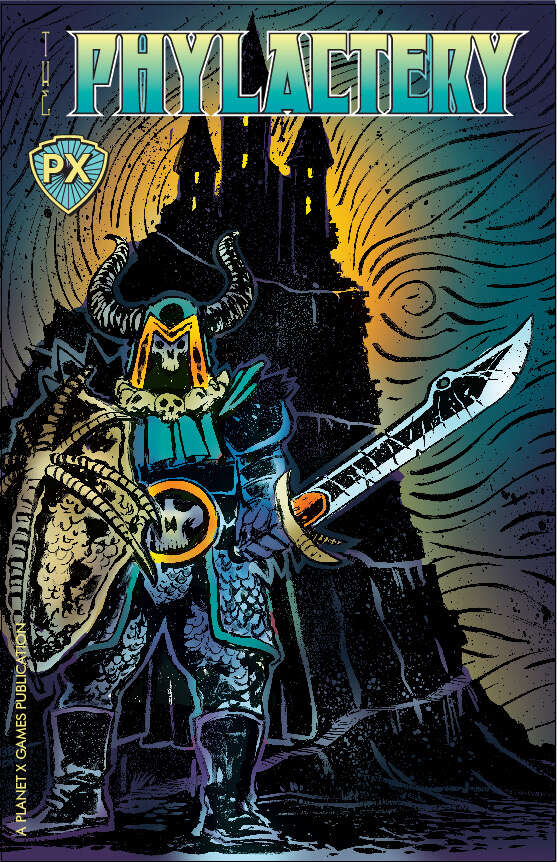
The Phylactery Issue #1, published by Planet X Games in November, 2020, following a successful Kickstarter campaign, is a fanzine for the Old School Renaissance rather than any specific fantasy retroclone. Thus, it works for Old School Essentials or The King of Dungeons or Labyrinth Lord. It is a collection of magical items—mostly, NPCs, monsters, and a scenario or two. It presents the Game Master with a relentless barrage of choice and options, some of which is ready to use, some of which is not, and so will require the Game Master to develop and add some stats. Everything comes with background elements—some specifically so to make them interesting—enabling the Game Master to flesh out her campaign setting as well as introduce an item of magical power. All of it is written by Levi Combs, the publisher, and his words are backed up with some decent artwork and excellent maps.
The issue’s monsters do not really start with ‘The Gibbering Thing In The Cellar And Other Slobbering, Gelatinous Horrors’, or at least start in the traditional sense of Dungeons & Dragons. For the table here is just of descriptions and no stats, leaving those for the Game Master. Instead, the monsters do not come until the end of the fanzine, ‘Here There Be Monsters!’. This includes the Anzu, servants of the goddess of bad fortune and ill-luck, the Death Tortle, a Chaotic Evil turtle, the Nexus Lurker, a scuttling thing that lurks near dimensional portals and the use of Teleport and Gate spells to pounce on their users, and the Thunder Chicken, known for its paralysing squawk and its lightning attack. Not all of these really have much use, as neither the Death Tortle or Thunder Chicken really have a role and the Thunder Chicken, in particular, is included for its chicken nature rather than anything else.
More interesting are the issue’s many magical items, which begin with ‘The Chaos Throne’, which describes a mighty throne designed to seeds of randomness, chance, and chaos into the lives of those who sit upon it. Both of its arm rests are inlaid with a line of ten gems, each different. Each gem can be pushed once to gain a magic effect. For example, depressing the beryl means that the incumbent’s soul is marked for annihilation, forcing a simple dice off between player and Game Master, whilst the yellow sapphire raises the incumbent’s lowest attribute to eighteen! Only a limited number of gems can be pressed before the throne disappears. Essentially, The Deck of Many Things, with fewer, but no less random or fun options, built into a chair.
Whilst there is no background to ‘The Chaos Throne’, ‘The Furious Faithful – Priests And Holy Men Of Renown’ is a good example of the issue’s magical item article with extras. In this case, they are magical items with the history of the first person to wield them. For example, Lathidus “the Lord of Secrets”, was priest of Chaos, adept at spreading lies and distrust through rumours, blackmail, and more. The Sliver of Secrets is a shard of Lathidius’ shinbone, a relic of his church which when carried by a believer, enables him to lie with impunity, gaining a +2 bonus to any deception check and such lies cannot be revealed as such by low-Level divination spells. From the simple description, the Game Master can not only add the Sliver of Secrets and the legend of Lathidius to her game, also his church of Chaos, the temple to the god justice he corrupted, and the god of thieves whose assassins killed Lathidius. The author presents six such items and thumbnail descriptions of their wielders.
‘Magic Weapons and Sorcerous Blades!’ continues the issue’s combination of item and background, though this time appended by local lore. The Dragonsbreath Bow is wielded by The Sons of the Crimson Scale, agent-assassins for the Cult of the Demon Dragon. It is a longbow +1, which once per day can fire a special attack which varies according to the type of dragon to which it is attuned. For example, the Dragonsbreath Bow attuned to Black Dragons unleashes a stream of acid and a cone of frost is released by the bow attuned to White Dragons. There is also said to be a bow attuned to each of the evil dragons. Local lore tells of a close-helmed warlord in blue-scaled armour said to be riding the edge of the hinterlands hunting for something or someone. He has already incinerated several of the king’s men with just a single arrow, so could he be wielding one of the infamous Dragonsbreath Bows? Other weapons include Conjuredoom, a sword created to wield against wizards, magic-using, and enchanted creatures, and Doomgiver, a magical footman’s mace sacred to a dread goddess of the sea.
‘Magic Gee-Gaws, Sorcerous Jim-Jams, And What-Not’ details general magical items, such as Weird Seeds, strange, armoured pods from a twisted dimension that when planted instantly blooms into a plant with bizarre flowers of an unearthly colour. The plant withers and dies within a day, but turns its immediate area into a wild magic zone. ‘They Look Good, but.... Gaaaaaaaah! 1d10 Fiendish Potions You’ll Wish You Hadn’t Drank!’ provides ten concoctions and elixirs that the imbiber will regret drinking. For example, one potion smells of mint and medicinal herbs and works as a Potion of Extra Healing, but triples the chance of random monster encounters for the next four hours! The idea of the cursed weapon or armour is almost a cliché, but this article does something interesting in creating cursed potions. It is common for potions to be actually poisonous, but to be cursed? The Player Characters will never look at those bottles of coloured liquids in quite the same way again.
‘Forbidden Spellbooks and Fell Prayers of the Ancients’—inspired in part by the fiction of H.P. Lovecraft—is a trio of highly detailed magical works. These are Seven Veils, Seven Voids, The Testament of Nammul, and The Three Faces of Yrgaath. The Seven Veils, Seven Voids, for example, is a treatise on nature of undeath, not so much penned as carved, by Huldath ‘the Black Vizier’, on the inside of a large marble sarcophagus lid—and then in the secret tongue of necromancers. It also includes a number of spells, as does The Three Faces of Yrgaath. Written by the hag-sorceress Beltrugald for her seven horrible daughters on the subject matter of demon summoning and similar matters, it includes potion recipes to, and the new spell, Ravenous Wound, which inflicts a wound that eats itself on the caster’s target.
The Phylactery Issue #1 the lean into cosmic horror with ‘Forbidden Demon Cults from the Outer Void’. This gives a trio of demonic cults for the Game Master to add to her campaign such as Yugg, the massive god-beast of dinosaurs and great lizard-beasts, which eats anything it likes and despises anything or anyone smaller or weaker than itself. Its cults are vile cannibal, regularly and ritually devouring the weakest of their own, no matter their age or gender.
‘Black Bess, Scourge of the High Seas!’ is the first of several NPCs in the issue. She is a Seventh Level Fighter and an infamous pirate, captain of The Sea Wyvern’s Kiss, a heartless, evil kill who still adheres to the pirate’s code and the ancient laws of the sea. ‘Once Upon a Time in the Grim Hinterlands: 3 Antagonists to Set Your Players on the Road to Adventure’ continues with three NPCs, such as Orloc, the Black Friar and Morgun Blackfeather, who are intended to plague and bother the Player Characters. All three come with a trio of actions they might do upon encountering the Player Characters, but in comparison to the earlier description of Blacks Bess, they feel underwritten and in need of more of the Game Master’s input. In comparison, ‘1d10 Tough SOBs, Roadhouse Hoodlums, Bored Adventurers, and Mean Ole Bastards You Might Meet in a Tavern’ does not feel so underwritten since they are both throwaway encounters the Player Characters might have in a tavern and hooks that a Game Master could develop into something. These are entertaining and even as a throwaway encounter should add colour to any night out or tavern crawl at the end of the information. Barring the stats, they do draw comparison with the ‘Meatshields of the Bleeding Ox’, the regular collection of NPCs from the Black Pudding fanzine, and they are just as useful.
The Phylactery Issue #1 contains not one, not two, but three scenarios. In ‘Corpse Garden of the Myconid King’, the inhabitants of Hog’s Chapel have been acting strangely, listlessly, or simply falling asleep where they stand. Mossbeard, a local druid, claimed that, “the King Beneath the Roots has awoken and is calling for his due.” and that the source of the problem lay below Gilly’s Gap, a nearby sinkhole. He disappeared into the sinkhole and has not returned. Following in his wake, the Player Characters will discover a kingdom of mushroom men infected by a blight. Consisting of five locations in a cavern system, the adventure is an engaging, if small, treatment of a Dungeons & Dragons classic setting—a fungal kingdom. The scenario does not have many interesting items for the Player Characters to find or be rewarded with and it lacks an indication of what Level it is intended for, an issue that runs through The Phylactery Issue #1 and all three of its scenarios.
‘Utos, the Isle of the Shattered Moon’ is a crescent-shaped island, a cursed place occupied in its long history by the pirate captain Brego ‘the Bitter-Heart’, a sacred covenant of druids and benign wizards, and practitioners of ancient magics. From a fortified tower magically woven from plants and trees to a ruin atop the Lonely Spire, the island has long fallen into disuse. In comparison to the previous ‘Corpse Garden of the Myconid King’, there is plenty of treasure to be found ‘Utos, the Isle of the Shattered Moon’ if the Player Characters want to put the effort in. Unlike ‘Corpse Garden of the Myconid King’, ‘Utos, the Isle of the Shattered Moon’ will need a motivating factor or two to drive the Player Characters to explore this mini-sandcrawl.
‘Grindhouse Hexcrawl #1’ gives an even bigger area for the Player Characters to explore, a hexcrawl rather than a sandcrawl. It contains an outpost of The Stoneswords, Dwarf mercenaries intent on killing the feral ettin called Kurr ‘the Dwarf Eater’ in revenge for eating one of their number; is bisected by the Black Crags, home to warrens of Goblins and flocks of Harpies, as well as The Crimson Wind, a mysteriously landlocked pirate ship said to contain a king’s ransom in riches; and Mag-Nachtur, the Screaming Tower, home to cultist torturers and demon worshipers of Thuul the Racked One (detailed in the earlier ‘Forbidden Demon Cults from the Outer Void’), working to rebuild the tower. The eight locations across the hexcrawl are fairly detailed, but again, there is no indication of what Level it is designed for, rewards will need to be developed by the Game Master, and hooks to drive the Player Characters to explore the region. This aside, ‘Grindhouse Hexcrawl #1’ has an enjoyably bleak feel and can easily be dropped into a wilderness area or on the edge of a kingdom.
Physically, The Phylactery Issue #1 is very nicely presented. It is well written, the artwork is excellent, and Skullfungus’ cartography is as good as you would expect it to be.
The Phylactery Issue #1 never seems to let up in its presentation of its information and its content. There is so much in the pages of the fanzine’s first issue, probably too much for the Game Master to use everything in her campaign, but lots and lots to pick and chose from, and in many cases, develop and so add extra detail to that campaign. Suitable for any Old School Renaissance retroclone, The Phylactery Issue #1 is a good first issue, giving the Game Master a wealth of choice and content to work with.