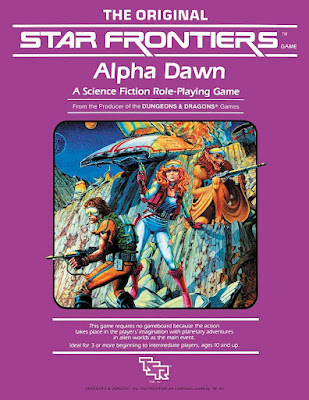
In 1982, TSR, Inc. published its first Science Fiction roleplaying game,
Star Frontiers. Now TSR, Inc. as stated in ‘The SF ‘universe’’ (
Dragon #74, June 1983), “TSR had previously published SF-oriented role-playing games, most notably the GAMMA WORLD® game and METAMORPHOSIS ALPHA game, but these two games are post-apocalyptic visions of the future.” and “While they are certainly interesting and undoubtedly SF in nature, neither of these games fully realizes the potential of a science-fiction setting. A star-spanning civilization, interstellar spacecraft, strange aliens, and adventures on a myriad of bizarre and challenging new worlds are the elements of a classic SF framework. The possibilities for adventure in such a “universe” are nearly limitless. The STAR FRONTIERS game, unlike its predecessor SF titles from TSR, is able to appreciate these possibilities.” This is a debatable claim, since the tag for
Metamorphosis Alpha—published in 1976—was ‘Fantastic Role-Playing Game of
Science Fiction Adventures on a Lost Starship’, but at the very least, the genres between the two roleplaying games were and are different.
So as the very first actual ‘Science Fiction’ roleplaying game from TSR, Inc., Star Frontiers was very much intended to play off the boom in Science Fiction and space adventure which followed in the wake of Star Wars and The Empire Strikes Back, for example on the big screen, as well as Battlestar Galactica and Buck Rogers in the 25th Century on the small screen. It would take a full year before it reached that potential with the Knight Hawks boxed supplement which added spaceships and spaceship combat to the roleplaying game, but in the meantime, Star Frontiers offered planetside adventure with stripped down, straightforward set of mechanics and rules designed to introduce new players to the hobby and Science Fiction roleplaying to more experienced players—especially if their only experience was Dungeons & Dragons.
Coming as a boxed set,
Star Frontiers Alpha Dawn, the roleplaying game was designed for players aged ten and up and came filled with high quality components. This included the sixteen-page Basic Game Rules, the sixty-page Expanded Game Rules, the thirty-page Adventure Module, SF-0: Crash on Volturnus, a large map, a sheet of two-hundred-and-eighty-five counters, and two ten-sided dice—one dark blue, one light blue. Everything is very nicely presented, starting with the superb cover artwork for both the box and the Basic Game Rules and the Expanded Game Rules. The internal artwork is also good, with lots and lots of action scenes, Jim Holloway’s illustrations prefiguring some of his work on
Paranoia. The large, full-colour poster map depicts a city centre on the one side with numerous buildings, roads, and monorails, whilst on the other are depicted craters, mountains, deserts, forts, towns, ruins, and more. These are all designed to use with the counters, for at its most basic,
Star Frontiers is a roleplaying game played out as a square-and-a-counter combat game.
The setting for Star Frontiers is lightly drawn, an area of space near the centre of a great spiral galaxy where the stars are closer together, known as the Frontier. Here Humans—though not the Humans of Earth—made contact with the insectoid Vrusk and the ameboid Dralasites and developed interstellar spaceships, and together discovered the Yazirians, tall leonine humanoids with patagiums and thus capable of gliding. They settled the twenty or so worlds of the Frontier (including the unfortunately named ‘Gollywog’) and to supply their needs, the Pan-Galactic Corporation (or PGC), the first interstellar company, was formed. It conducted scientific research as well as manufacturing everything from foodstuffs to spaceships, and even developed Pan-Galactic, a language which became the lingua franca for the Frontier.
However, the melting pot of the Frontier was upset by a series of attacks by the Sathar. This previously unknown worm-like species attacked isolated outposts and frontier worlds, but would kill themselves to avoid being captured. Together the Humans, the Vrusk, the Dralasites, and the Yazirians formed the United Planetary Federation (UPF) to defend the Frontier and forced the Sathar out of the Frontier. More recently, attacks by the Sathar have begun again, but more surreptitiously and sly, often using Human, Vrusk, Dralasite, and Yazirian agents to sabotage and undermine trade and government. The UPF has formed the Star Law Rangers to investigate and stop these activities, and both the Star Law Rangers and the Pan-Galactic Corporation often employ freelancers for a variety of tasks. These freelancers are, of course, the Player Characters.
Star Frontiers Alpha Dawn offers a choice of four playable races—Humans, Vrusk, Dralasites, and Yazirians. Dralasites are short, grey amoeboid-like creatures, notable for being able to change form by extending and retracting pseudopods and possessing a quirky, pun-based sense of humour; Humans are like those of Earth, but have a two-hundred-year lifespan; the insectoid Vrusk have eight walking legs and two manipulating arms, and are known for their logical minds and their business sense; and the Yazirians are an arboreal-like species with excellent grip for both hands and feet, patagiums for gliding, and known to pushy, even aggressive, and potentially, capable of battle rages. The mysterious Sathar, wormlike with pairs of tentacles which could be used as legs and to hold and manipulate objects are the villains of the Star Frontiers setting and thus not available to play. A character has eight abilities, arranged into four pairs—Strength/Stamina, Dexterity/Reaction Speed, Intuition/Logic, and Personality/Leadership. The rating for each ability is a percentile, ranging between thirty and seventy for starting Player Characters and serving as the base rating for all actions in the roleplaying game.
Character creation in Star Frontiers differs—though only slightly—depending upon whether the Basic Game Rules or the Expanded Game Rules are being used. In both, a player selects a race and rolls percentile dice for each pair of Abilities on the given table, applies the species modifiers, and derives a couple of factors, and that is it for the Basic Game Rules. It is quick and easy, and in the Basic Game Rules, barely takes up a page.
Name: Korung Speetrasser
Race: Dralasite
Handedness: – Gender: –
Walking: 1 Running: 4
Strength/Stamina 70/70
Dexterity/Reaction Speed 60/60
Intuition/Logic 35/35
Personality/Leadership 40/40
Initiative Modifier: 6
Current Stamina: 70
Laser Pistol (2) 60% Damage: 1d10
The remainder of the Basic Game Rules is devoted to the core rules and some adventures. From the outset, Star Frontiers is designed to be played on a map, using the maps and counters included in the box. Later, it would move on to more ‘theatre of the mind’ style of traditional roleplaying, but in the Basic Game Rules, the Player Characters and their opponents are moving—in squares, not metres (though Star Frontiers uses the metric system)—across a great cityscape, from building to building, jumping onto skimmers or aboard the monorail, and chasing each other across the city. The base value to undertake any action is the appropriate Ability, rolled against the percentile dice, using the dark blue die as the tens die and the light blue die as the ones die, as the Basic Game Rules explain it. In the Basic Game Rules, the emphasis is on combat, so modifiers are applied for movement and range, and if the roll is successful, the attack hits, and damage is rolled and deducted from the target’s Stamina Ability. Typically damage is rolled on just the one ten-sided die and an opponent would have to lose all of his Stamina to be knocked out. Consequently, combat can take a bit of time and options such as the Doze Grenade, which knocks out opponents are more than viable options, and rules for throwing grenades are included.
After a nicely illustrated introduction, the Basic Game Rules quickly cover the basics of character generation and combat before a short list of equipment (mostly weapons) and some adventures are presented. Some rules are given for other actions too, essentially a player rolls against the appropriate Ability and depending upon the difficulty, applies a five, ten, or fifteen percent modifier, either positive or negative. ‘Adventure 1: Pan-Galactic Security Breach’ sees the Player Characters investigate a series of breaches at various research centres. It is not designed as a standard adventure, but rather a programmed adventure with options like a ‘Choose Your Own Path’ solo adventure. One player serves as the Reader—rather than as a Referee, and reads out the entries and gives the options, whilst the players decide which of the options to choose. Since this is a programmed adventure, they all have to agree. It is a simple action-packed affair, more of a couple of scenes than a full adventure, with the perpetrators quickly revealed and making a run for the spaceport with the Player Characters on their heels. This is played out on the main map as is ‘Adventure 2: Alien Creature on the Loose’, in which a dangerous alien creature has escaped its confinement at the Zoological Park and the Player Characters have to capture it. The Hydra—nothing to do with the mythological and Dungeons & Dragons creature of the same name—is hunting for its handler and the Player Characters must stop it before the thing finds him. It is a big creature and tough to stop. There are guidelines for playing both adventures again. ‘Adventure 1: Pan-Galactic Security Breach’ this is as teams, one team controlling the perpetrators trying to get away, the other the Player Character types trying to stop them. For ‘Adventure 2: Alien Creature on the Loose’, this is the Referee creating her own creatures. There is advice too, for the Referee to create her own adventures, and like the two adventures these are quite basic. The focus of the advice is on a ‘crash on a desert planet adventure’ essentially preparing the Referee for running Adventure Module, SF-0: Crash on Volturnus and pointing towards the greater complexity and comparative sophistication in the Expanded Game Rules. The rules are what they say they are—basic—and come across not so much as a roleplaying game as a board game. For the experienced role-player they are probably too basic and even for players new to roleplaying, they do not offer a great deal of play.
The Expanded Game Rules, of course, greatly broaden and develop the rules given in the Basic Game Rules. It highlights the differences between the two, noting the expanded options, extra rules, and the fact that the roleplaying game can be played without maps, whether using miniatures or simply the imagination. The expanded rules for character creation add a five-point bonus to any Ability score for Humans, enable players to swap points between pairs during character creation, and Dralasities, Vrusk, and Yazirians have special abilities, such as Lie Detection and Elasticity for the Dralasities and Battle Rage, Gliding, and Night Vision for the Yazirians. All five Races, including the Sathar, are given a nicely done, detailed, one-page write-up. The Expanded Game Rules also add skills. There are thirteen of these, all fairly broad and divided into three Primary Skill Areas or PSAs. These are Military, Technological and Biosocial. Each skill has several subskills it covers and which a character automatically knows, and each subskill having its own base rating. Skills go from Level 1 to Level 6, each Level typically adding ten present to a roll. So the Biosocial Medical skill also covers Administering Drugs (100%), Diagnosis (60% + skill level), First Aid (100%), Minor Surgery (40% + skill level), Major Surgery (20% + skill level), Controlling Infection (50% + skill level), Curing Diseases (40% + skill level), Neutralizing Poisons (30% + skill level), and Activating Freeze Fields (30% + skill level), the latter the skill of putting a body in stasis until it can be revived and repaired. A Player Character has one PSA, and although he can have Levels in skills in the other PSAs, they are always more expensive. A Player Character starts play with a level in one skill from his actual PSA and one from the two others. Overall, the expanded rules for character creation do add more to a character, but without adding that much more complexity or even time to the process.
Name: Korung Speetrasser
Race: Dralasite
Handedness: – Gender: –
Walking: 1 Running: 4
Strength/Stamina 70/70
Dexterity/Reaction Speed 70/50
Intuition/Logic 35/35
Personality/Leadership 40/40
Initiative Modifier: 5
PSA – Military Skills: Beam Weapons (1)
Biosocial Skills: Environmental Skills (1)
Current Stamina: 70
Laser Pistol (2) 45% Damage: 1d10
The Expanded Game Rules also add further details and options for combat, such as careful aim and telescopic sights, firing two weapons, and even weightless combat. Alongside this is an expanded list of weapons and their descriptions of both them and other equipment. This includes armour, which is most ablative in nature, and also screens, portable force fields which react to hits and drain Standard Energy Units from their power packs when hit. Robots and computers are detailed too, with computers being easily upgraded, and options given for simple robot design or off-the-shelf purchase. Extra vehicles are added too, although notably, not spaceships. Star Frontiers Alpha Dawn is not a roleplaying game of spaceship travel or combat, but of adventures once you get there. Some notes on space travel are included in the Frontier Societies section, primarily the various classes of travel, travel times, layovers, and potential customs entanglements. Expanded also are the rules for creating creatures, as well as a bestiary. The bestiary itself is fairly short and backed up further entries in Adventure Module, SF-0: Crash on Volturnus, and do feel influenced by Dungeons & Dragons creatures, especially the Sand Shark, a creature which would also turn up in Gamma World. The rules for creature creation really consist of a series of questions about what the creature does and what its habitat is, and in comparison to other Science fiction roleplaying games, do feel underwritten, but they are serviceable enough for a Pulp Sci-Fi roleplaying game like Star Frontiers. The section on Frontier Societies provides some basic details of the Frontier sector setting and thumbnail descriptions of a handful of worlds. Lastly, there is advice for the Referee and a guide to creating adventures, which includes a short sample, search and rescue mission. It is a one-page affair, straightforward and easy to drop into a campaign or run after the two sample adventures in the Basic Game Rules. The Expanded Game Rules also has the equivalent of its own ‘Appendix N’ on the inside back page, and it is a good selection of Science Fiction further reading, though much of it falls outside of the Pulp Sci-Fi tone that Star Frontiers is aiming for. In the middle of this—and the Expanded Game Rules—is a two-page spread collating all of the useful tables for running Star Frontiers and effectively serving as the reference section of the screen if not as a screen itself.
Once the Player Characters have completed an adventure or a task, they earn both Experience Points and Credits. If injured, the Player Characters do have to spend Credits to purchase healing—one Credit per point of Stamina healed, so very American. None of that Socialist health service for you! Experience Points can not only be spent to purchase new Skills and new Levels in existing skills, but also on increasing Ability values, again on an Experience Point per Ability point cost.
The included full adventure in Star Frontiers is SF-0: Crash on Volturnus. The first part of a trilogy which would be completed with the sperate adventures, SF-1: Volturnus, Planet of Mystery and SF-2: Starspawn of Volturnus, this adventure begins with Player Characters aboard the Serena Dawn, bound for the world of Volturnus (oddly named for the Greek god of the southwest wind, which assumes that the Humans of the Frontier, who are not from Earth, also had Ancient Greeks and Greek myths) in the Zebulon system to conduct a planetary survey and perhaps locate the previous mission. Unfortunately, the Serena Dawn is hijacked, and the Player Characters must fight pirates to both get what equipment they can and escape the ship before it is destroyed. The adventure consists of a mixture of random and pre-planned encounters and once on the surface will begin with the former and evolve into the latter. This will see the Player Characters encounter a strange race of octopoidal telepaths who practice mind-to-mind communication who will offer to adopt them into the tribe in order to help them survive. If they accept—and to be honest, the scenario will not go very far if they refuse—the Player Characters will be borne out of the desert that their escape pod crashed down in and through some caverns. After being separated due to a cave-in, resulting in a mini-dungeon crawl for the Player Characters, they can reunite with the tribe and undergo the rituals of adulthood and become officially part of the tribe and thus set up for the sequels. Alternative endings are given if the Referee is not going to run SF-1: Volturnus, Planet of Mystery and SF-2: Starspawn of Volturnus. Perhaps the best aspect of SF-0: Crash on Volturnus is the description of the Ul-Mor and their culture, which is fairly unforgiving and likely force the Player Characters to act with due consideration rather than selfishly. Sadly the Ul-Mor are not particularly well illustrated in the module, and as to SF-0: Crash on Volturnus itself, it feels as if it is really only setting up the subsequent two modules rather than being a standalone affair itself.
Physically, Star Frontiers Alpha Dawn is very well produced and is an attractive, engaging product. In 1982, this was a relatively inexpensive boxed set and certainly in terms of the quality and quantity of components, the purchaser got his money’s worth.
—oOo—
Star Frontiers was first reviewed in The Polyhedron No. 9 (December 1982) by Steve Winter. Since this is the same Steve Winter who edited Star Frontiers, it is fair to say that this is not actually a review. It started out with a dig at not one, but three other Science Fiction roleplaying games of the period, with “Hey science fiction fans! Tired of travelling? Sick of the opera? Looking for a game that doesn’t require the patience of the universe to play? Have I got a deal for you!” before going to highlight in particular the fact that, “The game was designed to be played by people who had no experience with roleplaying games.”
Star Frontiers was reviewed by Andy Slack in the Open Box department of White Dwarf No 37 (January 1983), who said of the roleplaying game that, “A major drawback is space travel. This is virtually ignored. No-one can learn how to do anything useful aboard ship, which is perhaps as well since there are no guidelines for designing or using ships. There is much to be said for the point of view that ships are merely a delivery service to get you from one adventure setting to the next, but I disapprove of the lack of them. No doubt a future supplement will handle them if enough people share my view.” He concluded that, “Unfortunately, I can't say the system struck me as especially realistic; but if you like action adventure, thinking with your fists, and Star Wars (and who doesn’t from time to time) you can have a lot of fun with this game.” before awarding Star Frontiers a score of seven out of ten.
Star Frontiers was given a ‘Featured Review’ by William Barton in The Space Gamer Number 60 (February 1983). He wrote, “To start with my overall reaction: I don’t much like Star Frontiers. But then I don’t much dislike it either. I don’t really have a lot of strong feeling about the game at all. That’s not to say that Star Frontiers is a bad game; it’s not. Neither is it exceptionally good. It has some very good features, and a few really bad ones, too. And they balance out into a game that, two years ago, might have had a fair impact on the SFRPG filed, but which now is merely another face in the crowd.” In his conclusion, he asked, “What will be the fate of Star Frontiers? If the game were by any other company than TSR, I’d predict it would quietly fade away, like Star Rovers, and a few other less-than-spectacular systems. Since Star Frontiers is a TSR product, I don’t think that will happen. TSR, unlike many companies, has an “in” to the various nonspecialty stores. For a lot of potential gamers, Star Frontiers is likely to be the first SFRPG they encounter. TSR also has a large share of the younger market, which Star Frontiers seems to be aimed at. So, yes. Though it may not really deserve it when compared to other, better systems, I think TSR’s entry into the SFRPG field will prove to have staying power, as the loyal D&Ders turn to it as their first SFRPG. For myself, I’d have preferred to see TSR back and expand Universe, which it acquired with SPI’s assets. Maybe it will yet. In the meantime, Star Frontiers probably isn’t going top lose TSR any money. But I wish there were a lot more to commend it than that.”
Jim Bambra reviewed Star Frontiers in Imagine No 1 (April 1983). He was also of the opinion that “It is also a pity that there are no rules for designing starships or space combat; though these are due for release later this year. Even without starship rules, the STARFRONTIERS™ game is one of the best available. It has been designed with an emphasis on playability and here it succeeds admirably. Its inspiration comes more from pulp fiction than the ‘believable’ SciFi on which Traveller is based. Whether this style of play appeals is a matter of personal taste. Players of the D&D® game will certainly enjoy it, for in many ways this game is a kind of D&D in space.” Finally, he said, “In summary, the STARFRONTIERS game is an excellent introduction to Sci Fi gaming, a game I heartily recommend to beginners and experienced gamers, A lot of expertise has gone into the designing of this product and the result is a very enjoyable and easy to learn game.”
Ian R. Beste reviewed Star Frontiers in Different Worlds Issue 29 (June 1983) and was upfront about his disappointment, stating that, “Star Frontiers is by no stretch of the imagination a step forward in the state of the art. There just isn’t a whole lot to the game.” At the end of a detailed review, he concluded, “It would be easy to say that Star Frontiers is just D&D with lasers. It isn’t exactly, but it’s unlikely to make anyone drop their existing campaign to set up one for Star Frontiers. This game just doesn’t have a solid science fiction feel to it. I shudder to think of articles in The Dragon on “Converting D&D Monsters to Star Frontiers Creatures.” (Doing so would not be hard.) I also shudder when thinking of the possibility of the expensive hardbound Advanced Star Frontiers Player’s handbook, a Referee’s Guide, etc. True, the game could uses them. But why? TSR has a lot of money, talent, and resources with which to make a good game. Why did it disappoint us with Star Frontiers?”
Star Frontiers was also subject to a lengthy review by Tony Watson in Dragon #74 (June 1983). After a thorough examination which included a comparison to GDW’s Traveller, he wrote, “A final question remains: Is the STAR FRONTIERS game just a D&D game in space? The pedigree is evident, but I think TSR has managed to avoid trading magic for technology, swords for lasers, and orcs for aliens. The emphasis on action and some of the design philosophy belies the kinship of STAR FRONTIERS to the D&D game, but it is innovative and original in its own right. The similarities will make it easy for D&D players to shift over to STAR FRONTIERS as their first science-fiction role-playing game. This may be the largest single body of STAR FRONTIERS buyers. One very important advantage in the TSR connection is that players can count on the company to support the game with accessories, and TSR’s wide distribution network should make these products easy to find.” Before concluding that, “The STAR FRONTIERS game is fast paced, accessible, and playable. The design shows thought and imagination, and the product is quite a bargain. While not without its weaknesses, it’s certainly a contender in a competitive market and probably a good choice for newcomers to this facet of role-playing.”
—oOo—
Even with the combination of the Basic Game Rules and the Expanded Game Rules,
Star Frontiers Alpha Dawn feels basic and lacking in game play. Remember though,
Star Frontiers was designed for players aged ten and up, and so was not necessarily going to offer the depth, detail, or sophistication found in other Science Fiction roleplaying games, notably
Traveller and its Third Imperium setting. That depth, detail, or sophistication would appear with later expansions and supplements, even though there would only be a handful of them. In the meantime, with a combination of interesting races, the Frontier setting, and the presence of the Sathar,
Star Frontiers is not only potentially interesting, but also offers scope for the Referee’s own content and adventures, plus that scope is made easier by the straightforward nature of the mechanics. In fact, it is a pity that the mechanics of
Star Frontiers could not have been reused in the
Buck Rogers XXVC roleplaying game instead of it being hamstrung by the unwieldy chimera it got based on
Advanced Dungeons & Dragons, Second Edition.
What is evident from the contemporary reviews is that Star Frontiers was not seen as different enough or sophisticated enough from the other Science Fiction roleplaying games available. Yet Star Frontiers was not aimed at those reviewers, who of course, would have been an audience older than the roleplaying game was intended for, and to be fair Star Frontiers Alpha Dawn does serve its intended age group reasonably well. Undeniably though, for older audiences, even those coming to Star Frontiers as their first Science Fiction roleplaying game after Dungeons & Dragons, it is underwhelming. For them, Star Frontiers is at best a toolkit for running Pulp Sci-Fi or basic roleplaying game awaiting the arrival of more sophisticated support, most obviously Knight Hawks. Consider what it was and who it was aimed at, as a first step into Science Fiction roleplaying, especially Pulp Sci-Fi roleplaying, and especially for a younger audience, Star Frontiers Alpha Dawn is a very serviceable starting point.