Every Week It's Wibbley-Wobbley Timey-Wimey Pookie-Reviewery...

Sunday, 12 February 2012

Efficiency & Trains. What Else Did You Expect?

Originally released in 2007, Ticket to Ride: Switzerland was the first expansion for Days of Wonder’s Ticket to Ride that was not a full game all by itself. Previously available only as part of the Ticket to Ride: The Computer Game, it provided a whole new board or country to play across. Most importantly, it required a full set of Train Cards, scoring markers, and Train pieces from Ticket to Ride or Ticket to Ride: Europe is needed to play. The cards from Ticket to Ride: 1910 can also be used, but the Train pieces will have come from somewhere else. Because its distribution of Train Cards is different, Ticket to Ride: Märklin is not considered compatible with Ticket to Ride: Switzerland. So what do you get with this board? Simply, the board, the rules, and a new set of Destination Tickets.

What really set Ticket to Ride: Switzerland apart – and still does – is that it is designed for either two or three players only. Which was long before Ticket to Ride: Nordic Countries. Of course, in addition, Ticket to Ride: Switzerland adds a new type of Destination Ticket and a new way to play the Locomotive (or wild) Train Cards, all tied into the numerous tunnel routes which were first seen in Ticket to Ride: Europe.

Yet the first thing you notice about this expansion is the board. It a gorgeous piece of work, depicting Switzerland and its cities and routes, surrounded by the nations of Deutschland, Österreich, Italia, and France. These are not mere window dressing, but destinations in themselves that the players can connect to by claiming routes across their respective borders. The new cards are as equally nice, although everything does feel a little too like a chocolate box.

The simplest new rule for Ticket to Ride: Switzerland is a reduction in the number of Train pieces each player starts the game with – forty instead of the usual forty-five. A player also receives more Destination Tickets – five as opposed to three. Of these he must keep two. Any rejected Destination Tickets, including those rejected after drawing more during play are discarded from the game completely, thus making it possible to run out of Destination Tickets during a game.

Of the forty-six Destination Tickets, thirty-four connect two cities. The remaining twelve connect a city to another country or one country to another. The points scored for either of these new types of Destination Tickets varies and depends upon the country connected to. For example, completing the Zürich-to-country Destination Ticket scores a player just three points if he claims a route connecting to Deutschland, seven points to either France or Österreich, but eleven points if claims a route between Zürich and Italia. If a player does not connect either destination then he loses only the lowest point value for that Destination card, so in the previous example, only three points. Harder and longer routes of course, score more points, but these new city-to-country and country-to-country Destination Tickets make it easier for a player to score points, especially later in the game when a player draws extra Destination Tickets.

The way in which the Locomotive Train (or wild) cards are used in Ticket to Ride: Switzerland is radically different to that of the standard game. In ordinary Ticket to Ride, only one face-up Locomotive card can be drawn per turn and it is the only card that can be drawn on a turn. Here they are drawn as standard cards, so two Locomotive Cards can be picked up on a turn. Once in a player’s hand, Locomotive Cards can only be played to claim tunnel routes, either using all Locomotive Cards or combining with Train Cards matching the tunnel’s colour.

The last rule previously appeared in Ticket to Ride: Europe and concerns the tunnel routes, which are clearly marked with dots along their sides. To claim a tunnel route a player first pays the correct number of Train Cards, either in the matching colour, in Locomotive Cards, or a mix of both. He then draws the top three cards from the draw pile. For each of these three that match the colour of the cards used to claim the route, the player must an extra Train card of that colour. If the player has no extra cards of this colour, he receives his original cards back and his turn ends. He or another player can claim this tunnel route on subsequent turns, but either is still subject to what is the chance of having to pay a tunnel tax.

The first challenge with playing this expansion is answering the question, “Where the heck is…?” After all, Swiss geography is not going to be familiar to everyone and learning the routes is a whole new challenge by itself. Looking at the board it is clear that this geography is dominated by tunnels (well, this is Switzerland), mostly in the South and East. About a quarter of the tunnels are grey, meaning that any colour can be used to claim them, and the majority of grey routes are tunnels.

The second challenge is one that only happens in Ticket to Ride with five or six players – competing for routes. In a game with two or three players, there is usually very little competition and the game can feel as if everyone is playing alone. Not so with Ticket to Ride: Switzerland, where there are not only fewer routes, but everyone has fewer Trains to place. Within the borders of Switzerland each city is usually connected by at least three routes, but most routes are quite short so it is easy to block access or at least force a player to find another route. This is slightly offset by the city-to-country and country-to-country Destination Tickets which provide multiple choices in terms of routes and scoring.

Initially, a game of Ticket to Ride: Switzerland lasts about an hour, but with practice our games now last less than this. What we did find is that routes were harder to claim and that there was more competition for them, and because Locomotive Cards are no longer available for use as wild cards (except in tunnels), we accumulated fistfuls of Train Cards as we waited to get the ones we needed. In fact, we wanted a means of displaying Train Cards as easily they are in the computer game, ideally some sort of display tray. The other issue we have is one of packaging. The new slimmer box is a great idea, but there is actually very little room in the bottom of the box for the new Destination Tickets. The need for components from another game in the series also adds to the set up time, but this is a minor inconvenience.

There are two problems with Ticket to Ride: Switzerland. The first is minor, and a matter of geography. Any player receiving Destination Tickets following the board’s North-South axis and thus crossing the Alps via the many tunnels will find this game much more challenging. Of course, a player is free to discard these Destination Tickets and pick up new ones. The second is more of problem. It is possible for a player to complete the routes on his Destination Tickets and then when he takes new ones to find that the routes on these have already been completed or partially completed by the player. Essentially, this is free points for the player with no effort upon his part, and often, this can be done turn after turn by a player and this can be a game winning tactic with Ticket to Ride: Switzerland. For some players this might not be within the spirit of the Ticket to Ride family, and to be fair, this is not an unreasonable point of view.

Given how tight the routes are on Ticket to Ride: Switzerland, my partner and I found it to be play a good, competitive two-player game. This is where this expansion primarily succeeds – making the smaller and shorter game more competitive and more of a challenge. The other area where it succeeds is in format, offering a new play area without making the purchaser buy a whole new version of Ticket to Ride. In fact, my partner commented on this at the time and suggested that it would be even better if future expansions in this format could have a double sided board and offer two countries to compete over. After all, other train games have done it. There are of course, problems with such a format, in particular the need for two sets of Destination Tickets, but it is an idea…

Packaged in a flat album-sized box, Ticket to Ride: Switzerland set the format for a pair of releases for Ticket to Ride in late 2011 – Map Collection, Vol. 1 – Ticket to Ride Asia and Vol. 2 – Ticket to Ride India. Indeed, the latter includes the Ticket to Ride: Switzerland board, itself long out of print, much in demand, and its second hand price often reflecting that. Fortunately, both volumes of the Map Collection come in deeper boxes and thus avoid the packaging error of Ticket to Ride: Switzerland. That said, whilst the re-release of Ticket to Ride: Switzerland is far from unwelcome, it is annoying that in order to get the India board, it necessary to buy it again.

There is a school of thought that believes that Ticket to Ride: Switzerland is broken and that it needs fixing. The fault being that the replication of routes on some Destination Tickets within other Destination Tickets results in there being an easier method of scoring. The fault being that some routes are replicated in the country to country Destination Tickets, so that a player could score for completing a France to another country Destination Ticket and then score for completing another country to country Destination Ticket with the same route back to France. Such a belief is absurd, as nothing could be further from the truth. Neither of these are faults. They are design features on what is a Ticket to Ride map that focuses heavily on Destination Tickets.

The tightness of the routes and the new country-to-country and city-to-country Destination Cards make Ticket to Ride: Switzerland a challenging and interesting board. It offers all of the competition previously only found in a four or five player game of Ticket to Ride, but just for two or three players. The board itself is stunning and the routes it gives the players to take make for what is arguably the most efficient Ticket to Ride expansion to date.

Wednesday, 8 February 2012

The Generic Grit RPG

The CORTEX System Role Playing Game is a set of generic rules first seen in the Serenity RPG, and since used in the Battlestar Galactica, Demon Hunter, and Supernatural RPGs. It comes complete, bar the dice, and is designed to handle most genres short of the more fantastic – so no high fantasy, no superheroes, and no ultra-tech. What it can do is fantasy with magic, science fiction with psionics and cyberware, and more modern set and near future set games, all with a gritty edge. The book also includes some decent GM advice, three sample settings, and even an index.

There are numerous sets of generic rules for roleplaying currently available and the difference between one and any other, comes down to the level of detail it provides, the lightness of its rules, and quite simply the feel of the game. The CORTEX System Role Playing Game compares well with any of its competitors, sitting at the low end of the detail spectrum, its rules being moderately light, and possessing a feel that is grittier and grainier than other “light” generic rules. The core rules are slightly let down by their window dressing – more “pick ‘n’ play” elements could have been included to get a game set in a specific genre going faster, and the sample settings do undersell themselves. Nevertheless, the CORTEX System Role Playing Game is a good package for the GM who wants a light, gritty rules set with which to create his own games.

The system is relatively straight forward. Attributes, skills, and traits – assets and complications (or advantages and disadvantages), for characters, monsters, and vehicles are measured by dice type: two, four, six, eight, ten, and twelve-sided dice, with a rating of d6 being considered as average. Attributes – Agility, Strength, Vitality, Alertness, Intelligence, and Willpower; and Traits – Assets and Complications such as “Rank and Privilege” and “Traumatic Flashbacks” are measured by just a single die type, whereas skills work slightly differently. Above a rating of d6, all skills must have a speciality. So a character can have a skill in Drive of d2, d4, or d6, but beyond that he needs to specialise in Bus, Car, Truck, or something similar, in which he would have a rating of d8 or more. This would be expressed as Drive d6, Truck d8 and the character could easily buy specialities beyond that.

To do anything a character rolls against a target difficulty, three for easy, seven for average, right up to 31 for impossible. Any result of seven or more above this target is counted as an extraordinary success. Skill checks involve both an attribute and the skill, but the attribute will vary depending upon circumstances. For example, to successfully strike a target a character would roll his Agility and his Unarmed Combat d6, Tae Kwon Do d10, but to analyse and assess his opponent’s skill, he would roll his Intelligence and his Unarmed Combat d6, Tae Kwon Do d10. Rolls involving attributes either mean rolling it twice, for example, when making a strength check to force open a door, or two different attributes.

A character also receives Plot Points, used to modify his skill rolls, to reduce damage suffered, and to manipulate the game in small ways in his favour. He earns them not just for good roleplaying and achieving goals, but also for bringing his Complications into play.

Character creation uses a standard point buy method. A player is given points to spend on his character’s attributes, skills, and traits, the amount varying according to how experienced or how heroic the GM wants his player characters to be. The book also includes bundles that a player can buy, packages of attributes, skills, and traits representing racial or experience backgrounds, such as (UFO) Abductee or Elf. There are only a few sample such Bundles, and while it is easy enough to create more, it would have been nice to have been given a few more, perhaps categorised by genre so that a GM and his players could just pick and play.

The system is well supported with solid rules for handling combat and vehicles – anything from a minivan to a scout starship, and a decent equipment list that includes robots and androids (with rules to play both). The GM is given advice on creating and running games, with attention paid to the genres supported elsewhere in the book – crime, fantasy, and galactic fantasy.

Part of the problem with the CORTEX System Role Playing Game is that it draws strong comparison with the Savage Worlds RPG, primarily because the mechanics of both look vaguely similar and cater to not dissimilar markets. There are plenty of differences and similarities though. Both are quick games, but CORTEX is more straight forward in play compared with the slightly more complex Savage Worlds with its use of cards; CORTEX is a grittier, grainier game than the pulpier, more heroic in feel Savage Worlds; and lastly CORTEX gives the GM and player alike something less proscriptive to work with in terms of its mechanics and character advancement when compared to the tight framework of Savage Worlds. The other advantage that Savage Worlds has is that gives access to a wide range of settings (and it handles miniatures skirmish games better, but CORTEX was not written with that in mind), but CORTEX is better toolkit in terms of mechanics for the GM to create his own setting or game. That said, the similarities are enough that you could run a Savage Worlds setting with relatively little difficulty using the CORTEX System.

The other problem that the CORTEX System Role Playing Game has is in its choice of window dressings and sample settings. The primary window dressing elements provided are magic, cybernetics, and psionics, each including just about enough samples to show the reader how they work and then leave you really wanting more. The other piece of window dressing is a set of mechanics describing how the U.S. court procedure works, which seems an odd choice that only makes sense when you discover that one of the three sample setting is a cop show.

The first of the three sample settings is “Star of the Guardians,” a Star Wars-like space opera based on the books by Margaret Weis (whose company, Margaret Weis Productions, Ltd. publishes this book), in which the Guardians, members of the genetically bred Blood Royal who are trained to use the Bloodsword energy weapons and other technology, feud over the fate of the galactic Republic and the safety of the heir to the monarchy that the Republic overthrew. The second is “Trace,” a contemporary set police procedural inspired by the C.S.I. and Law & Order franchises that suggests that the players take multiple roles, from investigative to support to technical, and play troupe style. The third of the settings is “Arcady,” based in a southern gothic novel by Michael Williams about a family and their house, both of which are capable of slipping through the Borders into a dream-like world.

Of the three, “Star of the Guardians” and “Arcady” suffer from a lack of information and if the reader is not familiar with nor a fan of the books that they are based on, the likelihood is that the reader is not going to be grabbed by either. “Trace” has the advantage of familiarity – how many of us have not seen a police procedural? It also benefits from the fact that the CORTEX System is designed to handle exactly this kind of genre, the rules being an easy match, whereas in the other settings, the GM only receives sample window dressings to use with them.

Physically, the CORTEX System Role Playing Game is neatly laid out, lightly illustrated (with the silhouettes actually being better than some of the artwork), and clearly written. Its coverage of the possible genres is perhaps a little too cursory, but these rules are not really aimed at the inexperienced GM.

So the question is, do I like the CORTEX System Role Playing Game? The answer is, yes I do. I would probably turn to Savage Worlds for its settings – too many good ones to mention here – but the CORTEX System Role Playing Game is there for when I want something with a slightly harder edge.

Tuesday, 7 February 2012

A Hero's Every Day

Come the end of a hard day’s adventuring and every good hero will want to gather at The Hero’s Return and boast of the fantastic deeds that he performed that day. You are not a hero, but as a regular at The Hero’s Return, you like to get drunk and regale your equally drunken and equally unheroic friends of the great feats you certainly did not do that day. Sometimes your friends believe you, other times they call you “Liar” and tell you what really happened. This is the set up for Braggart – A game of heroes, lies, and unfortunate fish, a humorous card game that won the UK Games Expo award best card game in 2011.

Published by Spiral Galaxy Games, Braggart is designed for two to six wannabe heroes, and ten and up, and consists of one hundred and twenty full colour cards divided into five types. These are six Summary cards, a My Round card, ninety-two Boast cards, ten Liar! cards, and eleven Ploy cards. The Boast cards are further divided into four types – blue bordered Scene cards, green bordered Deed cards, red bordered Foe cards, and red bordered Result cards. The Boast cards each have a Brag Value at the top, a Victory Point value at the bottom, and a slightly cartoonish illustration with a short piece of text underneath. The black bordered Liar! cards are accusatory and force a bighead to change the details of his Boast, whilst the purple bordered Ploy let a show-off steal cards from a rival or change the cards in his hand.

The aim of Braggart is to score the most Victory Points at game’s end. This is done by creating the biggest Boast in a round as determined by the highest total Brag Value of each player’s Boast. At its most basic, a Boast consists of a single Deed card and a single Foe card. Optionally, a single Scene card and a single Result card can be added to a Boast, but either way, the Boast cards must be in the following order: Scene, Deed, Foe, and Result. This is so that the text on the cards forms a complete sentence. For example, the text from the following cards, “While wearing nothing more than my boots and a smile…” (Scene card), “I woke up next to…” (Deed card), “…a rogue magician of dubious morals” (Foe card), and “…and now barmaids all over town are unable to resist me!” (Result card) when read together forms a whole sentence.

The game starts with each player receiving a hand of four cards and is played in a series of rounds until the deck is exhausted and the game ends. Each round consists of two phases, a Draft Phase and a Boast Phase. In the Draft Phase a number of cards equal to the number of players is drawn from the deck and laid out face up where everyone can see them. Starting with the player with the My Round card in front him, everyone takes one of these face-up cards each.

In the Boast phase, a player has a number of options. He can “Go to the Bar” and draw three more cards in the hopes of gaining to a maximum hand size of eight, thus ending his turn. Or he can he play any number of Ploy cards to take cards from his fellow braggers before actually making a Boast. This consists of placing a single Deed card and a single Foe card with a single Scene card and a single Result card as optional extras, down on the table face-up and reading out the cards in as heroic or as boastful a fashion as possible. In response, the other blowhards round the table can call the swellhead out on the details of his deed by calling him a “Liar!” or an “Outrageous Liar!” and playing the appropriate cards. With these cards the accuser can replace one or two of the Boast cards in the windbag’s Boast with Boast cards of his own, the aim being to force the blusterer to reveal what really happened and reduce the Brag Value of his Boast.

For example, Anthony plays a seven-point Scene card, a four-point Deed card, an eight-point Foe card, and a six-point Result card. All together this has a Brag Value of twenty-five and reads as follows: “While possessed by the spirit of a long dead warlord…” “I opened a crate and was surprised to find…” “…a necromancer and her legions of the damned” “…and now a painting of these exploits hangs above the King’s fireplace!”. Naturally, Anthony reads this out in as heroic a voice as possible and looks around the table to see if any will challenge him as to the veracity of his claims.

With a cry of “Liar!” and a point of his finger, Dave to his left plays a “Liar!” card on Anthony’s Boast and replaces his seven-point Scene card with a four-point Scene card from his hand. Similarly, Michelle calls Anthony an “Outrageous Liar!” and replaces two of his Boast cards with a three-point Deed card and a two-point Foe card so that Anthony’s Boast now reads “In the Queen’s bedchamber…” “I was beaten and robbed by…” “…the vicious village cat” “…and now a painting of these exploits hangs above the King’s fireplace!” and has a Brag Value of fifteen rather than twenty-five. Of course, Anthony is still expected to read out his amended, but now a bit more truthful Boast, in as a heroic a voice as possible.

A round ends once every player has managed to either “Go to the Bar” or make a Boast. The player who made the Boast with the highest Brag Value wins the round and gets to keep all of the cards from his Boast in his score pile for game’s end. Any other player who managed to make a Boast gets to keep one of the cards from his Boast to add to his score pile. All other cards from played Boasts are discarded. Then a new round begins with the My Round card going to the player who scored the least or nothing in the previous round. The game continues round by round until the deck is exhausted and then everyone totes up the Victory Points scored from their Brags. The winner – the player with the highest total – is awarded the title of Lord Braggart.

Braggart is not a game that calls for much in the way of tactics. After all, all that a player is trying to do is get his best Boast out on the table whilst ensuring that his rivals make poorer Boasts by calling them Liars. The only real tactic is watching the cards that each player draws in the Draft phase, whether that is high value Boast Cards to play Liar! Cards on them or Liar! Cards to avoid having them played on your Boast. After that though, it is simply a matter of doing the dirty on the other players. For the most part, this is a random card game and the players have to make the best of their hands.

Lastly, there is the matter of the game’s full title: Braggart – A game of heroes, lies, and unfortunate fish. The “heroes” and “lies” aspects are obvious, but the “unfortunate fish”? Well, there is a single Foe Card worth exactly a Brag Value and a Victory Point total of one for which text on the card reads, “…an unfortunate trout.” This is not the only Foe Card of this value in the game, but when this is played in the designer’s own playing group, it is known as being “trouted”!

Braggart is a fun, silly, take that style game that serves as a good filler to play whilst waiting for more players or a longer game to start. It should appeal to gamers who like to tell a story, even if only very silly stories and it will really appeal to gamers who have played fantasy roleplaying games such as Dungeons & Dragons. It is also a suitably light game to play socially, be that with a drink in your hand or not, though it would be fitting as you do “Go to the Bar” in the game! Every gamer should have a selection of filler games and Braggart – A game of heroes, lies, and unfortunate fish is an entertaining game that deserves to be in your selection.

Saturday, 4 February 2012

A Kobold's Score

As Kobold Quarterly #20 attains its score, its coverage of Dungeons & Dragons – and its primary variants, continues to maintain a high standard with its mix of articles, advice, and scenarios. As with Kobold Quarterly #19, this latest issue from Open Design continues to move away from its previously self-avowed tag line – “The Switzerland of the Edition Wars” – with more coverage for Paizo Publishing’s Pathfinder Roleplaying Game than Wizards of the Coast’s Dungeons & Dragons, Fourth Edition. This is not to say that Dungeons & Dragons, Fourth Edition receives less coverage than in the previous issue, but the Pathfinder Roleplaying Game definitely gets the most space. In addition there are articles for the Adventure Game Engine, the mechanics that power the Dragon Age – Dark Fantasy Roleplaying from Green Ronin Publishing.

So if being neutral is not what Kobold Quarterly #20 is all about, what then, does it have as its theme? Again, the clue is in the tag line: “A Strong Bow and a Full Quiver,” for its theme is all about archers and archery, arrows and quivers, hunters and the hunted. Kicking off this theme is John E. Ling, Jr.’s “The Elven Archer: For Some Heroes, the Arrow Strikes Swift and True” which provides a Racial Class for the player who wants to play a character akin to Legolas. The Class is essentially a variant of the Ranger Class, but a pleasing touch is that it includes notes on how to adapt the Class to other races, roles, and missile weapons, as well as how the Class fits into the publisher’s Midgard Campaign Setting with a discussion of the Arbonesse Exiles and Daughters of Perun.

Thus “Arrows of the Arbonesse” by Jarrod Camiré can be seen as a companion piece, describing as it does the deadly and varied arrows of the Elves known as the Arbonesse Exiles. Again for use with the Pathfinder Roleplaying Game, it offers arrows that splash acid on a target, that release an obscuring fog, that leave a trail of razor wire, and need to be fired in pairs to create the anchoring points for the equivalent of the Web spell they release. The theme continues with Christopher Bodan’s “Fey Hunters & Shadow Hounds: Hunting PCs in the Margreve and the Shadow Plane,” which delves into the dangers of the hunt in the Old Margreve Forest in Open Design’s Midgard Campaign Setting. The region itself is described in more detail in the supplement, Tales from the Old Margreve, but this article looks at one particular aspect – how the Shadow Fey use the forest to hunt their prey. Their prey being the player characters… Discussed are the shadow fey’s tactics, devices, and servants, the latter possibly being the heroes’ fate if they fail to escape the shadow fey’s predations. It is perhaps not as punchy as the previous articles in the theme, but instead provides a greater depth.

Nicholas L. Milasich adds a mucky element to the art of Alchemy in the Pathfinder Roleplaying Game with “Derro Ooze Magic: New Discoveries and Archetypes for Alchemists.” It introduces the Ooze School of magic, a variant of the Transmutation school, the most notable features of which includes the ability to turn your arm into a slimy pseudopod and attack with its acidic touch and even temporarily transform into an Ooze! Similar abilities are available to the Sorcerer who selects the Ooze Bloodline, whilst adherents of the Ooze School who can take an Ooze familiar! Naturally, the article includes a list of oozy spells, but it is also much more than its mechanics as there is plenty of detail to be found here that can be added to a game, whether for player characters or NPCs.

A regular contributor to Kobold Quarterly, for this issue Mario Podeschi offers “Servants from Beyond: Lesser Planar Allies that are Ready to Summon,” a quartet of servants that the heroes could summon to their aid by casting the lesser planar ally and lesser planar binding spells. All four come with motivations as well as their stats and a list of negotiation mechanics that help bring them alive. The best of the four is Kaliskaria, an ambitious Fire Mephit whose jealousy and arrogance will surely try the patience of anyone who summons her. More obviously dangerous creatures are on show in Jack Graham’s “Night Terrors: Four Creatures to Truly Terrify.” They include the Chrysalis of the Changeling Moth, which charms groups of humanoids to care for it to the detriment of their own well-being and the haggard Pishtaco, a form of undead that butchers the living for their body fat and are reputed to be Alchemists or Gunslingers. Each of the four threats comes with a corresponding adventure hook and should present an interesting challenge to the heroes. Both articles are for the Pathfinder Roleplaying Game.

Of a similar nature is “Small Spirits: 5 Nature Spirits for Any Campaign” by Matthew J. Hanson, which is written for both the Pathfinder Roleplaying Game and Dungeons & Dragons, Fourth Edition. Each of the five is powerful force of nature within a localised area and whilst capable of granting a boon will not always do so readily. Each comes with an adventure hook or two that the GM can develop. My favourite of these is the “String of Grandfathers,” a necklace of teeth from a lost tribe’s shaman that will offer the wearer the toothy advice of the ages if he can win the shamans’ approval.

Christina Stiles makes two contributions to Kobold Quarterly #20. First, she authors the issue’s single scenario, “Captured in the Cartways.” Designed for use with fifth level characters for the Pathfinder Roleplaying Game, it is an entertaining side trek adventure set in the tunnels under the Free City of Zobeck that sees the adventurers captured and given a small task before they can progress with their current task. Quite literally a mucky adventure, it throws the adventurers into the murk of the city’s underworld politics as well as providing a set of NPCs that can be added to a GM’s campaign. Written to support the release of Open Design’s Streets of Zobeck, to get the fullest use out of the scenario a GM will need access to the recently published Zobeck Gazetteer and the Pathfinder Roleplaying Game Bestiary 1. For her second contribution to this issue, Christine is interviewed as part of the magazine’s regular “Kobold Diplomacy” feature. This is a thought-provoking article because the interviewee has been involved in various aspects of the industry that are rarely considered by the gaming public at large. As an editor myself, it was interesting to read her thoughts on the process.

Although the idea of old heroes coming out of retirement to perform one last deed is not new – it certainly gets used in books and movies aplenty – it is rare that such a narrative device gets used in roleplaying. Stefen Styrsky remedies this with “Putting the Band Back Together Again” for the Pathfinder Roleplaying Game, supporting it with examples and a full set of age related Feats. This has everything bar the plots specific to the GM’s campaign, but it could spur a great campaign and be a chance to bring back old, retired player characters that could revisit the sites of their former victories. (As an aside, an existing example of how this could be done would be with B2, Keep on the Borderlands followed by Return to Keep on the Borderlands).

Kobold Quarterly #20’s single article for the Adventure Game Engine is Randall K. Hurlburt’s self-explanatory “AGE of Specialization: Five New Character Options.” This presents five new Specialisations, one for the Warrior class, one for the Mage class, and three for the Rogue class. These become available once a character in Adventure Game Engine reach sixth level – as detailed in Dragon Age – Dark Age Roleplaying Set 2: For Characters Level 6 to 10, with the selection here providing some alternatives to the limited number given in that set. The number assigned to the Rogue class is indicative of the class’ flexibility, with the inclusion of the Marksman Talent covering for an odd omission in the rules given in the box.

“The Bardic Arts” by Aaron Infante-Levy is the first of the issue’s few articles written solely for Dungeons & Dragons, Fourth Edition. It provides a set of new Class features that expand obvious features of the class, whether that is its use of magic with “Cantrip Study;” interaction with “Carousing,” “Etiquette,” “Seduction,” and so on; and study with “Polyglot” and “Student of Human Nature.” Over the course of a Bardic character’s career he gets to choose four of these and they nicely add non-combat aspect to the Class and the game. This is followed by the second article, Jerry LeNeave’s “Unearthed Ancestry: Racial Utility Powers for Gnomes, Tieflings, and Minotaurs” which provides five new Utility Powers for these three species that do add more flavour to them in play.

The last article for Dungeons & Dragons, Fourth Edition is actually for the Adventure Game Engine and Pathfinder Roleplaying Game as well. “Make Haste! How to Design an Adventure with Time Pressure” by Ron Lundeen is really a generic article that provides a simple set of mechanics handling adventures that are a race against time. It is well explained and its mechanics are so light that it would work with many other RPGs too.

Rounding out Kobold Quarterly #20 is perhaps the issue’s oddest article, “Fish of Legend: Magical Seafood for Fighters & Wizards Alike” by Crystal Frasier. The idea is that in a world of magic that fish can provide more than the mundane – dyes, food, medicine, cosmetics, leather, and so on. This adds magical elements to fish and gives them innate abilities and secondary abilities to anyone who consumes or uses them. For example, the abaia has the knack of creating small rainstorms, but when eaten, renders a person impervious to dehydration and able to drip water from his skin for a day. In addition, it can be used as a material component doubles the duration of the control water and control weather spells. As the article explains, this is a means of recreating magical items in a different form, and a clever one it is too. Its contents should be used sparingly, but there is detail enough to add flavour and feel to a game.

For his regular Game Theories column, Monte Cook offers “The Power of the Game Master,” an exploration of the “GM as God,” the “GM as a Player,” and how this affects the group. All told its conclusions might be obvious to anyone with an interest in some of the theory behind roleplaying, but this is a well thought out piece. Of the other regular columns, Skip Williams answers questions about disease and poisons in “Ask theKobold,” Jeff Grubb explores “The Ruins of Arbonesse” in the “Free City of Zobeck” column, plus there are the usual cartoons and book review column.

Physically, Kobold Quarterly #20 is an improvement over Kobold Quarterly #19. It feels far less rushed, the art is more appropriate, and there are fewer editorial problems. The issue also feels as it has much more in the way of content. Similarly, the inclusion of more content, even if only a slight increase, for Dungeons & Dragons, Fourth Edition makes the issue feel more balanced. Anyone who wants to play a character akin to Legolas will get a lot out of the issue, but equally, the article on Ooze magic begs to be added to a campaign (now can I persuade my GM to me play a Kobold Sorcerer with the Ooze Bloodline?). There is material aplenty in Kobold Quarterly #20 that can be added to a campaign, with the detail galore present that add flavour and feel.

Tuesday, 31 January 2012

Green & Unpleasant Land

Ian Edginton is no stranger to the Cosmic Horror that is the hallmark of the Cthulhu Mythos, his most notable contribution (with artist I.N.J. Culbard), being the graphic novel adaptation of Lovecraft’s At the Mountains of Madness. With his latest stories, Ampney Crucis Investigates…, he dabbles and hints at the Mythos rather than drawing directly from Lovecraft’s works, just as he did with 2003’s Leviathan. As with Leviathan, these new tales originally appeared in the British weekly comic, 2000 AD and are now collected into volume of their own.

Ampney Crucis Investigates… Vile Bodies introduces us to Ampney Crucis, upstanding member of the British nobility (and not a small village in the Cotswolds) and Eddie Cromwell, Crucis’ stalwart man servant. Once tipped for high things, a strange otherworldly encounter in No-Man’s Land during the Great War, tipped him into temporary madness from which he has since recovered. The encounter has also left him with both a sense for the outré and a certain strength to withstand its malign power. A decade onwards and Lord Crucis is drawn to investigating the occult as its insidious influence infects dissolutely the Green and Pleasant Land that he holds so dear.

Ampney Crucis Investigates… Vile Bodies contains two cases, the titular story being the first in which Crucis must come to the aid of Lady Calliope Wykes, once his fiancée, but now driven from her home by the overripe advances of her husband. The second story, “The End of the Pier Show,” sends Crucis to a Northern seaside resort gone all to hell after his Lordship’s man Crowell, receives a postcard from a friend he saw shot dead during the Great War. Of the two stories, “Vile Bodies” feels very much the pilot, being a straightforward horror tale whose apian fecundity suggests at the influence of Shub-Niggurath. “The End of the Pier Show” is where the author and artist, Simon Davis, begin to really enjoy themselves, whether it is Crucis’ quartet of maiden aunts being depicted as the United Kingdom’s leading acting dames of the twenty-first century or hinting at the seediness underlying the polite façade of a seaside town with an artistic nod to the saucy postcards of Donald McGill. The threat faced is less obviously Lovecraftian, much more open to interpretation, but far more grounded in the woes of the period.

As the hero of the piece, Ampney Crucis draws from a familiar British archetype – the upper class twit with his resourceful servant. He is in part Dorothy L. Sayers’ Lord Peter Wimsey and P.G. Wodehouse’s Bertie Wooster, but Crucis is no fool, and Cromwell no urbane Jeeves, but rather more akin to Parker of Thunderbirds. Initially and outwardly, the pair do feel like the stereotypes that the author draws from, but by placing them in dire circumstances, their polite façade drops and they become more comradely with each other, lifting their portrayal out of caricature.

Simon Davis’ rich illustrations capture the delineation between the threats and the threatened. The inhabitants of dissolute England are pallid and wain, whilst the threats that Crucis and Cromwell must face are painted in swathes of rich colour.

The characters and situations of Ampney Crucis Investigates… would work as easily in print as on the radio – the latter perhaps the only other medium where its colours could be as rich – helped as much by our familiarity with its characters as its situations. There are certainly and hopefully, more of his Lordship’s investigations to be told of and collected, as the tales in Vile Bodies are most entertaining. That they are not overly Lovecraftian should not dissuade the reader, for these delightfully place manners against monstrosities.

Monday, 23 January 2012

New Train Challenges in the Orient

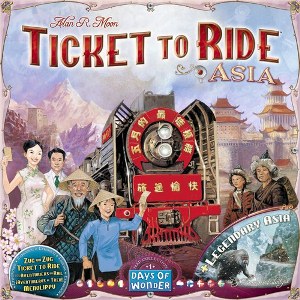
2011 was a good year for Ticket to Ride, the introductory railway themed board game from Days of Wonder that won the Spiel des Jahres and the Origins Award for Best Board Game in 2004, as well as the 2005 Diana Jones award. In its closing months, the publisher inaugurated a new line of expansions in the form of the Map Collection series. Each title in the series features two new maps – on a double-sided map board – as well as new tweaks to the core rules that provide new challenges and playing experiences. The first of these is Map Collection Vol. 1 – Ticket to Ride Asia, and it was quickly followed by Map Collection Vol. 2 – Ticket to Ride India, each of which requires the use of the Train Cards and Trains from Ticket to Ride or Ticket to Ride Europe to play. It is the first of these, Map Collection Vol. 1 – Ticket to Ride Asia, which is being reviewed here.

So in keeping with the series, Map Collection Vol. 1 – Ticket to Ride Asia contains two maps. The first of these is the Team Asia map, which introduces two elements that sell the Map Collection. One is team play, the other is the addition of another player, increasing the number of maximum players in Ticket to Ride from five to six, but requiring four or six players only. The second map, the Silk Road themed Legendary Asia, is more of a traditional affair designed for two to five players that harks back to Ticket to Ride Europe, but which adds a tweak of its very own. Team Asia was designed by Alan R. Moon, who also designed Ticket to Ride, whilst Legendary Asia was François Valentyne's entry in a competition to design and have published a new map for Ticket to Ride.

Each of the entries in the Map Collection series comes in a two-inch deep album sized box. Inside Map Collection Vol. 1 – Ticket to Ride Asia can be found the new double-sided map, forty-five Trains (nine for each of the Train colours to be found in Ticket to Ride and Ticket to Ride Europe), thirty-six Destination Tickets for Legendary Asia, sixty Destination Tickets for Team Asia, six wooden card holders, and two full-colour rule books. There is one each for Team Asia and Legendary Asia, and both are twelve pages long with the rules for each map being just a page long and given in ten languages. All of these components are nicely done and nicely packaged in the box with the two maps, one per side, being very attractive. If there is an issue with either map, it is that neither clearly state which variant they are for. Whilst the graphics for each map and accompanying Destination Tickets are similar, so is the geographical region that both maps cover, and it would have been simple enough for the designers to put the name of the variant on its map. This would make game choice and set up just that little more easier, and that much quicker.

Of course, there is the usual problem of learning the geography to be found in Map Collection Vol. 1 – Ticket to Ride Asia, but there is plenty of similarity between the two maps in this expansion, and anyway, not only do the mini-maps on the Destination Tickets help, but learning about geography as basic as this and whilst playing Ticket to Ride, is after all, fun.

The changes in the Legendary Asia variant begins with its Destination Tickets. There are thirty-six of these, of which six are Long Route Tickets, such as Moscow to Calcutta and Khabarovsk to Karachi, that are worth sixteen, seventeen, or eighteen points. At game’s start, each player receives a single Long Route and three normal Destination Tickets of which he must keep at least two. Later in the game he can choose to draw three Destination Tickets of which he must keep at least one.

Opening up the map for Legendary Asia and it looks not unlike the map for Ticket to Ride Europe. There several ferry Routes which require the expenditure of wild or Locomotive Cards to complete in addition to the usual Train Cards, but there are also several where the one or two spaces on a Route are marked with an “X” such as between Kathmandu and Mandalay, a two-space Route with an “X” on both spaces. These are Mountain Routes, which when claimed, require a player to not only expend the Train Cards of the appropriate colour, but for each “X” on the Route, to also expend one of his Trains! This represents the wear and tear on the trains that traverse these Routes and is not as bad as it sounds, because for each Train discarded, he scores an additional two points. So to claim the purple Kathmandu-Mandalay Route, a player has to discard two purple Train Cards and two of his Trains, but scores two points for the Route claimed and another four points for the Trains discarded.

In addition some double Routes, such as that between Perm and Omsk has one Route that does not require the discarding of a Train Card and one that does. In other words, one Route does not go through the mountains. In most, but not all cases, the non-Mountain Route is a grey Route, meaning that any Train Card colour can be used to complete them.

The effect of the Mountain Routes is twofold. First, it increases the completion value of some of the map’s shorter Routes. Compare a three-space Route, like that between Moscow and Astrakhan, which would score a player a simple four points for completing, and the two-space Mountain Route between Agra and Kathmandu which has one space with an “X” and which would score a player a total of four points to complete, two points for the Route itself and another two for the Train discarded. Second, the expenditure of Trains to complete Mountain Routes can be used to speed play towards the moment when a player has four Trains or less and thus trigger the game’s round of last turns.

The other additional rule in Legendary Asia is that of the Asian Explorer Bonus. This is awarded for the highest number of cities connected rather than the Longest Route as on many other Ticket to Ride maps. This encourages the creation of a network of Routes rather a single long Route and emphasises the value of the shorter Routes as they are generally easier to connect to and thus create a network with.

Overall, Legendary Asia feels like a traditional Ticket to Ride board. It offers a new map, but not a radically different playing experience. It is the easiest to adapt to, and in terms of complexity, sits nicely alongside Ticket to Ride and Ticket to Ride Europe.

Team Asia though, is a different experience. It offers complexity via a radical means of play that also restricts the number of players. It is played with teams of two players, with space for either two teams or three teams. Which means that there must be a minimum of four players if there are two teams playing, and a maximum of six players if three teams are playing. During the game the members of a team have to sit together with two of the wooden cardholders sat in front of them. These cardholders are used to store the team’s shared Destination Tickets and Train Cards, this sharing being the only means that the members of a team can communicate. In other words, during play, a team cannot talk about the Destination Tickets that either has to complete nor about what Routes that either wants to complete.

At game start, each team receives its cardholders and a total of fifty-four Trains in the same colour, the extra ones being provided with Map Collection Vol. 1 – Ticket to Ride Asia. The Trains are divided equally between the two members of a team so that they have a pool of twenty-seven each. During play, a player will draw only from his supply of Trains and just like standard Ticket to Ride, when their combined supply of Trains reaches four or less, the end game rules are triggered in which everyone has one last turn, including his teammate. So a player has to keep an eye on his supply of Trains as well as those belong to everyone else, including that of his teammate.

Then the secrecy begins. Each player receives four Train Cards as normal and a total of five Destination Tickets, of which he must keep three. Out of the kept Destination Tickets, a player must take one and simultaneously with his teammate reveal it and place it in one of the shared cardholders. When a player later draws additional Destination Tickets, he must not only keep one of the new Tickets, but also place one of the Tickets in his team’s cardholder used for their Tickets. Similarly, when a player draws Train Cards, he draws two as normal, but one of them has to go into his team’s cardholder used for the Train Cards. This must be done as they are drawn – a player cannot draw two and decide which of these Train Cards to share.

One additional option that a player has during play is that he can choose to share two of the Destination Tickets in his hand with his teammate by placing them in their shared cardholder. Whilst this can be helpful, it does deny that player the opportunity to pick up new Train Cards or claim a Route.

During the game, play order is by team. Both players on a team will take their turn one after another, then the players on the next team will have their go, and so on. Players in a team always take their turns in the same order.

At game’s end, the members of a team scores together. A ten point Asian Express bonus is awarded to the team with the Longest Continuous Path on the board whilst a ten point Globetrotter bonus is awarded to the team who has completed the most Destination Tickets.

Looking at the Team Asia map, it looks quite open, if not similar to the layout of the Ticket to Ride map of the USA with its long Routes over the top in the North, and shorter Routes to East and South. Three triple Routes run the length of the Chinese coast. In a two-team game, two of these triple Routes can be claimed, possibly by both players on a team, thus wholly blocking that Route to the other team. The map also contain two unnamed destinations – they cannot be cities as neither is named – that are black instead of the grey of the map’s actual cities. Being close to Kathmandu and Lhasa, they are probably the peaks of Everest and K2 in the Himalayas.

The other addition to the Team Asia board is not a new type of Route, but a variant upon a type of Route – the Tunnel. On maps with Tunnels, such as Ticket to Ride Switzerland and Ticket to Ride Nordic Countries, if player wants to claim a Tunnel Route he has to draw three more Train Cards from off the top of the draw deck, and if any of the drawn cards match the colour of the Route, that player must pay an extra Train Card for each extra drawn. If he cannot, he forfeits that turn. In Team Asia, the number of extra Train Cards varies, being determined by the number of the Route. For example, the yellow Route between Lhasa and Cawnpore is one space long, but is marked with a six, meaning that it requires a player to draw another six Train Cards and hope that he does not draw any yellow Train Cards and so have to pay extra Trains Cards. As with Ticket to Ride Switzerland and Ticket to Ride Nordic Countries, a player could also use Locomotive Cards to complete a Tunnel Route in this fashion. Overall, this makes Tunnels a much riskier affair and more difficult to complete.

In purely mechanical terms, Team Asia is not a complex addition to the Ticket to Ride family. In play style, it is much more complex, not just for the fact that the players within a team have to keep quiet about strategy, but also for the fact that Team Asia is not a five, or indeed, a six-player board. Rather, it is a two or three player board that it is as tight as Ticket to Ride Switzerland and Ticket to Ride Nordic Countries before it, though with more trains between the members of a team than is the norm.

Another factor in Team Asia that is similar to Ticket to Ride Switzerland is the high number of Destination Tickets. There are sixty in this set, and like Ticket to Ride Switzerland, once a player has completed his current Destination Tickets, there is the chance that a player will draw new Destination Tickets that he has already completed. It should be made clear that this is not as extreme as in Ticket to Ride Switzerland, which many players of Ticket to Ride consider to be broken for this reason. In our playing experience, this is less of an issue in Team Asia as there is less replication of Routes.

Team Asia feels almost, but not quite as tight as the other two or three player options, Ticket to Ride Switzerland and Ticket to Ride Nordic Countries because its tight play is offset by the higher number of Trains that each team begins play with. The co-operative, though silent play, adds another level of enjoyable challenge to the game and means that this variant requires a bit more thought than is the norm with Ticket to Ride. The means of adding a sixth player is innovative for Ticket to Ride, and the fact that it involves team play means that it still leaves room for someone to design a Ticket to Ride board for use with six players rather than three teams of two. Similarly, the addition of Team Play raises the question of how many other Ticket to Ride maps would its rules work with, something for the game’s fans to experiment with.

For years now, Ticket to Ride has not been receiving the support that it should have been. It did not need dice or a card game variant, nor did it need kaiju themed bits of plastic that were never in keeping with the line’s late nineteenth century, early twentieth century style. What it needed was new maps. Ticket to Ride is a train game. A very light train game it must be said, but train games are all about connecting Routes to new places, whether familiar or exotic. Every single other train game series does this and it works because gamers like new maps and the new challenges that they present. It has been three years since the release of a new map expansion in the form of the two-three player base game, Ticket to Ride Nordic Countries. It has been four years since the release of Ticket to Ride Switerland, the map expansion that sets the pattern for the Map Collection series, which appears in Map Collection Vol. 2 – Ticket to Ride India.

Hurrah! And “Hurrah!” again, because the wait has been worth it. Map Collection Vol. 1 – Ticket to Ride Asia is an excellent expansion that really does add to the Ticket to Ride family. The Team Asia gives a clever means of adding a sixth player to Ticket to Ride combined with a nice hidden objective dynamic between the members of each team. Despite it being a four or six player game, the organisation into team actually turns it into a tight two or three player board. Lastly, the six wooden card holders are nice additions can actually be used in Ticket to Ride game to hold and organise each player’s cards. The Legendary Asia is a more traditional board that offers less radical play than in Team Asia and is the easier option to get out and play. Together, Legendary Asia and Team Asia combine to make Map Collection Vol. 1 – Ticket to Ride Asia a great start to a new series of expansions and a cleverly designed challenge for the Ticket to Ride fan.

Friday, 20 January 2012

Medical Malpractice

Invasive Procedures is a scenario written for use with Fear Itself, Pelgrane Press’ RPG that pitches ordinary folk into a disturbing contemporary world of madness and violence. Like the majority of the titles published by Pelgrane Press, it uses the Gumshoe System, and so is compatible with its other two horror RPGs, Trail of Cthulhu and Esoterrorists. More particularly, Invasive Procedures includes notes that the GM can use to adapt the scenario so that it can be run specifically for Trail of Cthulhu. What helps with this is the fact that the scenario can easily be set during any period within the last one hundred years or so such that it could be run in the contemporary here and now of Delta Green, the 1890s of Cthulhu by Gaslight, the 1920s for classic Call of Cthulhu, the 1930s for Trail of Cthulhu, or indeed, any when in between. The scenario itself makes use of a foe first described in the publisher’s excellent supplement, The Book of Unremitting Horror, the details of which are included in Invasive Procedures. In the version that Pelgrane Press was kind enough to provide for the purpose of this review, the foe is described in a nine-page booklet that comes in an envelope glued inside the back cover. Later printings of scenario will have the description and motivation of this foe written in as part of the book.

Invasive Procedures works best as either a one-shot or as the opening chapter of a campaign. Its set-up is very specific, making it difficult to run as part of an on-going campaign. A quintet of pre-generated characters/investigators is included, and these can either be used as is, or as the models for characters of the players’ own creation. Using the provided characters as models is necessary, not because the characters are in any way special, but because of both how and where they are.

As the scenario opens, the player characters find themselves in hospital. They are each patients who have been moved from a county hospital to older facility where they are to recover from recent surgery. Our Lady’s Hospital was meant to have been closed down years ago, but despite its crumbling façade and obsolete infrastructure, it has been kept open in order to handle patients who need rest and observation rather than actual treatment. Thus freeing up much needed beds at the more modern hospital nearby.

The medical condition of the investigators has a marked effect upon the scenario and just what they can get up to. For much of the scenario, they will be restricted to their beds by the nurses, as they are expected to rest after all. This does not mean that the investigators cannot conduct any actual investigation, but rather that they will have to have to work hard to get around the nurses. When they do though, their efforts will be hampered by the state of their health. In game terms, an investigator literally must expend points from his Health Ability in order to conduct certain actions, points that can only be restored through bed rest. In effect in Invasive Procedures, each investigator’s Health Ability has a reduced and more temporary feel to it, and this, combined with the reduced number of points assigned to all of the investigators’ Abilities, places an emphasis on the resource aspect of playing a Gumshoe game.

This might be frustrating for some players, as might the fact that escaping Our Lady’s Hospital is intentionally difficult. Not just due to their investigators’ weakened health, but also later in the scenario as the forces they face isolate the facility. Nevertheless, this is intentional; Invasive Procedures is all about isolation and claustrophobia, as much as it is about medical malpractice and the classic duality of the medical practitioner. Despite the constraints placed on the investigators by their status and their situation, they do have room to manoeuvre and explore their environment, the nature of which changes between night and day. These elements are actually tools to help the GM run what is not necessarily an easy scenario to run if he is to both maintain its atmosphere and handle the flow of clues.

The difficulty that a GM might have in running Invasive Procedures is not helped by the pre-generated investigators, which feel underwritten; the lack of a timeline that could help him handle its flow of effects; and a simple map that could help him visualise Our Lady’s Hospital quickly and easily – both for himself and for his players. That aside, the scenario is nicely produced, and the writing excellent. Pasqual Quidalt’s illustrations are all suitably dark and makes for a moody change over the art usually seen in Pelgrane Press’ titles.

Lastly, there is the matter of Invasive Procedures and Trail of Cthulhu. The scenario is clearly written for Fear Itself, which shows in its choice of true foe and its feel as more a traditional horror scenario than a Lovecraftian investigative horror one. Mechanically, there is little that a Keeper needs to do in order to adapt Invasive Procedures from Fear Itself to Trail of Cthulhu. Thematically, he needs to work elements of the Mythos threat into the body of the scenario, the suggested threats being the Mi-go or Elder Things, the former being more appropriate and easier to work in than the latter. This, like the running of the actual scenario, is best done by an experienced GM or Keeper.

As a one-shot horror adventure, Invasive Procedures is a close, claustrophobic, and challenging affair. The challenge rises exponentially for the GM or Keeper if he wants to run this scenario as part of a campaign, though it would make for an atmospheric and scary start for a campaign.