Every Week It's Wibbley-Wobbley Timey-Wimey Pookie-Reviewery...
Showing posts with label 2000 AD. Show all posts

Sunday, 4 January 2026

Strontium Dog I

In 1988, Games Workshop would have published its fourth home grown roleplaying game. Like its second, Judge Dredd: The Role-Playing Game, this would have been drawn from the pages of Britain’s longest running Science Fiction comic, 2000 AD. Strontium Dog: The Role-Playing Game was based on the comic strip of the same name, telling the exploits of Johnny Alpha, an ‘S/D’ or Search/Destroy agent forced to live off Earth because he was a mutant and work collecting bounties on some of the worst criminals in the galaxy. Working Typically accompanied by one or more of his partners—Wulf Sternhammer, the Gronk, and Middenface McNulty, Johnny Alpha dealt with prejudice against mutants—the worst of which came from within his own family, rival bounty hunters, revenge-seeking criminals, and worse. The stories were essentially Spaghetti Westerns in space and the comic strip, which originally appeared in the pages of Starlord in 1978 before transferring to 2000 AD in 1980 ran until 2018 with the death of its artist, Carlos Ezquerra, was very popular. It has since been revived with stories exploring other characters and the wider setting. Had Strontium Dog: The Role-Playing Game been published by Games Workshop, it would have no doubt sold well. After all, in the mid-eighties, Strontium Dog was one of 2000 AD’s most popular series, as was Judge Dredd, and its familiarity to the British roleplaying game hobby would have given it as firm a fan base as Judge Dredd: The Role-Playing Game. Plus, there were fewer stories for Strontium Dog and its setting was more open—the whole of galaxy, plus time travel—so there was more space in which to create and tell adventures, and then, of course, the set-up was simple. Play a Mutie ‘S/D’ Agent, overcome the prejudice he faces, travel the galaxy, capture or kill criminals, collect their bounties, make a living.

Alas, it was not to be. In 1987, following the release of Warhammer 40,000: Rogue Trader, Games Workshop pivoted away from supporting intellectual properties that were not its own, dropping board games and roleplaying games in favour of miniatures and wargames. This included what would have been Strontium Dog: The Role-Playing Game.

This is not a review of Strontium Dog: The Role-Playing Game as released, for that did not come to pass, but a review of what could have been. This is a review of the playtest version that was very close to completion and came with everything necessary to play, including a beginning scenario.

—oOo—

Strontium Dog: The Role-Playing Game would, like the Judge Dredd: The Role-Playing Game, have appeared as boxed set. Inside there would have been three books—‘The Player’s Book’, ‘Equipment Manual’, and ‘The Game Master’s Book’. In addition to this, there would probably have been a set of percentile dice and some cardboard standees. The latter, along with the box itself and the book covers would have been the only things in colour. The books would have otherwise been black and white, but exactly like Judge Dredd: The Role-Playing Game had its artwork by various artists to draw upon to illustrate its pages, so to would have Strontium Dog: The Role-Playing Game with the artwork of Carlos Ezquerra. This would have imparted the rough, working and frontier nature of the Strontium Dog setting as well as its action.

‘The Player’s Book’ introduces the setting and details both the means to create characters and the rules for Strontium Dog: The Role-Playing Game. There are some suggestions as to how it might be played using miniatures, and no doubt, Games Workshop would have made a set of miniatures available. Everyone plays a Mutant ‘S/D’ Agent, operating out of an orbital base nicknamed the ‘Doghouse’. He is defined by his Attributes, Special Abilities, and Mutations, and will also have some equipment and weapon proficiencies. The six attributes consist of Strength, Initiative, Combat Skill, Technical Skill, Street Skill, and Psi Skill. Of these, Strength is both an ‘S/D’ Agent’s ability to both inflict and suffer damage, Initiative is both his speed and his agility, and the Psi skill is his ability to withstand psionic attacks and if he has a special Mutant Power, use that as well. These are all percentile values and are created by rolling ‘2d10+30’. He will definitely have a mutation of some kind, including minor, major, and extreme physical mutations, animal mutations, and Mutant Powers. If an ‘S/D’ Agent has a Mutant Agent he will still have a physical or animal mutation, and in all cases, the mutation also imparts a negative Reaction Check modifier. The more extreme the type of mutation, the more negative the Reaction Check modifier. ‘The Player’s Book’ includes multiple tables for determining an ‘S/D’ Agent’s mutation and its extent, providing for a lot of detail whilst still leaving room for the player to detail the specifics. This can lead to the creation of grotesques, but this is not out of keeping with the source material.

The Mutant Powers consist of a range of psionic powers, such as Absorb Energy, Chameleon, Illusions, Mind Control, Psychic Attack, Pyrokinesis, Telepathy, and Teleportation. They also include Johnny Alpha’s Alpha Ray Vision. Special Abilities consist of a mix of what would be abilities and skills in another roleplaying game. They are categorised under Initiative, Combat Skill, Technical Skill, and Street Skill. For example, Initiative-based Special Abilities include ‘Ambidextrous’, ‘Dodge’, and ‘Target Tracking’; Combat Skill-based Special Abilities include ‘Fast Aim’, ‘Hammerfist’, and ‘Weapon Specialist’; Technical Skill-based Special Abilities include ‘Computer Use’, ‘Drive’, and ‘Medtech’; and Street Skill-based Special Abilities include ‘Detect Traps’, ‘Intimidation’, and ‘Smooth Talker’. These Abilities provide a range of effects, including simply being able to undertake a particular task, grant a bonus to the associated Ability, or change when an ‘S/D’ Agent acts in combat. They typically require a roll against the associated Ability to activate. Penultimately, the ‘S/D’ Agent receives the standard equipment for an ‘S/D’ Agent and an advance to spend on extra arms, armour, and gear, which will be paid back from his first successful bounty. Lastly, the player rolls for his ‘S/D’ Agent’s weapon proficiencies. These represent some training and the weapons the ‘S/D’ Agent used during the Mutant Uprising.

To create a ‘S/D’ Agent, a player rolls for his Abilities and his Mutations and their depth and detail. Having generated his ‘S/D’ Agent’s Abilities, he receives points to spend on their associated Special Abilities. This is equal to the number of points above thirty for each Ability or equal to the die roll used to generate each Ability. Any excess points are saved to be spent later. He will also purchase further equipment. By the end of it, the player should have a very good idea of what his ‘S/D’ Agent looks like and what the extent of his mutations are. The process is not difficult, but slightly fiddly when it comes to determining the nature and extent of his mutations. It helps that there is a full example of ‘S/D’ Agent creation. Plus, at the end of the process, there is an engaging in-game briefing that the ‘S/D’ Agent would receive that sets the scene for his reception of his first bounty.

Raggedy Ann O’Riley

Strength 44
Initiative 47 (1)
Combat Skill 38 (0)
Technical Skill 36 (0)
Street Skill 40 (0)
Psi Skill 43

SPECIAL ABILITIES
Dodge (Initiative), Target Tracking (Initiative), Weapon Specialist (Combat skill), Drive (Technical Skill), Pursue (Street Skill), Sign Language (Street Skill)

Reaction Check Modifier: -05
Security Rating: CCC

MUTATIONS
Skin colouring is quartered (indigo, magenta, dark brown, normal flesh)
Skin is like coarse fabric
Eyes have strange colour (wheat yellow iris)

WEAPON PROFICIENCIES
GCC Standard Issue Single Cartridge Blaster, Skatta Gun, Lazooka

EQUIPMENT
GCC Standard Issue Single Cartridge Blaster
No. 1 Cartridges (3)
Wanted Meter
Custom-Fit Chest Armour, Upper Back Armour, Arm Protectors (pair)
GCC Standard Issue Jumpsuit, Black
GCC Standard Issue Combat Boots, Pair, Black
GCC Search/Destroy ID Badge with CCC Security Rating
GCC Standard Issue Pouch Belt with eight Pouches
2,500 cr

Mechanically, Strontium Dog: The Role-Playing Game is a percentile system. To have his ‘S/D’ Agent undertake an action, his player rolls the percentile dice and compares the result against the appropriate Ability. If the result is equal to, or under, the Ability, the action is a success, but if over, a failure. A roll of ‘01’ is always a success and a roll of ‘00’ is always a failure.

Combat, a major aspect of the roleplaying game, is played on a timescale of one Round equals five seconds in which there are five Phases. A combatant can act in one or more of those Phases, the number determined his current Initiative. All ‘S/D’ Agents begin play being able to act in two Phases, but their Initiative can go up and down. Up due to improvement, down due to injury. Most actions take a single Phase. Firing a weapon involves aiming, weapon proficiency (halved if the ‘S/D’ Agent lacks the appropriate weapon proficiency), size, distance, movement, and illumination. Combatants can target specific locations, but weapons can jam if a ‘00’ is rolled. A jam might simply be that, but it could also be a misfire or even the weapon exploding!

The combat rules also cover thrown weapons—a lot of different types of grenades are available and thrown in Strontium Dog, hand-to-hand, and so on, all supported by examples. Damage is determined by the attack type and for missile weapons, the base damage is modified by range. More damage is inflicted at close range, less at long range. Damage itself is applied to hit locations, which can be a challenge because not every mutant is going to have the same body parts, the same number of body parts, or the same bodily arrangement as other mutants or normal humans. The rules include advice on this, but ultimately in such cases, it is down to the Game Master to decide upon what part of the body that the damage is inflicted. Armour, if worn on a particular location, has a percentage chance of stopping the damage completely equal to its Armour Rating. If this Armour Roll is successful, the damage is stopped, but it damages the armour and reduces its Armour Rating. Damage is deducted from a target’s Strength and Initiative Abilities, potentially reducing his speed and capacity to act. Strontium Dog: The Role-Playing Game does include rules for critical hits, which occur when an ‘01’ is rolled, or an ‘01’ or ‘02’ if the combatant has the ‘Weapon Specialist’ Special Ability. The list of effects is not extensive, but range from loss of an eye or ear and permanent Initiative to extra damage and temporary unconsciousness. It can every result in the target being killed outright. This is rare though. There are Critical Hit Tables for each location. ‘The Player’s Book’ makes clear that the Critical Hit rules are optional.

The rules also cover movement, pursuit and fleeing, tracking, sneaking and searching, listening and observing, driving and flying, and more. Traps are covered too, as criminals not infrequently lay them for nosy ‘S/D’ Agents. What Strontium Dog: The Role-Playing Game makes clear though, is that combat is an option. An ‘S/D’ Agent can attempt persuade or intimidate a bounty into giving himself up and may well need to do so, since the terms of a bounty may require the apprehension of a fugitive or criminal rather than execute him. To that end, particular attention is paid to intimidation. The Intimidation Special Ability will give an ‘S/D’ Agent an advantage here, as will Persuasion and Smooth-Talker. That said, the negative Reaction Check Modifier from being a mutant and an ‘S/D’ Agent will counteract that.

‘The Player’s Book’ comes to close with a discussion of warrant types—‘Apprehend & Return’, ‘Dead or Alive’, and ‘Termination’—and the crimes that lead to their being issued and what sort of bounty an ‘S/D’ Agent can expect to be paid for completing each type. Presented here too, is discussion of the regulations as they pertain to each warrant type, how to use the Wanted Meter, and lastly, the rights of criminal once he has surrendered. This is all useful information as it underpins the structure of how the game is played from one scenario to the next. There are similarities here between Judge Dredd: The Role-Playing Game and Strontium Dog: The Role-Playing Game with the lists of crimes and associated values. Of course, in the former, the Judge is apprehending perps and sending them to the isoblocks for years, whilst in the latter, the ‘S/D’ Agent is apprehending criminals and bringing them back for money. Both are dispensing the law, if not justice, and there are situations where both can be regarded as executioners.

The ‘Equipment Manual’ is an extensive guide to the guns and gear used by ‘S/D’ Agents that appears in Strontium Dog. From signature blasters and blaster cartridges to mini-nukes and planet-busters, the list of equipment is lengthy and detailed. Lasers, grenades, bombs, hand-to-hand weapons, vehicles, and more are all described. The miscellaneous section covers bleepers (or tracking beacons) and com-units of various ranges), jetpaks, maps, medi-paks, toolkits of various kinds, security devices, and a lot more, including Plastiflesh for disguising oneself. The vehicle section gives profiles for various models and types along with rules for driving, crashing, and vehicular combat. These are comparatively more detailed than those for man-to-mutant combat, and so require more attention and study to bring them into play. The last entries in the ‘Equipment Manual’ explain the workings of the ‘AAA Security Weapons’ that Johnny Alpha is occasionally issued with in the comic series. Things such as ‘Stasis Grenades’, ‘Time Bombs’, ‘Time Traps’, and ‘Time Shrinkers’. Developed by the Galactic Crime Commission that the ‘S/D’ Agents ultimately work for, they are issued only to the most trusted agents and their unsanctioned use is a crime. Essentially, these are only to be issued by the Game Master and only for specific missions, their use serving the story rather than anything else.

‘The Player’s Book’ begins by giving the advice that the reader work through the examples included in its pages and create some examples of the ‘S/D’ Agents before running them through the rules to grasp how Strontium Dog: The Role-Playing Game is designed to work. This element of advice continues for the reader in ‘The Game Master’s Book’, suggesting she skim it more than once to gain an idea of where everything is in its pages, before examining its different elements in more detail. The specific advice focuses on the creation of scenarios and on running the game itself, discussing in turn, plot, settings, and encounters, all leading to the climax. It also provides Game Master with advice on various aspects of the roleplaying game, including mutations and Special Abilities, skill checks, combat and damage, as well as adding more details for criminals surrendering, including even the possibility of a reversal of any such surrender!

‘The Game Master’s Book’ includes the introductory scenario, ‘Doggy in the Middle’. This is specifically designed for beginning characters who are ready for their first bounty. It opens with the ‘S/D’ Agents in the Capitol on the planet of Sleaz, assigned a warrant from the Doghouse raised by the Sleaz Police. It wants the ‘S/D’ Agents apprehend several members of the Pleasant Street Gang. The ‘S/D’ Agents are told where the bounties can be found and told that they cannot use firearms of any kind. Fists and clubs are okay. The gang members are in Sammy’s Bar and the ‘S/D’ Agents are to apprehend them without causing too much collateral damage or killing anyone. There are about thirty staff and patrons in the bar and the ‘S/D’ Agents must sort the bounties from the innocent civilians. ‘Doggy in the Middle’ is fine for a single evening’s worth of play, but it is disappointing at the very least. It only showcases limited aspects of the roleplaying game, with no scope for the use of blasters and other ranged weapons, for investigating a bounty, and for action beyond the confines of the bar. For a barroom brawl, it is not a terrible scenario, but for an introductory scenario, it only does half the job. This would have been disappointing had Strontium Dog: The Role-Playing Game actually been published, but its failure to fully support the rules and showcase what an actually showcase what a Strontium Dog: The Role-Playing Game would actually look like is compounded by an editorial note deleting the mention and thus possible inclusion of a longer adventure.

‘Doggy in the Middle’ does show what an NPC looks like in Strontium Dog: The Role-Playing Game and in addition, the roleplaying game gives rules and tables for creating a variety of NPCs, including mercenaries, police, engineers, scientists, and aliens. Naturally, particular attention is paid to the creation of criminal NPCs since they will be the target the bounties in play. It includes minor criminals, criminal henchmen, and major criminals, and their equipment and their crimes. The most interesting addition here is for ‘Security’, specifically the ‘Security Rating’ for ‘S/D’ Agents. An ‘S/D’ Agent’s Security Rating consists of three letters such as ‘CCC’, ‘BCC’, and ‘BAC’. The first letter indicates the amount of bounty that an ‘S/D’ Agent has brought in, the second how well an ‘S/D’ Agent pursues warrants, and the third a general assessment of the ‘S/D’ Agent’s capability. The ratings can go down as well as up, and in the game, it represents an ‘S/D’ Agent’s access to equipment, which at a Security Rating of ‘CCC’, this could be Pressure Sensitive Device or Magnetic Decoder; for ‘BBB’, some Plastiflesh or a Retina Printer; and for ‘AAA’, the aforementioned special devices that the Galactic Crime Commission only assigns to its more trusted ‘S/D’ Agents.

Rounding out ‘The Game Master’s Book’ are sections on space travel, including vessels and hazards, and then time distortions. Time travel is known in Strontium Dog, indeed, one of the first stories sees Johnny Alpha going back in time to collect the bounty on a certain Adolf Schicklegruber! Dimensional travel is also possible as the universe is not stable, both being intended for use as narrative devices. There are some details given too on various galactic organisations, galactic and planetary law, crime and punishment and the legal process, as well as the means to create planets where criminals might be operating or hiding.

Overall, as a playtest version of what would have been the Strontium Dog: The Role-Playing Game, the files are very, very close to being complete. Everything necessary is included in its pages to be a playable, fully rounded roleplaying game. Character generation, core rules, combat rules, objectives of play, background, advice for the Game Master. It is all there. Of course, there are things missing. One is a fuller, more sophisticated, and more detailed scenario. The other is details of the cast of the source comics translated into game form. The latter though is something that the manuscript does acknowledge it as needing.

Physically, Strontium Dog: The Role-Playing Game in its playtest form is plain and simple. Literally plain, simple text. Further, it actually consists of over two hundred pages of printout from a late eighties dot matrix printer, which has then been marked up with red pen. Not extensively, but some. This means that it is not an easy manuscript to read physically and there is a degree of fragility to it.

Strontium Dog: The Role-Playing Game is a lost, forgotten roleplaying game. As an artefact, it is a possibility of what could have been. Another roleplaying game based on the pages of 2000 AD, supported with scenarios, miniatures, and content in the pages of White Dwarf. As a design, it is not ground-breaking, but it is a sound adaptation of the source material and it is more sophisticated than Judge Dredd: The Role-Playing Game, but not as complex as Warhammer Fantasy Roleplay, sitting somewhere between. It is easy to understand and easy to play and doubtless, it would have been a popular roleplaying game had it been published and supported. And likely, it would go on to be held in as high an affection just as Judge Dredd: The Role-Playing Game is held today.

—oOo—

Strontium Dog: The Role-Playing Game is a very playable roleplaying game because I have played it twice—thirty years apart. In the September of 1986, we made the trip from Dorset to London for Games Day ’86 held in the Royal Agricultural Hall. It was notable for several reasons. As our first trip to a gaming convention. As where we met gamers outside of our gaming circles. As where we first encountered the roleplaying game, SkyRealms of Jorune. As where I sat down and played a playtest version of Strontium Dog: The Role-Playing Game. My ‘S/D’ Agent was striped green and brown so had the name Esmeralda Brown. Somewhere I still have that character sheet for her. It was a fun game and in the months that followed, I awaited the publication of Strontium Dog: The Role-Playing Game. Of course, it never appeared and that character sheet remained the only proof of such a game actually existing. Games Workshop moved on and that Saturday afternoon experience became a memory.

Fast forward three decades and a Strontium Dog roleplaying experience was offered at the Manchester convention, GrogMeet. Not the versions based on Traveller, First Edition from Mongoose Publishing or Judge Dredd & The Worlds of 2000 AD from EN Publishing, but using the original ruleset. The ruleset that had never been published. I was both flabbergasted and intrigued and could not wait to speak to the Game Master. I wanted to find out how he had got hold of them and tell him about my connection to them, however tangential that was. I got to play them too and they still worked. I said at the time, that I was interested in reading them and reviewing them. I also said I understood that was not possible. After all, the three folders that hold the printouts of the rules are a singular artefact, a piece of roleplaying, Games Workshop, and 2000 AD history which never came to pass. It was very unlikely that anyone else had a copy and unlikely that Games Workshop had an accessible copy in its extensive archive. Of course, the Game Master wanted to ensure that they remained safe. 
Then in 2024, the Game Master turned up a convention and handed me the folders, saying that he trusted me to look after them and write the review that I wanted to. The review is late, but it is the review that I wanted to write and now, the files are going back to the Game Master next week at GrogMeet 2026.

—oOo—

With heartfelt thanks to Sam Vail for his patience and trust and generosity without which this review would not have been possible.

With thanks to the late, much missed John Amos, and Alex Blair without which that first trip to a national gaming convention would not have been possible.

Friday, 23 June 2023

1982: Judge Dredd: The Game of Crime-Fighting in Mega-City One

1974 is an important year for the gaming hobby. It is the year that Dungeons & Dragons was introduced, the original RPG from which all other RPGs would ultimately be derived and the original RPG from which so many computer games would draw for their inspiration. It is fitting that the current owner of the game, Wizards of the Coast, released the new version, Dungeons & Dragons, Fifth Edition, in the year of the game’s fortieth anniversary. To celebrate this, Reviews from R’lyeh will be running a series of reviews from the hobby’s anniversary years, thus there will be reviews from 1974, from 1984, from 1994, and from 2004—the thirtieth, twentieth, and tenth anniversaries of the titles. These will be retrospectives, in each case an opportunity to re-appraise interesting titles and true classics decades on from the year of their original release.

—oOo—

Judge Dredd: The Game of Crime-Fighting in Mega-City One is back! Originally designed by Sir Ian Livingstone and published by Games Workshop in 1982, it was the very first board game to be inspired by the Judge Dredd comic strip from the pages of 2000 AD. In the original game, the players control Judges patrolling the streets of Mega-City One, the vast twenty-second century metropolis on the Atlantic coast of North America, home to eight hundred million citizens and all of them potential lawbreakers. Every Judge is trained from the age of five to arrest criminals, pass sentence, and carry out the sentence—even if that means a death sentence!—all in the name of keeping the city and its inhabitants safe. Every turn a player sends his Judge to the scene of a reported crime, perhaps the Palais De Boing—the only place in the city where it is legal to go Boinging, Otto Sump’s Ugly Clinic for the very best in uglification surgery, or the Alien Zoo where wonders and weird creatures from across the universe can be seen— and attempts to arrest the perpetrator. Perhaps Joseph ‘Mad Tooth’ McKill for Tobacco Smoking, Ma Jong for Stookie Glanding, or Dobey Queeg for Robot Smashing. Notoriously, this is the board game where you could be arresting Judge Death for Littering, or Ma ‘Green Fingers’ Mahaffy for Murder. Unfortunately, only one Judge gets be top dog in Mega-City One, and that is Judge Dredd. Which means the player with greatest total strength of Crime and Perp cards in his score pile at the end of the game is the winner and thus next top dog.

Much like the later Block Mania, the good news is that Judge Dredd: The Game of Crime-Fighting in Mega-City One has returned to the fold of 2000 AD and is now published by Rebellion Unplugged. Like Block Mania, it has undergone a redesign and makeover, but not by very much, and the game play remains very much the same. What has been added are clearer rules for ending the game and a simple expansion to make play a little more interesting and worth revisiting. Everything else remains the same. Same game rules, same art style, same set of perps and crimes, and same take that style of play. So, although a classic, Judge Dredd: The Game of Crime-Fighting in Mega-City One is still a game from 1982. What that means is that the game is easy to learn and easy to play, has bags and bags of theme—even if that theme dates back between 1977 and 1982, a degree of players acting against each other, and a high degree of luck. Judge Dredd: The Game of Crime-Fighting in Mega-City One is by any definition, an ‘Ameritrash’ board game. That by no means is necessarily a bad thing as the game can also be funny and silly, and it is playable by anyone—not just those who played it first time around in 1982 and are noshing down on the nostalgia.

Judge Dredd: The Game of Crime-Fighting in Mega-City One is designed to be played by two to six players aged fourteen plus and has a playing time of between an hour and an hour-and-a-half. The board depicts twenty-eight locations in Mega-City One. Over the course of the game, each sector will be seeded with a reported Crime and Perp. The Judges will proceed to the Sectors where these Crimes and Perps have been reported, reveal them, and attempt to arrest the Perp. Failing that, they may be able to stop the Crime in progress. At the end of the game, the player who has scored the most points from Perps arrested and Crimes stopped, wins the game.

Set-up first requires the group to choose a game length—‘Hotdog Run’, ‘Day Shift’, or ‘Night Shift’—and decide whether or not to use the Specialist Judges expansion. Each player receives six Action cards, and the Crime, Perp, and Sector cards are shuffled. Sector cards are drawn and these indicate where reports of crimes have been made, Perp cards and Crime cards being drawn and placed face down in the indicated Sectors. Each round consists of three phases. In the Movement Phase, the Judges move two Sectors in a direction, taking accounting of bridges to cross the river, but primarily to the nearest Sector containing Perp and Crime cards. When a Judge moves into a Sector Perp and Crime cards, both are turned over and revealed. In the Arrest Phase, a Judge attempts to bring a Perp and his Crime to justice. To do this, his player rolls the game’s black Judge die and adds his Judge’s Strength. Another player roll’s the game red Perp die and adds the result to Perp’s Strength, a total of the value on the Perp card plus the value on the Crime card. Highest total wins. If the Judge’s result is higher, he arrests the Perp and his player takes both Perp and Crime cards and adds it to his score pile. If the Judge’s result is lower, the Judge has failed, is knocked out, and has to discard and refresh his hand of Action cards. If the result is a draw, the crime is stopped and the Crime is added to the player’s score pile, but the Perp runs away, ready to be arrested by another Judge! In the third Refill Phase, new Sector cards and Crime and Perp cards are drawn to bring the number in play back up to six, any Judges knocked out go to the Justice Department Hospital, and each player receives a new Action card, more if their Judge is in certain sectors.

Of course, it is not always possible for a Judge to beat a Perp and a Crime on a singe roll. For example, if Fink Angel And Ratty with a Strength of eight was Body Sharking, which has a value of five, the total Strength the player has to roll higher than is thirteen. Which is not possible with the addition of a Judge’s Strength of six plus a die roll. Fortunately, a Judge has access to Action cards. Most are Support cards, which add a bonus to the arresting Judge’s Strength. For example, ‘Judge Hershey is with you today’ adds three and ‘The Perp is Kill Crazy. You send in the Sonic Cannon.’ adds five. Others though, are Sabotage cards, and can be used by a player to make an arrest attempt by another player’s Judge even harder. For example, ‘Your breakfast of plasti-flakes and synthi-lix is giving you chronic indigestion. You are not in tip-top fighting condition’ levies a -2 penalty or ‘The Perp you are fighting is secretly an East-Meg spy. Add an Extra Die to their Strength’. The worst of these cards, of course, the Escape card, which reveals the Perp to be the notorious Edwin Parsey, notorious confessor of other people’s crimes, which forces all Support cards used in the arrest attempt to be discarded and the attempt be treated as a tie. Other Action cards allow extra movement, send the Judge to a particular Sector, grants on the spot healing, and so on.

Judge Dredd: The Game of Crime-Fighting in Mega-City One adds one expansion—Specialist Judges. There are six of these—or seven if the Judge Fish from ‘The Day the Law Died’ storyline promo is included—and each Judge has a different ability. They include Chief Judge, SJS Judge, Psi-Judge, Wally Squad, Cadet, and Mechanismo. For example, the Cadet Judge only has a Strength of four, but begins play with and can hold seven Action cards, and draws an extra card; the SJS Judge can look at another player’s Actions each turn and wins ties in combat; and the Wally Squad Judge can move through Sectors containing revealed Perps, but does not have to arrest them. All six are nicely thematic and give a player a good little edge in play. The mix means that the players can come back to the game, try another Specialist Judge and a slightly style of play.

Physically, Judge Dredd: The Game of Crime-Fighting in Mega-City One is well presented. The artwork on the board is in colour, whilst the cards is black and white, but also is sharply and crisply handled. The rulebook is clearly written, easy to read, and supported with examples of the rules. In addition, the rulebook includes all of the UMPTY CANDY CARDs from the Jack Caldwell’s Old-fashioned Umpty Candy packs. All three series—‘SECTORS of Mega-City One’, ‘CRIMES of Mega-City One’, and ‘PERPS of Mega-City One’ explain the three sets of cards in the game, giving background for each of them.

Judge Dredd: The Game of Crime-Fighting in Mega-City One is not a perfect game by modern standards. It is too luck driven, the game allows one player to directly hamper another with the Sabotage cards, and towards the end of play, players can congregate around the remaining Sectors that have not yet been drawn if they have been keeping an eye on the cards that have been drawn to date. That said, they were part of the game’s design in 1982 and they should be there also in 2022 because the new edition is intended as a nostalgia piece and to change the game’s design too radically would break from that. Another issue is that the game only draws from the first five or so years of the Judge Dredd strips in 2000 AD—1977 to 1982—so that means forty-year-old stories which may not be as familiar to younger players. Perhaps yet, there is room for further expansions involving the more recent stories and thus more Crimes and Perp cards?

Judge Dredd: The Game of Crime-Fighting in Mega-City One is a fun game, easy to play and all the more enjoyable if the players know the lore, know the crimes, and know the Perps. Rebellion Unplugged have done a fantastic job of updating the quality of the game whilst both retaining the same game play and adding an expansion for more varied play. Judge Dredd: The Game of Crime-Fighting in Mega-City One marks the welcome return of a beloved classic, British in both design and inspiration, in turns funny, frustrating, and evocative of our gaming youth and another age.

Saturday, 18 February 2023

Towering Trials

It has been over thirty-five years since the publisher of Britain’s longest running Science Fiction comic, 2000 AD, dabbled in the field of roleplaying. Both times, it was with solo adventure books, first with the Diceman comic, and then with You are Maggie Thatcher: a dole-playing game, but that all changed in 2021 with the first release in the Adventure Presents series. Published by 
Rebellion, best known as the publisher of 2000 AD, this is essentially a complete roleplaying game and scenario in a magazine format. The first issue was Tartarus Gate – A Roleplaying Game of Sci-Fi Horror, from the designers of Spire: The City Must Fall, a full Blue Collar Science Fiction Horror roleplaying game. Each entry in the Adventure Presents series a simple roleplaying game and a full, three-session scenario designed for up to six players and the Game Master for which everyone will need three six-sided dice and some pencils. Following a successful Kickstarter campaign, the second entry in the Adventure Presents line is Tiny in the Tower – Cosy Fantasy Roleplaying.

Adventure Presents Tiny in the Tower – Cosy Fantasy Roleplaying is a fantasy roleplaying game and scenario all in one, in which a group of courageous adventurers is employed by Azra Zathra to investigate the disappearance of her wife, Zura. Zura Zathra is a wizard and has not returned from her tower for the last two days. Her wife is thus worried, but cannot investigate herself because the tower is full of volatile and dangerous magic. Fortunately, being braver and more capable, a stalwart band of adventurers can! Unfortunately, when the adventurers enter the tower, things go terribly wrong for them. They are shrunk down to a diminutive size, which gives the adventure a whole new dimension! The adventurers must negotiate their way through an environment in which almost everything to them is a threat where previously they were the threat or anything other than a threat! Can they find they find a way to complete their towering trip, avoid the hazards of a world made both big and small, avoid or least find a way to confound the curious cat, and lastly, discover the means to restore themselves to full size, let alone discover what happened to  Zura Zathra?

The format of the Adventure Presents series and thus Tiny in the Tower is important. The centre twenty-two pages are intended to be pulled out. These include six Character Sheets, the Allies booklet which details all of the adventure’s cooperative critters, all of its antagonists, two Map handouts, and both the How to Play booklet and the Special Rules booklet. Zura Zathra’s wizard’s tower is mapped out across seven floors in lovely detail with full illustrations of each.

A character or Protagonist in Tiny in the Tower is simply defined. He has four Abilities—Toughness, Agility, Smarts, and Wits—each ranging in value between one and four. He has a value for his Health and his Resolve—his willpower, the former as high as twenty, the latter as high as twelve. He also has three Drives, for example, Calm, Swift, and Heroic. Each character has a background and a given role, such as The Daredevil or The Knight, and an excellent illustration. It is left up to the player to name the character.

Mechanically, Tiny in the Tower is simple and straightforward, its key mechanic, known as the ‘Adventure system’, best described as ‘roll three and keep two’—mostly. For his Protagonist to undertake an action, a player rolls three six-sided dice and removes one die. Which die depends upon the rating of the Ability being tested. If the Ability has a value of one, the highest die value is removed; if two, the die with the middle value is removed; if three, the lowest die value is removed; and if four, no die is removed, and all are counted. Either way, the total value of the remaining dice needs to equal or exceed the value of a Target Number to succeed, the Target Numbers ranging from six or simple to twelve or extreme. The Game Master can adjust the difficulty of a task by temporarily increasing or lowering the Player Character’s Ability value. A supporting Protagonist can help another and so temporarily increase the supported Protagonist’s Ability, whilst the acting Protagonist can spend Resolve to also increase his Ability value. Resolve can be regained by a Protagonist pursuing one or more of his Drives and at the beginning of each chapter, as can Health.

Combat, or conflict, in Tiny in the Tower consists of opposed rolls. The lower roll is subtracted from the higher roll and the remaining value deducted from the losing combatant’s Toughness. Conflict resolution is designed—much like the rules in general—to be fast and in the case of combat, dangerous rather than necessarily deadly. The special rules for the adventure primarily cover movement up and down the tower since this will be a major challenge for the Protagonists because the tower being a wizard’s tower means that it is missing one important feature found in other towers—stairs! How exactly the missing wizard gets up and down the tower, and more importantly, how her cat gets up and down the tower given that the Protagonists are on the same scale as the cat, are an important aspect of the scenario. Consequently, the Protagonists will have to find their own way up and down the tower and the Special Rules provides rules for climbing and falling, and suggests routes the Protagonists can take between each floor.

Tiny in the Tower is essentially a chase and investigation story. The Protagonists are chasing the Wizard to determine where she has gone and consequently find themselves in the same predicament. Their journey is on a grand scale, almost like scaling a mountain, complete with rooms which represent the different stages and base camps, although far more detailed and interesting. Along the way, the Protagonists will have the opportunity to confront enemies and dangers, overcome obstacles, make allies, and ultimately thwart the ambitions of a would-be dictator who wants to take over in the absence of her wizard mistress.

Physically, Tiny in the Tower is very nicely presented. It is well written, but what really stands out is the artwork—which is as good as you would expect from a publisher which puts out 2000 AD each week. If the illustrations are good, then the maps are even better. Overall, the production values, for what is just a ‘magazine roleplaying game’ are stunning. The format does mean that the roleplaying game and scenario requires a little extra preparation, in particular physically as the Game Master pulls it apart, and she will also need to find a means of storing it all together afterwards.

In addition, Tiny in the Tower – Cosy Fantasy Roleplaying comes with an extra adventure, a prologue called ‘The Burglar of Brackwood’. This takes place in and around the village of Brackwood, which over the previous three nights has been beset by a series of burglaries and thefts. Careful questioning of the villagers and examination of each break-in will garner some clues, but ultimately the trail will lead into the nearby forest where the Protagonists will find and confront the culprit. The situation is stranger than the players and their Protagonists might imagine, gives them a big problem to solve (which could go very wrong), and in being linked to Tiny in the Tower – Cosy Fantasy Roleplaying, serves as a straightforward, but enjoyable introduction to the ‘Adventure system’ and prologue to the full scenario. Plus, Tiny in the Tower – Cosy Fantasy Roleplaying comes with its own set of ‘Mice Dice’, bright yellow, cheese-themed six-sided dice. These are very cute and whilst mice do appear in the scenario in this issue of Adventure Presents, Rebellion Games should definitely do a mouse-based scenario in a future issue specifically for these dice. Similarly, there is scope for further adventures in the fantasy world that Tiny in the Tower – Cosy Fantasy Roleplaying presents, a classic fantasy roleplaying world.

Scenarios involving Player Characters being shrunk down to the size of insects or mice and expected to explore what is now a gigantic world are nothing new. Mechanically, what changes in such scenarios is not the Player Characters, the creatures they will face, and the environment they must overcome, but the scale at which it takes place. Jim Bambra’s ‘Round the Bend’, an Advanced Dungeons & Dragons, First Edition scenario published in Imagine No. 15 magazine (June, 1984) is a classic example, in which half-orc thieves are punished by the wizard they attempted to steal from by shrunk to two inches in height and then made to recover a magical item that the wizard accidentally dropped down a drain. Then again, there are roleplaying games such as Mouseguard and Mausritter which do a similar thing, but with the Player Characters cast as mice in a world which is much larger than them. Tiny in the Tower does a similar thing to ‘Round the Bend’, but here the Protagonists are definitely more heroic and the story approaches the ‘shrunken adventures’ theme from a different angle.

Adventure Presents Tiny in the Tower – Cosy Fantasy Roleplaying lives up to its description. It is cosy, but not without its dangers or its obstacles. It combines a simple, straightforward plot, set-up, and quick mechanics that are easy for the Game Master to run and easy for the players to roleplay and play. Adventure Presents Tiny in the Tower – Cosy Fantasy Roleplaying is an engaging and friendly all-in-one one-shot package which takes a classic fantasy situation and makes heroes of the Protagonists in letting them explore that situation and solve problems at a different scale.

Saturday, 21 May 2022

Luna Larceny

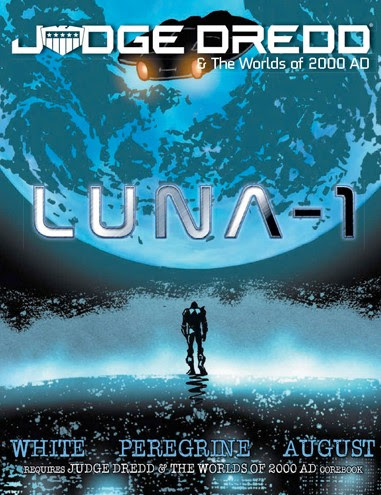
Luna-1 is a supplement for Judge Dredd and the Worlds of 2000 AD. Like The Robot Wars before it, it is as different a supplement as there has been for any of the four roleplaying games based on the Judge Dredd comic strip from the pages of 2000 AD, and that is all down to its focus. Traditionally, supplements for a Judge Dredd roleplaying game have concentrated on particular aspects of the setting—criminal organisations, crazes, psi-talents, block wars, and more—but Luna-1 focuses upon the one storyline, examining its episodes or Progs, and exploring their ramifications in detail. In Luna-1, this is the six months in which Judge Dredd is assigned to serve as Judge Marshall of Luna-1, a colony on Earth’s moon governed by judges from all three Mega-Cities. Told in Progs 42-59, this storyline thus takes Judge Dredd off Earth and onto the oxygen-short, crowded, and lawless and often wild frontier of the Moon. Here gangs and perps can escape the Mega-Cities to hide out and continue their criminal activities; corporations shorn of the scrutiny and regulations of Earth, build and hold more power and influence; resources are poor—especially oxygen, which needs to be paid for; even though they might hate each other, the Mega-Cities of North America and the Soviet East-Meg cities, will come together to participate in the Lunar Olympics; and criminal conspiracies work behind the scenes to take over the Moon! The supplement includes a Prog by Prog guide to the storyline with story hooks which the Game Master can develop as part of her campaign; descriptions of the Moon’s most notable locations and events, as well as what it like to both live and enforce the law there; new Exploits and Careers for Judges, Perps, and Civilians; an examination of a Moon-set campaign inspired by the ‘Luna-1’ storyline; stats and write ups for numerous NPCs; and more. 

LUNA-1 opens with a description of the Moon and a history of its settlement, including its important locations, such as the famous Armstrong Monument or Moonie’s Ranch, home to the reclusive corporate boss, C.W. Moonie, where he has ranchers raise genuine protein cake-fed, bio-engineered cattle on actual grass, their meat being highly prized by gourmets. The inhabitants of the Moon reside in domed settlements, ranging in size from urban sprawls to classic frontier towns. The maintenance of these domes is vital to everyone’s survival, as is a supply of oxygen, which of course, the inhabitants of the Moon have to pay for! The Oxygen Board has a monopoly on the supply. So it can be expensive! The Mega-Cities’ Justice Departments sometimes use Safe Houses on the Moon to keep witnesses safe. The Moon is also home to colonies from the other Mega-Cities beyond North America, including Shi-Shen Territories and Sov-Cities Territory, the closest they get to territories of the Mega-Cities. Locations important to the Moon, but back on Earth are detailed too, such as Moonray Tower and Temple of Lunar Light, a cult often described as being full of ‘loonies’. Events, like the Land Race—a race to grab new opened up territory, and the Lunar Olympiad are covered as well. They are all accompanied by adventure seeds.

In terms of mechanics, LUNA-1 provides numerous new options for Player Characters and NPCs of all types. New Judge Careers include Luna Judge, Zero Squad Judge (trained to work in zero gravity), Customs Judge, and more. STAR Judges or ‘Special Target Attack Retaliation’ Judges are drawn from all three North American Mega-Cities and their allies and assigned to police Earth’s off-world colonies, so the Player Characters could actually be a mixed group from various cities, not just Mega-City One. New Civilian Careers include Xenodiplomat, Corporate Executive, and Settler, whilst Perp ones include Luna Raider, Gunslinger, and Smuggler. They all include their own Exploits which can be gained by choosing them as Careers during character creation, and all provide interesting options for both Player Characters and NPCs. As expected, all of the characters from the ‘LUNA-1’ storyline are included in LUNA-1, from simple Badlands Gang Member and Futsie to Deputy Luna Marshal Tex, Judge Mex (complete with lasso for reigning in Perps), Elvis the Killer Car, and Judge Dredd himself. These can be used as is, if the Game Master wants to run the ‘LUNA-1’ storyline for her players and their characters, or simply used as inspiration for a campaign set on the Moon.

The campaign advice for the Game Master examines the how and the why of setting and running stories for Judge Dredd and the Worlds of 2000 AD. This should not just be because the setting itself is cool, but rather because there are particular types of stories which can be set there, which in this case might involve the Lunar Olympics or the looser regulations applied to corporations. It also highlights the differences between Mega-City One and the Moon—as well as colony frontiers, and how that will change game play. Smaller communities means fewer places to hide and everyone knows everyone’s business, including that of Perps, plus colonies like the Moon rely much more on technology for everyone’s survival. Only light synopsises are given for the fourteen Progs which make up the ‘LUNA-1’ storyline, more attention being paid to the whole storyline as a roleplaying campaign with a beginning, middle, and end. There is advice here on how to use Dredd, for it might be that the Player Character Judges are actually seconded to the unrelenting lawkeeper as his deputies.

The full adventure in LUNA-1 is ‘Sundance Rising’, an unashamed space western. It is set further on the frontier of the Moon in the isolated toon of Grey Rock. Inspired by the film High Noon, the town’s Judge, William Kane, is gunned down by the Sundance Gang, led by the vicious Preacher Jackson and the Judges are sent into restore order. The scenario and setting of Grey Rock is nicely detailed and there are notes too to run with Civilians as inhabitants of the town taking the law into their own hands and fighting back and also as Perps attempting to impress Preacher Jackson enough to become members of the Sundance Gang. Either way, this is a good scenario with lots going on that should provide multiple sessions of play.

LUNA-1 does not just cover Judge Dredd’s six-month secondment to the Moon, although that is its primary focus. That is told in Progs 42-59, but there were stories which took place between this and the events of ‘The Robot Wars’—as detailed in the supplement of the same name, and these are detailed in LUNA-1, again Prog by Prog. Each includes a synopsis, settings and locations, villains and bystanders, how the story can be used ‘Outside the Law’ (that is, used with Perp and Civilian Player Characters rather than Judges), and suggested further adventures. Some of these can be used as part of a Moon-set campaign, some not, but either way, the Game Master is given another eleven story hooks! Lastly, an appendix takes the Game Master—and potentially, her player’s characters to Titan. This includes a complete description and history of the penal colony where corrupt Judges are sentenced and again hooks and for the Game Master’s campaign.

Unlike ‘The Robot Wars’ storyline there is perhaps less satire and less social commentary in LUNA-1. Obviously, there is the rampant commercialism, but the Moon-set storyline is more of a means to tell stories away from Mega-City One and on the frontier in the style of the Wild West than anything else. The writing style has settled down a bit and there is more of the comic strip’s humour coming through than there was in The Robot Wars.

Physically, LUNA-1 is a slim, but nicely presented book. It is an engaging read and it is liberally illustrated with artwork from the ‘LUNA-1’ story and the other Progs it details in its pages. This is all black and white artwork and it is drawn from the very early issues of 2000 AD so there is certain quaintness to it since it dates from before the character of Judge Dredd evolved into the way he looks today.

Luna-1 picks up where The Robot Wars left off, continuing its fantastic approach to turning episodic source material into gameable content. The humour is stronger, even if the satire is not, but this is thoroughly excellent sourcebook on the ‘LUNA-1’ story, for the stories which can be told in and around it, and of course on the Moon (and other frontier settings) for Judge Dredd and the Worlds of 2000 AD (or in fact, any roleplaying game based on Judge Dredd).

—oOo


En Publishing will be at UK Games Expo which takes place from Friday, June 3rd to Sunday, June 5th, 2022.

Sunday, 10 April 2022

Judge Dredd V

Just as we wave goodbye to one roleplaying based on the Judge Dredd comic strip from the pages of 2000 AD, En Publishing’s Judge Dredd and the Worlds of 2000 AD, we are surprised by the arrival of another—and this one is almost entirely different to all four of the Judge Dredd roleplaying games which have come before it. Announced at The Galaxy’s Greatest: 2000 AD at 45, the event to celebrate the long running comic’s sapphire anniversary, Dread: Dredd is a storytelling game rather than a traditional roleplaying game. Dread: Dredd is a storytelling game in which you do not take the roles of Judges enforcing the harsh laws of Mega-City One, but of those opposed to both the Judges and their strident legal enforcement. Previous roleplaying games based on Judge Dredd have presented options to play Perps and citizens rather than  Judges, but in Dread: Dredd players take the roles of activists and subversives campaigning for the restoration of democracy to Mega-City One. Dread: Dredd is a storytelling game with a physical component to its play requiring a Jenga Tower to play, and this is because it is based upon Dread, the roleplaying game of existential, psychological horror that was the Winner of the 2006 Gold ENNIE for Innovation.

Dread: Dredd is a one-shot storytelling game in which events of the scenario, ‘The Power of the Crowd’, are narrated and played out. In ‘The Power of the Crowd’, pro-democracy agitators have the direct chance to strike a blow for self-governance. They have gained possession of Walter, a former Justice Department droid and somewhat reluctant co-conspirator who has damaging information about the judges. This is information the public must hear. Working together, the democracy activists will ensure that the public hears it today at the opening game of the first Aeroball season in decades. This is such a big event that all of Mega-City One will be watching, and the judges will be unable to pre-emptively shutdown the broadcast for fear of citywide riots. It is the perfect opportunity. There is no better time like now, but there is one judge whose intervention will stop their efforts—Judge Dredd. He is inbound, there is forty-eight minutes until he arrives, and he is the law!

At the heart of Dread: Dredd—and the centre of the table—is the tower of blocks. In a standard game of Jenga this is stacked into one block, but in Dread: Dredd, it is divided into two. The taller of the two is the Justice Tower, the shorter the Liberty Tower. As the game proceeds, whenever a player wants his Democrat to undertake a task, he pulls out a block and adds it to the top of the tower it was pulled from. If he wants the action to be inspiring, dignified, go unnoticed, showy, done safely, or done quickly, he can pull out another block for each. If the block is removed and added to the top of the tower, he succeeds. However, if the player decides not to pull a block or begins to pull a block and then stops halfway through, the action fails. Worse, if the tower is knocked over as a result of the block being pulled, whether the Justice Tower or the Liberty Tower, the Democrat not only fails, but dies.

The Host—as the Game Master in Dread: Dredd is known—narrates the outcome of the pull of the block. If the attempt is a failure, especially if the tower falls and the Democrat dies, the Host has the scope for no little invention. If a Judge is present, then he executes the Democrat, if not, he dies in some other fashion. The setting of Judge Dredd is darkly satirical and the death of a Democrat should reflect that. When a tower falls, it is rebuilt and play continues. Even if a Democrat dies, he can continue to inspire his fellow subversives from beyond the Resyk Center (which also keeps a player in the game even if his Democrat is dead).

In Dread: Dredd, the players and their Democrats have three objectives. The first is get Walter the Wobot to spill the beans on-air before an audience of millions. The second is to build the Liberty Tower is taller than the Justice Tower. The third is to do both before the arrival of Judge Dredd.

The Democrats lose in Dread: Dredd and ‘The Power of the Crowd’ if they fail to achieve all three of their objectives before the arrival of Dredd. They also lose if they all die in the attempt, though as martyrs, they might inspire others to make an attempt to expose damaging information about the Judges.

Getting Walter the Wobot to reveal all is a storytelling objective and it is up to the Host to determine when exactly this happens. When a player pulls a block, it is added to the top of the tower it is pulled from, but the Democrats need to shift the blocks from the Justice Tower to the Liberty Tower to succeed and in this, they have several advantages in their elbow pads here. One is that they have Democratic and personal abilities that will help the players shift blocks. One is making their actions Inspiring and pulling out blocks and adding them to the Liberty Tower. Each Democratic has three abilities, a Dodge, Spend, and Stash ability, each different in flavour for the various Democrats. A Dodge ability enables a free pull, a Spend to use blocks from a player’s Reserve—each player begins with three—and place them on a tower, and Stash to store a newly pulled block in a player’s Reserve. Lastly, Dredd arrives in forty-eight minutes of game time, with every three minutes of actual time representing one of game time (so ‘The Power of the Crowd’ is actually intended to be played in two hours and twenty-four minutes), and the Host has a ‘Countdown And Encounter Track’ with which to tick off time and throw some challenges in the Democrats’ paths.

The five Democrats include ‘The Perp From The Judge’s Tree’, ‘The Psychic Celebrity With A Grudge’, ‘The Dilettante On A Mission’, ‘The Wheel-Ape’, and ‘The Gearhead With A Secret’. Each of the quintet includes their own Dodge, Spend, and Stash Abilities, and a set of questions about the Democrat’s background and subversively democratic actions. One issue here is that some of the Democrats do share the same questions. So they may not necessarily be quite as personal or individual as perhaps the designer intended.

For the Host, there is advice for running ‘The Power of the Crowd’ and Dread: Dredd, which is primarily to follow the players’ lead, how to handle the countdown, and roleplaying Walter the Wobot. There is a complete description of the Hellcat Memorial Stadium, inside and out (though no map), plus excerpts from 2000 AD depicting the Harlem Heroes and their power gear, Harlem Heroes Super Liner, and blueprints of Walter the Wobot to add extra detail and flavour.

Physically, Dread: Dredd is cleanly laid out, easy to read, and illustrated with a range of artwork taken from 2000 AD. This is drawn from all eras of the Judge Dredd comic strip as well as the Harlem Heroes, so it includes both black and white, and colour artwork, all crisply presented and showcasing just how good the artwork has been in the pages of 2000 AD over the course of forty-five years.

Dread: Dredd and ‘The Power of the Crowd’ works as both a one-shot and a convention scenario, though for the traditional four-hour slot for a convention, it does need extending in terms of time, and advice is included to that end. Dread: Dredd and ‘The Power of the Crowd’ provides a different perspective upon roleplaying in the world of Judge Dredd and the setting of Mega-City One, operating under the threat of arrest or even execution by the fascistic Judges, rather than being the bully boys handing out the justice. It makes for a tense, desperate situation, all exacerbated by the pulling blocks from the towers, which together gives Dread: Dredd a nervous physicality and a sense of Dredd/Dread.

Sunday, 27 February 2022

Strontium Dog III

In the year 2150, the Great Nuclear War wipes out 70% of Britain’s population and results in a huge increase of mutant births due to exposure to the nuclear fallout of strontium-90, the children typically afflicted with one or more physical deformities. As the number of mutant births grows, so does the adverse reaction to them until the prejudice against them is open and adverse, with politicians, in particular, Nelson Bunker Kreelman of New Britain and his anti-mutant police force known as the ‘Kreelers’, actively campaigning on an anti-mutant platform. The prejudice would grow to the point where the Mutants banded together and formed a Mutant Army that would lead a Mutant Uprising in 2167. Although the rebellion fails, Kreelman is forced to resign and the Kreelers disband and whilst they continue to face prejudice, there are no pogroms against them. Most either move into the segregated ghettos set up for them, such as the large settlement of Milton Keynes, or because their work and business opportunities are severely limited, leave Earth all together.

The surviving members of the Mutant Army are also forced to leave Earth. They are also given a pardon in return for their joining the Search/Destroy Agency as galactic bounty hunters, tasked with hunting down criminals and threats deemed too dangerous to be handled by ‘norms’. The combination of their mutations being the result of strontium-90 radiation and the distinctive ‘S/D’ (for ‘Search/Destroy’) badges they wear, means that they are nicknamed Strontium Dogs, and their orbital base the Doghouse. This is set-up for the Strontium Dog comic strip from the pages of 2000 AD, which tells the tales of one of the most famous S/D bounty hunters, Johnny Alpha, a former leader of the 2167 Mutant Uprising, including going back in time to collect a bounty on one Adolf Schicklegruber! The comic strip, which originally appeared in the pages of Starlord in 1978 before transferring to 2000 AD in 1980 ran until 2018 with the death of its artist, Carlos Ezquerra. It is also the basis for Strontium Dog, a roleplaying supplement for Judge Dredd & The Worlds of 2000 AD.

Strontium Dog, published by En Publishing, is not the first roleplaying treatment for Strontium Dog. Mongoose Publishing released a version using the Traveller mechanics, and before that, there was a version from Games Workshop based on Judge Dredd: The Role-Playing Game, but which was never published. In Strontium Dog for Judge Dredd & The Worlds of 2000 AD the players take the role of Mutant Search/Destroy Agents, collecting bounties on the scum of the universe, travelling in the cargo hold from system to system, and suffering prejudice against Mutants along way—and not just from Norms, but from other Muties too. This can be because the Muties are criminals or simply because they hate the idea of Muties acting against other Muties. And although Strontium Dog is all about bringing in the scum of universe—dead or alive—and sometimes of the scum of other dimensions and other time periods, it is also possible for the players to take the roles of the scum of the universe and play criminals rather than bounty hunters! This would use the rules for creating criminals from Judge Dredd & The Worlds of 2000 AD, which can also be used for potential Strontium Dog/Judge Dredd crossovers—just like the comic—as they share the same universe.

Strontium Dog leaps straight into creating a character for the setting, beginning with options for Species. These include Humans and Mutants as well as Gronks, the intrepidly cowardly aliens known for their timidity and medical skills, whilst the Mutants, there are tables for physical, cosmetic, and metabolic/metaphysical mutations. Thus it is possible to play a mutant with boils or warts, tentacles, a rubberised body, acidic blood, an ice-cold metabolism, shimmering skin, a rash of fake eyes, a face full of teeth, and more. All of these individualise a mutant and should suggest a possible nickname, not necessarily a serious one, in addition to their skills and exploits. An option is included for the selecting the cruel and identical Strix as a species, and there is a guide to including robots in the setting too (although they do not appear in the comic strip as bounty hunters). Outlaw and Civilian careers includes everything from the Animal Rights Activist, Anti-Mutant Enforcer, and Bandit to the Theme Park Staffer, Vis Presenter, and Xenodiplomat, whilst specific Mutant Careers include Mutant Cultist, Mutant Stalker, and Sideshow Freak. Many of these could be used in the Judge Dredd and other settings for Judge Dredd & The Worlds of 2000 AD. Less easily adapted are the S/D Careers, which cover both recruitment and actual careers with the agency. The former include Born to It, mentored by an Older Dog, and Score to Settle, whilst the path for every S/D Agent is the same from Rookie S/D Agent to Veteran S/D Agent, with a choice of Agent in Time, Dimensional Agent, and S/D Agent in between. These are accompanied by a choice of Exploits such as ‘Nux for All’, which causes extra damage when using Electronux, ‘Making a Name for Yourself’ which grants a bonus to REP (reputation) checks because the rookie is trying to make a name for himself, and ‘I’ve SEEN Things’ (in other dimensions) enables an S/S Agent to initially ignore the Afraid condition!

The life of an S/D Agent means collecting bounties and making, hopefully big, money, but it also means paying out too. A Mutant gets nothing for free, and that includes his equipment. Strontium Dog includes a lengthy list of guns, grenades, and gadgets. These start off with the ubiquitous Westinghouse Variable-Cartridge Blaster and the dreaded ‘Der Happy Sick’ Warhammer wielded by Johnny Alpha’s friend, Wulf Sternhammer, and go from there… Some of the devices and bombs are extremely powerful, such as Dimension Warp which opens up a rift to another dimension, the Pocket Nuke (Throwing) capable of levelling a city, the Time Drogue for rewinding time on a victim or target, interrogating them, and then letting them die a second time, and the Time Shrinker, which speeds up time for the target to the point of death and beyond. It is suggested that the Player Characters only have access to these as plot devices rather than being readily available, but in general, they will have access to a lot of the gear and guns presented—if they have the credits, but then so are the criminals!

For the Game Master, there is a lot of support in the pages of Strontium Dog. This begins with advice about setting the tone, which is very much that of a Sci-Fi Spaghetti Western with blasters, mutant powers, and heavy prejudice. The latter runs throughout the setting and the players will need to have a thick skin when playing a campaign set in this twenty-second century. That said, their characters are armed—often heavily armed—and they have a lot of agency. Similarly, this future is not one in which there is a lot of trust, not even with the Player Characters’ fellow Muties, especially if they are rival bounty hunters. The notes on describing the world of Strontium Dog are pleasingly evocative, and this is backed up with descriptions of typical locations and then the various locations visited by Johnny Alpha in the pages of the comic strip. Both are really quite detailed and give the Game Master plenty to work with when taking her Player Characters there. Plus, there is a timeline for Johnny Alpha and the comic strip running from 793 AD to the 37th Century.

Almost a fifth of Strontium Dog is devoted to a series of Bounty Contracts. There are six of these, which can either run standalone, but they really work as a full campaign—the ‘En System’ Campaign. The campaign begins on Weaver’s Rock with a bounty of the Wispa gang, who have gone from robbing cargo trucks to murder! The first bounty is fairly simple and once completed, there are plenty of hooks if the Game Master wants to expand the Player Characters’ time in the backwaters of Weaver’s World. The second bounty takes the Player Characters to the planet’s big settlement, Paradise City, where they can continue tracking down the remaining members of the Wispa gang. Besides the main bounty, the Game Master is given another list of bounties available in the city, but once on the main trail, they become involved in a big chase across the city skyline. The third takes a darker turn when on the trail of an assassin, the Player Characters are inadvertently diverted—or are they?—to another planet and probably the best pun in what is a campaign packed with puns as they have to assault the ‘Merlock of Firestop Mountain’! The final encounter turns up the gonzo and the Merlock theme for an underwater, shark-infested big fight. In the fourth part it quickly becomes clear that the authors are really big fans of Doctor Who as the names and references fly thick and fast when the Player Characters are tasked with tracking down the creator of a gas which quickly grows anyone who breathes it into a zombie! They accidentally get dumped into an alternate dimension in the fifth part after they have to deal with a Mutie who has been terrorising Gronks—there is a bonus if no Gronks die during the apprehension of this bounty, so good luck with that!—and then fight their way out of it in readiness for the final showdown in the last part of the campaign. As the Player Characters have bounced from one bounty to the next, it has become clear that someone has been monitoring their actions and there they learn that it has been much more than that—the real villain has been broadcasting them across the galaxy! Cue lots of television jokes and shenanigans which bring the campaign to an entertaining close.

The ‘En System’ Campaign is not just a lot of fun, but it is clear that the authors had a lot of fun writing it. The jokes are as silly and as groanworthy as you would expect and they should be, and both Game Master and her players will appreciate the campaign even more if they get them. The Strontium Dog supplement is rounded with a lengthy section of Allies and Enemies, including Johnny Alpha, Wulf Sternhammer, the Gronk, Durham Red, Middenface McNulty, and a whole cast of criminals. This is the only section where the black and white artwork from the comic strip’s early days is seen, which is a pity. However, it is the ‘En System’ Campaign which pulls everything together and gives a playing group something to get started with.

Physically, Strontium Dog is a bright and breezy affair, which lots colour artwork drawn from the comic strip. It needs a slight edit in places, but is an easy read otherwise.

Strontium Dog is an impressive supplement for Judge Dredd & The Worlds of 2000 AD that with the addition of the ‘En System’ Campaign the Strontium Dog feels complete and succinct. It gives the Game Master and her players everything necessary to play an entertainingly gonzo, over the top game of hunting bounty on the scum of the universe and more!

Saturday, 26 February 2022

Rogue Reports

Rogue Trooper: Tour of Nu-Earth 1
is a supplement for Rogue Trooper. Which itself is a supplement for Judge Dredd and the Worlds of 2000 AD. Published by En Publishing, Rogue Trooper is based on the 2000 AD comic strip of the same name, set in the far future. Two great empires, the Greater Nordland Republic and the Southern Cross Confederacy constantly clash, in particular on Nu Earth. In the past fifty years, this has become a world war, the planet divided between the two factions, known as the Norts and the Southers, and turned into a nuclear, biological, and chemical ravaged wasteland. In order to break the stalemate, Milli-Com of the Southern Cross Confederacy develops elite clones known as G.I.s or Genetic Infantry. When they are deployed in the year ’86, most of the G.I.s are killed in the Quartz Zone Massacre. There would be only one survivor, Rogue, who accompanied by his former squad mates, Bagman, Gunnar, and Helm, downloaded onto biochips and slotted into his gear, would ultimately unmask the traitor responsible for the massacre. With obvious parallels between with the American Civil War, but also drawing on other modern conflicts, especially the First World War and the Vietnam War, Rogue Trooper has been running as an ongoing if irregular series since 1981 and has been developed into a board game from Games Workshop and a computer game. Like many series that appear in the pages of 2000 AD, there is an element of satire to many of the stories, though not as strong as that found within the Judge Dredd stories, and the humour in the stories veers towards the gallows. Rogue Trooper from En Publishing is the first roleplaying treatment of it and enables the players to take the roles of Genetic Infantry or ordinary conscripts and get shipped down to Nu Earth as part of the war effort. The blue-skinned G.I.s are designed to survive in the toxic landscape of Nu Earth. Anyone else will need to wear a chemsuit…

Rogue Trooper: Tour of Nu-Earth 1 is sadly, the only supplement for Rogue Trooper. Like Judge Dredd: Case File Compendium 1 it is an anthology of scenarios. The seven scenarios or ‘Mission Reports’ within its pages are all set on Nu-Earth, the toxic hellhole and battleground which is the main setting for the Rogue Trooper series. Each scenario comes with a full explanation of its plot, clues, NPC stats, details of its aftermath, and a discussion of possible extra plots and developments which can be added or might come about because of the actions of the Player Characters. Many include suggestions on how to use the scenarios with the Judge Dredd setting for Judge Dredd and the Worlds of 2000 AD or the other roleplaying setting, Strontium Dog.

The anthology opens with ‘Horror At Camp Vlad’, the first of three Mission Reports by John White. The Player Characters are a team of Nort military investigators working for the Office of Public Truth sent to Camp Vlad to find out why so many Prisoners of War have been shot making escape attempts. Other options are discussed, including making Camp Vlad a mutant detention camp in Judge Dredd or Strontium Dog. Camp Vlad is located in a stifling jungle far from the frontlines and apart from the escape attempts, everyone is bored stiff and none too happy to see the Player Characters. This is a solid piece of investigation involving an interesting mystery and a fun scenario which gives the Game Master some good NPCs to portray and plays up a few clichés. Plus the players get to roleplay Nort investigators which means they have latitude in how they conduct themselves, which can be fun to roleplay.

It is followed by ‘Killer in the Night’, also by John White. The Game Master has a few NPCs to portray in this Mission Report when the Player Characters, a Southern combat team is an obvious routine mission—guard a group of Nort Prisoners of War being moved from the frontlines to internment elsewhere. The scenario is intentionally linear, since the Player Characters have to travel along a set route, but along the way, something begins to strike at the prisoners—and if not the prisoners, then the guards. Rumours fly around the convoy about ‘Baba Yaga’ stalking both prisoners and guards and so fear mounts. Backed up with random events, this is a creepy game of ‘Ten Little Indians’ on the move across hostile territory (well, almost everywhere is hostile on Nu-Earth).

Benjamin Rogers’ first Mission Report in Rogue Trooper: Tour of Nu-Earth 1 is not so much a ‘Mission Report’ as a campaign concept, but it does include a short scenario. ‘Unlucky 7s’ provides an alternative to the standard campaign set-up in Rogue Trooper which has the Player Characters as ground pounders, or infantry types. Instead of infantry, the Player Characters are the crew of a Hopper, a VTOL vehicle used for a variety of purposes. This discusses the various roles aboard the Hopper, including Commander, Medic, Engineer, EWS/SIGINT (Signals Intelligence) officer, Gunner, Navigator, Pilot, and Sysop, and suggests the skills for each of them. Equipment and several variants are listed too, as well as a table of vehicle traits and the description of the 29th Assault Hopper Squadron, 7th Souther Air Cav, which as the Unlucky 7s, has an ‘unlucky’ reputation. The sample encounter, ‘Relieving Squad Costa’ is a evacuate under fire mission which would get an air cavalry style campaign off to a good start.

‘Deep Trouble’ is John Rogers’ third and final Mission Report in Rogue Trooper: Tour of Nu-Earth 1 and it is designed for use with the previous Mission Report, ‘Unlucky 7s’. When a Souther flier vanishes near Klumpflot Lake in a remote part of the Hell Hunt Jungle with an important intelligence officer aboard, Milli-Comm assigns the recovery mission to the Unlucky 7s and the Player Characters’ vehicle. This mission ups the ante by inverting the environment and making the Player Characters explore the depths of a lake in order to find the wreck of the crashed VTOL. Since this is a lake on Nu-Earth, this is not a pleasant experience and is made all the more challenging by the local flora and fauna and the danger of Nort patrols and possible intervention. ‘Deep Trouble’ is an enjoyably inventive scenario and its inclusion suggests that a campaign revolving around air cavalry and air support could be a lot of fun.

Ben Rogers’ third and final Mission Report in Rogue Trooper: Tour of Nu-Earth 1 is ‘Black Market Shenanigans’ and it continues to support the author’s ‘Unlucky 7s’ campaign set-up. When a fellow soldier is beaten up, the Player Characters go to his aid and in doing so, bring them to the attention of the base’s black-market dealer, ‘Big Moxie’. It turns out the soldier they helped is in debt to the dealer and effectively, so are the Player Characters. Do the Player Characters help him out, and if so how? How do they deal with ‘Big Moxie’—do they pay her off, get into debt themselves, or even end up working for her? This is an entirely base set scenario. Its one weakness is whether or not the Player Characters decide to get involved—and if not, the scenario has ‘Big Moxie’ come after them until they are forced to act. Alternatively, the victim of the thugs sent by ‘Big Moxie’ could have been set up as an NPC earlier in the campaign, perhaps even be one of those rescued in the earlier ‘Relieving Squad Costa’. Apart from this, ‘Black Market Shenanigans’ makes for a nice change of pace, primarily involving social interaction skills and when combat does occur, brawling.

The final Mission Report in Rogue Trooper: Tour of Nu-Earth 1 is ‘Assault on Nu-Everest’ by Adrian Smith. This is another ‘Unlucky 7s’ scenario, more Where Eagle’s Dare than anything else as the Player Characters are assigned a covert extraction mission which turns into an assault and rescue up a mountain whilst being hunted by monsters! The Player Characters can be as loud or as quiet as they want and it should all climax in a chase back down the mountain in order to escape back to their VTOL. If the Player Characters are successful, they have the chance to redeem the reputation of their regiment. This is an entertaining scenario let down by the fact that its plot is explained in the reading rather than at the start, so the Game Master is not forewarned.

Rogue Trooper: Tour of Nu-Earth 1 is in general well written with decent maps as needed and illustrations taken from the comic. It does need an edit in places.

Rogue Trooper: Tour of Nu-Earth 1 is a solid selection of scenarios for Rogue Trooper. One issue is that the majority of the Mission Reports are for the ‘Unlucky 7s’ campaign set-up, so they are difficult to use in a general campaign set on Nu-Earth. If perhaps all of the Mission Reports in the anthology had been written for the ‘Unlucky 7s’ campaign framework, the supplement could have had more focus and some of the scenarios would have been easier to set up. In fact, the other two scenarios could have been moved elsewhere and made way for more scenarios and more development for the ‘Unlucky 7s’ campaign framework. Ultimately, Rogue Trooper: Tour of Nu-Earth 1 is one third one thing, a scenario anthology, and two third another, a campaign. Consequently, it does not as if it is one whole thing. Nevertheless, Rogue Trooper: Tour of Nu-Earth 1 does contain some entertaining and inventive scenarios, and it does come with a decent campaign starter and if a Game Master for Rogue Trooper does not have this supplement, she should definitely buy it as quickly as she can.