Every Week It's Wibbley-Wobbley Timey-Wimey Pookie-Reviewery...
Showing posts with label 1960s. Show all posts

Monday, 1 June 2026

Miskatonic Monday #435: Terror on Texas 4

Much like the Jonstown Compendium for RuneQuest: Roleplaying in Glorantha and The Companions of Arthur for material set in Greg Stafford’s masterpiece of Arthurian legend and romance, Pendragon, the Miskatonic Repository for Call of Cthulhu, Seventh Edition is a curated platform for user-made content. It is thus, “...a new way for creators to publish and distribute their own original Call of Cthulhu content including scenarios, settings, spells and more…” To support the endeavours of their creators, Chaosium has provided templates and art packs, both free to use, so that the resulting releases can look and feel as professional as possible. To support the efforts of these contributors, Miskatonic Monday is an occasional series of reviews which will in turn examine an item drawn from the depths of the Miskatonic Repository.

—oOo—
Publisher: Chaosium, Inc.
Author: Autumn Unwin

Setting: Atlantic, 1961
Product: One-shot
What You Get: Thirteen page, 2.05 MB Full Colour PDF
Elevator Pitch: Grace Under Pressure because Grace under Pressure is out of print.
Plot Hook: An engineering survey reveals the reason why the deep sea tower went done...
Plot Support: Staging advice, no pre-generated Investigators,
two NPCs, one handouts, one deck plan, and three Mythos monsters.
Production Values: Serviceable

Pros
# Interesting real world location
# Set on the eve of a real world disaster
# Strong sense of isolation
# Man versus the elements shifts to man versus the deep
# Thalassophobia
# Batrachophobia
# Teraphobia

Cons
# Needs a slight edit
# No pre-generated Investigators

Conclusion
# Not entirely original, but the location and the staging is
# Engaging period piece let down by lack of pre-generated Investigators

Sunday, 5 October 2025

The Curwen Connection

Okay. Let us start with the pitch.
The Borellus Connection is The Case of Charles Dexter Ward meets The French Connection with the journalistic attention to detail of Frederick Forsyth writing a Suppressed Transmission. And if that fails to get your gaming juices roiling, then there is definitely something missing from your essential saltes since your last resurrection. It is crime meets Cthulhu, the Age of Aquarius shot up on smack, DELTA GREEN versus the drug trade, when the cowboys could protect the USA—and the world—with a bit of swagger, and evil was still easy to identify, sometimes because they were still your allies despite what happened in World War 2. It is a campaign of Lovecraftian investigative horror that will take you places rarely visited in the genre in an age that remains all but unexplored in roleplaying.

The Borellus Connection is a campaign for The Fall of DELTA GREEN, the winner of the 2019 Gold ENNIE Award for Best Setting. Published by Pelgrane Press and using the GUMSHOE System, what The Fall of DELTA GREEN does is turn the clock back on DELTA GREEN—and its modern iteration, DELTA GREEN: The Roleplaying Game from Arc Dream Publishing—to take a ride through its last hurrah, the decade of the swinging sixties in which the USA would land men on the Moon, but get mired in conflict in Southeast Asia, in which the optimism of hippism and free love would be marred by murder, and in which DELTA GREEN would be overwhelmed by threats domestic and foreign—and its own hubris. The campaign will take the Agents from the sweltering heat of the jungles of the Vietnam War and into the sweaty morass of money and misfeasance that is Saigon, before swinging into the weird reality of burgeoning international air travel, and then to Turkey and Lebanon. From there it races back across Europe to the cutting edge of the Cold War and the dark aftermath of the previous war, and at last, brings the campaign home and into the wake for the death of the counterculture, as the dark romantism of the previous century torments the next. This is a campaign designed by Ken Hite—the author of The Fall of DELTA GREEN—but actually developed and written by Gareth Ryder-Hanrahan.

The campaign does not stipulate what types of Agents it requires the players to roleplay. Both military veterans and former members of the Federal Bureau of Narcotics will be useful, but members of the FBI will be good as will any Agent with good surveillance skills. Similarly, there are no skills stipulated as being necessary to complete the campaign, but slots left open for languages may prove to be useful.

The campaign begins in 1968 just prior to the establishment of the BNDD, or Bureau of Narcotics and Dangerous Drugs, by the Justice Department. As the precursor of the DEA, it is assigned to investigate and disrupt the flow of drugs into the United States, in particular, the heroin coming out of the Golden Triangle in Southeast Asia and Turkey. The Agents are assigned to the new agency, but investigating and stopping the worldwide trade in narcotics is only half of their job and their least important one. The global nature of the trade means that the Agents can be assigned to any number of exotic, faraway places with legitimate reasons to be there. Which is perfect cover for their other job—investigating and thwarting the forces of the Unnatural before they become a threat to American interests and the world. What this means is that there is a constant duality to The Borellus Connection. The Agents’ investigations are always twofold—the drugs and the Unnatural—and there is always a constant pull back and forth between. Fortunately, or unfortunately, as the campaign progresses, it becomes clear that the Unnatural has coiled its ways around the drug trade, so making it potentially easier to investigate both at the same time, but potentially making the investigation of the drug trade Unnaturally dangerous, as opposed to just dangerous.

The campaign provides a good overview of the BNDD, who the Agents’ DELTA GREEN handler is, and of the linked twin networks that entwine their way through the campaign. One is the drug trade itself, running out of the Golden Triangle, east to the USA and also out of Turkey, and both west through Marseille to the USA. This network is dominated by the Union Corse—and closer to home in the USA by the Mafia. The other network is headed by an immortal sorcerer, an associate of Joseph Curwen of The Case of Charles Dexter Ward fame, who hides within the Union Corse as its chief chemist and who uses its network to secrete his own agents around the world to protect his own interests and to work towards his plans for domination beyond his mortal immortality. This includes moving a lot the necessary materials via the same routes as the heroin. The campaign constantly hints that there is a lot more going than it outwardly appears and there is a shadowy figure behind it all, but the Agents do not learn his identity or get the chance to confront him until the very last mission.

The campaign begins with ‘Operation JADE PHOENIX’. Following a briefing at the CIA headquarters at Langley, the Agents are sent into Laos to confirm that a Kuomintang-backed Shan warlord is funding his operations through opium smuggling, but in reality, their mission is to help conduct a double assassination. The CIA wants the warlord dead, whilst DELTA GREEN’s target is a Kuen-Yuin sorcerer. They will have a military escort, but the assassinations are to be carried out by a United States Marine Corps sniper, one Sergeant Adolph Lepus, already just a few shots away from being the stone-cold killer feared by every DELTA GREEN agent in the future. The scenario is perhaps the most straightforward, certainly the simplest, of the missions in the campaign, even if it is complicated by an inexperienced commanding officer of the escort, the limited time frame set by Tiger Transit, and the Mythos machinations of the second target. It is otherwise a twisted military or mercenary style scenario, one in which some of the Agents are likely to be out of their depth—or out of their comfort zone, that should introduce the players and their Agents to the core of the campaign.

That core comes to the fore in ‘Operation ALONSO’, the most complex scenario in the campaign. The Agents are turned around in Hong Kong on their way home and sent back to Vietnam as newly minted recruits for the Bureau of Narcotics and Dangerous Drugs. Once there, their cover operation is to run surveillance on a narcotics summit at the Continental Palace hotel in Saigon between Unione Corse bosses and emissaries from Marseille with local operations, whilst their actual mission is to ferret out signs of a resurgent Cthulhu cult that DELTA GREEN targeted a decade before. The challenge for the Agents is not only to navigate an unfamiliar city and equally unfamiliar military and espionage operations all on a war footing, but navigate a city where virtually everyone is on the take and their actions have a chance of alerting not only the heroin operation they are investigating, but also the Viet Cong that have infiltrated the city. Arouse the suspicions of either and the Agents will find themselves becoming the targets. In addition to infiltrating the hotel where the summit is being held, the Agents have to look for the activities of the Cthulhu cult in Saigon and beyond into the swamps outside the city where they might get a chance to conduct their own defoliation operation. They will also discover for the first time how weird and twisted some of the operatives connected to Union Corse really are. This as opposed to ‘Operation JADE PHOENIX’, where the weirdness seems local.

The scenario is made also the more complex by being set at the height of the Vietnam War and so amidst a morass of strange names and abbreviations. Add in a lot of organisations with different aims and sometimes overlapping areas of responsibility, and there is a lot for both the Handler and her players, let alone the Agents, to keep track off. It also makes it more challenging in comparison to prepare. Otherwise, this is a quagmire of a scenario, hot and sticky, that will take multiple sessions to complete.

The campaign narrows—quite literally—to the width and length of a Boeing 707. In ‘Operation HORUS HOURS’, the Agents are given another pair of assignments to conduct during their return to the USA. The BNDD wants the Agents to track some smugglers into the USA and DELTA GREEN wants the Agents to identify the purchaser in the USA of an Unnatural relic being transported aboard the aeroplane by a courier. The scenario takes place at the very dawn of the golden age of international air travel, but before the arrival of the Boeing 747 and similar large passenger jets, so the journey back from Hong Kong is via Sydney, Australia, Tahiti and Easter Island, Santiago, Buenos Aires, Panama City, and Los Angeles, and takes over one hundred hours in total! Since this is 1968, the Agents and other passengers aboard the flight have a lot of freedom of movement and face much lower security compared to modern flights, so the Agents have scope to move around, identify the smugglers, and spot the courier—and similarly, the smugglers and the courier have the opportunity to realise they are being watched and who by.

This tense, enclosed environment is exacerbated by the release of a nasty chemical that gets into the ventilation system and unleashes some of the Unnatural contraband being smuggled as well as tipping passengers and crew alike over into series of trippy dreams. And the dreams get weirder and weirder the closer the aeroplane gets to the site of sunken R’lyeh, a lovely contrivance of a flypast that brings another aspect of the Unnatural into play and requires intervention on Easter Island. ‘Operation HORUS HOURS’ has a submarine feel to it, of the Agents lost as if underwater, drowning in dreams and drugs.

The arrival of the Agents in the USA at the end of ‘Operation HORUS HOURS’ brings the first half of The Borellus Connection to close. The second half moves to the Middle East and Europe where the Agents investigate the drug trafficking running through Marseille for the BNDD and what looks like the activities—past and present—of an occultist somehow connected to the Union Corse for DELTA GREEN. ‘Operation DE PROFUNDIS’ takes place in eastern Turkey where the BNDD wants the Agents to investigate how the heroin is being transported through the country and DELTA GREEN wants them to investigate the death of Charles Whiteman, a British archaeologist at a dig site after his body vanished on the way back to England. Since this is set at an archaeological dig site, this has the feel of a more traditional scenario for almost any other roleplaying game of Lovecraftian investigative horror, but all more creepier because of the appearance and behaviour of the man who arrives to take control of the dig site with the permission of the dead and missing man! Clumsy and awkward, with a raspy voice and his hands always covered in gloves. He is very obviously suspicious and hiding something… This is likely the Agents’ first encounter with one of the servants of the shadowy figure at the heart of the conspiracy. All of these servants are monstrous in their way, but surprisingly, there is something sad about this man.

The location for ‘Operation SECOND LOOK’ is Beirut, Lebanon where the BNDD wants a drug deal investigated, and DELTA GREEN wants know why François Genoud, a Swiss Nazi sympathiser and intelligence broker, stopped informing for them and ‘gently’ reminded who he owes his continued existence to what he thinks are members of the CIA. Getting to the Genoud takes a bit of work and if they lean on him too hard, he goes running to his actual CIA masters, headed by retired agent, Miles Copeland, Jr., which will likely lead to the Agents earning a rebuke. The Agents can also discover the smuggling operation is shipping something big through the city, something guarded by a contingent of soldiers from the Egyptian army! The city has a post-colonial, seedy opulence to it and members of the Union Corse have a legitimacy that enables them to operate in the open, leading to scenes where the Agents have the opportunity to rub shoulders with them and even receive an offer that exposes the friction within the Union Corse and between the campaign’s two strands.

By now it should be clear that the use the Union Corse’s smuggling routes is twofold. One—and most obviously—to traffic drugs into the USA, and the other, hiding within that operation, to transport occult materials around the world. DELTA GREEN has the Agents follow the latter track, following the route of Charles Whiteman’s body into Germany in ‘Operation PURITAN’. Unfortunately, the Agents get sidetracked by another DELTA GREEN investigation meaning that it is no longer a duality, but a triality! Another DELTA GREEN briefing officer in Munich tasks the Agent with investigating what appears to be Unnatural prayers being broadcast via Radio Liberty into the Soviet Union. This forces the Agents into a more challenging balancing act, but as their investigation into the broadcasts takes them into Munich’s Turkish diaspora, it becomes apparent that all three are connected and lead back to the past activities in central Europe of the sorcerer at the heart of conspiracy. To confirm this, the Agents must cross the Iron Curtain on a quick excursion to Prague in the Prague Spring and almost back in time to dark house warped by monstrous sorceries. The mission comes to an end with a chance to save the world, but potentially end history in another twenty years, although the Agents are unlikely to be aware of either.

The penultimate mission is ‘Operation MISTRAL’ set in Marseille. By this point, the Agents know that they are on the trail of Jaques Vènice, the scar-faced chemist responsible for ensuring the quality of the heroin coming out of Turkey and the Golden Triangle and very probably using the Union Corse’s smuggling network as a cover for his own sorcerous activities. They may also have learnt his true identity. In ‘Operation MISTRAL’ they have chance to track him down in Marseille, the heart of the Union Corse’s smuggling operation. Another Mythos element comes into play here as the sorcerer uses a cult dedicated to another entity and the student protests that began in Paris and have spread to ‘La Cité Phocéenne’ as cover for his activities, as well as links to the authorities for both the Union Corse and the cult. The Agents may have an ally here and may also be able to take advantage of the friction within the Union Corse which will see one faction give up Jaques Vènice and potentially reveal his true identity. Either way, the Agents are definitely on his trail now and the operation will likely end with them chasing him across France and perhaps through another reality, all the way to the campaign’s finale.

‘Operation NEPENTHE’—named for the drug capable of banishing grief or trouble from a person’s mind described in Homer’s Odyssey—brings the campaign home to ‘Mob-town’, the city of Baltimore infamous for its riots, of which the latest it is trying to recover from with a national guard presence on the streets. The Agents are ostensibly here to follow up on Union Corse links to the city, but their DELTA GREEN handler all but gives them carte blanche to do what takes to stop the sorcerer’s plans. The latter has deep historical rather than modern ties to the city and as his gathered energies and plans coalesce, thorn bushes sprout from the strangest of places, the eyes of the city’s junkies turn towards the Agents, and time slips… The Agents need to slip too, back into city’s past and that of sorcerer, perhaps as far back as the last days of Baltimore’s most famous son. Of course, there is also the chance of the Agents getting lost in time and of failure, of the eastern seaboard getting lost in a bubble of time, but if they succeed, knowing that they saved millions is the only reward, and that they alone, are the only ones to know, are the only reward.

The Borellus Connection is a big sprawling campaign in the mode of the globetrotting campaigns of classic Lovecraftian investigative horror. Yet it owes some of its structure and tone to the conspiratorial structure of campaign in the designer’s other roleplaying game, Night’s Black Agents, whilst at the same time being loose enough that many of the individual scenarios could be run on their own. In addition to duality of the campaign’s entwined threads, its secrets are heavily obfuscated behind layers of obligation and history, and is only in the very later parts of the campaign that the players and their Agents begin to realise who or what they are facing. Since the Agents are sent hither and thither, they and their players do not have overall agency as they might in other globetrotting campaigns of classic Lovecraftian investigative horror and so it is not easy for them to step back from the overall campaign and work out what the overall picture is. The intricacy and connections within the campaign mean that the players are probably going to need their own corkboard, let alone their Agents. In terms of tone, the campaign veers towards Pulp, but there is often a brutality to it, hulking in the shadows until forced to act. The best and most unnerving of that brutality may occur after one or more of the Agents has been killed.

For the Handler there is not much advice on setting up the campaign and the advice throughout is not always as strong as it could be. Hence, this really is a campaign for the experienced Handler in terms of its structure and detail, but the balance between the Mythos and the mundane is well handled and the campaign is rich in historical detail. The Agents really get to get to meet some real and genuinely interesting historical figures and the Handler who wants more detail, there is a decent bibliography at the end. In terms of the Mythos, there is no one central threat in terms of the other, although the campaign does bounce between several differing Mythos traditions. Rather the threat faced is arguably all too human, but one who has fully embraced the inhuman in an attempt to realise his ambitions.

Physically, The Borellus Connection is a dense affair and as a whole, heavy going. Individual missions are well organised and explained with details of the mission spine and the key characters at the start before diving into the detail. The cartography is decent, but the artwork is intentionally obfuscatory, hinting and suggesting rather than clarifying.

The Borellus Connection is a big demanding campaign that is going to take no little commitment upon the part of the Handler, her players, and their Agents to run, play, and complete. There is a fantastic sense of energy and grime to this campaign, of the Agents constantly wading through the seedy underbelly of both humanity and alchemy, caught between the mundane and the Mythos, and ultimately, out of game, how far and what strange places, The Borellus Connection takes one of H.P. Lovecraft’s most famous stories.

Monday, 17 March 2025

Miskatonic Monday #348: Shadow of the Eagle

Much like the Jonstown Compendium for RuneQuest: Roleplaying in Glorantha and The Companions of Arthur for material set in Greg Stafford’s masterpiece of Arthurian legend and romance, Pendragon, the Miskatonic Repository for Call of Cthulhu, Seventh Edition is a curated platform for user-made content. It is thus, “...a new way for creators to publish and distribute their own original Call of Cthulhu content including scenarios, settings, spells and more…” To support the endeavours of their creators, Chaosium has provided templates and art packs, both free to use, so that the resulting releases can look and feel as professional as possible. To support the efforts of these contributors, Miskatonic Monday is an occasional series of reviews which will in turn examine an item drawn from the depths of the Miskatonic Repository.

—oOo—
Publisher: Chaosium, Inc.
Author Jordan Falcon

Setting: Vietnam, 1968
Product: One-shot
What You Get: Seven page, 877.91 KB PDF
Elevator Pitch: “In the jungle, the mighty jungle
The Mi-go hunts tonight
In the jungle the quiet jungle
The Mi-go hunts tonight”
Plot Hook: “Near the village, the peaceful village
The Tcho-Tcho sleeps tonight
Near the village, the quiet village
The Tcho-Tcho sleeps tonight”
Plot Support: Staging advice, no pre-generated Investigators,
no handouts, no maps, one NPCs, and two Mythos monsters.
Production Values: Plain.

P
ros
# Interesting period for Mythos investigation
# Straightforward and easy to run
# Could form the basis for an anti-Delta Green campaign for use with Delta Green: The Role-Playing Game and/or The Fall of Delta Green
# Gephyrophobia
# Vorarephobia
# Entomophobia

Cons
# No pre-generated Investigators
# No advice on creating Investigators
# Short and linear

Conclusion
# Potential starter to a campaign, but too basic
# Pre-generated Investigators with backgrounds would make it 100% better

Thursday, 31 October 2024

Miskatonic Monday #302: The Russians Are Coming!!

Much like the Jonstown Compendium for RuneQuest: Roleplaying in Glorantha and The Companions of Arthur for material set in Greg Stafford’s masterpiece of Arthurian legend and romance, Pendragon, the Miskatonic Repository for Call of Cthulhu, Seventh Edition is a curated platform for user-made content. It is thus, “...a new way for creators to publish and distribute their own original Call of Cthulhu content including scenarios, settings, spells and more…” To support the endeavours of their creators, Chaosium has provided templates and art packs, both free to use, so that the resulting releases can look and feel as professional as possible. To support the efforts of these contributors, Miskatonic Monday is an occasional series of reviews which will in turn examine an item drawn from the depths of the Miskatonic Repository.

—oOo—
Publisher: Chaosium, Inc.
Author: Keith Craig

Setting: Alaska, 1961
Product: One-shot Scenario
What You Get: Thirteen page, 1.94 MB Full Colour PDF

Elevator Pitch: The metal from another world...
Plot Hook: Could aberrant radar signals be a prelude to Soviet invasion?
Plot Support: Staging advice, six pre-generated Investigators, two handouts, three NPCs, and two monsters.
Production Values: Plain

Pros
# More weird alien invasion than Mythos investigation
# Creepy transformations
# Environment reasonably detailed
# Could be a Delta Green investigation?
# Russophobia
# Tomophobia
# Neophobia

Cons
# Wonky Investigator backgrounds
# No maps (the Air Force would provide maps)
# Needs a good edit
# Solutions and consequences underdeveloped
# No Sanity rewards

Conclusion
# Alien invasion scenario rather than Mythos scenario
# Underdeveloped in terms of how the Investigators deal with the threat and what happens next

Friday, 19 April 2024

Friday Filler: Thunderbirds Danger Zone: The Game

First broadcast six decades ago, Thunderbirds is a classic of British children’s television, combining the advanced puppetry of ‘Supermarionation’ with superb scale models and special effects. The result still stands up today as exciting television with great music and amazing opening credits. The series told of the daring missions to save life and limb conducted by International Rescue, a secret non-government organisation dedicated to rescuing those that governments cannot. It is equipped with a fleet of advanced vehicles, each with Thunderbird call sign, enabling its operatives to conduct air, land, sea, and space missions from its secret base on an island in the Pacific Ocean. Ex-astronaut Jeff Tracy leads International Rescue, but it is his sons that conduct the missions, supported by Brains, who develops and builds new vehicles, and Lady Penelope, the organisation’s London ‘secret’ agent. Opposing International Rescue is the criminal and terrorist, The Hood, who uses disguises and constantly plots to steal International Rescue’s technological secrets and make a fortune by selling them to the criminal underworld.

The Gerry Anderson television series has been the subject of previous board games, most notably, Thunderbirds, designed by Matt Leacock and published by Modiphius Entertainment in 2015. The latest game based on the series is the card game, Thunderbirds Danger Zone: The Game, published by YAY Games. Designed to be played by two to six players, aged ten and up, it is a co-operative game in which the players attempt to complete seven missions. Each of the seven is based on a classic episode—‘End of the Road’, ‘Pit of Peril’, ‘30 Minutes After Noon’, ‘Trapped in the Sky’’, Vault of Death’, ‘Terror in New York City’, and ‘The Impostors’—and the game can be played through in between twenty and forty minutes, depending upon the difficulty and length of a mission. In the game, each player takes turns playing the role of Jeff Tracy, leader of International Resource, who will marshal four types of resource—‘Team Spirit’, ‘Fuel’, Tech’, and ‘Knowledge’—that will get the members of International Rescue on a Journey to the Danger Zone where they can conduct the rescue. If the players get both the right members of International Rescue and the right resources to the right places, they can complete a mission and win the game!

Thunderbirds Danger Zone: The Game consists of several sets of cards. The first are the Danger Zone cards. There are three of these per mission and each shows which resources and character is needed to complete that part of the mission. The Journey cards represents the steps needed to get to the mission, represented by the Danger Zone cards and have their own requirements in terms of resources. The Resource cards show a mix of Resource types, either three or all four, and their number. The Tracy Island cards have countdowns on them of various lengths, from ten to four turns, and are used to set the game’s difficulty, ten being the easiest, , four being the hardest. There are also reference cards for the various Actions that the characters can take, Tokens to represent each character, Journey Tokens to increase the difficulty a bit more, a Countdown Marker to use on the Tracy Island cards, and Tokens used to indicate that a resource has been successfully supplied.

To set up a mission, its three Mission cards are placed in a row and three Journey cards, either those for the mission or three random, are laid out in a row below the Mission cards. A Journey Token is placed on each Journey card, either a resource or The Hood. The Journey Token increases the number of Resources needed to complete the Journey card, whilst the presence of The Hood reduces the number of Resources the players can play. Each of the three Mission cards has an associated character on it, and the Token for each is placed below the corresponding Mission card and Journey card, along with another Journey Token.

Each round, the players each has a hand of three Resource cards. One player is designated to take the role of Jeff Tracy and he will ask the other players to supply him with resources to fulfil one of the Resource requirements, first on the Journey cards, and then on the Mission cards. Each player selects a card from his hand and places it face down. The Jeff Tracy player selects two of these face down Resource cards. If the total number of the resources on the Resource cards selected match the number on the designated Journey card or Mission card—adjusted for the Journey Token or The Hood on the Journey card—then the action succeeds and the Jeff Tracy player can place a Success Token on that Resource. If the players have been unable to supply enough Resources, the Jeff Tracy player can swap one of the Resource cards he choose, with a Resource card of his own. If the Jeff Tracy player cannot match the number of Resources indicated on the Journey card or Resource card, the action fails, the Countdown Marker is moved down one space on the Tracy Island card.

The round ends and all cards played are discarded. Players draw back up to three Resource cards, except the Jeff Tracy player if he swapped one of his Resource cards. In this case, he starts the next round with two Resource cards. The Jeff Tracy token is passed to the next player and the new round begins.

The aim is move all three Character Tokens for a mission through the Journey card and onto the Mission Card. This is done by fulfilling all of the Resource requirements for the Journey card. Once all three Character Tokens have been moved from their respective Journey cards to the Mission cards, play continues in the same fashion until either all of the Resource requirements for each Mission card has been fulfilled and the Mission completed with a successful rescue, or the Countdown Marker runs out of space on the Tracy Island card, in which case, International Rescue has failed to complete the mission and the players have lost the game.

Initially, the Jeff Tracy player will have no real idea as to what Resources to ask for, so the players do not know which of the Resource cards in their hands to play with any certainty. However, once a particular Resource on a Journey card or a Mission card, the choices will begin to tighten and a player can husband his Resource cards and perhaps save particular cards for later rounds. Should the Jeff Tracy player swap a card to fulfil a Resource requirement, then the Jeff Tracy player on the next round will know one of the cards that player has a holdover from the previous round. In general, though, because Resource cards are kept hidden in each player’s hand, there is an element of uncertainty to play, which will of course, grow and grow as the players get closer to completing a Mission and the Countdown Marker slides down Tracy Island. On side effect of keeping the Resource cards hidden, is that there is no ‘Alpha’ player, no one player ‘suggesting’ the best course of action for everyone. The revolving role of Jeff Tracy enforces that too because it puts a different person in charge from round to round.

Beyond the core game, Thunderbirds Danger Zone: The Game adds options that increase both theme and complexity. These primarily give more options for the Jeff Tracy player. If the players manage to supply sufficient Resources on a turn, he has an extra pair of options. One is to ‘Prepare Pod and Equipment’, the other is to provide ‘Mission Support’. The ‘Prepare Pod and Equipment’ action is necessary because all of the six missions beyond the beginning mission, ‘End of the Road’, have Pods and Equipment. The Pods hold the special vehicles built by Brains and are transported by Thunderbird 2 piloted by Virgil Tracy. For example, the ‘Pit of Peril’ mission requires ‘The Mole’ and ‘Recovery Vehicles’, and the Equipment includes ‘Explosives’. What it means is the players have layers of cards each with their own Resource requirements, adding to demands of play and lengthening game play, but at the same time adding theme too.

‘Mission Support’ is carried out by bringing another character and his token into play, which is done by playing Resource card showing that character. These cannot be the characters actually on the mission, and provide the players with an advantageous action. For example, Lady Penelope has ‘Inside Information’ that lets the Jeff Tracy player reveal a third Resource card in play and use that instead of the one he has already selected, whilst Scott Tracy, as ‘Team Leader’, can use the Team Spirit Resource on one Resource card as the Knowledge Resource on another, and vice versa. The ‘Mission Support’ from any one character can only be used twice before he needs to be reactivated again. The Jeff Tracy player can conduct multiple ‘Mission Support’ actions.

Physically, Thunderbirds Danger Zone: The Game is well presented. The cards are of good stock and the tokens of sturdy cardboard. The rules leaflet is clearly laid out and easy to read. All three—especially the cards—are illustrated with photographs from the television series, and the particular episodes depicted in the seven Mission cards.

Thunderbirds Danger Zone: The Game is a serviceable card game that as a co-operative game interestingly introduces mechanics that avoid the ‘alpha player’ problem found in many co-operative games. As a game itself, it is perfectly playable, but ultimately, Thunderbirds Danger Zone: The Game really is a game for Thunderbirds fans and they are really going to get the most out of it.

Friday, 23 September 2022

Cable Cars & Souvenirs

The very latest entry in the Ticket to Ride franchise is Ticket to Ride: San Francisco. Like those other Ticket to Ride games, it is another card-drawing, route-claiming board game based around transport links and like those other Ticket to Ride games, it uses the same mechanics. Thus the players will draw Transportation cards and then use them to claim Routes and by claiming Routes, link the two locations marked on Destination Tickets, the aim being to gain as many points as possible by claiming Routes and completing Destination Tickets, whilst avoiding losing by failing to complete Destination Tickets. Yet rather than being another big box game like the original Ticket to RideTicket to Ride: Europe, or Ticket to Ride: Nordic Countries, it takes its cue from Ticket to Ride: New YorkTicket to Ride: London, and Ticket to Ride: Amsterdam. Part of the cities series for Ticket to Ride, it is thus a smaller game designed for fewer players with a shorter playing time, a game based around a city rather than a country or a continent. It is also notably different in terms of theme and period.

Published by Days of Wonder and designed for play by two to four players, aged eight and up, Ticket to Ride: San Francisco is easy to learn, can be played out of the box in five minutes, and played through in less than twenty minutes. As with the other entries in the Ticket to Ride ‘City’ series, Ticket to Ride: San Francisco sees the players race across the city attempting to connect its various tourist hotspots. Ticket to Ride: New York had the players racing across Manhattan in the nineteen fifties via taxis and Ticket to Ride: London had the players racing across London in the nineteen sixties aboard the classic double-decker buses, although Ticket to Ride: Amsterdam took the series back to the seventeenth century and had the players fulfilling Contracts by delivering goods across the Dutch port by horse and cart and claiming Merchandise Bonus if they take the right route. Ticket to Ride: San Francisco continues the lack of trains in the series by having the players travel around ‘The City by the Bay’ aboard its icon form of transportation—the cable car! In Ticket to Ride: San Francisco, the players can take the ferry from Pier 39 to Alcatraz, travel to the Golden Gate Bridge, and stop off at Sunset or Potrero Hill, and if they do, collect some souvenirs too!

Inside the small box can be found a small board which depicts the centre of San Francisco, from the Golden Gate Bridge in the northwest to Potrero Hill in the southeast and Sunset in the southwest to Alcatraz in the northeast. Notably, several of the destinations are marked in red, including Alcatraz, Golden Gate Bridge, Potrero Hill, Sunset, and The Embarcadero. This is where the Tourist Tokens—representing the souvenirs collected by the players when they connect to those destinations—are placed at the start of play. There are also the expected Cable Car pieces (as opposed to the trains of standard Ticket to Ride), the Transportation cards drawn and used to claim routes between destinations, and the Destination Tickets indicating which two Destinations need to be connected to be completed. The Cable Car pieces are nicely sculpted and can actually be seen through from one side to the other. Each player has twenty of these at the start of the game. The Transportation cards come in the standard colours for Ticket to Ride, but are illustrated with a different form of transport for each colour. So black is illustrated with a bus, blue with a tram, green with a car not unlike the Ford Mustang as driven by Steve McQueen in the film Bullitt (which of course is set in the city), purple with a Volkswagen Camper, and so on. This really makes the cards stand out and easier to view for anyone who suffers from colour blindness. Similarly, the Destination Tickets are bright, colourful, and easy to read. As expected, the rules leaflet is clearly written, easy to understand, and the opening pages show how to set up the game. It can be read through in mere minutes and play started all but immediately.

The board itself is also bright and colourful. The scoring track round the edge of the board is done as a series of cable car tickets in keeping with the form of transport used in Ticket to Ride: San Francisco. Most routes are one, two, or three spaces in length, and there is one five-space route. One difference with the previous titles in the series is that it includes ferries, the slightly more complex routes first seen in Ticket to Ride: Europe, though only three of them, two of which go to Alcatraz. There is a very knowing joke on the board. 

Play in Ticket to Ride: San Francisco is the same as standard Ticket to Ride. Each player starts the game with some Destination Tickets and some Transportation cards. On his turn, a player can take one of three actions. Either draw two Transportation cards; draw two Destination Tickets and either keep one or two, but must keep one; or claim a route between two connected Locations. To claim a route, a player must expend a number of cards equal to its length, either matching the colour of the route or a mix of matching colour cards and the multi-coloured cards, which essentially act as wild cards. Some routes are marked in grey and so can use any set of colours or multi-coloured cards. Three routes are ferry routes and require a Ferry or multicolour Transportation card and the indicated number of Transportation cards in the right colour to claim. 

When a player claims a route connected with one of the cities with the Tourist Tokens on it, he takes one Tourist Token. At the end of the game, each player will be awarded a number of points depending on how many Tourist Tokens he has collected. This is reminiscent of, is the Stock Share cards of the Pennsylvania map from Ticket to Ride Map Collection Vol. 5: United Kingdom + Pennsylvania. In that expansion, every time a player claimed a route, he could in most cases, also claim a Stock Share card in a particular company. At the end of the game, a player would score bonus points depending upon the number of Stock Share cards he held in the various companies in the expansion. In that expansion though, all routes had a Stock Share reward, but in Ticket to Ride: San Francisco, they can only be gained from five Destinations on the outer edge of the map and two other locations. These other locations can be anywhere on the map and are chosen by the two players who go last in the turn order.

The number of Tourist Tokens each player has at the end of the game can tip the balance and potentially help a player win the game. However, their limited location limits access to them, as can the Destination Tickets each player draws and completes over the course of the game. Only half of the Destination Tickets in the game have Destinations with Tourist Tokens. This means that a player should take this into account when drawing and discarding Destination Tickets as it will alter his score at the end of the game. This can be offset by the placement of the Tourist Tokens by the last two players in the turn order during the set-up of the game, which adds an element of randomness. Connecting to Destinations with Tourist Tokens can counter one issue with Ticket to Ride: San Francisco and that is it is possible to draw Destination Tickets it is impossible to complete because a player can only draw two and must keep one. So a possible strategy might be to complete a fewer number of Destination Tickets and try to get more Tourist Tokens instead.

Physically, Ticket to Ride: San Francisco is very nicely produced. It is bright and breezy and has a very sunny disposition. Everything is produced to the high standard you would expect for a Ticket to Ride game.

Like Ticket to Ride: New York, Ticket to Ride: London, and Ticket to Ride: Amsterdam, what Ticket to Ride: San Francisco offers is all of the play of Ticket to Ride in a smaller, faster playing version, that is easy to learn and easy to transport. In comparison to those games, it is tighter with players needing to more carefully balance the number of Destination Tickets they attempt to complete versus the number of Tourist Tokens they can grab. Ticket to Ride: San Francisco is a great addition to the Ticket to Ride family, offering fast, competitive play, and tactical choice in an attractive, thematic box.

Friday, 20 May 2022

Friday Filler: Burgle Bros 2: The Casino Capers

Some games have a table presence as soon as you have them unboxed and everything is out on the table. Others have table presence as soon as you look at them, and that presence follows through from the moment you hold them in your hand to point where you are actually playing them. Colt Express, the 2015 Spiel des Jahres Winner from Ludonaute is an example of the former, taking place aboard a card board train which you set up and attempt to rob. Burgle Bros 2: The Casino Capers is an example of the latter. It comes in a block-shaped box which when you stand it up, looks a cartoonish rendering of a Las Vegas casino. Open—or rather unfold—the box and everything inside comes stored in plastic trays and once these have been removed, a leg is inserted into the receivers in each of the four corners of the box and the box itself is then flipped over to stand on those legs. A playmat, showing a four-by-four playing grid, is placed both on top of the box and under the box. Together these two playmats, when laid out with the rooms and locations of the casino, form the playing surface for Burgle Bros 2: The Casino Capers and the target of the players and their characters and their heists. Add wall sections and playing pieces or meeples illustrated with yet more themed artwork and what you have in Burgle Bros 2: The Casino Capers is a board game with table presence. And yet… Burgle Bros 2: The Casino Capers looks a little rickety. The top of the box is not quite flat. Plus playing under the box is a little fiddly. Which is all a bit of a shame, because Burgle Bros 2: The Casino Capers really does look like a great game, with great artwork that supports its theme. However, Burgle Bros 2: The Casino Capers does not have to be played using this three-dimensional set-up, as clever as it is. It can be played using just the playmats, and it works just as well.

Published by Fowers Games, Burgle Bros 2: The Casino Capers is a sequel to Burgle Bros. and both are co-operative games. In Burgle Bros., between one and four players perform a heist on an office or bank, attempting to locate a safe whilst dodging patrolling guards, all done in the style of a sixties heist. In Burgle Bros 2: The Casino Capers, between one and four players attempt to break into a Las Vegas casino, locate and open a safe, and get away with the loot. However, Burgle Bros 2: The Casino Capers is much more of a challenge than Burgle Bros. This is no night-time burglary—it must be performed during the day. Security is tighter and the safes are tougher, plus there are Bouncers who will follow patrol routes, but who are always on the lookout for any Commotion which they will want to break up. And since this takes place during the day, the casino is thronging with guests. Some are customers, some are not. Some are helpful, most are not. A player might be forced to make a detour to avoid a drunk or get caught up with a saleswoman who never stops talking, be spotted by an undercover member of the casino’s staff or hide from a Bouncer in a crowd. On the plus side, the players are skilled and have gear too, but both only have a limited use. And when the crew manage to get to the safe and crack it open, they have to take the loot and get it out of the casino in an exciting finale!

At the start of the game, the game’s tiles are randomly placed on both floors of the casino, face down. Each floor must have an ‘Escalator’ and a ‘Monorail’ tile. The ‘Safe’ tile is placed on the second floor, whilst the ‘Owner’s Office’ tile is on the first floor. The Patrol Cards for each floor are shuffled and one drawn for each floor to determine where the Bouncer on each floor starts from and where the guests are placed. Guests are represented by poker chips, and these are also placed face down. A second Patrol Card is drawn to indicate where the Bouncer is going to move to, at least initially. Each time a Bouncer reaches his destination, a new Patrol Card is drawn to determine the new destination location, and so on and so on, until the Patrol Card deck is empty. In which case, the Bouncer will start hunting for the nearest player. Eight walls are placed randomly on each floor. These block movement and sight between locations. Then the first—or the next, if Burgle Bros 2: The Casino Capers is being played a campaign—Finale card is drawn out of its envelope, and its text read out. This adds flavour and detail to the heist. The rules on the back will only be revealed and come into play after the players have emptied the safe.

A player receives a character and the character’s three pieces of Gear, either by choice or at random. There are a total of nine in the game. With a maximum number of four players, this adds variety and replay value to the game. For example, Rook is an Elvis impersonator who has an ‘Earpiece’ which enables him to move any player to an adjacent tile, but not through a wall; a set of ‘Facemasks’ which enable two players to swop places; and can ‘Impersonate’ another player to use one of their already prepared items of gear. All great takes an action to prepare, but no actions to use. All have a limited number of uses before they are flipped over granting a last one-shot bonus action before being discarded, and for the most part, an item of Gear affects another player rather than the one using it.

The aim of Burgle Bros 2: The Casino Capers is for the players to enter the casino, locate both the Owner’s Office and the escalator on the first floor and then go up to the second floor. They must find the safe and open it. Not only do the players get the loot, but they also get to turn over the Finale Card and bring its rules into play. The Finale Card also details the players’ means of exit. There nine heists in Burgle Bros 2: The Casino Capers and thus nine different Finale Cards. Initially, Burgle Bros 2: The Casino Capers is designed to played in order, but once they have been played through once, the Finale Cards can still be played again, but in a random order.

A player’s turn consists of two phases—the player phase and the Bouncer phase. On the player phase, a player can take up to four actions from a choice of four. These are ‘Move’, ‘Peek’, ‘Use While Here’, and ‘Prep’. ‘Move’ is to an adjacent tile, revealing any face down poker chip and resolving it, and then resolve any ‘When You Enter’ effect if the tile has one. ‘Peek means to look at an adjacent tile, whilst ‘Use While Here’ is an optional action on a tile, again if it has one. Lastly, ‘Prep’ means to ready a piece of Gear for use.

In the Bouncer phase, the Bouncer on the same floor as the player moves three spaces towards the destination on the current Patrol Card. If the Bouncer moves through any tile occupied by a player, that player gains two Heat. If a player gains six Heat, either from encountering a Bouncer or from particular locations, not only does that player lose, but every player loses! If a Bouncer is hunting after running out of Patrol Cards and their routes to follow, he moves directly towards the nearest player. So it is very much in the best interests of the players to avoid the Bouncers on both floors. Out of the Bouncer phase, a Bouncer will also move towards a Commotion when it is created in a particular tile. When a Bouncer is hunting the players, a Commotion can actually be used as a distraction, which is both helpful and thematically brilliant.

Each of the tile types has particular effects. For example, in the ‘Buffet’ a cube is added to the tile each time a player enters it. When there are three cubes, a Commotion is caused, the cubes are removed, and the Bouncer moves three rather than the standard one space towards it. If a Bouncer enters the ‘Crow’s Nest’, he surveys the adjacent tiles and if there are players on them, they each gain one Heat. At the ‘Table Games’, a player rolls two dice and if he rolls either seven or eleven, he loses one Heat, but causes a Commotion on any other roll. Both the ‘Lounge’ and ‘Pool’ tiles have their own decks of cards for even more random events.

Locating and opening the safe is a multi-stage action. First, the players need to locate both the ‘Owner’s Office’ tile on the first floor and the ‘Safe’ tile on the second floor. They also need to reveal all of the tiles in the same row and column as the ‘Safe’ tile. Second, they need to locate the ‘Moles’ they already planted in the casino ahead of time. There are four of them in the casino and when a player finds one, he can be exchanged for a single die at a cost of two actions. This die is stored on the ‘Owner’s Office’ tile. Third, when a player is on the ‘Owner’s Office’ tile, he can transfer it to the ‘Safe’ tile. A player on ‘Safe’ tile can expend an action to roll the dice. If any of the numbers match those tiles in the same row and column as the ‘Safe’ tile, they are covered up, including multiple numbers. One die is returned to the ‘Owner’s Office’ tile, but a player can continue expending actions to roll the dice as long as one remains on the ‘Safe’ tile. Completely covering all six numbers in the same row and column as the ‘Safe’ tile means that the players have cracked the safe’s combination and triggered the effects of the Finale Card. If the players fulfil the victory conditions on the Finale Card, they have won the game.

At the end of the game, it can all be put away, or alternatively, the players can fill out the Heist Log if Burgle Bros 2: The Casino Capers is being played as a campaign. Successfully pulling off a heist increases their Suspicion value, ranging between one and ten, but failing decreases it. If they were successful they get a sticker to add to the Trophy Case in the bottom of the game’s box, and whether or not they win or lose, they do get an alternative piece of Gear which can be used in future heists. The rulebook also include a variant rules for ‘Dead Drops’, representing randomly distributed pieces of ‘Gear’ that the players must find rather than being assigned everything at game’s start. This makes the game more challenging, whilst the separate ‘Casing the Joint’ makes it less so by reducing the element of randomness in terms both set-up and game play.

Physically, Burgle Bros 2: The Casino Capers is very well produced and it is a great looking game. The rulebook is simple and straightforward to understand, though a lot of the game’s nuances are expected to come out in play rather than be explained in the rules. Some of the Gear cards could have done with clearer explanations though.

Burgle Bros 2: The Casino Capers is a fantastic combination of both theme and random events. The theme is instantly recognisable and playable, the casino heist a la the film Ocean’s 11, only the sixties version rather than the noughties update. It is very much get into the casino, case the joint, avoid the bouncers, dodge the guests, luck out on the Craps table, and slip into the safe room to crack the combination, but it is also another theme present too. One which Burgle Bros 2: The Casino Capers constantly threatens to tip over into—farce! The possibility of running into the wrong guest or Bouncer one too many times or entering the wrong room, and more, all threaten to endanger the heist attempt, and perhaps tip the attempt over into farce and then failure. Burgle Bros 2: The Casino Capers is an easy game to teach and play, but difficult to beat because of random events, and whilst that can be both great and frustrating—it can be a little too random in places, where the game really scores is theme and story. Theme because everyone loves a heist and story because all that randomness can set up great stories as the players run into that drunk one too many times or find a spot to pause whilst the Bouncer moves past or an item of Gear gets a player a out of a tight spot. Plus the Finale Cards simply add more theme, not just with the narrative at the start of the game, but also with the extra rules for the getaway at the end of a heist.

Ultimately, you do need to be lucky to pull of a heist in Burgle Bros 2: The Casino Capers. However, the theme is sheer brilliance, the game is fun to play, and together, everything in the game helps build a great stories.

Friday, 11 February 2022

Aquatic Action

A missing U-boat! A lost painting! A kidnapped journalist! Ex-Nazi villains! All classic ingredients for a mystery and an adventure set during the nineteen sixties, perhaps done as a film or an episode of an action television series made by ITC Entertainment. Or written and drawn as the plot of a French or Belgian comic, one of those bande dessinée or bédé titles starring Tintin, Spirou et Fantasio, Blake & Mortimer, or Yoko Tsuno. Or they could be the ingredients of a scenario for a roleplaying game inspired by those very same bande dessinée titles. The scenario is The U-Boat Mystery and the roleplaying game is The Troubleshooters. Published by Helmgast and Modiphius Entertainment, The Troubleshooters is the roleplaying game of action, adventure, and mystery set in an alternate nineteen sixties. This is an age of international travel, optimism, and co-operation, in which the Player Characters will solve mysteries, investigate crime, and thwart the evil plans for world domination by the secret organisation known as The Octopus. The U-Boat Mystery is the first scenario to be released for The Troubleshooters.

The U-Boat Mystery is designed to be played by between three and five Troubleshooters. Between them, they should have some decent combat skills and one of them at least, should have the Diver ability, if not the Divemaster ability, as the scenario does end in a dive on a submarine. One option might be to let the Troubleshooters have the opportunity to train before the dive itself and spend any Experience Points at that stage of the adventure rather than afterwards.

The U-Boat Mystery opens with a discussion of the Plot Hooks which will get the Troubleshooters involved in the scenario’s mystery. The four are Arch-Enemy: The Octopus, Do-Gooder, Looking for a Case, and Media Darling, and one or more of the Troubleshooters have these as one of their two Plot Hooks, enabling them to get pulled in from the start. This is a feature of The Troubleshooters and each of the Plot Hooks can be used in two ways. Either as a handout which relates the events of the Plot Hook and can be easily shared with the other Troubleshooters, or as a scene in their own right which can be played out as a prequel for each of these Player Characters, ideally before the opening credits roll… For the Troubleshooter with Arch-Enemy: The Octopus, a widow, Mrs Wallhaus gives him a map of the Sitomeyang archipelago in Southeast Asia, before she is suddenly shot and injured; for the Do-Gooder, he helps evacuate the tenants of a burning apartment block and learns that someone heard shots before the fire and that the only person missing is a widow; the Troubleshooter Looking for a Case receives an anonymous bundle of clues, all seemingly unconnected; for the Media Darling, the journalist—Pierre Martin—mentions that he is off to New York and then the Far East to cover a German marine expedition, but is then kidnapped. The Game Master does not use all four, but picks two to tie in two of the Troubleshooters cast and then their players should do their best to pull in the others into the mystery. Of the four Plot Hooks for The U-Boat Mystery, all of which are set in Paris, one of them should definitely involve Pierre Martin.

Once the Troubleshooters are on the trail of Pierre Martin, a journalist for La République, they will find further clues. These include a u-boat lost at the end of World War 2 on a long journey from Germany to Japan, a painting influenced by Wagner and said to be liked by Hitler on display as part of an exhibition in New York, a marine biology expedition being mounted by the University of Hamburg to South East Asia, and more… It should be relatively easy for the Troubleshooters to put these clues together and follow them to the island kingdom of Sitomeyang. There are side clues which though not key to solving the mystery, will help the Troubleshooters and better prepare them for events later on. These will take the Troubleshooters to Hamburg and possibly Berlin, but whether they travel to either city, or indeed to New York, their ultimate destination is Sitomeyang.

In Sitomeyang the Troubleshooters will need to track down the final resting place of the missing u-boat and then make the dive. The final scenes of The U-Boat Mystery involve them diving down to, gaining access to the submarine, and exploring it, perhaps after having sneaked aboard the marine biology (or not) vessel for further clues and probably during a confrontation with the rival dive crew. The dive and the exploration of the submarine is described in some detail and will require some careful planning upon the part of the Troubleshooters as it is technically challenging and could get them into serious trouble if it went wrong. The confrontation is excitingly staged and makes for a great climax in the mode of the underwater scenes from the James Bond film, Thunderball. Throughout the whole of the adventure, the Troubleshooters will find themselves watched, harried, and even attacked, only adding to the tension and excitement of the adventure.

In terms of support for the Game Master, The U-Boat Mystery comes with eleven NPCs and sixteen enemies—one of whom is weird indeed! Besides the four start-up handouts, The U-Boat Mystery includes seven clues and handouts, as well as deck plans for both the enemy ship and the submarine. Details of the city of New York—including such information as Fiddler on the Roof having just opened, and the fictional kingdom of Sitomeyang are provided in the same format as the city descriptions in the core rulebook, meaning that they can be revisited again and again. Similarly, the new gear kits can also be used elsewhere.

Physically, The U-Boat Mystery comes as a handsome hardback, presented in full colour, with some fantastic artwork done in the bande dessinée style. The handouts are very nicely done—the book actually comes with a handful of tourist visas for Sitomeyang!—though the deck plans of the submarine and the boat belonging to the rival marine biology could have been clearer. However, the scenario does feel as it could have been better organised to be a clearer read for the Game Master, certainly in the opening stages when explaining the various clues. One aspect of The U-Boat Mystery which is optional is its Science Fiction elements. The mystery does involve Nazi fringe science and its side effects as written, although neither is crucial to the plot, and they do send the scenario off in a slightly wacky direction.

The U-Boat Mystery is overall, a very nicely done scenario. Neither its mystery nor its clues are particularly complex, meaning that the players and their Troubleshooters can concentrate on the action and the roleplaying as they round them up and put them together. Every Game Master of The Troubleshooters will want to grab The U-Boat Mystery for her campaign because the scenario is exciting and fun, and the players and their Troubleshooters will thoroughly enjoy themselves.

Sunday, 9 January 2022

Jet Age Action

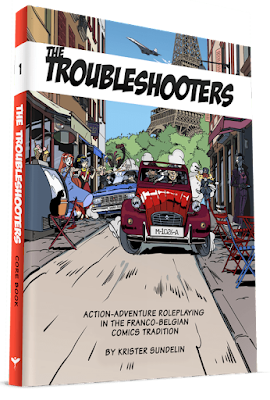
The year is 1965. On March 19th, 1964, a joint Japanese-French mission landed on the Moon aboard the giant atomic rocket Kaguyahime, the Moon Princess – affectionately called Monsieur Renard (‘Mister Fox’) in France because of its orange-red paint job. Two space stations orbit the Earth—the US Aurora and the Soviet Budushcheye-1. In the skies over Europe and far-flung cities, the Aérospatiale/BAC Concorde carries passengers at the speed of sound with BOAC, Air France, and Air Majestique. Around the world the Cold War continues between the United States of America and the Union of Soviet Socialist Republics, with Europe divided by the ‘Iron Curtain’. This includes Arenwald, the alpine principality formerly part of the Austro-Hungarian Empire, squeezed in between Hungary, Sylveria, and Yugoslavia, famous as a stop on the Arlberg Orient Express line from London to Athens, and its Soviet counterpart, the Socialist Republic of Sylveria. The Cold War is not the only threat to the world, a secret organisation known as the Octopus, a centuries-old criminal organisation, has designs on world domination. There are other dangers too, as well as mysteries and conspiracies, many of which the authorities are not best-placed to deal with. Step forward the Troubleshooters, bands of friends and adventurers who are prepared to travel the world and investigate the mysteries, crimes, and dangers that the authorities decline to do. And if they can have fun along the way, all the better!

This is the set-up for The Troubleshooters: An Action-Adventure Roleplaying Game inspired by French and Belgian comics—bande dessinée or bédé—such as Tintin, Spirou et Fantasio, Blake & Mortimer, and Yoko Tsuno. Published by Helmgast following a successful Kickstarter campaign, this is an action-adventure roleplaying game set in the second half of the sixties and first half of the seventies, an era of glamour, optimism, and technological advances. Its outlook is optimistic and exciting, a metropolitan world primarily set across a Europe full of diverse and exotic locations. The players will take the roles of the Troubleshooters, freelance adventurers and investigators, friends ready to look into mysteries and crimes, travel to exotic locales, and have adventures! The Troubleshooters can have a theme and thus be a band of curious adventurers, sleuths, agents, or criminals (in the tone of ‘gentleman thieves’)—and The Troubleshooters starts off by discussing these and giving sample inspirations. Each Troubleshooter should be competent, have a particular role in the group—such as the Doer, Investigator, or Muscle, want to adventure, possess a weakness which enhances the story, be fun to play, and fun to play with.

A character in The Troubleshooters is defined by Skills, Max Vitality, Plot Hooks, Traits, Abilities, Complications, and Story Points. Skills—rated as percentiles—are broken down into Background, Social, Investigation, Action, and Combat skills, and they include skills such as Agility, Endurance, Strength, and Willpower, which in other roleplaying games would be used as attributes. Plot Hooks, such as ‘Do-Gooder’ or ‘Media Darling’, are used to pull Troubleshooters into a scenario, and published scenarios will use specific Plot Hooks to involve Troubleshooters. Abilities mark the Troubleshooter out as a special and come in three Tiers with increasingly harder requirements, but at each Tier provide a means for the Troubleshooter to spend Story Points. For example, the Actor Ability requires the Entertainment skill at 65%, and when used with other skills like Charm or Subterfuge, enables a Troubleshooter pretend to be another person. For one Story Point, the Troubleshooter can flip a Subterfuge task check when pretending to be someone else, but for two, he can make a new task check for Entertainment or Charm, and keep the new roll. Complications are roleplaying hooks, for both the player and the Director of Operations—as the Game Master is known in The Troubleshooters is known—and also a source of Story Points. For example, a Troubleshooter with the ‘Amorous’ Complication will earn three Story Points when distracted by his emotions and receives a −2 pips modification to task checks not related to said emotions, three Story Points if a romantic interlude causes him trouble, and six Story Points when a date or romantic interlude prevents him from participating in an important scene.

Troubleshooter creation is template based, though guidelines are included which allow a new template to be built or a Troubleshooter to be built without using a template. Fifteen templates are included from Adventurous Scholar, Aspiring Student, and Caring Veterinarian to Racing Driver, Suffering Artist, and Vigilante Lawyer. Each template includes some background, eleven skills, five Abilities, three Complications, Vitality, extra languages, three gear kits, and some Plot Hook suggestions. A player can modify the skills, but must choose two Abilities, one Complication, five gear kits (this is three more than the template gives, but there is an extensive list of gear included in the book), and two Plot Hooks. He also chooses languages if his Troubleshooter has any and finally decide—or roll—where he met the other Troubleshooters. (Alternatively, the players could just use the six signature Troubleshooters included as examples who figure in all of the examples through the book.)

Dickie Jones – Curious Engineer
Skills: Contacts 45%, Electronics 65%, Engineering 75%, Investigation 45%, Machinery 65%, Science 65%, Search 65%, Security 45%, Melee 45%, Vehicles 45%, Willpower 45%. (All other Skills 15%.)
Abilities: Curious, Tech Wiz
Complications: Combat Paralysis, Crude
Vitality: 5
Languages: –
Gear: Camping Gear, Ham radio set, Electronics toolbox, First Aid Kit, Mechanic’s toolbox (Signature)
Plot Hooks: Friends in High Places, I Owe You

Mechanically, The Troubleshooters is a percentile system. To undertake a Task, a Troubleshooter’s player rolls percentile dice and if the result is equal to or less than the skill and the Troubleshooter succeeds. If the roll is a double and below the Skill value, then the Troubleshooter earns Good Karma, succeeding with a bonus and gains a Story Point. Conversely, Bad Karma is gained if a double is rolled and it is above the Skill value. The Karma can be mechanical or storytelling in nature. The former might be +2 or -2 Pips for Good or Bad Karma, the latter reinforcements turn up, either to help or hinder the Troubleshooters, depending upon whether it is Good or Bad Karma. Modifiers to the roll come in the form of Pips, which range from +5 to -5. If the number of Pips is positive, then any result equal to, or less than the number of Pips on the Ones die will always succeed, even if the actual percentile roll is greater than the Skill value. Conversely, if the number of Pips is negative, then any result equal to, or less than the number of Pips on the Ones die will always fail, even if the actual percentile roll is less than the Skill value. Pips can be applied because the environment, such as in the middle of a storm, or equipment used, such as a tool kit. The Pips system does feel a little weird, even counterintuitive, but it does not take much adjusting to, and once you have, it is very workable.

Notably, if a test is failed, it cannot be repeated, either by the current Troubleshooter or any other Troubleshooter—unless circumstances have changed significantly. Failure though is not intended be an absolute, but rather that the Troubleshooter ‘Fail Forward’ and either learn from the failure or push the story on in interesting ways. For example, in a fight, a Troubleshooter might not be killed, but rather captured, or if a Troubleshooter fails to defuse a bomb in time, he at least learns something about the design. In addition, every Troubleshooter has Story Points. Their most common use is to flip the results of a percentile roll. However, they can also be spent to activate Abilities, get gadgets beyond the standard five a Troubleshooter starts play with, gain clues, and either add something major or minor to the ongoing story. Adding something to the story may require a little negotiation with the Director.

For example, Dickie Jones is participating in a rally across Sylveria. He is the co-driver in a car driven by his fellow Troubleshooter and Finnish rally driver, Tristan Narbrough, but in addition to wanting to place well in the event, they are after a Soviet spy who is heading for the Socialist Republic of Sylveria with some information stolen from one of the sponsors of their car. However, during a night stage, in the middle of a storm, their car, a Mini-Cooper breaks down. Dickie leaps out of his seat, tool kit in hand, and pulls up the bonnet. To determine the fault and fix is going to require a Machinery 65% Test. The Director of Operations sets the Task at ‘-2 Pips’ for the storm, but Tristan’s player describes how he is holding a torch to make sure that Dickie can see what he is doing, which negates the ‘-2 Pips’. Plus, of course, Dickie has his signature Mechanic’s toolbox, which gives him two Pips. So, Dickie’s player is rolling his Machinery 65% Skill at ‘+2 Pips’. Dickie’s player rolls 99%! Not only is this a failure, but it is also one with Bad Karma. This could be bad news for both Dickie and Tristian, but Dickie has the Tech Wiz Ability, which enables his player to reroll an Electronics, Engineering, or Machinery Task for one Story Point. Dickie’s player spends the Story Point and rerolls, but the result is a 71%—better but still a failure… Except no, the value on the Ones die is less than the Pips, which means that Dickie finds the fault, fixes it, and they are back on the road again, driving hard to catch up with and capture the industrial spy!
Combat in The Troubleshooters is more complex and is built around opposed Tests between attacking and defensive Skills, for example, Melee versus Melee Skill or Ranged Combat versus the Agility Skill. The Troubleshooters, as Player Characters, have Defence Skills, but unless they are important, Director characters (or NPCs) do not. Initiative is handled with an Agility Test, with the rests of the two dice added together if successful. Damage is rolled on six-sided dice, typically just two for unarmed attacks, all the way up to seven for machine guns. Rolls of four, five, and six inflict a point of Vitality damage per die, with results of six exploding and potentially doing more damage. Armour allows Soak rolls which negate points of damage, but do not explode. Recovery rolls, made to recover Vitality work the same as Soak rolls. A Troubleshooter or an important Director character is out Cold when they run out of Vitality, although either can take the Wounded or the Mortal Peril Condition instead of suffering Vitality loss. This typically to void being Out Cold, but both have consequences after the fight and take time to heal. What is stressed throughout The Troubleshooters is that it is not a roleplaying game about killing and that it is very difficult for a Troubleshooter to die. Indeed, the most common way of a Troubleshooter dying is when it is dramatically appropriate and the Director has stated that it is a possibility in a scene. As to killing, if a player has his Troubleshooter kill a Director character in cold blood, then the Director is advised to deny the Troubleshooter any free improvement checks at the end of the adventure, and remove all of the Troubleshooter’s Story Points, as well as half of the Story Points of those Troubleshooters’ who could have stopped him. This is harsh, but The Troubleshooters is intended as a positive roleplaying and roleplaying experience.

For the Director of Operations, there is good advice on setting up combat scenes to make them interesting and challenging, adjudicating the use and awarding of Story Points, an extensive list of Gear—including Weird Tech with which to equip the bad guys or interest any budding Tech Wiz Troubleshooter. The advice also covers hosting and running the game, portraying the Director’s characters—including how to make the bigger villains camp, and creating adventures and campaign. She is accorded a full description of the Octopus, its organisation, members, aims, and technology, plus plenty of stats and write-ups of various Director characters and animals. In terms of background, ‘The World of The Troubleshooters’ presents the period and setting in some detail, highlighting not just the differences between the sixties that we know from history and the sixties of The Troubleshooters, but also the similarities. It covers technology, travel, and more before providing a whirlwind guide to some of the interesting places and cities around the world, from Paris and Berlin to Buenos Aries to Ice Station X-14. These are really good, describing each location in a couple of pages including lists of where to stay, things to do, and why that location is being visited as part of the Troubleshooters’ adventure. In fact, these location descriptions feel reminiscent of the Thrilling Locations supplement for the James Bond 007 roleplaying game from 1983 and certainly that sourcebook could be useful until The Troubleshooters gets one of its own. Rounding out The Troubleshooters is a set of appendices which include a calendar for 1965, lists of first names in various languages, a table of character traits, and several lists of profanities, but not profanities, which should allow a Troubleshooter to swear, but not swear, and still maintain the spirit of the bande dessinée. “Blue blistering barnacles!” indeed.

Physically, The Troubleshooters is a stunning looking book. The artwork, done in the ‘Ligne claire’ style pioneered by Hergé, nicely sets the signature cast of The Troubleshooters against the well-drawn backdrop of the real world. Make no mistake, the artwork is excellent throughout, really capturing the feel of the roleplaying’s inspiration. Although it needs a slight edit in places, The Troubleshooters is well written and an engaging read from start to finish. Throughout, the rules and situations are explained in numerous examples of play, all using the signature cast of The Troubleshooters and narrated by Graf Albrecht Vogelin Erwin von Zadrith, the Number Two of the Octopus, as the Director. These are all entertaining to read and tell a story as much as they inform about the rules.

If there are any issues with The Troubleshooters, then there are two. First, there is no scenario. Second, the other thing is that although it references various bande dessinée, it does not list actual titles. Fortunately, there are three scenarios available for the roleplaying game in The Troubleshooters’ Archive. The lack of a bibliography can be got around using the pointers included here as a starting point. In addition, The U-boat Mystery scenario is already available.

The obvious thing about The Troubleshooters is that could be used to run a James Bond style roleplaying game. It could be, and it would work well as a James Bond roleplaying game, but The Troubleshooters is not as cynical in tone or even as murderous as the world of James Bond is in comparison. Much lighter in tone, The Troubleshooters is of course a roleplaying game of adventure tourism in the style of bande dessinée, but also that of the ITC Entertainment television series of the period. For example, The Saint, The Persuaders!, and The Protectors, and whilst it is specific in its bande dessinée inspiration, The Troubleshooters is really the first roleplaying game to look back to the period since Agents of S.W.I.N.G..

The Troubleshooters: An Action-Adventure Roleplaying Game is great looking book with artwork which wonderfully evokes its source material. The rules and mechanics support play in the style of that source material, enabling the players to create fun Troubleshooters, and jet or drive off on amazing, exciting adventures with each other and tell great stories. With its comic book or bande dessinée sensibilities, there can be no doubt that The Troubleshooters takes us back to a simpler, if headier and more optimistic time. The combination means The Troubleshooters is engagingly, delightfully European and charmingly chic.