Every Week It's Wibbley-Wobbley Timey-Wimey Pookie-Reviewery...
Showing posts with label Ashen Stars. Show all posts

Sunday, 12 January 2020

A Post Space Opera Companion

Ashen Stars is Pelgrane Press’ Science Fiction roleplaying game of investigation and action. Using the investigation-orientated Gumshoe System mechanics written by Robin D. Laws, it takes the idea that Space Opera stories, especially those screened on television, are essentially mysteries to be solved and adapts it to an interesting frontier setting. This is the Bleed, a rough, wild fringe of space that barely twenty years ago was the enticingly glamorous frontier of The Combine, a two-hundred-year-old interstellar, culture-spanning government dedicated to peace, understanding, and self-determination. The Combine was an idealistic utopia that enabled numerous races and peoples to live happily under its governance, but then the Mohilar attacked, and employing technologies unknown to The Combine, their vast war fleets stormed system after system until The Combine’s heart, Earth itself, was devastated. Then following an unexpected defeat at the hands of a last-ditch effort by what remained of Combine forces, they vanished. That was a decade ago and yet, due to an effect known as the Bogey Conundrum, memories of the Mohilar race have become hazy and inconsistent. Try as they might, no one call recall exactly what the Mohilar were, and certainly, no one has any idea where they are now…

In the wake of the Mohilar War, both the interstellar economy and government have collapsed and whilst The Combine exists, its reach has been pulled back from the Bleed. Thus, the worlds the Bleed, many scorched and blasted by war, have been left to their own devices, bound only by a common currency and cultural ties. Where Combine patrols once kept the peace, peacekeeping missions and criminal investigations are now put out to private tender and assigned to independent ship operators known as ‘Licensed Autonomous Zone Effectuators’ or ‘Lasers’. As Lasers, the player characters will crew and operate a ship on a tight budget, hoping to pick up assignments that if completed will enhance their reputation and so lead to better and more profitable assignments.

Since its publication in 2011, Ashen Stars has received only slight support, all of it the form of scenarios, such as Dead Rock Seven and The Justice Trade. Accretion Disk is support of a different kind, a supplement which takes its name from the structure formed by diffuse material in orbital motion around a massive central body, typically a star. In terms of a roleplaying supplement what we have in Accretion Disc is a collection of unrelated material—new character options, new playable species, new ability options, new weapons and equipment, new contracts, new aliens, and more. Accretion Disc is essentially, the Ashen Stars Companion.

The supplement wastes no time in getting down to business. The first fifth of Accretion Disk is devoted to Investigative Abilities—knowledges which get the Lasers clues, and General Abilities—skills and so on which allow the Lasers to act. Every entry for an Investigative Ability includes sample benefits from Spends of an Ability and sample clues and plot hooks, whilst for General Abilities include possible investigative clues and possible ‘Cherries’. So for the Data Retrieval Technical Ability, a Laser’s player might spend a point to protect the team’s own data or disseminate an enemy’s secrets to the general public, whilst sample clues and plot hooks include being able to access the captain’s logs of a crashed spaceship, determine clues from a ransom video in a kidnap case, and so on. 

‘Cherries’ were introduced in Night’s Black Agents specifically to meet its thriller angle. Now, as with Night’s Black Agents, if a Laser in Ashen Stars has a General Ability with a rating of eight or more, he is regarded as being skilled enough to gain a special benefit. So for example, with an Athletics score of eight or more, a Laser have the ‘Hard to Hit’ and so become harder to target in combat, or he might take the Might Cherry for his high Athletics Ability, enabling his player to expend points from his Athletics Ability pool after the roll rather than before. Other Cherries give simple points in other Abilities or a free pool of points to spend on specific things. For example,  ‘Follow the Money’ for the Business Affairs General Ability, grants a free point in the Forensic Accounting Academic Investigative Ability, whilst the ‘Viro Wizardry’ Cherry for the Viro Manipulation General Ability to provide the Lazers with an extra pool of points to spend on the second use of a one-use Viroware. Overall, the section on Abilities—Investigative and General—is useful for both Game Master and player alike, adding further helpful description and utility. In general, the use of the Cherries also make the play of the game more cinematic in flavour and feel. Even further the write-up of the Flattery Interpersonal Investigative Ability is amusingly, exactly what it says it is.

‘Crewing Up’ expands upon the discussion of the Warpside and Groundside mission roles of the Lasers from the Ashen Stars core rulebook. It provides a list of the basic Investigative and General Abilities needed for each role, a discussion of the role, the role’s typical day-to-day routine, suggested equipment loadouts, specialised techniques and jargon, and classic media archetypes. So a Communications Officer or Hailer will be receiving communications, dealing with clients, tracking and analysing signals, hacking, and so on. He might be a polished corporate spokesman, an eccentric hacker/DJ, a military signals expert, harried technician, and more. Again, there is a lot of information here for both Game Master and player, giving the former ideas on how to bring them into play and the latter ideas on how to play each role. 

One of the aspects of Ashen Stars and of Gumshoe System roleplaying games in general is its direct implementation of Drives and Arcs to help involve Lasers in campaigns and plots. In the core rule book for Ashen Stars, they are discussed from the Game Master’s point of view since she is the one who will be implementing them. In Accretion Disk, they are examined from the player’s point of view. There are some general suggestions on how each player might bring them into play and do it judiciously, plus three sample Arc Drives for each. Ashen Stars then adds six new playable species to the Seven Peoples of the Combine, some of whom have held more prominent positions in the past. They include the warty, boney Cloddhuck, who once revered the Durugh as gods and served them as shock troops, but since the Mohilar War have used their combat intuition as mercenaries and criminals, and now, to solve crime! The Haydrossi evolved in the atmosphere of a gas giant and can not only float, but have excellent three dimensional spatial awareness and are driven to seek new places in search of a lost utopia. Unfortunately, they are not covered by the treaties which forbid the Kth-thk from eating certain sentient species. The Icti inhabit and animate the fresh corpses of the recently dead, the higher up the food chain the better, and can access the memories that the corpses had in life as well as preventing their newly inhabited ‘meat-shells’ from truly rotting for years. It is entirely for a Laser to die in game and his player chose to have come back as an Icti! The Ndoaites are even weirder, shell-residing lizards who consume radioactive ores and whose bowel movements are classed as type II biohazards. Consequently, as Lasers they serve Warpside happily, but send drones to represent them when Groundside. They can also generate and emit radiation, often in modulated, targeted bursts. The Racondids are bipedal reptiles overconfidently keen on the Combine and seeking out new challenges with a rapid metabolism which allows them to vomit flammable material! Lastly, the Verpid are a corporate-owned species, genetically engineered to change shape and have fled their masters in an act of self-emancipation.   

All six of the new races are interesting and different, but not necessarily useful or much-needed additions to Ashen Stars. They are again, another option for a campaign. More useful though are the sets of deck plans for the six most commonly used ships used by Laser teams. From the stalwart, reliable Runner to highly defensive, but uncomfortable Porcupine, all of the ins and outs of these vessels are discussed, as their foibles and quirks. If there is an issue here it that the deck plans are presented in greyscale rather than colour, so much of their definition and detail is lost. Accompanying this is a selection of new ‘Ship Bolt-Ons’, complete with Cost and Upkeep values, such as the Cannon-Nanny which prevents shipboard weapons from being used by over-zealous gunners so as to prevent Public Relations disasters or Particle Streamers which stream and excite particles hamper attempts by attackers to lock on and tow the ship. Shuttles receive a similar treatment with several alternatives to the standard shuttle carried by most Laser vessels, including Cargo Shuttles and Racing Shuttles. As does the section on personal technology, which includes a communications device, cybernetic enhancements, medical, forensic, and protective gear, and miscellaneous and investigative tech, viroware, and more. Players will enjoy the Dirty Harry Mod which makes a Disruptor weapon look a whole bigger and thus more intimidating; the Muckraker Suite, semi-intelligent systems and customised software for digging up dirt on a target; and the Wingman Ultra, which enables a Laser to mimic a colleague or friend’s Interpersonal skills, including of course, Flirting.

Rounding out Accretion Disk are over thirty ‘Hot Contracts’, giving the Game Master a wide array of tasks for the players’ team of Lasers to undertake, followed by an expansion to the ‘Entity Database’ with twelve new monsters and creatures. Lastly, the appendices provide rules for ‘Ashen Stars Warp’, a stripped down version of the rules with fewer skills and abilities. This is also intended for convention play where quicker mechanics might be of use.

Physically, Accretion Disk is cleanly laid out, decently edited, and nicely illustrated. It comes with a good index too. The only downside to the supplement is that it is presented in greyscale rather than colour, and some of the artwork—and certainly the deckplans—would have benefited from being in full colour.

Until now, Ashen Stars has not had a supplement to support both its play and its setting. Accretion Disk fulfills that need, with an array of useful and interesting bits and pieces, some of them connected—for example, the deckplans, the ship bolt-ons, and the shuttles—some not. Given the time between the publication of Ashen Stars and the publication of Accretion Disk, this is the supplement that will bring veteran players of the roleplaying back to play with its selection of new options, or support a group coming to the roleplaying game for the first time with advice and expanded explanations. 

Accretion Disk is more than welcome support for Ashen Stars, not necessary to play, but helpful, useful options and advice to expand and support a campaign. The perfect companion to Ashen Stars.

Saturday, 11 May 2019

An Ashen Stars Duo

Ashen Stars is Pelgrane Press’ Science Fiction roleplaying game of investigation and action. Using the investigation-orientated Gumshoe System mechanics written by Robin D. Laws, it takes the idea that Space Opera stories, especially those screened on television, are essentially mysteries to be solved and adapts it to an interesting frontier setting. This is the Bleed, a rough, wild fringe of space that barely twenty years ago was the enticingly glamorous frontier of The Combine, a two-hundred-year-old interstellar, culture-spanning government dedicated to peace, understanding, and self-determination. The Combine was an idealistic utopia that enabled numerous races and peoples to live happily under its governance, but then the Mohilar attacked, and employing technologies unknown to The Combine their vast war fleets stormed system after system until The Combine’s heart, Earth itself, was devastated. Then following an unexpected defeat at the hands of a last-ditch effort by what remained of Combine forces, they vanished. That was a decade ago and yet, due to an effect known as the Bogey Conundrum, memories of the Mohilar race have become hazy and inconsistent. Try as they might, no one call recall exactly what the Mohilar were, and certainly, no one has any idea where they are now…

In the wake of the Mohilar War, both the interstellar economy and government have collapsed and whilst The Combine exists, its reach has been pulled back from the Bleed. Thus, the worlds the Bleed, many scorched and blasted by war, have been left to their own devices, bound only by a common currency and cultural ties. Where Combine patrols once kept the peace, peacekeeping missions and criminal investigations are now put out to private tender and assigned to independent ship operators known as ‘Licensed Autonomous Zone Effectuators’ or ‘Lasers’. As Lasers, the player characters will crew and operate a ship on a tight budget, hoping to pick up assignments that if completed will enhance their reputation and so lead to better and more profitable assignments.

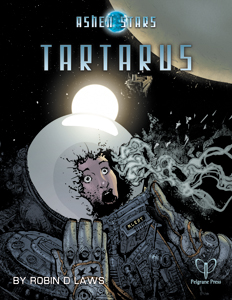
The first release for Ashen Stars was Dead Rock Seven. This presented a collection of four, dirty, detailed, and involving mysteries to be investigated that could be run singly or in sequence as a loose campaign. The second is Tartarus/Terra Nova, collects two scenarios, each of a very different nature. Both are investigative in nature of course, but one is a ‘ship in a bottle’ style adventure—though not the Lasers’ actual ship, and the other a horror scenario. Both also involve races against the clock. It should be noted that the book comes as a ‘Double Cover’, so that after reading or running one scenario, the Game Master needs to flip the book over. Essentially there are two front covers, so instead of reviewing them in chronological order, they will be reviewed in order of increasing interest.

‘Terra Nova’ is written by Leonard Balsera and it begins much like ‘Period of Tyranny’ from Dead Rock Seven. The Lasers are tasked to come to the rescue of a passenger liner in distress, the eponymous Terra Nova, and also determine the cause of the accident. Of course, it was no accident and the luxury liner, its glory faded from the days before the Mohilar War contains a terrible secret which the culprit at the heart of the scenario’s plot has discovered and wants to take advantage of. Once the Lasers are aboard the shattered vessel they will find it strangely twisted, its systems oddly belligerent, and the handful of survivors acting oddly.

This is a conventional murder-mystery style adventure set aboard a shipwreck floating in space with just a cast of five NPCs or suspects. What lifts this scenario above the ordinary is not just the fact that also the NPCs are suspects and that any one of them could be the culprit, but the fact that it supports this set-up from start to finish. Although the scenario has a plot and the villain of the piece has a plan, at the start of the scenario, exactly who that villain is yet to be determined and determining who that villain is, well depends upon the actions of the player characters. Each of the NPCs, including a faded celebrity, a crew member, a radical medical researcher, and more, in addition to their well-drawn descriptions, is discussed in terms of three roles. As innocent, as red herring, as culprit. Clues are written so that they can work with each of these roles and so enforce the NPCs’ roles.

The intention here is for the Game Master to adjust their role to fit the interests of the players and the investigative efforts of their Lasers. Thus, if the player characters take a strong interest in one NPC, that person might become a red herring or another might be pushed their way when the first NPC is actually the culprit. Overall, ‘Terra Nova’ is a solid plot combined with an excellent and well-explained toolkit with which to build a murder mystery plot. In fact, this toolkit is so good that it is worth a Game Master consulting again should she want to run a murder mystery style game whatever the genre or roleplaying game.

The other scenario is ‘Tartarus’, written by Robin D. Laws. Shrawley-Gosha Industries recently received an automatic message from one its ships, the Francis Crick, which indicated that her crew might be in trouble. That crew included board member, Charles Shrawley, who was leading a survey mission, and worse, the ship is currently orbiting what is known as a ‘Bad Planet’ (‘Bad Planet’ being the colloquial term for what the Combine calls a ‘ULC’ or ‘Unremittingly Life-Compromising’ world). The Lasers are hired to determine what has happened aboard the Francis Crick, rescue her crew and the survey team, and if unable to, extract their DNA to determine their cause of death and status.

If the Lasers do some research they can discover that Shrawley-Gosha Industries is looking to get rid of Shrawley as quietly as possible and that there is more to his survey team than the crew manifest states. After all, who needs a xeno-biologist and an archaeologist on a mineral survey team? As their investigations take the Lasers from the corporation’s Eden-like headquarters to the hell world which the Francis Crick is currently orbiting, they should really be worrying about what exactly Shrawley is up to and just what sort of a mess will they be expected to clean up.

Which is perfectly sensible because as the players roleplay their way through the scenario, what will likely become apparent is that essentially, ‘Tartarus’ is following the plot of Ridley Scott’s Prometheus. Now if that sounds like a bad thing, then it is, but only if the author was following the plot of the film exactly. Which thankfully, he is not. Instead, Laws addresses some of the issues raised by the plot of the film and divorces the plot of the scenario from the film, instead tying it into Ashen Stars’ background. Further, it gives reasons for both the NPCs and the player characters to investigate deeper into the situation on the planet—a dangerously unstable world which echoes the unstable nature of the mission that the Lasers find themselves in—and so discover what exactly is going on and confront its consequences. This is in addition to the appearance of ‘CKEMGMCs’—or ‘Class K Entities of the Game Master’s Choice’, Class K entities being the deadly and implacably hostile aliens who may or may not be the Mohilar.

‘Tartarus’ is a nasty scenario, a potential team killer as the Lasers get closer to the truth of what Charles Shrawley has been doing and is currently planning, encountering some of the horrors he has left in his wake. It is also a distinct change of pace and genre for Ashen Stars and whilst that may not quite fit every Ashen Stars campaign, ‘Tartarus’ makes for a good one-shot as it does a better treatment of the plot to a contentious movie. 

In between ‘Terra Nova’ and ‘Tartarus’ is an unannounced demonstration scenario—unannounced that is because Tartarus/Terra Nova has no back cover and therefore no back-cover blurb (it also does not have an introduction). ‘Stowaway’ is designed to offer twenty minutes of play as the Lasers fight a desperate battle to retain control of their ship and fight off a Class-K invader. Primarily action-orientated and designed to be played by two players as much as it is five—though four is a good number—it can be used as a demonstration scenario or prequel scene to help teach the players the rules and some of the dangers of the setting.

Tartarus/Terra Nova is clean and tidy, but does need an edit in places and it feels a little under-illustrated in comparison to other Ashen Stars titles. What it really lacks are handouts and maps, which again feel a bit light given the investigative nature of the two scenarios.

Tartarus/Terra Nova is great support for Ashen Stars. ‘Terra Nova’ presents a great toolkit and advice for the Game Master to run mysteries, whilst ‘Tartarus’ ups the ante by combining invasive body horror with the investigative process. The fact that it does so on the back of a well-known Science Fiction film and does a better job of it is just icing on the cake.

—oOo—

Pelgrane Press will be at UK Games Expo which will take place between May 31st and June 2nd, 2019 at Birmingham NEC. This is the world’s fourth largest gaming convention and the biggest in the United Kingdom.

Sunday, 17 March 2019

An Ashen Stars Quartet

Ashen Stars is Pelgrane Press’ Science Fiction roleplaying game of investigation and action. Using the investigation-orientated Gumshoe System RPG written by the Gumshoe System’s author, Robin D. Laws, it takes the idea that Space Opera stories, especially those screened on television, are essentially mysteries to be solved and adapts it to an interesting frontier setting. This is the Bleed, a rough, wild fringe of space that barely twenty years ago was the enticingly glamorous frontier of The Combine, a two-hundred-year-old interstellar, culture-spanning government dedicated to peace, understanding, and self-determination. The Combine was an idealistic utopia that enabled numerous races and peoples to live happily under its governance, but then the Mohilar attacked, and employing technologies unknown to The Combine their vast war fleets stormed system after system until The Combine’s heart, Earth itself, was devastated. Then following an unexpected defeat at the hands of a last-ditch effort by what remained of Combine forces, they vanished. That was a decade ago and yet, due to an effect known as the Bogey Conundrum, memories of the Mohilar race have become hazy and inconsistent. Try as they might, no one call recall exactly what the Mohilar were, and certainly, no one has any idea where they are now…

In the wake of the Mohilar War, both the interstellar economy and government have collapsed and whilst The Combine exists, its reach has been pulled back from the Bleed. Thus, the worlds the Bleed, many scorched and blasted by war, have been left to their own devices, bound only by a common currency and cultural ties. Where Combine patrols once kept the peace, peacekeeping missions and criminal investigations are now put out to private tender and assigned to independent ship operators known as ‘Licensed Autonomous Zone Effectuators’ or ‘Lasers’. As Lasers, the player characters will crew and operate a ship on a tight budget, hoping to pick up assignments that if completed will enhance their reputation and so lead to better and more profitable assignments.
The first release is the scenario anthology, Dead Rock Seven. This is a collection of four, dirty, detailed, and involving mysteries to be investigated that can be run singly or in sequence as a loose campaign. The links between the four scenarios are quite light, although they build to a denouement in the final scenario. Certainly, the links are light enough that the Game Master can slot scenarios in between them, whether those of her own design or published by Pelgrane Press—though sadly, there are few of those. These links run in two strands throughout the four scenarios. One is the Restreamers, a nufaith which believes that history in the wake of the Mohilar War has run in the wrong direction and that through their efforts that the current universe can be ended and restarted again to follow the correct path. The other is the appearance of ‘CKEMGMCs’—or ‘Class K Entities of the Game Master’s Choice’, Class K entities being the deadly and implacably hostile aliens who may or may not be the Mohilar. They appear throughout the anthology in various ways and the Game Master is free to select either the Class K entities given in the Ashen Stars core rule book or the three news ones given in the Dead Rock Seven.

All four scenarios in Dead Rock Seven follow the same format. The ‘Contract’ provides the Lasers with the details of their next job; the ‘Twist’ explains the basic situation for the Game Master, whilst the ‘The Backstory’ goes into it in more detail, including the NPCs and their connections, and ‘The Investigation’ outlines the general outline of the core spine upon which the scenario is hung. ‘Complications’ add red herrings, other suspects, and corollary lines of enquiry, all culminating in ‘The Choice’ which gives the choices that the player characters are likely to have to make once their investigation is complete. Together this sets up the scenes which make up the bulk of each scenario, all given in the general order that a team of Lasers will investigate. The degree of organisation here is excellent and helps to make the quartet here very easy to run.

In addition, Dead Rock Seven comes with a set of six ready-to-play Lasers—including character sheets—and their ship. The six are a good mix of character types and include heroes as well as war criminals, with all six including some excellent roleplaying links and hooks. All six though require a little customisation before play, but that should not take too long.

The quartet opens with ‘The Pleasure Bringers’. The Lasers are hired by a corporation to find one of its executives who has gone missing on the pleasure planet of Andarta. Now this is the same corporation as appeared in the introductory scenario, ‘The Witness of My Worth’, in the core rulebook, so that the Game Master could easily this scenario as sequel to it. What follows is a murky tale of greed, criminality, sex, and more, all against the neon backdrop of world which specialises in sex and carnality. Although not explicit, this means that the scenario has a strong adult tone, so it may not be suitable for all gaming groups. As well as introducing the Restreamers, the scenario explores issues of immigration in the wake of the Mohilar War, of sexually transmitted diseases, and exploitation, but really building upon them and using them in interesting ways to create a sordid and nasty mystery with an air of grim desperation.

The second scenario is the eponymous, ‘Dead Rock Seven’. The Lasers are hired to investigate a suspicious death aboard a mining asteroid which is in the process of being decommissioned. Where ‘The Pleasure Bringers’ took place planetside and across a major city, this scenario is really confined to just two locations—the asteroid and its labyrinth of hand-dug tunnels and a tethered habitation module. This is much more claustrophobic affair, echoing both the horror and the Blue-Collar Sci-Fi of films like Aliens and Outland (such that it could well with the recently released Mothership Sci-Fi Horror RPG [http://rlyehreviews.blogspot.com/2019/03/blue-collar-sci-fi-horror.html]. The enclosed nature though, does make the cast of NPCs feel bigger and more difficult for the Game Master to handle, as does the intensity of relations between them. This is intentional though, as really what the Lasers are investigating is the labyrinthine nature of the relationships, although this is not to say that there is not the wealth of physical evidence for them to find too. It also means that the Game Master has good cast of NPCs for her to roleplay. ‘Dead Rock Seven’ also introduces ‘CKEMGMC’ for the first time and does so in a clever fashion which initially appear confusing to the Lasers.

‘Period of Tyranny’, the third scenario begins almost en media res, with the Lasers racing to answer the distress call from a stricken passenger starship, the Beatrix. Along with the distress call is a clause that gives the right for the Lasers to investigate the cause of the accident aboard the vessel and arrest those responsible—if anyone is, of course. Then again, this being a scenario for Ashen Stars, there is. After a harrowing rescue mission aboard the Beatrix, the trail leads to the nearby synthculture planet of Pioneer. Now in Ashen Stars, a planet with a synthculture is one which has adopted a culture other than the one that the colonisers originally from, often a historical one. In the case of Pioneer, it is of the frontier drive to settle America, but when the Lasers arrive, they discover that it has been subverted into a fascist, xenophobic regime that echoes an earlier period of Earth’s future history. So essentially it allows the Lasers to explore a bit of history as well as getting involved in pro-Combine and pro-Bleed politics as they attempt to work out who was behind the destruction of the Beatrix and why. It also gives the Lasers a definitive enemy in the form of Pioneer’s secret police as their constant presence and surveillance works to hamper their investigation.

Lastly, ‘The Anaitis Gambit’ adds a degree of silliness and levity before the action kicks in and brings the quartet to a close. Located at a nexus of several translight corridors, Anaitis Station is hosting a cooking contest—essentially ‘The Great Galactic Bake-off’—as a publicity stunt and hires the Lasers to handle the security. This gives an excuse for the Game Master to roleplaying lots of outrageously over the top NPCs before things get nasty as first someone lobs a gigantic heap of star junk at the station and then the dead bodies start piling up. The question is, is this all an attempt to sabotage the cookery contest or is there something to it? Well, yes and yes. The cookery contest is important, but clues from that will lead to an encounter with some strange aliens, reveal just what the Restreamers want and are prepared to do it in order to achieve it, and more… This is fun, fast, and furious adventure which nicely brings the quartet to a close, leaving the Lasers with having saved both the Bleed and the Combine, or having started a whole new war…

Physically, Dead Rock Seven is a clean looking, greyscale book printed on glossy paper. It is only lightly illustrated, but the artwork is excellent. Unfortunately, it is not in colour, which much of this artwork should be to show of how it actually is. As well organised as the book is, Dead Rock Seven does need another edit, which is disappointing.

There is a surprising degree of adaptability to these scenarios, so that they would work in other Science Fiction roleplaying games. They do require of diversity in terms of their aliens and their worlds, so that they would work better in Traveller or Star Trek Adventures: The Roleplaying Game, for example, rather than Firefly Roleplaying Game. Indeed, it could be argued that ‘Dead Rock Seven’ is not unlike ‘The Devil in the Dark’ and ‘Period of Tyranny’ is not unlike ‘A Piece of the Action’ and ‘Bread and Circuses’, all three Star Trek: The Original Series episodes. All of them would work well with the Doctor Who: Adventures in Time and Space roleplaying game too (thank you, Dave Lai). It would take some effort to adapt them to the system and setting of the Game Master’s choice, but the option is there.

Dead Rock Seven presents four good Science Fiction mysteries that are detailed, murky, and convoluted—for the players and their Lasers, for the Game Master they are efficiently explained and organised—and thus exactly what an Ashen Stars Game Master needs. They are also mature of tone and successfully show off aspects of the Ashen Stars setting, whether that is its politics or its recent history as well as gently exploring some timely themes. Worth getting to peruse for ideas for any Science Fiction roleplaying game, Dead Rock Seven is simply excellent support for Ashen Stars.

Monday, 16 September 2013

Post Space Opera

We have been roleplaying Space Opera for over thirty-five years, ever since the release of Star Wars and the publication of GDW’s Traveller. In that time the genre has either gone high and fantastic, arguably right out of the Science Fiction genre all together, typified by the four Star Wars RPGs; enlisted in the semi-military, as typified by the five Star Trek RPGs; or let the player characters go independent with their own ship, as typified by the archetypal Traveller campaign and more recently by the Firefly Role-Playing Game: Gaming in the 'Verse, published by Margaret Weis Productions. What Ashen Stars does is set course between the semi-military and the independent ship operator and make every trip into an investigation.

Ashen Stars is the investigation-orientated Gumshoe System RPG written by the Gumshoe System’s author, Robin D. Laws, and published by Pelgrane Press. It works from the idea that the idea that Space Opera stories, especially those screened on television, are essentially mysteries to be solved. ‘The Devil in the Dark’, an episode of Star Trek from 1967 is a classic example of a Space Opera investigation in which the crew of the USS Enterprise must find out who is killing the workers and destroying their machinery on a mining planet. Further, the episode and others like it, give a chance for each of the series’ stars to shine. It is this model that Ashen Stars adopts before going on to build a unique setting all its very own.

That setting is the Bleed, a rough, wild fringe of space that barely twenty years ago was the enticingly glamorous frontier of The Combine, a two-hundred year old interstellar, culture-spanning government dedicated to peace, understanding, and self-determination. Ready access to starship travel enabled colonists to transverse the FTL corridors to settle the region then known as the Wave, safe in the knowledge that Combine patrols kept the peace, confronted anomalies, and solved any problems. The Combine was an idealistic utopia that enabled numerous races and peoples to live happily under its governance. Then the Mohilar attacked, and employing technologies unknown to The Combine their vast war fleets stormed system after system until The Combine’s heart, Earth itself, was devastated. Then following an unexpected defeat at the hands of a last ditch effort by what remained of Combine forces, they vanished. That was a decade ago and yet, due to an effect known as the Bogey Conundrum, memories of the Mohilar race have become hazy and inconsistent. Try as they might, no one call recall exactly what the Mohilar were, and certainly, no one has any idea where they are now…

In the meantime, the stars in the sky flicker and turn grey, and then revert to normal. The reason is unknown, but it is a suspected side effect of Mohilar weaponry. These are the Ashen Stars of the title…

In the wake of the Mohilar War, both the interstellar economy and government have collapsed and whilst The Combine exists, its reach has been pulled back from the Bleed. Thus the worlds the Bleed, many scorched and blasted by war, have been left to their own devices, bound only by a common currency and cultural ties. Where Combine patrols once kept the peace, peacekeeping missions and criminal investigations are now put out to private tender and assigned to independent ship operators known as ‘Licensed Autonomous Zone Effectuators’ or ‘Lasers’. As Lasers, the player characters will crew and operate a ship on a tight budget, hoping to pick up assignments that if completed will enhance their reputation and so lead to better and more profitable assignments. Each crewmember will undertake a role aboard ship and off ship for efficiency’s sake.

Although most Lasers are Human, a typical player character crew will consist of several members of ‘The Seven Peoples’ of The Combine. The seven include the uncannily beautiful Balla who love nature, but fear all emotions; the Cybes, former humans whose bodies and minds have been radically altered through cybernetic and genetic science; and the Durugh, short alien humanoids that can phase through solid matter who were once the enemy of The Combine. The Kch-thk are a warrior locust-like race that used to have a reputation for eating other species and can transfer to new bodies when their old ones die; the armadillo-like Tavak are placid warriors with strong ethics who fear falling into a battle rage; and the Vas Mal are a new Grey-like species given physical form following the Mohilar War from their former existence as near-omniscient energy beings. Lastly, Humans, as expected of the genre, are adaptable, resourceful, and numerous.

Each Laser undertakes two roles as part of a crew. One is Warpside, that is, aboard ship; the other is Groundside, that is, off ship. The former are Communications Officer, Pilot, Strategic Coordina¬tor, Systems Officer (engineer), and Weapons Officer, whilst the latter are Cultural, Operations, Survey, Security, and Technical. The Medic occupation is a mixed role that is important to both Warpside and Groundside, and rarely doubles up with another role. In selecting one from each category a player creates a character that has a role to fulfil or something to do when aboard ship or when conducting investigations off ship, and this is one of several balancing mechanics established in the game. Another is the number of points that each player receives to assign to his character’s Abilities. A player receives two pools of points, the smaller one to assign to his Laser’s Investigative Abilities, which are used to gather clues; the larger number to his General Abilities, which represent his physical skills. A player has to assign points to certain Abilities as these represent his Warpside and Groundside roles, plus if he is playing an alien species, then there a number of special Abilities that he has access to. For example, the Vas Mal are capable of Consciousness Simulation which enables them to interrogate the recently dead through their brain wave traces, whilst the Durugh can Phase and pass through objects.

Rounding each Laser is his Drive – what motivates him to serve, like Bleedism (the Laser believes that the Bleed should be independent of The Combine) or the Hunger Tourism of the Kch-Thk (the Laser likes to go places and eat new foods). Together as group, the player Lasers select a ship, of which there are ten Classes to choose from, including the balanced Runner, the offense heavy Hammer, and the Sherlock, which bristles with sensors and laboratories. Whilst this ship is free, the Lasers must pay for any extra gear beyond their standard equipment as well as any personal cybernetic and viroware enhancements. An array of both is available for purchase, some of which the various races of the Combine have an affinity for, while others are incompatible. All cyberware and viroware are incompatible to the Vas Mal. The Lasers will have a budget for this, out of which they must also pay for any ship bolt-ons like cargo modules or a Peacefist which enhances attempts to disable the weapons of enemy vessels. 

In addition, each player needs to decide what his Laser did in the Mohilar War, and then as part of the Laser team, decide how they came to possess their ship. Every character also has a personal development arc, such as identify the Mohilar or return to my home dimension – this latter particular to the Vas Mal. Each arc represents a story that a player wants to explore and see developed through the B-Story presented in each episode or scenario.

Our sample character was a scout for The Combine Colonial Administration surveying new worlds for on-going colonial expansion into the Bleed. He was caught behind enemy lines at the outbreak of the Mohilar War and was injured during the initial attacks. He would have died from his injuries had not a Cybe enclave rescued him and ‘upgraded’ him to help him survive, though his injuries left him with memory loss about his time before the war. He fought in a guerrilla war against the invaders until the Mohilar disappeared. He signed on as a Laser to find out who he was and to further the Cybe cause. His Cyberware and Viroware were installed to improve his survival chances and holding extra data. 

Stayer
Race: Cybe
Groundside Position: Survey Officer (Mapper)
Warpside Position: Communications Officer (Hailer)
Drive: Integrationist (Cybe).
Personal Arc: Discover where my family is.

Cybernetic Enhancements: Dataloader, Episealant, Headdisk, Internal Rebreather
Viroware Enhancements: Regenerate

Investigative Abilities 
Academic: Botany 1, Cybe Culture 1, Geology 1, History, Cybe 1, Linguistics 1, Zoology 1
Interpersonal: Bullshit Detector 2, Flattery 1, Reassurance 2
Technical: Astronomy 1, Bio Signatures 2, Chemistry 1, Data Retrieval 2, Decryption 2, Energy Signatures 2, Evidence Collection 1, Explosives Devices 2

General Abilities
Communications Intercept 10, Enhancement Integration 4, Groundcraft 4, Health 20, Infiltration 5, Neural Rewiring 4, Scuffling 6, Sense Trouble 8, Shooting 6, Surveillance 9 

Mechanically, Ashen Stars uses the Gumshoe System and therefore deviates little from the previous titles that Pelgrane Press has published – Trail of Cthulhu, Esoterrorists, Mutant City Blues, and so on, and has used since in Night’s Black Agents. The Gumshoe System has the ratings in Investigative Abilities being spent to gain extra clues during the course of an adventure or investigation – if a Laser has a rating in any one Investigative Ability, then he can always gain the base clues related to that Ability, whereas the ratings from General Abilities are spent to modify dice rolls. Beyond the investigative nature of the rules that is particular to the Gumshoe System, what Ashen Stars brings to the game are rules for running a Space Opera style game, most obviously those for spaceships, space travel, and space combat. The rules for the latter initially appear to be quite complex in comparison with the rest of the rules in the book, and it takes the full example of space combat given in the book’s second appendix – the first consists of a list of sample names for each of the seven races in The Combine – for the reader to grasp how they work. They are designed to handle a more cinematic style of spaceship combat rather than a realistic one, though a no less gruelling one.

The background to Ashen Stars – The Combine and the Bleed and how they interact; the major cultures of the Bleed; and a history of The Combine are given in detail. Also presented is a more detailed discussion of how Lasers go about obtaining and fulfilling contracts as well as how the Lasers can go about making extra money beyond their contract. In particular this focuses Reputation as a mechanic, this being both the standing by which the player group of Lasers is held and the modifier that will affect how often they will be assigned contracts and how good they are. It also lies at the heart of the game theme, that of the balance between altruism and self-interest. Building a positive Reputation primarily means often having to go beyond the exact terms of a contract – for example, in the aforementioned episode of Star Trek, ‘Devil in the Dark’, Kirk, Spock, and McCoy discover who has been killing the miners and destroying their machinery, but make first contact with the culprit and come to an accord with it. In addition, it often means presenting a positive spin upon the events of the investigation and their outcome, which is why the Public Relations General Ability is of importance to Laser teams.

For the GM there is an array of particularly nasty semi-sentient and sentient alien threats to throw at the Lasers, as well as good advice on running a game. This being a Space Opera game, then the advice is build investigations not around problems, but around worlds as these will be unique from episode to the next, and then of course around cases, as after all, Ashen Stars is an investigative game. Both aspects readily lend themselves to the episodic nature of genre television that the RPG is based up, and it should be pointed out that the genre television that inspires Ashen Stars is the more modern and grittier take upon the genre – often seen in reboots. Rounding Ashen Stars is an introductory scenario, ‘The Witness of My Worth’, in which the Lasers are contracted to respond to a distress call to a survey team stationed on planet severely damaged in the war. It does a good job of introducing the rules and the setting whilst also pleasingly putting a twist or two upon various Space Opera staples.

Physically, Ashen Stars is a well laid and fine looking book, all done in full colour. If there is an issue, it is that the book is in places slightly intimidating to read, this down to the use of a sans serif font. Further, the use in places of a serif font – which is more legible – actually clashes with the look of the book. 

Where the earlier Trail of Cthulhu allowed the GM to set the campaign styles to either Purist or Pulp and the more recent Night’s Black Agents let the GM set the mode of his campaign – Burn, Dust, Mirror, or (High) Stakes Mode – to determine the tone of its espionage and the nature of its vampiric threat, Ashen Stars does not allow such options. In fact, in comparison with other Gumshoe System RPGs, Ashen Stars is fundamentally straightforward and unfussy. Were it not for what the RPG does to the genre it is emulating, that is rework it as an investigation game, Ashen Stars would be considered to be a very traditional RPG. Instead it highlights and makes its focus upon the usually ignored investigative nature of the genre, the feature of Ashen Stars and so refreshes the genre.