Saturday, 13 September 2025
Solitaire: Midnight Melodies
This is the set-up for Midnight Melodies, a solo roleplaying and journaling game in which you play a jazz pianist recruited by the Grim Reaper. It is inspired by Pixar’s Soul and DC Comic’s John Constantine, but this is a roleplaying game which could be inspired by series such as Tru Calling, Dead Like Me, and Johnny Staccato. It is published by Critical Kit Ltd, best known for Be Like A Crow – A Solo RPG and to play the game, a player requires a six-sided die, a twelve-sided die, a journal or notebook, a cool jazz playlist (the book suggests Ambient Soundscapes – Private Eye Moods: Smooth Film Noir Jazz Mix), and a piano. The latter can be an online piano and Midnight Melodies does not require the player to be able to play said piano.
A Player Character in Midnight Melodies has a name, a set of six Actions, unique Talents, and a Blue Note reserve. There are five Actions—Talk, Move, Force, Handle, and Discern—two of which Dominant, meaning that the Player Character is good at them, and one Diminished, which means he struggles with it. Creating a character is fast simple, rolling for a name and deciding which Actions are Dominant and which one is Diminished.
Skylar ‘Mist’ Monroe
Talk+ Move Force– Handle Discern+
Blue Notes 6
Mechanically, Midnight Melodies is simple. The player selects the appropriate Action, rolls a six-sided die, and adds one if the Action is Dominant and deducts one if it is Diminished. The result varies from one and ‘No, and…’ to six and ‘Yes, and…’, with ‘No, but…’ and ‘Yes, but…’ in between. These are clear simple prompts for the player intended to help him interpret and then write about the results of his character’s actions. Each of the Talents in Midnight Melodies is tied to a particular Action and their use involves a standard roll. One element not explored is what happens if the Player Character employs too many of his Blue Notes, which does undermine the threat at the heart of every investigation.
The actual play of Midnight Melodies is about conducting investigations. The Player Characters has an extra gift that will help him when it comes to investigating deaths. Each death leaves a series of Tones that the Player Character can hear and will help him find out what has happened. Each death consists of nine Tones divided into three Chords. Collect all nine Tones and give the Reaper the three Chords before sunrise and the night’s investigation is done. The victim is initially known by his or her name and occupation, but will also later be revealed to have had a secret too. The Tones set a pattern for an investigation and in turn reveal the victim’s identity, the death scene, the first clue, an unexpected twist, signs of the supernatural, hints of something stranger, the discovery of the entity responsible, what their motive was, and an insight into the death.
Midnight Melodies suggests three styles of play for any investigation—‘Freeform’, ‘Challenges’, or ‘Story Beats’. Freeform requires the random selection of six motifs for Drive, Descriptor, Role, Action, Mood, and Theme—for example, ‘Embrace’, ‘Rustic’, ‘Spectator’, ‘Risk’, ‘Melancholic’, and ‘Trust’—which then the player is encouraged to riff from to tell the story of the investigation. ‘Challenges’ makes use of the Action mechanics supported by a set of tables, one each for the five Actions, whilst ‘Story Beats’ is tied to the three Chords and the nine Tones, which actually follow the structure of a detective story, whether on television or not. Ultimately, the Player Character will confront a supernatural entity, such as ‘Vlokkriat’, “A patchwork of various materials—stone, cloth, metal, all moving in a sinuous manner.”, with the Trait of “Can drown victims in its embrace; reflects distorted versions of reality.” and Motivation of “Seeks to balance its own ancient debt, where each death offsets a life it once inadvertently saved.” Midnight Melodies is then a roleplaying game of monster hunting and saving the world against the supernatural.
Once how the victim was killed has been discovered and who or what committed the murder is determined and confronted, the Player Character can communicate the information to the Grim Reaper. This can be simple matter of the player writing down in the journal that his character has done it, but Midnight Melodies includes the pass this on through the motif of the Chords and Tones. The player does this by randomly rolling for the investigation’s nine Tones and playing them on a piano (on or offline). It brings each investigation to a discordant, mournful close as the sun seeps over the horizon and perhaps, gives the Player Character some respite in the normality of daylight… Before another jazz set and another name at the bottom of the tip jar.
Physically, Midnight Melodies is decently presented. It is well written, and the artwork is good too, combining a sense of music and noir in its stark tones.
Midnight Melodies is great for the player who wants to write tell stories of investigation and supernatural horror and it provides some great prompts to do that as its Tones sound and Chords play out. However, it really is only set up for single investigations. The continuation of story elements from one investigation to another is very much left to the player to do and there are tables to create story elements except the investigation itself. There is also no resolution to Midnight Melodies beyond the individual investigations, so now way to know if the Player Character will ever be free of his obligation to Department of Unauthorized Deaths? The only way in which Midnight Melodies ends is when the Player Character has dealt with all twelve Entities and that is not satisfying.
Midnight Melodies is a thematic delight, exploring a classic story and roleplaying game set-up in stylish fashion and giving the player scope to tell good stories. Yet the lack of long-term resolution means that Midnight Melodies feels like a cancelled television series.
Sunday, 14 January 2024
Diesel Dystopia
Above it all, standing tallest at the centre of Tomorrow City, is The Spindle. The one hundred storey high tower shines gold and chrome, home to the city council and the Ministries of Peace, Truth, and Science, and of course, Mother, the great thinking machine who directs the future of Tomorrow City and monitors it citizens and their well-being with the automata that carry a spark of her intellect and her will. Men and women come to Tomorrow City looking for a better future, but do not always find it, for whilst its utopia may shine under the blazing sky, the long shadows of its skyscrapers hide a dystopian hell. The Ministry of Peace, with its slogan of ‘Peace Through Force’ can be brutal in pursuit of the city’s justice, whilst ordinary men and women, unable to obtain redress from the law due to the ineffectiveness and corruption of the Badges—as the cops are known, turn to private eyes or turn vigilante, like the Green Gargoyle. The Belafonte crime family runs crime across the city, its gang untouched, whilst the ‘Pillbox Mafia’, a gang of female bank robbers, extortionists, and murders known for their distinctive hats, seems to run rampant, the Badges unable to stop them, even they exist. Revolutionaries ferment change, the Prussian Band undermines the city on behalf of foreign powers, and the Temperance League advocates for the return of Prohibition and the banning of both alcohol and serum use—the latter the alchemical drugs developed during the Great War to enhance soldiers and since adopted everywhere in the city. The Temperance League is highly militant in its aims! Worse though is the Pattern. This strange energy seeps into Tomorrow City through rips in the fabric of reality, warping and distorting people, places, and buildings. During the Great war, the metaphysicists, Oppenheimer and Einstein, developed the Pattern bombs that helped bring the war to an end, but tore the reality of the bomb sites where they were dropped apart. The Pattern corrupts some of its victims into monstrous aberrations, but others learn how to manipulate its energy and become Pattern Weavers. The year is 1984. The Great War is over. Welcome to the bright future of Tomorrow City.
Tomorrow City is a dystopian Dieselpunk roleplaying game set in an alternate past. It is published by Osprey Games, best known for roleplaying games such as Gran Meccanismo: Clockpunk Roleplaying in da Vinci’s Florence and Jackals – Bronze Age Fantasy Roleplaying, and board games such as Undaunted: Normandy. It is designed by the author of Hard City: Noir Roleplaying and shares its rules and some of its tone. Inspired by films such as Brazil and Dark City, games like Bioshock and Crimson Skies, and books including 1984 and Brave New World, its genre lies somewhere between the optimism of Steampunk and the cynicism of Cyberpunk. In Tomorrow City, the Player Characters are ‘Revs’ or revolutionaries who want change in the city. They might be Trouble-shooters for a Ministry or the City Council, vigilantes and guardians, secret agents of Mother, agitators for a faction like the Ant-Robot League or the Followers of Moloch, simple mercenaries, or scavengers, traders, or explorers searching for lost artefacts and technology in the ruins left behind by the Great War.
Noah Lincoln’s attempt to track the sky pirate, Nancy Air-Tide, has come to nought when he caught up in a dog fight with a flight of Stormwind Fighters. Now he is returning to Tomorrow City, his Sunbright 8, the Flirty Freda, ablaze, and trying to land at Sky Ranger Field. Already, he has had the rest of his squad bail out, and as his player says that he is about to set the controls to head away from the city, the Game Master tags Noah’s ‘Risk-Taker’ and says, “Noah knows he can bring Flirty Freda into land safely.” Noah will receive a point of Moxie since the Flaw is going to put him in danger—and he is probably going to need it! Noah’s player assembles his Action Dice. Starting with a single die, Noah’s player adds extra for the Trademark of Bold and its Edge of Brave, plus another for being at the controls of the Flirty Freda, an aircraft he knows well. This gives Noah’s player four Action Dice. Now the Game Master adds two Danger Dice because the aeroplane is on fire and another because the controls are not responding as well as they should be. Noah’s player rolls four Action Dice and three Danger Dice. The result is two, two, five, and five on the Action Dice and two, five, and five on the Danger Dice. The pairs of two and one of the fives cancel each other out on the Action Dice and the Danger Dice. This leaves a five on the Action Dice, which is a Partial Success. Since Noah has the Flaw of ‘Show-off’, his player decides to spend that Moxie awarded by the Game Master and changes the five up to a six and gives him a Success. Noah’s player narrates how he brings the Flirty Freedonia with a light touch and avoiding setting anything else on fire.Amongst an extensive list of gear and other items, Tomorrow City also lists Serums and robots. Serums are administered via Spikers, revolver-like injectors which the user can rotate the cylinder and inject the desired Serum. Serums all give an advantage, but also cause side effects. For example, Celerity grants the Quick Reflexes tag for several minutes, but once it wears off, the user suffers the Clumsy tag for the same length of time. Others harm the user, like Nerve Block, which makes the user immune to damage for several minutes, but inflicts several points of damage. Robots are rated by their size, Grit (or toughness), and Intellect. A useful list of useful types is included alongside the quick and simple rules for their creation and there is a list of more detailed robots and automata given in the section on threats in Tomorrow City.
The Pattern in Tomorrow City is both a danger and something that Pattern Weavers can work with for various effects. The Pattern Weaver Occupations include Aberration Tracer, a bounty hunter who tracks down aberrations and dangerous Pattern users; Metaphysical Geometrist, who understands the flow of the Pattern through the city and can interact with its flow to move around in impossible ways; Symbolist, who manipulates the Pattern through symbols and signs to benefit or harm others; and Weird, who can read the Pattern as it flows around people and gives insight into their actions and status. In addition, the Pattern Weaver Trademark enables a Player Character to attempt actions such as detecting or manifesting the Pattern, summoning an Aberration, or even warping reality. In addition to the table that lists what Action and Danger Dice to add to a check, there is a list of possible consequences if the check goes wrong and a table of bystander reactions. The Great War has not long since ended and many still fear the effects of Pattern bombs, they heard the rumours about…
Sunday, 22 October 2023
Terror for Two Again
Sunday, 20 August 2023
Terror for Two
The aim of Cthulhu Confidential is to take a player and a Game Master “down these mean streets a man must go who is not himself mean, who is neither tarnished nor afraid. He is the hero; he is everything. He must be a complete man and a common man and yet an unusual man. He must be, to use a rather weathered phrase, a man of honour—by instinct, by inevitability, without thought of it, and certainly without saying it. He must be the best man in his world and a good enough man for any world.” And it is specifically a player and a Game Master, for Cthulhu Confidential is designed to be played head-to-head, with the player and his Investigator delving into a mystery, the Game Master helping to facilitate this and tell the story of the Investigator’s efforts. Published by Pelgrane Press, Cthulhu Confidential is set in the same world as the publisher’s Trail of Cthulhu, the roleplaying game of Lovecraftian investigative horror, but with major changes—most of them mechanical. This is to facilitate the change from the clue-orientated nature of Trail of Cthulhu using the GUMSHOE System and for several Investigators to the single player and single Game Master and the GUMSHOE One-2-One System. In addition to including the new rules, Cthulhu Confidential includes a guide for the Game Master to create her own GUMSHOE One-2-One System scenarios, a guide to Cthulhu Mythos and Cosmic Horror for beginners, and three scenarios. These are the highlight of Cthulhu Confidential, each with a different protagonist and by a different author, and each bringing noir horror and a different code of honour to another city in the thirties and forties.
Cthulhu Confidential assumes
that the Game Master and player alike are familiar with both roleplaying and
the cosmic horror of H.P. Lovecraft’s fiction. There are introductions to both
in the book, but they are not its starting point. Similarly, there is a set of
Starter Notes for the experienced GUMSHOE System Game Master in the appendix,
but again this is not the starting point in Cthulhu Confidential. This the
nature of the Investigator and the investigative process for one. Just like
Trail of Cthulhu and the GUMSHOE System, an Investigator in Cthulhu Confidential and the GUMSHOE One-2-One System has two types of Abilities—Investigative
Abilities and General Abilities. Investigative
Abilities, such as Assess Honesty and Research, are used to gain information.
If the Investigator has the Investigative Ability, he receives the information
or the clue. General Abilities, like Driving and Shadowing, are more
traditional in that their use requires dice to be rolled and a test passed to
determine success or failure. Cthulhu Confidential then deviates from this in
order to account for the fact that there is only the one Investigator rather
than many as in Trail of Cthulhu. With multiple players, all of the Investigative
Abilities would be accounted across the Investigators. Not so in Cthulhu Confidential. So, when an Investigator lacks an Investigative Ability, he can
instead turn to an NPC or source for help. In Trail of Cthulhu, Investigative
Abilities have pools of points which can be spent to gain extra clues about a
situation, but in Cthulhu Confidential, the Investigator has Pushes, which the
player can spend to gain the extra information or a benefit. This applies to
any Investigative Ability and could be used to spring the Investigator from
jail on a bogus arrest using the Law Investigative Ability, persuade the doorman
at a suspect’s office that you have not been asking about his whereabouts, and
so on. An Investigator begins a scenario with four Pushes and can earn more
through play.
In Trail of Cthulhu, General Abilities also have pools of points, which are
then expended to modify dice rolls for tests. In Cthulhu Confidential, General
Abilities have one or two six-sided dice, which are also rolled on Tests. Tests
are rolled when there is the possibility of failure in a situation, such as
getting past a doorman to break into a suspect’s office or fleeing from the inhuman
monster found in said suspect’s office, and are divided into two types. In either
case, the player rolls the dice—if his Investigator has more than one—one at a
time and totals their values. This is important because some Tests can be
overcome with the roll of the one die rather than two dice. The Challenge is the
more complex and more interesting of the two.
A Challenge gives three results—‘Advance’, ‘Hold’, and ‘Setback’. The ‘Advance’ is the equivalent of ‘Yes, and…’ and indicates a successful attempt with an extra benefit. This benefit is called an Edge and can prove useful later in the investigation. In addition, if the Challenge was overcome with the roll of a single die, then the Investigator is rewarded with an additional Push. The ‘Setback’ is the equivalent of ‘No, and…’ and indicates a failed attempt with an added Problem that will hamper the investigation. The ‘Hold’ lies somewhere in between with the Investigator no better or worse off, and also without an Edge or a Problem. It is also possible for the Investigator to suffer an Extra Problem in order to gain an additional die to roll in the hope of gaining an ‘Advance’.
For example, Dexter ‘Dex’ Raymond, the Private Investigator presented as the first protagonist in Cthulhu Confidential has been hired by the wife of Lorenzo Calderone, nightclub owner and suspected mob associate. She wants a divorce and suspects her husband of cooking the books to reduce her settlement and alimony. She does not think that the real account books are kept at home or the nightclub, but at the office of her husband’s lawyer, Crispin Grimes. To get those books, Raymond needs to get past the doorman and into the office. So, the Challenge could look like this:
COOKED BOOKS
Stealth
Advance 6+: You get past the doorman and into Grimes’ office where you find the account books. No one knows the books are missing and when they find out, who took them. Earn Edge: ‘Crooked Books.’
Hold 3-5: The doorman does his rounds just as you are about to break in and you are not going to get past him now.
Setback 2 or less: You initially get past the doorman, but just as you are about to get into Grimes’ office, he spots on his rounds. Triggers Challenge ‘Flee the Building.’
Extra Problem: ‘There was this one guy poking around…’
EDGE: ‘Crooked Books.’ You got the account books Mrs Calderone wanted, so case settled. But if you keep a copy yourself, it could keep her husband or his lawyer off your back.
PROBLEM: ‘There was this one guy poking around…’ The theft puts Lorenzo Calderone and Crispin Grimes on edge. A Push is needed to successfully use any Interpersonal skill with both.
In comparison, a Quick Test requires to simple roll to gain an ‘Advance’ result. The structure of Cthulhu Confidential and its scenarios presents Challenges as clear, black boxes of test and both Edges and Problems as essentially cards that are given to the player to add to his Investigator. Fights and both Horror and Madness, key elements of the two genres for Cthulhu Confidential—noir detective stories and Cosmic Horror—are handled as Challenges, typically using the Fighting General Ability for combat and the Stability General Ability when confronted with something horrifying. This is another place where Cthulhu Confidential differs from the multiplayer Trail of Cthulhu, because in Trail of Cthulhu, the Investigators can afford to lose one of their number, whether from a fight or madness, and such a loss is easily replaced. Not so in Cthulhu Confidential. Here a loss means the end of the investigation and the scenario, so whilst fights are dangerous, they are not lethal—and that applies to the NPCs or monsters as much as the Investigator. The investigator can suffer debilitating injury or loss, but can recover through the ‘Take Time to Recover’ action. Similarly, the antagonist, whether mundane or monstrous, is not killed, but suffers a loss that will benefit the Investigator in some way, represented by an Edge. Encounters or confrontations with horror work in the same fashion, although a ‘Setback’ will penalise the Investigator with a ‘Mythos Shock’ Problem. These cannot always be countered with the ‘Take Time to Recover’ action and instead require an Edge capable of countering a ‘Mythos Shock’ Problem. This is not to say that the Investigator cannot die or be sent mad, but this does not happen mid-story. Instead, it can become all too much at the end. This is especially so if the Investigator is left with a ‘Mythos Shock’ Problem or two or more that he has been unable to deal with in the course of the investigation. The remaining Problem cards will affect the narration of the investigation’s outcome and ending, typically in downbeat fashion to fit the twin genres of Cthulhu Confidential. If the Investigator survives, his player can retain these Problems to carry over into the next scenario—some he has to and some he can choose—and they will continue to influence the Investigator’s efforts until addressed. Even at the start of the first scenario, an Investigator has an ongoing problem, although the player is typically given a choice as to what that problem is.
For the Game Master there is advice on running the GUMSHOE One-2-One System. This covers guiding the player (gently) and avoiding the sticking points common to mystery and investigation scenarios, taking into account the nature of its single player and Investigator play style. This includes advice on running both sources and challenges and there is similar treatment on creating scenarios, building Challenges, and designing Edges. This is backed up with numerous examples which the Game Master can use for inspiration as well as model for her own scenarios. The appendix for Cthulhu Confidential includes a Rules Quick Reference, a Handout for New Roleplayers, lists of sources for all three protagonists, a guide to solving cases, sample Player Characters from other GUMSHOE System roleplaying games in the GUMSHOE One-2-One System format, such as an Ordo Veritas Agent from The Esoterrorists and a Mutant Cop from Mutant City Blues, and a set of generic Edges.
Two thirds of Cthulhu Confidential is dedicated to its three
investigations and their protagonists, settings, and Problems and Edges. The
three Investigators are Dexter ‘Dex’ Raymond, a Private Investigator in Los
Angeles, 1937, obviously inspired by works of Raymond Chandler and Dashiell
Hammet; Vivian Sinclair, an investigative journalist
and lady detective in thirties New York, inspired by Kerry Greenwood and
Dorothy L. Sayers; and Langston Montgomery Wright, an African American invalided
veteran Private Investigator in Washington D.C. towards the end of World War II,
inspired by Walter Mosely and Chester Himes. Each Investigator is accompanied by
detailed descriptions of his or her sources and exceptionally good write-ups of
their respective cities—Los Angeles, New York, and Washington, D.C. The
write-ups are so good, they are better than the actual supplements dedicated to
those cities previously published for Lovecraftian investigative roleplaying, and
in the case of Washington, D.C., the definitive guide Lovecraftian
investigative roleplaying, since no sourcebook has been published for the city,
let alone an actual scenario. In addition, all three authors—Robin D. Laws for Dexter
‘Dex’ Raymond, Ruth Tillman for Vivian Sinclair, and Chris Spivey for Langston
Montgomery Wright—address the social and cultural aspects of their settings. So,
there are discussions of whether Dexter ‘Dex’ Raymond should be a ‘straight
white guy’ or not; of Vivian Sinclair’s bisexuality and how to handle violence
against women; of handling the racist attitudes that Langston Montgomery Wright
will face. The advice is excellent throughout, being inclusive and helpful.
Then each Investigator has his or her own scenario. As Dexter ‘Dex’ Raymond,
the player will investigate ‘The Fathomless Sleep’. Fast-living society girl
Helen Deakin has fallen into catatonia and her smouldering sister wants to know
how this happened in this classic, hardboiled tale of blackmail and dirty money
with a dollop of weird mysticism. In ‘Fatal Frequencies’, Vivian Sinclair helps
out Sadie Cane, whose fiancé, George Preston, disappeared three days after a
murder in his apartment block. What has George got himself messed up in? Langston
Montgomery Wright investigates another disappearance, that of Lynette Miller, a
riveter, in ‘Capitol Colour’. Last time her father saw her, she had a new job,
secret, but highly paid. Where has she gone and what does her disappearance
have to do with the war effort? All three scenarios are excellent, detailed and
involving, and should keep the player and his Investigator intrigued and
enthralled to the end.
Physically, Cthulhu Confidential is a crisply presented black and white book.
It needs a slight edit in places, but is well written and engaging. It is not
extensively illustrated, but what artwork there is, is not only good, but also
captures the shades of grey in the three North American cities and both the
protagonists and antagonists the supplement depicts. The use of period maps and
other illustrations also enforces each setting’s sense of place.
Cthulhu Confidential provides an intense roleplaying experience. It has elements of classic solo play because of its set-up, especially in the structure of its Challenge mechanics and the Edges and Problems gained through play, but the intensity comes from working with the Game Master and interacting with the NPCs she depicts and doing so alone, pushing the player to rely upon himself and his Investigator’s Abilities rather than having to work with other players and their Investigators. Of course, the involvement of the Game Master means there is more flexibility and scope to adapt when investigating a mystery than there would be in a solo adventure. The end result is that Cthulhu Confidential provides an enthralling and engaging means of play and a one-on-one experience that pushes Lovecraftian investigative roleplay closer to its cinematic and literary influences and models.
Sunday, 5 March 2023
Hard City, Cold Heart
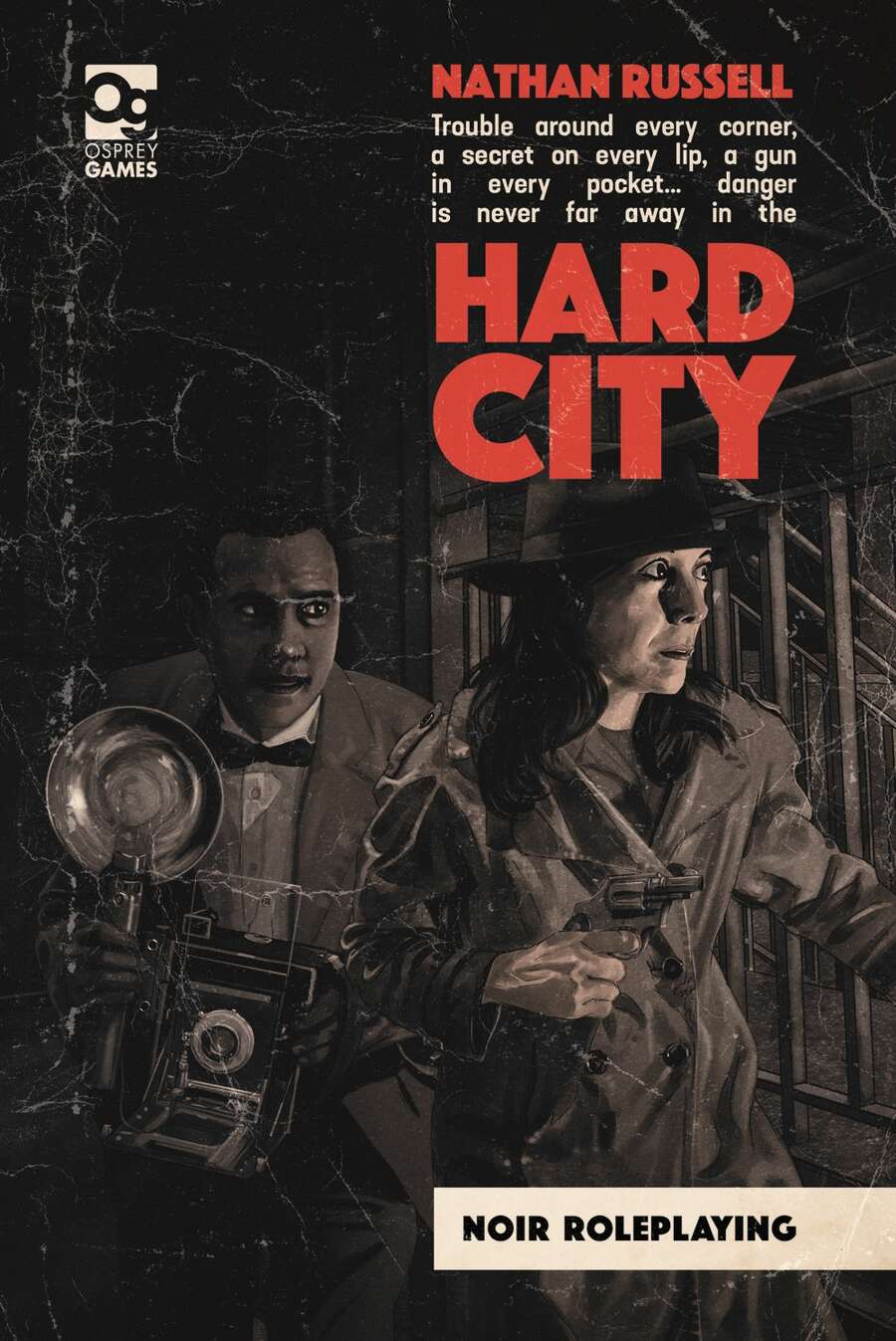
Hard City: Noir Roleplaying is published by Osprey Games, best known for roleplaying games such as Gran Meccanismo: Clockpunk Roleplaying in da Vinci’s Florence and Jackals – Bronze Age Fantasy Roleplaying, and board games such as Undaunted: Normandy. It enables the creation of Player Characters through trademarks rather than skills, enabling players to create classic archetypes of the genre, and combines this with light, dice pool mechanics designed to facilitate fast play and resolution in a grim, gritty city of America of the middle decades of the twentieth century. The result is a storytelling game in a classic genre, both black and white in its look and in the tales it tells.
A Player Character in Hard City is defined by his Trademarks, Edges, Flaws, Drives, Ties, and Belongings. Trademarks are broad, thematic Tags which are the most obvious interesting thing about a Player Character; Edges are specialisations or advantages; Flaws are difficulties, passions, or disadvantages; and Drives are a Player Character’s motivations. A Player Character has three Trademarks, one from his Past, his Present, and his Perk, five Edges, two Flaws, a single Drive, and two Ties. The Edges are listed under the Trademarks, which also provide options for Flaws. Past Trademarks include Bureaucrat, Button Man, Grifter, and Newshound; Present Trademarks include Enforcer, Finder, Infiltrator, and Performer; and Perk Trademarks include Badge, Dirty Fighter, Femme Fatale, and Weasel. Drives can be Altruistic, Debt-related, and Selfish, and Ties can be with people and places, positive, and problematic, and ideally, they should be with other Player Characters. Lastly, a Player Character has Moxie and Grit, the former a Player Character’s luck and willpower, the latter his toughness and capacity to survive.
The creation process is a matter of making several choices and the choices do lend themselves to creating some classic characters from the genre. So, the Veteran, Investigator, and Brave Trademarks could model Sam Spade; Grifter, Charmer, and Femme Fatale for Brigid O’Shaughnessy; Criminal, Finder, and Weasel for Joel Cairo; and High Society, Leader, and Huge for Caspar Gutman. It is eased by a table of flaws and a table of names, the latter including a list of regular surnames and hardboiled surnames. So, for example, an ordinary name might be Audrey Lewin or Ronald Scott, but their hardboiled versions could be Audrey Shields or Ronald Hawk.
Eudoxia Lionidze
Trademarks
Past: High Society (Edges: Educated, Charm)
Present: Infiltrator (Edges: Break & Enter, Escape)
Perk: Femme Fatale (Edges: Cunning, Strong-willed)
Flaw: Lack of Trust, Irresponsible
Drive: Pay off my brother’s gambling debts
Ties: I don’t trust Anton Powell because he gambles too much; I’m pretty sure Burt Torres knows who killed Gladys Janes
Moxie: 3
Grit: 3
Mechanically, Hard City uses a dice pool of six-sided dice, consisting of two sets of dice, Action Dice and Danger Dice, each in a different colour. To undertake an action, a player assembles the pool using Action Dice, starting with a single die, whilst the Game Master adds Danger Dice. Action Dice are drawn from a Player Character’s Trademark and an appropriate Edge, plus from any Tags from the Threat or Scene, Position, Belongings, and Help the Player Character might be receiving. Danger Dice come from Injuries and Conditions the Player Character is suffering, plus from any Tags from the Threat or Scene, Position, Belongings, and the Scale of the obstacle. Once the dice pool is assembled, the dice are rolled. Matches between the Action Dice and the Danger Dice are cancelled and the highest remaining Action Dice is counted. A six is a success, four or five a partial success, and three or less a failure. Extra results of six count as Boons and can have an Increased Effect of the success, Set Up an Ally with an extra success, can speed Extended Checks, and Add a Tag to a Scene or Threat. Botches occur when only results of one remain and can lead to Increased Danger, Inflict Serious Harm, and Extra Strikes in an Extended Check.
A Player Character also has Moxie. This can be spent to Demonstrate Expertise and add a second Trademark to a roll, gain A Little Luck to change a single die up or down by one result on both Action Dice or Danger Dice, Take a Breath to remove a Condition, or even details to a scene with a Voice-over. Moxie is refreshed when one of a Player Character’s Flaws comes into play and makes life complicated for everyone.
The outcome of a roll is to inflict Consequences which mean that a Player Character or NPC can suffer a cost or complication, a Tag can be added or removed, whether from the Player Character, Scene, or Threat, a Threat can be added or increased to a Scene, or Harm can be inflicted. Harm can be a Condition such as Angry, Dazed, or Dishevelled, or it can be an Injury of varying severity. All of these can be used to add Action Dice and Danger Dice to the dice pool, depending on the situation. When it comes to what a Player Character might be doing, Hard City does not so much provide extra rules for how investigations, chases, interrogations, arguments, and fights work, as suggest how the rules apply and what the possible Consequences might be, whether to the Player Characters or the NPCs. When it comes to actions within a turn, any shooting and fighting is done last, talking and moving first, emphasising the hard talking and words have meaning nature of the genre.
Eudoxia Lionidze has been hired to retrieve some letters that the mobster, Carlo Garcia, is using to blackmail her client. She has already managed to get the letters by attending a party at Garcia’s house and climbing over the balcony into his study from the room next door. As she exits into the hallway, bottle of champagne and glass in hand, slightly dishevelled after clambering over the balcony, she is confronted by one of Garcia’s goons, asking what she is doing there. Eudoxia is going to have to bluff her way past, and with a grin, says, “Oh I am so sorry. I just needed to lie down. Get my head straight. Too much to drink…” Eudoxia’s player creates his pool of Action Dice by starting out with a single die and adds one for her High Society Trademark since she is dressed like she should be at the party, another for her Charm, and suggests that her appearance and Belongings would earn her another die. The Game Master agrees, means that Eudoxia’s player has four Action Dice to roll. The Game Master adds two Danger Dice to the pool, including one for Goon and another for his Condition, which is Suspicious. The player rolls the dice and gets a one, five, five, and six on the Action Dice and three and five on the Danger Dice. The five on the Action Dice and the Danger Dice cancel each other out, which leaves the six from the Action Dice as the highest result, and means that the security goon believes Eudoxia, giving him the Trusting Condition. With a slight misstep of the slightly drunk, she makes her way back down to the party and her companion for the night.In terms of progression, Hard City is about the School of Hard Knocks, and a Player Character can learn from his setbacks as much as he can his successes. Two many setbacks and a Player Character can begin the next case or investigation with lower Moxie or even a Condition even as the Player Character improves.
Hard City is set in 1946 in a large, nameless city, either by the sea or the bay. It could be Los Angeles, San Francisco, or Chicago, but its particulars are described in more than enough detail to be a playable space, covering a little of its history, its movers and shakers and troublemakers, crime, but paying particular attention to its districts, complete with Tags, place suggestions and possible story hooks.
For both the players and the Game Master, there is an introduction to the genre with a decent bibliography, whilst for the Game Master there is advice on running the various aspects of the roleplaying game. This does include avoiding the social attitudes of the period in which the genre is set, but in the main focuses on two types of Case—or scenario. These are investigations and capers, the former more complex than the latter, but the latter requiring more planning upon the Player Characters. There is also a discussion of MacGuffins and suggestions as to possible campaign frames, primarily investigative in nature, but all supported by a list of example films which exemplify their set-ups. Only the ’Wrong Time, Wrong Place’ campaign frame differs from this, which explores ordinary men and women getting caught up in bad situations, typified by Double Indemnity and The Postman Always Rings Twice. This is all accompanied by a Case Generator.
The advice itself focuses on the fiction and playing to it, and on making the most out of scenes. This includes ‘Enter Late, Exit Early’ and Raymond Chandler’s famous adage that, “When in doubt, have a man come through the door with a gun in his hand.” In modelling its genre, the framing of scenes in Hard City is intended to be succinct, focused, and interesting. The players are meant to engage with this, bring their characters’ Drives and Flaws into play as much as their Trademarks, to make the lives of their characters if not difficult, then at the very least, interesting. Though ideally, difficult. As a consequence of this and the need for the players to embrace the various aspects of the genre, Hard City does demand more of its players, that they roleplay hard in every scene their characters appear in. Rounding Hard City is a pair of ready-to-play Cases—‘Engagement with Death’ is an investigation into the disappearance of a wealthy industrialist’s son, whilst ‘In at the Deep End’ is a caper in which the Player Characters must recover a piece of missing artwork. Both are classic Film Noir plots which nicely emulate the genre.
Physically, Hard City is very nicely presented. The book is tidily laid out and quite easy to read, but the best feature is the artwork. Luis F. Sanz’s illustrations are excellent, really capturing the feel and tone of the genre with a wide cast of characters and varying situations. If there is anything missing from the book it is a handy rules reference at the end of the book.
Hard City: Noir Roleplaying is a roleplaying game in which the players need to play hard and talk hard in order to bring out the best and the worst of their characters. Thematically and mechanically, it keeps everything simple by focusing on the trademark aspects of the genre and encouraging the players to bring them into play. The result is an impressively presented and clearly written storytelling roleplaying game whose look and play is designed to emulate the desperate, dangerous, and morally ambiguous tales of the Film Noir and Hardboiled genres.
Monday, 31 October 2022
Miskatonic Monday #150: Heinrich’s Call of Cthulhu Guide to Character Creation
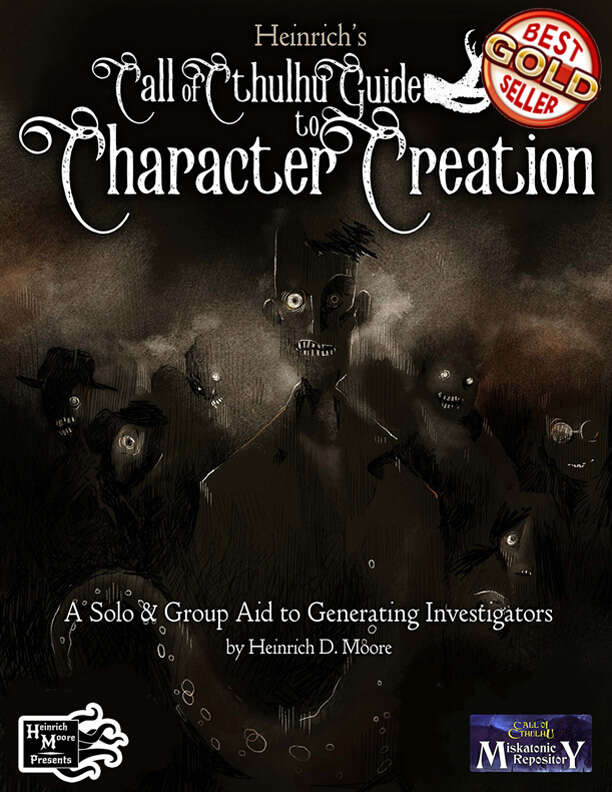
Now Call of Cthulhu, Seventh Edition goes some way in allaying this issue. In presents numerous Occupations, but also encourages a player to create a Backstory, including Personal Description, Ideology/Beliefs, Significant People, Meaningful Locations, Treasured Possessions, and Traits. Optional rules also provide alternative means of creating Investigators, as well as Experience Packages that can further round out an Investigator, though at a cost of some Sanity. What though, if there was a volume which would go even further, to help a player create even more interesting Investigators, with detailed backgrounds and histories, which would be even more engaging and interesting to roleplay and interact with? Heinrich’s Call of Cthulhu Guide to Character Creation is such a tome.
Heinrich’s Call of Cthulhu Guide to Character Creation is inspired by the series of books published in the early nineties by Task Force Games that include Central Casting: Heroes of Legend, Central Casting: Heroes Now, and Central Casting: Heroes for Tomorrow. They provided tools for interesting Player Character generation—in addition to the mechanics and numbers provided by the roleplaying game that the Player Character was being created for—for their respective genres, and so does Heinrich's Call of Cthulhu Guide to Character Creation. The book also works with Pulp Cthulhu: Two-fisted Action and Adventure Against the Mythos as some of the entries do veer into the fantastic. The volume takes the Investigator through the four steps of his life prior to becoming involved with the Mythos and entering play, from Origins through Childhood and Adolescence to Adulthood, the player rolling on the tables as necessary, and sometimes also being asked to make skill or attribute rolls as well. What is made clear is that neither the player nor the Keeper has to adhere to the outcome of any roll. Indeed, both are encouraged to cheat if it will make a more interesting Investigator or NPC, and anyway, even if not using dice the entries on the innumerable tables in the Heinrich's Call of Cthulhu Guide to Character Creation are ultimately nothing more than prompts to the imagination.
To it necessary to really see what we are contrasting in Heinrich's Call of Cthulhu Guide to Character Creation and so the following is an Investigator who has appeared in numerous forms. He is a Boston antiquarian, a would be academic whose experiences in the Great War left him partially deaf and unsuited to the rigours of university life.
Henry Brinded,
age 44, Antiquarian
STR 40 SIZ 85 CON 45 DEX 70
APP 75 INT 80 POW 65 EDU 91
SAN 58 Luck 75 Damage Bonus +1d4 Build 1
Move 7 HP 12
Brawl 35% (17/7), damage 1D3+db, or by weapon type
Rifle/Shotgun 35% (17/8), damage 2D6/1D6/1D3 (Ithaca Hammerless Field 20G 2.75” calibre shotgun)
Handgun 30% (15/7), damage 1d10+2 (Colt New Service (M1909) .45 LC calibre revolver)
Dodge 35% (17/7)
Skills: Appraise 45%, Archaeology 26%, Art/Craft (Book Restoration) 49%, Art/Craft (Painting) 26%, Artillery 40%, Climb 30%, Credit Rating 45%, Firearms (Handguns) 30%, Firearms (Rifle/Shotgun) 35%, First Aid 50%, History 55%, Library Use 50%, Navigate 20%, Occult 20%, Persuade 40%, Pilot (Boat) 26%, Psychology 31%, Spot Hidden 45%, Stealth 25%, Swim 40%, Track 20%.
Languages: Ancient Greek 41%, English (Own) 91%, Latin 51%.
Backstory
Personal Description: Tall and thin, just shy of infirm, bespectacled and inquisitive.
Treasured Possessions: Latin-English Primer
Traits: Introspective but curious, softly spoken, but firm in manner
Phobias: Ligyrophobia – Fear of loud noises.
Notes: Immune to sanity losses resulting from viewing a corpse or gross injury.
Heinrich's Call of Cthulhu Guide to Character Creation will build in elements that will potentially include Personal Description, Traits, Ideology/Beliefs, Injuries & Scars, Significant People, Phobias & Manias, Meaningful Locations, Arcane Tomes, Spells, & Artifacts, Treasured Possessions, and Encounters with Strange Entities, but begins with a point spread of characteristics. Similarly, it assumes a similar point spread for both Occupational skills and Non-Occupational skills, and builds from there. What the volume does not do is include tables to determine the Investigator’s race, sex, gender identity, or sexual orientation, these being all very personal choices and it should not be a case of a random roll determining something that a player might uncomfortable portraying in game. Similarly, the tables do not reflect the social, cultural, and legal prejudices prevalent during the Jazz Age or the Desperate Decade, the primary settings for Lovecraftian investigative roleplaying. Again, such choices are very much left up to the Keeper and her players to decide upon.
The creation process is methodical, step-by-step, sometimes sending off the player or Keeper off to a separate table way in the back in the book—so it does involve a lot of flipping back and forth—to roll on another table to get another detail. Some entries instruct the player or Keeper to add a detail here or assign there. For example, ‘Bookworm’ is an entry in the ‘Childhood Events’ table and informs the player or keeper that the Investigator or NPC was studious and curious as a child, always asking questions or reading a book. The Keeper or player is then instructed to assign the highest remaining characteristic score to the Education of the NPC or Investigator and suggests ‘Book Dealer’ and ‘Librarian’ be listed under Potential Occupations.
Albert Johansen,
age 44, Book Dealer
Place of Birth: Germany
Social Status: Extremely Wealthy
Occupation: Book Dealer
Potential Occupations: Librarian, Book Dealer, Professor
STR 40 SIZ 50 CON 50 DEX 50
APP 50 INT 70 POW 60 EDU 80
SAN 60 Luck 84 Damage Bonus None Build 0
Move 8 HP 12
Brawl 25% (12/6), damage 1D3+db, or by weapon type
Rifle/Shotgun 45% (22/11)
Dodge 35% (17/7)
Skills: Accounting 45%, Appraise 55%, Art/Craft (Painting) 21%, Credit Rating 70%, Cthulhu Mythos 05%, Drive Auto 60%, History 75%, Library Use 70%, Navigate 30%, Occult 45%, Own Language (German) 80%, Other Language (English) 61%, Other Language (Latin) 61%, Persuade 50%, Pilot (Boat) 21%, Psychology 30%, Swim 40%
Albert Johansen was born in Germany to an Extremely Wealthy family and was expected to be a great scholar (Destiny). He was brought up by his mother, his father having been killed in an automobile accident which left her blind in her right eye. He has a younger sister. During his childhood, he was frightened of taking a bath, believing there to be a monster in the water pipes, but as he grew older, the members of the hunting lodge his father had belonged to took an interest in his upbringing and encouraged to learn to shoot and enjoy other field sports. As a boy, he was studious and religious coming to believe that he was Blessed (gains the relevant handout which grants bonuses in play, plus extra Luck) after adopting the faith of his father (Turn of Faith). He was surprised to receive an invitation at Miskatonic University (Invitation to Study), having expected to study at home, but there discovered the Professors’ Conspiracy investigating some dread powers. Your involvement led to an encounter with a living flame, which injured your throat (gaining the handout, ‘The Injured’), scarring your neck (Body Scars) and leaving you with a raspy voice. You returned home and much to your family’s surprise entered the book trade. You were apprenticed to Herr Emil Winter, who provided to be more than a book dealer. Indeed, he was a Magician who was able to teach him one spell at least.
This is only the start and it is possible to explore numerous aspects of the Investigator or NPC. Events can occur as part of his Occupation, he can engage in romances and build a family life, suffer fortune and misfortune, join the military, get caught up in crime and even end up incarcerated or institutionalised due to mental illness, go on an expedition, including to the Amazonia and Antarctica, come to the attention of a secret government agency, and even venture into the Dreamlands and other dimensions. There is the chance of experiencing some kind of event that will become part of a campaign—as decided or chosen by the Keeper, that the Investigator or NPC be kidnapped or have to put up with a nosy neighbour, be possessed, and a whole more, all supported by table upon table! Handouts cover strange events which will have long lasting in-game effects, such as suffering ‘The Innsmouth Look’ or becoming ‘A Friend of Ghouls’. These do push the campaign towards a more Pulp style, but add flavour and detail. Even at the most basic functions, the tables in Heinrich's Call of Cthulhu Guide to Character Creation are just lists of prompts—certainly too many to count. If perhaps the one table that is underwhelming, it is the one of names, but to be fair, covering that in this book would probably double the page count!
Physically, Heinrich's Call of Cthulhu Guide to Character Creation is busily laid out with table upon table. It is decently written and liberally illustrated with both period photographs and painted pieces.
Heinrich's Call of Cthulhu Guide to Character Creation is fantastic toolkit. Of course, it is too much perhaps to create an Investigator or NPC with any rapidity. There are just too many tables to roll on and options to choose from, but between games, this is a superb resource to consult and gently create interesting and detailed characters. It very much has the feel of a solo adventure book, but one which creates a character by the end rather than at the beginning, equipped with a treasure trove of experiences and details that the player or Keeper can draw upon.
Sunday, 28 June 2020
Your Loop Starter
Specifically, Tales from the Loop is set on Mälaröarna, the islands of Lake Mälaren, which lies to the west of Stockholm. This is the site of the Facility for Research in High Energy Physics—or ‘The Loop’—the world’s largest particle accelerator, constructed and run by the government agency, Riksenergi. In addition, the Iwasaka corporation of Japan has perfected self-balancing machines, leading to the deployment of robots in the military, security, industrial, and civilian sectors and these robots are employed throughout the Loop and its surrounds. Meanwhile, the skies are filled with ‘magnetrine vessels’, freighters and slow liners whose engines repel against the Earth’s magnetic field, an effect only possible in northern latitudes. There are notes detailing the particulars of life in Sweden in the 1980s, but the culture is radically different—especially in terms of its (almost Socialist) government—to that of the USA and so Tales from the Loop includes an American counterpart to The Loop, this time located under Boulder City in the Mojave Desert in Nevada, near the Hoover Dam. Here the particle accelerator is operated by the Department of Advanced Research into Technology and there is an extensive exchange programme in terms of personnel and knowledge between the staff of both ‘loops’. Similarly, the description of Boulder City and its Loop include plenty of notes on life in the 1980s and as much as the two cultures are different, there are plenty of similarities between the two.
Since its publication in 2017, Tales from the Loop – Roleplaying in the ’80s That Never Was has won many awards and Tales from the Loop itself has been developed into a television series to view on Amazon Prime . The Tales from the Loop Starter Set is released in time to coincide with the release of the television series and is designed introduce roleplayers to the world of the roleplaying game—whether they have watched the television series and want to try Tales from the Loop or are experienced roleplayers wanting to try something different. It comes with everything necessary for the Game Master to present—and both Game Master and players alike—to roleplay a mystery within the Loop over the course of an evening or two.
The Tales from the Loop Starter Set comes in a surprisingly sturdy box. Open up and the first thing you see is a set of Tales from the Loop dice—some ten in all, with the number six on each of them replaced with the symbol for Riksenergi, the Swedish government agency which built and ran the Facility for Research in High Energy Physics or ‘The Loop’. Underneath that is a double-sided map of the region around the Loop. Roughly A3 in size, this depicted the region of Mälaröarna, the islands of Lake Mälaren on the main side, whilst on the other is marked the area around Boulder City, Nevada. The map is full colour and printed on thick paper. Below that there are five sheets, one for each of the five pre-generated player characters. Marked ‘Kid 1’ through ‘Kid 5’, they are again double-sided and include a Popular Kid, a Weirdo, a Jock, a Computer Geek, and a Bookworm. All five are part of the same gang and have connected relationships, and they have background and illustration on the front and the stats on the back. Like Tales from the Loop, they give suggestions which pertain to both the Swedish and the American Loops. Here this consists of names, so the player character Frederik is given the name Chad when playing in the American setting.
Lastly, there are two books in the Tales from the Loop Starter Set. These are the ‘Rules’ and ‘The Recycled Boy’ booklets. The former presents the game’s rules and explains how Tales from the Loop is played, and is marked, ‘Read This First’. The latter contains the scenario and is marked ‘For The Gamemaster Only’. The ‘Rules’ covers everything in four chapters—‘Welcome to the Loop’, ‘The Age of the Loop’, ‘The Kids’, and ‘Trouble’. The first of these, ‘Welcome to the Loop’, introduces the setting of Tales from the Loop and explains what roleplaying is. It does decent job and is backed up in the examples of play throughout the book. It also gives and explains the ‘Principles of the Loop’, essentially the six fundamental elements of the setting which set it apart from other roleplaying games. These are that ‘Your home town is full of strange and fantastic things’, ‘Everyday life is dull and unforgiving’, ‘Adults are out of reach and out of touch’, ‘The Land of the dangerous, but kids will not die’, ‘The game is played scene by scene’, and ‘The world is described collaboratively’. These nicely sum up the world of the Loop, that Kids will explore a world just outside their homes which is full of scientific marvels and mysteries, one that the Adults are unlikely to really appreciate, being wrapped up in their problems and dramas—problems and dramas which are likely to have an impact on the Kids on an ongoing basis. Although dangerous—the Kids can be robbed, beaten up, mocked, and so on, they cannot be killed (though they can be forced to leave the game due to trauma). The collaborative element of play means that not only can the Game Master set scenes, she can ask her players to do so too, and she can also ask the players to describe and add elements to the setting too. What this means is that Tales from the Loop is a game in which the story is played out together, some of the setting elements are worked out together as well.
‘The Age of the Loop’ describes the setting for the Swedish and the American Loops. As such, anyone familiar with the contents of Tales from the Loop will recognise the much shorter descriptions given here. Here though it sets the scene for the scenario to come rather than the full game, so is done in broader strokes. For anyone new to roleplaying or new to Tales from the Loop, perhaps what is interesting here are the cultural and political differences between Sweden and the U.S.A. Of the two, the Swedish Loop is the more interesting because it is different, the outlook and attitudes of its inhabitants presenting more of a roleplaying challenge because of the differences. Essentially, despite the presence of the Loop making many things different, the American Loop still feels too familiar from film and television, so too easy to fall into clichés.
The shortest chapter is ‘The Kids’. This describes what the various elements on the character sheets are—age, attributes, skills, Luck points, items, Drives, Problems, Pride, Relationships, and Conditions—and how they affect game play. Each Kid has four attributes—Body, Tech, Heart, and Mind—and each of these has three associated skills. Both are rated between one and five. Luck points are used to reroll dice and younger Kids have more Luck points than older Kids as they are simply luckier. Items can dice if appropriate to the situation, a Drive pushes a Kid to act and to investigate mysteries, a Problem is a personal thing related to a Kid’s home life and will get him into Trouble, Pride is what a Kid values and can get a Kid into Trouble as well as help him, and Relationships are between the other Kids in the gang as well as another NPC. So Dave or Isak might have the Drive of ‘I am fascinated by self-balancing machines, I’ve always wanted a robot of my own’, the Problem of ‘My parents are getting a divorce, but my dad hasn’t moved out yet’, and the Pride of ‘I know how that works’. Dave’s item might be an electronics toolkit. All of the various elements of a Kid are clearly explained and easy to understand.
Lastly, almost a third of the ‘Rules’ is devoted to the last chapter—‘Troubles’. This explains how the dice work and the dice pool mechanics in both Tales from the Loop and Tales from the Loop Starter Set. Known as the ‘Year Zero’ mechanics, dice pools are formed from a combination of a Kid’s attribute and appropriate skill, or just the latter if no skill applies. The player rolls the Tales from the Loop dice and if a six—or a Riksenergi symbol—comes up, the Kid succeeds. Failures can complicate situations or impose a Condition upon a Kid, like Upset or Exhausted, but a player can push a roll and get a reroll, though this is not without its consequences. Typically, only one Riksenergi symbol is needed for a Kid to succeed, but more challenging Trouble may require more. Sometimes extra successes can be used to add further narrative elements to play, such as to find out more information about a machine and its maker, not only beat a bully, but upset him, and so forth. Lastly, the ‘Troubles’ explains how the game’s skills work and give some bonus effects for those extra Successes.
‘The Recycled Boy’ is half the length of ‘Rules’ and contains the scenario of the same name. It presents a four or five scene mystery which can be played out in a session or two. Written to be run in either the Swedish or the American Loop, it concerns a fellow student at the pre-generated characters’ school who has begun acting oddly. Its plot feels suitably eighties, being too dissimilar to films of the period, though perhaps the title of the scenario might be a bit knowing. Either way, it is a good first scenario for Tales from the Loop, presenting a problem which can be best solved through roleplaying rather than other means and it would be easy for a Game Master to add it to her campaign.
Physically, the Tales from the Loop Starter Set is well presented. Notably both books are presented on glossy paper rather than the matt paper of the Tales of the Loop core rulebook. The package as a whole does need a slight edit in places, but throughout, is illustrated with Simon StÃ¥lenhag’s fantastic artwork. Everything is of a high quality and presents an attractive product, especially if you have not looked at a roleplaying book before.
However, there is a problem with the Tales from the Loop Starter Set and it is very simple. There is just the one scenario. What this means is that there is not the easy, next step to take after playing ‘The Recycled Boy’. Now of course, there is the Tales of the Loop core rulebook and Our Friends the Machines & Other Mysteries, but another scenario would support the continued interest of the Game Master and her players more immediately rather than forcing them to cast around for their next scenario. As good as the scenario is in Tales from the Loop Starter Set, it is difficult not to compare it with other recent starter or beginner boxed sets and be somewhat disappointed because they offer more value for money. Similarly, if a gaming group already plays Tales from the Loop, then the Tales from the Loop Starter Set only provides the one scenario—though one which is only available in the Tales from the Loop Starter Set—and so does not offer as much value for money as it could. That said, it comes with another set of dice for the game and good maps of each Loops, as well as the scenario.
Yet the Tales from the Loop Starter Set is a solid, well-presented package. As an introduction to the alternate, fantastic world of Simon StÃ¥lenhag’s artwork and the roleplaying game based on it, the Tales from the Loop Starter Set is enjoyably accessible and attractive, presenting a good first step into an eighties that never were.