Every Week It's Wibbley-Wobbley Timey-Wimey Pookie-Reviewery...
Showing posts with label Black Void. Show all posts

Saturday, 4 September 2021

Magazine Madness 7: Parallel Worlds #22

 The gaming magazine is dead. After all, when was the last time that you were able to purchase a gaming magazine at your nearest newsagent? Games Workshop’s White Dwarf is of course the exception, but it has been over a decade since Dragon appeared in print. However, in more recent times, the hobby has found other means to bring the magazine format to the market. Digitally, of course, but publishers have also created their own in-house titles and sold them direct or through distribution. Another vehicle has been Kickstarter.com, which has allowed amateurs to write, create, fund, and publish titles of their own, much like the fanzines of Kickstarter’s ZineQuest. The resulting titles are not fanzines though, being longer, tackling broader subject matters, and more professional in terms of their layout and design.

—oOo—

Parallel Worlds
 feels a little old-fashioned. By which Reviews from R’lyeh means that it supports the gaming hobby with content for a variety of games. So an issue might include new monsters, spells, treasures, reviews of newly released titles, scenarios, discussions of how to play, painting guides, and the like… That is how it has been all the way back to the earliest days of The Dragon and White Dwarf magazines. By which Reviews from R’lyeh means that it can be purchased, if not from your local newsagent, then from your local games store. Just like The Dragon and White Dwarf magazines could be back in the day. However, Parallel Worlds, published by Parallel Publishing can also be purchased in digital format, because it is very much not back in the day. 

Parallel Worlds #22 promises, as with previous issues, ‘The Best in Escapism’. It offers a mix of scenarios and support for various roleplaying games as well as interviews with creators and reviews of a number of books and games. Once past the editorial from Chris Cunliffe—less interesting than that in the previous issue—Parallel Worlds #22 opens with an interview with Science Fiction author, Peter Hamilton. Short but informative, this only focuses on his new book. A longer piece might have explored more of his previous works, which would have been interesting. Other media is thrown under the spotlight in Sam Long’s Thinkpiece, ‘The Pay-off’. Subtitled, ‘When character arcs… aren’t’, this both celebrates the adroit handling of pay-offs in the stories of films, in particular, the Marvel Cinematic Universe, and laments their poor handling in a number of films and television series. This also includes the Marvel Cinematic Universe, but the author includes the work of Zack Snyder and the DC Extended Universe too. The series, The Falcon and the Winter Soldier, is placed under a similar spotlight in ‘Let’s talk about…’ by Ben Potts, Chris Cunliffe, and Sam Long. Both it and ‘The Pay-off’—which covers Wandavision—are good pieces, but do rely very much upon the reader having watched either and thus have access to Disney+. Not everyone will have and so spoilers abound.

Ben Potts engineers a crossover between gaming and other media with ‘The New D&D Movie – What We Want To see’. This looks at the forthcoming Dungeons & Dragons film and speculates what traps it needs to avoid and suggests what it needs to include to really shine as a film adaptation of the world’s greatest roleplaying game. So of course, no chainmail bikinis, racial stereotypes, love story, or planar travel, but definitely split the party, include iconic monsters, keep it medieval, and more. It is of course, tongue in cheek, but there is no doubt that we want to see a Dungeons & Dragons film which puts the previous ones behind us and very much to shame.

In terms of gaming, Parallel Worlds #22 continues its support for the roleplaying games Black Void and Chivalry & Sorcery. For the former, there is a preview for the forthcoming supplement, Under Nebulous Skies, which showcases a new character background, the Djinn-Kin. This is all decently detailed, with some variation built in, and presented in a way that it could be added to the game straight off, and comes with an excellent illustration. For the latter, the designer of Chivalry & Sorcery, Stephen Turner, presents ‘Leganti, the Capital of Solda’. This details the ‘City of the Silver’ and its long history, its layout and districts. It is a serviceable description in just a few pages and a reasonable addition to a Chivalry & Sorcery campaign.

In terms of gaming, the most interesting article in the issue is ‘We Played… Cyberpunk RED’, R. Talsorian Games, Inc.’s 2045-set iteration of 1990’s Cyberpunk 2.0.2.0. (developed from the earlier Cyberpunk 2013). It provides an overview of the setting and the campaign run by Angus McNicholl, one built around the Night City Police Department, for his three players. All four participants are given space to give their opinion on both the campaign and Cyberpunk RED as a game system, their opinions on the former wholly positive, whilst on the latter, their opinions are less effusive and more nuanced. In general, they agreed that the rules and combat system of Cyberpunk RED’s Interlock System were playable, they also said that the game had too many attributes and too many skills, and that perhaps the system was not as gritty as they were expecting. Overall though, the combination of the game set-up and feedback is engaging and informative.

The world of Bethesda’s The Elder Scrolls receives not one, but two articles in Parallel Worlds #22. The first, by Thomas Turnball-Ross, ‘The Worlds of the Elder Scrolls’ examines the setting as a whole through the many computer games which have been set there over the years, whilst the second, ‘Skyrim in 2021’ by Ant Jones examines the ground-breaking computer roleplaying game and asks if ten years on, it is still worth playing despite its flaws. The issue with the first article is that it lacks a degree of context and whilst it is liberally illustrated, it is just with images from the various computer games. It would have been better if covers from the various computer games had been used as illustrations and a timeline included. The second article benefits from a better focus and actually makes this player want to go back and play again.

Reviews in the issue cover the Swords & Sorcery roleplaying game, Beyond the Black Sea, the Civilisation-style time travel Science Fiction board game, Anachrony, the novel Rachel’s Story (author Leigh Russell was interviewed in Parallel Worlds #21), and Byrony Pearce’s novel, Raising Hell. These are decent, though as with the earlier article on computer games, the covers of the items being reviewed could have been shown. Lastly, the issue is rounded out with ‘No Kisses Goodnight’, an enjoyable piece of fiction by Toshiya Kamei.

Physically, Parallel Worlds #22 is professionally presented and written. The layout is clean, strong, and easy to look at, and in general is easy to read. The previous issue, Parallel Worlds #21, did feel as if it needed more gaming content that would appeal to a wider audience, the focus on Black Void and Chivalry & Sorcery, perhaps a bit too narrow. Especially given that the magazine is sold in gaming stores. ‘We Played… Cyberpunk RED’ does expand it a little, just not enough. Similarly, the handful of reviews does not feel enough either, whether of roleplaying games or novels. Again, more of those might increase the appeal to a wider audience.

Parallel Worlds #22 is an enjoyable read, but two articles involving the Marvel Cinematic Universe and two articles involving The Elder Scrolls is two too much in either case. Certainly the second article in either case could have been bumped to Parallel Worlds #23. The best gaming article in the issue is ‘We Played… Cyberpunk RED’ and surely that could have been paired with something else, a review, a scenario… It seems as if the magazine missed an opportunity there to bring the reader further into that roleplaying game and perhaps set up a regular format, that of, ‘We Played…’ with content the reader can use. What this means is that as before, there are a few good articles within the issue and it needs to build on those to bring readers back to it on a regular basis rather than their simply checking out an issue to see if there might be something good in its pages, because ultimately, Parallel Worlds #22 just has its fingers in too many worlds to really get a handle on them and its gaming content is neither mainstream nor interesting enough for the reader to be either useful or adaptable.

—oOo—

An Unboxing in the Nook video of Parallel Worlds #22 is available here.

Saturday, 19 June 2021

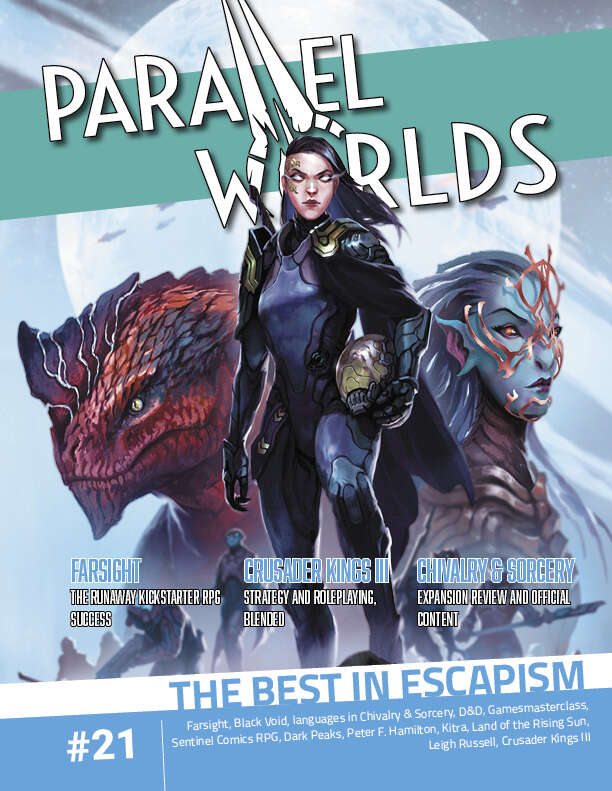
Magazine Madness 4: Parallel Worlds #21

The gaming magazine is dead. After all, when was the last time that you were able to purchase a gaming magazine at your nearest newsagent? Games Workshop’s White Dwarf is of course the exception, but it has been over a decade since Dragon appeared in print. However, in more recent times, the hobby has found other means to bring the magazine format to the market. Digitally, of course, but publishers have also created their own in-house titles and sold them direct or through distribution. Another vehicle has been Kickstarter.com, which has allowed amateurs to write, create, fund, and publish titles of their own, much like the fanzines of Kickstarter’s ZineQuest. The resulting titles are not fanzines though, being longer, tackling broader subject matters, and more professional in terms of their layout and design.

—oOo—

Parallel Worlds feels a little old-fashioned. By which Reviews from R’lyeh means that it supports the gaming hobby with content for a variety of games. So an issue might include new monsters, spells, treasures, reviews of newly released titles, scenarios, discussions of how to play, painting guides, and the like… That is how it has been all the way back to the earliest days of The Dragon and White Dwarf magazines. By which Reviews from R’lyeh means that it can be purchased, if not from your local news agents, then from your local games store. Just like The Dragon and White Dwarf magazines could be back in the day. However, Parallel Worlds, published by Parallel Publishing can also be purchased in digital format, because it is very much not back in the day. By which Reviews from R’lyeh means that Parallel Worlds has reached the grand old age of twenty-one—and these days, that is no magazine achievement for a magazine, gaming or otherwise.

Parallel Worlds #21 promises ‘The Best in Escapism’. It offers a mix of scenarios and support for various roleplaying games as well as interviews with creators and reviews of various books and games. The issue opens with editor Chris Cunliffe’s editorial lamenting the challenging nature of differing opinions and expressing them online, but highlighting that actually, through differing opinions you can discover new things, and that to some extent, the magazine is a vehicle for that. The first content in the issue is ‘Farsight – An Interview with Dario Pesce and Francesco Lucenti’, the Venice-based designers of their new roleplaying game, Farsight, and their company, Lightfish Games. As entertaining as the interview is, it actually focuses very little upon Farsight, the Dungeons & Dragons, Fifth Edition evolved roleplaying game, recently published following a successful Kickstarter campaign. Whether talking about themselves and their influences, this is still intriguing enough to make the reader want to check out the roleplaying game itself.

The actual gaming content in the issue begins with a scenario for Black Void, the roleplaying game of esoteric fantasy set in and around Llyhn the Eternal City, a dystopian cosmopolis and trading hub at the epicentre between the Cosmos and the Void. Here, Living in filthy alleys and shanties among beggars, slaves and the casteless, humanity is very much at the bottom of the social hierarchy in Llyhn, a city inhabited and ruled by eerie beings from faraway worlds, bizarre sapient entities and otherworldly Daimons from beyond the Veil. However, there are factions in the city who want this to change, for humanity to rise beyond its meagre existence, of which the latest is ‘The Cause’, a movement to unite humanity and work to improve its conditions. In Joel Lonergan’s ‘Offers Too Good’, the Player Characters are present at a recruitment drive for ‘The Cause’ and even if they decline to join, they get an offer of a job—join and find out exactly what the leaders of ‘The Cause’ want. The scenario is short and will pose a moral dilemma for the Player Characters, but really feels like a set-up to something bigger.

Stephen Turner, the designer and publisher of Chivalry & Sorcery, Fifth Edition, adds to the world of the Dragon Reaches with ‘Languages of the Dragon Reaches’. Again short, it explores the linguistic development of the setting and provides two scripts—Tadarn Runes and Bethrin Script, both of which Game Master can use to add flavour to her Chivalry & Sorcery campaign. The world’s most popular roleplaying game in the world comes under the spotlight, or at least an aspect of it, in ‘The Three Pillars of D&D Part 3: Exploration’ by Ben Potts. Previous entries in the series examined social interaction and combat, and if they were as decently done as this third and final part, then both are worth tracking down and reading. This article identifies the key elements of exploration in Dungeons & Dragons—travel and puzzles (and traps), and suggests ways in which they can be made both challenging and interesting to play. It also examines how Short Rests and Long Rests work in the game and points own how clunky they are and how they impede one character Class and not another. However, solutions are suggested as are ways in which both Short Rests and Long Rests—Short Rests in particular, can be made to be exciting and interesting without the Player Characters necessarily losing the benefits of either. In examining the way in which Dungeons & Dragons is played, this article feels old fashioned in that similar articles of its ilk have been written again and again over the years, but of course, looking at the various previous editions of the roleplaying game, rather than the current one. This does not in any way make it a poor article and any Dungeon Master running a Dungeons & Dragons, Fifth Edition game will find this an interesting and informative article, full of suggestions and advice that will either help her run a better and more fun game, or perhaps confirm that she is already implementing both and making her game better and more fun.

Editor Chris Cunliffe’s ‘From Tabletop to Desktop’, part of Parallel Worlds’ ongoing ‘Games Master Class’ series treads ground much touched upon by Wyrd Science – Session Zero, that of the shift of play around the table to play online precipitated by COVID-19. He explores his own problems in making that shift, as well as those of his fellow players, plus the changes in terms of preparation, socialising, and interaction within the game itself. In particular, more preparation is required, conversation and interaction are more focused, but does not flow as well as they would around the table, and play time is not just much slower, but also more tiring. This does not mean that gaming online is impossible, in fact, mechanically, it is much, much easier than it was a decade ago… However, for many gamers, it is the only roleplaying possible, but it is possible and it is very much easier than it once was. What one advantage it does omit is that online gaming brings people together, not just from the next town or nearby big city, but from around the world. (For example, I regularly game and chat with players who are not just ten miles away, but hundreds and even thousands of miles away.) Another development that the author ignores is that of virtual conventions. Still the article is informative and warns the potential online player and Game Master of the issues he and she will face when taking the next step into the virtual world, though perhaps it could have highlighted the benefits a bit more and perhaps included the experiences of others who have made the jump.

The remainder of Parallel Worlds #21 is devoted to reviews. They include reviews of Sentinel Comics – The Roleplaying Game, Land of the Rising Sun—the historically inspired adaptation of Chivalry & Sorcerery, Fifth Edition, and The Dark Peaks: Deep Maw. The problem with the first two reviews—the review of Land of the Rising Sun in particular is definitely underwritten—is that they focus just a little too much on the artwork than the text, so that they are drawn out, perhaps taking up space for another review or even a series of thumbnail reviews which might have broadened the appeal of the magazine and made it more useful. In comparison, the review of The Dark Peaks: Deep Maw is more focused and more engaging. Similarly, the reviews of A Hole in the Sky, an audio book by Peter Hamilton and the Young Adult space opera novel, Kitara, by Gideon Marcus, do not suffer from that problem.

Perhaps the least interesting articles in Parallel Worlds #21 are saved to last. ‘Moving to Dystopia: Why an Established Crime Writer is Turning to Dystopian Fiction’ is an interview with Leigh Russell about why she is making the aforementioned shift, whilst ‘Rules of Succession: Appreciating Crusader Kings III’ is about Chris Cunliffe’s experiences with the computer games Crusader Kings II and Crusader Kings III. The latter is interesting from the roleplaying experiences it offers, but again feels too long, whereas the former is short, with extra artwork making it both longer and more of an infomercial than an actual interview.

Physically, Parallel Worlds #21 is professionally presented and written. The layout is clean, strong, and easy to look at, and in general is easy to read. In places, especially in the reviews, the artwork does overpower the text, but overall, this is a good-looking affair.

The problem with Parallel Worlds #21 is that it simply needs more content which will attract gamers and readers to come back to it and content that a Game Master can bring to her table. This is not to say that the issue lacks good content—for example, ‘The Three Pillars of D&D Part 3: Exploration’ and ‘From Tabletop to Desktop’ are both informative and useful, and the scenario, ‘Offers Too Good’, is a good introduction to Black Void. However, too many articles are strung out and the issue lacks content that would attract a wider audience, perhaps the addition of a scenario or article aimed at larger fanbases for different games who might pick up the issue and then appreciate the rest of the content might have helped. This is in addition to generic content too. Of course, it is difficult to take in the swathes of roleplaying titles being released from one month to the next, but there could have been more reviews too, which again, could have appealed to a wider audience.

There can be no doubt that roleplaying magazines have a hard time surviving in contemporary times, but Parallel Worlds #21 does not make it easy for itself by having too much content which does not support the hobby and which is too light. There are a few good articles within the issue and it needs to build on those to bring readers back to it on a regular basis rather than their simply checking out an issue to see if there might be something good in its pages.

—oOo—

An Unboxing in the Nook video is available here.

Saturday, 16 May 2020

Esoteric Fantasy

In ages past the world ended. In the skies above Babylon, the greatest city on Earth, specks of black mist appeared, pulsated, and grew, extending until the heavens were engulfed by an ocean of darkness. Even in the darkness, gashes could be seen in the newly sundered skies and from them cyclone-like tentacles reached out and began to rip the world apart. As prayers to the gods went unanswered, helpless men, women, and children were swept up into the turmoil and into the Void beyond… In this way the world ended, and mankind fell from grace. Many centuries have passed and the descendants of those survivors who were ripped from Ancient Mesopotamia struggle for their existence between the cracks and in the shadows in the slums of Llyhn the Eternal City, a dystopian cosmopolis and trading hub at the epicentre between the Cosmos and the Void. Living in filthy alleys and shanties among beggars, slaves and the casteless, they scrounge for scraps that fall from palaces of the unknowable alien Unseen Rulers of the city. Humanity is very much at the bottom of the social hierarchy in Llyhn, a city inhabited and ruled by eerie beings from faraway worlds, bizarre sapient entities and otherworldly Daimons from beyond the Veil. However, there are factions in the city who want this to change, for humanity to rise beyond its meagre existence. Chief amongst these are the three enclaves of humanity. These are the Feerdani enclave, consisting of a thousand labourers and dork workers ruled by the one-armed, elderly despot, Feerada; the ruins known as Beggars Court, ruled by the corpulent and paranoid self-styled Beggar King; and the Assembly, an inclusive enclave governed by a representative body which is seen as a beacon of hope in Llyhn. 

The Player Characters are inhabitants of Llyhn Eternal, seeking matronage or patronage with one of the enclaves, getting involved in the rivalries between the city’s many factions, perhaps even voyaging out from the order and constancy of the Cosmos into the chaos and catalyst that is the Void to other worlds, perhaps on missions of trade, exploration, diplomacy, and more. Yet between the stability of the Cosmos and the ethereal, fluctuating ocean of the Void, is the Veil, a metaphysical entity which keeps them apart, though there are places where the Veil is weakened to the point where the boundary between the Void and the Cosmos is blurred. This is where border worlds such as Llyhn are located.

This is the set-up for Black Void , a roleplaying game of esoteric dark fantasy published by Black Void Games and distributed by Modiphius Entertainment. Although there have been many roleplaying game of late published in Scandinavia, nearly all of them by Free League Publishing, Black Void has the distinction of being a Danish roleplaying game. It may well be the first Danish roleplaying game to be published in English.

As the descendants of Earth, Player Characters can be Pureblood Humans; Halfbloods, the result of interbreeding with another species, often regarded with hostility by other Humans; or Voidmarked, either born of esoteric and Human parents or exposed too much to the chaotic nature of the Void. They may Llyhn natives and perhaps enclave members, outsiders from a backwater world, recluses from the city, or perhaps even Lost Children returned from traversing the Void or rescued castaways from missing expeditions or colonies. A Player Character is defined by his homeworld, Traits, Background, Attributes, Powers, and Skills. A homeworld provides a Player Character with a little background information and a Talent, whilst his Traits—Agility, Awareness, Stamina, Strength, Intellect, Persuasion, Presence, and Willpower, typically rated between one and five for Human characters, but can go as high as twelve for other species. They are the equivalent of attributes or characteristics in other roleplaying games. They typically average three for most Humans and most Player Characters. Traits and Flaws are advantages and disadvantages, whilst Background defines a character’s social standing, allies, resources, and ancestry. Attributes and Powers are somewhat different. Attributes—what would be called traits in other roleplaying games—can either be Physical or Esoteric. Physical Attributes, for example, wings or horns, may be found amongst Halfblood and Voidmarked characters, whilst only the Voidmarked may have Esoteric Attributes, such as Ageless or the beguiling Daimonic Whispers. Powers are supernatural abilities, either Mystic powers, Blood Rituals, or Void powers. Mystic powers enable a character to channel his mental energies or inner Void to manifest phenomena and change reality around him; Blood Rituals require deal with sacrificial divination, bloodletting rituals, and other practices in order to enhance the practitioner; and Void powers are innate inhuman abilities and manifestations, available only to the enlightened.

For the most part, character generation is done by Point Buy. A player has forty-eight Character Points to spend on everything. Half of these are assigned to the character’s eight Traits, giving them a value of three each. Deducting three from each Trait gives its bonus for actions and skill rolls, so a Trait needs to be at least four to provide any bonus. The other half is spent on Talents, Backgrounds, Attributes, Powers, and Skills. Talents and Flaws are associated with particular Traits. A Trait must have a value of three or more to have an associated Talent, or a value of three or less to have an associated Flaw. Being a Halfblood or Voidmarked character also costs points, but grants access to Attributes that an ordinary Human character would not have. 

Skills are ranked between zero and twelve, from Dabbler to Legendary, and must be purchased at a Rank of zero before they can be raised to a positive value. For every three ranks in a skill, a character can have a specialisation, but each specialisation costs three points. A character also has two other values. Enlightenment is a measure of his intuitive understanding of the greater Cosmos, Void, and the Veil, and can be a boon or a bane, but ultimately tracks his climb to illumination and the powers that grants him. Initial Enlightenment depends on a character’s origins and can only be improved through play. Wastah represents a character’s personal influence, typically ranging between one and three.

Our sample character is Bagrah, an orphaned Halfblood human who nominally works in an abattoir handling animals, but finds more work as a small time thief, thug, and hired muscle. His height and weird eyes unnerve many people, which can be to his advantage. He wants to improve his existence, but does not know how.

Name: Bagrah
Race: Halfblood
Homeworld: Enlightened – Core
Age: 19 Gender: Male
Appearance: Lanky and wiry; feathery hair, vertical; slits for eyes

Agility 4 (+1) (Talent: Fast Reflexes)
Awareness 4 (+1) (Talent: Vigilant)
Stamina 3 
Strength 3 
Intellect 3 (Talent: Focused)
Persuasion 2 (-1) (Flaw: Blunt [Mild])
Presence 2 (-1) (Flaw: Bad Aura [Mild])
Willpower 3 

Health: 28 Sanity: 8 Move: 5 Defence Value: 9 Enlightenment: 0 Wastah: 0

Backgrounds: Caste: Kalbi, Local 
Powers: Retractable Small Claws, Night Vision

Skills: Athletics 1, Animal Handling 0, Dodge 1, Larceny 1, Stealth 1, Streetwise 1, Unarmed Combat 1

Notes: +1 interaction from homeworld; +1 modifier to subterfuge, disguise and associated rolls.

Character creation and getting the points balanced between Backgrounds, Traits, Powers, and Skills is slightly fiddly to get quite right. At even the standard power level for starting characters a player will need to decide which of these his character will focus on. Certainly unless a character is focused on skills, he is unlikely to have any Specialisations as they are so costly.

Mechanically, Black Void uses a standard roll and add mechanic, employing a twelve-sided die. To this will be added modifiers from a character’s appropriate Traits, Talents, and Skills. An easy task has a difficulty rating of four, an average task a difficulty rating of seven, a challenging task a difficulty rating of ten, and so on, going up in steps of three all the way up to twenty-five for an impossible task. A roll of a one is a critical fumble, whilst a roll of a twelve is a critical success and enables the die to be rerolled and the result added. Various effect rolls, such as weapon damage, are rolled on two, three, four, six, and twelve-sided dice.

Combat uses the same mechanics, the difficulty to hit an opponent determined by his Defence Value. In general, combatants get only one action per round and this can be used up if a character needs to dodge or parry an attack, so a player will need to be more careful in his choice of actions as there is no automatic attack attempt. Armour reduces damage, but its bulk can impede attacks or other actions, and weapons can have other properties, such as piercing for a spear or knockdown for a mace. Both arms and armour can be modified and customised for further effects.
                                                                                               
Magic plays a major role in Black Void and comes in three types—Blood Rituals, Mysticism, and Void powers. Of these, only Blood Rituals and Mysticism are available at the start of the game, whilst Void powers come through being exposed to the Void or gaining Enlightenment. Magic is very different to that of other fantasy roleplaying games and has an adult tone in places. Notably, this is with Blood Rituals, the practice of ceremonial sacrifice of living animals, beasts, and sometimes even sentient or Daimonic beings. This is divided between bloodletting, the blood being consecrated, offered, or ritually consumed to confer its innate powers and thus a temporary ability, bonus, or advantage on the practitioner or other recipient, and sacrificial divination, in which the entrails and blood of a sacrificial animal are examined to elicit an answer to a query supposed fortune, insight, or providence. Mysticism is influenced by the Void and enables its practitioners to alter reality with inexplicable, wondrous, and oftentimes quite dangerous phenomena, and as such can only be practised by the Voidmarked, the enlightened, or those who have otherwise been affected by the Void. Practitioners of Mysticism are either Furores or Gnostics, depending upon if they use their Willpower or Intellect respectively. Furores tended to be untrained and unleash passion fuelled displays of unrefined powers, whilst Gnostics are trained and meditative, capable of creating more subtle effects. They cannot channel as much power as Furores, but know techniques which enable them to withstand the deleterious effects should they lose control of their power.

Our sample Mystic is Gulandam, a healer and scholar in good standing with the Beggars Court despite his appearance. 

Name: Gulandam
Race: Voidmarked
Homeworld: Llyhn Native
Age: 59 (Elder) Gender: Female
Appearance: Short and obese; speckled skin, hair tendrils, all black eyes, tendril beard, four fingers on each hand, four toes on each foot.

Agility 2 (-1)
Awareness 3 
Stamina 2 (-1) (Flaw: Obese [Mild])
Strength 2 (-1) (Flaw: Frail [Mild])
Intellect 4 (+1) (Talent: Quick Learner)
Persuasion 3 
Presence 3 
Willpower 5 (+2) (Talent: Resolve)

Health: 16 Sanity: 39 Move: 4 Defence Value: 7 Enlightenment: 0 Wastah: 1

Backgrounds: Educated, Local

Powers: Ageless, True Sight, Mysticism (Gnostic) 1– Spheres: Life (2), Mind (2)

Skills: Anatomy 1, Bladed Weapons 0, Enquiry 1, Herbalism 1, Occult Lore 1 

Then there is Enlightenment. Through a growing awareness and comprehension of the Cosmos and the Void, a Player Character can climb tiers of Ascension, becoming increasingly sensitive to the Void and able to express various powers. Enlightenment only comes about through play and it is up to the Arbiter to decide when a Player Character progresses.
Bagrah has been hired to mug Gulandam, part of the rivalries besetting the Beggars Court. The Arbiter Gulandam’s player must make an opposed Observation roll versus Bagrah’s Stealth check. The Stealth check figures in Bagrah’s Agility modifier and Stealth skill, which is +1 each. His player rolls the die and adds +2 for a result of 9, modified to 11. Gulandam has no modifier, nor the Observation skill, so is untrained and suffers a -3 bonus. His player rolls an 11, modified to 8. Bagrah has achieved surprise and consequently, beyond his natural Defence Value of 7, Gulandam cannot react to the attack. Bagrah unleashes his claws and leaps to attack. His player will add +1 for Bagrah’s Agility modifier and +1 for his Unarmed Combat skill. Unfortunately, Bagrah’s player rolls a natural 1—a critical fumble! This means his player rolls on the Mishap Table, the result being a ten in which Bagrah pinches a nerve and cannot conduct any combat manoeuvres the following round.
In the next round, both players roll for initiative. Gulandam has no modifier, but Bagrah gains a total bonus of +2 from his Agility and Fast Reflexes Talent. Bagrah’s player again rolls a natural 1! There is no penalty for this, but Bagrah is obviously slowed by the pain. Gulandam’s player simply rolls a 7. Now both players will declare their characters’ actions. Bagrah’s player says that he will be doing no more than dodge whatever Gulandam attack will make, whilst Gulandam’s player decides that the Mystic will strike fear into Bagrah using the Mind Sphere of his Gnosticism. This takes three separate steps. First to determine the Potency of the Mystic channelling, then make a to-hit roll and roll, followed by a damage roll.
Potency depends on the channelling time, range, duration, area, and the Rank of the Sphere used. An instant channelling time has a Potency of 6, but Gulandam has time to concentrate before Bagrah can act. Gulandam spends a second concentrating on the channelling, reducing his initiative to 3 and the Potency to 5. Range is inside three metres and duration is instant, so the Potency is not increased, but the target of one person increases it by 1. It is also increased by 2 for Gulandam’s Rank in the Mind Sphere. This gives his player a Difficulty of 9 to beat. To this, Gulandam’s player will add +1 each for Gulandam’s Intellect modifier and Mysticism Rank. He rolls a 9, adds +2, for a total of 11. Gulandam has successfully channelled the Gnostic forces and his player now makes the to-hit roll. Bagrah has a high Defence Value and Gulandam has a poor Agility, giving a -1 modifier to the attack roll. Fortunately, Gulandam’s player rolls an 11, which means Gulandam successfully strikes his assailant. At Rank 2 of the Mind Sphere, Gulandam can force Bagrah’s player to make a roll against Difficulty rating of seven. Unfortunately, Bagrah’s player rolls a 5 and Bagrah is suddenly affeared… This means he has to roll on the Fear effect table, and on a seven, Bagrah is panicked, and must flee for three rounds and is at a penalty to act against Gulandam.
Black Void is split into two parts. The first half presents the rules for both the players and the Arbiter—as the Game Master as known in Black Void—and quite an extensive equipment list also, including lists of physician’s tools, infusions and teas, services and labour, and so on. The second half is for the Arbiter. Here it presents solid advice on running and setting up a game, before delving into the world or worlds of Black Void itself. This includes an examination of the Void itself and the means and dangers of traversing it; perforations between the Void and the Cosmos, and the appearance and nature of the perforations where they appear; and information about the most common routes through, in particular those overseen by the Unseen Rulers of the Eternal City. The focus of the Arbiter’s section is Llyhn Eternal and here it is given a good breakdown of the city’s sections, factions, and so on, complete with decent maps, personalities, and plot hooks. The bestiary provides a selection of strange  sentient and non-sentient races. They include the curious and diminutive four-armed Aq’Jarea, traders and travellers known to hire guides and guides; the Eybolq, a black-scaled, aquatic-looking creature that swims through the air rather than the water and has a strange aims and known to feed upon the mental capabilities of its targets; and the Harith, bulky, six-armed blobs of muscle known for their sense of honour, their singing voices, and the great flotillas they travel the Void in. Lastly, nine worlds are described as potential destinations to go beyond the Veil.

Black Void is a roleplaying game in which not only are the Player Characters at the bottom, but so is the rest of Humanity. They cower at the bottom of a highly stratified and strict caste system, wanting to improve themselves as does the remnants of Humanity. However, step out of line and the powers that be in Llyhn the Eternal, the Unseen Rulers and their servants, are all too ready to swat Humanity like insects. Improving themselves will take matronage and patronage, allies, dangerous missions, and more. At times it involves the Player Characters to the Void, which may change them, make them less or more than Human. The question is, as the last bastion of Humanity, are they and the enclaves of Humanity in Llyhn prepared to sacrifice that? 

Physically, Black Void feels as dark as its name suggests. All of the pages are given a faded sepia wash and whilst is quite heavily illustrated, the artwork varies in quality. Much of the black and white art is of questionable quality, whilst the majority of the full artwork is very, it is often too dark, often murky, to really see the rich detail that it probably has. It needs an edit too in places, but otherwise in terms of the text is decently written.

Black Void is an amazing fantasy creation, dark and different in its feel with a great deal of originality and yet… Black Void simply suffers from poor design in terms of the way in which it presents its information. Fundamentally it is not sufficiently upfront what the game is or what is about and what the players can roleplay and what they are doing. In fact, there is not really enough background presented to the players at all before they are given the means of creating characters and then the rules. For the Arbiter, there is no explanation of what the game is about until halfway—two hundred pages—through the book. What this means is that the players are given the means—or the how—of character creation, but not the why. They have no context for what they are creating which leaves the Arbiter with extra work to do in order to educate her players. Certainly, Black Void needed some sample characters complete with backgrounds and motivations, some background with in-game voices explaining the factions and what they want, and so on. That would have prepared the players for character creation, given them basics about the background, given them some ideas about what to play, and also prepared the Arbiter for her own half of the book. It does not help that the core book lacks a scenario to help her get started either.

Black Void is a fantastical creation, genuinely original. It reads as if One Thousand and One Nights has been cast upon an alien shore under skies of cosmic horror and that is a weird combination. As a roleplaying game, Black Void takes more effort and makes more demands upon the players and the Arbiter than what its very different setting should, all of them unnecessary if it had been more clearly designed and presented. If as a Referee you are looking for a different, original fantasy setting, then Black Void is worth investigating, but bringing it to the table will be a challenge.