Every Week It's Wibbley-Wobbley Timey-Wimey Pookie-Reviewery...
Showing posts with label Chivalry and Sorcery. Show all posts

Saturday, 10 February 2024

Quick-Start Saturday: Chivalry & Sorcery

Quick-starts are a means of trying out a roleplaying game before you buy. Each should provide a Game Master with sufficient background to introduce and explain the setting to her players, the rules to run the scenario included, and a set of ready-to-play, pre-generated characters that the players can pick up and understand almost as soon as they have sat down to play. The scenario itself should provide an introduction to the setting for the players as well as to the type of adventures that their characters will have and just an idea of some of the things their characters will be doing on said adventures. All of which should be packaged up in an easy-to-understand booklet whose contents, with a minimum of preparation upon the part of the Game Master, can be brought to the table and run for her gaming group in a single evening’s session—or perhaps two. And at the end of it, Game Master and players alike should ideally know whether they want to play the game again, perhaps purchasing another adventure or even the full rules for the roleplaying game.

Alternatively, if the Game Master already has the full rules for the roleplaying game the quick-start is for, then what it provides is a sample scenario that she still run as an introduction or even as part of her campaign for the roleplaying game. The ideal quick-start should entice and intrigue a playing group, but above all effectively introduce and teach the roleplaying game, as well as showcase both rules and setting.

—oOo—

What is it?
The Chivalry and Sorcery, 5th Edition Quick Start Rules are designed to introduce the rules and setting for the fifth edition of the medieval-set roleplaying originally published in 1977 by Fantasy Games Unlimited. Chivalry and Sorcery, 5th Edition is now published by Britannia Game Designs Ltd. and 
draws deeply upon Medieval history, but offers options in terms of elements of fantasy and magic and miracles that the Game Master can choose from to create her setting and game style.

It is designed to be played by between four and six players, but includes seven pre-generated Player Characters. Plus, of course, the Game Master.

It is a fifty page, full colour book.

The quick-start is lightly illustrated, but the artwork is excellent. The rules are a slightly stripped down version from the core rulebook, but do include examples of the rules which speed the learning of the game. The maps are nicely done.

How long will it take to play?
The Chivalry and Sorcery, 5th Edition Quick Start Rules and its adventure, ‘Where Heroes Fear to Tread’, can be played through in one or two sessions.

What else do you need to play?
The Chivalry and Sorcery, 5th Edition Quick Start Rules requires a pair of percentile dice and a single ten-sided die per player. The extra
ten-sided die should be different in colour to the percentile dice.

Who do you play?
The seven Player Characters in the
Chivalry and Sorcery, 5th Edition Quick Start Rules consist of Master William Malister, a Forester; the Knight, Sir Edmund Silverheart; Magus Barnabus Hook, Mage; Rosamund Godspell, a Priest; the Warriors, Ursilda Dortmund and Heartha Brunswick; and the Herald, Lord Otto Gavilon. All seven Player Characters are Third Level and have their own character sheet. In addition, Magus Barnabus Hook has his own grimoire and Rosamund Godspell her own prayerbook.

How is a Player Character defined?
A Player Character has nine stats—Strength, Constitution, Dexterity, Intellect, Wisdom, Discipline, Bardic Voice, Appearance, and Spirit. Agility, Ferocity, and Charisma are derived attributes. Each Player Character has a similar set of base skills, skills relevant to his Vocation, and Combat skills. Attributes can range between two and twenty-five, whilst skills are represented as percentage values. A Player Character has a number of Action Points which are primarily expended on actions taken and attacks made in combat, whilst Fatigue Points are lost in combat prior to Body Points. Fatigue Points are also used to power spells.

How do the mechanics work?
Mechanically, the Chivalry and Sorcery, 5th Edition Quick Start Rules, and thus Chivalry and Sorcery, Fifth Edition, uses the ‘Skillskape’ system. This uses percentile dice as well as an extra ten-sided die. This extra die is the Crit Die. Both the percentile dice and the Crit Die are rolled at the same time. The Total Success Chance (TSC%) of a skill or action is a combination of the Basic Chance of Success (BCS%), the Player Character’s Personal Skill Factor (PSF%) in the skill, and any modifiers. It is possible to have a Total Success Chance above Maximum Chance of Success (Max%) or a Total Success Chance below the Minimum Chance of Success (Min%). The higher it is above the Maximum Chance of Success, the greater the bonus to the Crit Die, whereas the lower it is below the Minimum Chance of Success, the greater the penalty to the Crit Die.

The roll on the percentile dice determines whether the skill or attribute roll is a success or a failure. The Crit Die determines the magnitude of the success or failure. A roll of ten on the Crit Die is always a Critical result, whether a success or failure. Skills in Chivalry and Sorcery, Fifth Edition have their own specific Critical Outcomes table, but the Chivalry and Sorcery, 5th Edition Quick Start Rules uses the one table, Critical Outcomes - General’.

How does combat work?
Combat in the Chivalry and Sorcery, 5th Edition Quick Start Rules uses an Action Point economy to handle movement, attacks, defensive stances, spellcasting, and other actions. Damage suffered is deducted from a combatant’s Fatigue Points, but if a Critical success is rolled on the Crit Die, an extra die’s worth of damage is rolled and that is deducted from the defendant’s Body Points. Armour and shields reduce damage, but both can be rendered useless and shields even shattered if too much damage is suffered.

How does Magic work?
In the Chivalry and Sorcery, 5th Edition Quick Start Rules, spells are fully learnt and are cast automatically. Once cast, a spell must be aimed at the target recipient, opponent, or area that the caster wants the spell to affect. A Resistance Roll by the target, if allowed, can ameliorate or even negate the effects of a spell. A spell has a cost in Fatigue Points for it to be cast. If the targeting of a spell is unsuccessful, it is dispelled without having any effect. A Critical Failure doubles the Fatigue Point cost, a Critical Success halves it.

The pre-generated Player Character, Magus Barnabus Hook, is a Hex Mage and knows a number of cantrips, sorcery spells, and hexes. Sleep and Hold Person are both cantrips; Fear and Shadowbolt are sorcery spells; and Blurred Image and Lesser Illusion are hexes. Each spell is described in detail in a sperate grimoire for Magus Barnabus Hook.

How do Miracles work?
A miracle is performed via an A
ct of Faith, such as a , in a fashion similar to casting spells. Some prayers or rituals automatically work, but others require a die roll. This is made against the priest’s faith or that of the person being targeted. An Act of Faith costs the priest both Fatigue Points and Spirit. A successful Act of Faith costs no Spirit, but a Critical Failure means it does and the Priest’s Faith is shaken. A Critical Success means that the Priest actually gains Spirit!

The pre-generated Player Character, Rosamund Godspell, is a Priest. She has access to prayers such as Blessing, Prayer for Luck, and Sanctification. The prayer, Restore the Faithful, can be performed to grant a believer restored Fatigue Points, whilst Cure the Wounded, does the same for Body Points. A believer can be a recipient of either spell only once per day. Each prayer is described in detail in a sperate prayer book for Rosamund Godspell.

What do you play?
In the Chivalry and Sorcery, 5th Edition Quick Start Rules, the scenario is
‘Where Heroes Fear to Tread’. This is set in Marakush, the default world for Chivalry & Sorcery. It takes place in the Kingdom of Urtind where a few days ago, a group of pilgrims was attacked and captured by a Goblin and Tylwyth Du (Dark Elf) warband and taken back to their Lord, Grink of the Rock, in the Darken Forest. The Player Characters are hired by the religious fighting order, the Order of the Blue Rose, to deliver a ransom for the pilgrims to Grink of the Rock, a dragon! The Player Characters need to cross some rough farming country and through an area known as the ‘Killing Ground’ having been the site of numerous border conflicts to get to the forest. Here they will have to deal with the dragon lord and goblins. The scenario is action-packed and can be played through in a single session or expanded with the included random encounters to last a second session.

Is there anything missing?
The
Chivalry and Sorcery, 5th Edition Quick Start Rules are complete and it even comes multiple examples of play to help the Game Master understand the rules.

Is it easy to prepare?
The core rules presented in the
Chivalry and Sorcery, 5th Edition Quick Start Rules are not too difficult to prepare. The primary issue with the rules is the number of abbreviations that the Game Master and her players need to learn, which makes the rules look more complex than they are.

Is it worth it?
Yes.
The Chivalry and Sorcery rules have a reputation for being complex. Not so in the Chivalry and Sorcery, 5th Edition Quick Start Rules, which presents a streamlined version of them and supports them with plenty of examples of play and a decent scenario that can be played in a single session.

Where can you get it?
The Chivalry and Sorcery, 5th Edition Quick Start Rules is available to download here.

Saturday, 4 September 2021

Magazine Madness 7: Parallel Worlds #22

 The gaming magazine is dead. After all, when was the last time that you were able to purchase a gaming magazine at your nearest newsagent? Games Workshop’s White Dwarf is of course the exception, but it has been over a decade since Dragon appeared in print. However, in more recent times, the hobby has found other means to bring the magazine format to the market. Digitally, of course, but publishers have also created their own in-house titles and sold them direct or through distribution. Another vehicle has been Kickstarter.com, which has allowed amateurs to write, create, fund, and publish titles of their own, much like the fanzines of Kickstarter’s ZineQuest. The resulting titles are not fanzines though, being longer, tackling broader subject matters, and more professional in terms of their layout and design.

—oOo—

Parallel Worlds
 feels a little old-fashioned. By which Reviews from R’lyeh means that it supports the gaming hobby with content for a variety of games. So an issue might include new monsters, spells, treasures, reviews of newly released titles, scenarios, discussions of how to play, painting guides, and the like… That is how it has been all the way back to the earliest days of The Dragon and White Dwarf magazines. By which Reviews from R’lyeh means that it can be purchased, if not from your local newsagent, then from your local games store. Just like The Dragon and White Dwarf magazines could be back in the day. However, Parallel Worlds, published by Parallel Publishing can also be purchased in digital format, because it is very much not back in the day. 

Parallel Worlds #22 promises, as with previous issues, ‘The Best in Escapism’. It offers a mix of scenarios and support for various roleplaying games as well as interviews with creators and reviews of a number of books and games. Once past the editorial from Chris Cunliffe—less interesting than that in the previous issue—Parallel Worlds #22 opens with an interview with Science Fiction author, Peter Hamilton. Short but informative, this only focuses on his new book. A longer piece might have explored more of his previous works, which would have been interesting. Other media is thrown under the spotlight in Sam Long’s Thinkpiece, ‘The Pay-off’. Subtitled, ‘When character arcs… aren’t’, this both celebrates the adroit handling of pay-offs in the stories of films, in particular, the Marvel Cinematic Universe, and laments their poor handling in a number of films and television series. This also includes the Marvel Cinematic Universe, but the author includes the work of Zack Snyder and the DC Extended Universe too. The series, The Falcon and the Winter Soldier, is placed under a similar spotlight in ‘Let’s talk about…’ by Ben Potts, Chris Cunliffe, and Sam Long. Both it and ‘The Pay-off’—which covers Wandavision—are good pieces, but do rely very much upon the reader having watched either and thus have access to Disney+. Not everyone will have and so spoilers abound.

Ben Potts engineers a crossover between gaming and other media with ‘The New D&D Movie – What We Want To see’. This looks at the forthcoming Dungeons & Dragons film and speculates what traps it needs to avoid and suggests what it needs to include to really shine as a film adaptation of the world’s greatest roleplaying game. So of course, no chainmail bikinis, racial stereotypes, love story, or planar travel, but definitely split the party, include iconic monsters, keep it medieval, and more. It is of course, tongue in cheek, but there is no doubt that we want to see a Dungeons & Dragons film which puts the previous ones behind us and very much to shame.

In terms of gaming, Parallel Worlds #22 continues its support for the roleplaying games Black Void and Chivalry & Sorcery. For the former, there is a preview for the forthcoming supplement, Under Nebulous Skies, which showcases a new character background, the Djinn-Kin. This is all decently detailed, with some variation built in, and presented in a way that it could be added to the game straight off, and comes with an excellent illustration. For the latter, the designer of Chivalry & Sorcery, Stephen Turner, presents ‘Leganti, the Capital of Solda’. This details the ‘City of the Silver’ and its long history, its layout and districts. It is a serviceable description in just a few pages and a reasonable addition to a Chivalry & Sorcery campaign.

In terms of gaming, the most interesting article in the issue is ‘We Played… Cyberpunk RED’, R. Talsorian Games, Inc.’s 2045-set iteration of 1990’s Cyberpunk 2.0.2.0. (developed from the earlier Cyberpunk 2013). It provides an overview of the setting and the campaign run by Angus McNicholl, one built around the Night City Police Department, for his three players. All four participants are given space to give their opinion on both the campaign and Cyberpunk RED as a game system, their opinions on the former wholly positive, whilst on the latter, their opinions are less effusive and more nuanced. In general, they agreed that the rules and combat system of Cyberpunk RED’s Interlock System were playable, they also said that the game had too many attributes and too many skills, and that perhaps the system was not as gritty as they were expecting. Overall though, the combination of the game set-up and feedback is engaging and informative.

The world of Bethesda’s The Elder Scrolls receives not one, but two articles in Parallel Worlds #22. The first, by Thomas Turnball-Ross, ‘The Worlds of the Elder Scrolls’ examines the setting as a whole through the many computer games which have been set there over the years, whilst the second, ‘Skyrim in 2021’ by Ant Jones examines the ground-breaking computer roleplaying game and asks if ten years on, it is still worth playing despite its flaws. The issue with the first article is that it lacks a degree of context and whilst it is liberally illustrated, it is just with images from the various computer games. It would have been better if covers from the various computer games had been used as illustrations and a timeline included. The second article benefits from a better focus and actually makes this player want to go back and play again.

Reviews in the issue cover the Swords & Sorcery roleplaying game, Beyond the Black Sea, the Civilisation-style time travel Science Fiction board game, Anachrony, the novel Rachel’s Story (author Leigh Russell was interviewed in Parallel Worlds #21), and Byrony Pearce’s novel, Raising Hell. These are decent, though as with the earlier article on computer games, the covers of the items being reviewed could have been shown. Lastly, the issue is rounded out with ‘No Kisses Goodnight’, an enjoyable piece of fiction by Toshiya Kamei.

Physically, Parallel Worlds #22 is professionally presented and written. The layout is clean, strong, and easy to look at, and in general is easy to read. The previous issue, Parallel Worlds #21, did feel as if it needed more gaming content that would appeal to a wider audience, the focus on Black Void and Chivalry & Sorcery, perhaps a bit too narrow. Especially given that the magazine is sold in gaming stores. ‘We Played… Cyberpunk RED’ does expand it a little, just not enough. Similarly, the handful of reviews does not feel enough either, whether of roleplaying games or novels. Again, more of those might increase the appeal to a wider audience.

Parallel Worlds #22 is an enjoyable read, but two articles involving the Marvel Cinematic Universe and two articles involving The Elder Scrolls is two too much in either case. Certainly the second article in either case could have been bumped to Parallel Worlds #23. The best gaming article in the issue is ‘We Played… Cyberpunk RED’ and surely that could have been paired with something else, a review, a scenario… It seems as if the magazine missed an opportunity there to bring the reader further into that roleplaying game and perhaps set up a regular format, that of, ‘We Played…’ with content the reader can use. What this means is that as before, there are a few good articles within the issue and it needs to build on those to bring readers back to it on a regular basis rather than their simply checking out an issue to see if there might be something good in its pages, because ultimately, Parallel Worlds #22 just has its fingers in too many worlds to really get a handle on them and its gaming content is neither mainstream nor interesting enough for the reader to be either useful or adaptable.

—oOo—

An Unboxing in the Nook video of Parallel Worlds #22 is available here.

Saturday, 19 June 2021

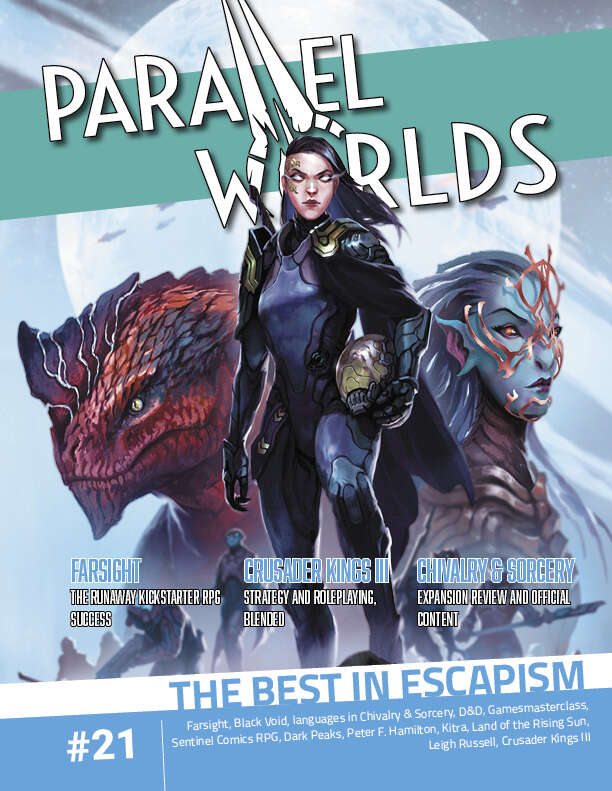
Magazine Madness 4: Parallel Worlds #21

The gaming magazine is dead. After all, when was the last time that you were able to purchase a gaming magazine at your nearest newsagent? Games Workshop’s White Dwarf is of course the exception, but it has been over a decade since Dragon appeared in print. However, in more recent times, the hobby has found other means to bring the magazine format to the market. Digitally, of course, but publishers have also created their own in-house titles and sold them direct or through distribution. Another vehicle has been Kickstarter.com, which has allowed amateurs to write, create, fund, and publish titles of their own, much like the fanzines of Kickstarter’s ZineQuest. The resulting titles are not fanzines though, being longer, tackling broader subject matters, and more professional in terms of their layout and design.

—oOo—

Parallel Worlds feels a little old-fashioned. By which Reviews from R’lyeh means that it supports the gaming hobby with content for a variety of games. So an issue might include new monsters, spells, treasures, reviews of newly released titles, scenarios, discussions of how to play, painting guides, and the like… That is how it has been all the way back to the earliest days of The Dragon and White Dwarf magazines. By which Reviews from R’lyeh means that it can be purchased, if not from your local news agents, then from your local games store. Just like The Dragon and White Dwarf magazines could be back in the day. However, Parallel Worlds, published by Parallel Publishing can also be purchased in digital format, because it is very much not back in the day. By which Reviews from R’lyeh means that Parallel Worlds has reached the grand old age of twenty-one—and these days, that is no magazine achievement for a magazine, gaming or otherwise.

Parallel Worlds #21 promises ‘The Best in Escapism’. It offers a mix of scenarios and support for various roleplaying games as well as interviews with creators and reviews of various books and games. The issue opens with editor Chris Cunliffe’s editorial lamenting the challenging nature of differing opinions and expressing them online, but highlighting that actually, through differing opinions you can discover new things, and that to some extent, the magazine is a vehicle for that. The first content in the issue is ‘Farsight – An Interview with Dario Pesce and Francesco Lucenti’, the Venice-based designers of their new roleplaying game, Farsight, and their company, Lightfish Games. As entertaining as the interview is, it actually focuses very little upon Farsight, the Dungeons & Dragons, Fifth Edition evolved roleplaying game, recently published following a successful Kickstarter campaign. Whether talking about themselves and their influences, this is still intriguing enough to make the reader want to check out the roleplaying game itself.

The actual gaming content in the issue begins with a scenario for Black Void, the roleplaying game of esoteric fantasy set in and around Llyhn the Eternal City, a dystopian cosmopolis and trading hub at the epicentre between the Cosmos and the Void. Here, Living in filthy alleys and shanties among beggars, slaves and the casteless, humanity is very much at the bottom of the social hierarchy in Llyhn, a city inhabited and ruled by eerie beings from faraway worlds, bizarre sapient entities and otherworldly Daimons from beyond the Veil. However, there are factions in the city who want this to change, for humanity to rise beyond its meagre existence, of which the latest is ‘The Cause’, a movement to unite humanity and work to improve its conditions. In Joel Lonergan’s ‘Offers Too Good’, the Player Characters are present at a recruitment drive for ‘The Cause’ and even if they decline to join, they get an offer of a job—join and find out exactly what the leaders of ‘The Cause’ want. The scenario is short and will pose a moral dilemma for the Player Characters, but really feels like a set-up to something bigger.

Stephen Turner, the designer and publisher of Chivalry & Sorcery, Fifth Edition, adds to the world of the Dragon Reaches with ‘Languages of the Dragon Reaches’. Again short, it explores the linguistic development of the setting and provides two scripts—Tadarn Runes and Bethrin Script, both of which Game Master can use to add flavour to her Chivalry & Sorcery campaign. The world’s most popular roleplaying game in the world comes under the spotlight, or at least an aspect of it, in ‘The Three Pillars of D&D Part 3: Exploration’ by Ben Potts. Previous entries in the series examined social interaction and combat, and if they were as decently done as this third and final part, then both are worth tracking down and reading. This article identifies the key elements of exploration in Dungeons & Dragons—travel and puzzles (and traps), and suggests ways in which they can be made both challenging and interesting to play. It also examines how Short Rests and Long Rests work in the game and points own how clunky they are and how they impede one character Class and not another. However, solutions are suggested as are ways in which both Short Rests and Long Rests—Short Rests in particular, can be made to be exciting and interesting without the Player Characters necessarily losing the benefits of either. In examining the way in which Dungeons & Dragons is played, this article feels old fashioned in that similar articles of its ilk have been written again and again over the years, but of course, looking at the various previous editions of the roleplaying game, rather than the current one. This does not in any way make it a poor article and any Dungeon Master running a Dungeons & Dragons, Fifth Edition game will find this an interesting and informative article, full of suggestions and advice that will either help her run a better and more fun game, or perhaps confirm that she is already implementing both and making her game better and more fun.

Editor Chris Cunliffe’s ‘From Tabletop to Desktop’, part of Parallel Worlds’ ongoing ‘Games Master Class’ series treads ground much touched upon by Wyrd Science – Session Zero, that of the shift of play around the table to play online precipitated by COVID-19. He explores his own problems in making that shift, as well as those of his fellow players, plus the changes in terms of preparation, socialising, and interaction within the game itself. In particular, more preparation is required, conversation and interaction are more focused, but does not flow as well as they would around the table, and play time is not just much slower, but also more tiring. This does not mean that gaming online is impossible, in fact, mechanically, it is much, much easier than it was a decade ago… However, for many gamers, it is the only roleplaying possible, but it is possible and it is very much easier than it once was. What one advantage it does omit is that online gaming brings people together, not just from the next town or nearby big city, but from around the world. (For example, I regularly game and chat with players who are not just ten miles away, but hundreds and even thousands of miles away.) Another development that the author ignores is that of virtual conventions. Still the article is informative and warns the potential online player and Game Master of the issues he and she will face when taking the next step into the virtual world, though perhaps it could have highlighted the benefits a bit more and perhaps included the experiences of others who have made the jump.

The remainder of Parallel Worlds #21 is devoted to reviews. They include reviews of Sentinel Comics – The Roleplaying Game, Land of the Rising Sun—the historically inspired adaptation of Chivalry & Sorcerery, Fifth Edition, and The Dark Peaks: Deep Maw. The problem with the first two reviews—the review of Land of the Rising Sun in particular is definitely underwritten—is that they focus just a little too much on the artwork than the text, so that they are drawn out, perhaps taking up space for another review or even a series of thumbnail reviews which might have broadened the appeal of the magazine and made it more useful. In comparison, the review of The Dark Peaks: Deep Maw is more focused and more engaging. Similarly, the reviews of A Hole in the Sky, an audio book by Peter Hamilton and the Young Adult space opera novel, Kitara, by Gideon Marcus, do not suffer from that problem.

Perhaps the least interesting articles in Parallel Worlds #21 are saved to last. ‘Moving to Dystopia: Why an Established Crime Writer is Turning to Dystopian Fiction’ is an interview with Leigh Russell about why she is making the aforementioned shift, whilst ‘Rules of Succession: Appreciating Crusader Kings III’ is about Chris Cunliffe’s experiences with the computer games Crusader Kings II and Crusader Kings III. The latter is interesting from the roleplaying experiences it offers, but again feels too long, whereas the former is short, with extra artwork making it both longer and more of an infomercial than an actual interview.

Physically, Parallel Worlds #21 is professionally presented and written. The layout is clean, strong, and easy to look at, and in general is easy to read. In places, especially in the reviews, the artwork does overpower the text, but overall, this is a good-looking affair.

The problem with Parallel Worlds #21 is that it simply needs more content which will attract gamers and readers to come back to it and content that a Game Master can bring to her table. This is not to say that the issue lacks good content—for example, ‘The Three Pillars of D&D Part 3: Exploration’ and ‘From Tabletop to Desktop’ are both informative and useful, and the scenario, ‘Offers Too Good’, is a good introduction to Black Void. However, too many articles are strung out and the issue lacks content that would attract a wider audience, perhaps the addition of a scenario or article aimed at larger fanbases for different games who might pick up the issue and then appreciate the rest of the content might have helped. This is in addition to generic content too. Of course, it is difficult to take in the swathes of roleplaying titles being released from one month to the next, but there could have been more reviews too, which again, could have appealed to a wider audience.

There can be no doubt that roleplaying magazines have a hard time surviving in contemporary times, but Parallel Worlds #21 does not make it easy for itself by having too much content which does not support the hobby and which is too light. There are a few good articles within the issue and it needs to build on those to bring readers back to it on a regular basis rather than their simply checking out an issue to see if there might be something good in its pages.

—oOo—

An Unboxing in the Nook video is available here.

Saturday, 6 February 2021

1980: Land of the Rising Sun

1974 is an important year for the gaming hobby. It is the year that Dungeons & Dragons was introduced, the original RPG from which all other RPGs would ultimately be derived and the original RPG from which so many computer games would draw for their inspiration. It is fitting that the current owner of the game, Wizards of the Coast, released the new version, Dungeons & Dragons, Fifth Edition, in the year of the game’s fortieth anniversary. To celebrate this, Reviews from R’lyeh will be running a series of reviews from the hobby’s anniversary years, thus there will be reviews from 1974, from 1984, from 1994, and from 2004—the thirtieth, twentieth, and tenth anniversaries of the titles. These will be retrospectives, in each case an opportunity to re-appraise interesting titles and true classics decades on from the year of their original release.

—oOo—

Land of the Rising Sun: Role Playing game of myths and legends in the age of Samurai
was published by Fantasy Games Unlimited in 1980. For the publisher, it predates Bushido, although that was previously published by two other publishers. Designed by Lee Gold, the editor of the long running monthly amateur press association, Alarums and Excursions, Land of the Rising Sun began life as a supplement for Chivalry & Sorcery dedicated to the samurai system of feudal Japan, but ultimately became a roleplaying game of its own. This gives Land of the Rising Sun the distinction of being first roleplaying game to be designed by a woman. It is a Class and Level system, in which samurai and nobles conduct themselves honourably; clerics—Buddhist and Shinto dispense blessings, write scrolls, conduct exorcisms, and more; merchants trade and make themselves richer than the nobility; mages of all types seek to perfect their art and studies; craftsmen make and sell their goods; bureaucrats keep the wheels of government running; and thieves, bandits, and ninja steal, rob, sabotage, and assassinate… This is a roleplaying game set in feudal Japan in which a wide array of character types can be played, including gamblers and geisha, and earn Experience Points for doing so. It presents a rich array of magical traditions, as well as extensive notes on religion and a bestiary of spirits, bakemono, demons, gaki, goblins, kami, and more. However, Land of the Rising Sun: Role Playing game of myths and legends in the age of Samurai does use the Chivalry & Sorcery mechanics, and together with a layout and organisation which is ponderous at best, does make this roleplaying game very much of a challenge to learn and play.

Land of the Rising Sun comes as a boxed set. Inside can be found the rulebook and five reference sheets which cover magic and combat. The rulebook itself, without much preamble, quickly dives into how to create a character. A Player Character in Land of the Rising Sun is first defined by his Species. This can be Japanese Human; Hengeyokai or Shapechanger, such as Fox or Cat; or Bakemono, a monster such as Kappa or Tengu. He has a Horoscope—Well-, Average-, or Poorly Aspected, which will primarily be of import should the character become a mage, followed by gender, height, and frame. The seven stats, Strength, Dexterity, Constitution, Appearance, Bardic Voice, Intelligence, and Wisdom, are all rolled on two ten-sided dice for Humans, but can be modified for non-humans. Lastly, Charisma is the average of all of these factors. He has an Alignment, which ranges from Saintly to Depraved. As well as Charisma, derived factors include Body Points (or Hit Points) and Fatigue Points, then Military Ability (talent as a field commander), Command Level (ability to lead troops), and Personal Combat Factor (ability to fight). The latter is modified by a Player Character’s Class and reflects the size of a weapon he can use and how well. Father’s social class and position determines a Player Character’s initial social class, and from this a player can work out how many siblings the Player Character has, birth order, how much money he has, and what gift his family might give him.

Our sample character is Kugojiro, the younger son of a samurai noble who is a justice of the peace in a small town, a reward for loyal service to his daimyo. The plain, homely-looking Kugojiro is ill-favoured by his family, which has not yet found a position for him, his older brother being groomed to take over from his father. Kugojiro wants to be a warrior, but his family will not support him and he is prepared to undertake less than honourable work.

Name: Kugojiro
Species: Human
Horoscope: Well-Aspected
Gender: Male
Height: Medium (5’ 2”) Frame: Heavy (123 lbs.)
Alignment: Worldly (Corruptible)
Profession: Fighter
Level: 1

Father’s Social Class: Noble (Level 18)
Father’s Clan Lord: Clan Head
Position: Department of Justice (Senior Official) Income: 65
Siblings: 3 (Two older sisters, one older brother)
Family Status: Poor Child
Birthplace: Town (Small Town)
Income: – Money: 72 bu/2 Oban

Basic Influence: 21
Social Status: 15

Strength 09
Dexterity 19 Dex Factor: +10%
Constitution 18 Disease Resistance: +5% BP Regen: +1/+2/+3 FP Regen: 3/6/9}
Appearance 04 Homely (-3 Charisma)
Bardic Voice 20 Orphic (+5 Charisma, +1 Military Ability)
Intelligence 13 Language Points: 3/LVL Detect Factor: +5% Research Limit: VI Remember Spells: 65% Read Scrolls: 85% BP: –

Wisdom 11 Average
Charisma 14 Influential

Military Ability: 7
Command Level: 3
Personal Combat Factor: 10.5

Light Weapons
BL: +1 DMG/WDF: 3 Hit: +15% Parry: -15%
Light/Heavy Weapons
BL: – DMG/WDF: 3 Hit: +12% Parry: -8% Shielding: -12% Dodge: -18%
Dex Bonuses: +2% to hit/Level, -2% to parry/Level; Weapon Specialisation 5, one extra Dodge per turn, two free missile shots per turn

Class Bonus: One free active shield/weapon parry

AC: 3

Body Points: 12
Fatigue Points: 3
Carrying Capacity: 198 lbs.

There is no denying that the end result of character generation is detailed, with the random determination of a character’s social status, family, and position within the family, it is possible to begin to get some idea about who the character might. However, both the end result and the process is far from perfect. It takes both a lot of flipping back and forth through the rulebook’s first twenty pages to get to this point as well as a lot of arithmetic—the author is not kidding when she suggests that the reader requires a calculator. Nor does the Player Character feel complete. Does the character have skills apart from a low chance to hit things—or Personal Combat Factor? Or a low chance for casting magic—Personal Magic Factor—for the Mage? Digging deeper—and it takes a lot of digging—the Cleric at least begins play with one miracle, Purify. The various types of Mage have learned some spells. An Artisan or Merchant begins play with the Production, Trading, and Investment skills, and there is a Dex Skill for Thieves, Bandits, and Ninja. No skills for the gambler or entertainer or geisha though.

Nor do the write-ups of the various professions—Fighter, Mage, Cleric, Thief, Bandit, Ninja, Government, Artisan, Peasant, Merchant, and Other (which covers gamblers and entertainers)—help, since they are all about their place in society and how they earn their Experience Points, and certainly not about what they can do. And the sections on martial arts and fine arts and magic and stealth are all about how to learn them and then be able to do anything of note. In many cases, too much attention is paid to how much money a Player Character will earn and essentially Land of the Rising Sun provides a means to create characters who know their place and role in society, know that they can do things and benefit or earn from doing them, but actually have very little idea how they actually do those things. Roleplaying games are all about things that the characters can do and being able to do cool things, and whilst Land of the Rising Sun will let the Player Characters do them, they have to learn them first.

So what of the mechanics? Land of the Rising Sun is a percentile system. Yet like many roleplaying games of its generation, it does not have a universal mechanic, but rather a set of rules for different circumstances. For example, the rules for Influence and Relationships are based upon the Charisma, Social Status, Level, and Honour Points of the Player Characters and NPCs, and covers ways to increase Influence as well as exert it, before discussing various relationships, from alliances between clan lords and different types of obligations to codes of justice and the nature of seppuku. Magic is broken down into not just a few, but eighteen types of mage, including Primitive, Dancer, Shaman, Medium, Herbalist, Divine, Artificer, Enchanter, Illusionist, Summoner, Symbolist, Poet, Calligrapher, and I Ching Master! Further, Symbolists include Origami, Painter, and Carver Symbolists, whilst Artificers Weaponsmiths, Jewelsmiths, and Weaver Mages. And each type of Mage has his own magic and mechanics, whether that is using I Ching rods to forecast the coming day or the Artificer constructing a magical device—which includes magical or Ego swords by the Weaponsmith. All of these different Mages, despite possessing different mechanics, are all nicely done and would be interesting to roleplay, whether that is the Origami Symbolist folding and animating paper to make it fly or run, or a Diviner reading the stars or writing a horoscope. There is a lengthy list of spells too. Clerics, Shintoism, and Buddhism are all treated in informative fashion. The rules over exorcism plus numerous Miracles, many of which the two faiths share.

The Martial Arts section covers everything from Tessen Jutsu or use of fans to Chikujojutsu or fortifications, and all have a number of skill points which need to be invested in them to be mastered. This is at least one hundred skill points, and because only a few points can be learned through training it can take a while to master a skill. Fine Arts, like Appreciating Embroidery and Dyeing and Playing Go, are treated the same way, but Stealth skills are not. They simply use a combination of a Player Character’s Dex Skill, Detect factor, and Level. Again, this section provides more background, this time about banditry, fences, ninja, and the like. And again, the Ninja is slightly different, first learning Ninjitsu, which of course, takes a while, and then being able to learn another raft of skills.

Combat covers morale, loss of fatigue for undertaking actions, parrying, mounted and a lot more, whilst later, separate sections provide rules for aerial, water, and mass combat. At the heart of combat, attackers are rolling on Missile or Melee Matrices—or attack tables—against an Armour Class rating, which goes from zero to ten. This gives a chance for the attack to succeed, primarily modified by the attacker’s Personal Combat Factor, and there are Melee matrices for different types of weapon and natural weapons. The rules do include a pair of examples, quite lengthy ones, and to be honest, they are necessary, because the rules are not only poorly explained, but there are a lot of them, whether that is aimed hits, desperate defence, attacking with chain weapons, and so on.

Oddly, the author suggests the reader purchase a geographical map of Japan rather than provide one, and instead of looking at Japan as whole, it concentrates on the types of buildings to be found in the country. There is certainly no history given and it would be nice to have some more context for the roleplaying game. Penultimately, Land of the Rising Sun includes a lengthy bestiary, which together with the tables for encounters and intentions of those met, provides the Game Master with plenty of threats, NPCs, and mysteries to present to her players and their characters. Lastly, there is a short bibliography, a handful of scenario ideas, and a piece of fiction, which though it might serve as inspiration for an encounter, feels out of place here.

Physically, Land of the Rising Sun is laid out in the classic wargames style with numbered sections. The layout is generally tidy, the writing reasonable, illustrations vary in quality, but the organisation leaves much to be desired. After covering elements such as character creation and influence and the prices of goods, it wanders off into the thirty-page section of magic, which though good, leaves the reader to wonder how a character does anything except magic, before finally arriving at the section on martial skills and fine arts, which of course, leaves the reader bewildered. It is a case of having to learn the rulebook as much as learn the game. And whilst there is an index, it not always of any help.

—oOo—
Land of the Rising Sun was extensively reviewed at the time of its publication. Eric Goldberg reviewed both of the roleplaying games set in Japan from Fantasy Games Unlimited—both Bushido and Land of the Rising Sun in Ares Nr. 7 (March 1981). He was not wholly positive, but said, “Land of the Rising Sun is an estimable addition to a FRP afficionado’s library. Aside from being well-explained, it is necessary for those who want to fully understand C&S. The care with which Japanese myth has been reproduced is simply amazing.” before concluding that, “It can also be said that the game is impossible to play, and requires too much of the players. Designer Gold achieved her objective, and did it in most impressive fashion. In doing so, however, she may have lost a greater audience.”

Writing in The Space Gamer Number 36 (February 1981), Forrest Johnson praised the roleplaying game, saying, “LOTRS is a very impressive effort. Lee Gold spent a little time in Japan. A lot of time studying the subject. Her game is complete and authentic.” before concluding that, “LOTRS is a beautiful treasure in an unopenable package. Recommended to zealots, and as a source-book to D&D.”

Wes Ives accorded Land of the Rising Sun a lengthy review in Different Worlds Issue 13 (August 1981). He detailed why the roleplaying game was not suitable for the wargamer or the dungeoneer, but for the romantic medievalist, it was, “A decent treatment of all those romantic, alien legends from medieval Japan! The medievalists will justifiably love LRS, even if they don’t have a Japanese FRP campaign to enjoy. After years of reading, in the hobby press (both apa-zines, which can be excused, and prozines, which should know better). treatments of various segments of Japan, held up and analysed in a vacuum, it is a glorious relief to see the strange weapons, the mysterious social classes, and the flabbergasting monsters collected and presented into an integral whole. If your wish is to run a campaign based on medieval Japan, then you will be in the care of someone who lavished as much attention on this set of rules as the Chivalry & Sorcery authors lavished on their treatment of medieval Europe.” He strongly recommended 
Land of the Rising Sun, describing it as, “It is a complete, entertaining game. Even if you don’t start a campaign based on the culture given, this is a good book to read to find out “How It’s Done When It’s Done Right.” LRS has all of the detail of Chivalry & Sorcery, with the added advantage of being a product of the second generation of those rules, so that the rough spots have been somewhat sanded down and refinished. And those of you who want to run a campaign in Old Japan will be in the best of care.”
—oOo—

There is no denying the wealth of detail about Japan ensconced in various sections throughout Land of the Rising Sun, all of them interesting and informative, but the author never pulls back to look at Japan in any great depth, to give context to the game, instead relying upon the reader’s expectations. The sections on magic and religion and the monsters are all good, but Land of the Rising Sun is lacking in so many other ways. Whether that is the frustrating organisation, the underwhelming, but overly complex nature of the Player Characters, the dearth of advice for the Game Master, they all serve to hamper both learning and playing the game. Land of the Rising Sun: Role Playing game of myths and legends in the age of Samurai is an attempt to do a roleplaying set in feudal Japan and do it well and do it comprehensively. Unfortunately, it comes up short of its goals. There are some fantastic elements in the roleplaying game, but it is too complex for what it is trying to do.

Friday, 9 December 2011

Old School Distilled

Originally published by Fantasy Games Unlimited in 1977, Chivalry & Sorcery was written as response to the medieval fantasy of Dungeons & Dragons. Instead its focus was medieval chivalry and roleplaying in a feudal society, though one that did not wholly ignore fantastic elements such as magic and non-human races. Since then, the game has gone through a number of editions, never quite losing its reputation for possessing complex rules, but now it has been out of print for almost a decade. Almost thirty-five years on from its original release, Brittannia Game Designs Ltd. is re-releasing Chivalry & Sorcery Essence, the revised introduction to the game.

Available as a forty-five page, 6.78 Mb PDF, Chivalry & Sorcery Essence comes with everything necessary to play. This includes rules for character generation, combat, and magic, equipment, skirmishes, a setting, and an introductory scenario. The rules themselves are supported with examples throughout.

Character creation in Chivalry & Sorcery Essence involves rolling dice to generate the numbers to assign to attributes, and then choosing a Social Class and a Vocation. A character’s Social Class provides some base skills, some skill points to spend on skills, one or more attribute bonuses, and some equipment and money. His Vocation will grant extra skills. The process is quick and easy, with the five Social Classes given – Serf, Freeman, Townsman, Guildsman, and Noble combining easily with the eight Vocations, Warrior, Forrester, Bandit, Thief, Friar/Priest/Shaman, Mage, Physician, and Mountebank to give the players plenty of choice. For example, Wilf of Gotham is a serf who had to fight for his lord in France. He was injured in battle and lost his right ear. The injury denied him the opportunity to loot the enemy and he has returned to England almost as penniless as when he left. Not wanting to return to the farm, he still knows that he has little choice but to continue serving his lord. Wilf is renowned for his prestigious strength.

Wilf of Gotham
Social Class: Serf Vocation: Warrior
Strength 20 Constitution 15 Agility 15
Intelligence 8 Wisdom 13 Discipline 13
Appearance 6 Bardic Voice 8 Piety 10
Body Points 35
Fatigue 35
Skills: Bargaining 1, Brawl 2, Craft (Carpentry) 1, Craft (Farming) 2, Detect 1, Dodge 2, Flail 2, Language (English) 1, Language (French) 1, Knife 1, Willpower 1
Equipment: Threshing flail, clothes he is wearing, and two days’ worth of food

Mechanically, Chivalry & Sorcery Essence relatively straightforward. To do anything, a character needs to roll under a target number with a twenty-sided die. The target is invariably the total of an appropriate attribute plus any suitable skills, bonus, or penalties. Higher rolls are better than lower ones, and a critical result is scored if a character rolls the target number exactly. The penalties are quite harsh though, running from -1 for even a “Very Simple” task up to -24 for a “Seemingly Impossible” task. These penalties are worse if a character does not have the required skill for a target and will vary according to how much it costs to buy a level in that skill. For example, if Wilf had to swim across a still pond on a warm day, a “Very Simple Action,” he would suffer a -2 penalty to his Constitution before he rolled against it. The Swim skill is cheap to buy though, a much harder task such as identifying even a relatively common poison for someone without the skill would face a -9 penalty.

Combat uses the basic mechanic, but adds a number of factors in. The number of attacks or Blows a character can make per round or minute is determined by the Weapon Class of his chosen weapon and his Agility. Lighter weapons are much faster. So for example, if Wilf attacked with a knife, he could attempt to stab his opponent five times in a minute because it is classed as a Light weapon. Wilf’s threshing flail is much heavier and thus much slower, so he can only make three Blows with it. Critical Successes with swung weapons or a defensive manoeuvre such as Dodge, weapon parry, or Shield use cause an opponent to be bashed backwards with the chance that he might fall over. Making a defensive manoeuvre requires the expenditure of a Fatigue point or the foregoing of the defender’s next Bash.

Damage inflicted is determined by the weapon type, half of a character’s Strength, and by how well he rolled. Both armour and shield reduce this damage, with any leftover being deducted from an opponent’s Fatigue and then his Body Points. Critical successes on an attack mean that the damage is deducted from the Body Points instead. For example, Wilf, facing a French knight in combat, must roll under his Strength plus Flail skill, plus a bonus from his Craft (Farming) skill, for a target of 23. He rolls 19, getting a Critical Success (target numbers over 20 grant better Critical Success ranges), whilst the knight chooses to try and get his small reinforced shield in the way of the farmer’s weapon and does so with an 11. Wilf inflicts a maximum damage on the knight, some 24 points! Fortunately, the knight’s shield and coate of plates armour stops 13 of that, but the remaining 11 points are deducted from his 30 Body Points. In addition, Wilf’s Critical Success inflicts extra damage which is not stopped by the armour, losing him another 8 points from his Body Points. Lastly, the knight was hit by a swung weapon on a Critical Success and must roll against his Agility to remain standing. On a result of a 16 he fails and is knocked to the ground, losing another horrible 10 points from his Fatigue. At this point, the knight is down, has lost half of his Body Points and a third of his Fatigue. The knight might not be out of the fight, but he is at a serious disadvantage!

Magic use in Chivalry & Sorcery Essence varies according to the type. Prayer and Shamanism both use the Piety attribute and the Prayer skill as the basis for the Target, with the actual Difficulty Factor being determined by the prayer being made. In addition, any Prayer attempt also costs a priest Fatigue which increases for each extra Prayer made. In general, Prayers are low and supportive in nature, such as Bless, Lay on Hands, or holding a Mass. Shamanistic prayers are not regarded as being civilised and let a shaman Converse with Spirit, Purify Blood to remove disease or poison, or Animate the Dead, for example.

Magic itself is more complex, each mage having a limited number of Spell Points with which to spend on spells that he knows. Actually casting a spell will cost him Fatigue – and even Body Points if he casts too many, modified by his Magic skill and his Spell Focus. This Spell Focus, a device such as a ring, staff, or wand, also allows a Mage to store fatigue for use in spell casting. In addition, extra Fatigue can be spent to enhance a spell’s range, duration, intensity, and the number of people affected. The mage also receives the longest list of spells, from which he must choose carefully. Further spells can be purchased with Experience Points.

Alternatively, a mage could use the Enchant spell to implant other spells into devices. This is expensive, not only in terms of the materials required – which can actually resist the enchantment attempt, but also in terms of the mage’s Magic Skill. The mage actually expends Magic Skill levels to carry out the enchantment.

Our sample mage is an itinerant book binder who travels from court to court repairing books. This enables him to look for interesting works, not only to read, but also to copy for their spells. He also works as a tutor and translator when his book binding are not required. He learned his magic from his first master with whom he travelled to Paris.

Richard le Lieur
Social Class: Guildsman Vocation: Mage
Strength 10 Constitution 10 Agility 11
Intelligence 18 Wisdom 10 Discipline 14
Appearance 10 Bardic Voice 8 Piety 6
Body Points 25
Fatigue 20
Spell Points 18 (9)
Spells Known: Charm, Light, Sense Magic, Strike
Skills: Craft (Book Binding) 2, Detect 2, Dodge 1, History 1, Language (English) 2, Language (French) 1, Language (Latin) 1, Lore (Astronomy) 1, Magic 2, Read/Write (English) 2, Read/Write (French) 1, Read/Write (Latin) 1, Sword 1, Willpower 1
Equipment: Suit of clothes, two shillings, a sword, book binding tools, and spell focus ring

The GM receives little advice in Chivalry & Sorcery Essence bar some suggestions as to alternative skill use. He does get though, a short bestiary and a set of ready-to-play heroes and villains, both of the latter with a set of adjustments to make any one of them more of a challenge. There is also a setting in the form of “Darken Expansion,” which is taken from the publisher’s The Dragon Reaches of Marakush campaign setting. The nation of Darken is ruled by the Great Queen Dragon Shugaloth, who is attempting to establish a feudocracy despite the temples devoted to her wanting to maintain a theocracy in her name. Shugaloth’s chancellor, the lich known as Ingravain funds the “The Queen’s Falconeers,” not to support a sport that she has no interest in, but as his personal spies and enforcers. Used to check the efforts of the temple, it is suggested that the player characters be members of this group.

Darken is also home to other races including Orcs, Goblins, Hobgoblins, and Dark Elves. These are available as player character races. Two new Social Classes are available, the Darken Warrior, more slave and militia overseer than true warriors; and the Mystic, which combines elements of the Priest and the Mage Vocations. This is continued with the Shaman Vocation, which gives a character access to both prayers and spells.

Chivalry & Sorcery Essence also includes a scenario, “The Serpent Of Paun-I-Tawe,” which takes place in a village in a border region recently annexed by Darken. Its set up is that the player characters are forced to stop at the village due to bad weather and must find shelter either with the villagers who resent being occupied by Darkic soldiers or with the soldiers who prefer to be stationed elsewhere. Into this situation will enter a thief prepared to take advantage of the tensions between the soldiers and villagers.

The problem with the scenario is that it is entirely possible for the player characters to wander through unaware of what is really going on. Now this intentional, the idea being that the characters should be the stars of their own particular stories and that often, there will be events going on in which they are only marginally involved in, and never get to see the whole picture. Whilst this is laudable in a longer campaign, in a short scenario, especially in one designed to introduce and showcase the new edition of your RPG, this is a mistake. The GM needs to get his players involved in the scenario as quickly possible and then keep them involved. Otherwise the likely result is that the players will not have been involved enough to play again.

The other reason why this was the wrong scenario to include is that it has very few ties to setting background given in Chivalry & Sorcery Essence. Had there been a scenario included that involved members of “The Queen’s Falconeers,” then the player characters would have had more of a drive to explore this or any other scenario.

Rounding out Chivalry & Sorcery Essence is a quick and dirty means of handling skirmish combat, plus a character sheet, a guide to character generation, and a sample character. Surprisingly for a supplement of this size, Chivalry & Sorcery Essence actually comes with an index!

Physically, Chivalry & Sorcery Essence is nicely illustrated and generally well presented. It could have been slightly better organised though, as some of the elements of the game are explained before the rules for them. For example, how arms and armour work is explained before combat. It does need a closer edit too.

Putting aside the poor choice of scenario – and it should be made clear that it is not necessarily a bad scenario, but rather not a suitable for either an introductory product or the background given – there is much to like about Chivalry & Sorcery Essence. Neither the rules nor the mechanics suffer from the complexity that Chivalry & Sorcery is supposed to suffer from. They are instead a nicely balanced mix of simplicity and brutalism, with a magic system that firmly and successfully aims for low fantasy rather than high. Overall, Chivalry & Sorcery Essence is a pleasing introduction to the game’s mechanics.