
—oOo—
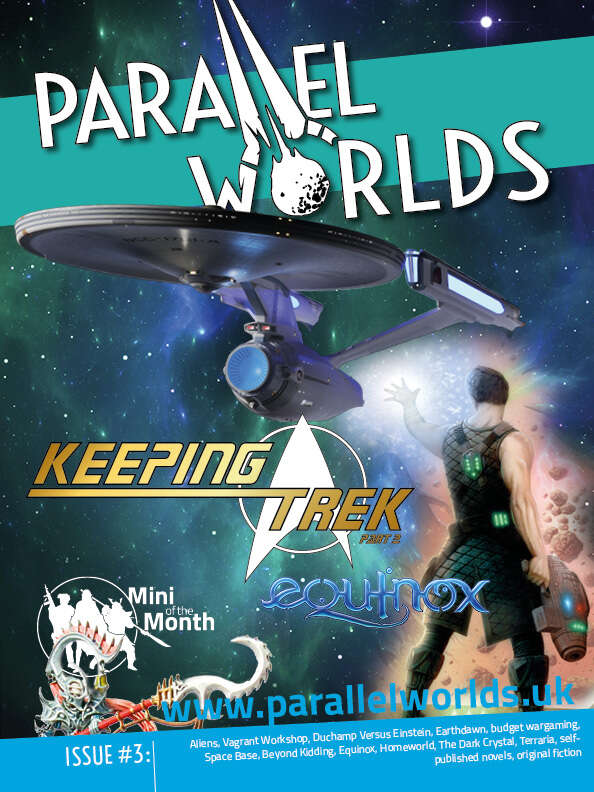
Parallel Worlds Issue #03 opens with its editorial from Tom Grundy, making the point that the value of Science Fiction, horror, and fantasy lies in its ideas and that in addressing and discussing these ideas, suggesting that in doing so, this is actually the highest form of conversation. It is an interesting stance, especially given the dismissive way in which genre content is often treated. Grundy does not take the idea any further, which is a pity. The issue then introduces a new addition, ‘Feedback’. This is the magazine’s letters page, the replies either complimentary or discussing the ‘Thinkpiece’ article ‘Ruling the World 20 – The sci-fi assumption of ‘Government Earth’’, in Parallel Worlds Issue #02, which examined the notion of the ‘global’ or civilisation-wide government. This opens up the magazine a little, making feel less like it exists in a vacuum.
The issue’s interview is with Carsten Damm, previously the developer of the fantasy roleplaying game Earthdawn—now thirty years old in 2023—and now the founder of the German publisher, Vagrant Workshop. This is quite a lengthy piece, exploring the interviewee’s beginnings as both a roleplayer and a designer, how he moved from writing in German and then English for Earthdawn, and then back again for his own content. In addition to learning a little about the publisher’s roleplaying game, Equinox, and more about growing up as a gamer in Germany. One issue with the hobby is that for obvious reasons it is dominated by the English-speaking market, so it is always interesting to hear from another gaming market and culture. The interview is a good start to Parallel Worlds Issue #03, although it is the roleplaying content in the issue.
The issue’s interview is with Carsten Damm, previously the developer of the fantasy roleplaying game Earthdawn—now thirty years old in 2023—and now the founder of the German publisher, Vagrant Workshop. This is quite a lengthy piece, exploring the interviewee’s beginnings as both a roleplayer and a designer, how he moved from writing in German and then English for Earthdawn, and then back again for his own content. In addition to learning a little about the publisher’s roleplaying game, Equinox, and more about growing up as a gamer in Germany. One issue with the hobby is that for obvious reasons it is dominated by the English-speaking market, so it is always interesting to hear from another gaming market and culture. The interview is a good start to Parallel Worlds Issue #03, although it is the roleplaying content in the issue.
Parallel Worlds Issue #03 has two articles devoted to wargaming. The second is the ‘Mini of the Month’ by Thomas Turbull-Ross and is definitely the less useful of the two, and probably the least interesting of the two. The figure is the Isharann Soulrender figure from Games Workshop’s range of aquatic elves and it is easy to see why the loves the figure with its lantern hanging from its helmet like an angler fish to be able to see under the sea, its man-catching polearm, and swordfish companion, but difficult to see why it warranted a double-page spread devoted to a single figure and some fiction. The first and infinitely more useful is a discussion on how to get into the miniatures hobby by ‘Wargaming on a Budget’. Written by Allen Stroud and Connor Eddies, this suggests ways and options in which a prospective player can begin wargaming with limited funds, tracking the money spent as they suggest the rules to choose, where to buy models on the cheap, what tools are needed, and so on. The budget is £70—and that includes choosing a free set of rules and opting for the skirmish level of wargaming, that is, twenty or so figures to a side. The article does gloss over the various options in terms of rules, and it might have been useful to look at the relative benefits of each, especially since there is some money left from the budget at the end of the exercise. After all, why include photographs of the Frostgrave line if it is really only going to be mentioned in passing in the text? Overall, a good guide and the most useful article in the issue.
The miniatures and wargames articles are divided by a review by Christopher Jarvis of the board game, Space Base, which at four pages feels too long. The issue is not the words, but the photographs which do not much to the review. Anyway, had the review been cut in half, there could have been room for another review or more content. For the Events article, Jane Clewett takes the reader to ‘FrightFest – Twenty Bloody Years’, to celebrate the longevity of the biggest horror film festival in the United Kingdom. This is an enjoyable piece, which not only tells us what the event is all about, but also what it is like to attend. It sounds like a fantastic event to attend if you are a fan of the horror genre, but Frightfest also showcases thrillers and other genre films too, so it may well be work checking out to what is being shown at the next event.
The two computer game-themed articles suffer from the same issue as the miniatures articles—one good, one not so good. The first, ‘Homeworld’, by Allen Stroud, explores the history and the story of the Homeworld real-time strategy computer game with its combination Star Wars-like space opera and Battlestar Galactica-like story. It places the series in context of the computer games of the late nineties and its genre and game type, which thankfully in the modern age is made all the more interesting because its three entries and extra content are readily available. Further and with the benefit of time, the article is also useful as a primer for Homeworld: Revelations, the roleplaying game from Modiphius Entertainment. Either way, it is a solid introduction to the series. ‘Terraria – The Success of Simplicity in Modern Gaming’ by Richard Watson is the not as interesting counterpart to ‘Homeworld’. Terraria is a two-dimensional, side-scrolling sandbox which is hugely popular given its relative price and despite there being any number of multi-million dollar titles which a player could choose to play instead. A relatively short article, it nevertheless takes too long to get to what the game is about, concentrating instead on updates and what the game is not. So it never fully sells the game and the fact that it is fun to play.
The two computer game-themed articles suffer from the same issue as the miniatures articles—one good, one not so good. The first, ‘Homeworld’, by Allen Stroud, explores the history and the story of the Homeworld real-time strategy computer game with its combination Star Wars-like space opera and Battlestar Galactica-like story. It places the series in context of the computer games of the late nineties and its genre and game type, which thankfully in the modern age is made all the more interesting because its three entries and extra content are readily available. Further and with the benefit of time, the article is also useful as a primer for Homeworld: Revelations, the roleplaying game from Modiphius Entertainment. Either way, it is a solid introduction to the series. ‘Terraria – The Success of Simplicity in Modern Gaming’ by Richard Watson is the not as interesting counterpart to ‘Homeworld’. Terraria is a two-dimensional, side-scrolling sandbox which is hugely popular given its relative price and despite there being any number of multi-million dollar titles which a player could choose to play instead. A relatively short article, it nevertheless takes too long to get to what the game is about, concentrating instead on updates and what the game is not. So it never fully sells the game and the fact that it is fun to play.
In comparison, the articles on books are uniformly good. Allen Stroud’s ‘Diamonds in the Rough: Read Adventurous!’ examines the joys and dangers of reading self-published books. It highlights the difficulty of picking your way through the innumerable genre titles available today to find the proverbial diamond in the rough, providing some pointers as to what to look for—reviews, blurbs, cover designs, price, and more. It is backed up with quintet of recommendations as a starting point. They include dystopian future, tales of epic fantasy, space opera, and others, all useful pointers. This is followed by a trilogy of book reviews—Tade Thompson’s Arthur C. Clarke Award-winning Rosewater, Beyond Kidding by Lynda Clark, and Duchamp Versus Einstein—by Allen Stroud, Louis Calvert, and Tom Grundy. These three reviews are surprisingly succinct and to the point, with little in the way of wasted space—not always the case with other articles in the issue.
Penultimately, ‘TV & Film’ completes a two-part article dedicated to Star Trek begun on the previous issue. In the first part of ‘Keeping Trek’ by Ben Potts looked at the origins and history of the franchise, all the way up the earliest films. Here he picks up with Star Trek: The Next Generation and explores the franchise over the course of numerous series, Star Trek: Deep Space 9, Star Trek: Voyager, and Enterprise, and to a lesser extent, the films of the nineties and noughties. It comes up to date for for the first two seasons of Star Trek Discovery, but does not give them more than a passing mention. Essentially, this continues the solid introduction begun in the first part, turning the two-part series into an overview primarily intended for the casual or uninitiated would be fan of Star Trek as there is nothing here that the dedicated fan will not already know. As with the first part, it highlights some of the issues of the various series as well as some of the issues too. It pays particular praise to Star Trek: Deep Space 9, especially in its capacity to tell more interesting and often longer stories, whilst acknowledging the parallels with Babylon 5.
The other ‘TV & Film’ article in Parallel Worlds Issue #03 is ‘Let’s Talk About... The Dark Crystal: Age of Resistance’, which is a noted departure in format for the magazine. Together, Tom Grundy, Allen Stroud, and Beth Faulds discuss and give their opinions. There is room here for the trio to agree and disagree, the discussion good-natured and everyone has room to give their opinion. This is a solid format with little wasted space here, and hopefully, future issues will return to it to discuss other genre television or film. Lastly, the issue is rounded out with a short piece of horror fiction. ‘Erden Foe’ by Mehzeb R. Chowdhury is a short piece of Lovecraftian military fiction which nicely rounds the article off.
Physically, Parallel Worlds #03 is printed in full colour, on very sturdy paper, which gives it a high-quality feel. As with both Parallel Worlds #01 and Parallel Worlds #02, it does suffer from a lot of empty space and just too many of the articles do feel stretched out. More concision when it comes to the layout and perhaps there might have been room for more content.
Parallel Worlds Issue #03 swings widely in tone and content. Once again roleplaying does come off a poor third in comparison to other types of gaming, too many articles feel stretched, and it does not yet escape the feeling that there should be more to it. One board game and one miniature review does not feel as if it is enough in comparison to several books. Yet there are good articles to be found in the pages of the issue. ‘Wargaming on a Budget’ is useful and informative, as are ‘FrightFest – Twenty Bloody Years’ and ‘Diamonds in the Rough: Read Adventurous!’ because they help the reader do things, whilst ‘Let’s Talk About... The Dark Crystal: Age of Resistance’ is spirited and engaging. All four articles are ones that might bring the reader back to the issue to follow up on that help or read again, whereas the others, less so. Overall, Parallel Worlds Issue #03 is still just a bit too light, but there are sections worth reading.

