1974 is an important year for the gaming hobby. It is the year that Dungeons & Dragons was introduced, the original RPG from which all other RPGs would ultimately be derived and the original RPG from which so many computer games would draw for their inspiration. It is fitting that the current owner of the game, Wizards of the Coast, released the new version, Dungeons & Dragons, Fifth Edition, in the year of the game’s fortieth anniversary. To celebrate this, Reviews from R’lyeh will be running a series of reviews from the hobby’s anniversary years, thus there will be reviews from 1974, from 1984, from 1994, and from 2004—the thirtieth, twentieth, and tenth anniversaries of the titles. These will be retrospectives, in each case an opportunity to re-appraise interesting titles and true classics decades on from the year of their original release.
Sunday, 22 March 2026
2006: Hollow Earth Expedition
Sunday, 4 August 2024
Review 2500: The Adventures of Indiana Jones Role-Playing Game
The Adventures of Indiana Jones Role-Playing Game was published in 1984 by TSR, Inc. It was an attempt to create an introductory roleplaying game based on the highly successful films, Raiders of the Lost Ark and Indiana Jones and the Temple of Doom. Although supported by six adventures and an accessory pack, it was poorly received and would prove to be a failure. The licence lapsed the following year. In the years since, it has gained a poor reputation for not only being a flop, but also for being a badly designed game. Even in some cases, one of the worst roleplaying games ever published. Its problems can be attributed to just two design decisions. The first decision limited what you could play. The options were Indiana Jones and then Sallah, Marion Ravenwood, Short Round, Willie Scott, Wu Han, and Jock Lindsey. They were the only options because The Adventures of Indiana Jones Role-Playing Game does not have rules for character creation. Even then, the choice of characters for a young teenage audience was extremely limited. Did anyone really want to roleplay Willie Scott, let alone Wu Han or Jock Lindsey? Plus, this is not a roleplaying game for more than a few players, one of whom gets to roleplay Indiana Jones, whilst the others play his sidekicks, who are going to change from one story to the next. The second decision is more mechanical, but effectively, none of the heroes can die in The Adventures of Indiana Jones Role-Playing Game. This models the films—except for poor Wu Han, of course—but no matter how bruised or battered he gets, how far he falls, Indiana Jones cannot die. He can suffer a lot of damage, but he cannot die. Then, when he does suffer damage, he takes weeks to heal, which does not model what we see on screen. Forty years since it was published, is The Adventures of Indiana Jones Role-Playing Game as bad as its reputation claims it to be?
The Adventures of Indiana Jones Role-Playing Game comes as a boxed set. Inside is the sixty-four-page Games Rules Booklet, an eight-page Evidence File, a World of Indiana Jones Map, a Referee’s Screen, and three-dimensional cardboard figures to cut out and use in play. The Games Rules Booklet contains all of the rules to play, as well as a solo scenario, ‘The Ikons of Ikammanen’, which leads in to a scenario that can be played by multiple players. The Evidence File gives stats for Indiana Jones and his six companions, plus maps and clues for the ‘The Ikons of Ikammanen’ scenario. The World of Indiana Jones Map depicts the world as it was in the nineteen thirties and is marked with the common travel routes, sadly not in thick red lines though. The Referee’s Screen has many of the tables on it needed to play, but not all. The Referee will need to refer to the Games Rules Booklet for the ‘Chase Flow Chart’ as well as the back of the Games Rules Booklet for the ‘Modified Check Table’ and the ‘Check Results Table’ as both require full colour and only the front of the Referee’s Screen is in colour. The three-dimensional cardboard figures include all of the heroes, NPCs that appear in ‘The Ikons of Ikammanen’ adventure, and generic Goons and Villains. They also include a few rough buildings.
With a little colour fiction, the Games Rules Booklet pulls the reader into an explanation of what a roleplaying game is and the basics of the mechanics and what a Player Character looks like. Following this is ‘The Ikons of Ikammanen’ scenario, at this stage a solo adventure, although not a ‘choose your own’ style of solo adventure. Rather, it provides a few options, but keeps them all to the same page. In each case, what it is doing is getting the reader to make a few dice rolls and show how the previously explained rules work in practice, going from one page to two, and then more as the rules have to handle more complex situations. It does this in turn for combat, chases, and more, until it gets to part four and dealing with ‘Cronies & Contacts’ where Indiana Jones has to interact with some NPCs. This requires an actual player and a Referee. Up until that point it has been the reader playing through this, so what this means is that to get to this point, the Referee has to play through the first three parts and the player has to play through the first three parts, and then they have to come together for part four and beyond… This is annoyingly clumsy in its execution when the simplest solution would have been to have had player and Referee involved from the start. From this point on though, the remaining five chapters of the adventure do require the Referee and then another player to take the role of Indiana Jones. That said, the format of the author explaining or telling the reader rules and then showing the reader the rules and getting him to use them in play is a good idea. It is just that its execution is poor.
Instead of character generation, The Adventures of Indiana Jones Role-Playing Game simply gives the stats for Indiana Jones and his sidekicks from the films Raiders of the Lost Ark and Indiana Jones and the Temple of Doom. A character has seven attributes—Strength, Movement, Prowess, Backbone, Instinct, and Appeal. Prowess is his fighting ability; Backbone is his determination and his guts, as well as his ability to overcome irrational fears; and Instinct is his perception. There is no Intelligence type ability, but there are Knowledges, areas of expertise that let a character do certain things or simply know about them. Notably Indiana Jones is not that much better than his sidekicks. Both Indiana Jones and Willie Scott have irrational fears that require a Backbone Check to overcome lest they be frozen in fear and ultimately, their players to roleplay their way past them. Some of the Player Characters have notes such as Wu Han knowing a little archaeology and being a master of disguise.
Indiana Jones
Attributes
Strength 68
Movement 80
Prowess 76
Backbone 72
Instinct 80
Appeal 88
Movement Rate (running); 25 squares (5 areas)/turn
Weapons: bullwhip, pistol, knife
Money: $500
Knowledges: Archaeology, Driving, Parachuting, Surveying
Irrational Fears: fear of snakes
Notes: Indy wears glasses to correct an astigmatism
Mechanically, The Adventures of Indiana Jones Role-Playing Game is a percentile system, similar, but very simplified in comparison to, the mechanics used in Marvel Super Heroes, also published in 1984. To have a character undertake an action, his player makes an Attribute Check. The Attribute Check is easily modified by either doubling the value if the task is easier, or halving or even quartering it if the task is difficult. Modifiers cancel each other out, so that a Prowess Check to shoot an NPC would be doubled because the weapon is resting on a solid object, but halved because the target is in cover. If the result on percentile dice is equal to, or less than, the attribute value, the character succeeds, but if how well the character succeeds, the Referee can consult the ‘Modified Check Table’ on the back of the rulebook. This compares the result of dice roll to the modified Attribute Check. The result is a colour coding and when that colour is checked on the ‘Check Results Table’ it will give a more nuanced outcome, depending upon whether a character is attempting to inflict damage in combat, discover something using Instinct, or persuade someone using Appeal.
For example, Indiana Jones wants to find the next clue to the location of a tomb. He is in a library, but a gang of goons is after him, so the Referee rules that this increases the difficulty and halves Doctor Jones’ Instinct of 80. So, his player will be making an Instinct Check of 40. He rolls ‘07’. This is between ‘06’ and a quarter of his current Instinct Rating and indicates a yellow box. Checking the corresponding yellow box under Instinct ‘Check Results Table’ and the Referee can tell Indiana’s player that he has a ‘What or Where’ result, meaning that he has found the information he was looking for.If the result is five or less, then the character gets a ‘Lucky Break’, but suffers a ‘Bad Break’ if the player rolls ninety-six or more. A Lucky Break on a Movement Check might be that the enemy falls and trips up his companions or a trap fails to work on an Instinct Check. A Bad Break might be that an NPC finds the character repulsive on an Appeal Check or the character’s knife or sword breaks on a Prowess Check. However, the important line here is, “No one ever dies as a result of a Lucky Break or a Bad Break. Such events just make things just a little more interesting—one way or another.”
Combat is more complex and stats slightly oddly in that rolling for initiative is optional. The players and the Referee only roll if they want to act before anyone else. A Movement Check is used for initiative and also if a character’s action is to move, whilst a Prowess Check is used for all attacks. Specific actions, such as Indiana Jones using his bullwhip to snatch a gun from a goon’s hand or attempt to knock a goon off his feet rather than inflicting straight damage are handled as modifiers to the attacker’s Prowess. The level of damage inflicted is determined by the quality of the roll and checking on both the ‘Modified Check Table’ and the ‘Check Results Table’. The outcome can either be light, medium, or serious damage. Brawling inflicts injuries, whilst Shooting inflicts wounds. Some weapons increase the severity of damage inflicted, for example, from light to medium. This tends to be weapons that inflict injuries, such as a blackjack or the buttstock of a rifle when used as a club, whilst piercing or cutting weapons inflict wounds. Both injuries and wounds can lead to Attribute Ratings being reduced and unconsciousness, whilst wounds can result in death—although how that is handled is not addressed and in fact, this is the only mention of death in the roleplaying game. Goons—such as Nazi guards or Nepalese thugs—always act after the heroes and are knocked out if they suffer serious damage, whereas villains, like rival archaeologist René Belloq, act and take damage like a Player Character. The fact that Goons can be knocked out by serious damage does model the films, for example, Indiana Jones shooting the swordsman in the marketplace scene or the fistfight against the German Luftwaffe mechanic. The roll also determines where the damage is inflicted. This is done by reversing the numbers on the roll and consulting the ‘Action Results Table’ on the Referee’s Screen.
For example, Indiana Jones is fighting his way out of the library and wants to punch one of the Nazis in front of him. This is a Prowess Check. Indiana has a Prowess of 76. His player rolls ‘25’ and the Referee compares it to the ‘Modified Check Table’ and the ‘Check Results Table’. This is between a quarter and a half of Indiana’s Prowess and indicates medium damage. The result of ‘25’ is reversed to ‘52’ and the ‘Action Results Table’ consulted—Indiana has landed a good blow in the Nazi goon’s gut! This forces a Strength Check on the goon. The check is successful and so all of the Nazi’s Attribute Ratings are halved for this and the next round. (If the roll failed, then the Nazi would have been knocked unconscious.)As this is a roleplaying game based on Raiders of the Lost Ark and Indiana Jones and the Temple of Doom, there are rules for vehicles, chases, and combat whilst in a chase. This is the most complex part of the rules in the roleplaying game, but is decently explained, there is an example of it in play, and then the reader gets to try it out. The rules also make use of the ‘Chase Flow Chart’, which model routes and intersections and possible hazards that the Player Characters might encounter. (A similar chart would later appear in Top Secret/S.I., published by TSR, Inc. in 1987.) Other rules cover money, travel, equipment, and dangerous events. Of these, the rules for money are arguably superfluous since money never plays a factor in the films. The rules for dangerous events, whether falling, hanging on to a failing rope bridge, riding a runaway cart in a mine, drowning, and more are simply given a Danger Rating which works like an Attribute in play, using the same ‘Modified Check Table’ and ‘Check Results Table’.
There is good advice for the player as well as the Referee. For the player, this is about having fun, getting into the adventure spirit, and playing the good guys. In fact, there is a rule for enforcing the latter, the Referee having the right to demand a Backbone Check if she thinks that Indiana Jones, or a sidekick, is about to do something out of character. Since there is no means of creating Player Characters in The Adventures of Indiana Jones Role-Playing Game, there is no way of improving them either. There is, though, an optional rule for Player Points. These are earned by achieving the objectives in an adventure overall and in some episodes as well, such as rescuing an NPC or obtaining the artefact that Indiana Jones is searching for, whilst the Referee can earn them by having the NPCs capture the Player Characters or retain the artefact that the Player Characters are after. The players and the Referee can also reward each other with Player Points at the end of an adventure or episode for making the play fun, good roleplaying, and coming up with good ideas. A player cannot earn more than five Player Points per adventure or episode and cannot have more than fifteen in total. Player Points can only be spent to reduce the severity of a Player Character’s wounds or injuries, for example, from serious to medium, at a cost of five Player Points each time. This also applies to the Referee and her NPCs.
Another way to earn Player Points is a special bonus if a Player Character sacrifices himself to save another Player Character or NPC. If a Player Character is killed, the Player Points are carried over to the player’s new one. Given the lack of discussion of character death in The Adventures of Indiana Jones Role-Playing Game, this seems at odds with the nature of its play, and whilst the expenditure of Player Points counters the sometimes severity of the combat system, in hindsight it feels so limiting that they cannot be spent to undertake heroic or cinematic action. That said, this is a roleplaying game published in 1984 and the idea of Hero Points or Luck Points, of which Player Points are a sort, had yet to be adopted by the wider gaming hobby. Yet this is despite the pioneer of their broader use, James Bond 007: Role-Playing In Her Majesty’s Secret Service, being published by Victory Games the year before.
In terms of background, The Adventures of Indiana Jones Role-Playing Game provides a timeline and a very short history of the 1930s, plus descriptions of various archaeological locations around the world, none of which are marked on the World Map. The advice for the Referee is decent enough. The scenario though, ‘The Ikons of Ikammanen’, is in parts exciting, but as a whole never more than serviceable. It opens with the death of a former student of Doctor Jones, which puts him on the trail of a set of legendary artefacts from West Africa. Here he will be captured along with the student’s sister—who also took classes under Indiana Jones—by a greedy local, and together they will be forced to explore a mysterious and deadly volcanic island. The scenario stretches credulity in places, such as when a Nazi submarine torpedoes the ship they are on, rescues them, and actually transports them across the Atlantic to New York! It is a direct adaptation of the first story of Marvel Comics’ The Further Adventures of Indiana Jones series and highlights how ultimately, The Adventures of Indiana Jones Role-Playing Game is a very direct adaptation of the source material rather than a setting to be explored. It is disappointing that an original story could not have been included, perhaps one that could actually have involved more than one player. That said, it does get comic artist and writer, John Byrne, who wrote ‘The Ikons of Ikammanen’ for The Further Adventures of Indiana Jones comic, a roleplaying game design credit!
Physically, The Adventures of Indiana Jones Role-Playing Game is underwhelming. The Games Rules Booklet is illustrated with images from the first two films, all in black and white, but the rulebook does feel cramped and busy. The most colourful items are the three-dimensional cardboard three-dimensional cardboard figures, but the artwork is far from great. It captures the look of Indiana Jones and his sidekicks in the clothing that they wear rather than their actual appearance.
The first review of The Adventures of Indiana Jones Role-Playing Game appeared in Imagine No. 21 (December 1984), appropriately in an issue dedicated to superhero roleplaying games! In ‘Games Reviews’, Paul Mason said, “The main strength of the rules lies in the system used. The designers have come up with an ingenious way of combining chance with success, quality of result and (in the case of combat) hit locations with a single percentage role. The whole game depends on this simple system, making it easy to pick up.” In the main though, he was critical of the game, finishing with, “…[W]hile the game structure is spot on, the execution is poor, making me feel overall that the game is a missed opportunity.”
The most positive of its reviews would appear in the pages of Imagine magazine’s rival. In Adrian Knowles’ review of The Adventures of Indiana Jones Role-Playing Game in ‘Open Box’ in White Dwarf Issue 61 (January 1985) he highlighted how the rules are designed for someone with little roleplaying experience, commenting that, “It is very obvious that the game has been produced entirely with a young market in mind - players totally new to the idea of roleplaying will find it easy to play and pick up and good fun to boot.” and that, “Experienced gamers, I suspect, will regard the game with horror - a character who is unthinkable [sic], ridiculous!”. (Presumably, he meant ‘unkillable’ rather than ‘unthinkable’.) He concluded with, “Although I found the game to be quite enjoyable (but then I had spend [sic] the evening propping up a bar before tackling it) it only has appeal as a ‘one-off’ game - good for a break but unlikely to have lasting appeal. It is fun, however, and no matter what crazy stunt you attempt, Indy will survive.” before awarding it seven out of ten.
Steve Crow was less charitable in his review which appeared in the ‘Capsule Reviews’ section of Space Gamer Number 73 (March/April 1985). He was critical throughout and ended with, “Indiana Jones is so locked into the concept of the two movies that it is practically useless for anything outside of reenacting the movies or similar plots. FGU’s Daredevils and Hero Games’ Justice Inc. both take a broader look at the genre of 30s roleplaying, giving you a chance to take your life into your own hands with characters of your own creation. Indiana Jones does neither.”
The negative reviews continued with Different Worlds Issue 39 (May/June 19865). In ‘Game Reviews’, Russell Grant Collins reviewed The Adventures of Indiana Jones Role-Playing Game as well as the first two adventures, IJ1 – Indiana Jones and the Temple of Doom Adventure Pack and IJ2 – Raiders of the Lost Ark Adventure Pack. He summed up both roleplaying game and scenarios with “In conclusion, avoid this game; if you play some other system that is set in this time period and are willing to do the conversions, the modules might be worth it, especially Raiders of the Lost Ark.”
Perhaps the oddest review would appear in the pages of Dragon No. 215 (March 1995). In ‘Role-Playing Reviews’, Rick Swan gave an overview of numerous roleplaying games and settings with ‘Something for everyone? West end Games’ MASTERBOOK game’. In examining The World Of Indiana Jones—which was published exactly ten years after The Adventures of Indiana Jones Role-Playing Game, he said of the first version that, “It wasn’t a big hit—I picked mine up at a GEN CON® Game Fair for fifty cents, still in the shrink wrap—possibly because of the elementary mechanics, more likely due to the exclusion of a character-creation system. Instead of dreaming up your own PC, you simply assumed the role of your favourite character from the films. Thus, the game ensured a flurry of fist-fights as players squabbled over who got to be Indy.”
Although the licence for the roleplaying game would lapse in 1985, The Adventures of Indiana Jones Role-Playing Game would infamously and curiously have an afterlife that lives on today. According to legend, when the licence was lost, all copies of the roleplaying game had to be burned. Employees at TSR (UK) rescued the last, partially burned copy, and its remnants would end up encased in a Perspex pyramid, the only words legible being ‘diana Jones’. In the twenty-first century, this became the trophy for the Diana Jones Award For Excellence In Gaming, serving as an accolade for everything that The Adventures of Indiana Jones Role-Playing Game was not. The irony is not subtle.
The Adventures of Indiana Jones Role-Playing Game was, notoriously, the roleplaying game that applied the ‘™’ or trademark symbol to the word ‘Nazi’ as in ‘Nazi™’. Except this really is a roleplaying myth. Many of the three-dimensional figures do have both the Trademark and the Copyright symbols on their bases. These are all named characters from the films—Indiana Jones, Sallah, Marion Ravenwood, and so on. The others like the various Goons, the Ship Captain, and yes, the Nazi, do not.
What is surprising about The Adventures of Indiana Jones Role-Playing Game is that in some ways it is not as bad as its reputation suggests, but in every other way, its poor reputation is deserved. Mechanically, The Adventures of Indiana Jones Role-Playing Game is a good game and the way in which a single Attribute Check can determine its qualitative outcome and in combat, the hit location, with a single roll, is actually elegant and fast playing. Yet the way in which it handles the effects of damage, death, and effectively, script immunity for Indiana Jones, Sallah, Marion Ravenwood, and so on, underwhelms any sense of jeopardy. Of course, the sense of peril seen on screen is not real, because ultimately, we know that Indiana Jones will prevail, but The Adventures of Indiana Jones Role-Playing Game makes it explicit. Indiana Jones can take any amount of damage and come back from it, and though optional, the use of Player Points, enforces this. At the same time, you want the Player Points to allow you to do other things, just like Indiana Jones does on screen, but the rules are not there for that. The limitations of who and what you can play also limits choice and the number of participants. What The Adventures of Indiana Jones Role-Playing Game really is, is not so much a roleplaying game, with its freedom for the Game Master and her players to create their content in terms of characters and adventures, as an ‘adventure’ game designed to emulate very closely the films and stories upon which it is based.
By modern standards, it would not actually take much to adjust The Adventures of Indiana Jones Role-Playing Game into something more playable. The underlying mechanics are workable. It is the choices made to model the films too closely that undermine the rules and the roleplaying game as a whole. The result is that as both a roleplaying game and a roleplaying game based on the world of Indiana Jones, The Adventures of Indiana Jones Role-Playing Game fails to satisfy.
Friday, 29 September 2023
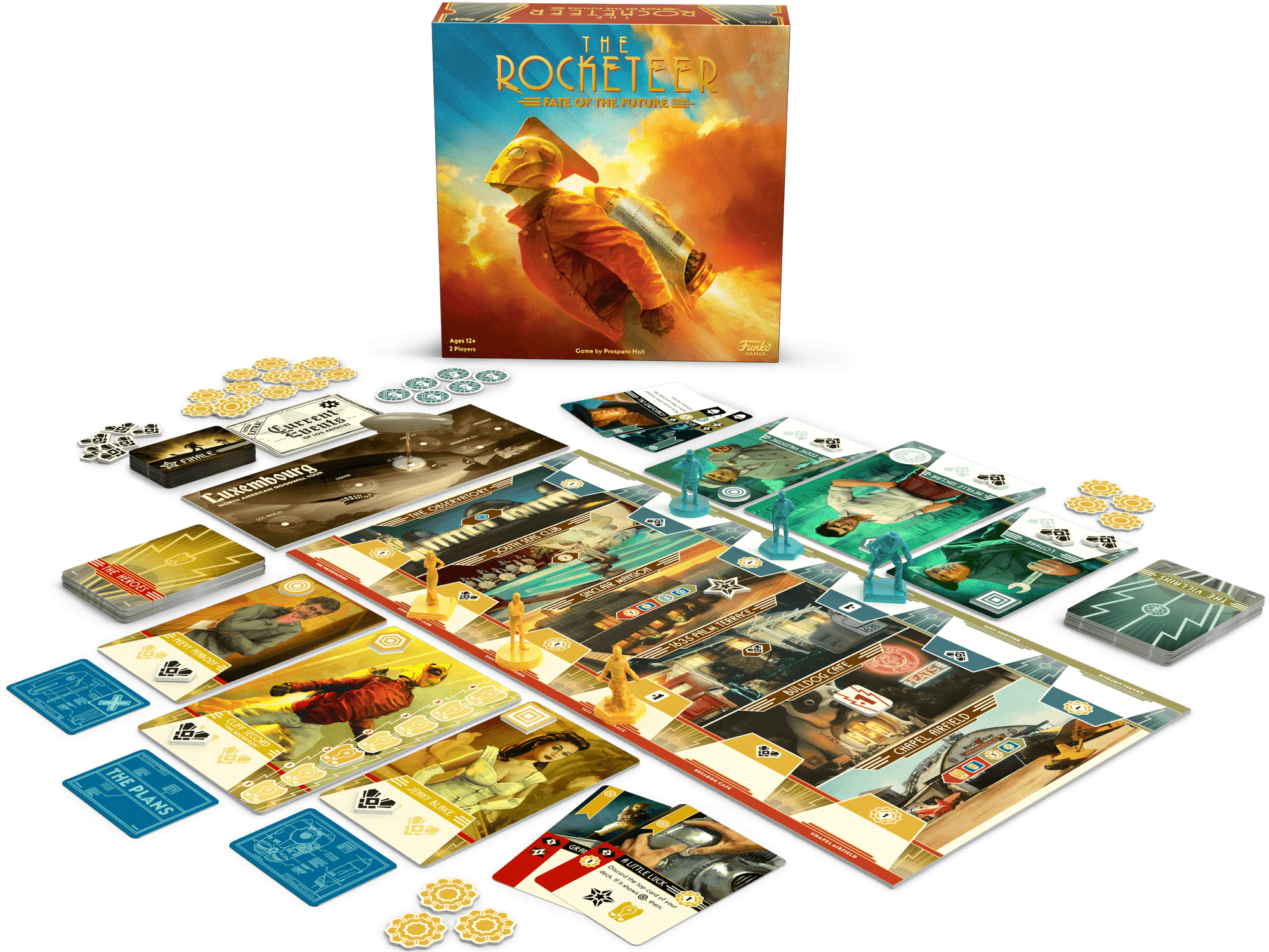
Friday Filler: The Rocketeer
So this essentially, is the plot to the 1991 Disney film, The Rocketeer, which of course, was adapted from the brilliant comic book series by the late Dave Stevens. Both combined art deco stylings, pulp action, and a serving of modest cheesecake with the inclusion of the Betty Page-like Jenny with the inspiration of Republic Pictures serials of the early nineteen fifties, most notably Radar Men from the Moon and Commando Cody: Sky Marshal of the Universe. (If you have not seen the film, why not? It is genuinely good fun. Actually, go watch the film instead of reading this review. I honestly do not mind. Really. I promise you will not be disappointed. In fact, I am watching it right now as I type this, so what is your excuse?) This it also turns out is the set-up for The Rocketeer – Fate of the Future. Designed by the same team behind Indiana Jones: Sands of Adventure and Jaws, The Rocketeer – Fate of the Future is a two-player, asymmetric boardgame which was published by Funko Games in 2021—the thirtieth anniversary of the film. Designed for ages twelve and up, each player in The Rocketeer – Fate of the Future controls a team of three characters who will race back and forth across Los Angeles, trade punches as much as pithy putdowns, all the while trying to ensure that by the time the zeppelin, the LZ Luxembourg, is in town, they have possession of the rocket pack plans. The game plays in forty-five minutes, but faster once you get to it is rules—though it is not that complex.
The first thing that can be said about The Rocketeer – Fate of the Future is that this is a great looking game. You know that the moment you open the box and the Rocketeer’s helmet stares at you from the back of the board. This is a lovely detail—as is the map of Los Angeles on the inside of the lid of the box. Neither add a single thing to the game except love for the source material. The game is full of such details, such as the Current Event cards being designed to look like newspaper front pages and the art deco style throughout. The artwork is excellent, fully painted rather than drawn from Dave Stevens’ own artwork or stills from the film. It is all inspired by the film and is all very, very good. If there is a downside to the components, it is the miniature figures for each of the six characters. It is easy to tell which one is which, but they are more representative than effectively depicting the characters. The other aspect of the game’s look is the lack of reference to, or iconography of, the Nazis. Although we know Sinclair to be one, that is enough to play the game and it need not be made obvious and so spoil the look of the game.
At the heart of The Rocketeer – Fate of the Future are the plans to the rocket pack. These are represented by three cards. One is the Rocket Blueprint, the other two are dummy plans. The Heroes start play with these hidden and face down. The Villains will Tussle with the Heroes to determine which of them has the Rocket Blueprints and having taken possession of them, will keep them hidden and face down. It is the Heroes turn to Tussle with the Villains Heroes to determine which of them has the Rocket Blueprints and having taken possession of them again, will keep them hidden and face down. Play will continue like this over the course of five or six rounds, the aim being not just to keep hold of the Rocket Blueprint, but acquire Finale cards. Finale cards can be earned from playing the Abilities on cards and from having the Plans at the end of each round. Finale cards reward points and the player with the most points at the end of the game—indicated by the arrival of the LZ Luxembourg in Los Angeles—wins the game.
The Rocketeer – Fate of the Future is played out a board depicting different locations from the film across Los Angeles. These include The Observatory, the setting for the film’s climax, the South Seas Club where Sinclair takes Jenny to dinner, Sinclair Mansion, 1935 Palm Terrace—home to Peevy and Cliff, Bulldog Café where Cliff takes Jenny to dinner, and Chapel Airfield, scene of much of the film’s action. These locations are marked with Icons indicating the benefits a player can gain from visiting, knocking out opponents, and being in control at the end of a round. Each Player controls the three heroes—Cliff, Jenny, and Peevy, or the three villains—Neville Sinclair, Eddie Valentine, and Lothar. As the Rocketeer, Cliff has the advantage of the rocket suit and has greater movement—which can be increased, whilst as a Nazi agent, Neville Sinclair can recruit and build a secret army of soldiers. When he ambushes any of the heroes, Eddie Valentine realises who Sinclair is working for and scarpers, but Sinclair has his army, nonetheless. It is best for the Villain player to recruit as many as he can before unleashing them. Sadly, unlike in the film, Eddy Valentine does not then fight on the Heroes’ side.
Control of each player’s three characters is done via a deck of cards. Every card has icons to indicate which character or characters the card applies to, an action or an ability that the player character choose between, and the cost of using the ability as well as a good illustration. For example, ‘Put It In Neutral’ can be used by either Cliff or Peevy. If used as an Action card, it grants a Move and a Tussle Icon and their associated actions. However, if used as an Ability, there is no cost, but the character can move to any Location and take the associated action there. The illustration shows Cliff as the Rocketeer in the back of Peevy’s pickup truck, using the power of the rocket pack to make a getaway. This illustrates one of the scenes from the film and all the cards are like this, depicting a scene from the film and so combining the film’s story and the rules in such a way that helps bring the game to life. It is really quite subtle, but if you know the film, it is just one more way in which the designers reward the players. Other rewards from the Ability options on the cards include gaining Grit or Clout, drawing a card, drawing a Finale card, revealing or hiding Plans. The Hero player can also increases Cliff’s skill and range with the rocket pack and the Villain player can recruit soldiers to his secret army and stage ambushes. Grit is possessed individually by each character and is used in Tussles and Clout is a shared resource used to activate the Abilities on many of the cards.
The game consists of several rounds. At the beginning of each round, a Current Event card will be draw, which adds a random event and determines how far the Luxembourg travels this round. Then, using a hand of seven cards, each player will take it in turn to active his three characters, have them move, Tussle with the enemy. A player can use as many cards as he wants or he can for each character. Once a character has been activated and moved, he cannot do so again that turn. At the end of the round, rewards are earned for having the Plans and from each location controlled. Tussles are simple. The Action part of a card has a Tussle icon on it. This represents the character’s strength in the Tussle and it can be increased by adding the character’s Grit tokens. The defending player can block the attack by discarding cards which have the Shield icon on them and card’s which have the defending character’s Icon on them. This also costs Grit. The character with the higher Tussle Strength will win the Tussle. Only the defending character can be knocked out in a Tussle, which if his side has the Plans, will also reveal if he has the Rocket Blueprint or the dummy plans. A Tussle can—and will often—end with a standoff, with blows exchanged, Grit expended, and no knockout. This though does make a defending character weak if the acting player still have characters to move. Once both players have moved all three of their characters, the round is over, rewards are awarded, and a new round is set-up. Once the Luxembourg arrives in Los Angeles, a final round is played and the game ends. Players total their points from the Finale cards—typically two or three points per card, though some have zero points and others have conditional rewards such as a bonus for Grit in play or controlling a location—and the player with highest total wins.
The Rocketeer – Fate of the Future does feel a little long in its game play and though designed to be asymmetrical, does favour the Heroes more than the Villains. The Heroes have more chances to gain Finale cards and their mechanics are simpler, whereas the Villains have the Secret Army, which is a bit fiddlier and a different sub-mechanic for the Villain player to have to contend with. Plus, when the Secret Army does come into play, it cannot possess the Rocket Blueprint, meaning that if in the Villains’ hands, either Neville Sinclair or Lothar has it, making it easier to track down and get back. The aspect of winning via the Finale cards means that neither player quite knows who is winning until the very end unless one player has managed to get many more than the other. So, it can be difficult to work out how you are progressing in the game.
The Rocketeer – Fate of the Future is a clever design which really takes advantage of its source material to turn it into a good game. The game play is fairly simple, tactical rather than strategic—a player needing to get the best out of his hand of cards in a round rather than long term planning, and thematic. In fact, highly thematic! If you are a fan of The Rocketeer, then The Rocketeer – Fate of the Future is definitely the game for you. The Rocketeer – Fate of the Future definitely looks the part—comic book or the film—and who wouldn’t want to sock Neville Sinclair where it counts?
Friday, 31 March 2023
Friday Fantasy: Bottled Sea
Bottled Sea is a hex crawl—or sea crawl (seabox?)—from Games Omnivorous dotted with the flotsam and jetsam of the ages, coral-reefs stung together from debris from across the universe, wrecks both sunken and afloat, technology scavenged and jury-rigged to new purpose—survival, dolphin-riders, Mother Sea Cucumbers spraying acid, Mimic-Islets that swallow ships whole, strange tides that sweep ships away, and more. The Bottled Sea is an in-between dimension where ships lost at sea end up, from past, from today, from the future, and from elsewhere. Here survivors search for the food and water necessary to survive, but also myths of the Bottle Sea, rumours of solid land, and salvage that can be used to make repairs or even something better. At the heart of the Bottle Sea is the Harbourage, a palimpsest of waste and rubble kept assiduously buoyant, where Travellers are always welcome, especially if they have resources, in particular, the rare dirt, paper, and plants, to trade and use as currency. Four factions vie for control of Harbourage. The Collectors are a masonic lodge of inventors working haphazardly to create an article island. The Ichthys are amphibious mutants, highly capable deep-sea salvagers, who want a greater unity between the sea and the surface. The Shepherds are an ascetic cult which worships and herds Sheep for their wool and their milk, and want to take its herd home. The Rainmakers are priests of the rain.
The Game Master Screen is a horizontal, three panel affair. The front depicts a paddle-galleon on the Bottled Sea itself, about to be overtaken by a tempestuous storm. The back is the meat of the supplement. Here, from left to right, it explains what Bottled Seas is, how to use and the best way to use it; tables of myths, salvage, pelagic—meaning open sea—encounters, weather, and details of the locations across the Bottled Sea—including areas of Solid Ground and the Mythical Whirlpool. Two locations are described in detail, one The Beacon, a lighthouse home to a Wizard, said to be able to use magic or psionic powers, depending upon, of course, who you ask, whilst the other is the Harbourage. Here can be found the Sea Lion Milk Farm, the Museum of Discarded Curiousity, the Blood Polo Sharkadrome, the Oyster Ranch, Wishing Windows, and other establishments. These require development upon the part of the Game Master, as they are not as detailed as other locations (and tiles) on the Bottled Sea, and similarly the entries on the tables of tasks and jobs will also need some development.
The first of the two posters has a full illustration of The Beacon on the one side and Harbourgae on the other. The second depicts and describes not what is on the Bottled Sea, but in the Bottled Sea. On the front is a cross section of the sea below the surface with various creatures and features illustrated and numbered, whilst on the back, ‘What is in the Sea’ provides a quick description, plus rules for fishing and deep-diving.
The Bottled Sea also includes two small pamphlets. ‘The Floating Hexahedron’ describes the six-sided, very shiny polyhedron, which literally floats above the surface of the Bottled Sea. The Shepherds from the Harbourage make an annual pilgrimage to wherever it is currently located, but like everyone else, cannot find their way in. What is inside is thus a mystery for everyone. The means to open it can be found somewhere across the Bottled Sea and locating said mean will form part of the backdrop to any campaign set on the Bottled Sea. The pamphlet provides basic descriptions as to what is inside the Floating Hexahedron, its major features, and also some adventure hooks to bring into play. The one piece of advice for the Game Master is that she should watch the 1997 film, Cube. The smaller, but longer pamphlet, ‘Watercrafts’ details some ten of the water-going vessels on the Botted Sea, from Rubbish Raft and Hydro-Cage to Catamaran Wavecutter and Benthic Bell. All have a lovely illustration, a short description, and details of their speed, price, crew requirement, power source, and cargo capacity. These are very nicely done and the illustrations are thoroughly charming. These are all vessels that the Player Characters can encounter, build, purchase, or sail—or depending upon their scruples, attack and/or capture.
So that is the physicality of Bottled Sea. What of the random nature of Bottled Sea? Simply, the hexes are placed in the cloth bag and drawn one-by-one, as the Player Characters cross or explore one hex and then move onto the next, creating the region hex-by-hex. If the hex is simple sand dunes, the Game Master might roll on the ‘Pelagic Encounters’ or ‘Weather’ tables to create random encounters. When the Player Characters reach a numbered location, they can explore one or more of individual places there, the Game Master improvising what will be encountered there based on the sentence or two description given for each. There is more detail for Harbourage, The Beacon and the Floating Hexahedron, especially the latter, and thus more for the Game Master to base her improvisation upon. This randomness means that playing Bottled Sea will be different from one gaming group to the next, more so than with other hex crawls or scenarios.
As suggested by the range of roleplaying games which Bottled Sea would be a natural fit for, its influences are equally as diverse. Those given include Waterworld, New Weird, and a Canticle for Leibowitz, but there is also the feel of boy’s own adventure or Saturday morning cartoons combined with elements of horror, such as the Floating Hexahedron. Of course, Bottled Sea need not be run as a standalone mini-campaign, but as an extension to an existing one. All the Game Master need do is provide a reason for the Player Characters to visit the Bottled Sea. For example, the Bottled Sea could be a rumoured location of a device of the Ancients in the Third Imperium for Traveller or what if the Player Characters were passengers from a crashed starship in the MOTHERSHIP Sci-Fi Horror Roleplaying Game?
In terms of play, Bottled Sea sort of traps the Player Characters within its confines. It keeps them within its limits until the last hex is drawn from the bag and they can find their way out. By that time, the Player Characters will probably have visited every hex and encountered multiple threats and dangers, and if they have engaged with any of the four factions to be found in Harbourage, they are likely to have found employment too, and that will drive them back out onto the Bottled Sea again. How or when that will happen all depends upon when the city location is drawn during play. What this means is that the Bottled Sea is a mini-campaign in its own right.
Bottled Sea is fantastically thematic and fantastically presented. A Game Master could grab this, set-up the Game Master’s Screen, pull the first tile, and start running a mini-campaign. However, that would take a lot of improvisation and improvisational skill upon the part of the Game Master, who also has to know the game system she is running the Bottled Sea with very well to run it easily. All of which is needed because the textual content of The Undying Sands really consists of prompts and hooks with little in the way of detail—if any. Perhaps a better way of approaching Bottled Sea—especially if the Game Master is not as confident about her ability to improvise—is to work through the locations, especially Harbourage, and prepare, prepare, prepare. Some Game Masters may relish the prospect, but others may wish that there had been more information given in Bottled Sea to make the task easier for them.
Ultimately, Bottled Sea gives a Game Master the means to improvise and run a fantastically pulpy campaign in a range of genres against a weird Science Fiction, lost worlds, lost at sea background. How much improvisation and how much preparation is required, will very much be down to the individual Game Master.
Sunday, 11 September 2022
Pulp Action Year Zero
Temples & Tombs is designed to accessible, fast playing, with the focus firmly on the Player Characters or Adventurers and their adventures, with the heroes often having to push themselves and raise the stakes in order to succeed. The template of Mutant: Year Zero – Roleplaying at the End of Days and subsequent Year Zero Engine can very much be seen in this pulp-action roleplaying game. It uses six-sided dice in three different colours—for primary or standard dice, Luck Dice, and Hero Dice—with the aim being to roll a single six as a success. Each Adventurer has a Profession, an Age which determines the points to be assigned to the four attributes and skills (younger Adventurers have higher attributes and lower skills, older have lower attributes and higher skills), one or more Talents derived from the Profession (there are other generic Talents available when an Adventurer gains experience), an Ambition which will drive the character to act, and together with other Adventurers, an institution which they all belong to. Each Adventurer will also have Relationships with his fellow adventurers and a Signature Item which will help him in certain situations, such as a bullwhip or a really sparkly red dress. Talents, Relationships, and Signature Items are all suggested by the Professions. The twelve Professions are Ace, Archaeologist, Doctor, Genius, Hunter, Journalist, Outlaw, Professional, Socialite, Soldier, Spy, and Thief.
James McTavish
Age: In Your Prime
Profession: Ace
Grit: 03 Fight 1 Endure 0 Feat 1
Quick: 05 Drive 3 Shoot 1 Stunt 1
Wit: 03 Fix 1 Savvy 1 Lore 0
Style: 03 Scare 0 Sway 1 Trick 0
Talents
Gets an additional Hero Die when using a skill to do something life-threatening.
Ambition
Relive your glory days.
Gear
Vehicle (single-propeller plane), pistol, survival gear, bag
Income: 3 (modest)
Signature Item
Lucky deck of cards
Mechanically, the core mechanic in Temples & Tombs is the Year Zero Engine. To undertake an action or skill test, an Adventurer’s player rolls dice equal to the character’s skill and its associated attribute. Any roll of six counts as success. If an Adventurer lacks points in a skill, his player just rolls a single attribute die. Modifiers can adjust the number of dice up and down. For example, a Signature Item can add a single die whenever an Adventurer brings it into play, whilst once per session, an Adventurer can use his Ambition to automatically succeed at any test.
In addition, a player can add Hero Dice to the pool. Each Hero Die is used only the once and always on the next test that the player rolls. They cannot be saved. They earned as an award from the Director for an Adventurer being amazing, for every success rolled over one on a text, and for using specific talents in a Profession. So, when added to a pool and a six is rolled on the Hero Die, they trigger a Heroic Action. These include all Adventurers losing a Catch with ‘Inspire’, give them all a Hero Die for their next test with ‘Strong Presence’, lose all of an Adventurer’s with ‘Rise Up’, clear the Adventurer’s Luck tracker with ‘Persevere’, succeed automatically on the next test with ‘Break Through’, and force an NPC to flee or surrender with ‘Ferocity’.
Temples & Tombs is designed to emulate the great swings in the fortunes of the genre’s protagonists, so failure is as much part of the game as is success—sometimes great success. However, instead when an Adventurer fails, he does not suffer harm or damage. Instead, he takes Catches. These represent the Adventurer being pushed to his limits and potentially being taken out of the action—which happens if he suffers five Catches—rather than being hurt or killed. Ranging from ‘Off Guard’ and ‘Emotional’ to ‘On the Run’ and ‘In need of Rescue’, each Catch has an immediate narrative effect which the player describes and a mechanical effect on the number of dice in an Adventurer’s dice pool. This can be negative or positive and are permanent until the triggering Catches are cleared. Alternatively, an Adventurer can lose all of his Hero Dice instead of taking a Catch.
If a player fails a roll or he wants more than the one success to garner more Hero Dice, he can push his Adventurer’s luck. Pushing an Adventurer’s luck allows a re-roll and adds one to the Adventurer’s Luck Tracker. The re-roll is made with number of dice equal to the Luck Tracker. This increases the Adventurer’s dice pool, but if one of the Luck Dice results in a roll of a one, the Adventurer’s Luck Tracker is cleared, and the Adventurer takes a Catch. The maximum the Luck Tracker can be increased to is five, after which it is cleared, and the Adventurer gains an automatic success on the last roll. What means is that an Adventurer is literally pushing his luck—to gain more dice to roll, with the increased potential for both success or failure—until he either succeeds or fails, so his luck runs out.
For example, pilot James McTavish is racing to get his team out of China where they have acquired some artefacts to bring back to put on display at the museum they work for before a warlord could and sell them to a collector. As he pilots his Beechcraft Model 17 Staggerwing out of the mountains and down river, he is jumped by a pair of Blackburn F.2 Lincock biplanes loaned out to the warlord after a well-placed bribe. The Staggerwing is not armed, but it is fast and manoeuvrable and one of his fellow passengers is armed with a Mauser M712 Schnellfeuer, and if McTavish can manoeuvre just right, then a good burst or three might be enough to drive off the Chinese pilots.Combat in Temples & Tombs uses the same mechanics, including close combat, ranged combat, and social combat. Damage is inflicted in terms of Catches, reflecting that an Adventurer can be hurt, knocked out, and put out of the action, but not killed. Weapons add only a single die to an Adventurer’s dice pool. An Adventurer cannot take any more than five Catches and are thus ‘In Need of Rescue’ and need to recuperate before he can act again. Gear is broadly handled and includes travel as well as equipment. If an Adventurer wants a piece of gear higher than his Income, his player makes an Income test with any successes indicating that the Adventurer can.
James McTavish’s player starts with a dice pool of eight, derived from James’ Quick of five and Drive of three. To this he adds a Hero Die because James is definitely doing something life-threatening. So, eight standard dice and one Hero Dice. Unfortunately, the player does not roll a single success, and decides to Push James’ Luck. This moves James’ Luck Tracker up by one and gives his player nine dice to roll—eight plus the Hero Die and the Luck Die. This time, he rolls four successes, including one on the Hero Die. One Success means that James succeeds—sliding his aircraft perfectly along one of the enemy aeroplanes, but the other three become Hero Dice he can roll on his next action. The success on the Hero Die gives him a Heroic Action and his player selects ‘Strong Presence’ which gives all Adventurers a Hero Die on their next action. James’ fellow Adventurer draws a bead on the enemy pilot with his machine pistol and her player takes up her dice, which will include a Hero Die thanks to James.
For the Director, there is advice to ensure that there is Never a Dull Moment, that it be made awesome, and to make it wondrous. It suggests using blocks—having bad guys show up, a ceiling collapse, or a trap door shuts—as narrative devices in line with the genre, always presenting the Adventurers with hard choices—equally bad, escalate the situation and more, make it visual, and so on. In terms of storytelling, Temples & Tombs uses the same model or set of story beats to emulate its genre and hang the Director’s plot on. These begin with the ‘Cold Open’, and then go through the ‘Call of Adventure’, ‘The Journey’, and ‘The Dungeon’ to finally get to ‘The Wrap’. These supported by discussions of and table for MacGuffins, set pieces (or archetypal locations), dungeon (or rather tomb), threats, and more. There is only a very broad overview of the thirties—the default setting for Temples & Tombs—which includes a list of the aspects of the period to avoid. This combination of overview and the lists of potential dungeons and treasures does mean that the Director will have to conduct some research to bring these places and MacGuffins to life in her game.
In general, Threats such as NPCs are relatively easy for the Adventurers to deal with and do not have Hero Dice or Luck Dice, although some powerful NPCs might utilise Luck Dice. More powerful NPCs can suffer more Catch conditions, as can beasts. What NPCs and beasts do have is Moments. These can be things like ‘Use a gadget to cause a diversion’ or ‘Dispatch goons’, but are not used to attack or harm an Adventurer directly. Instead, they are NPC or Villain moves which occur when an Adventurer fails a test against a threat, an extra narrative consequence to the Adventurer suffering a Catch. Numerous groups from barons and presidents and blue blood society to heroes gone bad and menacing museums all the way up to mutants and supervillains are examined and given suggested names, aims, set pieces, and more. They do feel undeveloped in places. Temples & Tombs is designed to be “somewhat agnostic”, but a bit more history would not have gone amiss.
Over a third of Temples & Tombs is devoted to three adventures. These are ‘Temple of the Feather of Ma’at’, ‘Sky Zeppelin and the Valley of Yesteryear’, and ‘The Lost Works of William Shakespeare and the Oak Island Mystery’. The first sends the Adventurers after Ma’at’s Feather of Truth from Egyptian mythology across the ancient world from Turkey to Egypt; the second to South America in search of a missing scientific expedition and mixes dinosaurs with lost cities; and the third from Germany to the USA to find a treasure which many have looked for, including Franklin D. Roosevelt. In fact, the president is included as a threat in this scenario which makes for an interesting twist. All three follow the story beats outlined earlier in the book, except for ‘The Lost Works of William Shakespeare and the Oak Island Mystery’ which omits a Cold Open and means the Director will have to add one of her own. Of the three ‘Temple of the Feather of Ma’at’ feels like Raiders of the Lost Ark and Indiana Jones and the Last Crusade, ‘Sky Zeppelin and the Valley of Yesteryear’ feels like an Edgar Rice Burroughs story, and ‘The Lost Works of William Shakespeare and the Oak Island Mystery’ like Indiana Jones and the Kingdom of the Crystal Skull.
Physically, Temples & Tombs is a plain, greyscale book. It is very lightly illustrated, it does suffer from repetition in places, and it does need an edit in others. There is no index. One oddity is the fact that the name of the roleplaying game is Temples & Tombs, but the generic term used for the roleplaying game’s grand set pieces is ‘dungeon’. Why not ‘tomb’?
Temples & Tombs feels rushed and consequently rough around the edges. Some of the rule explanations could have been clearer, there are no examples of play or Adventurer creation, and it does not help that there is no index. Nor is there a bibliography, filmography, or a timeline. These are all major omissions which make the roleplaying game that little bit harder to grasp or use with each missing element. In addition, the three omissions make it harder for the Director to write her own adventures because she has to look for the starting points which a bibliography, filmography, or timeline would have provided. To some extent the authors are relying upon the familiarity of the Director and her players with Year Zero Engine, the period when the roleplaying game is set, and definitely the genre. If that is the case, then these omissions are less of a problem, otherwise that is not so.
Temples & Tombs has a pick and up feel with its easy Adventurer creation rules and its fast-playing implementation of the Year Zero Engine which emphasises heroic action and firmly places the Adventurers in the centre of both action and story. This is supported by three entertaining adventures which romp around the genre in pursuit of their respective MacGuffins, but beyond these, the Director will need to conduct some research to create adventures of her own. Ultimately, Temples & Tombs is a solid implementation of the Year Zero Engine in the Pulp genre, but remains underdeveloped where it could have been more helpful.