Every Week It's Wibbley-Wobbley Timey-Wimey Pookie-Reviewery...
Showing posts with label two player game. Show all posts

Friday, 12 June 2026

Friday Filler: Lacuna

Lacuna is a very light game that is incredibly fast and easy to learn and quick to play and it also looks good on the table. It is an abstract, highly themed area control game that can be played in ten minutes and set-up again for another go. Published by CYMK, Lacuna is ‘A Cozy Game of Mystical Geometry’ designed for two players, aged eight and over. It stands out for two reasons. The first is the packaging. Lacuna comes as a sturdy tube dotted with flowers in sift pastel shades against a black background. The second is the components. The first of these is the playing surface, a black cloth mat roughly seventy centimetres square, marked with a blank circle in the middle and bordered by different flowers. The second are the game’s wooden tokens, forty-nine flowers divided into seven different shapes and colours. The third are the twelve pawns, six in silver and six in gold, and weighing quite a lot in the hand. The fourth is the tube itself, which serves as a shaker to sprinkle the flowers on the cloth. This is a game that looks good and feels good, but when it is on the table, it is simply pretty.

The idea behind Lacuna is that the players are competing to collect the most flowers from a pond by moonlight. The cloth mat represents the pond and the flower tokens the flowers they are collecting. At the start of the game, the mat is laid out flat and the player who will go first takes a flower token of any colour. This is because the second player will have an advantage in placing his tokens when going last because the first player cannot put a token near his. Then the rest of the flower tokens are placed in the game’s tube and sprinkled onto the cloth, adjust as necessary to ensure that they are not all clumped together. Play proceeds in two phases.

In the first phase, the flowers captured. To do this, a player draws an imaginary line between two flowers of the same colour. If nothing blocks them, he places one of his metal pawns anywhere on that imaginary line between the two flowers and takes the two flowers. This continues until both players have placed all six of their metal pawns.

In the second phase, the players take in turns to collect the remaining flowers. This is determined by the player whose metal pawn is nearest the flowers. If it is unclear whose metal pawn is closer to a flower or group of flowers, the game includes a ruler to determine the exact distance.

Once both phases are complete, the players determine who the winner is. If one player has the most of one colour flower, he wins that colour, and the player who wins the most colours, wins the game. Since there are only seven of each colour, a player only has to win four of a colour to win it, and since there are seven colours, a player only has to win four of them to win the game.

This all sounds a bit simple, even simplistic, and random. Of course, the distribution of the flowers is random, but whilst the mechanics of the play, that is, the placing of the metal pawns, is simple, their placing is not simplistic. There is some nuance to Lacuna. Not necessarily a great deal, but some. And it boils down to this… Where does a player place his metal pawn on the imaginary line between to flowers of the same colour? At one end or in the middle? It all depends on close the metal pawn can be placed to another group of flowers to claim them in the second phase of play. Too close and whilst the player will claim those flowers, the metal token might to far from other flowers to claim them. Too far, and the player might not be able to claim enough of them or any at all because his opponent has a pawn placed closer. After that, Lacuna is a numbers game. Since there are only seven flowers in a colour set, a player only needs to take four of them to hold the majority and claim the point. Consequently, a player cannot simply place his metal pawns at random if he wants to win. He does need to think about the best, or at least, the optimal places, to put them.

Physically, Lacuna is a lovely looking game. It comes in a sturdy tube, the cloth mat is clean and simple, and both the flower tokens and metal pawns are attractive. However, the tube does make the game difficult to store on the shelf along with other board games as much as it does make it stand out. The rulebook is underwritten, not defining quite exactly where the line is drawn between flowers in the game’s first phase. Is it from the middle or any edge? This can matter in play and the players will need to decide on a house rule. The distribution system of using the tube to sprinkle the flower tokens is cute, but there is always the chance that the flower tokens will roll off the table and the players will find themselves on their knees, looking for them on the floor.

Unfortunately, Lacuna is a game that will quickly outstay its welcome. Not because it is a bad game. It is not. Rather, it is charming and simple, and easy to teach and play, but it lacks depth. It is relying upon the attractiveness of its components—and they are very pretty—rather than game play to sell itself. At its worst, Lacuna is slightly fiddly and irksome trying to work out if a line is clear or which is the nearest metal pawn. At its best, Lacuna is cozy and calming, a perfect five or ten minutes between longer, deeper games. Its simplicity and attractiveness make it suitable for play with children and family members who do not play board games, but for veteran board gamer, Lacuna will likely live up to its true meaning.

Saturday, 9 May 2026

The Other OSR: Pitcrawler

If you opened the pages of Pitcrawler and wondered if you had wandered into a ‘choose your own adventure’ path book a la the Fighting Fantasy series of solo books, then you might be forgiven for being confused about what you are holding in your hand. Once you get past it, you actually find out what Pitcrawler is and why it had to start with ‘choose your own adventure’ path book. This is because the whole ‘choose your own adventure’ path book is designed to introduce the reader to the concept of roleplaying and what a roleplaying game is, and so actually prepare the player for what Pitcrawler actually is. Which is a fantasy roleplaying game inspired by classic Fighting Fantasy and Lone Wolf solo adventure books, but instead of being a ‘Choose-Your-Own-Adventure’ game, it is designed to be played by two players. One is the Adventurer; the other is the Games Master. It is as simple as that, but also a lot more than that and lot less than that—and none of that is bad.

Pitcrawler is published by MacGuffin & Co., which is best known for the superlative Odd Jobs: RPG Micro Settings Vol. I, the anthology of genuinely good systemless campaign settings and ideas. Pitcrawler is both a storytelling game and not a storytelling game, in that both player and Game Master are working together to create a story and world with the player encouraged to make suggestions, but whilst the Game Master is most definitely not competing with the player, she is making the game and world challenging for the player and his character. Pitcrawler is both a traditional fantasy roleplaying game and not a traditional fantasy roleplaying game. There is hero who will have adventures and may even go on a great quest (or just a little one), and may delve into ‘Pits’ as it calls dungeons. However, there is no given world or world lore in the Pitcrawler. It is presumed to be over-the-top grim fantasy, but one which eschews traditional ‘Old School’ elements with its traditional treatment of females and races, alignments, and its play styles. The only background element that will be consistent from one play through to another is the world has Wizards who are powerful magicians capable of changing the world around them, not always to the benefit of the inhabitants. Wizards are also very rich and their tombs are often worth plundering. Wizards are sufficiently powerful that as a group they could destroy a minor god and even face down a major one!

Pitcrawler does not just eschew traditional ‘Old School’. It goes further in describing itself as having “Progressive Lefty Values”. And to be clear, this is not a bad thing either. After all, there are plenty of roleplaying games, almost all of them under the ‘Old School’ banner which do have those traditional elements if you want them. Pitcrawler is simply a roleplaying game that offers a different perspective and greatly widens—even if only by one roleplaying game versus hundreds of traditional roleplaying games—the choice for the player who wants to play what is a self-confessed progressive fantasy roleplaying game.

A Player Character in Pitcrawler is an Adventurer. An Adventurer is not a Wizard as Wizards are evil and an Adventurer cannot perform magic (though he can use artefacts). An Adventurer has five qualities. These are Face, Feet, Fingers, Fists, and Heart. Each is rated by a die type, from a four-sided die to a twelve-sided die. The die type attached to each quality is determined randomly. He starts play with seven Hit Points, a Background, three areas of Expertise, a Companion, and some equipment. The Backgrounds, which indicate what the Adventurer did before he came a Pitcrawler, include Animal Farmer, Bookkeeper, Entertainer, Gambler, Midwife, Tax Collector, and more. Each Background provides two items of equipment and two areas of Expertise, one of which is mandatory, the other the player can choose. A third s determined randomly. The Background also provides some equipment, two other items are determined randomly, and the player choses a weapon. What is not on the character is anything akin to Intellect, Perception, and Defence. This is because the Adventurer is as intelligent as his player; instead of rolling for Perception, the player is expected to ask questions and the Game Master is expected to answer them honestly; and Pitcrawler is a player-facing roleplaying game. That is, he is the only one rolling dice whereas the Game Master will not—except for random chance or contests between NPCs.

To create an Adventurer, a player rolls for his Qualities, Background, extra Expertise, and selects a Companion. The Companion assists with particular types of tests and can perform a particular ability once per scenario. For example, the Priest can assist with tests of willpower and pass a Complicated Heart test for the Adventurer once per scenario. The player should name the Companion and explain why the Companion is accompanying the Adventurer. The process is quick and easy, which makes it good if an Adventurer dies. If he does, one of the features of Pitcrawler is legacies in which the new Adventurer is somehow related or linked to the one that died and will gain a benefit as a result.

Pallavi Iapheth
Level: 1
Face d10 Feet d12 Fingers d8 Fists d6 Heart d4
Hit Point: 7
Background: Tax Collector
Expertise: Accounting, Haggling, Gambling
Items: Book, fake jewels, measuring tape, weighing scales, pistol
Companion: Bruiser (Bob)

To have him undertake an action, the Adventurer’s player rolls an appropriate quality die and aims to equal to or higher than a Difficulty set by the Game Master. The Difficulty ranges from three or Simple to eighteen or Inconceivable. When a quality die is rolled, it can explode, which means that it is possible for the Adventurer to overcome a challenge even if the die type is low. In addition, the difficulty of the test can be lowered one step if the Adventurer has a relevant Expertise, a Useful item, or is Assisted by a Companion or NPC willing to help. A critical success, equal to double the number needed to succeed, grants the Adventurer an extra reward. Failure can lead to loss of Hit Points and/or a consequence which will send the scenario in a different direction.

If failure is likely, the Adventurer can instead ‘Put his heart Into It’ and his player roll the Heart quality die and add it to the total. If the roll is a failure, it is counted as a critical failure. One clever mechanic is that of ‘Thumbs’, which apes the keeping of the thumb on a previous page in a solo adventure book as the player explores the story on another. In effect, this allows the player to turn back the clock in the scenario to a reset point and there make a different choice. A player can have up to five Thumbs depending upon the difficulty of the play.

As with other player-facing roleplaying games, in combat, a player will be rolling to have his Adventurer avoid damage. It can be kept as simple as that, but it can be made more complex and detailed with the rules for advanced fights. These add more detail to opponents, allows for multiple opponents, range, the Adventurer or the enemy gaining the upper hand (whether through preparation, observation, or research), more detailed Companion involvement, and so on. The added complexity has its advantages in work, providing more mini-prompts with which to narrate the combat, but does slow game play down comparatively.

Beyond the simplicity of the rules, there is advice for the Game Master on easing the player into his first scenario and onto the next, as well as creating scenarios. These are effectively outlines or prompts that provide a foundation from which she can improvise from, consisting of a concept, objective, antagonist, location, complication, factions, and twists along with a hook that the Game Master can use to bait the Adventurer. The setting for Pitcrawler is described in broad detail—Wizards rule everything, dangers are everywhere and there are rewards to be won; and no thinking creature inherently evil, but that does not mean that they are necessarily good; and whilst there are a lot of gods, they are not necessarily going to be helpful. Particular attention is paid to the nature of Wizards, that they are ambitious, respect other Wizards only, are otherworldly and nerdy, and are egotistical. This is accompanied by a quick guide to creating a Wizard.

Two thirds of Pitcrawler consists of ten appendices. Some of these support Adventurer creation, but others provide lists of equipment, magic potions, and magic items to buy (the Adventurer can buy one of each of the magic potions and magic items between scenarios). The ‘Tome of Foes’ gives lots of suggested foes, ready to throw into the path of the Adventurer, whilst ‘Iconic Wizards’ describes some twenty-five different Wizards. These include An’Nimat the Dancer who is fascinated with music and sound and uses spells to make others move to the music including everyone in her domain the new moon; Bombatel the War Wizard, who resides in a cratered and battered domain, and is often hired by other Wizards to fight for them; Malsain the Rotmonger, who studies decay, disease, and entropy from her domain mired in slime and plague, and is shunned by other Wizards as a consequence; and Salvia the Chef, so enamoured of good food and the artistry of cooking, that he gave up his studies and made his mansion into a bistro, using magic to develop new ingredients, but not actually cook with. This is accompanied by ‘A Pitcrawler’s Progress’, a complete ten-part campaign, which takes the Adventurer from saving someone important to him in a fishing town that is being attacked by leviathan to delving into tombs, climbing mage towers, and more as he chases down The Sunless, a cult dedicated to awakening its dead god of darkness. Each of the parts has been opened up beyond simple prompts, but the structure does not limit the Game Master or the player in developing the world how they want in play, working from the prompts that the individual scenarios give. What is made clear is that ‘A Pitcrawler’s Progress’ is not a default setting for the roleplaying game, but something to define during play. Overall, ‘A Pitcrawler’s Progress’ provides the Game Master and player all that they need to get playing bar their creativity.

Unfortunately, there is not much in the way of pits or crawling in Pitcrawler. Despite all of its efforts to create a roleplaying game that treats a traditional roleplaying game style and concept in a non-traditional fashion, it seems odd that it does not talk about how to create and play dungeons in Pitcrawler. Given how much this is part of the traditional play that Pitcrawler is emulating, it is a major omission. The other is that for a roleplaying game that works from prompts and wants to push the imagination of both Game Master and player, it seems short of smaller, more general tables to help with that.

Physically, Pitcrawler is well presented. It is an easy read and the artwork constantly echoes the look of the Fighting Fantasy series.

Pitcrawler is different. It brings storytelling elements to Old School Renaissance play without any of its assumptions or traditions and what that means is greater flexibility in tone, style, and nature of the world that the Game Master and player will work together to create and the Adventurer will explore. Some of the elements are not as developed as they should have been, such as ‘pits’, perhaps opening up the possibility of a pit companion to this main rulebook. Ultimately, Pitcrawler opens up classic fantasy roleplaying to players and Game Master who would normally avoid it and allows them to make it their own together. The combination of a lack of assumed lore with it being a one-on-one roleplaying game also makes it easier to get a group—or pair—together and start playing.

—oOo—

MacGuffin & Co. will be at UK Games Expo which takes place from Friday, 29th to Sunday 31st of May.

Friday, 14 February 2025

Words Between the War

Between the quotas and the quanta, there is time for questions. Between the propaganda and proselytism there is time for pondering. Between the machinations and murders there is time for messages. Between the intrigues and insurgencies there is time for infatuation. Between the assassinations and alterations there is time for assignations. Between these moments, there is time for love. These are not moments that matter to great empires that believe that the only way to survive is to make the past, present, and future theirs, to adjust every version of themselves so that it survives and every version of their rival so that it does not. To wage wars violent in word and deed, but also subtle and imperceptible. There is a war up and down the timeline and sideways across the multiverse fought by armies and agents and two of those agents—one on either side—are beginning to question if the war will ever end? If either side will win? If there is more than the futility of fighting and thwarting each other’s efforts? If the other feels like they do? And if they do, can they shape reality so they are no longer foils for and reflections of each other, but together? After all, as elite agents in the war for time and reality, only they know what the other has experienced.

This is the set-up for The Words We Leave Behind, an epistolary roleplaying game for two players inspired by the multi-award-winning Science Fiction LGBT 
novella by Amal El-Mohtar and Max Gladstone, This Is How You Lose the Time War. It is published by Lunar Shadow Designs and uses the same mechanics and format as the publisher’s interstellar epistolary roleplaying game of increasingly challenging communication and saying goodbye, Signal to Noise. In Signal to Noise, the players, as friends, relatives, or lovers, beamed letters to each other back and forth across vast distances of space, between the Earth and a gigantic colony ship. In The Words We Leave Behind, the players take the roles of Proxies on opposite sides of a massive time war, one that has the capacity to spread to other worlds and dimensions. Each is their Faction’s ultimate warrior and agent because they perfectly embody the emotional profile which their Faction views as the ultimate driver behind the rise and fall of civilisations. In The Words We Leave Behind, each player will take the role of a Proxy, each guided by three emotions, which can be opposed to, or in direct competition with, the other Proxy. Over the course of play, the players will not exchange letters as in other epistolary roleplaying games, but draw cards to create points in the future and the past of a Timeline, each an Incursion which their Proxy will enter and alter details. As they play, they may visit previously visited Incursions, adding and changing other details, even to Incursions created by their rival Proxy. These changes can cascade down the Timeline to alter further points in the future. This is all played out on a shared document, meaning that The Words We Leave Behind is intended to be played online.

Besides the shared online document and a means to send each other messages, each player in The Words We Leave Behind requires a standard deck of playing cards. These have their jokers removed, separated into their four suites and shuffled in four decks. A card is drawn from each suit to form the starting hand and there is always a card from each suit in the suit. (An extra Hearts card can be added to simulate the themes of This Is How You Lose the Time War.)

A Proxy is first defined by the three emotions that also define the Faction they serve. The player is free to develop their Proxy’s Faction as much or as little as they want, including its objectives, and will also ask the other player what their Proxy’s Faction thinks of theirs and what their Proxy’s Faction calls their Proxy whom it regards as the enemy. A Proxy also has a preferred form, worn between missions, and three anchors or possessions, which helps maintain the association with their roots, one of which is a trinket, an actual physical object that the player owns. Lastly, each Proxy decides how they perceive themselves and their rival.

Verdigris
I am CALCULATING and you are RECKLESS
Prime Emotion: Hope
Secondary Emotions: Shame, Anger
Anchors: The skull of bird whose species was made extinct by dangerous technology (it reminds me of what we lost); a blade grass from my home farm (it is what we work to preserve and I leave behind on every mission to show what we are working to save); trinket: a single-sided die (from the game we played as children)

Play consists of several turns, typically four to five, in which each player will take control of the narrative and send a message as their Proxy to the other player and their Proxy. In subsequent turns after the first, a player will have their Proxy read the message from their rival, be assigned by their Faction to make an Incursion—roughly between five and thirty sentences long—and manipulate events there, before leaving a message behind for their rival to find. The Incursions are recorded on the Timestream document as are their effects on downstream Incursions. If a Proxy returns to an existing Incursion, their player can edit it by adding text at the beginning or end of the current Incursion, effectively changing the lead into the Incursion or the outcome. These changes can cascade down the Timestream, the current player examining subsequent Incursions and if necessary, adding, deleting, or altering a single sentence in the Incursion description. (Whilst the changes are made directly to the Timestream document, the prior state is tracked via the messages between the players. One of the potential issues with the play of The Words We Leave Behind is losing track of earlier incarnations of the Timestream.)

Cards are played randomly from the hand and provide two important details. First, the number determines the Incursion, whilst the suit advances the emotion which it matches. Once played, the cards represent a Proxy’s emotional state, the more cards a Proxy has in a suite, up to a maximum of three, the more intense the state. Roughly, Hearts equate to the emotion of love, Clubs to anger, Spades to uncertainty, and Diamonds to understanding. The emotional state will influence how the player describes their Proxy’s actions in an Incursion and their Proxy’s reactions to their rival’s actions.

A player can spend his Proxy’s Anchors for various effects. The first two anchors can be used to either let the player choose a card to play, alter three sentences in an Incursion when the changes cascade down the Timestream, or even to reverse the cascade, so back up the Timestream and into the past rather down into the future. The third anchor, a trinket, can be used to revert an Incursion to its original state, place an Incursion under a Temporal Lock so it is immune to the cascading effect, or to take a second turn.

The interaction between the proxies and thus the play of The Words We Leave Behind comes to climax when a player plays the third card from a suit and so acts on the emotional prompt it triggers. As in This Is How You Lose the Time War, this is the point when the Proxies decide to meet, and as in the novel, in The Words We Leave Behind it is not via the messages going back and forth between the Proxies, but in person, face to face (or alternatively, via a video call). Based on the current state of the Timestream, the messages exchanged, and their respective emotional states, the Proxies have a simple choice to make. Will they place their trust in each other or attempt to take advantage of the other. If they both place their trust in each other, their feelings transcend the conflict and they leave both it and their Factions behind together. If they attempt to take advantage of the other, the war continues to a calamitous end. Lastly, if one Proxy attempts to take advantage of the other and one Proxy places their trust in the other, the Proxy who attempted to take advantage prevails and their Faction gains greater control of reality. In all three cases, the outcome is then narrated.

Love and trust are not common themes in roleplaying games, with trust being a more common theme than love because it is easier to deal with via humour or politics or espionage rather than feelings. This is not to say that love cannot play a part in a roleplaying game, but in general, love is not a core theme of most roleplaying games. When it is, it has tended to come out of the storytelling and narrative style of design, such as Emily Care Boss’ The Romance Trilogy, consisting of Breaking the Ice, Shooting the Moon, and Under the Skin. Nor does this mean that more mainstream publishers have not ignored the subject, such as Thirsty Sword Lesbians from Evil Hat Productions and Blue Rose: The AGE RPG of Romantic Fantasy from Green Ronin Publishing. This, though, does not escape the fact that ‘love’ as a theme in roleplaying games is challenging to handle for the players because it requires trust between the participants and it requires them to roleplay feelings that are normally kept private. Lastly, The Words We Leave Behind has the possibility of the most devastating response to both love and trust—betrayal. As with those other roleplaying games, The Words We Leave Behind is best played by mature players.

The Words We Leave Behind can be played from start to finish in a matter of a few hours, but its epistolary format means that it can be played at a more leisurely pace over the course of a few days or weeks. It can also be played on an Earthly, Galactic, or Dimensional scale, but really this only adds to flavour and scope of the setting rather than the themes. Those themes are explored in the messages between the Proxies and in the changes made to the timestream, pushed and prodded by the suits of the cards played and then escalated. Each player and their Proxy is aware of how the other feels as the card details are exchanged in the messages and whilst for the most part the cards themselves are played randomly from their hands, each player has the choice to change how their Proxy feels by playing an anchor and being able to select a card instead of drawing it randomly.

Apart from the aforementioned issue with keeping track of the timestream, The Words We Leave Behind is more challenging to play if the participants have not read This Is How You Lose the Time War to understand the themes and structure of the roleplaying game. The roleplaying game is also part of the publisher’s Dyson Eclipse future setting, the same as Rock Hoppers, Signal to Noise, and The Kandhara Contraband: A System Agnostic Sci-Fi Adventure, but it is not clear how. Lastly, as an epistolary roleplaying game, The Words We Leave Behind feels that it should have more emotional prompts for longer play rather than the three for each suit which befit a game played in one go.

Physically, The Words We Leave Behind is neat and tidy and includes a lot of helpful advice and prompts on handling its themes, which undeniably are all needed give the nature of those themes.

Fans of This Is How You Lose the Time War will doubtless be intrigued by The Words We Leave Behind, but will find it a daunting prospect if they have not played a roleplaying game before or their roleplaying experience is with more mainstream roleplaying games. The Words We Leave Behind is a personally demanding game, asking us to explore themes and feelings that not every roleplaying game does, but the epistolary format means that this exploration does not have to be immediate and it can be more considered, which ameliorates some of the challenge to The Words We Leave Behind. Nevertheless, for mature players willing to do so, The Words We Leave Behind presents the demanding means to explore the growth of love and trust—and potentially betrayal—in considered fashion in an age of a time war.

—oOo—

This review is of the ‘Ashcan’ edition of The Words We Leave Behind. The full version is currently being funded via Kickstarter.

Friday, 29 September 2023

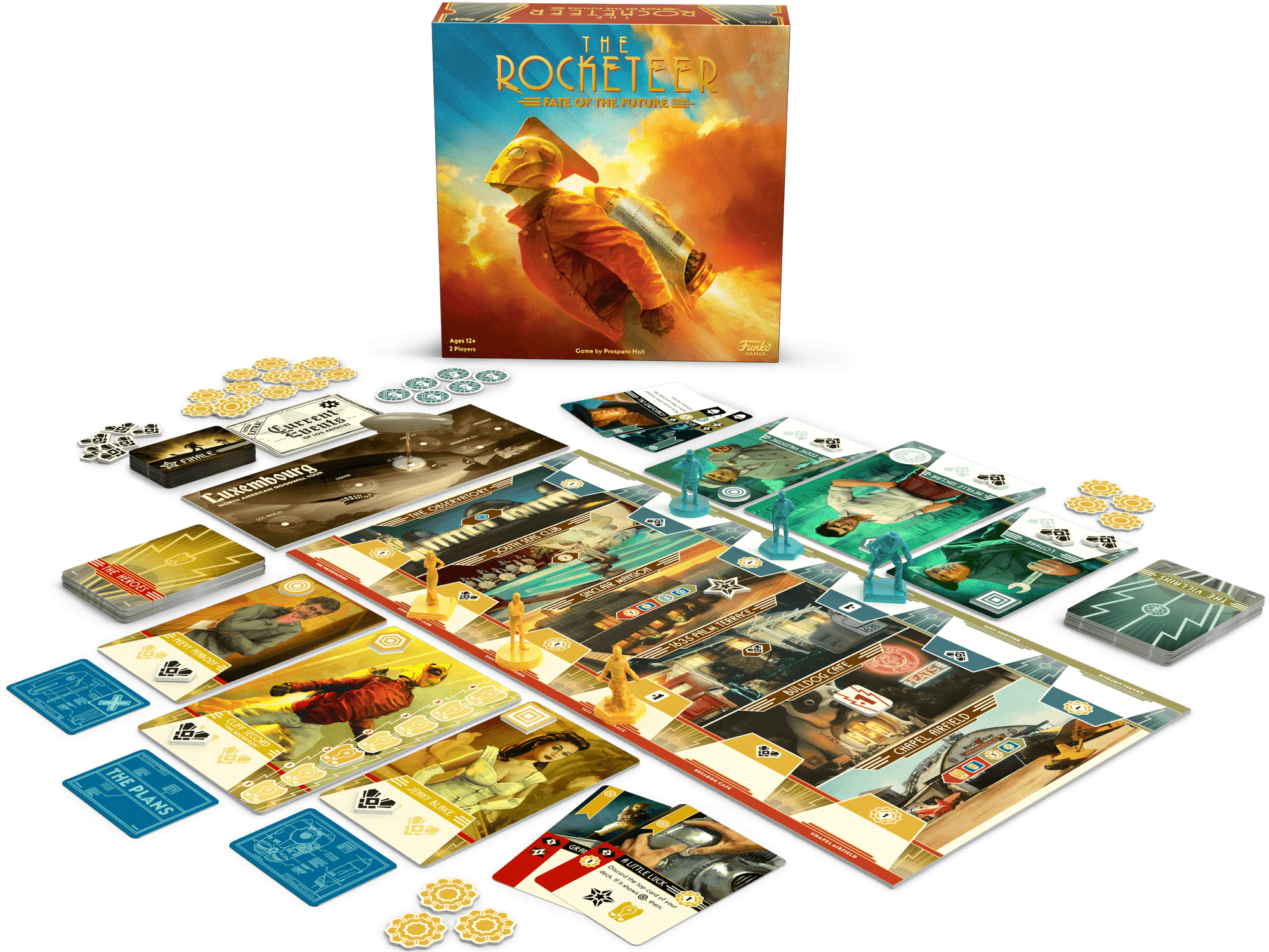
Friday Filler: The Rocketeer

With war looming – at least in Europe, the future of the world may depend upon who gets possession of a startling piece of equipment which could push the future of aviation technology—a rocket pack! Stolen to order from Howard Hughes by gangsters, they were forced to hide it in their getaway and both the one working model and the plans have ended up in possession of Cliff Secord, a stunt pilot. As he learns to fly the rocket pack, he comes to the attention of Eddie Valentine, the mobster hired to carry out the theft in the first place, and the man who hired Eddie, the matinee idol, Neville Sinclair, who also happens to be a secret Nazi! If Eddie Valentine cannot get the plans, then Sinclair’s henchman, the glowering Lothar certainly, if Lothar fails, Sinclair has a secret army of soldiers at his command. Cliff Secord must stop the plans from falling into Nazi hands—and if they do, get them back before Sinclair can travel to Germany. He has the help of his trusty mechanic, Peevy, and his girlfriend, both of whom can get places he cannot. Will Cliff keep hold of the rocket plans or will he fail and advance Nazi science in readiness for the coming conflict?

So this essentially, is the plot to the 1991 Disney film, The Rocketeer, which of course, was adapted from the brilliant comic book series by the late Dave Stevens. Both combined art deco stylings, pulp action, and a serving of modest cheesecake with the inclusion of the Betty Page-like Jenny with the inspiration of Republic Pictures serials of the early nineteen fifties, most notably Radar Men from the Moon and Commando Cody: Sky Marshal of the Universe. (If you have not seen the film, why not? It is genuinely good fun. Actually, go watch the film instead of reading this review. I honestly do not mind. Really. I promise you will not be disappointed. In fact, I am watching it right now as I type this, so what is your excuse?) This it also turns out is the set-up for The Rocketeer – Fate of the Future. Designed by the same team behind Indiana Jones: Sands of Adventure and Jaws, The Rocketeer – Fate of the Future is a two-player, asymmetric boardgame which was published by Funko Games in 2021—the thirtieth anniversary of the film. Designed for ages twelve and up, each player in The Rocketeer – Fate of the Future controls a team of three characters who will race back and forth across Los Angeles, trade punches as much as pithy putdowns, all the while trying to ensure that by the time the zeppelin, the LZ Luxembourg, is in town, they have possession of the rocket pack plans. The game plays in forty-five minutes, but faster once you get to it is rules—though it is not that complex.

The first thing that can be said about The Rocketeer – Fate of the Future is that this is a great looking game. You know that the moment you open the box and the Rocketeer’s helmet stares at you from the back of the board. This is a lovely detail—as is the map of Los Angeles on the inside of the lid of the box. Neither add a single thing to the game except love for the source material. The game is full of such details, such as the Current Event cards being designed to look like newspaper front pages and the art deco style throughout. The artwork is excellent, fully painted rather than drawn from Dave Stevens’ own artwork or stills from the film. It is all inspired by the film and is all very, very good. If there is a downside to the components, it is the miniature figures for each of the six characters. It is easy to tell which one is which, but they are more representative than effectively depicting the characters. The other aspect of the game’s look is the lack of reference to, or iconography of, the Nazis. Although we know Sinclair to be one, that is enough to play the game and it need not be made obvious and so spoil the look of the game.

At the heart of The Rocketeer – Fate of the Future are the plans to the rocket pack. These are represented by three cards. One is the Rocket Blueprint, the other two are dummy plans. The Heroes start play with these hidden and face down. The Villains will Tussle with the Heroes to determine which of them has the Rocket Blueprints and having taken possession of them, will keep them hidden and face down. It is the Heroes turn to Tussle with the Villains Heroes to determine which of them has the Rocket Blueprints and having taken possession of them again, will keep them hidden and face down. Play will continue like this over the course of five or six rounds, the aim being not just to keep hold of the Rocket Blueprint, but acquire Finale cards. Finale cards can be earned from playing the Abilities on cards and from having the Plans at the end of each round. Finale cards reward points and the player with the most points at the end of the game—indicated by the arrival of the LZ Luxembourg in Los Angeles—wins the game.

The Rocketeer – Fate of the Future is played out a board depicting different locations from the film across Los Angeles. These include The Observatory, the setting for the film’s climax, the South Seas Club where Sinclair takes Jenny to dinner, Sinclair Mansion, 1935 Palm Terrace—home to Peevy and Cliff, Bulldog Café where Cliff takes Jenny to dinner, and Chapel Airfield, scene of much of the film’s action. These locations are marked with Icons indicating the benefits a player can gain from visiting, knocking out opponents, and being in control at the end of a round. Each Player controls the three heroes—Cliff, Jenny, and Peevy, or the three villains—Neville Sinclair, Eddie Valentine, and Lothar. As the Rocketeer, Cliff has the advantage of the rocket suit and has greater movement—which can be increased, whilst as a Nazi agent, Neville Sinclair can recruit and build a secret army of soldiers. When he ambushes any of the heroes, Eddie Valentine realises who Sinclair is working for and scarpers, but Sinclair has his army, nonetheless. It is best for the Villain player to recruit as many as he can before unleashing them. Sadly, unlike in the film, Eddy Valentine does not then fight on the Heroes’ side.

Control of each player’s three characters is done via a deck of cards. Every card has icons to indicate which character or characters the card applies to, an action or an ability that the player character choose between, and the cost of using the ability as well as a good illustration. For example, ‘Put It In Neutral’ can be used by either Cliff or Peevy. If used as an Action card, it grants a Move and a Tussle Icon and their associated actions. However, if used as an Ability, there is no cost, but the character can move to any Location and take the associated action there. The illustration shows Cliff as the Rocketeer in the back of Peevy’s pickup truck, using the power of the rocket pack to make a getaway. This illustrates one of the scenes from the film and all the cards are like this, depicting a scene from the film and so combining the film’s story and the rules in such a way that helps bring the game to life. It is really quite subtle, but if you know the film, it is just one more way in which the designers reward the players. Other rewards from the Ability options on the cards include gaining Grit or Clout, drawing a card, drawing a Finale card, revealing or hiding Plans. The Hero player can also increases Cliff’s skill and range with the rocket pack and the Villain player can recruit soldiers to his secret army and stage ambushes. Grit is possessed individually by each character and is used in Tussles and Clout is a shared resource used to activate the Abilities on many of the cards.

The game consists of several rounds. At the beginning of each round, a Current Event card will be draw, which adds a random event and determines how far the Luxembourg travels this round. Then, using a hand of seven cards, each player will take it in turn to active his three characters, have them move, Tussle with the enemy. A player can use as many cards as he wants or he can for each character. Once a character has been activated and moved, he cannot do so again that turn. At the end of the round, rewards are earned for having the Plans and from each location controlled. Tussles are simple. The Action part of a card has a Tussle icon on it. This represents the character’s strength in the Tussle and it can be increased by adding the character’s Grit tokens. The defending player can block the attack by discarding cards which have the Shield icon on them and card’s which have the defending character’s Icon on them. This also costs Grit. The character with the higher Tussle Strength will win the Tussle. Only the defending character can be knocked out in a Tussle, which if his side has the Plans, will also reveal if he has the Rocket Blueprint or the dummy plans. A Tussle can—and will often—end with a standoff, with blows exchanged, Grit expended, and no knockout. This though does make a defending character weak if the acting player still have characters to move. Once both players have moved all three of their characters, the round is over, rewards are awarded, and a new round is set-up. Once the Luxembourg arrives in Los Angeles, a final round is played and the game ends. Players total their points from the Finale cards—typically two or three points per card, though some have zero points and others have conditional rewards such as a bonus for Grit in play or controlling a location—and the player with highest total wins.

The Rocketeer – Fate of the Future does feel a little long in its game play and though designed to be asymmetrical, does favour the Heroes more than the Villains. The Heroes have more chances to gain Finale cards and their mechanics are simpler, whereas the Villains have the Secret Army, which is a bit fiddlier and a different sub-mechanic for the Villain player to have to contend with. Plus, when the Secret Army does come into play, it cannot possess the Rocket Blueprint, meaning that if in the Villains’ hands, either Neville Sinclair or Lothar has it, making it easier to track down and get back. The aspect of winning via the Finale cards means that neither player quite knows who is winning until the very end unless one player has managed to get many more than the other. So, it can be difficult to work out how you are progressing in the game.

The Rocketeer – Fate of the Future is a clever design which really takes advantage of its source material to turn it into a good game. The game play is fairly simple, tactical rather than strategic—a player needing to get the best out of his hand of cards in a round rather than long term planning, and thematic. In fact, highly thematic! If you are a fan of The Rocketeer, then The Rocketeer – Fate of the Future is definitely the game for you. The Rocketeer – Fate of the Future definitely looks the part—comic book or the film—and who wouldn’t want to sock Neville Sinclair where it counts?

Saturday, 21 January 2023

Quick-Start Saturday: Pitcrawler

Quick-starts are a means of trying out a roleplaying game before you buy. Each should provide a Game Master with sufficient background to introduce and explain the setting to her players, the rules to run the scenario included, and a set of ready-to-play, pre-generated characters that the players can pick up and understand almost as soon as they have sat down to play. The scenario itself should provide an introduction to the setting for the players as well as to the type of adventures that their characters will have and just an idea of some of the things their characters will be doing on said adventures. All of which should be packaged up in an easy-to-understand booklet whose contents, with a minimum of preparation upon the part of the Game Master, can be brought to the table and run for her gaming group in a single evening’s session—or perhaps two. And at the end of it, Game Master and players alike should ideally know whether they want to play the game again, perhaps purchasing another adventure or even the full rules for the roleplaying game.

Alternatively, if the Game Master already has the full rules for the roleplaying game the quick-start is for, then what it provides is a sample scenario that she still run as an introduction or even as part of her campaign for the roleplaying game. The ideal quick-start should entice and intrigue a playing group, but above all effectively introduce and teach the roleplaying game, as well as showcase both rules and setting.

—oOo—

What is it?
The Pitcrawler Quickstart is a quick-start for a fantasy roleplaying game inspired by classic Fighting Fantasy and Lone Wolf solo adventure books, but instead of being a ‘Choose-Your-Own-Adventure’ game, it is designed to be played by two players. One is the Adventurer; the other is the Games Master.

The Pitcrawler Quickstart includes a basic version of the full game, but covers rules of Adventurer creation, an explanation of the rules and the roleplaying game’s implied setting, a table for creating scenario titles as inspiration, and four sample scenarios.

It is a twenty-seven-page, full colour booklet.

It is published by MacGuffin and Company.

How long will it take to play?
Each of the scenarios in the Pitcrawler Quickstart can be played through in a single session.

Who do you play?
One player is the Adventurer, but not a Wizard. The other player is the Games Master.


How is a Player Character defined?
The Player Character has five qualities. These are Face, Feet, Fingers, Fists, and Heart. Each is rated by a die type, from a four-sided die to a twelve-sided die. The die type attached to each quality is determined randomly. He starts play with seven Hit Points, a Background, three areas of Expertise, a Companion, and some equipment. The Backgrounds, which indicate what the Adventurer did before he came a Pitcrawler, include Artist, Burglar, Crop Farmer, Gravedigger, Mayor, and Sailor. Each Background provides two items of equipment and two areas of Expertise, one of which is mandatory, the other the player can choose. The third is determined randomly. The Background also provides some equipment, two other items are determined randomly, and the player choses a weapon.

The Companion assists with particular types of tests and can perform a particular ability once per scenario. For example, the Priest can assist with tests of willpower and pass a Complicated Heart test for the Adventurer once per scenario. The player should name the Companion and explain why the Companion is accompanying the Adventurer.

How do the mechanics work?
To undertake an action, the Adventurer’s player rolls an appropriate quality and aims to equal to or higher than a Difficulty set by the Game Master. The Difficulty ranges from three or Simple to eighteen or Inconceivable. When a quality die is rolled, it can explode, which means that it is possible for the Adventurer to overcome a challenge even if the die type is low. In addition, the difficulty of the test can be lowered one step if the Adventurer has a relevant Expertise, a Useful item, or is Assisted by a Companion or NPC willing to help.

Failure can lead to loss of Hit Points and/or a consequence which will send the scenario in a different direction. A critical success grants the Adventurer an extra reward.

If failure is likely, the Adventurer can instead ‘Put his heart Into It’ and his player roll the Heart quality die and add it to the total. If the roll is a failure, it is counted as a critical failure.

One clever mechanic is that of ‘Thumbs’, which apes the keeping of the thumb on a previous page in a solo adventure book as the player explores an option on another. In effect, this allows the player to turn back the clock in the scenario to a reset point and there make a different choice. A player can have up to five Thumbs depending upon the difficulty of the play.

In addition, the Game Master is advised to present actual physical or mental puzzles that the player as the Adventurer must solve at the table.

How does combat work?
Combat uses the same mechanics. Most weapons use the Fists quality to roll attacks, except where greater finesse is needed, in which case it is Feet instead. Fingers is used for missile attacks. If the quality roll is successful, the Adventurer inflicts a point of damage, more if it is a critical success. Failures mean that the Adventurer suffers damage. Enemies typically have one Hit Point each, so will be killed on a successful attack. Critical damage is inflicted against multiple opponents. 

How does magic work?
The Adventurer cannot cast magic in Pitcrawler. It is entirely the province of Wizards and their potentially world changing powers. The Adventurer can use arcane items.

What do you play?
There is no given world or world lore in the Pitcrawler Quickstart. It is presumed to be over-the-top grim fantasy, but one which eschews ‘Old School’ elements with its traditional treatment of females and races, alignments, and its play styles. It instead replaces these with Wizards who are powerful magicians capable of changing the world around them, not always to the benefit of the inhabitants. Wizards are also very rich and their tombs are often worth plundering. Wizards are sufficiently powerful that as a group they could destroy a minor god and even face down a major one!

The Pitcrawler Quickstart includes four sample scenarios. These include a raid on a tomb, an attempt to escape a murder-dungeon, a retrieval mission to recover a clockwork device from a swamp, and a retrieval mission on an island surrounded by a rainbow sea with the different colours having different magical effects.

Is there anything missing?
The Pitcrawler Quickstart could have done with more advice for the Game Master on running the individual scenarios and presenting the content to the player as well as mixing in the puzzles and traps, and giving the player meaningful choices.

Is it easy to prepare?
The rules are easy to grasp, but the preparation required by the Game Master could have been supported better.

Is it worth it?
The Pitcrawler Quickstart provides plenty of content to play with and it does something that few roleplaying games do and that is present a roleplaying game for one-on-one play. It is underwritten in terms of support for the Game Master, who will need to work a bit harder to prepare it for her player.

Where can you get it?
The Pitcrawler Quickstart is available here.

Saturday, 20 July 2019

Gibsons 100: L'Attaque

Gibsons is one hundred years old. Founded as H. P. Gibson & Sons Limited in 1919, it is the oldest manufacturer of board games in the United Kingdom as well as a noted manufacturer of jigsaws. In its time, it has been famous for publishing the classic strategic games of the 1970s and 1980s—Civilisation and Kingmaker—but before World War II, it was famous for publishing a quartet of early military strategy games. Known as the ‘big four’, the quartet consisted of Dover Patrol, L’Attaque, Aviation, and Tri-Tactics. Of these four, Gibsons has published L’Attaque in a brand new edition to celebrate its centenary. Originally marketed as the ‘game to rival chess’, L’Attaque is an abstract war game designed for two players, aged eight and up. The new edition remains relatively unchanged bar the inclusion of a set of the rules rewritten for clarity and a facsimile of the original 1925 rules.

Originally, a French game designed by Mademoiselle Hermance Edan who received a patent for a ‘jeu de bataille avec pièces mobiles sur damier’ (a battle game with mobile pieces on a game board) in 1909, the game was named L’Attaque by its French publisher, Au jeu retrouvé, before H. P. Gibson & Sons Limited purchased the English language rights to the game and published it in 1925. In this game two armies will face off against each other over a set of three rivers. In the original, the opponents were the English and French armies, but they have since been simply named the red and the blue armies. Played out on a nine by ten grid of squares with three rivers at its centre, the aim of the game is to defeat your opponent by either capturing their Flag or forcing him into a stalemate where he cannot move his pieces.

Both armies are identical, consisting of thirty-six pieces made up of the following in ascending order of value and rarity: Scout (2), Sapper (3), Sergeant (4), Lieutenant (5), Captain (6), Major (7), Colonel (8), Brigadier (9), and Commander In Chief (10). Each army also has a several Mines and a Flag. Although the artwork on the front of the pieces is the same for both sides—essentially an interwar period style English army—the backs of the pieces are either plain blue or plain red. A higher value piece beats a lower value piece, but several pieces have special moves. Thus, the Spy is easily defeated by every other unit, but defeats the Commander In Chief; when revealed, a Mine blows everyone up in adjacent squares, except a Sapper who defuses the Mine; and Scouts have unlimited, orthogonal movement. All other units are capable of moving just the one space, either backwards or forwards, left or right.

Set-up is simple enough. Each player takes his army and places its pieces on his side of the board, keeping all of the fronts and thus the types of pieces facing him, and the plain, coloured back facing his opponent. He is free to place his pieces where he wants, although Mines cannot be placed near the rivers. In general, each player will place his Flag at or near the back of his forces, as far away from his opponent’s forces as possible, protected by one or more Mines. On his turn, a player moves one piece. If it is in front of an opposing piece, then the player can declare an “Attack!” When this happens, both attacker and defender reveal the attacking and defending pieces, the highest ranked piece typically beating the lower ranked piece. Pieces of equal value defeat each other. The beaten piece or beaten pieces are removed from play, but a good player should endeavor to remember which pieces have defeated his own and so work to bring a piece of a higher value to defeat them. During the initial stages of the game, the two armies will be probe each other’s forces attempting to defeat or determine which pieces are which, whilst in the later stages, players will bring up their heavier units to defeat their opponents’ stronger defenders.

Some pieces are easier to identify than others, of course. The Scout is easy to identify simply by his extended movement, so a player may want to be more circumspect in revealing that until necessary. Similarly, Mines and Flags can be identified by the fact that neither moves, but that sets up the possibility of a trap. A player could keep a high value unit immobile throughout a game to lure his opponent in and so eliminate a piece attempting to locate and capture his Flag or locate a Mine. This can be effective if the attacking unit is a Sapper, which would deny a player the all important ability to defuse Mines. Once this trap is sprung, the high value piece is free to move and openly attack and defend.

With a playing time of twenty minutes, L’Attaque is surprisingly playable for a game that is over a century old. It is not a sophisticated game by modern standards, but it has given rise to many imitators, most notably Stratego, and was highly popular in its day. Nor is it a particularly deep game and the suggestion that it is a ‘game to rival chess’ is really hyperbole upon the part of the publisher.

Physically, the production values of the centenary version of L’Attaque are really quite lovely, whether that is the rich red box, the artwork on the playing pieces, and the heavy mounted board. The rules are printed on a slim, but heavy card sheet, whilst the inclusion of a facsimile of the original rules is a nice touch.

Of course, there is a wonderful sense of nostalgia to L’Attaque and this centenary edition does much to enforce that. As an artefact in itself, the game is nice celebration of the publisher’s birthday, but L’Attaque can still serve as an introduction to both early games and to wargaming, to bring new players into the hobby, and with a short playing time, to serve a diversion between longer games too. L’Attaque is a lovely piece of history—both gaming and ordinary history—which plays up to our nostalgia.

Friday, 17 May 2019

Friday Filler: Star Realms

The traditional card game plays from a single deck of cards, with players drawing from the same deck during play, for example, in games like Poker or Braggart. The publication of Magic: The Gathering in 1993 introduced a new type of card game—the collectible card game—in which players not only had their own decks, they could design and build their own decks from the ground up and then bring them to play. In 2009, the publication of the Spiel des Jahres-award winning Dominion introduced another type of card game—the deck builder. Just like the collectible card game, in a deck builder type of game, each player has his own deck, but the difference is that instead of building his own prior to player, each player starts the game with a basic set of cards and then builds and uses his deck during play. Typically, the deck building game will provide a means to purchase or obtain further cards and either attack or affect rival players or affect the game in some way. One good example of the latter is AEG’s Trains in which players acquire cards in order to build a railway network and its associated facilities, whereas a good example of the former is Star Realms.

Published by White Wizard Games in 2014, Star Realms is a spaceship combat deckbuilding game designed for two players. Starting from exactly the same set of base cards, the players will take it in turn to draw cards, generate Trade with which to purchase better spaceships and bases and Combat to attack their opponent and his Bases and Outposts, discard their used cards, and then refresh their hands for their next turn. Each player begins play with fifty Authority or health and since the base Personal Decks only include two cards (Vipers) which generate a point of Combat each, players are going to want to buy Spaceships, Bases, and Outposts which generate more combat and thus inflict more damage. Of course, these cost anywhere between one and eight Trade, and since the base Personal Decks only include eight cards (Scouts) which generate a point of Trade each, players are going to want to purchase Spaceships, Bases, and Outposts which generate more Trade. So from the outset, players are really going to want to buy more and better Spaceships, Bases, and Outposts.

One type of card (Explorers) is available to purchase throughout the game and these generate two Trade when drawn. Five other cards are also always available to purchase in the trade row, being refreshed when a player makes a purchase on his turn. The cards in the trade row are where Star Realms begins to get interesting because they fall into four colour-coded factions each with their unique mechanical focus. The green Blob faction have organic ships and bases with an emphasis on generating Combat and removing cards from the trade row; the red Machine Cult generates Combat and enables cards to be scrapped from a player’s deck; the yellow Star Empire generates Trade and allows a player to manipulate cards, either letting him draw more cards or forcing an opponent to discard cards; and the blue Trade Federation generates Authority for a player to restore his health as well as Trade.

Further, most of the cards have a secondary ability which is only triggered when a card of the same faction is played on the same turn. So play two or cards from the same faction and if they have a secondary ability, then they are all triggered. The effects will vary from faction. Most generate more Combat, but a Trade Federation card will generate Authority, a Blob ship more combat, and so on. One way in which a secondary ability can be triggered is by having a Base or Outpost in play. All four factions have Bases or outposts or a mix of the two which can be purchased and added to a player’s deck. Both have abilities which come into play on a player’s turn, sometimes a choice of abilities which a player can choose from one turn to the next, with both having their health value which represents the cost in Combat for an opponent to destroy them and return them to a player’s discard pile. In addition, the health value of each Outpost also represents their ability to stop Combat getting through to damage a player’s Authority. Until such times as a player can generate Combat to destroy his rival’s Outpost, an Outpost will continue to prevent Combat getting through to his Authority.

Some cards give a player one last option. They can be scrapped and removed from play—rather than go into a player’s discard pile—and grant the player more Combat or more Trade. In general though, a player is unlikely to scrap a card like this, but will probably do so towards the game to generate sufficient Combat to inflict the final blow to an opponent, to get rid of cards that are clogging up a player’s deck, and to generate enough Trade to purchase that a player really, really wants.

One mechanic that is common to many deck building card games is that of clogging up a player’s deck, so preventing him from more frequently drawing the better cards he has purchased. In a game like Trains, it is represented by Waste or pollution as well as the base cards in each player’s starting deck. In Star Realms, what clogs up up a player’s deck are the base cards in starting deck—the Vipers and Scouts. These do not provide much benefit to player later in the game and so a player will probably want to scrap them. Here is where the cards of the Machine Cult come to the fore, providing the means to scrap a card from a player’s hand or discard pile when played. This is one of the primary strategies in the game—essentially getting rid of the chaff in order to bring out the wheat over and over again.

Other strategies in the game are also built around the factions. So play Blob cards to inflict a lot of Combat, Star Empire cards to draw as many cards as possible whilst stopping a rival from doing so, and Trade Federation to gain or restore as much Authority as possible. What is key though, is that a strategy solely focusing on one faction rather than another is difficult to bring into play, so a player will have to mix and match strategies and factions to one degree or another. Whatever strategy a player decides to use, his objective is simple: reduce his opponent’s Authority to zero and so win the game. Mastering these strategies is not difficult and overall, the game is easy to learn.


Star Realms comes in a small, tightly packed—and easily portable—box which contains two ten-card Personal Decks—one per player; an eighty card Trade Deck from which Spaceships, Bases, and Outposts will drawn to fill the Trade Row where the players can purchase them for their decks; ten Explorer cards which provide two Trade rather than the one of the Scouts in the base Personal Decks; eighteen double-sided Authority cards for tracking how much damage a player has; and a pair of rules sheets. The cards not only feel good in the hand, but they are very clearly designed and easy to read. Best of all, their fully painted artwork is excellent, every card type having its own illustration.

With each player just drawing five cards per turn, they only have a few things to do each turn, Star Realms plays fairly quickly from one turn to the next. In fact, a game can be played in just ten minutes, making it easy to play, then set up, and play again. The rules do cover playing with more than two players, up to six, but for each extra pair, another copy of the Star Realms core set is required and that does increase the cost of the game. Plus, as much fun as multiplayer games are, the play of Star Realms feels very much best suited to just the two-player duel of the one core set.

Although there are now plenty of expansions available, the core set for Star Realms offers an incredible amount of game play and depth in terms of strategy in what is a small, inexpensive box. Plus it is really attractive to look at. Easy to learn, quick to play, very well designed, Star Realms is the perfect two-player deck building game and the perfect two-player filler.
—oOo—

White Wizard Games will be at UK Games Expo which will take place between May 31st and June 2nd, 2019 at Birmingham NEC. This is the world’s fourth largest gaming convention and the biggest in the United Kingdom.

Friday, 22 July 2016

Devilish Cards & Dice

Imps: Devilish Duels – A Dice & Card Battle Game is the latest game from Triple Ace Games, following on from designs such as Rocket Race: A Steampunk Rocket Building Card Game, Halfling Feast: a card game of competitive eating for 2-4 players, and Cadaver: A Game of Lighthearted Necromancy. Launched at UK Games Expo 2016, it is described as a ‘hybrid dice and card battle game’ for two players in which each player sends a team of four mischievous Imps to fight a number of elemental trials and determine who is top Imp wrangler and thus top wizard!

Now it should be made clear that this review is of a press preview version of Imps: Devilish Duels which like the preview print and play version contains just twelve Imp cards. The full version will come with a total of twenty-six Imp cards. This press preview version also comes with a plastic battle tray, whilst some Kickstarter versions of the game will have a wooden one. Both versions include a six-page rules booklet and sixteen six-sided dice. The colours of the Imp cards and the dice match according to their element: Air (white Imp cards and clear dice), Earth (green), Fire (red), and Water (blue). 

At the beginning of the game each player selects the four Imps that he will send into the trials and receives eight dice, two of each colour. On each round both players select four of their dice of any colour and one or two of their Imps to send into the trial. Then both players take in turn to roll their dice and compared with each other in a set order, so the green dice for the Earth Trial, the red dice for the Fire Trial, the blue dice for the Water Trial, and the clear dice for the Air Trial. Then the players can each roll and add two dice of their choice or reroll dice dice already in play. Then the final totals for each trial are compared, the higher total winning that player the trial and a bonus for the or a double bonus if the winning total is double or more than the other player’s total. So if a player wins the Earth Trial, then he can increase one of his dice by one of the subsequent trials, that is Fire, Water, or Air. If his total is double or more than his opponent, then he gets to increase two of his dice by two each. Note that no die can be increased beyond six. Winning subsequent trials force dice rerolls on an opponent, removal of his dice, and so on until one player wins wins the Air Trial and can banish one of his opponent’s Imps. Play proceeds like this until one player has managed to banish all of his opponent’s Imps and wins the game.

There is a cascade effect to winning trials, so that winning one trial gives an advantage to the next and so on and so on, but this is no guarantee that a player will win the final Air Trial and banish his opponent’s Imp. Good dice rolls will nearly always beat bad but modified dice rolls. Then there are the Imps. Every Imp has an ability that can aid a player with its Mischief. So the Earth Imp Puck allows the players to conduct an extra Earth Trial after the Fire Trial; the Fire Imp Soot deducts one from all of an opponent's Fire dice or forces him to reroll one of his Fire dice; the Water Imp Squirt adds one to each of a player’s Water dice or allows any of them to be rerolled; and the Air Imp Nimbus enables both players to combine their Water and their Air dice in the Air Trial. 

In initial games, it makes sense for both players to bring one dice of each elemental colour to their initial rolls. In later games players can pick and choose which dice they roll as well as which Imps they bring into play. To an extent, the player who goes second does have a very slight advantage over the other since he can react to whatever the first player rolled and can assign his dice to where he might be able to beat his opponent. Choice of Imp plays an important role too as their Mischief can greatly influence the outcome of a trial which if won affects the next trial and so on and so on…

Physically Imps: Devilish Duels – A Dice & Card Battle Game is up to standards of other games from Triple Ace Games. The rules are clearly written and although the game might be slightly easier if the Elemental Trials outcome table might have been on the back page of the rulebook, this is basically picking a nit… The artwork on the cards though is really very nice and each captures the character of each Imp.

Although it initially looks complex, Imps: Devilish Duels turns out to be straightforward to play and easy to teach. It also offers a pleasing tactical experience as each player brings their best Imps and their mischief into play. The twelve cards in the press preview version of Imps: Devilish Duels offer more than enough options to replay the game over and over, but the full game will offer even more. For a two-player game, Imps: Devilish Duels – A Dice & Card Battle Game packs a lot of tactical punch into both its box and its twenty-minute play time.

—oOo—

Imps Devilish Duels: A Dice & Card Battle Game is currently available to fund on Kickstarter.

Sunday, 15 December 2013

Viking Orders

Mijnlieff is an award-winning game from Hopwood Games, designed Andy Hopwood, a boardgame designer who lives local to me. Winner of the Best Abstract Game at the UK Games Expo 2010, Mijnlieff is all about controlling your opponent’s turns, forcing where they can play a piece whilst you try and lay the most lines of three. Designed for two players, Mijnlieff has a Viking theme and is essentially a variant of ‘Noughts & Crosses’ or ‘tic tac toe’, but a very clever one at that.

The game consists of four plain playing squares, each marked with four squares, and two sets of eight playing pieces, one white, the other red. The playing squares are usually laid out to create a four-by-four square grid, but other layouts are possible. Each set of playing pieces consists of four tiles – two Straights, two Diagonals, two Pullers, and two Pushers. When played, each tile tells an opponent where he must place his next tile. A Straight tile forces the other player to play a tile orthogonally to the one played; a Diagonal forces him to play a tile diagonally to the one played; a Puller forces him to play a tile adjacent to the one played; and a Pusher forces him to play a tile away rather than adjacent to the tile played. The playing tiles are clearly marked and easy to understand.

Each turn a player places a single tile. If a player cannot place a tile because he is blocked, then he loses a turn. For each line of three tiles – orthogonally or diagonally – that a player can lay, he scores a point. The player with the most points wins the game.

Mijnlieff is a simple game, but it does force a player to think about the consequences of his next move. Not only that, but he needs to think about what his opponent will play and how he can stop him. It is thus much thoughtful a game than the traditional ‘Noughts & Crosses’ or ‘tic tac toe’ and as a consequence takes a little longer to play. It is still a quick game though, and several games can be played in quick succession.

If there is an issue with Mijnlieff, it is that it is only available from Hopwood Games, but the good news is that Astraware has adapted the game as an app available for iOS and Android devices. It is free to download, but to get the very fullest use of the game does require in-game purchases – these include being able to play against more than two opponents at a time and to be able to rearrange the board other than a square. Once downloaded, the tutorial quickly teaches you how to play and then you are off, defeating – or not, one Viking after another, each progressively a more challenging opponent. In addition, you can play against your friends, random opponents, or with an opponent with the device between you. Visually, the game is well presented, there being a satisfying heft and click as the playing tiles are played and a slightly sharp ringing sound as lines are scored.

Either version of Mijnlieff is worth adding to your games collection. Both serve as an excellent, if thoughtful filler game for two players – there being advantages to both versions. It is a clever variation upon a very basic game, the one that we first played when we were children, that in Mijnlieff offers more play and more challenge.