Friday, 10 April 2026
Friday Filler: 7 Wonders Dice
7 Wonders Dice plays both exactly like 7 Wonders and exactly unlike 7 Wonders. Like 7 Wonders, it is designed to played by up to seven players, is played simultaneously, can be played in thirty minutes or less, and player controls the fate of a city home to one of the Wonders of the Ancient World. Unlike 7 Wonders, the game play of 7 Wonders Dice revolves around dice—as the game’s title suggests—and the results are not tracked by cards drafted and played, but by results of dice shaken that are recorded on player city boards. 7 Wonders Dice is actually a ‘Roll & Write’ rather than a straight dice game.
The game consists of ten dice, seven boards, seven dry-erase pencils, seven cloths, one box, scoreboard, three player aids, and a rulebook. All ten dice have different symbols on their faces, matching resources in the game. Seven of the dice—three grey and one each of blue, red, yellow, and green—are the starter dice. The colours match the colour of the cards in 7 Wonders. Thus, blue for culture, red for military, yellow for merchants, and green for science, whilst the grey cards are basic resource cards like the brown cards in 7 Wonders. The black, white, and purple dice are special dice. These only come into play when tracks on the University are completed and actually replace the base dice. The black die is the Spy and enables a player to cross off spaces in the buildings on his board; the white die grants access to the Gallery of Leaders and will help speed up construction; and the purple die allows access to Guild Court.
Each board is divided into two parts. The bottom part represents the city’s economy and is where a player tracks what resources he has access to in the city’s Warehouse and how much money he has in the Gold Reserve. The upper part is the city itself and here there are seven areas. These are the city’s blue-coloured Agora where culture is tracked; yellow-coloured Market where gold is generated; red-coloured Eastern Barracks and Western Barracks from where a player launch attacks against his neighbours and defend against attacks from his neighbours; green University where the special dice are unlocked; and purple Guild Court where a player can gain Victory Points from progress made by his neighbours. In addition, each board for its city’s Wonder and a set of three bonuses that can be gained by completing buildings.
At the start of the game, each player receives a board and a dry-erase pencil. A random player places the starting seven dice in the box. This box is the cleverest part of the game. It comes with a lid and when the lid is on, it looks like, and is called, the Forum. The bottom of the box is divided into four quadrants. These are priced from zero to three and separated by raised ridges. The Forum is shaken in a circular direction and the lid removed. The dice will now be distributed between the four quadrants. The face up symbols on the dice are what is available to buy at the Forum that turn and the value of the quadrant they are in determines how much they will cost to purchase that turn. A player can purchase only one die per turn and more than one player can purchase the same die.
Once each player has decided on the die he wants to purchase, he can one of three things with it. First, he can use it construct a building. Each building has one more or tracks showing what can be built next as well as the cost that has to be paid in addition to the price at the Forum. Construction cost can be offset by resources, but these need to be purchased and marked off in the Warehouse. Once done though, they are permanent and a player will not need to keep purchasing their resource over and over. Second, he can build a stage of his city’s Wonder and gain its benefits. This does not require a die to do so, but simply resources and gold. Third and last, a player can pass instead of selecting a die and receive three coins.
When a player completely fills in a single building and gained its benefits, there is an extra bonus to be gained. Once a player has filled in a total of three buildings and gained all three bonuses, the players are allowed one more turn before the game ends. At the end of the game, each player totals up the number of Victory Points earned from filled in spaces in the buildings across his city. The player with the most Victory Points is the winner. In comparison to 7 Wonders, determining which neighbouring cities defeated each other is slightly more complex, but otherwise scoring is a lot simpler in 7 Wonders Dice.
7 Wonders Dice faces the same problems as 7 Wonders in that it is not easy to teach or learn its nuances. The basics are fine—shake the dice, spend a die, and so on, but initially there is likely to be a lot of hand holding. Further, , the adaptation of 7 Wonders into the ‘Roll & Write’ 7 Wonders Dice has come at a cost. Gone is the interaction between neighbouring players in terms of purchasing resources, and instead, there is the ability of neighbouring players to invest in military defence that reduces the Victory Points gained by neighbour in his military offence. Gone is the ability to tell a story. There is no sense of a city being built, features being added, and it being developed along side the efforts to build the Wonder. This is not helped by the fact that the differences between one city and another are slight. They are there, but nowhere as distinctive as they are in 7 Wonders.
This is not to say that there is sense of progress to the game, more so when one or more of the special dice is purchased and they replace the base game, representing the city needing more sophisticated resources as they do in 7 Wonders. It is relatively slight though. On the plus side, 7 Wonders Dice is compact compared to 7 Wonders and has fewer components, making it easier to set up and play, as well as teach.
Physically, 7 Wonders Dice is a well presented. Everything is of good quality and bright and breezy and the rulebook is well written. Care will be needed to ensure that the boards—both the city boards and the scoreboards—are wiped clean after each play lest they mark permanently.
7 Wonders Dice plays fast and it plays simultaneously, both great features it shares with 7 Wonders. Yet it lacks nuance and the differences between the Seven Wonders of the Ancient World that made 7 Wonders so good in the first place, that of developing a civilisation, of attempting to win with different civilisations, of trying out their differing strategies, and ultimately telling a story. 7 Wonders Dice ultimately feels like 7 Wonders-themed game than an actual 7 Wonders game. 7 Wonders Dice is likeable, but not likeable enough to warrant coming back to too often.
Saturday, 31 May 2025
The Little Book of Death ...in Spaace!
The solution is Death in Deep Space, the Science Fiction equivalent of The Death Book for Escape the Dark Castle. This is a book of over one hundred death scenes, each corresponding to a particular Chapter or Boss. It is very easy to use. Whenever a character dies as a result of the events in a Chapter or the showdown with a Boss, he checks the relevant entry in the pages of The Death Book. This is made possible because every card in Escape the Dark Castle as well as in all three of its expansions is marked with a unique code. Cross reference the code with corresponding entry in the book, whether for a Chapter or a Boss card, read out the description provided, and so provide an unfitting, but final end for your character, followed by that of everyone else.
For example, the details on the Boss card, ‘The Alien Queen’ reads as follows:
“Die, humansss!”
The Alien Queen was lying wait! Jets of venom fly towards you as she pounces—YOU must roll two HIT DICE now.
If a player should die in the course of this final confrontation before he and his companions, always a strong possibility in Escape the Dark Sector, he picks up Death in Deep Space and after finding the entry for ‘The Alien Queen’, he reads aloud the following:
The Alien Queen
Once it enters your bloodstream, the paralysing venom of the Alien Queen works quickly – a spreading rigidity coursing through your entire body, locking your joints one by one until you are all but paralysed. Even your eyelids cannot close, and you are forced to watch in horror as the terrible creature captures your fellow crew with equal ease.
With a series of hissed commands to her countless, scurrying servitor spawn, you are all dragged back her vast, deck-spanning nest. There, a slick, black, fleshy membrane covers the walls and beneath the vaguely humanoid shapes of her decomposing victims are still recognisable. Their shallow breaths rise and fall in eerie synchronicity, an indication that their suffering is yet to be ended. Soon, you and your crew join them.
Once in place, your spines are sliced open. The shimmering spools of nerve fibre that spill out are intertwined with those of the other captives suspended around – the connection sealed with a sticky, mucus coating. In this way, you become part of the fabric of the hive, a sensory node in a living web, lining the walls as far as the eye can see, warning the hive of approaching threats and passing the news back through the biotic chain in an instant.
For the rest of your days, your pain is theirs and theirs is yours; you see what they see and hear what they hear, your collective existence painfully prolonged in service to your bestial captor.
Your adventure ends here.
Physically, Death in Deep Space is a neat and tidy, if plain affair. A page of introduction explains how to use the book and contains the book’s single illustration which shows where the unique code for the Chapter or Boss card is located. Then each entry has a page of its own. There is a degree of repetition to the entries, but only a little, and it really only becomes apparent when reading the book from end to end, which is not its intended use. A small and relatively slim book, Death in Deep Space fits easily into Escape the Dark Sector: The Collector’s Box Set.
Death in Deep Space is book of endings, but one that provides a final narrative and some context to that death. Escape the Dark Sector is an enjoyable game, but character deaths can feel little, “Is that it?”. With Death in Deep Space, it is no longer the fact that you died, but very much how you died. Grim and ghoulish, The Death Book brings the death of every character, and with it, the game of Escape the Dark Sector to a nasty and unfortunate, but fitting end.
Themeborne Ltd. will be at UK Games Expo which takes place on Friday, May 30th to Sunday June 1st, 2025.
Saturday, 28 September 2024
The Little Book of Death
The solution is The Death Book. This is a book of over one hundred death scenes, each corresponding to a particular Chapter or Boss. It is very easy to use. Whenever a character dies as a result of the events in a Chapter or the showdown with a Boss, he checks the relevant entry in the pages of The Death Book. This is made possible because every card in Escape the Dark Castle as well as in all three of its expansions is marked with a unique code. Cross reference the code with corresponding entry in the book, whether for a Chapter or a Boss card, read out the description provided, and so provide an unfitting, but final end for your character, followed by that of everyone else.
For example, the details on the Boss card, ‘The Dark One’ reads as follows:
“Your pitiful trinkets are no match for my dark magic!”
As YOU enter the Dark One’s presence, any items YOU are carrying vaporise (other players keep theirs). Discard them now.
If a player should die in the course of this final confrontation before he and his companions, always a strong possibility in Escape the Dark Castle, he picks up The Death Book and after finding the entry for ‘The Dark One’, he reads aloud the following:
The Dark One
From the strange, clawed fingertips of The Dark One a terrible torrent of dark magic pours, crackling through the air and striking you down. The unrelenting stream intensifies, coiling around you and holding you in place like spectral chains. You roll and twist on the chamber floor, wracked with agony, foaming at the mouth. With a single motion of it staff, The Dark One sends you hurtling through the air. Your body slams into each of fellow prisoners, the impact knocking them from consciousness one by one. By an upward motion of the staff, you are now sent soaring high into the air, only to be released as The Dark One turns his back and glides out of the chamber. As quickly as rose you tumble helplessly downward, slamming to the cold stones and exploding in a shower of gore.
Your adventure ends here.
Physically, The Death Book is a neat and tidy, if plain affair. A page of introduction explains how to use the book and contains the book’s single illustration which shows where the unique code for the Chapter or Boss card is located. Then each entry has a page of its own. There is a degree of repetition to the entries, but only a little, and it really only becomes apparent when reading the book from end to end, which is not its intended use. A small and relatively slim book, The Death Book fits easily into Escape the Dark Castle: The Collector’s Box Set.
The Death Book is book of endings, but one that provides a final narrative and some context to that death. Escape the Dark Castle is an enjoyable game, but character deaths can feel little, “Is that it?”. With The Death Book, it is no longer the fact that you died, but very much how you died. Grim and ghoulish, The Death Book brings the death of every character, and with it, the game of Escape the Dark Castle to a nasty and unfortunate, but fitting end.
Friday, 2 September 2022
Friday Filler: The Fighting Fantasy Science Fiction Co-op V
Friday, 22 July 2022
Friday Filler: The Fighting Fantasy Science Fiction Co-op IV
Other mission packs added new Items, but not Escape the Dark Sector – Mission Pack 3: Quantum Rift. Instead it gives Artefacts to be found. For example, it might be a Roman shield or javelin, a bundle of dynamite or bottle of grog, or a ration tin or a samurai sword. These enforce the sense of times and places that the escapees can visit with the various Rift chapters.
Escape the Dark Sector – Mission Pack 3: Quantum Rift does not so much add new subsystems, as add an even greater degree of randomness to fit the randomness of its theme. It is a fun theme and one that easily expandable with yet more Rift cards which will take the escapees across time and space. As with the other Mission Packs for Escape the Dark Sector, this third one easily mixes with the others, perhaps even more so given its random nature. Escape the Dark Sector – Mission Pack 3: Quantum Rift is an entertaining addition to Escape the Dark Sector: The Game of Deep Space Adventure, pushing its Sci-Fi theme to an even more random height.
Friday, 24 June 2022
Friday Filler: The Fighting Fantasy Science Fiction Co-op III
As with Escape the Dark Sector – Mission Pack 1: Twisted Tech before it, Escape the Dark Sector – Mission Pack 2: Mutant Syndrome includes twelve new Chapter cards which represent the encounters the escapees will have as they flee. They may run into raging mutant prisoners, dumping grounds for radioactive waste, hideously mutated guards, three-headed security dogs, gain medical assistance from a hologram, and even a mutant testing station! The single Boss card is for The Mutanoid, a mutant so twisted that his body consistently emit mutagenic spores that inflict damage on the escapees—or mutate them. It makes use of the new core mechanic in the expansion, the ‘Mutation Die’.
The ‘Mutation Die’ is not only rolled for The Mutanoid Boss at the end of the game but also for certain Chapter cards and Item cards—or rather Mutation cards which are added to the Item deck. When drawn, these can force an escapee to discard Item cards from his Inventory as they prevent him carrying anything, but their most immediate effect to prevent an escapee from using his Cybernetic Implant. However, a Mutation can have a greater effect. Depending upon the symbol rolled on the ‘Mutation Die’, an escapee might lose Hit Points, but he might suffer another effect all together. For example, a Mutation to the Arm can add a single Might result to an action or allow a Block in Close Combat, a Mutation to the Leg can add a single Cunning result to an action or prevent the loss of Hit Points from a single die roll, and so on. These are all one use mutations, but others change a roll of the Crew Die to a Wisdom result and reduce Hip Point loss by one, and are ongoing effects. Between Chapters, an escapee can excise a Mutation and permanently lose its effect, whether positive or negative. This is dangerous and painful and means that the escapee again loses Hit Points. Other items in the expansion include the ‘Stun Baton’ which on the successful inflicting of a wound, stuns the enemy and prevents them from attacking that round, whilst the ‘Life Serum’ either restores two Hit Points or removes a mutation.
Escape the Dark Sector – Mission Pack 2: Mutant Syndrome also adds three new escapees. Lieutenants Grib, Parvon, and Xaree are new alien crewmembers and each comes with their Crew die. This introduces the ‘Mixed Double’ consisting of two symbols within a shield, which even though they are different, they count as a double of either symbol as required. This gives the three new Lieutenants some flexibility in terms of their die results.
Escape the Dark Sector – Mission Pack 2: Mutant Syndrome adds new subsystems as well as new encounters with the Chapter and Boss Cards. They add both elements of complexity and luck, though more of the latter than the former. Design wise, this expansion is again thematically strong rather than narratively strong, but the Mutation is only strong when it comes to the Chapter cards and the encounters the escapees can have. In comparison, the potential mutations they might suffer during their escape attempt are underwhelming, in terms of both number in the expansion and theme. Anyone expecting a rioting of weird and wonderful powers and defects will be disappointed. Even so, Escape the Dark Sector – Mission Pack 2: Mutant Syndrome is still easy enough to add to the core game. Overall, Escape the Dark Sector – Mission Pack 2: Mutant Syndrome is not quite as interesting as it could have been, but still a decent expansion which adds more Sci-Fi theme to Escape the Dark Sector: The Game of Deep Space Adventure.
Friday, 10 June 2022
Friday Filler: The Fighting Fantasy Science Fiction Co-op II
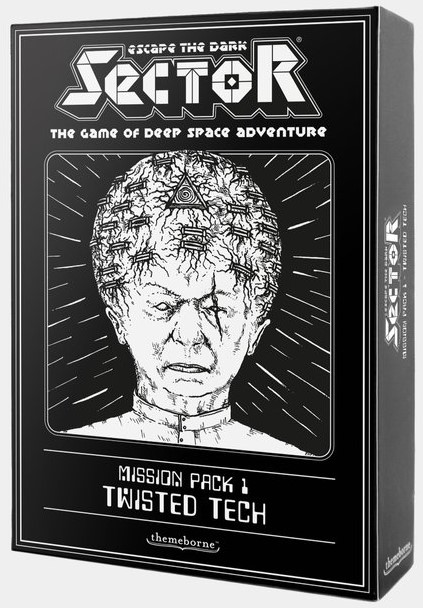
The nine Item cards include a mix of new cyberware, gear, and guns. The ‘Drone Commander Implant’ grants a second use of a Drone’s Basic Function before its card is flipped over. The ‘Chrono Rig’ enables any type or number of dice to be rerolled once per chapter (Escape the Dark Sector is played out in four chapters) and the second result used; the ‘Teleporter’ is used and discarded to gain a flanking attack in combat; and the ‘Nutri-Pill’ heals two Hit Points. Escape the Dark Sector – Mission Pack 1: Twisted Tech also includes three new weapons—the ‘Punch-Gun’, the ‘Sniper Rifle’, and the ‘Flame Thrower’. All three work in slightly different ways. Both the ‘Punch-Gun’ and the ‘Sniper Rifle’ need to be loaded using the ‘Special Ammo’ die, but the ‘Sniper Rifle’ must be then primed before it can be fired. If either hits, the Special Ammo die is rolled and can have an extra effect. This is extra damage for the ‘Punch-Gun’, but removes either the chapter dice of one type in the combat or three chapter dice of any type. This is a powerful effect as it helps negate the effects an encounter or chapter. Lastly, the ‘Flame Thrower’ can fire three bursts of flame of varying length, represented by rolling the ‘Flame Ammo’ dice, either one, two, or three per burst. These can result in inflicting damage on a target, no effect, or even engulfing a character in flames and causing them damage. Lastly, of course, there are the dice—the ‘Tech Die’, ‘Special Ammo’ dice, and the ‘Flame Ammo’ dice. (It will be easy to see the ‘Tech Die’ being used in the other two Mission Packs for Escape the Dark Sector.)
Physically, Escape the Dark Sector – Mission Pack 1: Twisted Tech is as well produced as the core game. The new Chapter and Boss Cards are large and in general easy to read and understand. Each one is illustrated in Black and White, in a style which echoes that of the Fighting Fantasy series and Warhammer 40K last seen in the nineteen eighties. The Item and Drone cards are also easy to use and the dice are clear and simple. The rule book requires a careful read, if only to grasp how the different new mechanics work.
Escape the Dark Sector – Mission Pack 1: Twisted Tech adds new subsystems as well as new encounters with the Chapter and Boss Cards. They add both elements of complexity and luck, though more of the latter than the former. Design wise, this expansion is thematically strong rather than narratively strong, adding new technology that the escapees can use and technology that the escapees must defeat or overcome. What this means is that it has no intrinsic story of its own and is thus easier to integrate with the core game and its other expansions. Overall, Escape the Dark Sector – Mission Pack 1: Twisted Tech is a solid expansion which adds more Sci-Fi theme to Escape the Dark Sector: The Game of Deep Space Adventure.
Friday, 13 August 2021
Friday Filler: The Fighting Fantasy Science Fiction Co-op I
This is the set-up for Escape the Dark Castle: The Game of Atmospheric Adventure, a grim co-operative dice game published in 2017 which echoes the Fighting Fantasy series of solo adventure books from the nineteen eighties. Published by Themeborne, Escape the Dark Castle is designed to be played by between one and four players, aged fourteen plus, so just like those Fighting Fantasy books, it can be played solo. It can be played in thirty minutes or less—probably less because Escape the Dark Castle is a brutally challenging game to beat and it offers plenty of replay value because of the number of cards it comes with and the random set-up each time it is played.
Centuries have now passed and Lieutenants Abbot, Cook, Miller, Smith, Tanner, and Tailor—perhaps the descendants of those who successfully escaped the Dark Castle?—have found themselves incarcerated in the detention block of a vast space station. Like their ancestors, they now have their own opportunity to escape their imprisonment, and just like back on Earth, the route they must take, between the detention block and their spaceship, is fraught with danger. The escapees must find their way out of the Detention Level, through the Heart of the Station, and then the Forgotten Zones to their impounded spaceship—and escape!
Funded via Kickstarter, Escape the Dark Sector comes as solidly appointed as Escape the Dark Castle, if not more so. This includes six Crew Cards, forty-eight Chapter Cards, five Boss Cards, and three Start Cards, all of which are A6 in size. The twenty Item Cards, four Starting Weapons cards, six Starting Cybernetics, and two Tactical Action cards are all standard sized cards. The thirty-five, large six-sided dice are divided between the nine black Chapter Dice and the six white Crew Dice—just as in Escape the Dark Castle, but also add four Hit Dice and sixteen Ammo Dice (representing a mixture of ballistic, energy, and explosive ammunition). A Medical Record pad—which actually looks like a heart rate tracker—and several pencils are included to track the Crewman’s Hit Points. The black and white rule book runs to some twenty-eight pages, over double the length of the rulebook for Escape the Dark Castle.
The Character Cards depict Lieutenants Abbot, Cook, Miller, Smith, Tanner, and Tailor. Each has ratings in three Traits—Cunning, Might, and Wisdom. The ratings each Character has in these Traits indicates how many times they occur on their Character die. So, Lieutenant Abbot has four in Wisdom, three in Might, and one in Cunning, and the corresponding number of symbols appear on Lieutenant Abbot’s Character Die. Some of the symbols appear twice on the face a Character Die and in shield. When rolled, this means that a Character is twice as effective, whilst the shield indicates that all damage has been blocked. The Chapter Dice simply show the three symbols twice.
The Chapter Cards depict the creatures and challenges the crew members have to overcome and the horrors and choices they will face. Each Chapter Card clearly indicates what the Characters have to do, how many Chapter Dice need to be rolled if required, and how much damage the Characters will suffer if they fail. For example, the Characters might pass through the engineering deck where a neglected warp cell is in its final stages of destabilisation, pulsing intermittently and snaking out crackling tendrils of irradiated energy. They immediately lose a Hit Point due to the radiation, and have the choice of leaving the room immediately or searching for further equipment, but at the cost of further exposure to irradiation. Alternatively, the Characters find themselves locked in an alien laboratory containing a control terminal and a stasis tank in which floats a mutated humanoid monstrosity. One character has to work the controls, and if he successfully understands and manipulates the pattern of alien symbols, he can open the exit allowing everyone to escape. If not, the stasis tube powers down and the mutated humanoid monstrosity is freed… The Characters must defeat this creature before they can progress.
The Item Cards are a mix of consumables, equipment, and weapons. So, a bottle of Unmarked Pills can be consumed to restore a Hit Point or Brain Stim taken to change the result of a die roll to a Wisdom result; a Chrono-Bomb can be detonated to allow the reroll of all the dice; and the Beam Emitter ranged weapon comes with relatively high ammunition and rate of fire, but when fired has a chance of overheating and causing the Character wielding it to lose a Hit Point! One notable addition in terms of equipment is that of Cybernetic Implants. Every Character starts play with one of these, such as Advanced Targeting which lets the Character reroll an Ammo Die during ranged combat. This has the added effect of making the Character feel a little more different to each other—more so than in Escape the Dark Castle. Each Character has enough space to carry four items, though some larger items count as double.
Lastly, the rulebook is a quick read and the rules are relatively easy to learn. Some close attention will need to be paid to the new rules, especially those for ranged combat and flanking. Escape the Dark Sector requires some degree of set-up, more than its forebear. Not only does each player need to choose a Character, he also needs to select a Cybernetic Implant and one of the Starting Weapons. Ideally, this should be done together, so that the three Traits—Cunning, Might, and Wisdom—are best represented and enable the Characters to potentially deal with most challenges and enemies. All depending on luck and player choices, of course. Lastly, the Mission Deck is created. This consists of twelve Chapter cards, divided into three Acts of four cards each for the Detention Level, the Heart of the Station, and the Forgotten Zones, topped with a Start card and tailed with a Boss card. There are sixteen cards for each of the three acts, three Start cards, and five Boss cards, and the set-up is done randomly. This allows for plenty of variety in terms of challenges and replayability in the long term.
Game play begins with a player turning over the Start Card and reading it. Then the first Chapter Card is turned over and play proper begins. There is no turn order, the players deciding who will turn over each Chapter Card and what they will do to overcome them. It can be important who turns over a Chapter Card as some have conditions which apply only to the Character of that player. From one Chapter to the next, the Characters will find themselves fighting or evading a suddenly powered-up security ’mech; creeping past large glistening eggs which sprout acid-seeping tentacles; bribing or attacking their way past rival gangs; abducted, experimented upon, and found again; swarmed by alien insectoids, and more. Along the way they will find items which will help them and if they are lucky, they will be strong enough to face the Boss at the end of the dungeon and defeat him to escape.
The major addition to Escape the Dark Sector in terms of rules is the ability for the Characters to engage in Ranged Combat. In some Chapters this is mandatory, others not, but adds new tactical options for the Characters, who can now Shoot and expect Return Fire from the enemy. To attack with a ranged weapon, a player rolls the Ammo Dice for that weapon—the number determined by the weapon’s rate of fire—and applies the effects. This varies from creature to creature, as some creatures are more susceptible to energy blasts than slug hits for example. It is also possible to miss and for weapons to suffer a malfunction which will harm the wielder. Instead of shooting, a Character can Flank the enemy, rushing out from behind cover to reach a better vantage point. This makes the Character vulnerable to attack from the enemy when moving, but it grants him a bonus attack in the extra Flank Round which takes place before the Ranged Combat or Close Combat Rounds. This bonus attack can either be a Ranged Combat or a Close Combat attack, inflicts extra damage if successful, and it cannot be blocked, but it can only be done once per Chapter.
In Close Combat, the players have a number of actions to choose from, the first of which is the Fight action. This covers attacking and defending, each player rolling his Character Dice in an attempt to match the symbols on the Chapter Card which represents the enemy. Unless a player has rolled a Shield on one of his Character Dice which would block any damage, his Character suffers damage automatically. Other actions include Reload—to reload any ranged weapon (so essentially when a Character finds a weapon, it comes with unlimited ammunition!), Trade or take an Item from another Character, Take Cover and take no action, and Activate Drone. The latter activates the drone carried in the backpack of one of the Characters. It heals the activating Character by one Hit Point and then recharges. It can only be used once per Chapter. This is a significant change to the game play of the format because in Escape the Dark Sector, unlike in Escape the Dark Castle, there is no Rest action during which a Character can heal. Between Chapters, the Characters are free to use Items or exchange with other Characters, and reload a weapon.
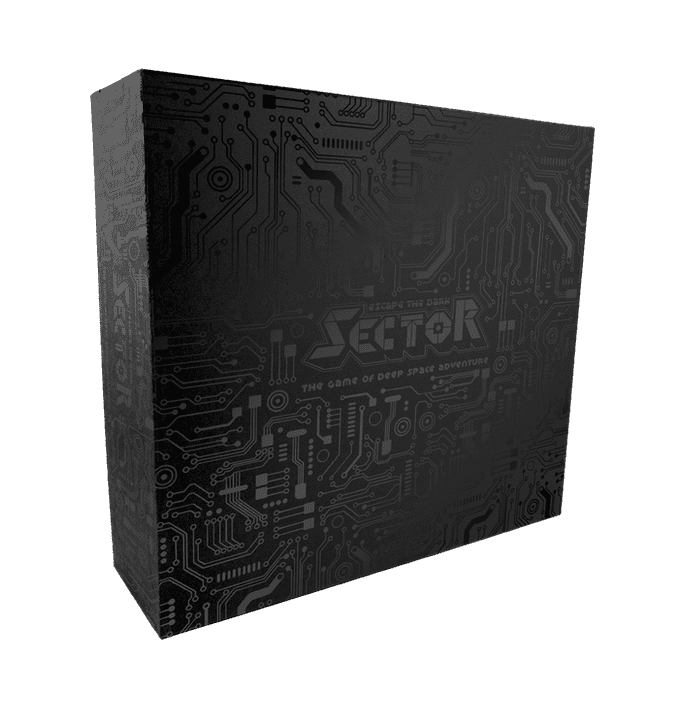
Escape the Dark Sector: The Game of Deep Space Adventure could simply have been a reiteration of Escape the Dark Castle: The Game of Atmospheric Adventure, but with a Science Fiction twist. Fortunately, it is anything but that. Although very much based on the set-up and mechanics as Escape the Dark Castle, the sequel is very much a development of it, adding theme and rules that are very much in keeping with both its Science Fiction genre and inspirations. Now the inspirations for Escape the Dark Castle were in the fantasy and the Fighting Fantasy solo adventure books of the eighties, but whilst Escape the Dark Sector draws from the Escape the Dark Sector solo adventure books for its style of play, its Science Fiction inspirations are the grungy, Blue Collar Science Fiction of the nineteen seventies and eighties, so Alien, Bladerunner, Outland, and others. There is another inspiration too, but one from the nineties rather than the eighties, and that is the computer first person shooter, Doom. It is inspirational only though, and although Escape the Dark Sector does involve gun combat, the resulting game is not a shoot ’em up. It is grimmer and more challenging, fraught with danger from one Chapter to the next.
Physically, Escape the Dark Sector is well presented and packaged. The cards are all on a good linen stock and their artwork has a grubby, rough quality which fits both theme and setting. There is a certain pleasure to be had examining the artwork and spotting the references and so on. Lastly, the dice feel solid and heavy in the hands, just waiting to be rolled. The rulebook is decently presented and written, and includes rules for solo play as well as standard play with multiple players.
As much as the new rules and mechanics in Escape the Dark Sector add structure and give the players options, they add complexity, they give more choices to be made, and thus they increase playing length. Whether coming to Escape the Dark Sector or after having played Escape the Dark Castle, the rules also need more attention paid to them because of their relatively greater complexity and increased procedural nature of play. However, a careful read through and a play or two of the game, and a gaming group should be fine.
Like its forebear, Escape the Dark Sector: The Game of Deep Space Adventure is both fun and challenging to play, offering frustration in failing to escape the confines of the space station and elation in overcoming the challenges of the Chapter Cards and defeating the final Boss. The game is fairly quick to set up and play through, making it a good filler—though one which warrants occasional rather than regular play. The new rules and structured Mission Deck add options as well as better storytelling, all pushing the players to make more choices and work better together. Escape the Dark Sector: The Game of Deep Space Adventure is an enjoyably brutal and challenging co-operative game, whether played solo or in a group.
Friday, 30 July 2021
Friday Filler: The Fighting Fantasy Co-op IV
The new mechanic which Adventure Pack 3 – Blight of the Plague Lord adds to Escape the Dark Castle is that of the Plague. When one of the four ‘Plague’ item cards are drawn or when instructed to on an Chapter card, the player rolls the new ‘Plague’ die. The faces of this die are marked with either two, three, or four splodgy Plague symbols, each indicating the number of Plague points an escapee gains, whether this is from simply being in the same location as Plague-victims, drawing an item riddled with the Plague, or even fighting someone or something infected with the Plague—including fellow escapees! Accrue enough points of Plague and the escapee sickens and weakens, losing Hit Points in the process. There are opportunities to gain some relief from the Plague in the form of an encounter with a Plague Doctor who will cure an escapee of his points of Plague, but in the main, unless an escapee is incredibly lucky and avoids the Plague all together or has all of his points of Plague cured by the Plague Doctor, once caught, the Plague is a downward spiral... In reducing his Hit Points, the Plague does not reduce his combat capabilities. Instead, it reduces his ability to withstand the negative effects of a fight. Consequently, Adventure Pack 3 – Blight of the Plague Lord tends towards, if not fewer fights, but slightly weaker opponents. So there is a certain balancing effect here, but this does not stop escaping the Dark Castle remains a challenge.
Physically, Adventure Pack 3 – Blight of the Plague Lord is as well produced as the core game. The Chapter, Boss, and Character (or escapee) Cards are large and really easy to read and understand. Each one is illustrated in Black and White, in a style which echoes that of the Fighting Fantasy series and Warhammer Fantasy Roleplay last seen in the nineteen eighties.
At its most basic, Adventure Pack 3 – Blight of the Plague Lord adds a whole new story and more challenges which extends the life of Escape the Dark Castle and means that players will it bring back to the table on a regular basis. It really only adds the one mechanic, ‘Plague’, and then thoroughly injects and infects it into the Chapter cards for the expansion, the result being grim, often grinding battle of survival against something that the escapees cannot see, but can see the effects of. When combined with the artwork, it is horridly thematic, adding to and enforcing the ghastly situation that the escapees find themselves in. However the strong theme and its mechanically deleterious effects upon the escapees is likely to clash with those of the other expansions and actually make their harder to play through because the Plague is constantly reducing an escapee’s chances of survival and there is not necessarily the balance between the effects of the Plague and the loss of Hit Points present in those expansions as there is in Adventure Pack 3 – Blight of the Plague Lord.
Thenborne will be at UK Games Expo which will take place between July 30th and August 2nd, 2021 at Birmingham NEC. This is the world’s fourth largest gaming convention and the biggest in the United Kingdom.
Friday, 4 September 2020
Friday Filler: Railroad Ink: Blazing Red
Railroad Ink comes in different colours—Railroad Ink: Deep Blue and Railroad Ink: Blazing Red are the most commonly available. They differ primarily in their colour and in the expansions available in each. Railroad Ink: Deep Blue adds the Rivers and Lakes expansions, each River symbol making connecting route that much more difficult, whilst Lakes can connect your networks by ferry. Railroad Ink: Blazing Red includes the Lava and Meteor expansions. The Lava comes pouring out of an erupting volcano and can expand to destroy routes, as can meteor strikes, but the craters can be for precious ore (or points). Apart from these expansions (and those in the other editions), the game play is the same between Railroad Ink: Deep Blue, Railroad Ink: Blazing Red, and other editions. Both Railroad Ink: Deep Blue and Railroad Ink: Blazing Red can be combined to enable as many as twelve players to player—something that few games can do! Of the two, it is Railroad Ink: Blazing Red which is being reviewed here.
Railroad Ink: Blazing Red comes in a little box containing six player boards, six markers, four Route dice, two Lava dice, two Meteor dice, and the rulebook. Each player board consists of a grid, seven squares by seven squares, with three exits on each side. The nine central squares are of a different colour and if routes are built across them, a player will score more points. The back of the player board folds up and serves not as a shield to hide a player’s layout from his rivals, but includes a scoring track, a means to track the dice symbols used each turn, and presents six special symbols which can be used during play. These consist of crossroads of various types, a player being allowed to use one per turn, but can only use each symbol once and cannot use more than three special symbols per game.
The basic dice—all of which are white—consist of two types. One has type has sections of curved, straight, and tee-junction highways and railways. There are three of these. The other type, of which there is only one, shows an overpass and stations at which highways and railways can connect. These connections can be straight or curved. The full colour rulebook runs to sixteen pages and does a decent job of explaining how the game is played. It is not a large rulebook, so it does need a careful read-through to spot everything.
Game set-up is simple. Each player receives a player board and a pen. Game play is also simple. At the beginning of each turn, the four dice are rolled. The players then draw those route symbols onto their player boards, ensuring that the routes connect to either an exit or an existing network. It really is as simple as that. A player can also draw in a special symbol from those listed on the inside of his player board, up to a maximum of three per game. In total seven rounds are played before the game ends. Then a player will score points for the number of exits his networks connect, the longest highway, the longest railway, and the number of central squares he has drawn routes through. Points are deducted for dead ends.
However, the puzzle element of Railroad Ink: Blazing Red means that a player will be constantly working to make the efficient connections and wondering how he can best use the routes marked on the dice that turn. It means that there is a luck element to the game, but a player can work to try and mitigate the effects of what might be a bad roll for him, whilst that roll might be better for another player. In effect, a player is building a puzzle from turn to turn, but does not know what pieces of the puzzle he and his fellow players will receive each turn until the dice are rolled. The game is mechanically simple, but there really is a neat little challenge to it from start to finish, and it really feels satisfying when the dice are rolled and the right symbols come up to make connections and draw an efficient network.
The Meteor and Lava Expansions are optional and add complexity to the game. Both shorten game length to six rather than seven rounds. The Meteor dice are rolled along side the standard dice and indicate the direction and how many squares away a meteor will hit on a player’s board on the next turn. If this means it lands on a route—highway or railway, it is destroyed. A special route can be sacrificed to ignore the effects of a Meteor strike and Meteor craters can be built over. However, dead ends which connect to an existing crater will score a player points as he mines the crater.
The Lava Expansion adds a volcano at the centre of each player’s board as well as the two Lave dice to the basic dice rolled at the start of each turn. The Lava dice depict the sides of a lava lake, some adjacent to a railway or highway, most not. When they are rolled with the basic dice, a player must use one of the Lava symbols shown to expand the Lava lake. If he cannot do that, he can either start another volcano else where on his board or the lava lake is forced to expand and erase a highway or a railway. Open Lava Lake sides will lose a player points at the end of the game, but a player will score points for each fully enclosed Lava Lake and for his largest Lava Lake.
Both expansions give more for a player to work with and draw, but also make the game play more involving and longer. The Meteor Expansion is the more complex one as there is slightly more to keep track of, but both make the game more challenging. So are probably better suited to older players.
Another way in which Railroad Ink: Blazing Red can be played and that is solo. This is playing the standard game without any competition to see how high a score you can get. However, it is not as much fun as competing with other players, and in some ways, it just highlights the fact that even with other players, Railroad Ink: Blazing Red still feels like a solo game since there is no interaction between them. This does not mean that Railroad Ink: Blazing Red is a bad game, but it is still quite light in terms of its puzzle and challenge factors, so ideally, it should be mixed in with other games or played as filler (as a ‘Friday Filler’ or otherwise). For a family audience this should be less of an issue, but for veteran players or fans of train games, it might be too light (in which case Railway Rivals is a good alternative).
Overall, Railroad Ink: Blazing Red is a very nicely done mix of puzzle and challenge which looks and feels good in play. A charming little filler worth bringing to the table amongst a mix of other fillers.