Every Week It's Wibbley-Wobbley Timey-Wimey Pookie-Reviewery...
Showing posts with label Tuesday Knight Games. Show all posts

Saturday, 18 April 2026

The Other OSR: Unconfirmed Contact Reports

It is curious to note that since its original publication in 2018, the Mothership Sci-Fi Horror RPG from Tuesday Knight Games has been reliant upon the single rulebook, the Mothership Sci-Fi Horror RPG – Player’s Survival Guide. First as a ‘Zero Edition’ and then as an actual ‘First Edition’. Curious, because despite the horror roleplaying rules detailing no alien threats and giving no advice for the Warden—as the Game Master is known in Mothership—the has proved to be success, with numerous authors writing and publishing scenarios of their own as well as titles from the publisher. What the Mothership Sci-Fi Horror RPG offered was a stripped down, fast playing Science Fiction system that supported a number of sub-genres. Most obviously Blue Collar Science Fiction with horror and Military Science Science Fiction, the most obvious inspirations being the films Alien and Aliens, as well as Outland, Dark Star, Silent Running, and Event Horizon. Yet the authors of third-party content for the roleplaying game have also offered sandboxes such as Desert Moon of Karth and Cosmic Horror like What We Give To Alien Gods, showing how the simplicity of Mothership could be adjusted to handle other types of Science Fiction. This combination of flexibility and simplicity has made it attractive to the Old School Renaissance segment of the hobby, despite Mothership not actually sharing roots with the family of Old School Renaissance roleplaying games derived from the different editions of Dungeons & Dragons. It is thus, at best, Old School Renaissance adjacent.

With the publication of the Mothership Core Box and the
Mothership Deluxe Box following a successful Kickstarter campaign in 2024, the Mothership Sci-Fi Horror RPG has a complete set of rules for what is its first edition. The includes rules the construction and option of spaceships with Shipbreaker’s Toolkit, monstrous threats with Unconfirmed Contact Reports, and a guide for refereeing the roleplaying game in the form of the Warden’s Operations Manual.

—oOo—

Unconfirmed Contact Reports is the monster book for the Mothership Sci-Fi Horror RPG. It contains descriptions of fifty strange entities and horrendous abominations with which to scare the Player Characters, stalk them, and bleed them, infect them, feed on them, or worse… It is designed to do several things. Obviously, it is intended to provide a range of threats that will strike fear into the Player Characters, but the authors also want to spur the Warden’s imagination. The entries—where appropriate—have the minimum of stats, so mechanically they are all easy to use. The collection begins with ‘The 4youreyez Algorithm’ which infects electronics and completely wipes, but seems to affect androids in some way, and continues with ‘Angels’, those who have communed with the great eye-like portals that have opened up in space, and ‘The Body Politic’, an invasive colonial organism which forms parliamentary voting body in all of the host’s cells rather than a single collective. ‘Cabin 102-B’ is a locked cabin that appears aboard one spaceship after another, ‘The Engineer’ is an itinerant ship’s engineer who high on stimulants sabotages the spaceships he is hired to work whilst the crew are asleep, and ‘Good’ is an alien ‘subtle, psychotropic “oversight and ethics committee.” that makes people good and so corporations and governments fear it.

There are a lot of entries Unconfirmed Contact Reports and some of are less interesting than others. For example, ‘Granny’ describes a hole in the ground from which an old woman’s voice emanates, begging to be fed. Whatever is thrown in is not enough, and on the colonies where this hole appears, the colonists begin feeding her everything they can—supplies, pets, children, and ultimately themselves. It is enough and soon Granny will leave the hole to hunt. Similarly, ‘The Sea of Silence’ is a viscous and vicious protoplasmic organism that absorbs any body of water it can and immerses its victims, scouring away any sense of self and awareness. In too many cases, the entries consist of nothing more than this description and some colour fiction accompanying the illustration. To which the response amounts to no more than, “Yes, and…?” There is no obvious way in which to bring these monsters, memes, mutterings, mutations, and more into play and so make them threats that arouse more than a similar, “Yes, and…?”. The book states that it aims to spark the Warden’s imagination and that, “Importantly, much about these entities, from their history to their reasoning, and even how they may be defeated (if they can be at all) has been left absent.” The Warden is the encouraged to these descriptions in Unconfirmed Contact Reports as a starting point for creating a scenario.

What this means that the entries in Unconfirmed Contact Reports are as just much prompts as they are descriptions of monsters. In fairness, there is advice on running scenarios and using monsters in the Mothership Sci-Fi Horror RPG. It is in the excellent Warden’s Operations Manual and it is called the ‘TOMBS Cycle’, which stands for ‘Transgression, Omens, Manifestation, Banishment, Slumber’ Cycle. This is neat little summary of how a horror scenario typically plays. So, in ‘Transgression’, the horror disturbs the horror and awakens; in ‘Omens’, signs of its activities appear; it begins to move openly in ‘Manifestation’; ‘Banishment’ can only be attempted once a means of destroying or stopping the horror has been found; and finally, under ‘Slumber’, it can be banished or subdued, at least temporarily, until someone else triggers the ‘TOMBS Cycle’ once again.

The ‘TOMBS Cycle’ is brilliantly succinct and not only a great way to outline a scenario, but to categorise a horror. Imagine if the ‘TOMBS Cycle’ had been applied to each and every one of the entries in Unconfirmed Contact Reports? Imagine how quick and easy it would have made each and every one of the entries in Unconfirmed Contact Reports to use? Imagine how quick and easy it would have made making a change to each and every one of the entries in Unconfirmed Contact Reports rather than think up any way to use them in a scenario from scratch? Imagine how not how much better Unconfirmed Contact Reports would have been if the ‘TOMBS Cycle’ had been applied, but simply just how useful?

It begs the simple question. Why was the ‘TOMBS Cycle’ not applied to Unconfirmed Contact Reports?

Physically, Unconfirmed Contact Reports is okay. The writing is okay. The artwork varies widely in quality and that is okay too.

If you have the Mothership Deluxe Box then you already own Unconfirmed Contact Reports. If you own neither, and perhaps want a good bestiary or book of threats to run with the Mothership Sci-Fi Horror RPG, the sad news is that Unconfirmed Contact Reports is a poor choice. It lowers the quality of the Mothership Deluxe Box because it more a work of fiction than a game book and more a book of prompts than something that the Warden can readily use in her game. Unconfirmed Contact Reports could have been very, very good, but as it is, it is just not good enough. One for the completionist rather than either essential or actually useful.

Saturday, 7 February 2026

The Other OSR: Warden’s Operation Guide

It is curious to note that since its original publication in 2018, the Mothership Sci-Fi Horror RPG from Tuesday Knight Games has been reliant upon the single rulebook, the Mothership Sci-Fi Horror RPG – Player’s Survival Guide. First as a ‘Zero Edition’ and then as an actual ‘First Edition’. Curious, because despite the horror roleplaying rules detailing no alien threats and giving no advice for the Warden—as the Game Master is known in Mothership—the has proved to be success, with numerous authors writing and publishing scenarios of their own as well as titles from the publisher. What the Mothership Sci-Fi Horror RPG offered was a stripped down, fast playing Science Fiction system that supported a number of sub-genres. Most obviously Blue Collar Science Fiction with horror and Military Science Science Fiction, the most obvious inspirations being the films Alien and Aliens, as well as Outland, Dark Star, Silent Running, and Event Horizon. Yet the authors of third-party content for the roleplaying game have also offered sandboxes such as Desert Moon of Karth and Cosmic Horror like What We Give To Alien Gods, showing how the simplicity of Mothership could be adjusted to handle other types of Science Fiction. This combination of flexibility and simplicity has made it attractive to the Old School Renaissance segment of the hobby, despite Mothership not actually sharing roots with the family of Old School Renaissance roleplaying games derived from the different editions of Dungeons & Dragons. It is thus, at best, Old School Renaissance adjacent.

With the publication of the Mothership Core Box and the
Mothership Deluxe Box following a successful Kickstarter campaign in 2024, the Mothership Sci-Fi Horror RPG has a complete set of rules for what is its first edition. The includes rules the construction and option of spaceships with Shipbreaker’s Toolkit, monstrous threats with Unconfirmed Contact Reports, and a guide for refereeing the roleplaying game in the form of the Warden’s Operations Manual.

—oOo—

The Warden’s Operations Manual is the other of the core rulebooks after the Player’s Survival Guide for the Mothership Sci-Fi Horror RPG. It is the guidebook for the Warden—as the Game Master is known in the Mothership Sci-Fi Horror RPG—and it takes the Warden, neophyte or not, from the first steps of making the initial preparations for a campaign all the way up to running a campaign. Not just advice, but also suggestions, prompts, and more. In the process, it talks about creating and portraying horror, creating compelling mysteries and investigations, how to be a Warden—and a good at that, how to support player agency, interpreting the rules and making good rulings, handling different aspects of the rules, introducing house rules, and more. And in just sixty pages. It packs a lot into those pages.

The Warden’s Operations Manual is at its heart a book of questions and answers, asking and answering such questions as how do I get started? What should I run? Where do I find the horror in my scenario? What challenges do I give my Player Characters? There are effectively ten questions that it poses and gives answers to in explaining the step-by-step process. More experienced Wardens might want to miss or two, and in the long run, the Warden omit some too as she gets used to the process. It starts with simplest of things. Buying a notebook to serve as the Warden’s ‘Mothership Campaign Notebook’, inviting friends to play, and reading the Player’s Survival Guide, before choosing a scenario and asking what is the horror going to be? As it expands here, it suggests options, such as ‘Explore the Unknown’, ‘Salvage a Derelict Spaceship’, and ‘Survive a Colossal Disaster’, and to find the horror it gives the ‘TOMBS Cycle’, which stands for ‘Transgression, Omens, Manifestation, Banishment, Slumber’ Cycle. This is neat little summary of how a horror scenario typically plays. So, in ‘Transgression’, something has disturbed the Horror and caused it to activate or awaken; signs hinting of its activities or effect are found in ‘Omens’; its ‘Manifestation’ means that the Horror moves into the open and everyone can see what it is, and will now be hunted by it; ‘Banishment’ sees the Player Characters race to find a way to destroy or stop the Horror; and lastly, in ‘Slumber’, the Horror is banished or subdued, at least temporarily, until someone else triggers the ‘TOMBS Cycle’ once again. It is both a superbly succinct summary of just about any horror film—and very obviously of the key film which inspires the Mothership Sci-Fi Horror RPG—and a framework that the Warden can return to again and again to construct further scenarios.

Once the horror is in place, the Warden adds obstacles for the Player Characters to be overcome, which the Warden’s Operations Manual categorises as ‘Survive, Solve, or Save’. These are then broken down, offering choices. For example, for ‘Solve’ it offers questions or mysteries, puzzles or obstacles, and answers or secrets, and further expands upon them. The most common questions are ‘What happened here?’, ‘Who did it?’, and ‘Where are they?’ and some ideas are given as what they could be. For ‘Solve’, there is a really good table for defining NPCs along two axes—‘Helpful versus Unhelpful’ and ‘Powerful versus Powerless’. A helpful, but powerless NPC is a drinking buddy, whereas a powerful, unhelpful NPC is a gatekeeper. Lastly. The supplement takes the Warden through the process of drawing her scenario onto a map and then in tying it all together, providing something for each of the four roles in the roleplaying. Violence for Marines, something that Humans cannot do, but Androids can, some science or research for the Scientist, and something to build, repair, or pilot for the Teamster.

With the writing and the design out of the way, the middle part of the Warden’s Operations Manual is dedicated to advice on actually running the game. Here we are on more familiar territory, good for running almost any other roleplaying game, but very much focused on the Mothership Sci-Fi Horror RPG. There is direct and more immediate advice for the prospective Warden not to worry about the rules, to use common sense, to build up the horror slowly, to treat every violent encounter as if it could be last, and more. The advice on teaching the game is good for a Warden’s first game as much as it is the players as well as if the Warden runs the Mothership Sci-Fi Horror RPG at conventions, and there is advice on that as well for setting the tone and safety limits for strangers (at conventions) in addition to that for friends.

It breaks down the cycle of play, examining each of the stages in turn, from the Warden describing the situation and answering the players’ questions through waiting for them to decide what they want their characters to do, the Warden setting the stakes for any conflict and explaining the consequences, and again waiting for the players to commit, to resolving the action. This is such a usual deconstruction of the game flow from minute to minute and what is so useful is that like a lot of the advice in the Warden’s Operations Manual, it applies to a lot of other roleplaying games and not just the Mothership Sci-Fi Horror RPG. And as with the earlier ‘TOMBS Cycle’ and ‘Survive, Solve, or Save’, it examines these aspects of play in further detail, noting how to handle time and tension, what to do about technology (lots of good options here such as offloading the explanation as to how a device or technology works onto the players and having futuristic technology work as badly as our own, alongside simply keeping track of it to make it part of the campaign background and focusing upon what it does rather than how it works), when to not roll dice and when to roll dice as well as resolving the action and the consequences of failure.

The suggestions for social situations are interesting in that NPCs should be obvious in their manner so that the Player Characters have a greater understanding of who they are and be in a better place to decide how to interact with them and what to do with the information they learn about or from them. The Warden is also told that she should tell players when an NPC is lying. Similarly, the Player Characters can lie to the NPCs. And all this without resort to dice rolls, although the Player Characters will suffer the consequences if found out and knowing that an NPC is lying leads to further investigation (or confrontation) as the Player Characters try to confirm it.

The advice on investigations is kept surprisingly short, boiling down to giving the players clues rather than making them roll for them, except when their characters are in a hurry or when time is short. Monsters and horrors are to be kept that, as ‘boss’ monsters that the Player Characters cannot readily defeat until they have more information about them. When it comes to combat and death, the Warden’s Operations Manual reiterates that the Mothership Sci-Fi Horror RPG is a roleplaying game about people in the worst and most stressful situation possible and that this, in addition to the possibility that their characters might die, should always be made clear to the players.

The latter third of the Warden’s Operations Manual focuses upon building campaigns. Here it talks about style and types of campaign frames, such as space truckers, dogs of war, bounty hunters, and mining and salvage, creating factions, handling money and debt, and more. There is a bibliography too and some advice on telling a good story, like the fact that the game is about what the players do, that story happens in retrospect, and for the Warden to use her best ideas first rather than build up to them, and how to end a campaign. All of which is supported by tables of prompts and ideas that the Warden can pick from or roll on.

Physically, the Warden’s Operations Manual is well produced and very nicely illustrated, with many illustrations actually serving as examples of elements of the game, such as the illustration for tactical considerations or the ‘TOMBS Cycle’. The book is very readable. 

The Warden’s Operations Manual is a very good book of advice, help, and suggestions for the Mothership Sci-Fi Horror RPG, but there is room for expansion in places. For example, the individual parts of ‘Survive, Solve, or Save’ get more attention than those of the ‘TOMBS Cycle’ and the campaign frames amount to no more than elevator pitches rather than actual frameworks. Despite this, the Warden’s Operations Manual is useful not just for the first time Warden, but worth reading and dipping into for the experienced one too. In going back to basics before giving sound advice that will give the prospective Warden a very good start in setting up and running her first game of the Mothership Sci-Fi Horror RPG, the Warden’s Operations Manual is an exceptionally good book.

Saturday, 24 January 2026

The Other OSR: Player’s Survival Guide

It is curious to note that since its original publication in 2018, the Mothership Sci-Fi Horror RPG from Tuesday Knight Games has been reliant upon the single rulebook, the Mothership Sci-Fi Horror RPG – Player’s Survival Guide. First as a ‘Zero Edition’ and then as an actual ‘First Edition’. Curious, because despite the horror roleplaying rules detailing no alien threats and giving no advice for the Warden—as the Game Master is known in Mothership—the has proved to be success, with numerous authors writing and publishing scenarios of their own as well as titles from the publisher. What the Mothership Sci-Fi Horror RPG offered was a stripped down, fast playing Science Fiction system that supported a number of sub-genres. Most obviously Blue Collar Science Fiction with horror and Military Science Science Fiction, the most obvious inspirations being the films Alien and Aliens, as well as Outland, Dark Star, Silent Running, and Event Horizon. Yet the authors of third-party content for the roleplaying game have also offered sandboxes such as Desert Moon of Karth and Cosmic Horror like What We Give To Alien Gods, showing how the simplicity of Mothership could be adjusted to handle other types of Science Fiction. This combination of flexibility and simplicity has made it attractive to the Old School Renaissance segment of the hobby, despite Mothership not actually sharing roots with the family of Old School Renaissance roleplaying games derived from the different editions of Dungeons & Dragons. It is thus, at best, Old School Renaissance adjacent.

With the publication of the Mothership Core Box and the
Mothership Deluxe Box following a successful Kickstarter campaign in 2024, the Mothership Sci-Fi Horror RPG has a complete set of rules for what is its first edition. The includes rules the construction and option of spaceships with Shipbreaker’s Toolkit, monstrous threats with Unconfirmed Contact Reports, and a guide for refereeing the roleplaying game in the form of The Warden’s Operations Manual.

—oOo—

The Player’s Survival Guide is the core rulebook for
the Mothership Sci-Fi Horror RPG, detailing as it does the the rules for character creation, Stress and Panic, and combat. The book also comes with a content warning giving that Mothership Sci-Fi Horror RPG is a horror game and best suited for mature players. Plus, there is advice on being a great player, waning them that their characters can die, that the game is stacked against them, that they will be faced with difficult choices, that they should pay attention, and finally, to accompany the content warning, to create a safe play environment. Of course, it is obvious, but is short and to the point, readying the player for his first experience of play in the Mothership universe.

A Player Character in Mothership Sci-Fi Horror RPG has four Stats—Strength, Speed, Intellect, and Combat—together indicate how well he might perform under trying conditions. He also has three Saves—Sanity, Fear, and Body—which are his capacity to withstand the effects of different kinds of trauma. There are four Classes, which determine what skills he begins play and how he reacts to Stress and Panic. These are Marines, Androids, Scientists, and Teamsters, essentially modelling the type of characters that appear in Alien and Aliens. When a Marine fails a Panic Check, all nearby Player Character must make a Fear Save; Fear Saves made by Player Characters close to an Android at made at a Disadvantage; when a Scientist fails a Sanity Save, all nearby Player Character gain one Stress; and once per session, a Teamster can make a Panic Check at a Disadvantage. Skills are rated as Trained, Expert, or Master, or ‘+10%’, ‘+15%’, or ‘+20%’ respectively. Penultimately, he has a Loadout, Trinket, and Patch, the Loadout being his equipment, the Trinket something that might give him good fortune, and the Patch is the slogan or saying, which may or may not have some meaning, he has sewn onto his clothes or equipment. Lastly, he has a value for ‘High Score’, which starts at zero and may not actually change since it represents the number of missions or assignments or sessions completed (or survived). It has no mechanical effect, being something that the player and Warden can track. The rules suggest that the average High Score is four, so that and better is something for both player and character to aim for.

NAME: Boyd Tófa
CLASS: Teamster

STATS
Strength 42 Speed 45 Intellect 41 Combat 44
SAVES
Sanity 35 Fear 29 Body 24
Health: 5
Stress: 2
SKILLS
Trained (+10%): Zero-G, Industrial Equipment, Rimwise
Expert (+15%): Piloting
Master (+20%):

Credits: 100cr
Trinket: Pamphlet: Android Overlords
Patch: “Powered By Coffee”
Loadout: Standard Crew Attire (AP 1), Nail Gun (32 rounds), Head Lamp, Toolbelt with Assorted Tools, Lunch Box

Player Character creation is an easy process, just as it always was with the Zero Edition of the Mothership Sci-Fi Horror RPG. This was because the character sheet was marked with a flow chart that led the player through the process. Here in the new edition of Player’s Survival Guide it not only been retained, but slimmed down and streamlined for ease of use.

Mechanically, the Mothership Sci-Fi Horror RPG is percentile game. To have his character undertake an action, a player rolls percentile dice, aiming to roll equal to or under the appropriate Stat. To avoid dangers, a player can make a similar roll against a Save. A Save is rolled against Sanity to withstand the illogical nature of the universe and to deal with Stress; Fear for fear itself, isolation, and emotional distress; and Body to resist physical effects such as hunger, disease, and invasion organisms. Rolls can be made with Advantage and Disadvantage, meaning that a player rolls the dice twice, taking the best result if at an Advantage and the worst result if at a Disadvantage. A roll of a double counts as a critical success if the roll is equal to, or under the Stat or Save, a critical failure if over. A critical failure also triggers a Panic Check. If appropriate, a player can add one of his character’s Skills to the roll, whether a Stat Roll or a Save.

However, there is a further penalty to failed rolls. The Player Character gains a point of Stress, up to maximum of twenty. Under certain situations, such as seeing another crewmember die, multiple crewmembers failing a Panic Check at the same time, when encountering something horrific and unearthly for the first time, a Player Character must roll a Panic Check. This is a roll of a twenty-sided die, the aim being to roll above the Player Character’s current Stress. A failure requires a roll on the Panic Table. The result is a random effect such as a ‘Loss of Confidence’, ‘Haunted’, ‘Deathwish’, or ‘Heart Attack/Short Circuit (Android)’.

Combat is designed to be fast and deadly. During each round, a Player Character can move and undertake a single action. Attacks are handled by a Combat Check and armour protects up to a certain limit, but above that is destroyed. Some Armour can have Damage Reduction. Damage is subtracted from the defendant’s Health. When Health is reduced to zero, a roll is made on the Wounds Table. The Wounds Table has options for Blunt Force, Bleeding, Gunshot, Fire & Explosives, and Gore & Massive damage.

In terms of further support, there are options for Player Character training skills, although it will actually take years to do so and apart from military training, has to be paid for. The rules cover the effects of different atmospheres, cryosickness from time spent in the cryopods used for long space journeys or hyperspace jumps, starvation, radiation, and more. When not on a mission or assignment, there are ports that the Player Characters’ ship can dock, where they can engage in rest and recreation, and mechanically, each make a Rest Save to reduce their Stress. This can be made at Advantage if a Player Character participates in consensual sex, recreational drug use, heavy drinking, prayer, or other suitable leisure activity. (This is another why the Player’s Survival Guide makes that consent is required.) Contractors can also be hired at ports and once hired, become NPCs defined by a simple format, but potentially upgradable to full Player Character should one of the existing ones somehow die…

If there is anything missing from the Player’s Survival Guide, it is the omission of the stealth skill. This seems odd given that the Mothership Sci-Fi Horror RPG is a horror roleplaying game and such situations often require the Player Characters to sneak around to avoid alerting whatever threat they are facing. That said, one of the several examples of play does show a Player Character attempting to sneak. Instead of making a Stat Check with a Stealth skill added on as a bonus, the player instead rolls a Stat Check with the outcome being that a successful check indicates that it has been done quietly. So instead of the absence of a Stealth skill, the attempt is rolled into whatever it is that the Player Character is attempting to achieve. This could have been made clearer in the rules rather than an example of play.

Physically, the Player’s Survival Guide is very well presented. The layout is clean and tidy, and the book is easy to read. Learning the rules is eased by the numerous examples of play. The artwork is also good throughout.

The ‘Zero Edition’ of the Player’s Survival Guide has proved to be a Science Fiction workhouse, supporting the creation of numerous scenarios and supplements and fanzines within the Blue Collar Science Fiction, Military Science Fiction, Science Fiction Horror genres. The Player’s Survival Guide for the Mothership Sci-Fi Horror RPG, First Edition does and will do the same thing. The new edition of the Player’s Survival Guide is really accessible and everything in its pages are easy to learn—helped by the reference guide on the back—and it lays the foundation of the Mothership Sci-Fi Horror RPG.

Saturday, 12 November 2022

Blue Collar Sci-Fi Supplement I

Since 2018, the
Mothership Sci-Fi Horror RPG, beginning with the Mothership Sci-Fi Horror RPG – Player’s Survival Guide has proved to be a popular choice when it comes to self-publishing. Numerous authors have written and published scenarios for the roleplaying game, many of them as part of Kickstarter’s ZineQuest, but the publisher of the Mothership Sci-Fi Horror RPG, Tuesday Knight Games has also supported the roleplaying game with scenarios and support of its own. Dead Planet: A violent incursion into the land of the living for the MOTHERSHIP Sci-Fi Horror Roleplaying Game is one such scenario, but Tuesday Knight Games has also published a series of mini- or Pamphlet Modules. The first of these are The Haunting of Ypsilon 14, Hideo’s World, Terminal Delays at Anarene’s Folly, and Chromatic Transference. The fourth is The Hacker
’s Handbook. Wher The Haunting of Ypsilon 14 was a traditional ‘haunted house in space monster hunt’, Hideo’s World presented a horrifyingly odd virtual world, Terminal Delays at Anarene’s Folly a locked room—or locked ship—McGuffin hunt, and Chromatic Transference did cosmic horror, The Hacker’s Handbook is not even a scenario, but a supplement!

The Hacker’s Handbook provides expanded rules for extra detail in for just the one skill in the Mothership Sci-Fi Horror RPG—‘Hacking’. One of the issues in the Mothership Sci-Fi Horror RPG – Player’s Survival Guide is that none of the skill are actually defined and so the Warden has to adjudicate exactly how they in the dark future depicted in the roleplaying game. Most of the time this will be enough, and in play, the Warden can have a player simply roll of his character if he wants to unlock a door, take remote control of a gun turret, or extract information from a computer system. However, if the Warden wants to present a more detailed, even extended challenge for the player whose character has the Hacking skill, then the core rules are insufficient. This is where The Hacker’s Handbook is useful. It still suggests using simple rules under most circumstances, but otherwise suggests presenting the hacking Player Character with a ‘Network’. This is constructed of a linked series of nodes and each node can be individualised. Each is defined by its Function, Security, and Response. In other words, what it does, the degree of how difficult it is to gain unauthorised access to, and what happens if the Hacker’s attempt is noticed by a network admin, automated security feature, A.I., and so on.

The Hacker’s Handbook lists several options for each as well as giving a modifier between zero and five for the roll on the Response Table if the hacker’s intrusion is noticed. For example, an automated security turret might be listed as ‘Automated security turret,  Infrastructure/Hardpoint Control, Hardened, +2 Response’, whilst a medical database might be listed as ‘Medical Records Storage, Data Storage, Secured, +1 Response’. In play, each node can be drawn as a box and the boxes connected to form a diagram of linked nodes and thus you have the computer network for the starship or the facility, and so on.

The Hacker’s Handbook does not ignore the social aspect of hacking either. It suggests ways of gaining access via user accounts rather than direct hacking and the various types of user account which a hacker might gain access to. It also suggests that it is one way of getting Player Characters involved in a hacking attempt whether or not they have the actual skill. Whether or not a Player Character has the skill, it also lends itself to more roleplaying opportunities than might be available with a simple roll against the skill.

Lastly, The Hacker’s Handbook lists equipment that a hacker might want to carry as a loadout. This includes decks, wristcoms, and pieces of gear. Decks include gear slots and often have extra abilities, such as treating Hardened Nodes as Secure Nodes. For example, Maze ignores one response from network security whilst CoyBoy reduces the Response value of a node by a random value. Essentially, this provides some technical equipment and details which can flavour a hacker’s activities in game and bring a little more verisimilitude to play.

Physically, The Hackers Handbook is all text, barring the network diagram examples. This is not an issue because the supplement has a lot of information to impart, so none of feels wasted.

There is a lot to like about The Hacker’s Handbook. It provides an easy way to handle a particular aspect of the Mothership Sci-Fi Horror RPG, and supports it with enough details to keep both interesting and challenging.

—oOo

An Unboxing in the Nook video of The Hackers Handbook can be found here.

Saturday, 22 October 2022

Blue Collar Sci-Fi One-Shot IV

Since 2018, the
 Mothership Sci-Fi Horror RPG, beginning with the Mothership Sci-Fi Horror RPG – Player’s Survival Guide has proved to be a popular choice when it comes to self-publishing. Numerous authors have written and published scenarios for the roleplaying game, many of them as part of Kickstarter’s ZineQuest, but the publisher of the Mothership Sci-Fi Horror RPG, Tuesday Knight Games has also supported the roleplaying game with scenarios and support of its own. Dead Planet: A violent incursion into the land of the living for the MOTHERSHIP Sci-Fi Horror Roleplaying Game is one such scenario, but Tuesday Knight Games has also published a series of mini- or Pamphlet Modules. The first of these are The Haunting of Ypsilon 14, Hideo’s World, and Terminal Delays at Anarene’s Folly. The fourth is Chromatic Transference. Where The Haunting of Ypsilon 14 was a traditional ‘haunted house in space monster hunt’, Hideo’s World presented a horrifyingly odd virtual world, and Terminal Delays at Anarene’s Folly a locked room—or locked ship—McGuffin hunt, Chromatic Transference does cosmic horror!

The set-up for Chromatic Transference is simple. In fact, Chromatic Transference is so simple that it is all set-up and no scenario. What it actually does is describe a location, the top secret Ukweli-4 research facility (‘ukweli’ meaning truth in Swahili). The facility was built inside an asteroid far from civilisation to study a strange meteorite, which contained a colour never before seen by human eyes. Unfortunately, as is the way of these things, there was an accident, the original researchers were killed, and the tiny base has been long since abandoned and forgotten. What Chromatic Transference details are the base and its environs, what can be found inside, and the threat at the heart of the set-up. The Ukweli-4 research facility is built into a large asteroid with a landing pad on the surface and a single entrance to the facility. From there a single tunnel bores into the asteroid with areas off the main tunnel for the facility’s quarters, mess, then research lab, and finally engines (or should that be power plant? Chromatic Transference does not say if the asteroid is capable of movement or not). Outside the base, there are signs that a vessel has left in a hurry and inside, at least initially, signs of men and women going about their ordinary lives. The research lab contains the meteorite and the unknown Colour previously being studied, plus three bodies.

In terms of support, there is a cross section given of the Ukweli-4 research facility, two quite small and far from easy-to-read handouts, and the stats for the Colour. There are notes too of what will happen if the Player Characters do nothing and what they can do to solve the situation.

All of which is fine, except the fact that Chromatic Transference has no plot and it has no hooks to get the Player Characters to the location of Ukweli-4. There is simply no reason for the Player Characters to go to Ukweli-4 given. Yet despite this lack of either hook or plot, Chromatic Transference is described and sold as “A fully playable, ready-to-run one shot to drop in to any sci-fi RPG campaign.” Which is absolutely not the case. If it was ready to run, it would have a hook or a plot that the Warden can use straight to the table without the need for her to develop one of her own, whether that is to work it into her own campaign or provide impetus for the Player Characters in a one-shot or convention play. There is mention that powerful people are looking for it, but is that sufficient enough a hook?

Further, there are elements of Chromatic Transference simply left dangling and unaddressed by the author. The Ukweli-4 research facility has a staff of six, but only three bodies are found, so where are they? The base’s shuttlecraft is missing, so where is that? Arguably finding both the missing staff and shuttlecraft would be the perfect hook for the Player Characters to get involved in Chromatic Transference, have them trace the shuttlecraft’s flightpath back to Ukweli-4 and go from there. This is so obvious it should have been included in Chromatic Transference rather than being spelled out here. One counterpoint might be that the pamphlet format of these scenarios makes the inclusion of every detail or idea difficult, and that is a legitimate point as far as the format goes. However, it cannot and cannot apply to Chromatic Transference, which has sufficient space for this content were it not the fact that one whole page is taken up with the cross section of the Ukweli-4 research facility that imparts an incredible minimum of information. Half that cross section—and yes, the cross section might have been slightly cramped—and the author would have had the luxury of half a page to give the plot and hook ideas instead of leaving the Warden to do the job that he should have done.

Physically, Chromatic Transference consists mostly of text, primarily because of the limited amount of space in which the author has to play with. However, the big blob of a map dominates the pamphlet and is an intrusive presence.

In terms of its horror, Chromatic Transference is Alien meets H.P. Lovecraft’s ‘The Colour Out of Space’. It is a Lovecraftian horror scenario set in haunted house in space. Which is a decent combination and there is a palpable sense of the unknowable and the weird to the whole affair. The players may have an idea of what it might be, but their characters will not and leaning into the unknowable and the weird will part of the pleasure of playing Chromatic Transference.

Doubtless, some Wardens will be happy with Chromatic Transference as is and will pick it up and do what they want with it. That is very much fine. Yet Chromatic Transference as is, is not a scenario, is not a one-shot, is not fully playable, is not ready-to-run, and is not complete. All it needs is a plot or hook, and Chromatic Transference is then all of those things and thus complete as intended. It is a shame that one big map has to deny the author the opportunity to complete his intended scenario.

—oOo

An Unboxing in the Nook video of Chromatic Transference can be found here.

Saturday, 18 June 2022

Ineffably Alien

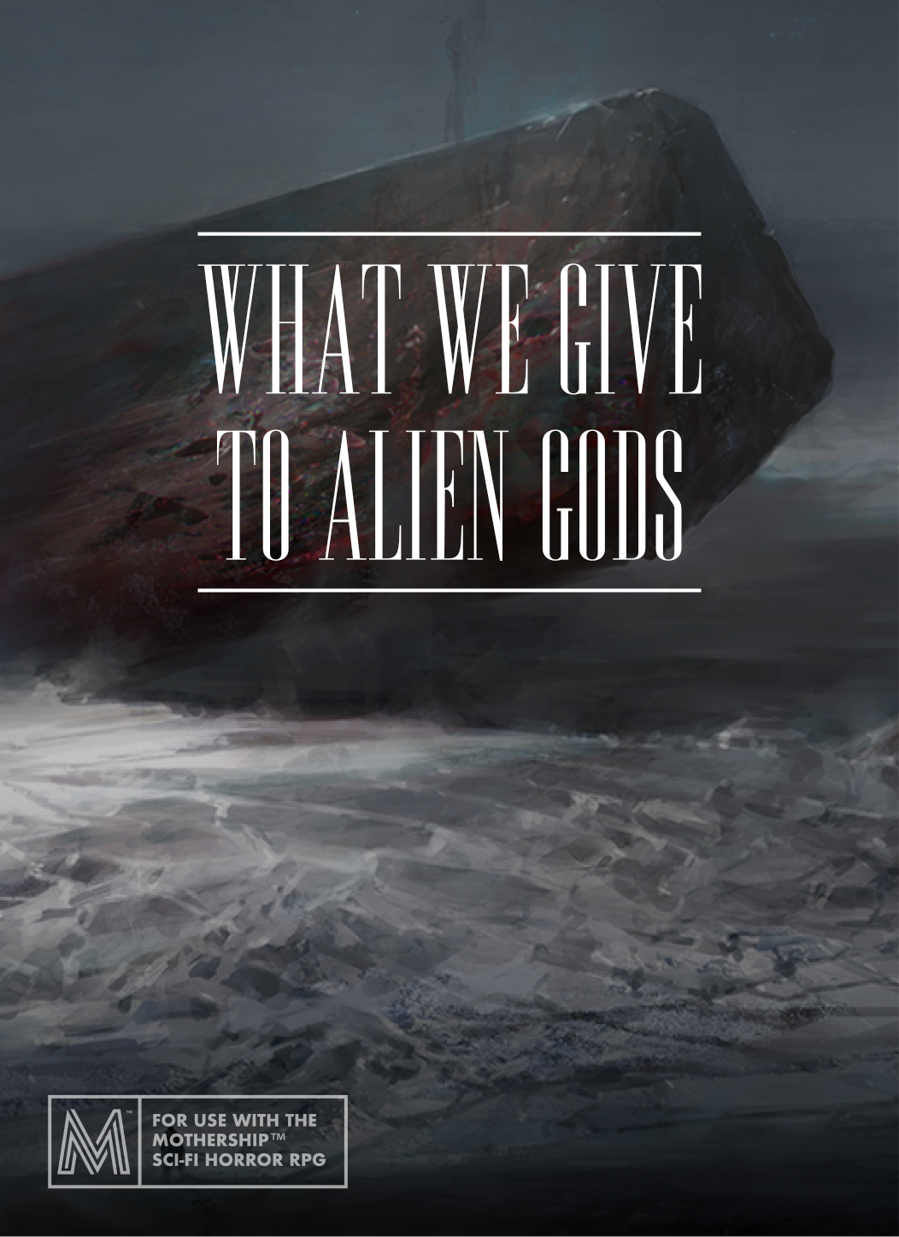
What We Give To Alien Gods
 starts in an odd fashion. It starts with advice as to how to use the module, introduces a new optional rule for Conviction—a Player Character’s belief in an idea or concept; discusses the nature of the Triathal language, its trifold glyphs which combine into layers to form sentences and concepts and used by an alien species which did not vocalise; the Xenoconstellations of star patterns used by a cosmic entity as a form of communication; and examples of both the Triathal language and the Xenoconstellations. Certainly, both are brilliantly alien and both will hopefully help the challenge of the Warden imparting the stellar strangeness of What We Give To Alien Gods to her players and their characters. Yet nearly a quarter of the way into the module and the Warden has no idea as what is going on, what the module is about, and what the significance of anything she has just read is.

Which means that What We Give To Alien Gods breaks one of the cardinal rules of a roleplaying scenario. Which is…

Tell the Game Master what the scenario is about upfront.

What We Give To Alien Gods is a scenario for the MOTHERSHIP Sci-Fi Horror Roleplaying Game, the roleplaying game of blue collar Science Fiction Horror, inspired by films such as Outland, Dark Star, Silent Running, and Event Horizon, as well as Alien and Aliens. Hyperspace anomalies, reports of an alien structure, a missing contact, a seemingly telepathic cry for help, or even an inexplicable urge all hook the Player Characters into travelling Gaelar XII, a distant magellanic nebula. Once inside, they must negotiate dense pockets of cosmic dust, ionised gas storms, ship debris, thermal spikes, and more before alighting before a strange structure. Consisting of three immense pillars with a massive cube suspended between the three, which all together rotate as one, this is Maerkithelth, an unfathomably ancient temple to alien god. The Crew can enter any one of the pillars and begin to explore, finding signs of an alien civilisation—tools and devices left lying about, as well as extensive patterns of glyphs. They will also find indications that someone has already beaten them to the temple.

Discovering both the temple and the existence of aliens can have a profound effect upon a MOTHERSHIP Sci-Fi Horror Roleplaying Game, depending on whether or not they exist in the Warden’s campaign. However, even if they already exist, the presence of the Triathals and what they have left behind—especially the Triathal language, will have a profound upon the members of the Crew. This is intentional since the Scientist in the Crew, in particular, one with the Xenoesotericism, Xenomysticism, and Xenolinguitsics, will be translating the Triathal language and learning more and more of just what Maerkithelth contains and is protecting the universe from. Or even protecting the universe from which the Triathal came. There is such an emphasis upon the Triathal language and upon the role of the Scientist in the scenario that it is not like other MOTHERSHIP Sci-Fi Horror Roleplaying Game scenarios, and whilst the author describes it as a “A dungeon-crawl through an alien temple”, it is not that either. Rather, What We Give To Alien Gods is a puzzle crawl, an exploration of an environment that requires elements of a language to be learned in combination with skill rolls and the clues left behind by other explorers. Which obviously places a great deal of emphasis upon the player with the Scientist role. This is not say that the other roles in MOTHERSHIP Sci-Fi Horror Roleplaying Game do not figure in the scenario—and What We Give To Alien Gods does give advice to that end—but the Scientist predominates.

Much of What We Give To Alien Gods is devoted to is describing the interior of the three pillars of Maerkithelth and the almighty cube which hangs between them. It is only after this that we read of a major threat to both the Crew and possibly the universe. Doctor Aislin Grahm has an obsession with the cosmos and Xenomysticism and is driven—or possibly pulled—by whatever Maerkithelth actually contains (or keeps contained). However much like the explanation of what the plot to What We Give To Alien Gods, this does not really become obvious to very later in the book, over two thirds of the book in the listing of the NPCs, and it applies to her as much as it does the other, often very alien NPCs the Crew is likely to encounter.

Which means that What We Give To Alien Gods breaks one of the cardinal rules of a roleplaying scenario. Again. Which is…

Tell the Game Master what the scenario is about upfront.

Yet these are not the only issues with What We Give To Alien Gods and to be fair, they can be overcome as part of the Warden’s preparation. The real issue is with the extra element of preparation. For not only does the Warden have to prepare the scenario, she also has to learn how its puzzles work and learn the Triathal language, enough to be able understand and if not teach it to her players, then guide them through their learning process. In effect, the Warden has to play through aspects of What We Give To Alien Gods in order to really grasp what is going on. Then once prepared, the scenario—as the author advises—requires a lot of buy in upon the part of the players and their characters.

Physically, What We Give To Alien Gods is a solid little book. It has a sense of the ineffable and the alien in its look and use of art, of a place that is not quite like ours, and it is lovely booklet to look at. However, the writing is often succinct and there are no maps of Maerkithelth which might make it easier for the Warden to visualise and then impart that to her players.

Inspired by films and television such as Event Horizon, The Expanse, Interstellar, and Arrival, there is no denying that What We Give To Alien Gods is an ambitious treatment of Cosmic Horror for the MOTHERSHIP Sci-Fi Horror Roleplaying Game. It is conceptually brilliant and the result is fantastically weird and creepy and unsettling, but the effort to get that to the table, that is where What We Give To Alien Gods does not quite deliver.

Saturday, 19 March 2022

Blue Collar Sci-Fi One-Shot III

Since 2018, the
 Mothership Sci-Fi Horror RPG, beginning with the Mothership Sci-Fi Horror RPG – Player’s Survival Guide has proved to be a popular choice when it comes to self-publishing. Numerous authors have written and published scenarios for the roleplaying game, many of them as part of Kickstarter’s ZineQuest, but the publisher of the Mothership Sci-Fi Horror RPG, Tuesday Knight Games has also supported the roleplaying game with scenarios and support of its own. Dead Planet: A violent incursion into the land of the living for the MOTHERSHIP Sci-Fi Horror Roleplaying Game is one such scenario, but Tuesday Knight Games has also published a series of mini- or Pamphlet Modules. The first of these are The Haunting of Ypsilon 14 and Hideo’s World. The third is Terminal Delays at Anarene’s Folly. Where The Haunting of Ypsilon 14 was a traditional ‘haunted house in space monster hunt’ and Hideo’s World, presented a horrifyingly odd virtual world, Terminal Delays at Anarene’s Folly is a locked room—or locked ship—McGuffin hunt against the clock and Player Character cluelessness!

The set-up for Terminal Delays at Anarene’s Folly is simple and requires that the Player Characters possess a ship, especially one suited to carrying large amounts of cargo. They are making one more cargo run when they have to dock and refuel at the remote service station of Anarene’s Folly—which when their troubles begin. Their problem is twofold, at least initially. First, someone, and it is up to the Warden to decide, has placed an experimental planetary colonisation device, ‘volatile warhead of chemicals, biological agents and mutagens’ (a bit like the Genesis Device from Star Trek II: Wrath of Khan) aboard their vessel and they know nothing about it. Second, someone else does, the Space Traffic Controller of Anarene’s Folly, and he is prepared to go to ordinary lengths to get hold of it. This is when the Player Characters’ problems multiply…

First, all of the docking berths on the Anarene’s Folly are in use. Then the Anarene’s Folly seems to target the Player Characters’ ship, and when the Player Characters’ vessel is allowed to dock, the maintenance crews aboard the space station seem really, really insistent on getting aboard the ship and carrying out repairs. Does the Player Characters’ space ship require repairs? Should maintenance crews like that actually be armed? Or are the maintenance crews actually coming aboard for some other reason? If so, then what have the Player Characters down to warrant such interest? Those are all questions that that will be flying the minds of both the players and their characters as the events of Terminal Delays at Anarene’s Folly unfold.

The Game Master is given a large number of tools with which to taunt and even gaslight the players and their characters! These are built around a pair of time lines, one which escalates events on the station, whilst the other tracks the hacking attempts on the players’ ship. Together, they form a count up of escalating events and challenges for the Player Characters which threaten to overwhelm them if they do not deal with each one in turn. Accompanying this are details of the marine’s battle plan (the marines having disguised themselves as the Anarene’s Folly maintenance crews) and the profile of the main NPC the Player Characters will interact with. It is likely that the players and their characters will come to hate him, as he will prove evasive and unhelpful. The Warden can colour this interaction by using the ‘Small Talk Table’ and ‘Improvised Marine Tech Jargon Table’, and further, there is ‘Gaslighting Table’ for essentially confusing the players and their characters… 

Terminal Delays at Anarene’s Folly as written feels very much like the scenario and thus the Warden is setting out to screw with the players and their characters. This is because they are placed in what is essentially a reactive stance from one event to the next in the scenario’s escalating timeline, and that escalating timeline really does require the Warden to keep track of lot. Ideally, this should be set up beforehand as part of the Warden’s preparation. The scenario also feels as if it would benefit from the use of deck plans so that the Warden and players can track where their characters are from scene-to-scene and thus which problems they are trying to deal with at any one moment.

Like Hideo’s World before it, Terminal Delays at Anarene’s Folly is different to other scenarios for Mothership Sci-Fi Horror RPG. Again, it is very much less of a horror scenario than you would normally expect for a roleplaying game which is best known for its Blue Collar Sci-Fi horror one-shots. It is much more of an escalating, against the clock affair where the horror is bureaucratic in nature, its cause unknown for much the scenario. Like Hideo’s World this scenario will need a higher degree of preparation because of its multiple timing mechanisms.

Physically, Terminal Delays at Anarene’s Folly has less of a presence than Hideo’s World primarily because it consists mostly of text. It is broken up into boxes, but it is still text heavy. Lastly, it does need a slight edit in places.

Terminal Delays at Anarene’s Folly is a fairly busy scenario with lots of things that can happen to the Player Characters in quite a confined space—their own spaceship—and piles event after event on them. It requires preparation in terms of what all those events are, but Terminal Delays at Anarene’s Folly is a grueling, often confounding scenario that will test the patience of both players and their characters.

—oOo

An Unboxing in the Nook video of Hideo’s World can be found here.

Saturday, 29 January 2022

Blue Collar Sci-Fi One-Shot II

Since 2018, the Mothership Sci-Fi Horror RPG, beginning with the Mothership Sci-Fi Horror RPG – Player’s Survival Guide has proved to be a popular choice when it comes to self-publishing. Numerous authors have written and published scenarios for the roleplaying game, many of them as part of Kickstarter’s ZineQuest, but the publisher of the Mothership Sci-Fi Horror RPG, Tuesday Knight Games has also supported the roleplaying game with scenarios and support of its own. Dead Planet: A violent incursion into the land of the living for the MOTHERSHIP Sci-Fi Horror Roleplaying Game is one such scenario, but Tuesday Knight Games has also published a series of mini- or Pamphlet Modules. The first of these is The Haunting of Ypsilon 14, the second Hideo’s WorldThe world of the title is virtual, a slickware slickworld game world which has become the last refuge of its designer, Hideo Kieslowski, the Hideo. Originally designed as a console called HypnoDD running slickware and a slickworld intended to be both played whilst sleeping and replace the user’s dreams, the project was a failure and despite attempts to salvage it, Hideo retreated into his creation and has remained there in a drug-induced come for a decade. Now, the slickware running the virtual world is deteriorating, degrading, and in danger of destroying it—and taking Hideo’s mind with it. In order to find that mind, the Player Characters will have to plug directly into the interface, and once inside the HypnoDD’s slickworld, move as quickly as they can.

The first thing that strikes the reader about Hideo’s World is the format. It is done as a double-sided tri-fold brochure on pale pink card. In fact, the card is stiff enough for the scenario to stand up right on its own, but open up the folder and the second thing that reader about Hideo’s World is the graphic design. The beginning location, the Plaza, is a virtual menu placed around a Communications Tower takes centre stage in the middle panel. The four options—or doors—on the menu are presented on the left-hand and right-hand panels consists of Settings, Game, Shop, and Home, and each of these has further options, as does the Communications Tower. A separate lists the things that the Player Characters might encounter in Hideo’s World, including Bugs (in the system), and Raiders—hackers, fans of Hideo’s come to see his world one last time, and so on, and Mister Goodnight™, an internal program and moon-headed mascot of PacyGen Pharmaceuticals & Soft Drinks Company which has a love-hate relationship with Hideo... Mister Goodnight™ is the primary NPC in Hideo’s World and ideally the Warden should really go to town in portraying him. On the back of the pamphlet, the Warden is provided with tables of Glitches, Textures, and Adverts with which to colour the world around the Player Characters as they explore and examine its limits.

The scenario begins with the Player Characters arriving in the Plaza and beginning to explore the Options available to them via the four virtual menus. Of the four options, Home is the one that the Player Characters need to access, as it should lead to the short where Hideo’s mind resides. However, a stretch of the Glitch Sea lies between the Plaza and Hideo’s Home. The players and their characters must then work out a way to get over there and explore the tower. It is primarily a puzzle scenario into which the Warden can throw the occasional spanner into the works with an NPC or a strange effect or a Glitch. The latter are important because the more of them there are, the greater the stress caused to the sleeping Hideo, the more likely he is to panic and so cause parts of his Slickworld to collapse around him... This gives Hideo’s World its countdown mechanism, though the players and their characters will initially be unaware of it.

Hideo’s World is different to other scenarios for Mothership Sci-Fi Horror RPG. To begin with, it is a puzzle adventure and then it very much less of a horror scenario than you would normally expect for a roleplaying game which is best known for its Blue Collar Sci-Fi horror one-shots. It is instead a puzzle scenario, not quite in the vein of the text adventures, but certainly giving a nod to them. The scenario is also more of a funhouse adventure with a lot of randomly generated elements for the Warden to pitch at her players. As a consequence, Hideo’s World is simply not as dangerous a scenario as the more obviously horror-based scenarios for Mothership Sci-Fi Horror RPG.

The second thing which strikes you about Hideo’s World is that just like The Haunting of Ypsilon 14 before, the Warden will need to undertake a high degree of preparation in order to run it. The brevity of the format means that none of the NPCs have stats, but they can be provided. The major omission is the lack of motivations or reasons for the Player Characters to get involved, and the difficulty for the Warden in devising any such reason or motivation is compounded by the different nature of the scenario. It is not a traditional Mothership Sci-Fi Horror RPG scenario and so the traditional types of set-up found in Blue Collar Sci-Fi will be challenging to use. Perhaps a family member wants to rescue him or a corporation wants the knowledge that might be hidden in his Sliceworld?

Physically, Hideo’s World is definitely a scenario with physical presence, despite its relative slightness. If the cover illustration is underwhelming, the map-illustration of the Plaza is good and the cross section of the Tower that is Hideo’s Home is serviceable. It is actually a pity that the map-illustration of the Plaza is numbered because unnumbered it could be shown to the players. Lastly, it does need a slight edit in places.

Hideo’s World is a fairly busy scenario with lots of things that can happen to the Player Characters in quite a confined space and not all of them of any consequence. So it requires preparation in terms of what everything does and detailing NPCs and motivations, and so on. Wacky more than weird, hare-brained than horrifying, Hideo’s World is a funhouse puzzle adventure that pushes Mothership Sci-Fi Horror RPG in an unexpected and not as easy to use direction.

—oOo

An Unboxing in the Nook video of Hideo’s World can be found here.

Saturday, 2 October 2021

Blue Collar Sci-Fi One-Shot I

Since 2018, the Mothership Sci-Fi Horror RPG, beginning with the Mothership Sci-Fi Horror RPG – Player’s Survival Guide has proved to be a popular choice when it comes to self-publishing. Numerous authors have written and published scenarios for the roleplaying game, many of them as part of Kickstarter’s ZineQuest, but the publisher of the Mothership Sci-Fi Horror RPG, Tuesday Knight Games has also supported the roleplaying game with scenarios and support of its own. Dead Planet: A violent incursion into the land of the living for the MOTHERSHIP Sci-Fi Horror Roleplaying Game is one such scenario, but Tuesday Knight Games has also published a series of mini- or Pamphlet Modules. The first of these is The Haunting of Ypsilon 14. During a routine cargo job to a remote asteroid mining base, the Player Characters learn that one of the workers has disappeared. Then as they complete the delivery, one by one, the rest of the workers begin to disappear. What is happening to the mine workers on Ypsilon 14—and are the Player Characters next?

The first thing that strikes the reader about The Haunting of Ypsilon 14 is the format. It is done as a double-sided tri-fold brochure on bright yellow card. In fact, the card is stiff enough for the scenario to stand up right on its own, but open up the folder and the second thing that reader about The Haunting of Ypsilon 14 is the graphic design. At the top of the middle panel is a black box which reads ‘START HERE’ with an arrow pointing to the first location, Docking Bay 2, and then via the AIRLOCK to the second location, the WORKSHOP, and from there to the other locations in the scenario. Each location is given a box containing a description and an icon or two to indicate what might be found there, such vents and beds for the QUARTERS area. What the graphic designer has done here is combine the floorplans of the Ypsilon 14 mining facility with the description of the Ypsilon 14 mining facility. It is an incredibly economic piece of graphic design.

Whilst the Mothership Sci-Fi Horror RPG is not the Alien or Aliens roleplaying game anew—there is after all, Alien: The Roleplaying Game for that—it very much shares the same Blue Collar Science Fiction Horror subgenre and inspirations. And so does The Haunting of Ypsilon 14. The scenario is, like Alien, a haunted house horror film in space, with first the NPCs and then the Player Characters, being stalked and taken by something unknowably alien. The crew aboard the mining facility even have cat, which can be used to add suspense and even herald the appearance of the scenario’s monster—much like Jones in Alien. When encountered the alien will be genuinely creepy, and definitely worthy of a scare or two in the low lighting of the mining facility. Whilst the main areas of the mining facility are detailed on the inside of the tri-fold brochure, the NPCs are listed and the monster fully detailed on the back, as is a set of three (well, two actually) clues—which come in the form of audio cassettes or logs—which can be found throughout Ypsilon 14. (Ideally, the Warden should record these ahead of time to play to her players when they find them, or even better, have someone else record them so that it is not just the Warden reading them out.)

The Haunting of Ypsilon 14 is designed as a one-shot, a horror film in which few—if any—of the cast is expected to survive. It is also designed to be easy to pick and run, with relatively little preparation required. The limited space of its format and economy of words facilitates both features, but creates its own problems at the same time. Advice for the Warden is light, primarily telling her to roll randomly to see which NPC disappears every ten minutes or so of game time and the various NPCs are very lightly sketched out. Now this does leave plenty of scope for the Warden to improvise, perhaps allowing a scene or two for each of the NPCs to shine before they are bumped off, but for a less experienced Warden, a little more preparation may be required.

However, there is a bigger issue with The Haunting of Ypsilon 14 and that is Player Character motivation. There are no ideas or suggestions as to why the Player Characters and their starship would actually stay at the mining facility once their cargo ‘job’ is complete. Is the crew dropping off or picking up—or both? Opting for the latter two options might be a way to keep the crew on-site as its starship is slowly loaded with ore, but the Warden will have to devise some motivations for the crew if not. Of course, since The Haunting of Ypsilon 14 is designed as a one-shot anyway, why not go ahead and create a set of ready-to-play Player Characters, complete with motivations?

Physically, The Haunting of Ypsilon 14 is definitely a scenario with physical presence, despite its relative slightness. It has just the one illustration and it needs a slight edit in places, but its graphical layout is excellent. The combination of its simple presentation and the familiarity of its plot, does mean though, that The Haunting of Ypsilon 14 is easy to adapt to other roleplaying games—even other roleplaying games within the Blue Collar Science Fiction Horror subgenre.

For the Warden ready to improvise and run a scenario on the fly, The Haunting of Ypsilon 14 is a low preparation, easy to pick up and play scenario, whilst for the less experienced Warden, The Haunting of Ypsilon 14 will require more preparation, but either way, the Warden may want to create some pregenerated characters and motivation to help pull the players and their characters into the events on The Haunting of Ypsilon 14. However, the Warden sets it up, The Haunting of Ypsilon 14 serves up a creepy even weird dose of body horror in a classic haunted house horror in space!

Friday, 1 January 2021

Reviews from R'lyeh Post-Christmas Dozen 2020

Since 2001, Reviews from R’lyeh have contributed to a series of Christmas lists at Ogrecave.com—and at RPGaction.com before that, suggesting not necessarily the best board and roleplaying games of the preceding year, but the titles from the last twelve months that you might like to receive and give. Continuing the break with tradition—in that the following is just the one list and in that for reasons beyond its control, OgreCave.com is not running its own lists—Reviews from R’lyeh would once again like present its own list. Further, as is also traditional, Reviews from R’lyeh has not devolved into the need to cast about ‘Baleful Blandishments’ to all concerned or otherwise based upon the arbitrary organisation of days. So as Reviews from R’lyeh presents its annual (Post-)Christmas Dozen, I can only hope that the following list includes one of your favourites, or even better still, includes a game that you did not have and someone was happy to hide in gaudy paper and place under that dead tree for you. If not, then this is a list of what would have been good under that tree and what you should purchase yourself to read and play in the months to come.

—oOo—

Arcanist Press ($24.95/£18.50)
There can be no doubt that 2020 has been a fractious year and a year in which no subject matter has been more contentious than that of Race. So it was inevitable that questions about ‘Race’ and the stereotypes that the concept of ‘Race’ in roleplaying games such as Dungeons & Dragons enforces would be asked. Does a Gnome always live the forest and have an affinity for illusion magic? Does a Dwarf always have a beard, hate Goblins, and be trained as a smith, stonemason, or brewer? Why are there only Half-Orcs and Half-Elves? On the one hand, the answer is ‘yes’, because that is the way that it has always been—and in your Dungeons & Dragons campaign, there is nothing wrong in keeping it that way. On the other hand, the answer is a firm ‘no’. If you want your half-Orc to grow up amongst Halflings and have led a gentler life, or your character to have an Elf father and a Tielfling mother, than that is equally as acceptable. Ancestry & Culture: An Alternative to Race in 5e is a supplement which explores and addresses the issue of ‘Race’ in Dungeons & Dragons, Fifth Edition, providing options for you to create and play the types of characters that not only break the mold set by almost fifty years of Dungeons & Dragons history, but are the types of character you want to play.

Free League Publishing ($54.50/£39.99)
Few starter sets for any roleplaying game come as packed as that for Alien The Roleplaying Game, the ‘Blue Collar’ Science Fiction-Horror roleplaying based on the films Alien, Aliens, and more. A rulebook, a complete scenario in ‘Chariot of the Gods’, a full-colour double-sided map showing charted space and starship plans, plus reference cards and counters, everything necessary to play a game of existential dread and horror in the isolation of deep space, all complicated by the personal agendas of the crew. Not only is the Alien The Roleplaying Game – Starter Set well appointed, it is superbly illustrated, in turns creepy and horrifying, and its mechanics—a variant of Free League Publishing’s Year Zero system—are designed to drive Player Character Stress up and up, first into hypercompetence, and then into panic and dread. Panic and dread that can spread and escalate… Lastly, the Alien The Roleplaying Game – Starter Set can be used to run Destroyer of Worlds, a scenario involving the Colonial Marines.

Chaoisum, Inc. ($39.95/£29.99)
2020 was a great for the Jonstown Compendium, Chaosium, Inc.’s community content programme for RuneQuest: Roleplaying in Glorantha and other roleplaying games set in Glorantha. One of the best is Six Seasons in Sartar: A Campaign for RuneQuest: Roleplaying in Glorantha, a complete introductory campaign set in Glorantha designed to take characters from children through initiation and into their first few seasons as adults among an isolated clan in Sartar. It is also a complete description of this clan and the Player Characters’ place in it, an initiation for the Player Characters, their players, and the Game Master into the mysteries of Glorantha, and more. Fundamentally though, it is a campaign which takes the players and their characters step-by-step into the setting of Glorantha before forcing them into a confrontation with events from wider world beyond their vale. Six Seasons in Sartar: A Campaign for RuneQuest: Roleplaying in Glorantha is a fantastic introduction to a fantastic world, one of the first titles a prospective Game Master of RuneQuest: Roleplaying in Glorantha should purchase from the Jonstown Compendium.

Evil Hat Games ($39.99/£29.99)
The influence of the Cthulhu mythos continues to ripple through the gaming hobby to spread and warp the options available when it comes to Lovecraftian investigative roleplaying. When it reached FATE Core, it did something completely different. It combined the Cthulhu Mythos with a ‘going back in time to save the world’ plot a la The Terminator not once, not twice, but five times! In FATE of Cthulhu, the End Times have come about and the survivors have made sacrifices to Yog-Sothoth to be able to go back before the disaster which befell humanity and perhaps foil its most twisted members in their attempt to welcome their inhuman masters back into the world. Whether it is Cthulhu, Dagon, Shub-Nigggurath, Nyarlathotep, or the King in Yellow, FATE of Cthulhu includes five timelines—or campaigns—which the investigators must go back to and disrupt the five events of which lead up to each of the Old One’s calamitous appearance, in the process facing not just the sanity-draining revelations of the true nature of the cosmos and mankind’s place in it, but also the potentially, physically corruptive effect of being exposed to it. FATE of Cthulhu is a more action-orientated, more direct, and more upfront about its confrontation with the forces of the Mythos and all the more refreshing for it.

Forty years after the publication of Cyberpunk 2.0.2.0., the classic Cyberpunk roleplaying game returns in the form of Cyberpunk RED, set three decades before the computer roleplaying game, Cyberpunk 2077, also released this year. As well as improving and streamlining the mechanics—still familiar from the previous editions of the game—Cyberpunk RED pushes the timeline on two decades, into a post-mega-corp future where nation states are pushing back against rampant corporate influence, but the world, and the punk on the street, still has to deal with the fallout (sometimes literally)  from the Fourth Corporate War. Solos still provide jacked up, cybered muscle and cyber-eye targeting handguns to bring force and leverage to a situation, Media reports and now ‘makes’ the (fake) news, Execs represent cooperate interests, and Netrunners jack in and hack the post-NET world to steal data, sabotage, monitor, and more. Cyberpunk RED provides background, cyberware, streamlined and updated rules, solid advice on running the game and game types, and more to run a campaign on the edge, in a book which will look as good on the coffee table as on your shelf.

Free League Publishing ($39.99/£27.99)
Stripped back to a stark brutalism, MÖRK BORG is a pitch-black pre-apocalyptic fantasy roleplaying game which brings a Nordic death metal sensibility to the Old School Renaissance. At the end of the world, there is one last dark age before all of the miseries come to pass as predicted by The Two-Headed Basilisks in which Fanged Deserters, Gutterborn Scum, Esoteric Hermits, Heretical Priests, Occult Herbmasters, and Wretched Royalty pick over the last remnants of civilisation on an island surrounded by an icy sea and as rotten as they are, make last grasps at heroism and their humanity, undertaking strange missions and tasks from the high and mighty, from The Two-Headed Basilisks’ gothic cathedral in Galgenbeck and Blood-countess Anthelia’s limestone palace, to the fields of death in Graven-Tosk and the barren wastes of Kergüs. From the doomed setting to the ultra-light mechanics, all of MÖRK BORG is wrapped up in vibrant washes of neon colour, splashes of sticky red blood, and stabs of polished silver, in what is an anguished scream of a game.

Like the superlative Harlem Unbound: A Sourcebook for the Call of Cthulhu and Gumshoe Roleplaying Games—arguably the best supplement of 2017—before it, An Inner Darkness is a supplement for Call of Cthulhu, Seventh Edition which explores the darker side human history during the Jazz Age. Thus, the anthology’s subject matters include child exploitation, sexual assault, mob violence, nativism, religious persecution, and racial discrimination, which is why it carries a Reader Advisory and that despite the fact that it also deals with cosmic horror which can drive the Investigators mad. This is an undeniably an adult, or at least a mature, gamer’s book and is unflinching in its treatment of its subject matters. Never more so that in ‘A Fresh Coat of White Paint’ which draws parallels between the treatment of immigrants now and then, ‘A Family Way’ which forces the investigators to confront the terrible consequences of sexual assault, and in ‘Fire Without Light’ that explores the aftermath of the Tulsa Race Riots of 1921. All six scenarios are uncomfortable to both run and play, forcing Keeper and player alike to confront the horror of our actual history as well as the horror of the Mythos. They should be no less memorable for either the history or the horror.

Games Omnivorous ($25/£20)
Mausritter is a little game about little heroes in a big world. In this rules-light fantasy adventure role-playing game, each player character is a brave mouse adventurer, faced with a dangerous world in which there is threat to mouse-kind under every log and in every bush. Rush nose-first into every situation, and a mouse is sure to come to a short, but nasty end. By being clever and brave and lucky, a mouse can overcome the dangers the world presents to him, find a solution to the problem threatening his community, and perhaps become a hero in doing so. Mausritter is fast to set-up and fast to play—all too fast if a mouse is foolish, or just plain unlucky—and presents a world we recognise from above, which become a big challenge from below when faced at mouse scale. As well as simple mechanics, Mausritter employs an innovative inventory system which streamlines what and how many things a mouse is carrying and brings a clever mechanical effect into play when a mouse suffers from conditions such as Hungry or Injured. The Mausritter book also includes an adventure location to explore and a mouse kingdom base a campaign in. All wrapped up in a totally charming little book.

* (In the interests of transparency, I did edit the new edition of Mausritter.)

Chaosium, Inc./Troupe Games ($35/£25.99)
2020 was a great for the Jonstown Compendium, Chaosium, Inc.’s community content programme for RuneQuest: Roleplaying in Glorantha and other roleplaying games set in Glorantha. One of the best is Six Seasons in Sartar: A Campaign for RuneQuest: Roleplaying in Glorantha, a complete introductory campaign set in Glorantha designed to take characters from children through initiation and into their first few seasons as adults among an isolated clan in Sartar. However, the Jonstown Compendium was so good that it did it all over again with Valley of Plenty, a starter campaign not for RuneQuest: Roleplaying in Glorantha, but for QuestWorlds (previously known as  and compatible with HeroQuest: Glorantha), but very much still set in Sartar. The first part of The Jaldonkillers Saga, which will take the player characters from the idyll of their childhood through the sundering of their tribe and beyond to its reconstitution in exile and then the efforts made to retake both their tribe’s lands and glory. Use of the QuestWorlds mechanics enables the campaign to narratively scaled to the characters and the campaign is very well supported in terms of its background and setting. This is another great introduction to roleplaying in Glorantha, which takes both players and their characters step-by-step into the setting, its mythology, and drama.

Aliens: Another Glorious Day in the Corps
Gale Fore Nine, LLC ($60/£44.99)
Aliens: Another Glorious Day in the Corps—or just another bug hunt—puts the players in command of Vasquez, Hicks, Ripley, and others, colonial marines or civilians as they land on and then investigate the strangely empty facility of Hadley’s Hope, looking for survivors, and answers… All too quickly they find out what happened as swarms of relentless monsters from hell which capture you for who knows what reason, have acid for blood, and if not capturing you, then ripping you apart, erupt from the walls and swarm towards you. The colonial marines are trained for anything, but not this and they had better keep their cool and stay frosty in this tense, co-operative, tactical standoff against an implacable, alien foe. The players work together against the board, whether on a bug hunt, or one of several missions which form a campaign. Aliens: Another Glorious Day in the Corps is richly appointed with reversable maps, character cards for members of the Aliens cast, equipment, and more, including miniatures for Ripley, Newt, five of the colonial marines, and xenomorphs. Aliens: Another Glorious Day in the Corps brings the science fiction-horror of Aliens to the table and lets you play out the tense standoff and cat and mouse action horror of the film.

Based on the work of Swedish illustrator and author Johan Egerkrans, Vaesen – Nordic Horror Roleplaying takes you into a dark Gothic setting of the nineteenth century, one steeped in Nordic folklore and old myths of Scandinavia. Long have the vaesen—familiars, nature spirits, shapeshifters, spirits of the dead, and other monsters lived quietly alongside mankind, for mankind knew their ways and the vaesen understood ours, but as the century wanes, the Mythic North is changing. The young are moving to the cities, the cities are industrialising, and the old ways are being forgotten, but not by the vaesen—and they are becoming unruly and dangerous. As members of the newly refounded The Society, the player characters have the gift of the Sight, able to see the vaesen and despite all possessing their own dark secrets have decided to band together and protect mankind against the threat posed by the vaesen. Whatever mystery presents itself to them, whatever horror or suspense they must suffer, the player characters must find a solution to the disruption caused by the vaesen, a solution that requires means other than brute force. Vaesen – Nordic Horror Roleplaying is a beautiful game, oozing atmosphere and hiding secrets for the player characters to discover, secrets forgotten in this very modern, industrial age.

Dissident Whispers is an anthology of fifty-eight two-page adventures for roleplaying games as diverse as Basic/Expert Dungeons & Dragons, The Black Hack, Dungeon Crawl Classics, Dungeons & Dragons, Fifth Edition, Electric Bastionland, Mausritter, MÖRK BORG, Mothership Sci-Fi Horror RPG, Trophy Gold, Troika!, The Ultraviolet Grasslands, and more, including many systems neutral adventures. It has been put together by an international and diverse range of authors, designers, editors, and illustrators. So it includes ‘Graktil – The Citadel that Crawls’,  a hallowed scorpion corpse turned mobile goblin fortress; ‘Snake Temple Abduction’, the partly flooded dungeon home to a medusa queen; and ‘Necropolis of Pashtep’, an Aztec-themed puzzle dungeon. For the Mothership Sci-Fi Horror RPG, ‘Hideo’s World’ turns the player characters virtual, whilst ‘Flails Akimbo’ for MÖRK BORG has the player character wake up with their weapons nailed to their hands, and… There is so much to dig into in Dissident Whispers, in truth not all of it necessarily the best quality. However, there are plenty of adventures here that are worth the price of admission and of the adventures that are not worth that, there are many here that are worth rescuing or plundering for ideas. Last and best of all, every purchase of Dissident Whispers goes towards the support of the Black Lives Matter movement.