Every Week It's Wibbley-Wobbley Timey-Wimey Pookie-Reviewery...
Showing posts with label swashbuckling. Show all posts

Saturday, 16 August 2025

1975: En Garde!

1974 is an important year for the gaming hobby. It is the year that Dungeons & Dragons was introduced, the original RPG from which all other RPGs would ultimately be derived and the original RPG from which so many computer games would draw for their inspiration. It is fitting that the current owner of the game, Wizards of the Coast, released the new version, Dungeons & Dragons, Fifth Edition, in the year of the game’s fortieth anniversary. To celebrate this, Reviews from R’lyeh will be running a series of reviews from the hobby’s anniversary years, thus there will be reviews from 1974, from 1984, from 1994, and from 2004—the thirtieth, twentieth, and tenth anniversaries of the titles. These will be retrospectives, in each case an opportunity to re-appraise interesting titles and true classics decades on from the year of their original release.

—oOo—

En Garde! is one of the first five roleplaying games to be published and it was the first to be published by Game Designer’s Workshop. It was not the first historical roleplaying game—that likely would have been Boot Hill from TSR, Inc., published like
En Garde! in 1975—but subtitled, “Being in the Main a Game of the Life and Times of a Gentleman Adventurer and his Several Companions”, it was definitely the first swashbuckling roleplaying game and the first to emphasis what a Player Character was doing socially and what a Player Character’s social status and standing was. Although it began life as a set of rules for handling duels, the expanded rules provided the scope for roleplaying as gentlemen attended their clubs and caroused and quaffed and gambled, spied pretty ladies and courted them as potential mistresses, joined a regiment and went off on campaign to fight either the Habsburgs, the Spanish, or the Protestants, aiming to win prestige, promotion, and position, all the whilst attempting to maintain sufficient monies to support themselves and their mistresses in the lifestyles they have become accustomed and want to become accustomed to! There is always the danger of death and penury, and insults flung, leading to a duel and its consequences.

Yet, En Garde! has always been overlooked as a roleplaying game and may not even be a roleplaying game in the traditional sense of even the Dungeons & Dragons of 1974. There are good reasons for this. The game play is rarely one of being sat round the table in the traditional sense because a player programs the actions of his character a month in advance. There is none of the immediacy of a traditional roleplaying game, no back and forth between the players and their characters, or indeed between the players, their characters, and the Game Master’s NPCs. Nor is there a real strong sense of place, since the Player Characters move between locations automatically, whether between their club and their barracks, between their mistress’ apartments and the duelling ground, and between Paris and wherever the French army is in campaign. Consequently, En Garde! abstracts France rather giving it any sense of place or geography.

Consequently, the baton of the swashbuckling genre and the period of Alexander Dumas’ The Three Musketeers would be taken up other roleplaying games, most notably Flashing Blades from Fantasy Games Unlimited. Yet En Garde! has had a long life of its own parallel to the roleplaying hobby. This is because its pre-programmed style of play lent itself very easily to what was then Play by Mail, turns and results being sent and received through the mail, and more recently Play by E-Mail. It thus found a home in fanzines devoted to postal games such as Chess and Diplomacy. The current owner of En Garde! began running postal games of En Garde!, and convention games of it, before becoming the publisher.

To be fair, just because the game is played in a procedural fashion, it does not mean that it is truly lacking roleplaying possibilities. En Garde! does have a definitive aim for every Player Characters and that is to acquire better social standing and status—and keep it. That desire to better oneself and maintain it drives a Player Character’s decisions and how he reacts to the outcomes of those decisions and those of the other Player Characters, and it is this space that En Garde! has scope for roleplaying? If a Player Character discovers another man has been courting his mistress, what should he do? If facing certain death on the field of battle, an act of poltroonery might save him, but should the act be exposed, should the Player Character challenge his accusers to a duel and protect his honour or confess and suffer the consequences? As a King’s Musketeer, what insults should he be taunting members of the Cardinal’s guard with? Answering them spurs a roleplaying response in character, even if only written down, and in being written, unlike in most roleplaying games, you have a specific chronicle of the actions, reactions, and responses of all of the Player Characters.

A Player Character in En Garde! is simply defined. He has four stats, Strength, Expertise, Constitution, and Endurance. The first three are rolled on three six-sided dice, whilst Endurance is determined by multiplying Strength by Constitution. Strength is a Player Character’s ability to inflict damage, Expertise his skill with a sword, Constitution his health, and Endurance his ability to withstand punishment. His Social Level is determined by rolling on tables for his Birth, Sibling Rank, Father’s Position, and Father’s Title (if Noble). His Military Ability, used when he is on campaign, is rolled a single six-sided die.

Our sample Player Character, Cyrille Mageau, is of a very lowly origins, with barely a Louis d’or to his name. His lack of status means that his prospects are equally as low, but Cyril is ambitious and not without potential. Given his very high Military Ability, his best option is to enlist and prove himself on campaign. If he is successful there, he may improve his fortunes in Paris.

Cyrille Mageau
Social Level: 1
Class: Commoner
Sibling Rank: Bastard
Father’s Position: Peasant
Strength 09 Expertise 13 Constitution 13 Endurance 117
Military Ability: 6
Initial Funds: 9 Allowance: 0 Inheritance: 0

Mechanically, En Garde! does not really offer much in the way that looks like a roleplaying game. It starts by offering the mechanics out of which the rest of the game grew. These are the duelling rules, with participants programming manoeuvres such as Close, Cut, Slash, Lunge, Throw, and more. This is written out in a sequence of letters as a routine, for example, ‘-X-L-X-’ for a Lunge, ‘-CL-K-X-X-X-’ for Kick, ‘-P-(R)-’ for Parry and possible Riposte, and so on, with the ‘X’ standing for Rest or Guard. These sequences are then compared step-by-step and the results determined, with duellist’s Strength, manoeuvre, and weapon type. The latter includes rapier, dagger, foil, sabre, cutlass, and even two-handed sword! A duellist who has a lower Swordsmanship—later called Expertise—will be slower against a duellist who has a higher Swordsmanship, and this is represented by the player having to be put in more ‘X’s. Duels are played out until one participant either surrenders or is killed. Winners will gain Status Points and Social Levels in general, depending upon the Status Points and Social Levels of the participants.

The actual play structure is based on four weeks per month, three months per season, and four seasons per year. A player will program his character’s activities four weeks at a time. These could be to a club with a friend, practice with a weapon, carouse at a bawdyhouse, and court a mistress. A Player Character can also join clubs, gamble, take out loans, join a regiment, and so on. The aim throughout is for the Player Character to maintain his Social Level at the very least, but really the aim is to increase his Social Level. To do this he needs to acquire Status Points. If at the end of a month, the Player Character has acquired Status Points equal to his current Social Level, he maintains it, but he acquires Status Points three times the next Social Level, he can increase it. Just as a Player Character can rise in Social Level, he can also fall, but he will also be seeking out actions that will gain him Status Points. Being a member of a club, carousing, toadying to someone of higher Social Level, successfully gambling, winning duels—especially against members of rival regiments, and belonging to a regiment. Actions such as losing when gambling, losing duels, and not spending enough money to maintain his Social Level will lose a Player Character Status Points and his Social Level. Most of these actions will cost a Player Character money. Most Player Characters have some income, but can gain more from gambling, taking out a loan, making successful investments, receiving an inheritance, being in the military and returning from a campaign with plunder. Conversely, loss of money and income will lead to bankruptcy and a Player Character enlisting in a lowly frontier regiment in the hope of restoring his name and fortune.

Once per year, members of a regiment will have to go on campaign for a complete season. There is a chance of a Player Character being killed in battle, but he could try to be heroic and make a name for himself, get mentioned in dispatches, get promoted, and take some battlefield plunder. Being mentioned in dispatches gains a Player Character national recognition and ongoing Status Points. In the long term, a Player Character can apply for various positions in both the military and the government. For example, being appointed regimental adjutant, Army Quartermaster-General, or Inspector-General of the Infantry, or Commissioner of Public Safety, Minster of War, or Minister Without Portfolio. Titles can also be won. Once a Player Character achieves a high position, he gains some Influence that can be used to help others.

Of course, En Garde! is a profoundly masculine game. As the subtitle says, it is, “Being in the Main a Game of the Life and Times of a Gentleman Adventurer and his Several Companions”. Women are not really characters at all, merely dalliances there to prove a Player Character’s masculinity and bolster his social standing. It is difficult to get around this, since the role of women both at the time when En Garde! is set and in the fiction it draws upon, is not as protagonists, but even as in some cases in both, as antagonists.

En Garde! is not a roleplaying game that looks beyond achieving high rank, position, or social status. So, there is a limit to how much play potential there is beyond this. Certainly, in a typical group of players, this would be the case. In a larger group, there is greater room for manoeuvring and jostling for status and rivalry with players being members of rival regiments, competing for the same positions, even for the same mistresses, and so on. This lends itself to play at a club if it has plenty of members or simply playing with a more dispersed group of players by mail—electronic or otherwise.

One way in which En Garde! is not a roleplaying game is in how little scope there is for the players to roleplay and affect the world around the characters through roleplaying. Perhaps through delivering an insult to a member of a rival from another regiment? Further, players will find themselves playing at odds with each other when they join rival regiments or compete for the same mistress or position. In some ways, to get the most out of En Garde! it is best for the players to play characters who are rivals and so it is adversarial to one degree or another.

Physically, En Garde! is surprisingly well presented and written. Illustrated with a mix of period pieces, the only real downside is that it starts talking about duels rather than characters and what they do and who interact with each other beyond duels. This organisation lends itself to the idea that the rest of the rules grew out of wanting more to the game and more reasons to duel.

—oOo—
It appears that En Garde! was never reviewed in the roleplaying hobby press, though it was covered by magazines and publications devoted to games. The designer and publisher, Charles Vasey reviewed it in Games & Puzzles Issue 55 (December 1976) saying that GDW has, “…[P]icked a really splendid period for the new duelling game.” He was critical though, saying, “Despite its complexity, the system does not play as well as one might think. Often duels end very swiftly.” and “It is complex and convoluted, and it feels like real life. Players will soon find they have natural enemies and rivals who must be crushed directly or by a hired blade. One must seek to be in the best set, but beware bankruptcy or it’s the frontier regiment and disgrace until you pay off your debts.”

Similarly, games designer Greg Costikyan reviewed En Garde! in ‘Games fen will Play’ in Fantastic Science Fiction. Vol. 27, No. 10. (July 1980). He was very positive, calling En Garde! “[T]he the first well-written set of role-playing rules.... En Garde! was the first role-playing game by a major company and by established designers; and, as one might expect, it set new standards for role-playing rules — standards to which few subsequent games have risen.”

Perhaps the oddest vehicle for a review was The Playboy Winner’s Guide to Board Games (Playboy Press, 1979). Author John Jackson said that, “There is a minimum of player interaction; play is geared toward individual deeds rather than group action.”, but that, “Although lacking neither color nor detail, the rules to En Garde! are clear and comprehensible.” He concluded that, “If it lacks the scope of true fantasy role-playing games, it’s not as time-consuming, either, and it appears to be a pleasant diversion.”
—oOo—

En Garde! is not a roleplaying game per se. There is more of a simulation to it, a means of modelling the life of an officer and gentlemen in the early seventeenth century as he makes his way in life and attempt to better himself. Yet like any simulation, the result of dice rolls on the roleplaying game’s various tables sets up interesting, intriguing, and involving results that draw you in and make you want to explore how to resolve them and how to respond to them. This is where the roleplaying potential lies in En Garde!, even if it is not written to support roleplaying and all but ignores it. Ultimately, it has been shown again and again, in multiple games, all this is best handled and roleplayed away from the table and at distance, whether by mail or email.

—oOo—

The current version of En Garde! is available here.


Saturday, 10 August 2024

Mythos & Musketeers

The Mythos of H.P. Lovecraft and the swashbuckling tales of Alexandre Dumas are closer than you think. Or at least, they can be moved closer than you think. After all, both involve conspiracies and secrets and assignations in the night and shocking revelations and dark organisations plotting to end the current regime–whether that is a total end to mankind or a change in who controls the fate of France. However, when it comes to roleplaying, it has not been a close fit, bar the very occasional scenario. In fact, the easiest way to do it has been to combine Leagues of Cthulhu, an expansion to Leagues of Gothic Horror for Leagues of Adventure: A Rip-Roaring Setting of Exploration and Derring Do in the Late Victorian Age! with All For One: Régime Diabolique, because both are written for use with the Ubiquity System. Step forward–or swing through a window on a rope and land on its feet, rapier drawn–Nightfall Games, because the Scottish publisher has a much easier solution for you.

Musketeers vs. Cthulhu: A Simple Nightfall RPG Book is a campaign and sourcebook for use with Call of Cthulhu, Seventh Edition, published by Chaosium, Inc. It is based on ‘The Tablet’, a short story by Claudia Christian–yes, that Claudia Christian–and Chris McAuley from the anthology, Musketeers vs. Cthulhu in the Court of King Louis, from Black Ink. It is also based on The Three Musketeers and others in the series, includes some basic background, guidelines to creating Musketeers and other period Investigators, genre rules, and over twenty new manoeuvres, because after all, what would a game involving Musketeers be without the means to swash a buckle or two! As you would expect, it includes stats for all four Musketeers and those of the villains and villainesses they face in the course of Dumas’ classic novels. Of course, in Musketeers vs. Cthulhu, the Musketeers will face things that are much, much worse, and much more of a threat to France–and the world in general!

Musketeers vs. Cthulhu very quickly opens with the first part of its four-part campaign. It is set in 1626. King Louis XIII holds the throne with Cardinal Richelieu as his adviser, opposed to the influence of the Queen Mother, Marie de Medici, who was once regent for her son. ‘L’Affaire du Possion Rouge’ opens with the musketeers at a ‘dive’ bar on the Seine, meeting Damian De Salazar, a friend on behalf of Monsieur le Colonel de Tréville and then getting him away from the attentions of the Cardinal’s Guards and back to Musketeer headquarters. With barely enough time to take in the less than salubrious ambiance, disaster, or rather the Cardinal’s Guards strike! The clientele of the bar take strong exception to their presence and the first of the campaign’s many brawls breaks out. With the Cardinal’s Guards outside and a brawl inside, this is the perfect cover to make an escape, but in the process, the musketeers discover that the bar flies were hiding secrets of their own. Dark secrets.

At the end of the first scenario, the musketeers should have Damian De Salazar in tow, but where he ends up is down the musketeers. If they successfully get away from the bar, they should get him back to the care of Monsieur le Colonel de Tréville, but if they get captured, they find themselves before Cardinal Richelieu. If this happens, the rest of the scenario will play out as described in the book, but with the musketeers secretly beholden to the manipulative Cardinal.

The affair in the Possion Rouge sets the events of the campaign in motion as factions working beyond the shadows begin to plot against the King–and in the process against the King’s Musketeers and Cardinal Richelieu. De Salazar himself, is a scholar of the occult, and has recently decrypted and translated a document known as the Third Key of Solomon. Unfortunately, a faction of cultists known as the Court of Chaos has kidnapped De Salazar’s daughter and is demanding that he hand over the manuscript in return for her life.

In the second scenario, ‘The House of Hasteur’, the musketeers undertake a second task, the delivery of the manuscript in exchange for the life of De Salazar’s kidnapped daughter. Although they may have gained some slight awareness of the strangeness that these doings entail, it does not prepare them for the strange encounters in the house. This is not so much a ‘madhouse dungeon’ as a ‘Mythos madhouse’ in which their experiences verge into the hallucinogenic. If they succeed though, no matter who exactly they are working for–Monsieur le Colonel de Tréville or Cardinal Richelieu–the actions of the musketeers bring them to the attention of the King. He has another task for them, one that takes them to ‘The Courtyard of Miracles’ and into the Paris catacombs via a newly opened up entrance.

The fourth and final scenario, ‘Nuit d’Apocalypse!’, begins almost immediately after ‘The Courtyard of Miracles’ comes to a bloody close. The streets of Paris are rife with fear and fighting as it appears that the city is subject to a riotous assembly as Protestant Huguenots run amok, citizens either blockade the streets to prevent anyone from passing or hide behind locked doors, and dark forces take advantage of the chaos. A series of running street battles, including a standing battle with a Dark Young of Shub-Niggurath, build to a climactic showdown with the forces of the Court of Chaos and hopefully the opportunity to save Paris and thus all of France.

Musketeers vs. Cthulhu: A Simple Nightfall RPG Book is a short campaign. Some of the individual scenarios might only take a session to play through, though most will probably take two or three. They are also not investigative scenarios in the more traditional sense of Call of Cthulhu, so no consulting of ancient documents or perusing the shelves at libraries. Instead, the scenarios involve more interaction, and definitely more action and combat. In fact, a lot more of the latter, and although Musketeers vs. Cthulhu is written for use with Call of Cthulhu, Seventh Edition, it might actually be better to run it using the rules in Pulp Cthulhu, especially as there is a lot of combat and there are a lot of Mythos monsters.

The campaign can be played in one of two ways. First, the players can take the roles of the Musketeers from Dumas’ novels—Aramis, Athos, Porthos, and d’Artagnan—and Musketeers vs. Cthulhu provides full stats and background for all four. Second, they can create their own Investigators and play through the campaign. Thus, there is a guide to creating Investigators suitable for the period, beginning with Musketeer, but also including members of the Clergy, Spy, Courtier, and Occult Scholar. Along with a list of weapons appropriate to the period, there is guidance on playing with just one or two players. The given options allow for increased starting Luck, narrative style combat when fighting members of the supporting cast, and almost immediate adaptation to seeing the Mythos. The latter minimises the amount of Sanity lost for seeing a Mythos monster a second time—after all, once you have seen one Ghoul, you have seen them all!

To fit the other genre of Musketeers vs. Cthulhu, there is also a list of new Manoeuvres. These include ‘Charge’, ‘Counting Coup’, ‘Creative Flamboyance’, ‘Flipping a Table’, ‘Leaping onto a Horse’, and ‘Using a Cape’ or ‘Throwing a Drink to Blind an Opponent’. All enable the Investigators to engage in the type of swashbuckling action that their players will have seen on screen.

Lastly, there are full stats for both the other characters from the novels, such as Milady de Winter and Cardinal Richelieu—though no backgrounds as are given to the Musketeers, and all of the Mythos monsters that appear in Musketeers vs. Cthulhu. Add in the table of phrases and events and the Keeper has a few prompts with which to add colour to her depiction of seventeenth century France.

Physically, Musketeers vs. Cthulhu: A Simple Nightfall RPG Book is a short, buff, and unillustrated affair. It is well written and easy to read. It needs a slight edit in places and there are fun flourishes here and there. The cover though, is particularly eye-catching and feels not dissimilar in style to a certain series of very long running children’s story and reference books.

Musketeers vs. Cthulhu: A Simple Nightfall RPG Book leans into two things. First, the ‘Simple’ aspect of its title, the campaign being a straightforward confrontation with the forces of the Mythos rather than a convoluted investigation, and second, the swashbuckling action of The Three Musketeers. As a result, this is an action-orientated, often combat focused, Pulp-style campaign rather than a Purist scare fest. Musketeers vs. Cthulhu: A Simple Nightfall RPG Book is not just “All for one, and one for all”, but “All for one, and one for all—and all against the Mythos”, and the musketeer-mythos movie you never knew you wanted.

Saturday, 24 December 2022

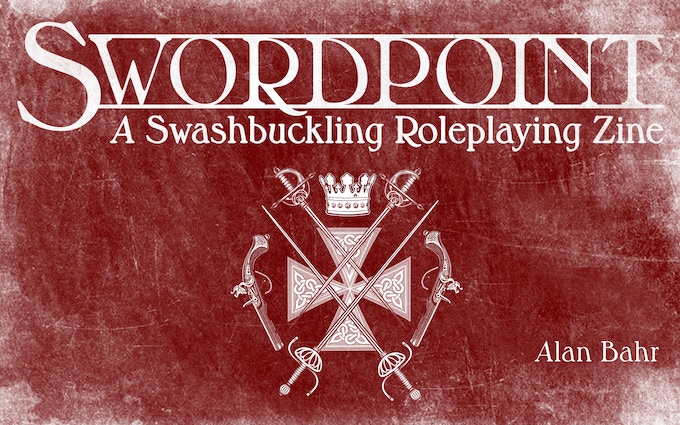
[Fanzine Focus XXX] Swordpoint: A Swashbuckling Roleplaying Zine

On the tail of the Old School Renaissance has come another movement—the rise of the fanzine. Although the fanzine—a nonprofessional and nonofficial publication produced by fans of a particular cultural phenomenon, got its start in Science Fiction fandom, in the gaming hobby it first started with Chess and Diplomacy fanzines before finding fertile ground in the roleplaying hobby in the 1970s. Here these amateurish publications allowed the hobby a public space for two things. First, they were somewhere that the hobby could voice opinions and ideas that lay outside those of a game’s publisher. Second, in the Golden Age of roleplaying when the Dungeon Masters were expected to create their own settings and adventures, they also provided a rough and ready source of support for the game of your choice. Many also served as vehicles for the fanzine editor’s house campaign and thus they showed another DM and group played said game. This would often change over time if a fanzine accepted submissions. Initially, fanzines were primarily dedicated to the big three RPGs of the 1970s—Dungeons & Dragons, RuneQuest, and Traveller—but fanzines have appeared dedicated to other RPGs since, some of which helped keep a game popular in the face of no official support.

Since 2008 with the publication of Fight On #1, the Old School Renaissance has had its own fanzines. The advantage of the Old School Renaissance is that the various Retroclones draw from the same source and thus one Dungeons & Dragons-style RPG is compatible with another. This means that the contents of one fanzine will be compatible with the Retroclone that you already run and play even if not specifically written for it. Labyrinth Lord and Lamentations of the Flame Princess Weird Fantasy Roleplay have proved to be popular choices to base fanzines around, as has Swords & Wizardry. And then there is Swordpoint: A Swashbuckling Roleplaying Zine.

Swordpoint: A Swashbuckling Roleplaying Zine is not really a fanzine, at least in the traditional sense. This is despite having the word ‘zine’ in the title. Published by Gallant Knight Games, this is a roleplaying game of swashbuckling action inspired by The Three Musketeers and Captain Alatriste as well as roleplaying games such as En Garde and Flashing Blades, all set in the Paris of the seventeenth century. Published as part of ZineQuest #3 it highlights how the fanzine and ZineQuest itself is moving from showcasing a particular game or author’s campaign—typically from the Old School Renaissance—to becoming a format for standalone mini-roleplaying games. Also, its odd format—five-by-eight inches, flipbook sized, and in landscape format, also marks it out as not being a fanzine in the very traditional sense.

Published following a successful Kickstarter campaign, Swordpoint uses a percentile system, being based on Mongoose Publishing’s Legend OGL. Players take the roles of Heroes who swashbuckle, race across rooftops, duel for honour, save the day, protect the innocent, defeat villains, and defeat villains again because they can never truly die. Games can involve military engagements, espionage, diplomacy, courtly intrigue, and both love and passion. There are rules for creating characters, action resolution, Style Points, combat, duels, grudges and revenge, spells and spellcasting, and of course, passion. These are all explained in a fairly succinct fashion, and whilst Swordpoint is not quite the bare bones of a roleplaying game, it is not far off from being so.

A Player Character has seven characteristics rated between three and eighteen—Strength, Constitution, Courage, Intelligence, Power, Dexterity, and Appeal. He has several Style Points, an Education rating for his general knowledge, and Rank. The latter represents his Social Status, derived from his social standing, position within an organisation, nobility, and wealth. Both Education and Social Status are percentile values. Rank can be increased for notable deeds, publicising those deeds, earning wealth, and so on. Rank can also be lost through misdeeds, and so on. A Player Character or NPC with a higher Rank will gain a bonus to social skills and situations. In addition, Player Character will have various skills—quite broad, and some possessions.

To create a character, a player rolls dice—typically three six-sided dice for most, but two six-sided dice to which six is added for Intelligence and Courage—to create the characteristics, or he can assign values from an array. Starting Rank is based on Power, but can be more if the character is of noble birth, determined by rolling on the appropriate table. Skill base values are derived from the characteristics and the player then assigns some bonuses, the largest being assigned to the character’s professional skill. He also has five items of equipment, which cannot include medium or large shields or armour, or shotguns, as they not suited to the genre. That said, stats for them are included should the Game Master want them in her game.

NAME: Campion Babin
CHARACTERISTICS
Strength 06 Constitution 06 Courage 17 Intelligence 15 Power 09 Dexterity 10 Appeal 12

ATTRIBUTES
Damage Modifier: -1d4
Hit Points: 23
Style Points: 5
Education: 75%
Rank: Gentlefolk

SKILLS
Athletics 26%, Craft (Specialty) 21%, Dodge 29%, Endure 33%, First Aid 35%, Lore (Religion) 70%, Melee 31%, Perception 44%, Persuasion 51%, Ride 39%, Shooting 25%, Stealth 25%, Thievery 19%

EQUIPMENT
Bible, sword, rosary beads, quill & ink

Mechanically, Swordpoint uses the percentile system of Mongoose Publishing’s Legend OGL. When a player wants his character to undertake an action, his player rolls the percentile dice and if the result is less or equal to the skill, then the character succeeds. Modifiers range between ten and forty, whether penalty or bonus, and in opposed rolls, it is the roll that succeeds and rolls highest which wins in that situation. Characteristic tests are rolled on a twenty-sided die.

Combat is not that much more complex than this. The rules cover initiative (players roll only, and go first if successful), attacking, dodging, insulting or taunting an opponent, two-weapon fighting, and so on. Successfully insulting or taunting an opponent will lose them a Style Point or Villain Point and is a nice genre touch. A character is only wounded when his Hit Points are reduced to zero, but further damage renders him first Helpless and then dead. Swordpoint being a swashbuckling game includes rules for duels, used by Heroes to settle matters of honour and resolve perceived slights and insults, whilst Villains use them as a means isolate and remove Heroes as threats to their Villainous plans. Heroes tend to duel to first blood, whilst Villains to the death. A successful Perception test allows the duellists to assess each other, learning things such as skill ratings, preferred weapons, Hit Points, Style or Villain Points, and so on.

In addition to loss of Hit Points, a Player Character can suffer a Condition. Being Wounded is a Condition, but a Player Character can also be Afraid, Confused, Exhausted, Heart-Broken, and so on. They have mechanical effect, but are primarily earned through the narrative of game play. In addition, Player Characters have Style Points, whilst the Game Master has Villain Points. Style Points can be spent to gain several benefits. These include ‘Catch Your Breath’ to regain some Hit Points, ‘Grit Your Teeth’ to reduce incoming damage, ‘Make Them Bleed’ to double the damage of an attack, ‘Redouble Your Efforts’ to reroll a test, and ‘Press Your Advantage’ to gain an extra action at the end of a round. Style Points are recovered at a rate of one per day, but a player can have his character fail a test in dramatic fashion, insult a foe in combat, accept a duel, and decide to accept a condition all to recover Style Points immediately.

Setting rules cover clubs and organisations, gambling, grudges and revenge. Having a Grudge against someone grants a slight bonus when acting against the target of the Grudge and can be settled quickly, whilst Revenge is a more determined, long-term attempt to do damage to a person and their situation. It requires Game Master approval, and enables the potential recovery of Style points when enacting said revenge. For the Game Master there are stats for various NPCs, from guards to Dangerous Villains, but oddly no feme fatale type character such as Milady de Winter. Swordpoint also includes rules for spellcasting and sorcery, plus a handful of skills, which would work in a more fantastical version of the genre. Rounding out Swordpoint are rules for Passion (and romance), which can be initiated between Player Character and Player Character or Player Character and NPC by the player or Game Master saying, “Passion, if you please.” The recipient does not have to consent, but a couple of tables follow which are rolled on to shape the romance itself. This covers the spark between them, the obstacle, and the possible fate of the relationship. When roleplayed, this all adds to the feel and genre of the game.

Swordpoint does not come with any setting. To be fair, it does not need to. This a swashbuckling film style of a roleplaying game and there are plenty of those for the Game Master to draw upon for inspiration, let alone the various works of fiction that she draw from.

Physically, Swordpoint is clearly and tidily laid out. It is well written and easy to grasp. It is very lightly illustrated. Given its length and format, Swordpoint is unsurprisingly sparse in feel and nature, and there are a lot of elements that the Game Master will need to develop, especially in terms of setting. Swordpoint: A Swashbuckling Roleplaying Zine is bare bones, but those bones are sturdy enough to provide everything, at least mechanically, that a gaming group will need to run a mini-campaign of swashbuckling action and romance.

Saturday, 13 February 2021

Savage Sherwood

The tales of Robin Hood, of a band of outlaws standing up to the tyrant King John in the Forest of Nottingham are so strongly woven into the folklore, legends, and myths ‘Merrye Olde Englande’ that they are familiar across the English-speaking world. Over the decades, the tales have been reinforced again and again by film and television, from the 1938 The Adventures of Robin Hood with Errol Flynn and the 1950s television series The Adventures of Robin Hood with Richard Greene to more recent adaptations such as the BBC’s Robin Hood of the noughties and the 2018 film, Robin Hood. These adaptions and retellings, of course, vary in quality, tone, and humour, some even having been done as comedies. Similarly, Robin Hood has been the subject of numerous roleplaying games and supplements. Some have been quite comprehensive in their treatment of the outlaw and his band, for example, the supplements Steve Jackson Games’ GURPS Robin Hood and Iron Crown Enterprises’ Robin Hood: The Role Playing Campaign are both highly regarded in this respect, whilst other supplements take a broad approach or simply touch upon the subject of Robin Hood, such as Romance of the Perilous Land from Osprey Games.

Sherwood: The Legend of Robin Hood takes a broad to the tales of Robin Hood and his merry men. Published by Battlefield Press, it is written for use with Savage Worlds, Third Edition, but versions of the supplement are also available for Pathfinder, First Edition, Swords & Wizardry, and Dungeons & Dragons, Fifth Edition, and since it is written for Savage Worlds, Third Edition, it is easily adapted to the more recent edition, Savage Worlds Adventure Edition.

Sherwood: The Legend of Robin Hood begins with a ‘Gazetteer of the 13th Century England’, which provides a historical and geographical overview of England—and to an extent, Ireland, Scotland, and Wales—for the period. It covers geography, economy, religion, everyday life, and more, including useful little details such as a list of the religious holidays during the period. Overall, it is a decent overview, giving some context for creating Player Characters and the setting. In terms of setting rules, Sherwood: The Legend of Robin Hood offers three different modes of play. These are Historical—realistic, superstition rather than magic, and relying upon Outlaw skill, luck, and confidence; Mythic England—a combination of mysticism, the supernatural, and the fantastic; and Swashbuckling—cinematic and sword-swinging! Each mode of play comes with a list of its Disallowed Hindrances and Edges, Setting Rules, and new Edges, along with a nod to its particular inspirations. Thus, for the Swashbuckling mode, it is The Adventures of Robin Hood, starring Errol Flynn; for Mythic England, it is the British Robin of Sherwood television series of the eighties; and for Historical, it is Robin Hood: Prince of Thieves from 1991. Of the three modes, Swashbuckling is actually intended to work with the first two, either Historical or Mythic England, so that the Game Master could run a Swashbuckling Historical campaign or a Swashbuckling Mythic England campaign. It should be noted that for role-players of a certain age, Mythic England, based upon Robin of Sherwood, is likely to be the default mode.

Player Characters in Sherwood: The Legend of Robin Hood are all Human. Along with a range of new Knowledge subskills, it gives a variety of new Edges and Hindrances. Thus for the latter there is Love, the type of love which going to bring a Player Character serious trouble, ‘Maladie Du Pays’, the medieval equivalent of Shell Shock, and Xenophobia, this last probably needing to carefully adjudicated by the Game Master lest it lead to inappropriate play at the table. Alongside various modified Edges, new Background Edges can make a Player Character have the Blood of the Fey, be a Knight of the Order—three are given, Knight Templar, Knight Hospitaller, and Knight Teutonic, or be Landed, for particularly rich characters; Combat Edges include Long Shot and One Shot Left, both useful for the Player Characters who want to be as good at archery as Robin Hood himself; and Social Edges include Quip!, Witty Banter, and Taunt, which all work with the Taunt skill to grant more than one attack per round.

If a campaign does involve magic, then Arcane Backgrounds include Alchemist, Conjurer, Druid, Priest, and Witch, the latter reflecting the period attitudes towards witchcraft rather than modern ones. These are nicely done and mechanically distinct, so the Alchemist concocts his spell effects into potions and the Druid casts rituals which take several rounds. The last Arcane Background is Engineer, which functions more like the Weird Science Arcane Background than magic, and enables  a character to design and build various devices.

Mechanically, Sherwood: The Legend of Robin Hood adds three new options. First, Bennies, the equivalent of Luck or Hero Points in Savage Worlds, are called Swashbuckling Points. Like Bennies, Swashbuckling Points can be used to reroll a Trait Test or Soak damage, but in Sherwood: The Legend of Robin Hood, they can also be used to add a bonus to a Trait Test, increase the success of an Agility Trick to a Raise, and for one or two Swashbuckling Points, depending upon the degree of alteration, a player can alter the story or immediate surrounds to his character’s benefit. Second, Agility can be used to perform Tricks like Attack from Above, Blade Ballet, Running Up Walls, Swinging Attacks, and more, which the players are encouraged to use Swashbuckling Points to set up. Lastly, rules for archery contests, target shooting, including the splitting of an opponent’s arrow, and speed shooting cover the signature elements of the Robin Hood legend.

Besides equipment, Sherwood: The Legend of Robin Hood gives several archetypes, including Engineer, Knave, Man-at-arms, Noble, Priest, and Yeoman, all ready for play. In each case, their role in both the setting and gaming group is discussed, as well as ways in which they might vary. For the Game Master, there is ‘Trouble in Sherwood: Adventuring in Nottingham’, covering various types of campaign, Gritty Outlaws or Political Outlaws, for example. What it highlights upfront is that whatever the type of campaign, a Robin Hood-style campaign should ideally be episodic—which nicely ties back into Robin of Sherwood—and rather than be about combat or facing monsters, should be more like an espionage campaign, involving secrecy and subterfuge. Rounding out the supplement is a set of write-ups for the major figures of  the Robin Hood legend, from Robin Hood himself and Little John to Guy of Gisborne. Lastly, ‘Mythic Sherwood’ guides the Game Master through bringing mythic elements and magic into the setting, the primary advice being to keep the effects of magic subtle, whether real or not. The aim being with the introduction of magic or any of the ‘Legends and Monsters’, from dragons and gargoyles to pookas and banshees, is to avoid the campaign from straying into territory already covered by traditional fantasy gaming.

As much content as there is in Sherwood: The Legend of Robin Hood, it is lacking a couple of areas. First, as much as the gazetteer gives context for a potential campaign, a timeline would have been useful to give more context for the history, and second, a better map would have been useful to give more context for the geography. Of course, both of these omissions can be addressed with some research upon the part of the Game Master, but the loss of a piece of art or two would certainly give room for either. 

Physically, Sherwood: The Legend of Robin Hood is a decent little book. It is well written and illustrated with public domain artwork, but it does need an edit in places and the layout could definitely have been tidier. By contemporary standards, it does feel a little too grey and plain in terms of its look, but to be fair, it would not have been greatly improved by being full colour.

Sherwood: The Legend of Robin Hood packs a lot into its seventy-two pages, playable Player Characters, new Edges and Hindrances and skills, NPC write-ups, and both campaign ideas and modes. Together, Sherwood: The Legend of Robin Hood should just about cover anything that a Game Master and her players would want in a Robin Hood campaign in what is a serviceable little supplement.

Saturday, 12 October 2019

#WeAreAllUs: The Sword of Kings

October 10th marks the first anniversary of Greg Stafford’s passing. To both commemorate that date and celebrate Greg’s contribution to the roleplaying hobby, Chaosium, Inc. is publishing not just one free scenario, but five. One for each of the major roleplaying games published by Chaosium, Inc. Either designed or influenced by Greg, they include RuneQuest: Roleplaying in GloranthaKing Arthur PendragonHeroQuest in GloranthaCall of Cthulhu, Seventh Edition, and 7th Sea. The aim of these releases is twofold. One is to showcase each of these worlds and roleplaying games, typically with a scenario that can be brought to the table with relative ease, whether that is your own or at a convention, but primarily the purpose is to get everyone sat round the table and playing since we are all roleplayers. In Greg’s words, that #WeAreAllUs.

The Sword of Kings is a scenario for 7th Sea, the preeminent roleplaying game of swashbuckling action, adventure, and storytelling in Théah, an alternate and fantastical version of Europe and beyond in the seventeenth century. Written by the game’s designer, John Wick, it is a one-shot, one-session adventure that can be run as a demonstration scenario, a convention scenario, or a scenario that dropped into an ongoing campaign with relative ease. It is thus quite short, consisting of three scenes and is relatively easy to prepare, but on the downside, as a demonstration or convention scenario, The Sword of Kings is lacking pre-generated player characters. The Game Master will need to prepare these prior to running the game. On the plus side, the scenario comes with staging advice aplenty such that the designer’s voice is strong throughout.

The Sword of Kings begins in medias res—two ships, one of them on fire (the one the heroes are on, of course), a raging storm, and a sea battle—as the stalwart heroes withstand assault after assault from brute squads and a villain bent on getting his hands on the one half of the McGuffin that the heroes have in their possession. The player characters are not meant to know what is going on, but a quick flashback reveals that they are off the Highland Marches having been ashore in Avalon where a woman wearing the symbol of the Explorer’s Society not only told them of a legendary sword that could ruin the reign of Queen Elaine of Avalon, she also gave them half of a map that would lead to its location. Guess who has the other half and happens to be aboard the sailing ship that is not on fire and that the heroes not aboard?

The subsequent acts get the heroes onto the island where clues to the location of the sword might be discerned and from there to its actual location. The simplicity of the set-up and the scenario—which are all but clichés—means that it is not heavily plotted, but instead focuses more on staging its various scenes, such as things that can occur aboard the burning boat, what happens should the heroes be captured, and both who the player characters’ patron might be and who the villain might be. A sample villain is included, but the Game Master is free to create one of her own or simply bring a recurring villain from her own campaign. The plot is definitely more spine upon which the Game Master can hang contingencies and the like in reaction to the player characters’ actions. Adapting to such contingencies likely means that the scenario will never quite turn out the same way twice if run as a demonstration or convention scenario.

The ending in which, of course, the heroes find the sword of the title, may well be slightly downbeat following the excitement of the opening scenes, especially if the Game Master is running it as a demonstration or convention scenario. Perhaps she may well want to add one last confrontation with the villain of the piece, if only to show off what the newly found sword can do. For an ongoing campaign this is less of an issue as ownership of the sword is likely to cause the heroes further complications.

Physically, The Sword of Kings is an eleven page, full-colour, 5.20 MB. Behind its full colour cover, the scenario tidily laid out and written in an engaging style. The scenario comes with a decent map and a decent handout (also a map).


The Sword of Kings is relatively easy to pull and run with a minimum of preparation, that is, if using it in an ongoing campaign. As a demonstration or convention scenario it will need pre-generated characters and those will need preparing ahead of time. Otherwise, The Sword of Kings comes with everything necessary to provide a 7th Sea Game Master and her players with a session’s worth of swashbuckling and sorcery—more than mild peril, a dastardly villain, a McGuffin, and a mystery.

Monday, 9 September 2019

7th Sea's 7

Like the DM’s Guild for Dungeons & Dragons  and the Miskatonic Repository for Call of Cthulhu, Seventh Edition, there is also the Explorer’s Society for 7th Sea. It provides an outlet for fans and writers of the preeminent roleplaying game of swashbuckling action, adventure, and storytelling in Théah, an alternate and fantastical version of Europe and beyond in the seventeenth century. Inspired by films such as Ocean’s Eleven, Evan Perlman’s Sea’s 7 published by Chaosium, Inc. is a heist adventure set in a grand casino. Which means high stakes gambling, intrigue, secrets, lies, spies, dangerous liaisons, and more—but above all, rising tension as the heroes case the joint, devise and then execute the plan, doubtless ending in a flurry of action and consequences as they get away with it (or not)!

Ideally, the Game Master should have access to the Pirate Nations sourcebook, for the Queen of the Pirates has a problem and needs a favour. Someone swindled the Pirate Republic’s dock workers out of a considerable amount of money and to avoid any embarrassment, she and the Brotherhood of the Coast want it returned. Now the perpetrator has been traced to the Montaigne colony of Sylviette where she has resurfaced as the Comtesse du Janvier, operator of its newest, hottest social destination—the Casino Impérial. The Queen of the Pirates not only wants the money back, but the Comtesse du Janvier ruined. It sounds like a simple job, but security is tight, the company charming if duplicitous, and there is bound to be a plot twist or along the way. If not written into the plot, then probably due to the Heroes’ involvement.

Sea’s 7 is a two-Step, four-Scene adventure. In the first two scenes, the Heroes start planning the heist and spend a night at the casino looking for ways to get into the vault and the money out. In the second two steps, events escalate as the Heroes carry out their plan in the face of cruel opposition and a rival ‘heist’ before making their getaway as everything goes awry around them. The description of the Casino Impérial and its layout are detailed enough for the Game Master to run the Heroes through all four scenes, although the promised map is strangely absent. Of course, much of the action and story will be player-led, so there are lots of NPCs for their Heroes to interact with, from a nobleman on a stag do to a possible Fate Witch who is all too successful at the gaming tables; Opportunities aplenty to divert attention, uncover secrets, recruit allies, and more; Consequences to suffer, including stumbling into a tryst, getting caught sneaking around, being mistaken for someone’s enemy—did I mention that everyone at the Casino Impérial wears a mask?—and so on; plus secrets galore to uncover... There is a lot here for the Heroes to get involved in should they go looking—and they probably will—in addition to their actually robbing the place and ruining a reputation. 

Physically, Sea’s 7 comes as a 4.08 MB, full colour PDF. It is lightly illustrated, really just chapter headers showing period scenes of gambling and carousing. All very suitable and all very chaste, though doubtless, the events surrounding the Heroes’ heist attempt on the Casino Impérial will involve romantic entanglements, if not actual trysts.

With plot hooks, a handful of given nicely detailed villains, and example lists of approaches, Consequences, Opportunities, NPCs, secrets, and more, as well as solid staging advice, Sea’s 7 is a really superb toolkit for running heists in 7th Sea. There is so much information here that it is unlikely that the Game Master will use it all, though to do that, she would have to find a way to run it twice! In fact were the Game Master to run it more than once—perhaps as a convention scenario (all it would need is a good set of pre-generated Heroes)—it is unlikely that Sea’s 7 would play out the same way twice. Any 7th Sea Game Master wanting to run a heist will find Sea’s 7 invaluable and for any 7th Sea Game Master needing a short scenario to add to her campaign, Sea’s 7 is a good choice.

Sunday, 15 October 2017

Swashbuckling & Sorcery

From Game Designers’ Workshop’s En Garde!, Yaquinto Publication’s Pirates and Plunder, and Fantasy Games Unlimited’s Privateers and Gentlemen to The Australian Gaming Group’s Lace & Steel, Evil Hat Production’s Swashbucklers of the 7 Skies, and Triple Ace Games’ All For One: Régime Diabolique, the swashbuckling RPG has been a perennial favourite. Yet few have managed to capture all of the roleplaying genre’s elements—swashbuckling, sorcery, pirates, romance, adventure—with as much love as 7th Sea. Originally published by Alderac Entertainment Group in 1999, it was co-designed by John Wick, best known for Play Dirty and Legend of the Five Rings. For almost a decade though, the 7th Sea roleplaying game has been out of print, but with the acquisition of the publishing rights by John Wick and the subsequent successful funding of a new edition on Kickstarter, 7th Sea is in print again with an all new Second Edition.

Now published by John Wick Presents, 7th Sea presents a setting that is very like the Europe of the late seventeenth century. There are pirates, there is religious rivalry, there are flashing blades and musketry, there is diplomacy and intrigue, there is adventure and romance, there is disruption in country after country as medieval kingdoms evolve into modern nation states. Yet there are large differences also. There is an equality between the genders and races; greater advances have been made in the sciences as much as the Inquisition would seek to burn all knowledge of it; there are superstitions and monsters who are much more than folklore; and there is real magic, whether that is the Glamour magic of Avalon, the Sorte or ‘fate’ magic of the Vodacce women, or the Le Magie des Portails or Porté of Montaigne. This is a roleplaying game of great heroes and heroines, but also great villains; a roleplaying game in which the player characters are expected to be those heroes and heroines; and a roleplaying game which draws mechanically from the past as much as it does from the now, for 7th Sea is as much a storytelling game as it is a roleplaying game.

Unfortunately, right from the start, 7th Sea has a problem and that is with its overview. Now 7th Sea is a roleplaying game with an extensive background and setting as befits a line with some forty or releases for its first edition alone, and yet whilst some of that setting is given in the 7th Sea corebook for its second edition, what it really lacks is a timeline. This is a problem because the focus of 7th Sea is very much on recent events, many of which are mentioned in the 7th Sea core book’s setting material, yet without a timeline, the game feels hamstrung because it has no history let alone a sense of history and worse, because it has no context. Without that context, it is difficult for the players to create characters and it is difficult for the Game Master to create scenarios because it is difficult to tie them back into the setting.

A less pressing issue concerns the name of the roleplaying game. 7th Sea refers to the mythical sea beyond the six seas that surround the game’s setting. There is an explanation for this, but it seems so odd that this explanation appears almost a hundred pages into the book when it feels like it should and could have been mentioned much, much earlier.

The setting for 7th Sea is Théah. The year is 1668 Anno Veritas. The continent is dominated by eight countries—Avalon, Castille, Eisen, Montaigne, the Sarmatian Commonwealth, Ussura, Vestenmennavenjar, and Vodacce. Each of these countries has parallels with those of seventeenth century Europe. So, Avalon is actually the dominant nation in the Glamour Isles, the others being Inismore and The Highland Marches, all three countries being home also to the Sidhe. It equates to Elizabethan England and is ruled by Queen Elaine, who recently became the Keeper of the Sacred Graal following a civil war. Avalon has a powerful navy and her queen is said to issue letters of marque to the privateers known as the ‘Sea Dogs’. Castille is Spain, weakened following an invasion by neighbouring Montaigne, but dominated by the church—the Vaticine Church of the Prophets—which has recently moved its headquarters there from Vodacce and is itself dominated by the Inquisition following the death of its head, the Hierophant. The corruption of both the church and the nobility is opposed by the masked vigilante, ‘El Vagabundo’, whose identity remains unknown. Eisen equates to the German states of the Holy Roman Empire after the Thirty Years War, or rather, the War of the Cross which has ravaged the land and left it infested with all manner of monsters. Eisen is also a source of the metal known as ‘Drachenstein’, which when turned into arms and armour, is one of the most effective things against the monsters. Montaigne is pre-revolutionary France, a rich land in the which the rich live lavishly off the backs of the peasantry and whose whims set the fashion trends across the continent.

To the east lies the Sarmatian Commonwealth, which equates to Poland, and is best known for its radical form of government. To prevent the corrupt House of Nobles from running the country in its own interests, the king elevated everyone to the nobility and effectively created Théah’s first democracy. Ussura is medieval Russia, a land which literally supports those who respect it and destroys those who do not. The most striking figure in Ussura is Matushka, mother figure who can show great kindness and even grant magic, but is also capable of great wrath. Vestenmennavenjar equates to an alliance between the Vikings and the Hanseatic League, an alliance of proud warriors and wily merchants. They trade everywhere, their guilds dominate various trades, and their guilders have become common coinage accepted almost everywhere. Lastly, Vodacce is Italy governed by feuding city states. It dominates church politics even though it is no longer home to the Vaticine Church of the Prophets and it values its women for their beauty, their Sorte or ‘fate’ magic, but not their ability to learn.

Beyond the six seas that surround Théah, there are several far-off lands. Khitai, the Crescent Empire, and Cathay lie to the east, whilst the New World can be reached in the west. There is also the past to be explored, the ruins of the mysterious Lost Syrneth being the foundation upon which many cities of Théah are built.

So what can you do in Théah and 7th Sea? As a melange of ideas and genres, 7th Sea provides numerous options. The continent is rife with intrigue, whether that is in the feuds between the rival merchant princes of Voddace or the petit rivalries at the court of l’Empereur of Montaigne. There are monsters to hunt and kill in Eisen; ruins and distant lands to be discovered and documented, perhaps for the Explorer’s Society; there are ships aplenty to crew, perhaps as privateer with the Sea Dogs, a pirate sailing as part of the Brotherhood of the Coast, or a nation’s navy tracking down pirates. There are rebellions to foment, perhaps against church and state with the Rilasciare, or against the Inquisition as part of the efforts of the Invisible College to protect science. Ultimately, there are the dastardly plans of great villains to thwart, secrets to be recovered, damsels and swains to rescued, buckles to be swashed, and days to be saved.

The next question is, what can you play? Options include—but are not limited to—a Puritan of Avalon, an Alquimista (alchemist) of Castille, an Ungetümjäger (Monster Hunter) of Eisen, a L’ami du Roi (courtier) of Montaigne, a Winged Hussar of The Sarmatian Commonwealth, a Cossack of Ussura, a Guildmästaren of Vestenmennavenjar, or Bravo of Vodacce. Each of the eight nations has several of these backgrounds which are in addition to the thirty or so basic backgrounds which range from archaeologist and aristocrat to soldier and spy. Characters or rather, Heroes, because in 7th Sea that is what the player characters are, are themselves defined by five traits—Brawn, Finesse, Resolve, Wits, and Panache—and sixteen broad skills. These are Aim, Athletics, Brawl, Convince, Empathy, Hide, Intimidate, Notice, Perform, Ride, Sailing, Scholarship, Tempt, Theft, Warfare, and Weaponry. A Hero will also have Arcana, divided into Hubris and Virtue, personality traits which will earn him Hero Points when roleplayed or tagged by the Game Master. Similarly, each Background will have a Quirk which can be triggered to earn Hero Points. Plus, he will have Advantages, but notably, not Disadvantages. 7th Sea does not have Disadvantages.

To create a Hero, a player must first play the Game of Twenty Questions—in a fashion previously seen in Legends of the Five Rings—to set some facts down about his character and only then select his character’s nation and his two Backgrounds. So your character might be an Engineer-Crafter, a Consigliere-Priest, a Pugilist-Mercenary, an Orphan-Criminal, a Bearsark-Sjørøver (a berserker-pirate), a Sorcier Porté-Aristocrat, and so on. The choice of nation determines the bonus to one Trait, whilst each Background provides a quirk, some Advantages, and bonuses to various skills. In addition, a player has extra points to assign to Traits and extra points with which to purchase more Advantages. Lastly, he selects Arcana.

—oOo—

Our first sample Hero is Héctor de Estrella de Lucas del San Gustavo, a disposed noble from Castille. In the peace following the war the Montaigne invasion, the soldier was expecting to return home to marry Beatriz, his father’s ward, but heavy taxes forced his father’s hand. In return for paying the taxes, Beatriz was betrothed to the Vizconde Alonso de Esteban del Galán and Héctor was disgusted at his father’s actions. Especially since Beatriz would not be the Vizconde’s first wife and Héctor suspected that marrying Beatriz was a means to obtain her dowry. One too many heated arguments and Héctor’s father disowned him, with Héctor fleeing and vowing to win her hand back and raise the monies to pay for the taxes himself.

Héctor de Estrella de Lucas del San Gustavo
Nationality: Castille
Concept: Errant Hidalgo
Backgrounds: Aristocrat, Diestro

Brawn 2
Finesse 3
Resolve 2
Wits 3
Panache 3

Quirk: Earn a Hero Point when you best a trained duellist at her own game.
Quirk: Earn a Hero Point when you prove there is more to nobility than expensive clothes and attending court.
Advantages: Fencer, Disarming Smile, Rich, Fascinate, Duellist Academy (Aldana)
Skills: Aim 1, Athletics 2, Brawl 0, Convince 3, Empathy 3, Hide 0, Intimidate 1, Notice 1, Perform 2, Ride 1, Sailing 0, Scholarship 1, Tempt 1, Theft 0, Warfare 1, Weaponry 3

Arcana: The Sun
Hubris: Proud (Receive a Hero Point when you refuse an offer of aid)
Virtue: Glorious (Activate when the centre of attention to have all dice count as a Raise.)

Story: A True Betrothal
Héctor’s true love and his father’s ward, Beatriz, has been betrothed to the Vizconde Alonso de Esteban del Galán to pay for taxes owed. Héctor has sworn to win her hand true and fair.
Ending: ‘To win the hand of Beatriz’
Reward: Convince (Rank 4)
Steps:

  1. Write a letter to Beatriz ensuring her of my intentions and ensure she receives it.
  2. Investigate Vizconde Alonso de Esteban del Galán to see if the rumours about are true.
  3. Gather evidence of the Vizconde Alonso de Esteban del Galán’s activities.
  4. Present the truth about her betrothed to Beatriz.


—oOo—

One of the last steps in creating a Hero is setting up his Story. This begins with deciding upon the theme for the Story and its ending. So, for example, Héctor’s Story is very much one of romance, so the ending might be ‘To win the hand of Beatriz’, but it might ultimately turn out to be ‘Beatriz rejects him telling that she is betrothed to another man’. That depends upon the outcome of the Story, which will involve several steps. So, Gunther, a Ungetümjäger whose family were butchered by a thing of the night has the story, ‘Discover more about the creature that butchered my family’, which he builds with the following steps, ‘Return to the scene of my family’s death’, followed by ‘Study at Freiburg University to learn more of the creature’. The outcome of a story can be an improvement to a skill, a trait, an advantage, a quirk, an arcana, and so on, the new value being equal to the number of steps in the story. So in Gunther’s case, the reward is to raise his Scholarship skill from one to two.

This is the primary means of improving a character in 7th Sea. Instead of using the Experience Points of traditional roleplaying games, the improvement is explicitly tied to a Hero’s story and is set up beforehand. Now whilst it is clever and it does move 7th Sea away from traditional roleplaying towards storytelling, it comes with a number of consequences. One is that the greater the desired reward, the greater the number of steps required and the greater the number of descriptions required to detail each of those steps. So to improve the Weaponry skill from three to four would require four steps, and then from four to five, another five steps. Of course, this sets out for both player and Game Master what steps the player’s character has to take to achieve each objective, but in the long term, this is likely to prove something of challenge as the players try and be original and consistent in building longer and longer stories—and that does not count the players who find this sort of thing difficult anyway.

This also means that the Game Master cannot just create a scenario and run that—at least not very often. Like character stories, Game Master stories also consist of steps, although what the rewards are for completing all of the steps, well, the book is somewhat hazy about… In addition to the steps of the Game Master story, the Game Master has to take into consideration the steps for each of his players’ Heroes’ stories, and when this involves multiple Heroes, it can be a lot to take into consideration. Yet the Game Master cannot ignore, because without fulfilling them, a Hero cannot progress.

In traditional roleplaying games, the amount of damage a player character can take will vary from character to character. Unless changed by an Advantage, each Hero has the same damage track, or ‘Death Spiral’, some twenty pips long. Every fifth pip of damage represents a dramatic wound, which grants a Hero an advantage or inflicts a penalty. So for example, upon suffering the first dramatic wound, a Hero is given an extra die to roll when he acts, but upon the second, the Villain that the Hero is facing gains two extra dice!

Unlike other roleplaying games, when a Hero suffers a fourth dramatic wound and thus runs out of wounds, he is not dead, but helpless and cannot act. At this point, a Hero can be killed by a Villain, but even this action requires the expenditure of a Danger Point by the Game Master and a murderous declaration. Even then, another Hero can leap into save the helpless Hero. Similarly, should a Hero reduce a Villain to the equivalent of helpless, he cannot simply kill him. It takes the declaration of intent and the expenditure of a Hero Point. What this highlights is that the damage in 7th Sea is designed to be dramatic and to add to the story not just represent mechanically how much pain a Hero is in.

Should a Hero act in a way that is evil, such as inflicting unnecessary suffering or not acting to save another when the opportunity arose, then he can accrue Corruption Points. These have no mechanical effect in game, but the more corrupt acts he commits, the Corruption Points he gains and they escalate very quickly. The more they do, the greater the chance of the Hero turning into a Villain and becoming an NPC. There is a way though, via a Redemption Story, but this is hard work upon the part of the failing Hero.

One other option a Hero has is to join a secret society. Some ten are given, including  the pirates of The Brotherhood of the Coast, monster-battling knights of Die Kreutzritter, the scholars and archaeologists of the Explorer’s Society, along with what each wants, knows, and can help with. Joining one is essentially free, but a Hero can only join the one and be trusted. In return, he can gain and earn favours with the secret society and this can provide motivation for the Hero and storylines for the Game Master.

Mechanically, 7th Sea uses pools of ten-sided dice, but where both the previous edition and Legend of the Five Rings used ‘Roll and Keep’ where the player or Game Master selected the dice results and added them together, 7th Sea uses a ‘Roll and Pair’ mechanic. When a player or the Game Master rolls the dice, his aim is to build totals of ten or more using two or more dice. So rolling six dice, a player might roll 2, 3, 4, 4, 8, and 10. This would be paired like so, 3+4+4, 8+2, and 10, to give three results of ten or more. Each result being known as a Raise (which should confuse any long-time player of Legend of the Five Rings). The number of dice to be rolled will be determined by the combination of trait and skill used, for example, Finesse and Weaponry to delicately cut at an opponent with a rapier, Wits and Tempt to wheedle some information out of someone, or Panache and Perform to impress someone with your singing. Further dice can be earned through the expenditure of Hero Points as well as from various advantages, but they can also be earned through storytelling—dynamic and verbal. The latter by a player character describing how his character will undertake an action, the former for the first use of a trait and skill combination, which will lead to a character switching between combinations of trait and skill to both gain the bonus and give dynamism to the action.

For example, James McTavish rushes into battle wielding his country’s signature weapon, a claymore. This means that his player will roll seven dice for James’ Brawn and Weaponry. His player adds one die because James has the Bruiser advantage, which gives him an extra die for welding a heavy weapon, in this case, the claymore; he gains a second die for using the Brawn and Weaponry combination for the first time; and a third for the description given by his player of “With a scream, I ferociously charge into the soldiers surrounding the cardinal, attempting to knock as many aside as I can.” This gives the player a total of ten dice. On a subsequent turn, the player decides that James will switch to Finesse and Weaponry, which gives him a base of six dice to roll. His player adds one die for the Bruiser advantage, a second die for using the combination for the first time, and a third for the description, “Not all of the cardinal’s men have been scattered, so I am forced to fight them blade to blade, knocking them aside to put them out of the battle.” So nine dice to roll then.

Conversely, Brute Squads—and groups of monsters who are like squads, such as a horde of shambling corpses or a pack of ravenous wolves—do not roll dice. Instead, they simply have Strength value, representing how damage they would inflict if left to attack unchecked. Their Strength value also represents how much damage the squad can take, so reducing a squad’s Strength also reduces how much damage it does in combat. Both types of squad, Brute or Monster can have qualities. For example, Guards, which force attacks against a Villain to be made against the Brute Squad accompanying the Villain with less damage, whilst Assassins can go first and inflict damage first. Monsters have qualities such as Shadowy, which makes them more difficult to track, or Chitinous, which negates damage from a single attack. A quality particular to monsters is that of Fear, which reduces the number of dice rolled by a Hero. Many of these qualities require the Game Master to expend a Danger Point to trigger.

Villains, whether monsters or humans, are slightly more complex. Like the Heroes, a Villain has Arcana—a Virtue and Hubris—and has Advantages, but a Villain does not have skills. Instead, a Villain has a Villainy Rank which is divided between two Traits, Strength and Influence. The first represents a Villain’s personal abilities, the second his power in the world. Thus, the first might be his swordsmanship, his sorcerous abilities, his charm, and so on, rolled just like a Hero’s skills are rolled, whilst the second is his money, his allies, his political power, and so on. To thwart a Villain, the Heroes can undermine his Influence, but to defeat him, they must battle him face to face and reduce his Strength. Villains being Villains, they are always scheming and schemes require the investment of Influence. This is permanent. If he succeeds, a Villain gains the Influence back and more, but if the Heroes thwart him, the Villain loses that investment—permanently. Villains are notoriously difficult to defeat though and it takes a lot of effort upon the part of the Heroes to defeat a Villain.

One advantage that Heroes have is Hero Points. All Heroes start each session with one Hero Point. More can be earned by a player or the Game Master activating a Hero’s Hubris, roleplaying a Hero’s Quirks (from his Backgrounds), a player having his Hero accept defeat, and by the Game Master buying any unpaired dice that not part of a Raise. The Game Master also gains a Danger Point this way. Hero Points can be spent to gain dice—on a one-for-one basis—before a roll or given to another Hero to help him with three extra dice. Certain Advantages require Hero Points to be activated and Hero Points can be spent to allow a Hero to act if he is helpless. Unfortunately, where a Hero has Hero Points, a Villain—and thus the Game Master—has Danger Points. These can be spent to raise the target required for a Raise (a success), to add dice to the Villain’s action, to activate a special ability of the Villain or a Brute Squad, or to kill a helpless Hero. The Game Master begins each session with Danger Points equal to the number of Heroes.

7th Sea being a roleplaying game of swashbuckling and sorcery means that it needs mechanics for duelling, sorcery, and seamanship. Duelling requires attendance at a duelling academy, there being one per nation, and in game terms, this requires the Duellist Academy advantage. Graduates are also members of the Duellist Guild and can thus initiate duels. A duellist is taught several common manoeuvres—slash, parry, feint, and so on—plus a Style Bonus unique to each academy. For example, the Valroux style is defensive in nature, requiring the use of a primary weapon and a main gauche. Its style bonus, Valroux Press, is a blocking manoeuvre which limits the number of wounds which can be inflicted and makes the opponent’s next action more difficult. In battle, manoeuvres cannot be repeatedly used, but instead must be alternated, so what results is the back and forth of swordplay so beloved of the genre and the movies. 7th Sea’s treatment of all things nautical is unsurprisingly aimed at telling stories rather than running a simulation of naval encounters. It is informative, gives you everything you might need to know to play and run shipboard and ship-to-ship encounters, including battles and trading, but without unnecessary detail. Ships can also have histories and adventures, both building a vessel’s legend, and with it, that of the Heroes.

If 7th Sea’s treatment of sailing and duelling is quite straightforward, the same cannot be said of sorcery, which really comes down to a number of subsystems, one per type of sorcery per nation. So Hexenwerk is practised in Eisen and involves the preparation of unguents from the dead combined with herbs, poisons, and other ingredients. Some like, Winter’s Scowl, which requires holy water, a thorny rose stem, and drops of the sorcerer’s blood, can be used to inflict wounds on an undead and stun them—and so aid against the undead that plagues Eisen. Others, like Master’s Bread, which requires a combination of a dead brain with hallucinogens, enables the practitioner, upon eating the resulting doughy result, to command an undead Monster Squad, have less savoury uses and explains why Hexenwerk is illegal, punishable by death. The Knights of Avalon practise glamours, each embodying one of the knights of legend and a particular Trait like Brawn or Wits. Unlike Hexenwerk, Glamours have Ranks and so can be improved. The La Magie des Portails or ‘Porté’ of Montaigne involves the sorcerer cutting holes and doorways in the fabric of the universe. These bleed and scream, but by placing a mark on objects—in his own blood, a sorcerer can pull the object to him or pull himself to the object, no matter how far away it is. Most famously, the Sorte of ‘fate magic’ of certain Vodacce women who manipulate the strands that connect all things to change the fate of those around them with Tesse or weaves, perhaps to place a blessing or a curse on someone, or even to meddle with their Hubris or Virtue. As a Sorte Strega—or ‘fate witch’—manipulates these strands, the power of her Tesse grow, but so do the lashes that fate binds to her. To remove these lashes a Sorte Strega must pay in blood or bad luck, that is, wounds or further Danger Points for the Game Master.

Typically, a Hero only gains a minor and a major sorcerous effect when purchasing the Sorcery Advantage. To improve his Sorcery, a Hero will need to complete a five step story as the advantage costs five points! If a Hero wants to become a powerful sorcerer, then this must be done again and again, so a lengthy process. That said, it does not take a Hero long to become a powerful sorcerer and some of the powers are potent indeed. The Hero is not really meant to fully embrace these powers though, but rather use them wisely lest the power goes to his head and perhaps leads to his becoming corrupted.

The treatment of the various sorcerous powers is uneven. For example, there is lots of flavour detail in the description of Hexenwork, but not really many powers for a character to learn unless he wants to learn the darker practices. The Knights of Avalon are given lots of Glamours and a sense of progress in that each possesses a rank and can be improved. In comparison, Sorte and Porté can only do a few things and feel decidedly underwritten, but they are powerful, in many ways more powerful than the other forms of sorcery. The underwritten nature leaves the Game Master to wonder at just how much more there is to magic in Théah.

—oOo—

Our second sample Hero is Iolandia, a Sorte Strega from Vodacce who was orphaned and kidnapped as a child and forced to study ‘fate magic’ or Sorte. She never learnt who her captors were before managing to escape in her teens and she had to live on the streets and by her wits for many years. She became a burglar and a thief, at times applying her Sorte to give her an advantage, first in Vodacce, but when the princes’ men hunted her, then in Montaigne and Castille. The black clad men and women have followed her again and again and now she wants to find out who they are, why they want her, and what happened to her parents.

Iolandia
Nationality: Vodacce
Concept: Rogue Sorte Strega
Backgrounds: Sorte Strega, Criminal

Brawn 2
Finesse 3
Resolve 3
Wits 2
Panache 3

Quirk: Earn a Hero Point when you commit to a dangerous course of action that you believe is destiny.
Quirk: Earn a Hero Point when you break the law in pursuit of a noble endeavour.
Advantages: Brush Pass, Camaraderie, Second Story Work, Sorcery, Sorcery, Streetwise, Time Sense
Skills: Aim 0, Athletics 3, Brawl 1, Convince 2, Empathy 1, Hide 3, Intimidate 1, Notice 1, Perform 2, Ride 1, Sailing 0, Scholarship 0, Tempt 2, Theft 3, Warfare 0, Weaponry 0

Sorcery—Sorte
Minor Tessere: Read, Arcana, Bless, Curse
Major Tessere: Blessing, Curse

Arcana: Coins (for the Ferryman)
Hubris: Relentless (Receive a Hero Point when you refuse to leave well enough alone or quit whilst you are ahead, and it gets you into trouble).
The Fool
Virtue: Wily (Activate to escape danger from the current scene. You cannot rescue anyone, but yourself.)

Story: Who am I?
Iolandia does not know who her parents were, why she was kidnapped and why she is hunted. She wants to find out why. Starting with the name of the organisation after her.
Ending: ‘To find out who is after her.’
Reward: Scholarship (Rank 1)
Steps:

  1. Kidnap one of the men or women after her and interrogate them to find out what she needs to know.

 —oOo—

The game itself is played out in a series of sequences, either Dramatic or Action. Whilst both can handle conflict or adversity, the latter handles furious bursts of activity, combat, and derring do, the former are extended scenes which might cover an evening at a duke’s ball, a burglary attempt on a merchant’s house, or a sea voyage into pirate ridden waters. During play it is possible to switch back and forth between the two, according to the needs of the story, but both involve Risks and both are constructed with Consequences and Opportunities. Consequences represent what can go wrong if the Heroes fail at a Risk, whilst Opportunities represent chances for the Heroes to learn more information, run into a contact, find a conveniently placed item, lock eyes with a villain leading to a duel, and so on. To overcome Risks, avoid Consequences, and take Opportunities involves the expenditure of Raises. A Hero might roll enough Raises to overcome a Risk, avoid the Consequences, and take advantage of the Opportunities, but then again, he might not. In which case, he might have enough to overcome the Risk, but not grab an Opportunity whilst avoiding the Consequences. So, he might get away with kicking the villain off the top of the speeding coach and grabbing the necklace that he stole from the duke’s mistress, but he might find himself hanging onto the door to the coach as it careers into a narrow street.

What a player does at the start of either Action Sequence or Dramatic Sequence is decide upon his Hero’s approach. This determines what combination of Trait and Skill a player must roll. For example, to fire the cannon aboard a pirate ship, a player might roll Wits+Aim; to impress someone with your singing, then a player should roll Panache+Perform; and to taunt an opponent in a duel, a player might roll Wits+Weaponry. In a Dramatic Sequence, there is no specific order in which the players spend their Heroes’ Raises beyond in the demands of the story, but in an Action Sequence, the player with the highest number of Raises gets to spend them first, then the others play theirs with the Game Master running a countdown. In combat, damage is inflicted or blocked on a one-for-one basis, and unless a Hero has an Advantage or been to a Duelling Academy, the damage will come from the roll rather than from the quality of the weapon wielded.

—oOo—

In our sample Dramatic Sequence, the Heroes are in the Castille port of Arisent when Iolandia is kidnapped! Her compatriots, Héctor de Estrella de Lucas del San Gustavo and James McTavish, know that she was last seen in and around the harbour, so decide they must search this area for her. The Game Master asks what approaches their players will take in conducting this search. James’ player states his approach will be direct, using his bluff presence to scare some answers out of the inhabitants of the port area. The Game Master suggests that James’ player will be rolling Brawn+Intimidation. Héctor’s player states that Héctor will be charming and friendly, attempting to make a good impression. The Game Master says that this is Héctor is using his Panache+Convince. The Game Master also states that the players will need two Raises if they are to overcome the Risk and learn what has happened to Iolandia. He also informs them that there is one Consequence and two Opportunities.

James’ player rolls seven dice for his Brawn+Intimidation. He rolls 2, 3, 3, 5, 6, 9, and 9. Since his Intimidation skill is 3, he can re-roll a die, but only gets a 1, so no change to the rolls. These he pairs into three Raises (3+9, 3+9, and 6+5). The Game Master decides that he will purchase the unused 2, which gives him a Danger Point and James’ player a Hero Point. Héctor’s player rolls six dice for his Panache+Convince. He also gets a reroll because his Convince is 3. He rolls 1, 3, 7, 9, 10, and 10. Since this will give him four Raises (1+9, 3+7, 10, 10), he decides not reroll.

With four Raises, Héctor’s player goes first and describes how he speaks quietly to some of the smugglers in the port and asks if they have seen Iolandia. By expending two Raises, he learns that she is being held aboard the La Sybella Nera, a Vodacce vessel. This leaves him with two Raises and means that James’ player has three Raises, so can act next. He uses two of them to learn the same thing, leaving him with one raise. With two Raises left, Héctor’s player goes next and uses one Raise to avoid the Consequence—this being that the crew of the La Sybella Nera will not learn of his enquiries—and uses the other Raise to activate the first Opportunity. The Game Master tells Héctor’s player that he finds a boatman who knows the waters of Arisent who is willing to row them out to the Vodacce vessel. He has no Raises left, but James does. James’ player spends the last Raise not to avoid the Consequence, but to activate the other Opportunity and learns that the La Sybella Nera is due to sail on the morning tide.

So at the end of the Dramatic Sequence, the Heroes know where Iolandia is, know how to get there and when. The crew of La Sybella Nera know that James McTavish is looking for her, but not Héctor. The Game Master now decides to switch to an Action Sequence in which James and Héctor will raid La Sybella Nera. He asks for their players for their approaches. James’ player states that since the enemy knows that he is coming, he will be direct, rowing up to the ship, climb the side of the hull, and facing whomever he finds, claymore in hand, yelling all the way. The Game Master decides that this involves Brawn+Weaponry and awards James’ player two extra dice, one for the flair of the description and another for the first time use in the scene. Héctor’s player decides that he will climb up the stern of the La Sybella Nero while everyone aboard is distracted by the loud, bluff, Highland Marcher. This the Game Master sets as Finesse+Athletics and again awards him two extra dice. James’ player makes life easier for Héctor by giving him a Hero Point, which lets him roll three extra dice.

Aboard the La Sybella Nera is not only a Strength 6 Brute Squad, but also a Rank 12 (Strength 8/Influence 4) Villain, Lady Sybella herself! She is a Duellist and knows the Mantovani style, which uses a whip and is popular in Vodacce. She also has the Disarming Smile Advantage, the Hubris, ‘Star-Crossed’, and the Virtue, ‘Adaptable’. The Game Master sets the Consequences at three to reflect the fact that the crew of La Sybella Nera are on guard, but also tells both players that there is one Opportunity to activate.

James’ player rolls seven dice for his Brawn+Athletics, plus the two awarded by the Game Master. He rolls 2, 3, 4, 4, 4, 7, 7, 9, and 10. As he has a skill of 3 in Athletics, he can re-roll one die, which he does. He pairs the results in five Raises (4+6, 4+7, 4+7, 2+9, 10). Héctor’s player rolls five dice for his Finesse+Athletics, plus plus the two awarded by the Game Master and the three granted by James’ Hero Point. This gives him ten dice to roll and gives him the results of 1, 2, 4, 7, 8, 9, 9, 10, 10, and 10. He pairs these into six Raises (1+9, 2+8, 4+7, 10, 10, and 10)—a good result.

The Game Master only has to roll dice for Lady Sybella as the Brute Squad has a simple Strength of 6 and does not roll dice. He rolls eight dice for Lady Sybella with the results, 2, 4, 5, 7, 7, 7, and 9. This he pairs in three Raises (2+9, 4+7, and 5+7). So in order of initiative, Héctor has six Raises, James has five Raises, and has Sybella has three Raises. The round begins with Héctor spends one Raise to climb up the stern of La Sybella Nera and another to unlatch a window and slide quietly into the cabin. There he discovers Iolandia tied up and gagged. This leaves Héctor with four Raises and because James has five, he goes next. He uses one to row around the side of the ship, another to climb up the side, and a third to pull the member of the Brute Squad over the side. This reduces the size of the Brute Squad from six to five and leaves him with two Raises, but he is aboard La Sybella Nera.

Héctor has four Raises and acts next. He spends one to active the Opportunity and the Game Master says that as he hears the sound of the Highland Marcher outside making his presence known, Héctor can sneak over and slip the gag free of Iolandia’s mouth. He also spends his remaining three Raises to avoid the Consequences. The Game Master explains that Héctor is quiet enough that no one hears him in the cabin. Outside on the main, James is confronted by both the Brute Squad, currently with a Strength of 5, and the Lady Sybella. She has three Raises so acts next. Since they are faced by one man, using one Raise the Lady Sybella orders the remaining crew, the Brute Squad, to attack. It would inflict five Wounds on James, but his player expends the last of his Raises to block part of the damage and he takes only three Wounds.

No one has any Raises left bar the Lady Sybella. First, the Game Master spends a Danger Point to activate the Brute Squad’s Pirate ability and have them abduct an NPC. This will be for the Member Squad who was pulled overboard by James, to heave himself into and hijack the boat that James and Héctor were rowed to La Sybella Nera in. If the player characters are able to get free of the ship, they will need to find another way back to the shore. They just do not know it yet! Then the Game Master points out that because James did not buy off the Consequences, the Lady Sybella, although unaware of Héctor because he did buy off the Consequences, is suspicious of the Highland Marcher attacking alone. The Game Master spends one to have say, “I cannot believe that you are all that has come to rescue my prisoner. My crew will deal with you while I ensure my pretty charge is still mine.” As the round comes to an end, the Lady Sybella bursts into the captain’s cabin to discover Héctor about to untie Iolandia as the sounds of battle continue.

James’ player declares that James will swing his claymore about ferociously, attempting to knock as many of the Brute Squad over the side as he can. This gives him seven dice for his Brawn+Athletics, one for his Bruiser Advantage, one for his first use in the Action Sequence, and another for Flair. He gets the results 1, 1, 2, 2, 5, 5, 6, 7, 7, and 9. With a skill of three, he re-rolls a 1 and gets a 2. He pairs these into four Raises (1+9, 2+2+6, 5+5 and 7+7). Héctor’s player declares that Héctor will engage Lady Sybella in a duel, capturing her sole attention with a swish and flick of his blade. Héctor has six dice for his Panche+Weaponry, one for his Flair and first use of this combination, plus one for his Fencer Advantage. His player also says that he will spend a Hero Point to activate his Fascinate Advantage and capture Lady Sybella’s attention. He rolls 3, 3, 3, 3, 4, 6, 7, 9, and 10. He can re-roll a 3 and gets a 10. He pairs these into five Raises (3+9, 3+7, 4+6, 10, and 10). Iolandia also gets to act this turn and her player says that she will appear to struggle to get free, but will actually be using her Sorte sorcery to affect Lady Sybella. The Game Master lets her roll Iolandia’s Panache+Convince. This gives her five dice dice plus one each for the first use and flair. She rolls 2, 5, 5, 5, 8, 9, and 10, which become four Raises (2+8, 5+5, 5+9, and 10). Lastly, the Game Master will roll eight dice for Lady Sybella, but will add two further dice by expending a Danger Point. He rolls 1, 1, 2, 3, 3, 4, 4, 5, 5, and 8, which become four Raises (1+1+8, 4+4, 5+5, and 3+8). The order of action is Héctor with five Raises, then Lady Sybella—Villains always go before a Hero if they have the same number of Raises, then James and Iolandia. The Brute Squad will act when Lady Sybella does.

Héctor dances forward, blade in hand and with one Raise slashes at Lady Sybella’s sword arm. This would inflict three Wounds (equal to Héctor’s Weaponry skill), but with everyone on four Raises, Lady Sybella acts next and parries, blocking these Wounds. Out on the deck, the Brute Squad harries at James. The squad will inflict five Wounds on him, so James is forced use his Raises to block all but a single Wound. Neither he nor the Brute Squad will act again in this round. Iolandia acts next and uses a Raise to activate her Sorte sorcery and Read to see the Arcana in the cabin. Héctor presses forward, this time with an Aldana Ruse, a special maneuvre, which will inflict extra damage equal to his Panache when Lady Sybella next takes damage and combines it with a Feint, inflicting a knick to his opponent’s wrist in addition to the Wounds caused by the Aldana Ruse. This means that both Lady Sybella and Iolandia have three Raises left, whilst Héctor has two.

Lady Sybella acts next and deploys the Mantovani Flay, a maneuvre of her duelling school which requires the use of her whip. With a crack of the leather she ensnares Héctor’s weapon in an attempt to prevent him lunging at her again. It also inflicts a Wound on the man from Castille. Having read the arcana of the cabin, Iolandia activates Lady Sybella’s Hubris, ‘Star-Crossed’, which means that she is smitten with Héctor! This costs Iolandia’s player a Raise and causes Iolandia to suffer a Lash, a sorcerous effect that will cut her if she is not careful. Everyone is now on two Raises. 

The Game Master decides that Lady Sybella, sword in hand, but whip wrapped around Héctor’s rapier, will huskily say, “I have one of your blades in my grasp… perhaps I should make a grasp for the other?” Héctor cocks an eyebrow and responds, “You have just one of my blades my lady, but not my heart.” His player also says that he will spend a Hero Point to activate Héctor’s Fascinate Advantage and capture Lady Sybella’s attention. The Game Master agrees that he definitely has her attention. Iolandia will act now, using her last two Raises to slip free of her bonds and crack the Lady Sybella over the head with a chair. As she keels over, Héctor says, “...and I thought it was my sparkling personality that floored her.”  With that, the two head for the main deck where they can hear a bellowing Highland Marcher.
—oOo—

 Given the author’s past experience in writing both Play Dirty and Play Dirty 2, it is no surprise that the gamer mastering section for 7th Sea is very well done—and in places just as brutal. It gives three approaches—or hats—to being a Game Master in 7th Sea—Author, Referee, and Storyteller. The first covers the scope of a story, the various modes or genres which fit within the 7th Sea oeuvre—oddly not romance, themes and dramatic situations, and plots. The second looks in more details at the rules and explores the nature of Consequences. This is important because it is so very difficult to die in 7th Sea and challenging to tell stories when death is not on the line. The third discusses the literary techniques—Five Questions (how, what, where, who, and why), Five Senses, and Five Voices of narrative (action, description, dialogue, exposition, and thought)—and how to apply them to a game. Rounding the section off is a look at something rare in mainstream roleplaying games—the GMasking how he did after the game—and an better look at villains and how to handle them. Overall, this brings 7th Sea to a more than impressive close. It is never less than helpful, but it takes the times to be chatty and friendly when it is needed.

Physically, 7th Sea is a stunning book. Although the book needs an edit in places, it reads well and is tidy looking. The index is simply awful and the publisher should know better… The artwork though is just perfect for the swashbuckling genre of 7th Sea, capturing the action, the romance, the intrigue, and more. The quality of the book really is eye-catching.

One issue with 7th Sea is the disconnect between its intent and certain aspects the setting of Théah. 7th Sea promises an equality between races and genders. It almost, but not quite delivers on that promise. For the most part, there is a balance in terms of race and gender in what you can play. The issue is with the nation of Vodacce, first in its treatment of women, not allowing to be literate, merely decorative, whilst allowing mistresses to be both, and with the Sorte Strega, who can only be women (thus not be male Heroes). Now this is relatively minor issue with 7th Sea. The fact that there is no timeline much more of an issue, as is the feeling that some sections are succinct, sorcery in particular, giving just enough to play with and no more. What a prospective Game Master may find disconcerting is a lack of a scenario, story ideas and story benefits for him to work with. 

Fundamentally, there are three things that 7th Sea does. The first is mechanical in nature, stripping the crunchy heft of other roleplaying games away from the Game Master, leaving him to concentrate on the storytelling, which of course will keep him fairly busy. Whilst it pares down the mechanical elements of player characters—for example, no disadvantages and minimalised wound track, it still leaves them with a lot to work with in comparison with that of the Game Master. This comparatively greater mechanical heft on the part of the player characters is what allows the players and their Heroes to engage with the setting of Théah. 

The second thing that 7th Sea does is enforce its genre, in particular, one of heroic swashbuckling, making it difficult for the player characters or Heroes to act unherocially by having it difficult to kill Villains, Heroes, and NPCs and by punishing Heroes with Corruption if they commit evil acts. It also does this by making duelling stronger than standard melee combat and whilst making black powder weapons nasty, having duelling be effectively faster and more deadly in the long run.

The third thing is an adoption of changes in play and game mastering styles and techniques from the past decade and a half. Some of these come straight out of the author’s own gamemastering playbooks—Play Dirty and Play Dirty 2—but others come from the Indie roleplaying game movement. Most obviously, in the die reward for Flair—for a player describing how his Hero acts, but also for the increased capacity for input into the story from the players  in creating Opportunities during an Action Sequences and Dramatic Sequences, and in building their own Stories by outlining their objective step-by-step.

Above all, what 7th Sea does is update a revered classic and does so in a modern, accessible fashion. It firmly places the action and the mechanics in the hands of the players whilst encouraging their Heroes to be heroic and their players to play them as such. Although both the players and the Game Master share the storytelling, 7th Sea gives the Game Master some great tools to facilitate of the action, the mystery, the romance, and the intrigue of both Theáh and the genre.