Every Week It's Wibbley-Wobbley Timey-Wimey Pookie-Reviewery...

Sunday, 27 August 2023

1983: Dagon No. 1

1974 is an important year for the gaming hobby. It is the year that Dungeons & Dragons was introduced, the original RPG from which all other RPGs would ultimately be derived and the original RPG from which so many computer games would draw for their inspiration. It is fitting that the current owner of the game, Wizards of the Coast, released the new version, Dungeons & Dragons, Fifth Edition, in the year of the game’s fortieth anniversary. To celebrate this, Reviews from R’lyeh will be running a series of reviews from the hobby’s anniversary years, thus there will be reviews from 1974, from 1984, from 1994, and from 2004—the thirtieth, twentieth, and tenth anniversaries of the titles. These will be retrospectives, in each case an opportunity to re-appraise interesting titles and true classics decades on from the year of their original release.

—oOo—

Dagon
was the premiere fanzine dedicated to Call of Cthulhu of its day. Between 1983 and 1990, its editor would publish some twenty-seven issues, initially dedicated to Call of Cthulhu, but under the aegis of its editor, Carl Ford, expanding to encompass the fiction of H.P. Lovecraft and weird and horror fiction. As it did so, it would transform itself into a professional looking publication sporting glossy covers and featuring the artwork of work of Dave Carson, Martin McKenna, Jeffrey, Allen Koszowski, and others. In its day, without the easy access of the internet we have today, it would introduce readers to authors that included T.E.D. Klein, Thomas Ligotti, Ramsey Campbell, and Karl Edward Wagner, with special editions dedicate to each of them. Its issues are highly sort after and collectable, but its beginnings are distinctly humble.

Dagon No. 1 was published in November 1983. Amounting to a mere twelve pages, it contains just the single thing, that is, beyond the editorial and the dedication to H.P. Lovecraft. Discussions of H.P. Lovecraft’s eponymous ‘
Call of Cthulhu’ and comic based on Lovecraft’s fiction were promised for future issues—and of course, future issues would greatly expand beyond that, but in the fanzine’s premiere issue, the only content consisted of ‘No room at Innsmouth’. Both it and the fanzine were intended to provide fans of Call of Cthulhu with an inexpensive option in between the expense of professional modules, which at the time were £8!

‘No room at Innsmouth’ is the first part of trilogy which would be completed in future issues with the scenarios ‘The Lighthouse’ and ‘The Devil Reef’. All three are set in 1934 and inspired by Lovecraft’s short story, ‘The Shadow over Innsmouth’. This would have made the scenario one of the earliest to be set in the Desperate Decade of the thirties and one of the earliest to have visited Innsmouth, notorious for its townsfolk being intertwined with the Deep Ones living out below Devil Reef and the raid on the town in 1928 by the F.B.I. Across New England, and certainly in Lovecraft Country, knowledge of this is a badly kept secret, and certainly one of the more recent details about the town that the Investigators will uncover as part of their initial enquiries. The motivation for them to do so, is the disappearance of two young women, Angela Tithany and Susan Dissderry, within the town. The police have made little progress, the parents are not talking, and the reputations of both women are being besmirched. Armed with either simple curiosity or the promise of a $200 reward if a good story can be got out of the disappearances, the Investigators set out to see what they can find.

The only location detailed in ‘No room at Innsmouth’ is Gilman House, the only squalid hotel in the town willing—and then barely—to accept outside guests. Once the Investigators discover that Angela Tithany and Susan Dissderry, were actually residents of Gilman House, the investigation proper can begin. This can be learned from either the staff and guests, both of whom will be similarly reluctant to talk to strangers, or from simply snooping around the mouldering rooms. Scattered throughout the hotel are indications of Innsmouth’s history and its connection to Devil Reef, including the dreadful fishmen-creatures found there, as well as the signs of ordinary everyday life. Clues and interactions will point towards Gilman House having its own secrets and their revelation will come in a confrontation with a victim of the Innsmouth curse, struggling with her loss of humanity and morality. From there, the trail leads in the direction of Devil Reef and to ‘The Lighthouse’.

‘No room at Innsmouth’ is short, just nine pages in length. It would provide a single session’s worth of play. Although pitched as the first part of a trilogy of scenarios—‘No room at Innsmouth’, ‘The Lighthouse’, and ‘The Devil Reef’—it is really the first act of a three-act scenario, as there is investigative conclusion to the scenario. Similarly, there is no real indication or clues as to the backstory to the scenario and the reason for the abduction of Angela Tithany and Susan in this first, essentially why the denizens of Devil Reef are acting in this manner given that only six years before, the US government launched a military raid on the town. For the Investigators to discover this, the Keeper would have to have access to ‘The Lighthouse’ and ‘The Devil Reef’ in Dagon No. 2 and Dagon No. 3 respectively, but both are hard to find and being highly sought after, expensive. 

‘No room at Innsmouth’ is also rough. It is badly written and poorly organised. It is not always quite clear what is going on. Certainly, actually getting the Investigators to the Gilman House and inside is a challenge itself, and initially, the Investigators have no reason to go to the hotel except that it is the only place in Innsmouth where they can stay. Only then and after some investigation do they discover the missing women are staying there. Perhaps if there were hints as to this, it would to drive the Investigators to move directly to the Gilman House? And yet… ‘No room at Innsmouth’ is far from a poor first attempt at a published scenario. The scenario is detailed and there is a feeling of sympathy for the various inhabitants of Gilman House even as they accept the terrible futility of their situation and the ever-present fear of the threat that lies just off the coast. The narrow focus of the means that it is suitable for fewer Investigators rather than more, and it would even work as a one-on-one scenario with a single Investigator and the Keeper.

Physically, Dagon No. 1 is the first issue of a fanzine and it shows. Yet it would be unfair to criticise this unduly, since Dagon No. 1 was published when personal publishing was still analogue and the possibilities of the personal computer and personal desktop publishing were yet to come. Future issues of Dagon, along with many other fanzines of its time would greatly benefit from this and make vast improvements in appearance and layout, let alone content. Nick Basi’s artwork is pretty decent though.

Dagon No. 1 is a promising, but not great start for what would go on to become a highly regarded and highly sort after fanzine. It is fascinating to see where it began, nevertheless.

[Fanzine Focus XXXII] Crawl-thulhu: A Two-Fisted ’Zine of Lovecraftian Horror Issue 2

On the tail of Old School Renaissance has come another movement—the rise of the fanzine. Although the fanzine—a nonprofessional and nonofficial publication produced by fans of a particular cultural phenomenon, got its start in Science Fiction fandom, in the gaming hobby it first started with Chess and Diplomacy fanzines before finding fertile ground in the roleplaying hobby in the 1970s. Here these amateurish publications allowed the hobby a public space for two things. First, they were somewhere that the hobby could voice opinions and ideas that lay outside those of a game’s publisher. Second, in the Golden Age of roleplaying when the Dungeon Masters were expected to create their own settings and adventures, they also provided a rough and ready source of support for the game of your choice. Many also served as vehicles for the fanzine editor’s house campaign and thus they showed another Dungeon Master and group played said game. This would often change over time if a fanzine accepted submissions. Initially, fanzines were primarily dedicated to the big three RPGs of the 1970s—Dungeons & Dragons, RuneQuest, and Traveller—but fanzines have appeared dedicated to other RPGs since, some of which helped keep a game popular in the face of no official support.

Since 2008 with the publication of Fight On #1, the Old School Renaissance has had its own fanzines. The advantage of the Old School Renaissance is that the various Retroclones draw from the same source and thus one Dungeons & Dragons-style RPG is compatible with another. This means that the contents of one fanzine will compatible with the Retroclone that you already run and play even if not specifically written for it. Labyrinth Lord and Lamentations of the Flame Princess Weird Fantasy Roleplay have proved to be popular choices to base fanzines around, as has Swords & Wizardry. Another popular choice of system for fanzines, is Goodman Games’ Dungeon Crawl Classics Roleplaying Game, such as Crawl! and Crawling Under a Broken Moon. Some of these fanzines provide fantasy support for the Dungeon Crawl Classics Roleplaying Game, but others explore other genres for use with Dungeon Crawl Classics Roleplaying Game.

Crawl-thulhu: A Two-Fisted ’Zine of Lovecraftian Horror is one such fanzine. Published by Discerning Dhole Productions, this fanzine presents Lovecraftian investigative horror through the lens and mechanics of the Dungeon Crawl Classics Roleplaying Game. In Crawl-thulhu: A Two-Fisted ’Zine of Lovecraftian Horror Issue 1, presented a ‘Character Funnel’, a feature of Dungeon Crawl Classics which introduces a setting and sets them up for play with Zero Level Player Characters. Each player controls not one, but four Zero Level characters, and whichever one of them survives the ordeal of the scenario has proved themselves strong enough to advance to First Level and so gain a Class in the traditional Class and Level, Dungeons & Dragons set-up. In the Dungeon Crawl Classics Roleplaying Game, the surviving characters go on to be Fighters, Thieves, Clerics, Wizards, and so on. In Crawl-thulhu, the surviving Player Characters will go on to be Adventurers, Docs, Roughnecks, Scholars, and Socialites. The Character Funnel in Crawl-thulhu: A Two-Fisted ’Zine of Lovecraftian Horror Issue 1, sent them scampering around Dunwich in ‘A Horrible Day at the Dunwich Fair’ on a day trip from hell as they react to the dread events of HP Lovecraft’s ‘The Dunwich Horror’.

Crawl-thulhu: A Two-Fisted ’Zine of Lovecraftian Horror Issue 2 picks up where the first issue left off. Written by John Potts and Annie Hunter, it covers skills, Classes, recovery from death and insanity, magic, and campaign tips. It wastes no time in getting down to business. So there is no forward or editorial. Instead, it starts with ‘Skills’. In Crawl-thulhu, there are just sixteen skills covering most of the actions an Investigator might undertake. This handled mechanically by the Investigator’s rolling a die and adding the appropriate attribute and Level bonuses to equal or exceed a Difficulty Check. Actual skill level is handled by the ‘dice-chain’, which ranges from the three-sided die all the way up to the thirty-sided die. An Investigator begins with a ten-sided die in all of his skills. He will be trained in one single skill, determined by his Occupation, rolled for during the character creation process. For example, the Secretary receives the Search skill, the Undertaker the Stealth skill, and the Antiquarian the History skill. A trained skill means that the player rolls a twenty-sided die instead of the ten-sided die. Acquiring Levels during play gives the Investigator skill points, which can be expended to raise a skill level to Expert and then Master. This means that the player rolls a twenty-four-sided and a thirty-sided die respectively.

‘Magic’ introduces Lovecraftian magic to the mechanics, if not the roleplaying game, of Dungeon Crawl Classics. Character Level does not work as a bonus for Magic skill tests and Sanity is lost for casting spells, the higher the Level of the spell and the more effective it is, the greater the Sanity loss. This is keyed to the spell descriptions and especially the fact that Magic-Users in Dungeon Crawl Classics are attempting to roll as high as possible to get the best possible result. In Crawl-thulhu, the practitioner of the arcane arts does not want to do that that, because the higher the roll, the bigger the effect, the more the caster is dealing with abstract mathematics he was never meant to engage with, and the higher the Sanity loss. What Crawl-thulhu: A Two-Fisted ’Zine of Lovecraftian Horror Issue 2 does not do is provide extensive lists of spells. Instead, the author provides a ‘Mythos Spell Name Generator’ which can be used to inspire the creation of new spells, modelled on those found in the pages of Dungeon Crawl Classics, or simply rename them.

Crawl-thulhu: A Two-Fisted ’Zine of Lovecraftian Horror Issue 2 introduces the Classes of the setting. There are six of these, each typical—even clichés—of Lovecraftian investigative horror—and each with an indication of their Weapons Training, Unique Skill, Skills they can train in, and more. The six are the Adventurer, the Doc, the Gumshoe, the Roughneck, the Scholar, and the Socialite. The Adventurer is the guide, tracker, and crypt delver a la Indiana Jones or Lara Croft. His unique skill is Deeds of Derring-Do, using a Deeds die to carry off incredible feats of action, such as leaping from one moving car to another, grabbing a rope to swing across a chasm just in time, and so on. The Doc is a Doctor, who with his ‘Dissection’ can dissect a Mythos creature to evaluate its biology and weaknesses to gain an attack bonus against the creature and at higher Levels grant half of this bonus to his fellow Investigators. The Gumshoe is the classic private investigator, who with the ‘Sharpened Skills’ Unique Skill receives bonuses to find or gain clues and information. Roughnecks are the combat specialists and receive not one but two Unique Skills. One is ‘The Old One-Two’, which simply adds an extra die to all attack rolls, whilst ‘Hardened to Threats’ increases his Armour Class. The Scholar analyses the Mythos as an intellectual, his ‘Inquisitive Mind’ Unique Skill giving him a Mythos Die to roll whenever he would lose Sanity. The result reduces the amount he would lose. Like the Roughneck, the Socialite has two Unique Skills. ‘Force of Will’ is the first, which enables the Socialite to burn points of the Personality attribute to gain a bonus when dealing with people. Personality point loss is recovered daily. The other is ‘Deep Pockets’ which grants him extra funds each week.

Despite the obviously pulpy nature of the rules and play of Crawl-thulhu, it is still a deadly setting, both mentally and physically. Two tables reflect this. ‘Mental Trauma’ provides a list of effects should an Investigator be reduced to zero Sanity and recover. This includes the permanent loss of Sanity as well as effects such as short-term memory loss, expressed as a loss of Experience Points, which is worse depending upon whether Investigator cast a spell or encountered a Great Old One, or even believing that you are dead and so will not eat or drink or even gain Experience Points unless cured of the delusion. ‘Near-Death Experience’ does the same for being reduced to zero Hit Points and recovering. It typically involves the permanent loss of the Stamina attribute and a physical trauma such as arrhythmia or constant tiredness.

Lastly, ‘Crawl-thulhu Campaigns’ explores the options for taking Crawl-thulhu beyond the ‘A Horrible Day at the Dunwich Fair’ Character Funnel of Crawl-thulhu: A Two-Fisted ’Zine of Lovecraftian Horror Issue 1. One is to use Doctor Henry Armitage of Miskatonic University as a patron who could suggest missions and investigations the Investigators can look into. Another is generate random Lovecraftian or Mythos-related plots, mostly via generators available on DriveThruRPG, but it also references the excellent Stealing Lovecraft too. A third is re-use existing material. To that end, it provides a quick and dirty conversion guide for Call of Cthulhu. The fourth is to suggest various modules for Dungeon Crawl Classics which can be used in conjunction with Crawl-thulhu. Some will require tracking down, but all of them are useful starting points for play beyond the Zero Level of the Character Funnel.

Physically, Crawl-thulhu Issue 2 is nicely put together. It is clean and tidy, and the artwork decent throughout.

This second issue nicely builds on the foundations laid by Crawl-thulhu: A Two-Fisted ’Zine of Lovecraftian Horror Issue 1. However, Crawl-thulhu: A Two-Fisted ’Zine of Lovecraftian Horror Issue 2 still leaves you wanting more. Some of that will come in the third issue, but something like some plot hooks or scenario seeds might have given the Judge something to work with herself until that issue arrives. Until that happens, Crawl-thulhu: A Two-Fisted ’Zine of Lovecraftian Horror Issue 2 continues firming up the foundations of Lovecraftian investigative horror for Dungeon Crawl Classics.

Saturday, 26 August 2023

[Fanzine Focus XXXII] Thoughts & Prayers 2023

On the tail of Old School Renaissance has come another movement—the rise of the fanzine. Although the fanzine—a nonprofessional and nonofficial publication produced by fans of a particular cultural phenomenon, got its start in Science Fiction fandom, in the gaming hobby it first started with Chess and Diplomacy fanzines before finding fertile ground in the roleplaying hobby in the 1970s. Here these amateurish publications allowed the hobby a public space for two things. First, they were somewhere that the hobby could voice opinions and ideas that lay outside those of a game’s publisher. Second, in the Golden Age of roleplaying when the Dungeon Masters were expected to create their own settings and adventures, they also provided a rough and ready source of support for the game of your choice. Many also served as vehicles for the fanzine editor’s house campaign and thus they showed another Dungeon Master and group played said game. This would often change over time if a fanzine accepted submissions. Initially, fanzines were primarily dedicated to the big three RPGs of the 1970s—Dungeons & Dragons, RuneQuest, and Traveller—but fanzines have appeared dedicated to other RPGs since, some of which helped keep a game popular in the face of no official support.

Since 2008 with the publication of Fight On #1, the Old School Renaissance has had its own fanzines. The advantage of the Old School Renaissance is that the various Retroclones draw from the same source and thus one Dungeons & Dragons-style RPG is compatible with another. This means that the contents of one fanzine will compatible with the Retroclone that you already run and play even if not specifically written for it. Labyrinth Lord and Lamentations of the Flame Princess Weird Fantasy Roleplay have proved to be popular choices to base fanzines around, as has Swords & Wizardry. One of the more recent retroclones to inspire fanzines is Mörk Borg, but there are fewer fanzines dedicated to its sister roleplaying games, Death in Space and CY_BORG. Thoughts & Prayers 2023 addresses this by providing support for all three.

Thoughts & Prayers 2023 is a fanzine published by the Stockholm Kartell, the design group for notable Old School Renaissance such as Mörk Borg, Death in Space, and CY_BORG. It provides support for all three of those roleplaying games—and more. That more consists of content found in the more personal style of fanzines, often consisting of filler material, but despite the professionalism of the fanzine, it does not feel out of place. The most notable aspect of Thoughts & Prayers 2023 is that it is only available direct from Stockholm Kartell and then only at conventions on the Thoughts & Prayers Tour 2023, which took in Gothcon, the Blackwork Tattoo Convention, Lincon, UK Games Expo, and Gen Con. In addition, all proceeds from the sale of the fanzine go to charity. Most of the content is written is by Johan Nohr, the co-creator of Mörk Borg, except where noted.

Thoughts & Prayers 2023 opens with ‘Hog God’, a short scenario for Mörk Borg. It begins with a fight and every drop of blood from the wounds inflicted floating into the air and shooting towards Goresnout Crag. This leads the Player Characters to a series of caves where a new god is about to be spawned attended by his Hog Men acolytes. There is a porcine fleshiness throughout this mini-dungeon, pleasingly mapped by Skullfungus. The second scenario in Thoughts & Prayers 2023 for Mörk Borg is by Pelle Nilsson. In ‘Skewed Angel’, the Player Characters find themselves the honourable winners of a lottery to remove a ‘Fallen’—either an angel or a daemon—which are despoiling the crops in the fields. This has the feel of a more traditional Mörk Borg scenario, more detailed in its location descriptions, and offering two sessions’ worth of play.

Also for Mörk Borg, ‘Who goes there, at the end of all things?’ is a table of strangers, quest givers, companions, and victims for the Game Master to roll on and develop. The longest entry in Thoughts & Prayers 2023 is Christian Sahlén’s ‘d66 ways to slay your enemies’. Beginning with ‘A (Sometimes) Spiked Flail To The Face’, this describes six interesting weapons under the categories of flails, polearms, blunt trauma weapons, blades, heavy weapons, and missile weapons. For example, the Crow’s Caw is a Bec de Corbin, which has a +2 bonus to attack, inflicts damage equal to that of a dagger, but against heavy armour, it ignores the armour modifier, and with the sound of a caw, a crow begins to claw itself out of the opponent’s armour, impeding his actions and inflicting damage. All thirty-six of the weapons in the article share the same level of inventiveness, and whilst designed to be used with Mörk Borg and SKR, they can easily adapted to work with the retroclone of the Game Master’s choice.

Christian Sahlén’s ‘Sprawling Car Park’ describes a location for CY_BORG in the manner of the CY_BORG Asset Pack. This gives a map of a typical car park and then options for what it actually is and what such locations might actually be hiding in the city of CY. The location works as well as other similar locations for the roleplaying setting. He follows this with ‘In Case of Emergency’, which presents a trio of NPCs belonging to an ‘ERT’ or ‘Emergency Response Team’. This can be used in various ways. Perhaps as a team that has to rescue the Player Characters, perhaps a rival ERT team, or a team the Player Characters are hired to act against. Christian Sahlén is also the author of ‘A Day in the Life of a Cy Corp Drone’, a short story detailing the unsurprisingly nasty last day as a regimented, monitored wage slave. It makes clear exactly why the Player Characters do not want that life… ‘Fraudulent Freemium Game Generator’ and ‘Why is the product cheap or free?’ and more by Christian Sahlén and Johan Nohr add tables for inspiration for CY_BORG and Death in Space.

The first actual content for Death in Space is the scenario ‘Cesium 66’. Written by Carl Niblaeus, this details a complete sector ready for the presence of the Player Characters. It gives people, locations, factions, and imminent trouble, including an authoritative leader, a murderous resistance/terrorist group, and science artists who only leave cryrosleep to perform Zero-G dance rituals and speed the end of the universe, and a hive decayer in an adjacent sector. Throw in some contracts and the sector is ready to boil over, seething with tension waiting to be exacerbated by the Player Characters. The other scenario for Death in Space, ‘Transit Precinct 45’, is by Carl Niblaeus and Christian Plogfors. This is set aboard an old marshal satellite station which was staging outpost for the enforcing company law and regulations during the Gem War, but is now operated by rogue corrupt marshals. They capture new prisoners and imprisoning them under false accusations. The Player Characters are hired to extract a wrongly accused prisoner whose family cannot afford the bail to free him. The station is nicely detailed and there are random events tables for the approaches the Player Characters can take to solve the situation—talking and scheming or sneaking around—as well as possible environmental events. It is a more direct affair than ‘Cesium 66’, which has a sandbox feel, but both are easy to add to a Death in Space campaign.

Extra content in Thoughts & Prayers 2023 consists of ‘Public Domain goodness’, which is a selection of black and white publicly available artwork, which can work as inspiration or illustration. ‘Regarding the misses’ discusses ways in which failed attack rolls can be made interesting, a not uncommon point of discussion in Old School Renaissance-style roleplaying games, whilst Pelle Nilsson’s ‘Broken Body Bits’ gives twelve unpleasant maladies that are annoying to the affected character as well as those around him. Jonas Stattin explores the afterlife in ‘The Hell Realms’, drawing from Buddhist traditions to describe several different hells. Unfortunately, it is not anything more than this and there is no application or development. That is left up to the Game Master and reader to do. Fortunately, ‘A Love Letter to the Reaction Roll’ is more interesting because it tells a story. Christian Sahlén begins by telling us how Dungeons & Dragons was looked down upon in the nineties in Sweden, but explains that for him, its saving grace was the reaction roll whenever the Player Characters encountered some monsters or an NPC. It is rather an endearing piece dedicated to the author’s favourite roleplaying game mechanic. Skullfungus adds ‘That weird egg you picked up last session? Yeah it just hatched, and this space-god-spawn crawled out…’, a pair of tables that do exactly what their title suggests.

Rounding out Thoughts & Prayers 2023 is the more personal, non-gaming content. In ‘Ryūnosuke Akutagawa’, Jonas Stattin provides a quick examination, but informative of the Japanese short story writer. This is more interesting and possibly useful than the earlier ‘The Hell Realms’ as it is more likely to spur the reader to investigate further. Lastly, ‘Dronedevil and Massgrav’, described as anonymous Stockholm Kartellites, pen ‘2022 in records’, reviews of the best music in the noise, drone, doom, and black genres. These are either space fillers or interesting depending upon the reader’s interest in these genres.

Physically, Thoughts & Prayers 2023 is well presented. Its artwork is more ‘Doom Punk’ than ‘Art Punk’ and works well in black and white.

Thoughts & Prayers 2023 is a good fanzine. It provides support for all three roleplaying games from the Stockholm Kartell—Mörk Borg, Death in Space, and CY_BORG—and more. That the proceeds go to a good cause is a bonus on top of the solid support, the most fun of which are the delightfully vile weapons.

[Fanzine Focus XXXII] Carcass Crawler Issue #2

On the tail of the Old School Renaissance has come another movement—the rise of the fanzine. Although the fanzine—a nonprofessional and nonofficial publication produced by fans of a particular cultural phenomenon, got its start in Science Fiction fandom, in the gaming hobby it first started with
Chess and Diplomacy fanzines before finding fertile ground in the roleplaying hobby in the 1970s. Here these amateurish publications allowed the hobby a public space for two things. First, they were somewhere that the hobby could voice opinions and ideas that lay outside those of a game’s publisher. Second, in the Golden Age of roleplaying when the Dungeon Masters were expected to create their own settings and adventures, they also provided a rough and ready source of support for the game of your choice. Many also served as vehicles for the fanzine editor’s house campaign and thus they showed another DM and group played said game. This would often change over time if a fanzine accepted submissions. Initially, fanzines were primarily dedicated to the big three RPGs of the 1970s—Dungeons & Dragons, RuneQuest, and Traveller—but fanzines have appeared dedicated to other RPGs since, some of which helped keep a game popular in the face of no official support.

Since 2008 with the publication of Fight On #1, the Old School Renaissance has had its own fanzines. The advantage of the Old School Renaissance is that the various Retroclones draw from the same source and thus one Dungeons & Dragons-style RPG is compatible with another. This means that the contents of one fanzine will be compatible with the Retroclone that you already run and play even if not specifically written for it. Labyrinth Lord and Lamentations of the Flame Princess Weird Fantasy Roleplay have proved to be popular choices to base fanzines around, as has Swords & Wizardry. Then there is also Old School Essentials.

Carcass Crawler is ‘The Official Fanzine Old-School Essentials zine’. Published by Necrotic Gnome, Old School Essentials is the retroclone based upon the version of Basic Dungeons & Dragons designed by Tom Moldvay and published in 1981, and Carcass Crawler provides content and options for it. It is pleasingly ‘old school’ in its sensibilities, being a medley of things in its content rather than just the one thing or the one roleplaying game as has been the trend in gaming fanzines, especially with ZineQuest. Carcass Crawler #0 and Carcass Crawler #1 focused on Classes and Races alongside its other support for Old School Essentials, whereas although Carcass Crawler Issue #2 does provide new Races and Classes, it instead focuses on general support for the Player Character and playing Old School Essentials.

The two new classes in Carcass Crawler Issue #2 follow standard Old School Essentials rules in that it allows for ‘Race as Class’ as well as supporting the separation of Race and Class as per Old School Essentials: Advanced Fantasy. ‘Phase Elf & Wood Elf’ are the two in question and interestingly, the latter is inspired by both Moldvay’s Basic Dungeons & Dragons and Advanced Dungeons & Dragons, First Edition, whilst the former is inspired by Original Dungeons & Dragons. The Elf of Original Dungeons & Dragons could switch between the Fighter and Magic-User Classes and do so in between adventures. As a Demihuman Class for Old School Essentials, the Phase Elf can also switch between the two Classes, but can only do so from one day to the next. As well as switching Classes, the Player Character can also switch personalities, whilst still retaining the same body and memories. Where the Phase Elf does not so much mix and match the abilities of the Fighter and Magic-User Classes as alternate between the two, the Wood Elf eschews both. Instead, the Wood Elf is more naturalistic, good at foraging and hunting and hiding in the woods. The Wood Elf is good with missile weapons, but can only wear leather armour. Instead of arcane magic, the Wood Elf can pray for and cast divine magic. If using Old School Essentials: Advanced Fantasy, this can be Druidic magic, but Clerical if not.

The Phase Elf and the Wood Elf are also presented as Races in their own right. As a Race, the Phase Elf has two Classes and these need not be the Fighter and Magic-User Classes. The Wood Elf is more straightforward.

‘Town Services’ covers all of the services an adventurer might need and find in a town. Inns, money changers, and traders and provisioners are all detailed, along with optional rules for haggling and noting that jewelers and moneychangers will hire guards. One of the features of early Dungeons & Dragons is the need for the Player Characters to hire retainers. ‘Town Services’ covers options for this, including townsfolk as porters and torch-bearers as well as actual adventurers. Wages are suggested, as is an optional rule for Treasure-Share-XP. Both articles provide simple, workable means of handling these rules aspects. Ease is the aim of ‘Quick Equipment’, which sets out to provide a quick method of a player equipping his character. This begins with standard basic equipment before making rolls—or choosing—for Class-specific items such as armour, weapons, and extra bits of equipment. Most Classes use the standard Weapons table, but Classes like Acrobat, Bard, Cleric, Druid, and Knight have their own. ‘Item-Based Encumbrance’ offers a new and third option for handling encumbrance in Old School Essentials. This is done on an item-by-item basis, so weapons and armour, bulkier adventuring equipment, and magical items count as a single items. Others, such as torches and rations, can be bundled together to make up single items. After a Player Character is equipped, his player counts up the number of items he is carrying and that determines his movement rate. It is a simple enough system and quick and easy to use. This quartet of articles are not the most interesting content in the fanzine, reflecting the utilitarian side of playing Dungeons & Dragons-style games, but it makes them no less useful.

‘Snake Cult Monsters’ and ‘The Tomb of Aum-Pharath’ are a pair of articles that involve a snake cult. The first lists eight monsters themed around a snake-worshipping cult. They include snakes bred by the cult, like the Alabaster Serpent, placed in suspended animation in treasure chests and urns as traps, and whose bite inflict Dexterity debilitating spasms. Hydral Statues are five-headed stone or bronze constructs that are typically used to guard gates in tombs and temples, whilst the Zombie Snake-Guard are snake-cultists who were ritually sacrificed to serve as tomb and shrine guards. As well as being undead, their bite is poisonous. The eight are nicely thematic and the Player Characters get to face them in ‘The Tomb of Aum-Pharath’. This details a tomb complex consisting of twelve locations detailed over a two-page spread. The Game Master will need to provide the stats, but these are based on the previous ‘Snake Cult Monsters’ article and so easy to create. She will also need to create a hook or two to get the Player Characters to the tomb complex’s doors, or drop it into a sandbox, but otherwise, the location is ready to play. If the Game Master has them, a snake-themed magical item would be a good addition too.

‘Black Powder Weapons’ in Carcass Crawler Issue #2 gave rules for early firearms such as matchlocks, wheellocks, and flintlocks in Old School Essentials. ‘Energy Weapons’ details energy blades such as daggers, staves, and swords, and pistols, carbines, and rifles for energy guns. The energy types consist of ion, plasma, and laser weapons, and besides describing them and detailing their use, suggests Class restrictions, depending whether they are martial, semi-martial, or non-martial Classes—with Clerics a special case, and how to handle their use as unknown technology is in Gamma World or S3 Expedition to the Barrier Peaks. The Energy Weapon Technician is added as a Specialist if energy weapons are common the campaign world.

Finally, ‘Adjudicating Traps’ is a discursive piece, examining the role of traps in the game and how to make them interesting for both the players and the Game Master. It suggests the benefits and negatives of rolling dice as a means to find and disarm traps and of taking a more narrative approach, with the players describing the actions of their characters. The options for making traps fun include placing clues and telegraphing the presence of traps, having traps fail to activate, and including non-lethal traps. Although short, this is a thoughtful piece that neatly ends by pointing out that the traps are part of play and the players should learn to enjoy the tragic, comedic, or gruesome ways in which traps might kill their characters.

Physically, Carcass Crawler Issue #2 is well written and well presented. The artwork is excellent.

Carcass Crawler Issue #2 is not as fun or as exciting as Carcass Crawler Issue #1. This is due to the fact that four of its articles deal with the mundane aspects of Dungeons & Dragons-style play—services, retainers, equipment, and encumbrance—and they are simply unexciting. However, that does not mean that they are not useful or well thought out, as they are. The other articles in the issue are also well done and perhaps more exciting, though not necessarily too much. Overall, Carcass Crawler Issue #2 is an enjoyably old school-style issue of a fanzine for Old School Essentials, but one that is more serviceable than surprising.

Friday, 25 August 2023

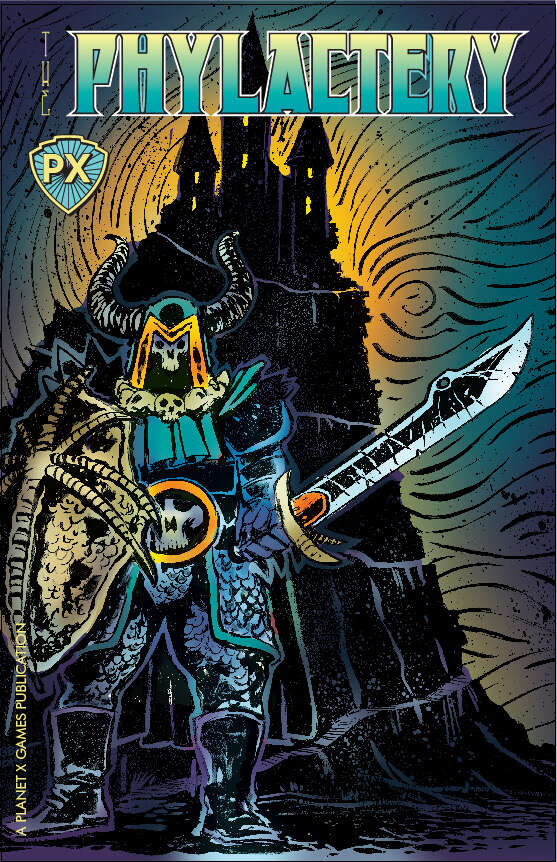
[Fanzine Focus XXXII] The Phylactery Issue #1

On the tail of Old School Renaissance has come another movement—the rise of the fanzine. Although the fanzine—a nonprofessional and nonofficial publication produced by fans of a particular cultural phenomenon, got its start in Science Fiction fandom, in the gaming hobby it first started with
Chess and Diplomacy fanzines before finding fertile ground in the roleplaying hobby in the 1970s. Here these amateurish publications allowed the hobby a public space for two things. First, they were somewhere that the hobby could voice opinions and ideas that lay outside those of a game’s publisher. Second, in the Golden Age of roleplaying when the Dungeon Masters were expected to create their own settings and adventures, they also provided a rough and ready source of support for the game of your choice. Many also served as vehicles for the fanzine editor’s house campaign and thus they showed another Dungeon Master and group played said game. This would often change over time if a fanzine accepted submissions. Initially, fanzines were primarily dedicated to the big three RPGs of the 1970s—Dungeons & Dragons, RuneQuest, and Traveller—but fanzines have appeared dedicated to other RPGs since, some of which helped keep a game popular in the face of no official support.

Since 2008 with the publication of Fight On #1, the Old School Renaissance has had its own fanzines. The advantage of the Old School Renaissance is that the various Retroclones draw from the same source and thus one Dungeons & Dragons-style RPG is compatible with another. This means that the contents of one fanzine will compatible with the Retroclone that you already run and play even if not specifically written for it. Labyrinth Lord and Lamentations of the Flame Princess Weird Fantasy Roleplay have proved to be popular choices to base fanzines around, as has Swords & Wizardry. Not every fanzine for the Old School Renaissance need be dedicated to a specific retroclone, such as The Phylactery.

The Phylactery Issue #1, published by Planet X Games in November, 2020, following a successful Kickstarter campaign, is a fanzine for the Old School Renaissance rather than any specific fantasy retroclone. Thus, it works for Old School Essentials or The King of Dungeons or Labyrinth Lord. It is a collection of magical items—mostly, NPCs, monsters, and a scenario or two. It presents the Game Master with a relentless barrage of choice and options, some of which is ready to use, some of which is not, and so will require the Game Master to develop and add some stats. Everything comes with background elements—some specifically so to make them interesting—enabling the Game Master to flesh out her campaign setting as well as introduce an item of magical power. All of it is written by Levi Combs, the publisher, and his words are backed up with some decent artwork and excellent maps.

The issue’s monsters do not really start with ‘The Gibbering Thing In The Cellar And Other Slobbering, Gelatinous Horrors’, or at least start in the traditional sense of Dungeons & Dragons. For the table here is just of descriptions and no stats, leaving those for the Game Master. Instead, the monsters do not come until the end of the fanzine, ‘Here There Be Monsters!’. This includes the Anzu, servants of the goddess of bad fortune and ill-luck, the Death Tortle, a Chaotic Evil turtle, the Nexus Lurker, a scuttling thing that lurks near dimensional portals and the use of Teleport and Gate spells to pounce on their users, and the Thunder Chicken, known for its paralysing squawk and its lightning attack. Not all of these really have much use, as neither the Death Tortle or Thunder Chicken really have a role and the Thunder Chicken, in particular, is included for its chicken nature rather than anything else.

More interesting are the issue’s many magical items, which begin with ‘The Chaos Throne’, which describes a mighty throne designed to seeds of randomness, chance, and chaos into the lives of those who sit upon it. Both of its arm rests are inlaid with a line of ten gems, each different. Each gem can be pushed once to gain a magic effect. For example, depressing the beryl means that the incumbent’s soul is marked for annihilation, forcing a simple dice off between player and Game Master, whilst the yellow sapphire raises the incumbent’s lowest attribute to eighteen! Only a limited number of gems can be pressed before the throne disappears. Essentially, The Deck of Many Things, with fewer, but no less random or fun options, built into a chair.

Whilst there is no background to ‘The Chaos Throne’, ‘The Furious Faithful – Priests And Holy Men Of Renown’ is a good example of the issue’s magical item article with extras. In this case, they are magical items with the history of the first person to wield them. For example, Lathidus “the Lord of Secrets”, was priest of Chaos, adept at spreading lies and distrust through rumours, blackmail, and more. The Sliver of Secrets is a shard of Lathidius’ shinbone, a relic of his church which when carried by a believer, enables him to lie with impunity, gaining a +2 bonus to any deception check and such lies cannot be revealed as such by low-Level divination spells. From the simple description, the Game Master can not only add the Sliver of Secrets and the legend of Lathidius to her game, also his church of Chaos, the temple to the god justice he corrupted, and the god of thieves whose assassins killed Lathidius. The author presents six such items and thumbnail descriptions of their wielders.

‘Magic Weapons and Sorcerous Blades!’ continues the issue’s combination of item and background, though this time appended by local lore. The Dragonsbreath Bow is wielded by The Sons of the Crimson Scale, agent-assassins for the Cult of the Demon Dragon. It is a longbow +1, which once per day can fire a special attack which varies according to the type of dragon to which it is attuned. For example, the Dragonsbreath Bow attuned to Black Dragons unleashes a stream of acid and a cone of frost is released by the bow attuned to White Dragons. There is also said to be a bow attuned to each of the evil dragons. Local lore tells of a close-helmed warlord in blue-scaled armour said to be riding the edge of the hinterlands hunting for something or someone. He has already incinerated several of the king’s men with just a single arrow, so could he be wielding one of the infamous Dragonsbreath Bows? Other weapons include Conjuredoom, a sword created to wield against wizards, magic-using, and enchanted creatures, and Doomgiver, a magical footman’s mace sacred to a dread goddess of the sea.

‘Magic Gee-Gaws, Sorcerous Jim-Jams, And What-Not’ details general magical items, such as Weird Seeds, strange, armoured pods from a twisted dimension that when planted instantly blooms into a plant with bizarre flowers of an unearthly colour. The plant withers and dies within a day, but turns its immediate area into a wild magic zone. ‘They Look Good, but.... Gaaaaaaaah! 1d10 Fiendish Potions You’ll Wish You Hadn’t Drank!’ provides ten concoctions and elixirs that the imbiber will regret drinking. For example, one potion smells of mint and medicinal herbs and works as a Potion of Extra Healing, but triples the chance of random monster encounters for the next four hours! The idea of the cursed weapon or armour is almost a cliché, but this article does something interesting in creating cursed potions. It is common for potions to be actually poisonous, but to be cursed? The Player Characters will never look at those bottles of coloured liquids in quite the same way again.

‘Forbidden Spellbooks and Fell Prayers of the Ancients’—inspired in part by the fiction of H.P. Lovecraft—is a trio of highly detailed magical works. These are Seven Veils, Seven Voids, The Testament of Nammul, and The Three Faces of Yrgaath. The Seven Veils, Seven Voids, for example, is a treatise on nature of undeath, not so much penned as carved, by Huldath ‘the Black Vizier’, on the inside of a large marble sarcophagus lid—and then in the secret tongue of necromancers. It also includes a number of spells, as does The Three Faces of Yrgaath. Written by the hag-sorceress Beltrugald for her seven horrible daughters on the subject matter of demon summoning and similar matters, it includes potion recipes to, and the new spell, Ravenous Wound, which inflicts a wound that eats itself on the caster’s target.

The Phylactery Issue #1 the lean into cosmic horror with ‘Forbidden Demon Cults from the Outer Void’. This gives a trio of demonic cults for the Game Master to add to her campaign such as Yugg, the massive god-beast of dinosaurs and great lizard-beasts, which eats anything it likes and despises anything or anyone smaller or weaker than itself. Its cults are vile cannibal, regularly and ritually devouring the weakest of their own, no matter their age or gender.

‘Black Bess, Scourge of the High Seas!’ is the first of several NPCs in the issue. She is a Seventh Level Fighter and an infamous pirate, captain of The Sea Wyvern’s Kiss, a heartless, evil kill who still adheres to the pirate’s code and the ancient laws of the sea. ‘Once Upon a Time in the Grim Hinterlands: 3 Antagonists to Set Your Players on the Road to Adventure’ continues with three NPCs, such as Orloc, the Black Friar and Morgun Blackfeather, who are intended to plague and bother the Player Characters. All three come with a trio of actions they might do upon encountering the Player Characters, but in comparison to the earlier description of Blacks Bess, they feel underwritten and in need of more of the Game Master’s input. In comparison, ‘1d10 Tough SOBs, Roadhouse Hoodlums, Bored Adventurers, and Mean Ole Bastards You Might Meet in a Tavern’ does not feel so underwritten since they are both throwaway encounters the Player Characters might have in a tavern and hooks that a Game Master could develop into something. These are entertaining and even as a throwaway encounter should add colour to any night out or tavern crawl at the end of the information. Barring the stats, they do draw comparison with the ‘Meatshields of the Bleeding Ox’, the regular collection of NPCs from the Black Pudding fanzine, and they are just as useful.

The Phylactery Issue #1 contains not one, not two, but three scenarios. In ‘Corpse Garden of the Myconid King’, the inhabitants of Hog’s Chapel have been acting strangely, listlessly, or simply falling asleep where they stand. Mossbeard, a local druid, claimed that, “the King Beneath the Roots has awoken and is calling for his due.” and that the source of the problem lay below Gilly’s Gap, a nearby sinkhole. He disappeared into the sinkhole and has not returned. Following in his wake, the Player Characters will discover a kingdom of mushroom men infected by a blight. Consisting of five locations in a cavern system, the adventure is an engaging, if small, treatment of a Dungeons & Dragons classic setting—a fungal kingdom. The scenario does not have many interesting items for the Player Characters to find or be rewarded with and it lacks an indication of what Level it is intended for, an issue that runs through The Phylactery Issue #1 and all three of its scenarios.

‘Utos, the Isle of the Shattered Moon’ is a crescent-shaped island, a cursed place occupied in its long history by the pirate captain Brego ‘the Bitter-Heart’, a sacred covenant of druids and benign wizards, and practitioners of ancient magics. From a fortified tower magically woven from plants and trees to a ruin atop the Lonely Spire, the island has long fallen into disuse. In comparison to the previous ‘Corpse Garden of the Myconid King’, there is plenty of treasure to be found ‘Utos, the Isle of the Shattered Moon’ if the Player Characters want to put the effort in. Unlike ‘Corpse Garden of the Myconid King’, ‘Utos, the Isle of the Shattered Moon’ will need a motivating factor or two to drive the Player Characters to explore this mini-sandcrawl.

‘Grindhouse Hexcrawl #1’ gives an even bigger area for the Player Characters to explore, a hexcrawl rather than a sandcrawl. It contains an outpost of The Stoneswords, Dwarf mercenaries intent on killing the feral ettin called Kurr ‘the Dwarf Eater’ in revenge for eating one of their number; is bisected by the Black Crags, home to warrens of Goblins and flocks of Harpies, as well as The Crimson Wind, a mysteriously landlocked pirate ship said to contain a king’s ransom in riches; and Mag-Nachtur, the Screaming Tower, home to cultist torturers and demon worshipers of Thuul the Racked One (detailed in the earlier ‘Forbidden Demon Cults from the Outer Void’), working to rebuild the tower. The eight locations across the hexcrawl are fairly detailed, but again, there is no indication of what Level it is designed for, rewards will need to be developed by the Game Master, and hooks to drive the Player Characters to explore the region. This aside, ‘Grindhouse Hexcrawl #1’ has an enjoyably bleak feel and can easily be dropped into a wilderness area or on the edge of a kingdom.

Physically, The Phylactery Issue #1 is very nicely presented. It is well written, the artwork is excellent, and Skullfungus’ cartography is as good as you would expect it to be.

The Phylactery Issue #1 never seems to let up in its presentation of its information and its content. There is so much in the pages of the fanzine’s first issue, probably too much for the Game Master to use everything in her campaign, but lots and lots to pick and chose from, and in many cases, develop and so add extra detail to that campaign. Suitable for any Old School Renaissance retroclone, The Phylactery Issue #1 is a good first issue, giving the Game Master a wealth of choice and content to work with.

[Fanzine Focus XXXII] Crawling Under A Broken Moon Issue No. 2

On the tail of Old School Renaissance has come another movement—the rise of the fanzine. Although the fanzine—a nonprofessional and nonofficial publication produced by fans of a particular cultural phenomenon, got its start in Science Fiction fandom, in the gaming hobby it first started with Chess and Diplomacy fanzines before finding fertile ground in the roleplaying hobby in the 1970s. Here these amateurish publications allowed the hobby a public space for two things. First, they were somewhere that the hobby could voice opinions and ideas that lay outside those of a game’s publisher. Second, in the Golden Age of roleplaying when the Dungeon Masters were expected to create their own settings and adventures, they also provided a rough and ready source of support for the game of your choice. Many also served as vehicles for the fanzine editor’s house campaign and thus they showed another Dungeon Master and group played said game. This would often change over time if a fanzine accepted submissions. Initially, fanzines were primarily dedicated to the big three RPGs of the 1970s—Dungeons & Dragons, RuneQuest, and Traveller—but fanzines have appeared dedicated to other RPGs since, some of which helped keep a game popular in the face of no official support.

Since 2008 with the publication of Fight On #1, the Old School Renaissance has had its own fanzines. The advantage of the Old School Renaissance is that the various Retroclones draw from the same source and thus one Dungeons & Dragons-style RPG is compatible with another. This means that the contents of one fanzine will compatible with the Retroclone that you already run and play even if not specifically written for it. Labyrinth Lord and Lamentations of the Flame Princess Weird Fantasy Roleplay have proved to be popular choices to base fanzines around, as has Swords & Wizardry. Another popular choice of system for fanzines, is Goodman Games’ Dungeon Crawl Classics Roleplaying Game, such as Crawl! and Crawling Under a Broken Moon. Some of these fanzines provide fantasy support for the Dungeon Crawl Classics Roleplaying Game, but others explore other genres for use with Dungeon Crawl Classics Roleplaying Game. One such fanzine is the aforementioned Crawling Under A Broken Moon.

Crawling Under A Broken Moon Fanzine Issue No. 2 was published in in August, 2014 by Shield of Faith Studios. It followed on from Crawling Under A Broken Moon Fanzine Issue No. 1 which introduced the post-apocalyptic setting of Umerica and Urth, which would go on to be presented in more detail in The Umerican Survival Guide – Core Setting Guide, now distributed by Goodman Games. The setting is a world brought about after a rogue object from deep space passed between the Earth and the Moon and ripped apart time and space, leaving behind a planet which would recover, but leave its inhabitants ruled by savagery, cruel sorcery, and twisted science. It wastes no time in getting down to business with the issue’s single Character Class. This is ‘The Mutant’, a Racial Character Class, genetically ‘gifted’ due to exposure to a nanovirus, cosmic radiation, or dimensional rift. The Class has two features. One is the Survival Die. This works much like the Action Die in Dungeon Crawl Classics, but it is used only for non-combat tasks when attempting to survive in the wastelands. The other is the Mutation. This can be Hybridisation, which means that the Mutant is more than human, Physiological, which means that the Mutant’s body is twisted and different, or it can be both. This is rolled for, followed by subsequent rolls to determine the details. For example, the first roll is for Hybridisation, to see if it is animal, mineral, or vegetable. Further tables get to the exact details, which if the Mutant is a Vegetable Hybrid, and if flower-like, there is a chance of being very beautiful and having increased Presence, having a pollen attack that causes sneeze, a fragrance that attracts the wandering monsters, and a probability of falling immediately asleep at night or in darkness. The tables give some fun results, but once past that, the Class is not quite as interesting in play. In comparison to Technologist Class given in Crawling Under A Broken Moon Fanzine Issue No. 1, the Mutant does not have quite so much to do.

The Mutant theme in the issue continues with ‘Cirque de Bizarre’, which is all about making mutants out of ‘normal’ monsters. It uses the tables from ‘The Mutant’ Racial Character Class and applies the results of the chosen animal. It then applies the results to two sample creations, the Falcon Wolf and the Mighty Tarasqu-Ape. These are decent mutated creatures and nicely show off the versatility of the ‘The Mutant’ Racial Character Class’ creation tables.

‘Weapons of the Wastelands’ continues the article which appeared in Crawling Under A Broken Moon Fanzine Issue No. 1. It gives rules for grenades, breaking them down into four eras—primitive, Western-era, Modern-era, and Futuristic—as the previous article did for guns in general. This covers clay pot bombs and Molotov cocktails as well as modern and fusion grenades, plus various different things which can be put into a grenade, such as Greek fire, mustard gas, and even a MicroNuke! This is a decent expansion to the previous article.

The last two articles in Crawling Under A Broken Moon Fanzine Issue No. 2 are connected and together present a massive alien cyberintelligence and its minions. ‘Twisted Menagerie’ details the servants, beginning with the Zombie Monks of the Cyberhive, which travel between communities, singing hymns in machine code, distributing small, but useful technological devices, and collecting corpses for conversion. Once converted, they are used to serve in the Floating Tower of the Cyberhive or to spread the Cyberhive’s influence and monitor those its servants come into contact with. The other servants are the Robo-Lich, capable of casting certain spells and used to monitor Zombie Monk operations, and the truly monstrous Mutitan, a writing mass of body parts from humans, animals, and mutants, which can spawn Mutitanling and warp the effects of spells. The Floating Tower of the Cyberhive is detailed in ‘An Interesting Place to Die’. It stands suspended over a crater of boiling mud and caustic vapours, and contains zombification chambers, organ chambers where wizards are converted in Robo-Liches, a Fabrication Chamber where Zombie Monks manufacture the various technological devices given out as gifts, and more. Oddly, neither the Zombie Monks or the Robo-Lichs will attack the Player Characters unless they are aggressive, but there are weird trap-like rooms scattered throughout the facility. It turns out that the Cyberhive is actually testing them and if they succeed, they are given actual missions, perhaps building towards a Patron relationship. The Cyberhive is presented as neither benign or evil, but an interesting faction in Umerica and Urth that the Player Characters can interact with.

Physically, Crawling Under A Broken Moon Fanzine Issue No. 2 is serviceably presented. It is a little rough around the edges, but overall, it is a decent affair.

The problem with Crawling Under A Broken Moon Fanzine Issue No. 2 is that much of its contents have been represented to a more professional standard in the pages of The Umerican Survival Guide – Core Setting Guide, so it has been superseded and superseded by a cleaner, slicker presentation of the material. Yet there is still much to like about Crawling Under A Broken Moon Fanzine Issue No. 2, full of interesting details and aspects about the setting and there is a certain charm to reading about the world of Umerica in serial format.

Monday, 21 August 2023

Miskatonic Monday #213: The Thing in the Pines

Between October 2003 and October 2013, Chaosium, Inc. published a series of books for Call of Cthulhu under the Miskatonic University Library Association brand. Whether a sourcebook, scenario, anthology, or campaign, each was a showcase for their authors—amateur rather than professional, but fans of Call of Cthulhu nonetheless—to put forward their ideas and share with others. The programme was notable for having launched the writing careers of several authors, but for every Cthulhu Invictus, The Pastores, Primal State, Ripples from Carcosa, and Halloween Horror, there was Five Go Mad in Egypt, Return of the Ripper, Rise of the Dead, Rise of the Dead II: The Raid, and more...

The Miskatonic University Library Association brand is no more, alas, but what we have in its stead is the Miskatonic Repository, based on the same format as the DM’s Guild for Dungeons & Dragons. It is thus, “...a new way for creators to publish and distribute their own original Call of Cthulhu content including scenarios, settings, spells and more…” To support the endeavours of their creators, Chaosium has provided templates and art packs, both free to use, so that the resulting releases can look and feel as professional as possible. To support the efforts of these contributors, Miskatonic Monday is an occasional series of reviews which will in turn examine an item drawn from the depths of the Miskatonic Repository.

—oOo—
Publisher: Chaosium, Inc.
Author: Ted Hart

Setting: Michigan’s Upper Peninsula, November of 1927
Product: Scenario
What You Get: Twenty-two page, 4.14 MB Full Colour PDF

Elevator Pitch: “There is no hunting like the hunting of man, and those who have hunted armed men long enough and liked it, never care for anything else thereafter.” ─ Ernest Hemingway
Plot Hook: A missing man, a missing girl, will the Investigators join them?
Plot Support: Staging advice, four pre-generated Investigators, four
handouts, one map, one NPC, and one Mythos monster.
Production Values: Plain

Pros
# Detailed, single location encounter with the Mythos
# Nicely detailed pre-generated Investigators
# Easy to adjust to other times and settings
# Suitable for novice Keepers
# Xylophobia
# Diokophobia
# Chionophobia

Cons
# Could be better structured for the novice Keeper
# Maps needs work

Conclusion
# Classic, trapped in the woods with a ravenous monster scenario
# Nicely done pre-generated Investigators, but maps needs work