Saturday, 18 June 2022
Ineffably Alien
Which means that What We Give To Alien Gods breaks one of the cardinal rules of a roleplaying scenario. Which is…
Tell the Game Master what the scenario is about upfront.
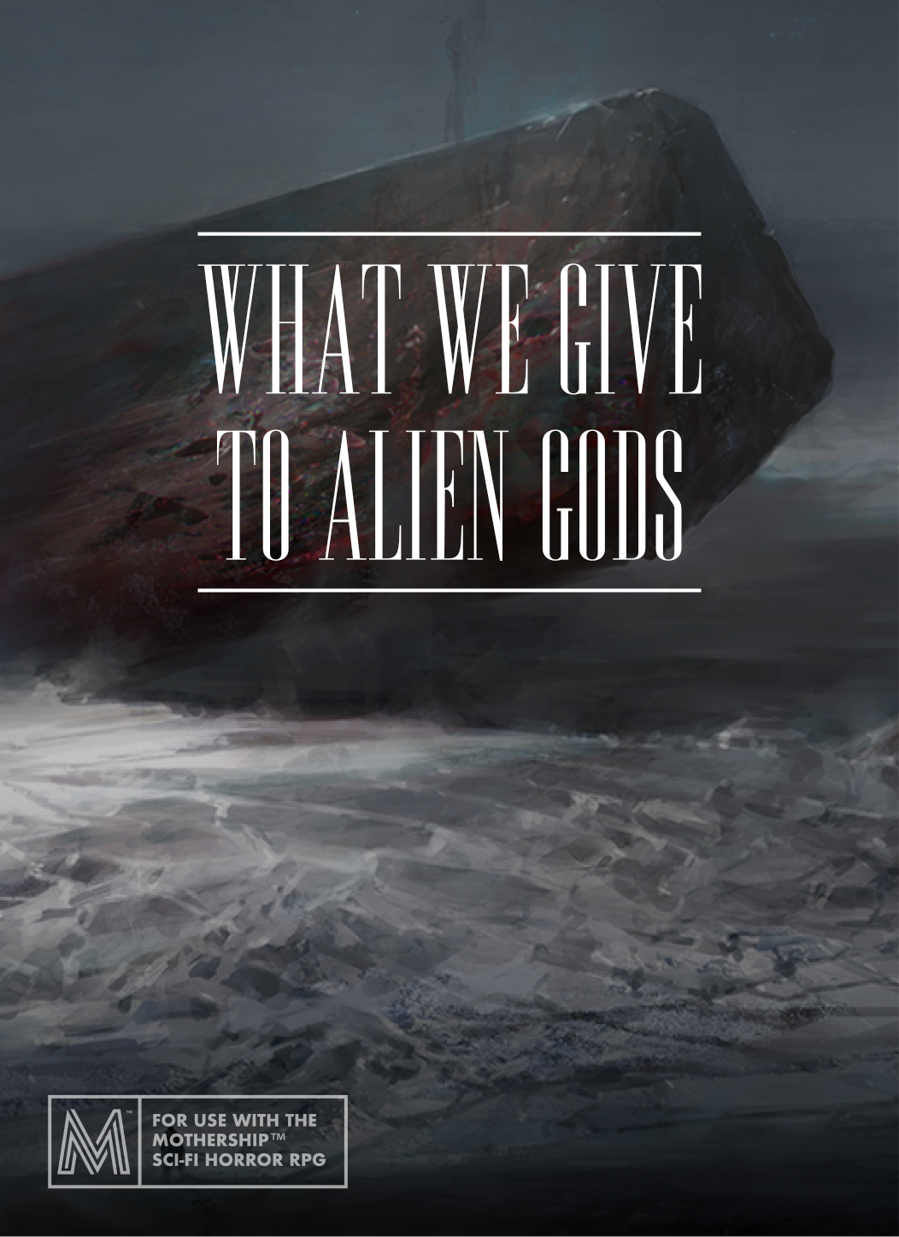
What We Give To Alien Gods is a scenario for the MOTHERSHIP Sci-Fi Horror Roleplaying Game, the roleplaying game of blue collar Science Fiction Horror, inspired by films such as Outland, Dark Star, Silent Running, and Event Horizon, as well as Alien and Aliens. Hyperspace anomalies, reports of an alien structure, a missing contact, a seemingly telepathic cry for help, or even an inexplicable urge all hook the Player Characters into travelling Gaelar XII, a distant magellanic nebula. Once inside, they must negotiate dense pockets of cosmic dust, ionised gas storms, ship debris, thermal spikes, and more before alighting before a strange structure. Consisting of three immense pillars with a massive cube suspended between the three, which all together rotate as one, this is Maerkithelth, an unfathomably ancient temple to alien god. The Crew can enter any one of the pillars and begin to explore, finding signs of an alien civilisation—tools and devices left lying about, as well as extensive patterns of glyphs. They will also find indications that someone has already beaten them to the temple.
Discovering both the temple and the existence of aliens can have a profound effect upon a MOTHERSHIP Sci-Fi Horror Roleplaying Game, depending on whether or not they exist in the Warden’s campaign. However, even if they already exist, the presence of the Triathals and what they have left behind—especially the Triathal language, will have a profound upon the members of the Crew. This is intentional since the Scientist in the Crew, in particular, one with the Xenoesotericism, Xenomysticism, and Xenolinguitsics, will be translating the Triathal language and learning more and more of just what Maerkithelth contains and is protecting the universe from. Or even protecting the universe from which the Triathal came. There is such an emphasis upon the Triathal language and upon the role of the Scientist in the scenario that it is not like other MOTHERSHIP Sci-Fi Horror Roleplaying Game scenarios, and whilst the author describes it as a “A dungeon-crawl through an alien temple”, it is not that either. Rather, What We Give To Alien Gods is a puzzle crawl, an exploration of an environment that requires elements of a language to be learned in combination with skill rolls and the clues left behind by other explorers. Which obviously places a great deal of emphasis upon the player with the Scientist role. This is not say that the other roles in MOTHERSHIP Sci-Fi Horror Roleplaying Game do not figure in the scenario—and What We Give To Alien Gods does give advice to that end—but the Scientist predominates.
Much of What We Give To Alien Gods is devoted to is describing the interior of the three pillars of Maerkithelth and the almighty cube which hangs between them. It is only after this that we read of a major threat to both the Crew and possibly the universe. Doctor Aislin Grahm has an obsession with the cosmos and Xenomysticism and is driven—or possibly pulled—by whatever Maerkithelth actually contains (or keeps contained). However much like the explanation of what the plot to What We Give To Alien Gods, this does not really become obvious to very later in the book, over two thirds of the book in the listing of the NPCs, and it applies to her as much as it does the other, often very alien NPCs the Crew is likely to encounter.
Which means that What We Give To Alien Gods breaks one of the cardinal rules of a roleplaying scenario. Again. Which is…
Tell the Game Master what the scenario is about upfront.
Yet these are not the only issues with What We Give To Alien Gods and to be fair, they can be overcome as part of the Warden’s preparation. The real issue is with the extra element of preparation. For not only does the Warden have to prepare the scenario, she also has to learn how its puzzles work and learn the Triathal language, enough to be able understand and if not teach it to her players, then guide them through their learning process. In effect, the Warden has to play through aspects of What We Give To Alien Gods in order to really grasp what is going on. Then once prepared, the scenario—as the author advises—requires a lot of buy in upon the part of the players and their characters.
Physically, What We Give To Alien Gods is a solid little book. It has a sense of the ineffable and the alien in its look and use of art, of a place that is not quite like ours, and it is lovely booklet to look at. However, the writing is often succinct and there are no maps of Maerkithelth which might make it easier for the Warden to visualise and then impart that to her players.
Inspired by films and television such as Event Horizon, The Expanse, Interstellar, and Arrival, there is no denying that What We Give To Alien Gods is an ambitious treatment of Cosmic Horror for the MOTHERSHIP Sci-Fi Horror Roleplaying Game. It is conceptually brilliant and the result is fantastically weird and creepy and unsettling, but the effort to get that to the table, that is where What We Give To Alien Gods does not quite deliver.
Conflicts & Clearings
This is the set-up Root: The Roleplaying Game, the game based on Root: A Game of Woodland Might And Right, the anthropomorphic asymmetrical boardgame from Leder Games, published by Magpie Games. The players take the roles of the Vagabonds, but it is up to the Game Master to create a network of Clearings, each with interesting NPC denizens and general conflicts and issues rather than ready-to-play plots. Root: The Roleplaying Game includes a set of tables to help her design her first set of twelve Clearings, including their denizens, the paths between the Clearings (which themselves can often be difficult and dangerous to travel), and which faction controls each Clearing. Since this is done randomly, the resulting Woodland will differ from that created by another Game Master and had there been a pre-written set of twelve Clearings proscribed by the authors of Root: The Roleplaying Game, it would have differed from that too. Root: The Roleplaying Game does come with an example Clearing called ‘Gelilah’s Grove’ which neatly shows off the concept. However, if the Game Master is short on inspiration or ideas and wants further examples or wants a Clearing which can be run as a one-shot, then there is a ready set of Clearings in the supplement, Root: The Roleplaying Game – Clearing Booklet.
Root: The Roleplaying Game – Clearing Booklet provides a quartet of Clearings ready for the Game Master to add to her Woodland. The format for each entry is the same. This includes a ‘Description’, ‘At First Sight’, ‘Conflicts’, details and stats for ‘Important Residents’, ‘Important Locations’, ‘Special Rules’, and ‘Introducing the Clearing’. The latter provides advice and guidance, whilst the ‘Conflicts’ starts off with a ‘Core Conflict’ and adds several more, all of whom come with a ‘How It Develops’ section which examines what happens if the Vagabonds never get involved. Each of the Clearings in the supplement comes with four such Conflicts, and though the listed playing is two to four hours for each Clearing, the likelihood is that it will take more than one session for a band of Vagabonds to deal with all of them. Either way, whether the Vagabonds involve themselves in a Conflict or not, there are consequences to their actions or their inaction respectively.
The first Clearing in Root: The Roleplaying Game – Clearing Booklet is ‘Hookfoot Bog’, the name of a swampy, smelly settlement best known as a source of peat which the local Hookfoot Clan of mice dig out using harvesting machines and which the Marquisate governs as an important resource. From the off, it is clear that the Marquisate is not necessarily the bad cat here. The local commander governs with a light paw, but its now monopoly on the digging out and sale of peat has led to increased prices and tension, as well as changes to the Clearing as the Cats and their allies have constructed wooden buildings and homes in the settlement centre. This has divided the settlement into the old town and the new town, between collaborators who welcome, if not a newfound wealth, then at least job security. However, some within the Hookfoot Clan resent the Marquisate’s presence and are finding ways to resist, including purchasing weapons from smugglers who in turn smuggle out Nip, a powerful narcotic regulated by the Marquisate, which requires peat to manufacture. The Conflicts are all nicely interconnected, and supported with details of the Clearing’s important NPCs, interesting locations, special rules—the latter covering the swampy, peat fuelled smoky environment and peat harvester operations, and guidance for the Game Master on how to get the Vagabonds involved in the Conflicts in Hookfoot Bog. The latter includes the governor asking the Vagabonds to infiltrate the resistance; a local merchant wants them to stop the vandalism on the peat harvesters, but others want to help it; they might be recruited by the resistance or tested by the smugglers to see if they support or oppose their operations; and more. Plus, there are tips on how to escalate the situation and keep the action going.
The other three Clearings follow the same pattern. ‘Sixtoe Stand’ is named for a hero who drove off a wolf attack many years ago, but a more recent wolf attack has left it ill-prepared to survive the winter. So, it needs an ally, but which faction will it side with? ‘Limmery Post’ details an ancient fortification on the edge of the Woodland occupied by the Marquisate much to the dismay of the inhabitants, who want the invaders gone, but camped outside the settlement is a contingent of the Woodland Alliance, ready to lay siege to Sixtoe Stand. Some in Sixtoe Stand want to keep the peace with the Marquisate, others would welcome their being driven out by the Woodland Alliance, but many want to remain in isolation as they have for many years. Which of course is not possible given the situation. Lastly, ‘Coolclaw Mine’ details an important iron mine under Marquisate occupation, but ill prepared to deal with the influx of soldiers and refugees and so the threat of starvation looms. Here the Marquisate Lord Scowl is much more of an openly oppressive presence and so is closer to the classic rebellion versus authority set-up, although it does throw a rival Vagabond group into the situation.
Physically, Root: The Roleplaying Game – Clearing Booklet is well presented, well written, and of course, illustrated with the same great art as with Root: The Roleplaying Game and Root: A Game of Woodland Might And Right. The worst that could be said of it is that there is not enough!
Root: The Roleplaying Game – Clearing Booklet is a solid supplement for Root: The Roleplaying Game. It complements a Game Master’s Woodland, whether of fully worked Clearings ready to add to her campaign or bring to the table as a one-shot. Or simply as a book of examples to take inspiration from and develop Clearings of her own.
Friday, 17 June 2022
Strange & Simple
The Silver Road is published by Handiwork Games, best known for BEOWULF: Age of Heroes, and requires a single six-sided die each for both the players and the Game Mediator, and some pencils and paper. A character is simply defined. He has a name, an important fact about them—such as a job, role, or what he is, two things he is good at, two things he is bad at, and lastly, a Magic Number. The latter ranges between two and five, and is unique to the character. Character creation can be done as a group or separately, but ultimately, the players should have as a group a reason to stay together and face the hostile situations designed and presented to them by the Game Mediator.
Tiddles
I am a Cat Who Belongs to No-One
Things I am Good at
I am good at getting people to trust me
I am good at sneaking
Things I am Bad at
I am bad at meowing
I am bad at dealing with children
In terms of play, the Game Master will have ready a series of scenes containing obstacles and consequences, which when one is overcome will lead to the next and so on and so on. She will present the scene and then in turn, each player will narrate what his character will do (it need not be in turn order round the table, but that is the default). To have his character undertake an action, a player rolls his die. If it is something the Player Character is good at, he will nearly always succeed. If it is something the Player Character is bad at, he will nearly always fail. If he fails, there will be consequences, but if it is something the Player Character is good at and he fails, there will be consequences also, but he will succeed on his next turn.
There are no rules for combat in The Silver Road, the outcome of any direct conflict being already built into the rules through the effect of consequences. In conflicts, these can be that the character is hurt—or depending upon the story being narrated, actually killed. The former is more likely than the latter though, and even if killed, a character could return as a ghost—depending upon the story, of course.
In addition, if the result on any die roll is equal to a player’s magic Number, that player can ‘Butt-in’. This gives him the opportunity to add to the current scene or action within the scene—even if it is not that player’s turn—with his new narration having to begin, “But…” The Butt-in’ interjection can be used to bring in the player’s own character, or that of another player, to add something to the scene (even to warp it to make it even more challenging for the current or next player!), and so on. The narration thus switches from player to player to the Game Mediator and back again, with the interjections happening at random.
The Silver Road could be criticized for being too simple—and arguably, given the size of the book and the extent of its mechanics, it is. After all, they have been developed from one page of rules. Nevertheless, their simplicity makes them easy to learn, teach, and use—such that this roleplaying game could be run with children—and further, what that space allows is advice for the Game Mediator on organising and running the game, handling consequences, getting hurt and more. The roleplaying game also comes with a set of example Player Characters and Obstacles, as well as a scenario or story, a sort of Enid Blyton’s Famous Five affair which spirals into a fairy tale.
The Silver Road is well written, easy to read, and ready to run in five minutes. In addition, the simplicity of The Silver Road expanded into a booklet-sized roleplaying game has the advantage of allowing space for fantastic artwork on every page. This has an ethereality to it, suggesting something lost or over there on the edge where figures, often in odd or period garb, slide into the mists, doors stand closed in hedges, buildings crumble atop rises, and ghosts linger in the morning light. The implied nature of The Silver Road is liminal, somewhere between the modern and the past, a step or two’s way from somewhere further back or elsewhere.
Cloak Crawl
In more recent times, Cambros, the sari-draped Warbot, has been seen wandering the land, wrapped in a great cloak, said to have belonged to his friend, Riblerim the Unsure. He wants to find his friend, whom he is sure can be found in the cloak. In return for the Player Characters’ aid, he offers adventure unlike any that they have been on before and great treasures to be found, and with his uttering of the Passcode, they are whisked into the cloak and the weird and wonderful world of Riblerim’s Interesting Place. They find themselves in the Welcominarium, an island complete with a wizard’s tower in classic style, a large orientation map marked with ‘You Are Here’ and an arrow, the Slips aYe Olde Gift Shop shaped like a wizard’s conical hat, and a dock on the monoriver, at which the animal themed boats—the horsey, the rocking pony, the seahorsey, the unpiggie, the pegaswan, and naturally, the teacup too, all sit ready to transport their passengers elsewhere. That elsewhere consists of several islands floating in the sky, around, above, and below the Player Characters. They include the feudal mini-kingdom of Avalon; the springiness of Bouncy Island, complete with white pellet rafting; the constant end of day Sunset Island; the benighted and lovelorn Adult Island; and the ostentatiously studious Island of Special Interests.
This is the set-up for Capes and Cloaks and Cowls and a Park, a highly detailed, but systemless sandbox scenario whose sense of wonder and whimsy combine the classic funhouse style of dungeon with Alice’s Adventures in Wonderland. It is published by Mottokrosh Machinations, following a successful Kickstarter campaign, a publisher best known for Hypertellurians: Fantastic Thrills Through the Ultracosm, an Old School Renaissance adjacent roleplaying game of retro science fantasy. Numerous suggestions are given to get the Player Characters to and then inside the cloak—or rather into Riblerim’s Interesting Place. The default arrival point is the Welcominarium, but the Game Master is free to have them end up wherever seems the most appropriate, or fun. From there, the Player Characters are free to go wherever they want, or at least wherever the animal themed boats (or the teacup) will take—including up stream as well as down. Each island is a realm of its own, consisting of three or more adventure sites all following a particular theme. For example, Avalon is home to a fairy tale castle where tourneys and jousting are held to appease the self-appointed queen, Moronoe, nearly surrounded by dark forest lush with game and the domain of secretive druids. There is a seemingly endless cosplay closet at the dock where the Player Characters will alight, one which they can enter and select a suitable outfit for their time on the island. In comparison, Bouncy Island seems all but deserted, yet it does have its ruler, an Elfin figure whose cloak appears to mimic his moments and who can often be seen frolicking up and down the White Pellet Rafting route. Like many of the inhabitants, he knows many secrets of the Riblerim’s Interesting Place and might be persuaded to share one or more if the Player Characters are willing to brave the dangers of The Plastic Gauntlet—which like the rest of Bouncy Island, has definite springiness to it.
All of the adventure sites in Capes and Cloaks and Cowls and a Park are nicely detailed—its interior spaces more so. These include both the floorplans for locations such as the Museum of Divination, as well as dungeons like the Tomb of the Last Knight and The Plastic Gauntlet. These are also neatly arranged so that the maps and map keys are opposite each other.
Mechanically, Capes and Cloaks and Cowls and a Park is designed to be systemless. Or rather, written to be used with any roleplaying game, for it does actually have a system of its very own. This is the ‘HAWK’ structure, which stands for ‘Has’, ‘Acts’, ‘Wants’, and ‘Knows’, which is used to describe and define each of the major NPCs who appear in the scenario. The lack of numbers though, has its upsides and its downsides. Obviously, the Game Master can adapt Capes and Cloaks and Cowls and a Park to the roleplaying game of her choice, whether that is 13th Age, the Dungeon Crawl Classics Role Playing Game, Hypertellurians, or Old School Essentials. All would work. The downside is that all together there are a lot of NPCs and monsters to provide stats for, but that is offset by how succinct the design of the individual islands is. The Player Characters are likely to be exploring one island at a time, so the Game Master need not necessarily adapt the whole of Capes and Cloaks and Cowls and a Park in one go.
Given the nature of its setting and many of its inhabitants, it should be no surprise that most of the main treasures in Capes and Cloaks and Cowls and a Park consist of cloaks, mantles, shawls, stoles, and the like. For example, the Dwarven War Cloak is made of thumb-sized iron bars which can interlock to form a personal fortification whilst the Concordant Cowl of Teeth, consisting of an array of molars, incisors, and canines strung together with silver chains, is simply an intimidating—and sometimes—an enraging sight. The other treasures to be found in Riblerim’s Interesting Place are much less detailed and generally simpler in nature, like the Ruby Opera Gloves, enchanted by vampires to make the wearer unnoticeable to humans or the carved soap, a heavy cake of rainbow tulip and hope-scented soap into which has been artfully scratched a trigonometrical formula. Decipher the formula and the Player Character casts Venusian magics with greater power. As with the rest of the content in Capes and Cloaks and Cowls and a Park, none of these items have stats, but their simplicity makes them easy to adapt to the roleplaying game of the Game Master’s choice. Also included is a guide to making the studying and use of grimoires more interesting than mere spellbooks, which could also be adapted to the whatever rules the Game Master is using.
Physically, Capes and Cloaks and Cowls and a Park is beautifully presented, done in retro-lush colours that add to the sense of unreality of Riblerim’s Interesting Place. The cartography is also excellent. If there is an issue with the presentation, it is that the layout is too tight and the text a little too small in places, making the book slightly difficult to read. There is advice though for both Game Master and players on how to handle the tone and some of the scenario’s content, which is clearly marked for each location and includes spiders, demonic summonings—under mostly safe conditions, cannibalism, and more. This is through the use of lines and veils, and the X-card, although the self-contained nature of the scenario’s varying islands do help to separate this more adult content.
As a sandcrawl, Capes and Cloaks and Cowls and a Park differs in that its individual locations, its islands floating on the fabric of Riblerim’s cloak, are discrete and there is relatively little to connect them narratively. This is because this is not really a sandcrawl with factions and the power and influence of its NPCs do not extend beyond the confines of their respective islands. Here perhaps some advice or a table listing what each of the NPCs want and how those wants crossover could have been useful. However, there are threads which run right across the theme park that is Riblerim’s Interesting Place. In particular, a lot of the NPCs that the Player Characters will encounter are the equivalent of staff or actors. They look the part, and they play the part, but their lack of competence in comparison to the Player Characters adds to the sense of unreality of the already strange realm. Similarly, the fact that Riblerim’s Interesting Place has its own currency—Aesopian Rupees—exchanged for whispered secrets, also adds to the unreality as well as driving the players to come up with increasingly interesting confessions for their characters to pay for anything!
Monday, 13 June 2022
Jonstown Jottings #62: Bog Struggles
Bog Struggles: An Adventure for RuneQuest Glorantha is a scenario for use with RuneQuest: Roleplaying in Glorantha in which the adventurers come to the aid of the inhabitants of a nearby bog.
It is a twenty-five page, full colour 4.02 MB PDF.
Where is it set?
There are no specific roles necessary to play Bog Struggles, but martial characters will be needed as combat is involved. In addition, a Shaman and an Issaries merchant may prove useful, and Heler or Engizi worshippers may have an advantage.
Bog Struggles: An Adventure for RuneQuest Glorantha requires RuneQuest: Roleplaying in Glorantha and the RuneQuest: Glorantha Bestiary will be useful for details of some of the encounters. Borderlands: A RuneQuest Campaign in Seven Scenarios may be useful as reference, but is not required to play Bog Struggles.
What do you get?
Sunday, 12 June 2022
A Differing Dune
Open up Dune – Adventures in the Imperium: Agents of Dune and the first thing you see is a ‘Read This First’ pamphlet. This does five things. It addresses the players and their characters directly, first explaining to the Player Characters what is happening and what they are going to be doing, in the process giving them agency, before explaining what is going on to the players, essentially that this is not the Dune they might be expecting. It also details what is in the Dune – Adventures in the Imperium: Agents of Dune box and what all of the components are—and there are a lot of components. This is a packed box. It also provides a rules reference on the back page. It is not the only rules reference in Dune – Adventures in the Imperium: Agents of Dune, but to be honest, more is better. Lastly, it guides the Gamemaster about what steps to take getting ready to run the first of the scenarios in the Dune – Adventures in the Imperium: Agents of Dune ‘Adventure Book’, which is immediately beneath the ‘Read This First’ pamphlet.
The next component consists of five, full colour, character folios. Each of these has been carefully designed in terms of its presentation. So on the front there is an illustration and description of the Player Character as well as a reason why a player might choose to roleplay that character. Inside is an introduction to the Known Universe in the year 10,191 which is standard to all five of the character folios, and then background and details for the Player Characters. They include two nobles, brother and sister, one a duellist, the other a diplomat; plus a Swordmaster, a Mentat, and a Bene Gesserit Spy. On the back of each, just like the ‘Read This First’ pamphlet, is a rules reference.
Below this is a Momentum and Threat Tracker (Momentum is spent by the players to gain certain advantages for their characters, whilst the Game Master spends Threat to give them to her NPCs), a Spice Harvesting Tracker, three handouts, a sheet of counters, a double-sided map for the campaign, a double-sided duelling and negotiation positioning map, a set of five twenty-sided dice, a pack of plastic stands, and a pack of cards. The latter contains images and stats of every item, NPC, and Player Character in Dune – Adventures in the Imperium: Agents of Dune. The great thing about the NPC and Player Character cards is that as much as they are intended to be used as references, they can also be slotted into the plastic stands and then used as figure standees to show that NPC or Player Character is on a map or the position that he has taken up on the duelling and negotiation positioning maps when they enter play. Beyond the limits of Dune – Adventures in the Imperium: Agents of Dune, most of these physical components—the Spice Harvesting Tracker, the counters, the duelling and negotiation positioning maps, the dice, the plastic stands, and most of the cards will prove useful in an ongoing Dune – Adventures in the Imperium campaign. The handouts are decent and done on sturdy paper, but the particular delight of the three is a pamphlet which the Player Characters are given as soon as they step off the shuttle onto the planet which gives them an introduction to Arrakis. It is pleasingly immersive. Lastly, there is one extra thing in Dune – Adventures in the Imperium: Agents of Dune and that is a copy of Dune – Adventures in the Imperium. Or rather there is a code for the PDF. Either way it is fantastic extra, because what it does is enable the Game Master and her players to look up the rules if they want a further explanation or a more experienced group to create their Player Characters and play the campaign with those rather than the five included in Dune – Adventures in the Imperium: Agents of Dune.
The ‘begin playing as soon as you open the box’ aspect of Dune – Adventures in the Imperium: Agents of Dune instructs the Game Master to read the ‘Read This First’ pamphlet and give the character folios out for her players to choose. Once done, the Game Master reads the opening section of ‘Adventure Book’ which explains the basics of the Player Characters and the setting, plus the first decision that the players will take collectively, that is what type of house do their characters belong to. This is determined by a piece of advanced technology. A Maula Rifle and House Nagara is a military house, a Blight Scanner and it is farming house, and so on. There are five options. There is a fair bit to read out here, so a little bit of patience is required upon the part of the players, but on page, the action starts. The players are roleplaying. There is no explanation of the rules up until this point. Instead, these are explained as they come up as part of each scenario. There are details in the sidebars which in turn expand upon the rules, such as giving assistance to another Player Character; explain more about the setting, for example, why Lasguns are rarely used in the Known Universe; and to give direction advice to the Game Master, such as handing a particular card to the players.
What the ‘Adventure Book’ and thus Dune – Adventures in the Imperium: Agents of Dune is thus providing programmed learning through play or learn as you play. This has the advantage of the rules coming into play only when the story needs it and it helps that the 2d20 System, the mechanics used for Dune – Adventures in the Imperium as well several other roleplaying games from Modiphius Entertainment are not that complex and that their iteration here are relatively simple in comparison to others. Yet there are downsides to this approach, none of them major, or indeed, insurmountable. The programmed learning and structure of the campaign means that it is linear and it is difficult to deviate away from its plot. It means that there is no one clear explanation of rules in Dune – Adventures in the Imperium: Agents of Dune, although the various reference sheets on the back of the character folios and the free copy of the PDF of the core rules counter this issue. On the other hand, the player or Game Master who has played any of the other 2d20 System roleplaying games will adjust to the rules presented here with ease.
One potential issue of Dune – Adventures in the Imperium: Agents of Dune is that its introduction is not sufficiently basic enough. Now its introduction to the setting of Dune, the 2d20 System, and Dune – Adventures in the Imperium are all fine, but it really does not have much in the way of an introduction to what roleplaying is. Both player and Game Master really need to have some idea of what roleplaying is before tackling Dune – Adventures in the Imperium: Agents of Dune because it does not start from first principles. Of course, in the hands of an experienced Game Master, the programmed nature of learning makes it easier to teach the rules and mechanics.
Dune: Adventures in the Imperium and thus Dune – Adventures in the Imperium: Agents of Dune employ the 2d20 System first used in the publisher’s Mutant Chronicles: Techno Fantasy Roleplaying Game and Robert E. Howard’s Conan: Adventures in an Age Undreamed Of, and since developed into the publisher’s house system. To undertake an action, a character’s player rolls two twenty-sided dice, aiming to have both roll under the total of a Skill and a Drive. Each roll under this total counts as a success, an average task requiring two successes. Rolls of one count as two successes and if a character has an appropriate Focus, rolls under the value of the Skill also count as two successes.
In the main, because a typical difficulty will only be a Target Number of one, players will find themselves rolling excess Successes which becomes Momentum. This is a resource shared between all of the players which can be spent to create an Opportunity and so add more dice to a roll—typically needed because more than two successes are required to succeed, to create an advantage in a situation or remove a complication, create a problem for the opposition, and to obtain information. It is a finite ever-decreasing resource, so the players need to roll well and keep generating it, especially if they want to save for the big scene or climatic battle in an adventure.
Now where the players generate Momentum to spend on their characters, the Game Master has Threat which can be spent on similar things for the NPCs as well as to trigger their special abilities. She begins each session with a pool of Threat, but can gain more through various circumstances. These include a player purchasing extra dice to roll on a test, a player rolling a natural twenty and so adding two Threat (instead of the usual Complication), the situation itself being threatening, or NPCs rolling well and generating Momentum and so adding that to Threat pool. In return, the Gamemaster can spend it on minor inconveniences, complications, and serious complications to inflict upon the player characters, as well as triggering NPC special abilities, having NPCs seize the initiative, and bringing the environment dramatically into play.
Combat uses the same mechanics, but offers more options in terms of what Momentum can be spent on. This includes creating a Trait or an Asset, either of which can then be brought into the combat, and keeping the initiative—initiative works by alternating between the player characters and the NPCs and keeping it allows two player characters to act before an NPC does. Where Dune: Adventures in the Imperium differs from other 2d20 System roleplaying games is the lack of Challenge dice, and instead of inflicting damage directly via the loss of Hit Points, combatants are trying to defeat each through the removal of Assets and attempting to create—cumulatively—Successes equal to or greater than the Quality of the task or the opponent. Minor NPCs or situations are easily overcome, but difficult situations and major NPCs will be more challenging to defeat and will require extended tests.
The system is intended to cover the various types of situations which can occur in a story in Dune: Adventures in the Imperium. So, individual duels, skirmishes and open battles, espionage, and social intrigue. All these, as well as spice harvesting rules are presented in Dune – Adventures in the Imperium: Agents of Dune as they appear in the story and thus come up in play. In general, anyone with experience of the 2d20 System will see that the iteration here involves more of a narrative, storytelling style of play.
In terms of setting and story, it is the big ‘What if?’ of Dune – Adventures in the Imperium: Agents of Dune which comes into play. In the novel Dune, House Atreides is awarded the fiefdom of Arrakis by the Padishah Emperor Shaddam IV as part of a conspiracy with former fief holder and enemy of House Atreides, House Harkonnen. A prequel to this is even explored in Dune: Adventures in the Imperium Wormsign Quick-start Guide. The ‘What if?’ though of Dune – Adventures in the Imperium: Agents of Dune asks what if the Player Characters’ house was awarded the fiefdom instead of House Harkonnen? Further, what if the transfer of power on Arrakis from House Harkonnen to House Nagara—the Player Characters’ house—was peaceful, rather than as fractious as that depicted in the novel? And what if the reason for this is the fact that House Harkonnen and House Nagara are allies? What if, despite losing control of Aarrakis, it was in the best interests of House Harkonnen to help House Nagara gain and keep control of the fiefdom? The ‘Adventure Booklet’ gives several reasons for this, but there can be no doubt that this flies in the face of almost sixty years of storytelling and of House Harkonnen never being portrayed as anything less than the villain. This puts a different perspective on matters and forces anyone familiar with the story to roleplay against their player knowledge. The campaign itself begins on Giedi Prime, home planet of House Harkonnen, with the Player Characters being trained, going through a couple of simulations, assessed by House Harkonnen trainers, all in preparation for the great shift, getting involved in some intrigue and being exposed to the terrible conditions on the planet, before travelling to Aarrakis and taking control of the fiefdom.
Dune – Adventures in the Imperium: Agents of Dune includes five full colour character folios, representing five members, including two heirs of House Nagara, and ideally, the campaign in the ‘Adventure Booklet’ is designed to be played by five players, plus the Game Master. It can be played with less, but this does limit the specialities available to the characters and their players as a whole. If the playing group decides to instead create their own characters using the rules inDune – Adventures in the Imperium, they should ideally create characters with similar roles to those presented in the given character folios to fit the campaign. The campaign consists of three acts with three or four scenes each, which all together should provide multiple sessions’ worth of play. There is a lot of boxed text to read out, which when combined with the programmed learning of the roleplaying game’s mechanics, means that it does require a little patience upon the part of the players. For the more experienced Game Master, there are notes at the start of each chapter which break its events down and enable her to bring to play as she would normally do in any other scenario.
Physically, Dune – Adventures in the Imperium: Agents of Dune comes in a sturdy box and everything inside is superbly presented. All of the components are good quality and many of them will be useful in a Dune – Adventures in the Imperium campaign beyond the Dune – Adventures in the Imperium: Agents of Dune boxed set.
There remains the question, of course, of just who the Dune – Adventures in the Imperium: Agents of Dune boxed set is aimed at. That is not necessarily an easy question to answer. It is not quite suitable for anyone new to roleplaying as it does not explain what the basics of roleplaying are, but the programmed learning and structure of the campaign goes someway to offset that. For the experienced Game Master and group of players, the programmed learning and structure may instead be more of hindrance than a help, but with some effort and adjustment, there is nothing to prevent the Game Master from adapting it to her preferred style of running a game. For the Dune devotee though, and the player with a little experience of roleplaying and an interest in Dune, Dune – Adventures in the Imperium: Agents of Dune, perhaps being run with the Game Master with some experience, is actually a really good introduction to both the setting and the roleplaying game.
In the past five years, starter sets for roleplaying games have gotten better and better. It is not enough to put the basic rules, a scenario, some dice, and a link to another scenario online in a box and sell it as a starter set. A starter set has to offer longevity—it is no longer a ‘done and discard’ product. The starter set can no longer leave the Game Master and her players wondering what they should play next. The One Ring Starter Set, the RuneQuest Starter Set, and the Warhammer Fantasy Roleplay Starter Set are all proof of that—and so is Dune – Adventures in the Imperium: Agents of Dune. It provides the means to learn the rules and play a mini-campaign, in the process teaching the rules and the mechanics, exploring different aspects of the setting, most notably Giedi Prime, and establishing the players and their characters, and their House on Dune, ready for further adventures and intrigues—whether they are of the Game Master’s own creation or available from Modiphius Entertainment.
If a Game Master and her players have any interest in exploring the Known Universe and Dune – Adventures in the Imperium, then Dune – Adventures in the Imperium: Agents of Dune really is the starting point that they want. Dune – Adventures in the Imperium: Agents of Dune provides a fantastically complete and superbly appointed introduction to both the Known Universe and Dune – Adventures in the Imperium—both the setting and the roleplaying game—and lives up to its subtitle of providing a ‘Roleplaying Campaign Experience’.
Saturday, 11 June 2022
Screen Shot X
To begin with the general format has split, between portrait and landscape formats. The result of the landscape format is a lower screen, and if not a sturdier screen, than at least one that is less prone to being knocked over. Another change has been in the weight of card used to construct the screen. Exile Studios pioneered a new sturdier and durable screen when its printers took two covers from the Hollow Earth Expedition core rule book and literally turned them into the game's screen. This marked a change from the earlier and flimsier screens that had been done in too light a cardstock, and several publishers have followed suit.
Once you have decided upon your screen format, the next question is what you have put with it. Do you include a poster or poster map, such as Chaosium, Inc.’s last screen for Call of Cthulhu, Sixth Edition? Or a reference work like the GM Resource Book for Pelgrane Press’ Trail of Cthulhu? Or scenarios such as ‘Blackwater Creek’ and ‘Missed Dues’ from the Call of Cthulhu Keeper Screen for use with Call of Cthulhu, Seventh Edition? Or even better, a book of background and scenarios as well as the screen, maps, and forms, like that of the RuneQuest Gamemaster Screen Pack published by Chaosium, Inc. In general, the heavier and sturdier the screen, the more likely it is that the screen will be sold unaccompanied, such as those published by Cubicle Seven Entertainment for the Starblazer Adventures: The Rock & Roll Space Opera Adventure Game and Doctor Who: Adventures in Time and Space RPG.
Once you have decided upon your screen format, the next question is what you have put with it. Do you include a poster or poster map, such as Margaret Weis Productions included in its screens for the Serenity and BattleStar Galactica Roleplaying Games? Or a reference work like that included with Chessex Games' Sholari Reference Pack for SkyRealms of Jorune or the GM Resource Book for Pelgrane Press’ Trail of Cthulhu? Or a scenario such as ‘A Restoration of Evil’ for the Keeper's Screen for Call of Cthulhu from 2000 or the more recent ‘Descent into Darkness’ from the Game Master’s Screen and Adventure for Alderac Entertainment’s Legends of the Five Rings Fourth Edition. In general, the heavier and sturdier the screen, the more likely it is that the screen will be sold unaccompanied, such as those published by Cubicle Seven Entertainment for the ;Starblazer Adventures: The Rock & Roll Space Opera Adventure Game and Doctor Who: Adventures in Time and Space RPGs.
So how do I like my GM Screen?
I like my Screen to come with something. Not a poster or poster map, but a scenario, which is one reason why I like ‘Descent into Darkness’ from the Game Master’s Screen and Adventure for Legends of the Five Rings Fourth Edition and ‘A Bann Too Many’, the scenario that comes in the Dragon Age Game Master's Kit for Green Ronin Publishing’s Dragon Age – Dark Fantasy Roleplaying Set 1: For Characters Level 1 to 5. I also like my screen to come with some reference material, something that adds to the game. Which is why I am fond of both the Sholari Reference Pack for SkyRealms of Jorune and the GM Resource Book for Pelgrane Press' Trail of Cthulhu as well as the The One Ring Loremaster’s Screen & Rivendell Compendium for The One Ring: Roleplaying in the World of Lord of the Rings, the second edition of the roleplaying game from Free League Publishing.
The One Ring Loremaster’s Screen & Rivendell Compendium consists of two items. The first is the Loremaster’s Screen. It is a three-panel affair in landscape format and one of the first things the Loremaster will notice upon opening it up is the roleplaying game’s advice as to when to roll—when there is danger, when there is knowledge to be had, and when there are NPCs to influence. The left-hand panel covers the general outcomes of rolls, such as special successes and risk levels, advantages and complications, conditions, and more. As well as the advice on when to roll, the central panel covers endurance, resting, first aid, and damage in general. A sperate reprints the tables for council structure for when engaging in major meetings, whilst the right-hand panel has the rules and tables for travelling—an important part of play The One Ring. This includes journey roles, events, and perilous areas. Lastly, rules and tables are reprints for sources of both dread and Shadow. This is all laid out clearly with plenty, both making everything easy to read and highlighting the fact that The One Ring: Roleplaying in the World of Lord of the Rings is not a complex game. The style matches that of the core rule book and all of the rules and tables come with reference numbers to their respective entries and full explanations in The One Ring: Roleplaying in the World of Lord of the Rings. The front or player-facing side depicts a small fellowship deep in the wilderness about to be assailed by a band of Orcs. It is a nicely tense piece.
The second item is the ‘Rivendell Compendium’. This is a short supplement which details Imladris, the Last Homely House, home to its master, Elrond Halfelven, for thousands of years. His magic has kept this Hidden Valley safe in all that time and protects it still, either making difficult for anyone to find the entrance or actively blocking access. A map is given of Rivendell, though only the floorplans of the ground floor of Elrond’s mansion is given. There are multiple levels of vaults below and storeys above which are not mapped out here, and though that is disappointing, it is unlikely that the Player-heroes will have ready access to them. They are described in broad detail though, so the Loremaster can develop something from this as necessary; more detail being given to particular locations. Not all of the locations are included on the given floorplan. For example, the library is described in the text, but not marked on the floorplan. Ultimately, both the floorplan and the descriptions need to be taken as a guide—good guide—to Elrond’s home.
Also found Rivendell are many Elven folk. The many here include Elrond Halfelven himself, his daughter, Arwen Undómiel, Glorfindel, the great Prince of the Elves, and others. Elrond is described in the most detail, primarily because he is a source of wisdom and a potential Patron for the Player-heroes. In particular, he favours those with the Scholar and Warden Callings, and can be consulted for advice when it comes to making journeys and on particular marvellous artefacts and wondrous items that may have come into the Player-heroes’ possession. Along with the description are spot rules for how to find the entrance to the Hidden Valley, making music in Rivendell, the moment when the Player-heroes first see Arwen Undómiel, and more. These add to the magic of Rivendell and bring elements of the setting into play.
Lastly, the High Elves of Rivendell are added as a new Culture. They are based in Rivendell as it is one of their last refuges. Their inclusion means that along with the Elves of Lindon, members of the Firstborn who rarely leave the Grey Havens, there are two Elven Cultures available in The One Ring: Roleplaying in the World of Lord of the Rings.
The ‘Rivendell Compendium’ expands The One Ring: Roleplaying in the World of Lord of the Rings eastwards—if only a little. It provides a potential sanctuary and patron for the Player-heroes as they explore and journey in that direction, although there remains much to be explored in Eriador, the focus of the new roleplaying game. Devotees of the earlier edition of The One Ring—The One Ring: Adventures over the Edge of the Wild Roleplaying Game—may find there is some repetition between the new ‘Rivendell Compendium’ and the earlier Rivendell supplement, but that is inevitable given that they are covering the same subject. In fact, the earlier Rivendell supplement is notable for how many of its elements found their way into The One Ring: Roleplaying in the World of Lord of the Rings such as the Eye of Mordor and the rules for treasure.
Physically, the ‘Rivendell Compendium’ is again down in the same style as The One Ring: Roleplaying in the World of Lord of the Rings. The book is nicely presented and easy to read and understand. The only real downsides to the ‘Rivendell Compendium’ are that as a slim book it is easier to lose and perhaps some of this may be repeated in a fuller supplement devoted to Eriador later on. Fortunately, the ‘Rivendell Compendium’ can be stored in The One Ring Starter Set.
The One Ring Loremaster’s Screen & Rivendell Compendium is exactly as it should be, a useful tool to have in front of the Loremaster during play, whilst the ‘Rivendell Compendium’ adds to the setting of The One Ring: Roleplaying in the World of Lord of the Rings with material that the Loremaster can really make use of as her Player-heroes’ explorations take them to further edges of Eriador. Overall, this makes the The One Ring Loremaster’s Screen & Rivendell Compendium a solid, useful package, one that a group playing The One Ring: Roleplaying in the World of Lord of the Rings should get plenty of use out of.