Every Week It's Wibbley-Wobbley Timey-Wimey Pookie-Reviewery...
Showing posts with label Nuclear. Show all posts

Friday, 20 November 2020

1965: Nuclear War

1974 is an important year for the gaming hobby. It is the year that Dungeons & Dragons was introduced, the original RPG from which all other RPGs would ultimately be derived and the original RPG from which so many computer games would draw for their inspiration. It is fitting that the current owner of the game, Wizards of the Coast, released the new version, Dungeons & Dragons, Fifth Edition, in the year of the game’s fortieth anniversary. To celebrate this, Reviews from R’lyeh will be running a series of reviews from the hobby’s anniversary years, thus there will be reviews from 1974, from 1984, from 1994, and from 2004—the thirtieth, twentieth, and tenth anniversaries of the titles. These will be retrospectives, in each case an opportunity to re-appraise interesting titles and true classics decades on from the year of their original release.

—oOo—

Invented in 1965 by Doug Malewicki and published by Flying Buffalo, Inc. since 1972, the Nuclear War Card Game is a satirical game of Cold War brinkmanship, black propaganda, and mass destruction designed for between two and eight players. Designed for players with a sense of humour, aged thirteen and up, who each control a major nuclear power, it  can be played in roughly thirty to forty-five minutes. Whilst the aim of the Nuclear War Card Game is to win by defeating a player’s rivals—either by persuading their population to defect or bombing them back into the Stone Age, either way reducing their population to zero—a game can also end in a storm of retaliatory missile and bomber strikes that leaves everyone’s population dead and dying. In which case, everyone loses. If you think that this sounds M.AD., then that is Mutually Assured Destruction for you.

The Nuclear War Card Game consists of two decks of cards, eight player boards, a Nuclear Spinner Board, and a four-page rules leaflet. The two decks are the Population Deck and the much larger Nuclear War Deck. The Population contains cards representing between one and twenty-five million persons, whilst the Warhead Deck contains cards of various types. Warhead cards represent nuclear warheads ranging in size from ten to one hundred megatons, each indicating how many members of a population it will kill, ranging from two to twenty-five million. Delivery cards indicate the size of Warhead tonnage they can deliver to a target, raging from a single ten megaton warhead in a Polaris missile to a Saturn rocket capable of carrying a single one hundred megaton warhead, whilst a B-70 Bomber can carry multiple warheads up to a total of fifty megatons. Other cards include Anti-Missile cards which will bring down incoming missiles during an attack, whilst others are Top Secret or Propaganda cards. Top Secret cards can decrease an opponent’s or the current player’s population, force him or the current player to lose a turn. For example, ‘Your Cold War prestige soars due to being the first on the Moon’ causes five million of the enemy to join the current player’s country and ‘TEST BAN!’, which called by the President of the current player’s country forces him to miss a turn. Propaganda cards simply cause Population from a rival country to defect to the current player’s country.

Each of the Player Boards, illustrated with a photograph of a Titan missile launch station, is marked with six spaces—‘Face Up Card’, ‘1st Face Down Card’, ‘2nd Face Down Card’, two ‘Deterrent Force’ spaces, and ‘Population’. A player uses the ‘Face Up Card’ and ‘Face Down Card’ spaces to set up and bluff using his country’s nuclear arsenal; the ‘Deterrent Force’ space to establish a threat against anyone who might attack his country; and the ‘Population’ space to keep track of his Population cards. The infamous Nuclear Spinner Board is spun whenever a missile is launched or a bomb is dropped to give a random effect, such as ‘Explodes a Nuclear Stockpile! Triple the Yield’ to increase the number of Population killed or ‘Bomb Shelters Saves 2 Million’ which reduces the damage inflicted. The Nuclear Spinner Board also tables to get the same effects from rolling either two six-sided or two ten-sided dice as an alternative, or if the spinner is broken! Lastly, the rules sheet both explains the rules, answers various questions, and gives some suggestions as to tactics when playing the game.

Game set-up is simple. Each player receives a Player Board, a number of Population cards (the number determined by the number of players), and nine cards from the Nuclear War deck. On a round each player takes it in turn to play all the cards marked Secret or Top Secret in his hand, draw back up to nine cards, play any cards marked Secret or Top Secret in his hand so added, draw again, and so on until he no cards marked either Secret or Top Secret in his hands. The fun of these is a player using the text on the cards to build a story about his country, taking it through the Cold War to the point where Nuclear confrontation turns hot…

Then each player places two cards face down in the first two slots on his Player Board. They will be revealed in subsequent turns and in doing so, will reveal a player’s strategy. A player with weak warheads or inadequate means of delivery—bombers or missiles, or who does not immediately want to turn the Cold War hot, can play Propaganda cards to reduce a rival country’s population. A player who wants to go aggressive immediately can put down a delivery system—bomber or missile—followed by a warhead, which has to be launched at a rival country once the combination has been revealed. A player can also bluff, playing a warhead, but not a delivery system—and vice versa, instead playing a Propaganda card. In some instances, a player does not have a choice as to which option he chooses, it very much depends upon the cards in his hand.  Alternatively, a player can place Anti-Missile cards or even a combination of a warhead and a delivery system onto the Deterrent spaces of his board. These are placed face up rather than face down and serve as a warning against any other player who might be thinking of launching a nuclear strike at that country. The classic combination being a Saturn missile with a hundred megaton warhead ready to launch in retaliatory fashion against an enemy. 

Once a player has put two cards into the first two slots, and sets up his initial strategy, he draws a third from the Nuclear War deck and places a third card into the third slot on his Player Board. The last thing a player does is turn over and reveal the card in the first slot on his Player Board. This will reveal the initial suggestions as what his current strategy is. On subsequent turns, a player will draw a card first and then play the rest of the turn as per normal.

If a player reveals on subsequent turns that he has a delivery system loaded with a warhead—in the order of delivery system first, followed by the warhead, he is ready to launch a nuclear strike! He designates his chosen target, spins the spinner on the Nuclear Spinner Board and applies the results to the warhead’s detonation. If the warhead is successfully detonated, the targeted player loses the indicated number of casualties from his Population. Once a nuclear strike has been launched at another player, a State of War exists not between the attacker and defender—but between all players! This State of War continues until one player, whether the attacker, defender, or another player is eliminated. An eliminated player can retaliate by combining warhead and bomber or missile cards and target not just the player who struck at him, but any player! It is entirely possible for an eliminated player to eliminate a rival with a retaliatory strike, and that rival to eliminate a rival with a retaliatory strike, and so on. Basically in one giant M.AD. conflagration!

Peace then breaks out… until another player has a warhead ready to launch. Play continues with rounds of missile and warhead build-ups punctuated by deadly strikes. Of course, during the build-up phases, there is scope for further bluff, as well as negotiation, counter bluff, and intimidation. A game of the Nuclear War Card Game continues until one player is left standing (amidst the irradiated rubble) undefeated and still with a Population of at least a million. Alternatively, everybody might have been wiped out, in which case, everybody loses.

With simple rules and direct mechanics, the blast ’em, bomb them style of play of the Nuclear War Card Game is quick. Which means that once a player is eliminated, he should not have to wait too long before either the game finishes (with a winner or not) and a new one, quickly and easily set up to start play anew or a wholly different game chosen. In this way, the Nuclear War Card Game serves as a solid filler.

Physically, the Nuclear War Card Game does not share the production values as more contemporary titles. The card stock for both the Player Boards and the Nuclear Spinner Board is adequate enough though still feels slightly cheap. The cards for the game feel slightly thin, but apart from the Propaganda cards which are rather plain and lacking in flavour, all of the cards are brightly and engagingly illustrated. The rules sheet is simple and utilitarian, but like everything else in the game, does its job.

—oOo—

In 1984 Games Magazine called Nuclear War, “the quintessential beer and pretzels game” and put it on its  top 100 list. The game also won the Origins Hall of Fame Award as one of the best games of all time in 1998 and in 1999, Pyramid magazine named it as one of The Millennium's Best Card Games. Editor Scott Haring said “Back when people were well-and-truly scared of the possibility of nuclear vaporization (I guess today either the threat is lessened, or it's become old hat), Nuclear War dared to make fun the possibility of mankind's dreaded nightmare via a card game.”

Designer and publisher Steve Jackson reviewed the Nuclear War Card Game in Space Gamer Number 34 (December, 1980). He described it as, “...[N]o sense a serious simulation - and even as a game it is very, very simple. Other than that, the only drawback is that the "strategy" rules often lock you into a bad move a couple of turns ahead. Real life is like that - but this game isn't real life and shouldn't try to be.” before concluding that, “This is NOT an "introductory" wargame - it's not a wargame at all. It's a card game. Recommended for a quick social game or for when everyone is too sleepy to play anything complex.”

In Dragon Issue #200 (Vol. XVIII, No. 7, December 1993), Allen Varney included it in a list of ‘Famous & forgotten board games’, in his article, ‘Social Board Games’. He stated that, “It’s a sin for a multi-player design to throw out a player before the game is over, but in this venerable game, that’s the whole point.”, ultimately describing it as the “black-humored contemporary of Dr. Strangelove.” More recently in Scarred For Life Volume One: The 1970s (Lonely Water Books, 2017), authors Stephen Brotherstone and Dave Lawrence described the Nuclear War Card Game as “A card game about the unthinkable, featuring a Twister-style spinner containing results such as ‘RADIOACTIVE BETA RAYS KILL ANOTHER 5 MILLION’ and ‘ADDITIONAL 1 MILLION ARE ENGULFED IN THE FIREBALL’ might not seem like most people’s idea of a fun night in, but Nuclear War is a darkly comedic, even educational game. And it’s a brilliant one to boot.”

—oOo—

The Nuclear War Card Game is a game of nuclear brinkmanship, of nuclear standoffs and deterrence, one in which peace is always temporary and war always inevitable. Its subject matter—notoriously black, if not tasteless, in terms of its humour—combined with its mechanics (especially the retaliatory strike rule) make it the ultimate ‘take that’ game, often escalating into everyone having to ‘take that’ and suffer the consequences. The Nuclear War Card Game captures the foolishness and absurdity of the Cold War, pushing everyone to slam their fists on the big red button in the ultimate ‘screw you, screw everyone’ game—whether as first strike or in revenge.

—oOo—

With thanks to Steve Dempsey for locating Allen Varney’s ‘Social Board Games’ in Dragon Issue #200 and Jon Hancock for Steve Jackson’s review in Space Gamer Number 34.

Sunday, 29 December 2019

1974: Warlord

1974 is an important year for the gaming hobby. It is the year that Dungeons & Dragons was introduced, the original RPG from which all other RPGs would ultimately be derived and the original RPG from which so many computer games would draw for their inspiration. It is fitting that the current owner of the game, Wizards of the Coast, released the new version, Dungeons & Dragons, Fifth Edition, in the year of the game’s fortieth anniversary. To celebrate this, Reviews from R’lyeh will be running a series of reviews from the hobby’s anniversary years, thus there will be reviews from 1974, from 1984, from 1994, and from 2004—the thirtieth, twentieth, and tenth anniversaries of the titles—and so on, as the anniversaries come up. These will be retrospectives, in each case an opportunity to re-appraise interesting titles and true classics decades on from the year of their original release.

—oOo—


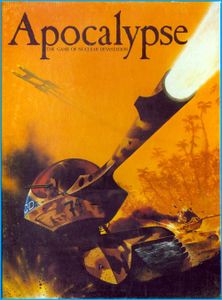
Image result for Apocalypse board game games workshopIf you are of a certain age, then you will remember Apocalypse. Not the ‘Apocalypse’, but Apocalypse: The Game of Nuclear Devastation, a board game published by Games Workshop in 1980 in bookcase format along with Valley of the Four Winds and Warlock. It saw generals fighting for territory in a near future Europe in conflicts that would quickly escalate into nuclear confrontations and inevitably, nuclear devastation. The rules were simple and to our fourteen-year-old minds, the fun thing about the game was that every time you won a conflict, you were awarded a stage for your nuclear missiles. The game included little plastic missile stages that clipped together to form slightly wonky nuclear missiles and when you fired them, each missile devastated several regions on the board and destroyed whole armies. It was in my English teacher Mister Peter Rolfe’s opinion, when we explained it to him, very poor taste.

The truth of it was that Apocalypse was produced on a low budget. The map was quite small, the missiles were of cheap plastic, the armies of thin card, and the six-sided die included in the game was arguably the worst die I have ever seen. Fortunately, this did not matter. The die was never intended to be rolled in Apocalypse. A couple of years later I got to play again, but not Apocalypse, but The Warlord, the original version of the game that was not quite as simplified as Apocalypse and had better components—although the copy I was playing used Lego blocks as missile stages. What was interesting was that I was playing with the designer’s nephew. I never did get to meet the designer—Mike Hayes—then, but by chance I met him at UK Games Expo 2013 where he had a new edition of the game available. Not of Apocalypse: The Game of Nuclear Devastation, but Classic Warlord – The Holy Grail of Wargaming, a new version of the original game first self-published in 1974.

Classic Warlord, a game of bluff, conquest, and nuclear confrontation, is designed for two to seven players—Apocalypse was for between two and four. Classic Warlord retains the same simplicity of rules as Apocalypse and is designed to be modular. Its eight map boards sit together to cover Europe, the Near and Middle East, and North Africa. What this means is that a short game can be played out over a small theatre over two maps—for example, the Madrid and Rome maps to form a Western Mediterranean theatre—in an hour or two with two, three, or four players. With all eight maps and all seven players, a game could last several hours.

Classic Warlord comes richly appointed. In addition to the eight full-colour map boards—each marked with mega-cities, key urban areas, rural regions, mountains, deserts, and sea regions, the big box includes two sets of the three-page rules sheet, seven separate red cloth bags full of small coloured discs—these represent the players’ armies, a black bag of thick squares used to mark irradiated regions, two sets of missile stages—red for A-Bombs, white for H-Bombs, and a large die. Also included in the box is a twenty-four page combined FAQ and set of Designer’s Notes. What is missing from the box is a cup under which to hide the die during battles, but that is easily supplied.

Once the map boards have been selected, players take in turn to place a single army on an unoccupied and unconnected mountain region until they have all been filled. What this means is that the players begin the game with unconnected forces, each conducting the near-future conflict in a balkanised fashion as a mini-empire of its own. Then on his turn, a player conducts three phases. The first phase consists of firing and detonating missiles—this occurs later in the game after a player has won a few battles against his opponents. In the second phase, a player receives more armies, the number based on the number of separate empires he owns, as well as the number of mega-cities, key areas, and rural regions he controls at the start of his turn. These are placed within the empires they are generated from.

In the third phase, he can move his armies to occupy empty regions and he can also attack enemy-held regions. Classic Warlord’s combat mechanics are where the game begins to shine. The attacker selects a number on the die not greater than the number of armies he is attacking with and hides it under a cup. The defender now has to guess the number selected. If he does so, the attacker loses that number of armies from his attacking forces.  Essentially, the attacker is staking a portion of his forces on the defeat of the defender. If on the other hand, the defender fails to guess the number correctly, he loses one of his armies and the attacker gains a single A-Bomb missile stage that he can place anywhere within his empire that he attacked from, to be launched in the first phase of subsequent turns. Attacking mega-cities, mountains, and from sea onto the land are difficult to stage.


For example, it is Dave’s turn. He has already reinforced the Apennines in Italy so that it has six armies. He wants to capture Milano to the north which Niamh defends with just two armies. Dave as the attacker takes the die, selects a number between one and six, and hides it so that the number cannot be seen or changed. Niamh has to guess the number, which must be between one and six. She selects three, but Dave chose two, so Niamh loses an army. Dave also gains an A-Bomb missile stage to place anywhere in his empire in Italy. He also continues the attack. He again selects three, thinking that Niamh will not choose that, but she does! Dave loses three armies from his forces and decides not to press his attack.

Once a player has a missile, he can launch it during the first phase of his turn. A missile’s range is determined by the number of its stages. When it strikes, the targeted region is irradiated—marked with one of the game’s black squares—and rendered unsafe for the rest of the game. In addition, all of the adjacent regions are devastated and any armies in them destroyed. These regions can be reoccupied. H-Bombs are more effective. They not only irradiate the targeted region, but also all of the adjacent areas. Of course, all of the regions adjacent to the irradiated regions are devastated.

If any missile—A-Bomb or H-Bomb—is stationed in an area that is devastated, it will also detonate, having the same effect as if it had been launched at a region. It is thus possible to set off a chain-reaction of missiles is they are placed too close to each other. (It should be noted that our fourteen-year-old selves would look upon this with unbridled glee!). Although missiles do permanently remove territory from the game, their devastation effect is an efficient means of removing enemy armies from the map.


For example, Niamh wants to stop Dave from staging further attacks from the Apennines, so on a later turn she launches a two-stage A-Bomb from the Tyrol on the Apennines. It irradiates the Apennines and devastates Emilia, Milano, Torino, the Ligurian Sea, Toscana, Umbria, and Marche. In the next phase, Niamh will receive more armies and not only reinforce her armies in the Alps, but march south into northern Italy. For launching an A-Bomb, Niamh also receives an H-Bomb to place in her empire in northern Italy...


Play continues like this until there one last survivor who is declared the winner of the game.

In the process, irradiated and devastated areas will ripple and grow across the map. This will affect further battles as players’ forces are channelled around irradiated areas. H-Bombs exacerbate this issue.  As this happens and players are eliminated from the game, battles are likely to become bigger and bigger, but more tightly focused on certain terrain.

By modern standards, Classic Warlord shows its age—after all, it is more than forty years old. It is a brutal wargame in which no prisoners are taken; it is not a balanced Eurogame in which the play is competitive rather than combative; and it is a game in which the players are eliminated from play one after another. Its subject matter has also dated—we no longer live in fear of imminent nuclear annihilation. That said, there is a simple elegance to the design of this game and there is a complete absence of luck—Classic Warlord is not Risk with its reliance on dice rolls. The mechanics in Classic Warlord rely purely on player decision, bluff, and deduction. Selecting how many armies to commit to a battle is a tough decision for the attacker and deducing how many the attacker is prepared to risk lies at the heart of the game. A larger number of armies means that the attacker has greater choice in how many he can risk, but risking too many means that his attack can fail more spectacularly. The defender of course, has to gauge just how many the attacker is prepared to risk…

In comparison to the earlier Apocalypse, the new edition of Classic Warlord is bigger, bolder, and better presented. It has been streamlined in places—there are fewer mega-cities and it is not possible to reconstruct irradiated areas. As much as they are destructive in their effect, the addition of H-Bombs from earlier iterations of the game—they do not appear in Apocalypse—actually speeds play because they knock territories out of the game and reduce the need to battle over them.

In larger, multiplayer games, one issue is that the players are sat around doing nothing when it is not their turn. Of course, there is nothing to stop them enjoying the tension of the confrontation between the current combatants or indeed involving themselves in attempts to form or break alliances. This diplomatic aspect to the game is not discussed in the rules, but it is implicit with this kind of multi-player wargame.

What then of Classic Warlord as a simulation? It certainly does not simulate actual warfare, its scope and mechanics being too broad and too abstract for that. In a sense, it is more like Diplomacy or Risk in terms of its scope and mechanics, but given that its setting is that of a then near-future post-Cold War conflict (the game having been long developed and published before the end of the Communist Bloc at the end of the 1980s), what it does simulate is a conflict that never came to pass. It is thus a ‘what if?’, although loose parallels can be drawn to certain post-Cold War conflicts in Classic Warlord’s set-up of small empires jockeying for power and territory combined with the post-Cold War fear of post-Soviet states and factions gaining control of nuclear weapons. Certainly though, it models the brinkmanship of nuclear conflict.

Given its set-up and its expanded playing area with the extra maps, it is disappointing that Classic Warlord does not entertain the possibility of scenarios to simulate possible conflicts. Given the game’s age, the obvious would be a Warsaw Pact/NATO confrontation in Germany, but the collapse of the Balkans could also be played out, as could numerous conflicts in the Middle East.

Physically, Classic Warlord is nicely presented. The maps are well down and mounted on sturdy cardboard. The plastic pieces are sturdy, though the armies are a little fiddly to handle. Although a nice touch, the inclusion of bags for all of the plastic pieces does seem a little redundant given that they come in ziplock bags. Lastly, the rules sheet is nicely done. At just three pages in length, it points to the game’s simplicity and elegance.

There is no denying that the premise behind Classic Warlord is unwholesome. Indeed, it may even be unpalatable to some, yet there is an undeniable pleasure—a guilty pleasure perhaps—in seeing the game back in print, but a pleasure nonetheless. Even though its premise has dated, there is no denying the sheer brutality and elegance of Classic Warlord’s design.