Every Week It's Wibbley-Wobbley Timey-Wimey Pookie-Reviewery...

Sunday, 12 January 2020

A Post Space Opera Companion

Ashen Stars is Pelgrane Press’ Science Fiction roleplaying game of investigation and action. Using the investigation-orientated Gumshoe System mechanics written by Robin D. Laws, it takes the idea that Space Opera stories, especially those screened on television, are essentially mysteries to be solved and adapts it to an interesting frontier setting. This is the Bleed, a rough, wild fringe of space that barely twenty years ago was the enticingly glamorous frontier of The Combine, a two-hundred-year-old interstellar, culture-spanning government dedicated to peace, understanding, and self-determination. The Combine was an idealistic utopia that enabled numerous races and peoples to live happily under its governance, but then the Mohilar attacked, and employing technologies unknown to The Combine, their vast war fleets stormed system after system until The Combine’s heart, Earth itself, was devastated. Then following an unexpected defeat at the hands of a last-ditch effort by what remained of Combine forces, they vanished. That was a decade ago and yet, due to an effect known as the Bogey Conundrum, memories of the Mohilar race have become hazy and inconsistent. Try as they might, no one call recall exactly what the Mohilar were, and certainly, no one has any idea where they are now…

In the wake of the Mohilar War, both the interstellar economy and government have collapsed and whilst The Combine exists, its reach has been pulled back from the Bleed. Thus, the worlds the Bleed, many scorched and blasted by war, have been left to their own devices, bound only by a common currency and cultural ties. Where Combine patrols once kept the peace, peacekeeping missions and criminal investigations are now put out to private tender and assigned to independent ship operators known as ‘Licensed Autonomous Zone Effectuators’ or ‘Lasers’. As Lasers, the player characters will crew and operate a ship on a tight budget, hoping to pick up assignments that if completed will enhance their reputation and so lead to better and more profitable assignments.

Since its publication in 2011, Ashen Stars has received only slight support, all of it the form of scenarios, such as Dead Rock Seven and The Justice Trade. Accretion Disk is support of a different kind, a supplement which takes its name from the structure formed by diffuse material in orbital motion around a massive central body, typically a star. In terms of a roleplaying supplement what we have in Accretion Disc is a collection of unrelated material—new character options, new playable species, new ability options, new weapons and equipment, new contracts, new aliens, and more. Accretion Disc is essentially, the Ashen Stars Companion.

The supplement wastes no time in getting down to business. The first fifth of Accretion Disk is devoted to Investigative Abilities—knowledges which get the Lasers clues, and General Abilities—skills and so on which allow the Lasers to act. Every entry for an Investigative Ability includes sample benefits from Spends of an Ability and sample clues and plot hooks, whilst for General Abilities include possible investigative clues and possible ‘Cherries’. So for the Data Retrieval Technical Ability, a Laser’s player might spend a point to protect the team’s own data or disseminate an enemy’s secrets to the general public, whilst sample clues and plot hooks include being able to access the captain’s logs of a crashed spaceship, determine clues from a ransom video in a kidnap case, and so on. 

‘Cherries’ were introduced in Night’s Black Agents specifically to meet its thriller angle. Now, as with Night’s Black Agents, if a Laser in Ashen Stars has a General Ability with a rating of eight or more, he is regarded as being skilled enough to gain a special benefit. So for example, with an Athletics score of eight or more, a Laser have the ‘Hard to Hit’ and so become harder to target in combat, or he might take the Might Cherry for his high Athletics Ability, enabling his player to expend points from his Athletics Ability pool after the roll rather than before. Other Cherries give simple points in other Abilities or a free pool of points to spend on specific things. For example,  ‘Follow the Money’ for the Business Affairs General Ability, grants a free point in the Forensic Accounting Academic Investigative Ability, whilst the ‘Viro Wizardry’ Cherry for the Viro Manipulation General Ability to provide the Lazers with an extra pool of points to spend on the second use of a one-use Viroware. Overall, the section on Abilities—Investigative and General—is useful for both Game Master and player alike, adding further helpful description and utility. In general, the use of the Cherries also make the play of the game more cinematic in flavour and feel. Even further the write-up of the Flattery Interpersonal Investigative Ability is amusingly, exactly what it says it is.

‘Crewing Up’ expands upon the discussion of the Warpside and Groundside mission roles of the Lasers from the Ashen Stars core rulebook. It provides a list of the basic Investigative and General Abilities needed for each role, a discussion of the role, the role’s typical day-to-day routine, suggested equipment loadouts, specialised techniques and jargon, and classic media archetypes. So a Communications Officer or Hailer will be receiving communications, dealing with clients, tracking and analysing signals, hacking, and so on. He might be a polished corporate spokesman, an eccentric hacker/DJ, a military signals expert, harried technician, and more. Again, there is a lot of information here for both Game Master and player, giving the former ideas on how to bring them into play and the latter ideas on how to play each role. 

One of the aspects of Ashen Stars and of Gumshoe System roleplaying games in general is its direct implementation of Drives and Arcs to help involve Lasers in campaigns and plots. In the core rule book for Ashen Stars, they are discussed from the Game Master’s point of view since she is the one who will be implementing them. In Accretion Disk, they are examined from the player’s point of view. There are some general suggestions on how each player might bring them into play and do it judiciously, plus three sample Arc Drives for each. Ashen Stars then adds six new playable species to the Seven Peoples of the Combine, some of whom have held more prominent positions in the past. They include the warty, boney Cloddhuck, who once revered the Durugh as gods and served them as shock troops, but since the Mohilar War have used their combat intuition as mercenaries and criminals, and now, to solve crime! The Haydrossi evolved in the atmosphere of a gas giant and can not only float, but have excellent three dimensional spatial awareness and are driven to seek new places in search of a lost utopia. Unfortunately, they are not covered by the treaties which forbid the Kth-thk from eating certain sentient species. The Icti inhabit and animate the fresh corpses of the recently dead, the higher up the food chain the better, and can access the memories that the corpses had in life as well as preventing their newly inhabited ‘meat-shells’ from truly rotting for years. It is entirely for a Laser to die in game and his player chose to have come back as an Icti! The Ndoaites are even weirder, shell-residing lizards who consume radioactive ores and whose bowel movements are classed as type II biohazards. Consequently, as Lasers they serve Warpside happily, but send drones to represent them when Groundside. They can also generate and emit radiation, often in modulated, targeted bursts. The Racondids are bipedal reptiles overconfidently keen on the Combine and seeking out new challenges with a rapid metabolism which allows them to vomit flammable material! Lastly, the Verpid are a corporate-owned species, genetically engineered to change shape and have fled their masters in an act of self-emancipation.   

All six of the new races are interesting and different, but not necessarily useful or much-needed additions to Ashen Stars. They are again, another option for a campaign. More useful though are the sets of deck plans for the six most commonly used ships used by Laser teams. From the stalwart, reliable Runner to highly defensive, but uncomfortable Porcupine, all of the ins and outs of these vessels are discussed, as their foibles and quirks. If there is an issue here it that the deck plans are presented in greyscale rather than colour, so much of their definition and detail is lost. Accompanying this is a selection of new ‘Ship Bolt-Ons’, complete with Cost and Upkeep values, such as the Cannon-Nanny which prevents shipboard weapons from being used by over-zealous gunners so as to prevent Public Relations disasters or Particle Streamers which stream and excite particles hamper attempts by attackers to lock on and tow the ship. Shuttles receive a similar treatment with several alternatives to the standard shuttle carried by most Laser vessels, including Cargo Shuttles and Racing Shuttles. As does the section on personal technology, which includes a communications device, cybernetic enhancements, medical, forensic, and protective gear, and miscellaneous and investigative tech, viroware, and more. Players will enjoy the Dirty Harry Mod which makes a Disruptor weapon look a whole bigger and thus more intimidating; the Muckraker Suite, semi-intelligent systems and customised software for digging up dirt on a target; and the Wingman Ultra, which enables a Laser to mimic a colleague or friend’s Interpersonal skills, including of course, Flirting.

Rounding out Accretion Disk are over thirty ‘Hot Contracts’, giving the Game Master a wide array of tasks for the players’ team of Lasers to undertake, followed by an expansion to the ‘Entity Database’ with twelve new monsters and creatures. Lastly, the appendices provide rules for ‘Ashen Stars Warp’, a stripped down version of the rules with fewer skills and abilities. This is also intended for convention play where quicker mechanics might be of use.

Physically, Accretion Disk is cleanly laid out, decently edited, and nicely illustrated. It comes with a good index too. The only downside to the supplement is that it is presented in greyscale rather than colour, and some of the artwork—and certainly the deckplans—would have benefited from being in full colour.

Until now, Ashen Stars has not had a supplement to support both its play and its setting. Accretion Disk fulfills that need, with an array of useful and interesting bits and pieces, some of them connected—for example, the deckplans, the ship bolt-ons, and the shuttles—some not. Given the time between the publication of Ashen Stars and the publication of Accretion Disk, this is the supplement that will bring veteran players of the roleplaying back to play with its selection of new options, or support a group coming to the roleplaying game for the first time with advice and expanded explanations. 

Accretion Disk is more than welcome support for Ashen Stars, not necessary to play, but helpful, useful options and advice to expand and support a campaign. The perfect companion to Ashen Stars.

Saturday, 11 January 2020

Jonstown Jottings #6: Arrows of War

Much like the Miskatonic Repository for Call of Cthulhu, Seventh Edition, the  Jonstown Compendium is a curated platform for user-made content, but for material set in Greg Stafford's mythic universe of Glorantha. It enables creators to sell their own original content for RuneQuest: Roleplaying in Glorantha and HeroQuest Glorantha (Questworlds). This can include original scenarios, background material, cults, mythology, details of NPCs and monsters, and so on, but none of this content should be considered to be ‘canon’, but rather fall under ‘Your Glorantha Will Vary’. This means that there is still scope for the authors to create interesting and useful content that others can bring to their Glorantha-set campaigns.


—oOo—


What is it?
Arrows of War is a short, two-session scenario set in Dragon Pass during Dark Season easily run as part of the Colymar campaign begun in RuneQuest: Roleplaying in Glorantha – QuickStart Rules and Adventure and then continued in and around Apple Lane as detailed in the RuneQuest Gamemaster Screen Pack, specifically before the events of the scenario, ‘The Dragon of the Thunder Hills’.

It is a five page, full colour, 2.0 MB PDF.

Arrows of War is well presented and decently written, but needs an edit in places. The internal artwork is okay, but the map is decent.

Where is it set?
Arrows of War by default takes place in Apple Lane in the lands of the Colymar tribe and then near Runegate in Dark Season 1625.

If run as part of the Colymar Campaign, it is best run before The Throat of Winter: Terror in the Depths, before the onset of the worst of Dark Season.

Who do you play?
The scenario does not have any strict requirements in terms of the characters needed, but warriors, entertainers, and priests will all be useful.

What do you need?
Arrows of War can be run using just RuneQuest: Roleplaying in Glorantha. If the Game Master is running the Colymar campaign in and around, then the RuneQuest Gamemaster Screen Pack is recommended.

Although optional, The Armies and Enemies of Dragon Pass will provide more information about the Gloranthan warfare depicted in the scenario, whilst The Eleven Lights will explain the significance of the scenario’s cosmic events.

What do you get?
In the wake of the Dragonrise, King Pharandros of Tarsh reacts to Kallyr Starbrow’s revolt by sending a large Tarshite army to reinforce Lunar rule in Alda-Chur. In response, she petitions the tribes for warriors and the summons are issued across the tribal lands, including to the player characters.

In contrast to the events the characters will have participated in as indicated by ‘Step 2: Family History’ of the Adventurers chapter of the RuneQuest: Roleplaying in Glorantha core rulebook during character generation, Arrows of War is not a scenario in which they take part in a great event or battle. Although a battle does take place—at Dangerford—the player characters, along with many of their fellow tribesmen, are stationed elsewhere and can only wait and watch in case the Tarshite army and its Lunar allies attack there.

Arrows of War is about the call to war, preparing for it, and its aftermath, rather than the fighting involved. As a scenario, it is not as obviously dramatic as getting involved in a showdown between Sartarite and Lunar forces would be, but there is plenty of scope for drama and roleplaying within the events it describes. In the main, these involve a lot of waiting and marching and waiting, with suggested small events along the way. It is also about military camp life and the anticipation of battle rather than battle itself. Throughout, the scenario suggestions are given as to what skills might be used and why, many of them less commonly used skills.

Although none are detailed in Arrows of War, the scenario represents an opportunity for the Game Master to bring in NPCs for the player characters to interact with, either of his own creation, or drawn from the backgrounds of the player characters created during ‘Step 2: Family History’ of character creation.

Is it worth your time?
Yes. Although Arrows of War places the player characters on the periphery of events in Sartar, it highlights the importance of those events as well as their consequences, as well as providing opportunities for both roleplaying and skill use. It is a another decent scenario to run as part of the Colymar-set campaign from the RuneQuest Gamemaster Screen Pack in and around Apple Lane, one that will benefit from the addition of some named NPCs.
No. If you are running a campaign set further away from Colymar, then Arrows of War may not be of use to you. Its events could be adapted to other battles though.
Maybe. Arrows of War can be run using groups from further away, adapted to other battles, or even with some effort, run for a group of Lunar or Lunar Tarshite characters.

Friday, 10 January 2020

Post-Zombie Quick-Start

Trouble on the Steel Pier: A Dystopia Rising: Evolution Jumpstart is a quick-start for a Dystopia Rising: Evolution, a Post Apocalypse roleplaying game from Onyx Path Publishing. It provides everything necessary for a gaming group to give the roleplaying game a try and perhaps even use it as the starter scenario to a campaign set in the dark future of Dystopia Rising: Evolution, including a basic explanation of the rules, a six-scene scenario, and five pre-generated player characters. The setting of Dystopia Rising: Evolution is an America some generations after the outbreak of a zombie virus brought about an apocalypse. In the decades since, the survivors have not only learned to adapt and get by, but mutated into several distinct Lineages. In more recent times, the cities, long fallen and crumbled, have formed the bones upon which new and vibrant settlements have been built, trade and travel have been established once again, and societies have begun to be formed. The setting for the scenario, ‘Trouble on Steel Pier’, is the Big A.C., a place of glitz, glamour, and danger within the post-apocalyptic wasteland. Here are opportunities for trade, for work, for entertainment, but also criminality, murder, and more…

Unlike other Jumpstarts and roleplaying games from Onyx Path Publishing which use the Storyteller system, Trouble on the Steel Pier: A Dystopia Rising: Evolution Jumpstart employs the Storypath system. The latter can be best described as a distillation of the former and certainly anyone familiar with the Storyteller system will find that it has a lot in common with the Storypath system, except that the Storypath system is simpler and streamlined, designed for slightly cinematic, effect driven play. The core mechanic uses dice pools of ten-sided dice, typically formed from the combination of a skill and an attribute, for example Pilot and Dexterity to sail a boat, Survival and Stamina to cross a wilderness, and Persuasion and Manipulation to unobtrusively get someone to do what a character wants. These skill and attribute combinations are designed to be flexible, with a character’s preferred method being described as a character’s Favoured Approach. So a character whose Favoured Approach is Force, would use Close Combat and Might in a melee fight; if Finesse, Close Combat and Dexterity; and if Resilience, then Close Combat and Stamina. 

The aim when rolling, is to score Successes, a Success being a result of eight or more. Rolls of ten are added to the total and a player can roll them again. A player only needs to roll one Success for a character to complete task, but will want to roll more. Not only because Successes can be used to buy off Complications—ranging between one and five—but also because they can be used to buy Stunts which will impose Complications for others, create an Enhancement for another action, or one that it makes it difficult to act against a character. Some Stunts cost nothing, so ‘Inflict Damage’ costs nothing, though may cost more if the enemy is wearing soft armour, a ‘Critical Hit’ costs four Stunts, and so on. Instead of adding to the number of dice rolled, equipment used adds Enhancements or further Successes for a player to expend, but the player needs to roll at least one Success for equipment to be effective.

Under the Storypath system, and thus in Dystopia Rising, failure is never complete. Rather, if a player does not roll any Successes, then he receives a Consolation. This can be a ‘Twist of Fate’, which reveals an alternative approach or new information; a ‘Chance Meeting’ introduces a new helpful NPC; or an ‘’Unlooked-for Advantage’, an Enhancement which can be used in a future challenge. Alternatively, a character gains Momentum which can be expended to gain an Enhancement or to activate a Skill Trick or an Edge.

The rules in Trouble on the Steel Pier: A Dystopia Rising: Evolution Jumpstart cover narrative and dramatic scale, combat—players roll an appropriate Resilience Attribute to generate Successes to be expended on Defensive Stunts, and procedurals such as information gathering, intrigue, influence, and so on. These are all clearly explained and all easy to use in play. In general, the Storypath system, as presented in this Jumpstart is clearly presented and quick to pick up. They feel simpler and faster than the Storyteller system and have a cinematic quality to them, especially with the availability of Stunts and Consolations in the face of failure.

Characters in the Storypath system share much in common with the Storyteller system. They have nine Attributes—Intellect, Cunning, Resolving, Might, Dexterity, Stamina, Presence, Manipulation, and Composure; a range a skills, some with associated Skill Tricks and Specialities; and Edges, Paths, and Aspirations. A Skill Speciality, such as ‘I Can Eat That’ for the Survival skill, adds an Enhancement, whilst a Skill Trick, like ‘Wayfinder’ or ‘Charisma’, require a point of Momentum. Of all of the aspects in Trouble on the Steel Pier: A Dystopia Rising: Evolution Jumpstart, what each Skill Trick actually is the least explained, so a playing group will just have to improvise. Edges are the equivalent of advantages, and for certain characters can be Faith or Psi Edges, whilst a character has three Paths. His Strain Path represents his history and strain of humanity, as well as his Strain condition; his Role Path is his occupation or what he is good at; and his Society Path represents his connection to a group or society. For example, one of the pre-generated characters is has the Strain Path of Retrograde, which means he has rotting skin due to excess radiation and consequently, the Strain Condition of ‘It’s Zed!’, meaning his appearance makes it difficult for others to communicate with him; the Role Path of Gunslinger, good with firearms; and the Society Path of Settlement (Philly del Phia). Aspirations are a character’s goals, and in the scenario are either short or long term.

The five characters included in Trouble on the Steel Pier: A Dystopia Rising: Evolution Jumpstart are a firebrand leader and sniper, a bruiser and paragon of faith, a cannibal tunnel rat and knife fighter, a charismatic scoundrel, and a physically disabled tech wizard and driver. Each is presented in full colour over two pages with the character sheet on one and an illustration and background on the other. The character sheets are easy to read and the background easy to pick up.

The scenario, ‘Trouble on the Steel Pier’, is a Macguffin hunt. The characters in the Big A.C., a glitzy harbour settlement , when they are asked by a contact from a Pure Blood family in Philly del Phia to collect a parcel of medical supplies from an incoming boat, the Harbinger. Unfortunately, as the boat sails into view, it comes under attack by zombies. The characters will have to get out to the Harbinger and save both her and the crew and find the medical supplies. Of course, not all is as it seems, but discovering that will require co-operation and investigation upon the part of the player characters. Each of the five scenes is very clearly organised with explanations of how the characters got there, what they need to accomplish, the opposition they face, and the goal of the scene all laid out for the Storyguide—as the Game Master is known in Dystopia Rising: Evolution. Everything that the Storyguide needs is laid out within each scene, making them easy to run. The scenes are a mix of action, investigation, roleplaying, and subterfuge. The story is linear, but that is not really an issue in a Jumpstart which is intended to introduce both setting and mechanics of Dystopia Rising: Evolution. If there is an issue with ‘Trouble on the Steel Pier’, it is perhaps that the scenario is a bit short and does not end on an exciting note. Nevertheless, there is plenty for the players and their characters to do, the characters themselves being nicely done to encourage roleplaying and show off what they can do.

Physically, Trouble on the Steel Pier: A Dystopia Rising: Evolution Jumpstart is a slim softback, done in full colour with plenty of illustrations depicting the grungy, worn world of a post-apocalyptic future. It could have done with an edit in places and perhaps a better explanation of some of the elements of the characters.

The good thing is that as much as Trouble on the Steel Pier: A Dystopia Rising: Evolution Jumpstart is a standalone, there is nothing to stop the Storyguide running its scenario with the full rules and characters of the players’ own creation. Its setting has a grim and grimy atmosphere, but does not over do either, nor does it overdo its zombies, so this is more than just a zombie roleplaying game. Overall, Trouble on the Steel Pier: A Dystopia Rising: Evolution Jumpstart is a good introduction to the Dystopia Rising: Evolution setting, a Post Apocalypse future still beset by zombies, its stripped down, slimmer mechanics of the Storypath system support its cinematic feel with its Stunts which give the players and their characters more options in play.

Sunday, 5 January 2020

Imperial Destiny

Since its publication in 1977 and development as the Third Imperium setting, only one event and time and date has mattered in the Traveller roleplaying game. That time and date is 1517 hours on 132-1116. The event is the assassination of Strephon Aella Alkhalikoi, the Emperor of the Third Imperium, his wife, Iolanthe Abartii Guuibataashullibaa, and their daughter and his heir, Grand Princess Ciencia Iphigenia Alkhalikoi, and the Aslan Yerlyaruiwo ambassador, at the hands of Dulinor Astrin Ilethian of Dlan, Archduke of the Domain of Ilelish. Although Archduke Dulinor would assume the throne by Right of Assassination, the bullets he would fire from the Magnum Revolver it was his perogative to carry it loaded anywhere within the Imperium—even into the Imperial Throne room—would topple the Third Imperium. This event and its subsequent Rebellion changed the future of the Traveller timeline, the conflict between the leading claimants grinding each other into technological regression and making Humaniti’s greatest empire vulnerable to attack by external forces.

It does not have to be though… For example, between 1998 and 2015, Steve Jackson Games published and supported GURPS Traveller, a version of the Third Imperium setting in which Dulinor’s assassination attempt was foiled and the Rebellion never took place. Alternatively, a gaming group can explore what happens on the date 132-1116 and perhaps decide the future of the Third Imperium with the scenario, Eve of Rebellion. Now in most Traveller campaigns, players take the role of ship’s crews, being the eponymous travellers, moving from world to world, trading, thwarting crimes, uncovering mysteries and making discoveries, and so on. Alternatively, the player characters will go to war, undertaking contracts as mercenaries in low-conflict engagements. In Eve of Rebellion though, the players take the role of those present at the events leading up to the assassination of Emperor Strephon. Each has his motivations and reasons for being at the Imperial Court—all of which will drive them to act in the best interests of the Imperium (or so they think).

Published by March Harrier Publishing via Mongoose Publishing, Eve of Rebellion is a one-shot scenario suitable for conventions or campaign breaks, designed to be played between four and five players—though it will play best with all five players, plus the Referee. In terms of mechanics, Eve of Rebellion is written for the current rules for Traveller, but is so rules light, it can be run by almost every previous version of Traveller, or indeed, be adapted to almost any system of the gaming group’s choice. Indeed, the primary game content in Eve of Rebellion in terms mechanics are the stats and skills of the five characters involved, although stats are also provided for the Cepheus Engine.

The five characters in Eve of Rebellion are Emperor Strephon Alkhalikoi, Grand Princess Ciencia lphegenia Alkhalikoi, Prince Varian Alkhalikoi and Prince Lucan Alkhalikoi, Dulinor Astrin Ilethian, Archduke of Ilelish, and Duke Norris Aella Aledon. Of these, one player will take the roles of both of the twins, Prince Varian Alkhalikoi and Prince Lucan Alkhalikoi. It should be noted that Empress Iolanthe is not amongst these five. In the first of two non-canonical elements in Eve of Rebellion, she is not included, having died in 1112. The other is that Duke Norris is present at the court prior to when the asassination attempt took place in the official history instead of being in the Spinward Marches restoring the ravages of the Fifth Frontier War. Of the five, Emperor Strephon Alkhalikoi wants to continue his reforms and ensure that he has a successor to continue them; Grand Princess Ciencia lphegenia Alkhalikoi wants to maintain her status and power of Iridium Throne and possibly marry a suitable suitor; Prince Varian Alkhalikoi and Prince Lucan Alkhalikoi want maintain their louche lifestyle; Dulinor Astrin Ilethian, Archduke of Ilelish wants to reduce Imperial taxes which he sees as unfair and a cause of corruption; and Duke Norris Aella Aledon wants to learn why he is at the Imperial court. Now it should be clear that these are not all of their motivations, but their motivations interlock with each others, some opposing, some in alignment.

Now there is a very good reason for this, and that is the fact that the author has experience in writing LARP—Live Action Role Play—scenarios where the emphasis is on interaction, talking, negotiation, and scheming, rather than on physical actions, such as sword fights, use of magic, running and jumping, and so on, but with tightly bound and opposing characters that possess strong motivations to encourage roleplay. And this is what is, a LARP scenario, written for the Third Imperium and around the most significant event in its history. Unlike a LARP scenario, the players do not have to dress up as their characters, but rather Eve of Rebellion is played around the table with a Referee, just as a standard tabletop roleplaying scenario would be. Of course, with the scheming and intriguing going on, the players are allowed to leave the table and perhaps conive, intrigue, and confide in their fellow players, but they still need to keep the Referee informed.

To support Eve of Rebellion, the author provides everything necessary to play. This includes an explanation of the plot and its set-up and intricacies for the Referee, a guide to running the scenario, labels for each character—including two for the Varian/Lucan player, full stats and briefings for each character—these are two to three pages in length, a set of library data which can be printed out for each player, a quick briefing for the Referee and list of who has what skill for her reference. Every character is illustrated and comes with detailed background, goals, and resources. The goals and resources are very clearly marked and easy for the players to grasp.

Physically, Eve of Rebellion is a 1.29 Mb, twenty-seven page, black and white PDF (though the cover does use colour). It is well written, the characters are superbly designed, and the advice is excellent throughout. 

If there is a problem with Eve of Rebellion it is that the casual player is not going to grasp the nuances and significance of the situation in its set-up. This is very much a Traveller scenario, and for the players to really get the most out of this scenario they very likely want to be au fait with the background to the Third Imperium and its events. Now the Library Data undoubtedly helps with that, but this is still very much a scenario that a Traveller fan will get the most out of. Similarly, this is not a scenario for Traveller devotees more interested in the technical and technological aspects of the setting rather than the background and roleplaying. That said, if you are a Traveller fan, and a Traveller fan with some knowledge of the setting, then this is a scenario that you absolutely have to play. With its superbly designed set-up and support, impressively presented characters and well-explained, interlocking goals and motivations, Eve of Rebellion is an opportunity for you to explore and play out a pivotal event in Traveller canon, to redirect its history in a way that no other scenario does. 

Saturday, 4 January 2020

Jonstown Jottings #5: Early Family History

Much like the Miskatonic Repository for Call of Cthulhu, Seventh Edition, the  Jonstown Compendium is a curated platform for user-made content, but for material set in Greg Stafford's mythic universe of Glorantha. It enables creators to sell their own original content for RuneQuest: Roleplaying in Glorantha and HeroQuest Glorantha (Questworlds). This can include original scenarios, background material, cults, mythology, details of NPCs and monsters, and so on, but none of this content should be considered to be ‘canon’, but rather fall under ‘Your Glorantha Will Vary’. This means that there is still scope for the authors to create interesting and useful content that others can bring to their Glorantha-set campaigns.


—oOo—


What is it?
Early Family History is a supplement for creating the backgrounds of mostly Sartarite characters in earlier time frames than given in RuneQuest: Roleplaying in Glorantha.

It is a fourteen page, full colour, 1.71 MB PDF.

Early Family History is tidily presented in the same format as ‘Step 2: Family History’ (pages 27-43) of the Adventurers chapter of the RuneQuest: Roleplaying in Glorantha core rulebook. It needs an edit in places.

Where is it set?
Early Family History focuses on events in and around Sartar with excursions to Esrolia, Pavis, and Tarsh.

Who do you play?
Any of the character options as per the RuneQuest: Roleplaying in Glorantha core rule book.

What do you need?
RuneQuest: Roleplaying in Glorantha.

What do you get?
The rules in RuneQuest: Roleplaying in Glorantha include a set of tables in the Adventurers chapter to create the family and personal background for characters who come of age in 1619 and enter play in 1625. This does not mean that characters from other periods of history cannot be created using the rules in RuneQuest: Roleplaying in Glorantha, but what it does mean is that characters created for those other periods will not enter play with the same degree of detail and family and personal history.

Early Family History addresses this issue by providing two sets of tables for creating the backgrounds and histories of player characters, their parents, and their grandparents. ‘Early Family History’, the first set of tables in Early Family History covers the period from 1565 to 1615, from the Orldaging War (1565-1577) to the Grazelander raids on Trash (1614). ‘Even Early Family History’, the second set of tables in Early Family History covers the period from 1538 to 1564, from the Axes Against the Empire and Destruction of the Temple (1538) to the Trollkiller War (1551-1561). Both sets of tables detail events at which the player characters and their immediate ancestors may have been presents as well as a range of possible outcomes and the benefits which might result from their participation.

The default period for RuneQuest: Roleplaying in Glorantha is 1625 and the beginning of the Hero Wars, but most of the supplements and scenarios published for previous editions are set earlier in the timeline, typically from 1615 onwards. The use of Early Family History enables a playing group to play using those supplements and scenarios—for example, Apple Lane, but also for many of the other titles published for RuneQuest II with characters who are as detailed in terms of background and history as the default characters are in RuneQuest: Roleplaying in Glorantha.

In addition, the ‘Early Family History’ and ‘Even Early Family History’ tables enable a player to create a more experienced character with more than the base five years back story developed during the character creation process. Alternatively, the Game Master can use these tables to flesh out the backgrounds of her NPCs. Of the two tables, Early Family History’ is easier to use, whilst for ‘Even Early Family History’, the Game Master will need to calculate the birth dates for the player characters’ ancestors.

Is it worth your time?
Yes. If you are looking to create characters who enter play during an earlier period, have more history and are older before entering play, or develop more detailed backgrounds for the older NPCs in your campaign, then Early Family History is the supplement you need.
No. If you are not looking to create characters with more detailed background in the earlier periods of Glorantha’s timeline, then Early Family History will not be of use to you.
Maybe. Useful to have around to add colour and background to an older NPC at least, but not absolutely useful or a must have.

Friday, 3 January 2020

Friday Fantasy: The Song of the Sun Queens

Arc Dream Publishing is best known as the publisher of the Delta Green: The Role-Playing Game, the roleplaying game of conspiratorial and Lovecraftian investigative horror, but in 2019, branched out into publishing for Dungeons & Dragons, Fifth Edition with its ‘Swords & Sorceries’ adventure line and two releases for its ‘Broken Empire’ setting. The first of these was The Sea Demon’s Gold, an adventure offering more dangers than rewards, and doing so in a weird, dank, and squelchy environment, with a strong undercurrent of the Lovecraftian. Where The Sea Demon’s Gold roughly threw the adventurers ashore and into a clammy dungeon, the second scenario takes the adventurers out onto sun bleached savannah in search of a great treasure.

The Song of the Sun Queens is an adventure designed to be played by five characters of Second and Third Level and takes place out on the vast plains of the Sunlands. In the Broken Empire—the setting for Arc Dream Publishing’s campaign world—this lies far to the south of the remnants of the Zyirran Empire, a fallen Byzantium-like empire, placed of course, in the Swords & Sorcery genre. There is no background given on the Broken Empire in The Song of the Sun Queens, but it does include details of the Sunlands kingdom, its weather and its gods. The Sunlands themselves are similar to parts of Africa, so the scenario is relatively easy to adapt to other settings, to other roleplaying games like Robert E. Howard’s Conan: Adventures in an Age Undreamed Of, and even to other genres, for example, it could be run using Raiders of the Lost Artifacts: Original Edition Rules for Fantastic Archaeological Adventures, Leagues of Adventure: A Rip-Roaring Setting of Exploration and Derring Do in the Late Victorian Age!, or Pulp Cthulhu: Two-fisted Action and Adventure Against the Mythos . Essentially, The Song of the Sun Queens is a fantasy scenario with pulp undertones and so perfectly in keeping with its ‘Swords & Sorceries’ genre.

As the scenario opens, the adventurers have travelled south to the colourful royal fortress of Juafalme, where they hope to learn more about the location of an ancient, cursed ruin known as Juakufa where a great treasure is said to rest. Here in Ndame, the Land of the Sun, the Sunlanders of the local kingdom welcome the adventurers as honoured guests and invite them to join an ostrich hunt and a celebration afterwards. The former drops the adventurers into the action more or less straight away, the latter an opportunity for roleplaying and the chance to learn more about their proposed destination. (It should be noted that there is a scene of an adult nature here, but it is well handled and could easily be dropped if a group would be uncomfortable with it.) Armed with what they have learned and equipped with a guide, the adventurers then set out south and into the Bleak Lands.

There really is only the one route south, which means that the trip is linear in nature. That said, The Song of the Sun Queens is quite short and the encounters the adventurers have along the way, as well as the villages they visit, could all be moved around if they decide to deviate from the route that the guide is leading them along. As they journey south, they will be harassed by giant hyenas and hyena giants—which even the author notes is confusing—and their Gnoll allies, as well encountering other horrors and finding respite at various villages. Ultimately, they come to Juakufa, otherwise known as the ‘Cackling Fortress’, a dusty, rubble-strewn ruin littered with some nicely detailed treasures, but haunted by a pair of quite tough monsters in a pleasingly creepy climax.

The Song of the Sun Queens is decently presented, cleanly laid out, and well written, and includes advice on making it tougher or easier depending on the strength of the party. The maps are excellent as are the illustrations, both being fully painted. Certainly the illustrations can all be shown to the players as they progress through the scenario.

The Song of the Sun Queens is a relatively short scenario, offering two to three sessions of play. Consequently, it is straightforward in its plotting, but the Dungeon Master could easily expand the scenario, perhaps by playing up the rivalry between the twin monarchs in Ndame, the Land of the Sun, and have that dog the adventurers all the way to scenario’s denouement. Even without this expansion, The Song of the Sun Queens presents a good mix of roleplaying and action, offering a strong combination of pulpy horror and fantasy in a setting that nicely draws upon on cultures other than Western fantasy. 

Wednesday, 1 January 2020

Reviews from R'lyeh Post-Christmas Dozen 2019

Since 2001, Reviews from R’lyeh have contributed to a series of Christmas lists at Ogrecave.com—and at RPGaction.com before that, suggesting not necessarily the best board and roleplaying games of the preceding year, but the titles from the last twelve months that you might like to receive and give. Continuing the break with tradition—in that the following is just the one list and in that for reasons beyond its control, OgreCave.com is not running its own lists—Reviews from R’lyeh would once again like present its own list. Further, as is also traditional, Reviews from R’lyeh has not devolved into the need to cast about ‘Baleful Blandishments’ to all concerned or otherwise based upon the arbitrary organisation of days. So as Reviews from R’lyeh presents its annual (Post-)Christmas Dozen, I can only hope that the following list includes one of your favourites, or even better still, includes a game that you did not have and someone was happy to hide in gaudy paper and place under that dead tree for you. If not, then this is a list of what would have been good under that tree and what you should purchase yourself to read and play in the months to come.


—oOo—


Ravensburger £24.99/$29.99
Can you defeat the great white shark which has been preying on swimmers and holidaymakers on Amity Island? Jaws: A Game of Strategy and Suspense is proof that game designers can take an forty-five year old intellectual property and turn it into a good game. This is a semi-co-operative game in which Brody, Quint, and Hooper must first drive off the shark—played by the fourth player—before it eats too many swimmers and go to sea aboard the Orca to face the shark as it hunts them. This is a tense game of hidden movement (by the shark) and desperate searching (by the hunters) played across two very different acts, but which together can the flavour and feel of the film. Play the game, quote the film, and see whether you can beat a great white shark before it eats you and the boat!

Chaosism, Inc. £23.95/$29.99
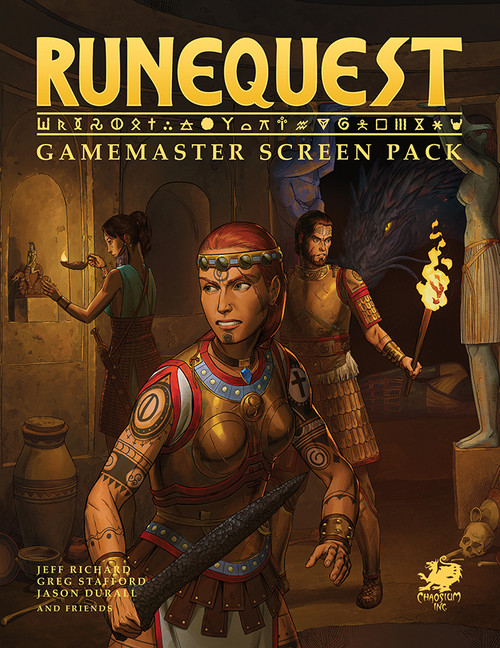
The Game Master Screen Pack for RuneQuest: Roleplaying in Glorantha is proof that you can do more with a GM screen and some reference and/or character sheets. Yes, there is a references booklet, a Gloranthan Calendar, two character sheets, seven pre-generated characters, and six full colour maps, and that in addition to the sturdy, genuinely useful GM screen. That is not all though, for the included ‘RuneQuest Gamemaster Adventures’ book provides everything that the Game Master needs to get her RuneQuest campaign going. It reintroduces the classic setting of Apple Lane as well as the surrounding lands and supports it through three scenarios and numerous scenario hooks. These tie the adventurers into the local area, events, and politics following the Dragonrise which presages the coming of the Hero Wars. Altogether, the Game Master Screen Pack will not only support a gaming group for numerous sessions, but it also sets a standard by which other Game Master screens and their supporting content should be measured.


Cubicle Seven Entertainment £22.99/$29.99
The shelves at our local gaming shop always feel better for Warhammer Fantasy Roleplay, 
the British fantasy roleplaying game being on them. And they feel better for the new Fourth Edition having its own starter set. Like any good starter set the Warhammer Fantasy Roleplay Starter Set includes everything necessary to play. In particular, 
ix, ready-to-play adventurers, a complete setting, and a five-part mini-campaign, plus a whole lot more for the Game Master to develop. This is a richly appointed box set which comes at very pocket friendly price and with everything necessary to get a group playing or it can be used as a scenario and setting set which can be played using the full rules of Warhammer Fantasy Roleplay, Fourth Edition. Whichever it is used, the Warhammer Fantasy Roleplay Starter Set is a perfect introduction to the Old World and a life of ‘Grim and Perilous’ adventure.

Old School Essentials Classic FantasyNecroctic Gnome £26/$40Remember a time when men were men (and Clerics, Fighters, Magic-Users, and Thieves) and Elves were Elves, Dwarves were Dwarves, and Halflings were Halflings? And what they did was delve deep into caverns and dungeons in search of adventure and danger? This is the world of Old School Essentials Classic Fantasy, a retroclone of Basic Dungeons & Dragons, the version designed by Tom Moldvay in 1981. Long out of print, this redesigned and represented version brings ‘Old School’ roleplaying back like never before in an accessible and attractive hard cover enabling gamers to experience the gaming they played back when they started or even for the very first time. The Old-School Essentials Classic Fantasy: Rules Tome is everything that a gaming group wanting to try the ‘Basic Dungeons & Dragons’ of old will need and the perfect update that the 1981 Moldvay version of Basic Dungeons & Dragons deserved.


Published as a beautiful hardback, Liminal is an urban fantasy roleplaying game set entirely within the United Kingdom, a United Kingdom with a Hidden World populated by the strange and the otherworldly, in which magic and magicians, vampires, werewolves, the fae, and many myths of the British Isles are real. It is riven by factions, such as the conerservative Council of Merlin, the scheming vampires of the Soldality of the Crown, the Fae lords, the Queen of Hyde Park and the wife-hunting Winter King of the north, whilst the Order of St, Bede, a Christian order, is dedicated to protecting the mundane world from magic and the supernatural and keeping it and the existence of magic a secret. Where Fortean or inexplicable crimes occur, P Division, a national agency of the British police, are likely to investigate, but cannot mention magic, for fear such knowledge might leak… The players take the role of ‘Liminals’, able to stand astride the mundane and the Hidden World, working as a Crew—which the players create along with their characters—which has its own objectives and facilities, to investigate the weirdness and mysteries that seeps into the real from the Hidden World.

Alien: The Roleplaying Game
Free League/Modiphius Entertainment £39.99/$53.99

In the vast coldness of space, you might lose your life to the environment—radiation will cook you alive, black holes will rip you apart, and the void itself will freeze your blood and seize your brain; you might die as collateral damage in the cold war of aggression between rival governments; greedy corporations might enslave you or drive you into poverty in their relentless scramble for resources; or the frontier world you staked your hopes and dreams on might simply poison or starve you. Then are the things that lurk in the darkness, the things of nightmare, the things that see humanity as prey, as a resource… or worse. This is the future of 2183, a future we have seen depicted on the Silver Screen in Science Fiction Horror classics, Alien and Aliens, but now made accessible and ready for us to explore in the Alien: The Roleplaying Game. Play marines or corporate troopers, colonists, ship’s crew, scientists, company men, even synthetics in cinematic one-shots or grim sandbox campaigns in what is the definitive licensed bug hunt Science Fiction roleplaying game.


King Arthur Pendragon
Chaosium, Inc. £31.99/$39.99

The classic roleplaying game of Arthurian legend, questing, honour, passion, romance, and glory returns in a brand new, full colour edition, today very much the masterpiece it was upon first publication in 1985. King Arthur Pendragon takes place in the ‘Dark Ages’ of the Fifth Century with native Britons, the players taking roles of noble knights, holding off the Saxon invaders, sees the discovery and rise of King Arthur, inaugurating a golden age of chivalry, Christianity, and feudalism, and of honour, romance, and great quests, before the death of Arthur ushers a return of the Dark Ages with greater Saxon successes… At its heart lie a set of personality traits shared by every knight which can change and grow over time, but in play can direct a knight to a particular response or action and so further the story. Knights do not only go on quests and go to war, but they raise families too, hoping to have an heir who will continue the glorious actions of his father. This dynastic play ensures enables a gaming group to play from before, after, and throughout the whole of King Arthur’s reign. King Arthur Pendragon is one of the greatest roleplaying games ever published, the perfect combination of mechanics and theme. 

Best Left Buried
Soul Muppet Publishing £12/$17

We have been doing it for decades. We have been venturing through the cracks and breaks in the ground into the caves and crypts below and beyond in search of secrets and treasures. We were told that this was dangerous. We were told that we would face monsters, weird environments, eldritch magic, and more… We did not believe what we were told. We were fools. Deep underground we suffer constant stress, face fears hitherto unknown, and will probably return from the depths physically and mentally scarred, the strangeness we have seen and the wounds we have suffered separating us from those not so foolish as to descend into the dark. This is the background to Best Left Buried, a stripped back, simple Old School Renaissance-style roleplaying game of brutal, unforgiving underground exploration, in which Cryptdiggers plumb the depths, make discoveries if they are lucky and suffer the consequences if not… Best Left Buried is a bruising fantasy heartbreaker, presenting the old school style of play anew in which few Cryptdiggers return unscarred from their endeavours with some remaining below to become monsters that will stalk and prey on future delvers.


The world of Carbon 2185: A Cyberpunk RPG is the Earth of 2185, a world of the left behind by ‘The Scramble for the Stars’, a world where rampant environmental collapse has forced cities to build protective against the rising seas and pollution has turned the spaces between the cities into wastelands, and a world that is simply a market for corporations discovering and developing new products offworld. As Daimyo, Docs, Enforcers, Hackers, Investigators, and Scoundrels, the player characters need to find a way to survive, to make connections, to make money in this Cyberpunk roleplaying. If only to pay for the implants and cyberware whose power cells are poisoning them even as they give them an edge on their missions. Using the mechanics from Dungeons & Dragons, Fifth Edition, this is a surprisingly accessible, but gritty treatment of the Cyberpunk genre.


Nightfall Games £45/$60
SLA Industries: Cannibal Sector 1 takes SLA Industries, the roleplaying game set in a far future dystopia of corporate greed, commodification of ultraviolence, the mediatisation of murder, conspiracy, and urban horror, and serial killer sensationalism beyond the mammoth city walls and out into the poisoned, disease ridden, horror infested, dream rent, carnivorous pig romping, Carrien filled, Manchine-stalking, trench-cut quagmire-jungle-urban ruin no-go zone that is Cannibal Sector 1. Here the Shivers man outposts and send out forward patrols in an attempt to stop the incursions into Mort City by monsters, serial killers, and terrorists that would murder its citizenry—and worse, as Rangers work deep into the ruins of what was once part of the city itself to determine the nature of threats SLA Industries faces, and SLA Operatives get to the cool stuff and look good on TV! SLA Industries: Cannibal Sector 1 opens up an whole range of environments for SLA Industries along with numerous threats and dangers. It also adds new ways in which to play, including running conflicts out in Cannibal Sector 1 as squad battles using miniatures. Every monster, every threat, every item of equipment is fully illustrated in glorious colour, bringing the World of Progress to live as never before. SLA Industries: Cannibal Sector 1 is the supplement that SLA Industries has been waiting for and fully deserves. There is so much detail here, all of it rife with gaming potential that this supplement could have been a roleplaying game all of its very own.

Berlin: The Wicked City – Unveiling the Mythos in Weimar Berlin
Chaosium, Inc. £35.99/$44.99In a good year for Call of Cthulhu, with numerous supplements and plenty of support on the Miskatonic Repository, the highlight Berlin: The Wicked City – Unveiling the Mythos in Weimar Berlin, a supplement which explored the place of the Mythos in the wickedest, sexiest city during the Jazz Age. This most mature–in both tone and subject matter–of supplements for Call of Cthulhu explores Berlin as a city and its radical culture and politics and also discusses both LGBTQI investigators and LGBTQI politics. It combines all of this with three sophisticated scenarios which together form a loose campaign which begins in the decade’s political turbulence and end just as Hitler comes to power, foreshadowing the horror which was to come in the next decade and a half. These three take in history, noir, louche artistry and dissolution, and the frightening effect to which Mass Media could be utilised. There is still yet room aplenty around these scenarios for the Keeper to create her own scenarios, or indeed, for Chaosium to bring us an anthology of Berlin-set scenarios. In the meantime, Berlin: The Wicked City sets the blueprint for what a good city or setting supplement should be like for Call of Cthulhu.

Image result for Dune board game
Dune
Gale Force 9 £39.99/$50
With a film adaption of Frank Herbert’s novel, Dune coming in 2020, it is no surprise that it is being licensed out, including to games publishers. There is a Dune roleplaying game to be published by Modiphius Entertainment, but when it came to a Dune board game, instead of designing something new, Gale Force Nine turned to a classic long out of print and much sought title, the original Dune board game published in 1979 by Avalon Hill. This is a game of warfare, diplomacy, alliances, and treachery in the very far future on the planet Arrakis where highly individual six factions work to take control of the only source of the life-extending Spice. Updated and newly presented, this is a game of asymmetrical that fans of the book and film will enjoy, whilst gamers will enjoy the chance to play a board game classic.

—oOo—

And last, but not least, because after all of the fun and palaver of getting the family together, you might want to play something about bringing them together or breaking them up once and for all. Plus of course, it is traditional to not actually do a dozen.

Eve of Rebellion
March Harrier Publishing £3.81/$4.99
A Traveller adventure like no other, Eve of Rebellion, enables five players to take the roles of the great, the good, and the well-intentioned of the Third Imperium and explore the events which would lead up to the assassination of Emperor Strephon and the rebellion which would follow. Except that is not a forgone conclusion, for the cast of five—Emperor Strephon Alkhalikoi, Grand Princess Ciencia lphegenia Alkhalikoi, Prince Varian Alkhalikoi and Prince Lucan Alkhalikoi, Dulinor Astrin Ilethian, Archduke of Ilelish, and Duke Norris Aella Aledon—have their own motivations and goals, many of them conflicting, not necessarily all of them in the best interests of the empire. The scenario includes everything needed to play—five detailed characters with goals and resources, background material for all five characters (and those new to the Traveller setting), and solid advice for the Game Master in running what is all but a systemless scenario.