Every Week It's Wibbley-Wobbley Timey-Wimey Pookie-Reviewery...

Saturday, 19 November 2022

The Assassin’s Credo

The Assassin has always been a difficult Class in Dungeons & Dragons. Since its introduction in the Player’s Handbook for Advanced Dungeons & Dragons, First Edition in 1978, the Assassin Class has always been the Class which crossed that moral no-man’s land from the grey to the black, because the Assassin did not just kill monsters, but men and women too, of all races—and worse, did it for profit. Consequently, its position in the game has been downplayed over time, until in the Player’s Handbook for Dungeons & Dragons, Fifth Edition, it has been subsumed into the Rogue Class and treated as a Subclass. Consequently, it means that the ‘Assassin as Rogue’ Subclass is highly focused with little in the way of variety. Which means it is not necessarily going to be that interesting to play and it is not going to lend itself to the creation of interesting NPCs—at least mechanically—by the Dungeon Master. Fortunately, Dungeons & Dragons players are a resourceful lot and there are options. One of which is Den of Assassins.

Den of Assassins is a supplement for Dungeons & Dragons, Fifth Edition, published by Bite-Sized Gaming following a successful Kickstarter campaign. It promises “Deadly new player options, villains, and game master tools for the world’s greatest roleplaying game.” It does this with a mix of new Subclasses, antagonists and minions, magic items, and more—the latter including a range of tools and support for the Dungeon Master. All of which is packed into a fairly slim book liberally illustrated in full colour that is accessible, easy to read, and easy to bring into a Dungeon Master’s game.

What Den of Assassins does first is present twelve new Assassin-themed Subclasses. These are not all for the Rogue Class, but instead there is one for each Class. Notably, they are not necessarily all ‘evil’ per se, but range in tone and ability and how they can be used, as they are not necessarily Assassins in the strictest sense. So, the ‘Oath of the Headhunter’ is a Subclass for the Paladin and more of a bounty hunter than an assassin, gaining on skills used to track and locate its quarry, gains spells such as See Invisibility and Hunter’s Mark, and becomes so charismatic or intimidating, that with the ‘Get Over Here!’ feature can command another creature to move immediately towards the Paladin. Similarly, the Lightbender Subclass for the Ranger seems to supernaturally bend light to hide with spells like Invisibility, deliver an ‘Unexpected Strike’ for extra damage, and so on, but it is all down to skill. The Monk, with the ‘Way of the Bonebreaker’ Subclass targets opponent’s weak spots to inflict devastating blows that can inhibit a target’s ability to wield weapons or move, strike the vocal cords and prevent speech temporarily, and more. Such a Monk could be a deadly killer, but equally could simply be a dangerous opponent from a rival school. Some Subclasses are unsubtle, such as the ‘Path of the Splatter’ for the Barbarian, which specialises in two-weapon fighting and delivering as many attacks as possible, whilst the Fighter’s ‘Gatecrasher’ Subclass specialises in shoving opponents, smashing doors and even breaking shields. The Rogue Subclass, the ‘Conspirator’ is conversely subtle, using words to distract opponents, ‘Raise Suspicion’ about them, spread rumours and sow confusion, and more, making it feel more like the typical Assassin. For the spellcasting Classes, there is ‘Decomposition’ Domain for the Cleric, which sees the Class use plagues and diseases to cleanse the world; the ‘Circle of Devouring’ for the Druid specialises in the darker side of transformation; and the Warlock becomes ‘The Urban Legend’, seemingly able to walk in and investigate from the shadows, guided by signs and omens.

In addition, there Assassin-themed Backgrounds such as ‘Former Crown Assassin’ (who never retired) or ‘Left for Dead’ (and accompanied by the ghosts who did not survive); Feats like ‘Ambush Planner’ and ‘Sleeper Agent’; and magic items such as ‘Assassin’s Garrotte’ and ‘Deck of Disguises’, all of which can round out and add to an assassin, whether Player Character or NPC. Having presented the dozen new Subclasses, Den of Assassins showcases them with an example of each. So Ketch the Headsmen follows the Barbarian Path of Splatter and is a Dragonborn who is a former executioner, now retired, but willing to become an agent of retribution should they require his services, whilst High Priest Dozart, the Cleansing Worm, is an adherent of the worm goddess Insitharra, who leads efforts to purify plague-ridden areas, but can be paid to completely remove someone from the world.

All of the examples are accompanied by minions, such as the Cleansing Worm Cultist—dressed in a classic plague doctor costume—for the worm goddess Insitharra. All twelve NPCs and twelve minions, the latter typically lesser versions of the ideas behind the NPCs are described in detail, most of the NPCs given a two-page spread which includes the various magical items they use as part of their tasks. 

In addition to the NPCs and monsters or minions, the Dungeon Master is also provided with a number of tools to help her run a campaign involving assassins. These include tables of reasons to have someone killed and locations where the assassination could be carried out, and an adventure seed for each of the NPCs. Given the wealth of detail accorded the NPCs, the hooks are underwritten and also the table entries are basic. More useful though are the Ambush Locations and Lairs. Ranging from a ‘Caravan Camp’ to ‘The Compound’, these consist of a decent, full colour map, description, and some hooks to use them. All are straightforward and easy to use, as are the lair locations, which include ‘Fort Frigid’, a mountaintop camp, and ‘The Omertá Airship’ out which assassin strikes as he travels the world.

Physically, Den of Assassins is well written and presented—for the most part. It is a little untidy in places, but is very nicely illustrated, with every NPC and minion presented ready for the Dungeon Master to show to her players. The maps at the rear of the book are also well done.

What Den of Assassins does lack is advice on running a scenario or a campaign involving assassins—whether as Player Characters or NPCs. What this means is that it is not the definitive guide to the Assassin in Dungeons & Dragons, Fifth Edition and the Dungeon Master will need to look elsewhere for any such advice. Put that aside though, and Den of Assassins provides the tools and means for a gaming group to bring them into its play. That includes creating interesting Player Characters and NPCs, introducing NPCs and enemies to the campaign, and then places to involve assassins. In doing so, it presents options arrayed across the moral spectrum, so that certain Subclasses can be labelled evil, others good, but many lie in between, and even then, none of them necessarily have to be treated as assassins at all, but simply Subclasses. Whether assassins or not, Den of Assassins presents an interesting, often darker-edged, range of Subclasses and NPCs for both the player and the Dungeon Master and their Dungeons & Dragons, Fifth Edition game.

Underdogs

Werewolves of Britain is a supplement for Liminal, the urban fantasy roleplaying with light, narrative mechanics, presented in rich full colour which hints at and captures the strange place astride the familiar of the mortal and the unfamiliar of the Hidden World. This ‘Hidden World’ is one in which magic and magicians, vampires, werewolves, the fae, and many myths are real. As its title suggests, Werewolves of Britain explores one of the major factions in the United Kingdom, originally  brought to the British Isles by the Vikings where they became part of society, even accepted by it. They were seen as noble and savage, but were cast out as merely savage, driven from society in the wilds where they continued to hunt in their packs and were in turn hunted. Yet in the modern age, rage-fuelled and howling for revenge, their fortunes are on the up. The fearsome Jaeger twins are aggressively expanding, not only subsuming other packs, but expanding from the wilds and into the cities… No longer is the urban werewolf a myth!

Werewolves of Britain presents this history and more. It explores what gang life is like, but really focuses upon the nature of gang initiation, for example, reciting the stories of its lineage is part of the initiation rite for the Red Hang Gang, and replicating the hedonism and excesses of the eighties is part of the Lacemakers’ rite. There are darker rituals too, including cannibalism… These rites make for great roleplaying and bonding scenes, if not played through during character creations, then as flashbacks. Ways of leaving are discussed too, equally as challenging in their own as the initiation. Once joined, a werewolf has access to gang magic, its strength based on the bonds between the members, their numbers, and the strength and control of the gang’s Alpha. These include being able knit bones through the change from man to wolf, being better hunters, seeming to work together supernaturally, and more. There are no mechanics for these, but are instead intended as narrative devices that the werewolf’s player and Game Master can work through together. In fact, Werewolves of Britain is very light in terms of new mechanics, really only adding the three new werewolf traits—Avenge, Predator, and Partial Change—to what is already a light roleplaying game.

A ‘Who’s Who’ adds stats and biographies for the most notable werewolves in Britain. These include Ada and Jamie Jaeger, of course, but also detailed are creatures out of legend—Black Shuck, the ‘Ghost Dog’ which could be the physical manifestation of all the werewolves who have died or an omen of death, the truth behind the Hound of the Baskervilles—decently done and involving Doyle whilst keeping Holmes fictional, and the Wolfshead, the band of ‘Merry Men’ which ran the length of Sherwood Forest and disappeared centuries ago, and only of late have been whispered of across the county once again. The gangs are given similar treatment, starting with the Jaeger family, describing how Jaeger twins built both their legend and their family, always aiming to restore werewolves of Britain to their former status, with the twins at the head—of course. These days many other gangs, such as the Red Hand Gang, petty criminals and corrupt police officers, pay tribute to the Jaeger family, whilst others, like the Dogs of War, consisting exclusively of ex-armed forces veterans under the command of the highly disciplined Major Chanda Patel, would not even consider it. Rounding out the description of the gangs is the city of Sheffield, often overlooked and underestimated, but adjacent to the Peak District, easily defensible, and with a network of closed tunnels running under its hills, is the perfect power base for the feudal ambitions of the Jaeger twins. Then Werewolves of Britain itself comes to a close with two short chapters. One provides an idea of what the werewolves think of the other factions in the Hidden World, whilst the other lists some plot hooks.

Werewolves of Britain is short, and that is its major problem. It does feel as if it should contain more, but it is difficult to describe quite what. The details and descriptions of the gangs and NPCs are certainly good, whilst still leaving room for the Game Master or player to develop gangs of their own, both socially within werewolf society and geographically, depending how far any such gang wants to be from Jaeger influence—if at all. Perhaps it does not help that the final chapters, one dealing with what werewolves think of the other factions in the Hidden World, the other listing plot hooks, amount to no more than a single page of text each. If perhaps the supplement had contained a full scenario or two, one perhaps for a pack of werewolf Player Characters and another one with a range of different Player Characters dealing with a werewolf pack, then the supplement might not be so underwritten in its last few pages.

Physically, Werewolves of Britain is superbly presented. Some of the artwork is genuinely fantastic, the ghostly presence of Black Shuck adding an eerie, unsettling feeling to what would otherwise be an ordinary residential street, the depiction of Major Chanda Patel capturing her steeliness, and the gangs artwork both depicting a variety of some of the werewolves abroad in Britain, including one who has probably been to a certain virtual pub up north… The writing is decent, if perhaps tight in places and in need of a slight edit elsewhere.

There is material in the pages of Werewolves of Britain for both player and Game Master, though more for the latter than the former. It provides much needed details about the Jaeger family, presenting the gang as family and as foe, as well as werewolf culture in general. Werewolves of Britain expands just enough upon its subject matter from that given in Liminal to make it a worthy addition to the line. 

Friday, 18 November 2022

Friday Fantasy: The Hole in the Oak

The Hole in the Oak
is a scenario published by Necrotic Gnome. It is written for use with Old School Essentials, the Old School Renaissance retroclone based on the version of Basic Dungeons & Dragons designed by Tom Moldvay and published in 1980. It is designed to be played by a party of First and Second Level Player Characters and is a standalone affair, but could be connected to another scenario from the publisher, The Incandescent Grottoes. Plus there is scope in the adventure to expand if the Referee so desires. Alternatively, it could simply be run on its own as a self-contained dungeon adventure. The scenario is intended to be set underneath a great mythic wood, so is a perfect addition to the publisher’s own Dolmenwood setting, but would be easy to add to the Game Master’s own campaign setting. Further, like so many other scenarios for the Old School Renaissance, The Hole in the Oak is incredibly easy to adapt to or run using the retroclone of the Referee’s choice. The tone of the dungeon is weird and earthy, part of the ‘Mythic Underworld’ where strangeness and a degree of inexplicability is to be expected.

The first thing that strikes you about The Hole in the Oak is the way in which it is organised. The map of the whole dungeon is inside the front cover, and after the introduction, the adventure overview provides a history of the dungeon, an explanation of its factions and their relationships, and details—but definitely not any explanations—of its unanswered mysteries. The latter can be left as they are, unexplained, or they can be potentially tied into the rumours which will probably push the Player Characters into exploring its depths. Or of course, they can be tied into the Referee’s greater campaign world and lead to other adventures, or even developed from the players’ own explanations and hypothesises should the Referee be listening carefully. Besides the table of rumours, the adventure includes a listing of the treasure to be found in the dungeon and where, and a table of ‘Random Happenings’ (or encounters). The latter is placed inside the back cover where it is very convenient.

In between are the descriptions of the rooms below The Hole in the Oak. All sixty of them. These are arranged in order of course, but each is written in a parred down style, almost bullet point fashion, with key words in bold with details in accompanying parenthesis, followed by extra details and monster stats below. For example, the ‘Nonsense Study’ is described as containing “Cobblestones (round and smooth). Root walls and roof (clean; hand-worn patches). Arched roof (8’ high),” It expands up this with “South: Smell of tea and crumpets. Warm light. Quiet bleating (words?).” It expands upon this with descriptions of the room’s bookshelves, upholstered chairs, and monster stats for the latter. There is a fantastic economy of words employed here to incredible effect. The descriptions are kept to a bare minimum, but their simplicity is evocative, easy to read from the page, and prepare. The Hole in the Oak is genuinely easy to bring to the table and made all the easier to run from the page because the relevant sections from the map are reproduced on the same page. In addition, the map itself is clear and easy to read, with coloured boxes used to mark locked doors and monster locations as well as the usual room numbers.

In places though, the design and layout does not quite work. This is primarily where single rooms require expanded detail beyond the simple thumbnail description. It adds complexity and these locations are not quite as easy to run straight from the page as other locations are in the dungeon.

The dungeon in The Hole in the Oak, has an earthy, musty feel to it. Roots protrude in places from the walls and ceilings, and will sometimes lash out, talk to passers-by, or even hide things they steal. The inhabitants—factions even—have a mouldering feel to them too, many of them secretive and deceitful, and several of them would be more than willing to eat the adventurers if they can. Obviously, the Ghouls will—and will play dead as if drowned by the river—to ambush intruders, whilst the flock of sheep-headed fauns in its spiral-shaped home will invite visitors in for tea before striking. The most dangerous of the dungeon’s inhabitants consists of several giant lizards and a mutagenic Ogre whose breath could warp any adventurer he exhales on. There is plenty of weirdness too, including ghostly battles, black skeletons which seem to do nothing but stand there, and a strange cult of heretical Gnomes dedicated to decidedly odd, if megalomaniacal, object of veneration. Throughout, there are lots of lovely little details and oddities that make The Hole in the Oak much more than a simple series of connected rooms.

However, The Hole in the Oak can be a tough scenario. Not so much the traps, but the denizens. These include the aforementioned Ghouls and giant lizards, as well as the troglodytes. Of course, this encourages careful play, just as any classic Old School Renaissance dungeon or scenario should, and the likelihood is that the Player Characters will be making two or three delves down into it before exploring its fullest reaches.

Physically, The Hole in the Oak is a handsome little affair. The artwork is excellent, the cartography clear, and the writing to the point.

The Hole in the Oak can be used as an introductory dungeon—and it would be perfect for that, but it begs to be worked into a woodland realm of its own, its various details and connected rumours used by the Referee to connect it to the wider world and so develop context. Whichever way it is used, The Hole in the Oak is a superbly designed, low level dungeon, full of musty, fusty flavour and detail, presented in a format that makes it incredibly accessible and easy to run.

The Worst Game at Gen Con 2022

The Strange Land
is a scenario for Space: 1889. First published by Game Designers’ Workshop in 1989, it was the first Steampunk roleplaying game. Inspired by the works Jules Verne, H.G. Wells, and Arthur Conan Doyle, it presented an alternate past of Victorian-era space-faring, in which Thomas Edison invented the ‘ether propeller’, a means to propel space vessels through the ‘luminiferous aether’ to first the Moon, then Mars, and later Venus and Mercury. All are proven to be inhabited, Venus by Lizardmen and dinosaurs, but Mars by Canal Martians, Steppe Martians, and High Martians, and the world itself was arid and dry, its cities connected by a network of canals that had been seen from Earth. Mars was also the source of Liftwood, the mysterious tree cultivated for the antigravity properties of its wood, which could be used to keep sky galleons and then when Earthmen arrived, their armoured, steam powered flyers aloft. The great powers rushed in make trade deals and ultimately establish colonies on the Red Planet, just as they would on Venus. In the two decades since Edison landed on the Moon and then on Mars, all of the Imperial tensions of the age have been brought to Mars and exacerbated by the lay of the land of the new world.

Space: 1889 would not remain in print for very long. Game Designers’ Workshop cancelled the line in 1990, but Heliograph, Inc. would reprint many of the titles at the turn of the century. In 2010, the Pinnacle Entertainment Group published a Savage Worlds edition of the game called Space 1889: Red Sands. More recently, in 2015, German publisher Uhrwerk Verlag/Clockwork Publishing published a new edition using the Ubiquity System, originally seen Hollow Earth Expedition from Exile Game Studio. Notably, this edition emphasised the role of the European powers, especially Prussia under Bismarck, in the setting, as opposed to the role of the British Empire in the previous versions. The Strange Land is available for both the Ubiquity System of Space: 1889 and the Savage Worlds rules for Space 1889: Red Sands. It is the latter version of The Strange Land that is being reviewed here.

The Strange Land concerns the fate of the young Canal Martian boy, Kime, and is divided into two parts. The first part is set on Earth and is an investigation into his kidnapping which leads into industrial unrest, whilst the second part takes place on Mars, and more directly involves industrial unrest. The scenario can be played straight through, but ideally, the second part should take place later in the campaign some time after the first. In particular, it is suggested that the Player Characters for the first part be from Novice to Seasoned Rank, and from Season to Veteran in the second part. The scenario also suggests that the Player Characters, or at least a few of them, be British. The scenario has a nice sense of historicity and although the scenario calls for more middle- and upper-class character types initially, any working-class character, or a character with radical leanings will have much to do in the scenario.

The Strange Land opens with the Player Characters invited to stay at the Hampshire estate of Lord John Feltam-Hithe, where at the end of a lengthy dinner, his young ward, an orphaned Canal Martian named Kime, will perform an amazing feat—he will levitate into the air! The Player Characters have the opportunity to interact with the other guests, including an explorer, an industrialist, a businessman, a poetess, and others, but after performing for the night and retiring, Kime has disappeared. Lord Feltam-Hithe presses upon the Player Characters that the boy is in danger and must be found. Their investigations lead first to one of the staff and from their to decidedly rotten circus, which has pitched its tents outside the nearby town. The circus owner is a vile piece of work, poorly treating both staff and exhibits, including, it turns out, one John Merrick! Who proves to be the most noble amongst all of the NPCs that the Player Characters will encounter as they conduct their investigation, which will also reveal more about Lord Feltam-Hithe’s parlous financial situation.

In the third scene of the first part to The Strange Land, the Player Characters literally follows the tracks to London and get involved in the London Dock Strike of 1889. In the setting of Space: 1889, this is exacerbated by taking place on the Southern Aerial Docks, which is currently being occupied the striking dockworkers. Rumour is flying about an ‘Angel of the Docks’, a figure who has become a figurehead to the striking dockworkers. Could this be Kime? If so, the Player Characters need to find a means to ascend to the Southern Aerial Docks. Here the author provides several NPCs which can become potential contacts for the Player Characters, including a historical figure or two, along with several means of accessing the Southern Aerial Docks. These means are inventive and the author is clearly having some fun with them. Ultimately, which should happen is standoff between the striking dockworkers and the strike breakers, with both Kime and the Player Characters sort of in the middle, and the situation getting resolved one way or another.

It is at this point that the scenario could have ended and nobody would have been the wiser. However, The Strange Land has a second, much shorter part, which takes place on Mars, a year or two after the events of the first part. The Player Characters are sent to the aid of a hill station towards the edge of the British sphere of influence on the Red Planet. A local noble, Shune, wants the help of the commander of the hill station in ending a labour strike at the nearby pumping station, Astolor Station—which helps keep the waters flowing through the canals of the dying planet. The commander of the hill station would rather not get involved, and certainly not involve the British residency on Mars, but there are rumours too that a British hostage has been taken as well. So a labour strike, a kidnapping, and an unpleasant, condescending Martian noble, but how are they all connected? This is a simpler situation than in the first half of The Strange Land, but not as linear and more open in how the Player Characters approach the situation. Whether they decide to give help to Shune or negotiate with him, or storm the pumping station or parlay with the strikers, there are consequences to their decisions. The various options are discussed and supported with details of the situation’s major NPCs, so rather than running her Player Characters through the plot as in the first half, the Game Master will primarily reacting to their decisions.

Physically, The Strange Land is a short book. It needs a slight edit in places, but the few pieces of artwork and the single map—that of the Southern Aerial Docks—are all decent. However, it would have benefitted from a few more thumbnail portraits of the NPCs, and definitely more maps. Whether that is of Lord Feltam-Hithe’s estate, the region around Astolor Station, and of Astolor Station itself. If not that, then at least an illustration.

Whether written for use with Space 1889: Red Sands or the original Ubiquity System version of Space: 1889The Strange Land is a solid little scenario. (With a little effort, it could no doubt be adapted to new version, Space 1889: After, currently being Kickstarted by Strange Owl Games.) It takes the Player Characters to the highs and lows of society on both Earth and Mars, and the first half, set on Earth could easily be run without the need to run the second half. There is an enjoyable sense of working-class radicalism to both halves and together they allow The Strange Land to explore the underside to Victorian life the reform movement in Space: 1889.

—oOo—

The Strange Land was the worst scenario we played at Gen Con 2022. This is not to say that the scenario itself is bad. In fact, given its author, it is no surprise that it is a decent, playable, and enjoyable scenario—as written. Yet, of all the gaming experiences we had at Gen Con 2022, it was the worst. Attending Gen Con as a group, we signed up to play a total of five games and got into four of them. These were, in chronological order, Pirates of the Shattered World, X-Crawl, Delta Green, and Space: 1889. Of these, Delta Green was a blast, Pirates of the Shattered World entertaining if crowded, X-Crawl disappointing, and Space: 1889 utterly dreadful. This is despite the fact that our X-Crawl game, which was due to take place in Goodman Games’ Wizard’s Van, was to be run by the game designer, and was an event that we were really, really looking forward to, was cancelled—with good reason. So yes, a gaming experience which was cancelled and thus involved no gaming whatsoever and meant we did not meet the game designer, was a superior gaming experience than the Space: 1889 game.

So why was it so bad?

It took too long to get started and too long for the Game Master to explain the rules. It took too long to get to the hook for the first half of the scenario—the disappearance of Kime—and thus get us involved. When we wanted to roleplay, the Game Master would attempt to move the plot on and when we attempted to investigate, the Game Master would ignore our efforts. The Game Master added a couple of scenes and details that having read and reviewed the scenario are implied, but not really suitable additions given that the scenario is being run in a convention timeslot. So, we felt unengaged in the scenario and grew increasingly bored over the course of the session. In fact, we were communicating this to each other via our Whatsapp group, to the point where we agreed two things. First, it looked like the session of Dungeons & Dragons, Fourth Edition session that the Game Master’s wife was running on an adjacent table, was a whole lot more energetic and fun, and that we wished that were playing that instead. Second, when towards the end of the session when the Game Master announced that the scenario was not yet finished, but could be if we decided to stay after the session was supposed to end if we had no pressing appointments, we all agreed that we really, really needed to be somewhere else.

All of which would be exacerbated by ‘Red Hat Guy’. The gaming group of consisted of myself and four other friends. The sixth player was ‘Red Hat Guy’. So named because he wore a red baseball cap. He sat down, selected a character, did not want to know who we were or who our characters were, and only seemed to come alive when there was combat involved. He made no contribution to the investigation or the roleplaying, what little of it we were allowed to do, and said virtually nothing for the whole of the session. However, he proved to be as bored as we were. Towards the end of the session, the player sat next to him sent the following message on our Whatsapp group: “Red hat is skimming through boob pictures. My game is now complete.”

Now in hindsight we should have done something about this. We should have told Red Hat Guy to stop or gone to the Gen Con organisers. We did not. Why not? We were in shock at the audacity of anyone doing such a thing. Had we done so, it would have upended the game, disrupting it, and somehow that did not feel right. Had the one female player been sat next to Red Hat Guy it might have been a different matter. He might never have begun browsing pornography on his mobile phone and the session would have slouched to its end, with none of us the wiser as to how he was feeling. If he had, then she would have very likely, clearly asked him not to, and that probably would have brought the gaming session to end.

Even to this day, we are still in shock even now at what happened with Red Hat Guy. Thankfully, we did not see him again and if we did, we would not want to game with him again. His actions capped what was already a terrible gaming experience, one that we really wanted to get away from, but are never going to forget.


—oOo—

A coda to this terrible gaming experience came at Gateway Strategicon, a convention held over Labour Day weekend 2023 in Los Angeles. One of our number ran The Adventure of the Sword Tournament, the quick-start for Pendragon, Sixth Edition and ‘Red Hat Guy’ had signed up to play. The was no sign that he recognised the Game Master, who had also been a player in the Space 1889 game at Gen Con and who had no idea that ‘Red Hat Guy’ had signed up to play. Although he did not commit the faux pas of watching pornography in public, ‘Red Hat Guy’ committed the gaming faux pas of refusing to engage with the scenario or the game world. Instead of playing an Arthurian knight, he wanted his character to walk the land and meditate. Kung Fu this was not and David Carradine he was not. Rather than engage in the scenario, he decided his knight would sell his arms and armour and horses, and then sit outside the city of London praying. For a full four-hour session. The only times he stirred were for the tournament when there was going to be some (mock) combat and then at the end when everyone swore fealty to the newly anointed King Arthur. The first of these he was unable to do because of course, he had sold all of knight’s arms and armour and horses and so could not participate. As for the second, he was able to swear fealty to King Arthur, but literally last and right from the back of the crowd as he rushed in from outside London’s walls to the square where the sword in the stone was. 

Monday, 14 November 2022

Jonstown Jottings #69: A Grim Pilgrimage

Much like the Miskatonic Repository for Call of Cthulhu, Seventh Edition, the Jonstown Compendium is a curated platform for user-made content, but for material set in Greg Stafford’s mythic universe of Glorantha. It enables creators to sell their own original content for RuneQuest: Roleplaying in Glorantha13th Age Glorantha, and HeroQuest Glorantha (Questworlds). This can include original scenarios, background material, cults, mythology, details of NPCs and monsters, and so on, but none of this content should be considered to be ‘canon’, but rather fall under ‘Your Glorantha Will Vary’. This means that there is still scope for the authors to create interesting and useful content that others can bring to their Glorantha-set campaigns.

—oOo—


What is it?
GLORANTHA: A Grim Pilgrimage is a scenario for use with RuneQuest: Roleplaying in Glorantha.

It is a five page, full colour, 959.82 MB PDF.

The layout is clean and tidy. It is art free, but the cartography is excellent.


Where is it set?
GLORANTHA: A Grim Pilgrimage is set in Prax in the Eiritha Hills.

Who do you play?
Player Characters of all types could play this scenario, but as written are expected to be members of one of the tribes of Prax. A Humakti will be useful, and a worshipper or shaman of Daka Fal would be approriate. magic and enchanted weaponry will be very useful.

What do you need?
GLORANTHA: A Grim Pilgrimage requires RuneQuest: Roleplaying in Glorantha and the Glorantha Bestiary.

What do you get?
GLORANTHA: A Grim Pilgrimage details a Daka Fal shrine in the Eiritha Hills of Prax. It consists of a simple complex of just five rooms, its description in the main, focusing upon the undead threats currently inhabiting its handful of rooms. Three reasons are suggested as to why the Player Characters might be journeying there, the easiest being that a recent party of pilgrims failed to return from its annual visit, and their queen or khan commands them to investigate.

The Game Master has the option to throw in a random encounter or two, but once there, the Player Characters quickly discover it to be infested with the undead. One add fact is that the most recently dead, and the first ones they will encounter, are skeletons rather than zombies. This is an extended combat encounter, with no roleplaying or investigation required. However, there is scope for the Game Master to expand the scenario a little. One way would be to expand on the restoration of the shrine after it has been cleansed of the undead, whilst the Game Master add details about Daka Fal and his worship to the shrine, and possibly add physical details and possessions to the undead, suggesting who they might have been in their former lives and what they were carrying, which could lead to further adventures. The descriptions of both the shrine and its undead are perfunctory at bests, uninspiring at worst.

GLORANTHA: A Grim Pilgrimage is not badly written for what it is, but very much like the earlier GLORANTHA: The search for the Throne of Colymar, GLORANTHA: A Trek in the Marsh, GLORANTHA: The Avengers of Earth Temple, and GLORANTHA: Underwater Quest, it is underwritten and leaves a fair amount of development work for the Game Master to do before she brings GLORANTHA: A Grim Pilgrimage to the gaming table. Probably not as much as the other scenarios from this author, but to really bring it alive, the effort is required. Of course, since if the Game Master is going to have to do that development work, she might as well grab the map and start from scratch.

Is it worth your time?
YesGLORANTHA: A Grim Pilgrimage is surprisingly not awful. That does not mean that it is actually adequate, but it contains the germ of an interesting encounter if the Game Master is willing to develop the set-up, add the flavour, and the detail, which of course the author failed to do. Then of course, the Game Master can do something about making the dungeon, or rather shrine, interesting.
NoGLORANTHA: A Grim Pilgrimage is a self-contained mini-dungeon bash which the author kindly leaves much of the interesting detail, stats, and flavour to be found in the back story—as is his standard practice—for the Game Master to develop herself. Cheap, cheerless, characterless, and charmless. Mostly.
MaybeGLORANTHA: A Grim Pilgrimage is surprisingly not without potential. The location, the backstory, and possible hooks could all be developed into something more interesting and playable than the mini-dungeon it currently is. Of course, the author could have done that for the potential purchaser too, but why break the habit of the rest of his scenarios for RuneQuest: Roleplaying in Glorantha?

Miskatonic Monday #153: The Change

Between October 2003 and October 2013, Chaosium, Inc. published a series of books for Call of Cthulhu under the Miskatonic University Library Association brand. Whether a sourcebook, scenario, anthology, or campaign, each was a showcase for their authors—amateur rather than professional, but fans of Call of Cthulhu nonetheless—to put forward their ideas and share with others. The programme was notable for having launched the writing careers of several authors, but for every Cthulhu InvictusThe PastoresPrimal StateRipples from Carcosa, and Halloween Horror, there was Five Go Mad in EgyptReturn of the RipperRise of the DeadRise of the Dead II: The Raid, and more...

The Miskatonic University Library Association brand is no more, alas, but what we have in its stead is the Miskatonic Repository, based on the same format as the DM’s Guild for Dungeons & Dragons. It is thus, “...a new way for creators to publish and distribute their own original Call of Cthulhu content including scenarios, settings, spells and more…” To support the endeavours of their creators, Chaosium has provided templates and art packs, both free to use, so that the resulting releases can look and feel as professional as possible. To support the efforts of these contributors, Miskatonic Monday is an occasional series of reviews which will in turn examine an item drawn from the depths of the Miskatonic Repository.

—oOo—

Name: The Change
Publisher: Chaosium, Inc.
Author: Bobby Nelson

Setting: Jazz Age Lovecraft country
Product: Scenario
What You Get: Fourteen page, 51.06 MB Full Colour PDF
Elevator Pitch: “Nature never knew colors like this.”
Plot Hook: ‘The Color Out of Space’ Redux
Plot Support: Four NPCs, one map, two floor plans/handouts, and one Mythos monster
.
Production Values: Plain.

Pros
# Tranquility turns into countdown horror
Eerie environmental horror
# Lovecraft Country scenario
# Easy to adapt to other periods and places
# Chromophobia

Cons
# No pre-generated Investigators
# Region map would have been useful
# Needs an edit
# ‘The Color Out of Space’ Redux

Conclusion
The Change has an eerie sense of bucolic horror and environmental decay in what is a reactive, countdown horror. 
# Ultimately, ‘The Color Out of Space’ redux too far

Sunday, 13 November 2022

Clouting Cthulhu II

As a darkness falls over a Europe under the heel of the Nazi jackboot, a secret war has begun against the invader, one which at the direction of Winston Churchill, Prime Minster of Great Britain, would “…[S]et Europe ablaze.” This would be led by the Special Operations Executive or SOE, whose operatives, often working with local resistance forces, would carry out acts of sabotage against the Axis war effort, as well as work to establish secret armies which ultimately act in conjunction with Allied invading forces. However, there is a darker, more secret war, this against those Nazi agents and organisations which would command and entreat with the occult and forces beyond the understanding of mankind. Yet even this dark drive is riven by differing ideologies and approaches pandering to Hitler’s whims. The Black Sun consists of Nazi warrior-sorcerers supreme who use foul magic and summoned creatures from nameless dimensions to dominate the battlefields of men, whilst Nachtwölfe, the Night Wolves utilise technology, biological enhancements, and wunderwaffen (wonder weapons) to win the war for Germany. Ultimately, both utilise and fall under the malign influence of the Mythos, the forces of which have their own unknowable designs… Standing against them, ready to thwart their malign efforts are the audacious Allied agents of Britain’s Section M, the United States’ Majestic, and the brave Resistance, willing to risk their lives and their sanity against malicious Nazi villains and the unfathomable gods and monsters of the Mythos themselves, each striving for supremacy in mankind’s darkest yet finest hour!

This is the set-up for Achtung! Cthulhu, the roleplaying game of fast-paced pulp action and Mythos magic published by Modiphius Entertainment. Originally published using Call of Cthulhu, Sixth Edition and Savage Worlds in 2013, and later FATE Core, almost a decade on, it returns in brand new edition. Not though written for use with Call of Cthulhu, Seventh Edition, but rather for use with the publisher’s 2d20 System house mechanics, first seen in Mutant Chronicles and Robert E. Howard’s Conan: Adventures in an Age Undreamed Of. The result is a roleplaying game of Lovecraftian investigative action in which the Player Characters can take the fight to the enemy, punch out the Nazis, and wield powerful sorcery or psychic powers against their agents and their Mythos allies, as well as even weirder weapons against the backdrop of World War II and the Nazi war machine.

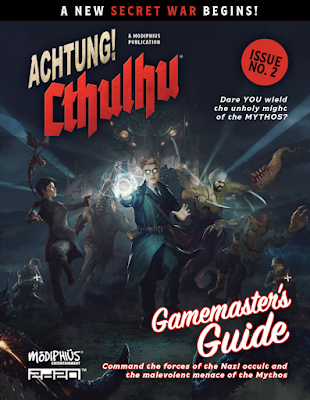
The Achtung! Cthulhu 2d20: Gamemaster’s Guide—heralded as ‘Issue No. 2’ in a series on the cover—picks up where the Achtung! Cthulhu 2d20: Player’s Guide left off. Written for the Achtung! Cthulhu 2d20 Game Master’s eyes only, this is the supplement exposes and explores a whole lot more of the setting and its secrets, presents the six major factions involved in the new Secret War, their personnel minor, major, and notable, the equipment they field, and the magics they wield. Alongside this, there is extensive advice and suggestions for the Game Master on how to run Achtung! Cthulhu 2d20 and keep it exciting. Fundamentally, the latter is what sets Achtung! Cthulhu 2d20 apart from other roleplaying games of Lovecraftian investigative roleplaying. It is meant to be fast and furious, exciting and unnerving, the tone and style hewing heavily into Pulp action. The Player Characters are not so much Investigators—although some investigation is likely to be required in game—but rather Pulp action, anti-Mythos special forces operatives or secret agents. This can be on an ad hoc basis, with the Player Characters coming from a diverse range of backgrounds and cultures, which is very likely to be the default set-up in a campaign, but it could also be run a military Pulp action horror game with the Player Characters all being part of the same unit. For example, Section M fields The Grey Watch, a band of Scottish warriors specialising in hand-to-hand combat, always accompanied by a piper playing the Pipes of McMurden, the sound of which strikes fear into the forces of the Mythos, whilst Majestic sends out its Flaming Salamanders of the Majestic Corps, consisting of U.S. marines in flame retardant clothing wielding all manner of flame-based weapons to burn out the Mythos. The action-packed cover of the Achtung! Cthulhu 2d20: Gamemaster’s Guide very much sets the tone for the roleplaying game, as does the Achtung! Cthulhu 2d20: Player’s Guide.

The Achtung! Cthulhu 2d20: Gamemaster’s Guide begins by exploring the factions and history of Secret War, and this not merely divided between the Allies and the Nazis. There are instead six factions, and to extent, this does feel like a set of factions for both roleplaying and wargaming, something that the extensive set of stats for allies, enemies, and forces in the later ‘Heroes & Villains of the Secret War’ and ‘Bestiary’ does nothing to persuade otherwise. On the Allied side are the British Section M and the American Majestic. Both capture the flavour and feel of their respective mundane counterparts, playing to some stereotypes too in keeping with the roleplaying game’s Pulp leanings. Thus, Section M is reserved, but combines desperate ingenuity and improvisation with measured study and cups of tea, whilst Majestic is brasher, more muscular, and relies on psychic operations rather than the classical study of magic. On the Nazi side are two factions, The Cult of the Black Sun and Nachtwölfe, which have different approaches to the Mythos and despise each other. Black Sun uses Hyperborean magics and knowledge to work back and forth between the Dreamlands and the waking world in an effort to free Yog-Sothoth. Nachtwölfe employs Atlantean superscience to develop, arm, and field an array of fantastic new weapons, armoured fighting vehicles, and more. In addition, both the Mi-Go and the Deep Ones have been drawn into the war, sometimes allies of the Nazis, sometimes not, as both have their own agendas. The backgrounds, histories, military structures, bases, missions and goals are all given for the six factions in what is an excellent overview of the Secret War. There is a timeline too, running from 1939 to 1945, noting important events throughout the Secret War, and hinting at potential scenarios which the Game Master could purchase and run for her players, but notably still leaving plenty of room into which the Game Master can insert her own adventures.

The Game Master can arm and equip her Player Characters and NPCs with a vast array of strange and wonderful weapons and devices. For example, the elite snipers of the Bronze Berets use the Beowulf Monstr Slayer Kk. 1 Sniper Rifle, a magnetic propulsion weapon sometimes combined with Elder Sign-inscribed rounds, whilst the Blevins Steam-Assisted Enzymatic Weapons which fire gouts of superheated steam and high-temperature active enzymes which dissolve the physical make-up of some trans-dimensional creatures. There are more mundane—in comparison—items too—like the Sword-Cane or the Bolas (until that is, the weights are filled with explosives!), and in general, such devices and weapons are rare and the ammunition, where required, available in limited quantities. In comparison, the Nazis of both Black Sun and Nachtwölfe have much wider range of weapons and equipment, and it is more widely manufactured, especially the technologically-focused Nachtwölfe. For example, Wotan’s Staff-Spear or ‘Grungnir’, are tipped with black steel forged in the Dreamlands and aid in the casting of Mythos magic, whilst the Anddrsserher-Helm worn by some Nachtwölfe soldiers is bulky, but contains a set of lenses—based on the Cornwallis design stolen from New World Incorporated in a nice nod to the classic Call of Cthulhu campaign, The Fungi from Yuggoth or The Day of the beast—that provides magnified vision, infrared vision, and the ability to see creatures and things that the human eye is normally incapable of seeing. Weapons and devices of both the Mi-Go and the Deep Ones are also given. 

Besides technology, all sides field magic during the Secret War, although reluctantly in the case of the Allies. In the main they restrict themselves to studying and using magics, spells, and rituals from the Celtic and Runic or Norse traditions, as well as Psychic powers, rather than the Mythos magic. Psychic powers are themselves treated as a sort of magic, but a very modern one, and all three traditions are more fully detailed in the Achtung! Cthulhu 2d20: Player’s Guide. The Achtung! Cthulhu 2d20: Gamemaster’s Guide instead focuses on Mythos magic, including both its battlefield and ritual applications. These are akin to the classic magics of traditional Lovecraftian investigative horror, but classified according to the deity they relate to—Cthulhu, Nyarlathotep, and Yog-Sothoth. These are likely to be used by the Deep One and Mi-Go factions and to limited extent, if at all, by the other factions. They are accompanied by numerous rituals, some of which like the Dust of Ibn-Ghazi and the various versions of Evoke/Dismiss Deity will be familiar from other roleplaying games of Lovecraftian investigative horror, whilst the Pulp nature of Achtung! Cthulhu 2d20 is highlighted by the inclusion of healing magic—for both the body and the mind. Similarly, the list of Mythos tomes is a mix of the old and the new.

For the Game Master there is an extensive chapter of advice and suggestions as to how to run Achtung! Cthulhu 2d20. It covers her role and responsibilities, letting the players and their characters be awesome, how to handle both Threats and the action, and so on before delving in the mechanics of the 2D20 System explained in the Achtung! Cthulhu 2d20: Player’s Guide, but here from the Game Master’s perspective. It pays particular attention to handling Truths in play and the consequences of failure. The Momentum and Threat economy are also examined again, and there is advice on creating and handling memorable NPCs too.

This last piece of advice leads into the last two chapters of the Achtung! Cthulhu 2d20: Gamemaster’s Guide, which together take some forty percent of the book. First, ‘Heroes & Villains of the Secret War’ looks first at the British and American forces, and covers both standard troops and special forces, the latter including those involved in the Secret War, like the Scared Blades: Gopal’s Ghurkhas from Nepal and the Pathfinder Demin Hunters from the First Nation Tlingit peoples. It does a similar thing for Black Sun and Nachtwölfe, as well as the Resistance operating in occupied Europe. Included too are all of the major figures in each of the different actions, whether that is Sally Armitage of Majestic or Mina Wolff of Nachtwölfe. Each is rated as either Trooper, Lieutenant, or Nemesis level NPC, depending upon their individual degree of threat and involvement in Secret War. Second, the ‘Bestiary’ does a similar thing for the Mythos. It includes ordinary beasts too, plus the creations of abhorrent science, but in the main presents the various creatures, entities, and gods of the Mythos. Ranging from Colours Out of Space and Ghouls all the way up to Azathoth, Hastur, and Shub-Niaggurath, the things of the Mythos are classified along similar lines and detailed under the 2D20 System. There is a handful of the unfamiliar thrown into the mix to add some unfamiliarity too, but whilst a great many of the entries are familiar, at least conceptually, Achtung! Cthulhu 2d20 gives them, if not a greater degree of agency, then a greater degree of active and more immediate agency. There is very much a sense in Achtung! Cthulhu 2d20 of the Mythos factions not being prepared to play the long game as is traditional both in Mythos fiction and Lovecraftian investigative horror, but preferring to play a more active, if still secret, role in the affairs of men, whether that is as allies or as enemies, and so taking advantage of the chaos and acceleration of change that comes with the war between the Allies and the Nazis.

So the question is, what is missing from the Achtung! Cthulhu 2d20: Gamemaster’s Guide? Really, only the two aspects of the game. Vehicles, both Allied and Nazi, are not included despite all the various troops are, though they are instead given in the Achtung! Cthulhu 2d20: Player’s Guide. What is missing is a feature of almost every roleplaying game of Lovercraftian investigative horror and that is Sanity and insanity. Being a decidedly pulpier, more action-orientated, Achtung! Cthulhu 2d20 instead has a Player Character potentially suffer insanity once he has suffered enough mental damage to defeat him, whether from encountering a Mythos monster or reading a Mythos tome. and remove him from the combat and then taken more. This shifts the danger of losing Sanity and suffering from insanity as to more of an afterthought than perhaps a constant worry, but it could have been addressed more clearly. Especially for the Game Master or player adapting from another roleplaying game of Lovercraftian investigative horror.

Physically, the Achtung! Cthulhu 2d20: Game Masters Guide is well presented. It does need an edit in places, but it is well written, and again, like the Achtung! Cthulhu 2d20: Player’s Guide before it, the book’s full colour artwork is fantastic. Much of it has been seen in the previous iteration of Achtung! Cthulhu, but the new artwork in the Achtung! Cthulhu 2d20: Game Master’s Guide is really good, capturing the action, excitement, and horror of the war against the darkest forces of the Axis powers.

In its treatment of magic, the monsters of the Mythos, and emphasis upon action, Achtung! Cthulhu 2d20 is not a game for the player or Keeper who prefers the classic play style of a roleplaying game of Lovecraftian investigative horror. For the player and the Game Master who want to emphasis a Pulpier, more action-driven, and less horrific approach to Lovecraftian investigative roleplaying, Achtung! Cthulhu 2d20 is a great choice, and the Achtung! Cthulhu 2d20: Game Masters Guide ably supports this style and tone with the engaging background of the Secret War, a wide array of foes to challenge the Player Characters, and the means for them to fight back and keep humanity safe.

—oOo—

Both Reviews from Rlyeh and Modiphius Entertainment will be at DragonMeet on Saturday, 3rd December, 2022.