Every Week It's Wibbley-Wobbley Timey-Wimey Pookie-Reviewery...
Showing posts with label Steampunk. Show all posts

Saturday, 15 August 2026

Quick-Start Saturday: Time Without Tide

Quick-starts are a means of trying out a roleplaying game before you buy. Each should provide a Game Master with sufficient background to introduce and explain the setting to her players, the rules to run the scenario included, and a set of ready-to-play, pre-generated characters that the players can pick up and understand almost as soon as they have sat down to play. The scenario itself should provide an introduction to the setting for the players as well as to the type of adventures that their characters will have and just an idea of some of the things their characters will be doing on said adventures. All of which should be packaged up in an easy-to-understand booklet whose contents, with a minimum of preparation upon the part of the Game Master, can be brought to the table and run for her gaming group in a single evening’s session—or perhaps two. And at the end of it, Game Master and players alike should ideally know whether they want to play the game again, perhaps purchasing another adventure or even the full rules for the roleplaying game.

Alternatively, if the Game Master already has the full rules for the roleplaying game the quick-start is for, then what it provides is a sample scenario that she still run as an introduction or even as part of her campaign for the roleplaying game. The ideal quick-start should entice and intrigue a playing group, but above all effectively introduce and teach the roleplaying game, as well as showcase both rules and setting.

—oOo—

What is it?

Time Without Tide Quickstart: Mirth & Misery in the World Of Fog is the quick-start for Time Without Tide : Mirth & Misery in the World Of Fog, a post-apocalyptic steampunk horror roleplaying game set during the Time Without Tide following the Victorian Age of Decadence during which the moon fell from the sky, vaporising as it hit the ground, splintering cities, shrouding the ruins in Lunar Dust, and unleashing the Unknown, an unforgiving horizonless fog that mutates anything unprotected by bright light.

The Time Without Tide Quickstart: Mirth & Misery in the World Of Fog is a sixty-two e page, 22.91 MB full colour PDF.

It is well produced with excellent artwork. The maps also very good.

How long will it take to play?
The Time Without Tide Quickstart: Mirth & Misery in the World Of Fog includes the scenario ‘Lonely Phareflaw’. It can be played in a single session.

What else do you need to play?
The Time Without Tide Quickstart: Mirth & Misery in the World Of Fog needs several six-sided dice per player.

Who do you play?
The Time Without Tide Quickstart: Mirth & Misery in the World Of Fog includes six pre-generated Player Characters. Six are given and are members of the Dowsing Odd relay crew. They include a steadfast protector who wields a Greatlight, a heavy, double-handed lantern to burn protect the fog and protect her allies; a charming socialite who is a radical freethinker and a good shot; a sturdy mechanic who wields a pickaxe to smash monsters; an orphan with a lot of luck; a noble turned reluctant assassin with amphibian traits; and a reanimated corpse turned doctor.

How is a Player Character defined?
A Player Character in the Time Without Tide Quickstart: Mirth & Misery in the World Of Fog is defined by his name and pre-delving resumé, Traits, Skills, Health, and Records. Each Trait—Body, Mind, and Will—has a score value and a health value, which range which one and five. The six skills—Culture, Industry, Navigation, Skulduggery, Survival, and Violence—are rated between zero and five. Records are what makes a Delver special. They consist of Items, Features, and Adaptations. Items are equipment that a Delver takes with him and things he found. (Notably, it is assumed that a Delver is competent enough to replenish supplies and so basic supplies do not need to be tracked.) Features are specialities and skill focuses that make each Delver stand out. Adaptations reflect exposure to the Unknown, evolving the infecting with malign detrimental powers or beneficial mutations. All Records take up slots. For Items, they take up Body slots; Features take up Mind slots; and Adaptations take up Will slots. Records can be depleted and typically require a safe or three-day rest to restore.

How do the mechanics work?
The Time Without Tide Quickstart: Mirth & Misery in the World Of Fog uses a dice pool of six-sided dice. The dice pool is equal to the value of a Trait and a Skill. This can be any pair suitable for the situation. Each roll of a five or six is a counted as a success or Mark. A standard difficulty requires a player to roll two or more Marks, but the difficulty can range from one and easy to five and very hard. An ally can spend a whole action to assist and add half his dice to the pool and if the roll is a failure, a Delver can strain, suffer damage to the Mind, and reroll any dice. Any Marks in excess of the difficulty become Boons. These can be spent on extra effects. This is generally to halve the time of a task or to improve its quality, but this is not covered in any depth in the Time Without Tide Quickstart: Mirth & Misery in the World Of Fog, although they are used for combat.

How does combat work?
Combat in The Time Without Tide Quickstart: Mirth & Misery in the World Of Fog uses a combination of the Violence Skill and Body Trait to hit things, the Violence Skill and Mind Trait to shoot things, and the Violence Skill and Will Trait to scare things. Initiative is a simple roll of a six-sided die and a Delver can take one major and one minor action. The action is fought across zones, each of which has room for four combatants.  The Unknown floods the battlefield and not only deplete Will, but make things harder to hit. The only way to counter this is to cast the light from a Lantern, which will hold back the Unknown, protecting the Delver and perhaps his allies. Exposure to the Unknown can lead to a loss of Will.

Combat includes a number of a number of Boon options for surplus Marks. For example, if a Delver is wielding two weapons, he can use a Boon to trigger Flurry and make an extra attack or increase the effect of a Invigoration on another ally Boon by Boon.

Most damage amounts to either one or two points depending upon the weapon and benefits gained from Boons. Damage represents an injury rather than a scrape or bruise. If the Health of any Trait is reduced to zero, the Delver is on the verge of dying. A simple recovery test will restore the Delver to one Health, but if failed, the Health of the Delver is still restored, but suffers a malignant Adaptation (for example, he becomes an ‘Overthinker’, his brain swelling painfully against the inside of his skull, meaning that it is harder for him to Strain), is closer to death, and everything is harder to do.

How does travel work?
Travel is a major part of play in The Time Without Tide Quickstart: Mirth & Misery in the World Of Fog as the Delvers leave their Safe Harbours and explore the World of Fog to preserve the fading light. The day is eighteen hours long and divided into three segments. Each segment spent travelling requires the assignment of the Ward or effect of a lantern, rolling to overcome any obstacles that the Game Master places in their path, and dealing with random events—two dice are rolled and for each six, a random event happens. Yes, this means that two can occur in the same Segment. During any Segment spent in camp resting, a Delver can also take a major one-hour action and any number of immediate actions. The Time Without Tide Quickstart: Mirth & Misery in the World Of Fog only provides a basic introduction to travel.

When travelling on an expedition, the Delver will carry a Relay, a ‘Decadent Device’, that is, a relic from the Age of Decadence, which are calibrated beacons. Using the Relay, a Delver party can teleport to any beacon they have calibrated their Relay to, typically using it to return home after an expedition.

What do you play?
The Time Without Tide Quickstart: Mirth & Misery in the World Of Fog includes the scenario ‘Lonely Phareflaw’. The scenario involves an expedition to the Phareflaw Lighthouse, which went dark during Deep Winter. The Delvers are hired by the Saltport council to restore Phareflaw’s light travelling aboard the Riverboat Drastic which will be used to construct a Tenderhold, a fortified settlement around the lighthouse. The scenario begins with the Delvers’ arrival on the beach below the lighthouse and once ashore they will need to make their way up the cliffs to the lighthouse. The latter is indeed dark and the Delvers will need to break in and in exploring, restore its light. ‘Lonely Phareflaw’ is a solid, action-orientated scenario that in a very, very slight way feels like a Dickensian version of Aliens.

In addition to the scenario, The Time Without Tide Quickstart: Mirth & Misery in the World Of Fog includes an introduction to the Delvers’ home port of Saltport, the Last City. It is accompanied by a fetching map. As well as including the pre-generated Delvers, the appendix includes a good introduction to the setting and the roleplaying game for the benefit of the players.

Is there anything missing?
No. 
The Time Without Tide Quickstart: Mirth & Misery in the World Of Fog has everything that a Game Master needs to run the included scenario.

Is it easy to prepare?
Yes. Although 
The Time Without Tide Quickstart: Mirth & Misery in the World Of Fog does feel slightly out of order in places, it is relatively straightforward and not too challenging to prepare.

Is it worth it?
Yes. The Time Without Tide Quickstart: Mirth & Misery in the World Of Fog is a well done, solidly engaging introduction to the basics of The Time Without Tide: Mirth & Misery in the World Of Fog. Anyone looking for a post-apocalyptic, Dickensian steampunk horror roleplaying game should definitely give this a try.

The Time Without Tide Quickstart: Mirth & Misery in the World Of Fog is published by Chaosium, Inc., and is available to download here.

Saturday, 25 April 2026

Blackmail & Betrayal

If you are one of the few wealthy Drow in the Spire, then the Silver Quarter is where you come to see and be seen. If you are one of the Aelfir in the Spire, then you need deign to descend to such lows as the Silver Quarter, unless you want to rebel and have fun and perhaps even cause a scandal. Famous—or is that notorious?—for its casinos, gambling houses and members-only clubs, the quarter is a renowned hotbed of dubious, if not outright illegal activity that its bosses can pay off the local bosses and local detachment of the city guard to look the other way. At the heart of it all, is Mesye So, a powerful and influential Drow, who controls the Silver Quarter from behind layer after layer of the best security that his money can buy and the best ignorance of his involvement that his bribes can engineer. Still, he hungers for greater power and influence, and perhaps his ambition and his hubris will be his undoing. It is certainly an affront to ‘The Ministry of Our Hidden Mistress’. A council of elders of these freedom fighters—or terrorists—has decided that enough is enough and that a figure such as Mesye So, of their own, should be bent to their cause. They have purchased a base of operations from which a teams of Ministers can operate in the Silver Quarter, a rundown, not quite seedy gambling den called the Manticore. Armed with what they know about Mesye So and other leading figures seen in the Silver Quarter—represented by a handful of newspaper clippings—the Ministers are to gather further intelligence and use to extort and blackmail Mesye So and others in support of ‘The Ministry of Our Hidden Mistress’ and its aims. This is the set-up for The Kings of Silver: A Campaign Frame for Spire RPG.

It is a mini-campaign
for Spire: The City Must Fall, the roleplaying game of secrets and lies, trust and betrayal, violence and subversion, conspiracy and consequences, and of committing black deeds for a good cause. It is set in a mile-high tower city, known as the ‘Spire’, in the land of the Destra, the Drow, which two centuries ago the Aelfir—or ‘High Elves’—invaded and subjugated the Dark Elves. The Drow have long since been forced to serve the High Elves from their homes in the city’s lower levels and allowed only to worship one facet of Damnou, the moon goddess, instead of the three they once did. However, not all of the Drow have resigned themselves to their reduced and subjugated status and joined ‘The Ministry of Our Hidden Mistress’, or simply, the Ministry. Its members—or Ministers—venerate the dark side of the moon, the goddess of poisons and lies, shadows and secrets, her worship outlawed on pain of death, and they are sworn to destroy and subvert the dominion of the Aelfir over the Drow and the Spire. Published by Rowan, Rook, and Decard Ltd., Spire: The City Must Fall inverts traditional fantasy, making the traditional enemy in fantasy—the Drow—into the victim, and certainly the protagonist, but not necessarily the hero.

The Kings of Silver: A Campaign Frame for Spire RPG is
not a traditional roleplaying scenario. It foregoes the traditional construction with prewritten encounters that the Player Characters play through one after another. Nor does it not suggest any plot or story threads, something that other campaign frameworks for Spire: The City Must Fall, such as Eidolon Sky: A Campaign Frame for Spire RPG do. Instead, it sets up a situation, that is, a chief villain (and others) who are going to be the targets of the Player Characters’ actions, and a base of operations from where the Player Characters will operation. Instead of briefing given by the council of elders, the Player Characters are furnished with a set of newspaper clippings. These include titles such as ‘New Captain of the Watch Appointed in Silver Quarter’, ‘Temple Brawl Kills Five’, ‘Mr Silver Quarter: Looking for Love?’, ‘Midwife Murderer Walks Free’, and ‘Walks-On-Light Drinks Docks Dry!’, from which the players and their characters are going to extract clues about their targets and begin to formulate a plan or two. There is a total of fourteen such clippings and they are all presented as handouts for the players. They tell the players and their characters about the doings of not just Mesye So, but also the extremely wealthy Lay-Deacon Stride-Out-Harmonious; Hestra Wander-The-Lost, famous for being famous who wants to even more famous; and Loq Walks-On-Light, a rebellious Aelfir, who might just turn on his own. Each of these and other NPCs is nicely detailed as why they are so important to the cause of ‘The Ministry of Our Hidden Mistress’, how they differ from other Aelfir, what they desire and what they despise, and what could the Player Characters get from them. Each is also accompanied by some suggested where they might be encountered, but in some cases such as Lay-Deacon Stride-Out-Harmonious and Hestra Wander-The-Lost, what they do not come with is stats. This is deliberate, since they are combatants and if they are being fought, then the probability is that the Player Characters’ blackmail and/or exhortation attempts are going poorly.

The Player Characters also receive The Manticore, the gambling club from which they will be operating. This is nicely detailed in a couple of pages, with a particular emphasis placed upon the staff. They are only given the simplest of descriptions each, but that leaves room aplenty for the Game Master to develop them according to the needs of the campaign. The players and their characters are free to leave the day to day operation of The Manticore to the staff, but they can also have their characters get involved with both of its operation and the staff and their lives, which could open up a lot of roleplaying possibilities.

The Game Master is supported with advice on running The Kings of Silver and given several tables to roll on as a source of prompts and ideas, including ‘Which House Is This Drow Noble Claiming To Come From?’ and ‘What’s The Name Of This Gambling House/Club, And What’s Interesting About It?’. There is a list too of the primary places in the Silver Quarter. Although what might happen in between is not discussed, there is an examination of the possible endings to the campaign as well as its set-up. These look at the ultimate possible consequences of the Player Characters’ actions, not all of them good.

Lastly, The Kings of Silver presents six pre-generated Player Characters. They include a Bound, one of the vigilantes who bind small gods into their weapons, who can infiltrate locations with ease; a night-club singer who is secretly a Blood-Witch with a long history of terrifying others; a Knight of the North Docks with an encyclopaedic knowledge of the city’s public houses who has brought his daughter with him as his squire; an ex-masked servant able to move amongst high society; an ex-embezzler good at cutting deals; and an ex-priest turned confidence trickster. They all come with their own character sheets.

Physically, The Kings of Silver: A Campaign Frame for Spire RPG is well presented and its contents are neatly organised and easy to reference, done in an easy-to-grasp style from start to finish. The news clippings each have a page of their own enabling the Game Master to print or copy them and once in play, the players can consult them again and again.

Although it is of scenario length, The Kings of Silver: A Campaign Frame for Spire RPG is very much a campaign framework, with a beginning and an ending (or endings). It is a juicy set-up, with lots for the players and their characters to think about, whilst giving them complete agency as how they act upon the set-up and the information that it gives them. After that, the campaign is primarily player driven as they decide how their characters will act against the NPCs they are targeting, with the Game Master supporting and reacting to those decisions. There is no set length to the campaign either, the length likely depending upon the players’ decisions and how many of the NPCs their characters will move against. The Kings of Silver: A Campaign Frame for Spire RPG lays out the basis for an entertaining campaign, but where it goes is entirely up to the players.

Saturday, 28 February 2026

Decay & Destruction

The city of Spire is in a constant state of wrack and ruin. As its overlords, the Aelfir, live a life of indolence and intrigue, the walls crack and parts of the structure shear and fall the many storeys to smash crumble on the ground below. The rot though, does not come from without, the cold and the wet finding cracks in the walls, working them and snapping them open, but from within. Deep below the city of Spire is the Heart, a ruinous tear in the fabric of the world that bleeds upwards, spreading disorder and chaos and blighting souls with rot. Unseen, its consequences have found a home in the harsh and uncaring undercity of Red Row, making the lives of its Destra inhabitants ever more dangerous, ever more dreadful. Gangs engage in open warfare, the sound of their gunfire marked by palls of spireblack gunsmoke, unable to agree on any one cause or able to resume the wary respect that kept their weapons holstered and a peace between them. Families bicker and divide, casting children aside. The Crimson Vigil, a group of violent anti-aelfir reactionaries, is openly recruiting soldiers for their forbidden cult, and with its numbers growing, how long before its actions bring the attention of the authorities down upon the whole neighbourhood? And yet despite the violence and despite the dissension that seems rife in every home and on every street, what the people of Red Row are talking about is The Weeping Maiden, a new play currently on tour! Society seems to be tearing itself apart at the seams and everything is going to wrack and ruin. This cannot be natural. There has to be someone or something behind it. Surely? This is the set-up for Blood and Dust: A Campaign Frame for Spire RPG.

It is a mini-campaign 
for Spire: The City Must Fall, the roleplaying game of secrets and lies, trust and betrayal, violence and subversion, conspiracy and consequences, and of committing black deeds for a good cause. It is set in a mile-high tower city, known as the ‘Spire’, in the land of the Destra, the Drow, which two centuries ago the Aelfir—or ‘High Elves’—invaded and subjugated the Dark Elves. The Drow have long since been forced to serve the High Elves from their homes in the city’s lower levels and allowed only to worship one facet of Damnou, the moon goddess, instead of the three they once did. However, not all of the Drow have resigned themselves to their reduced and subjugated status and joined ‘The Ministry of Our Hidden Mistress’, or simply, the Ministry. Its members—or Ministers—venerate the dark side of the moon, the goddess of poisons and lies, shadows and secrets, her worship outlawed on pain of death, and they are sworn to destroy and subvert the dominion of the Aelfir over the Drow and the Spire. Published by Rowan, Rook, and Decard Ltd., Spire: The City Must Fall inverts traditional fantasy, making the traditional enemy in fantasy—the Drow—into the victim, and certainly the protagonist, but not necessarily the hero.

Blood and Dust: A Campaign Frame for Spire RPG is 
not a traditional roleplaying scenario. It foregoes the traditional construction with prewritten encounters that the Player Characters play through one after another. Nor does it not suggest any plot or story threads, something that other campaign frameworks for Spire: The City Must Fall, such as Eidolon Sky: A Campaign Frame for Spire RPG do. Instead, it outlines an intrigue and a greater plot of sorts whose chaotic effects are playing out on Red Row and which the Player Characters are driven to investigate, and beyond the initial set-up of getting the Player Characters together, it focuses on the six factions involved. These consist of the Retroengineers employed to operate the devices that are destabilising the neighbourhood and helping to sow the chaos; the Sunlight Collective, a theatre group of radical artists and occultists fascinated to see the effect that its latest play is having on Red Row; the Knights of the North Docks, the strutting bully boys whose factionalism has turned them into extortionists; members of the City Guard, overworked with all of the unrest they have had to deal with; the Church of Absolution, a burned-out magicians and sages, destitute oracles and defrocked priests, that worships decay and wants revenge on those that stole its ideas; and the Crimson Vigil, anti-Aelfir zealots ready and happy to stir up more chaos. Some are more detailed than others—the Game Master will need to refer to the Spire: The City Must Fall for more details—but all are given motivations and suggestions as to what they might do as well as some notable NPCs.

The most detailed advice for the Game Master is on how to set the scenario up and involve the Player Characters, whether they are the pre-generated Player Characters or not. This is because there are no staged encounters or scenes, so there is no advice on how to handle them. What happens instead is the Game Master will reacting to the directions in which the players want to push their characters, which character hook and motivation and thus which faction that the want to investigate. Having set this up, the authors leave it to the Game Master at the table to respond to her players and their characters to determine what happens. There are some notes on how to end the story, primarily concerning what the remaining factions that the Player Characters do not investigate might do.

In addition, Blood and Dust: A Campaign Frame for Spire RPG includes five pre-generated Player Characters, all members of ‘The Ministry of Our Hidden Mistress’. They consist of an ex-military revolutionary and firebrand; a beautiful artistic and revolutionary idol; a Knight of the North Docks (effectively a gangster in plate armour); a Lajhan, a priest of Our Glorious Lady, the light side of the moon, the one aspect of the Drow goddess that is legal to worship, whose temple has been despoiled; and a Vermissian Sage, who hides knowledge in the Vermissian , the broken mass-transit system that runs up and down Spire. All five have their own character sheets and reasons to get involved in the investigation and adventure, such as the Lajhan’s temple having been bespoiled and the Vermissian Sage having recently been denied access to the Vermissian.

Physically, Blood and Dust: A Campaign Frame for Spire RPG is well presented and its contents are neatly organised and easy to reference, done in an easy-to-grasp style from start to finish.

Blood and Dust: A Campaign Frame for Spire RPG is not a ‘campaign frame’ as its subtitle suggests. Its emphasis and thus is structure is all on the set-up. It is described on the back cover as “…[A] series of prompts, suggestions, factions, pre-generated characters and personalities…” and it is very much that rather than a frame or framework that provides anything akin to structured campaign or plot line. Nor is it necessarily a campaign, since it is intended to be run in a few sessions. Yet as a set-up, it does work, giving the elements that a Game Master would need to run it. However, the lack of the frame and the fact that the Game master will be improvising the responses to the Player Characters’ actions does not make Blood and Dust: A Campaign Frame for Spire RPG either easy to use or necessarily suitable for the inexperienced Game Master. For the experienced Game Master, Blood and Dust: A Campaign Frame for Spire RPG provides a good set-up and content suitable for several sessions’ worth of player-driven play.

Saturday, 3 January 2026

The Demon Drug

The sacred streets, back alleyways, and secret sanctuaries of New Heaven and Perch are rife with rumours and fear. A new drug has hit the streets and hit the streets hard. Dreck is making in-roads everywhere with its surefire hit, but making its addicts hyper-violent. Someone is snatching Drow off the street, but that appears to have nothing to do with a serial killer called ‘The Swan’, who kills his victims by excising their hearts and leaves them pinned up with swan wings in glass piercing their limbs, along with cryptic notes that taunt the authorities to catch him before he kills again. Then there is rumour of a demonic incursion which tore apart a tower of silence, killing everyone inside and driving everyone nearby mad. This is the set-up for Eidolon Sky: A Campaign Frame for Spire RPG.

It is a mini-campaign
for Spire: The City Must Fall, the roleplaying game of secrets and lies, trust and betrayal, violence and subversion, conspiracy and consequences, and of committing black deeds for a good cause. It is set in a mile-high tower city, known as the ‘Spire’, in the land of the Destra, the Drow, which two centuries ago the Aelfir—or ‘High Elves’—invaded and subjugated the Dark Elves. The Drow have long since been forced to serve the High Elves from their homes in the city’s lower levels and allowed only to worship one facet of Damnou, the moon goddess, instead of the three they once did. However, not all of the Drow have resigned themselves to their reduced and subjugated status and joined ‘The Ministry of Our Hidden Mistress’, or simply, the Ministry. Its members—or Ministers—venerate the dark side of the moon, the goddess of poisons and lies, shadows and secrets, her worship outlawed on pain of death, and they are sworn to destroy and subvert the dominion of the Aelfir over the Drow and the Spire. Published by Rowan, Rook, and Decard Ltd., Spire: The City Must Fall inverts traditional fantasy, making the traditional enemy in fantasy—the Drow—into the victim, and certainly the protagonist, but not necessarily the hero.

Eidolon Sky: A Campaign Frame for Spire RPG is
not a traditional roleplaying scenario. It foregoes the traditional construction with prewritten encounters that the Player Characters play through one after another. Instead, it presents three plot threads that they can investigate—the drug ‘Dreck’, the serial killer ‘Swan’, and the demonic incursions. Each thread includes an opening or ‘Trigger’ scene, these being the closest to prewritten encounters in
Eidolon Sky. Each of them begins their plot thread with a bang and is followed by the details that the Player Characters can discover as they investigate each thread. Stats and details of the antagonists involved in each thread are listed at their ends, but these feel underwritten in comparison to the various NPC write-ups that follow. This is because they are accompanied by a list of suggested scenes that where the Player Characters might encounter them. Essentially, what Eidolon Sky gives the Game Master is a set of plot threads and NPCs that she can set up and have her Player Characters engage with them. The Game Master is free to bring these into play as necessary, but in the main, what she will be doing is responding to the decisions of the players and the actions of their characters as Eidolon Sky is very much a player-led investigation.

The most detailed advice for the Game Master is on how to end the campaign frame. As they investigate the three threads, the Player Characters will come to realise that they are connected and following those connections will lead to the villain of the piece. Eidolon Sky both explains what will happen if the Player Characters fail and what will result depending upon their actions. This includes discussions of what leverage the Player Characters might gain over the villain, how they might seek help from other factions, and so on. Representatives of these other factions are included in the NPC descriptions given earlier.

Eidolon Sky: A Campaign Frame for Spire RPG ends with a set of five pre-generated Player Characters. They include a trader-priest, one of the Bound vigilantes, a Carrion-Priest, a Midwife, and a Vermissian Sage. All five are fully detailed and not only do they include a character sheet, they come with short backgrounds each of which has some details designed to hook them into the campaign frame’s three plot threads.

Physically, Eidolon Sky: A Campaign Frame for Spire RPG is well presented and its contents are neatly organised and easy to reference, done in an easy-to-grasp style from start to finish.

Eidolon Sky: A Campaign Frame for Spire RPG is a solid investigation for Spire: The City Must Fall, a good mix of investigation and violence in three flavours—criminal, occult, and horror. However, it also a straightforward investigation meaning that it lacks some of the moral ambiguity at the core of Spire: The City Must Fall which casts the Player Characters as much terrorists as they freedom fighters, dedicated to the cause that leads them to make difficult and questionable choices. Where the Player Characters will be making moral choices in Eidolon Sky is in deciding which faction to side with and perhaps what to do with the villain of the piece, but these are not hard choices and their consequences are lacklustre. The Game Master may want to find scenes and points in the campaign frame where she can inject some of that moral ambiguity, although she could run it as written as change of tone and style. Eidolon Sky: A Campaign Frame for Spire RPG is an entertaining and straightforward, but not typical campaign frame for Spire: The City Must Fall.

Sunday, 26 November 2023

A Campaign of Leagues

For over a decade, there is something that Leagues of Adventure: A Rip-Roaring Setting of Exploration and Derring Do in the Late Victorian Age! has been lacking. The roleplaying game of globetrotting adventure and mystery set during the ‘Gay Nineties’ at the end of the nineteenth century is published by Triple Ace Games and in its time has been very well supported with numerous supplements, including Leagues of Gothic Horror, which took it into the realm of classic horror and Leagues of Cthulhu, which took it into the far realms of Cosmic Horror. However, in that time, what it has not had, is a campaign. That all changes with the publication of The Great Campaign – A Globetrotting Campaign in Four Glorious Parts. Inspired by the works of Joseph Conrad, in particular, Heart of Darkness and The Secret Agent, as well as H. Ridder Haggard and Rudyard Kipling, even a little Indiana Jones, and a big fat serving of treacle sponge history covered in lashings of occult custard and radical political thought, The Great Campaign will take the Player Characters—or Globetrotters—from a missing persons case in Cambridge to the ‘Roof of the World’ via assorted assassinations, anarchy in the UK, a journey to the Russian Wild West, and the ‘Great Game’. Throw in a mix of steampunk technology and what you have in The Great Campaign is an over-the-top, unashamedly Imperialist, pulpy campaign that delivers murder, mystery, intrigue, corruption, and more, but ultimately, just one big ripping yarn.

The Great Campaign – A Globetrotting Campaign in Four Glorious Parts, published following a successful Kickstarter campaign, can be played using just the core rules for Leagues of Adventure: A Rip-Roaring Setting of Exploration and Derring Do in the Late Victorian Age! even to the point of playing using the seven pre-generated Globetrotters in the book, plus their followers. There are several supplements which will prove useful to run the campaign if the Game Master has access to them. These are The Globetrotters’ Guide to Expeditions, Leagues of Gothic Horror, Globetrotters’ Guide to London, The Globetrotters’ Guide to Dramatic Developments, and the character collection, Dramatis Personae. Of these, Leagues of Gothic Horror adds rules for Corruption and Sanity, the former earned and the latter lost for vile deeds and suffering the travails of journeys beyond the borders of civilisation. Both Corruption and Sanity are included as part of The Great Campaign, but only come into play if Leagues of Gothic Horror is being used. Their inclusion does suggest an interesting possibility though. Though The Great Campaign is not a cosmic horror campaign, through Leagues of Gothic Horror and then Leagues of Cthulhu, it connects to Cthulhu by Gaslight, the Victorian era supplement for Call of Cthulhu. Should the Game Master—or rather Keeper—have a mind to, The Great Campaign could be adapted to run with Cthulhu by Gaslight, though the use of Pulp Cthulhu: Two-fisted Action and Adventure Against the Mythos is highly recommended should she decide to do so. Another option would be run the campaign using the Ubiquity system version of Space: 1889, though the Game Master will need account for aerial vessels in the third and fourth parts of the campaign. Perhaps by having the Czar impose an aerial interdiction in the region?

The campaign opens in late 1891 with ‘The Dreaming Spires’ which takes place in Cambridge (rather than Oxford and its dreaming spires). Sir Reginald Ponsonby and his wife, Lady Fenella, are worried about their son, Edmund, who has gone missing after having been sent down from Trinity College, Cambridge. Hunting for clues as to his whereabouts reveals that Edmund Ponsonby had got himself mixed with a bad lot—foreign radicals (but not French!) and Socialists to boot. The trail leads away from the college to a house in the fens and back again. By the time the first adventure is over, the Globetrotters should have stopped one anarchist plot—here in Cambridge—and gained hints of another, playing out far away in Central Asia, and gained the Ponsonbys as patrons. The last few scenes should ideally involve a race back to Trinity College and a desperate search for its hidden secrets, but there is also an exciting chase across the rooftops of the university to get the heart racing a little earlier.

If they are successful in ‘The Dreaming Spires’, by the time of the second part of the campaign, ‘The Emerald Scarab Conspiracy’ in late November of 1891, the Globetrotters will be famous enough to be invited to a grand Christmas ball to be hosted by the Russian Embassy aboard by HMS Hrimnir, the ice leviathan capable amphibious land and sea movement, especially on the ice. Before then they are asked to investigate the death of a prominent rocket scientist, which will draw them into London’s Russian immigrant community and bring them into contact with Konstantin Tsiolkovsky. All quickly too quickly, someone takes a violent interest in the Globetrotters’ investigation, but before they can find out the Globetrotters must attend the grand ball. With numerous members of different governments in attendance, the event does not end with the Prussian Princess Charlotte ending up dead and the gift she has just been given—the Emerald Scarab of the title—in the possession of one of the Globetrotters. If an international incidence is to be avoided the Globetrotters need to think and investigate fast. Fortunately, their good reputation should be enough for them to avoid incarceration, but that is not enough for the true culprit who will strike first at the Globetrotters in classic location before launching an even bigger attack elsewhere, hoping to bring the major powers of Europe to the brink of war and beyond. As with ‘The Dreaming Spires’, ‘The Emerald Scarab Conspiracy’ is a pacey affair which ends in a race to save the day, but much more scaled up.

‘The Emerald Scarab Conspiracy’ climaxes with the Globetrotters thwarting the plans of the anarchist cell in London and hopefully, defeating its leader. It leaves the matter of N.F. Fyodorov, who is somehow connected to the anarchists and their plot, but is far away in Central Asia. Of course, if that is the case and the man is dangerous, could India, the Empire’s jewel in the crown, be danger. As a part of a ‘Justice Expedition’, the third part of the campaign, ‘Journey to the Roof of the World’ quickly takes the Player Characters across Europe in comfort and style on the Simplon-Orient Express, but once in Constantinople, that is where the comfort and style ends. From Batum to Baku across Transcaspia, across the Caspian Sea—where of course, the Globetrotters might run into the ‘Pirates of the Caspian’—to Krasnovodsk, and from there fabled Samarkand, and beyond into the Pamirs, said to be the ‘Roof of the World’. Unlike the first two scenarios which were quietly tightly focused in their storytelling, ‘Journey to the Roof of the World’ opens up and is more episodic in nature, focusing on the travel and its possible difficulties, having to deal with both the region’s Russian overlords and the native peoples, and in the process discover some of the secrets of the region.

The campaign comes to a close with ‘Paradise Lost’, the title hinting at what the Globetrotters will find at the ‘Roof of the World’. Once past the native peoples protecting farther progress, they must climb the mountainous glacier high into the Pamirs. Here, in an isolated valley, the Globetrotters have the opportunity to locate and apprehend N.F. Fyodorov, hopefully discovering whether he was connected to the anarchist plots back in England, and possibly secrets that go all the back to the Garden of Eden. It is a classic climax to this type story, revealing the secrets to a big mystery like that of Eldorado or Atlantis.

Besides the seven pre-generated Globetrotters and their cohorts given in its first appendix, The Great Campaign comes with another four appendices providing further support. This includes sixty-one additional Followers, for the Game Master who needs a Bagpiper or a Mime; eight additional Globetrotters; Professor Pennyworth’s Catalogue of Gadgets, such as an Endless Chain Saw, Enhanced Itching Bomb, Targeting Monocle, Aquatic Tripod, and Clockwork Soldier; and More Leagues of Adventure, from the Alpine Horticultural Society and the Author’s Club to the Tobacconists Club and The Turkophile Society. In fact, not all of it directly supports the campaign, but Globetrotters and Followers are useful as a source of replacement characters and the devices for the scientist or engineer to design.

Physically, The Great Campaign is ably presented. Much of the artwork is decent and the cartography clean and easy to read. However, the layout is busy, often relying on a lot of bold text especially when presenting NPCs and interrogations of NPCs. This very much a case of the style for Leagues of Adventure, but it can be a lot to take in.

The Great Campaign – A Globetrotting Campaign in Four Glorious Parts is the campaign that Leagues of Adventure: A Rip-Roaring Setting of Exploration and Derring Do in the Late Victorian Age! wanted and needed. It certainly has plenty of opportunities for both rip-roaring and derring do, along with the investigation and the exploration. The Great Campaign – A Globetrotting Campaign in Four Glorious Parts is a classic campaign of Victorian adventure, torn from the pages of Victorian novels and the film cells of the silver screen.

Saturday, 22 April 2023

Magister’s Miscellany

Magister’s Guide – A Spire RPG GM Handbook is supplement for Spire: The City Must Fall, the roleplaying game of secrets and lies, trust and betrayal, violence and subversion, conspiracy and consequences, and of committing black deeds for a good cause. It is set in a mile-high tower city, known as the ‘Spire’, in the land of the Destra, the Drow, which two centuries ago the Aelfir—or ‘High Elves’—invaded and subjugated the Dark Elves. The Drow have long since been forced to serve the High Elves from their homes in the city’s lower levels and allowed only to worship one facet Damnou, the moon goddess, instead of the three they once did. However, not all of the Drow have resigned themselves to their reduced and subjugated status and joined ‘The Ministry of Our Hidden Mistress’, or simply, the Ministry. Its members—or Ministers—venerate the dark side of the moon, the goddess of poisons and lies, shadows and secrets, her worship outlawed on pain of death, and they are sworn to destroy and subvert the dominion of the Aelfir over the Drow and the Spire. Published by Rowan, Rook, and Decard Ltd., Spire: The City Must Fall inverts traditional fantasy, making the traditional enemy in fantasy—the Drow—into the victim, but not necessarily the hero.

Magister’s Guide – A Spire RPG GM Handbook is a a companion to Spire: The City Must Fall. Born of four years development, it brings together a number of new systems, new stuff for every Character Class in Spire, including content drawn from the Strata and Sin sourcebooks, as well as advice for the Game Master. It is a fairly slim book, but comes packed with content for both the player and the Game Master. The book opens with four New Systems, beginning with ‘Liberty’, based on the ‘Control’ mechanic from Strata. This is a further measure of control and oppression applied by the authorities on the Dark Elves in response to actions of the Ministers that make the High Elves feel threatened. It does not target them specifically, but the Drow population in general. Liberty is a broad response and its Fallout can be Minor, Moderate, or Severe. For example, Light Fallout might be ‘No Congregation’, meaning that no Drow can gather together, Moderate Fallout might be ‘Branding’ or tattooing of Drow criminals, and Servere ‘Sanctioned Killers’ which arms the agents operating against the Ministry. Its broad nature means that Liberty is difficult to reclaim or remove. Only two options are listed, but the rules suggest using ‘Acquisitions’, the third of the new Systems to supplement these two.

‘Advancement Beats’ give a Minister and his player options in terms of challenges, goals, and achievements. Each ‘Beat’ can be a personal aim or shared with a fellow Minister, but is not specifically tied to the broader advancement of the Ministers’ cell and overall objectives of the The Ministry of Our Hidden Mistress. A Minister can have as many Beats as he wants, but only two are active in play at any one time. They are measured in terms of time they take to achieve. So a Low Beat such as ‘Sell someone out to the authorities’ can be fulfilled in a single session, a Medium Beat like ‘Research and perform a demonological ritual’ takes two or three, and so on. Essentially an adaption of the concept of ‘story beats’, this New System provides a player with story options that flag to the Game Master what he would like to have happen to his Minister—good or bad—in a session or more.

‘Acquisitions’ provides a further means of Player Character improvement, not just a means of getting items of equipment. One way to use them to is reclaim or remove the aforementioned Liberty, but options here include gaining an Ability from an entirely different Class, Favours, extra Advances, and a Safehouse. The latter nicely ties in with the rules for safehouses later on. For the Player Characters, this takes time, but they can push the attempt and act recklessly, to increase the Stress they suffer. Acquisitions are similarly categorised into Low, Medium, and High. The system is nicely worked through with a couple of good examples and enable a Player Character to have something going on in the background that he is working towards in terms of story and bring it into the action when necessary.

The fourth and last of the New Systems is for ‘Safehouses’. Out of all of the New Systems in the Magister’s Guide – A Spire RPG GM Handbook, this does like the most obvious addition. After all, the Player Characters do make a terrorist cell and will need somewhere to hide out and operate from. Once they have a safehouse
—and the rules here suggest a ‘starter’ safehouse—the Player Characters can upgrade it with facilities such as a secret entrance, a gunsmith, and even a sacrificial chamber! Each of these is rated as a Medium Advance or a Medium Acquisition, using the previously presented ‘Acquisitions’ system. Suggested too are options for making the sanctuary a community instead of a hidden base and for using it as part of the story, so again giving both the players and the Game Master some flexibility in how the System is used.

The bulk of the
Magister’s Guide – A Spire RPG GM Handbook is devoted to new options for the roleplaying game’s numerous Character Classes. Each is given various options including, but not all, new abilities, equipment and special equipment, adversaries, and Fallout (or consequences specific to the Class). For example, the Midwife emphasises the arachnid nature of the Drow and her role in the nurseries with Abilities such as ‘Hands of Silk’ which give her silk glands in the wrist from which can draw and combine with any hand-to-hand weapon to stun and bind, whilst with ‘Trapped Door’ she casts glyphs upon a door to hide it. She can use equipment such as a ‘Prosthetic Limb Array’, useful for the Midwife who finds it difficult to partially change into a spider, or a weapon like a ‘Arachnid Glaive’ . Her Special Equipment includes ‘Frenzy Incense’ which allows her to shrug off the negative effects from Minor or Moderate Blood Fallout. Her Adversaries include ‘The Black Sheep’, those that the Midwife raised, but which turn out bad—criminals, High Elf loyalists, apostates, heretics, and worse... Potential Fallout specific to the Midwife consists of ‘Spiders’ which crawl out her clothing, the walls, or even her mouth, much to the consternation of those around her.

In addition, the entry examines the nature of birth and child-care amongst the Drow, but also neatly provides a list of elements related to her role that the Game Master can bring into play. So, children, families, sacrificial altars, upholding traditions, and so on, and these work for NPCs as much as they do for the Player Character.
The Magister’s Guide – A Spire RPG GM Handbook does this again and again for each of the Classes in Spire: The City Must Fall, each time providing options for the player to chose from, as for the Game Master to add to the story.

Rounding out
the Magister’s Guide – A Spire RPG GM Handbook is a quartet of short essays in ‘Essays and Advice’. ‘Just the Basics’ is a relatively short blurb which the Game Master can use to explain the setting to prospective players or even for convention games. Even better is ‘Preparing For A Game of Spire’, which gives advice on how to prepare a scenario if a Game Master has no time, twenty minutes, an hour, or two hours. The advice of course, directly applies to Spire: The City Must Fall, but could easily be adapted to any roleplaying game. The essay also includes advice for preparing for a one-shot and again, is applicable to other roleplaying games. If Rowan, Rook, and Decard Ltd. was to publish a generic book of advice for running games, a version of this essay would definitely be included. Similarly, ‘When To Roll, And When Not To’ and the shorter ‘Creative Use Of Skills’, can apply to this roleplaying and others, but are not quite as interesting.

Physically, the Magister’s Guide – A Spire RPG GM Handbook is well presented and its contents are neatly organised and easy to reference, done in a succinct style from start to finish. All of that content is really very good, providing options in terms of Player Character abilities and actions, that both the player and the Game Master can use or effectively tag in the game. It is backed up by really good advice for the Spire Game Master, that is applicable in any roleplaying game. Overall,
the Magister’s Guide – A Spire RPG GM Handbook is great supplement for the Spire Game Master, which the Game Master for almost any other roleplaying game should borrow (from her Spire Game Master) just to read the essays.

Saturday, 17 December 2022

An Elven Elevensome

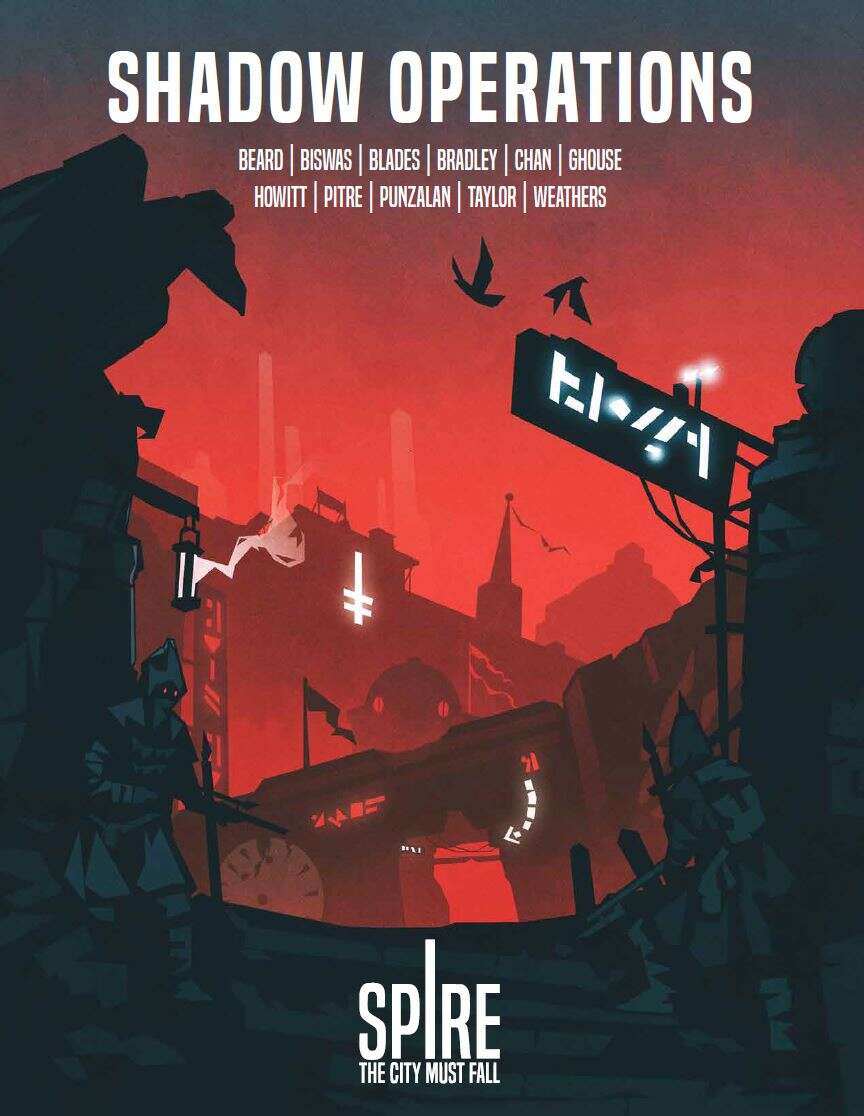
Shadow Operations is an anthology of scenarios for Spire:The City Must Fall, the roleplaying game of secrets and lies, trust and betrayal, violence and subversion, conspiracy and consequences, and of committing black deeds for a good cause. It is set in a mile-high tower city, known as the ‘Spire’, in the land of the Destra, the Drow, which two centuries ago the Aelfir—or ‘High Elves’—invaded and subjugated the Dark Elves. The Drow have long since been forced to serve the High Elves from their homes in the city’s lower levels and allowed only to worship one facet Damnou, the moon goddess, instead of the three they once did. However, not all of the Drow have resigned themselves to their reduced and subjugated status and joined ‘The Ministry of Our Hidden Mistress’, or simply, the Ministry. Its members venerate the dark side of the moon, the goddess of poisons and lies, shadows and secrets, her worship outlawed on pain of death, and they are sworn to destroy and subvert the dominion of the Aelfir over the Drow and the Spire. Published by Rowan, Rook, and Decard Ltd., Spire: The City Must Fall inverts traditional fantasy, making the traditional enemy in fantasy—the Drow—into the victim, but not necessarily the hero.

Shadow Operations addresses an issue inherent to Spire: The City Must Fall. The roleplaying game does not do one-shots. Instead, it is designed for campaign play, which will take the Player Characters, as members of the Ministry, up and down the Spire from the flickers of revolution to the fall of the High Elf regime. What though, if the Game Master wanted to run a one-shot at a convention or as a taster for her gaming group prior to running the roleplaying game proper? This is where Shadow Operations comes to the fore. It is an anthology of short, standalone adventures, the only connection between them being that the Ministry and thus the Player Characters will want to get involved in them. They are all designed to be played in a single three-to-four-hour session, so are suitable as convention scenarios, and they are also formatted to be accessible and easy to prepare. Even so, their low preparation time and their short running length does not preclude the Game Master from including them in her campaign. In fact, the anthology is worth having simply to have a set of accessible, low preparation scenarios to hand.

The simplicity and the low preparation time starts in the introduction to Shadow Operations. Despite having a total of eleven scenarios, the anthology includes just the one set of stats for the NPCs that appear in all eleven scenarios. Or rather it provides stats for archetypes, such as the Fool, the Vizier, the Queen, the Monster, and more, which will appear in most, if not all, of the scenarios. All the Game Master has to do is apply the backgrounds for the versions of these archetypes which appear in each scenario. Which means that the Game Master only has to refer to the one set of stats which learning the specifics of each NPC. Plus, if the Game Master portrays each NPC as written, the players are unlikely to notice the lack of difference in stats from one scenario to the next. Then each of the scenarios is organised in the same fashion. This includes Mission Parameters, Recommended Classes, an Introduction, Non-Playing Characters (NPCs), Suggested Scenes, Locations, Props, Twist, and Reward. ‘Suggested Scenes ‘ are exactly that, scenes that will help push the scenario’s plot involved and get the Player Characters involved. ‘Props’ details other objects and minor NPCs that the Player Characters might encounter as part of the scenario, and they can either be visible where everyone can see and make use of them in terms of the narrative, or hidden, in which case the Player Characters will need to investigate to reveal them. The ‘Twist’ simply the plot twist. This will be revealed during the scenario and in general, make the Player Characters’ lives that much more complicated. Lastly,  the ‘Reward’ is what the Player Characters can expect to gain from successfully, even partially successfully, completing the scenario. Most of the scenarios award bonds, or connections, between the surviving NPCs and Player Characters. The majority of the scenarios are no more than four pages long—and that includes a full-page illustration which prefaces each scenario.

The scenarios themselves include assassinations, uncovering mysteries, protection jobs, preventing conflicts, breaking into and out of jail, locating objects, and more. Many, if not all, begin en media res, with the Player Characters already in the plot at the start of the scenario, with the players being asked how they got there—typically through the means of bribes, false papers, threats of violence, actual violence, and so on. So for example, in Grant Howitt’s ‘Life and Soul’, the Player Characters have to get into a gangster’s birthday party and assassinate him in such a way that the message is clear—do not sell weapons to every buyer, and the players are expected to explain how they gained admittance. In ‘The Last Train’ by Nathan Blades, the Player Characters are tasked with finding the last train still operating on Spire’s otherwise defunct public transport network. Finding it and ensuring it still worked would strengthen an alliance for the Ministry. In Christopher Taylor’s ‘A Shotgun Wedding’, the Player Chaarcters not only have to infiltrate the wedding held at the Church of the Gun, which means a fusillade of gunfire and bullets from start to finish, but prevent anyone from disrupting or stopping it. There are plenty of factions who do not want the ceremony to go ahead. ‘Powderkeg’ is well named. By J.P. Bradley, it sends the Player Characters into the North Docks where the feud between two taverns has escalated to the point where a turf war is about to break out. This includes jousting, but done without horses, of course!

Jason Pitre’s ‘The Show Must Go On’ takes to the Player Characters to the theatre where they have to ensure that performance of a controversial blood opera goes ahead, since prior performances have actually sparked revolution, whilst in ‘Jailbreak’ by Basheer Ghouse, the Player Characters have to break into the Hive, the city’s greatest prison, to free a rebel war hero. Unfortunately, he turns out to be a monster who might be a danger to the Ministry, let alone the authorities. ‘How to Steal a Body’ by Pauline Chan is another break in scenario. The Player Characters must steal a corpse from a necropolis morgue, a task made the more difficult by the presence of ghosts and having to get it across the city, plus a time limit. The body must not yet have suffered decomposition! In Christine Beard’s ‘Rime and Reason’ is another prison break in, this time into the literally cold storage facility of Amaranth, to get a key anti-establishment figure back out before word spreads of his incarceration, whilst in ‘House of Leaving’ by Sharang Biswas the Player Characters are charged with finding a missing historical researcher who might have uncovered something  which threatens to undermine the accepted wisdom of the accepted faith in the Spire. Just how damaging could it be? ‘The Moon Beneath’ by Jabari Weathers continues the religious strand of scenarios with Player Characters trying to prevent an important cleric brought over to support the Ministry from slipping into corruption, whilst in Pam Punzalan’s ‘Feral Saints’—the longest scenario in the anthology—they must find a reborn saint, a Hallow, capable of healing the sick and feeding the poor from falling into the wrong hands.

Rounding out Shadow Operations is a short section on ‘Running One-Shots’. This is the Game master used to running a longer campaign which Spire: The City Must Fall is intended for. The main advice is to be upfront everything and sign-post much of the obvious elements within a scenario. It recommends doing this on index cards where the players can see them and refer to them in play., Overall good advice, if obviously short.

Physically, Shadow Operations is well presented. Everything is neatly organised and easy to reference, done in a succinct style for start to finish. Overall, this is an excellent set of scenarios, designed not only with strong plot and exciting situations and dilemmas in mind, but also ease of both use and preparation. For the Spire: The City Must Fall Game Master, Shadow Operations is an very useful source of scenarios ready to run a convention or add to a campaign.

Friday, 18 November 2022

The Worst Game at Gen Con 2022

The Strange Land
is a scenario for Space: 1889. First published by Game Designers’ Workshop in 1989, it was the first Steampunk roleplaying game. Inspired by the works Jules Verne, H.G. Wells, and Arthur Conan Doyle, it presented an alternate past of Victorian-era space-faring, in which Thomas Edison invented the ‘ether propeller’, a means to propel space vessels through the ‘luminiferous aether’ to first the Moon, then Mars, and later Venus and Mercury. All are proven to be inhabited, Venus by Lizardmen and dinosaurs, but Mars by Canal Martians, Steppe Martians, and High Martians, and the world itself was arid and dry, its cities connected by a network of canals that had been seen from Earth. Mars was also the source of Liftwood, the mysterious tree cultivated for the antigravity properties of its wood, which could be used to keep sky galleons and then when Earthmen arrived, their armoured, steam powered flyers aloft. The great powers rushed in make trade deals and ultimately establish colonies on the Red Planet, just as they would on Venus. In the two decades since Edison landed on the Moon and then on Mars, all of the Imperial tensions of the age have been brought to Mars and exacerbated by the lay of the land of the new world.

Space: 1889 would not remain in print for very long. Game Designers’ Workshop cancelled the line in 1990, but Heliograph, Inc. would reprint many of the titles at the turn of the century. In 2010, the Pinnacle Entertainment Group published a Savage Worlds edition of the game called Space 1889: Red Sands. More recently, in 2015, German publisher Uhrwerk Verlag/Clockwork Publishing published a new edition using the Ubiquity System, originally seen Hollow Earth Expedition from Exile Game Studio. Notably, this edition emphasised the role of the European powers, especially Prussia under Bismarck, in the setting, as opposed to the role of the British Empire in the previous versions. The Strange Land is available for both the Ubiquity System of Space: 1889 and the Savage Worlds rules for Space 1889: Red Sands. It is the latter version of The Strange Land that is being reviewed here.

The Strange Land concerns the fate of the young Canal Martian boy, Kime, and is divided into two parts. The first part is set on Earth and is an investigation into his kidnapping which leads into industrial unrest, whilst the second part takes place on Mars, and more directly involves industrial unrest. The scenario can be played straight through, but ideally, the second part should take place later in the campaign some time after the first. In particular, it is suggested that the Player Characters for the first part be from Novice to Seasoned Rank, and from Season to Veteran in the second part. The scenario also suggests that the Player Characters, or at least a few of them, be British. The scenario has a nice sense of historicity and although the scenario calls for more middle- and upper-class character types initially, any working-class character, or a character with radical leanings will have much to do in the scenario.

The Strange Land opens with the Player Characters invited to stay at the Hampshire estate of Lord John Feltam-Hithe, where at the end of a lengthy dinner, his young ward, an orphaned Canal Martian named Kime, will perform an amazing feat—he will levitate into the air! The Player Characters have the opportunity to interact with the other guests, including an explorer, an industrialist, a businessman, a poetess, and others, but after performing for the night and retiring, Kime has disappeared. Lord Feltam-Hithe presses upon the Player Characters that the boy is in danger and must be found. Their investigations lead first to one of the staff and from their to decidedly rotten circus, which has pitched its tents outside the nearby town. The circus owner is a vile piece of work, poorly treating both staff and exhibits, including, it turns out, one John Merrick! Who proves to be the most noble amongst all of the NPCs that the Player Characters will encounter as they conduct their investigation, which will also reveal more about Lord Feltam-Hithe’s parlous financial situation.

In the third scene of the first part to The Strange Land, the Player Characters literally follows the tracks to London and get involved in the London Dock Strike of 1889. In the setting of Space: 1889, this is exacerbated by taking place on the Southern Aerial Docks, which is currently being occupied the striking dockworkers. Rumour is flying about an ‘Angel of the Docks’, a figure who has become a figurehead to the striking dockworkers. Could this be Kime? If so, the Player Characters need to find a means to ascend to the Southern Aerial Docks. Here the author provides several NPCs which can become potential contacts for the Player Characters, including a historical figure or two, along with several means of accessing the Southern Aerial Docks. These means are inventive and the author is clearly having some fun with them. Ultimately, which should happen is standoff between the striking dockworkers and the strike breakers, with both Kime and the Player Characters sort of in the middle, and the situation getting resolved one way or another.

It is at this point that the scenario could have ended and nobody would have been the wiser. However, The Strange Land has a second, much shorter part, which takes place on Mars, a year or two after the events of the first part. The Player Characters are sent to the aid of a hill station towards the edge of the British sphere of influence on the Red Planet. A local noble, Shune, wants the help of the commander of the hill station in ending a labour strike at the nearby pumping station, Astolor Station—which helps keep the waters flowing through the canals of the dying planet. The commander of the hill station would rather not get involved, and certainly not involve the British residency on Mars, but there are rumours too that a British hostage has been taken as well. So a labour strike, a kidnapping, and an unpleasant, condescending Martian noble, but how are they all connected? This is a simpler situation than in the first half of The Strange Land, but not as linear and more open in how the Player Characters approach the situation. Whether they decide to give help to Shune or negotiate with him, or storm the pumping station or parlay with the strikers, there are consequences to their decisions. The various options are discussed and supported with details of the situation’s major NPCs, so rather than running her Player Characters through the plot as in the first half, the Game Master will primarily reacting to their decisions.

Physically, The Strange Land is a short book. It needs a slight edit in places, but the few pieces of artwork and the single map—that of the Southern Aerial Docks—are all decent. However, it would have benefitted from a few more thumbnail portraits of the NPCs, and definitely more maps. Whether that is of Lord Feltam-Hithe’s estate, the region around Astolor Station, and of Astolor Station itself. If not that, then at least an illustration.

Whether written for use with Space 1889: Red Sands or the original Ubiquity System version of Space: 1889, The Strange Land is a solid little scenario. (With a little effort, it could no doubt be adapted to new version, Space 1889: After, currently being Kickstarted by Strange Owl Games.) It takes the Player Characters to the highs and lows of society on both Earth and Mars, and the first half, set on Earth could easily be run without the need to run the second half. There is an enjoyable sense of working-class radicalism to both halves and together they allow The Strange Land to explore the underside to Victorian life the reform movement in Space: 1889.

—oOo—

The Strange Land was the worst scenario we played at Gen Con 2022. This is not to say that the scenario itself is bad. In fact, given its author, it is no surprise that it is a decent, playable, and enjoyable scenario—as written. Yet, of all the gaming experiences we had at Gen Con 2022, it was the worst. Attending Gen Con as a group, we signed up to play a total of five games and got into four of them. These were, in chronological order, Pirates of the Shattered World, X-Crawl, Delta Green, and Space: 1889. Of these, Delta Green was a blast, Pirates of the Shattered World entertaining if crowded, X-Crawl disappointing, and Space: 1889 utterly dreadful. This is despite the fact that our X-Crawl game, which was due to take place in Goodman Games’ Wizard’s Van, was to be run by the game designer, and was an event that we were really, really looking forward to, was cancelled—with good reason. So yes, a gaming experience which was cancelled and thus involved no gaming whatsoever and meant we did not meet the game designer, was a superior gaming experience than the Space: 1889 game.

So why was it so bad?

It took too long to get started and too long for the Game Master to explain the rules. It took too long to get to the hook for the first half of the scenario—the disappearance of Kime—and thus get us involved. When we wanted to roleplay, the Game Master would attempt to move the plot on and when we attempted to investigate, the Game Master would ignore our efforts. The Game Master added a couple of scenes and details that having read and reviewed the scenario are implied, but not really suitable additions given that the scenario is being run in a convention timeslot. So, we felt unengaged in the scenario and grew increasingly bored over the course of the session. In fact, we were communicating this to each other via our Whatsapp group, to the point where we agreed two things. First, it looked like the session of Dungeons & Dragons, Fourth Edition session that the Game Master’s wife was running on an adjacent table, was a whole lot more energetic and fun, and that we wished that were playing that instead. Second, when towards the end of the session when the Game Master announced that the scenario was not yet finished, but could be if we decided to stay after the session was supposed to end if we had no pressing appointments, we all agreed that we really, really needed to be somewhere else.

All of which would be exacerbated by ‘Red Hat Guy’. The gaming group of consisted of myself and four other friends. The sixth player was ‘Red Hat Guy’. So named because he wore a red baseball cap. He sat down, selected a character, did not want to know who we were or who our characters were, and only seemed to come alive when there was combat involved. He made no contribution to the investigation or the roleplaying, what little of it we were allowed to do, and said virtually nothing for the whole of the session. However, he proved to be as bored as we were. Towards the end of the session, the player sat next to him sent the following message on our Whatsapp group: “Red hat is skimming through boob pictures. My game is now complete.”

Now in hindsight we should have done something about this. We should have told Red Hat Guy to stop or gone to the Gen Con organisers. We did not. Why not? We were in shock at the audacity of anyone doing such a thing. Had we done so, it would have upended the game, disrupting it, and somehow that did not feel right. Had the one female player been sat next to Red Hat Guy it might have been a different matter. He might never have begun browsing pornography on his mobile phone and the session would have slouched to its end, with none of us the wiser as to how he was feeling. If he had, then she would have very likely, clearly asked him not to, and that probably would have brought the gaming session to end.

Even to this day, we are still in shock even now at what happened with Red Hat Guy. Thankfully, we did not see him again and if we did, we would not want to game with him again. His actions capped what was already a terrible gaming experience, one that we really wanted to get away from, but are never going to forget.


—oOo—

A coda to this terrible gaming experience came at Gateway Strategicon, a convention held over Labour Day weekend 2023 in Los Angeles. One of our number ran The Adventure of the Sword Tournament, the quick-start for Pendragon, Sixth Edition and ‘Red Hat Guy’ had signed up to play. The was no sign that he recognised the Game Master, who had also been a player in the Space 1889 game at Gen Con and who had no idea that ‘Red Hat Guy’ had signed up to play. Although he did not commit the faux pas of watching pornography in public, ‘Red Hat Guy’ committed the gaming faux pas of refusing to engage with the scenario or the game world. Instead of playing an Arthurian knight, he wanted his character to walk the land and meditate. Kung Fu this was not and David Carradine he was not. Rather than engage in the scenario, he decided his knight would sell his arms and armour and horses, and then sit outside the city of London praying. For a full four-hour session. The only times he stirred were for the tournament when there was going to be some (mock) combat and then at the end when everyone swore fealty to the newly anointed King Arthur. The first of these he was unable to do because of course, he had sold all of knight’s arms and armour and horses and so could not participate. As for the second, he was able to swear fealty to King Arthur, but literally last and right from the back of the crowd as he rushed in from outside London’s walls to the square where the sword in the stone was. 

Friday, 8 April 2022

Friday Fiction: The Gutter Prayer

The Gutter Prayer
is a fantastic novel of worldbuilding and tumultuous change. The debut from Gareth Hanrahan—an author best known for his many roleplaying credits, from The Persephone Extraction to The Pirates of Drinax—and much more besides, it opens with a prologue written in the second person that narrates a burglary upon the House of Law in the city of Guerdon. It gives a strange, almost impersonal point of view to the beginning of the novel, the identity of the narrator not quite clear, but oh so important as the events of the story reveal later. The burglary though is a failure, forcing its perpetrators, Carillon, an orphan newly returned to the city after years away as a refugee, Rat, a young Ghoul not wanting to join his kind below, and Spar, a Stoneman, cursed with a disease which causes him to ossify into stone, and ultimately die if he does not receive injections of the serum, alkahest, to flee. In the wake of an explosion they know nothing about, the trio splits up, chased by the Tallowmen, waxworks which keep going as long as their wick remains alight, created by the Alchemists Guild to help enforce the laws and keep the peace. That explosion and the identity of the narrator in the prologue set off a chain of events which reverberate throughout the rest of novel.

Guerdon stands at the heart of the novel, a fantasy-industrial city-port which remains neutral in the ongoing Godswar afflicting other nearby nations. Religious strife underlies its history though, religious freedom allowed in the city because the Church of the Kept Gods threw down the dark rule of the Black Iron Gods and their vile servants. In recent times, the influence of the Kept Gods has diminished as the power and influence of the Alchemists grew and turned Guerdon into the soot-strewn industrial powerhouse that it is today. In the narrow streets and through the warrens of the smugglers’ tunnels lurks the Brotherhood, the city’s thieves’ guild—of which the novel’s central trio are members—whilst below are stranger factions still. Both are Lovecraftian in nature, the Ghouls feeding upon the city’s dead lowered into corpse chutes by the Church of the Kept Gods, whilst the Crawling Ones, amorphous collective masses of worms which can take on humanoid shapes, plot for greater power and influence in the city above at the expense of the Ghouls.

Once past the prologue, the story switches back and forth between various character points of view, initially Carillon, Rat, and Spar, in turn providing different views of the city and thus nbuilding and building Guerdon. They counterpart each other, Carillon impulsive and impatient, Spar physically slowed into terminal patience, with the pragmatic Rat between them. Guerdon though, forms a character of its own as the author serves up one aspect of the city after another, often seeming to throw them away before moving onto the next, leaving the reader to wonder if he will ever return to explain or expand. The three central protagonists, plus Guerdon itself, are not the only characters given time in the spotlight. Carillon has a starchy cousin, Eladora, who provides a different perspective upon their extended family; the three are hunted by Jere, a thief taker with connections; and Aleena, foul-mouthed and weary, who as a Saint of the Kept Gods channels their power. Not all of the other characters in the novel are accorded such treatment and consequently, some are underwritten.

The Gutter Prayer is also a tale of responsibilities, each of the three central characters gaining them, often unwillingly, due to the events of the novel, in the case of Carillon coming to her as a result of the vents of the prologue. In turn, they pull each of the three away from their central friendship which is so strong at the beginning of the novel, especially as the pace of the book picks up and up as their stories and the book comes to a climax.

Most obviously, in terms of genre, with its guilds and gods, thieves and cults, 
The Gutter Prayer is a dark fantasy, and whilst the industrialisation of alchemy in Guerdon does push it towards the steampunk genre, the novel is neither pseudo-Victorian nor obsessed with mechanical technology. It is rather Dickensian in both its character and its griminess, but The Gutter Prayer is ultimately more of a horror story, and whilst the author’s depiction of the Crawling Ones and their servants is suitably Lovecraftian, the truly creepy creations in the novel are the Tallowmen and the Gullmen. The latter appear only a few times in the novel, but that is enough, because seagulls given arms and legs is not something that you want to be thinking about. The former though, are a constant presence and threat—chasing, watching, guarding, herding… Each is the facsimile in stretched wax of their former self, vaguely self-aware, but always knowing that if their wick is extinguished, then so is their soul.

Throughout it is interesting to see the author going through the process of world-building through the narrative rather than the construction we are used to seeing done via roleplaying supplements. Although there are mentions of the wider world and then just the one fantastic excursionary scene, the action of 
The Gutter Prayer is confined to Guerdon itself. As much as the city is brought to life, there is still very much left for the reader to wonder at and hope that the author returns to in later books. Were The Gutter Prayer a roleplaying supplement, then perhaps it would be a different matter. In terms roleplaying, any number of rules sets could be used to portray Guerdon and its inhabitants, for example, Into the Odd would work.

The Gutter Prayer is a fast-paced—sometimes too fast-paced as the reader tries to keep up—and grim and grimy dark fantasy. It evokes a wonderfully sooty and tarnished sense of place in Guerdon and explores it through a cast of engaging characters who face difficult choices and undergo often traumatic transitions. The Gutter Prayer is a great introduction to Guerdon and the Black Iron Legacy series, and an exciting and engaging debut novel.