Every Week It's Wibbley-Wobbley Timey-Wimey Pookie-Reviewery...
Showing posts with label 'punk. Show all posts

Saturday, 25 April 2026

Blackmail & Betrayal

If you are one of the few wealthy Drow in the Spire, then the Silver Quarter is where you come to see and be seen. If you are one of the Aelfir in the Spire, then you need deign to descend to such lows as the Silver Quarter, unless you want to rebel and have fun and perhaps even cause a scandal. Famous—or is that notorious?—for its casinos, gambling houses and members-only clubs, the quarter is a renowned hotbed of dubious, if not outright illegal activity that its bosses can pay off the local bosses and local detachment of the city guard to look the other way. At the heart of it all, is Mesye So, a powerful and influential Drow, who controls the Silver Quarter from behind layer after layer of the best security that his money can buy and the best ignorance of his involvement that his bribes can engineer. Still, he hungers for greater power and influence, and perhaps his ambition and his hubris will be his undoing. It is certainly an affront to ‘The Ministry of Our Hidden Mistress’. A council of elders of these freedom fighters—or terrorists—has decided that enough is enough and that a figure such as Mesye So, of their own, should be bent to their cause. They have purchased a base of operations from which a teams of Ministers can operate in the Silver Quarter, a rundown, not quite seedy gambling den called the Manticore. Armed with what they know about Mesye So and other leading figures seen in the Silver Quarter—represented by a handful of newspaper clippings—the Ministers are to gather further intelligence and use to extort and blackmail Mesye So and others in support of ‘The Ministry of Our Hidden Mistress’ and its aims. This is the set-up for The Kings of Silver: A Campaign Frame for Spire RPG.

It is a mini-campaign
for Spire: The City Must Fall, the roleplaying game of secrets and lies, trust and betrayal, violence and subversion, conspiracy and consequences, and of committing black deeds for a good cause. It is set in a mile-high tower city, known as the ‘Spire’, in the land of the Destra, the Drow, which two centuries ago the Aelfir—or ‘High Elves’—invaded and subjugated the Dark Elves. The Drow have long since been forced to serve the High Elves from their homes in the city’s lower levels and allowed only to worship one facet of Damnou, the moon goddess, instead of the three they once did. However, not all of the Drow have resigned themselves to their reduced and subjugated status and joined ‘The Ministry of Our Hidden Mistress’, or simply, the Ministry. Its members—or Ministers—venerate the dark side of the moon, the goddess of poisons and lies, shadows and secrets, her worship outlawed on pain of death, and they are sworn to destroy and subvert the dominion of the Aelfir over the Drow and the Spire. Published by Rowan, Rook, and Decard Ltd., Spire: The City Must Fall inverts traditional fantasy, making the traditional enemy in fantasy—the Drow—into the victim, and certainly the protagonist, but not necessarily the hero.

The Kings of Silver: A Campaign Frame for Spire RPG is
not a traditional roleplaying scenario. It foregoes the traditional construction with prewritten encounters that the Player Characters play through one after another. Nor does it not suggest any plot or story threads, something that other campaign frameworks for Spire: The City Must Fall, such as Eidolon Sky: A Campaign Frame for Spire RPG do. Instead, it sets up a situation, that is, a chief villain (and others) who are going to be the targets of the Player Characters’ actions, and a base of operations from where the Player Characters will operation. Instead of briefing given by the council of elders, the Player Characters are furnished with a set of newspaper clippings. These include titles such as ‘New Captain of the Watch Appointed in Silver Quarter’, ‘Temple Brawl Kills Five’, ‘Mr Silver Quarter: Looking for Love?’, ‘Midwife Murderer Walks Free’, and ‘Walks-On-Light Drinks Docks Dry!’, from which the players and their characters are going to extract clues about their targets and begin to formulate a plan or two. There is a total of fourteen such clippings and they are all presented as handouts for the players. They tell the players and their characters about the doings of not just Mesye So, but also the extremely wealthy Lay-Deacon Stride-Out-Harmonious; Hestra Wander-The-Lost, famous for being famous who wants to even more famous; and Loq Walks-On-Light, a rebellious Aelfir, who might just turn on his own. Each of these and other NPCs is nicely detailed as why they are so important to the cause of ‘The Ministry of Our Hidden Mistress’, how they differ from other Aelfir, what they desire and what they despise, and what could the Player Characters get from them. Each is also accompanied by some suggested where they might be encountered, but in some cases such as Lay-Deacon Stride-Out-Harmonious and Hestra Wander-The-Lost, what they do not come with is stats. This is deliberate, since they are combatants and if they are being fought, then the probability is that the Player Characters’ blackmail and/or exhortation attempts are going poorly.

The Player Characters also receive The Manticore, the gambling club from which they will be operating. This is nicely detailed in a couple of pages, with a particular emphasis placed upon the staff. They are only given the simplest of descriptions each, but that leaves room aplenty for the Game Master to develop them according to the needs of the campaign. The players and their characters are free to leave the day to day operation of The Manticore to the staff, but they can also have their characters get involved with both of its operation and the staff and their lives, which could open up a lot of roleplaying possibilities.

The Game Master is supported with advice on running The Kings of Silver and given several tables to roll on as a source of prompts and ideas, including ‘Which House Is This Drow Noble Claiming To Come From?’ and ‘What’s The Name Of This Gambling House/Club, And What’s Interesting About It?’. There is a list too of the primary places in the Silver Quarter. Although what might happen in between is not discussed, there is an examination of the possible endings to the campaign as well as its set-up. These look at the ultimate possible consequences of the Player Characters’ actions, not all of them good.

Lastly, The Kings of Silver presents six pre-generated Player Characters. They include a Bound, one of the vigilantes who bind small gods into their weapons, who can infiltrate locations with ease; a night-club singer who is secretly a Blood-Witch with a long history of terrifying others; a Knight of the North Docks with an encyclopaedic knowledge of the city’s public houses who has brought his daughter with him as his squire; an ex-masked servant able to move amongst high society; an ex-embezzler good at cutting deals; and an ex-priest turned confidence trickster. They all come with their own character sheets.

Physically, The Kings of Silver: A Campaign Frame for Spire RPG is well presented and its contents are neatly organised and easy to reference, done in an easy-to-grasp style from start to finish. The news clippings each have a page of their own enabling the Game Master to print or copy them and once in play, the players can consult them again and again.

Although it is of scenario length, The Kings of Silver: A Campaign Frame for Spire RPG is very much a campaign framework, with a beginning and an ending (or endings). It is a juicy set-up, with lots for the players and their characters to think about, whilst giving them complete agency as how they act upon the set-up and the information that it gives them. After that, the campaign is primarily player driven as they decide how their characters will act against the NPCs they are targeting, with the Game Master supporting and reacting to those decisions. There is no set length to the campaign either, the length likely depending upon the players’ decisions and how many of the NPCs their characters will move against. The Kings of Silver: A Campaign Frame for Spire RPG lays out the basis for an entertaining campaign, but where it goes is entirely up to the players.

Saturday, 28 February 2026

Decay & Destruction

The city of Spire is in a constant state of wrack and ruin. As its overlords, the Aelfir, live a life of indolence and intrigue, the walls crack and parts of the structure shear and fall the many storeys to smash crumble on the ground below. The rot though, does not come from without, the cold and the wet finding cracks in the walls, working them and snapping them open, but from within. Deep below the city of Spire is the Heart, a ruinous tear in the fabric of the world that bleeds upwards, spreading disorder and chaos and blighting souls with rot. Unseen, its consequences have found a home in the harsh and uncaring undercity of Red Row, making the lives of its Destra inhabitants ever more dangerous, ever more dreadful. Gangs engage in open warfare, the sound of their gunfire marked by palls of spireblack gunsmoke, unable to agree on any one cause or able to resume the wary respect that kept their weapons holstered and a peace between them. Families bicker and divide, casting children aside. The Crimson Vigil, a group of violent anti-aelfir reactionaries, is openly recruiting soldiers for their forbidden cult, and with its numbers growing, how long before its actions bring the attention of the authorities down upon the whole neighbourhood? And yet despite the violence and despite the dissension that seems rife in every home and on every street, what the people of Red Row are talking about is The Weeping Maiden, a new play currently on tour! Society seems to be tearing itself apart at the seams and everything is going to wrack and ruin. This cannot be natural. There has to be someone or something behind it. Surely? This is the set-up for Blood and Dust: A Campaign Frame for Spire RPG.

It is a mini-campaign 
for Spire: The City Must Fall, the roleplaying game of secrets and lies, trust and betrayal, violence and subversion, conspiracy and consequences, and of committing black deeds for a good cause. It is set in a mile-high tower city, known as the ‘Spire’, in the land of the Destra, the Drow, which two centuries ago the Aelfir—or ‘High Elves’—invaded and subjugated the Dark Elves. The Drow have long since been forced to serve the High Elves from their homes in the city’s lower levels and allowed only to worship one facet of Damnou, the moon goddess, instead of the three they once did. However, not all of the Drow have resigned themselves to their reduced and subjugated status and joined ‘The Ministry of Our Hidden Mistress’, or simply, the Ministry. Its members—or Ministers—venerate the dark side of the moon, the goddess of poisons and lies, shadows and secrets, her worship outlawed on pain of death, and they are sworn to destroy and subvert the dominion of the Aelfir over the Drow and the Spire. Published by Rowan, Rook, and Decard Ltd.Spire: The City Must Fall inverts traditional fantasy, making the traditional enemy in fantasy—the Drow—into the victim, and certainly the protagonist, but not necessarily the hero.

Blood and Dust: A Campaign Frame for Spire RPG is 
not a traditional roleplaying scenario. It foregoes the traditional construction with prewritten encounters that the Player Characters play through one after another. Nor does it not suggest any plot or story threads, something that other campaign frameworks for Spire: The City Must Fall, such as Eidolon Sky: A Campaign Frame for Spire RPG do. Instead, it outlines an intrigue and a greater plot of sorts whose chaotic effects are playing out on Red Row and which the Player Characters are driven to investigate, and beyond the initial set-up of getting the Player Characters together, it focuses on the six factions involved. These consist of the Retroengineers employed to operate the devices that are destabilising the neighbourhood and helping to sow the chaos; the Sunlight Collective, a theatre group of radical artists and occultists fascinated to see the effect that its latest play is having on Red Row; the Knights of the North Docks, the strutting bully boys whose factionalism has turned them into extortionists; members of the City Guard, overworked with all of the unrest they have had to deal with; the Church of Absolution, a burned-out magicians and sages, destitute oracles and defrocked priests, that worships decay and wants revenge on those that stole its ideas; and the Crimson Vigil, anti-Aelfir zealots ready and happy to stir up more chaos. Some are more detailed than others—the Game Master will need to refer to the Spire: The City Must Fall for more details—but all are given motivations and suggestions as to what they might do as well as some notable NPCs.

The most detailed advice for the Game Master is on how to set the scenario up and involve the Player Characters, whether they are the pre-generated Player Characters or not. This is because there are no staged encounters or scenes, so there is no advice on how to handle them. What happens instead is the Game Master will reacting to the directions in which the players want to push their characters, which character hook and motivation and thus which faction that the want to investigate. Having set this up, the authors leave it to the Game Master at the table to respond to her players and their characters to determine what happens. There are some notes on how to end the story, primarily concerning what the remaining factions that the Player Characters do not investigate might do.

In addition, Blood and Dust: A Campaign Frame for Spire RPG includes five pre-generated Player Characters, all members of ‘The Ministry of Our Hidden Mistress’. They consist of an ex-military revolutionary and firebrand; a beautiful artistic and revolutionary idol; a Knight of the North Docks (effectively a gangster in plate armour); a Lajhan, a priest of Our Glorious Lady, the light side of the moon, the one aspect of the Drow goddess that is legal to worship, whose temple has been despoiled; and a Vermissian Sage, who hides knowledge in the Vermissian , the broken mass-transit system that runs up and down Spire. All five have their own character sheets and reasons to get involved in the investigation and adventure, such as the Lajhan’s temple having been bespoiled and the Vermissian Sage having recently been denied access to the Vermissian.

Physically, Blood and Dust: A Campaign Frame for Spire RPG is well presented and its contents are neatly organised and easy to reference, done in an easy-to-grasp style from start to finish.

Blood and Dust: A Campaign Frame for Spire RPG is not a ‘campaign frame’ as its subtitle suggests. Its emphasis and thus is structure is all on the set-up. It is described on the back cover as “…[A] series of prompts, suggestions, factions, pre-generated characters and personalities…” and it is very much that rather than a frame or framework that provides anything akin to structured campaign or plot line. Nor is it necessarily a campaign, since it is intended to be run in a few sessions. Yet as a set-up, it does work, giving the elements that a Game Master would need to run it. However, the lack of the frame and the fact that the Game master will be improvising the responses to the Player Characters’ actions does not make Blood and Dust: A Campaign Frame for Spire RPG either easy to use or necessarily suitable for the inexperienced Game Master. For the experienced Game Master, Blood and Dust: A Campaign Frame for Spire RPG provides a good set-up and content suitable for several sessions’ worth of player-driven play.

Saturday, 3 January 2026

The Demon Drug

The sacred streets, back alleyways, and secret sanctuaries of New Heaven and Perch are rife with rumours and fear. A new drug has hit the streets and hit the streets hard. Dreck is making in-roads everywhere with its surefire hit, but making its addicts hyper-violent. Someone is snatching Drow off the street, but that appears to have nothing to do with a serial killer called ‘The Swan’, who kills his victims by excising their hearts and leaves them pinned up with swan wings in glass piercing their limbs, along with cryptic notes that taunt the authorities to catch him before he kills again. Then there is rumour of a demonic incursion which tore apart a tower of silence, killing everyone inside and driving everyone nearby mad. This is the set-up for Eidolon Sky: A Campaign Frame for Spire RPG.

It is a mini-campaign
for Spire: The City Must Fall, the roleplaying game of secrets and lies, trust and betrayal, violence and subversion, conspiracy and consequences, and of committing black deeds for a good cause. It is set in a mile-high tower city, known as the ‘Spire’, in the land of the Destra, the Drow, which two centuries ago the Aelfir—or ‘High Elves’—invaded and subjugated the Dark Elves. The Drow have long since been forced to serve the High Elves from their homes in the city’s lower levels and allowed only to worship one facet of Damnou, the moon goddess, instead of the three they once did. However, not all of the Drow have resigned themselves to their reduced and subjugated status and joined ‘The Ministry of Our Hidden Mistress’, or simply, the Ministry. Its members—or Ministers—venerate the dark side of the moon, the goddess of poisons and lies, shadows and secrets, her worship outlawed on pain of death, and they are sworn to destroy and subvert the dominion of the Aelfir over the Drow and the Spire. Published by Rowan, Rook, and Decard Ltd., Spire: The City Must Fall inverts traditional fantasy, making the traditional enemy in fantasy—the Drow—into the victim, and certainly the protagonist, but not necessarily the hero.

Eidolon Sky: A Campaign Frame for Spire RPG is
not a traditional roleplaying scenario. It foregoes the traditional construction with prewritten encounters that the Player Characters play through one after another. Instead, it presents three plot threads that they can investigate—the drug ‘Dreck’, the serial killer ‘Swan’, and the demonic incursions. Each thread includes an opening or ‘Trigger’ scene, these being the closest to prewritten encounters in
Eidolon Sky. Each of them begins their plot thread with a bang and is followed by the details that the Player Characters can discover as they investigate each thread. Stats and details of the antagonists involved in each thread are listed at their ends, but these feel underwritten in comparison to the various NPC write-ups that follow. This is because they are accompanied by a list of suggested scenes that where the Player Characters might encounter them. Essentially, what Eidolon Sky gives the Game Master is a set of plot threads and NPCs that she can set up and have her Player Characters engage with them. The Game Master is free to bring these into play as necessary, but in the main, what she will be doing is responding to the decisions of the players and the actions of their characters as Eidolon Sky is very much a player-led investigation.

The most detailed advice for the Game Master is on how to end the campaign frame. As they investigate the three threads, the Player Characters will come to realise that they are connected and following those connections will lead to the villain of the piece. Eidolon Sky both explains what will happen if the Player Characters fail and what will result depending upon their actions. This includes discussions of what leverage the Player Characters might gain over the villain, how they might seek help from other factions, and so on. Representatives of these other factions are included in the NPC descriptions given earlier.

Eidolon Sky: A Campaign Frame for Spire RPG ends with a set of five pre-generated Player Characters. They include a trader-priest, one of the Bound vigilantes, a Carrion-Priest, a Midwife, and a Vermissian Sage. All five are fully detailed and not only do they include a character sheet, they come with short backgrounds each of which has some details designed to hook them into the campaign frame’s three plot threads.

Physically, Eidolon Sky: A Campaign Frame for Spire RPG is well presented and its contents are neatly organised and easy to reference, done in an easy-to-grasp style from start to finish.

Eidolon Sky: A Campaign Frame for Spire RPG is a solid investigation for Spire: The City Must Fall, a good mix of investigation and violence in three flavours—criminal, occult, and horror. However, it also a straightforward investigation meaning that it lacks some of the moral ambiguity at the core of Spire: The City Must Fall which casts the Player Characters as much terrorists as they freedom fighters, dedicated to the cause that leads them to make difficult and questionable choices. Where the Player Characters will be making moral choices in Eidolon Sky is in deciding which faction to side with and perhaps what to do with the villain of the piece, but these are not hard choices and their consequences are lacklustre. The Game Master may want to find scenes and points in the campaign frame where she can inject some of that moral ambiguity, although she could run it as written as change of tone and style. Eidolon Sky: A Campaign Frame for Spire RPG is an entertaining and straightforward, but not typical campaign frame for Spire: The City Must Fall.

Monday, 20 May 2024

Miskatonic Monday #284: The Curse of Punk

Between October 2003 and October 2013, Chaosium, Inc. published a series of books for Call of Cthulhu under the Miskatonic University Library Association brand. Whether a sourcebook, scenario, anthology, or campaign, each was a showcase for their authors—amateur rather than professional, but fans of Call of Cthulhu nonetheless—to put forward their ideas and share with others. The programme was notable for having launched the writing careers of several authors, but for every Cthulhu Invictus, The Pastores, Primal State, Ripples from Carcosa, and Halloween Horror, there was Five Go Mad in Egypt, Return of the Ripper, Rise of the Dead, Rise of the Dead II: The Raid, and more...

The Miskatonic University Library Association brand is no more, alas, but what we have in its stead is the Miskatonic Repository, based on the same format as the DM’s Guild for Dungeons & Dragons. It is thus, “...a new way for creators to publish and distribute their own original Call of Cthulhu content including scenarios, settings, spells and more…” To support the endeavours of their creators, Chaosium has provided templates and art packs, both free to use, so that the resulting releases can look and feel as professional as possible. To support the efforts of these contributors, Miskatonic Monday is an occasional series of reviews which will in turn examine an item drawn from the depths of the Miskatonic Repository.

—oOo—
Publisher: Chaosium, Inc.
Author Keller O’Leary

Setting: California, 1985
Product: One-shot
What You Get: Thirty-five page, 6.08 MB PDF
Elevator Pitch: Some punks sell out. Some punks never buy-in.
Plot Hook: It takes friends to turn a derelict building into a venue to stick fingers up at the man.
Plot Support: Staging advice, four pre-generated Investigators,
five handouts, six NPCs, seven mythos spells, one Mythos monster, and one animal monster.
Production Values: Okay

P
ros
# Punks gotta stand together till until someone sells out
# What if one underground runs into another?
# Tight plotted multi-session one shot
# Easy to adjust to other cities
# Musophobia
# Melophobia
# Athazagoraphobia

Cons
# Organisation could be clearer

Conclusion
# Spikey attitude pervades a telling of a punk perversion
# Two undergrounds don’t make a right, especially if one is selling out

Saturday, 22 April 2023

Magister’s Miscellany

Magister’s Guide – A Spire RPG GM Handbook is supplement for Spire: The City Must Fall, the roleplaying game of secrets and lies, trust and betrayal, violence and subversion, conspiracy and consequences, and of committing black deeds for a good cause. It is set in a mile-high tower city, known as the ‘Spire’, in the land of the Destra, the Drow, which two centuries ago the Aelfir—or ‘High Elves’—invaded and subjugated the Dark Elves. The Drow have long since been forced to serve the High Elves from their homes in the city’s lower levels and allowed only to worship one facet Damnou, the moon goddess, instead of the three they once did. However, not all of the Drow have resigned themselves to their reduced and subjugated status and joined ‘The Ministry of Our Hidden Mistress’, or simply, the Ministry. Its members—or Ministers—venerate the dark side of the moon, the goddess of poisons and lies, shadows and secrets, her worship outlawed on pain of death, and they are sworn to destroy and subvert the dominion of the Aelfir over the Drow and the Spire. Published by Rowan, Rook, and Decard Ltd., Spire: The City Must Fall inverts traditional fantasy, making the traditional enemy in fantasy—the Drow—into the victim, but not necessarily the hero.

Magister’s Guide – A Spire RPG GM Handbook is a a companion to Spire: The City Must Fall. Born of four years development, it brings together a number of new systems, new stuff for every Character Class in Spire, including content drawn from the Strata and Sin sourcebooks, as well as advice for the Game Master. It is a fairly slim book, but comes packed with content for both the player and the Game Master. The book opens with four New Systems, beginning with ‘Liberty’, based on the ‘Control’ mechanic from Strata. This is a further measure of control and oppression applied by the authorities on the Dark Elves in response to actions of the Ministers that make the High Elves feel threatened. It does not target them specifically, but the Drow population in general. Liberty is a broad response and its Fallout can be Minor, Moderate, or Severe. For example, Light Fallout might be ‘No Congregation’, meaning that no Drow can gather together, Moderate Fallout might be ‘Branding’ or tattooing of Drow criminals, and Servere ‘Sanctioned Killers’ which arms the agents operating against the Ministry. Its broad nature means that Liberty is difficult to reclaim or remove. Only two options are listed, but the rules suggest using ‘Acquisitions’, the third of the new Systems to supplement these two.

‘Advancement Beats’ give a Minister and his player options in terms of challenges, goals, and achievements. Each ‘Beat’ can be a personal aim or shared with a fellow Minister, but is not specifically tied to the broader advancement of the Ministers’ cell and overall objectives of the The Ministry of Our Hidden Mistress. A Minister can have as many Beats as he wants, but only two are active in play at any one time. They are measured in terms of time they take to achieve. So a Low Beat such as ‘Sell someone out to the authorities’ can be fulfilled in a single session, a Medium Beat like ‘Research and perform a demonological ritual’ takes two or three, and so on. Essentially an adaption of the concept of ‘story beats’, this New System provides a player with story options that flag to the Game Master what he would like to have happen to his Minister—good or badin a session or more.

‘Acquisitions’ provides a further means of Player Character improvement, not just a means of getting items of equipment. One way to use them to is reclaim or remove the aforementioned Liberty, but options here include gaining an Ability from an entirely different Class, Favours, extra Advances, and a Safehouse. The latter nicely ties in with the rules for safehouses later on. For the Player Characters, this takes time, but they can push the attempt and act recklessly, to increase the Stress they suffer. Acquisitions are similarly categorised into Low, Medium, and High. The system is nicely worked through with a couple of good examples and enable a Player Character to have something going on in the background that he is working towards in terms of story and bring it into the action when necessary.

The fourth and last of the New Systems is for ‘Safehouses’. Out of all of the New Systems in the Magister’s Guide – A Spire RPG GM Handbook, this does like the most obvious addition. After all, the Player Characters do make a terrorist cell and will need somewhere to hide out and operate from. Once they have a safehouse
—and the rules here suggest a ‘starter’ safehouse—the Player Characters can upgrade it with facilities such as a secret entrance, a gunsmith, and even a sacrificial chamber! Each of these is rated as a Medium Advance or a Medium Acquisition, using the previously presented ‘Acquisitions’ system. Suggested too are options for making the sanctuary a community instead of a hidden base and for using it as part of the story, so again giving both the players and the Game Master some flexibility in how the System is used.

The bulk of the
Magister’s Guide – A Spire RPG GM Handbook is devoted to new options for the roleplaying game’s numerous Character Classes. Each is given various options including, but not all, new abilities, equipment and special equipment, adversaries, and Fallout (or consequences specific to the Class). For example, the Midwife emphasises the arachnid nature of the Drow and her role in the nurseries with Abilities such as ‘Hands of Silk’ which give her silk glands in the wrist from which can draw and combine with any hand-to-hand weapon to stun and bind, whilst with ‘Trapped Door’ she casts glyphs upon a door to hide it. She can use equipment such as a ‘Prosthetic Limb Array’, useful for the Midwife who finds it difficult to partially change into a spider, or a weapon like a ‘Arachnid Glaive’ . Her Special Equipment includes ‘Frenzy Incense’ which allows her to shrug off the negative effects from Minor or Moderate Blood Fallout. Her Adversaries include ‘The Black Sheep’, those that the Midwife raised, but which turn out bad—criminals, High Elf loyalists, apostates, heretics, and worse... Potential Fallout specific to the Midwife consists of ‘Spiders’ which crawl out her clothing, the walls, or even her mouth, much to the consternation of those around her.

In addition, the entry examines the nature of birth and child-care amongst the Drow, but also neatly provides a list of elements related to her role that the Game Master can bring into play. So, children, families, sacrificial altars, upholding traditions, and so on, and these work for NPCs as much as they do for the Player Character.
The Magister’s Guide – A Spire RPG GM Handbook does this again and again for each of the Classes in Spire: The City Must Fall, each time providing options for the player to chose from, as for the Game Master to add to the story.

Rounding out
the Magister’s Guide – A Spire RPG GM Handbook is a quartet of short essays in ‘Essays and Advice’. ‘Just the Basics’ is a relatively short blurb which the Game Master can use to explain the setting to prospective players or even for convention games. Even better is ‘Preparing For A Game of Spire’, which gives advice on how to prepare a scenario if a Game Master has no time, twenty minutes, an hour, or two hours. The advice of course, directly applies to Spire: The City Must Fall, but could easily be adapted to any roleplaying game. The essay also includes advice for preparing for a one-shot and again, is applicable to other roleplaying games. If Rowan, Rook, and Decard Ltd. was to publish a generic book of advice for running games, a version of this essay would definitely be included. Similarly, ‘When To Roll, And When Not To’ and the shorter ‘Creative Use Of Skills’, can apply to this roleplaying and others, but are not quite as interesting.

Physically, the Magister’s Guide – A Spire RPG GM Handbook is well presented and its contents are neatly organised and easy to reference, done in a succinct style from start to finish. All of that content is really very good, providing options in terms of Player Character abilities and actions, that both the player and the Game Master can use or effectively tag in the game. It is backed up by really good advice for the Spire Game Master, that is applicable in any roleplaying game. Overall,
the Magister’s Guide – A Spire RPG GM Handbook is great supplement for the Spire Game Master, which the Game Master for almost any other roleplaying game should borrow (from her Spire Game Master) just to read the essays.

Saturday, 17 December 2022

An Elven Elevensome

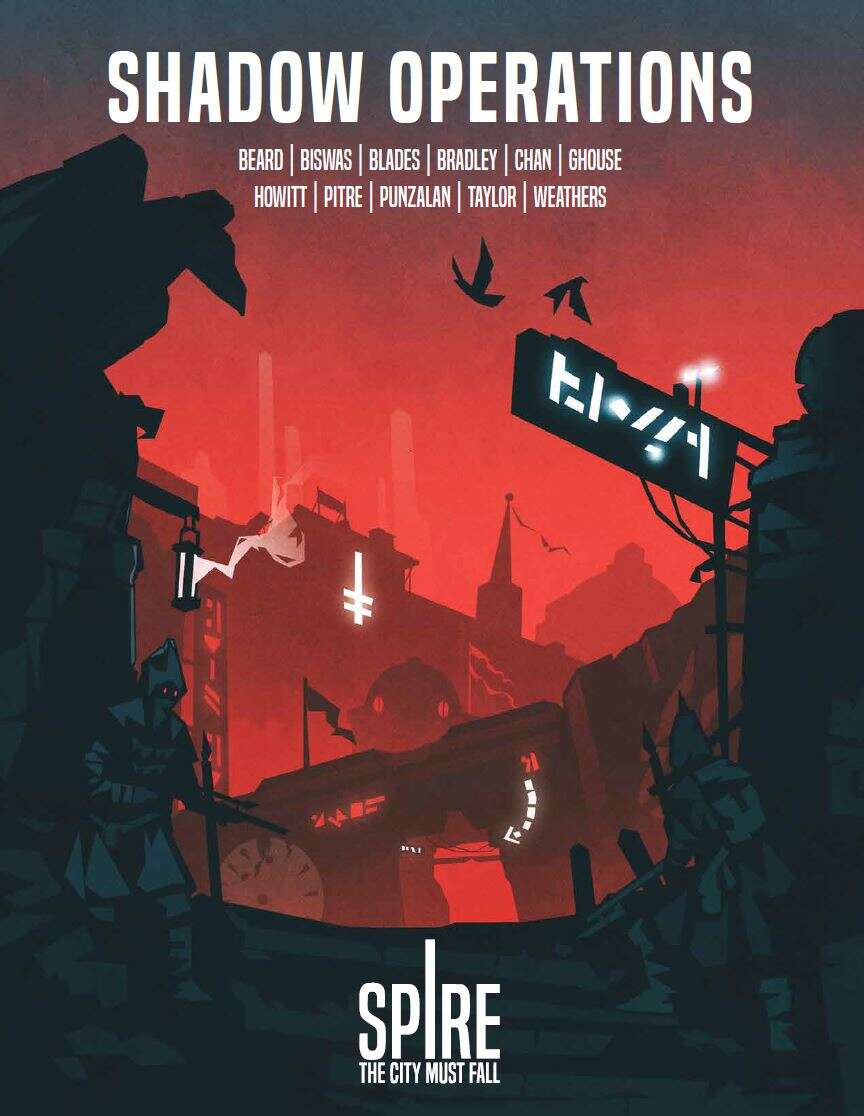
Shadow Operations is an anthology of scenarios for Spire:The City Must Fall, the roleplaying game of secrets and lies, trust and betrayal, violence and subversion, conspiracy and consequences, and of committing black deeds for a good cause. It is set in a mile-high tower city, known as the ‘Spire’, in the land of the Destra, the Drow, which two centuries ago the Aelfir—or ‘High Elves’—invaded and subjugated the Dark Elves. The Drow have long since been forced to serve the High Elves from their homes in the city’s lower levels and allowed only to worship one facet Damnou, the moon goddess, instead of the three they once did. However, not all of the Drow have resigned themselves to their reduced and subjugated status and joined ‘The Ministry of Our Hidden Mistress’, or simply, the Ministry. Its members venerate the dark side of the moon, the goddess of poisons and lies, shadows and secrets, her worship outlawed on pain of death, and they are sworn to destroy and subvert the dominion of the Aelfir over the Drow and the Spire. Published by Rowan, Rook, and Decard Ltd., Spire: The City Must Fall inverts traditional fantasy, making the traditional enemy in fantasy—the Drow—into the victim, but not necessarily the hero.

Shadow Operations addresses an issue inherent to Spire: The City Must Fall. The roleplaying game does not do one-shots. Instead, it is designed for campaign play, which will take the Player Characters, as members of the Ministry, up and down the Spire from the flickers of revolution to the fall of the High Elf regime. What though, if the Game Master wanted to run a one-shot at a convention or as a taster for her gaming group prior to running the roleplaying game proper? This is where Shadow Operations comes to the fore. It is an anthology of short, standalone adventures, the only connection between them being that the Ministry and thus the Player Characters will want to get involved in them. They are all designed to be played in a single three-to-four-hour session, so are suitable as convention scenarios, and they are also formatted to be accessible and easy to prepare. Even so, their low preparation time and their short running length does not preclude the Game Master from including them in her campaign. In fact, the anthology is worth having simply to have a set of accessible, low preparation scenarios to hand.

The simplicity and the low preparation time starts in the introduction to Shadow Operations. Despite having a total of eleven scenarios, the anthology includes just the one set of stats for the NPCs that appear in all eleven scenarios. Or rather it provides stats for archetypes, such as the Fool, the Vizier, the Queen, the Monster, and more, which will appear in most, if not all, of the scenarios. All the Game Master has to do is apply the backgrounds for the versions of these archetypes which appear in each scenario. Which means that the Game Master only has to refer to the one set of stats which learning the specifics of each NPC. Plus, if the Game Master portrays each NPC as written, the players are unlikely to notice the lack of difference in stats from one scenario to the next. Then each of the scenarios is organised in the same fashion. This includes Mission Parameters, Recommended Classes, an Introduction, Non-Playing Characters (NPCs), Suggested Scenes, Locations, Props, Twist, and Reward. ‘Suggested Scenes ‘ are exactly that, scenes that will help push the scenario’s plot involved and get the Player Characters involved. ‘Props’ details other objects and minor NPCs that the Player Characters might encounter as part of the scenario, and they can either be visible where everyone can see and make use of them in terms of the narrative, or hidden, in which case the Player Characters will need to investigate to reveal them. The ‘Twist’ simply the plot twist. This will be revealed during the scenario and in general, make the Player Characters’ lives that much more complicated. Lastly,  the ‘Reward’ is what the Player Characters can expect to gain from successfully, even partially successfully, completing the scenario. Most of the scenarios award bonds, or connections, between the surviving NPCs and Player Characters. The majority of the scenarios are no more than four pages long—and that includes a full-page illustration which prefaces each scenario.

The scenarios themselves include assassinations, uncovering mysteries, protection jobs, preventing conflicts, breaking into and out of jail, locating objects, and more. Many, if not all, begin en media res, with the Player Characters already in the plot at the start of the scenario, with the players being asked how they got there—typically through the means of bribes, false papers, threats of violence, actual violence, and so on. So for example, in Grant Howitt’s ‘Life and Soul’, the Player Characters have to get into a gangster’s birthday party and assassinate him in such a way that the message is clear—do not sell weapons to every buyer, and the players are expected to explain how they gained admittance. In ‘The Last Train’ by Nathan Blades, the Player Characters are tasked with finding the last train still operating on Spire’s otherwise defunct public transport network. Finding it and ensuring it still worked would strengthen an alliance for the Ministry. In Christopher Taylor’s ‘A Shotgun Wedding’, the Player Chaarcters not only have to infiltrate the wedding held at the Church of the Gun, which means a fusillade of gunfire and bullets from start to finish, but prevent anyone from disrupting or stopping it. There are plenty of factions who do not want the ceremony to go ahead. ‘Powderkeg’ is well named. By J.P. Bradley, it sends the Player Characters into the North Docks where the feud between two taverns has escalated to the point where a turf war is about to break out. This includes jousting, but done without horses, of course!

Jason Pitre’s ‘The Show Must Go On’ takes to the Player Characters to the theatre where they have to ensure that performance of a controversial blood opera goes ahead, since prior performances have actually sparked revolution, whilst in ‘Jailbreak’ by Basheer Ghouse, the Player Characters have to break into the Hive, the city’s greatest prison, to free a rebel war hero. Unfortunately, he turns out to be a monster who might be a danger to the Ministry, let alone the authorities. ‘How to Steal a Body’ by Pauline Chan is another break in scenario. The Player Characters must steal a corpse from a necropolis morgue, a task made the more difficult by the presence of ghosts and having to get it across the city, plus a time limit. The body must not yet have suffered decomposition! In Christine Beard’s ‘Rime and Reason’ is another prison break in, this time into the literally cold storage facility of Amaranth, to get a key anti-establishment figure back out before word spreads of his incarceration, whilst in ‘House of Leaving’ by Sharang Biswas the Player Characters are charged with finding a missing historical researcher who might have uncovered something  which threatens to undermine the accepted wisdom of the accepted faith in the Spire. Just how damaging could it be? ‘The Moon Beneath’ by Jabari Weathers continues the religious strand of scenarios with Player Characters trying to prevent an important cleric brought over to support the Ministry from slipping into corruption, whilst in Pam Punzalan’s ‘Feral Saints’—the longest scenario in the anthology—they must find a reborn saint, a Hallow, capable of healing the sick and feeding the poor from falling into the wrong hands.

Rounding out Shadow Operations is a short section on ‘Running One-Shots’. This is the Game master used to running a longer campaign which Spire: The City Must Fall is intended for. The main advice is to be upfront everything and sign-post much of the obvious elements within a scenario. It recommends doing this on index cards where the players can see them and refer to them in play., Overall good advice, if obviously short.

Physically, Shadow Operations is well presented. Everything is neatly organised and easy to reference, done in a succinct style for start to finish. Overall, this is an excellent set of scenarios, designed not only with strong plot and exciting situations and dilemmas in mind, but also ease of both use and preparation. For the Spire: The City Must Fall Game Master, Shadow Operations is an very useful source of scenarios ready to run a convention or add to a campaign.

Sunday, 28 October 2018

Stressful Sedition

Two centuries ago, the Aelfir—or ‘High Elves’—invaded the Spire, a mile-high tower city in the land of the Destra, the Drow, and subjugated the Dark Elves. Whether the Spire is a fossilised tree of flesh and bone, the larval form of a deity, or a vast consensual hallucination accepted by all as real, the Aelfir forced the Drow into the city’s lower levels and destroyed their temples. Where they had once worshipped all three facets of Damnou, the moon goddess, the Drow are only allowed to venerate the one, Limyé, Our Glorious Lady and the Light Side of the Moon, by their Aelfir masters. All Drow are expected to enter a four year period of indentured service, known as ‘Durance’, with the Aelfir, some hauling raw materials to the furnaces in the Works, harvesting fruit or tending algae vats in the Garden, some swathed in protective clothing against the sun in as soldiers in the Allied Defence Force, and others entering personal service of some Aelfir Lord or Lady as a personal assistant, pet, duellist, emissary, and so on. The Aelfir, creatures of great beauty and colour and magic, enjoy lives of luxury in the Spire’s higher levels and although do run the Spire or undertake great acts of art or study, most spend in the pleasure domes. Yet from amongst the drudgery and poverty of the Works and the Garden Districts has arisen a threat to this order, The Ministry of Our Hidden Mistress, or simply, the Ministry. Its members venerate the dark side of the moon, the goddess of poisons and lies, shadows and secrets, her worship outlawed on pain of death, and they are sworn to destroy and subvert the dominion of the Aelfir over the Drow and the Spire.

This is the setting for Spire: The City Must Fall, a roleplaying game published by Rowan, Rook, and Decard Ltd. following a successful Kickstarter campaign. It is a roleplaying game of secrets and lies, trust and betrayal, violence and subversion, conspiracy and consequences, and of committing black deeds for a good cause. It is for want of a better description, a roleplaying game of fantasy- or Elf-punk, one which combines Mervyn Peake’s Gormenghast with Gareth Evans’ The Raid, William Gibson’s Neuromancer with the television series, Peaky Blinders, and China Mieville’s Perdido Street Station with Blade Runner. There is technology and there is magic, but neither influence the ‘Punk’, the attitude of the Spire’s protagonists, who are rising up from the streets as the cell of a rebel movement to overthrow their High Elf masters. It is these protagonists that the players will roleplay, Drow who have completed their Durance and who in the eyes of the state have joined an illegal organisation and engaged in an outlawed practice. They are resistance fighters with a righteous cause, but to the state, they are rebels, criminals, and worse, terrorists. The question is, how far will they go to bring about the change they desire, what acts will they commit, and what are the likely consequences?

In comparison to other roleplaying games, the fantasy of Spire: The City Must Fall is a low fantasy. Divine magic, the magic learned from the church or temple is weak compared to occult magic, but occult magic is potent, unreliable, and likely to fry your brain, whilst magic items are rare. Similarly, there are no monsters—both protagonists and antagonists are people, although the protagonists are Drow, whereas the antagonists might be Drow, Aelfir, or Humans. Also, there are morality mechanics, rather the morality comes the choices that the player characters make and the actions they take, all of which take place within the urban and industrial confines of the Spire.

A character in Spire: The City Must Fall is defined by his Durance, what he did before being recruited by the Ministry, and his Class, what he does now. Together, these grant Skills, Domains, Abilities, Resistances, and Bonds. Skills are what he can do such as Compel, Fight, or Steal, whilst Domains are areas of knowledge and expertise like Crime, High Society, or Religion. Abilities are things a Player Character can do granted by a Class, such as the ‘Cut a Deal’ of the mercantile Azurite Class, some granted by the Class, others a player must select. Resistances—Blood, Mind, Silver (money), Shadow (secrecy), and Reputation—represent a character’s capacity to withstand Stress in particular categories. Suffer too much and a Player Character will be subject to fallout, which can be Minor, Moderate, or Severe. Whilst fallout reduces a character’s Stress from a particular Resistance, it has consequences. For example, a Minor Fallout for a character’s Reputation might be that he tells a lie which will cause a problem later on, whilst a Moderate Fallout for Blood could be a broken arm. Bonds are connections to NPCs who can help or hinder a player character and if they suffer Stress, then the potential Fallout will affect the relationship.

To create a character, a player selects a Durance and a Class. From the Class a player needs to choose two Low Advances—essentially two minor improvements to the character, pick some equipment, and name some Bonds. The Durances range from Acolyte and Agent to Sage and Spy, options are included should a Drow manage to have avoided his Durance. The Classes include the Azurite, wheel-dealer and hustler; the Bound, acrobatic vigilante; the Carrion-Priest, heretical death-worshippers who believe that the dead should be eaten by holy hyenas to ensure the safety of their solus; the Firebrand, rabble-rousing revolutionary; the Idol, artist-sorcerer and revolutionary; the Knight, ancient order fallen into criminal dishonour; the Lajhan, priests of Our Glorious Lady, the Light Side of the Moon; the Masked, who know the ways of Aelfir society at the top of the Spire; the Midwife, arachnid defenders of the Drow who tender to their young; and the Vermissian Sage, Drow historians who hide their research in an abandoned, non-Euclidean, maze-like, mass transport network that runs throughout the Spire. All eight Classes are interesting and nicely pull each character type into the setting of the Spire.

Our sample character is Yashek. He served his four years as a scribe and then sage to an Aelfir lord who was attempting to write a history of the Drow. His own researches eventually lead him to the strange network of tunnels and corridors beyond and inside the Spire and to learning some Occult magic.

Yashek
Durance: Sage
Class: Vermissian Sage

Skills: Compel, Fix, Investigate
Domains: Academia, Occult, Technology
Abilities: Back Door (to the Vault), The Vault, Obsessive Researcher
Advances (Low): That Didn’t Happen, Mental Directory
Resistances: Blood, Mind 6, Silver, Shadow 1, Reputation

Refresh: Uncover hidden information.

Bonds: Herik, researcher in the vault; Player Character with a Secret

Equipment: Dagger (concealable)

It is interesting to note that Spire: The City Must Fall there is no experience point system. Instead, player characters are rewarded for making a change—for good or ill. Make a small change and a character will gain a Low advance, make a moderate change and he can choose a Medium advance, and so on. What you have here then, is an experience system driven by the ends not the means, the narrative rather than the mechanics.

Mechanically, Spire: The City Must Fall uses dice pools of ten-sided dice. Whenever a character wants to undertake an action, his player rolls a ten-sided die. A result of a one is a critical failure, two to five is a failure, six and seven is a success at a cost, eight and nine a success, and ten is a critical success. A player can add more dice to the roll if his character has an appropriate Skill, Domain, or Mastery over the Skill or Domain. For example, Yashek’s would only roll one ten-sided in combat because he does not have the Fight skill; two dice for Yashek to persuade someone using the Compel skill; and three dice if he was attempting to mend a scanning device using the Fix skill and the Technology domain. No more than four dice can be rolled for an action and only the highest counts. The Game Master can adjust the difficulty by removing one or two dice from a player’s dice pool.

Unless a player rolls eight or more, the result of an action will inflict Stress upon the Player Character, the type depending upon the nature of the action—the more stressful the situation, the greater the die type the Game Master rolls to determine the Stress suffered. For example, using Compel to persuade a watch patrol to let you go might inflict Minor Stress or a three-sided die, Moderate Stress or a six-sided die if the watch captain is present, or Severe Stress or an eight-sided die if the watch commander is involved. Taking Stress can result in a character Fallout, actual consequences of his actions. In some situations though, a character can withstand Stress because of a high Resistance. So a character with a high Blood Resistance is tough or can parry blows; a high Mind indicates strength of will; a high Silver is wealth and resources; a Shadow is a good cover or well-kept secrets; and a Reputation is good standing with a group. Some equipment, such as armour for Blood, can enhance a Resistance. 

Once a character starts taking Stress, the Game Master keeps track of both the type and the total for all of a character’s Stress. If she rolls under that total on a ten-sided die, then the character loses Stress, but gains Fallout, effectively injuring something related to the Resistance. It is also possible to remove Stress by laying low—but essentially, this takes the character out of the story for a scene; by using a Class Refresh Action; or by undertaking an action that remove stress, for example, borrowing money to reduce Silver Stress or going to a doctor to reduce Blood Stress.
For example, Yashek borrowed a scanner from the Vault without permission, but it got broken on a mission. He needs to repair it before he can return it. His player rolls three dice—one plus one each for Yashek’s Fix Skill and Technology Domain. He rolls 1, 4, and 6. The highest result is a six, meaning that he succeeds, but at a cost. The Game Master rolls a three-sided die for Stress, inflicting three points of Stress. The Game Master now rolls for Fallout and rolls a one, indicating a Minor Fallout and a reduction his Reputation Stress by three points. Since this is against Yashek’s Reputation, the Game Master decides that this will result in his committing a Lie about how the device got damaged.
Both Combat and Magic—whether Divine or Occult—uses the same mechanics, the Stress from their outcomes will primarily affect the Blood Resistance or the Mind Resistance respectively. The magic itself is represented by various Class abilities and advances, rather than a separate set of mechanics. Similarly, Bonds can also suffer Stress, so a Player Character’s connection can degrade too. Overall, the fact that Fallout is rolled against a Player Character’s total Stress means that the mechanics in Spire: The City Must Fall have a really brutal feel to them (though alternative rules are provided should a group decide they are too brutal). The players will need to move carefully if their characters are to avoid accumulating Stress, but as stories and plots ramp up, the more their actions should have consequences and the greater the Stress involved.

A good two fifths of Spire: The City Must Fall is devoted to the setting and background the tower city. What is interesting about the descriptions is that they are tied thematically to several of the Domains—Academia, Commerce, Crime, High Society, Low Society, Occult, Order, and Religion, though not Technology. The districts and factions related to these domains are rich in detail and hooks for the Game Master to build her campaign around. There is a lot here for the Game Master to bring out and the density of the material may be a hindrance for the Game Master in setting up her campaign.

That said, there is good advice for the Game Master on how to run Spire: The City Must Fall. This includes general advice as well as examining the game’s themes and in turn, the three stages of a revolution in the Spire—the Gathering Storm, the Strike, and the Aftermath. It also includes a discussion of what makes a good villain and how to make the city the Game Master’s own. A nice touch that it examines what players are expecting when they select a particular Class. It is followed by seven appendices, in turn describing the new gods and cults to be found in the Spire, giving tables of random events and things, providing a Drow glossary, describing the ‘Rumoured Goats of Spire’(!?), hinting at the arcologies of ancient race known as the Prokatos to be found far beyond the walls of Spire, adding tables of antagonists, and listing suggested media. The contents of the latter is helpful to get the feel and tone of Spire: The City Must Fall beyond the rich description given earlier.

Physically, Spire: The City Must Fall is an attractive hardback, cleanly laid out and sturdily illustrated in an imposing style. The writing is also enjoyable, but not always clear where it needs to be. For example, it is not readily apparent that the mechanics are primarily player facing, that is, the players do the majority of rolling the dice with the Game Master only really rolling for Fallout and its effects. Which very much changes how the game is run by the Game Master. What is also missing is a starting point for the player characters and their revolution, is an easy hook to get a campaign begun. Now, arguably Spire: The City Must Fall is not designed to played or run by players or Game Masters new to roleplaying, but that starting point would nevertheless have been useful.

Spire: The City Must Fall inverts traditional fantasy, making the traditional enemy in fantasy—the Drow—into the victim. It makes the enlightened golden boys of fantasy—the High Elves—into the enemy. Yet, it does not make the Drow the heroes, freedom fighters with whom we can easily identify with. Rather, it pushes them towards ends justifying the means and into a moral grey area where they might actually be the terrorists that their Aelfir subjugators claim them to be. Spire: The City Must Fall is a superb dark fantasy roleplaying game where the overthrow of the state is ultimately attainable and good, but the consequences of the actions taken to get there are the point of playing.