Every Week It's Wibbley-Wobbley Timey-Wimey Pookie-Reviewery...
Showing posts with label Ancient History. Show all posts

Friday, 31 May 2024

The Other OSR: Under the Seal of Solomon

Under the Seal of Solomon is a scenario for Into the Bronze: Sword & Sorcery RPG in Bronze Age Mesopotamia. Published by Lantern’s Faun, as the title suggests, it is set in the Bronze Age in Mesopotamia on the plains between the Tigris and Euphrates rivers. Here the first city states were founded, here the first men and the women strode forth to explore the lands between the first two great rivers known to mankind, to enter the silent, gloomy valleys where demons and their acolytes hid and devised their evil plans, here they would encounter the very gods of Sumer, and here they would build the first great civilisations. As those first men and women to stride the land, the Player Characters are Sumerian ‘Bounty Hunters’ , those willing to go forth and undertake dangerous tasks—explore the unknown, hunt down criminals, kill monsters, and more… In Under the Seal of Solomon, the Player Characters have a greater calling—killing demons!

In Under the Seal of Solomon, the king, Solomon himself, has selected the Player Characters for a great task. Whether the Player Characters are augurs, astronomers, sorcerers, priests, or warriors, you have been given a new role—exorcist. Demons run rampant across his kingdom, and King Solomon has chosen them to rid them from his lands. However, this is no easy task since demons cannot be killed. Instead, their physical manifestation must be defeated, the demon captured, and then conveyed to the Temple of Solomon where it can confess its corruptions. Only then will the kingdom be free of that one demon. There are seventy-two demons. If though, a demon cannot be killed, how is this task to be achieved? In addition to blessing the Exorcists with an oath to capture the demons, King Solomon bestows them with three other gifts. These are the Keys of Solomon, the Seal of Solomon, and the Jar of Solomon. The Keys work in similar fashion to the Magic Words in Into the Bronze, being written down on tablets or sheets of vellum and used against a demon. However, unlike the tablets of the Magic Worlds, the Keys of Solomon do not break, only the implements using them do. The Seal of Solomon is a ring engraved with his sigil used to seal the written Keys, whilst the Jar of Solomon is used to trap a demon before taking it to the Temple of Solomon. So think of this as Ghostbusters, but with Demons and set in Ancient Mesopotamia and not New York.

The bulk of Under the Seal of Solomon is dedicated to describing its seventy-two demons who are ranked as Kings, Dukes, Princes, Marquises, Counts, Knights, and Presidents—and some can hold more than one rank. A pleasing presentation places the hierarchy of the demons upon the steps of a ziggurat! Each demon is described in terms of its Manifestation, its Domain, and what Invocations it knows. The Domain is the power it holds over other demons and the Invocations are the powers it tempts sorcerers with. For example, Bael, King of the East, holds the Rank of King, manifests as a three-headed conglomeration of cat, toad, and man, has the Domain of “66 legions of demons”, and his Invocations include the teaching of science, bestowing of Invisibility, and the teaching of love. Attributes, Hit Points, and Damage are determined by the demon’s Rank.

In terms of support and advice, Under the Seal of Solomon suggests that a demon might be hiding amongst the population or tempting them openly as a false god, or colluding with a sorcerer. It suggests having a single demon dominate or take over a single hex, creating a location around it, in the process turning Into the Bronze into not so much a hexcrawl, but a hex clearance. The other factor that the Under the Seal of Solomon makes clear is that seventy-two demons is a lot and so the Player Characters are not the only ones to have received the blessings of King Solomon. This enables the Game Master to bring rival Exorcists into play. Lastly, Under the Seal of Solomon notes that it is set during the end of the Bronze Age, at the dawn of the Iron Age.

Physically, Under the Seal of Solomon is nicely presented, although the use of red text on black in places is not easy to read. It does need another edit.

Unfortunately, Under the Seal of Solomon is at best very light, at worst underwritten and underdeveloped. For example, it is not quite clear whether one Exorcist is holding the Keys of Solomon, the Seal of Solomon, and the Jar of Solomon and using them to fight demons or if they are divided between several Exorcists. Nor is it really clear how the Keys of Solomon work against the demons and what the user is actually dealing with them. Similarly, there is no actual adventure in Under the Seal of Solomon as its cover claims. Instead, what it gives the Game Master is a campaign set-up. It is not even a campaign framework, because there is only a beginning, and not a middle or an end. After all, what happens when the Exorcists have defeated all of the demons?

Ultimately, there is no denying that Under the Seal of Solomon is a great set-up for Bronze: Sword & Sorcery RPG in Bronze Age Mesopotamia (and indeed for any roleplaying game set in Bronze Age Mesopotamia). Unfortunately, it simply does not support the Game Master as fully as it should and leaves her with more concepts to develop and questions to answer than it really should
.

—oOo—

Soul Muppet Publishing will be at UK Games Expo which takes place on Friday, May 31st to Sunday June 2nd, 2024.

Saturday, 4 March 2023

Quick-Start Saturday: Aegean

Quick-starts are a means of trying out a roleplaying game before you buy. Each should provide a Game Master with sufficient background to introduce and explain the setting to her players, the rules to run the scenario included, and a set of ready-to-play, pre-generated characters that the players can pick up and understand almost as soon as they have sat down to play. The scenario itself should provide an introduction to the setting for the players as well as to the type of adventures that their characters will have and just an idea of some of the things their characters will be doing on said adventures. All of which should be packaged up in an easy-to-understand booklet whose contents, with a minimum of preparation upon the part of the Game Master, can be brought to the table and run for her gaming group in a single evening’s session—or perhaps two. And at the end of it, Game Master and players alike should ideally know whether they want to play the game again, perhaps purchasing another adventure or even the full rules for the roleplaying game.

Alternatively, if the Game Master already has the full rules for the roleplaying game the quick-start is for, then what it provides is a sample scenario that she still run as an introduction or even as part of her campaign for the roleplaying game. The ideal quick-start should entice and intrigue a playing group, but above all effectively introduce and teach the roleplaying game, as well as showcase both rules and setting.

—oOo—

What is it?
Aegean Quick Start Rules is the quick-start for Aegeana roleplaying game about a group of mythic heroes building a new, free city on the shores of the Aegean Sea.

It includes a basic explanation of the setting, rules for actions and combat, the gods, the adventure, ‘The Nesaean Boar’, and five ready-to-play, Player Characters.

It is a one-hundred-and-one-page, black and white digest-sized book.

The quick-start is lightly illustrated, but tidily laid out. There are a lot of examples of the rules which speed the learning of the game.

How long will it take to play?
Aegean Quick Start Rules and its adventure, ‘The Nesaean Boar’, is designed to be played through in three to five sessions. Notes are included for the Game Master who wants to run it in a single session.

Who do you play?
The five Player Characters are all would be mythic heroes. They consist of a ranger and hunter, a famous athlete, a healer, an oracle, a merchant, and a wealthy soldier. All are available to download from the publisher’s website.

How is a Player Character defined?
A Player Character in Aegean has five characteristics—Might, Reflexes, Cool, Insight, and Cunning—and several broad skills, such as Lore, Melee, and Perform. All are rated between one and five, although specialisations increase the rating of skills by one. He has the attributes Resolve, Risk, Endurance, Standing, Wounds, Hubris, Glory, and Fate. He can also have Gifts and Talents, the first bestowed by the gods upon heroes of divine parentage, the second representing his greater expertise.

Resolve represents the gods’ favour and is spent to add to a story detail, gain a single success, or activate an item property. A Player Character does not begin play with Resolve, but can earn it when tens are rolled on the dice. It has to be used by the end of a session or the Player Character gains the disfavour of the gods and earns Hubris. Risk represents the danger he is in and can be gained through play involuntarily or voluntarily, the latter to add successes to a roll or to activate an item property. When Risk exceeds a Player Character’s Endurance, he gains a Wound. Gain enough Wounds and they can be spent as Scars in a fashion similar to Experience Points. Hubris is a Player Character’s Pride and if it exceeds his Glory, the gods’ disfavour is gained and he is Cursed. Fate can be a Player Character’s Goal, Belief, or Passion.

How do the mechanics work?
To have his player undertake an action, a player rolls a pool of ten-sided dice. This is equal to the value of the characteristic and the skill being used, plus any appropriate specialisation. Rolls of eight or more are counted as a Success. A Standard Difficulty does not require extra Successes for a Player Character to succeed, but harder tasks do, all the way up to a Difficulty Factor of five or Divine. Risk and Resolve can be spent to gain extra Successes. 
Rolls of ten can be used to gain an extra Success, a point of Resolve, remove a point of Risk, activate an item property, or give another Player Character a Success.

How does combat work?
Combat in Aegean is quite tactical taking into account terrain, range, and a variety of manoeuvres and actions. Actions include Defend, Disarm, Harm, and Taunt, whilst manoeuvres include Aim, Prepare, and Sacrifice Item. Initiative is interesting in that it can flow back and forth between the Player Characters and the NPCs. When the Player Characters have the initiative and continue to succeed in their combat rolls, the players can decide who acts next. If a roll is failed, the initiative passes to the Game Master and NPCs and if the Game Master fails a roll, it passes back to the players to decide who acts next. This continues until both Player Characters and NPCs have acted, but it can flow into the next round because whomever acts last in the round and succeeds gets to decide who acts first in the next.


How does magic work?
One of the pre-generated Player Characters does have the gift of Oracle, which grants him the ability to predict the future once per session. This is represented by an Insight (Lore) roll and this can be used to replace the results of a roll by another Player Character or NPC. If good roll, it can benefit the Player Character, if a bad, it can penalise an NPC.

What do you play?
Aegean is set in a mythic age which combines the periods of before the fall of Troy and the Greek dark age and Classical Greece when Sparta is at her military might and Athens a beacon of democracy. The given adventure, 
‘The Nesaean Boar’, begins in Vlokis, a coastal colony recently founded by Athens where the Player Characters live. They are asked to investigate an attack upon a farm belonging to Nesaea by a boar in which her family died. The adventure will take the Player Characters from Vlokis to Delphi to consult the oracle and discover a means of dealing with the creature, before locating said means and returning to confront the beast in its lair.

Is there anything missing?
Surprisingly not. 
Aegean Quick Start Rules also includes rules for item properties, downtime activities, and dealing with the gods, as well as advice for the Game Master in running the adventure. Further, there is scope for the Player Characters to gain Experience Points and their players to spend them to improve skills and purchase Talents. This enables a group to play further adventures, such as those in the Aegean Adventure anthology.

Is it easy to prepare?
The core rules presented in the 
Aegean Quick Start Rules are easy to prepare. The Game Master will need to pay closer attention to how the Resolve, Risk, and Hubris rules work as well as how to to handle interaction with, and portrayal of, the gods.

Is it worth it?
Yes. The 
Aegean Quick Start Rules present a concise, but detailed version of the rules that are tactical and engaging and encourage the players to roleplay through the need to balance their characters’ Risk, Resolve, and Hubris on the path to their characters becoming heroes. Although the Aegean Quick Start Rules are not free to download, they do offer scope for long term play, something that most other quick-starts do not. Whether or not a group decides to play beyond the given adventure, the Aegean Quick Start Rules are still a solid introduction to the rules and roleplaying in Mythic Greece.

Where can you get it?
The Aegean Quick Start Rules are available to download here. 

Saturday, 25 February 2023

1983: The Valley Of The Pharaohs: Role Playing Adventure

1974 is an important year for the gaming hobby. It is the year that Dungeons & Dragons was introduced, the original RPG from which all other RPGs would ultimately be derived and the original RPG from which so many computer games would draw for their inspiration. It is fitting that the current owner of the game, Wizards of the Coast, released the new version, Dungeons & Dragons, Fifth Edition, in the year of the game’s fortieth anniversary. To celebrate this, Reviews from R’lyeh will be running a series of reviews from the hobby’s anniversary years, thus there will be reviews from 1974, from 1984, from 1994, and from 2004—the thirtieth, twentieth, and tenth anniversaries of the titles. These will be retrospectives, in each case an opportunity to re-appraise interesting titles and true classics decades on from the year of their original release.

—oOo—

The Valley Of The Pharaohs: Role Playing Adventure
 set in Ancient Egypt has the distinction of being the first roleplaying game to explore the idea of roleplaying in Ancient Egypt, the first historical roleplaying game published by Palladium Games, the only boxed roleplaying game from Palladium Games, and the only roleplaying game from Palladium Games to not use its Megaverse rules. Published in 1983, the result is a game with a surprisingly simple and straightforward rules system, plenty of solidly researched background and historical material, and some superb illustrations and maps. However, even by the standards of the day, it suffers from cheap production values and a lack of development. Unlike other titles from Palladium Games, such as the Mechanoid Invasion Trilogy, it has not been reprinted. Consequently, The Valley Of The Pharaohs: Role Playing Adventure in Ancient Egypt has remained a historical curio, little remembered by anyone.

The Valley Of The Pharaohs: Role Playing Adventure in Ancient Egypt is a boxed set. Inside is a fifty-page, black and white rulebook, a full colour map of Ancient Egypt, and several sheets which depict the Nile Valley, routes across the deserts and ‘Nomes’ (a regional division of the country), city fortifications, house floorplans, the True Pyramid, the Step Pyramid, the Temple of Hatshepsut, and more. In the roleplaying game, players take on the roles of members of Egyptian society who go and well, not adventure exactly. Society in the setting is described as stable and as is made clear in the ‘G.M. Notes’, “…[T]he government will not allow a band of marauders to plunder the countryside (at least not within Egypt proper).” Instead, it is suggested that the adventurers undertake business trips or pilgrimages, perhaps be representatives of noble or merchant patrons. Alternatively, there are ruins to explore or military ventures to engage in beyond the borders of the country, even though none of Egypt’s enemies are detailed, but suggestions as to what the Player Characters might do in a scenario or campaign are really only covered in the barest of details. In some ways this parallels the feel of an earlier roleplaying game, Empire of the Petal Throne, which has always had the repetition of being dense and impenetrable and not easy to run from the material contained in the rules. That said, an experienced Game Master will be able to develop an adventure from the material in the book.

A Player Character in is, of course, Human and Egyptian. He is defined by his Caste, Attributes, Hit Points, Occupation, and Skills. There are four Castes—Nobility, Clergy, Bureaucracy, and Commons—and each Caste suggests possible Occupations and gives an Attribute bonus. For example, the Occupations for the Clergy Caste are Priest and Scholar and its grants a bonus to the Power Attribute. The five attributes are Strength, Speed, Intellect, Power, and Persona, and these range between three and eighteen. Hit Points are equal to double the Player Character’s Strength. There are five Occupations—Soldier, Priest, Scholar, Merchant, and Thief. Skills are given as percentile values, and come from a Player Character’s Caste and Occupation. To create a Player Character, a player rolls for his Caste, Attributes, selects an occupation, rolls for the number of Caste skills and selects them, and then picks four skills from those available from the Occupation. Oddly, the rulebook does not include a list of names. The process is quick, but not necessarily clearly explained. For example, Priests and Scholars can learn spells, but it is not how many they know at game’s start.

Akhethetep
Caste: Bureaucracy
Occupation: Scholar

Strength 06 Speed 09 Intellect 18 Power 16 Persona 14

Hit Points: 12

SKILLS
Agriculture 20%, Gaming 26%, Law 18%, Magick 32%, Philosophy 18%, Reading 18%, Swimming 09%, Writing 18%

SPELLS
Clairvoyance, Detect Truth, Illumination

Mechanically, The Valley Of The Pharaohs employs the percentile system. A player rolls under percentile dice against a particular skill to succeed. Beginning Player Characters are thus far from being very skilled and one of the stated aims of play, at least mechanically, is to improve skills. Skill improvement is done at the end of each session and is done with a roll over the skill as in other percentile systems. A Player Character can also gain training in a skill. Combat is different and uses a twenty-sided die. To attack an opponent, a player rolls the die and adds bonuses based on the character’s Speed Attribute and Combat Skill. The Valley Of The Pharaohs differentiates between the Combat, Military Combat, Shield, Archery, and Throw Skills, and the higher the skill, the more bonuses provided. If the player rolls higher than the Resistance Factor of the target’s armour, which can range from six for simple clothing and eight for padded to eleven for leather and fourteen for scale, then the character is successful in penetrating the armour. Damage is then rolled for and applied directly to the target’s Hit Points. However, if the roll is equal to the Resistance Factor and up to five less than the Resistance Factor of the armour, the attack hits and damage is applied to the armour’s damage capacity before the target. A defending character, though, does have the option of parrying or dodging, which requires a player to roll higher than the attack roll. Either way, a roll of a natural twenty is a critical hit and inflicts double damage.

In comparison to the combat rules, the base mechanic and the rulebook’s explanation of it are woefully underwritten. The combat rules are given much more detail and have a bit of cut and thrust to them with combatants able to parry and dodge as well as attack. Soldiers do feel more skilled though, because there is direct correlation between a Warrior’s skill and what he can do in mechanical terms. As he gains in skill, he has more attacks, bonuses to attack and parry, and more. So even the average warrior is going to have two attacks per round and a bonus to parry if he has the Military Combat skill, although it is not clear what the difference between the Combat and Miliary Combat skills are. 

Magic uses the Magick skill to determine both how well a Player Character casts spells and what spells he might possibly know. His Magick skill is rolled against whenever he wants to cast a spell as per the roleplaying game’s skill mechanic. Its value is also used as the level of a Player Character’s magical knowledge in that a Player Character might know or be able to learn and cast all of the spells of a level under the value of his Magick. Thus, a Priest or Scholar with a Magick skill of 25 might only know the Illumination, Detect Truth, Clairvoyance, and Move Water spells, which are levels ten, fifteen, twenty, and twenty-five, respectively. Spells have a Magic Point cost to cast, a duration, and a casting time, ranging from two to twelve combat rounds, such as with the spells Portal and Speak with Gods, depending on spell level. A caster can also extend a spell and attempt to ward or counter a spell if he knows the spell being cast at him. Characters of all types have access to passive magick through amulets, wax figures, Ushabti, magic pictures, and more. Amulets provide minor bonuses, such as the Serpent’s Head, a red stone amulet that protects the wearer from snakes and to a certain extent from magical snakes, whilst Ushabti resemble objects in the real world which come to life and magically perform tasks that their real-world equivalents would. For example, a bull Ushabti could come to life and plough a field or a soldier Ushabti protect its owner. In the case of amulets, the more someone wears, the less effective they are. Of the two, the passive magic of the amulets and similar objects is much more interesting and much more immersive than that of the active magic. This is not to say that active magic is not powerful, but it is not as flashy as in other fantasy roleplaying games, there are a limited number of spells, and there are few if direct combat spells. Another issue is that the spells feel generic, rather than being specifically tied to the setting of Ancient Egypt, its priesthoods, and its gods, and that is not the case with the passive magic. 

In terms of setting, The Valley Of The Pharaohs provides information on the history of Ancient Egypt, its society, government, law, slavery, army, and more. It pays particular attention to the clergy, which includes temples, medicine, beliefs, and of course, burial customs, plus the gods themselves. A bestiary gives stats for ordinary creatures such as crocodiles and baboons, and for monsters like great serpents and several unnamed man-eating beasts believed to inhabit the deserts. The range of monsters feels threadbare.

Rounding out The Valley Of The Pharaohs is a set of tables for random encounters and treasures, the latter slightly at odds with non-marauding style of play the author informs the Game Master is ill-suited to the setting. Even the limited number of spells with their even more limited number of direct combat spells enforce this style of play. Yet the advice for the Game Master is limited in terms of explaining what sort of games and campaigns can be run using The Valley Of The Pharaohs. In particular, military campaigns are severely curtailed because although the roleplaying game is set at a time when Egypt is conducting military campaigns beyond its borders, only neighbouring Nubia is mentioned, and then only in passing. So, no idea is given of who these possible rivals are and what their armies look like. Similarly, whilst priests are discussed in general, the only difference between them is that they worship different gods. So, it is not easy to develop scenarios involving inter-temple rivalries and factionalism because there is not enough information here. This is not to dismiss the amount of information in what is a forty-year-old roleplaying game just fifty pages in length, but rather it can at best be described as a decent introduction to the period—at least for 1983. An experienced Game Master would be able to overcome these issues with research, and there is a bibliography included in the back of the rulebook. Of course, there have been developments in Egyptology since, so even what is here may have become outdated by contemporary standards. Plus, research today is going to be much easier to conduct than it was in 1983. Ultimately in terms of a setting, The Valley Of The Pharaohs is almost too settled and too stable, so that there are no real tensions or rivalries or differences which might drive adventure, conflict, or obvious story.

Physically, The Valley Of The Pharaohs: Role Playing Adventure in Ancient Egypt manages to both please and disappoint at the same time. The production values are disappointingly poor, the quality of the paper a significant factor in that—especially for the various separate maps and illustrations, which consequently feel flimsy. The rulebook’s text is also small and cramped and not easy to read. Yet the artwork, the maps, and so on are really particularly good, strong, bold, and really capture the feel of the setting.

—oOo—
The Valley Of The Pharaohs: Role Playing Adventure in Ancient Egypt appears to have been reviewed just the once. This was by designer Jonathan Tweet, in the ‘Game Reviews’ department of Different Worlds Issue 45 (March/April 1987). He wrote, “The biggest obstacle to running a Valley of the Pharaohs campaign is the lack of motives for adventuring. The rules sanely remind gamemasters that armed adventurers freelancing as monster exterminators do not belong in 'the civilized, orderly land of Egypt but do not offer alternatives to the kinds of adventures players usually enjoy. If the game was designed so that the scholar, merchant, and soldier characters could have exciting adventures in civilized country like Egypt using all the noncombat skills described, Valley of the Pharaohs would have been given a better rating, but the game left me with no excitement as to the possibilities for scenarios.” before concluding that, “The Valley of the Pharaohs, then, would be a worthwhile game for those with deep interest in ancient Egypt and for those gamemasters with enough energy and imagination to synthesize historical background and basic game mechanics into an original and exciting campaign. Good luck to those of you who try.” He awarded The Valley Of The Pharaohs: Role Playing Adventure in Ancient Egypt just one-and-a-half stars.
—oOo—

The Valley Of The Pharaohs: Role Playing Adventure in Ancient Egypt has all of the right substance—solid, if basic rules, a decent amount of background and history, and plenty of excellent illustrations and maps, but where it comes up short is application. What exactly do you do with it and what sort of scenarios and campaigns do you play? The basic advice that The Valley Of The Pharaohs is a stable and settled society does not leave the Game Master with a great deal to work with in terms of setting up a campaign or even a scenario. There is no denying that there is the basics of a solid enough roleplaying game in The Valley Of The Pharaohs: Role Playing Adventure in Ancient Egypt, but in terms what adventures can be run, it is underdeveloped and leaves a lot of work for the Game Master to do. One might say that it is all ‘Valley of the Pharaohs’ and not enough ‘adventure’.

Saturday, 15 January 2022

The Other OSR: Into the Bronze

Published by Lantern’s Faun, Into the Bronze: Sword & Sorcery RPG in Bronze Age Mesopotamia is a minimalist roleplaying game built on the architecture of Into the Odd. As the title suggests, it is set in the Bronze Age in Mesopotamia on the plains between the Tigris and Euphrates rivers. Here the first city states were founded, here the first men and the women strode forth to explore the lands between the first two great rivers known to mankind, to enter the silent, gloomy valleys where demons and their acolytes hid and devised their evil plans, here they would encounter the very gods of Sumeria, and here they would build the first great civilisations. As those first men and women to stride the land, the Player Characters are Sumerian ‘Bounty Hunters’ those willing to go forth and undertake dangerous tasks—explore the unknown, hunt down criminals, kill monsters, and more… In return, their wicker baskets will be filled with great wealth—treasures, secrets, and favours. With their treasures, their wealth, and their secrets, they not only have the potential to make their mark on the world, but go onto to stamp on the world by building and constructing civilisation around them.

Into the Bronze: Sword & Sorcery RPG in Bronze Age Mesopotamia includes thirty-six backgrounds, a flexible narrative system for enchantments, a simple system for building and construction, exploration, encounter creation, god creation, and a bestiary. A Player Character or Sumerian in Into the Bronze is lightly defined—and needs to be! A Sumerian is a fragile thing, weapons and monsters both being deadly, so a Sumerian can be quickly and easily replaced. Sumerian has three Ability scores—Strength, Dexterity, and Willpower, his Hit Protection, some Obsidian (the currency), a Background which provides two Items of Equipment. Depending on the Background, a Sumerian may have Magic Words, though they count as an Item. To create a Sumerian, a player rolls three six-sided dice for each Ability and keeps the highest two, a six-sided die each for his Hit Protection and Obsidian, and then cross references the values of his Hit Protection and Obsidian to determine his Background. A Sumerian also has a weapon of his choice, a single torch, and his Omens. Garments and physical features can also be rolled for. Rolling up a Sumerian takes minutes at most.

Harran
Background: Beer Brewer
Omens: In the night Harran was born, they saw sandstorms (Reckless/Sanguine)
Physical Feature: Has a falcon
Strength 6
Dexterity 11
Will 9
Hit Points: 3
Obsidian: 3
Item: stone spoon (1.5 m), torch, yeast, spear
Garment: Black Linen

Mechanically, Into the Bronze is simple. To undertake an action, a Sumerian player rolls a twenty-sided die, attempting to roll equal to or less than an ability. When it comes to combat, Initiative is handled narratively, with the Game Master foreshadowing events around the Sumerians to both engage them and determine when they act. Otherwise, mechanically, combat involves rolling for damage rather than to hit. Every attack hits and does damage, rolled on a six-sided die. All weapons ‘explode’ and allow an extra die to be rolled and added to the total if a six is rolled. Heavier weapons explode on a four, five, or six. Damage is inflicted on a Sumerian’s Hit Protection and then his Strength. Any time a Sumerian suffers Strength damage, his player must make a test against his Strength, failure indicating that he has suffered a critical hit. The effects of this are determined by a roll of an eight-sided die on the Critical Hit Table, and can be anything from a scar, teeth being knocked out, loss of a limb, all the way up to death. The life of the average Sumerian who ventures out from the safety of the city is likely to be nasty, brutish, and short.

Another effect of combat and other situations is that a Sumerian may suffer Conditions. Unfortunately, these are not given in ‘Annex 1’ as Into the Bronze states, but are attached to the character sheet for the game. Many of these Conditions also cause a player to roll with Disadvantage. This is not explained in Into the Bronze either, but essentially this should be taken to refer to the Advantage/Disadvantage mechanics common to other roleplaying games, first seen in Dunegons & Dragons, Fifth Edition. In play, Conditions also take up slots in a Sumerian’s Inventory, much like Mausritter. Lastly, items such as torches, lanterns, and the like all have a Usage die, which is rolled on six-sided die, one use being marked each time a player rolls four, five, or six.

Some Backgrounds such as Archivist, Astrologer, Enuuch, Scribe, Mathematician, and Tapestry Weaver have access to Magic Words, and so through Divine Intonation, the Language of the Sacred. At the start of play, a Sumerian with such knowledge knows two words, such as Treason, Clay, Bones, or Steps, but can learn more. The player of such a Sumerian describes the effect he wants using the Words his Sumerian knows and casts the combination automatically as an enchantment. However, the Game Master determines the cost of casting the enchantment in terms of Hit Protection, or Strength if the caster has no Hit Protection. For example, Gizzal the Enuuch knows the Words Treason and Shadow. Chased by some bandits, he calls upon the gods to direct the bandits’ shadows to betray them and so confuse them as to the direction they are heading in. The Game Master decides that since this is affecting several bandits, Gizzal will lose two points of Hit Protection, but he will get away from the bandits. The Enchantments rules are simple and engaging to use, encouraging player inventiveness, whilst at the same time being far more narrativist than a roleplaying like Into the Bronze usually would be.

More than half of Into the Bronze is about building the world around the Sumerians. This includes elements such as weather and travel, but much is devoted to creating the terrain nearby for the Sumerians to explore and then populating these hexes with encounters across steppes, swamps, deserts, and mountains, and adventure sites. These are backed up with a lengthy table of adventure hooks, a table for creating the gods who walk among men, and a bestiary of classic creatures, such as Ghouls, Griffins, and Minotaurs. These are joined by monsters and creatures out of Sumerian myth, such as the Ekkimu, unburied bodies who have returned as demons and hunt in packs of seven to hunt for human flesh.

Physically, Into the Bronze is decently presented with a range of Public Domain Artwork and laid out in an exciting style. In places, the artwork is poorly handled though, and worse, the roleplaying game is underdeveloped. For example, the lack of explanation for the Disadvantage mechanic, whether or not there is a corresponding Advantage mechanic, and the missing Conditions. An experienced Game Master will be able to address this issue, but having to do so, adds more effort than is necessary in running the game—if only a little. In terms of running Into the Bronze, the Game Master will need a fair bit of effort with Into the Bronze given the brevity of the rules, but at least a bibliography is included for further research. Certainly, the Game Master will need a few more monsters and threats to throw at her players. As a framework, it is potentially too sparse, but that does mean there is room aplenty for input by both the Game Master and her players.

Despite its flaws, Into the Bronze is a fantastic little toolkit for running games in a version of ancient Mesopotamia that the roleplaying game provides a means to create and the Player Characters to then explore and go onto building civilisation. Simple and easy to play, Into the Bronze: Sword & Sorcery RPG in Bronze Age Mesopotamia is an enjoyably nasty, brutish, and short roleplaying game set at the dawn of civilisation.


—oOo—

Into the Bronze: Sword & Sorcery RPG in Bronze Age Mesopotamia is available for sale in print here or in PDF here.

Sunday, 2 January 2022

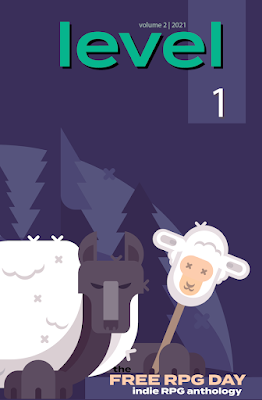
[Free RPG Day 2021] LEVEL 1 – volume 2 2021

Now in its fourteenth year, Free RPG Day in 2021, after a little delay due to the global COVID-19 pandemic, took place on Saturday, 16th October. As per usual, it came with an array of new and interesting little releases, which traditionally would have been tasters for forthcoming games to be released at GenCon the following August, but others are support for existing RPGs or pieces of gaming ephemera or a quick-start. Of course, in 2021, Free RPG Day took place after GenCon despite it also taking place later than its traditional start of August dates, but Reviews from R’lyeh was able to gain access to the titles released on the day due to a friendly local gaming shop and both Keith Mageau and David Salisbury of Fan Boy 3 in together sourcing and providing copies of the Free RPG Day 2020 titles. Reviews from R’lyeh would like to thank all three for their help.

—oOo—

In 2020, the most radical release for Free RPG Day was 
LEVEL 1 – volume 1 2020. Published by 9th Level GamesLevel 1 is an annual RPG anthology series of ‘Independent Roleplaying Games’ specifically released for Free RPG Day. LEVEL 1 – volume 1 2020 consisted of fifteen featuring role-playing games, standalone adventures, two-hundred-word Roleplaying Games, One Page Dungeons, and more! Where the other offerings for Free RPG Day 2020—or any other Free RPG Day—provide one-shots, one use quick-starts, or adventures, LEVEL 1 is something that can be dipped into multiple times, in some cases its contents can played once, twice, or more—even in the space of a single evening! The subject matters for these entries ranges from the adult to the weird and back again, but what they have in common is that they are non-commercial in nature and they often tell stories in non-commercial fashion compared to the other offerings for Free RPG Day 2020. The other differences are that Level 1 includes notes on audience—from Kid Friendly to Mature Adults, and tone—from Action and Cozy to Serious and Strange. Many of the games ask questions of the players and possess an internalised nature—more ‘How do I feel?’ than ‘I stride forth and do *this*’, and for some players, this may be uncomfortable or simply too different from traditional roleplaying games. So the anthology includes ‘Be Safe, Have fun’, a set of tools and terms for ensuring that everyone can play within their comfort zone. It is a good essay and useful not just for the fifteen or so games in LEVEL 1 – volume 1 2020.

LEVEL 1 – volume 2 2021‘The Free RPG Day Anthology of Indie Roleplaying Games’was made available on Free RPG Day in 2021 and once again provides some fifteen different roleplaying games of varying sizes, subject matters, and maturity in terms of tone. Once again, the volume opens with the same guidelines on safe play, consent, lines and veils, and so on, all useful reminders, especially given the subject matter for the issue, which is ‘Masks’. The issue is thus exploring questions and ideas about identity, different roles, and revelations (or unmasking).

LEVEL 1 – volume 2 2021 opens with Nat Mesnard’s ‘Ball of the Wild’, in which all of the animals shall go to the ball, but not as themselves. Instead they go as glamorous, crossdressing, speciesdressing dragged up attendees who bring all of their flamboyance and their joy as they participate in contests of dance, fashion, makeovers, lip syncing, comedy, and acting. Inspired by RuPaul’s Drag Race, this gets the anthology off to a good start with a layering of roleplaying upon roleplaying, before coming to a close with an unmasking. This is followed by ‘Once This Land Was One’. Written by Alexi Sergeant, this is a short storytelling game of cities attempting to survive following the Cataclysm and ultimately competing against each other. More timely and more in keeping with the anthology’s theme is Whitney Delaglio’s ‘Tiny Tusks’ in which half-orcs come together to talk about themselves and their families. This encourages the players to get behind the supposed perceptions of half-orcs and upfront states that the game is “…[A] self-indulgent game about being biracial.” What this means is that players can explore what for most is an unfamiliar experience through the mask of fantasy.

MV’s ‘Let’s wear masks & hide from humans’ is a vampiric game for two players. One takes the role of the City, the other the Vampire. Both are hiding behind masks—the City between night and day, the Vampire between a Human and a Vampire face. The Vampire hunts for victims to drain of the blood he needs across a city that the City player builds and is subsequently changed by the Vampire’s predations. Ultimately, this will culminate in the Vampire attempting to sneak into a Grand Ball where another immortal, vampire hunter, the city mayor, or distant family is also in attendance, and the Vampire may be unnoticed, captured, or identified, but escapes. ‘Faeries on the Run’ by Helena Real is a dark twist upon the changeling myth and the fae exchanging Human babies for their own. The players take of the roles of the changelings, each with a powerful Façade and magics of a Faerie Domain, who are hunted by the Humans who grew up in Faerie. Designed as a one-night affair of pure survival in which the Player Characters—in and out of game—taking place from dusk to dawn, this a horror game using simple mechanics in which the Player Characters must balance the sometimes need to use the powers of their Façade against the loss their human face and thus revealing their true nature and being banished back to Faerieland. Joel Salda’s ‘Heavy is the Mask’ is the second city-themed game in the collection in which unseen individuals—the Masks—who can be an Artist, Diplomat, Innkeeper, or more, work to build and shape the future of a city. From round to round, the players take control of these Masks and narrate how they attempt to solve problems and issues caused by the unclaimed Masks and created by the players in turn. This is an engaging storytelling and city-building game which could even be used to create a city’s history for another game.

‘Getting Away With It’ by Adam Bell is more complex than the previous entries and requires the use of a deck of tarot cards rather than a standard deck. It is about loosely affiliated supervillains in a long-term struggle against a league of heroes. Primarily, each villain is pursuing their own master plan, but can interact with the plans of their evil cohorts and of course, can sometimes be thwarted by a do-gooding superhero. This has plenty of scope for storytelling, but consequently requires a lot of input by the players. The complexity continues with ‘Friends on a Walk’, the contribution from Tim Hutchings, the designer of the ENnie award winning Thousand Year Old Vampire. This is a procedural game in which the players create and explore a tableau of changing scenery as several characters go on a walk. It is played silently, and that combined with the point-by-point of the way the game is presented and it feels not a little sterile. Mara Li’s ‘Restoration’ is a two-player game in which one player is Veteran returned from the Great War with an injury to his face, the other the Artist charged with creating a Mask which will restore his features. Based on the movement following the Great War to help restore damaged veterans’ faces (detailed here), this is a short game with the potential for personal intimacy and emotion as it does involve one of the player’s face. It does require a photograph and potentially some artwork too, as well as strong degree of trust.

Jonathon ‘Starshine’ Greenall’s ‘We Are The Order’ is about cultists, their rituals, and their masks. The players take the roles of Detectives undercover infiltrating The Order’s grand party with the Game Master as the Cult Order. Rituals are part of the party and so the Player Characters have to perform them even as they conduct their undercover operation. Unfortunately, the rituals have an almost brainwashing effect, turning The Order’s strongest critics into happy members, seemingly without resistance—and that means the Detectives. This is an interesting adversarial game in which first the Game Master is against the players and if one of them defects, then the player against the others. In ‘The Ascent of Todd’ by Michael Faulk, the players are faced by a terrible choice. They have travelled far to ritually destroy an ancient MASK, but their friend Todd has put it on! The players need to decide if their characters will try thwarting Todd or continue with the ritual. The powers and strength of an unthwarted Todd grow and grow, ultimately to the game ends and the ritual cannot be performed. The game comes with four pre-generated characters and can be played solo or with up to four players. This the game to play in remembrance of that one player who invariably did the most inappropriate thing at the most inappropriate time. In Josh Hittie’s ‘Death Mask’ the players take the roles of Revenants protecting Tomb City unsure of why they are bound to it and what lies beyond… As they explore Tomb City and protect it from Aberrations, they will uncover truths about it, strengthen their Reliquary or Fracture their Mask until they either become an unholy saint bound to Tomb City or their spirit is freed and they move toward the light…

‘The Chaos Café’ by Tim McCracken is about robots who think they are humans. Not just robots, but ‘Wrecks’ who and emotionally unstable and prone to giving into one single emotion, who have each set themselves three goals in life, such as ‘List out date ideas’ or ‘Work out self-doubt’, all whilst occasionally suffering from random acts of chaos. Players take it in turns to be the Game Master in this slice of silicon silliness, focusing on one Wreck with the others as possible NPCs. Lysa Penrose’s ‘Coven of Crones’ is about crones protecting the Loom of Destiny despite it having been broken and thus damaging your ability to do magic. They undertake mortal missions at any point in time and space, but their capacity to do magic is not only limited on the mortal realms, it causes chaos too! This is modelled with Spell Tokens which are flipped to become Chaos Tokens, and then back again when the Game Master uses them to cause mayhem about the crones. A balancing act is required between the two, but towards the end of the mission, the Game Master should be using and flipping more Chaos Tokens to ensure that the crones have the Spell Tokens to achieve their objective. Ultimately ‘Coven of Crones’ is about how the Player Characters succeed rather than if they will. Jack Rosetree’s ‘Skeletal Remains’ is set in world where everyone is undead and the Player Characters are skeletons attempting to fill in time when they have no objectives, but only memories. This is an interesting idea, but it is underdeveloped as it does not effectively bring the memories into play and acknowledges the lack of motivations for the characters by then offering three story ideas.

Maxwell Lander’s ‘Vis-a-Visage’ is a two-player game in which each has an opposing goal or opinion. Each character has a goal, a weakness, something that he will not compromise on, and a tell. This on the top half of the sheet, whilst his physical details and contacts are on the bottom half. This divide is because the players will swap the bottom halves of the sheets with each other. What this means is that each player will be trying to achieve a mission hindered—and sometimes even helped—by their characters looking like each. Essentially, the Player Characters Face-off until one has achieved his goal and then wants his face back to replace the mask he is currently using. The included character sheet is definitely needed to fully explain the game’s set-up. ‘Tooth or Truth’ by Dawn Metcalf is a game about building trust in which the characters answer questions truthfully—the aim of the game, or get drunk, and the drunker they get, the greater the chance of their swallowing a tooth. Presumably the tooth is in the drink, the rules are not quite clear on this. It is designed as an in-game drinking game and a means of developing and further roleplaying the Player Characters. The default is for Dungeons & Dragons, but ‘Tooth or Truth’ could be adapted to any rules or setting. It comes with twenty-five questions of increasing maturity, but it is easy to replace them. Playing this live would be another matter… Lastly, R.K. Payne’s ‘STALAG 14’ is about allied prisoners of war who have allowed themselves to be captured in order to conduct missions of sabotage, disruption, and disinformation deep inside of Nazi Germany, inspired by Hogan’s Heroes, Stalag 17, and The Great Escape. Instead of escaping, the Player Characters are using the tunnels to get out, complete their missions, and get back in. They take the roles like Medic, Fixer, Conman, Scrounger, Grunt, and Snitch and have Story Points which can be used to modify dice rolls or buy off stress. Mechanically, more dice are rolled depending upon how dramatic a scene and any doubles rolled means that a character has failed and suffered Stress. A Player Character can suffer a maximum of two Stress, whereas NPCs only one. Complete with a mission generator, ‘STALAG 14’ is intended to be a light-hearted game, more action-orientated than an accurate depiction of the war.

LEVEL 1 – volume 2 2021 is a slim, digest-sized book. Although it needs an edit in places, the book is well presented, and reasonably illustrated. In general, it is an easy read, and everything is easy to grasp. It should be noted that the issue carries advertising, so it does have the feel of a magazine.

As with LEVEL 1 – volume 1 2020 before it, LEVEL 1 – volume 2 2021 is the richest and deepest of the releases for Free RPG Day 2021. Not every one of the fifteen games in the anthology explores its theme of masks, but for the most part, the fifteen are interesting, even challenging, and will provide good sessions of roleplaying. The standouts are ‘Ball of the Wild’ and ‘Tiny Tusks’ as these nicely explore to issue’s theme to its best. Once again, despite the variable quality of its content, of all the releases for Free RPG Day 2021, LEVEL 1 - volume 2 2021 is the title that playing groups will come back to again and again to try something new each time.

Sunday, 6 June 2021

Worriment on the War Road

Jackals: The Fall of the Children of Bronze is something a little bit different. It a supplement—the first supplement—for a roleplaying game from Osprey Games. Over the past couple of years or so, the publisher has diversified into the roleplaying hobby to publish a number of well-presented titles, including Paleomythic: A Stone and Sorcery Roleplaying Game, Ruthless Blood, Ruthless Blades – Wuxia Roleplaying, and Those Dark Places: Industrial Science Fiction Roleplaying, as well as Jackals – Bronze Age Fantasy Roleplaying, but none them, however, have received supplements. That is, until now. Jackals: The Fall of the Children of Bronze is not just a supplement for Jackals, but a whole campaign. In Jackals, the Player Characters take the eponymous roles of mercenaries, accepted ‘outcasts’ who undertake tasks and missions up and down the War Road which connects the various towns, cities, and city-states of the Zaharets, the Land of Risings where four kingdoms and cultures meet. The Zaharets is only recently free of the yoke of the monstrous bestial folk known as the Takan and their great kingdom of Barak Barad, and there remain ruins to be explored and cleansed of Takan influence, secrets of the past to be uncovered, merchants to be protected, alliances to be forged, and more. Yet no good community would have truck with the Jackals. For who knows what evil, what chaos they might bring back with them? Nevertheless, Jackals face the dangers that the community cannot, Jackals keep the community safe when it cannot, and from amongst the Jackals come some of the mightiest heroes of the Zaharets, and perhaps in time, the community’s greatest leaders when the Jackals decide it is time to retire and let other Jackals face the dangers beyond the walls of the towns and cities of the Land of Risings.

Jackals: The Fall of the Children of Bronze provides a grand campaign for Jackals, encompassing some fourteen adventures across nine years. These fourteen adventures will take the Jackals up and down the War Road from Ameena Noani in the north to Sentem in the south, and back again, time and time again. They will search for new sources of tin—a vital resource in the manufacture of bronze, hunt for the rare ingredients needed in a ritual to save a potential patron, face the corruption creeping into the towns and the hearts of men and women across the Zaharets, discover histories and pacts made long before man’s subjugation at the claws of the Takan, reclaim lands long lost, strike at the heart of the Takan presence in the Zaharets, and even as they stand between Law and Chaos, become involved in the growing conflict along the War Road. It grows to become an epic campaign that not every Jackal will see to the end. Some will die. Others will find it too much and retire.

As is made clear, Jackals: The Fall of the Children of Bronze is not a traditional campaign in the sense that it is formed of a singular interconnected story a la an adventure path. Rather, it is formed of multiple stories that lead up to a more singular series of events. There is also much more going on around the Jackals, so the nature of the campaign is episodic, almost part of the hustle and bustle of their lives from one season to the next. For the first five years, the campaign consists of two adventures per year, essentially one in the dry season and one in the rainy season. There is scope here for the Jackals to undertake a couple of adventures at each end of the War Road at a time, one at the end of each season, and one at the beginning of the next, but more likely, the players and their Jackals could simply focus on missions at either end of the War Road and ignore the other. That though, would not be without its consequences, if the Jackals undertake more than one mission, they will be forced to choose sides as the campaign comes to a close. Either way, this leaves plenty of room for the Loremaster to add encounters and adventures of her own.

By the time that Jackals: The Fall of the Children of Bronze focuses on just the one scenario per year, the Jackals will have become ‘Regarded’ up and down the War Road for their deeds, some of their number may have retired or died—their replacement Jackals will gain several benefits, which vary depending upon how long it is into the campaign, upon joining such a well-known Pack, and they will have participated in a great raid upon the Takan which if successful, will undermine their activities in the Zaharets. This will see the Jackals in turn capturing and clearing out a strategically located fortress, undertaking a ritual which may lead to the mighty of a large number of Takan, and finally, participating in the battle which will bring about the end of the Wars of Unification.

Every chapter of the campaign is organised in the same fashion, with an introduction and explanation of that year’s theme—this varies from year to year, a list of the important NPCs, a list of events in both the North and the South, and retirement benefits if a Jackal decides to retire. Most adventures run to three acts, and offer a good mix of roleplaying, investigation, combat, and exploration, with the start of individual locations listing the sights, smells, and sounds that the Jackals will encounter there, all nicely placed for the Loremaster’s reference. Each chapter ends with a list of hooks and other events going on up and down the War Road. For the most part, the individual scenarios should provide between two and three sessions’ worth of solid play, with the final four adventures lasting longer each.

Jackals: The Fall of the Children of Bronze will need some effort upon the part of the Loremaster to prepare. She should least have a ready supply of monsters and NPCs—especially Takan who often menace the Jackals and she should apprise herself of the War Road’s geography, both sections on the Northern and Southern Reaches to be found in Jackals – Bronze Age Fantasy Roleplaying. Essentially this is to familiarise herself with the various NPCs and places that the Jackals will be visiting. Although the campaign is a sequel to the three adventures in Jackals – Bronze Age Fantasy Roleplaying, the Loremaster needs to supply her players and their Jackals with a Hook to pull them into the campaign. There is a table of these provided, such as ‘Terrors from the Night’ in which each night an Ukuku, one of the grey, horned owls who serve the lord of the dead, visits the Jackal in his dreams and attempts to deliver a message from beyond. Which is a harrowing experience, and throughout the campaign, events and encounters are tied into these hooks. In addition, the Loremaster may need to design other encounters and scenarios depending upon the outcome of the Jackals’ actions. There is a little advice to that end in the aftermath of every adventure.

Physically, Jackals: The Fall of the Children of Bronze is well presented, in the now standard, full colour format for all of the roleplaying titles from Osprey Games. The artwork is scarce, but excellent where it does occur and the maps in general are decent, all arguably many of the numbers implicating position on the map could have been moved off the actual maps in some cases as they obscure details. If the book has an issue, it is that its font size is not all that large and there is quite a lot of cramped text, meaning that it may not be easy to read for some of its target audience.

Unfortunately, the episodic nature of the campaign in Jackals: The Fall of the Children of Bronze does not make it easy to run as a campaign and thus build the links between the epsiodes. It does not really focus on anything until the last four adventures in the campaign, and whilst the hooks do serve to draw the Jackals further into the campaign, they feel underused. None of this is really helped by the lack of a strong overview of the campaign and its events, which leaves the Loremaster to often make the connections herself for her own benefit, let alone the players and their Jackals in play. Overall, Jackals: The Fall of the Children of Bronze is a solid campaign for Jackals – Bronze Age Fantasy Roleplaying—and exactly the support it needed. However the Loremaster will need to work hard to lift it above being simply solid and make it good.

Sunday, 31 January 2021

Demand and Dread on the War Road

Zaharets, the Land of Risings, has been free for six generations. Kept as slaves for longer than they can remember, it has been one-hundred-and-fifty years since the Luathi rose up and overthrew the great kingdom of Barak Barad, driving out their masters, the monstrous bestial folk known as the Takan. The rebels anchored their claim to the region by founding cities at the northern and southern ends of the War Road, the route which runs along the coast. From the south came traders—in goods and information, from the Kingdom of Ger, whilst the Melkoni came from the west to establish a colony city-state of their own in the Zaharets. To the east, inland, lies a great desert, home to the horse clans of the Trauj, who trade with the Luathi and guide their merchants across the desert, whilst remaining ever watchful of dangers only they truly understand. In time, Zaharets has become a crossroads where three landmasses and numerous cultures meet. Yet as hard as the Luathi have worked to re-establish human civilisation, the Zaharets is not safe. There are a great many ruins to be explored and cleansed of the Takan, there are secrets of the time before the Luathi’s enslavement to be discovered, bandits prey upon the merchant caravans as they traverse the War Road, and there are dark forces which whisper promises of power and influence into the ears of the ambitious—and there is something worse. Jackals. Jackals give up the safety of community and law and order to go out into the ruins and discover the secrets hidden there, to burn the broken cities free of Takan presence, to face the bandits that raid lawful merchants, and worse… No good community would have truck with the Jackals. For who knows what evil, what chaos they might bring back with them? Yet Jackals face the dangers that the community cannot, Jackals keep the community safe when it cannot, and from amongst the Jackals come some of the mightiest heroes of the Zaharets, and perhaps in time, the community’s greatest leaders when the Jackals decide it is time to retire and let other Jackals face the dangers beyond the walls of the towns and cities of the Land of Risings.

This is the set-up for Jackals – Bronze Age Fantasy Roleplaying, a roleplaying game in land akin to the Levant in a post-Bronze Age collapse. Released by Osprey Games, the publisher of roleplaying games such as Paleomythic, Romance of the Perilous Kingdoms, Righteous Blood, Ruthless Blades, and Those Dark Places, this is a roleplaying game inspired by the epic myth cycles of the Ancient Near East—The Iliad, The Odyssey, Gilgamesh, amongst others, as well as the history. They primarily serve as inspiration though, for although there are parallels between the various cultures of Jackals – Bronze Age Fantasy Roleplaying, so the Ger are akin to the people of Middle/New Kingdom Egypt, the Luathi to those of Israel and Canaan, the Melkoni to Mycenaen Greece, and the Trauj to the dessert and tribal nomads of the Arabian Peninsula, these are cultural touchstones rather than direct adaptations. In Jackals – Bronze Age Fantasy Roleplaying, each of the Player Characters will be human, a Jackal from one these four cultures, most obviously a warrior or a ritualist, but also possibly a craftsman, scholar, thief, or even politician, who has eschewed his or her community in favour of secrets, glory, honour, and danger to ultimately protect it.

A Player Character or Jackal in 
Jackals – Bronze Age Fantasy Roleplaying is first defined by his Culture, either Luathi, Ger, Melkoni, or Trauj. This defines his virtues—what his culture values are, suggests reasons for becoming a Jackal, faith, magical traditions if a Ritualist, names and appearance, and skill bonuses. A virtue, if relevant, can be used to improve a skill test, essentially a fumble into a failure, a failure into a success, and a success into a critical success. For example, with ‘Fires of Freedom’, a Luathi Jackal can call on the virtue to defend against attempts—physical or spiritual—to take him into bondage or to fight to ensure that others remain free. A Jackal also has five attributes—Strength, Deftness, Vitality, Courage, and Wisdom—which range between nine and eighteen at start. They can be lowered at the cost of Corruption Points and a Ritualist also has a sixth attribute, Devotion, which represents the strength of his devotion to the spiritual world. He has various derived abilities, including Mettle, representing his willingness to fight; Clash Points, representing his battlefield awareness and capacity to react; and Devotion Points, used to invoke rituals, plus Skills which are percentiles and can go above one hundred percent. A Jackal has four traits, two general and two cultural. Each trait is tied to a specific skill and when that skill is rolled, a player can roll an extra die to provide with a choice of ones when determining the percentile value of the roll. This can be advantageous when determining if the player has rolled a critical result—failure of success, either of which requires doubles. So if Jackal had an appropriate trait, his player would roll percentile dice, plus an extra ones die, for example, ‘30’, ‘7’, and ‘3’, he would select the ‘3’ rather than the ‘7’ for a critical success of ‘33’ if the skill is high enough to get a critical success, or opt for the ‘7’ and ‘37’ if not to avoid a critical fumble. For example, ‘Light Touch’ is a general trait which provides this bonus for pickpocketing attempts for the Thievery skill rather than all Thievery related actions, whilst ‘The Jewels of Melkon’ is a Melkoni cultural trait which grants the extra die for Craft rolls related to whitesmithing, or working with gold or silver.

To create a Jackal, a player comes up with a concept, chooses a Culture and an associated virtue, before assigning seventeen points to his attributes (which begin at nine). After deriving various abilities from them, he assigns points to his skills. These are done group by group, so Common, Defensive, Martial, Knowledge, and Urban skills, and the points are different for each group, being derived from various attributes and derived abilities. The player selects four traits, two general and two cultural, selects equipment, and answers some character questions, primarily how and why he is a Jackal. The process is not overly complex, but it does involve a little arithmetic.

Kallistrate is a native of Kroryla, the Melkoni colony established four decades ago in the Zaharets. She is a devotee of Lykos, the founder of the colony and demi-god, and believes it is her destiny to follow in his path rather than that destined by her parents—a good marriage, children, and… boredom. She walked out on a betrothal and following in her family trade, weaving, and sort to make a name for herself in her own right.

Name: Kallistrate
Culture: Melkoni
Cultural Virtue: The Fires of Lust

Strength 12 Deftness 16 Vitality 12 Courage 12 Wisdom 10 Devotion 00

Clash Points: 5 (Max. 5)
Mettle: 12 (Max. 12)
Valour: 18 (Max. 18)

Wounds 6
Valour ×3 (6)
Valour ×2 (6)
Valour ×1 (6)

Common Skills
Craft 66%, Drive 15%, Influence 60%, Perception 55%, Perform 75%, Ride 10%, Sail 10%, Survival 50%

Defensive Skills
Dodge 60%, Endurance 45%, Willpower 45%

Martial Skills
Athletics 50%, Melee Combat 75%, Ranged Combat 30%, Unarmed Combat 40%

Knowledge Skills
Culture (own) 45%, Culture (Other) 25%, Healing 40%, Lore 20%, Ancient Lore 00%

Urban Skills 56
Deception 31%, Stealth 40%, Thievery 10%, Trade 45%

Traits and Talents
Bearer of the Eye of Chium (Perception for Ambushes)
Dangerous Beauty (Influence – Charm/Seduction)
Classically Trained (Rhetoric)
Twin Fangs (Two Leaf-Bladed Swords)

Combat
Damage Bonus: +1d4 Move: 15 Initiative: 16+1d6
Weapons: Twin Leaf-Bladed Swords (1d8)
Armour: Leather (2)

Mechanically, 
Jackals – Bronze Age Fantasy Roleplaying employs the Clash system. This is a percentile system in which rolls of ninety-one and above is always a failure, even though skills can be modified or even raised through advancements above one hundred percent. Rolls of doubles rolls under a skill are a critical success and rolls of double over are a fumble. Opposed rolls are handled by both parties rolling, with the participant who rolls higher and succeeds at the skill check winning. In general, except in situations where there is an extended contest, such as a chase or combat, only one roll is made for a particular skill per scene. Of course, traits and cultural values have a chance of modifying a roll, depending upon the situation, but a Jackal also has several fate Points. These are used to gain a re-roll of a skill check or a damage roll, to add a narrative twist, to invoke a talent that a Jackal does not have, and to prevent a Jackal from dying when reduced to zero Wounds.

If in terms of skills and skill checks, the Clash system in 
Jackals – Bronze Age Fantasy Roleplaying is simple and straightforward, combat by comparison, is not. Every combatant typically one main action in a combat round, often a standard type attack, but with the addition of Clash points, combat becomes more dynamic, more heroic. In the main they work as reactions, such as responding to a melee attack and turning it into a clash or dodging a ranged attack, or taking minor actions in addition to a main action. For example, switching a weapon, invoking a rite, or standing up from prone. They can also be spent to improve the effect of an action, such as turning a simple attack into a power attack or sweeping arc, though this costs more in terms of Clash Points. Damage is taken first in terms of Valour Points, and then in Wounds, and once a Jackal begins suffering Wounds, damage can have permanent effects. Suffer enough wounds and a player has to roll for Scarring at the end of a combat.
On the edge of the Luasa Sands, Gashur, a Luathi Hasheer, a seeker of knowledge, has engaged a Trauj guide, Ikemma of the Ashan Mudi clan, to locate some ruins. Accompanied by her bodyguard, Kallistrate, they have penetrated a cave network and discovered some worked rooms where Gashur has begun to survey some of the mosaics on the walls. Their investigations have alerted a band of Takan, the small, foul and rat-like Norakan led by their leader, one of the hyena-like Oritakan and his lieutenant, the simian Mavakan. The Loremaster states that Kallistrate can use her Bearer of the Eye of Chium Talent to determine if she spots the ambush. Kallistrate has a Perception of 55% and her player rolls percentile dice plus another die for the ones. The percentile roll is ‘99%’! Not only a failure, but a fumble too. Fortunately, the roll of the second ones die results in a ‘5’. Kallistrate’s player choses the ‘5’ and turns the roll into a ‘95%’ rather than the ‘99%’, downgrading it from a fumble to a failure. It means that the three Jackals have been surprised as the Takan come charging into the room, the Mavakan at their head wielding its chipped bronze axe.

Barely able to squeeze through the doorway, the Mavakan runs straight at the nearest interloper, which is Gashur. It attacks first, and the Loremaster rolls ‘18’, opting for a Shield Bash manoeuvre, smashing into the Luathi Hasheer and knocking him flying into the rubble. From behind the Mavakan, the Norakan swarm into the room and over Gashur. If the other two Jackals cannot stop him, they will drag him back into the darkness… On the next round, Kallistrate wins the initiative—she is faster than anyone in the battle, followed by the Norakan and the Oritakan, then Ikeema, and lastly the Mavakan. Kallistrate charges the large beast readying her twin swords to strike. This grants her a total of six Clash Points to spend. Her player rolls ‘40’, enough for Kallistrate to hit with her Melee Combat skill, but her Twin Fangs Talent grants her a second ones die, and this rolls a ‘4’, which turns a success into a critical. However, the Takan have their own supply of Clash points—not as many as the Jackals, but enough—and the Loremaster decides that the Mavakan will spend one to turn Kallistrate’s melee attack into an actual clash. The Loremaster roll’s the Mavakan’s Combat value and it comes up a ‘99%’! Not only a failure, but a fumble, and since the Mavakan fumbled, it suffers maximum damage, ignoring armour, and Kallistrate gains a Fate Point. Since Kallistrate hit, her player decides to power up her attack by making it a Power Attack for two Clash Points. This increases damage by an extra six-sided die, so together with the damage for the weapon and Kallistrate’s damage bonus, the Mavakan suffers a total of eighteen damage. This is more than half of its wounds!

Ikeema uses a Clash Point to ready his bow and fire an arrow at the Oritakan, but misses as the Norakan drag away the helpless Gashur. The Oritakan responds with its ‘Commanding Presence’ special ability, its high-pitched barks driving the Takan band to follow its orders. The Mavakan regains five Wounds too and all of the Takan can adjust their combat rolls as if they had an appropriate trait! Kallistrate’s blow was mighty, but it looks like the battle is not yet going the Jackal’s way…
Magic in 
Jackals – Bronze Age Fantasy Roleplaying consists of Rites, its casters known as Ritualists. Each Ritualist enters into a pact with a power or entity of the spiritual realm, following one of the two ritualist traditions of his culture. For example, Luathi Ritualists are either Kahar, the Servants of Alwain, the creator of Kalypsis—greater world—and the initiator of Law, their rites focusing on purity, light, and water, or Hasheers of Ameena Noani, who seek out and gather the knowledge from before and during the kingdom of Barak Barad, their rites focusing on seeing and understanding. In terms of Jackal creation, a Ritualist selects a tradition from one of the two Ritualist traditions for his culture, receives one less general and one less cultural trait, knows the four rituals particular to his tradition, and has the Devotion attribute as well as access to the Magical Skills group.

In play, every Rite has a cost to cast or reserve—essentially to prepare it and cast when needed, a cost in Clash points to cast in combat, and so on. Each Rite is treated as a sperate skill roll, so it is possible to have critical effects and many can be advanced or upgraded. In the long term, this is necessary because 
Jackals – Bronze Age Fantasy Roleplaying only includes four rites per tradition, so there are no extra rites for a Ritualist to learn, although it is possible to study another tradition, and even for non-Ritualists to begin studying a tradition.

Ikemma of the Ashan Mudi clan is of the Trauj people, a deaweller of the desert who keeps the traditions and magics of his people alive through storytelling. He has explored many ruins in his time and often serves as guide to those foolish enough from along the War Road who want to delve into the secrets that the sands of his homeland hide.

Name: Ikemma of the Ashan Mudi clan
Culture: Trauj
Cultural Virtue: Hearer of Old Tales
Ritualist Tradition: Yahtahmi

Strength 09 Deftness 12 Vitality 11 Courage 12 Wisdom 13 Devotion 15

Clash Points: 4 (Max. 4)
Mettle: 11 (Max. 11)
Valour: 15 (Max. 15)

Wounds 5
Valour ×3 (5)
Valour ×2 (5)
Valour ×1 (5)

Common Skills
Craft 45%, Drive 15%, Influence 20%, Perception 65%, Perform 57%, Ride 55%, Sail 10%, Survival 60%

Defensive Skills
Dodge 40%, Endurance 55%, Willpower 55%

Martial Skills
Athletics 50%, Melee Combat 35%, Ranged Combat 60%, Unarmed Combat 36%

Knowledge Skills
Culture (own) 50%, Culture (Other) 15%, Healing 30%, Lore 60%, Ancient Lore 00%

Urban Skills
Deception 40%, Stealth 45%, Thievery 10%, Trade 44%

Magic
Devotion Points: 15 (Max. 15)
Rites
Zahara Breaks the First Horse 52%
Ilou Slaughters the Eastern Beasts 52%
Yakhia Crosses the Luasa 52%
Tamat Finds the Well of the World 52%

Traits and Talents
Born Under Oura (Willpower)
Ruin Dweller (Lore for Ruins)

Combat
Damage Bonus: – Move: 14 Initiative: 12+1d6
Weapons – Scimitar (1d8), Trauj Bow (1d10)
Armour – Linen (1)
In the fight beneath the ruins, the Takan have spirited Gashur deeper into the darkness and the Mavakan has continued to press its attacks, wounding both Ikemma and Kallistrate. When it unleashes its Howling Fury, it forces a Willpower check on the two Jackals. Both fail, reducing their Valour temporarily. Fortunately, neither fail the second roll, so they are not forced to flee, but discretion being the better part of valour, they decide to retreat with the Mavakan at their heels. They race back through the corridors only to find their way blocked by a chasm—the Takan must have collapsed the bridge over it they used earlier. Kallistrate looks nervously at the distance, wondering if she can make the jump. Ikemma asks, “Tell me, have you heard how we Trauj first came to cross the desert? It was Yakhia who-” Kallistrate looks at the desert dweller incredulously and exclaims, “Is now a good time to be telling stories? We have Takan behind us and a missing employer.” The Yahtahmi laughs and replies that is always time for stories and in telling the story, casts the rite, ‘Yakhia Crosses the Luasa’ which grants them both a bonus to their Athletics skill equal to his Devotion for the rest of the day. With any luck, this will be enough that they can make the jump as they hear the roar of the Mavakan behind them.
If 
Jackals – Bronze Age Fantasy Roleplaying is a solid design which supports heroic play and the clash of law and order, it is long term play where it begins to shine. In the long term, a player has the chance for his Jackal to push his skills above one hundred percent. This not only opens the option for a highly skilled warrior to divide his martial skills between attacks and dodge attempts and so forth, but further, they open up Advanced Skill Talents. These enable a Jackal to be heroic, even amazing, such as ‘Arrow Snatch’, with which a Jackal can enhance his ability to defend against a ranged attack by grabbing a missile from the air by spending further Clash points. Advanced Skill Talents are provided for each of the five skill groups.

The life of a Jackal is not just dangerous physically, but also mentally and socially. In facing the chaos left over from the remnants of the great kingdom of Barak Barad and the forces of chaos that would tear down the Law of Men, a Jackal can incur Corruption. It can also be incurred for corruptive actions, such as turning to banditry or allying with a chaotic being, and gain enough, a Jackal can have his Fate Points replaced by Dark Fate Points, which can be used to fuel dark rites, and also gain marks of Corruption, such as paranoia and pus-filled blisters. Corruption can also break a Jackal’s connection to the powers that grant him his rites, a major loss for any ritualist. Fortunately, a Jackal can undertake acts of Atonement, which varies from culture to culture, and though challenging, if successful, reduces the Jackal’s Corruption.

Unfortunately, as his Kleos, or renown, grows, a Jackal increasingly comes to the attention of the forces of Chaos. He will also gain recognition and potentially patrons, but the forces of Chaos will reach out to a Jackal, not necessarily to kill him, but tempt or coerce him—and if that fails, well, then kill him. He will have prophetic dreams too, their nature depending upon the Jackal’s degree of Corruption. Of course, no town or society, wants Jackals to return from their ventures with the stain of Corruption, and since Corruption cannot initially be detected, society cannot trust Jackals.

Jackals – Bronze Age Fantasy Roleplaying is played over two seasons—rainy and dry, and at the end of each, a Jackal can undertake a Seasonal Action. One of these can be Atonement, but other options include Carouse, Craft/Commission an Item, Find Rumours, Increase Kleos, and Research. In the long term though, they also include Acquire Patron, Establish Home, and Hospitality, and these last Seasonal Actions represent not those of a Jackal excluded from society, but a Jackal who is attempting transition back into society. This will take years, but if a Jackal survives, he can retire, and the player’s new Jackal can benefit from the wisdom of the retiring one. Not necessarily covered in the roleplaying game, but there is scope here for generational play a la King Arthur Pendragon.

For the Loremaster—as 
Jackals – Bronze Age Fantasy Roleplaying terms the Game Master—there is a Gazetteer of the War Road, focusing upon Ameena Noani and Sentem, the Luathi cities at the northern and southern ends of the War Road, each of the various locations accompanied by a pair of secrets which the Loremaster can expand upon. A bestiary provides a range of threats, including wolves of the four-legged and two-legged (or bandit) kind, the dead, and Takan of various types. There is good advice on running the game too, but this is not a roleplaying game intended necessarily to be run by anyone new to the hobby. Lastly, there are three adventures, designed to start a Jackals – Bronze Age Fantasy Roleplaying campaign and lead into Jackals: Fall of the Children of Bronze, the first campaign for the game. The three scenarios will take the Jackals up and down the War Road.

Physically, Jackals – Bronze Age Fantasy Roleplaying is as well presented as you would expect for a title from Osprey Games. The artwork is excellent and the layout clean and tidy, but it needs a slight edit in places. It is far from poorly written, but it often suffers from a lack of examples in places, or rather a lack of full examples. It certainly could have done with a full example of a Player Character and a longer example of combat to show how the Clash system fully works. Another issue with the roleplaying game is that its tables—especially the combat tables—are not repeated at the rear of the book for easy access.

Conceptually, Jackals – Bronze Age Fantasy Roleplaying is easy to understand and grasp—the conflict between the Law of Men and Chaos, the tension between society needing those brave enough to face the threat of Chaos, but because they are, never trusted for it. Similarly, its Bronze Age will be familiar and easy to grasp, whether from The Iliad, The Odyssey, or Gilgamesh, or the films of Ray Harryhausen, but as a setting, Jackals – Bronze Age Fantasy Roleplaying is not as easily accessible. This is a combination of content and presentation, there being a fair number of terms and phrases that the players will need to know to understand the cultures of the setting. Ultimately, the Loremaster will need to work a bit harder with her players for them to match the same degree of buy-in as herself.

Jackals – Bronze Age Fantasy Roleplaying
is a game which will reward long term play, so it is good to know that it will be followed by Jackals: Fall of the Children of Bronze, but it would be nice to have an anthology of scenarios too. Overall, Jackals – Bronze Age Fantasy Roleplaying nicely balances its tension between the Jackals and society, giving the Jackals a rich environment in which to explore, face ancient threats, be heroic, and ultimately return from to the society they turned away from in order to protect.