Every Week It's Wibbley-Wobbley Timey-Wimey Pookie-Reviewery...
Showing posts with label Classic Call of Cthulhu. Show all posts

Saturday, 2 August 2025

1985: Fragments of Fear

1974 is an important year for the gaming hobby. It is the year that Dungeons & Dragons was introduced, the original RPG from which all other RPGs would ultimately be derived and the original RPG from which so many computer games would draw for their inspiration. It is fitting that the current owner of the game, Wizards of the Coast, released the new version, Dungeons & Dragons, Fifth Edition, in the year of the game’s fortieth anniversary. To celebrate this, Reviews from R’lyeh will be running a series of reviews from the hobby’s anniversary years, thus there will be reviews from 1974, from 1984, from 1994, and from 2004—the thirtieth, twentieth, and tenth anniversaries of the titles. These will be retrospectives, in each case an opportunity to re-appraise interesting titles and true classics decades on from the year of their original release.

—oOo—

Fragments of Fear: The Second Cthulhu Companion was published in 1985. It was the second supplement for
Call of Cthulhu, a roleplaying game which in its forty-year history has had relatively few supplements compared to the number of campaigns and scenario anthologies. Following on from its forebear, Cthulhu Companion – Ghastly adventures & Erudite Lore, which was published in 1983, it brings together a collection of essays and scenarios, some of which are drawn from the pages of Different Worlds, providing the Keeper with source material and extra scenarios, all set within the classic period of the Jazz Age. In comparison to the Cthulhu Companion, this second volume is noticeably slimmer, being forty-eight pages in length whereas the Cthulhu Companion is sixty-four pages.

Behind its gripping cover, Fragments of Fear opens with what almost feels like an editorial from Sandy Petersen. It is interesting to note that the planned revision referred to here for Investigator creation for Call of Cthulhu, Second Edition had not been adopted since it was time consuming and spread an Investigator’s skill points too thinly. He added some errata from the Cthulhu Companion, but in particular, noted that as of time of writing (June, 1985), Call of Cthulhu was continuing to grow and prosper. By this time, Chaosium, Inc. had published nine books for the line and various licensees had published another six. That included two solo adventures, Alone Against the Wendigo (since republished as Alone Against the Frost) and Alone Against the Dark, and three campaigns, Shadows of Yog-Sothoth, Masks of Nyarlathotep, and The Fungi from Yuggoth. Apart from the Cthulhu Companion, the rest were scenario anthologies, as were those from the licensees.

In terms of content, the bulk of Fragments of Fear is written by Sandy Petersen. The actual gaming content begins with ‘Call of Cthulhu Questions Answered’, the equivalent of an F.A.Q. by Sandy Petersen. This does what it says, answering and explaining three different aspects of the rules that require further clarification. They consist of “Why does it take so long to read a Cthulhu Mythos book?”, “How Do I Learn a Language in Call of Cthulhu?”, and “Why Can’t My Investigator Get ‘Used-To’ Seeing Common Types of Monsters?”. These look very familiar, having been asked and answered multiple times over the forty-year history of Call of Cthulhu, most notably in the highly regarded The Keeper’s Companion Vol. 1. Familiarity though, does not negate the usefulness of the questions or the answers, but rather highlighting their relative complexity compared to the rest of the rules.

‘Mythos Comparative SIZes’ provides the weight equivalency in pounds and tones from SIZ 1 to SIZ 330, so if the Keeper wants to know how much Great Cthulhu weighs, it is roughly 950 tons! It complements another feature in Fragments of Fear and that is the ‘Size Comparisons’ foldout that appears in the centre of the book. Four pages long (plus a half page nearby), this shows how various entities of the Cthulhu Mythos, from Mighty Cthulhu, a Star-Spawn of Cthulhu, and Ithaqua to a Star Vampire, Gug, and in the background, a Large Dhole, compare in size to the average Human. The artwork is all done as silhouettes as per the cutout standees provided in the Call of Cthulhu core boxed set. The result though is both useful and silly, many of them of such behemothic size that actual SIZ does not matter.

Flavour and verisimilitude comes in the form of Sandy Petersen’s ‘Ritual Curses’. Whether an ‘Excommunication Ritual by Pope Clement VI’ or an ‘Ancient Egyptian Curse to Inflict Catalepsy or Death’, these are delightful inspiration for the Keeper and thoroughly deserve to be inflicted upon the Investigators in one form or another. It continues with ‘On the Ubiquity of Cthulhu’ by William Hamblin, which is itself a continuation of his translation [sic] of the Bulgarian scholar, Phileus P. Sadowsky’s ‘Further Notes on the Necronomicon’ from the Cthulhu Companion. It examines the linguistic appearance of Cthulhu in a variety of languages, including Hebrew, Arabic, and Sanskrit. Though short it lends itself to a linguistic underpinning of a global campaign against various cults dedicated to Cthulhu, especially in conjunction with the first article. Obviously, such a campaign would need a fair degree of effort, but together there two articles have potential.

Elsewhere, there is a map of Innsmouth, but perhaps the most useful inclusion in Fragments of Fear is ‘A Cthulhu Grimoire’, in which Sandy Petersen collates all of the spells from the nine supplements, campaigns, and anthologies so far then published by Chaosium. Some of these are very specific, such as Call the Beast from The Fungi from Yuggoth and Curse of the Stone from The Asylum & Other Tales, but there are many spells here that are regarded as classics of the roleplaying game, such as Cloud Memory, Consume Likeness, Flesh Ward, and Wither Limb. He also adds stats for numerous creatures and Mythos entities. First with ‘Lions and Tigers and Bears, etc.’, which adds a mix of big, dangerous, but mundane animals’, whilst ‘New Mythos Deities, Races, and Monsters’ gives stats and descriptions of entities including Bast, Doaloth, Glaaki and its servants, Insects from Shaggai, and Beings From Xiclotl, these entries making their first appearance here for Call of Cthulhu.

There are two scenarios in Fragments of Fear, one short, one long. The first, the uncredited ‘The Underground Menace’, originally appeared in Different Worlds Issue 19, runs to four pages and is set in northern Michigan, on the shores of Lake Superior. The area around the town of Winnemuck, has been beset by earthquakes, despite not being seismically active and the Investigators are hired to investigate. However, there is little investigation to really do, as even the townsfolk will reluctantly point out the likely cause, Bill Whittaker, who was run out of town a while back. With no other leads, the Investigators trek out into the deep woods and there confront him, making the awful discovery that he has transformed into a Ghoul and is about to summon something awful out of the woods in an effort to spread the influence of Cthulhu. Unfortunately, the only solution offered is a fight and that is against a very nasty opponent and the thing that he summoned. If the Investigators do not come armed for bear, they are going to find this a daunting encounter to survive. Perhaps the best part of this scenario is dealing with the scared townsfolk of Winnemuck, but overall, this is an underwhelming scenario that presents a tough challenge that the players and their Investigators are unlikely to be prepared for, and if they do survive, rewards the Investigators with some surprisingly high Sanity bonuses.

The second scenario is ‘Valley of the Four Shrines’. Written by Bob Heggie, at seventeen pages, it takes up the last third of the supplement. It is a rare scenario set in Africa outside of Egypt, taking place in the Belgian Congo. It begins with the discovery of a map and a few pages of a journal that falls out of a copy of Unausprechlichen Kulten in the Investigators’ possession. Both are written in German and describe a journey to a location identified as the ‘Valley of the Gods’, entered via the carved maw of a statue of Great Cthulhu. The scenario details the journey to this location via Cape Town in South Africa to the seaport of Banana, and from there up the Congo River to Leopoldville via various methods as travel along the river is blocked by multiple cataracts. Passing through several villages, the Investigators will reach the statue described in the journal and enter its maw. This leads into the valley of the title. The valley is infested with zombies, although they are magically constrained from certain paths and from entering the village at the head of the valley. The villagers fear and worship the zombies, which together with their awareness of the Mythos, means that they could be described as cultists. Yet they are not evil, but are in general, very happy with their lot and surprisingly benign in outlook.

Further exploration of the valley reveals several locations of note. One appears to float above the Lake of the Gods that dominates the valley. This is the very top of a Great Race city, one that collapsed millions of year before and now lies below the waters of the lake. Described as a floating temple, the only thing of note it contains is a member of the Great Race who has survived in stasis from since before the city’s destruction at the hands of the Flying Polyps, one of which lurks in the valley walls. It is possible, but very difficult, to communicate with this surviving member of the Great Race, and although the Investigators might gain its help against the Flying Polyp, what form this aid might take is left up to the Keeper’s imagination to determine. The other four are the shrines of the scenario’s title, in turn dedicated to Cthulhu, Cthugha, Hastur (or ‘He Who is Not to Be Named’), and an unknown Great Old One. These four are all identical offering a variety of strange effects and experiences and magical gewgaws that are best left untouched. Although it is very far obvious, destroying these shrines is the only way in the scenario to regain any lost Sanity.

‘Valley of the Four Shrines’ is problematic in many ways and fails to answer any questions that the Keeper and her players might have. The first of which is, “Why?” Apart from being set in the Belgian Congo and offering the opportunity for the Investigators to visit the remnants of a Great Race, why would the Keeper even run this scenario? The Investigators will only have an inkling of what might be found there, so why would they make the dangerous trek into the jungles of deepest Africa? The scenario certainly does not offer any suggestions and barring the possibility of aiding or hampering a coup d’état in a village the Investigators pass through, the scenario is completely devoid of any plot or story. It does not help that the author of the journal, Mannheim Dorffman, is left completely undescribed and that one person mentioned in that journal shares the surname with an NPC that the Investigators can meet, but no connection is made between the two. Thus, leaving the Keeper to wonder if there is something missing from the scenario or if the name is a pure coincidence.

The depiction of the inhabitants of various villages is mostly transactional and those outside the villages hostile, whilst beyond the dangers and details of journey up the Congo river, including an extensive list of encounters, the description of the Belgian Congo is non-existent. It would be a little rich to expect details of the terrible colonial history of the Belgian Congo, but there is nothing. There is no background, no history, no context, and it all feels like an overly ambitious, but poorly shot Saturday morning serial filmed on a backlot. ‘Valley of the Four Shrines’ is a terrible travelogue and an unremittingly uninteresting scenario.

Physically, Fragments of Fear is very well presented. The artwork is uniformly good, whilst the cartography is serviceable enough. In general, the supplement is well written and presented and an easy read.
—oOo—

Fragments of Fear was reviewed three times following its release in 1985. The first was by Phil Frances in Open Box in White Dwarf Issue 75 (March, 1986). From the start, he was not positive, opening with, “Chaosium’s companion packs should be pretty familiar by now, and the company’s intention to publish bits of lore to fit in elsewhere is essentially an admirable one. The latest collection of oddities is the Second Cthulhu Companion, also known as Fragments of Fear, which unfortunately falls into most of the pits that its predecessor managed to avoid.” He continued by describing ‘Valley of the Four Shrines’ as “[T]he direst scenario for Call of Cthulhu I have ever seen”, before concluding that, “Overall, Fragments of Fear disappoints me, especially as it follows in the wake of Masks of Nyarlathotep, the best CoC campaign to date. The biggest weakness is the ‘Valley’ scenario; surely Chaosium has better works than this on file? It lowers the whole tone of the supplement and takes up so much space that the other items truly appear to be Fragments.” Nevertheless, he awarded it an overall score of seven out of ten.

The supplement was reviewed in ‘Game Reviews’ by Michael Szymanski in Different Worlds Issue 43 (July/August, 1986). He was more positive, stating that, “The greatest achievement of this companion has to be the Cthulhu Grimoire, which lists and describes all new spells that were created for the previous seven supplements for the game.”, which was, “[A]n excellent timesaving reference for those Keepers who wish to create their own scenarios.” He also described ‘Valley of Fear’ as “[A]n excellent adventure for experienced Investigators, and it will certainly make them work for their rewards.” Before awarding it three stars, Szymanski, finished by saying, “Overall, Fragments Of Fear is an excellent supplement; though some may argue over the inclusion of certain pieces, everything in it can be used in one form or another, either to enhance the game or to provide for smoother play.” and “The book was well thought out and put together in an orderly manner. Fragments Of Fear displays the brand of quality we’ve come to expect from Chaosium, and this supplement is a definite step forward for a very unique game.”

Guy Hail reviewed Fragments of Fear in Space Gamer/Fantasy Gamer Issue 79 (August/September, 1987). Although he complained that ‘A Cthulhu Grimoire’ was not complete, omitting one spell from Masks of Nyarlathotep, he commented that, “Aside from this slip the supplement is better than the supplement for the first edition. The Sadowsky material is extremely fanciful and has thankfully been kept to entertaining length.” and of the other content, he said, “ The other miscellany here is offbeat or potentially useful.” Hail was positive about ‘Valley of the Four Shrines’ suggesting that, “Keeper emphasizing the remoteness of the valley and harmlessness of its human inhabitants will stun the investigating party with the strangeness of the uninhabited city of the Great Race.” He concluded by saying that, “Chaosium has published a lightly flawed and reasonably priced supplement for the many feverish fans of Call of Cthulhu.”

—oOo—
Ultimately, Fragments of Fear is always going to compared to the Cthulhu Companion, and unlike the Cthulhu Companion, little of the contents of Fragments of Fear would be collected into later editions of the Call of Cthulhu rules or subsequent supplements. In fact, only the new Mythos entities from ‘New Mythos Deities, Races, and Monsters’ would appear in subsequent editions of the roleplaying game, and it was not until the publication of the Call of Cthulhu Classic box set that celebrated the fortieth anniversary of Call of Cthulhu that it would be reprinted. What this indicates is both how highly the Cthulhu Companion is regarded, then and now, and how poorly Fragments of Fear is regarded in comparison, then and now. When this was published in 1985, it was highly anticipated like any scenario for Call of Cthulhu, but even in 1985, reading Fragments of Fear was disappointing.

Had it not been republished as part of the Call of Cthulhu Classic box set, the honest truth is that Fragments of Fear might have remained a forgotten supplement. There is no denying the then usefulness of some of the content in the supplement when it was originally published, but really there is there is nothing in its pages that really stands out as being worthy of a Keeper’s attention, either today or in 1985. What does stand out is just how underwhelmingly dissatisfying Fragments of Fear: The Second Cthulhu Companion very much was and is.

—oOo—

An unboxing of Fragments of Fear: The Second Cthulhu Companion can be found here.

Saturday, 15 April 2023

Review 1999: Cthulhu Companion

1974 is an important year for the gaming hobby. It is the year that Dungeons & Dragons was introduced, the original RPG from which all other RPGs would ultimately be derived and the original RPG from which so many computer games would draw for their inspiration. It is fitting that the current owner of the game, Wizards of the Coast, released the new version, Dungeons & Dragons, Fifth Edition, in the year of the game’s fortieth anniversary. To celebrate this, Reviews from R’lyeh will be running a series of reviews from the hobby’s anniversary years, thus there will be reviews from 1974, from 1984, from 1994, and from 2004—the thirtieth, twentieth, and tenth anniversaries of the titles. These will be retrospectives, in each case an opportunity to re-appraise interesting titles and true classics decades on from the year of their original release.

—oOo—

Cthulhu Companion – Ghastly adventures & Erudite Lore was published in 1983. It was the first supplement for Call of Cthulhu, a roleplaying game which in its forty-year history has had relatively few supplements compared to the number of campaigns and scenario anthologies. It brings together a collection of essays and scenarios, some of which are drawn from the pages of Different Worlds, providing the Keeper with source material and extra scenarios, all set within the classic period of the Jazz Age. The supplement actually opens with a quick guide to adapting a Keeper’s campaign from the first to the second edition of Call of Cthulhu. The changes here are to what is recognisably the version of Call of Cthulhu which would form the basis of the roleplaying game for the next few decades until the advent of Call of Cthulhu, Seventh Edition.

The opening essay in the supplement is ‘The Cthulhu Mythos in Mesoamerican Religion’ by Richard L. Tierney. This builds on Zealia Bishop’s novella, ‘The Mound’, to draw correlations between the Cthulhu Mythos and the religions of Mesoamerica. Thus, Cthulhu is the Aztec Tlaloc, Yig is Quetzalcoatl, Nyarlathotep is Tezcatlipoca, Shub-Niggurath is Coatlique, and more. It suggests that there are signs of Cthulhu worship at Chichen Itza, explores the role played by the Mythos in the Aztec religious practices, and so on. A more contemporary sourcebook, for example, The Mysteries of Mesoamerica: 1920s Sourcebook and Mythos Adventures for Mexico and Central America from Pagan Publishing might not necessarily equate the deities of Mesoamerica with those of the Cthulhu Mythos quite so readily, instead leaving it up to individual cults and cultists to interpret however the Keeper wants. Nevertheless, as one of the first articles on comparative theology for Call of Cthulhu and on Mesoamerican religion, there is much here for the Keeper to work with if she wants to develop the parallels for her scenarios.
This is followed by William Hamblin’s translation [sic] of the Bulgarian scholar, Phileus P. Sadowsky’s ‘Further Notes on the Necronomicon’. This is a linguistical examination of the Kitab al-Azif or the Necronomicon which works from Arabic through Greek, Latin, and Egyptian to explain the meanings derivations of the names of various Mythos entities and races. It is a thoroughly enjoyable piece of faux scholarship which could worked into a campaign or scenario as a lengthy handout.

One of the great additions to Call of Cthulhu is ‘A Sourcebook For the 1920’s’, both an almanac for the Jazz Age and an expansion to the rules. The Cthulhu Companion expands upon this with ‘Sourcebook Additions’. These include a range of prisons by Lynn Willis, such as H. M. Deathoak Prison, Great Britain and the American Wayshearn Co. Work Farm. Each includes a physical description, the penal theory in force, routine functions, staff, and more. These are all horrid places and the Investigators best hope that they never end up behind the walls of any of these establishments, but in case there is plenty of detail here to help the Keeper bring them to life should an Investigator end up a prisoner for crimes he did, or did not, commit. Keith Herber details two skills, Photography and Lock Picking. The former is more interesting than latter, hinting at the difficulties of taking and developing photographs of the Fungi from Yuggoth, ghosts, and similar entities. This is an aspect, if only a small one, which Call of Cthulhu would revisit later. Sandy Petersen pens a ‘Lovecraftian Timeline’ for the various works of H.P. Lovecraft, running from the disappearance of the Starry Wisdom cult in Providence, Rhode Island in 1877 (from ‘The Haunter of the Dark’) to the autopsy performed on the Eridanus mummy in late 1932 after its attempted theft and deaths of the would-be thieves (from ‘Out of the Eons’). It is a handy little thing for the Keeper who wants to tie her scenarios into particular events depicted in Lovecraft’s fiction.

The ‘Rulesbook Additions’ gives new content to supplement the core rulebook for Call of Cthulhu. Glenn Rahman provides a long list of ‘New Phobias’, everything from Acrophobia, Ailurophobia, and Algophobia to Verbophobia, Vestiophobia, and Zoophobia. More phobias are always useful, as are the two Insanities—Quixotism and Panzaism—which Sandy Petersen contributes before working with Alan K. Crandall and Glenn Rahman on ‘Additional Deities, Races, and Monsters for the Cthulhu Mythos’, an expanded ‘bestiary’ of more Mythos entities for the roleplaying game. Many, like the Atlach-Nacha, Gnoph Keh, Gugs, Moon Beasts, and Lloigor will be familiar in the Call of Cthulhu canon today, but this article marks their first appearances and they would have been welcome additions, though not necessarily what the Cthulhu Companion would be remembered for.

‘Excerpts and Prayers’ collects pieces drawn from the works of H. P. Lovecraft, J. Ramsey Campbell, Frank Belknap Long, and Clark Ashton Smith and includes excerpts from the Necronomicon and Revelations of Glaaki as well as others. Much like the earlier ‘Further Notes on the Necronomicon’, these are all begging to be used as handouts in a campaign or scenario where they would add to their flavour and sense of verisimilitude.

If the Cthulhu Companion is remembered for anything, it is its four scenarios. These begin with John Sullivan’s ‘Paper Chase’. This is a then rare, one-on-one, one Investigator, one Keeper scenario in which the Investigator is hired to find out who is stealing some books. The trail quickly leads to a nearby cemetery where the Investigator will encounter the ghoul who is not only responsible for the thefts, but was the previous owner of the books! This is a classic which would be included in ‘Book Three—Paper Chase and Other Adventures’ of the Call of Cthulhu Starter Set. ‘Paper Chase’ is fairly benign scenario, really only deadly depending upon what the Investigator decides to do. Of course, there is the sanity-sapping realisation that the truth of the world is not as the Investigator knows it be, but this is a gentle introduction to Lovecraftian investigative horror and shows how although the Mythos is antithetical to mankind, aspects of it are not necessarily actively working against mankind.

The first long scenario in the Cthulhu Companion is ‘The Mystery of Loch Feinn’ by Glenn Rahman. Set in Scotland, it concerns the death near Loch Feinn of Professor Willard Gibbson, a noted palaeontologist working at the British Museum, whose last words were that he was onto “the biggest scientific discovery of this century or the last!” Putting aside the fact that ‘Feinn Loch’ is actually in the west of Scotland rather than due north of Inverness in the east as ‘Loch Feinn’ here, the scenario brings together the Loch Ness monster (or its equivalent) and the Mythos, a backward Scottish clan, a gothic ruin, and the first appearance of the Lloigor in a scenario. There are moments of silliness, such as giving an NPC the surname ‘MacGuffin’, but there is lots to investigate here and the scenario has an eerie, mystery of the moors feel to it, with very nasty encounters both below the castle and—if the Investigators venture out—on the waters of the loch.

Lynn Willis’ ‘The Rescue’ is a much more linear affair, taking place in the Appalachians where a US State Department official has been found dead and his daughter has gone missing. Joining the search party leads to encounters with the lowlife and the poor of the nearest town before the search sends them into the nearby hills, where the culprits behind the death and the abduction are lurking. The scenario turns feral as those responsible decide to hunt the Investigators. This is physically brutal confrontation with a Wild West style shootout in a ravine as the culprits—now revealed to be werewolves—stalk the Investigators. The scenario funnels the Investigators into this confrontation and that and the fact that it involves Lycanthropy is a potential issue. This may or may not fit the Keeper’s view of the Mythos, but the scenario gives a means of passing the Lycanthropic curse, treating it as a form of rabies.

The longest and grandest scenario is ‘The Secret of Castronegro’ by Mark Pettigrew and Sandy Petersen. Intended for moderately experienced Investigators, it sends them to the town of Silver City in New Mexico where there has been a rash of disappearances, including a Professor of Psychology, an anthropology student, and a local man from the nearby town of Castronegro. The clues should lead the Investigators to Castronegro, an odd, out of the way place dominated by two corrupt Spanish families, the de Diaz and the Vilheila-Pereira families, noted for their long teeth, black hair, and vibrantly green eyes. The Mythos seems to have run quietly wild in the town, a weird combination of Port Merion and Innsmouth, but both set in the desert. One notable establishment in the town is ‘The Tomb’, bizarrely stuffed with Mythos gewgaws and doodads for sale! The town’s inhabitants reactions to the Investigators’ presence and questions will be slow at first, but ramp up to daily pot shots and nightly bad dreams and then a kidnapping. The latter is unfortunately, a deus ex machina, that the player and his Investigator can do nothing about once it happens, forcing the player to create a new Investigator. Looming over the town is the Casa de Diaz and it is here that the Investigators will confront the scenario’s ultimate villain. Unfortunately, he only ever appears in the confrontation, never taking an active part in the scenario until the very end, which is a waste of a good villain. 
If the preceding investigation has been weird and creepy, the confrontation is likely to be physical and combative and this perhaps is the biggest weakness of the scenario. It either ends in combat against tough opponents here in the almost dungeon-like or lair-like house or not at all.

The Cthulhu Companion draws to a close with ‘Poetry’. This includes four poems by H.P. Lovecraft taken from The Fungi from Yuggoth and Other Tales, but also includes the one item that the Cthulhu Companion is really remembered for. This is ‘The Lair of Great Cthulhu’, an eyebrow raising set of Filk lyrics by Joan Carruth and Larry Press set to the tune of Glenn Miller’s Chattanooga Choo-Choo. Lastly, Morgan Conrad’s ‘Sanity Quiz’ which anything other than that, but instead a lengthy, two-page listing of every adjective that H.P. Lovecraft used in his fiction to describe his unworldly creations. It is either useless, or a priceless list of descriptive words for the Keeper to add to her vocabulary with describing the monsters of the Mythos at the table.

Physically, the Cthulhu Companion – Ghastly adventures & Erudite Lore is very well presented. The artwork is uniformly good and the cartography, if a little quirky, is as good. The cover depicts a desperate explorer trying to climb up out of a walled pit, chased by grasping tentacles. The inclusion of the fedora being knocked from his head hints at Indiana Jones, if only a little…

—oOo—
Cthulhu Companion – Ghastly adventures & Erudite Lore was first reviewed in ‘Open Box’ in White Dwarf Issue No. 51 (March 1984) by Jon Sutherland. He awarded it 7 out of 10 and ended his review with, “In conclusion, this tome is really of use only to the Keepers of Arcane Knowledge and given that this does not set out to fundamentally change any of the basic rules themselves, again this will limit appeal. The scenarios are quite good and altogether, this represents a predictable package and is reasonable value for money.”

Graeme Davis reviewed ‘The Cthulhu Companion’ in the Game Reviews department of Imagine No. 15 (June 1984). He was slightly dismissive of the supplement’s poetry, ‘Sanity Quiz’, and other bits and pieces, and said, “Apart from these, there is nothing which is not immediately useful to any campaign, and it is to be hoped that future supplements will maintain the very impressive standard of the Cthulhu Companion. The value for money is excellent, and no Call of Cthulhu referee can afford to be without it.”

Lastly, it was reviewed in Different Worlds Issue 36 (Sep/Oct 1984) by Steve Marsh. He said, “I liked the Cthulhu Companion. For a keeper who uses a great deal of background and whose investigators live for giblets of lore, it is easily worth the price. For a keeper who uses preset scenarios (I rarely do but will use some of these) it isn’t bad deal excepting for the hack-and-slash elements of the last scenario. Pricewise a keeper might be better off purchasing one of the scenario packs available for Call Of Cthulhu if not inclined to use the material in the Companion except such are by far too rare.” He expressed disappointment that more of the source material could not have been integrated into the supplement’s gaming content, but concluded that, “However, on the net, it is a good buy for the money. It meets Chaosium’s demanding physical product standards. Every article can be easily understood. Everything does have a use even if requiring a bit of work. Its only failure is that it is merely a good solid work instead of the brilliance I was expecting.”

—oOo—

The Cthulhu Companion would be reprinted in the 1986 collated Call of Cthulhu, Third Edition, which for the British audience would be the definitive edition of the roleplaying with hardback from Games Workshop. ‘The Secret of Castronegro’ would be reprinted in 1989 in Cthulhu Classics, along with Shadows of Yog-Sothoth, and of course, in ‘Paper Chase’ in the Call of Cthulhu Starter Set. The other scenarios and the rest of the volume’s content has not.

In 1983, there can be no doubt that the Cthulhu Companion – Ghastly adventures & Erudite Lore greatly added to Call of Cthulhu—new supplementary information, new Mythos monsters, and four scenarios—and all of it useful in some ways. It was a good supplement, which set the blueprint for the subsequent, but nowhere near as good, Fragments of Fear: The Second Cthulhu Companion, and the superior, Island of Ignorance – The Third Cthulhu Companion. Today, the content of the Cthulhu Companion – Ghastly adventures & Erudite Lore is still playable, although by modern standards too many of scenarios emphasise combat solutions over other means of resolution. Yet the Cthulhu Companion – Ghastly adventures & Erudite Lore genuinely added to Call of Cthulhu, expanding its background material and exploring the types of scenarios which the roleplaying game could support.

—oOo—

An unboxing of the Cthulhu Companion – Ghastly adventures & Erudite Lore can be found here.

The previous release
in 1982 from Chaosium, Inc. for Call of Cthulhu was Shadows of Yog-Sothoth. The next would be the anthology, The Asylum & Other Tales.

Sunday, 24 July 2022

1982: Shadows of Yog-Sothoth

1974 is an important year for the gaming hobby. It is the year that Dungeons & Dragons was introduced, the original RPG from which all other RPGs would ultimately be derived and the original RPG from which so many computer games would draw for their inspiration. It is fitting that the current owner of the game, Wizards of the Coast, released the new version, Dungeons & Dragons, Fifth Edition, in the year of the game’s fortieth anniversary. To celebrate this, Reviews from R’lyeh will be running a series of reviews from the hobby’s anniversary years, thus there will be reviews from 1974, from 1984, from 1994, and from 2004—the thirtieth, twentieth, and tenth anniversaries of the titles. These will be retrospectives, in each case an opportunity to re-appraise interesting titles and true classics decades on from the year of their original release.

—oOo—

In 1981, Call of Cthulhu would revolutionise the roleplaying hobby, introducing the works of the Lovecraft, if not to the industry, then to the wider hobby; creating horror as a genre; making Player Characters or Investigators mortal and fragile; introducing the concept of Sanity and suffering mental damage; and more. The first supplement for Call of Cthulhu, published the following year, was just as revolutionary. Shadows of Yog-Sothoth: A Global Campaign to Save Mankind was the first campaign for Lovecraftian investigative roleplaying. It introduced the concept of the onionskin campaign. This has the investigators stripping away layers of information like the skin of an onion as the players progress through the campaign, revealing more of the evil cult’s plans and coming closer to the heart of the adventure. There had been campaigns before, such as G1 Steading of the Hill Giant Chief, G2 Glacial Rift of the Frost Giant Jarl, G3 Hall of the Fire Giant King, D1 Descent into the Depths of the Earth, D3 Vault of the Drow, and Q1 Queen of the Demonweb Pits for Advanced Dungeons & Dragons, First Edition, which were connected and could be run as a campaign. However, each part was available separately and could readily be run independent of the others, whereas each and every chapter of Shadows of Yog-Sothoth was integral to the plot and thus awkward to dismantle and run on their own. It was the first campaign to be set in a historical period and the first campaign to be set in a modern historical period and the first campaign to take its Player Characters around the world. In this way, Shadows of Yog-Sothoth set the blueprint for many the Call of Cthulhu campaigns we have had since, many of which would go on to improve upon the format, but Shadows of Yog-Sothoth was there first.

Shadows of Yog-Sothoth: A Global Campaign to Save Mankind also introduced the first cult to Call of Cthulhu, the Lords of the Silver Twilight, whose members range from centuries old wizards to the undead. It is their aim to force the rise of the sunken city of R’lyeh under the Pacific where Dread Cthulhu has slumbered for aeons and so unleash the Great Old One upon the world and bring about the end of mankind’s dominion over the Earth. The stars though, are not yet right to bring about such a calamitous event and there is a chance that the Lords of the Silver Twilight will fail. When they discover the plans of the Lords of the Silver Twilight have for humanity and the Earth, a group of stalwart Investigators set out to thwart them, an effort which takes them to Boston to New York, then Scotland, California, Maine, and finally Easter Island and the South Pacific. In the process, they will discover dread histories and the darkest of secrets, place both their minds and their bodies in harm’s way again and again, learn things that man was always best not knowing, and ultimately, confront an alien being beyond their comprehension.

Shadows of Yog-Sothoth opens in Boston in 1928. In ‘The Hermetic Order of the Silver Twilight’, the Investigators are invited to join the eponymous and rich, well-to-do, misogynistic fraternity with a reputation for charitable works, not unlike the Freemasons. The order has several ranks though which the Investigators will quickly progress to the point when its reveals to them that in truth, its inner circle is dedicated to worshipping an unearthly god and is awaiting the time when the stars come right, and alien species can reclaim what once was theirs. The location and rituals for The Hermetic Order of the Silver Twilight are all sketched out in some detail and once they are initiated into the upper ranks, there is the constant nagging question of, “When is knowing too much just too much?” Yet as the Investigators are promoted through the ranks and exposed to unspeakable things and expected to commit increasingly despicable acts, they have the chance to learn both what the order knows and what its aims are. This includes sneaking into some of the more secret areas where they will find horrors indeed.

‘The Hermetic Order of the Silver Twilight’, the first chapter of the campaign, is detailed and rife with roleplaying possibilities combined with skulduggery and stealth. As written though it does not support that with any ease, there being no other members described other than the cultists and their acolytes, and similarly there is no real reason for the Investigators to join The Hermetic Order of the Silver Twilight except as a means to begin the plot. This despite the fact that Shadows of Yog-Sothoth is intended for fairly experienced Investigators. Shadows of Yog-Sothoth, Second Edition, published in 2004, addressed some of these issues, but not all. It is easy to be underwhelmed by ‘The Hermetic Order of the Silver Twilight’, but set-up and the plot definitely has possibilities. They just await the hand of a good Keeper to really fillet them out.

After the Investigators have learned all that they dare and fled the headquarters of The Hermetic Order of the Silver Twilight, they receive the first of several letters which will alert them to strange events around the world. This is a device that the campaign will use again and again, typically letters which draw their attention to something which turns out to be connected to the main plot, but does not look like it first. This is one of the major complaints about the campaign, that the use of letters as a narrative device is clumsy and clichéd. In hindsight this is undeniably true, but at the time of publication this was not the case. 

The second scenario, ‘Look to the Future’, is a radical departure from the rest of the campaign, a piece of weird Science Fiction which takes the Investigators to New York where they will infiltrate an odd self-help and self-actualisation organisation. The Investigators are easily able to attend a meeting which is held in an oddly bare bunker-like building. In return for ready donations of money and unaware donations of Power—at this point in Call of Cthulhu’s rules, magic is fuelled by raw Power rather than Magic Points—at regular ceremonies, attendees are rewarded with small items of advanced technology, such as disposable lighters, digital watches, and non-stick frying pans. In addition, there is strange technology in the basement if the Investigators can gain access. Meddle too much and there is the possibility that one or more of their number will be killed, to the point that there is the possibility of all of them being killed. Even if they do not, they should find further links to the activities of the Hermetic Order of the Silver Twilight and its masters, but the scenario leaves a lot for the Keeper to develop if the Investigators want to explore beyond the walls of Look to the Future’s bunker. Curiously, this scenario involves Nyarlathotep, here indicating for the first time the involvement of the Crawling Chaos in the numerous machinations of those involved in the Mythos and other scenarios and campaigns for Call of Cthulhu. This is despite the fact that the campaign is called Shadows of Yog-Sothoth and famously Yog-Sothoth appears nowhere in the campaign. 

More letters direct the Investigators to Scotland to check upon one Henry Hancock, renowned big game hunter and local amateur archaeologist. ‘The Coven of Cannich’ is a sprawling sandbox populated by numerous masters and mistresses of the Mythos as factions from the Lords of the Silver Twilight search for parts of an artefact believed to be buried in an ancient temple on the shores of Loch Mullardoch. These are not the only Mythos forces in the area, and there seems to be a medley of them, most far too powerful for the Investigators to face. The scenario is very much one of who the Investigators can trust from among the NPCs, and the difficulty is that because there are some twenty of them, the Keeper just has too many to handle and make them stand out from each other. There is potential to camp this up a bit a la Hammer Horror, what with the screeching ghost and the accents of the locals, but ‘The Coven of Cannich’ is a difficult scenario to run and prepare, and there is little in the way of advice for the Keeper.  

Back in the U.S.A., the Investigators are hired by a Hollywood movie mogul to investigate a supposedly ‘haunted’ film set out in the Mojave Desert after the film was shut down, the director committed suicide, and the lead actor, all but a vagrant. Again, as a scenario, ‘Devil’s Canyon’, feels unconnected to the campaign as a whole, but again the Investigators will find what also seem like coincidental links. Yet there is some fun investigation to conduct in Hollywood before the Investigators set out the eponymously named Devil’s Canyon. There they find the ruined set of what would have been an epic film. After the bucolic highlands of Scotland and the city streets of Boston and New York, there is a sense of space, sunlit and dry, in this scenario’s desert setting, but even with that feeling of openness the Investigators quickly find themselves trapped and stalked by invisible things. Their invisibility is balanced by their cowardice and if they can harness the technology available, the Investigators might be able to reveal what they are. Where the Mythos and the monsters are overdone in the other scenarios, here they are restrained and creepy, and the scenario really benefits from that. However, the scenario does not add much to the overall campaign, and it comes across as a diversion rather than essential to the plot.

The campaign then takes a turn for the worse for the Investigators in ‘The Worm that Walks’. They are offered further clues, even patronage and respite, by one Christopher Edwin, but in following them up, they face increasingly nasty dangers—a family of cannibalistic backwoodsmen, an attack by a shoggoth whilst they are aboard their new patron’s yacht, and then when one of them is poisoned, stalked by something in the hospital. By the time it gets to that point, the likelihood is that the Investigators do not trust him—even if they ever did given the typical player sense of paranoia—and they have every reason not to. Edwin is out to kill them as part of the Lords of the Silver Twilight’s revenge upon the Investigators, and whilst that is understandable, to come at a point so late in the campaign when there is the possibility again of all the Investigators being killed, in what is already a campaign a deadly campaign designed for experienced Investigators, is well, overkill. 

Penultimately, the campaign switches from reactive mode to proactive mode as it nears its climax. Up until now the Investigators have been reacting to letters received, but now they have the chance to begin moving against the cult, in ‘The Watchers of Easter Island’ and then in ‘Rise of R’lyeh’, the last two parts of the campaign. In the first, ‘The Watchers of Easter Island’, they travel to Easter Island, which during the period when Shadows of Yog-Sothoth is set, is a colony of Chile and under military rule. If the Investigators can make contact with the indigenous islanders and the survivors of an archaeological team, all of whom have suffered attacks and disappearances. There is something strange going on and the island is under martial law, the local commandant curious as to the reason for the Investigators’ visit and wanting to be kept aware of their activities. The indigenous islanders will guide the Investigators to a local, elderly priest who can advise and suggest the cause, and even equip them to fight the fearsome figure responsible for the disappearances. Getting to both priest and threat is physically gruelling and the end confrontation is challenging. ‘The Watchers of Easter Island’ does feel superfluous to the campaign itself. If they fail, the Investigators will be attacked on their voyage to R’lyeh at the beginning of the next chapter, but otherwise, the Investigators’ success or failure in preventing the final preparations being conducted by a Lord of the Silver Twilight have little effect on the campaign’s climax.

At last, in ‘The Rise of R’lyeh’, the efforts of the Lords of the Silver Twilight and their acolytes come to fruition and the island of R’lyeh rises out of the south Pacific, and they attempt to call Dread Cthulhu from his slumber. By this time, the Investigators should be armed with the artefacts they found during their investigations in the previous scenarios, and have the means to reverse the ritual that the Lords of the Silver Twilight want to perform, and so sink the island. It is a very short scenario, but a fitting one, as the Investigators race across the island to find a non-Euclidean vantage point from which to perform their reverse ritual. There is that moment of course, when they will have to witness Great Cthulhu easing himself out of his tomb and wading through the flotilla of boats carrying his worshippers, a moment worthy of legend that will tear at the Investigators’ sanity, after which the survivors must flee back across the island to their boat, and hopefully get away in safety. As momentous as this actually is, it does feel as if the Investigators are doing everything from the wings of the stage and so slightly anti-climactic. 

In addition, Shadows of Yog-Sothoth includes two extra scenarios. The first, ‘People of the Monolith’ is based on the short story, ‘The Black Stone’ by Robert E. Howard and reads more like a short story than a scenario. The Investigators are hired by a publisher to travel to Hungary to look into the circumstances behind a piece of poetry and the poet’s subsequent suicide. The scenario is short and very little actually happens, although it is not without its strangeness. Written as a beginning scenario, it is suited to less action-orientated Investigators, and it works with fewer Investigators rather than more. 

The second scenario is ‘The Warren’. This takes place in Boston and focuses upon the Boucher estate, long abandoned and now purchased for demolition and redevelopment. When the demolition expert goes missing the Investigators are hired to look into what has happened at the estate. What they discover inside the house is that the Boucher family never died out, but rather degenerated and became inbred, worshipping the Great Old Ones. Despite there being a decent bit of research to do beforehand, ‘The Warren’ all too soon descends into a location-based, dungeon style adventure. Nowhere near as bad as scenarios which would appear in the pages of the anthologies, The Asylum & Other Tales and Curse of the Chthonians: Four Odysseys Into Deadly Intrigue, but not something that would be done today or indeed since they were published. Despite the investigative efforts made before exploring the Boucher estate, the Investigators are unlikely to full prepared for the true threat at the heart of the scenario and the choice of the Great Old One feels ill-suited to the role here just as much as this type of scenario, whilst Lovecraftian, feels ill-suited to Lovecraftian investigative roleplaying. 

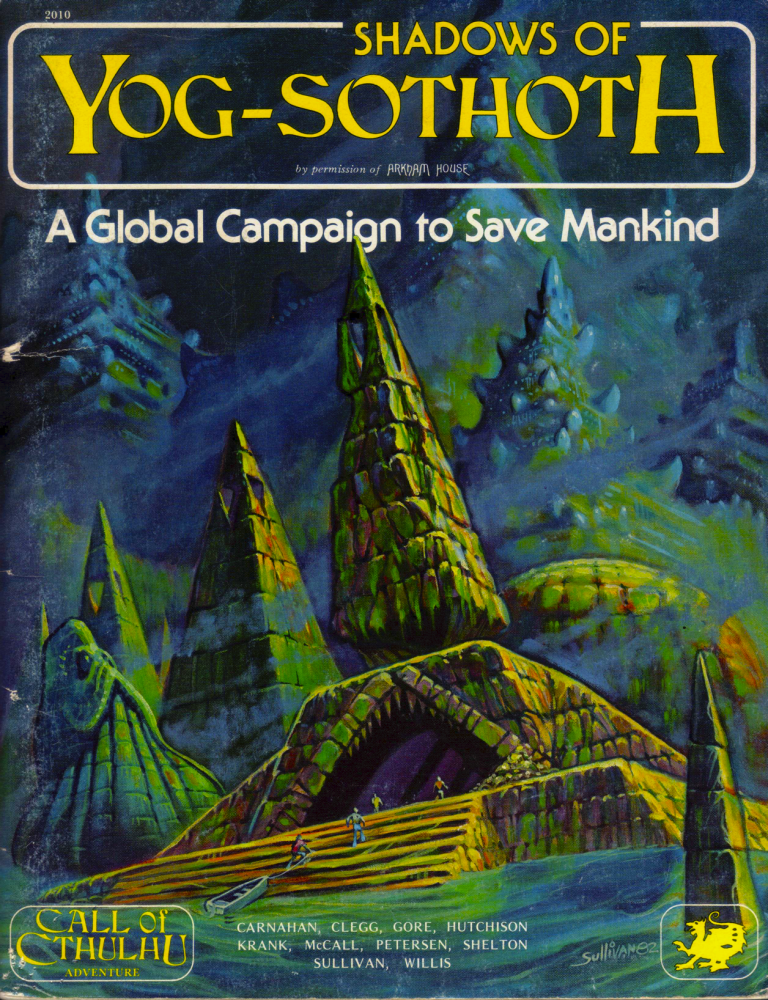
Physically, Shadows of Yog-Sothoth is well presented and actually decently written for a campaign published in 1982. The organisation of the material leaves a lot to be desired and a lot for the potential Keeper to work through and prepare. The cover is a glorious depiction of R’lyeh and the pen and ink illustrations, all by Tom Sullivan, are all suitably dark and oppressive, and the maps have a certain charm. By the modern standards, the handouts are plain, but they are serviceable. 

—oOo— 

Following its publication in 1982, Shadows of Yog-Sothoth was reviewed in Space Gamer Number 60 (February 1983) in the ‘Capsule Reviews’ section by William A. Barton, the designer of Cthulhu by Gaslight. He identified that several of the scenarios are “almost too deadly”, but concluded that, “Overall, though, SHADOWS OF YOG-SOTHOTH should provide some exciting CoC play for even the most experienced investigators (despite the odd fact that Yog-Sothoth never makes an appearance, title or not), and I recommend it to all Lovecraftians.” 

Shadows of Yog-Sothoth was reviewed not once, but twice in Dragon magazine. First, in Dragon #81 (Vol. VIII, No. 7, January 1984) in ‘Gaming without heroes: Horror role-playing gets its vigor from victims’ by Ken Rolston. From the start he highlighted issues with the campaign: “In design, each of the seven linked scenarios is a mystery, complete with clues, NPCs, and settings. However, for smooth presentation, considerable study and preparation by the GM will be necessary. The scenarios lack strict linear narratives. Though this avoids arbitrary limits on player freedom, it forces the GM to structure the adventures in response to the actions of the players — a difficult job even for experienced gamemasters. The-tactics of the antagonists are not adequately detailed, and will need to be improvised or planned ahead.” Ultimately, he was far more positive in his conclusion, saying that, “Yog-Sothoth requires much labor and study on the part of the GM; it is not usable after a single reading. The GM will have to provide most of the narrative structure for the campaign, since the players have much freedom to choose their own approach to solving problems. The writing and editing are generally superior. Player materials are provided in ample quantity and the text is adequately organized for GM reference. The adventures are unusual and the atmosphere exotic and terrifying. Yog-Sothoth is a classic example of role-playing horror, with awesome monsters, desperate victims, and an atmosphere of mystery and menace. Since it provides enough material for a campaign of several months’ duration, it is an excellent value for the $10 purchase.” 

The campaign was then reviewed six years later in Dragon #81 (Vol. XV, No. 1, June 1990) in ‘Role-playing Reviews: A losing war against the forces of darkness’ by Jim Bambra. This was as part of the Cthulhu Classics anthology, which reprinted Shadows of Yog-Sothoth along with ‘The Warren’, but not ‘People of the Monolith’, alongside ‘The Pits of Bendal-Dolum’ and ‘The Temple of the Moon’ from Terror from the Stars; ‘Dark Carnival’ from Curse of the Chthonians; and ‘The Secret of Castrenegro’ from Cthulhu Companion. Bambra was positive in his summation, stating, “The horror elements are well presented, and the adventures span a wide variety of locations and investigative approaches. Opportunities for role-playing, investigation, and combat abound with nameless horrors and the depraved cultists who worship the creatures of darkness.”

Ian Bailey reviewed Shadows of Yog-Sothoth in ‘Open Box’ in White Dwarf #44 (August, 1983). Before awarding it ten out of ten, he said, “All in all the Shadows of Yog-Sothoth is an excellent and masterly campaign that demands a high standard of play throughout. It is well presented (one feature is five pages of player-information which can be photocopied or pulled out to save the Keeper time) and carefully managed throughout, and it provides, I believe, the most exciting and satisfying adventure available on the market to date. It might seem expensive but it is worth every penny.” 

Anders Swenson reviewed the campaign in ‘Game Reviews’ in Different Worlds Issue 34 (May/June 1984). He highlighted the deadliness of the campaign saying that, “…[M]any  of the scenarios would seem to work better with relatively well-equipped adventurers who have gotten access to heavy military weapons…” as well its organisation, complaining that, “Then there is the organization. Each scenario does contain the material needed to run the adventure, but finding it and having it handy is another question. Many of the scenarios have a lot of nonplayer characters, situations, maps, etc., and the tendency of the layout people was to string them together without enough introductory, transitional, and connective next to make everything findable.” As with other reviewers, he ended on a positive note with, “Overall, though, this is an excellent collection of first-rate Call Of Cthulhu scenarios. All keepers (gamemasters) should get Shadows of Yog-Sothoth.” 

—oOo— 

When it was first published in 1982, Shadows of Yog-Sothoth was like nothing that had come before. It was a whole campaign, consisting of several linked parts, each integral to the whole and the flow of the campaign’s story. It was set in a modern age and it was a first horror campaign, and it pitted the Investigators against H.P. Lovecraft’s signature creature, the Great Old One, Cthulhu himself. That is one thing that no campaign has done since. It is this version that would be reprinted as part of the Call of Cthulhu Classic Kickstarter campaign to celebrate the fortieth anniversary of Call of Cthulhu. It is also this version which would be reprinted as part of Cthulhu Classics in 1989.

Yet for all its scope and grandeur, Shadows of Yog-Sothoth suffers, by modern standards, numerous flaws—and those flaws are well known. They include an underwhelming set-up which challenges the Keeper to involve her players and their Investigators in the campaign. The links between the chapters are flimsy, awkward, and repetitive, and the constant use of the letter as a plot device is wearisome. ‘The Worm that Walks’, the fifth scenario, has a well-deserved reputation as a killer, an intentional method of murdering one Investigator after another at a point in the campaign when their knowledge and experience are needed for the last two scenarios. The campaign also lacks advice for the Keeper and having been written by different hands, it has a rough, incohesive feel. 

It is possible that some or all of these issues could have been addressed by the planned development of a longer, more extensive, and greater world-spanning version of the campaign which would have been edited by Scott David Aniolowski. This would have included far more of locations visited in Lovecraft’s ‘The Call of Cthulhu’, the story which directly inspired Shadows of Yog-Sothoth, including Greenland, China, Germany, New Orleans, Kingsport, Saudi Arabia, Irem, San Francisco, and Xoth. Unfortunately, due to time constraints, this expanded version of the campaign was cancelled and Shadows of Yog-Sothoth, Second Edition was published instead. It should be noted that some of content of ‘The Call of Cthulhu’ has been presented for Call of Cthulhu, Seventh Edition in Cults of Cthulhu.

Some of these problems were addressed in Shadows of Yog-Sothoth, Second Edition, published in 2004. They included reasons and motivations for the Investigators to join the Hermetic Order of the Silver Twilight in ‘The Hermetic Order of the Silver Twilight’, as well as NPCs beyond the Cultists which they could interact with. The links between the chapters were listed and made more obvious and some advice was provided for the Keeper, although all too often, not enough. Whether the version from 1982 or 2004, Shadows of Yog-Sothoth cannot fail to show its age and whilst as it should, it presents a huge challenge to the players and their Investigators, it also presents an enormous challenge to the Keeper who wants to run the campaign. There is so much to prepare in the campaign and Shadows of Yog-Sothoth never makes it easy. Certainly, within two years, there would be campaigns from Chaosium, Inc, beginning with The Fungi from Yuggoth and Masks of Nyarlathotep, the latter often regarded as the greatest roleplaying campaign ever published, which made incredible strides in campaign design and presentation. There is no denying that Shadows of Yog-Sothoth needs a rewrite and even a redesign and hopefully its third edition will be the rewrite and the redesign it needs and addresses its issues.

Shadows of Yog-Sothoth: A Global Campaign to Save Mankind broke new ground in so many ways, but it is no masterpiece. It is flawed and often incoherent, and it remains a daunting prospect for any Keeper who sets out to run it for her players. Yet it has many fine moments of horror and creepiness, and above all, it has ambition, and it has a grandeur and it does something no other campaign has done since, which is have the Investigators face Cthulhu himself.