Every Week It's Wibbley-Wobbley Timey-Wimey Pookie-Reviewery...
Showing posts with label DragonMeet 2021. Show all posts

Sunday, 15 May 2022

Smoke, Shadow, and Subterfuge

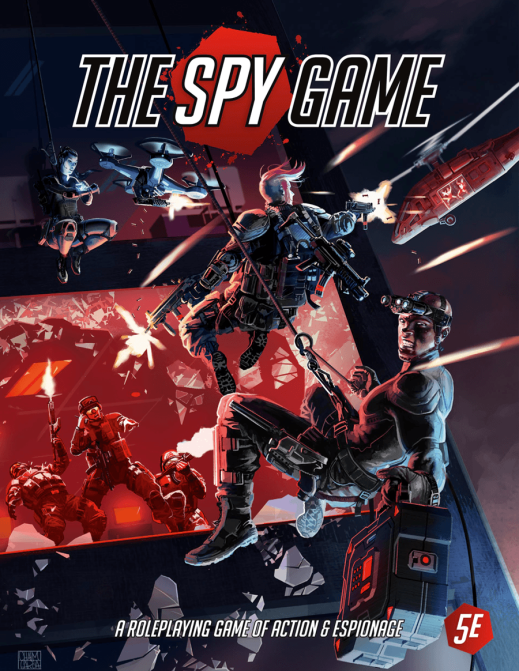
The Spy Game: A Roleplaying Game of Action & Espionage
takes the mechanics of Dungeons & Dragons, Fifth Edition into the very modern world of international espionage and intrigue, of stealth and superscience, and of maladjusted masterminds and doomsday devices in which spies, hackers, assassins, femme fatales, and suave secret agents set out to save the world in the name of freedom and democracy! Published by Black Cats Gaming 
following a successful Kickstarter campaign, The Spy Game casts the Player Characters as Agents, members of a spy agency, whether a real-world agency like the USA’s CIA, the United Kingdom’s MI6, or India’s RAW, or a fictional one included in its pages or of the Game Master’s own creation, and undertake assassination, capture, obtain, sabotage, or surveillance missions—or a combination of any five of them. They will attend briefings, gather intelligence, and conduct fieldwork, all before attending mission debriefings. The rules in The Spy Game allows the players to create interesting characters from a diverse range of backgrounds who engage in a range of espionage activities including infiltration and hacking, equipped with a wide array of equipment, and the Game Master to create agencies, missions, enemies and threats. In bringing espionage and modern action to Dungeons & Dragons, Fifth Edition’s mechanics, The Spy Game notes that anyone who comes from that roleplaying game will find a lot of familiarity, but also that it adds Infiltration to combat to expand upon the element of surprise and detection, gadgets which replace magic items—and which have to requisitioned, and hacking which works like magic, but only on computer technology.

Like any good, modern roleplaying game, The Spy Game includes advice on the use of safety tools. Not just on the use of the X-card and lines and veils, but also advice appropriate to The Spy Game and its genre. This includes advice on taking care when involving real world events and politics in the game, and be careful when involving torture as a means of acquiring information. Ideally, if it is used, it would only be a grittier type of game and even then a veil be drawn over it. The Spy Game also notes that whilst sex and seduction have always played a role in espionage, whether fact or fiction, there is no Seduction skill in the roleplaying game and again, all of the players will need to agree to its inclusion in a game.

The Spy Game: A Roleplaying Game of Action & Espionage is a Class and Level game. It has eight Classes—Face, Hacker, Infiltrator, Martial Artist, Medic, Ranger, Soldier, and Technician, each one of which has its own three archetypes, Proficiencies, abilities, and more. Backgrounds such as Academic, Athlete, Civil Servant, Con Artist, Criminal, Diplomat, Motorist, Outdoorsman, and Scientist, all add bonuses in terms of attributes, languages, and equipment, as well as special advantages, proficiencies, and a Feature. Each also gives options for an Agent’s Double Life, Secret—which is initially kept just between the player and the Game Master , Ideal, and Bond, all of which can be used in play to gain Inspiration as per the roleplaying mechanic introduced in Dungeons & Dragons, Fifth Edition. For example, the Motorist increases an Agent’s Dexterity and Wisdom by one, grants Mechanics as a skill proficiency, grants him Advantage on Dexterity Saving Throws when driving or piloting a vehicle, gives special proficiency on motorcycles, cars, heavy goods vehicles, and mechanic’s tools, and provides the ‘Home Behind the Wheel’ Feature, which lets him regain control of a vehicle if he loses control of it as a Bonus Action. This can only be done once before requiring a short or long rest to use again.

To create a character, a player selects a Class and a Background, generates his character attributes—either by rolling or using the point buy option, and adds all of the finishing details you would expect. Multiple dice rolling options are given, but The Spy Game suggests that a player choose his character’s Class and Background first before rolling, or preferably, using the point-buy option. This varies from the ten points of a Gritty campaign to the twenty-five of one involving Super-Spies, but the standard is fifteen.

Rachel Rosen
Nationality: British
First Level Hacker

Str 10 (+0) Dex 12 (+1) 1 Con 10 (+0)
Int 15 (+2) Wis 10 (+0) Chr 16 (+3)

Hit Points: 6
Hit Dice: 1
Armour Class: 13

Class Abilities: Hacking, Personal OS
Skills: Acrobatics (+1), Athletics (+0), Deception (+5), Espionage (+4), Infiltration (+2), Infotech (+4), Insight (+0), Intimidation (+3), Mechanics (+2), Medicine (+0), Perception (+0), Persuasion (+5), Slight of Hand (+4), Stealth (+1), Survival (+0), Tactics (+2)

Proficiency Bonus: +2
Proficiencies: Charisma Saving Throws, Deception, Espionage, Hacking Tools, Infiltration, Infotech, Intelligence Saving Throws, Languages—Spanish and Russian, Light Armour, Motorcycles, Persuasion, Simple Melee Weapons, Simple Ranged Weapons, Sleight of Hand, Thieves’ Tools

Advantage: Dexterity Saving Throws
Feature: Escape Notice
Equipment
Laptop, taser, padded armour, investigation pack

Background: Criminal
I steal as a form of activism, targeting the ruling classes and the corporate machine (Double Life); My plans for a heist could bring down all the major banks (Secret); I only steal to help the poor, with 50% of the world’s wealth in the hands of the top 3% of people – it’s time to there was some redistribution (ideal); I have a unique relationship with the detective who wants to take me down (Bond)

Mechanically, The Spy Game uses the same ones as Dungeons & Dragons, Fifth Edition, although there are changes. The first major addition is that of infiltration to combat. This expands upon the rules for surprise and detection, accounting for the Agents’ actions round by round whilst they remain hidden from the view of any enemy NPCs. This adds a degree of tension to play prior to combat itself breaking out. The rules for vehicles also cover chases—treated as contests, but complete with manoeuvres like ramming or weaving, and combat, including targeting parts of a vehicle.

One of the major additions to The Spy Game consist of rules for Hacking. Primarily the purview of the Hacker Class who can Bypass protected operating systems or password protected software, Modify software, or Attack. The Hacker can use hacking tools which he can install as executable slots in his operating system, which like physical tools and gadgets have a Calibre rating. Operating Systems have their own Calibre rating, Armour Class, and Hit Points, and thus their own executable slots, and when a Hacker attempts to infiltrate an operating system, his aim is reduce its Hit Points to zero and so corrupt its programming and security features. Although the rules for hacking do feel like another combat subsystem, they are not intrusive in the sense that they do not impede play in the way that they do in other roleplaying games which have rules for them at their core, plus not all of the hacking tools are designed to just do damage. Others map or copy a network, deny access, and so on.

A fifth of The Spy Game is dedicated to equipment. It includes just about every item, device, or gadget that the players and their characters can imagine—and probably more beside. If not given , then the Technician Class can actually build more as gadgets as well as boosting those already in the Agents’ possession. The equipment list also includes Equipment Packs, like a Diplomatic Pack, Investigation Pack, and Wetwork Pack, as well as individual items. Unlike some of the source fiction, The Spy Game does not use brand names, makes, marks, and manufacturers in its descriptions, for example, genericising its weapons. It avoids the designers and the roleplaying game getting bogged down in real world detail, but on the other hand, it does mean that the game loses a degree of verisimilitude.

The list of equipment also encompasses the gadgets beloved of the genre. So it includes Exploding Gum, Palm Flamethrower, Bladed Boots, Garotte Watch, and more, all the way up to close air support! Vehicles are added too, such as drones and buses, all the way up to tanks and ground attack aircraft. Gadgets themselves have a Calibre rating, from one to five, and do need to be requisitioned. The maximum Calibre of the gadgets available is determined by the Mission Calibre, a factor itself based on the average Level of the NPCs the Agents will face and the number an Agent can carry is determined by his Level.

The Spy Game’s ‘World of Spies’ focuses on spying in the early twenty-first century and how espionage has changed from the late twentieth century. Several real-world agencies are detailed, but it really gives space to new and fictional agencies, including their primary locations, agents and activities, and signature devices. These are the Operations Executive, a ‘deep state’ international organisation committed to global co-operation, co-ordination, and contentment; Taga Bunot, a Philippines-based agency which specialises in date recovery and prevention of blackmail, extortion, and smear activities; Streetworks, an agency whose agents consist of those who have been fired or forced into early retirement from other agencies due to injury, incompetence, or office politics, and operate on a lower budget; the Caledonian Spy Group or CSG, the spy agency established in Scotland following a successful bid for Scottish independence; Zodiac, an agency which responds to threats detected by data sifting by artificial intelligence; and the Hive, an organisation of highly distributed digital mercenaries. Some of these agencies do wear their influences on their sleeves, almost literally in the case of the Operations Executive, a very Kingsman-like organisation, whilst Streetworks feels like Mick Herron’s Slow Horses series of novels. My favourite though is the Caledonian Spy Group, a delightfully parochial agency whose creation feels all prescient.

For the Game Master there is solid advice on creating missions and mission types, and running not just the game, but also portraying and roleplaying the Handler, the Agents’ case handler or control. Campaign themes—technology, cyber warfare, and the effects of globalised economies—are discussed and options are given for running The Spy Game during earlier periods, from the Great War and World War II to the Cold War and the War on Terror. However, the roleplaying game does not go into too much detail about those here. Safety tools are again discussed, but backed up here with examples, which are useful inclusions, but a favourite section is ‘The Moscow Rules of Game Mastery’ inspired by The Moscow Rules said to be followed by spies in the Moscow of the Cold War. These are very nicely done and would apply to almost any roleplaying game. There is good advice too on designing traps and encounters, especially to highlight the particular roles of the different Classes, so the Hacker, Medic, and Technician will want to face technical challenges, combat Classes like the Soldier and the Martial Artists combative challenges, and so on. This also gives them time in the spotlight. When it comes to traps, the advice is also to build in vulnerabilities.

Along with really big vehicles like aircraft carriers and space shuttles, The Spy Game includes rules for creating villains and masterminds. These are backed up with both standard NPCs, including stats for the Head of State(!) and Survivalists along with their bunker, and fully detailed villains and masterminds. These include a pair of sisterly assassin, each of whom uses different methods; ‘The Con’, an incredibly lucky conman who fomented war between Andorra and Lichtenstein for profit, though thankfully no shots were fired; and ‘The Count’, a classic European supervillain! Both ‘The Con’ and ‘The Count’ have their own Legendary Actions with which they are likely to thwart any Agents’ attempts to stop them.

Physically, The Spy Game is for the most part, cleanly and tidily laid out, and the artwork excellent. If there is an issue with the layout it is that the section on equipment and gadgets is simply in the wrong place. It comes after the descriptions of the roleplaying game’s eight Classes and how to create a Player Character, but before the roleplaying game’s rules. So there are sixty pages of gear between an explanation of the ability scores and their modifiers, the Proficiency Bonus, skill explanations, and more. Which impedes Player Character creation. And surely the rules for vehicle combat should be in the combat section?

The Spy Game is very much an espionage roleplaying game which focuses on the here and now as well the tomorrow of the spying world in which its Agents are really designed to be capable or super cable. Although it can do campaigns set in the past or ones which are gritty in tone and mechanics, these are really asides and switches which the Game Master will have to make and research and develop on her own. Perhaps for either option, gadgets and equipment could have been listed along with indications as which type of campaign they would be suitable for. Similarly, a bibliography could have included for reference and inspiration—the equivalent of The Spy Game’s Appendix N. That said, the rules of The Spy Game could easily be used to run a game in the style of Leverage or Hustle.

The Spy Game: A Roleplaying Game of Action & Espionage takes the mechanics of Dungeons & Dragons, Fifth Edition and adeptly adapts to an entirely different genre, successfully providing new character types and Classes and unobtrusive genre mechanics. The result is a pleasing slick and modern approach to the high action, Spy-Fi genre.

Sunday, 20 March 2022

Shaping the Story

In ages past, following the defeat and death of King Arthur at the Battle of Camlann, Queen Guinevere slipped through the All’s Well portal and into the mysterious lands of the fae that were a mirror to the British Isles. These lands were and are known for their magics—their ability to Shape, that is the Shaping of the four elements—Air, Earth, Fire, and Water, and two powerful opposing energies, Belief and Disbelief. Disbelief, brought about through greed, corruption, cruelty, and bloodshed, is strong enough to damage the World Tree at the base of the Islands, but Belief can be stronger still, strong enough to restore the health of the World Tree. The islands are also home to many fae, known as the Friends. These include the flightless, but birdlike Glimmer who sometimes use Shadowshaping for criminal ends; the goatlike Capra, typically traders, but who dislike Trolls and their bridges; the four-armed Piskies who like building automata; the regal Wyrmbitten who regret knowing nothing about their heritage; the turtlelike Bucca who prefer the freedom of the ocean; the molelike Knockers who enjoy solitary lives digging for silver and gems; the winged and birdlike Glow, who research Belief; and the Giantheld, peaceful stone giants. Queen Guinevere found the Islands at war with powerful Shape-wielding Wyrms who hoarded Belief, the conflict enabling Disbelief to wither the World Tree. Together, Queen Guinevere and the fae forced the Wyrms into hiding, and she made a pact with the fae, that whenever the World Tree was poisoned by Disbelief, some of her descendants would follow their dreams into the Islands, and there learn to Shape magic, collect enough Belief, and so heal the World Tree. Every few generations, several teenagers enter the Islands and learn and adventure together. They are known as Pendragons, and once their adventures are over, they can return to the real world as if no time has passed at all, but some do stay, and continue to adventure and even train new Pendragons.

This is the setting for Inspirisles, a storytelling roleplaying game published by Hatchlings Games. It is a storytelling game set in a magical realm, in which teenagers learn to Shape the elements and go on adventures together, solve puzzles, combat Disbelief through Belief—though not through bloodshed as it is forbidden in the Islands, heal the World Tree, and prevent Calamity befalling the islands. The latter is done by undertaking a second quest—the recovery of the pieces of Excalibur which were stolen following King Arthur’s burial in the Islands. Calamity is gained by failing tasks or tests, and as it grows, Trolls build new bridges into communities and ravage them, cold iron is used to kill fae, a Wellbeing from another dimension appears via the All’s Well, and the Questing Beast might slip free of the Underisles to stalk the Pendragons.

Published following a successful Kickstarter campaign, Inspirisles is inspired by Arthurian legend and Celtic myth, and by films such as Labyrinth and The Neverending Story. Designed to be played by teenagers and young adults, it is written to be inclusive of identity and gender. Ideally, this should be five players, one for each of the four Elements, plus the Grail Guide, the name for the Game Master in Inspirisles. More particular though is the fact that it is designed to be played by the deaf and the hard of hearing, and to support that, not only does it provide an introduction to and help teach Deaf culture and sign language—both American Sign Language and British Sign Language
—it uses sign language as part of game play. Just as words, letters, numbers, and expressions are shaped out in sign language, in Inspirisles, the players Shape out their characters’ magical control of the Elements. Of course, magic has always had a somatic aspect, even in something like the shaping and casting of Isho in SkyRealms of Jorune, but in Inspirisles, the players are literally Shaping what their characters are Shaping, and it gives the game a wonderful physicality.

A Pendragon is simply defined and very quick to create. They have a name and set of preferred pronouns, a past memory of their ancestor’s time in the Islands and a connected Friend associated with that memory, a preferred Element (Air, Earth, Fire, or Water) and its associated patron, a hobby they are passionate about, and a Sanctuary which is entered via the Questing Cabin they share with their fellow Pendragons. The Questing Cabin is somewhere they can reflect on their adventures and plan further adventures. The latter is a personal space where they will always feel safe and contains five items which are important to them. Several tables are provided for the players to choose from if they are short of ideas.

Name: Bowie
Pronouns: Them/Their
Element: Water Patron: Athelyn Friend: Wyrmbitten
Hobby: Tarot
Sanctuary: My grandmother’s room with its rich colourful hangings, smell of incense, well-worn and much used tarot deck on the table, and a plate of her favourite biscuits
Items Worn: Headphones, nose piercing, jumper
Items Carried: Ukulele, mug

Mechanically, Inspirisles is all about its magic through the Elements and Shaping. Both Elements and Shaping are used to overcome Belief Barriers and enter into Disbelief Battles. The former are puzzles or problems which the Pendragons need to solve or overcome, whilst the latter are contests against a threat infused with Disbelief, for example, a troll who has built a bridge into a community and is about to pillage it. Players and their Pendragons work together to solve a problem, explaining how their Shaping and their use of their Element contribute to the solution, working through a Leader. The Leader will change from problem to problem, depending upon which Element is best suited to dealing with the current situation.

Shaping itself comes in three Levels—Weak, Strong, and Potent. These are increasing complexities of sign language, from signing out simple words to facial expressions and body language to full sentences with syntax. At its simplest, a player and their Pendragon would sign ‘W-A-T-E-R’ or ‘E-A-R-T-H’, and the greater the Level of the Shaping, the more bonuses can be contributed to a situation. Learning to Shape—and thus sign language—is helped by the Lexicon in Inspirisles’ appendices of both American Sign Language and British Sign Language.

To undertake a Test, the Leader rolls three six-sided dice, the target number always being eleven or more. The difficulty is represented by the number of Tests, typically one, two, or three, but can go as high as five for tough opponents or situations, that the Pendragons have to pass. A roll of three or four is an automatic failure and always adds Disbelief to the Calamity Meter, whilst a roll of seventeen or eighteen is an Unshakeable success and grants the Pendragons Belief. The Level of Shaping and the contribution of the other Pendragons both add bonuses and allow rerolls. As aggressive Elements, Air and Fire can force an opponent to reroll some of their dice, whilst the defensive Earth and Water enable a Leader to reroll some of their dice. In Disbelief Battles, the dominant Element—Fire dominates Earth, Earth dominates Air, Air dominates Water, and Water dominates Fire—can remove an opponent’s capacity to reroll. The point of having the one Leader roll is that it keeps the mechanics simple and fast, but by having everyone else round the table contribute, Inspirisles encourages teamwork.
For example, the Pendragons need to cross over to a nearby island, but the bridge has been badly damaged in a severe storm. If they can get to the island, they hope to find out why. The Pendragons decide that Dana will be the Leader as the dominant Element is Earth, her player described how she will restore and repair the bridge. In turn, Bowie describes how she Shapes the Water to keep it away from the bridge and so prevent it from being washed away, Ember will Shape Fire to light the way, and Nolan will Shape the Air to make it easier to lift the stones of the bridge back into place. Each of the players successfully Shapes and their Element, granting a bonus of four to the roll. Dana rolls the three six-sided dice and gets one, two, and three. With the bonus of four, this gives a total of ten, so not enough to succeed. Fortunately, Earth is the dominant Element and allows a Leader to reroll. So Dana’s player rerolls the one and gets a two, which changes the total to eleven and thus a success.
For the Grail Guardian, there is advice on the types of Tests which Shaping can be used in, including Smarts, Speed, Survival, and Social Tests, handling and narrating failure, and more, noting that whilst injury is possible, Bloodshed is not. There is only a small selection of ‘monsters’ or threats described, but the Grail Guardian could easily find other sources. Besides a description of the Islands and the Underisles—written as a tour, there is an adventure, ‘Questing Day’ and suggestions to further inspire the Grail Guardian.

Where Inspirisles comes up short is really handling Pendragon progression—it is possible to be rewarded with items infused with the Elements which add bonuses in Tests, but Inspirisles never gets round to detailing its end point, that is what happens at the World Tree and the giving of collected belief there. Whilst there are Cheat Sheets for Belief Barrier and Disbelief Battle Tests, both are perfunctory at best, and do not reference the rules for them earlier in the book. In fact, the rules for Belief Barrier and Disbelief Battle Tests are best explained in the examples rather than the rules. This is compounded by the lack of an index, which would have made everything much, much easier to find.

Physically, Inspirisles is clearly presented and written in an engaging and personal style. The reader is constantly addressed by in-game characters and the book is illustrated with bright depictions of Pendragons, and the Islands and their inhabitants. The book could have been better organised in places and it definitely needs an index. Overall though, there is very much a sense of warmth to the book.

Inspirisles is primarily a roleplaying game written for the Deaf community to play, but it is also a teaching aid in that students (and others) can learn both sign language and the skill of storytelling through play of Inspirisles. As the latter it does have its limitations in that it is only primer, and likewise, being aimed at a teenage audience does mean that it will not necessarily appeal to everyone. Another limitation perhaps is that not everyone will want to learn a sign language to play, so Inspirisles is unlikely to be for them. Then again, think of it as learning magic, and actually learning something new and magical which has a use away from the table.

Inspirisles is definitely a roleplaying game with an audience which is unfortunately not always considered by the hobby, but by creating a roleplaying game built around sign language, Hatchling Games has created a game which supports and recognises the way in which the Deaf community communicates and brings a physicality to the play. The result is that Inspirisles is both a clever way and a novel way in which to introduce gaming to the Deaf community and both Deaf culture and sign language to the gaming community.

Sunday, 20 February 2022

It's Doom O'Clock!

Shiver – Role-playing Tales in the Strange & the Unknown is a fast-playing, dramatic, and generic horror roleplaying game. Want to play a scenario of teenagers camping out at Lake Blood being stalked by a masked slasher? Inhabitants of a small town caught up in a zombie outbreak? A race through Transylvania being harried by vampires? Villagers oppressed by a demonic cult operating out of the nearby castle in medieval Italy? A rescue team dropping onto a colony in the far future and discovering it to be infested by strange aliens? Townsfolk stalked by werewolves and a witchfinder in seventeenth century England? Investigators making enquiries in a New England seaside resort rumoured to be home to a fish cult? Published by Parable Games, Shiver can do all of these and more. The roleplaying game combines simple, thematic mechanics built around archetypal characters and a simple propriety dice mechanic, combined with a Doom Clock which escalates the tension and a wide selection of classic, nasty monsters that really know how to hit back.

A Player Character in Shiver is defined by an Archetype, six Core Skills, one or more Abilities, and a Fear. There are seven Archetypes—the Warrior, the Maverick, the Scholar, the Socialite, the Fool, the Weird, and the Survivor—and each emphasises one of the six Core Skills and provides three Paths, each of which provides ten Tiers of Abilities as the character gains experience and goes up a Character Level. For example, the Maverick’s Paths are the Thief, the Assassin, and the Ranger. The Tier One Ability for all Mavericks is Dodge, but the Tier Two Ability for the Thief is Sneaky, for the Assassin, Sneak Attack, and for the Ranger, Covering Fire. An option is given that when a Player Character reaches Tier Five, he can either carry on in his own Archetype or switch to another one altogether and become a Hybrid, though this also means that he has a Fatal Flaw as a troubled character.

The six Core Skills—effectively both skills and attributes—are Grit, Wit, Smarts, Heart, Luck, and Strange. Grit represents a character’s physical capabilities; Wit covers physical dexterity; Smarts is his intellect and capability with investigation and technology; Heart is his charisma and charm; Luck is his good fortune and the random of the universe; and Strange is his capacity for using magic, psychic powers, and so on. Of the Archetypes, the Fool relies upon Luck rather than a specific Core Skill; the Weird is the strange individual who might follow the Eldritch, Spiritualist, Psionic, or Body Horror Path; and Survivor is a generalist who might follow the Chosen/Leader, Survivalist, or Cockroach Path, the desperate, cowardly type. In addition, a Player Character has a Luck Bank for storing Luck—one for all Archetypes, except for the Fool, who has space for three; a current Fear status—either Stable, Afraid, or Terrified; and a Lifeline—Weakened, Limping, Trauma, and Dead—which is the same for all Archetypes.

To create a character in Shiver, a player selects an Archetype, a Background which adds a unique Ability and a Flaw. He also adjusts one Core Skill in which his character is deficient. It really is as fast as that. The longest step is noting it all down. Of course, playing a character at a higher Tier will take a longer because the player needs to choose more Abilities, but not by much.

Henry Brinded
Archetype: Scholar
Path: Academic (Tier One)
Abilities: Medic!
Background: The Nerd
Ability: Run Away! Flaw: Weak
Fear: Ligyrophobia

Grit: 2 Wit: 3 Smarts: 5 (Talent: 1) Heart: 3 Luck: 3 Strange: 3

Mechanically, Shiver uses a dice pool system of six-sided dice, their faces marked with the symbols for the roleplaying game’s six Core Skills—Grit, Wit, Smarts, Heart, Luck, and Strange. To these are added Talent dice, eight-sided dice marked with Luck and Strange symbols. (The rules include a conversion guide for using standard six-sided and eight-sided dice, but if the group still wants to use the dice system, there is an online dice roller.) When he wants his Player Character to undertake an action, he assembles a dice pool based on the action and its associated Core Skill plus Talent dice if the Player Character has in that Core Skill. Further dice can be added or deducted depending on whether the Player Character has Advantage or Disadvantage, an Ability which applies, or the player wants to spend his character’s Luck, and on the character’s Fear status.

The aim is to roll a number of symbols or successes in the appropriate Core Skill, the Challenge Rating ranging from one and Easy to five and Near Impossible. If the player rolls enough, then his character succeed; if he rolls two Successes more than the Challenge Rating, it is a Critical Hit; and if a player rolls three or more dice and every symbol is a success, this is Full House. In combat, a Critical Hit doubles damage and a Full House triples it, but out of combat the Director—as the Game Master is known in Shiver—will need to suggest other outcomes for both. If Luck symbols are rolled, one can be saved in the Player Character’s Luck Bank for later use, but if two are rolled, they can be exchanged for a single success on the current skill roll, or they can be used to turn the Doom Clock back by one minute. A failed roll does not necessarily mean that the Player Character fails as he can use other means to succeed at the task if his rolls enough successes in another Core Skill for that task, though this requires some narrative explanation. However, a failed roll has consequences beyond simply not succeeding—each Strange symbol rolled pushes the Doom Clock up by a minute…
For example, the scholar Henry Brinded has found a tome written in Latin containing a spell which he thinks will dispel the monster stalking the halls of the college where he teaches. He can hear the thing getting closer and desperately intones the spell direct from the book. Henry’s player will roll the five dice for his Smarts plus its Talent die and the Director will sets Challenge rating at two. However, Henry is at a Disadvantage because he is intoning from the tome in a hurry and because he has not had the time to study either the tome or the spell. This would reduce the number of Smarts dice his player would roll to four, but Henry has one Luck in his Luck Bank and uses that to counter the Disadvantage. He rolls one Grit, one Smarts, and three Luck on the Core Skill dice and two Luck on the Talent die. This gives him one Smarts and would be a failure except for the five Luck. Henry’s player changes two of the Luck into a Smarts, guaranteeing his successful casting of the spell, adds a third Luck to Henry’s Luck Bank, and the last two he uses to move the Doom Clock back one minute…
Combat uses the same mechanic with monsters and enemies—and the Player Characters when they are attacked—using the same Challenge Rating as skill tests. It is Turn-based, with the Director deciding whether each Player Character is acting First, in the Middle, or Last, depending upon their situation and what they want to do. Players are encouraged to be organised and know what their characters are capable of, the surroundings for the battle, and so on, in order to get the best out of their characters. With every Player Character possessing the same Lifeline (the equivalent of sixteen Health Points), combat can be simply nasty or nasty and deadly, depending upon the mode. In Survivor Mode, a Player Character who loses all of his Health Points is at Death’s Door and his player rolls his Luck Pool to survive until he dies or help arrives. In Nightmare Mode, every four Health Points has a negative effective upon the Player Character, such a as reduction in his Core Skills at Weakened, his movement at Limping, and so on, all the way down to no Health Points and dead—no being at Death’s Door. Depending on the scenario, death though need not be end though. A Player Character could become a ghost and continue to provide help from the afterlife or even become an antagonist!

Fear in Shiver uses the same Challenge Rating system and mechanics. A Fear Check is made with a Player Character’s Strange Dice, and if the player fails the check, the character becomes Afraid, and if Afraid, becomes Terrified. If Afraid, a Player Character loses one die from all Core Skills, and two if Terrified. This temporary, and a Player Character can get rid of the effects of Fear be escaping or vanquishing the threat, steadying himself (this requires another Fear Check), or another Player Character uses an Ability to help him.

Narratively, Shiver is played out against a Doom Clock. This at eleven o’clock at night and counts up minute by minute to Midnight and the Player Characters’ inevitable Doooommm! However, at ‘Quarter Past’, ‘Half Past’, ‘Quarter To’, and ‘Midnight’ certain events will happen, these being defined in the scenario or written in by the Director. So if camping at Lake Blood, a storm might break out at ‘Quarter Past’, then the strange old man who actually knows more than he is letting on might be abducted at ‘Half Past’, a tree fall on the Player Characters’ van at ‘Quarter To’, and then ‘Midnight’, the Serial Killer switch to chasing the Player Characters rather than stalking them. In general the Doom Clock will tick up due to the actions of the Player Characters, whether that is because of a failed skill check with Strange symbols, a failed Fear Check, abilities for the Weird Archetype, Background Flaws, or simply interacting with the wrong things in game. What this means is that dice rolls become even more uncertain, their outcome having more of negative effect potentially than just failures, but this is all in keeping with the genre. However, just as the Doom Clock can tick up to ‘Midnight’ through the Player Characters’ actions. It can also be turned back due to their actions. Rolling two Luck on skill checks, reaching Story Milestones, finding clues and important items, and certain Abilities can all turn the Doom Clock back.

Just as the Doom Clock racks up the tension and triggers bad events, it can also trigger positive events. Some Archetypes have Abilities which can only be used ‘Once Per Doom Quarter’ (others can only be used ‘Once Per Doom Cycle’), whilst the Weird Archetype in particular has Abilities which require the Doom Clock to tick up and trigger. This does make the Weird Archetype a little more complex than the other Archetypes to play and the Abilities are not always going to be helpful to the other Player Characters.

For the Director, there is good advice on her role, setting up a game and setting its tone, building and structuring a story, getting the Player Characters involved, adjudicating the rules, handling the Doom Clock and designing events around it, handling Player Character deaths, and rewarding the Player Characters. The latter ranges from handing out Advantage dice and turning the Doom Clock back to their finding weapons and equipment and being given Levels Up. The latter is based on narrative events and each gives an Archetype access to new Abilities and/or Core Skill increases. In a campaign, it might be as often as at the end of a chapter, but in a one-shot it might be as fast as once a Quarter on the Doom Clock! In addition, the Director is given a huge list of equipment from baseball bats and books of banishment to stake rifles and zweihanders, from acid flasks and bear traps to the Helsing crossbow and Excalibur, and from berserker’s bear and bomb disposal suit to jet packs and symbiotic entities, there is just everything she needs to equip her Player Characters, NPCs, and seed a scenario across an array of genres and time periods.

Similarly, the Director has a big list of monsters and enemies to choose from. They categorised under Slashers, Shapeshifters, Dark Magic, Demonic, Cosmic Horrors, Eldritch Entities, Spirits, Aliens, Vampyrs, and Zombies. All are fully detailed and reflect a wide range of threats and stories that they lend themselves to, and further support the different subgenres of horror that Shiver is designed to cover. In addition to their own Abilities, these monsters and enemies can use Reaction Tables which the Director rolls on whenever a Player Character strikes them in combat. This requires a roll of a single Skill die, and might see a Bruiser type retaliating a slashing attack that does one Blunt damage if the Grit symbol is rolled or Dracula turning into a Cloud of Bats and flitting away on the roll of a Wit symbol. Apart from the Reaction table for Dracula, the Reaction tables are all generic and include a no effect result for rolling the Luck symbol—except for Dracula in which case, he gets hit ‘Right in the Kisser’ and prevents him from making an infect attacks on the next round due to the blow on his fangs! There is advice too for creating Reaction tables for other monsters. Lastly, there is a scenario, ‘Corporate Risers’, which casts the Player Characters as lowly employees at a corporate research centre when there is an outbreak of the zombies. It is a decent scenario which gives a chance for the Director and her players to experience Shiver in a one-shot. It includes notes on character types to create for it, or the player could use those from the SHIVER RPG Quick-start Guide.

Physically, Shiver – Role-playing Tales in the Strange & the Unknown is a good-looking book. The artwork is excellent, done in a style similar to that of Mike Mignola and his Hellboy comic, and very much showcases the type of horror stories that Shiver was designed to handle. The writing is clear, but in places, the roleplaying game could have been slightly better organised to make things easier to find.

If there is an issue with Shiver, it lies its generic nature and sometimes in the limited choices offered by the Archetypes. The generic nature means it has to work harder at some subgenres than others and not all of the Abilities offered by the Paths for the Archetypes necessarily fit. This is all due to Shiver having to cover a wide variety of horror types and elements and so some nuances may be lost. However, there are nuances to be found in the mechanics, especially in the Archetype and Ability design as they interact with the Doom Clock. Another issue is that as written, it does feel primarily written for one-shots, so it would be interesting to see what a campaign for Shiver looks like.

Shiver – Role-playing Tales in the Strange & the Unknown is great for one-shots and convention games too. Its simple, fast-paced mechanics hide some nice little nuances—especially in the design of Archetypes and the way that they and the dice rolls interact with the Doom Clock, which means that the players are not just going to be kept on their toes by the monsters, but also by their own dice rolls, as the tension racks up and the clock ticks down... If a group is looking for a generic horror roleplaying game that veers a little towards the Pulp and which can do a range of horror subgenres, especially film-inspired ones, then Shiver – Role-playing Tales in the Strange & the Unknown is a perfect choice.