Every Week It's Wibbley-Wobbley Timey-Wimey Pookie-Reviewery...
Showing posts with label Funko Games. Show all posts

Friday, 27 February 2026

Friday Filler: Alfred Hitchcock’s Rear Window

The film Rear Window is a classic thriller, regarded as one of Alfred Hitchcock’s best. It combines claustrophobia and voyeurism in a murder mystery which plays out from one point of view, that of Professional photojournalist L.B. ‘Jeff’ Jefferies. Following an accident whilst getting a front cover shot, he is confined to a wheelchair with a leg in a cast in his Greenwich Village apartment. With nothing to do and armed with a telephoto lens, he starts watching his neighbours whom he can see through the rear window of his apartment and into theirs. Sitting in the darkness he observes them going about their daily lives and as he becomes more obsessed about them, he suspects that one of them has committed a murder. It is a fantastic set-up for a film and if you have never seen it, you really should. It has parties, knives, bickering, laughing, weeping, music… and a mysterious trunk! In fact, you should definitely see it before playing Alfred Hitchcock’s Rear Window, a board game designed by Prospero Hall and published by Funko Games. However, you can play the game without watching it because the set-up is simple and you are not actually playing the role of L.B. ‘Jeff’ Jefferies and his friends, although they do play a part in the game.

Alfred Hitchcock’s Rear Window is designed to be played by three to five players, aged thirteen and over, and be played in less than an hour. The game is about solving the mystery of what can be seen through the eponymous window. Sometimes it will be murder and sometimes it will be not. One player takes the role of the Director who randomly sets up the mystery (or the murder if the mystery is a murder), whilst the other players are Watchers, who over the course of four days (or rounds), look through their window into the apartments of their four neighbours. However, they know nothing about their neighbours—who they are, what they do, and what they are like—and this constitutes the mystery at the heart of the game (in addition to the murderer, if there is a murderer) that they need to solve by the end of the fourth day. The elements that make up this mystery are represented by Resident and Attribute Tokens. Of course, the Director knows everything, but can only communicate to the Watchers via the cards he plays from his hand. For the Watchers, interpreting these correctly is key to winning the game.

At the end of the game, if there is not a murder, both Watchers and Director win if the Watchers correctly guess all eight spots taken up by the Resident and Attribute Tokens behind the Director’s Screen on the Solution Board. Otherwise, they all lose. If there is a murder, the Watchers win if they correctly identify seven or eight of the spots taken up by the Resident and Attribute Tokens and the identity of the Murderer. However, if the Watchers only correctly deduce six or seven of the spots taken up by the Resident and Attribute Tokens and fail to identify the Murderer, then they lose and the Director wins. Lastly, if the Watchers only work six or fewer of identities of seven or eight of the spots taken up by the Resident and Attribute Tokens and fail to work who the Murder is, then again, everyone loses. Thus, depending on the set-up, Alfred Hitchcock’s Rear Window is either a co-operative game or a semi-co-operative game.

Alfred Hitchcock’s Rear Window comes richly appointed. There are a Director Screen and a Watcher Screen, four Day Boards (one for each round), Solution Board, four Watcher Placards, seventy Window Cards, one-hundred-and-two tiles, forty-five Resident and Attribute Tokens, a Trunk Box, four wooden cubes, and the Rulebook. All of the components are of good quality, but the artwork is exceptional. Instead of using photographs from the film, the game uses painted illustrations which capture the period and feel for the film as well as the likenesses of the main cast on each of the four Watcher Placards. Even the front of the Rulebook replicates the photograph of the Grand Prix accident that L.B. ‘Jeff’ Jefferies shot and which landed him in a wheelchair!

At the start of the game, the Director randomly draws eight Resident and Attribute Tokens and lays them out on the Solution Board he keeps behind his Director Screen. Any Tokens not used, go into the Trunk—a little cardboard trunk made to like the one used by the murderer in the film! Each day consists of three phases, the ‘Window Phase’, the ‘Deduction Phase’, and the ‘Scoring Phase’. In the ‘Window Phase’, the Director draws eight Window cards and plays them on to the current Day Board to represent what L.B. ‘Jeff’ Jefferies (and the Watchers) can see from his apartment. Each Window card depicts a scene in a neighbouring apartment and shows an array of elements. One can show a woman in a yellow dress about to move a dining chair, there is a meal and a glass on the dining table, whilst on the wall there is a painting of a waterfall and a lake, whilst on another there is a low table upon which stands two full cocktail glasses and a very full jewellery case behind which on the wall is the shadow of two women clasping hands. Notably, there is even one of Hitchcock himself adjusting the hands on a clock that stands on a mantlepiece next to some books, whilst a phonograph plays in the foreground, just like his cameo in the film. There is no text on these cards and both Watchers and Director are free to interpret the images in any way that they like.

Most of the time, Window cards are played face up, but they can be played face down as if the window the Watchers are looking through is closed. The Director will do this if he feels that a Window card cannot impart any clues (or even too many clues if there is a Murderer!). If a Director does not like the Window cards he has drawn, he can use a Cut token to discard and redraw as many as he likes, but this can only be done three times.

In the ‘Deduction Phase’, the Watchers ponder the current Day Board that the Director filled out in the ‘Window Phase’. They can also look at any previous Day Boards as there may be linked clues, but on the current Day Board, after some discussion and deliberation between themselves, they place four Resident Tokens and four Attribute Tokens indicating who they think are involved in the mystery. If there is a murder and the Watchers think they know who the murderer is, then they also add a purple token to indicate that. The Watchers can also use the Watcher Placards, of which there are four, representing the film’s main cast. For example, the L.B. ‘Jeff’ Jefferies Watcher Placard is ‘Hand me the binoculars’ which forces the Director to discard a Window card placed face down and replace it, whilst the Lisa Fremont Watcher Placard is ‘Breaking and Entering’ which enables the Watchers to ask the Director which is the most important feature on a particular Window card.

In the ‘Scoring Phase’, the Director compares the four Resident Tokens and four Attribute Tokens on the current Day Board with those on his Solution Board and marks how many the Watchers have got right.

The play of Alfred Hitchcock’s Rear Window is about imparting information that the other players will try and guess correctly, although that will change slightly if there is a murder, in which case the Director needs to impart enough information so that the Watchers can get some details of the solution correct and so avoiding having everyone lose, but not enough that they guess everything, including the identity of the murderer and so win. Not every play through of Alfred Hitchcock’s Rear Window involves a murder, but when it does, it changes the way in which the game is played. The communication is done silently by the Director via the Window cards and since they are randomly drawn each Day, he will not always have the most obvious cards to play. He will thus be trying to play the best Window cards that he can, the ones that he thinks will impart the clues he wants to get across. After that, it is down to the Watchers and their interpretation.

As has already been pointed out, Alfred Hitchcock’s Rear Window is a very fine looking game. The rulebook itself is very well written and takes the players through the set-up process and the play of the game with ease. There is even advice on how to set up the tray that holds all of the tokens and there is an FAQ at the back. The rules are simple and clearly written.

The film Rear Window is the last film that you would think suitable for a board game adaptation. Yet it works and it works well, it has a fantastic sense of claustrophobia, voyeurism, and potential for the misreading of the situation, just as the film does. Plus, there is that question it constantly asks us, “How well do we know our neighbours?” Alfred Hitchcock’s Rear Window is a fine social deduction game that fans of the classic film will love and players of similar games will enjoy.

Friday, 9 January 2026

Friday Filler: The Parks and Recreation Party Game

The deputy director of the Parks and Recreation Department in Pawnee, Indiana, Leslie Knope, is incredibly enthusiastic about her job, about the good works that government can do, about promoting the town (despite its sometimes less than perfect history), and life in general. Her boss, Ron Swanson, the Parks and Recreation Department director, as a staunch libertarian, believes otherwise and would in fact prefer to shrink the government, including his department. The rest of the department vary in their enthusiasm and attention for their roles in the office, but they have their own projects that they need to complete. Even Ron. This is the set-up for the Parks and Recreation Party Game, based upon the sitcom. It is all about the Waffles. If they Complete Projects, the Parks and Recreation Department employees will earn Waffle Rewards. Sometimes—and more than sometimes—they need the help of their fellow employees, who have to help, and if they take the credit, then all of the Waffles are theirs. The Parks and Recreation Party Game is designed to be played by three to six players and is published by Funko Games.

The Parks and Recreation Party Game is played over several rounds. Each round, a player attempts to complete part of project, with or without the help of another player. If with, the other player must help and cannot act in that round. When a project is completed, the players who helped and are recognised for doing so—that is, they have their tokens on the project—get Waffle Rewards. The Waffle Rewards have numbers on their reverse that are kept hidden until the end of the game. The game ends when ‘Li’l Sebastian’, Pawnee’s much loved celebrity miniature horse, eats the last of his waffles. At which point, the players turn over their Waffle Rewards, count their scores, and the player with highest is the winner.

The Parks and Recreation Party Game consists of six Character Cards, a Project Deck, a ‘To Do’ deck, a ‘Visitor’ deck, a supply of Waffles, and a cute ‘Li’l Sebastian’ figure. The six Character Cards each show a character from the television series—Leslie Knope, Ron Swanson, Donna Meagle, April Ludgate, Andy Dwyer, and Tom Haverford—and is marked with a symbol representing ‘Personnel’, ‘Music’, ‘Catering’, ‘Sponsorship’, ‘Public Support’, and ‘Cut Red Tape’. The ‘To Do’ cards are numbered, show one or two sets of two or three of the aforementioned symbols. They also have quote from the series. The Project Deck consists of large cards which show the type and number of symbols required to complete each part of the project, a bench where the characters can sit to indicate that they have helped complete the project, and symbols that indicate whether ‘Li’l Sebastian’ eats Waffles and moves the game closer to its end or if a new Visitor card has to be drawn. Every Project Deck is illustrated much like the paintings that depict famous scenes in Pawnee history and are hung on the walls of Pawnee City Hall. Visitor Cards are drawn at the start of the round and remain in play until a new Project indicates that a new one is drawn. They represent other characters from the television series visiting the Parks and Recreation Department and grant various effects. For example, the ‘Chris Traeger City Hall Visitor’ card lets every player take a Waffle Reward, except the player with the most Waffle rewards’ and the ‘Tammy Swanson 2 City Hall Visitor’ card forces everyone to play with their hand of ‘To Cards’ in front of them. There are also several tokens for each of the characters, Pawnee Tokens to indicate that part of project has been completed, and Waffle Reward tokens.

At the start of a round, each player, assigned a Character card, has a hand of five ‘To Do’ cards and there will be ‘Project cards’ in play on the table. On a round, each player selects one of the ‘To Do’ cards in their hands and places it face down on the table. These cards are revealed simultaneously and then in order, from the lowest number to the highest. What a player is trying to do is match the symbols and their number on his ‘To Do’ card with those on a ‘Project card’. If he can, the requirement is fulfilled and he gets to place a character marker on the ‘Project card’. If he cannot, he goes round the table and finds a player who has played a ‘To Do’ card with the symbols that he needs and gets that player to help him by using his ‘To Do’ card. If the requirement is fulfilled, both players place their character marker on the ‘Project card’. The player who is asked for this help has no choice in this and the act of helping serves as his action for the round. This is not as bad as it sounds because it gives both players the opportunity to gain Waffle Reward.

Lastly, if no other player can help complete a ‘Project card’, then the acting player can turn to ‘Jerry’ Gergich, the much put upon and gently mocked character in Parks and Recreation. In the Parks and Recreation Party Game, he serves as a wild card and can be used to stand in for any symbol that a player needs. However, he can only be used once in a round.

Waffle Rewards are earned once a ‘Project card’ is completed. The player whose character marker is to the left on the completed ‘Project card’ will gain a Waffle Reward which is more likely to have a better scoring value. What this means is that it is better to start a ‘Project card’, that is, ne ‘assigned’ it, rather than work on it latter as the scoring potential is higher. However, some ‘To Do’ cards are ‘Promotions’ and let a player move his character marker to the left, gaining the spot with the higher scoring potential, effectively taking credit for the project despite not being assigned to it. If at the end of a round, a player has been unable to act, most likely because the ‘Project card’ he was planning to work on has been fulfilled, he can discard as many cards from his hand at once and refresh them.

Play continues like this until ‘Li’l Sebastian’ has eaten all of his Waffles. This ends the game and the players turn over all of their Waffle Rewards and add their scores. The player with highest total is the winner.

Physically, the Parks and Recreation Party Game is well presented. The cards use photographs of the characters from the television series and the artwork on the ‘Project’ cards is decent. The rules are clearly written, although they leap straight into set-up without any explanation. The figure of ‘Li’l Sebastian’ is cute.

The Parks and Recreation Party Game does not feel like a party game. It is not particularly social in its play or interaction and there is nothing physical about it. Its character is more amiable than anything else, its forced help mechanic actually giving both players involved the chance to score. That does set up an opportunity for a player to gain a promotion and move his character to a better scoring position, but that is about as sharp as play gets. As much as that feels like the office politics of Parks and Recreation, the game is lacking. The problem is that none of the characters have any character. The personalities of the characters seen on screen are not reflected in the game play. That is, they have no special abilities that match their personality and they feel all the same. In fact, the ‘Visitor’ cards have more personality than the characters and that ultimately, is the undoing of the Parks and Recreation Party Game. Without any variation in the characters and without any special abilities to reflect their personalities from the television series, there is no reason to want to play the Parks and Recreation Party Game more than once because it does not enough variation between games.

The Parks and Recreation Party Game is a game for the Parks and Recreation fan rather than the experienced gamer. There is nothing wrong with that, since not everyone is an experienced gamer. Yet even the Parks and Recreation fan is going to bored of this game fairly quickly, and ultimately, the Parks and Recreation Party Game is a missed opportunity.

Friday, 24 January 2025

Friday Filler: Ted Lasso Party Game

Ted Lasso is facing a big challenge. As an American Football coach recently appointed as manager of AFC Richmond, he has to get both the staff and the players of this soccer—sorry, football team—to ‘Believe to Believe’, despite his lack of knowledge and experience, and so win games. However, apart from Coach Lasso and his best friend, Coach Beard, nobody believes that Ted will succeed and while they are busy believing that, everybody is in need of something. Whether its Coaching, Quality Time, Jokes, or even Inspirational Speeches, Ted Lasso can give them all. And if that does not work, there is always that pink box of perfect biscuits which always makes things right. This then, is the set-up for Ted Lasso Party Game, a game based on the Apple+ comedy series, designed for two to six players, aged ten and up, which can be played in twenty minutes. Notably, it is a co-operative game played in four, very short rounds, and it comes with its own Timer App (although it is very noisy). It is designed by Prospero Hall and published by Funko Games.

The aim of the Ted Lasso Party Game is to score forty-five Morale or more. Do this and the players win. Otherwise, they lose. To do this, the players take it in turns to play Believe Cards on the Trouble Tiles belonging to the various Character Cards. This will score Morale. Believe Cards must also be used to the Coaches to the various Location Mats and to gain bonus Morale if there is nothing else to spend them on!

Ted Lasso Party Game is very well appointed. It includes a football-shaped Game Board, five Location Mats, two Coach pieces, twelve Event Cards, fourteen Character Cards, fifty-four Believe Cards, thirty-two Trouble Tiles, a Biscuit Box, a Football Die, a Scoring Clip, a Reference Card, and a Rules Booklet. The Game Board has spaces for the Event Cards, the Self-Care section, and the Move a Coach option. The Location Mats consist of Rebecca’s Office, Coach’s Office, the Locker Room, the Trainer Pitch, and the Crown & Anchor pub. Each has space for a Character Card and multiple Trouble Tiles and a Coach Piece. The two Coach Pieces consist of Coach Lasso and Coach Beard. Event Cards—of which four are drawn in game, provide a random event at the start of each round, such as ‘Silent Treatment’, which means that the players cannot talk that round or ‘Elaborate Set Pieces’ which if ‘Coaching’ Believe Cards are played on it, will score the players more Morale.

The various Character Cards have a special condition and a bonus to Morale. Most have a score, whilst the footballers have Football symbols indicating that the Morale bonus is rolled randomly on the Football Die. For example, ‘Rebecca Welton’, scores seven Morale and allows the use of the Biscuits Trouble Tiles to remove whole Trouble Tiles. The Believe Cards come in five colours, four of which correspond to the Trouble Tiles. The yellow Coaching Believe Cards deal with Characters who are Sceptical; the red Quality Time Believe Cards deal with Characters who are Angry; the blue Jokes Believe Cards deal with Characters who are Sad; and the purple Inspirational Believe Cards deal with Characters who are Insecure. The fifth Believe Card type is pink and are Biscuits, which act as a Wild Card. The thirty-two Trouble Tiles are each marked with two emojis whose colours correspond to the Believe Cards.

There is a fantastic sense of verisimilitude to Ted Lasso Party Game as it draws heavily from the television series. Thus, the Biscuit Box, which is pink, is used to store the Trouble Tiles and looks like the box which Ted Lasso delivers biscuits to Rebecca Welton every day; the Football Die is a four-sided die shaped like a football; and the base box is designed as a football stadium. The Believe Cards also have quotes from the television series.

Set-up is simple. Four Events cards are drawn and placed on the Game Board and, a random Character Card is placed on each of five Location Mats as are a number of Trouble Tiles as indicated on each Location Mat. The Believe Cards are shuffled and dealt out to the players. This is done at the start of each round, which also includes turning over an Event Card. The players are allowed to look at the combinations of the Character Cards and the Location Mats and are free to discuss plans for the round.

Each round lasts two minutes and the players act in turn. On his turn, a player plays as many Believe Cards as possible of one colour from his hand that he needs too. This is done to undertake three actions. These are ‘Be Kind’, ‘Move a Coach’, and ‘Self-Care’. If a Coach is on a Location Mat, a player can be ‘Be Kind’ and play Believe Cards to the Location to counter the emojis on the Trouble Tiles. A Believe Card can be discarded to the Move a Coach space on the Game Board to move a Coach from one Location Mat to another. ‘Self-Care’ lets a player discard cards to the Self-Care space on the Game Board. Once a player has played all of the Believe Cards, either that he can, his turn is over. Play proceeds like this until everyone has played all of their Believe Cards over multiple turns or the two-minute timer runs out.

At the end of the round, for every five Believe Cards in the Self-Care, the players can remove a single Trouble Tile from any Location Mat. Also, at the end of the round, any Trouble Tiles with matching Believe Cards at the Location Mat are removed. If all of the Trouble Tiles are removed from a Character Card on a Location Mat, he is removed and the players are awarded the Morale bonus—a simple number unless rolled for the Footballers. A new Character Card is added for the next round. Morale will be lost if the timer goes off and the players still have the Believe Cards in their hands.

Play of the Ted Lasso Party Game is frenetic as the players scramble from turn to turn to play all of their Believe Cards to their best advantage. Apart from this pace, it plays a great deal like any other co-operative game. There is some variability to the game in that there are fourteen Character Cards and not all of them are going to come out during play and the combination of Trouble Tiles on a Location Mat is rarely going to be the same. As with any co-operative game there is the danger of play being dominated by an ‘alpha’ player, though the frenetic pace of the game does negate that to some extent. The game does require some planning on the part of the players since they need to decide what Believe Cards they are going to play—and where, since with two minutes of play per round, there is insufficient time for planning. That said, a player will likely be forced to rethink his action if another player does something unexpected or a Coach Piece cannot be moved.

However, there is not a lot of variability and the game play does not really change. Consequently, there is not a lot of depth to the Ted Lasso Party Game and not a lot of replayability either. So, it is going to appeal more to fans of the television series than hobbyist board game players. Yet saying that, the game play is challenging for the casual player and the fact that it is a co-operative game is going to be challenging for some players. The fact that it is a co-operative game and that it actually has a lot of components suggests that it is not, as the title of the game suggests, a ‘party’ game, although the theme and speed of play suggests that it might be. Lastly, that speed of play does hinder the enjoyment of the game’s theme—the game is too fast to read the quotes on the Believe Cards, for example, in play.

Physically, the Ted Lasso Party Game is a really great looking game. Photographs are actually used of the cast from the series, except for Coach Lasso and Coach Beard. Otherwise, everything is themed very much around the television series. Lastly, the game app is more intrusive than useful.

The Ted Lasso Party Game is another good design from Prospero Hall which fits the theme of the source material. It is only a very light game though and only hardcore fans of Ted Lasso are likely to want to keep playing after a few plays.

Friday, 3 January 2025

Friday Filler: Back to the Future: Back in Time

What is great about boardgames today is that designers can go back in time to revisit old films and old television series and create if not great games based on them, but then good solid, playable games that at the very least do the films and television series they are based on justice by making you feel that you are playing those films or television series. The design team at Prospero Hall proved this to be the case again and again with multiple titles like Fast & Furious: Highway Heist, E.T. The Extra-Terrestrial, Horrified, Jaws, and more. Back to the Future: Back in Time is Prospero Hall’s version of the classic eighties time travel film starring Michael J. Fox, which happens to be forty years old in 2025. Back to the Future: Back in Time is also published by Funko Games, so from the start, the pedigree of the game looks good. The result is a co-operative game for two to four players, aged ten and up, which focuses not on the obvious theme of the film, time travel, but on what the lead character, Marty McFly, has to do to get back from 1955 to 1985, which is make sure his parents get together and are in love and the DeLorean is in right place and ready for time travel. Of course, this is not easy. The photograph of Marty McFly and his siblings must not have faded away by the time this happens, Biff will be constantly interfering and so needs punching, the DeLorean needs repairing, and there are a lot of other obstacles that the players will face.

Since Back to the Future: Back in Time is from Funko Games, the production values are great. This starts with the image of the Fluxx Capacitor on the base of the board. This adds nothing to the game play, but it is a little detail that just adds a little extra… The rulebook is not presented as a rulebook per se, but as an issue of the ‘Tales from Space’ comic book, this time containing a ‘Shocking SCIENCE-FICTION Rulebook’. The look of the cover to the comic book is matched by the game’s artwork, which is all drawn and painted in the style of a bande dessinée comic book rather than the game using stills from the film. There is no doubt that there are good film stills that could have been used in the game, but the look of Back to the Future: Back in Time is classier and all the better for not using film stills.

Underneath the board, in addition to the rulebook, you will find four Character Mats plus their Starter Power Tiles and Player Figures, three Non-Player Figures, eight dice, a Clock Dice Tower, a DeLorean Car piece, decks of Movement, Opportunity, Trouble, and Item Cards, DeLorean Part Tiles, Knockdown Tokens, a Turn Tracker, McFly Photo Sections, and a Love Meter. The board depicts the various locations in Hill Valley, including the Clock Tower, Town Square, Hill Valley High, Doc Brown’s House, and the houses of both Lorraine and George. The four Character Mats plus their Starter Power Tiles and Player Figures are for Marty, Doc, Jennifer, and Einstein—and yes, you really do play Doc Brown’s pet dog! The Character Mats depict each character, have spaces for the Starter Power Tiles with room for more, and details of each character’s Special Power. Marty McFly can move Lorraine closer to him, Doc Brown can move to the location of the DeLorean, Jennifer can move Marty, Doc, or Einstein closer to her, and Einstein can move Biff away if he is too close to him. The Power Tiles represent Actions that a player can do on his turn, including moving his Character, attempting a challenge, modifying a die roll, and using Item Cards. The three Non-Player Figures are George, Lorraine, and Biff. Throughout the game, the players will be escorting George and Lorraine to get them together and thus fall in love, whilst keeping Biff away.

The Movement Cards give instructions to move George, Lorraine, and Biff. Whereas George and Lorraine will move around the board, Biff will move towards them and if in the same location as either, will reduce the love between George and Lorraine as tracked on the Love Meter. The Opportunity Cards, each based on a scene from the film, present a chance for the players to gain an advantage. For example, ‘Provoke Biff’ Opportunity Card shows Biff and his gang chasing you in his black 1946 Ford Super De Luxe convertible and if the player is successful, he will gain an extra Power Tile and the Skateboard Item Card, whilst the ‘Get Your Damn Hands Off Her’ Opportunity Card shows George punching Biff and rewards the player by moving Biff to the School Parking Lot, knocking him down, and giving him a Knockdown Token. The Item Cards show items and pieces of equipment, many of them iconic to the film, which give a player an advantage each turn. For example, the ‘Remote Control’ Item Card enables a player to attempt a Move DeLorean Challenge from anywhere on the board, whilst with the ‘George’s Notebook’ Item Card, a player can move George closer to him. Apart from the ‘Backpack’ Item Card, which has the constant effect of granting a player more Power Tiles and is never exhausted, an Item card is exhausted after each use and it can be used every turn.

Where the Movement, Opportunity, and Item Cards are quite small, the Trouble Cards are larger and square in shape. They represent factors that will hinder the players throughout the game and come in three levels so that they get more difficult to overcome and have a greater negative the higher their level. For example, the Level One Trouble Card, ‘Strickland Looks for Slackers’, prevents anyone from attempting a ‘Fight Biff Challenge’ and if dealt with, grants a player a new Power Tile, whilst the ‘Starlighters’ Guitarist Injured’ Trouble Card is Level Three and has the chance of forcing sections of the McFly Photo to be flipped over, and if dealt with, grants a player a new Power Tile. There can only be one Trouble Card in play, but remains in play until resolved or removed from the board.

The Love Meter shows two things. One is the McFly Family Photo which depicts Marty McFly and his older siblings, Dave and Linda. The McFly Family Photo is made up of six sections that can be flipped over during play to represent their fading from the timeline. Around the edge of Love Meter is a track that runs from ‘-4’ to fifteen. The top three spaces are marked with a Heart and called the ‘Heart Zone’. If the Love Meter Cube (or marker) is in this zone, George and Lorraine are in love. The lower numbered spaces track the progress of their potentially falling in love and whilst the Love Meter Cube is in this area, there is the chance of the six sections that McFly Family Photo will fade…

Lastly, there is the Turn Tracker, which acts as a countdown towards 10:04 p.m. on November 12th, 1955 when the lightning bolt will strike the Clock Tower overlooking the Hill Valley Town Square and provide the DeLorean’s flux capacitor with the 1.21 gigawatts of pure power needed to propel it forward it in time, back to 1985. One side is intended for player with three players, which the other is for two or four. The spaces on the Turn Tracker indicated what cards are drawn on each turn, including Movement Cards and Trouble Cards and checking the Love Meter and the McFly Family Photo.

Back to the Future: Back in Time does have a lot of pieces and a few moving parts, so that it looks more complex than it actually is. A player’s turn consist of two phases. In the Turner Tracker Phase, he will move the Turn Tracker Cube along one space and resolves the instructions it gives. This will always be a Movement Card to move George, Lorraine, and Biff, but can also be adding new Trouble Card to the game board or having to check the Love Meter and the McFly Family Photo. In the Action Phase, a player uses the Power Tiles to move his character around Hill Valley and Attempt Challenges. The Starter Power Tiles—five per Character—either enable the Character to move or a particular set of dice. Some of the extra Power Tiles, which can be gained by overcoming various challenges, do exactly the same, but others do more than this, such as reroll all dice that show ‘Biff’ symbols or change the symbols rolled on the dice to another. A Power Tile can be used only once per turn, but together with his Character’s Special Power, they give a player six actions on his turn and this can be expanded up to nine if a player overcomes enough Challenges.

There are six types of Challenge in Back to the Future: Back in Time. For the ‘Influence Love Challenge’, George and Lorraine must be together with the Character, whose player rolls the dice to generate Heart symbols to raise the Love Meter and so cause the potential lovebirds to fall in love. The ‘Move DeLorean Challenge’ is done to move the DeLorean around the board to get it to the Town Square in readiness for the lighting bolt striking the Clock Tower, whilst the ‘Prepare DeLorean Challenge’ has the Characters prepare the DeLorean with the Cable, the Hook, and the Gasoline at Doc Brown’s house before it can be moved to the Town Square. This only needs be done once per DeLorean Part per game, unlike the other Challenges. The ‘Fight Biff Challenge’ is conducted to try and knock Biff. This disables his action and movement, in particular, preventing the rolling of ‘Biff’ symbols on the dice. The ‘Opportunity Challenge’ gives a chance for the player to gain an advantage, a Power Tile, and other rewards, whilst a ‘Trouble Challenge’ is a chance for the player to overcome a ‘Trouble Card’ that is hindering everyone’s progress.

The dice come in four sets of two. The different types have certain symbols on them that need to be rolled for the various Challenges, but they all have ‘Biff’ and ‘Wild Card’ symbols on them too. The ‘Wild Card’ symbols can be used as any symbol to meet any Challenge and a player can reroll as many dice as he wants on an attempt against a Challenge, depending upon the Power Tiles used, of course. However, ‘Biff’ symbols are bad. Once rolled, they cannot be rerolled, and for each one rolled, the Biff figure is moved closer to Lorraine or George and once at the same location, lowers the Love Meter. Each Knockdown Token that Biff has counters a single ‘Biff’ symbol rolled on the dice. A player can roll as many or as few dice as he wants, which has its advantages and disadvantages. Rolling more dice means that there is likelihood of rolling Wildcard symbols, which means getting more of the symbols he wants, but it also means that he might roll more ‘Biff’ symbols. Further, as long as he does not roll ‘Biff’ symbols, a player can roll the dice as often as he wants or needs to.

Once set-up, the play is all about getting the right pieces to the right places. George and Lorraine together and all the way up on the Love Meter, Biff away from them, and the DeLorean, first to Doc Brown’s House to get the items needed for the lightning strike, and then to the Town Square. As the players push all of their characters and pieces into place, the game is annoyingly pulling them apart, splitting up George and Lorraine, getting Biff too close, causing trouble, and so on. And if the game sounds complex, once you actually have it set up and start playing, everything clicks into place, because what you realise is that you are playing out the plot of Back to the Future and quite literally time is against you. This is where the fun of the game comes to the fore along with the tension in the mechanics, so ultimately, the question of the game is, “Can you do as well as director, Robert Zemeckis, and the film’s cast?” And whilst you might not be able to first time, when you do, you will have told your own version of the story.

The fact that Back to the Future: Back in Time hews so close to the film is both a blessing and a curse. It means that the game is familiar to most players and that from the start, they understand what the overall objective is, and from there it is not that difficult to learn how to achieve that objective using the game’s rules. However, it does mean that Back to the Future: Back in Time cannot actually offer all that much in terms of variability and replayability. This is less of an issue for casual boardgame players than it is for the veteran player, but still, play it more than a few times and it begins to feel like you are watching the same film over and over. Lastly, as a co-operative game, it has the potential suffer from the Alpha Player Problem in which one player starts directing everyone else’s action, especially given that this game is aimed at a family audience and an experienced boardgame player may be the one teaching others to play it.

Physically, Back to the Future: Back in Time is very well produced. The standout piece is the DeLorean car which looks really good and there is even a Clock Tower Dice Tower that you can put together and have sat on the board where it can be used to roll dice and to add a little more physicality to the game. The artwork on the cards and in the rulebook is all excellent, capturing the likenesses of the various characters, items, and places an engaging comic book style. What lets the production values down are the figures. They are not particularly detailed and they really just about capture a feel of the likenesses of the characters. Plus, they are a little light. However, done in different colours, it is easy to work out which character is which.

Back to the Future: Back in Time is very good adaption of the classic time travel comedy. Almost too good in fact. Fans of the film will enjoy this game a great deal, but without being daunted by the rules which really do help them tell the story of Back to the Future. Hardened boardgame players will enjoy what is a very well designed, very nice looking, co-operative game (though not much beyond a few plays). Back to the Future: Back in Time is another excellent game from both Prospero Hall and Funko Games.

Friday, 22 March 2024

Friday Filler: Last Defense!

It does not matter what you are doing. Working construction, cooking barbeque just like any dad, going to school on your skateboard, playing football for your champion team, on shift as a paramedic, or even just being a good dog, you always remember where you were when the invasion began. Not just Space Aliens are invading your hometown, but also Spider Robots, Sentient Plants, Giant Tentacles, and the Junk Blob! All of these Threats can be defeated, but only with the right scientific knowhow, and thus the right scientists. Unfortunately, the invasion has damaged buildings across the town and the fallen rubble has trapped every scientist in the town. With authorities busy elsewhere dealing with the Threats, it is up to you, ordinary men, women, and children, to rescue the scientists and defeat the invading Threats. All it takes is the right tools, a bit of co-operation with each other, and above all, speed. This is the set-up for Last Defense!, a game of planetary and hometown defence that is noticeable for three things. First, it is co-operative. Second, it is played in real-time. Third, it has a time limit. That time limit is twenty minutes. A time limit that never changes from one game to the next.

Last Defense! is designed to be played by between two and six players, aged eight and up. It also requires an app to play, as this acts as the game’s timer—hence the twenty-minute time limit. Published by Funko Games, it is designed by the Prospero Hall team, which has a track record of taking intellectual properties—some of them decades old such as E.T. The Extra-Terrestrial and Jaws: A Boardgame of Strategy and Suspense—and turning them into playable games. Last Defense! is not based on any intellectual property, but instead takes its inspiration from the Science Fiction ‘B’ movies of the nineteen fifties. The game is easy to learn and play.

The game consists of a game board, six character cards and figures, two dice, thirty-two tool cards, thirteen rubble tokens, thirteen scientist tokens, five Threat movers, five Threat cards, and the rules pamphlet. The board depicts various locations in the town, such as a school, bank, farmers’ market, hospital, megastore, plaza, and rest area. The six characters cards depict a BBQ Dad, Construction Worker, Good Dog, On-Call Nurse, Skateboarder, and Soccer Champ. Each character card has a full illustration, the character’s starting location, and a list of what a player does when it is it his turn. The character figures match their illustrations on their cards, and whilst not very detailed, do stand out in play on the board. The Tools die is numbered between one and three and indicates how many Tool cards a player draws when rolled on his turn, whilst the Move dice is numbered between two and four, indicating how many spaces he can move on his turn. The Tool cards depict a variety of objects, most notable of which are the Flare cards, which can be used to distract an invader and get past it. The rubble tokens hide the tools needed, such as a hard hat and a pair of pliers, to move the rubble and free the trapped scientist. The scientists include meteorologists, astrophysicists, biologists, chemists, and more. The five Threat cards and Threat movers (or standees) consist of Giant Tentacles, Junk Blob, Sentient Plants, Space Aliens, and Spider Robots. Each Threat card indicates which scientists known how to defeat it. For example, an astrophysicist and meteorologist will defeat the Space Aliens, whilst the biologist and engineer will defeat the Giant Tentacles.

To win Last Defense!, the players need to explore the rubble, reveal the tools necessary to free the scientist trapped by the rubble and get the tools to the location, then transport the rescued scientist to the plaza space in the middle of the town. If the right pair of scientists is in the plaza, they will defeat one of the Threats, whether a player is there or not. Only four of the five Threats will be invading the players’ hometown, but which ones varies from game to game. Once all four Threats are defeated, the players win the game. Otherwise, they lose.

Last Defense! is set up with the characters in their starting locations, the tool cards shuffled, and several sets of Token Stacks created. Each Token Stack consists of a rubble token placed on top of a scientist token, both face down. The app guides the players through this process, step-by-step, and then when everything is ready, it indicates which of the locations on the board have people trapped by rubble on them. A Token Stack is placed on these, with more being added when a Threat moves to a location. Both the four Threats invading and when they move are randomly determined by the app, which periodically announces threat movement.

On his turn, a player rolls both dice. He draws a number of Tool cards equal to the roll on the Tool die and moves as many spaces as he wants, up to the number rolled on the Move die. If he enters a location with a token stack, he can turn over a rubble token, revealing the tools required to free the scientist trapped by the rubble. If he has the right tools, he can free the scientist and transport him to the plaza. If a player ends his move on the same space as another player, he can give a Tool card to that player or take a Tool card from that player. A player can hold a maximum of five Tool cards. Instead of a scientist, a player might uncover a helicopter. This can be used to transport a player directly to another location on the board. If a threat occupies a location, a player cannot move into a location or end his turn on a location occupied by a threat, unless he can distract it with a flare or the location is special to the player, such as the school for the soccer champ or the shopping mall for the skateboarder.

If a player is in a location when a Threat appears in or moves to a location, the player is sent to the rest area and starts his move from there next turn, but leaves any scientists he had behind in that location. A new Token Stack is added to that location. In this way, the appearance or movement of a Threat impedes movement around the board, although what it can do is actually impede overall player progress as it can prevent them getting already revealed scientists to the plaza to stop the threats. Scientists on a location with a Threat on it cannot be reached unless the player has a Flare Tool card or the location is special to the player.

Play proceeds like this until the Threats are defeated and everyone wins or time runs out with one or more Threat left undefeated and everyone loses. Play is fast and energetic, the board game’s real time nature requiring a player to act rather than overthink his actions lest time be wasted, rolling the dice, drawing cards, moving, and then handing the dice to the next player. All the while, the players are listening to ominous nature of the app soundtrack, waiting for its news reporter to interrupt with some breaking news as to where a Threat has appeared or moved too.

Physically, Last Defense! is a very well done board game. All of the artwork is bright and breezy and the rules are clearly explained, and quick and easy to learn. The components are also of high quality. The app includes a link to a video to learn how to play, but once a game begins keeps everything moving, reminding the players as to their time limit. One player will need to keep an eye on the app as the game progresses.

Last Defense! is a simple, straightforward co-operative game. It is easy to lean by both younger players and a family audience. As a family game, it is bright and breezy, fast playing, and tense. For board game veterans, Last Defense! is solidly playable, but does not offer much in the way of depth or replay value. There is an option for a more advanced game, but this does not add anything in the way of complexity or extra options. Any player wanting special ability like that provided for each of the characters in Pandemic will be disappointed.

Last Defense! is a solid family game that mixes modern, co-operative play with play against the clock that adds just about the right sense of jeopardy. Its twenty-minute play time means that it does not outstay its welcome, and whilst veteran players will find it a little too light, this is still game that they can play with their family.

Friday, 9 February 2024

Friday Filler: Fast & Furious: Highway Heist

Race down the highway in pursuit of a tank whose driver, dangerous mercenary, Own Shaw, has stolen a top-secret computer chip, ramming and forcing the SUVs protecting Shaw into and under the tank to stop it. Chase a semi-truck and manoeuvre close to it so that you can climb out of the driving seat of your vehicle onto it roof and leap onto the semi-truck, through open its back door, and throw its cargo to the other waiting drivers, all the while the semi-truck driver blasts away at you with his shotgun! Protect a hacker as you are chased by a helicopter which can track her laptop and launch missiles at her to stop her getting away. Leap from vehicle to vehicle, brawl atop different vehicles with the enemy, take control of an enemy vehicle and wreck it before leaping back to their own to climb back behind its wheel, and perform amazing stunts in order to beat the bad guys… These are the tasks faced by Dominic Toretto, Brian O’Conner, Letty Ortiz, Roman Pearce, Tej Parker, and Han Seoul-Oh at the wheel of either an American Muscle, Import Racer, Street Drifter, or Exotic Supercar vehicles. This is also the set-up for Fast & Furious: Highway Heist, a board game which brings the high-octane action of the Fast & Furious franchise of films to the table. It is a co-operative, dice and stunt game designed to be played by one to four players, aged twelve and up, published by Funko Games. It has also been designed by the Prospero Hall team, which has a track record of taking intellectual properties—some of them decades old such as E.T. The Extra-Terrestrial and Jaws: A Boardgame of Strategy and Suspense—and turning them into playable games. In taking advantage of decades’ worth of game design and mechanical improvement, these games typically far outshine those games published at the time when the intellectual properties they are based on were first released, both in terms of mechanics and play style. In other words, a Prospero Hall design is respectful of the source material and bases both play style and mechanics directly upon it.

Fast & Furious: Highway Heist is a superbly supported with lots of bits and pieces in its box, the most eye-catching of which, are of course, the vehicles. These consist, not just of those driven by the heroes—American Muscle, Import Racer, Street Drifter, and Exotic Supercar—but also a tank, a semi-truck, and a helicopter. All are nicely detailed and look great on the table. There are six Character Boards, one each for Dominic Toretto, Brian O’Conner, Letty Ortiz, Roman Pearce, Tej Parker, and Han Seoul-Oh, and four Vehicle Boards for the vehicles they will drive. The game has three scenarios—‘Tank Assault’, ‘Semi Heist’, and ‘Chopper Takedown’—each of which is supported by its own instruction sheet, Scenario Board, a set of Stunt cards for the players, and a set of Enemy Cards for the opposition’s Actions. Plus, there are Reference Cards, tokens for cargo and certain characters and Boosts to Actions, dice for both the players and the enemy, and pegs for the characters and the enemy which slot into holes atop each vehicle to indicate if a driver is on top of, rather than driving, a vehicle. Which all together means that it both looks a lot and busy as well as complicated. Fortunately, whilst it is a lot, it is actually not as complicated as it looks and it turns out to be quite fun.

The Character Boards and Vehicle Boards slot together and are double-sided. A Character Board depicts the character, his special Action, the standard Actions he can take, and ratings in Speed, Control, Athletics, and Defence. Speed and Control are used when the character is behind the wheel of his vehicle, Athletics is used when he is atop his own or another vehicle, and Defence is used to avoid damage from other vehicles. A Vehicle Board has its own special ability, plus ratings in Speed, Control, and Defence, and a series of slots to indicate how much damage the vehicle can suffer. The combined rating in Speed, Control, or Defence from both Character Board and Vehicle Board indicates how many dice a player rolls, and whilst this will not change for the Character Board, it will change if the character is driving another vehicle and the Vehicle Board is changed. The Character Board is turned over at the end of a player’s turn to indicate that the character is exhausted and can only roll Defence against incoming damage and that the player needs to roll the Enemy die. The Vehicle Board is turned over and used whenever a character is driving an Enemy SUV rather than his own vehicle.

Each of the scenario instruction sheets explains the set-up, additional rules, and winning conditions, as well as giving some strategy tips for the players. Each set of Stunt Cards for each scenario details a manoeuvre that the players can attempt. For example, ‘Chain Reaction’ in ‘Tank Heist’ enables a player to drive into two SUVs which are in a straight line. This causes one SUV to crash into the other, turning it into a Wreck which can be tossed into any direction, potentially hitting the tank and causing damage. It requires a Speed roll. ‘Grappling Hook’ lets a player snare another player’s vehicle, enemy SUV, or wreck and pull it towards his vehicle. It requires a Control roll. ‘Stop Hitting Yourself’ requires a player to be atop an enemy SUV which he forces to swerve into the tank, inflicting damage, and ending with him atop the tank. This requires an Athletics roll.

There is a set of Enemy Cards for each scenario. Each Enemy Card has two sets of effects, one when it is drawn and another when it is in the ‘Activate!’ spot on the Scenario Board. For example, ‘Meat Grinder’ for the ‘Tank Heist’ scenario adds two new Enemy SUVs behind the Tank when revealed, but when activated on the ‘Activate!’ spot on a Scenario Board, each Player Vehicle adjacent to both the Tank and an Enemy SUV is squeezed and suffers damage. The Stunt cards are large, whereas the Enemy Cards are standard size.

The Scenario Board for each scenario is double-sided. One guides the players through the set-up of the scenario, which when done, is turned over to provide the rules for the scenario. Each Scenario Board spots for the Enemy Cards, one of which is the ‘Activate!’ spot, and also a track for the amount of damage the Tank—or other vehicle—can suffer during play. The tracks are actually cut into the Scenario Boards, much like the damage track is cut into the Vehicle Boards. The Character Boards do not have a damage track as the players cannot be killed.

Play of Fast & Furious: Highway Heist—for all three scenarios—takes place on the Road Board. This shows a simple road, marked with a twelve by six grid. Player Vehicles and Enemy SUVs are constantly moving along and manoeuvring back and forth on the road represented by the Road Board, but they do not leave it. In other words, they constantly keep pace with each other. Only when a vehicle is wrecked and becomes undrivable does it get left behind as all of the other vehicles continue moving.

Core play in Fast & Furious: Highway Heist is simple. On his turn, a player can undertake two Actions. There are eight standard Actions. In the ‘Drive’ Action, the player moves his vehicle a number of spaces equal to the combination of his character’s Speed and his vehicle’s Speed. The ‘Leap’ Action lets a player’s character jump from atop his current vehicle onto another player’s vehicle or an Enemy SUV. The target vehicle must be within a number of spaces equal to the character’s Athletics skill. Pegs are used to indicate if a character or an enemy is atop a vehicle. A ‘Ram’ Action is used to destroy an Enemy SUV and turn it into a Wreck; ‘Force’ Action lets a player force another Player Vehicle or Enemy SUV two spaces in any direction; ‘Shake’ forces an Enemy Peg off the top of a Player Vehicle whilst at its wheel; ‘Brawl’ can happen when a player and an Enemy Peg are atop the same vehicle and if successful, the player knocks the Enemy Peg off the vehicle, and the ‘Hijack’ Action lets a player already atop an Enemy SUV take control of the vehicle. The last Action a player can take is Take Boost Token, and this must be done as the second of his two Actions on his turn.

Alternatively, a player can take a ‘Stunt Action’. These are represented by the Stunt Cards and there are always three in play at any one time. Each has specific conditions which have to be fulfilled and are much more effective than the standard Actions. The Stunt Cards are constantly changing, moving off the end of the Road Board, and the players have three rounds in which to perform before it is replaced. A Stunt can also only be performed once or twice, as indicated by the number of Boost Tokens on its Stunt Card. After successfully performing it, a player receives the Boost Token on the Stunt Card and when there are no more Boost Tokens on the Stunt Card, it is exhausted and cannot be performed. However, it remains on the Road Board until it moves off the end, reducing the number of possible Stunt Actions available until replaced. Stunt Cards come in three levels for each scenario and get progressively more spectacular and effective.

The ‘Ram’, ‘Force’, ‘Shake’, ‘Brawl’, ‘Hijack’, and most of the ‘Stunt’ Actions all require a roll of the Effort Dice to succeed, using the Skills from both the player’s character and his vehicle, as necessary. A player can use Boost Tokens to either improve his roll on the Effort Dice or to assist another player and increase the number of Effort dice he has to roll.

Once a player has taken his two Actions, he rolls the Enemy Die. The results on this die can activate all of the Enemy SUVs, which either move closer to or slam into the player vehicles; activate the Enemy Pegs which either damage or hijack the player vehicles; and move the Main Enemy—which is different depending on the scenario—and then move the Enemy Cards on the Scenario Board and resolve the one in the ‘Activate!’ spot.

Once a player has taken his turn, he flips his Character Card over to its Exhausted side. When every player’s Character Card is exhausted, the round is over. On the Road Board, all of the Wrecks move back, possibly off the Road Board, as the Player Vehicles and the Enemy Vehicles speed forward. If a vehicle, including a Player Vehicle, is behind a Wreck, it will crash and also become a Wreck! Both the Enemy Cards and the Stunt Cards are moved along their respective boards and new ones added. This ends the round.

Play continues like this until the game is either won or lost. Fast & Furious: Highway Heist is won by achieving the objective in a scenario or performing the Level 3 Stunt Action that will win the game. However, it is lost if the players do not achieve the winning conditions in a scenario or the Level 3 Stunt Action for the scenario moves off the Road Board, meaning there are no Stunt Actions for the players to attempt.

The three scenarios in Fast & Furious: Highway Heist all vary in terms of their objectives and complexity. ‘Tank Assault’ is the simplest and should be played first. The players have to destroy the tank before it can get away. This is done by manoeuvring Enemy SUVs and Wrecks into it and inflicting damage. In ‘Semi Heist’, the players must get atop the trailer of a semi-truck and open its cargo door—this actually opens on the model of the semi-truck!—to throw stolen cargo to waiting Player Vehicles below. The Player Vehicles need to be in the right position to receive the cargo and whilst this is happening the driver of the semi-truck is taking shotgun blasts at the character atop his trailer. ‘Semi Heist’ adds ‘Reactive Stunts’, which can be performed even when it is not a player’s turn. ‘Chopper Takedown’ is the most complex. The players are trying to get a hacker to safety, but there is a helicopter which can pick up her computer on radar. The stronger the radar signal, the more damage the helicopter’s missiles will do. The players win by destroying both the main villain’s vehicle and the helicopter. The latter is done by a player launching his vehicle into the air via a wreck and performing a mid-air ram attack! It is possible to transfer the hacker from one vehicle to another if the one she is in is damaged. Where in the earlier scenarios, the players have to track the damage suffered by the Tank and the shotgun shells fired, here they have to track the Radar signal strength, the damage done to the villain’s vehicle, and the damage done to the helicopter.

Physically, Fast & Furious: Highway Heist is very well presented and designed. The rules are well explained, the vehicles nicely detailed, and whilst the art does not use photographs from the films, it is still very good, capturing their high-speed action.

For a family or younger audience, Fast & Furious: Highway Heist is probably a bit too complex, both in terms of the number of options a player has and co-operative play. That though, can be alleviated with the help of a more experienced player and the online guides to play video. Also, being scenario-based means that once the three scenarios in Fast & Furious: Highway Heist have been played through two or three times and won, the longevity and replayability of the game is greatly diminished.

Fast & Furious: Highway Heist is another fine adaptation of an intellectual property by Prospero Hall. In fact, the designers have taken an intellectual property that would seem not to lend itself to adaptation as a board game and actually turned it into one that is exciting and fun. It has physicality to its play as the vehicles manoeuvre back and forth across the road, speed up and slow down, brake to avoid wrecks, and the drivers jump from atop one vehicle to another to brawl each with other and hijack vehicles, which you can all visualise as you play. Yet that is only the standard play. Add in the Stunt Cards and the action of the play goes up, getting more and more spectacular. In doing so, it captures the action of the Fast & Furious films and there can be no doubt that fans of the franchise will enjoy game. For more general board game players, the attraction is of another good adaptation by Prospero Hall of mechanics to fit the game’s theme. Ultimately, whilst it may not offer long term play, 
Fast & Furious: Highway Heist captures the speed and action of the films, bringing their physicality to the table in a solid design.

Friday, 26 January 2024

Friday Filler: E.T. The Extra-Terrestrial

One of the amazing aspects of modern games is that we can have great board games based on intellectual properties, but not just intellectual properties from this year or next year, even from a decade ago, but intellectual properties from decades ago. Go back even two or so decades and the board games based on intellectual properties would be nothing more than simple, tried and tested designs with the imagery of the intellectual properties slapped on them. Simple, tried and tested designs means unsatisfying, means dull, means feeling nothing like the intellectual properties such board games are based upon. Not so in the twenty-first century, when designers are expected to match the themes of an intellectual property with the mechanics of game play. The result has been some very playable board games, all based on well-known intellectual properties and all feeling like they are based on those intellectual properties. For example, Jaws: A Boardgame of Strategy and Suspense is a genuinely tense experience, as is Horrified. All of which have tended to be co-operative in their play style and have tended to appeal to a family audience rather than a dedicated board game player audience. E.T. The Extra-Terrestrial: Light Years From Home Game is a similar game, a co-operative board game based on a decades old intellectual property, designed to be played by a family audience.

E.T. The Extra-Terrestrial: Light Years From Home Game is published by Funko Games and designed to be played by two to four players, aged ten and up, in just thirty minutes. The players take the roles of Elliot, Gertie, Mike, and Greg in their search for parts that E.T. needs to build a communication device to contact his home world. This takes time and effort as the four of them race around the neighbourhood, but their efforts will be hampered by the police in their cruisers and Federal Agents who are searching for E.T. Fortunately, Elliot, Gertie, Mike, and Greg know the neighbourhood though, and can make use of ramps and shortcuts to avoid the Federal Agents and the Cop Cars. To win, the Kids need to build the Device which will summon the Mothership to the Forest Clearing and then get E.T. there to be picked up. The Kids will lose if all three Cop Cars reach the Forest Clearing and block access to it or if E.T. becomes too weak because his Heartlight is reduced to zero.

Open up E.T. The Extra-Terrestrial: Light Years From Home Game and what you see first is the bowl of chrysanthemums—the one that E.T. restores to life in the film and then takes it with him when he leaves—on the back of the board. Turn the oddly squished board over and it depicts the neighbourhood in the San Fernando Valley where the film and thus this game are set. In one corner is the home of Elliot, Gertie, and Mike, whilst in the opposite is the Forest Clearing. Below that in the box, there are lots of striking components. Elliot, Gertie, Mike, and Greg have playing pieces which depicts each of them on bicycles that not only click together so that they can move together, but also have a basket into which E.T. can sit. The Mothership is pleasingly detailed plastic depiction of the starship from the film which sits on a stand. Although the board game does not use any photographs taken from E.T. The Extra-Terrestrial, the artwork it uses in their stead to depict scenes and characters from the film is excellent. Make no mistake, E.T. The Extra-Terrestrial: Light Years From Home Game is a good-looking board game.

The board itself is crisscrossed with roads which breaks up the lots and houses—known as zones—of the neighbourhood. Some have diagonal red routes across them which are shortcuts that the Kids can take, but the Cop Cars and the Federal Agents cannot. They, instead, must stick to the roads, which the Kids can also use. Three routes run from one corner of the board, from Elliot’s house to the Forest Clearing, and it is these that the three Cop Cars will follow over the course of the game. Three zones are marked with a coloured square—yellow, green, and blue. At the start of the game, the various zones are seeded with a single item represented by an item piece. These are also colour-coded yellow, green, and blue. During the game, the Kids will find and transport item pieces (or a wild token) to the zone of the corresponding colour. Once there are four in the zone, the Kids must transport E.T. to that zone who will then build a device, represented by a Device Die. The Device Die must then be transported to the Forest Clearing. There they can be rolled to generate the ‘telephone handset’ symbols that indicate that the Mothership has been contacted and is moving closer to the Earth and landing to rescue E.T. There are three colours of Device Items and three Device Dice. So, the more Devices that E.T. can build, the more Device Dice the Kids will have to roll. Another item that the Kids can find is a ramp. This can placed to leap over spaces, even over the Cop Cars and the Federal Agents, just as happened in the film.

Each of the four Kids, has their own card and their own special ability, which can used once per turn. Elliott can discard Candy to move E.T. extra spaces; Michael can move along a Shortcut for free; Greg can take a Dangerous Move without rolling the Danger Die; and Gertie can take a Dangerous Pick Up without rolling the Danger Die. Sixteen E.T. Power Cards give a range of different abilities that a Kid can use if he or she is carrying E.T. in the basket on their bicycle. For example, ‘Flying Kids’ lets a Kid move three spaces without the need to roll the Danger Die is enemies are encountered, ‘Trick or Treat’ lets the Kids skip the Move Enemies Phase that turn, and with ‘Hiding’, Special Agent Keys moves during the Move Enemies Phase, it is away from E.T. rather towards it. There are always three E.T. Power Cards on display and when one is used, it is discarded, and a new one drawn. There is a reference card and an E.T. counter with dial on it for tracking his Heartlight.

Once the game is set up, each Kid’s turn consists of three steps—‘Take Actions’, ‘Phone Home’, and ‘Move Enemies’. During the ‘Take Actions’ step, a Kid can take three Basic Actions and as many Free Actions as he wants. The Basic Actions are ‘Move’, ‘Take A Candy’, and ‘Pick Up An Item or Device’. ‘Take A Candy’ means taking a piece of Candy—or Reece’s Pieces in the film—from the general supply and adding it to the Kids’ Candy Pool. Candy is spent to move E.T., one space per Candy. If during a ‘Move’ or ‘Pick Up An Item or Device’, a Kid runs into or near an enemy, then his player must roll the red Danger Die. Depending on the result, this can move a Cop Car closer to the Forest Clearing, Special Agent Keys closer to E.T., the Federal Agent assigned to the Kid closer to him or her, or all assigned Federal Agents closer to their Kids. If a Cop Car or Federal Agent lands on the same space as a Kid, he is caught and must drop any Items or Devices carried. If E.T. is caught, Special Agent Keys takes charge of it and the Kids will have to rescue him! In both cases, E.T.’s Heartlight is reduced by one.

The Free Actions include ‘Drop An Item or Device’, ‘Move E.T. With Candy’, ‘Pick Up or Drop E.T.’, ‘Use One E.T. Power Card’, ‘Team Up’, and ‘Build A Device’. Of these, the most fun is ‘Temp Up’. This is when two Kids are in the same location. It not only enables Kids to swap Items, Devices, and even E.T., but it also enables their bicycles to click together and let them move together and even make use of their abilities together.

In the ‘Phone Home’ step, the player will roll any Device Dice which have been built and delivered to the Forest Clearing. For each ‘telephone handset’ rolled, the Mothership moves one step closer to landing at the Forest Clearing. Lastly, in the ‘Move Enemies’ step, the player rolls the two Enemy Dice (plus the red Danger Die if a Cop Car or Agent is on the location as a Kid or E.T.). Like the Danger Die, the Enemy Dice will move the Cop Cars closer to the Forest Clearing, the Agents closer to their assigned Kid, and Special Agent Keys closer to E.T. Play continues like this until the victory conditions are met by the Mothership picking up E.T., or the game is lost because either E.T.’s Heartlight is reduced to zero or the Cop Cars reach the Forest Clearing.

E.T. The Extra-Terrestrial: Light Years From Home Game is thematically great, but a busy game. What the Kids have to do is collect enough Items to build as many Devices (and their corresponding Device Dice) as they can, get E.T. and the Items to the right zones to build each device, take the Device Dice to the Forest Clearing, roll enough of the right symbols on the Device Dice to bring the Mothership to the Forest Clearing, and then transport E.T. to the Forest Clearing. All the while avoiding both the Cop Cars and the Federal Agents. Which is six steps. Add to this is the number of possible actions that the players can take. Not just the three Basic Actions, but six Free Actions! Now an experienced board game player will grasp the rules and how to play the game with ease, but the number of actions available in play and the number of steps necessary to win mean that the game is not as easy to teach or learn as it could be for less experienced or younger players. Which includes the family audience that E.T. The Extra-Terrestrial: Light Years From Home Game is intended for. Yet for the experienced board game player, the game play itself does not offer anything new or exciting and bar adjusting the number of Items needed to build devices and their corresponding Device Dice up or down to make game play harder or easier, there is very little variation in game play.

Of course, what E.T. The Extra-Terrestrial: Light Years From Home Game is not about is E.T. The Extra-Terrestrial, the film, as a whole. It only focuses upon the climax. Upon the part of the film which is exciting and action-orientated and so gameable. Nevertheless, it is good adaptation of that part of the film and it is clear that a lot of effort has gone into making the game play match that part of the film. Fans of E.T. The Extra-Terrestrial will appreciate E.T. The Extra-Terrestrial: Light Years From Home Game for that reason alone. As a game overall, E.T. The Extra-Terrestrial: Light Years From Home Game is more serviceable than a success. It is not a poor game, but rather straddles a difficult line of being too easy and not offering enough variation for the experienced board game player and slightly too difficult with too many choices for the less experienced or family audience. E.T. The Extra-Terrestrial: Light Years From Home Game is definitely a game that fans of the film will appreciate more than dedicated board game players.

Friday, 29 September 2023

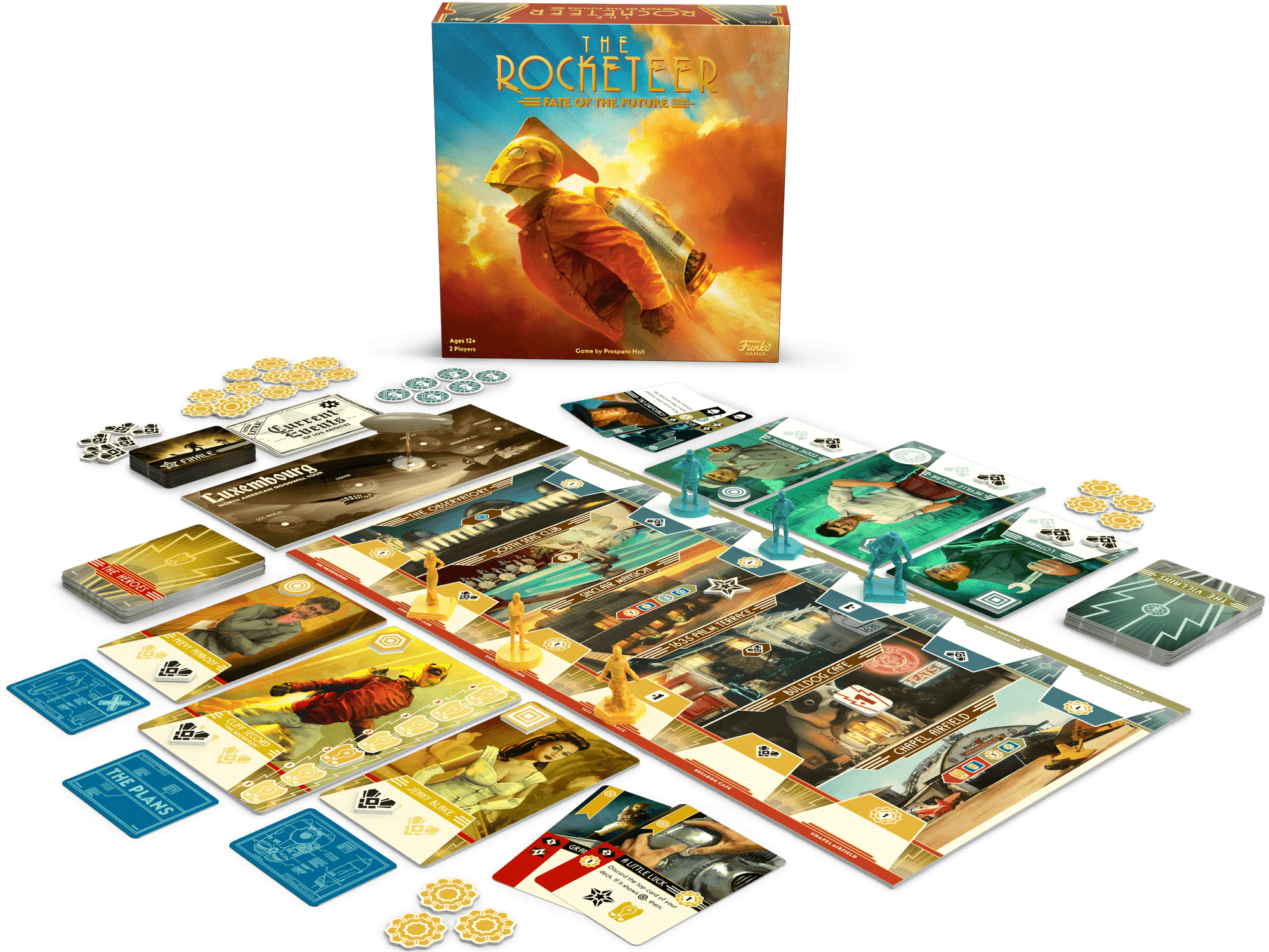
Friday Filler: The Rocketeer

With war looming – at least in Europe, the future of the world may depend upon who gets possession of a startling piece of equipment which could push the future of aviation technology—a rocket pack! Stolen to order from Howard Hughes by gangsters, they were forced to hide it in their getaway and both the one working model and the plans have ended up in possession of Cliff Secord, a stunt pilot. As he learns to fly the rocket pack, he comes to the attention of Eddie Valentine, the mobster hired to carry out the theft in the first place, and the man who hired Eddie, the matinee idol, Neville Sinclair, who also happens to be a secret Nazi! If Eddie Valentine cannot get the plans, then Sinclair’s henchman, the glowering Lothar certainly, if Lothar fails, Sinclair has a secret army of soldiers at his command. Cliff Secord must stop the plans from falling into Nazi hands—and if they do, get them back before Sinclair can travel to Germany. He has the help of his trusty mechanic, Peevy, and his girlfriend, both of whom can get places he cannot. Will Cliff keep hold of the rocket plans or will he fail and advance Nazi science in readiness for the coming conflict?

So this essentially, is the plot to the 1991 Disney film, The Rocketeer, which of course, was adapted from the brilliant comic book series by the late Dave Stevens. Both combined art deco stylings, pulp action, and a serving of modest cheesecake with the inclusion of the Betty Page-like Jenny with the inspiration of Republic Pictures serials of the early nineteen fifties, most notably Radar Men from the Moon and Commando Cody: Sky Marshal of the Universe. (If you have not seen the film, why not? It is genuinely good fun. Actually, go watch the film instead of reading this review. I honestly do not mind. Really. I promise you will not be disappointed. In fact, I am watching it right now as I type this, so what is your excuse?) This it also turns out is the set-up for The Rocketeer – Fate of the Future. Designed by the same team behind Indiana Jones: Sands of Adventure and Jaws, The Rocketeer – Fate of the Future is a two-player, asymmetric boardgame which was published by Funko Games in 2021—the thirtieth anniversary of the film. Designed for ages twelve and up, each player in The Rocketeer – Fate of the Future controls a team of three characters who will race back and forth across Los Angeles, trade punches as much as pithy putdowns, all the while trying to ensure that by the time the zeppelin, the LZ Luxembourg, is in town, they have possession of the rocket pack plans. The game plays in forty-five minutes, but faster once you get to it is rules—though it is not that complex.

The first thing that can be said about The Rocketeer – Fate of the Future is that this is a great looking game. You know that the moment you open the box and the Rocketeer’s helmet stares at you from the back of the board. This is a lovely detail—as is the map of Los Angeles on the inside of the lid of the box. Neither add a single thing to the game except love for the source material. The game is full of such details, such as the Current Event cards being designed to look like newspaper front pages and the art deco style throughout. The artwork is excellent, fully painted rather than drawn from Dave Stevens’ own artwork or stills from the film. It is all inspired by the film and is all very, very good. If there is a downside to the components, it is the miniature figures for each of the six characters. It is easy to tell which one is which, but they are more representative than effectively depicting the characters. The other aspect of the game’s look is the lack of reference to, or iconography of, the Nazis. Although we know Sinclair to be one, that is enough to play the game and it need not be made obvious and so spoil the look of the game.

At the heart of The Rocketeer – Fate of the Future are the plans to the rocket pack. These are represented by three cards. One is the Rocket Blueprint, the other two are dummy plans. The Heroes start play with these hidden and face down. The Villains will Tussle with the Heroes to determine which of them has the Rocket Blueprints and having taken possession of them, will keep them hidden and face down. It is the Heroes turn to Tussle with the Villains Heroes to determine which of them has the Rocket Blueprints and having taken possession of them again, will keep them hidden and face down. Play will continue like this over the course of five or six rounds, the aim being not just to keep hold of the Rocket Blueprint, but acquire Finale cards. Finale cards can be earned from playing the Abilities on cards and from having the Plans at the end of each round. Finale cards reward points and the player with the most points at the end of the game—indicated by the arrival of the LZ Luxembourg in Los Angeles—wins the game.

The Rocketeer – Fate of the Future is played out a board depicting different locations from the film across Los Angeles. These include The Observatory, the setting for the film’s climax, the South Seas Club where Sinclair takes Jenny to dinner, Sinclair Mansion, 1935 Palm Terrace—home to Peevy and Cliff, Bulldog Café where Cliff takes Jenny to dinner, and Chapel Airfield, scene of much of the film’s action. These locations are marked with Icons indicating the benefits a player can gain from visiting, knocking out opponents, and being in control at the end of a round. Each Player controls the three heroes—Cliff, Jenny, and Peevy, or the three villains—Neville Sinclair, Eddie Valentine, and Lothar. As the Rocketeer, Cliff has the advantage of the rocket suit and has greater movement—which can be increased, whilst as a Nazi agent, Neville Sinclair can recruit and build a secret army of soldiers. When he ambushes any of the heroes, Eddie Valentine realises who Sinclair is working for and scarpers, but Sinclair has his army, nonetheless. It is best for the Villain player to recruit as many as he can before unleashing them. Sadly, unlike in the film, Eddy Valentine does not then fight on the Heroes’ side.

Control of each player’s three characters is done via a deck of cards. Every card has icons to indicate which character or characters the card applies to, an action or an ability that the player character choose between, and the cost of using the ability as well as a good illustration. For example, ‘Put It In Neutral’ can be used by either Cliff or Peevy. If used as an Action card, it grants a Move and a Tussle Icon and their associated actions. However, if used as an Ability, there is no cost, but the character can move to any Location and take the associated action there. The illustration shows Cliff as the Rocketeer in the back of Peevy’s pickup truck, using the power of the rocket pack to make a getaway. This illustrates one of the scenes from the film and all the cards are like this, depicting a scene from the film and so combining the film’s story and the rules in such a way that helps bring the game to life. It is really quite subtle, but if you know the film, it is just one more way in which the designers reward the players. Other rewards from the Ability options on the cards include gaining Grit or Clout, drawing a card, drawing a Finale card, revealing or hiding Plans. The Hero player can also increases Cliff’s skill and range with the rocket pack and the Villain player can recruit soldiers to his secret army and stage ambushes. Grit is possessed individually by each character and is used in Tussles and Clout is a shared resource used to activate the Abilities on many of the cards.

The game consists of several rounds. At the beginning of each round, a Current Event card will be draw, which adds a random event and determines how far the Luxembourg travels this round. Then, using a hand of seven cards, each player will take it in turn to active his three characters, have them move, Tussle with the enemy. A player can use as many cards as he wants or he can for each character. Once a character has been activated and moved, he cannot do so again that turn. At the end of the round, rewards are earned for having the Plans and from each location controlled. Tussles are simple. The Action part of a card has a Tussle icon on it. This represents the character’s strength in the Tussle and it can be increased by adding the character’s Grit tokens. The defending player can block the attack by discarding cards which have the Shield icon on them and card’s which have the defending character’s Icon on them. This also costs Grit. The character with the higher Tussle Strength will win the Tussle. Only the defending character can be knocked out in a Tussle, which if his side has the Plans, will also reveal if he has the Rocket Blueprint or the dummy plans. A Tussle can—and will often—end with a standoff, with blows exchanged, Grit expended, and no knockout. This though does make a defending character weak if the acting player still have characters to move. Once both players have moved all three of their characters, the round is over, rewards are awarded, and a new round is set-up. Once the Luxembourg arrives in Los Angeles, a final round is played and the game ends. Players total their points from the Finale cards—typically two or three points per card, though some have zero points and others have conditional rewards such as a bonus for Grit in play or controlling a location—and the player with highest total wins.

The Rocketeer – Fate of the Future does feel a little long in its game play and though designed to be asymmetrical, does favour the Heroes more than the Villains. The Heroes have more chances to gain Finale cards and their mechanics are simpler, whereas the Villains have the Secret Army, which is a bit fiddlier and a different sub-mechanic for the Villain player to have to contend with. Plus, when the Secret Army does come into play, it cannot possess the Rocket Blueprint, meaning that if in the Villains’ hands, either Neville Sinclair or Lothar has it, making it easier to track down and get back. The aspect of winning via the Finale cards means that neither player quite knows who is winning until the very end unless one player has managed to get many more than the other. So, it can be difficult to work out how you are progressing in the game.

The Rocketeer – Fate of the Future is a clever design which really takes advantage of its source material to turn it into a good game. The game play is fairly simple, tactical rather than strategic—a player needing to get the best out of his hand of cards in a round rather than long term planning, and thematic. In fact, highly thematic! If you are a fan of The Rocketeer, then The Rocketeer – Fate of the Future is definitely the game for you. The Rocketeer – Fate of the Future definitely looks the part—comic book or the film—and who wouldn’t want to sock Neville Sinclair where it counts?

Friday, 8 September 2023

Friday Filler: Big Boss

The Golden Age of Industry has dawned. As skyscrapers—and profits—soar to new heights, now is the time to build your fortune . Launch companies and invest in new industries to earn capital. Buy shares of burgeoning businesses and reap the rewards of lucrative mergers. If you play your cards right, you’ll forge a legacy worthy of the title Big Boss. Big Boss is a radical departure for Funko Games. The publisher is best known for its generally family friendly, more mainstream titles that provide a combination of intellectual property and thematic game play which is attractively packaged and designed. Big Boss is a classic Euro-style board game about setting up companies, expanding them, purchasing shares and increasing their value, and occasionally, merging companies. It also has a bit of history attached to it. Big Boss is designed by Wolfgang Kramer, best known—along with Michael Kiesling—for the Spiel des Jahres-winning board games, Tikal and Torres. It is specifically based on Acquire, the classic board game of multi-player mergers and acquisitions, designed by Sid Sackson and published by 3M in 1964, and so highly regarded that it has been republished multiple times. Unlike Acquire, which has been available in English numerous times over its near sixty-year history, Big Boss was previously only available in German, having been published in 1994. Now available in English for the first time, Big Boss is designed for two to six players, aged ten and over, and plays in about an hour to about an hour-and-a-half.

Big Boss consists of a square board, plain and austere, but marked with a track which snakes around in a loop, running from one to seventy-two. Each number has a corresponding card in the Industry Card deck. In play, these numbers indicate where a player can found a company, and if the company occupies the right numbers where a player can expand the company along the track. The other cards in Big consist of the Level cards, the Share Cards, and Player Cards. There are eleven Share cards in each of the game’s eight companies—these are colour coded and have fantastically aspirational names such as Kingdom, Lunar, and Oasis, as well as a matching counter for the Share price Mat. The Level cards are used to expand any company on the board. The Player Cards are marked with two Radio Towers, which each player has two of at game’s start. The Radio Towers are added to a company headquarters to give a player a bonus of three shares. The Share Price Mat is numbered from one to fifty and is used to track each company’s share value over the course of the game. There is also a big stack of money tokens, ranging in value from one million to five hundred million, a big pile of building pieces, and eight headquarter pieces. The building pieces are black and not only fit into the track on the board, but stack on top of each other. The eight headquarter pieces correspond to the eight companies, sit atop the building pieces in play, and each have a slot for a Radio Tower.

At the beginning of the game, each player receives a hand of ten Industry Cards, two Radio Towers, and forty million in money tokens. Game play is simple. On a turn, a player has two options—buy a card or play a card. He can buy an Industry Card—either from the face up Industry Cards or from the Industry Card deck, or he can buy a Level card. He can play an Industry Card or a Level Card. The Industry Card is played to found a company or expand a company corresponding to the number on the Industry Card. The Level Card is used to expand a company by adding a building piece on top of an existing building piece in any company. When they are played to expand a company, both Industry Card and Level Card will also increase a company’s Share Price. Increasing the level of a Company will increase the Share Price by a greater amount than expanding the Company along the track. A Level Card also gives a player choice in which Company he chooses to expand, whereas an Industry Card does not. Consequently, a Level Card is more expensive than an Industry Card.

Once a player has expanded or founded a Company, its Share Price increases and the player earns money based on the new Share Price. He has then has two optional actions. One is to buy two shares, either from the same company or two different ones, and the other is to add a Radio Tower to the company that he just founded or expanded. He has two Radio Towers, with the second being more expensive to place than the first. Lastly, if a player cannot buy or play a card, he can either sell Shares at their current value or simply pass and take no action.

Initially, companies must be three spaces apart, but as they expand, they grow closer together and then, if they are connected, they merge. The larger company—the one with greater presence on the board and greater Share Price—will take over the smaller one. Anyone who has shares in the smaller company will receive a pay-out, the smaller company is eliminated from the game, and the share price of the larger company is increased by the share price of the smaller, now eliminated company. Eliminated along with the company are its shares, so although there is an immediate pay out, there will be none at the end of the game because neither shares nor company are in the game. So, mergers have a long-term effect as well as a short term one. They are also inevitable since there are seventy-two locations on the board and seventy-two corresponding Industry Cards, and whilst not every Industry card will necessarily be played, most will be and they can only be played the once.

Big Boss ends either when every player has decided to pass or more likely, all of the building pieces have been placed. Everyone receives money according to their shares, their Radio Towers, and the Industry and Level Cards they have their hands. The player with the highest value is the winner.

A notable feature of Big Boss is that the Share Price for any company always goes up, never down. Another aspect is that whilst share and profit games can be dry in tone and feel, the addition of the building pieces gives Big Boss a physical presence on the table and in play. Although the Share Price of a company is tracked on the Share Price Mat, the players can see it grow, literally physically as the game progresses. Consequently, whilst the use of the building pieces is used as an abstract representation of the company’s Share Price, that use actually does the reverse, it literally does indicate growth. Play of Big Boss is quick and easy, the rules being easy to grasp and understand, but once the initial flurry of Industry Cards have been played from the players’ hands to first found and then expand companies, the game can become quite intense as players decide whether they want to expand out along the track in the hope of merging, focus on adding Levels to a Company to increase its Share Price and make it stronger should it face a merger, or perhaps a mixture of the two. The more expensive Level Cards will give a player more options, but the cheaper Industry Cards restrict and focus a player’s choice. Equally important are the Share Cards, which enable a player to invest in a company even if he has been unable to directly expand the company.

One strong feature of Big Boss is the rulebook. It is well written, explaining how to play in simple fashion, enabling play to begin quickly even after opening the box for the first time. It also includes clear examples of play and play tips. In addition, the rulebook includes a history of Big Boss, rules for playing the original version of the game as published in 1994, and a section of ‘Frequently Asked Questions’. The original version of Big Boss is slightly more complex and less forgiving in its set-up and play.

Physically, Big Boss is has decent production values beyond the rulebook. The Industry Cards are nicely illustrated even though the number on them is the only thing that actually matters in play and everything has an art deco feel to it, including the eight headquarter pieces, so that you feel like you are building the skyscrapers across the skyline of nineteen thirties New York. One issue is the bulk of the components, especially the building pieces, which come in their own bag. They take up a lot of room in the box and since there is no tray inert, they can knock everything about in the box and that is despite the fact that they do not quite fit.

The game is explicitly based on the Sid Sackson classic Acquire and shares many similarities to that game though mergers are not as prevalent or as necessarily crucial in Big Boss. The main differences between the two games include the more visually satisfying three-dimensional aspect of Big Boss, and the existence of a strong monetary incentive to expand companies that you do not control.

Big Boss is a chance to own a Wolfgang Kramer game that has never been seen in English before. The question is, is it worth it. The answer is yes, as Big Boss has a great pedigree, being an alternate, streamlined, and more forgiving version of Acquire. As a competitive game of shares and company growth Big Boss is a good introduction to the financial theme in board games which does not get too complex, nor too dry, and with the physical presence of the company buildings, looks just about right.