Every Week It's Wibbley-Wobbley Timey-Wimey Pookie-Reviewery...
Showing posts with label PbtA. Show all posts

Saturday, 30 August 2025

[Free RPG Day 2025] :Otherscape – The Mythic-Cyberpunk RPG Demo Game

Now in its eighteenth year, Free RPG Day for 2025 took place on Saturday, June 21st. As per usual, Free RPG Day consisted of an array of new and interesting little releases, which are traditionally tasters for forthcoming games to be released at GenCon the following August, but others are support for existing RPGs or pieces of gaming ephemera or a quick-start. This included dice, miniatures, vouchers, and more. Thanks to the generosity of Waylands Forge in Birmingham, Reviews from R’lyeh was able to get hold of many of the titles released for Free RPG Day.

—oOo—

Two days ago, a terrorist cyber team was able to identify, isolate, and take control of an anomaly in cyberspace. An informant in the Tokyo Tangle has identified the team as belonging to the Ōgama marauders, a radical terrorist organization which has been frog-like yōkai who have been attacking civilian targets in the Megacity, likely in an attempt to destabilize the local government. The team’s target is the anomalous cyber Domain, BNZ4I-10, known to display cutting-edge or supernatural capacities with regard to data control. Now that Ōgama have control of BNZ4I-10, it has the ability to manipulate the flow of data throughout cyberspace. This includes the capacity to redirect data packets, including highly sensitive information sent from secure locations, into this anomalous Domain. With this, their cyber team has unchecked reach and significant advantage in terms of access to communication.

Although the location of the physical server hosting this Domain cannot be determined, but communications access has been gained. You will be placed in Harness and projected into the Domain’s virtual representation. Your objective is to infiltrate and take over BNZ4I-10, eradicate Ōgama presence and code, and transfer control to Section 7. As a secondary objective, identify and secure any tech or artifacts used by Ōgama operatives to control or access the server.

Mission begins.

This is the set-up for :Otherscape – The Mythic-Cyberpunk RPG Demo Game, a quick-start for :Otherscape – The Mythic-Cyberpunk RPG, published by the Son of Oak Game Studio, best known for City of Mist, the Pulp Noir, Urban Fantasy storytelling game. It is a narrative roleplaying game set some time during the next century in which the Player Characters are inhabitants of a dystopian Megacity who make a living undertaking dangerous jobs that their employers want temporary, deniable assets for. Typical tasks include hijacking, extraction, procurement, security sweeps, and so on. More recently, the Player Characters have made contact with something inexplicable, a legend or a Mythos that they hitherto only thought to be fiction, but is currently proving to be actually real. Almost as if it was out of a book of myths and legends, they find themselves capable of warping reality in a way that can only be described as magic! It uses a variant of the Powered by the Apocalypse mechanics, called the ‘Mist Engine’ and the :Otherscape – The Mythic-Cyberpunk RPG Demo Game includes a short strike mission, ‘BNZ4I-10 Cyber Anomaly’, that can be played through in a single session with the three pre-generated Player Characters provided.

A Player Character in :Otherscape – The Mythic-Cyberpunk RPG is defined by four sets of themed Tags. These Themes vary, but can include Esoterica, Expertise, Affiliation, Assets, Artefact, Personality, and more. Each Theme set contains five Tags which can be used as a ‘Power Tag’ or a ‘Weakness Tag’. For example, the Wilson has the Tags of ‘Oni Strength’, ‘Demonic Durability’, ‘Rapid Regeneration’, ‘Acute Sense of Smell’, ‘Muscular Overgrowth’, and ‘Easily Angered’ for his Oni Mask Theme. A Theme also has background details that develop and explain who the character is. Each Player Character has a set of items which can be used as Tags too.

The three Player Characters in the :Otherscape – The Mythic-Cyberpunk RPG Demo Game are ‘Genji’, a grizzled detective working for the Bureau of Onmyu, a secret government organisation that that tracks Mytho-related activities that are a threat to Tokyo and the rest of Japan; ‘Unagi’ is a scavenger and urban explorer looking for her kid sister who has also received the boon of Unagi Hime, the Eel princess; and ‘Wilson’ is a gaijin ronin, an ex-soldier turned mercenary armed with a cutting edge rail gun, who wears an Oni mask which gives strength and endurance. Each Theme comes with some colour text which gives it and the Player Character some context. Lastly, each of the three pre-generated Player Characters comes on a double-sided A3-size sheet, with a full illustration on one side and the full stats and details on the other, including an explanation of the roleplaying game’s core mechanic.

Mechanically, to have his character attempt a task a player rolls two six-sided dice. If the result is ten or more, the Player Character succeeds without Consequences; if it is seven to nine, he succeeds, but suffers Consequences; and if six or less, the Player Character fails and suffers the Consequences. To the roll, the player adds as many Power Tags as he can and which are appropriate, but has to deduct any Weakness Tags that apply. The resulting value is the Player Character’s Power. This can be spent on various Effects—Attack, Influence, Boost, Create, and Restore. They can also be applied to Challenges and Threats in an attempt to overcome them. Each Challenge or Threat has a rating or a ‘Limit’, for example, to get past an encampment of bandits with two men on watch, the Limits might be ‘stealth: 2’ and ‘wounded: 3’. In the first example, the Player Characters would apply the Effects from a stealth-related Tag to exceed the Limit, whilst in the second, the Effects from an attack-type Tag would be used. This can be done over multiple attempts with the Effects stacking each time, but if successful will change the status of a Challenge or Threat. Thus, the ‘stealth: 2’ Limit changes to ‘evaded-2’ and the ‘wounded: 3’ Limit to ‘wounded-3’.

However, there are ramifications if a Challenge or Threat is not dealt with succinctly or is even ignored. The Narrator can apply Consequences. This might be something as straightforward as ‘bleeding-3’ for a wound, ‘burning-1’ from a fire, or ‘lost-4’ if in darkness, but Limits themselves could change. For example, the Limits for the bandits could change to ‘hunted: 3’ and ‘wounded: 4’, now that the Player Characters failed to get past the encampment. The :Otherscape – The Mythic-Cyberpunk RPG Demo Game includes a list of possible Effects, advice on running the roleplaying game, and possible Challenges, Threats, and Consequences that the Player Characters might face and suffer.

The adventure itself, ‘BNZ4I-10 Cyber Anomaly’ is set within cyberspace into which each Player Character and his abilities are projected, a process known as Harnessing. What this means is that whilst what is actually happening is that lines of code are running and interacting with each other, they are visualised and anything a Player Character could do in meatspace, he can do in the virtual space too and it will look exactly what it does in the real world. BNZ4I-10 is a ‘thin place’, a place where the mythic and the real meet. BNZ4I-10 actually looks like a shrine, complete with several pagodas, a bathhouse, and a pond. These locations are not mapped out in detail, but they do not need to be. Both these locations and the Ōgama marauder threats are described in detail enough that the Master of Ceremonies—as the Game Master is known in :Otherscape – The Mythic-Cyberpunk RPG—will handle how they react to the actions of the Player Characters. The scenario be played as is, but options explore what might happen if the Player Characters are betrayed by their employer or they betray their employer.

Physically, the :Otherscape – The Mythic-Cyberpunk RPG Demo Game is well presented. The artwork is good and the writing decent. All three Player Character sheets come separate from the main book and there is even a sheet of Tracking Cards to cut and use to keep track of Effects being applied to Threats and Challenges and Limits being reduced.

If the :Otherscape – The Mythic-Cyberpunk RPG Demo Game is lacking anything, it is an example of play or the rules in play. Without either, it is not quite as easy to grasp as it could have been, presenting more of a challenge to learn for anyone new to roleplaying or new to the narrative style of play employed in :Otherscape – The Mythic-Cyberpunk RPG. However, for the experienced Narrator or the Narrator willing to grasp its slightly different rules, the :Otherscape – The Mythic-Cyberpunk RPG Demo Game is a solid, engaging introduction to :Otherscape – The Mythic-Cyberpunk RPG, with an exciting strike mission that puts the Player Characters in the heat of the action.

Friday, 18 July 2025

[Free RPG Day 2025] Legend in the Mist Demo Game

Now in its eighteenth year, Free RPG Day for 2025 took place on Saturday, June 21st. As per usual, Free RPG Day consisted of an array of new and interesting little releases, which are traditionally tasters for forthcoming games to be released at GenCon the following August, but others are support for existing RPGs or pieces of gaming ephemera or a quick-start. This included dice, miniatures, vouchers, and more. Thanks to the generosity of Waylands Forge in Birmingham, Reviews from R’lyeh was able to get hold of many of the titles released for Free RPG Day.

—oOo—

Life in the Dales has been good and all you have ever known. The working of the soil, the turning of the seasons, the joy of the festivals scattered throughout the year, and shared stories, some of past exploits, others of caution and calamity, and then, legends of great deeds long in the past and far away, outside the mountain fastness of the Dales. Above you know the wind as it blows cold down the mountain and into your bones or wafts along the river to warm your face and sway the barley. Of late, the wind has changed. You know it as it wails through the ruins of an ancient tower. You feel it as it brings a chill earlier in the nights than it should. You see the shadows deepen and hearts fill with uncertainty. The tales of old twist to tell of a fallen kingdom, of the Creatures of Twilight, and of Deceivers that stalked the innocent and the unwary, preying on the lost… Has an age-old threat returned and if so, why do you feel compelled to seek out the truth of the doom whispered upon the winds? To explore the extent of the Dales, before leaving its sanctuary, your home, and embark on a long journey in the Wanderlands?

This is the set-up for Legend in the Mist Demo Game, a quick-start for Legend in the Mist: The Rustic Fantasy RPG, published by the Son of Oak Game Studio, best known for City of Mist, the Pulp Noir, Urban Fantasy storytelling game. It is a narrative roleplaying game with optional tactical features intended to evoke the feeling of an old fireside tale. It uses a variant of the Powered by the Apocalypse mechanics called the ‘Mist Engine’, and the Legend in the Mist Demo Game includes a short three-act scenario, ‘A Shadow in the Barley’, that can be played through in a single session with the three pre-generated Player Characters provided.

A Player Character in Legend in the Mist is defined by four sets of themed Tags. These Themes vary, but can include Devotion, Trade or Skill, Trait, Personality, People, Trait, Possessions, and more. Themes are categorised as either Origin, Adventure, or Greatness Themes, which define where the Player Character came from, how he works to affect the world, and what he is good at, respectively. Each Theme set contains five Tags which can be used as a ‘Power Tag’ or a ‘Weakness Tag’. For example, the Red Marshal has the Tags of ‘The Red Armour’, ‘Stand Watch’, ‘Reassuring Presence’, ‘Know These Lands’, and ‘Loyal Horse’ for his Devotion Theme. A Theme has tracks for Experience—gained when a Tag is used as a weakness, and Decay, gained for acting against a Theme—that is, out of character—and which if filled, will lead to the replacement of the Theme. Each Player Character has a set of items which can be used as Tags too.

The three Player Characters in the Legend in the Mist Demo Game are ‘the Apple Picker’, a young, orphaned prankster; ‘the Red Marshal’, the new village scout; and ‘the Wise One’, the village healer who knows some of the mysteries of the world. Each Theme comes with some colour text which gives it and the Player Character some context. Lastly, each of the three pre-generated Player Characters comes on a double-sided A3-size sheet, with a female version on one side and a male version on the other.

Mechanically, to have his character attempt a task a player rolls two six-sided dice. If the result is ten or more, the Player Character succeeds without Consequences; if it is seven to nine, he succeeds, but suffers Consequences; and if six or less, the Player Character fails and suffers the Consequences. To the roll, the player adds as many Power Tags as he can and which are appropriate, but has to deduct any Weakness Tags that apply. The resulting value is the Player Character’s Power. This can be spent on various Effects—Attack, Influence, Boost, Create, and Restore. They can also be applied to Challenges and Threats in an attempt to overcome them. Each Challenge or Threat has a rating or a ‘Limit’, for example, to get past an encampment of bandits with two men on watch, the Limits might be ‘stealth: 2’ and ‘wounded: 3’. In the first example, the Player Characters would apply the Effects from a stealth-related Tag to exceed the Limit, whilst in the second, the Effects from an attack-type Tag would be used. This can be done over multiple attempts with the Effects stacking each time, but if successful will change the status of a Challenge or Threat. Thus, the ‘stealth: 2’ Limit changes to ‘evaded-2’ and the ‘wounded: 3’ Limit to ‘wounded-3’.

However, there are ramifications if a Challenge or Threat is not dealt with succinctly or is even ignored. The Narrator can apply Consequences. This might be something as straightforward as ‘bleeding-3’ for a wound, ‘burning-1’ from a spell, or ‘lost-4’ if in a blizzard, but Limits themselves could change. For example, the Limits for the bandits could change to ‘hunted: 3’ and ‘wounded: 4’, now that the Player Characters failed to get past the encampment. The Legend in the Mist Demo Game includes a list of possible Effects, a very quick introduction to character creation—more of an enticement to look at the full rulebook and what it offers than anything else, advice on running the roleplaying game, and possible Challenges, Threats, and Consequences that the Player Characters might face and suffer.

The adventure itself, ‘a Shadow in The Barley’ is set in the village of Ravenhome in the Dales. One autumn morning, the three Player Characters met on the road* outside of the village. They have time to interact before they hear the scream of a child coming from a nearby field of barley. Investigating reveals a very scared child, paralysed with fear, as well as a strange feeling upon the air. Is there something lurking in the field? All is revealed when a shambling, water-logged corpse, wearing old armour and wielding a rusty sword lurches onto the road. This is a Waken Sentry and the Player Characters will realise that the only source of water nearby is that of a pond in a decrepit tower. However, before the Player Characters can investigate they need to get the child to safety and warn the villagers. This sets up a social challenge which can end with the whole village fleeing or even arming everyone with pitch forks to deal with themselves. There is scope here for some good roleplaying versus some interesting, but not always helpful NPCs. The finale of the scenario sees the Player Characters investigate the tower, encounter a strange NPC who wants their help in retrieving a ‘family heirloom’ from the pond, and discover the cause of the Waken Sentry.

* Well, it makes a change from a tavern.

‘a Shadow in The Barley’ is ultimately the introduction to a longer scenario, setting up, as it does, a mystery at the end . In the process of setting that up, it showcases how the rules apply to different situations—one combat related, one social, and one exploratory.

Physically, the Legend in the Mist Demo Game is well presented. The artwork is good and the writing decent. All three Player Character sheets come separate from the main book and there is even a sheet of Tracking Cards to cut and use to keep track of Effects being applied to Threats and Challenges and Limits being reduced.

If the Legend in the Mist Demo Game is lacking anything, it is an example of play or the rules in play. Without either, it is not quite as easy to grasp as it could have been, presenting more of a challenge to learn for anyone new to roleplaying or new to the narrative style of play employed in Legend in the Mist: The Rustic Fantasy RPG. However, for the experienced Narrator or the Narrator willing to grasp its slightly different rules, the Legend in the Mist Demo Game is a solid, engaging introduction to Legend in the Mist: The Rustic Fantasy RPG.

Friday, 5 July 2024

[Free RPG Day] Rebels & Refugees Adventure

Now in its seventeenth year, Free RPG Day for 2024 took place on Saturday, June 22nd. As per usual, Free RPG Day consisted of an array of new and interesting little releases, which are traditionally tasters for forthcoming games to be released at GenCon the following August, but others are support for existing RPGs or pieces of gaming ephemera or a quick-start. This included dice, miniatures, vouchers, and more. Thanks to the generosity of Waylands Forge in Birmingham, Reviews from R’lyeh was able to get hold of many of the titles released for Free RPG Day.

—oOo—

The Rebels & Refugees Adventure is a scenario released for Free RPG Day 2024 for Avatar Legends: The Roleplaying Game, one of the most successful Kickstarter campaigns for any roleplaying game. Published by Magpie Games, this is the roleplaying adaptation of Avatar: The Last Airbender and The Legend of Korra, animated series which are inspired by the indigenous cultures of North America and Asia, in particular, China, Chinese martial arts, and the ability to ‘bend’ or manipulate the four elements—water, earth, fire, and air. Only one person can bend all four elements, and he is known as the ‘Avatar’, and not only does he serve as the link between the physical world and the spirit world, but he is also responsible for maintaining harmony between the world’s four nations. In the roleplaying game, the players roleplay characters, or companions, who are capable of bending one of the elements as well as practising martial arts, all with the aim of protecting the world from harm and those unable to stand up to misuse of power. The Rebels & Refugees Adventure can be run using the Movers & Shakers Quick-Start Booklet rather than the full rules and there is advice for the Game Master to that end. It is designed for three to six players, one of whom will be the Game Master, and includes five pre-generated Player Characters, rules and advice for the Game Master, and a situation or scenario, the ‘Rebels & Refugees’ of the title.

The Rebels & Refugees Adventure and thus Avatar Legends: The Roleplaying Game is ‘Powered by the Apocalypse’, the mechanics based on the award-winning post-apocalyptic roleplaying game, Apocalypse World, published by Lumpley Games in 2010. It is set during the ‘100 Year War Era’ and opens with the Player Characters, or Benders, having joined a group of Earth Kingdom rebels and Earth Kingdom refugees fleeing the Fire Nation Army. They have taken refuge in the Western Air Temple, hoping to find respite from an enemy which has been behind them every step of the way. Unfortunately, the Western Air Temple is not as safe as they hoped that it would be. Long abandoned, the only inhabitant now is a spirit whose antics quickly escalate from throwing oranges at the new arrivals to collapsing columns and blocking passages. Faced with a threat from within as well as the Fire Nation Army closing in, tensions grow as it becomes clear that the Western Air Temple is not as safe as everyone thought it was. When neither the leader of the rebels or the leader of the refugees can agree on what the best course of is—stay in hiding from the Fire Nation Army, but at the mercy of a malicious spirit, or make a run for it and hope that the Fire Nation Army does not catch with them, both they and the refugees and the rebels turn to the Player Characters for help and advice.

The scenario opens with the Player Characters and the rebels and the refugees they are accompanying in the Western Air Temple having lowered themselves by ropes down cliffs to the entrance. Both the rebels and the refugees are spooked by the first of the strange events in the temple and already on edge. Beyond this set-up, the Rebels & Refugees Adventure provides all of the bits and pieces that the Game Master needs to run it and even possibly run a sequel. This includes a very good summary and description of the scenario, all of its NPCs, and its locations. Among the NPC descriptions are the leaders if the rebels and the refugees, the spirit lurking in the Western Air Temple, even General Uyanga, the commander of the Fire Nation Army, whom it is possible for the Player Characters to meet in the course of the adventure. There is a number of pre-plotted events, but much of what the Game Master will be doing is reacting to the actions of the Player Characters in order to construct a pursuit clock. This will ultimately measure the chase between the Player Characters and the many people with them as they try to escape from the Western Air Temple to a southern port where they can properly escape the Fire Nation Army. Numerous actions and options in terms of what the Player Characters might do, and ultimately, the outcome is very much player-driven and the Game Master will need to adapt as necessary.

In terms of Player Characters, the scenario comes with a varied selection. There is a headstrong inventor with a penchant for sabotage, an Earth-Bending farmer able to adjust the plans of others, an acrobat with a walrus-yak companion—although how the Player Characters got it down the cliff to the Western Air Temple is a whole other scenario of its own, a nun wants to heal the world of its war woes and fights defensively, and a Water Bender who is an astute judge of character. All five start play with a single mastered technique and other unique advancement options, so they are not equal to starting characters. There is advice given on how to adjust new characters to play the scenario if the players want to create their own.

Physically, the Rebels & Refugees Adventure is well presented, sturdy booklet. The booklet is well written with plenty of advice and help for the Game Master, including summaries of the Moves, Combat Exchanges, Fighting Techniques, and more at the back.

Rebels & Refugees Adventure is good scenario for Avatar Legends: The Roleplaying Game and the worlds of Avatar: The Last Airbender and The Legend of Korra. It will also appeal to fans of anime and martial arts, but this is still a scenario for an experienced Game Master even if it can played with just the quick-start rules in Movers & Shakers Free RPG Day Booklet.


Friday, 11 August 2023

[Free RPG Day 2023] Movers & Shakers

Now in its sixteenth year, Free RPG Day for 2023 took place on Saturday, June 24th. As per usual, Free RPG Day consisted of an array of new and interesting little releases, which are traditionally tasters for forthcoming games to be released at GenCon the following August, but others are support for existing RPGs or pieces of gaming ephemera or a quick-start. Thanks to the generosity of David Salisbury of Fan Boy 3, Fil Baldowski at All Rolled Up, and others, Reviews from R’lyeh was able to get hold of many of the titles released for Free RPG Day, both in the USA and elsewhere.

—oOo—

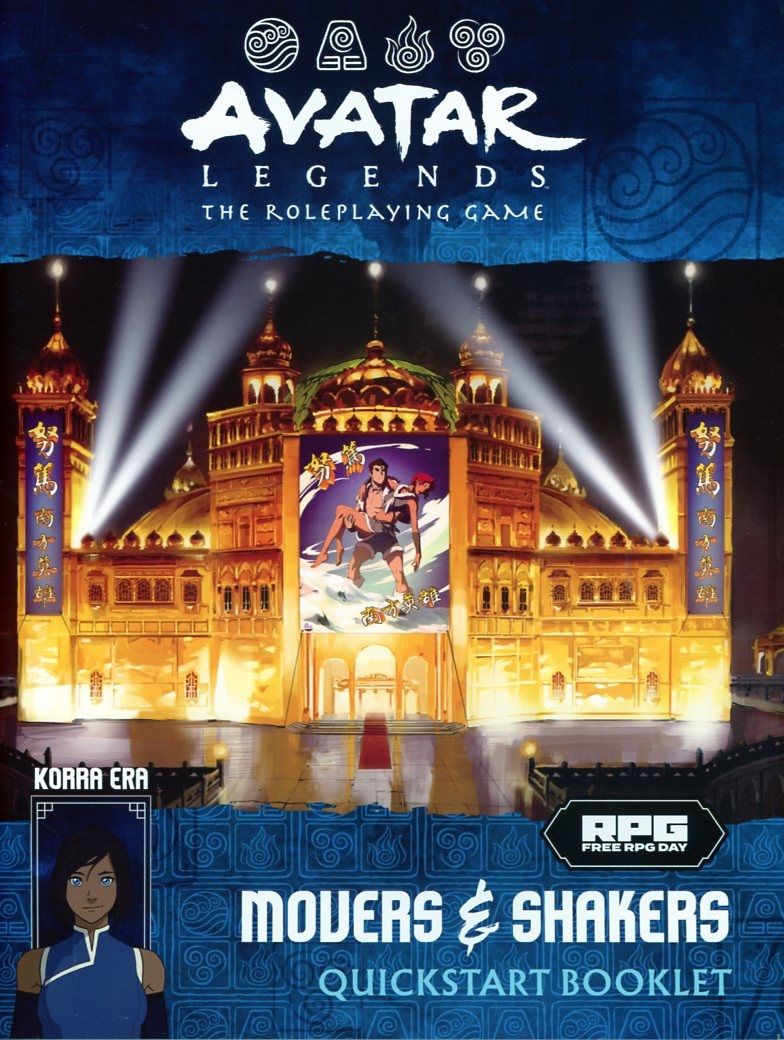
The Movers & Shakers Free RPG Day Booklet is the quick-start for Avatar Legends: The Roleplaying Game, one of the most successful Kickstarter campaigns for any roleplaying game. Published by Magpie Games, this is the roleplaying adaptation of Avatar: The Last Airbender and The Legend of Korra, animated series which are inspired by the indigenous cultures of North America and Asia, in particular, China, Chinese martial arts, and the ability to ‘bend’ or manipulate the four elements—water, earth, fire, and air. Only one person can bend all four elements, and he is known as the ‘Avatar’, and not only does he serve as the link between the physical world and the spirit world, but he is also responsible for maintaining harmony between the world’s four nations. In the roleplaying game, the players roleplay characters, or companions, who are capable of bending one of the elements as well as practising martial arts, all with the aim of protecting the world from harm and those unable to stand up to misuse of power. The Movers & Shakers Free RPG Day Booklet is designed for three to six players, one of whom will be the Game Master, and includes five pre-generated Player Characters, rules and advice for the Game Master, and a situation or scenario, the ‘Movers & Shakers’, of the title.

The Movers & Shakers Free RPG Day Booklet and thus Avatar Legends: The Roleplaying Game is ‘Powered by the Apocalypse’, the mechanics based on the award-winning post-apocalyptic roleplaying game, Apocalypse World, published by Lumpley Games in 2010. At the heart of these mechanics are Playbooks and their sets of Moves. Now, Playbooks are really Player Characters and their character sheets, and Moves are actions, skills, and knowledges, and every Playbook is a collection of Moves. Some of these Moves are generic in nature, such as ‘Guide and Comfort’ or ‘Rely on your Skill and Training’, and every Player Character can attempt them. Others are particular to a Playbook, for example, Qacha, the Guardian, one of the five pre-generated Player Characters, has the Moves, ‘Catch a Liar’, ‘Suspicious Mind’, ‘Martyr Complex’, and ‘A Warrior’s Heart’.

To undertake an action or Move in a ‘Powered by the Apocalypse’ roleplaying game—or Avatar Legends: The Roleplaying Game, a character’s player rolls two six-sided dice and adds the value of an attribute such as Creativity, Focus, Harmony, and Passion, to the result. A full success is achieved on a result of ten or more; a partial success is achieved with a cost, complication, or consequence on a result of seven, eight, or nine; and a failure is scored on a result of six or less. Essentially, this generates results of ‘yes’, ‘yes, but…’ with consequences, and ‘no’. Notably though, the Game Master does not roll in ‘Powered by the Apocalypse’ roleplaying game—or Avatar Legends: The Roleplaying Game, although she does have Moves of her own.

So, for example, if Erdene, the Prodigy, wants to assess an opponent, her player will select the ‘Judging a Rival’ Move. The aim is to have Erdene determine the rival’s strengths and weaknesses, how she can show dominance or submission to the rival, what the rival intends to do next, and what the rival wishes that Erdene would do next. To make the Move, the player rolls the dice and his Erdene’s Focus to the result. On a result of ten or more, the player can ask two of these questions, whilst on a result of seven, eight, or nine, he only gets to ask one.

Besides the four stats, a Player Character has Backgrounds, for example, Urban and Military, Demeanours like Confident and Warm, and a Training, such as Airbending. He also has a Fighting Style, like ‘Strong individual streams of air, like a Firebender’s flame jets’. His Balance is represented by a track, which runs from ‘+3’ to ‘-3’, for example, between the Principles of Excellence and Community. Events and the effects of Moves can shift the Player Character’s Balance up and down the track. This represents a Player Character’s core personality and if this Balance is pushed off the track, which can lead to a loss of a Player Character’s powers, his acting against his principles, or even give in to the enemy. A Player Character’s Balance can be restored through rest and reflection, but this takes time. In addition, a Player Character has an aspect that adds depth and detail, as well as motivation. For example, Thi, the Hammer, has ‘Bringing Them Down’ which sets him up to confront a single enemy. In his case, it is Amrita, the lieutenant of the Creeping Crystal Triad that Thi once worked for and is trying to make up for having done so. When facing Amrita, Thi has a penalty to all interactive Moves, but when fighting Amrita, becomes Inspired and clears all fatigue. A Player Character has two or three ‘Fighting Techniques’ and notes on connections, a Moment of Balance when he can restore his Balance, and a Background.

As the quick-start for Avatar Legends: The Roleplaying Game, the Movers & Shakers Free RPG Day Booklet provides both an introduction to the setting and the mechanics. The former includes a basic overview of the setting, the ‘Avatarverse’ and its five ages and four nations, plus descriptions of Airbending, Earthbending, Firebending, and Waterbending, followed by Weapons and Technology, and the roles that they all play in the ‘Avatarverse’. It provides a short, basic introduction to the setting, whilst the scenario gives more setting specific details. The explanation of the rules is more extensive, covering what a roleplaying game is, the need for safety tools, how to frame scenes, and more, all before going into detail about Moves. This includes the Basic Moves common to every character, plus Balance Moves, which affects the Balance Track, as well as Combat Exchanges. In general, combat in the Movers & Shakers Free RPG Day Booklet and in Avatar Legends: The Roleplaying Game is run as a series of one-on-one combats rather than mass brawls, no matter the number of combatants. They require combatant to first select an approach, either ‘Defend and Manoeuvre’, ‘Advance and Attack’, or ‘Evade and Observe’, this being the basic style the character wants to assume. After that, a combatant can select a Fighting Technique associated with the approach. For example, Erdene, the Prodigy, has three Fighting Techniques. Both ‘Steady Stance’ and ‘Air Swipe’ are associated with the ‘Defend and Manoeuvre’ approach and ‘Small Vortex’ with the ‘Evade and Observe’ approach.

What there is not in Avatar Legends: The Roleplaying Game is any Moves connected to Bending, or the manipulation of an element. A Player Character needs to be trained in Bending, whether Airbending, Earthbending, Firebending, or Waterbending, and these colours what he does and the Moves he makes. For example, Meeka, the Idealist, is a Waterbender and she has the fighting style involving ice spikes, either flung or driven up from the ground or through the walls. With the ‘Disorient’ Fighting Technique, she pummels the foe with quick blows, in this case a flurry of ice shards, but with ‘Slip Over ice’, she slides around the environment with ease to put off an enemy off-balance, this could be over the ice she creates or the water from partly melted ice she has created.

The scenario in the Movers & Shakers Free RPG Day Booklet is the eponymous ‘Movers & Shakers’, which is set during the Korra Era of Avatar: The Last Airbender and The Legend of Korra. The Player Characters are hired to protect the production of a new mover—or film—called ‘Sengo: lady of the Winds’. It has been plagued with equipment malfunctions and breakdowns, and an executive at Varrimovers International Studios fears that someone is attempting to sabotage the production of a mover that could restore the studio’s fortunes. This is certainly the case and that someone is connected to the backstory of one of the five pre-generated Player Characters. Over the course of four days, the Player Characters must protect the film, its production, its crew, and its cast from attacks from without by members of the Creeping Crystal Triad and tensions from within between the cast and crew. With the latter there is scope for investigation and roleplay and with the former, there is scope for roleplaying and combat. Like the publisher’s scenarios for Root: The Tabletop Roleplaying Game, ‘Movers & Shakers’ is not a linear scenario. Rather it is a situation or scenario, comprised of detailed descriptions of the various locations and NPCs, that the players and their characters can explore, the Game Master reacting to their decisions and making Moves of her own to keep up the tension, the storyline, and the action as necessary. It is primarily player-driven and the Game Master will need to understand all of the scenario’s elements to run it properly. This does mean that the scenario—and also the Movers & Shakers Free RPG Day Booklet—are really designed for the beginning Game Master. She is accorded good advice on how to run the scenario, but for someone new to the hobby, it is likely to be daunting prospect.

The five pre-generated Player Characters include a rash airbender with great airbending ability who exasperates her sister, who has sworn to protect her. The others are a former triad employee who is good with technology, who is trying to redeem himself; a former soldier and waterbender who wants to help and heal the world; and an earthbender who wants to live up his father’s skill, but not his reputation. All five pre-generated Player Characters are nicely designed, capable, and interesting, and include backgrounds and connections to one or more of the other Player Characters.

Physically, the Movers & Shakers Free RPG Day Booklet is well presented, sturdy booklet. Running to some fifty-pages, there is plenty of advice and help for the Game Master, including summaries of the Moves, Combat Exchanges, Fighting Techniques, and more at the back. Although it needs a slight edit in places, the main issue perhaps is the lack of examples that would ease the learning of the ‘Powered by the Apocalypse’ mechanics, especially the Combat Exchanges of Avatar Legends: The Roleplaying Game. The detailed nature of the Movers & Shakers Free RPG Day Booklet also means that the Game Master does have a lot to learn and prepare.

The density of Movers & Shakers Free RPG Day Booklet and the non-linear, sandbox style nature of its scenario, ‘Movers & Shakers’, means that Game Master needs to study the booklet in order to prepare and run the adventure. For anyone new to roleplaying, perhaps fans of Avatar: The Last Airbender and The Legend of Korra and having picked up the Movers & Shakers Free RPG Day Booklet to find out what roleplaying is, this is too dense and not supported with examples that would have made the learning process easier. For the more experienced roleplayer, and certainly anyone with experience of ‘Powered by the Apocalypse’, this will be very much less of an issue.

The Movers & Shakers Free RPG Day Booklet is a fun, entertaining introduction to Avatar Legends: The Roleplaying Game and the worlds of Avatar: The Last Airbender and The Legend of Korra. Fans of both will enjoy this, as will any player who enjoys anime and martial arts, but Movers & Shakers Free RPG Day Booklet definitely benefits from an experienced Game Master.

Sunday, 14 May 2023

Down with the Gutters

Titan City reaches beyond the sky and deep into the planet. Its soaring Empyreal Spires are home to the Plutogia, the ruling families, who know only a life of glittering beauty and untold wealth. At its heart is the Great Cannon, the greatest machine on the planet, capable of launching starships laden with rare and valuable minerals mined by the innumerable tunnels which bore into the planet’s crust. The limits of Titan City are marked by the walls of the impossibly large crater and beyond lies radioactive deserts, inhabited only by mutated beasts and half-life bandits capable of surviving the death-grey sands and poisoned atmosphere, all under a sky marked with three moons. Ten billion humans live in Titan City, many in the Undercity, amidst industrial ruins which stretch for miles and miles up and down as well as in any other direction. Here such humanity and other such outcasts—mutants and psions, survive as best they can. Enforcers ruthlessly break up any dissent or uprising from here in the Guts of the Titan City, but that is only an intermittent threat to inhabitants’ lives, their purses bled dry by the hyper-corporations and the air they breath wrapped in smog poisoned by the waste output from barely regulated factories. Under such grinding conditions, some of these Guts-dwellers make what purpose and hope they can. They join gangs, cults, rebellions, churches, anything to give them both purpose and hope. The gangs are everywhere, staking their claims to territories, making money from crime, dealing with rivals through ‘honourable’ agreements and bloody violence, trying to get bigger, better, and richer, grab all the power they can to be crime lords, not just petty gangs.

The is the setting for Gangs of Titan City, a roleplaying game of crime and consequences in a far future underworld—literally and figuratively. Published by SoulMuppet Publishing, it can be best described as BBC’s Peaky Blinders meets Games Workshop’s Necromunda in a Judge Dredd-like Mega-City One, but vertical, in which the players take of the role of Gutters in a gang which wants to grow and be feared. As Gutters, the players will direct and roleplay the lives and development of their gang over three phases of play per session. In the ‘Escalation Phase’, the gang plans its next move. In the ‘Operation Phase’, the gang enacts its plan, and in the ‘Fallout Phase’, the gang suffers the consequences of their actions, for good or ill. Grabbing a Claim will often bring a gang into conflict with a potential rival and as the gang’s domain grows so will its rivalries and the consequences of its actions. How far will a gang go before the consequences threaten to overwhelm it, let alone individual gang members, will be revealed as a Gangs of Titan City campaign progresses. And it is important to note that Gangs of Titan City does require that progress to really work. The roleplaying game is better suited to campaign play than the one-shot because the consequences are not going to be fully explored in the short term, only the long term.

Gangs of Titan City is a storytelling roleplaying game in which the players are encouraged to be bold in their storytelling and their Gutters’ actions, as well as embrace and explore the consequences of those actions. It is player-driven in that there are no set plots and much of the setting can be created during play. However, it is a roleplaying game which deals with gangsters and that means that the players will be exploring the darker, criminal side of human nature. It is not surprise that Gangs of Titan City carries warnings about its violent, traumatic themes that include body horror, injury, and death. Similarly, the inclusion of addiction and drug abuse should be no surprise either. Harm to animals is definitely a surprise, whilst as a Science Fiction roleplaying game which includes psionics, especially one of this nature, the invasion of privacy and mind control are also included as a possible issue. To be clear, Gangs of Titan City does not dwell on these or condone, but instead indicates that they can be part of the game and its play given its dark nature. Thus, the use of Safety Tools is advised, but even so, Gangs of Titan City deals with some surprisingly direct and mature themes.

The players in Gangs of Titan not only create their Player Characters or Gutters, but also their Gang. A Gang has an Archetype, three XP Prompts, which suggest activities and behaviours the gang can engage in to generate Experience Points; various details which will vary between Archetypes and add flavour rather than mechanical benefits; two Aspects or quirks, which again flavour rather than mechanical benefits; a Contact and a Rival; an Advancement, a powerful ability which gives the gang an advantage; and lastly, a Hideout connected to the Gang’s Claim and three Hazards. One hazard comes from the Gang’s Rival, one from its Hideout, and one from its Archetype. There are six Archetypes. A Consortium will make and sell anything because money equals power; a Cult worships something dark and terrible and wants more converts; an Enclave is made up of outcasts and the dispossessed trying to survive, make a space for their own, and even hit back at their oppressors; Mercenaries are guns for hire, the bigger the paycheck, the bigger the boom; Operatives work in secret, stealing, destroying, and keeping secrets; and Overlords just want to rule. Each entry gives lots of options to choose from, including names, so that there is lots of variation and the players can really make their gang their own.

Name: The Party Syndicate
Archetype: Consortium
XP Prompts: Negotiate a favourable price, force a competitor out of business, secure a supply or source
Starting Claim: Stack-Market
Core Product: Vice Peddling
Aspects: Wide-Ranging Suppliers, Catchy Slogan (“Our price, your vice”)
Consortium Gear: Emergency Funds (enough for a small bribe or two), Very Fancy Outfit for each Gutter
Consortium Hazards: City-Wide Shortage
Contact: Hekeret Tine, Corporate Stooge
Rival: Promolium Vol, Spire House Representative
Hideout: Bodega Bill’s Corner Shop
Consortium Advancements: Smugglers
Hazards: Bodega Bill’s Corner Shop gets a lot of footfall (Hideout), got Promolium Vol, Spire House Representative very drunk and got him to invest (Rival), already sold a whole load of filth (City-Wide Shortage)

A Gutter has a Class, three XP Prompts, six Approaches (or methods of dealing with a situation), Aspects (visual descriptors and quirks), Personality Traits (roleplaying prompts), a Contact and a Rival, Specialisms (skills and areas of knowledge), an Advancement, and some Gear. A Gutter always has one piece of Gear with him, plus one item related to a Specialism and one given to the Gutter by his Contact or taken from his Rival. The six Approaches range in value between -3 and +3 and are Overwhelm, Exploit, Dominate, Resolve, Calculate, and Appeal. There are eight different Classes. These are the Aberration, more or less Human; the Broker, ready to make any deal; the Bruiser, who provides muscle and close-up intimidation; Marksman, stealthy gun for hire; Mastermind, gifted liar and clever thinker; Psionicist, whose gift both marks them and gives them power; Spectre, the sneak and knife in the back; and Technomancer, combing man and machine. Like the Gangs, each of the Classes is nicely detailed with lots of elements for a player to choose from and individualise his Gutter, to which the player also assigns an array of values to the Gutter’s Approaches.

Name: Wolter Dabrurgun
Class: Spectre
XP Prompts: Deception, Stealth, Disabling Security
Approaches:
Overwhelm 0 Exploit +2 Dominate -1
Resolve +1 Calculate +1 Appeal 0
Aspects: Pale Skin, Goggles
Personality Traits: Careful, Manipulative
Contact: The Bird’s Foot, Alleged Master Thief
Rival: Horvas, Data-Mind Scavenger
Specialisms: Security measures, Cyber Splicing
Advancements: Are you sure about that?
Gear: Cybernetic Interface, Lockbreakers, Climbing Kit

Mechanically, Gangs of Titan City is simple. If a Gutter wants to undertake an action, his player rolls two six-sided dice and applies the modifier from the appropriate Approach. A roll of ten or more indicates a Full Success, between seven and nine a Partial Success, and six or less, a Failure. Essentially, the equivalent of ‘Yes’, ‘Yes, but’, and ‘No’. Some abilities, including Specialisms, allow an additional die to be rolled, but only two are kept. Circumstances can add a single +1 bonus and rerolls of single dice are possible if the Gutter takes a point of Desperation.

Combat uses the same core mechanic. It tends to favour the Gutters initially; opponents tending only to act or have a Reaction when a Gutter’s player rolls a Partial Success or Failure on an attack. When this happens, the player makes a Resistance roll to avoid or withstand the effects of the attack. Essentially, Gangs of Titan City is player-facing. Once a Gutter starts suffering damage, combat can get nasty. A Gutter only has three Damage Boxes, which are filled in with Scratches and Wounds, and if all three are filled in, it becomes a Critical Wound. Further damage can inflict Desperation, Trauma, or kill the Gutter. If a Gutter has too much Desperation at end of the three phases of Gangs of Titan City’s play, there are multiple consequences that include burning a Contact, suffering a Trauma—which might be a Hatred, an Obsession, or a Weariness, and adding to the Gang’s Danger Table.

Gangs of Titan City’s rules also detail weapons, vehicles, and other gear in quite light detail. More detail is paid to Pharma-Serums, which are readily available across the city. These all have drawbacks, but provide an extra die for certain checks depending upon the Pharma-Serum. In terms of improvement, both Gang and Gutters can acquire further Advancements if they have sufficient Experience Points, which are gained from tagging their XP Prompts under dangerous circumstances. For the Gutter, a player can choose a new Advancement or Specialism from the Gutter’s Class, increase an Approach, or gain an Alteration. Alterations can be Cybernetic Augmentations, Gene-Mods, or Psionic Disciplines. Gaining Alterations can be easier for some Classes rather than others. For example, the Psion will only have access to Psionic Disciplines, but members of the other Classes can obtain the Cybernetic Augmentations and Gene-Mods—for a price and likely some roleplaying too. The players can spend their Gang’s Experience Points to take an Advancement for its Archetype or improve one of its Squads. In addition, a Gang’s Hideout can be improved with a new Feature or have an existing Feature upgraded.

Gangs of Titan City has a distinct Cycle of Play consisting of three phases. In the ‘Escalation Phase’, the gang plans its next move. In the ‘Operation Phase’, the gang enacts its plan, and in the ‘Fallout Phase’, the gang suffers the consequences of their actions, for good or ill. Each phase consists of several steps. For example, in the ‘Escalation Phase’ there are three steps. In the ‘Montage Phase’, the players explore what their Gutters are doing on a day-to-day basis, followed by a roll on ‘The Event Table’ which brings in a Rival or Faction into the story for that Cycle of Play, and then the Gang gets together to decide on its next ‘Gang Moves’. The ‘Operation Phase’ is when the Gutters go out and seize control of a Claim or Asset, launch a pre-emptive strike to remove a Hazard from the Gang’s Danger Table, or perform a job or contract for another Gang or faction, and this is when the Gutters will go out and actively, physically pursue the Gang’s aims. In the ‘Fallout Phase’, the Gutters and their players will resolve objectives, treat wounds, determine if the Gang’s actions has made sufficient ‘Noise’ to attract the authorities, check income, spend Experience Points, and more. All of this is intended to be played within a single session, although it need not be, and fundamentally player driven, with outside elements randomly generated by the Narrator. So, there are no set plots and the players need to be proactive more than reactive.

Gangs of Titan City is played on two levels. One is the tactical, often the individual level, when the Gutters are acting directly and the players are roleplaying them, often in the field. The other is strategic, when the Gutters plan their actions, direct their Squads, handle their Assets and Claims, and so on. Thus, there is a degree of resource management to the play, whether that is dealing with Assets and Claims, but also Debt. Debt represents how far a Gang’s resources are spread out or extended and works the same way as Desperation does for the individual Gutter. If a Gang has too much Debt at end of the three phases of Gangs of Titan City’s play, there are multiple consequences that include burning an Asset, suffering a Hardship—which might be being Watched, Spread thin, or suffering from Loose Lips, and adding to the Gang’s Danger Table. Whilst Desperation and Debt track the consequences of the Gutters’ actions on the personal and collective levels, they both come together in the Danger Table. Entries can be added to the Danger Table because of both, but also due to Noise generated during the ‘Operation Phase’, taking Claims and assets from rival Gangs and Factions or doing jobs for them, and so on. As the Danger Table is filled with Leads, Jobs, and Hazards, these become storytelling elements which randomly come back into play and the Gutters have to deal with immediately. The entries on the Danger Table are never hidden, so there is always a problem or difficulty looming over the Gutters and their Gang, waiting to escalate into something that they must deal with immediately.

However, Gangs of Titan City does require some set-up by the Narrator. Not necessarily a great deal, but it is not obvious from the outset. This includes creating a starting sector or two and then populating it with themes, factions, and a starting dynamic. Plus, an Asset web needs be drawn, connecting the players’ Gang and their Assets to the previous owners of those Assets, because every Asset has a previous owner! This of course, builds connections for the Gang, for both good and bad. As a campaign progresses, this Asset web will grow and grow. Fortunately, the Narrator’s role is strongly supported throughout with almost a third of the devoted to helping her run Gangs of Titan City. The advice is good, including letting the players be cool, be open about the risks that their Gutters and Gang face, and almost in adversarial terms, that the Narrator can always get the Gutters and their Gang later if they are successful in their plans now! This does not mean that the Narrator is expected to be adversarial, but rather the successes of the Gutters and their Gang will come back to proverbially bite them through the Hazards and other entries on the Danger Table. There are also examples of almost everything that the Narrator can bring into play or use as inspiration, including Leads and Jobs. Various sector types are discussed as are the Enforcers who will act when the Gang causes too much Noise, and there are numerous example Gangs and Factions given too, ready to populate the sector.

Rounding out Gangs of Titan City is an overview of the City of Plutogia, its major powers, and its technology. There is high degree of technology and gear being used over and over, and is not that far advanced from that of the twenty-first century. Advances (or not) include the Data-Brains, the brains of both animals and humans preserved and used as motherboards, wired into electronic devices, including computers, as well as A.I.s, laser and beam weaponry, and space travel, but it is unlikely that the Gutters will have access to that.

Physically, Gangs of Titan City is in general well written and presented. The artwork is scrappy, but works well enough. The writing does suffer from being a little too succinct in places, but the main problem is the lack of index. This might not be an issue in another roleplaying game, but Gangs of Titan City does have a lot of moving parts and interplay between the Gutters, their Gang, other Factions, and the consequences of the actions of both Gutters and Gang. What might have helped is a flowchart for the phases of the roleplaying game’s play that was readily accessible, perhaps placed inside the back cover of the book.

Gangs of Titan City is not a roleplaying game that everyone is going to want to play given its subject matter, dealing with crime and having the Player Characters—the Gutters—commit criminal and direct criminal acts. However, whilst Gangs of Titan City does do that, it never lets them avoid the consequences of committing or directing such actions, and the roleplaying game is about those consequences as much as it is the criminal acts themselves. This balance makes for great storytelling with both the players and the Narrator expected to engage with and encourage actions and consequences, whilst at the same time making the players care their Gutters’ decisions on a broader stage. For the mature gaming group willing to commit to the time it needs, Gangs of Titan City is a great toolkit for telling stories and drama in the dirty underbelly of the tallest city in the galaxy.

—oOo—


SoulMuppet Publishing will be at UK Games Expo
from Friday 2nd to Sunday 4th, 2023.

Saturday, 8 April 2023

[Fanzine Focus XXXI] Love Letters From The Baker House Band

On the tail of Old School Renaissance has come another movement—the rise of the fanzine. Although the fanzine—a nonprofessional and nonofficial publication produced by fans of a particular cultural phenomenon, got its start in Science Fiction fandom, in the gaming hobby it first started with Chess and Diplomacy fanzines before finding fertile ground in the roleplaying hobby in the 1970s. Here these amateurish publications allowed the hobby a public space for two things. First, they were somewhere that the hobby could voice opinions and ideas that lay outside those of a game’s publisher. Second, in the Golden Age of roleplaying when the Dungeon Masters were expected to create their own settings and adventures, they also provided a rough and ready source of support for the game of your choice. Many also served as vehicles for the fanzine editor’s house campaign and thus they showed another Dungeon Master and group played said game. This would often change over time if a fanzine accepted submissions. Initially, fanzines were primarily dedicated to the big three RPGs of the 1970s—Dungeons & Dragons, RuneQuest, and Traveller—but fanzines have appeared dedicated to other RPGs since, some of which helped keep a game popular in the face of no official support.

Since 2008 with the publication of Fight On #1, the Old School Renaissance has had its own fanzines. The advantage of the Old School Renaissance is that the various Retroclones draw from the same source and thus one Dungeons & Dragons-style RPG is compatible with another. This means that the contents of one fanzine will compatible with the Retroclone that you already run and play even if not specifically written for it. Labyrinth Lord and Lamentations of the Flame Princess Weird Fantasy Roleplay have proved to be popular choices to base fanzines around, as has Swords & Wizardry. Some fanzines though are not written for a specific roleplaying game or roleplaying games, but are instead about roleplaying and the hobby.

Love Letters from the Baker House Band is not a fanzine about one author’s campaign or his thoughts upon gaming, but instead a collaborative project put together by the various members of a long running gaming group hosted by the games designers, Vincent and Meguey Baker. Funded via Kickstarter as part of Zine Quest #2, its content includes art, reviews, and game design firmly placed in the Indie style or storytelling style of roleplaying, which should be no surprise given that Vincent Baker is the designer of Apocalypse World, the 2010 roleplaying game whose Powered by the Apocalypse mechanics have been adapted to numerous roleplaying games such as Matrons of Mystery and Cartel: Mexican Narcofiction Powered by the Apocalypse to drive strong storytelling. However, there is relatively little that is specifically for Powered by the Apocalypse roleplaying games in the pages of the fanzine, and what there is, is easily adapted to the roleplaying game of the reader’s choice.

Love Letters from the Baker House Band opens with Roxanne Gariepy’s tribute to the group, ‘Love Makes a Family’, depicting a group of misfits—the characters if not necessarily, but probably as much, their players—who come together (to play) and are bound by love. Including a bird and a sentient ‘pile of laundry’ and nicely illustrated, this captures the feel of a gaming group sharing experiences and coming together as a family and hints what it is like being a member of the Baker House Band. The gaming group’s influence is also seen in Evan Janssen’s ‘How Gaming at the Bakers’ Helped Me Design Better Video Games’, which recounts how his experience playing and running roleplaying games influenced and changed how he designs video games. Of course, roleplaying and Dungeons & Dragons have been a strong influence upon video games and especially video roleplaying games, but here the author uses the languages and the tools used by a Game Master to improve how he designs video games. The parallels between the two are fascinating and highlight how the skills used in gaming can be useful beyond its confines.

The first gaming content in the fanzine is ‘Barbara’s Book Club & Motorcycle Gang’ by Alix Janssen. This is both a book club and hardcore motorcycle gang of tough women in crisp print dresses, headscarves, heels, and big motorcycles who read and ride. Armed with their rides, their books, their big handbags containing all manner of useful items, the ladies ride the apocalypse bringing manners and a helpful attitude wherever they go. Obviously written for use with Apocalypse World, but pointers and tags rather than stats, this gang would fit into most post-apocalyptic settings, but also a great many other settings if the Game Master wants a memorable set of eccentric old biddies. ‘Tales of Timberwind’ by Elliot Baker and Tovey Baker introduces an anthropomorphic cosy woodland setting in the style of Mouse Guard or Root: The Tabletop Roleplaying Game, which sounds intriguing, but leaves the reader wanting more. However, to learn more, the reader will need to sign up for the family’s Patreon.

Tovey Baker’s other contribution to Love Letters from the Baker House Band is ‘Hvanrost City’. This is a setting for Blades in the Dark, the roleplaying game crime and gang activity set in a Dickensian industrial city. Notably, this city is powered by pipes filled with electric eels or leeches, but it is also ghost haunted and surrounded by a toxic mist which rolls off the sea and changes creatures into giant mindless animals. There is plenty to work with here for the Game Master to use the city for his own campaign.

The highlight and the bulk of Love Letters from the Baker House Band consists of Meguey Baker’s ‘Baker House LARP’. Each year, as a teacher, she has hosted a LARP for her teenage students over a five-day period. This is full of advice on how to set up, run, adjudicate, and get the most out of such event, along with advice and commentary based on her experiences. There is a great deal to work through here and perhaps could have been better presented—likely as a separate guide for other educators—but it is fascinating to how this is done. For most readers, this will be an interesting article rather than a useful one, but for the teacher, or someone with a similar role, looking to host something along the same lines, this is to be recommended.

‘The Care and Keeping of Waifs, Strays, and Castaways – A Practical Guide’ by Adin Klotz is a set of pointers and warnings that works as a narrative too, whilst Micah’s ‘Legend of Mandoom’s Leg’ is a short, four-page comic which hilariously turns a Dirty Harry style confrontation aboard a school bus on its head with an ‘Unnatural Lust Transfixion’ Powered by the Apocalypse-style move. It is funny and weird, but captures that moment a desperate dice roll can send a situation in a completely different direction with an unexpected move. ‘PBTA reviews from the BHB’ by Josh Savoie reviews six Powered by the Apocalypse roleplaying games including Dungeon World and Masks: A New generation, and is a good overview of some of the best of the very many roleplaying games available using its mechanics.

Josh Savoie also provides the Powered by the Apocalypse move, ‘Last Breath’. It is made when a Player Character is reduced to zero Hit points and has the opportunity to utter his last words. It begins by asking the other players round the table a number of questions, the bonus to the roll being determined by their answers. The Player Character is going to die, but this gives him one last action, whether glorious or helpful. It is pleasingly dramatic. ‘Shadow Magic’ by Annika Sturmer is more straightforward and designed for long term play, providing a means of teleportation or travel via the shadows, though it is not without its perils. Failure gives the result, “You bring something with you or leave something behind that you did not intend.”, which is again a dramatically great result. This move would work in a number of genres, whether fantasy, superheroes, or urban fantasy. It would be good to see this developed into a suite of moves rather than just the one here.

Love Letters from the Baker House Band comes to a close just as it started with tribute. Again, this is to the family and the gaming group as a family. Sebastian’s ‘D&D Day’ captures the feel and joy of play in an all-day session which runs to midnight. It is a lovely memory, which perhaps wistfully, as adults we miss a great deal.

Physically, Love Letters from the Baker House Band is a lovely fanzine. It needs an edit here or there, but is decently presented.

Love Letters from the Baker House Band is a snapshot of a gaming group and the pleasure its members take in gaming together and being in each other’s company. There are useful things to be found in its pages, especially for educator wanting to host a LARP for his students, but those are not necessarily what this fanzine is about. As a fanzine, Love Letters from the Baker House Band achieves a rare sense of warmth and feeling that radiates from the title on the cover to the very last page—and that is what sets it apart.

Sunday, 19 February 2023

Crime & Consequences

It is the year 2007 and the Sinaloa Cartel, the largest drug trafficking organization in the world, operates a vast network of narcos, halcones, y sicarias whose sole purpose is to ensure the flow of drugs north across the border into Los Estados Unidos and the flow of dollars into the cartel’s coffers. Mexico is a narcostate in which the influence and corruption of the cartels has reached deep into every level of society, backed up by both bloody violence and corruption. One stop on that path is the Free and Sovereign State of Durango in northwest Mexico and it is here that the Sinaloa Cartel runs into primary enemy—Los Zetas. This rival cartel is renowned for its even greater, more obvious acts of cruelty than the Sinaloa Cartel to the point where both ordinary Mexicans and members of Sinaloa Cartel fear the Los Zetas, which mostly consists of ex-army special forces soldiers. The Sinaloa Cartel has few other enemies. Most of la Policía and los federales—the local police and the Mexican federal police—are in the pockets of one cartel or another, as are local businessmen and both local and national politicians. At the local level, that of a territory or plaza, the biggest dangers come from rival cartels, upstart gangs, and ambitious members of the cartel who more control of the drug trade in the area. Within the plaza, el narco wants everything to run smoothly and everyone to know he is in charge, el halcón wants to both protect the interests of his boss and have a greater involvement in it, el concinero wants to cook the drugs in safety, la esposa wants to protect her family even as it is in volved in the drug trade, la polizeta takes el narco’s money to protect his own life even as he giving information to los federales, la rata wants out of the cartel and has plenty of information to spill if she can last long enough, and la sicaria has been brought back to protect the interests of el narco and the plaza, but whose side is he on? All are desperate, all have made bad decisions and will likely suffer the consequences, and all will do their utmost to survive as their secrets and ambitions collide in Cartel: Mexican Narcofiction Powered by the Apocalypse.

Cartel: Mexican Narcofiction Powered by the Apocalypse is a decidedly mature and darkly themed roleplaying game published by Magpie Games following a successful Kickstarter campaign. Inspired by the television series Breaking Bad and The Wire and the films, El Mariachi and Siccario, this roleplaying game draws heavily on the stories about the manufacture and trafficking of narcotics—cocaine, crystal meth, and heroin—in Mexico and north across the border into the USA. The players take on the roles of archetypes or Playbooks, each of which is involved with the Sinaloa Cartel and has one or more connections with each other. A combination of these connections, the characters’ agendas, their obligations to the cartel, and the cartel’s agenda serves to drive the drama of the roleplaying game, establishing tensions and hooks that will drive the story in a playthrough of Cartel. Which with all of that criminality, money, power, and obligation on the line, means that Cartel has potential for some great roleplaying.

Cartel is ‘Powered by the Apocalypse’. What this means is that it uses the mechanics first seen in Apocalypse World, the 2010 roleplaying game which won the 2010 Indie RPG Award and 2011 Golden Geek RPG of the year and is from the designer of Dogs in the Vineyard. The core of these mechanics is a roll of two six-sided dice, with results of ten or more counting as a complete success or ‘strong hit’, results of between seven and nine as a partial success, a ‘weak hit’ or a success with consequences, and  and results of six or less counting as a failure with consequences—or ‘no, but’. The dice are rolled against actions or ‘Moves’. For example, ‘Get the Truth’. When ten or more is rolled for this Move, the player using the Move gains a ‘strong hit’ and picks two out of three option. The options are that the target of the Move cannot mislead with the truth, confuse with falsehoods, or stonewall with silence. If seven, eight, or nine are rolled, the player has achieved a ‘weak hit’ and can only select one of the three options. The character making this Move also loses a point of Stress, reflecting a lowering of tension as the target of the Move is forced to be honest. When the Move is rolled, the player adds the appropriate stat, which typically ranges in value between -2 and +2. The four stats in Cartel are Face (social influence), Grit (tenacity and good fortune), Hustle (fast talk and persuasion), and Savagery (violence and reading others).

For example, El Coninero, Yolanda, has problem—the shipments she is sending out are arriving short, so she wants to ask El Halcón, Pepe, if he knows anything about this. Having cornered Pepe, Yolanda says to him, “Hey, Pepe, my last shipment came up short. This isn’t the first time. What do know about it?” The Master of Ceremonies says that this is a ‘Get the Truth’ Move. Yolanda’s player has to roll the dice and add her Hustle, which is +1. Her player rolls six, but the +1 makes it a seven. This is not a complete success, but it is a hit and Yolanda does get to reduce her Stress (well, she is going to get some of the truth after all). The options are that Pepe cannot mislead Yolanda with the truth, confuse her with falsehoods, or stonewall her with silence. If Yolanda’s player had rolled ten or more, her player could have selected two of these options, but can only choose one because of the roll. Yolanda’s player opts for Pepe not confusing her with falsehoods, which means that Pepe cannot lie. He responds with, “Look Yolanda, it was me, okay? I’ve been selling it on the streets. I had too though… there’s some dumbass cop taking a bigger cut of my pandillo’s money. He’s not one of ours, so…”

Cartel has ten basic Moves, which every Player Character has access to. These include ‘Justify Your Behaviour’, ‘Propose a Deal’, ‘Push Your Luck’, ‘Turn to Violence’, and more. Two other types of Move are conditional. Stress Moves such as ‘Verbally Abuse or Shame Someone’, ‘Lose Yourself in a Substance’, or ‘Confess Your Sins to a Priest’ are triggered when a character is in danger of suffering too much Stress. Heat Moves are triggered when a Player Character wants to avoid the notice of, or entanglement with, la Policía or los federales. These are ‘Avoid Suspicion’, ‘Leave a Messy Crime Scene’, and ‘Flee from Los Federales’. The basic Moves are detailed in a two-page spread each, while the others are given just the one page each. Half of each description is given over to detailed and engaging examples of play.

Further, players have access to Moves known only to their characters. These Moves, what a character knows or can do, are defined by their archetype or Playbook. Cartel itself has seven Playbooks. These are ‘El Concinero’, who cooks or manufactures the drugs; ‘La Esposa’, the spouse entangled in the lies of their partner; ‘El Halcón’, the ambitious young gang member; ‘El Narco’, the local boss in charge of an area or la plaza; ‘La Polizeta’, the cop corrupted by the cartel as much as he is trying to bring it down; ‘La Rata’ is the compromised mole in the cartel who wants out, but the only way is through the cartel; and ‘La Sicaria’, the cartel veteran enforcer or killer who has managed to survive thus far. The Moves in each Playbook are unique and thematically appropriate to the archetype. For example, the ‘Amante’ Move for ‘La Rata’ is made when the Player Character shares an intimate night with a lover, the player rolls and adds the character’s Face stat. On a strong hit, the Player Character can ask two questions of her lover, but only one on a weak hit. A hit also clear the Player Character’s Stress. On a miss, the Player Character reveals something about themself and so places themselves in danger.

Besides Moves, each Playbook has Extras and Llaves—or Keys. Extras represent a Playbook’s connections or resources, essentially their support. So, El Concinero has a lab where the drugs are cooked, La Esposa a family and obligations, El Halcón his loyal Pandilla or gang, El Narco a Plaza through which drugs are moved and sold, La Polizeta connections to an anti-cartel taskforce, La Rata his wretchedness at his situation, and La Sicaria his weapons and gear, which represent how they conduct his tasks. Each Key or Llave represents a means of a character gaining Experience Points. Thus, El Concinero has Secrets, Debt, and Arrogance. The first grants him Experience Points when he lies to someone close to him about his illicit activities; the second when he takes on a new loan or has to ‘strain your finances’ to meet family needs; and the third, when he uses his superior knowledge or experience to verbally shame or abuse someone they care about. Earned Experience Points are spent on Advances which range from improved Stats and support options to new Moves and resolving support issues. All seven Playbooks are highly detailed, including a guide on playing each Playbook, notes on each of the Playbook’s Moves, as well as a list of inspirations for the Playbook.

Character creation in Cartel is in part a collaborative process. Each player selects a Playbook and together work through the options it gives, deciding on a name, look, and gear as well as adjusting a Stat and deciding on Moves, Llaves, and connections or resources. Each player also establishes ‘Los Enlaces’ or links with other characters, ideally other the player characters, but NPCs are acceptable too. Guiding the players through this process is the Master of Ceremonies—as the Game Master is known in ‘Powered by the Apocalypse’ Games—who will be asking questions and helping to build the relationships and backgrounds to each of the Player Characters. 

In play, this is the primary role of the Master of Ceremonies, to ask questions, push and prompt the players, and build their characters’ involvement in the setting. For this she has the Moves of her own, such as ‘Inflict stress’, ‘Escalate a situation to violence’, and ‘Lean on a secret’, but the most important one is more of a directive—to be always asking the Player Characters, “What do you do?”. The Master of Ceremonies’ Moves are not as extensively described as the others in the game, but they are not as complex. The advice for the Master of Ceremonies is extensive though, beginning with how to set up and frame scenes, and to keep them meaningful to the fiction. It also covers how to use and pace her own Moves, examining each Playbook, managing the player versus player interaction and conflict at the heart of Cartel, using NPCs, and how to set up, run, and end the first session. It is supported by a lengthy, six-page example of play.

Damage in Cartel is managed as either Stress or Harm. The first represents mental damage, whilst the second is physical damage. Both are greatly deleterious to a character’s wellbeing. Interestingly, whilst the outcome of the ‘Turn to Violence’ Move will inflict Harm on the intended victim, it also inflicts Stress on the person doing it. Should a character suffer from too much Stress or Harm, then a player can clear by undertaking certain related Moves. For example, ‘Verbally Abuse or Shame’ or ‘Lose Yourself in a Substance’ as Stress Moves and ‘When You Get Fucking Shot’ as a Harm Move. Most damage-related Moves inflict Stress though and when a character suffers enough Stress, a Stress Move is obligatory. Stress Moves invariably have negative consequences as much as they relieve a character of Stress and further add to the drama of the game.

In terms of background, Cartel offers details of the city of Durango in Mexico, located between Mexico City and the US border, near the Pacific coast. This is part of the Sinaloa Cartel’s territory, although there are rival cartels working the area. It is here that the Player Characters are supplying, working, operating, and protecting a plaza, essentially a personal territory they are responsible for. Both the cartels and the law are covered as well as a broad history of both Mexico and the Drug War, the major players in the Drug War, and the culture which has developed as a result of the Drug War. The city of Durango is described, though in more of an overview than any great detail, and here the Master of Ceremonies may want to conduct some research or gather some photographs of the city to help her players visualise where their characters are living and working.

Physically, Cartel: Mexican Narcofiction Powered by the Apocalypse is a very well-presented book. It is clean and tidy with a large typeface and excellent artwork throughout, often in the calavera or ‘Catrina’ style. One standout feature of the writing is the number of examples of play, typically two for many of the Moves. These clearly explain how each Move works and highlights not just how the game is played, but also how the Moves work the tensions in the game and thus its incredible storytelling potential.

However, as rich and as powerful as the storytelling possibilities are with Cartel, the roleplaying game has a number of problems. The most obvious of which is the subject matter, the players are creating and roleplaying characters involved in the drug trade and if not committing the acts of violence and savagery perpetrated by some members of the cartels, then very much connected to the cartels that do. This is different than merely reading about it in a work of fiction or watching it on television. The experience is not vicarious, but personal, often viscerally so. As much as Cartel does not glorify its subject matter or its protagonists, it demands a degree of involvement and complicity that some players will not want to engage in and that is understandable. Cartel is not a roleplaying game for them, but even those who are prepared to play a roleplaying game of this nature need to be aware of what they are playing and the maturity which that demands.

Another issue is that Cartel is specifically written with Mexico and the Latino experience in mind, and that may well be alien to some of the game’s audience. Especially outside of North America. Even the writing here is an issue given that although primarily written in English, there are a lot of Spanish phrases and Mexican colloquialisms used throughout (which in some cases turn out to be terms of abuse), and as much as this adds to the flavour and feel of the book, it can come across as slightly mystifying. A more expansive glossary might have helped, even if that meant publishing bad language in the book. Being able to portray the world of the cartels on the streets of Durango with any degree of verisimilitude, let alone accuracy—and to be fair Cartel is aiming to create the feel of the former rather than the latter—demands a lot of the player and his skill as a roleplayer.
 
Cartel: Mexican Narcofiction Powered by the Apocalypse is an incredible piece of design which brings to life the greed, desperation, and drives of men and women living and working in a narcostate that pushes them to make poor choices and suffer the consequences. It makes great demands of both players and the Master of Ceremonies, asking them to commit to telling tough stories, have their characters carry out terrible deeds, and pay for them. If not in their deaths, then emotionally. By any standards, Cartel: Mexican Narcofiction Powered by the Apocalypse is about roleplaying in a horrible situation with no clear paths to absolution or redemption, but that situation and its Player Characters—through their Playbooks—encourage, even demand, great roleplaying and powerful storytelling.