Every Week It's Wibbley-Wobbley Timey-Wimey Pookie-Reviewery...
Showing posts with label 2001. Show all posts

Saturday, 30 July 2022

2001: The Witchfire Trilogy Book One: The Longest Night

1974 is an important year for the gaming hobby. It is the year that Dungeons & Dragons was introduced, the original RPG from which all other RPGs would ultimately be derived and the original RPG from which so many computer games would draw for their inspiration. It is fitting that the current owner of the game, Wizards of the Coast, released the new version, Dungeons & Dragons, Fifth Edition, in the year of the game’s fortieth anniversary. To celebrate this, Reviews from R’lyeh will be running a series of reviews from the hobby’s anniversary years, thus there will be reviews from 1974, from 1984, from 1994, and from 2004—the thirtieth, twentieth, and tenth anniversaries of the titles. These will be retrospectives, in each case an opportunity to re-appraise interesting titles and true classics decades on from the year of their original release.
—oOo—

The Witchfire Trilogy Book One: The Longest Night
was published in 2001 by Privateer Press and introduced the Iron Kingdoms, the Steampunk and high fantasy setting best known for its miniatures combat game, Warmachine: Prime. In 2001 though, the Iron Kingdoms was very much a roleplaying setting, The Witchfire Trilogy being written for the d20 System and thus compatible with Dungeons & Dragons, Third Edition. The trilogy would be completed by The Witchfire Trilogy Book Two: Shadow of the Exile and The Witchfire Trilogy Book Three: The Legion of the Lost, all before being collected as The Witchfire Trilogy in 2005. The Iron Kingdoms is notable for three things. First, its interesting mix of races—Gobbers, Ogrun, and Trollkin alongside the traditional Humans, Elves, and Dwarves. There are no Halflings or Gnomes, and even the Elves are different to those of more traditional Dungeons & Dragons-style fantasy. Second, the prevalence of technology, in particular, the use of firearms and Steamjacks and Warjacks, steam-driven robots with magical brains, used in heavy industry and on the field of battle. Third, the tone of the setting is fairly grim, there being an island to the west, Cryx, where the sorcerers have long experimented with combining the undead with Steamjacks and Warjacks, and have long planned to invade the Iron Kingdoms. Some, but all of this would be introduced in 
The Witchfire Trilogy Book One: The Longest Night.

What strikes you first about 
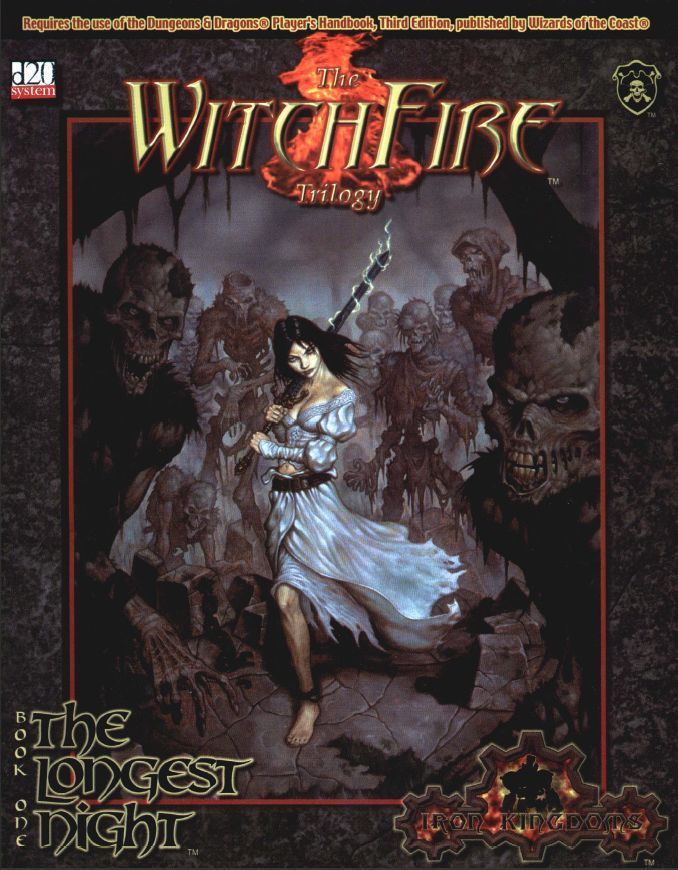
The Witchfire Trilogy Book One: The Longest Night is the cover. It is an incredible piece by Matt Wilson, depicting a young woman wielding a black two-handed sword crackling with energy whilst she is surrounded by the undead. The cover promised much, and whilst the scenario would deliver in terms of story and plot to match the cover, the cover also revealed the villainess of the piece. But then, so did the back cover blurb! What strikes you second about The Witchfire Trilogy Book One: The Longest Night are its internal illustrations, heavy pen and ink pieces by Matt Wilson and Brian Snoddy which brought the industrial gothic of the Iron Kingdoms to life. It gave The Witchfire Trilogy Book One: The Longest Night and the Iron Kingdoms a singularly recognisable look and that cover would win the ‘Best Cover Art Gold ENnie Award’ in 2001.

The Witchfire Trilogy Book One: The Longest Night though, has something of a split personality. This is because it has to do two things. One of which is to introduce the setting and the other is to give the first part of the scenario. Although it introduces the Iron Kingdoms, the bulk of the setting material is devoted to Corvis, the City of Ghosts, in and around where the scenario itself is set. Boxed sections cover elements of the setting as the scenario goes along, such as how firearms work and what skills are relevant to their use and manufacture in the d20 System; how steam power and steamjacks work, again with the appropriate skills; Human religion in the Iron Kingdoms; and more. Only a tenth or so of The Witchfire Trilogy Book One: The Longest Night is devoted to this setting’s background, and it is both enough and not enough. It is enough with which to run the scenario, but not enough to do more than that. Notably, there are no notes on what Player Characters are like in the Iron Kingdoms. In fact, that information would not be available until the Lock & Load: Iron Kingdoms Character Primer was published in 2002. This introduced all of the new Races and Classes particular to the setting, all of which were different to that of standard Dungeons & Dragons and contributed very much to the feel and flavour of playing in the Iron Kingdoms. Without them, The Witchfire Trilogy Book One: The Longest Night and the Iron Kingdoms feel like a very different setting for Dungeons & Dragons, but one still played using the standard Races and Classes of Dungeons & Dragons, even down to the Halfling, a Race actually mentioned in the scenario.

The Witchfire Trilogy Book One: The Longest Night is designed for Player Characters of First to third Level. As the scenario and the first act opens, the Player Characters are on their way to Corvis as guards on a merchant caravan, when the caravan is attacked by Swamp Gobbers raiders including one with a device capable of creating heavy mist! Unless the Swamp Gobbers manage to run off with one of the chests, the Player Characters will be able to progress into the city fairly quickly. There they will encounter Father Dumas, High Priest of Corvis, who will hire them to investigate a series of grave robberies that he has been unable to persuade the city Watch to look into. After visiting gravesites both in and out of the city, the Player Characters learn that the bodies stolen were all connected to a witchcraft trial which took place ten years ago. Further, one of the witches put on trial and executed was Father Dumas’ sister-in-law and he himself, is the guardian of her daughter and his niece, Alexia Ciannor. By this point, the Player Characters may also have suspicions that she is behind the grave robberies.

In the second act, Father Dumas suggests that the Player Characters investigate the site where the witches were interred after their execution. This is in a former army outpost, deep in Widower’s Wood, the first of the two mini-dungeons in the scenario. It consists of a mix of caves and worked rooms and passages, there are obvious signs that the complex has been broken into and that once the chain-bound coffins are found, that not all of the witches were entombed there… The tomb is also a chance to have the Player Characters encounter more of the Iron Kingdoms’ strange creatures. There is a chance too, for the Dungeon Master to roleplay one of these and there is good advice to that end. By this time, the Player Characters’ suspicions about Alexia Ciannor will have grown and grown, and nobody will believe them if they voice such concerns. Their best course of action is to keep tabs on her and that will lead the Player Characters via the sewers—in very Shadows of Bogenhafen fashion—into her lair where she captures them, explains her plans, and temporarily traps them before making her getaway. Getting out of her lair and its surrounding tunnels ends the second act.

The third act begins with the Player Characters climbing out of the sewers and into the arms of the law. Or rather, Captain Julian Helstrom of the Watch. He more or less press gangs the Player Characters into working for him, revealing his own concerns over Alexia Ciannor, and sends them out on her trail to an old, abandoned fortress beyond Widower’s Wood. It was here that a century ago the army slaughtered a bandit army and it is their hundred year old bones that will form the bulk of Alexia Ciannor’s undead army. With this news in hand, the Player Characters must race back to Corvis to inform Captain Helstrom of the attack, which is just in time for the ‘Longest Night’, the annual celebration which takes place during a lunar eclipse. This is the setting for the climax of the scenario, the celebrations disrupted by the attack of the undead army and a showdown between Alexia Ciannor and the actual villain of the piece. There are some fun moments to throw at the Player Characters and get them involved, including a runaway coach, costumed undead using the dead as a raft, a merchant ship under attack by undead, and more. Alexia Ciannor will appear and attempt to bring her plans to fruition, and ultimately although she will be thwarted, she will get away. Of course, she will return in The Witchfire Trilogy Book Two: Shadow of the Exile.

In addition to the setting content and the scenario, 
The Witchfire Trilogy Book One: The Longest Night provides stats for all of its monsters and NPCs. The monsters in particular are all interesting creatures with a different feel to those presented in the Monster Manual. These would also go on to appear in the bestiary for the Iron Kingdoms, the excellent Monsternomicon.

Physically, 
The Witchfire Trilogy Book One: The Longest Night is a great looking book with wonderfully atmospheric artwork. However, that artwork is not always best placed. For example, the illustration depicting an attack upon a boat by a swamp squid, is placed several pages away from where it is described. The map of Corvis could have been larger and had more locations marked on it, whilst the individual dungeon and fortress maps are just a little too dark to read with ease. The writing feels rushed in places, the rules are poorly utilised in others, and the combination of mini-sourcebook and scenario means that the author has a lot to pack into the scenario, making it feel cramped in places.

There is no denying that 
The Witchfire Trilogy Book One: The Longest Night has a great setting and a great story, but the way in which it implements that story is often heavy-handed. There are scenes where the Dungeon Master is advised to try and have her players and their characters avoid certain actions and then push them back onto the plot. There is a scene where the Player Characters are captured by Alexia Ciannor so that she can explain her plans to them and she uses multiple Hold Person spells to do it. Then at the climax of the scenario where she appears, Alexia Ciannor is confronted by another NPC rather than by the Player Characters, and although they do have some influence over the outcome of the scenario, they cannot stop her escaping. Now some of this is understandable, as the author wants to tell a good story and if the Player Characters capture her or even kill her, it derails the plot. Mechanically, this is unlikely though, as the Player Characters are going to be Third Level at most and Alexia Ciannor is a Tenth Level Sorcerer! The result is that there are moments where the players and their characters lack agency even as they are on the periphery of Alexia Ciannor’s story and plot. Doubtless, a Dungeon Master would be able to fix some of these issues, much as the author did in the later The Witchfire Trilogy Collected Edition.

Yet despite its flaws, 
The Witchfire Trilogy Book One: The Longest Night is still playable and far from being a bad scenario. It is though a scenario which comes its own with the addition of Lock & Load: Iron Kingdoms Character Primer or the Iron Kingdoms Character Guide: Full Metal Fantasy Volume 1 because it brings in Player Character options. Then of course, The Witchfire Trilogy Book Two: Shadow of the Exile and The Witchfire Trilogy Book Three: The Legion of the Lost build on it in epic fashion.

The Witchfire Trilogy Book One: The Longest Night is a hugely atmospheric scenario, full of flavour and detail that is worth experiencing even if the plot in places is heavy-handed. The full potential of The Witchfire Trilogy Book One: The Longest Night might not be realised until later books, but in 2001 it stood out as a well-received scenario offering something different from the growing array of d20 System third-party content which was then beginning to flood the market.

Sunday, 19 December 2021

2001: Godlike

1974 is an important year for the gaming hobby. It is the year that Dungeons & Dragons was introduced, the original RPG from which all other RPGs would ultimately be derived and the original RPG from which so many computer games would draw for their inspiration. It is fitting that the current owner of the game, Wizards of the Coast, released the new version, Dungeons & Dragons, Fifth Edition, in the year of the game’s fortieth anniversary. To celebrate this, Reviews from R’lyeh will be running a series of reviews from the hobby’s anniversary years, thus there will be reviews from 1974, from 1984, from 1994, and from 2004—the thirtieth, twentieth, and tenth anniversaries of the titles. These will be retrospectives, in each case an opportunity to re-appraise interesting titles and true classics decades on from the year of their original release.

—oOo—

As much as the noughties was a decade dominated by the d20 System and the rise and fall of the third-party Dungeons & Dragons publisher, it was also the decade of two genres. One was pirates, the other was World War 2. The former was certainly given a big push by the release in 2003 of Pirates of the Caribbean, and would see titles such as Swashbuckling Pirates, Pirates of the Spanish Main, and Swashbucklers of the 7 Skies being published. The latter was spurred on by the anniversary of the USA’s entry into World War 2 with the attack on Pearl Harbour, and indeed, in that sixtieth anniversary three World War 2 roleplaying games would be published—Gear Krieg The Roleplaying Game from Dream Pod 9, GURPS WWII from Steve Jackson Games, and Godlike: Superhero Roleplaying in a World on Fire, 1936-1946. Over the course of the next decade, numerous World War 2 themed roleplaying games, from the small such as Battleforce Bravo from Deep7 Press to Weird War Two D20: Blood on the Rhine from Pinnacle Entertainment. These five represent the differing approaches taken to what is a defining period in twentieth century history. Both Battleforce Bravo and GURPS WWII played it straight and kept it to the history (that is, until GURPS WWII Classic: Weird War II), but the others would go in a different direction, adding another genre. Weird War Two D20: Blood on the Rhine added horror, Gear Krieg The Roleplaying Game added combat walkers, and Godlike added superheroes.

Godlike: Superhero Roleplaying in a World on Fire, 1936-1946 did superhero roleplaying and superheroes in World War 2 like no other. In supplements like Glory Days for Brave New World and scenarios like All This and World War II for Marvel Super Heroes, the focus is traditionally on the superhero first, not the soldier. Although Godlike was a superhero roleplaying game and an alternate history game in which superheroes existed and influenced the course of the war—and beyond, they would not change the outcome of the war. The World War 2 of Godlike would still be won by men and machinery, by grit and determination, and when the Talents—those blessed with the superpowers or miracles which set them apart from ordinary men—of the Allies met the Übermensch of the Axis powers, they were soldiers first, superheroes second. Godlike is not a superhero setting in which the superheroes, the Talents, wear spandex. Instead, they wear a uniform and they serve their country. It is also not a Four Colour setting, but gritty. Despite their amazing abilities, Talents do die, whether that is due to combat with an Übermensch or an artillery barrage.

The alternate history of Godlike begins in 1936 when Der Flieger—‘The Airman’—appeared in the skies over the Berlin Olympics. He was the first Talent, and as Europe moved towards war, more would appear. Pevnost, a Czechoslovakian resistance fighter who could step through one door and out of any door he had previously stepped through, enabling him to traverse hundreds of miles in an instance. He would support the underground resistance throughout the war. As Der Flieger destroyed the Polish airforce, a Polish Talent, Cien appeared, who was capable of manipulating objects touched by his shadow, the Finnish Viljo, became one with the arctic snow and fought the Soviet invaders, and the Danish schoolboy, Vogel, found himself invulnerable to any attack he was aware of. As the Nazis occupied more and more of Europe, more Talents appeared amongst the local populations, many of whom would become heroes of their nations. The first British Talent was Jumping Johnny, capable of leaping twenty-seven miles in a single bound and land with a destructive bang, whilst The Indestructible Man, the USA’s first Talent, immune to any damage he was aware of, up to and including as was tested after the war, a ten-megaton nuclear bomb. More and more Talents would manifest throughout the war and around the world, as men and women were subject to the stresses and strains of the war. Despite the Soviet attempts to ‘biologically re-educate’ subjects into manifesting as Talents, the resulting Baba Yaga escaped, mad and willing to attack Soviet and Nazi forces alike. The Nazis conscripted its Übermensch into special SS brigades, whilst the Allies transferred its Talents into Talent Operations Command and trained them as commandos before organising them into Talent Operation Groups, or squads, which would typically be attached to standard forces or used on special missions.

In Godlike, player take the roles of Talents, soldiers with superpowers or miracles who serve in Talent Operation Groups. A character has six stats, Body, Brains, Command, Cool, Coordination, and Sense, rated between one and five, with two being average. Similarly, skills are rated between one and five. Beyond this, stats and skills can have Hyperstats and Hyperskills, so a Talent can have Hyper-Body and be super strong, or Hyper-Intimidation, and be incredibly imposing! Then there are Miracles. Certain traditional superpowers are unknown in the world of 
Godlike: Superhero Roleplaying in a World on Fire, 1936-1946—mind control or reading, absorption or imitation of other Talents, the ability to create Talents, time travel, unlimited healing powers, and actual super-science—though Goldberg Science and the creation of gadgets is possible. A wide array of cafeteria-style Miracles is given. This ranges from Aces, which makes the Talent incredibly lucky, Break, which enables a Talent to puncture or smash objects beyond Human capability, and Dampen, which allows him to reduce or negate a physical effect of a Talent to Side Step, with which a Talent can avoid a disaster or attack, Time Fugue, which enables a Talent to stop time for a single object or creature, and Zed, which can be used to negate the ability of another Talent. All of the Miracles come with Power Stunts, Extras, and Flaws, which all adjust the cost of the Talents, and there are also prebuilt, ready-to-play, Cafeteria Power-Sets—though only a handful of them. They include The Blaster, The Brain, The Bruiser, The Flyer, and so on.

There is also the option for a player to build his Talent’s Miracles as per other point-buy systems in other superhero roleplaying games. Fundamentally though, the tone and power level of Godlike means that certain superhero archetypes are challenging, even impossible to build. To build a Talent with the powers of flight and blast rays is possible, but expensive, but add in invulnerability, and it becomes prohibitively expensive. This is because Miracles—and also Hyperstats and Hyperskills—are bought as die types. Standard dice are the least expensive, Wiggle dice the most expensive, and Hard dice in between. Figure in Qualities—Attacks, Defends, Useful out of Combat, and Robust—and the cost also goes up, although a player could remove them to reduce the cost, but with the loss of utility. Miracles can also be modified by Extra, Flaws, and Power Stunts, which in turn adjusted the cost. Another limiting factor is the number of Will Points a Talent is built on. Godlike gives the stats for the first ten Talents to appear, their costs ranging from twenty-five to one-hundred-and-fifty Will Points, but the majority have Miracles way out of the league of beginning Talents. In the default campaign setting of the Talent Operations Group, a player is given twenty-five Will Points with which to purchase Hyperstats, Hyperskills, and Miracles. It is not a lot and it makes it challenging to create Talents without resorting to Hyperstats or Hyperskills. Nevertheless, it is possible to create interesting Talents, not all of them necessarily designed for combat.

To create a Talent, a player assigns six points to his Talent’s stats—which already begin at one, assigns twenty points to skills, and if playing in the Talent Operations Group campaign, receives training in another eighteen points’ worth of skills. Lastly, he has twenty-five Will Points to spend on Hyperstats, Hyperskills, and Miracles. As well this, a player should determine his Talent’s background, nationality, age, family, education, motivations, and so on, to flesh out the character.

Our sample Talent is Technician Third Grade Theodore Huffman, who was studying piano at the Juilliard School of Music in New York when his draft number came up 1943. After basic training he was assigned to Special Services and performed piano concerts in the USA, and then England and North Africa. In early 1944, the convoy he was in, was ambushed by the Germans and the truck he was driving blown up. He was thrown from the vehicle and knocked unconscious. It was then that his Talent manifested—Billy Bones. Whilst Theodore was unconscious, his skeleton got up, grabbed a machine gun and proceeded to fight the ambushers, killing most of them, and driving the rest off. When relief arrived, they discovered Huffman asleep and Billy Bones brashly playing jazz on the piano and smoking a cigar. As a Talent, Billy Bones fights when Huffman cannot, and is stronger and faster than Huffman. He also smokes when Huffman does not, and whilst Huffman is a classical pianist, Billy Bones plays music more popular with his fellow soldiers.

Technician Third Grade Theodore Huffman, ‘Billy Bones’, TOG-242
Body 2 Coordination 2 Sense 2
Brains 2 Command 3 Cool 1
Base Will 4
Current Will 4
Motivations: Survive the war; Become a better musician
Skills: Brawling 1 (3d), Climb 1 (3d), Cryptography 2 (4d), Dodge 1 (3d), Drive (Automobile) 1 (3d), Education 2 (4d), Endurance 1 (3d), Explosives 1 (3d), Grenade 1 (3d), Hearing 2 (4d), Knife Fighting 1 (3d), Language (French) 2 (4d), Machine Gun 1 (3d), Map Reading 1 (3d), Navigation (Land) 1 (3d), Perform (Piano) 3 (6d), Perform (Sing) 1 (4d), Pistol 1 (3d), Radio Operation 1 (3d), Rifle 1 (3d), Sailing (Sailboat) 1 (3d), Stealth 1 (3d), Submachine Gun 1 (3d), Survival 1 (3d), Swim 1 (3d), Tactics 1 (3d)

Talents (25 Will Points)
Alternate Form 2hd (Qualities: Attacks, Defends, Robust, Useful Outside of Combat. Base Cost: 5/10/20. Extra: Endless +1/+2/+4, Extra: Unconscious +1/+2/+4; Flaw: Peace of Mind (Asleep) -2/-4/-8; Flaw: Mental Strain -2/-4/-8; Final Cost 3/6/12; 12 points).
Hyperstat: Body +3d (Base Cost: 2/5/10. Flaw: Attached to Alternate Form -1/-2/-4; Final Cost 1/3/6; 3 points).
Hyperstat: Coordination +3d (Base Cost: 2/5/10. Flaw: Attached to Alternate Form -1/-2/-4; Final Cost 1/3/6; 3 points).
Hyperstat: Cool +3d (Base Cost: 2/5/10. Flaw: Attached to Alternate Form -1/-2/-4; Final Cost 1/3/6; 3 points).
Hyperskill: Submachine Gun +2hd (Base Cost: 1/3/7. Flaw: Attached to Alternate Form -1/-2/-4; Final Cost 1/1/3; 2 points).
Hyperskill: Perform (Piano) +2hd (Base Cost: 1/3/7. Flaw: Attached to Alternate Form -1/-2/-4; Final Cost 1/1/3; 2 points).

Although there is a wide range of Miracles listed in Godlike, the list is not extensive, and it would not be until the supplement, Will to Power when the roleplaying game received Miracles such as Size Shift and Unconventional Move. (The supplement also added a range of aircraft which were not included in the core rules—an issue potentially if one of the player Talents could fly.) Nevertheless, between the Godlike and Will to Power, both Game Master and player had access to a decent range of Miracles, enabling both to create interesting Talents. (The following example Talent was created using the extra content from Will to Power.)

Dorothy Murray was fourteen when she was evacuated from London. Unhappy with life away from her parents she ran away and returned to life in the capital. When the family house was bombed, and she found herself buried under rubble, her Talent manifested—she was able to tunnel her way out. At first she thought it was luck, but during later raids, she could hear the cries of those trapped and knew where they were. She began to experiment her powers and by the height of the Blitz, was going out nightly to tunnel into the rubble of bombed houses to rescue the survivors. Anyone pulled free always remembered the glow of the girl who came to rescue them and carry them to safety. The newspapers nicknamed her the ‘Angel of the Blitz’.

Dorothy Murray ‘Angel of the Blitz’
Body 2 Coordination 2 Sense 2
Brains 2 Command 2 Cool 2
Base Will 4
Current Will 4
Motivations: Help people with her Talent; Finish school
Skills: Athletics 1 (3d), Education 1 (3d), First Aid 1 (3d), Health 1 (3d), Hearing 1 (3d), Inspire 1 (3d), Language (Latin) 1 (1d), Mental Stability 1 (3d), Perform (Violin) 1 (3d), Run 1 (3d)

Talents (25 Will Points)
Unconventional Move: Tunnelling 4d+2wd (Qualities: Attacks, Defends, Robust, Useful Outside of Combat. Base Cost: 5/10/20. Extra: Endless +1/+2/+4, Extra: Passenger +1/+2/+4. Flaw: Beacon -4/-8/-16, Flaw: Glows -1/-2/-4, Flaw: Specific Material (Rubble) -1/-2/-4; Final Cost 1/2/4; 12 points).
Hyperstat: Body +8d (Base Cost: 2/5/10. Flaw: Attached to Unconventional Move -1/-2/-4; Final Cost 1/3/6; 8 points).
Detection: Humans 4d (Qualities: Defends, Robust, Useful Outside of Combat. Base Cost: 4/8/16. Flaw: Human Trapped in Rubble/Underground -1/-2/-4; Flaw: Attached to Alternate Form -1/-2/-4; Final Cost 2/4/8; 4 points).

Mechanically, Godlike uses what would become known as ‘Ore’ or the ‘One-Roll Engine’. This is a dice pool system, usually formed of the appropriate Stat plus Skill, for example, Coordination plus Rifle or Command plus Perform (Piano), the aim being not to roll successes, but get matches—pairs, triples, and so on. Neither player nor Game Master roll more than ten dice—although actually rolling that many dice is not common. If any of the dice match, then the character has succeeded. However, the more successes rolled, the wider the result is and the faster it is, and the higher the set of matches, the more effective it is. Carried over into combat, the width of the roll will determine the speed of the attack and how much damage is inflicted, whilst its height will determine exactly where the hit was made. Taking damage is not only physically injurious, but will negate dice in an attacker’s pool, so going first is almost a must, but dodging can ‘gobble’ up dice if successful, potentially breaking up matching sets. Although damage inflicted can be stunning, killing, or stunning and killing, combat can be brutal in Godlike, so players had better be warned ahead of play. Leaping into a game and expecting bullets to bounce off your hero’s chest just because is a sure-fire way to get him killed. Overall, the system is elegant, easily handles multiple actions, and plays fast, although it does take some adjustment from the traditional rote of rolling for initiative, rolling to hit, rolling for damage, and so on.

However, there are a couple interesting wrinkles which comes into play once Hyperstats, Hyperskills, and Miracles are figured. There are two other die types beyond the standard type. The medium cost die type is the Hard die. When this is in a pool and rolled, it is always set at a ten. This means that with a pair of Hard dice, a Talent will not always succeed, he will always do so with the maximum effect possible. The most expensive die type is also the most flexible. The Wiggle die can be set to any number, either to create a set or widen a set. Effectively, both give a player more control over his Talent’s ability to bring his Hyerstats, Hyerskills, and Miracles into play, especially as the dice pools for these increase in size—and it is generally easier to improve an already existing Talent rather than select a completely new one.

Perhaps the most enjoyable aspect of Godlike is the extensive timeline which covers the ten years from the Berlin Olympics of 1936 to the beginning the Cold War in 1946. It is richly detailed, mixing in both the actual history with the alternate history of Godlike, but keeping the two sperate. The entries which involve Talents are clearly marked with a bullet hole. This is supported by an equally interesting exploration of the wider background to Godlike and the appearance of Talents, especially how society at large reacted to them. The racism and sexism rampant throughout societies in the period is also acknowledged, but notes that despite that the targets of both played major roles in the global conflict. In the main, the role of Talents in Godlike—at least in 
Godlike: Superhero Roleplaying in a World on Fire, 1936-1946—is focused upon military and special operations style campaigns. This is understandable given that it is the major role of Talents throughout the war, and perhaps other types of campaigns, perhaps with a more diverse range of characters might have come had the publisher had the opportunity. Nevertheless, there is nothing to stop the Game Master using the content in Godlike: Superhero Roleplaying in a World on Fire, 1936-1946 and backed up with research of her own from running other types of campaigns set within the Godlike universe.

Godlike: Superhero Roleplaying in a World on Fire, 1936-1946 is further supported with a wide arsenal of equipment used by both the Allied and Axis powers, from small arms to armoured vehicles. The Game Master is given good advice on running a Godlike campaign, and the following details of the Talent Operations Group campaign is accompanied by a complete write-up of a sample TOG squad. This nicely showcases some of the possibilities using the Miracle creation rules earlier in the book. Alternatives and options suggest ways in which a campaign can be adjusted to allow Talents to be even more ‘godlike’, right up to a Four Colour-style campaign, but these do push the setting away from its gritty and very much soldier-first feel. Rounding out the book are the aforementioned write-ups of the first ten Talents to appear and since the book was published in 2001, rules for running a Godlike campaign under the d20 System. These are decently done, but feel superfluous now.

Physically, 
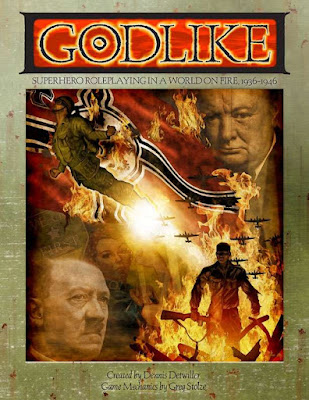
Godlike: Superhero Roleplaying in a World on Fire, 1936-1946 is sturdy black and white hardback. It perhaps feels a little odd in its ordering of its content, with explanations of the rules, mechanics, and character creation coming before the roleplaying game’s detailed background. Without the latter, the rules do lack context, but with perseverance the reader will get to the richly detailed background and begin to put everything together. The book is well written and illustrated throughout with black and photographs manipulated to add in the presence of the Talents in each and everyone. There is something quite odd about many of them, their slightly off kilter perspective giving them a sense of the unearthly.

Godlike is lacking a number of elements. Mostly obviously a scenario, but World War 2 is such a familiar setting that a Game Master should be able to develop something of her own with relative ease. It is lacking details of the aircraft—of either side, but that would be addressed in Will to Power. Perhaps its major omissions are the lack of perspectives from either a female point of view or a non-American point of view—and to be fair, there is some truth to both omissions. Yet the focus of Godlike: Superhero Roleplaying in a World on Fire, 1936-1946 is on the soldier on the front lines and beyond them, and not necessarily on the home front, and the role might very well have been more fully explored in subsequent supplements—for example, if a supplement devoted to the Russian Front had been published. The authors did publish scenarios in which women played a significant role, and to be fair, there is only just so much that can be covered in a book, even a core book like Godlike. Plus again, there is nothing to stop the Game Master, backed up with some research from running a campaign where women can play a major role. The other emphasis, that of the US soldier and the role of the USA in World War 2 is present in Godlike, but again to be fair, the roleplaying game was published in a year which was the anniversary of the entry of the USA into World War 2 and that emphasis could be found across all media. However, throughout the alternate history of Godlike, the roles of non-US Talents and their stories and contributions are highlighted again and again, each time working as potential inspiration for stories and scenarios which do not necessarily involve the USA. So ultimately, that emphasis is not strong as it could have been.

Godlike: Superhero Roleplaying in a World on Fire, 1936-1946 would go on to spawn a number of supplements and scenarios, including Will to Power and the campaign, Black Devils Brigade: The First Special Service Force and the Italian Campaign, 1943–1944. Its mechanics would have a wider influence, the One-Roll Engine appearing eventually on its own in Wild Talents, a sequel of sorts to Godlike, but which also stood alone and enabled a Game Master to run a more traditional style of superhero campaign. It in turn would give rise to some wildly imaginative campaign settings, including Wild Talents: Progenitor, Wild Talents: The Kerberos Club, and Wild Talents: This Favored Land.

Then published by Hawthorn Hobgoblynn Press, but later Arc Dream Publishing, 
Godlike: Superhero Roleplaying in a World on Fire, 1936-1946 would be one of the first roleplaying games I reviewed and certainly the first I reviewed after being contacted directly by the publisher and asked to review. I can remember the surprise when it happened, even when it happens today, I am still surprised and even humbled by the trust that publishers place in me in asking me to review their books. Godlike was worth that trust, because it was a great game in 2001 and it still is in 2021. The combination of Greg Stolze’s elegant mechanics with Dennis Detwiller’s richly developed background is a grim and gritty take upon the superhero genre, something that still stands out today as being different and stood out even more in 2001 against the backdrop of the d20 System boom and the tone taken by the other World War 2 roleplaying games then being released. Godlike: Superhero Roleplaying in a World on Fire, 1936-1946 is an amazing piece of writing and design which shows how even as miraculous powers change the world, the soldier—even the soldier Talent, not only has to survive that world, but stand up and still be a hero in that world.

Sunday, 20 June 2021

2001: Munchkin

1974 is an important year for the gaming hobby. It is the year that Dungeons & Dragons was introduced, the original RPG from which all other RPGs would ultimately be derived and the original RPG from which so many computer games would draw for their inspiration. It is fitting that the current owner of the game, Wizards of the Coast, released the new version, Dungeons & Dragons, Fifth Edition, in the year of the game’s fortieth anniversary. To celebrate this, Reviews from R’lyeh will be running a series of reviews from the hobby’s anniversary years, thus there will be reviews from 1974, from 1984, from 1994, and from 2004—the thirtieth, twentieth, and tenth anniversaries of the titles. These will be retrospectives, in each case an opportunity to re-appraise interesting titles and true classics decades on from the year of their original release.

—oOo—

Sometimes the choice of game to review is not yours to make. So, it is, once again, with this review. This review came as a surprise and was completely unplanned. But with the sad news of the death of Andrew Hackard at Steve Jackson Games, it seemed timely to review the card game which he was in charge of and would take out into the gaming hobby with versions like Munchkin Warhammer Age of Sigmar, Munchkin Pathfinder, and Munchkin Gloom. Then into the mainstream with editions which date have included Munchkin SpongeBob SquarePants, Munchkin: Disney, Munchkin: Disney Duck Tales, Munchkin Harry Potter, Munchkin Teenage Mutant Ninja Turtles, and Munchkin Shakespeare. Then when Reviews from R’lyeh checked when Munchkin was first published, the year 2001, it was obvious that a twentieth anniversary review was warranted, and when upon finding that the nearest copy to hand had never been opened, an Unboxing in the Nook, was also required. So this review is both a retrospective and an acknowledgement that the hobby has lost another who by all accounts was a good friend and will be much missed.

—oOo—

Munchkin
is many things. It is a fantasy roleplaying game without any roleplaying. It is a fantasy card game which parodies fantasy roleplaying. It is a silly fantasy card game with a clever design. It is a fantasy card game which parodies Dungeons & Dragons. It is a dungeon exploration game without a dungeon. It is a fantasy card game which parodies a particular play style of fantasy roleplaying. It is a fantasy card game which understands its genre. It is a fantasy card game with simple rules, but sophisticated interaction of its cards. It is a fantasy card game whose format has become a template for numerous variations, iterations, licences, and accessories. It is a fantasy card game which won the 2001 Origins Awards for Best Traditional Card Game. Above all, it is a fantasy card game which is not just fun to play, it can be laugh out loud fun to play.

So the first question is, what is a ‘Munchkin’? The most obvious answer is the race of little people from Frank L. Baum’s The Wonderful Wizard of Oz, enslaved by the Wicked Witch of the East. In roleplaying parlance, a ‘Munchkin’ is the type of roleplayer—typically a roleplayer of Dungeons & Dragons (but it applies to any roleplaying game)—who will always try and maximise his character’s stats, kill anything in his path for the maximum Experience Points possible, find and optimise the best gear and/or magical items possible, and acquire as many Levels as he can, all the while ignoring the roleplaying aspects of the game, his character’s personality, and that of any other Player Character around the table to the detriment of everyone else’s fun. Unless of course, everyone else is also a Munchkin, in which case, all bets are off! Munchkins are not always fun to game with and to an extent this can be true of the Munchkin card game. It can outstay its welcome. However, Munchkin is both fun to play and funny.

So in Munchkin the card game you are attempting to be the most munch-kiny. To out-munchkin your fellow munchkins. To be the munchkin’s munchkin. To win, to be top Munchkin, you need to be the first to acquire Level Ten—and you start at Level One. To go up a Level, you need to kill monsters. Kill a monster, gain a Level. Monsters can be hard though, and you need better treasure and better gear which will improve your ability to kill Monsters. Better treasure and better gear comes from killing monsters. Sometimes you are never going to kill a monster on your own—you are just not enough of a munchkin. So you negotiate with your fellow munchkins for a share of the treasure, and together you might defeat that tough monster—but you gain the Level. Ultimately, when Level Ten is in sight and you have chance of being the uber-munchkin, negotiating and working together is not going to work. It is just you and the monster (and whatever monsters and perils your rival munchkins can throw into your path) and your bestest gear. Never fear though, YOU will get to Level Ten!

First published in 2001, Munchkin from Steve Jackson Games is designed for three to six players, aged twelve and up. It has a playing time of an hour, but games typically last half that time. It consists of two decks of cards—Dungeon cards and Treasure cards. Dungeon cards have a dungeon door on the back whilst Treasure cards have a pile of loot. Chief amongst the Dungeon cards are the monster cards, from the lowly Level 1 Potted Plant and Drooling Slime to the dread Level 20 Squidzilla and the Level 20 Plutonium Dragon. Defeat them and not only are your rewarded with Treasure cards, but also a Level or two, depending on the toughness of the monster. Fail to defeat them and a monster might kill you (it’s okay, you can start again back at Level One), make you lose a Level, or lose an item. Others includes Curses like ‘Curse! Income Tax’ or ‘Curse! Duck of Doom’ which force you to discard items; and Classes, Races, and Genders—Cleric, Thief, Warrior, and Wizard, Dwarf, Elf, and Halfling (Human is the default), and Male and Female. The Classes, Races, and Genders will often determine what gear you can and what magical items and weapons you can wield, and lose the wrong one or have it changed to another, perhaps because of a Curse! and you lose the associated items.

The Treasure cards include single use items like potions, like the ‘Polymorph Potion’, which turns a monster into a parrot which flies away, leaving behind its treasure, and spells, like ‘Magic Missile’ which adds a one-use bonus in combat. Then there are magic items—lots and lots of magic items. These include the ‘Kneepads of Allure’ which force another player to help you, and ‘Boots of Butt-Kicking’ and ‘Chainsaw of Bloody Dismemberment’, both of which add bonuses when you fight monsters. There is a limit to how many items you can carry—one item of footwear, one item of head gear, suit of armour, an item in each hand, or an item in both hands, just as you would in a fantasy roleplaying game. 

Munchkin is quite simple to play. At the start of the game, you and the other players receive four cards, receive two Dungeon cards and two Treasure cards, and equip yourself from them as best you can. On your turn, you ‘Open a Door’ and draw a card from the Dungeon deck. If a monster, you fight it or you run away. If not, the card goes into your hand or is equipped immediately, or if a Curse!, played immediately. If you did not encounter a monster, you can ‘Look for Trouble’ and play one from your hand. Either way, if you defeat the monster, go up a Level, and you can ‘Loot the Room’ and draw cards from the Treasure deck.

To defeat a monster, the total of your Level, plus bonuses from any items equipped and any one-shot items must be greater than that of the monster’s Level. However a rival can play cards which will hinder you and so prevent you from defeating the monster. Then you have two options. One is to run away, but doing so may have consequences depending on the monster faced, as well as losing any opportunity of gaining any treasure. Alternatively, you can ‘Ask for Help’. Essentially, bribe another player into helping you defeat a monster that you cannot defeat on your own, typically with the treasure, or the best of the treasure that you will find when you ‘Loot the Room’. This can become a negotiation and even if another player agrees to help you, it does not stop a rival from throwing in cards to further hinder you.

Play continues like this until a player reaches Level Nine and looks ready to get to Level Ten and win the game. Then all bets are off. Up until this point, players have been hindering each other because they can, because it is funny, because they do not want to see another player gain a hoard of treasure cards, but now… But now, they have to stop the player in the lead from winning. If there is another player in the lead, then give his opponent a potion which will increase its Level, send a Wandering Monster in his way and increase the number he has to fight, Backstab him (if you are a lowdown, sneaky Thief), or curse them with a Curse! card—it is all legal. Expect the same response though, if you are the one in the lead…

However, there are many criticisms levelled at Munchkin. That it is too luck-based, that it is too random, that it is unbalanced, that much of the game play is exception based, that it involves too much ‘take that’ style of play between the players, and that this is exacerbated as a game gets closer and closer to one player attaining Level Ten, and everyone else gangs up on the player about to win. All of those criticisms are true. Yet that does not mean that Munchkin is a terrible game—far from it. Yes, it is luck based in that you are drawing from two large decks—larger once any of the expansions are added—and you might draw a monster you cannot defeat or start off with a hand of cards you cannot use, but then so might the other players or if they have better hands of cards than you, they might have worse hands in another game. So game play can swing this way and that, but part of the play is getting the best out of the cards in your hands and going on to get better cards—or worse, and perhaps winning the game. And even if Munchkin ditches the roleplaying aspect that it draws so much inspiration, there is still a story to be told in those ups and downs, the good fortune and the bad.

Munchkin is also exception based in its game play and many of the cards will run counter to the core rules, but again, that is the point. Those exceptions are where much of the game’s flavour and humour come into play and enforce the many aspects of the genre it is parodying. As to Munchkin being too much a case of too much ‘take that’ in its game play, that is also true, just as it is true that the game play gets more and more back-stabby towards the end of the game and there is a chance that someone will win. And again, this is in the genre and the style of play that the game draws from and parodies. The clue is in the game’s subtitle—“Kill the Monsters • Steal the Treasure • Stab Your Buddy”.

Ultimately, the answer to the accusation that Munchkin is that too luck-based and too random is that it is not a Eurogame. It is not designed to be balanced or necessarily fair in its game play, and the fact that it is luck based, that it is simple to play, and that it is heavily, heavily thematic, actually makes it a fine example that the antithesis to the classic Eurogame. In other words, Munchkin is classic Ameritrash. Lots of luck, lots of theme, and lots of fun.

However, there are legitimate criticisms that can be levelled at Munchkin. It is designed for players aged ten and up and this leads to a several issues. One is that the artwork on the cards can be suggestive in one or two places, and the second is that jokes may well be lost on younger players because they are unlikely to be as familiar as the type of fantasy and play that Munchkin is parodying. The latter may be ignored at least if younger players are prepared to embrace the silliness and humour of the game, and the former can be addressed by older players or adults pruning the cards in play to ensure that some the more suggestive ones—and they are no worse than that—are removed. Another is that the ‘take that’ backing-stabbing element is not friendly and so not necessarily suited to younger players. Altogether, that may mean that Munchkin is not necessarily family-friendly, but of course, that may depend upon the family and the type of games that its likes to play. Lastly, as simple as the game play is, learning what card works with which other cards, can be a little daunting, especially if the players are not familiar with the genre. This is one of the problems with the exceptionalism built onto the game’s cards, but a play through or two and this should be less of an issue.

Issues aside—and to be fair, they are far from being either major or insurmountable issues—Munchkin is plain, simple silly fun. In fact, it can be laugh out loud round the table fun. This starts with the titles of the cards and the artwork on the cards. For example, on the ‘Magic Missile’ card, instead of whatever dweomer-driven dart the spell normally suggests, the caster is actually holding a rocket-powered missile; that on the ‘Curse! Change Race’ card, the victim’s pointy ears have popped off, as if he was losing his Elfiness; instead the Level 1 monster being a mall rat, it is a ‘Maul Rat’, an actual rat with a maul!; and the Level 16 ‘Wight Brothers’ are not a pair of undead brothers, but a pair of undead mechanic brothers! Game play, the back and forth of the cards can be as equally as funny. After all, it is undeniably funny when you are about to defeat the easily beatable Level 1 ‘Drooling Slime’ and a rival whammies you with the ‘Ancient’ card (illustrated with a bespectacled old dragon) which adds ten levels to the monster and makes it unbeatable.

Then, there are the in-jokes and the references. Munchkin is rife with them, each time taking the joke or the reference and poking fun at them, making us laugh at a memory or a story, and reminding us how silly they are. Whether that is the title of the game itself, Munchkin, or the ‘Gelatinous Octahedron’ or ‘Gazebo’ monsters, or ‘Bribe GM with Food’, ‘Whine at the GM’, and ‘Invoke Obscure Rules’ cards which grant you an extra Level, and which all invoke a certain style of play or occurred in a session of Dungeons & Dragons long ago that you were definitely not playing. Munchkin then is poking fun at us and it is funny.

Physically, Munchkin is well presented. Both rules and cards are easy to read, and the cards are fantastically illustrated by John Kovalic in sepia tones, with many of the characters from his long running Dork Tower comic strip making appearances. It is clear that a great deal of thought has gone into the look of the game and into getting the jokes, in-jokes, and the humour right. Even now, not have played it in a few years, just looking at the cards and their jokes are still funny. However, there is a lot of space in the box, so the owner will need to add dividers or means to stop the cards from sliding around, but that does mean that there is room for expansions! And what expansions there were! In the past twenty years Steve Jackson Games has taken the format of Munchkin and not parodied other genres, from pirates in Munchkin Booty!, vampires in Munchkin Bites!, and Science Fiction in Star Munchkin to facing cosmic horror in Munchkin Cthulhu, superheroes in Super Munchkin, and martial arts in Munchkin Fu—and a whole lot more. There can be no denying the success of the format and its adaptability, and it has remained Steve Jackson Games’ best seller for years.

Munchkin is not a great game and it is not a classic, and yes, ultimately, its humour can outstay its welcome, and if you prefer more balanced play, then it is probably too much of an Ameritrash game for you. It is instead a joke-filled, funny filler of a classic beer and pretzels game, that really can make you and your players laugh out loud round the table when playing it, and how many games can do that? Munchkin makes us laugh at ourselves and our hobby and that is what makes it fun to play.

Friday, 23 April 2021

2001: Zombies!!!

1974 is an important year for the gaming hobby. It is the year that Dungeons & Dragons was introduced, the original RPG from which all other RPGs would ultimately be derived and the original RPG from which so many computer games would draw for their inspiration. It is fitting that the current owner of the game, Wizards of the Coast, released the new version, Dungeons & Dragons, Fifth Edition, in the year of the game’s fortieth anniversary. To celebrate this, Reviews from R’lyeh will be running a series of reviews from the hobby’s anniversary years, thus there will be reviews from 1974, from 1984, from 1994, and from 2004—the thirtieth, twentieth, and tenth anniversaries of the titles. These will be retrospectives, in each case an opportunity to re-appraise interesting titles and true classics decades on from the year of their original release.

—oOo—


The undead have arisen and are dead set on chewing down on any still alive. A handful of Survivors are stuck in the centre of a city, but know if they can get to the helipad, there is a helicopter which they can escape aboard. Between them though, is a cadaver cavalcade with Bullets in short supply—though nearby buildings can be scavenged for further supplies and weapons, and the Survivors are as equally as desperate to escape as each other. This is the set-up for Zombies!!!, which takes a classic zombies movie plot and turns it into a board game designed for between two and six players, aged fifteen plus. Originally published by Journeyman Press in 2001—and by Twilight Creations, Inc., since 2002, Zombies!!! combines dice rolling, hand management, and take-that mechanics with the themes of exploration, combat, and bloody zombie horror!

Open up Zombies!!! and you find a lot of components—thirty map tiles, a fifty-card Event deck, Life and Bullet tokens, six human Survivor miniatures, and a hundred zombie miniatures! Yes, really. A hundred zombie miniatures! The miniatures are simple. The humans all wield shotguns, whilst the zombies are all reaching out for their next victim whilst moaning , “Brainssss…” The map tiles are each four inches square and marked with a three-by-three grid of squares. They depict the streets and buildings of the town where 
Zombies!!! takes place. Some have named buildings like the Toy Store, Police Station, and Hospital. Each named building indicates the number of zombies found in the building and the number of Life and Bullet tokens which can be scavenged from the building. One map tile is marked with a helicopter. This is the Helipad, the destination which is one of the ways of winning a game of Zombies!!!. The map tiles are done in grey and muted tones, reflecting that this is a town at night.

What stands out though about the production values of 
Zombies!!! are its Event cards. Painted by Dave Aikins these are superb slices of horror, each depicting a Survivor dealing with the zombies swarming the town. Perhaps sneaking past as in ‘Alternate Food Source’, which stop all zombies from attacking that Survivor until his next turn; confronting them like throwing a ‘Grenade’ in the Army Surplus Store, killing all zombies inside, but inflicting damage on the Survivor too; or healing from their attacks, such as applying a ‘First Aid Kit’, which prevents the Survivor from taking damage when in the Hospital or Drug Store. Many of the cards are designed to complicate the lives of other Survivors. For example, ‘Butter Fingers’ forces a target Survivor to discard a weapon or two Bullets; ‘Your Shoe’s Untied’ halves the target Survivor’s movement roll; and ‘Slight Miscalculation’ fills a target building up with zombies, up to double the amount given on the named map tile. Many of the Event cards work only specific buildings, for example, the aforementioned ‘First Aid Kit’ and ‘Grenade’. Lastly, the rules are done in simple black and white and easy enough to read and understand. The rules run to three pages, the other page devoted to a piece of fiction and a nice little foreword by George Vasilakos, publisher of the zombie roleplaying game, All Flesh Must Be Eaten.

Set-up for 
Zombies!!! is easy. Each player receives a Survivor miniature, three Life tokens, three Bullet tokens, and three Event cards. The Town Square map tile is placed in the centre of the table, the other map tiles are shuffled and the Helipad tile placed at the bottom. Then on each turn, a player draws a new map tile and places it anywhere on the map as long as any of its roads connect to the adjacent tiles. Zombie miniatures are added to the new tile and building on a name tile as indicated. The player refreshes his hand of Event cards back up to three, rolls a die to determine how far his Survivor can move, fighting any zombies encountered square by square. To defeat a zombie, a player rolls a die and hopes to get a four, five, or six. If he does, the zombie is defeated and added to the player’s collection. If he rolls a one, two, or three, he loses a Life token. If he loses all of his Life tokens, his Survivor miniature is moved back to the Town Square map tile to start again, and he loses any weapons he has from Event cards and half of his accumulated Zombie miniatures. Alternatively, if the player has any Bullet tokens, he can spend them on a one-for-one basis and hopefully increase the value of the roll to survive the combat and continue moving. Lastly, the player rolls a die and moves that number of zombies in any direction he likes. Typically, this will be either away from his Survivor miniature to ease his path on his next turn or towards the Survivor miniature of another player to make his next turn just that bit more difficult, or a mixture of both. During the turn, a player can also play a single Event card and also discard one.

Play continues like this until the Helipad map tile is drawn. This is always placed by the player with the least number of zombies currently in front of him. This will typically be nearer that player’s Survivor miniature than those of his rivals, but at that point, 
Zombies!!! becomes a race game to get to the Helipad first. The player whose Survivor gets there first wins the game. The other way to win is by defeating and accumulating a total of twenty-five zombies in front of you.

Physically, 
Zombies!!! is a decently produced game—at least for 2001. The rule book is a bit plain, but the zombie miniatures are fun and the tiles decent, if a little thin. The Event cards are to reiterate, fantastic. They really capture the grim, bloody nature of the situation that the Survivors find themselves in, and they are the exact reason why Zombies!!! would go on to win the 2001 Origins Awards Best Graphic Presentation of a Board Game. They are also the same reason why later editions of Zombies!!! would raise the suggested minimum playing age from twelve to fifteen.

Zombies!!! manages to be both a great game and a terrible game at the same time. It is a great game because it is pure Ameritrash. It is high on luck, it involves lots of deadly combat, has a high take that aspect as everyone plays Event cards against each other, and it does not so much ooze theme, as bash it against the nearest wall and splatter it across the room. It is also easy to learn, easy to teach, and it can be fun to play. It can also be tense because each player is desperately trying to husband both Life and Bullet tokens against the need to search for more, entering the dark confines of buildings to do so. It is a terrible game because it is pure Ameritrash. It involves too much luck and the take that value is high; many of the weapon Event cards only work in specific buildings, which whilst thematic, limits their use; there is too much combat without any real significance, which slows game play—Zombies!!! does feel as if it should be a shorter game; and ultimately, the Survivors are just waiting for the Helipad map tile to be drawn and the race for the endgame to begin, because trying to get the twenty-five zombies necessary to win is really challenging.

In 2021 
Zombies!!! is twenty years old. Not only did it win an Origins award, but would receive sixteen expansions, which in turn added a military base, a mall, a school, and more, including new themed map tiles, Event cards, and zombie miniatures. As much as these added theme and further showcased Dave Aikins’ art, they did have the side effect of increasing the space and time needed to play Zombies!!!. Plus, the game received spin-off titles enabled players to play as the zombies hunting humans, deal with an alien invasion, and even have the players face skeletons rather than zombies back in medieval times. Which all serve to highlight how successful Zombies!!! was. Indeed, it would ride the wave of popularity that hit board games in the noughties all the way up to the release of The Walking Dead television series, and beyond… Notably, it would make the jump from specialist shops that supported the hobby into mainstream shops, especially ones that sold CDs, DVDs, and the like. With its eye-catching, action-packed cover, this ensured that Zombies!!! reached a wider audience that it would not have done otherwise.

It is easy to dismiss 
Zombies!!!, but it has been highly popular and despite its flaws, it is still playable, it is very easy to bring to the table, and it can be fun to play, even after twenty years. Zombies!!! is a still a classic ‘beer ‘n’ pretzels’ treatment of a classic horror situation.

—oOo—

Twilight Games is currently running a campaign for the Zombies!!! 20th Anniversary Edition on Kickstarter. (With thanks to Niamh for her loan of her copy of Zombies!!!, which she can definitely have back.)