Every Week It's Wibbley-Wobbley Timey-Wimey Pookie-Reviewery...
Showing posts with label Privateer Press. Show all posts

Sunday, 7 August 2022

[Free RPG Day 2022] Iron Kingdoms: A Strange Light Breaks

Now in its fifteenth year, Free RPG Day in 2022, was celebrated not once, but twice. First on Saturday, 25th June in the USA, and then on Saturday, 23rd July internationally. This was to prevent problem with past events when certain books did not arrive in time to be shipped internationally and so were not available outside of the USA. As per usual, Free RPG Day consisted of an array of new and interesting little releases, which are traditionally tasters for forthcoming games to be released at GenCon the following August, but others are support for existing RPGs or pieces of gaming ephemera or a quick-start. Thanks to the generosity of David Salisbury of Fan Boy 3, Reviews from R’lyeh was get hold of many of the titles released for Free RPG Day, both in the USA and elsewhere.

—oOo—

Iron Kingdoms: A Strange Light Breaks
is a scenario fo Iron Kingdoms: Requiem, the version of the Steampunk and high fantasy setting best known for its miniatures combat game, Warmachine: Prime, for use with Dungeons & Dragons, Fifth Edition. Published by Privateer Press, Iron Kingdoms: Requiem and thus Iron Kingdoms: A Strange Light Breaks—and Iron Kingdoms: An Echo in the Darkness before it for Free RPG Day 2021 bring the setting and intellectual property full circle, both having been first seen in The Longest Night, Shadow of the Exile, and The Legion of the Lost, the trilogy of scenarios published for use with the d20 System in 2001. The three would later be collected as The Witchfire Trilogy.

The Iron Kingdoms is noted for three things. First, its interesting mix of races—Gobbers, Ogrun, and Trollkin alongside the traditional Humans, Elves, and Dwarves. There are no Halflings or Gnomes, and even the Elves are different to those of more traditional Dungeons & Dragons-style fantasy. Second, the prevalence of technology, in particular, the use of firearms and Steamjacks and Warjacks, steam-driven robots with magical brains, used in heavy industry and on the field of battle. Third, the tone of the setting is fairly grim, there being an island to the west, Cryx, where the sorcerers have long experimented with combing the undead with Steamjacks and Warjacks, and have long planned to invade the Iron Kingdoms.

Iron Kingdoms: A Strange Light Breaks is not a quick-start for Iron Kingdoms: Requiem, but a scenario, so the Game Master will need access to a copy of Iron Kingdoms: Requiem as well as Dungeons & Dragons, Fifth Edition, to run the scenario. It is designed to be played by between three and seven Player Characters of First to Fourth Level, but is optimised for five First Level Player Characters. As the scenario opens, a new branch of
the Strangelight Workshop, the premier organisation in the Iron Kingdoms dedicated to investigating the supernatural, which has opened up a new branch in the city of Merin in the nation of Ord. It is looking for candidates and the Player Characters have decided to apply for whatever reason. Several motivations are provided to that end. A large sign above the door to the new branch reads ‘Post Delivery Outpost #113’ and the scenario feels reminiscent of Terry Pratchett’s Going Postal as well as possessing an enormous dollop of Ghostbusters.

The Ghostbusters feel starts with the equipment that the Player Characters are assigned. This includes antispectral ammunition for targeting ghosts, charged gauntlets to deal lightning damage to or grapple with ghosts, a Handheld Lumitype to take ‘spectragraphs’ of ghosts, and Strangelight Goggles and Strangelight Projectors, which gives the scenario a very technological feel.

The scenario is built around a job board on which are pinned three little jobs, each with a little commentary by the branch clerk, Emil Todmann, a constantly scowling if friendly ex-postman. These are quite colourful and should influence the order in which the Player Characters tackle them. They are free to do them in any order, but ideally should be run in the order that they are presented. In the first gig, ‘Branston Gunwerks’, the Player Characters, now newly-minted ‘spectral investigators’, are directed to a manufactory which is beset by gremlins doing all sorts of damage. They need to get into the building and in and amongst the machinery to ferret out the Gremlins who are having way too much fun in the Gunwerks. It is an action orientated opener which should be fun.

The second gig is ‘210 Aurora Street’ which takes place a few streets away from the branch office. There the occupants of a house have been beset by a spirit known as ‘Headless John’. The Player Characters have a chance to do a little research before he makes an appearance. When he does, they are free to approach however they want, so they can fight ‘Headless John’ or persuade him to move on. The latter is a less bruising option as ‘Headless John’ is quite a tough opponent, but again, this is another decent little encounter.

The third and final gig is ‘The Red Mare of Lime Gate’. A burning figure astride a red horse has been setting warehouses in the dock alight and Emil Todmann warns the Player Characters that this is an unknown entity and needs to be careful of what it might be. This is a slightly more complex scenario and there is plenty of opportunity for the Player Characters to conduct some investigation—interacting with the locals, examining some of the warehouses, and so on, before the spectre strikes! Ideally before then the player Characters will have picked up some clues that something is not right here and so it proves in a rousing finale to the scenario. Its secret is not the only one to be revealed in the scenario, as there is another in the scenario’s epilogue, which is entitled ‘End of Watch’ and has a double meaning. Both the finale and the epilogue can be played out in a few different ways, all of which are covered in the scenario.
Physically, Iron Kingdoms: A Strange Light Breaks also comes with plain and simple, decent maps of each location for the scenario’s three gigs, as well as ‘Post Delivery Outpost #113’, full stats for all of its monsters and NPCs—from Gremlins to Emil Todmann, and full descriptions and stats for all of the equipment that the Player Characters are assigned as newly hired members of the Strangelight Workshop. Many of these are illustrated, as appropriate.

Iron Kingdoms: A Strange Light Breaks contains three very different ‘gigs’ or encounters and offers players a very different style of play to that of traditional Dungeons & Dragons in Iron Kingdoms. It involves a more investigative and technological mode of play and thus has a more modern feel. Iron Kingdoms: A Strange Light Breaks is an entertaining Ghostbusters-style scenario which is not fun to play, but definitely deserves a sequel.

Saturday, 30 July 2022

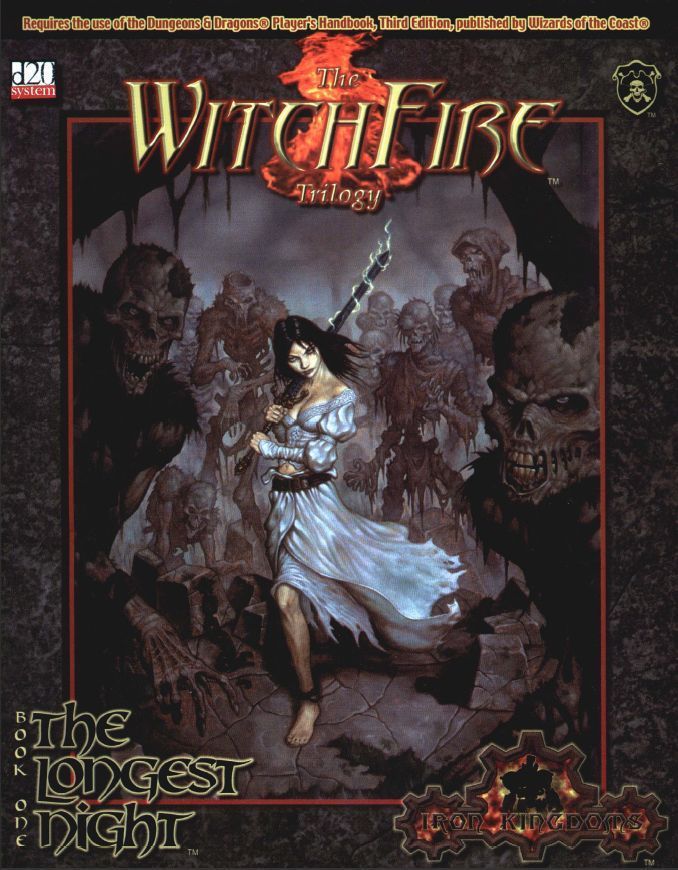
2001: The Witchfire Trilogy Book One: The Longest Night

1974 is an important year for the gaming hobby. It is the year that Dungeons & Dragons was introduced, the original RPG from which all other RPGs would ultimately be derived and the original RPG from which so many computer games would draw for their inspiration. It is fitting that the current owner of the game, Wizards of the Coast, released the new version, Dungeons & Dragons, Fifth Edition, in the year of the game’s fortieth anniversary. To celebrate this, Reviews from R’lyeh will be running a series of reviews from the hobby’s anniversary years, thus there will be reviews from 1974, from 1984, from 1994, and from 2004—the thirtieth, twentieth, and tenth anniversaries of the titles. These will be retrospectives, in each case an opportunity to re-appraise interesting titles and true classics decades on from the year of their original release.

—oOo—

The Witchfire Trilogy Book One: The Longest Night
was published in 2001 by Privateer Press and introduced the Iron Kingdoms, the Steampunk and high fantasy setting best known for its miniatures combat game, Warmachine: Prime. In 2001 though, the Iron Kingdoms was very much a roleplaying setting, The Witchfire Trilogy being written for the d20 System and thus compatible with Dungeons & Dragons, Third Edition. The trilogy would be completed by The Witchfire Trilogy Book Two: Shadow of the Exile and The Witchfire Trilogy Book Three: The Legion of the Lost, all before being collected as The Witchfire Trilogy in 2005. The Iron Kingdoms is notable for three things. First, its interesting mix of races—Gobbers, Ogrun, and Trollkin alongside the traditional Humans, Elves, and Dwarves. There are no Halflings or Gnomes, and even the Elves are different to those of more traditional Dungeons & Dragons-style fantasy. Second, the prevalence of technology, in particular, the use of firearms and Steamjacks and Warjacks, steam-driven robots with magical brains, used in heavy industry and on the field of battle. Third, the tone of the setting is fairly grim, there being an island to the west, Cryx, where the sorcerers have long experimented with combining the undead with Steamjacks and Warjacks, and have long planned to invade the Iron Kingdoms. Some, but all of this would be introduced in 
The Witchfire Trilogy Book One: The Longest Night.

What strikes you first about 
The Witchfire Trilogy Book One: The Longest Night is the cover. It is an incredible piece by Matt Wilson, depicting a young woman wielding a black two-handed sword crackling with energy whilst she is surrounded by the undead. The cover promised much, and whilst the scenario would deliver in terms of story and plot to match the cover, the cover also revealed the villainess of the piece. But then, so did the back cover blurb! What strikes you second about The Witchfire Trilogy Book One: The Longest Night are its internal illustrations, heavy pen and ink pieces by Matt Wilson and Brian Snoddy which brought the industrial gothic of the Iron Kingdoms to life. It gave The Witchfire Trilogy Book One: The Longest Night and the Iron Kingdoms a singularly recognisable look and that cover would win the ‘Best Cover Art Gold ENnie Award’ in 2001.

The Witchfire Trilogy Book One: The Longest Night though, has something of a split personality. This is because it has to do two things. One of which is to introduce the setting and the other is to give the first part of the scenario. Although it introduces the Iron Kingdoms, the bulk of the setting material is devoted to Corvis, the City of Ghosts, in and around where the scenario itself is set. Boxed sections cover elements of the setting as the scenario goes along, such as how firearms work and what skills are relevant to their use and manufacture in the d20 System; how steam power and steamjacks work, again with the appropriate skills; Human religion in the Iron Kingdoms; and more. Only a tenth or so of The Witchfire Trilogy Book One: The Longest Night is devoted to this setting’s background, and it is both enough and not enough. It is enough with which to run the scenario, but not enough to do more than that. Notably, there are no notes on what Player Characters are like in the Iron Kingdoms. In fact, that information would not be available until the Lock & Load: Iron Kingdoms Character Primer was published in 2002. This introduced all of the new Races and Classes particular to the setting, all of which were different to that of standard Dungeons & Dragons and contributed very much to the feel and flavour of playing in the Iron Kingdoms. Without them, The Witchfire Trilogy Book One: The Longest Night and the Iron Kingdoms feel like a very different setting for Dungeons & Dragons, but one still played using the standard Races and Classes of Dungeons & Dragons, even down to the Halfling, a Race actually mentioned in the scenario.

The Witchfire Trilogy Book One: The Longest Night is designed for Player Characters of First to third Level. As the scenario and the first act opens, the Player Characters are on their way to Corvis as guards on a merchant caravan, when the caravan is attacked by Swamp Gobbers raiders including one with a device capable of creating heavy mist! Unless the Swamp Gobbers manage to run off with one of the chests, the Player Characters will be able to progress into the city fairly quickly. There they will encounter Father Dumas, High Priest of Corvis, who will hire them to investigate a series of grave robberies that he has been unable to persuade the city Watch to look into. After visiting gravesites both in and out of the city, the Player Characters learn that the bodies stolen were all connected to a witchcraft trial which took place ten years ago. Further, one of the witches put on trial and executed was Father Dumas’ sister-in-law and he himself, is the guardian of her daughter and his niece, Alexia Ciannor. By this point, the Player Characters may also have suspicions that she is behind the grave robberies.

In the second act, Father Dumas suggests that the Player Characters investigate the site where the witches were interred after their execution. This is in a former army outpost, deep in Widower’s Wood, the first of the two mini-dungeons in the scenario. It consists of a mix of caves and worked rooms and passages, there are obvious signs that the complex has been broken into and that once the chain-bound coffins are found, that not all of the witches were entombed there… The tomb is also a chance to have the Player Characters encounter more of the Iron Kingdoms’ strange creatures. There is a chance too, for the Dungeon Master to roleplay one of these and there is good advice to that end. By this time, the Player Characters’ suspicions about Alexia Ciannor will have grown and grown, and nobody will believe them if they voice such concerns. Their best course of action is to keep tabs on her and that will lead the Player Characters via the sewers—in very Shadows of Bogenhafen fashion—into her lair where she captures them, explains her plans, and temporarily traps them before making her getaway. Getting out of her lair and its surrounding tunnels ends the second act.

The third act begins with the Player Characters climbing out of the sewers and into the arms of the law. Or rather, Captain Julian Helstrom of the Watch. He more or less press gangs the Player Characters into working for him, revealing his own concerns over Alexia Ciannor, and sends them out on her trail to an old, abandoned fortress beyond Widower’s Wood. It was here that a century ago the army slaughtered a bandit army and it is their hundred year old bones that will form the bulk of Alexia Ciannor’s undead army. With this news in hand, the Player Characters must race back to Corvis to inform Captain Helstrom of the attack, which is just in time for the ‘Longest Night’, the annual celebration which takes place during a lunar eclipse. This is the setting for the climax of the scenario, the celebrations disrupted by the attack of the undead army and a showdown between Alexia Ciannor and the actual villain of the piece. There are some fun moments to throw at the Player Characters and get them involved, including a runaway coach, costumed undead using the dead as a raft, a merchant ship under attack by undead, and more. Alexia Ciannor will appear and attempt to bring her plans to fruition, and ultimately although she will be thwarted, she will get away. Of course, she will return in The Witchfire Trilogy Book Two: Shadow of the Exile.

In addition to the setting content and the scenario, 
The Witchfire Trilogy Book One: The Longest Night provides stats for all of its monsters and NPCs. The monsters in particular are all interesting creatures with a different feel to those presented in the Monster Manual. These would also go on to appear in the bestiary for the Iron Kingdoms, the excellent Monsternomicon.

Physically, 
The Witchfire Trilogy Book One: The Longest Night is a great looking book with wonderfully atmospheric artwork. However, that artwork is not always best placed. For example, the illustration depicting an attack upon a boat by a swamp squid, is placed several pages away from where it is described. The map of Corvis could have been larger and had more locations marked on it, whilst the individual dungeon and fortress maps are just a little too dark to read with ease. The writing feels rushed in places, the rules are poorly utilised in others, and the combination of mini-sourcebook and scenario means that the author has a lot to pack into the scenario, making it feel cramped in places.

There is no denying that 
The Witchfire Trilogy Book One: The Longest Night has a great setting and a great story, but the way in which it implements that story is often heavy-handed. There are scenes where the Dungeon Master is advised to try and have her players and their characters avoid certain actions and then push them back onto the plot. There is a scene where the Player Characters are captured by Alexia Ciannor so that she can explain her plans to them and she uses multiple Hold Person spells to do it. Then at the climax of the scenario where she appears, Alexia Ciannor is confronted by another NPC rather than by the Player Characters, and although they do have some influence over the outcome of the scenario, they cannot stop her escaping. Now some of this is understandable, as the author wants to tell a good story and if the Player Characters capture her or even kill her, it derails the plot. Mechanically, this is unlikely though, as the Player Characters are going to be Third Level at most and Alexia Ciannor is a Tenth Level Sorcerer! The result is that there are moments where the players and their characters lack agency even as they are on the periphery of Alexia Ciannor’s story and plot. Doubtless, a Dungeon Master would be able to fix some of these issues, much as the author did in the later The Witchfire Trilogy Collected Edition.

Yet despite its flaws, 
The Witchfire Trilogy Book One: The Longest Night is still playable and far from being a bad scenario. It is though a scenario which comes its own with the addition of Lock & Load: Iron Kingdoms Character Primer or the Iron Kingdoms Character Guide: Full Metal Fantasy Volume 1 because it brings in Player Character options. Then of course, The Witchfire Trilogy Book Two: Shadow of the Exile and The Witchfire Trilogy Book Three: The Legion of the Lost build on it in epic fashion.

The Witchfire Trilogy Book One: The Longest Night is a hugely atmospheric scenario, full of flavour and detail that is worth experiencing even if the plot in places is heavy-handed. The full potential of The Witchfire Trilogy Book One: The Longest Night might not be realised until later books, but in 2001 it stood out as a well-received scenario offering something different from the growing array of d20 System third-party content which was then beginning to flood the market.

Friday, 19 November 2021

[Free RPG Day 2021] Iron Kingdoms: An Echo in the Darkness

Now in its fourteenth year, Free RPG Day in 2021, after a little delay due to the global COVID-19 pandemic, took place on Saturday, 16th October. As per usual, it came with an array of new and interesting little releases, which traditionally would have been tasters for forthcoming games to be released at GenCon the following August, but others are support for existing RPGs or pieces of gaming ephemera or a quick-start. Of course, in 2021, Free RPG Day took place after GenCon despite it also taking place later than its traditional start of August dates, but Reviews from R’lyeh was able to gain access to the titles released on the day due to a friendly local gaming shop and both Keith Mageau and David Salisbury of Fan Boy 3 in together sourcing and providing copies of the Free RPG Day 2020 titles. Reviews from R’lyeh would like to thank all three for their help.

—oOo—

It is such a common trope in fantasy roleplaying that it is almost no surprise that amongst the releases for Free RPG Day 2021, there are not one, but two scenarios in which the Player Characters must protect a village against a threat. Common enough, of course, but in fact, the nature of the threat in both scenarios consists of the undead, in both scenarios the Player Characters have to protect the village overnight, and in both scenarios, the Player Characters face an onslaught not once, not twice, but three times! One is Reap and Sow, a scenario and quick-start for Warhammer Age of Sigmar Soulbound, but the other is Iron Kingdoms: An Echo in the Darkness. This is a scenario for Iron Kingdoms: Requiem, the version of the Steampunk and high fantasy setting best known for its miniatures combat game, Warmachine: Prime,  for use with Dungeons & Dragons, Fifth Edition. Published by Privateer Press, Iron Kingdoms: Requiem and thus Iron Kingdoms: An Echo in the Darkness bring the setting and intellectual property full circle, both having been first seen in The Longest Night, Shadow of the Exile, and The Legion of the Lost, the trilogy of scenarios published for use with the d20 System in 2001. The three would later be collected as The Witchfire Trilogy.

The Iron Kingdoms is noted for three things. First, its interesting mix of races—Gobbers, Ogrun, and Trollkin alongside the traditional Humans, Elves, and Dwarves. There are no Halflings or Gnomes, and even the Elves are different to those of more traditional Dungeons & Dragons-style fantasy. Second, the prevalence of technology, in particular, the use of firearms and Steamjacks and Warjacks, steam-driven robots with magical brains, used in heavy industry and on the field of battle. Third, the tone of the setting is fairly grim, there being an island to the west, Cryx, where the sorcerers have long experimented with combing the undead with Steamjacks and Warjacks, and have long planned to invade the Iron Kingdoms. 

Iron Kingdoms: An Echo in the Darkness is not a quick-start for Iron Kingdoms: Requiem, but a scenario, so the Game Master will need access to a copy of Iron Kingdoms: Requiem to run the scenario. It is designed to be played by between three and seven Player Characters of First to Fourth Level, but is optimised for five Third Level Player Characters. As the scenario opens, whether as envoys, on escort duty, or conducting family business, the Player Characters have come to the small coastal village of Ingrane, which is in the middle of celebrating Founding Day, the anniversary of its refounding. Surrounded by swamp, the village is a year old, having been refounded and rebuilt on the ruins of the previous village of Ingrane which was destroyed a little over three decades ago by Cryxian raiders. However, the village was also home to a late, great hero of the Iron Kingdoms, and many people have come from far and wide to rebuild the village in her honour.

Upon entering Ingrane the Player Characters have the chance to explore Ingrane and interact with the villagers, whether that is praying at the Shrine of the First Daughter—the statue of the fallen hero of the Iron Kingdoms, engaging in friendly competitions and games of chance, doing a little bit of shopping, and even testing out a new invention! These are chances for the players to roll the dice without having anything serious at stake, roleplay a little, and with luck establish some rapport with the villagers. Certainly the latter will be in their favour when the Player Characters have to defend the village, the Founding Day ceremony has barely been completed when the villagers are assaulted by the stench of burnt corpses! Which can only mean one thing—Ingrane is under attack by Cryxian raiders (again). Cryxian forces consisting of a mix of Bile Thralls—bloated reservoirs of digestive tract corrosives which fire their own intestinal acids at their targets via a Bile Cannon, Brute Thralls—great hulking things capable of knocking down the walls of, and then whole buildings; Mechanithralls—horrific fusions of corpses and machinery possessed of great strength; and Scrap Thralls—ramshackle amalgams of old jacks rebuilt to carry necrotite-infused bombs, assault the village in the course of the evening and into the night. 

In the first wave, the Cryxian attack the people on the streets of the village and target the garrison, whilst in subsequent waves, they will target individual buildings. The Player Characters will be forced to react time and time again, rushing to each flashpoint, with little chance for rest or recuperation. Perhaps the most fun encounter is with the Brute Thralls attempting to smash the village open, but the attacks in each the three waves are different and present different challenges for the Player Characters. Ultimately, the commander behind the raiders comes ashore and his real intentions revealed, all tied into the history of Ingrane.

There is plenty going on in Iron Kingdoms: An Echo in the Darkness, its structure differing between its two halves. In the first, there is a decent amount of roleplaying and a celebratory, playful feel, whilst in the second, the tension ratchets up as wave after wave makes their way ashore and assault the village. There is very much a nod to the wargaming play style of Warmachine: Prime in this second half, such that if a gaming group wanted to, it could easily map out the village on the table and use miniatures, and mixing the roleplaying with the defence of Ingrane. This is helped by the simple, clear map of the village provided with the scenario. Rounding out the scenario is a pair of appendices containing the stats and write-ups of all of the monsters and NPCs the Player Characters will face, as well as details of some magical items, firearms, and the village’s NPCs.

Physically, Iron Kingdoms: An Echo in the Darkness is a decently presented book. Not necessarily done on glossy paper as other releases for Free RPG Day, but full colour, with some excellent artwork. The scenario is well written and easy to understand, and consequently, relatively easy to prepare, and should provide one good, if not two sessions’ worth of play.

If there is a problem with Iron Kingdoms: An Echo in the Darkness, it is that it is not an immediately accessible adventure that perhaps a quick-start might have delivered, and so Iron Kingdoms: An Echo in the Darkness is much more demanding in terms of a Game Master bringing it to the table. That is not a criticism ofIron Kingdoms: An Echo in the Darkness as such, but rather a matter of highlighting the investment necessary to simply play it. Overall though, Iron Kingdoms: An Echo in the Darkness is a likeable, flavoursome adventure, which nicely shows off the feel and threat to the Iron Kingdoms.