Every Week It's Wibbley-Wobbley Timey-Wimey Pookie-Reviewery...
Showing posts with label Free RPG Day 2021. Show all posts

Friday, 24 December 2021

[Free RPG Day 2021] Twilight Imperium: Ashes of Power

Now in its fourteenth year, Free RPG Day in 2021, after a little delay due to the global COVID-19 pandemic, took place on Saturday, 16th October. As per usual, it came with an array of new and interesting little releases, which traditionally would have been tasters for forthcoming games to be released at GenCon the following August, but others are support for existing RPGs or pieces of gaming ephemera or a quick-start. Of course, in 2021, Free RPG Day took place after GenCon despite it also taking place later than its traditional start of August dates, but Reviews from R’lyeh was able to gain access to the titles released on the day due to a friendly local gaming shop and both Keith Mageau and David Salisbury of Fan Boy 3 in together sourcing and providing copies of the Free RPG Day 2020 titles. Reviews from R’lyeh would like to thank all three for their help.

—oOo—

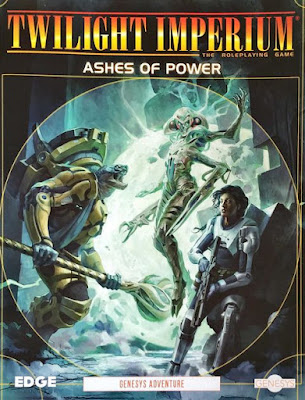
For Free RPG Day 2021, EDGE Studio offered Twilight Imperium: Ashes of Power. This is a quick-start for Embers of the Imperium, the roleplaying game based on Twilight Imperium, the classic ‘4x’ (eXplore, eXpand, eXploit, and eXterminate) board game. It uses the Genesys Narrative Dice System—first seen in Warhammer Fantasy Roleplay, Third Edition—but ultimately derived from the original Doom and Descent board games. Twilight Imperium: Ashes of Power comes with everything necessary to play—an explanation of the rules, four pregenerated characters, and an exciting, action-packed scenario for the Game Master to run. What it does not come with is dice and the fact that both the Genesys Narrative Dice System and Embers of the Imperium—and therefore Twilight Imperium: Ashes of Power—use propriety dice is a small problem. Not an insurmountable one, but a small problem, nonetheless. Fortunately, EDGE Studio has made available a Genesys Dice App free to download which will alleviate that problem unless one or of the players lacks a mobile device.

Twilight Imperium: Ashes of Power opens with a rules summary. The core mechanic requires a player to roll a pool of dice to generate successes and should the roll generate enough successes, his character succeeds in the action being attempted. The complexity comes in the number of dice types and the number of symbols that the players need to keep track of. On the plus side, a player will be rolling Ability dice to represent his character’s innate ability and characteristics, Proficiency dice to represent his skill, and Boost dice to represent situational advantages such as time, assistance, and equipment. On the negative side, a player will be rolling Difficulty dice to represent the complexity of the task being undertaken, Challenge dice if it is a particularly difficult task, and Setback dice to represent hindrances such as poor lighting, difficult terrain, and lack of resources. Ability and Difficulty dice are eight-sided, Proficiency and Challenge dice are twelve-sided, and Boost and Setback dice are six-sided.

When rolling, a player wants to generate certain symbols, whilst generating as few as possible of certain others. Success symbols will go towards completing or carrying out the task involved, Advantage symbols grant a positive side effect, and Triumph symbols not only add Successes to the outcome, but indicate a spectacularly positive outcome or result. Failure symbols indicate that the character has not completed or carried out the task, and also cancel out Success symbols; Despair symbols count as Failure symbols indicate a spectacularly negative outcome or result, and cancel out Triumph symbols; and Threat symbols grant a negative side effect and cancel out Advantage symbols. Only Success and Failure results indicate whether or not a character has succeeded at an action—the effects of the Advantage, Triumph, Despair, and Threat symbols come into play regardless of whether the task was a success or not. Task difficulties range from one Difficulty die for easy tasks up to five for Formidable tasks, and in addition, certain abilities enable dice to be upgraded or downgrade, so an Ability die to a Proficiency die or a Challenge die down to a Difficulty die.

In general, the dice mechanics in the Genesys Narrative Dice System—and thus, Twilight Imperium: Ashes of Power—are straightforward enough despite their complexity. They are perhaps a little fiddly to assemble and may well require a little adjusting to, especially when it comes to narrating the outcome of each dice roll.

Combat is more complex. Initiative is handled by a skill roll—using Cool or Vigilance, and attack difficulties by range and whether or not the combatants are engaged in melee combat. Damage is inflicted as either Strain, Wounds, or Critical Injuries. Strain represents mental and emotional stress, Wounds are physical damage, as are Critical Injuries, but they have a long effect that lasts until a Player Character receives medical treatment. When a Player Character suffers more Wounds than his Wound Threshold, he suffers a Critical Injury, and when he suffers Strain greater than his Strain Threshold, he is incapacitated. The various symbols on the dice can be spent in numerous ways in combat to achieve an array of effects. So a Triumph symbol or enough Advantage symbols could inflict a Critical Injury, allow a Player Character to perform an extra manoeuvre that round, and so on, whilst Threat and Failure symbols inflict Strain on a Player Character, three Threat symbols could be spent to knock a Player Character prone, and so on. Twilight Imperium: Ashes of Power includes a table of options for spending Advantage, Triumph, Threat, and Despair in combat, as well as a table of critical Injury results. It does not, however, include a table for spending Advantage, Triumph, Threat, and Despair out of combat—a disappointing omission for anyone wanting to do a bit more with their character’s skills. That said, the Game Master should be able to adjust some of the options on the table to non-combat situations.

Lastly, the rules in Twilight Imperium: Ashes of Power cover NPCs and Story points. Apart from nemesis-type NPCs, most NPCs treat any Strain they suffer as equal to Wounds, and Minions work together as a group. In Twilight Imperium: Ashes of Power, there are two pools of Story Points—one for the Player Characters, one for the GM. They can be used to upgrade a character’s dice pool or the difficulty of a skill check targeting a character—NPC or Player Character in either case, or to add an element or aspect to the ongoing story. The clever bit is that when a Story Point is spent, it does not leave the game, but is shifted over to the pool of Story Points. So if the Game Master spends a Story Point to increase the difficulty of a Player Character’s Perception check to determine the motives of an NPC, she withdraws it from her own Game Master pool of Story Points and adds it to the players’ pool of Story Points. As a game proceeds and Story Points are spent and move back and forth, it adds an elegant narrative flow to the mechanics and will often force the players to agonise whether they should spend a Story Point or not as they know it is going to benefit the Game Master and her NPCs before it comes back to them.

A character in Twilight Imperium: Ashes of Power has six characteristics—Agility, Brawn, Cunning, Intellect, Presence, and Willpower, plus a range of skills from Charm, Computers, and Cool to Ranged (attacks), Skulduggery, and Vigilance, as well as range of special abilities. The four pre-generated Player Characters include a reptilian Xxcha, an overly optimistic liaison who carries an antique Lazax grav-mace; a Human Orbital Drop Soldier with a dislike of the L1Z1X; a curious Hylar Field Scholar who travels in an exosuit which enables him to survive out of water; and a Hacan Wayfarer merchant captain looking to restore her family fortune and is an expert negotiator with word and gun. All four Player Characters are nicely presented in a busy, but easy to access character sheet which gives a clear explanation of the character background, roleplaying notes, skills, equipment, abilities, and so on—plus each comes with a decent illustration of the character. Of note, each Player Character has an agenda, for example, the Hylar Field Scholar’s requirement to record and gather all data and samples they can of new or archaic technologies. There are boxes throughout the scenario which inform the Game Master when each of the Player Characters has an opportunity to fulfil their agenda, and notably, it is not up to the player to remember to bring it into play, but rather that the Game Master should remind the player. As such, there is no benefit in game to fulfilling an agenda, but it does provide roleplaying opportunities and motivation, and provides a chance for each player to showcase his character.

The setting for Twilight Imperium and thus for Embers of the Imperium and Twilight Imperium: Ashes of Power, is a space opera in a vast, sprawling galaxy. For twenty thousand years, the galaxy prospered under the Lazax Empire, governed by a Galactic Council which gave everyone a voice. Both the Lazax and the empire would be destroyed in a series of wars that would culminate in the bombardment of Mecatol Rex, glittering throne world of the Lazax and the seat of Council, by the reviled Mahact Kings. The subsequent Twilight Wars lasted for millennia, but more recently, the great galactic powers have come together—warily, and established a Galactic Council amidst the ruins of Mecatol City. There is peace, measured diplomacy, and careful co-operation, but in a new age when the members of the councils do not yet fully trust each other, there remain threats which would return the galaxy to chaos once more—the L1Z1X Mindnet, Vuil’Raith Cabal, Mahact Gene-Sorcerers, and Nekro Virus. In response, the Galactic Council established the Keleres, an agency dedicated to dealing with threats larger than any one faction can effectively deal with. Though dedicated to the safety of the galaxy, the Keleres is dependent on the factions for support and resources, as well as for its members—also known as Keleres—and most of them have to answer to their sponsors as well as the agency. The Player Characters are of course, members of the Keleres.

The scenario in the quick-start, ‘Ashes of Power’, sends the Keleres to Herool’s Truce, a tidally locked world which has only regained contact with the rest of galaxy in recent years and from where a Keleres informant has reported the possible discovery of unknown, Imperial-era technology and the presence of unsanctioned L1Z1X agents. There they are to investigate the possible disappearance of the informant, confirm the discovery of the ancient technology, and if they do, prevent it from falling into the hands of the L1Z1X agents. It sounds a simple enough mission, but the Player Characters will need to find the ship they have been assigned, get to the planet, deal with it bureaucracy, follow up on a rumour or two, all before facing off against the cybernetically enhanced L1Z1X agents. Divided into three acts, in the first act, the Player Characters will be briefed about their mission and find their ship; in the second, they will conduct their investigation on Herool’s Truce; whilst in the third, they will confront the L1Z1X team and discover whether or not the rumours of ancient technology are true. The scenario takes its time to help the Game Master, clearly indicating skills necessary and their possible outcomes, as well as presenting numerous ways in which the Keleres can approach the mission. They can be open about it with the local authorities, they can try and avoid getting the authorities involved, and although there are numerous opportunities for combat and conflict, with many of them, the scenario also suggests other ways of dealing with the situations. Along the way, there are opportunities for each of the Player Characters to fulfil their personal agendas and explore an interesting world which has been cut off from the rest of the galaxy for centuries and consequently has an interesting society and geography. There are lots of chances to roleplay too, which is helped by the succinctly done backgrounds for each of the Player Characters. 

The scenario concludes with notes as to what happens next. This takes into account the fact that the Player Characters might not succeed or might even side with the L1Z1X agents! There are consequences to both outcomes as well as their being successful, and these could play out should the Game Master continue with an Embers of the Imperium campaign. In addition, the PDF version of Twilight Imperium: Ashes of Power comes with support that includes two extra Player Characters, their agendas, and extra encounters for the scenario’s third act. Also included is a map—which was not in the Free RPG Day release. The extras increase the number of players possible or character choices available.

Physically, Twilight Imperium: Ashes of Power is as nicely done as you would expect from the publisher. It is well written, the full artwork is good, and the sample Player Characters are excellent. If there is a downside perhaps it is that few of the NPCs are illustrated, and there are no maps or illustrations of the world of Herool’s Truce, both of which would have helped the Game Master portray the world for her players.

Ultimately, if there is an issue with Twilight Imperium: Ashes of Power, it is that it uses the Genesys Narrative Dice System and that does take some adjusting to. Get past that though, and Twilight Imperium: Ashes of Power offers up not just a solid introduction to the system, but a thoroughly entertaining and exciting introduction to Embers of the Imperium with a really good scenario and some nicely done pre-generated Player Characters. 

Monday, 20 December 2021

[Free RPG Day 2021] Blue Rose Quick-Start

Now in its fourteenth year, Free RPG Day in 2021, after a little delay due to the global COVID-19 pandemic, took place on Saturday, 16th October. As per usual, it came with an array of new and interesting little releases, which traditionally would have been tasters for forthcoming games to be released at GenCon the following August, but others are support for existing RPGs or pieces of gaming ephemera or a quick-start. Of course, in 2021, Free RPG Day took place after GenCon despite it also taking place later than its traditional start of August dates, but Reviews from R’lyeh was able to gain access to the titles released on the day due to a friendly local gaming shop and both Keith Mageau and David Salisbury of Fan Boy 3 in together sourcing and providing copies of the Free RPG Day 2020 titles. Reviews from R’lyeh would like to thank all three for their help.

—oOo—

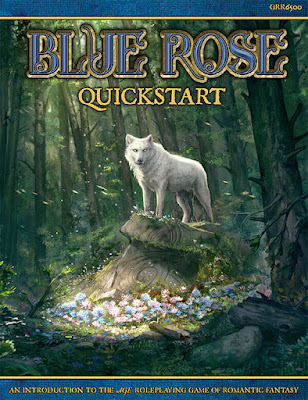
The Blue Rose Quick-Start: An Introduction to the AGE Roleplaying Game of Romantic Fantasy is Green Ronin Publishing contribution to Free RPG Day in 2021. This is an introduction to Blue Rose: The AGE RPG of Romantic Fantasy which provides Game Master and players alike with everything necessary to play. This includes an explanation of its genre, the rules, a complete scenario, and a nonet of pre-generated Player Characters, all of which comes packaged in a handsome, not to say sturdy—especially in comparison to other releases for Free RPG Day, booklet done in full colour. It very quickly gets down to explaining what it is, what roleplaying is, and what everyone needs to play before providing an explanation of what ‘Romantic Fantasy’ is. Traditional fantasy is not necessarily romantic, although it can have great romances, its focus is more on great sagas and battles and magic and great evils and the like, but inspired by authors such as Mercedes Lackey, Diane Duane, Tamora Pierce, and others, Romantic Fantasy and thus Blue Rose: The AGE RPG of Romantic Fantasy, emphasises love and relationships between a diversity of healthy sexualities, genders, and identities, often through deep, meaningful romantic relationships and consent. In the Kingdom of Aldis, the key setting for Blue Rose, preference for more than the single gender is widespread, and although in the minority, preference for a single gender is equally as accepted. The tone is also positive, rather than grim and gritty, so the characters—and thus the Player Characters—are motivated by sincerity and heroism. Magic is also different to that of standard fantasy, tending to be psychic in nature rather than necessarily arcane, although that too, as arcana, also exists. Lastly, there is a sense of sense of environmental consciousness to be found in the genre, and reverence for the natural world often drives stories in which the antagonists have none.

A quick overview of Kingdom of Aldis—the ‘Kingdom of the Blue Rose’—is also provided as is a description of the Aldinfolk. The kingdom is a beacon of Light having arisen from the darkness that was the Empire of Thorns, whose cabal of wicked Sorcerer Kings had previously overthrown the Old Kingdom. It is also home a diverse range of peoples. Not just Humans of all colours, but also aquatic Sea-folk, the mystical Vata (divided between the chalk-skinned Vata’an and the ebonskinned Vata’sha), and also the Night People, the creations of the Sorcerer Kings and their terrible sorcery, who eventually freed themselves from their servitude. Lastly, there are the Rhydan, various species of animal who Awaken to sapience and psychic ability, and are equal citizens in Aldis. This mix is reflected in the range of Player Characters presented in the appendix at the end of the Blue Rose Quick-Start: An Introduction to the AGE Roleplaying Game of Romantic Fantasy. Nine pre-generated First Level Blue Rose Player Characters make up the Family Nightsong, a collection of misfits and outcasts who have come together to form a family. The appendix includes an explanation of who they and what the relationships are between the nine, as well as their history. Each of the nine comes with a complete background and descriptions of their personality, goal, calling, destiny, and fate, plus their important relationships. This is in addition to their actual character sheets, so every one of the nine pre-generated Player Characters is given a two-page spread. The mix includes Sea-folk, a Night Person, Humans, Vata’sha, Vata’an, and a Rhy-Badger, and they can either be used intended with the scenario included in the quick-start, or as a ready supply of replacement Player Characters, or even NPCs if the Game Master is running a Blue Rose campaign.

The Blue Rose Quick-Start: An Introduction to the AGE Roleplaying Game of Romantic Fantasy and thus Blue Rose: The AGE RPG of Romantic Fantasy uses the AGE System, or Adventure Game Engine System. Originally seen in Dragon Age – Dark Fantasy Roleplaying Set 1: For Characters Level 1 to 5. It is fast, simple, but cinematic in its play style. At the core of each character in Blue Rose are eight abilities—Accuracy, Communication, Constitution, Dexterity, Fighting, Intelligence, Perception, Strength, and Willpower. Each attribute is rated between -2 and 4, with 1 being the average. They will have ability focuses, areas of expertise such as Perception (Searching) or Intelligence (Natural Lore), each of which adds +2 bonus to appropriate rolls. Characters can also know Weapon Groups, Talents, and Specialisations and these are worked into and explained in the nine pre-generated characters. The AGE System and Blue Rose has three Classes—Adept, who use arcana, Experts, who can be anything from stealthy scouts to suave diplomats, and Warriors, who can use a variety of weapon styles.

Mechanically, the AGE System requires the use of just six-sided dice, both to handle actions as well as effect—such as damage, time taken, or to generate Stunt Points. To undertake an action, a player rolls three six-sided dice to beat a target, the average being eleven. To the roll a player also adds the appropriate Ability and if one applies, a +2 bonus for any Focus. For example, Chaya the Rhy-Badger wants to understand what a wolf that she and her family has just encountered is doing. Her player would roll the dice, add two for her Intelligence Attribute and two for her Natural Lore Focus. The roll is two, two, and six, which together with the bonuses for the Intelligence Attribute Natural Lore Focus, means that Chaya’s player has rolled a fourteen. This is more than the Target Number of the twelve required to understand the wolf.

Now of the three six-sided dice, one is a different colour to the other two. This is called the Stunt Die. Typically, it acts as an effect die, measuring how well a character does or how quickly an action takes, but in the basic rules, particularly in combat, the Stunt Die does much, much more. Whenever a player rolls doubles on two of the three six-sided dice and succeeds, he gets a number of points equal to the result of the Stunt Die to spend on Stunts, which come in four types—Combat, Exploration, Social, and Power. Thus, Knock Prone or Mighty Blow are Combat Stunts for use in melee or missile combat, Arcane Shield or Effortless Arcana are Arcane Stunts when casting magic, Speedy Search or With a Flourish are Exploration Stunts for general actions, and Passionate Inspiration or Flirt! are Roleplaying Stunts. In the case of Chaya above, her player rolled doubles, generating two Stunt Points to spend from the Exploration Stunts. The list of stunts is not exhaustive in the quick-start, but enough at last for the scenario, and there are more in Blue Rose: The AGE RPG of Romantic Fantasy.

The Blue Rose Quick-Start: An Introduction to the AGE Roleplaying Game of Romantic Fantasy explains the rules clearly and simply in just a few pages. Tables are included covering the Actions that the Player Characters and NPCs can take, as well as Talents and Arcana. Four tables list Combat Stunts, Exploration Stunts, Roleplaying Stunts, and Arcane Stunts. Lastly, and particularly to the Blue Rose: The AGE RPG of Romantic Fantasy, the Player Characters can be driven to greater feats and achievements when the people and things they care about are in danger, and mechanically, this is reflected in the Relationship value which each Player Character has with particular members of their family. Once per scene, if an action would support the emotion and context of the Relationship which the Player Character has with another, then the player can add the Relationship value to any Stunt Points generated, or even be used to generate Stunt Points when the roll actually does not. Lastly, there is advice throughout the quick-start, especially on handling the potential interplay of Stunts and Emotions and how to portray them, in a way which is responsible and mature.

The scenario in the Blue Rose Quick-Start: An Introduction to the AGE Roleplaying Game of Romantic Fantasy is ‘The Rhy-Wolf’s Woe’. Consisting of eight scenes, the adventure can be easily scaled to any number of players, though four or five should be a reasonable number. The Player Characters are traveling through the Pavin Weald, a vast forest, when they encounter a Rhy-wolf who wants their help. One of his friends, another Rhy-wolf, has gone missing and he believes that she may have gone off with a boy with whom she has formed a rhy-bond. He wants the Player Characters to find her and make sure that she is safe. Of course, being heroes, the Player Characters agree and go in search of the missing Rhy-wolf. He directs them to the village where the boy can be found, but once they discover that he too is missing. Now in search of both, they must trek deep into the wilderness, facing increasingly difficult encounters along the way.

‘The Rhy-Wolf’s Woe’ is nicely built around a burgeoning relationship between the boy and the Rhy-wolf, and comes with plenty of detail. However, the scenario is short—really intended to be played in a single four-hour session—and it is linear. So in terms of storytelling it is not particularly sophisticated and beyond perhaps using it as an introduction or a side quest in a campaign, it is perhaps a little too basic an adventure for experienced players. This does not mean that they will not enjoy it necessarily, but its structure is likely to be obvious. Less experienced players or those new to roleplaying will have less of an issue, and if this is one of the first things that the Game Master has run, then the structure makes it easier for her to run and concentrate on roleplaying and portraying the setting.

Physically, the Blue Rose Quick-Start: An Introduction to the AGE Roleplaying Game of Romantic Fantasy is cleanly and tidily laid out. The full colour artwork is excellent and as a physical product, it feels nicely solid in the hands.

Overall, as an introduction to the Blue Rose: The AGE RPG of Romantic Fantasy, the Blue Rose Quick-Start: An Introduction to the AGE Roleplaying Game of Romantic Fantasy is better aimed at players and Game Masters new to the hobby rather than experienced roleplayers. However, as an introduction, the Blue Rose Quick-Start: An Introduction to the AGE Roleplaying Game of Romantic Fantasy is well done and a more than serviceable entry point.

Saturday, 11 December 2021

[Free RPG Day 2021] The Heart of Dako & Zara Harlowe

Now in its fourteenth year, Free RPG Day in 2021, after a little delay due to the global COVID-19 pandemic, took place on Saturday, 16th October. As per usual, it came with an array of new and interesting little releases, which traditionally would have been tasters for forthcoming games to be released at GenCon the following August, but others are support for existing RPGs or pieces of gaming ephemera or a quick-start. Of course, in 2021, Free RPG Day took place after GenCon despite it also taking place later than its traditional start of August dates, but Reviews from R’lyeh was able to gain access to the titles released on the day due to a friendly local gaming shop and both Keith Mageau and David Salisbury of Fan Boy 3 in together sourcing and providing copies of the Free RPG Day 2020 titles. Reviews from R’lyeh would like to thank all three for their help.

—oOo—

For Free RPG Day 2021, Hit Point Press released not one, but two things. However, the publisher, best known for its Humblewood anthropomorphic setting for Dungeons & Dragons, Fifth Edition, actually put the two things in the one booklet and gave them a cover each, much like a Doubleday cover. So look at the one cover, turn the book over and upside down, and you have the other. Both contributions are for Dungeons & Dragons, Fifth Edition, but each provides the Dungeon Master with something different, one is more generic than other, whilst that other is setting specific. T provides an NPC designed to be dropped into almost any fantasy setting and a new Humblewood adventure.

The BIG BADS series presents a range of booklets, each detailing a villainous NPC which the Dungeon Master can drop into her campaign at short notice. The idea is that they be used when the Player Characters have wandered away from the centre of the action or the plot, and the Dungeon Master does not have anything ready for such an eventuality. Each entry comes complete with a description of the villainous NPC, his tactics and traits (Ideal, Bond, and Flaw), his allies, some background, and some adventure hooks. In the case of The Heart of Dako & Zara Harlowe release for Free RPG Day 2021, the ‘BIG BAD’ is Zara Harlowe, who can be inserted into major town or city which has a city guard and a single thieves’ guild dominating the criminal underworld. Zara Harlowe is the chief of the watch or city guard, and has managed to wage a major campaign against organised crime, breaking up gangs and intimidation rackets, foiling heists just in the nick of time, and filled the nearby gaols with innumerable crooks. However, one major criminal, the local Thieves’ Guild Guildmaster, known as Nix, eludes her, and it continues to frustrate the chief of the guard. Except, of course, it does nothing of the sort, for the simple reason that Zara Harlowe and Nix are one of the same. Zara Harlowe has long been corrupt, and her growing ties to the local criminal underworld put her in a position, eventually, to eliminate all of the local competition and install someone else on charge. Namely, herself—or rather Nix. By day, she commands the city guard to crack down on crime, invariably directing them away from her activities by night as the city’s crime boss. It is all a case of one big misdirection—through double agents, bureaucracy, ruthlessness, and disguise.

The Heart of Dako & Zara Harlowe also details her two allies in the know, both as evil as she is, one a Dragonborn shapechanger and wereboar, the other a Half-Elf Necromancer! There are good notes on roleplay on each of these villains, but especially Zara Harlowe, as well as details of what might be found should the trio be encounter at the Guard Station or the Thieves’ Guild Headquarters. Neither is mapped, which is pity, but the Dungeon Master should be able to find or draw something. Should the Dungeon Master want to use Zara Harlowe and her compatriots, the mini-supplement comes three adventure hooks, one a closed room mystery, one a heist in the city where Zara commands the guard, and the last a rambling letter which hints at the truth of her activities. All three will need no little development upon the part of the Dungeon Master, but they represent a good start. Lastly, there are the stats for each of the three NPCs, each given their own page and all accompanied by decent illustrations. In terms of Challenge Rating, all together they have a rating of ten or eleven, depending upon the situation, so the Dungeon Master will need to adjust according or choose when to run these NPCs.

The BIG BADS section of The Heart of Dako & Zara Harlowe runs to just twelve or so pages of content, but provides the background and stats necessary for the Dungeon Master to run this villainess and her allies with relative ease. She will need to make adjustments and development the content a little to fit her campaign or scenario, but no more than usual.

—oOo—

The other half of 
The Heart of Dako & Zara Harlowe is ‘The Heart of Dako’. This is a scenario for the Humblewood campaign setting in which you play anthropomorphic Birdfolk and other woodland creatures. It does not take place in the Humblewood region though, but in the Tanglewilds, a vast jungle far south of the Humblewood on the western continent of Wesden. Here Tanglewilds Guides are stationed at the guide outpost of Wayfare, from where they can be hired to lead expeditions through the jungles of Sania’s Paradise. The four pre-generated Player Characters, all of Fifth Level, are Tanglewilds Guides. They include Zenja Brightfeather, a Seeta Luma (or Parrot) Druid, a Sun Eluran (big cat) Cleric, a Sandscale Tilia (lizard or gecko) Rogue, and an Arma Hedge (armadillo?) Ranger. All four are given two pages each containing all of the necessary stats, features, and traits, plus an explanation of each character’s role, backstory, and equipment. These are all easy to read and understand, and thus far from difficult to ready to play.

‘The Heart of Dako’ opens with the four Player Character Tanglewilds Guides being hired by the Companions of the Blue Rose, a stalwart company of adventurers, to lead them on their way to the coastal city of Espinorra, where a ship awaits to ferry them to their northern homelands. They boast of great find, a precious magical relic they believe to be the fabled Heart of Dako, which they took from the Temple of Naba, and plan to take home with them. Thus they want to get home without any fuss or difficulty. Not long after they set out, the Player Characters and their employers are disturbed in their journey. It might be that they see a strange, apocalyptic vision, be suddenly warned by Companion of the Blue Rose about the Heart of Dako his companions are carrying, or they recall or hear a story about the dreadful outcome should the Heart of Dako be removed from the Temple of Naba. Essentially, the Dungeon Master is free to use these as necessary to persuade the Player Characters that taking the Heart of Dako from the Temple of Naba was not a good idea, each serving as a hook for the adventure proper. Making this decision though will come after the scenario’s opening scene when the Player Characters have an opportunity to interreact with the Companions of the Blue Rose, learn of some of the dangers they faced in finding and plundering the Temple of Naba, and more. This is no mere exposition, but essential in completing the adventure, because the Player Characters will not only have to retrace the steps of the Companions of the Blue Rose, but do so with hot on their heels after stealing the Heart of Dako!

‘The Heart of Dako’ perhaps suggests a nod towards Joseph Conrad’s Heart of Darkness, but the scenario is more Indiana Jones—right down to one of the NPCs exclaiming, “ It belongs in a museum!”, than exploring the nature of European colonialism! After a race across a rope bridge, the Player Characters enter the Temple of Naba and must navigate the various traps and puzzles located in its various chambers. These include the classic spike traps and walls closing in trap, all before the Companions of the Blue Rose confront again and hopefully, the Player Characters can save the day.

In addition to the scenario, ‘The Heart of Dako’, the first appendix gives full stats for all four members of the Companions of the Blue Rose, as well as other NPCs and a handful of jungle monsters. The second appendix describes the Wilderness Explorer, a new Background, and the third, details the actual Heart of Dako.

‘The Heart of Dako’ is a short and linear and presumes that the Player Characters will do the right thing in returning the artefact to the temple. If not, the scenario ends badly… In fact, the scenario feels all too short and could have done with interaction and opportunities for roleplay as it does emphasise exploration, puzzles, and combat rather than roleplaying. This does not mean that there are no opportunities, but they feel sparse in comparison. The adventure itself can be completed in a single session or so, certainly no more than two sessions. The players are provided with some decent characters to roleplay, and the Dungeon Master likewise has a good selection of NPCs to portray. The Companions of the Blue Rose will need careful study as they are the equal of the Player Characters and just as detailed and capable.

—oOo—

Physically, The Heart of Dako & Zara Harlowe decently presented. The artwork is decent enough in ‘Zara Harlowe’, but fully painted in ‘The Heart of Dako’, and full of lush colours that help bring the various characters (Player Characters and NPCs) to life and the jungle too. A fair bit of the artwork gets used more than once, but it is really good artwork. Otherwise, the writing is good, though perhaps a better explanation of the scenario’s plot could have been included at the beginning.

Of the two pieces of content in The Heart of Dako & Zara Harlowe, ‘Zara Harlowe’ is undoubtedly the more useful, being generic in nature and easily transposed to any setting. Being more specific in its setting, ‘The Heart of Dako’ is less useful to the Dungeon Master unless she wants to run a jungle-set scenario and/or run an anthropomorphic scenario, and less useful to the Humblewood Dungeon Master it takes place far away from the core setting. That said, ‘The Heart of Dako’ is a preview of Humeblewood 2, which opens up the southern tropical continent for the Humblewood setting. As a preview though, it still feels all too short and perhaps wondering if ‘Zara Harlowe’ had been omitted, there might have been room for a bit more adventure and bit more of the Humeblewood 2 to be showcased. Plus, as an adventure for Fifth Level Player Characters, ‘The Heart of Dako’ is not necessarily going to be useful to run when Humeblewood 2 is released.

Overall, The Heart of Dako & Zara Harlowe as a combination does not quite work. The latter is more useful than the former, but detracts from the former which feels as if it could have done with a bit more adventure as a result. Both are available separately on the Hit Point Press website.

Friday, 10 December 2021

[Free RPG Day 2021] Talisman Adventures – Quick Start Guide: Curse of the Rat Queen

Now in its fourteenth year, Free RPG Day in 2021, after a little delay due to the global COVID-19 pandemic, took place on Saturday, 16th October. As per usual, it came with an array of new and interesting little releases, which traditionally would have been tasters for forthcoming games to be released at GenCon the following August, but others are support for existing RPGs or pieces of gaming ephemera or a quick-start. Of course, in 2021, Free RPG Day took place after GenCon despite it also taking place later than its traditional start of August dates, but Reviews from R’lyeh was able to gain access to the titles released on the day due to a friendly local gaming shop and both Keith Mageau and David Salisbury of Fan Boy 3 in together sourcing and providing copies of the Free RPG Day 2020 titles. Reviews from R’lyeh would like to thank all three for their help.

—oOo—

Talisman Adventures – Quick Start Guide: Curse of the Rat Queen is the introduction to the Talisman Adventures Fantasy Roleplaying Game. Published by Pegasus Press, this is actually the roleplaying adaptation of Talisman: The Magical Quest Game, the classic fantasy board game originally published by Games Workshop in 1983. Like the board game, the Talisman Adventures Fantasy Roleplaying Game and thus Talisman Adventures – Quick Start Guide: Curse of the Rat Queen takes place in the in the Realm, a land of deadly creatures and ancient dragons and wondrous magic and fell curses, born in ages past after the Great Wizard cleansed the land of its many threats. Yet the Great Wizard did not stay, leaving behind the Crown of Command, talismans of great power, and perturbed peoples. Without the presence of the Great Wizard, vile monsters and other evil servants of Oblivion have begun to regain their power across the Realm, and now it is up to Heroes to step up and make a name for themselves.

The Talisman Adventures – Quick Start Guide: Curse of the Rat Queen comes with everything necessary to play. This includes an explanation of the setting, the core mechanics—including combat and spellcasting, four pre-generated Player Characters, and a short three-act scenario. To play, each player, including the Game Master, will need four six-sided dice, one of which must be a different colour to the others. This die of a different is the Kismet Die. Each player will also need five or six tokens, whilst the Game Master will also need five or six of her own, but of a different colour. These represent tokens Fate—Light Fate for the Player Characters, but Dark Fate for the Game Master.

The Talisman Adventures – Quick Start Guide: Curse of the Rat Queen quickly leaps into an explanation of the mechanics—the 3D6 Adventures System—and how tests work. However, to understand how they work, both Game Master and her players need to know what makes up a Player Character. Each Player Character has two Attributes, Strength and Craft. The former represents a character’s physical capability, and has three Aspects—Brawn, Agility, and Mettle, whilst the latter represents a character’s mental capability, and also has three Aspects—Insight, Wits, and Resolve. For the pre-generated Player Characters provided with the Talisman Adventures – Quick Start Guide: Curse of the Rat Queen, both Attributes and Aspects range between one and five. A Player Character can also have Skills, for example, Decipher, Entertain, Melee, or Psychic, and some Skills can have Specialisations, such as Mystic for Spellcasting, Axe for Melee, or Forest for Survival.

When a Player Character wants to undertake an action, his player rolls three six-sided dice, one of which must be a different colour, and thus the Kismet die, hoping to beat a given Difficulty, for example, an Average Difficulty might be eleven. If the Player Character has an appropriate Skill, then an associated Attribute or Aspect can be added to the total. More than the one Attribute or Aspect can be associated with the Skill, for example, Entertain Skill is associated with Wits, Insight, and Agility. Obviously, Agility for physical performances such as dancing or juggling, Insight for singing and playing a musical instrument, and Wits for reciting a saga or performing in a play. Further, if the Player Character has a Focus for the Skill, the player receives a flat +2 bonus to the roll. The outcome of the roll generates a Degree of Success. If the combined result—including the dice roll plus appropriate Attribute, Aspect, and Focus—is equal to, or greater than the Difficulty, then that is a Standard Success. If doubles are rolled on any of the three dice, and the combined result is equal to, or greater than the Difficulty, then that is a Great Success. If triples are rolled on any of the three dice, and the combined result is equal to, or greater than the Difficulty, then that is an Extraordinary Success.

A result is less than the Difficulty, then the Player Character has failed. In combat this means that not only has the Player Character failed to strike his opponent, that opponent has struck back and inflicted full damage. A Standard Success means that the Player Character has succeeded in the Test, but at a cost or with a complication. This then, is a classic, ‘Yes, but…’ result. In combat, this means that a Player Character has managed to attack an opponent, but said opponent strikes back and inflicts half damage. A Great Success means that the Player Character has succeeded without any beneficial or detrimental effect. This is complete success. An Extraordinary Success means that the Player Character has succeeded and done so with great effect. In combat, that might be to inflict extra damage or another effect. This is a classic ‘Yes and…’ result.

Further, if a one is rolled on the Kismet Die, the Game Master gains one Dark Fate, whilst if a six is rolled, the Player Character gains one Light Fate. Rolling a one on the Kismet Die, can also trigger the Special Ability for an NPC or Enemy, whilst rolling a six can trigger a Player Character’s Special Ability. Light Fate points can be spent to add a bonus six-sided die to a Test, reroll a single die after a Test roll has been made, activate a Special Ability or an item’s Special Quality, and to avoid dying following a failed death test. The Game Master can spend Dark Fate to increase an Enemy, activate an Enemy’s Special Ability, activate effects in special areas, and activate an item’s curse effects. Both the Player Characters and the Game Master have a limited supply of their respective Fate, but more is generated throughout play.

Combat in Talisman Adventures is player facing, with each player making a Test with a Difficulty equal to the Threat of the Enemy faced by his Player Character. What this means is that the Player Characters act first and the Degrees of Success their players generate determine exactly how the Enemy react. So if an attack fails, the Opponent will attack, inflicting full damage or a Special Attack, whilst with a Success, the Player Character inflicts full damage, but suffers half damage from his Opponent in return. Only with a Great Success will full damage be inflicted without any comeback, whilst an Extraordinary Success does that and more. Numerous options are given for what that ‘more’ might be, depending whether the Player Character’s action is a Melee or Ranged Attack, a Psychic Attack, a Spell being cast, and so on… Once the Player Characters have acted, any Enemy who have not been engaged in combat, are free to act. In this case, any Player Character attacked must make a Defence Test, again against the Enemy’s Threat, and again, the Degree of Success determines the outcome, even to potentially stopping the attack and riposting with half damage on an Extraordinary Success.

Armour in Talisman Adventures is ablative, but can be repaired between encounters. However, armour always suffers a single permanent point of damage in combat which requires repair with a full set of tools. What this means is that the effectiveness of armour degrades over the course of an adventure, from encounter to encounter. When armour has been rendered useless in an encounter, any further damage is inflicted as Wounds. Successive Wounds also inflict increasing penalties to Tests and if a Player Characters suffers too many Wounds, his player must begin making Death Tests—or die!

The Talisman Adventures – Quick Start Guide: Curse of the Rat Queen comes with four pre-generated Player Characters. They include a brawny, axe-wielding Troll Warrior; an unarmed and unarmoured Dwarf Priest who can heal and bless, plus banish spirits; an Elf Scout, good with a bow and moving in the forest; and a Ghoul Assassin (!) who is incredibly sneaky and can even turn a dead Enemy temporarily against his former companions. In general, the Player Characters are clearly laid out and easy to read, though players should note that the Dwarf Priest has no armour and the Ghoul Assassin has the Soul Drinker Special Ability, but not the Psychic Assault Special Ability necessary to initiate a psychic attack.

The adventure, ‘Curse of the Rat Queen’, in the Talisman Adventures – Quick Start Guide: Curse of the Rat Queen runs to ten pages. A three-act affair, it sees the Player Characters travelling to the village of Jellico which requires their help. After the cliché of a barroom brawl to get the players used to the dice mechanics, the village elders summon the Player Characters and explain the problem besetting the village. It has been beset by a plague of rats, and naturally, the elders hired a Pied Piper and his tunes drew all of the rats out of the village. However, now they are returning, and the elders cannot not find the piper, so they want the Player Characters to find him, get their money back, and hopefully put an end to the rat menace. This will take them out of the village and into the surrounding wilderness to the Whispering Woods where the piper led the rats… Even if the start is a cliché, ‘Curse of the Rat Queen’ is a decent adventure, supported with good advice and optional content that the Game Master can add if she wants to. It adds a couple of rules of play along the way, so the Game Master will need to the adventure through thoroughly as part of the preparation. The adventure is not necessarily straightforward, but should be fun to play and adds several extra monsters which the Game Master could use to expand upon the adventure. Overall, a decent adventure which should provide two or so sessions’ worth of play.

Physically, the Talisman Adventures – Quick Start Guide: Curse of the Rat Queen is decently presented. The artwork varies a little in quality, but the writing is clear and easy to understand. The Game Master will need to conduct a careful read through as it does leap straight into the rules and there are extra rules explained later in the scenario. This does mean that The Talisman Adventures – Quick Start Guide: Curse of the Rat Queen is not quite suited to the novice Game Master as intended, but anyone with a little experience will pick the rules up fairly quickly. Also, the phrasing of the Degrees of Success feels slightly odd in that a Standard success is one with an element of failure. Adjust to that—and of course, the player facing mechanics which do make the Game Master’s task much easier, and Talisman Adventures serves up a mix of the traditional and the slightly lesser than traditional fantasy. Overall, the Talisman Adventures – Quick Start Guide: Curse of the Rat Queen is a solid introduction to Talisman Adventures combined with fairly simple mechanics and a fun adventure.

Monday, 6 December 2021

[Free RPG Day 2021] Victoriana: Going Underground

Now in its fourteenth year, Free RPG Day in 2021, after a little delay due to the global COVID-19 pandemic, took place on Saturday, 16th October. As per usual, it came with an array of new and interesting little releases, which traditionally would have been tasters for forthcoming games to be released at GenCon the following August, but others are support for existing RPGs or pieces of gaming ephemera or a quick-start. Of course, in 2021, Free RPG Day took place after GenCon despite it also taking place later than its traditional start of August dates, but Reviews from R’lyeh was able to gain access to the titles released on the day due to a friendly local gaming shop and both Keith Mageau and David Salisbury of Fan Boy 3 in together sourcing and providing copies of the Free RPG Day 2020 titles. Reviews from R’lyeh would like to thank all three for their help.

—oOo—

Cubicle7 Entertainment Ltd. offered two titles for Free RPG Day 2021. One is Reap and Sow, a scenario and quick-start for Warhammer Age of Sigmar Soulbound. The other is Going Underground, an adventure for the forthcoming version of Victoriana, the roleplaying game of intrigue, sorcery, and steam for Dungeons & Dragons, Fifth Edition. This is the roleplaying game of gothic fantasy magic and steampunk engineering set at the height of the reign of Queen Victoria and the British Empire. Magic is commonplace and even powers many of the new technological advances, such as the clockwork automata and prosthetic limbs, the latter often replacing those lost through industrial accidents or war. However, there is tension between maintaining the old ways of magic and embracing the optimism which comes with the new technology and the speed of change. The world of Victoriana is also inhabited by different species too. The Duine are much like Humanity, but there are also Púca—humans with animal traits; Muirlochs—nocturnal Humans with batlike ears and an affinity for technology; Khald—short, stout, and stubborn professionals known for their craftsmanship; Gruagach—tall, muscled, and honestly direct of opinion; and Elderen—elegant psychics said to have connections to the fae. There are numerous sources of magic too. These include the Aluminat faith which the Luminous Host and works to keep Humanity from becoming embroiled in the dangers of Entropy—which is thought to have lead to the apocalyptic magical event known as the Great Cataclysm in the past; the Thaumturge’s Guild which has legitimised and industrialised magic; Animism is drawn from the Otherworld which is home to the fae and harnesses the quintessence of nature to create talismans; and Maleficium is dark magic—necromancy and diabolism—taught by the Pallid Ones, fallen Archons. Magic is also another source of tension since it was once the sole purview of the nobility, but this is no longer the case as it has been industrialised and democratised. 

Victoriana: Going Underground is a preview of the forthcoming new edition of Victoriana, effectively the fourth edition, which is designed for use with Dungeons & Dragons, Fifth Edition. It moves the setting on two decades from just after the Crimean War to the Queen’s Golden Jubilee in 1877. After a solid introduction which explains the setting, it quickly throws both players and Game Master into the adventure itself, ‘Going Underground’. Designed for four players—the quick-start includes four pre-generated Player Characters—it is a short, direct, and linear adventure. They include Adelaide Finch, a Muirloch Sleuth, Theodore Gatesly, a Noble Gruagach Confidante, Sam Urmacher, a Púca gadgeteer, and Charalata Rathmore, an Elderen Animist. Each of the four comes with a full colour portrait and a clearly presented set of stats and abilities. All four are attending the opening and inaugural running of the deepest and newest underground train line built and run by the City & South London Subway. As detailed in the opening explanation for the players and their characters, Adelaide Finch has learned that someone is planning to sabotage the opening of the line, Theodore Gatesly used his connections to get the quartet tickets to the event, Sam Urmacher is along to investigate and write an article for periodical about trains, and Charalata Rathmore may help soothe the proletariat’s objections to the newly dug line.

The adventure itself is direct. The Player Characters alight from their carriage, descend into the London Underground, interact with the other guests and the staff, before boarding the train, and making the journey from Cannon Street to Stockwell and back (the alternate history of Victoriana means that the two are connected via the same line, when at the time they would have completely separate, unconnected lines). On the way something strange happens and it appears to be pulling the train through a portal. The question is, what caused this, and how do the Player Characters and everyone aboard the tube train get back? Throughout there are moments when the adventure puts each of the Player Characters in the spotlight, mostly to learn new information rather than act, and it is not until the strange event occurs that they really have the chance to do anything and be more proactive. Up until this point it does feel as if the Player Characters are in the background of the adventure, often reacting to the sometimes-clichéd actions and utterances of the NPCs. Once the train is thrown into the portal, the Player Characters have more opportunities to act—mostly combat and making repairs, but definitely more than the initial parts of the adventure.

Mechanically, there are relatively few changes between Victoriana and Dungeons & Dragons, Fifth Edition—at least in Victoriana: Going Underground. The most notable is the list changes to various skills, of which the Social Class skill, with its specialisations of Noble, Bourgeoisie, and Proletariat, figure prominently in the play of the scenario. The other is the addition of Quintessence, which is used to power spells, special abilities, and devices. This replaces the traditional Vancian spell slots of Dungeons & Dragons with what is in effect, a spell point system.

Physically, Victoriana: Going Underground is decently presented and written, with decent artwork—especially those of the Player Characters. It is a pity that none of the NPCs are illustrated.

Victoriana: Going Underground is short and direct and playable in a single session. As an example adventure, it is not that engaging, often relying upon clichés for its presentation of its NPCs and having a tightly plotted script. The latter though, is primarily due to the length of the scenario—a little over six pages in a fourteen-page booklet—and the fact that it is set in a tube train! Nevertheless, there are opportunities for the Player Characters to interact with the NPCs, shine a little, and the scenario does go out of its way to spotlight each of the four pre-generated Player Characters, and there is also scope for players to roleplay as well. However, as an introduction to the new edition of Victoriana, the scenario in Victoriana: Going Underground is too limited and too linear—certainly to stand on its own as a memorable adventure. As the opening chapter or prequel to a fuller, deeper, and proper scenario, Victoriana: Going Underground is serviceable enough, but not much more.