Every Week It's Wibbley-Wobbley Timey-Wimey Pookie-Reviewery...
Showing posts with label Cthulhu Dark. Show all posts

Monday, 4 May 2026

[Fanzine Focus XLII] Hypergraphia Issue o

On the tail of the Old School Renaissance has come another movement—the rise of the fanzine. Although the fanzine—a nonprofessional and nonofficial publication produced by fans of a particular cultural phenomenon, got its start in Science Fiction fandom, in the gaming hobby it first started with Chess and Diplomacy fanzines before finding fertile ground in the roleplaying hobby in the 1970s. Here these amateurish publications allowed the hobby a public space for two things. First, they were somewhere that the hobby could voice opinions and ideas that lay outside those of a game’s publisher. Second, in the Golden Age of roleplaying when the Dungeon Masters were expected to create their own settings and adventures, they also provided a rough and ready source of support for the game of your choice. Many also served as vehicles for the fanzine editor’s house campaign and thus they showed how another Dungeon Master and group played said game. This would often change over time if a fanzine accepted submissions. Initially, fanzines were primarily dedicated to the big three RPGs of the 1970sDungeons & Dragons, RuneQuest, and Travellerbut fanzines have appeared dedicated to other RPGs since, some of which helped keep a game popular in the face of no official support.

Since 2008 with the publication of Fight On #1, the Old School Renaissance has had its own fanzines. The advantage of the Old School Renaissance is that the various Retroclones draw from the same source and thus one Dungeons & Dragons-style RPG is compatible with another. This means that the contents of one fanzine will be compatible with the Retroclone that you already run and play even if not specifically written for it. Labyrinth Lord and Lamentations of the Flame Princess Weird Fantasy Roleplay have proved to be popular choices to base fanzines around, as has Swords & Wizardry. Of course, not all fanzines are dedicated to classic fantasy roleplaying games.

Hypergraphia Issue o was published in August, 2017 for release the following October at NecronomiCon Providence 2017. It takes its name from the rare behavioural condition in which the sufferer has the compulsive urge to write or draw, often resulting in voluminous amounts of text or detailed illustrations. However, the fanzine does not suffer from the effects of the latter, since it only runs to thirty-two pages in length. In-keeping with the nature of NecronomiCon Providence: The International Conference and Festival of Weird Fiction, Art, and Academia, a biennial convention and academic conference held in Providence, Rhode Island dedicated to the life and works of H. P. Lovecraft and other creators of weird fiction, film, and art, the contents of the fanzine are dedicated to Lovecraftian investigative horror. Mechanically, all of the content is written for Cthulhu Dark, the rules light roleplaying game of Lovecraftian investigative horror. What this means that all of the content is readily adaptable to the roleplaying game of Lovecraftian investigative horror (or just horror) of the Game Master’s choice.

The issue opens with ‘Night Business – Three scenario hooks for Cthulhu Dark’s London 1851 setting’ by Charles Gerard. They include ‘Link-Boys’ in which it rumoured that the Link-Boys that once lit the way home for pedestrians on the streets of London have retreated from the gaslit streets into the maze of alleyways and other dark routes, where razor-teethed , some hunt the unwary. ‘Rat-Catchers’ asks how far will the suppliers for the rat-baiting pits go in providing tougher creatures and what happens when the rats push back? Lastly, in ‘Resurrectionists’, the cadaver gangs have returned to London to fulfil a shortage of bodies for the surgeons and the anatomists. Where have the bodies of the dead of the workhouses gone and who is disinterring the dead now? Overall, nicely detailed ideas that the Game Master can develop into some further.

In between, Ed Possing’s ‘Unwanted Visitor’ is a short piece of fiction that hints at the dread of being alone in the cabin in the woods, as ‘Cleaning Up the Supernatural – An investigator background for any game system’ from Tyler Hudak explores the role of the janitor or garbage collector in horror games. He notes that theirs is a ubiquitous and unnoticed presence, collecting rubbish, raking over the trash, and having access to caustic chemicals and disposal systems. There are no game stats, but it suggests that stealth and hiding skills are appropriate along with lower social skills and a lower social status given the nature of the job. It is perhaps slightly too basic a description to really work from, but the article is accompanied by a trio scenario hooks and a description of ‘The Order of Janus’, originally founded in Ancient Rome to clean up evidence of activity. In the modern day, the Janus Corporation performs crime scene clean-up for law enforcement around the world. It is an interesting idea and would be fascinating to see this developed further with some actual scenarios and Occupational write-up.

There is more support for the period with Max Mahaffa’s ‘Ashes in the Dark – A scenario hook for Cthulhu Dark’s London 1851 setting’. It highlights the horrors of being a chimney sweep in the Victorian era, whilst also presenting a horror they could encounter at 50 Berkeley Square, infamously described as, ‘the most haunted house in London’. Essentially, there is something nasty in the chimneys of the townhouse, and the sweeps are noticing how few boys go in and come out again. What if the Player Characters are given the task of sweeping the townhouse’s twisted, cramped chimneys? Playing on claustrophobia, it includes lists of key words to describe the location, physical feelings, and the monster itself.

Somewhere on the road to Kingsport stands ‘The Green Bough Inn – A setting for any game system’ by Anthony Lee-Dudley. The dark and sombre building is as unwelcoming as the family that run it. The accompanying adventure seeds suggest that the family leads a cult in the nearby woods, that have something growing in the attic, and so on. In comparison to the hooks presented elsewhere in the issue, these are threadbare and will need no little development to be fully useful.

Ian MacLean explores the mysteries and legends of Canada in ‘Occultarum Borealis’. In particular, the lost village of Hochelaga. The St. Lawrence Iroquoian village was described by French explorer Jacques Cartier in October, 1535, in some detail as being well-defended, organised, and home to two thousand indigenous peoples. However, when Samuel de Champlain, ‘the father of New France’, visited the area seventy years later, it was gone. Although suggestions are given as to what actually happed—war, emigration, or disease—the article suggests that the Player Characters could be European visitors or even other locals looking to trade, but they could also be from rival tribes wanting to war on the village of Hochelaga. Further, he suggests Mythos involvement in the form of Iroquoian legends of the Flying Head, said to ride on howling winds, ripping its victims apart with bloodied claws. Could this be Nyarlathotep as the Haunter of the Dark. Alternatives include suggestions which could be the ‘Little People’ or the ‘White Buffalo’ that seek the surface to writhe and ravage the lands that could be Cthonians. Another option could be Mi-Go interference given European interest in mining rights. This is one of the more detailed articles in the fanzine and gives a lot of suggestions for the Game Master to work with, no matter which roleplaying game she is using.

‘Fragments of Fears and Phobias – Coulrophobia: Fear of Clowns’ by Sean Murphy examines the history of clowns, clowning, and the phobia some have of them. It notes that their portrayal in the media as monsters preying on children and adults alike, combined with their not quite human appearance has constantly pushed children’s happy association with clowns into fear and loathing. It is a solid overview of what appears to be a relatively new phobia and it would be interesting to see other phobias treated in the same way. Sadly, there are no hooks as there are in other articles in the fanzine.

Penultimately, Edwin Nagy takes the reader to the venue for NecronomiCon Providence, more recently seen in The Shadow Over Providence. In ‘Horror at the Biltmore’, he describes the planned multi-table Call of Cthulhu scenario at NecronomiCon Providence 2017 in which it possible for players to buy elements such as a revolver, or spell or if they are feeling nasty, a monster to add to the playthrough, and the monies going to charity. This sounds a lot of fun and a future issue of the fanzine should definitely tell what happened.

Lastly, ‘Off the Rails’ by Brian Murphy explores what happens when the players take their Investigators and gave them do something entirely unexpected, even also most counter to the scenario being played. Or at least, what happens when the Investigators decided to settle down in the Dreamlands with a lot of money in their playthrough of The Sense of the Sleight-of-Hand Man. His solution is to escalate events to the point where the Investigators were turned into pariahs and driven from the city which had burned down after it was attacked by the Black Ship owned by the Men of Leng which the Investigators had sold. It is thoroughly apocalyptic and quite, quite entertaining.

Physically, Hypergraphia Issue o is clean, tidy, and simply laid out. The artwork is a mixture of photographs and publicly available images and well chosen.

Hypergraphia Issue o is a good mix of background and suggested ideas for play. All of it needs development to one degree or another, in order to make it playable. Otherwise this is an engaging read that will work for almost horror roleplaying game.

Sunday, 4 June 2023

Initiation Island

It seemed like the opportunity of a lifetime. The chance to attend the annual summer camp of Miskatonic Shoreside Conservatory, a prestigious performing arts institute located on an island just off Providence, Rhode Island. Graduates of the summer camp are guaranteed admittance to Miskatonic Shoreside Conservatory and graduates of the institute are all but guaranteed of a glittering career including recognition and status. You are gifted. A dancer. A saxophonist. A painter. A singer. A violinist. Yet something is not quite right—about you. About the Miskatonic Shoreside Conservatory. You hide a secret. Miskatonic Shoreside Conservatory has its secrets. This is the set-up for a mini-campaign published by Symphony Entertainment using Cthulhu Dark, the minimalist roleplaying game of Lovecraftian investigative horror in which the horror is so bleak that the Investigators can at best hope to survive rather than overcome. Thus, attendees of the Miskatonic Shoreside Conservatory summer camp do not so much need to overcome their experiences at the institute, as rather find a way to survive, and perhaps even a way to abide…

Miskatonic Shoreside Conservatory is a one-shot scenario in which the players take the roles of teenagers, musical prodigies attending the Miskatonic Shoreside Conservatory for the first time at its annual summer camp. It is designed for five players. It can be played with fewer players, but works best with five. As the inspired Investigators enter the various arts programmes at the conservatory, they will quickly come to notice that not all is what it seems on the island. It is clear that the institute and its backers are wealthy, the conservatory being almost a luxurious retreat as much as it is a school. Yet there is a strangeness to it, as if it is not quite of this world, the other students in attendance are often unsettled, or driven to act in desperately weird ways, such as attempting sculpt a statue on the campus to get it right, but do so hands on with hot food on the plate like modelling clay or such as slamming themselves from wall to wall at their inability to perform to the level of skill they want. There is also the feeling that the Investigators are being groomed for something, tested not just on their musical ability, but on their past experiences and how they affect their musical ability. Ultimately, whatever it is, they will be given a choice…

Miskatonic Shoreside Conservatory is supported with detailed descriptions of the five Investigators, as well as the Miskatonic Shoreside Conservatory, its facilities and staff, and then a broad timeline of the thirty days that the Investigators will spend on the island. There is only the one map, and no floorplans, but most of the NPCs have photographs, and the handouts are decent. (In fact, the handouts would actually work if they were physically made as props.)

The scenario is also supported throughout with ‘Director Insight’, which includes advice for the Director—as the Keeper is known in Cthulhu Dark—and playtest and staging notes. It also makes use of Cthulhu Dark’s ‘Dark Symbols’, which indicates if a scene involves a clue, something harmful, dialogue, something to sport, or a combination of two or more of them. They are useful as they highlight the key points of any one scene and they can also be used to suggest to the Keeper that certain skills need to be rolled in those scenes if she is running the scenario under another rules system. However, they are not always best placed to be spotted with any ease.

The scenario does ‘suffer’ from a certain disconnect. More so than any other scenario of Lovecraftian investigative horror. Players of the genre quickly learn to recognise the elements of the genre in play and have to pull back from that knowledge lest it informs their roleplaying and their Investigators. In the case of Miskatonic Shoreside Conservatory, this is challenging because the scenario resonates with the Mythos. It is everywhere and unavoidable, despite the Investigators knowing nothing, so roleplaying across that disconnect is all more challenging and all the more demanding for the players. Miskatonic Shoreside Conservatory does play around a little with that divide, but not too much, and certainly not enough to alleviate the degree of challenge that the scenario demands.

Miskatonic Shoreside Conservatory is potentially a very difficult scenario because it does call upon the players to confront their Investigators committing dark acts and committing themselves to dark, antithetically inhuman forces. There is an interesting way of alleviating this within the scenario, at least initially, almost like a comfort blanket—although this one goes ‘woof!’ and wags his tail—but ultimately, the players and their Investigators will be called upon to make a choice. One minor irritant that breaks the atmosphere of the piece is naming an NPC, if only a minor one, ‘Vincent Price’.

It is possible with Miskatonic Shoreside Conservatory to draw parallels with two other roleplaying campaigns connected to Chaoisum, Inc., one Call of Cthulhu related, the other not. These are The Eldritch New England Holiday Collection from Golden Goblin Press, which is, of course, Call of Cthulhu related, and Six Seasons in Sartar, which is not. All three are about initiation and heritage, all are about playing children, teenagers. The Eldritch New England Holiday Collection, not into the Mythos, but about the Mythos. Six Seasons in Sartar is an initiation into both the core cults of Glorantha and Glorantha as a setting—both in as characters and as players. Miskatonic Shoreside Conservatory is also about initiation and the Mythos, but both into and about the Mythos, but unlike the other two where the players and characters accept their situation and their heritage, Miskatonic Shoreside Conservatory is whether not they accept their initiation and heritage. All of which plays out on an island retreat which is one part music school, one part The Village from The Prisoner, as if viewed through the fisheye lens of the Mythos.

Scenarios for Lovecraftian investigative horror which call for the players to take the roles of cultists are far and few between. This is primarily because such roleplaying games are about investigating and stopping the consequences of the cultists’ actions, preventing the end of the world, and saving humanity. They are about humanity, not inhumanity. This is not to say that such scenarios are not interesting to roleplay, and where they do occur, it is always as fully fledged cultists, having committed to the cause. Not so, here. Miskatonic Shoreside Conservatory offers something genuinely unique in offering the player the opportunity to become a cultist and everything their Investigator wants, but never once lets up on the horror and weirdness of that choice and so commit to becoming beyond human, whilst ultimately making the moral option the most painful one. Miskatonic Shoreside Conservatory is an unnervingly, relentlessly horrifying scenario which deserves to reach a wider audience and be the single answer to the question, “Are there any scenarios in which you play cultists?”

Saturday, 26 November 2022

Cosmic Anarchy

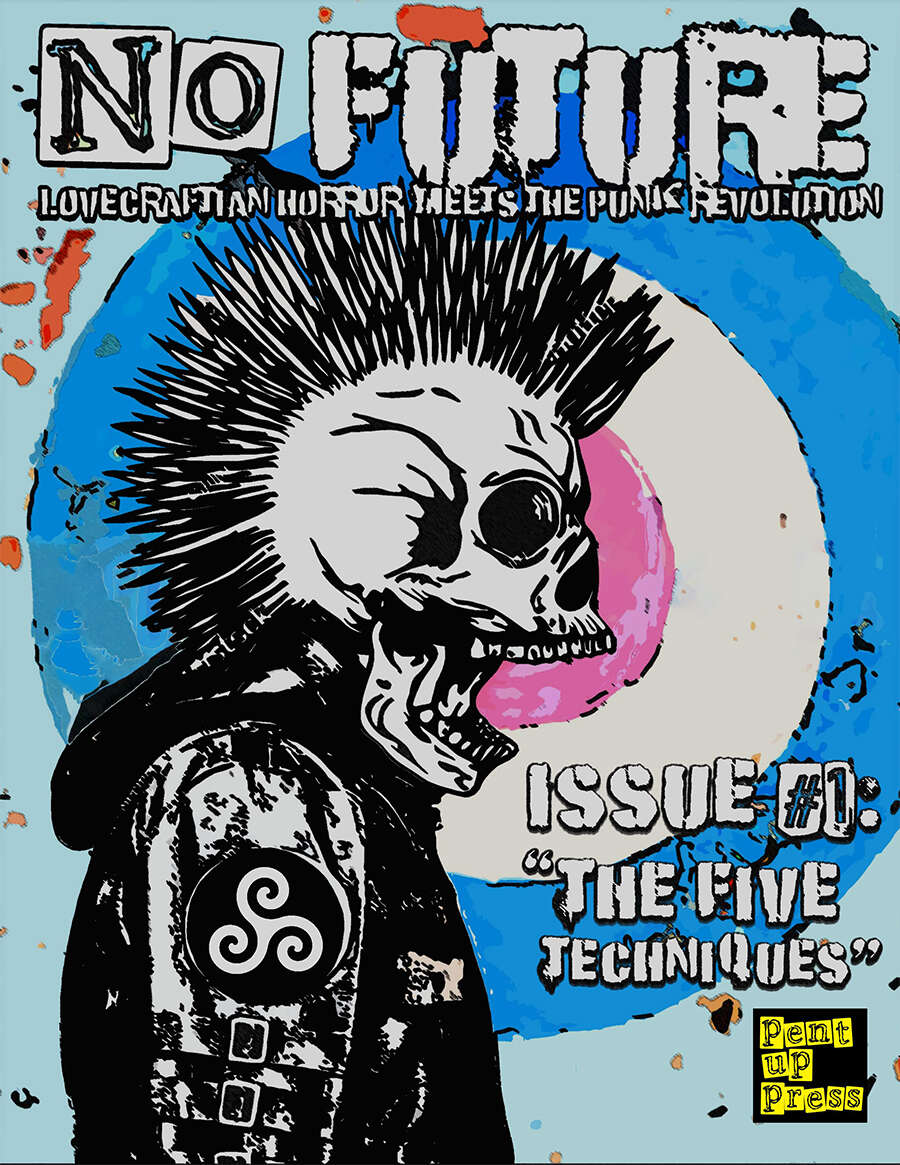
NO FUTURE: Lovecraftian Horror Meets the Punk Revolution
would normally be reviewed as part of the Fanzine Focus strand, but it is not really a fanzine. Although originally intended to be part of Kickstarter’s ZineQuest for 2022, the publisher decided to do it on its own via Itchio, when Kickstarter moved ZineQuest from march to August to coincide with Gen Con, its format—A4 rather than A5, its singular content, and the production standards all move it away from the ’zine ethos and look and towards a more professional product. As a result, it stands somewhere between a fanzine and prozine. It is a trend which has been growing with each successive ZineQuest, to the point where it is quite difficult to determine the difference between a fanzine and a publication simply using the format and the promotional support of ZineQuest to present a whole scenario or even an RPG. NO FUTURE: Lovecraftian Horror Meets the Punk Revolution does itself no favours in making a such a determination. Although the cover can be described as Punk Art and Punks are the protagonists of its scenario, the style and layout of the first issue’s content evokes neither Punk Art nor a fanzine sensibility, and the glossiness of the first issue just does not scream Punk! However, whether or not NO FUTURE: Lovecraftian Horror Meets the Punk Revolution is ’zine or not ’zine, it does not meet the criteria to fit the Fanzine Focus strand, but it does include content which is interesting and which does involve Punks.

NO FUTURE: Lovecraftian Horror Meets the Punk Revolution – Issue #1: “The Five Techniques” is published by Pent Up Press and contains a single scenario designed to be run using Trail of Cthulhu or Cthulhu Dark. The former is the clue orientated roleplaying game of Lovecraftian investigative horror from Pelgrane Press and the latter the rules light RPG of Lovecraftian investigative horror designed for simple, minimalist play. It could easily be adapted to the roleplaying game of Lovecraftian investigative horror of the Game Master’s choice. What makes the scenario stand out is its time period—the 1970s, its setting—Northern Ireland, and its protagonists—members of punk rock band. The set-up is this. The would-be Investigators are members of The Gutters which formed in London. The band’s bassist, Ciaron McCarthy, has died and his bandmate, Mickey Grayes, has persuaded everyone to give Ciaron a proper Punk wake in his home village of Conhale in County Armagh in Northern Ireland. This sets up some fantastic tensions. The Punks themselves are very much the ‘fish out of water’ amidst the tensions of the Troubles. Not just their clothes, but their anti-establishment sentiment will make them standout in the conservative society of Armagh, already tense from the locked down presence and influence of the British Army and the Royal Ulster Constabulary supposedly keeping them safe from the IRA.

The Investigators will feel and experience this tension almost from the start. The journey from London has been long and tiring when the Punks are stopped by an IRA checkpoint and questioned. The villagers are reluctant to talk to the interlopers, but will warm to them with a drink or two. The British Army will take a seemingly mild interest too—at least initially. All whilst the Investigators suffer odd dreams, or even daydreams of dreams, spiral patterns are marked here and there, and then one of their number runs off…

As written, “The Five Techniques” is systemless, but the scenario includes notes on running it in either Cthulhu Dark or the GUMSHOE System of Trail of Cthulhu. The latter comes with stats for some NPCs and new Investigative and General Abilities, all musical in nature. For either system, there is a set of tables for creating the background of the Punk, covering ‘Creating Your Punk’ and ‘Getting the Band Together’, as well the scenario’s set of dreams and four decently done handouts.

Whether run for Cthulhu Dark, Trail of Cthulhu, or another roleplaying of Lovecraftian investigative horror, “The Five Techniques” is more folk horror, more Green Room meets Junji Ito’s Uzumaki, rather than Lovecraftian horror per se. It also adheres to the style of play of Cthulhu Dark in which the Investigators can only confront the Mythos. They cannot fight it directly, for it is too powerful, too unknowable, and such efforts are doomed to end in failure, resulting in the Investigators’ deaths or insanity. Thus “The Five Techniques” is more Purist than the traditional Purist mode of Trail of Cthulhu to the point where the motivations of outrĂ© threat are never explained and the Game Master is not expected to explain them either. Only in the epilogue which each player gets to narrate for their Investigator is there time to wonder at what happened and the horror of it. Here though, is where “The Five Techniques” does not support the Game Master as the scenario does not say about the responses to what happened for those living in and around Clonhale, whether the villagers, the British Army, the R.U.C., or the I.R.A. There will be consequences and it would have been useful to be given pointers as to what they might be.

Physically, NO FUTURE: Lovecraftian Horror Meets the Punk Revolution – Issue #1: “The Five Techniques” is busily presented with plenty of decent artwork and good handouts. The writing is decent and the plot sufficiently straightforward that the Game Master can easily run this in a single session or as a convention one-shot. In addition, the scenario has a pleasing historicity, which includes the appearance of Northern Ireland’s most famous Punk band.

The seventies is a period which has been little explored in Lovecraftian investigative horror, and much of what has, has been inspired by the Grindhouse, exploitation cinema of the period. NO FUTURE: Lovecraftian Horror Meets the Punk Revolution – Issue #1: “The Five Techniques” shifts Lovecraftian investigative horror to the seventies in a historical sense and location, placing the unknowable against a framework of real-world tensions, making the already fraught situation all the more fraught, the result being a unique scenario for Lovecraftian investigative roleplaying.

Monday, 5 June 2017

A Taste of Cthulhu in the Dark

Originally appearing in the highly regarded Stealing Cthulhu and then in The Unspeakable Oath #22, Cthulhu Dark is a rules light RPG of Lovecraftian investigative horror designed for simple, minimalist play. Its core rules fit on a single page and require no more than three dice—one of which should be green—per player to play so that a game can be begun with a minimum of preparation upon the part of the players. A stripped down version of the rules for Cthulhu Dark are currently available from the author’s website, but an expanded version of the game itself is currently being funded via a Kickstarter campaign. This review is not of the edition that will eventually be funded via Kickstarter, but Cthulhu Dark 0, the preview edition launched at DragonMeet 2016.

As with other RPGs of Lovecraftian investigative horror, in Cthulhu Dark, the player take on the roles of Investigators drawn into mysteries that defy explanation and will eventually reveal to them terrible secrets that bring them to understand the true nature of the universe. This nature is alien and uncaring, a sense of dread that threatens to overwhelm and sap both the sanity and the humanity of these that come into contact with it. This is a universe of things—alien entities and species—who care nothing about the existence of humanity and those that do see them as nothing more than as transitory irrelevancies or playthings. Collectively they are known as the Cthulhu Mythos, being as like unto gods as mankind might be to lesser species on Earth. Some are worshipped by men in the hope of gaining power or at least the chance to survive should the stars come right and these things come to reclaim the plant that was once theirs and will be again. Such men are insane and in carrying out their master's’ plans spread horror and insanity… The Investigators will often find themselves looking into such plans and so confront the Mythos and its corrosive effects.

Notably, in Cthulhu Dark, confronting the Mythos is all that the Investigators can do. They cannot fight it directly, for it is too powerful, too unknowable, and such efforts are doomed to end in failure, resulting in the Investigators’ deaths or insanity. They can instead face its Earthly minions, though often hampered by the positions of power such minions hold in society, and so perhaps thwart such dastardly plans as would end in the return of the Great Old Ones and the end of life on Earth as they know it…

In Cthulhu Dark 0, an Investigator essentially consists of three things—a name, an Occupation, and his Insight. Alternatively, he might have a trait should the scenario not need the Investigators to have an Occupation. So for example, here is a Henry Brinded, an Investigator who appears in the recently published Masks of Nyarlathotep Companion.

Name: Henry Brinded
Occupation: Bostonian Antiquarian
Insight Die: 1

Mechanically, Cthulhu Dark is very simple. If an Investigator wants to do or investigate something, whether that is question someone or search the newspaper morgue for relevant articles, as long as that act is within human capabilities, his player rolls one die—the Human die. If the investigative act lies within the scope of the Investigator’s Occupation, then his player rolls a second die—the Occupation die. If the Investigator wants to risk his mind to succeed or if the investigative act directly pertains to the Mythos, then his player rolls a third die—the green Insight die. Then the dice are rolled and the highest result counts, showing the Investigator how much information he learns.

On a result of a one, he discovers the bare minimum; enough to proceed with the investigation, but no more. On a result of a four, he discovers everything that a competent investigator would, whilst on result of a five, he discovers this and something more. On a result of a six, he discovers everything that a competent investigator would and something more, but also glimpses something beyond the understanding of mere men. This undoubtedly going to be horrific and will probably require the player to make an Insight Roll for the Investigator. Likewise, if the highest result is on the Investigator’s Insight Die, an Insight Roll also needs to be made. 
For example, Henry Brinded has found the Diaries of the Walter Corbit, late of a supposed haunted house in Boston. He decides to read them. The Keeper lets his player roll his Human Die, his Occupation Die, and because Brinded is reading a Mythos tome, his player can also roll his Insight Die. On a result of a one, Brinded learns that Corbit worshiped at the Chapel of Contemplation; on  result of a four, he discovers that Corbit worshiped at the Chapel of Contemplation and was in dispute with his neighbours; on result of a five, he learns that Corbit worshiped at the Chapel of Contemplation and was in dispute with his neighbours because he wanted to be buried in his house; but on a six, he discovers that he learns that Corbit worshiped at the Chapel of Contemplation and was in dispute with his neighbours because he wanted to be buried in his house and that he had no intention of dying! 
An Investigator’s Insight represents how far he comprehends the true, horrifying nature of the universe. It begins at one and is represented by the Investigator’s green Insight Die, which always has its current value displayed. When an Investigator encounters something unnatural and disturbing, his player must make an Insight roll, rolling his Insight Die. If the result is higher than the Investigator’s Insight, it goes up by one as he gains greater understanding of the universe’s true nature and his player must roleplay his Investigator’s newly invoked fears. 

If an Investigator’s Insight reaches five, he can attempt to suppress his knowledge by burning Mythos tomes, stopping rituals, and so on, his player rolling the Insight Die in an attempt to lower his Investigator’s Insight. Unfortunately, should an Investigator’s Insight reach six, he achieves full comprehension of the universe and after one moment of lucidity goes insane… Time to create a new Investigator.

The effect of these stripped back mechanics is keep play simple and straightforward. Essentially there is no means of failure, the dice rolls determining how well an Investigator does rather than whether he fails or succeeds. Unlike most traditional roleplaying games of Lovecraftian investigative horror, Cthulhu Dark is very much a narrativist game rather than a simulationist game. (Actually, there is a mechanic for failure which adds a ‘Failure Die’ to an Investigator’s roll, but only when it is interesting and only when it does not impinge upon the investigative process.)

Further, in comparison to most traditional roleplaying games of Lovecraftian investigative horror, Cthulhu Dark collapses the Sanity/Insanity scale and changes the rate at which an Investigator will lose his Sanity. Initial loses will be quicker and more likely, but as an Investigator’s Sanity drops and his Insanity rises, he becomes inured to the horrors of the Mythos, making that final realisation as to the truth of the universe all the more horrifying when it occurs.

The core rules in Cthulhu Dark 0 run to no more than ten pages—and eight pages of those really only expand upon the rules given in the first two pages. In comparison, the Keeper’s Section is four times as long. It delves into how to write and rewrite a mystery, and then play the mystery before presenting a bestiary. It takes the Keeper from first principles through to running the adventure, constantly asking questions of him in order to help him develop the adventure, avoid pitfalls, and handle both both dice rolls and scene. This section is engaging and worth the time of any Keeper to read, whatever roleplaying game of Lovecraftian investigative horror he runs. 

Like any roleplaying game of Lovecraftian investigative horror, Cthulhu Dark includes a bestiary of Mythos entities and creatures. It looks at each entry’s themes, creeping horrors, and how they can applied to the settings mentioned elsewhere of ‘London 1851’ and ‘Mumbai 2037’. The entries include Old Ones such as Cthulhu and Yog-Sothoth, servitor races like Deep Ones, independent races such as the Elder Things and the Mi-Go, sorcerers like Joseph Curwen and Keziah Mason, and even artefacts such as the Shining Trapezohedron. It is not a comprehensive bestiary and feels influenced by the author’s earlier Stealing Cthulhu. This is no bad thing and there is no reason that a Keeper could not apply the ideas and methods of Stealing Cthulhu to the entities and creatures presented in Cthulhu Dark.

The setting provided in Cthulhu Dark 0 is ‘London 1851’, with the other mentioned setting, ‘Mumbai 2037’, to be included in the full version of the roleplaying game. ‘London 1851’ is a Dickensian alternative to the ‘Mauve Decade’ of Cthulhu by Gaslight atypical to most Victorian Era set roleplaying games. Not only does it provide a detailed snapshot of the city at the time of the Great Exhibition, it looks at the various options for Investigators during the period. What is interesting about the options discussed is that none of them are really Middle Class or Upper Class, most are really Working Class. Other Victorian Era roleplaying games might provide such options, but the point in Cthulhu Dark 0 is that the Investigators do not hold positions of real power or influence and in a typical Cthulhu Dark scenario, the Investigators are at odds with those who do. The lack of Middle Class or Upper Class options enforces this.

Rounding out Cthulhu Dark 0 is ‘The Screams of the Children’, a scenario set in London, 1851. The Investigators are thieves, prostitutes, street-sellers, and others—sample Investigators are provided, all female—who reside at the same lodging house where the baby of another resident has disappeared. It involves themes of pregnancy, childbirth, and monstrous offspring, and makes uses of the previous description given of London in the early Victorian period, but adds specific locations to accompany its plot, plus  themes and suggested die rolls for Investigators’ efforts. The scenario is relatively short, but nicely involving and atmospheric, harking back in tone to the author’s Purist scenarios for Trail of Cthulhu.

Physically, Cthulhu Dark 0 is a slim volume, neatly laid out and lightly, but nicely illustrated. The writing style is also light, but very direct with the author constantly asking questions of first the reader and then the Keeper. This is a style singular to the author and can be seen in his earliest tome on roleplaying, Playing Unsafe, as it can here and in the more recent Cthulhu Apocalypse. If there is an issue with the writing and with a great any of the questions—at least in the answers given to them—is that they go to support the given scenario, ‘The Screams of the Children’ rather than a Cthulhu Dark scenario in general. This though, is only an issue with Cthulhu Dark 0 and hopefully will be less of an issue in Cthulhu Dark when released with more scenarios as the full roleplaying game.

What Cthulhu Dark combines is Graham Walmsley’s interpretation of the Cthulhu Mythos gained through his authoring of Stealing Cthulhu with simple, unobtrusive mechanics that model the investigative process and sanity degradation inherent to the genre of Lovecraftian investigative horror. The result is a refinement of Lovecraftian investigative horror gaming down to its essential saltes.

Sunday, 11 September 2016

Shining for Cthulhu Dark

Sun Spots is the second scenario designed by Dave Sokolowski following on from He Who Laughs Last. Like He Who Laughs Last, it is another scenario written for use with Cthulhu Dark – A Rules-Light system For Lovecraftian Horror, the stripped down RPG designed by Graham Walmsley, the author of Stealing Cthulhu, but unlike Like He Who Laughs Last, it is not set in the here and now, but in the heyday of Lovecraftian investigative horror, the Jazz Age of the 1920s. More specifically, it takes place in 1926, west of Boston in Massachusetts, so in a period and setting that will be familiar to most players of games of Lovecraftian investigative horror.

As it opens, the investigators are on that journey west of Boston, driving in midwinter to Red Valley. They are in the employ of Daniel Peterson, a prominent New England banker, accompanying him to the mountain resort where he believes  that has his daughter has fallen under the influence of a cult, perhaps a pagan one or a Communist collective after having failed to return to college. He has already been to the town to speak to his daughter, but now he hopes that the investigators will not only be able to help him talk to his daughter again, but also help extract her too and get her back to college. Yet when the party reaches the high mountain valley, they find themselves not in town drawing itself in ready for a worsening winter, but inhabitants and visitors alike in turns praying and cavorting under clear blue skies and bright sunshine as if it was the Fourth of July. Having come dressed for the season, are the investigators ready for a day at the beach?

Upon investigating the balmy situation—a matter of talking to the town’s now many inhabitants rather than delving into musty tomes—the player characters will learn that that they have become worshippers of the Sun. Upon closer examination, this worship seems not to actually centre on the sun itself, but upon stones that they meditate upon. Known as Sunstones, these play a central role in the scenario, the inhabitants of the town becoming increasingly obsessed with them as they come to represent a source of power and influence. As this escalates, where Sun Spots gets interesting is in two ways… First is in the rising religious mania and feuding between rival interpretations of how the Sun should be ‘correctly’ worshipped. Second is in how the investigators are likely to need to obtain Sunstones of their own—a challenge in its own right as the various faiths feud over possession of these artifacts—if they are to truly understand the threat that the Sunstones represent. There are of course dangers inherent to this in that any investigator who examines a Sunstone is likely to become obsessed with the artifact himself and hinder, if not outright endanger the investigation and the other investigators… There is even an opportunity for the investigators to become involved in the religious mania in way or another, right up to them actually leading their own Sun-worshipping cult. 

Although the Mythos is having a direct influence upon the events in Sun Spots, its effect is more a force of the natural universe and whilst that effect is catastrophic in the long term, in the short term the primary is represented by the religious mania that sweeps Red Valley. There is of course a Mythos explanation to the events in the resort town, but these are quite underplayed. This explanation revolves around a new interpretation of Azathoth, the Blind Idiot God, one that is more stellar than interstellar in nature. In some ways, the powers presented in the scenario might be more readily said to belong to the purview of Cthugha, and should a Keeper not agree with the author’s interpretation of the Daemon Sultan, then perhaps Cthugha might be a suitable substitute. 

In addition to the scenario itself, Sun Spots also includes two appendices. The first presents the rules for Cthulhu Dark – A Rules-Light system For Lovecraftian Horror, a set of simple rules that in three or so pages gives everything needed to play a game of Lovecraftian investigative horror. What this means is that Sun Spots comes as a complete package. That said, the second appendix includes some of the scenario author’s house rules for Cthulhu Dark. These cover the use of skills and particular skills and a means to advance your surviving investigators. Both are simple enough, but both slightly move the rules away from the rules light, bare bones, horrifyingly uncaring simplicity of Cthulhu Dark.

Physically, Sun Spots is well presented, though it could do with a little more organisation to better order its information and a slightly tighter edit. It is lightly illustrated, but the artwork is reasonable. The one map, a topographical map of the town of Red Valley and its environs, is nicely done, though what it really highlights is the need for a map of the town itself, which is not included in the scenario. Of course, the Keeper can run Sun Spots using just the description of Red Valley included in the scenario, but a map would be a sufficiently useful aid. There are some elements where the scenario could be developed a little, particularly to present the rival religious factions, but there is perhaps still time for this.

Interestingly, Sun Spots did not begin life as a scenario for use with Cthulhu Dark, but rather as a submission for The Outer Gods, a cancelled scenario anthology for Call of Cthulhu, Sixth Edition that would have been published by the late and much lamented Miskatonic River Press. Although it was never published, in the decade since, the author has had the time to develop the scenario and then develop it again for use with Cthulhu Dark. Much of this is chronicled in the author’s introduction, the inclusion of which provides the interesting backstory for Sun Spots.

What this introduction does highlight is that Sun Spots can be run using the game system of your choice, so long of course, as it has mechanics for handling mental states and shock and loss of sanity. The inclusion of skills—a house rule variant rather the standard rules for Cthulhu Dark—is actually helpful to that end, but since Cthulhu Dark is such a light system, there is very little impediment for the Keeper who wants to run the scenario using any RPG of Lovecraftian investigative horror, whether that be Call of Cthulhu, Trail of Cthulhu, or Realms of Cthulhu. All he has to do is create the stats for the various NPCs and artifacts.

The history behind Sun Spots presents a moment to reflect upon what might have been had Miskatonic River Press remained in business. Although the publisher released a limited number of books not a single one of them was a bad book. In fact all of them were good—even great books—the latter including a campaign in the form of The Legacy of Arrius Lurco, to date the best support for the Cthulhu Invictus setting. Further, Miskatonic River Press has spurred further publishers such as Golden Goblin Press and Stygian Fox. In looking back and thinking about the scenarios that appeared in New Tales of the Miskatonic Valley and More Adventures in Arkham County, it is not difficult to see why Sun Spots would have been a suitable inclusion in a Miskatonic River Press anthology.

In presenting a new interpretation of an Outer God, Sun Spots brings an uncaring and elemental influence to bear down on New England, but this is pleasingly manifest in an all too human a fashion—pride, belief, and religious mania that are as much a threat to the investigators as the Daemon Sultan is himself. Sun Spots is a delightfully balmy investigation into the dangers of sun worship.


—oOo—

This review is of the pre-release version of Sun Spots. This is of the version of the scenario written for use with Cthulhu Dark – A Rules-Light system For Lovecraftian Horror. As of Tuesday, 13th September, 2016, Sun Spots will be published for use with Call of Cthulhu, Seventh Edition. The scenario is currently on Kickstarter.