Every Week It's Wibbley-Wobbley Timey-Wimey Pookie-Reviewery...
Showing posts with label Ninja. Show all posts

Sunday, 25 August 2024

[Fanzine Focus XXXVI] Ninja City: Drug Demon Disco

On the tail of Old School Renaissance has come another movement—the rise of the fanzine. Although the fanzine—a nonprofessional and nonofficial publication produced by fans of a particular cultural phenomenon, got its start in Science Fiction fandom, in the gaming hobby it first started with Chess and Diplomacy fanzines before finding fertile ground in the roleplaying hobby in the 1970s. Here these amateurish publications allowed the hobby a public space for two things. First, they were somewhere that the hobby could voice opinions and ideas that lay outside those of a game’s publisher. Second, in the Golden Age of roleplaying when the Dungeon Masters were expected to create their own settings and adventures, they also provided a rough and ready source of support for the game of your choice. Many also served as vehicles for the fanzine editor’s house campaign and thus they showcased how another DM and group played said game. This would often change over time if a fanzine accepted submissions. Initially, fanzines were primarily dedicated to the big three RPGs of the 1970s—Dungeons & Dragons, RuneQuest, and Traveller—but fanzines have appeared dedicated to other RPGs since, some of which helped keep a game popular in the face of no official support.

Since 2008 with the publication of Fight On #1, the Old School Renaissance has had its own fanzines. The advantage of the Old School Renaissance is that the various Retroclones draw from the same source and thus one Dungeons & Dragons-style RPG is compatible with another. This means that the contents of one fanzine will be compatible with the Retroclone that you already run and play even if not specifically written for it. Labyrinth Lord and Lamentations of the Flame Princess Weird Fantasy Roleplay have proved to be popular choices to base fanzines around, as has Swords & Wizardry and the Dungeon Crawl Classics Roleplaying Game from Goodman Games. Some of these fanzines provide fantasy support for the Dungeon Crawl Classics Roleplaying Game, but others explore other genres for use with Dungeon Crawl Classics Roleplaying Game. One such fanzine is Ninja City.

Ninja City
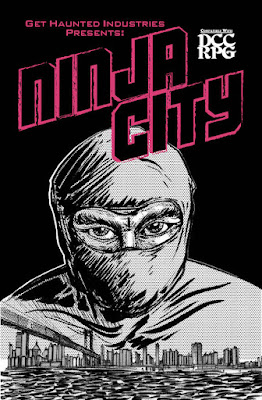
is different type of fanzine for the Dungeon Crawl Classics Roleplaying Game. Published by Get Haunted Industries, it adapts the roleplaying game from Goodman Games to run adventures inspired by the Ninja movies and craze of the eighties, cheap straight-to-VHS tales of crime and retribution, and just a little bit, Teenage Mutant Ninja Turtles. In Ninja City, the streets of the Player Characters’ hometown have been taken over by Bad Guyz—drug lords, street gangs, crooked cops, and worse—and nobody is doing a damned thing about it! Fortunately for the town and the Player Characters, they have rediscovered the Lost Secrets of the Ninja, found a sensei, set up a Clan in a secret hideout, and at the end of the day, when their day jobs are over, sneak out to strike at the Bad Guyz! Disrupt their operations, destroy their product, free the cheap labour they employ, rescue victims held hostage, defeat the Big Boss and unmask him, ultimately, free the town for good folk everywhere!

Ninja City: Drug Demon Disco is the follow up, published via a successful Kickstarter campaign. It opens with a hot and sweaty summer of a scenario, the eponymously named ‘Drug Demon Disco’. As the mercury in the thermometer rises, the Bad Guyz take advantage of the heatwave to go on a crimewave as the city cops are too lazy to leave the air conditioning of their black-and-whites and costumed vigilantes skulk in their basements, it falls to the Ninja to act. This Level One adventure opens with the Player Characters attending a ‘Squirt Day’ run by the city’s Youth and Family Association to help everyone cool done. What looks to be a fun day, turns to chaos as several members of the crowd each turns into a ‘Juice-Pumped Meathead’ and start attacking everyone. The Player Characters’ sensei informs them that the cause of the random transformations is an ancient being known as the ‘Shadow Demon’ and his coming presages the spread of an apocalyptic plague. He also points to the Freak Out Sector as a likely place to search for clues. This is the worst district in Ninja City and in order to find and face the villain of the piece, the Player Characters will have to dance and fight their way through a disco of death… This is a frantic, frenetic scenario, as well as suitably cheesy with big hair, dance moves, and a lot of hairspray.

‘Drug Demon Disco’ takes up half of Ninja City: Drug Demon Disco. The other half continues with some colour fiction, ‘Let me tell you of my greatest failure.’, which gives the back story to ‘The Black Lotus’. He is one of the deadliest of ninja clan leaders in the city. He has his own signature moves, such as ‘The Slumbering Serpent Uncoils at Dawn’. With this, the Black Lotus withholds his action to retaliate. In this, the highest of his Action Dice becomes the attack roll and the remainder—up to three—become the damage dice. In general, the Black Lotus fights defensively to lure his opponents into false sense of security before retaliating.

‘The Six Masks of the Mystic Masters’ presents six masks each of which provides an ability. For example, the ‘Hornet Masks’ or ‘Golden Sting’ which grants a chance of inflicting extra poison damage. They are intended to be difficult to find and the article suggests several possible locations. These require some development by the Judge, but the one-line descriptions are a good starter. ‘Newly Translated Forces’ details a new to be discovered power, ‘Force of Panda’, and how it is found and how the Player Characters have to sneak past a TV special to get hold of it. Again, it needs to be fleshed out, but this could be fun encounter.

Ben ‘Dr. Metal’ Grimes’ ‘Nin-Jistory: How the Ninja Craze Hit Suburban America in the Early 80’s’ gives a quick and dirty overview of the genre as it appeared in the USA in the 1970s and 1980s. It is a fun and very personal overview, which brings the fanzine to an enjoyable close.

Physically, Ninja City: Drug Demon Disco is a busy, fizzy affair, all action and ninjitsu. The scenario is fun and the other content is a solid content to add to the Judge’s campaign. As a follow on to Ninja City, fans of that fanzine will definitely want to pick this up and return to the hot, sweaty streets of Ninja City.

Saturday, 17 August 2024

Your Shadow Scar Starter

In ages past, the Kotoamatsukami, the First Great Spirits of the Land, created the peaceful land known as Nakatsukuni. All was well in this land until the Great Mother Spirit Izanami died giving birth to the Spirit of Fire. Her husband, Izanagi, attempted to retrieve her spirit from Yomi No Kuni, the Afterlife, and appeared to have succeeded when given permission to return her by the Ruler of the Dead. Unfortunately, Izanami has been corrupted by the Ruler of the Dead, and she brought with her an army of twisted souls and horrible monsters and after corrupting the minds of the Yokai, Izanami set out to destroy reality. The peace was at an end and the war known as the Hundred Years of Sorrow was only won by a combined effort of Izanagi and the Kami. It was a victory won at great cost. Although Izanami was cast into the Void—or the Inbetween, via a Shadow Scar rent in the fabric of reality, her monstrous minions were scattered across the Mosaic, a vast array of worlds and realities that to this day remains unexplored. These Yokai continue to do the bidding of Izanami on these worlds, often served by human agents and cults, most of whom have no idea who they are serving or the true nature of reality that is the Mosaic. Whilst there a few worlds that fortunate enough to be free of Yokai, both their presence and their influence, there are many which are infected by both, and there are even more where the situation remains unknown. On Nakatsukuni, an organisation was established by the Kami to counter the threat of the Yokai. This is the Shadow Scar Agency, an order of Shinobi—or ninja clans—trained by the Six Great Clans of Shadow. Its task is to investigate potential signs of activity of both the Yokai and their human servants across the worlds of the Mosaic, stop such activities when discovered, and prevent the inhabitants of those worlds from learning about either the Yokai or the Mosaic. The Shadow Scar Agency still fights this Veil War today.

This is the set-up for Shadow Scar, a new roleplaying published by R. Talsorian, Inc., best known for Cyberpunk RED and Castle Falkenstein. It is a world/parallel Earth hopping setting across what Shadow Scar calls the Mosaic in which modern day Ninja, armed with high tech tools and magical artefacts, leap from one world to the next to defeat the Yokai and other minions of the corrupted Great Mother Spirit Izanami. The Player Characters—or Agents—are these Ninjas, members of the Shadow Scar Agency, a secret organisation dedicated to keeping reality safe. The Ninja must conduct their assignments in secrecy and ‘Maintain the Veil’, both to keep the civilian population safe and prevent any mystical monsters from learning of their presence and activities until they absolutely have to reveal both to the targets of their operations. It was introduced in Shadow Scar: Eyes in Darkness as part of Free RPG Day 2024, which provided a basic primer for the setting and rules as well as scenario to play and the Player Character Agents needed to play it. The scenario in Shadow Scar: Eyes in Darkness is a prequel to ‘The Mask of the Green Demon’, the scenario in Shadow Scar Starter Set, and although it is not necessary to play through ‘Eyes in Darkness’ in order to play ‘The Mask of the Green Demon’ and the contents of the Shadow Scar Starter Set, ‘Eyes in Darkness’ serves as a good build up to it.

The Shadow Scar Starter Set comes as a solid box containing three booklets, six pre-generated customisable Player Characters, a pair of maps and tokens to help play out the action of its scenario, and a set of Shadow Scar six-sided dice. Beside the dice, the first thing that you see upon opening the box is the ‘Welcome to Shadow Scar’ sheet. This is a sperate sheet tells the reader what to expect from the roleplaying game and starter, that the Player Characters will learn the ways of Ninjitsu, assassinate deadly foes, foil complicated plots, work with powerful factions, explore the Mosaic, and hunt down rogue agents, and tells the player where to go next. On the back is a glossary. Altogether, this primes the player up, ready to learn to play, and the Storyteller ready to learn to run Shadow Scar.

The first of the three books in the Shadow Scar Starter Set is the twenty-eight page ‘World Lore’ booklet. This introduces Shadow Scar Agency and expands on the on-going Veil War as well as explaining the nature of the Mosaic and the Utsushiyo and the Kakuriyo. The former is the Unveiled or Material World, whilst the latter is the Unseen or Spirit World. To most mortals, the Kakuriyo, home to spirits, Kami, and even spirits that fail to pass and become monsters, is inaccessible although it does mirror the Utsushiyo in an exaggerated way. Every world has its own Utsushiyo and Kakuriyo, but the Kami can traverse between the Kakuriyo of one world and the Kakuriyo of another. Some mortals can see into the Kakuriyo and sometimes monsters and dangers can find their way out of it. The Mosaic itself is described in broad detail, but the accompanying shows the rough relationships between just a few of the worlds within it and the links between them. Several of these worlds are described in some detail. These include the primary base of operations for the Shadow Scar Agency, Nakatsukuni, which remains an archipelago of islands—many floating—shattered by the war against Izanami and her minions. The others include ‘Steel Court’, a Grand Victorian Empire in which the Stewart Steam Turbine Engine has powered fantastical industrialisation and inventions even as revolt foments the Empire’s ‘Protectorates’; ‘5th Street’, an early twentieth century world recovering from the Great War that would seem to be utterly mundane except the masked vigilantes on the rooftops and the racial inventors working in their workshops; and ‘Refuge’, a world so blighted by the Yokai that humanity has been forced to retreat to a Lunar Colony and massive station orbiting the moon. All three locations will be visited as part of the scenario included in Shadow Scar: Eyes in Darkness. Thumbnail descriptions are given for the three worlds as well as the Shadow Scar Agency and the six Shinobi clans. These consist of the war at any cost Arashi Clan; the spiritualist Futsumashi working to pull the world back into balance; the fire-using Hibana; the espionage-focused Kuromaku; the Tantei clan which works to free Yokai from Izanami’s grasp; and the Yokai-hunting Wanami clan. These are not the only organisations detailed in ‘World Lore’. ‘The Hollow Eye Syndicate’ is a secret criminal organisation that offer a refuge to ‘nukenin’, those missing ninja who have left the Shadow Scar Agency. The Shadow Scar Agency takes a very dim view of the ‘nukenin’. Lastly, there are some details of the Yokai.

The forty-eight-page ‘System’ book is both a rules book and a bestiary for Shadow Scar. First, it breaks down a Player Character, which has three attributes, Mind, Body, and Spirit, rated between one and five. Each attribute has six associated skills, each of which is rated between one and three. He has Techniques, Mikkyo, and Quirks. Techniques are special abilities, such as ‘Nimble & Quick’, which increases an Agent’s speed, whilst Mikkyo are secret techniques taught by the shinobi clans which require an Agent to expend Ki to trigger, such as ‘Duplicates’ which enables the caster to create silent duplicates himself that he can control.

Mechanically, Shadow Scar is a dice pool system that uses six-sided dice. Every roll of a three or more is a success, whilst a roll of six is equal to two successes. If the number of successes is equal to or greater than the Difficulty Value, the task is successful. An average task has a Task Difficulty of two, Challenging has a Task Difficulty of three, Difficult has a Task Difficulty of four, and so on. Bonuses and penalties adjust the number of dice a player has to roll. To reflect that the world of Shadow Scar is pulled in two directions by different forces of nature, an Agent has access to ‘Inyo’—Japanese for Yingyang. If an Agent fails a task by a single Success, he can call upon the power of ‘Inyo’ to gain that much-needed Success. Or he can use to inflict an additional three points of damage upon a target. However, when the Agent draws upon the power of Inyo, he draws only upon one side. In response, the other side draws back and the Storyteller can draws upon the Agent’s Inyo to make him fail a task by one Success or have an enemy inflict three extra damage on the Agent. Once that has happened, the Agent has access to Inyo again. Essentially, the fortunes of each Agent swings back and forth quite literally.

Combat is an extension of the rules, with Initiative Order being determined by an Awareness Check. During a turn, each Agent can conduct two actions. Some fifteen possible actions are detailed as are the conditions and hazards that they might suffer. The hazards covered include environmental, mechanical, and magical. When an Agent is reduced to three points of Vitality or less, he suffers the Grievously Wounded Condition, and when his Vitality is reduced to zero, in combat, he can either be killed or knocked out. The latter reduces his Vitality to one rather than zero. If an Agent’s Vitality is reduced to zero or less, it is possible to become a Wandering Spirit, but an Agent equipped with a Spirit Lantern can collect and protect a Wandering Spirit. At the end of a mission, if the other Agents return with a dead Agent’s body and his Wandering Spirit in a Spirit Lantern, the Agent can be resurrected. Otherwise, a new body has to be created.

Over half of the ‘System’ book is devoted to a ‘Rogues Gallery’. This describes some sixteen or so creatures. There is a good mix of the mundane and the monstrous to the book, all of which appears in the ‘The Mask of the Green Demon’ scenario.

The six pre-generated Player Characters in the Shadow Scar Starter Set come from each of the six clans who contribute to the Shadowscar Agency. Each is done in full colour and as a folder. Each comes with an illustration, background, and history of the Player Character, full stats and abilities, and options for improving the character over the course of the adventure. It also includes a set of bullet points suggesting why a player might choose to roleplay a particular character.

The longest of three books in the Shadow Scar Starter Set is ‘The Mask of the Green Demon’. It is ideally run as a sequel to ‘Eyes in Darkness’ from Shadow Scar: Eyes in Darkness as that already gets the players and their characters involved in the scenario. Of course, it need not be, and either way, the scenario opens with the Player Characters being introduced to a fellow member of the Shadow Scar Agency prior to the briefing. This Agent Jasmine Gamble, who has been investigating a notorious Yokai and crime lord, Green Demon, whose activities and network spreads across the four known worlds that the Shadow Scar Agency has ready access to and is suspected to spread into others unknown. Her work has greatly been enhanced by a notebook that Agents recently uncovered (this is mission is detailed in ‘Eyes in Darkness’) and she has begun to decode. Her notes so far point to a Green Demon operative working in a pleasure quarter on one of the floating islands of Nakatsukuni. This set-up scene is designed to introduce Agent Gamble as she plays an important role in ‘The Mask of the Green Demon’ and ideally the Player Characters should come to like her. This needs a careful portrayal by the Storyteller to make her as likeable as she is written and to build up a relationship between her and the Player Characters.

The missions in ‘The Mask of the Green Demon’ will take the Player Characters from a pleasure house in Nakatsukuni where tensions between a pretentiously arrogant noble scion, the staff, and other patrons, helped by a mischievous kami, get in the way of capturing the target Green Demon operative all the way to Refuge in Lunar orbit where they have an opportunity to capture one of the Green Demon’s most loyal lieutenants before he is assassinated! In between, they must travel to an abandoned island infested with venomous ghost centipedes left over from the Hundred Years of Sorrow; investigate Green Demon activities on Steel Court only to discover that the Green Demon has been investigating them; and dive into an ancient, submerged, and of course, puzzle and death trap-filled Olmec temple in the Gulf of Mexico in 5th Street, which holds a magical artefact said to give access to the Hollow Earth.

‘The Mask of the Green Demon’ is a fun exciting adventure, with a good mix of action and intrigue, that also showcases both the different worlds of the Mosaic and some of the history of the roleplaying game’s setting. It also hints—just a very little—at how ruthless the Shadow Scar Agency can be. The adventure is designed to be played through in roughly five to six sessions and make use of the tokens and maps included in the box. Notably, the booklet does begin with some excellent advice for the Storyteller on how to run Shadow Scar and ‘The Mask of the Green Demon’. Much of it will be obvious to experienced Storytellers, but it is still worth reading and it is good advice for anyone running Shadow Scar Starter Set as her first game. However, what the Shadow Scar Starter Set does not do is give any advice for the players. The Storyteller has her role explained, is given tips, and then advised on how to run Shadow Scar. There is no similar advice for the player, except for the ‘Welcome to Shadow Scar’ sheet at the top of the box, which does not do as good a job.

Rounding out the Shadow Scar Starter Set is a set of maps. There are four of these, depicting various locations in the scenario. Using in conjunction with the two sheets of tokens, these are bright and colourful, done by Loke BattleMats, which previously created The Big Book of Cyberpunk Battle Mats for use with Cyberpunk RED. Lastly, there is also a ‘Reference Sheet’, which includes rules for everything up to and including the assassination manoeuvre, and ‘The Armoury’, a sheet of traits, gear details, and information about artefacts that will play a role in the adventure.

Physically, the Shadow Scar Starter Set is an attractive product with a pleasing heft and sturdiness. All three books are on thick paper and all have card covers. Similarly, the maps and tokens have a good physical presence. The artwork is excellent throughout, having an anime style that reflects the genre of the Shadow Scar setting. Particularly attractive is the piece showing players sat round playing the game itself, but there is also plenty of artwork show different scenes across the Mosaic as well. However, the Shadow Scar Starter Set does need a further edit as it feels slightly rushed in places.

Shadow Scar is both a spy and a ninja roleplaying game, a sidebar for the Storyteller noting that it is inspired by the anime series Demon Slayer and Naruto as much as it is the James Bond and Men in Black films. Mix in martial arts, magic, and the supernatural and it offers a stealth and action orientated genre mashup—all of which is on show in the Shadow Scar Starter Set. The result is that the Shadow Scar Starter Set is a very well presented, fun and exciting introduction to the Shadow Scar setting and roleplaying game.

Saturday, 13 July 2024

[Free RPG Day 2024] Shadow Scar: Eyes in Darkness

Now in its seventeenth year, Free RPG Day for 2024 took place on Saturday, June 22nd. As per usual, Free RPG Day consisted of an array of new and interesting little releases, which are traditionally tasters for forthcoming games to be released at GenCon the following August, but others are support for existing RPGs or pieces of gaming ephemera or a quick-start. This included dice, miniatures, vouchers, and more. Thanks to the generosity of Waylands Forge in Birmingham, Reviews from R’lyeh was able to get hold of many of the titles released for Free RPG Day.

—oOo—

Shadow Scar: Eyes in Darkness is the ‘Easy Mode’ for Shadowscar, a new setting from R. Talsorian Games, Inc., much like The Witcher: Easy Mode – An Introductory Booklet to the Witcher TRPG for The Witcher and Cyberpunk Red: Easy Mode – An Introduction to the Dark Future for Cyberpunk RED. It is a world/parallel Earth hopping setting across what Shadow Scar calls the Mosaic in which modern day Ninja, armed with high tech tools and magical artefacts, leap from one world to the next to defeat the Yokai and other minions of the corrupted Great Mother Spirit Izanami. The Player Characters—or Agents—are these Ninjas, members of the Shadow Scar Agency, a secret organisation dedicated to keeping reality safe. The Ninja must conduct their assignments in secrecy and ‘Maintain the Veil’, both to keep the civilian population safe and prevent any mystical monsters from learning of their presence and activities until they absolutely have to reveal both to the targets of their operations. Shadow Scar: Eyes in Darkness mixes magic, action, and stealth, including not just an introduction to the setting, but also the rules, six pre-generated Agents, and a complete scenario.

The setting is Nakatsukuni, a peaceful land created by the Kotoamatsukami, the First Great Spirits of the Land. When the Great Mother Spirit Izanami died giving birth to the Spirit of Fire, her husband, Izanagi, attempted to retrieve her spirit from Yomi No Kuni, the Afterlife, and appeared to have succeeded when given permission to return her by the Ruler of the Dead. Unfortunately, Izanami has been corrupted by the Ruler of the Dead, and she brought with her an army of twisted souls and horrible monsters and after corrupting the minds of the Yokai, Izanami set out to destroy reality. The war was won by the combined effort of Izanagi and the Kami, but at great cost. Izanami was cast into the Void via a Shadow Scar, but her monstrous minions were scattered across the Mosaic. To counter the Yokai threat, the Kami established the Shadow Scar Agency, an order of Shinobi—or ninja clans—trained by the Six Great Clans of Shadow. The Shadow Scar Agency still fights the Veil War today.

Nakatsukuni remains an archipelago of islands—many floating—shattered by the war against Izanami and her minions. Other worlds of the Mosaic include ‘Steel Court’, a Grand Victorian Empire in which the Stewart Steam Turbine Engine has powered fantastical industrialisation and inventions even as revolt foments the Empire’s ‘Protectorates’; ‘5th Street’, an early twentieth century world recovering from the Great War that would seem to be utterly mundane except the masked vigilantes on the rooftops and the racial inventors working in their workshops; and ‘Refuge’, a world so blighted by the Yokai that humanity has been forced to retreat to a Lunar Colony and massive station orbiting the moon. All three locations will be visited as part of the scenario included in Shadow Scar: Eyes in Darkness. Thumbnail descriptions are given for the three worlds as well as the Shadow Scar Agency and the six Shinobi clans.

An Agent in Shadow Scar: Eyes in Darkness—and thus Shadow Scar—has three stats. These are Mind, Body, and Spirit, and these are rated between one and five. Each attribute has six associated skills, each of which is rated between one and three. He has Techniques, Mikkyo, and Quirks. Techniques are special abilities, such as ‘Nimble & Quick’, which increases an Agent’s speed, whilst Mikkyo are secret techniques taught by the shinobi clans which require an Agent to expend Ki to trigger, such as ‘Duplicates’ which enables the caster to create silent duplicates himself that he can control. All six pre-generated Agents come with background and illustration.

Mechanically, Shadow Scar is a dice pool system that uses six-sided dice. Every roll of a three or more is a success, whilst a roll of six is equal to six successes. If the number of successes is equal to or greater than the Difficulty Value, the task is successful. An average task has a Task Difficulty of two, Challenging has a Task Difficulty of three, Difficult has a Task Difficulty of four, and so on. Bonuses and penalties adjust the number of dice a player has to roll. To reflect that the world of Shadow Scar is pulled in two directions by different forces of nature, an Agent has access to ‘Inyo’—Japanese for Yingyang. If an Agent fails a task by a single Success, he can call upon the power of ‘Inyo’ to gain that much-needed Success. Or he can use to inflict an additional three points of damage upon a target. However, when the Agent draws upon the power of Inyo, he draws only upon one side. In response, the other side draws back and the Storyteller can draws upon the Agent’s Inyo to make him fail a task by one Success or have an enemy inflict three extra damage on the Agent. Once that has happened, the Agent has access to Inyo again. Essentially, the fortunes of each Agent swings back and forth quite literally.

Combat is an extension of the rules, with Initiative Order being determined by an Awareness Check. During a turn, each Agent can conduct two actions. Some fifteen possible actions are detailed as are the conditions and hazards that they might suffer. The hazards covered include environmental, mechanical, and magical. When an Agent is reduced to three points of Vitality or less, he suffers the Grievously Wounded Condition, and when his Vitality is reduced to zero, in combat, he can either be killed or knocked out. The latter reduces his Vitality to one rather than zero. If an Agent’s Vitality is reduced to zero or less, it is possible to become a Wandering Spirit, but an Agent equipped with a Spirit Lantern can collect and protect a Wandering Spirit. At the end of a mission, if the other Agents return with a dead Agent’s body and his Wandering Spirit in a Spirit Lantern, the Agent can be resurrected. Otherwise, a new body has to be created.

In terms of setting, Shadow Scar: Eyes in Darkness covers the means of travel between worlds, the invisible and magical tattoos which enable communication and understanding, arms and armour and other equipment, before leaping into the scenario, ‘Eyes in Darkness’. The Shadow Scar Agency assigns the Agents to investigate a Dodomeki named Kagura, a lieutenant to a powerful smuggler known as the ‘Green Demon’, who runs operations at the ground level of the Green Demon’s Mountain Branch. Two of the Yokai working for Kagura are attending a black-market auction in a makeshift space station called the Scattery in the Refuge. Whatever the Agents do, the Yokai are likely to cause trouble at the auction, meaning that the Agents will have to work hard to protect the Veil. Following the Yokai—or following the clues they leave behind—the Agents jump through a gate or Rift Dive to find themselves at Easy Ray’s Gas Station outside of New Orleans on 5th Street, and when they or their contact make a run for it, it leads to a car chase through the streets of the city. A pair of tables providing random events both outside and inside the city nicely enliven the car chase.

Although this turns out to be a dead end, the Agent’s Handler suggests that a renegade Agent, currently in ‘Steel Court’ might have some information. The renegade Agent is selfish and immoral, but will trade for information—at a price. Which can be money or some entertainment. The information he provides gives the location of Kagura’s hideout in an isolated village in the mountains which she is beginning to fortify. The climax of the scenario is an assault on the village, initially by stealth, helped and then hindered by two of the Kami of the sky having a violent argument over the borders of their territory and causing a severe snowstorm. Success leads provides clues as to the whereabouts of Kagura’s boss, the Green Demon. Locating the Green Demon will be the Agents’ next mission, the details of which are given in Shadow Scar Jumpstart Kit: The Mask of the Green Demon!, the sequel to Shadow Scar: Eyes in Darkness. The bestiary or ‘Rogues Galley’ at the end of Shadow Scar: Eyes in Darkness provides all of the stats and details of the Yokai and other NPCs that the Agents will encounter over the course of the mission.

Although ‘Eyes in Darkness’ does have a sequel in the form of Shadow Scar Jumpstart Kit: The Mask of the Green Demon!, it is complete and can be played on its own without the need to run the sequel. Thus, the Storyteller and her players can get a full taste of what Shadow Scar is like to play and what a mission feels like. ‘Eyes in Darkness’ is a decent scenario, with lots of action and plenty of stealth and combat. It is accompanied by some decent maps as well.

Physically, Shadow Scar: Eyes in Darkness is decently put together. Much of the artwork is anime in style and bright and colourful. The cartography is excellent. Whilst well-written, it does need an edit in places.

Shadow Scar: Eyes in Darkness is a solid introduction to the Shadow Scar setting and roleplaying game. There is good advice for the Storyteller on running the game and everything is clearly explained and easy to understand, and all supporting an exciting, action-packed scenario which can played through in a single session or two.

Monday, 10 April 2023

[Fanzine Focus XXXI] Bronx Beasts Volume 1: Games Rules

On the tail of the Old School Renaissance has come another movement—the rise of the fanzine. Although the fanzine—a nonprofessional and nonofficial publication produced by fans of a particular cultural phenomenon, got its start in Science Fiction fandom, in the gaming hobby it first started with
Chess and Diplomacy fanzines before finding fertile ground in the roleplaying hobby in the 1970s. Here these amateurish publications allowed the hobby a public space for two things. First, they were somewhere that the hobby could voice opinions and ideas that lay outside those of a game’s publisher. Second, in the Golden Age of roleplaying when the Dungeon Masters were expected to create their own settings and adventures, they also provided a rough and ready source of support for the game of your choice. Many also served as vehicles for the fanzine editor’s house campaign and thus they showed another Dungeon Master and group played said game. This would often change over time if a fanzine accepted submissions. Initially, fanzines were primarily dedicated to the big three RPGs of the 1970s—Dungeons & Dragons, RuneQuest, and Traveller—but fanzines have appeared dedicated to other RPGs since, some of which helped keep a game popular in the face of no official support.

Since 2008 with the publication of Fight On #1, the Old School Renaissance has had its own fanzines. The advantage of the Old School Renaissance is that the various Retroclones draw from the same source and thus one Dungeons & Dragons-style RPG is compatible with another. This means that the contents of one fanzine will be compatible with the Retroclone that you already run and play even if not specifically written for it. Labyrinth Lord and Lamentations of the Flame Princess Weird Fantasy Roleplay have proved to be popular choices to base fanzines around, as has Swords & Wizardry. Another popular choice of system for fanzines, is Goodman Games’ Dungeon Crawl Classics Roleplaying Game, seen in titles such as Crawl! One notable feature of the range of fanzines for Dungeon Crawl Classics Roleplaying Game is that they often support and showcase the settings and campaigns created by their authors. Crawl Under a Broken Moon, for example, details a post-apocalyptic setting which would be collated in the pages of the Goodman Games distributed The Umerican Survival Guide – Core Setting Guide, whilst Ghostlike Crime #01, One of Us, Ninja City, and Black Powder, Black Magic: A ’Zine of Six-Guns and Sorcery Volume 1 all explored familiar genres of their own for the mechanics of the Dungeon Crawl Classics Roleplaying Game.

Similarly, Bronx Beasts Volume 1: Games Rules supports a very familiar genre, one that has much in common with Ninja City. One of the cultural hits of the eighties was the indie comic, Teenage Mutant Ninja Turtles, and then for roleplaying, the Teenage Mutant Ninja Turtles & Other Strangeness roleplaying game, published by Palladium Books. Bronx Beasts provides the rules to create and play bizarre mutant animal characters in wild eighties urban action, much in the mode of Teenage Mutant Ninja Turtles, but written of course, for the Dungeon Crawl Classics Roleplaying Game. In fact, not so much in the mode of Teenage Mutant Ninja Turtles & Other Strangeness, but exactly like Teenage Mutant Ninja Turtles & Other Strangeness. R
epublished via a Kickstarter campaign as part of ZineQuest #3 by Bronx Beasts, Bronx Beasts Volume 1: Games Rules provides the rules to create anthropomorphic animals and mutate and modify them, and then the rules for playing them.

Character creation in Bronx Beasts Volume 1: Games Rules is built around a series of tables. Beast Origin is random mutation or deliberate experimentation. Determined randomly, if the former, the player rolls on the Random Mutation Experience Table’, but if the latter, he rolls on the ‘Deliberate Experimentation Origin Table’. The results for this are further tables for ‘Biological Research Origin Experience’, ‘Military Origin Experience’, ‘Criminal Origin Experience’, or ‘Special Interest Origin Experience’. None of these add stat bonuses or other benefits, instead simply creating elements of the Player Character’s background. The ‘Beast Type’ table provides a hundred entries, from aardvark, alligator, and ape to wolf, wolverine, and zebra. None are described, so the player will need to do some further reading, but in the main, these animals are all familiar and easy to read up about. ‘Beast Size’ does modify the character, adjusting Armour Class, Strength and melee check die, Hide and Sneak die, Hit Dice, Movement, and weight. Bigger creatures will have lower Armour Class and Hide and Sneak die, but everything else will be higher.

The player is then free to adjust the ‘Beast Form’ of his animal character, shifting his speech, legs, hands, and looks to be more human-like or more animal-like. Either full, partial, or none, these are randomly determined and adjusted by expending Evolution Points. These can also be spent to change a Beast’s size, for example, to play a larger mouse or smaller elephant, add abilities such as a prehensile tail, natural weapons or natural armour, and better movement. These are not hard and fast rules, so instead the player and Judge will need to work together to create Beast-type character that fits the style and setting of the genre. Otherwise, character creation follows the standard rules for the Dungeon Crawl Classics Roleplaying Game, although Bronx Beasts Volume 1: Games Rules does have its own ‘Lucky Signs’ table.

Bronx Beasts Volume 1: Games Rules does not provide any new Classes. In fact, a Beast has no Class, and instead, a player can choose between increasing his character’s Base Attack Modifier or Saving Throws Level by Level. In terms of game play, Beasts are Lucky. They always have a bonus on the Lucky Sign and they both benefit and suffer from Fleeting Luck. One way of gaining Fleeting Luck is for the Beast to give into his animalistic urges, typically in socially or intellectually challenging situations. If the player declines the offer of Fleeting Luck in return for his Beast succumbing to his urges, a Beast Check against Personality or Intelligence is required to overcome them. A Player can also do ‘Fur Burn’ or temporarily burn points of Personality or Intelligence to gain a modifier to die rolls. The last big change is to the rules for Armour Class, which is based on Reflex, Beast Size, and any shield carried. Armour is represented by a die and is instead rolled to soak damage. The armour worn is damaged and steps down a die size any time a one is rolled on the Armour Die. The rules for armour use are similar to those for The Umerican Survival Guide – Core Setting Guide, but not as developed.

Bronx Beasts Volume 1: Games Rules ends with an announcement of what is in the next issue. This includes an adventure against a criminal ninja gang and ‘Natural Weapon Crit Tables’ amongst other things. It would have been useful to have had the latter in the pages of Bronx Beasts Volume 1: Games Rules to make it more versatile.

Physically,
Bronx Beasts Volume 1: Games Rules is well presented. The artwork has a certain rough quality, but is as cartoonish as you would expect.

As standalone product Bronx Beasts Volume 1: Games Rules can be played as is, but it feels incomplete. Certainly, the ‘Natural Weapon Crit Tables’ would have rounded it out. However, plug the pages of Bronx Beasts Volume 1: Games Rules into another setting or genre and the content comes alive. Take it into the post apocalypse of The Umerican Survival Guide – Core Setting Guide for possible mutant action or throw it down alongside Ninja City for some real new York eighties action, and
Bronx Beasts Volume 1: Games Rules feels right at home.

Friday, 25 February 2022

[Fanzine Focus XXVII] Ninja City

On the tail of the Old School Renaissance has come another movement—the rise of the fanzine. Although the fanzine—a nonprofessional and nonofficial publication produced by fans of a particular cultural phenomenon, got its start in Science Fiction fandom, in the gaming hobby it first started with Chess and Diplomacy fanzines before finding fertile ground in the roleplaying hobby in the 1970s. Here these amateurish publications allowed the hobby a public space for two things. First, they were somewhere that the hobby could voice opinions and ideas that lay outside those of a game’s publisher. Second, in the Golden Age of roleplaying when the Dungeon Masters were expected to create their own settings and adventures, they also provided a rough and ready source of support for the game of your choice. Many also served as vehicles for the fanzine editor’s house campaign and thus they showed another DM and group played said game. This would often change over time if a fanzine accepted submissions. Initially, fanzines were primarily dedicated to the big three RPGs of the 1970s—Dungeons & DragonsRuneQuest, and Traveller—but fanzines have appeared dedicated to other RPGs since, some of which helped keep a game popular in the face of no official support.

Since 2008 with the publication of Fight On #1, the Old School Renaissance has had its own fanzines. The advantage of the Old School Renaissance is that the various Retroclones draw from the same source and thus one Dungeons & Dragons-style RPG is compatible with another. This means that the contents of one fanzine will be compatible with the Retroclone that you already run and play even if not specifically written for it. Labyrinth Lord and Lamentations of the Flame Princess Weird Fantasy Roleplay have proved to be popular choices to base fanzines around, as has Swords & Wizardry. Another choice is the Dungeon Crawl Classics Role Playing Game.

Ninja City is different type of fanzine for the Dungeon Crawl Classics Roleplaying Game. Published by Get Haunted Industries as part of ZineQuest 3, it adapts the roleplaying game from Goodman Games to run adventures inspired by the Ninja movies and craze of the eighties, cheap straight-to-VHS tales of crime and retribution, and just a little bit, Teenage Mutant Ninja Turtles. In Ninja City, the streets of the Player Characters’ hometown have been taken over by Bad Guyz—drug lords, street gangs, crooked cops, and worse—and nobody is doing a damned thing about it! Fortunately for the town and the Player Characters, they have rediscovered the Lost Secrets of the Ninja, found a sensei, set up a Clan in a secret hideout, and at the end of the day, when their day jobs are over, sneak out to strike at the Bad Guyz! Disrupt their operations, destroy their product, free the cheap labour they employ, rescue victims held hostage, defeat the Big Boss and unmask him, ultimately, free the town for good folk everywhere!

A Ninja in Ninja City uses the SWORDZ Attribute System—Stealth, Wisdom, Offence, Respect, Discipline, and Z-Force—instead of the standard set of attributes found in Dungeon Crawl Classics Roleplaying Game. Of these six, Wisdom covers knowledge and technology use, Respect includes Leadership, Connections, and Trust; Discipline a Ninja’s use of Kuji-in; and Z-Force both his Luck as per Dungeon Crawl Classics and Super Moves. A Ninja has the same Hit Points as every other Ninja, and a Melee Weapon and a Ranged Weapon which defines him. He also has a day job, anything from a Sponsored Skateboarder, Bartender, or Aerobics Instructor to Street Performer – Portrait Artist, Street Performer – Musician, or Telephone Psychic. To create a Ninja, a player rolls four six-sided dice and keeps the best three for each attribute, selects his two weapons, and rolls for his Day Job on the lengthy table of options.

Jeanette Somers
Level 1 Ninja
Day Job: Mechanic
Armour Class: 12 Hit Points: 10
Stealth 14 (+1) Wisdom 12 (+0) Offence 15 (+1) Respect 13 (+1) Discipline 16 (+2) Z-Force 16 (+2)
Weapons: Bo Staff, Shuriken
Unarmed Strike: +1/1d4+1 Damage 

Mechanically, Ninja City uses the rules from the Dungeon Crawl Classics Roleplaying Game, but with a tweak or two designed to make it cinematic. First, a Ninja can use Force of Tiger, Force of Monkey, and Force of Butterfly to do amazing things, each of which costs a point of Z-Force. Force of Tiger grants access to the Fighter Class’ Mighty Deed of Arms; Force of Monkey enables a Ninja to climb sheer surfaces and leap over obstacles; and Force of Butterfly lets him descend falls in freefall. A Ninja can inflict greater damage in unarmed combat, even a single point of damage if he misses in combat!

Kuji-In are powerful Hand Seals which require hand signals and concentration which also require Z-Force points to use. Ten Kuji-In Hand Seals are listed, each the equivalent of a spell—Cleric or Wizard—from the Dungeon Crawl Classics Roleplaying Game. For example, Rin or Strength is the equivalent of the Blessing spell and Retsu or Control of Time and Space has the same effect of the Sleep spell. Once expended, Z-Force can be recovered after a full day’s meditation. Ninja are also notoriously hard to kill. In fact, they cannot truly die and if a Ninja’s Hit Points are reduced to zero, another Ninja can share his Hit Points, binding the two together, meaning they share damage taken; ‘Embrace the Darkness’ and recover, but remain in danger of turning to the dark side and attacking his fellow Ninja; and even have his energy transferred into an item or be dispersed into the universe. The first option means that the player can continue playing his Ninja as a possessed item or weapon, whilst the second allows him to play his Ninja as a ghost!

Tables also enable the players to roll for their Sensei—including a Sewer Dwelling Mutant, and Hideout, such as a Movie Rental Shop or a Fireworks Shop. For the Game Master there are stats descriptions given for a variety of Bad Dudez, such as Rival Ninja, Karate Fighters, Renegades, and more, as well as suggestions for the contraband they might be dealing in. Put the entries on these two tables together and the Game Master has a ready set of mission hooks. Advice for the Game Master takes the form of a basic framework, very much based on the Ninja movies which inspire Ninja City. This all comes together in ‘Rise of the Cyborgs’, which takes up a third of the fanzine. The Ninjas’ hometown is beset by a rash of crime carried out by the Aviators mercenary crime gang, backed up with Cyborgs. Where are the Cyborgs coming from and who are the Aviators working for? ‘Rise of the Cyborgs’ includes a large map of the antagonists’ base of operations and is a decent adventure which can be played in a single session, so perhaps could be run as a convention scenario, but should take no more than two sessions to play through.

Physically, Ninja City is decently written and illustrated with a mix of artwork, some of it cartoonish, some of it quite decent. If Ninja City is missing anything, it is a bibliography of inspiration for the fanzine. In fact, the map from the ‘Rise of the Cyborgs’ could easily have been shrunk to a single page and the space used for such a bibliography.

As written, Ninja City deserves some expansion. In addition to the bibliography, it would have been nice for Ninja City to have included the description of a town in the thrall of multiple gangs and criminal organisations, a sort of ‘crime sandbox’ for the Ninja to investigate and take down crook by crook. Essentially, an actual ‘Ninja City’ for the Player Characters to make their own. That could have easily been included without breaking the limits or page count of the fanzine format.

Ninja City is a fun little option for an alternate campaign for the Dungeon Crawl Classics Roleplaying Game. As presented, it will provide a gaming group with a session or two of cheesy chop-socky action, but the Game Master will need to develop a lot more if the group wants to keep on playing.

Friday, 1 September 2017

Free RPG Day 2017: The Ninja Crusade, Second Edition QuickStart

Now in its tenth year, Saturday, June 17th was Free RPG Day and with it comes an array of new and interesting little releases. Invariably they are tasters for forthcoming games to be released at GenCon the following August, but others are support for existing RPGs or pieces of gaming ephemera or a quickstart. One of the regular pieces of support for an existing roleplaying game in 2017 is The Ninja Crusade, Second Edition QuickStart. Published by Third Eye Games, best known for roleplaying games such as Apocalypse Prevention, Inc. and Mermaid Adventures, The Ninja Crusade, Second Edition is a game inspired by anime and movies such as Naruto and Kung Fu Hustle in which the Emperor of Izou has declared war against the ten Ninja clans, forcing once rivals to co-operate as the Lotus Coalition to ensure their survival. Players take the role of these ninja, whose role in this setting is as honourable if stealthy warriors, since this is not a world with samurai.

Characters in The Ninja Crusade belong one of the ten ninja clans, each of which has its own speciality. So the Blazing Dancers are performers and acrobats, the Pack of the Moon are farmers and herders known for their specially bred ninja-dogs, and the Living Chronicle are historians who keep stories and knowledge on their bodies and in their minds. Besides a Clan, a Ninja is defined by twenty or so skills, plus an Element, Profession, Tragedy, Wartime Role, Clan, Contacts, Martial Training, and two ‘Ways of…’, the latter paths of training. Each of the Element, Profession, Tragedy, Wartime Role, and Clan provides a Gift and a Trigger. The Gift grants a bonus, whilst the Trigger gives Karma under certain conditions. For example, the Water Element with its Devious Temperament gives an underhanded Ninja a bonus to his Fighting when attacking in unsportsmanlike way and earns him Karma when he cheats the wrong person and it comes back to haunt him. 

To undertake an action, a character combines two skills appropriate to the action and then rolls a number of ten-sided dice equal to the combination. For example, to go on a lengthy journey a Ninja might need to roll a combination of his Travel and Fortitude skills, to quickly draw and throw a blade, he would roll a combination of Speed and Marksmanship skills. Rolls of seven, eight, and nine count as successes, whilst rolls of ten count as two successes. A simple task requires the one success, a moderate task two successes, and so on all the way up to five successes for a legendary task. If three or more successes are rolled above the difficulty, then a boost is gained, which can be a damage bonus, extra opponents being targeted, bonus information being earned, halves a task’s time, complete a task with style, trigger a weapon’s condition—for example, a brutal weapon inflicts extra damage whilst a piercing weapon ignores a level of armour—and so on. A critical failure appears to be any failure in which ones are rolled, the more ones rolled, the worse the result, though neither is clearly explained in The Ninja Crusade, Second Edition QuickStart.

In combat, a Ninja gets one action plus one for each success rolled on his dynamic dice. These can then be spent to conduct various dynamic actions—inflict harm (make an attack), plan an attack (aid a friend), increase damage inflicted, knock an opponent back or down, mold Ki to regenerate it, dodge or block an attack, and so on. Ki can be spent as part of dynamic actions to do various things to temporarily gain certain effects, for example, counter attack, deeper cuts, deflect attack, and thicker skin. Now exactly how much Ki a player begins play with is not made clear in The Ninja Crusade, Second Edition QuickStart as none of the pre-generated ninja have any. Perhaps a ninja needs to mold his Ki to generate it before it can be used? Attacks appear to be resolved as opposed rolls, for example, an attacker’s Perception plus Marksmanship versus a defender’s Athletics plus Speed, but again, this is not spelled out in The Ninja Crusade, Second Edition QuickStart.

The basic damage inflicted in any attack is modified by the number of successes rolled, the weapon used, and any dynamic or boost damage. It can be quite deadly given that the sample pre-generated Ninja have a Health of between five and eight. To forestall a ninja taking too much damage, whether this is to their Health or their Pysche, a Ninja can instead suffer a Condition, equal to the value of the damage taken. This might be Bleeding, Bruised, Burned, Slowed, Afraid, Confused, Scarred, and so on. There is a limit to the level of these Conditions and how many a Ninja can have, so it is not possible for a Ninja to accumulate Condition upon Condition—eventually he will suffer actual damage, whether physical or mental. Each Condition has, of course, a negative effect, and depending on its severity, it may take a scene, days, or even weeks to recover from a Condition.

Accompanying the rules is a scenario, ‘Trial of the Lotus’, and six pregenerated Ninja.This sees them sent on a mission under of the guidance of MasterDaiku, whose approval they need to work for to successfully complete the mission. This is to infiltrate a neighbouring region, get past various guards and soldiers, and then sneak into the Autumn Brand Festival. It includes lots of tests of skill as well as of character and should provide a good session’s worth of play, if not two.

Technically, ‘Trial of the Lotus’ requires four Ninja, not six. Which begs the question as why there are six pre-generated Ninja included in The Ninja Crusade, Second Edition QuickStart. The given answer is so that the adventure can be played again, but with different characters. This is problematic since it is unlikely to happen and because although it showcases more character types, they take up extra space that could have been better devoted to explaining the rules, because ultimately, it is the rules that suffer in The Ninja Crusade, Second Edition QuickStart. Or rather their explanation does. Another page or two, perhaps including an example of play, a fuller explanation of the core mechanics, an explanation of Ki, and so on, would not have gone amiss.

Well presented, if not well developed, The Ninja Crusade, Second Edition QuickStart is not as good as it should be. The essential problem is that it is ill suited for beginning players and game masters alike because it does not explain enough of the rules or guide them through how the game should be played. This should not be as much of a problem for the experienced player or game master who will be able to make the connections between the rules given in The Ninja Crusade, Second Edition QuickStart and so be able to play or run the given adventure. Another two pages—or rather, two fewer pre-generated Ninja—and The Ninja Crusade, Second Edition QuickStart could have been the quickstart it should have been.