Every Week It's Wibbley-Wobbley Timey-Wimey Pookie-Reviewery...
Showing posts with label Button Kin Games. Show all posts

Saturday, 8 November 2025

Solitaire: Jude’s World

From the outset, Jude’s World faces a challenge in terms of the audience it will not appeal to. Not because it is a bad game, but rather because of its subject matter. It is a solo storytelling and journalling game, and over the two decades that the hobby has had storytelling games, they have generally dealt with generally non-commercial subject matters in a fairly direct manner. These have included love, betrayal, survival, community, mysteries, loyalty, magic, and many more. Jude’s World though, deals with divorce. And for a sizeable percentage of the gaming community—as in society, in general—that may be too sensitive a subject matter, especially one to turn into a game. And that is whether they were a child whose parents separated and divorced or an adult who has a child and goes through a divorce with a partner. For others though, Jude’s World may be as fantastical a concept as going down a dungeon and fighting monsters. More interestingly though, Jude’s World has also been written in response to the Walt Disney film, The Parent Trap, both the original 1961 version and the 1998 remake, which the author describes as being a very conservative view of marriage and relationships. This in addition to the quite bonkers nature of the films’ plot (and the German book it is based upon, Lisa and Lottie, by Erich Kästner).

Jude’s World is published by Button Kin Games, best known for its collaboration with the excellent Odd Jobs: RPG Micro Settings Vol. I and it requires nothing more than a means to record the player’s progress, two six-sided dice, and a deck of Tarot cards. In Jude’s World, the player takes the role of twelve-year-old Jude, writing a diary about the breakdown of the marriage of their parents, Mika and Jamie, and then their effort to get them back together again. Essentially, just like The Parent Trap, but without a twin. Of course, a player need not roleplay Jude and need not set their efforts in the default period of the here and now for Jude’s World. The player is free to assign whatever names he wants and set his playthrough where and whenever he wants.

Jude and their parents are very lightly defined. In fact, it comes down to the single sentence, ‘Jude is XXX, who XXX’, where the ‘XXX’s are defined by the player’s initials and those of his favourite teenage icons. So, for example, mine would be ‘Jude is a philosopher, who loves movie nights’, whilst those for Jude’s parents would be ‘Mika is social butterfly, who speaks multiple languages’ and ‘Jamis is a goody two shoes, who wants to go to space’. Besides this, Jude has a stat called ‘Teen’ which measures their progress from pre-teen to teen and rated from zero to five, beginning at zero. Their parents have ‘Hearts’ and ‘Hurts’. ‘Hearts’ runs from one to five and starts at one, and represents the love that Mika and Jamie had for each other. ‘Hurts’ runs between one and three, starts at two, and represents the pain they have caused each other. If it rises to three, Mika and Jamie have a fight and lose two Hearts! Ultimately, the aim of Jude’s World is for Jude to get her parents back together, indicated by increasing their parents’ ‘Hearts’ to five, whilst increasing their ‘Teen’ value represents their increasing maturity.

Set-up begins by having Jude ‘Build a Life’. This is done by creating a nine-card Tarot spread, roughly shaped like a house, that indicate what Jude and Mika care about apart from Jude, how they met and what drew them together, obstacles they overcame and what they sacrificed to have Jude, a personality trait for Jude, what Jude’s happiest memory of their family is, and what they know about their parents’ break up. This represents the past for Jude, whilst her future is defined by having her ‘Rebuild a Life’ using the same nine-card Tarot spread.

As he draws the Tarot cards, the player will interpret and use them to tell the story of Jude’s efforts to get their parents back together. The Minor Arcana consist of Pentacles representing wealth and work; Cups emotions, health, family, and friends; Swords are intellect and school; and Wands are creativity and hobbies. The Major Arcana, such as Death, The Sun, and Justice represent major milestones. ‘The Fool’, ‘The Magician’, and ‘The High Priestess’ form the Twists stack, whilst three Minor Arcana form Jude’s Keepsakes stack. It is not a matter of drawing a single card each time, since that would produce a build which could be interpreted as a story, but which was wholly random. Instead, the player draws three cards on a turn. One he keeps, the others he returns randomly to the deck. The drawn cards represent different aspects of Jude’s life and that of their parents. Numbered Minor Arcana are Keepsakes, such as ‘A picture of an old house’ or ‘A teddy bear holding a stuffed heart’, that their parents once held dear and which Jude uses to strengthen the emotional effect of the Traps they will lay for them. Face Minor Arcana are a foil or an accomplice, part of Jude’s life, such as a popular and ambitious older teen for ‘Knight of Cups’ or an authoritative, determined adult for the ‘King of Swords’. An accomplice will help Jude get their parents back together, whilst a foil will not. Major Arcana are Twists, big events in Jude’s life, such as standing up to a bully for ‘The Chariot’ or running away for the night for ‘The Fool’. Effectively, these are all prompts and all handily listed in Jude’s World, which the player is using to tell and then record Jude’s efforts.

There are twin drives to Jude’s World and the key them are the Twists, which can either be picked or used to ‘Spring a Trap’. Picking a Twist, a big event in Jude’s life, increases their Teen score and their maturity, whereas a Twist is used along with three Keepsakes to ‘Spring a Trap’. The player uses a Twist and three Keepsakes to trigger a Trap and then rolls for the results on the table. An Accomplice or a Foil add a bonus or penalty to the roll if present. Results vary widely. A ‘Failure’ increases Hurt by one. A ‘Partial Success’ gives three options—adding a Heart and changing an Accomplice to a Foil; increase Heart and Hurt by one each; or reduce Hurt by one. A ‘Full Success’ increases Heart by one. An ‘Outstanding Success’ also increases Heart by one and adds further options of turning a Foil into an Accomplice, Reducing Hurt to zero, or increasing Heart by one again. The three Keepsakes are discarded, as is the Major Arcana used for the Twist if the result was a failure. On any degree of success—Partial, Full, or Outstanding— the Major Arcana is added to the ‘Rebuild a Life’ spread.

Mechanically, the flow and aim of the game is to build up enough Minor Arcana as Keepsakes and one or more Major Arcana as Twists to set a Trap for Jude’s parents to make them remember what was good about their relationship and why they got together in the first place, and to try get them back together again. The player will do this multiple times, working to fill in the nine-card ‘Rebuild-a-Life’ spread. Thematically, the player is recording the story of how this happens and what the outcome is, as well as making discoveries about Jude’s parents using the cards of the Tarot deck together with the prompts listed in the book.

Also thematically, the player is exploring his past. Primarily, his memories of being both a pre-teen and a teenager, but also the breakup of his parents’ relationship and his reaction to that—if that happened. There is a degree of intimacy to both, meaning that the play of Jude’s World is potentially more personal and even more painful than other roleplaying games, even storytelling ones. Plus, that intimacy can be exacerbated because Jude’s World is played alone and the player is not just drawing upon personal thoughts and recollections, but considering them and writing them down. Of course, a player need not draw on his past so heavily or even at all, perhaps playing Jude’s World inspired more directly by the tone of The Parent Trap than is Jude’s World itself. That said, the potential remains. Of course, as the author points out, Jude’s World is not intended and should not be used as therapy.

Physically, Jude’s World is a decently presented book. The cover is striking, but whilst decent enough, the internal artwork is more functional. The layout of the book as a notebook with coloured tabs down the side is appropriately effective.

Jude’s World is a well designed and thought out game that showcases the types of stories that possible within the storytelling genre. This is a coming-of-age story, one of the trauma of family break-up, but also an attempt to repair that trauma and put the family back together. It also offers flexibility in how a player approaches its play and replayability in the use of the Tarot deck and the prompts in the book. However, its degree of intimacy and the feelings and memories it can engender make it less of a comedy, coming-of-age drama for some players than the author intended.

Saturday, 3 June 2023

Solitaire: Bumbling

As the title suggests, Bumbling – a solo RPG is about bees. Or rather about being a bee, a worker bee, to be precise. Published by Button Kin Games, also responsible for the fun Caltrop Kaiju: A Monstrously fun and fast-paced TTRPG, and part of the team responsible for the superlative Odd Jobs: RPG Micro Settings Vol. I, , this is a solo roleplaying game in which you control the fate of a worker bee as it goes about its bee business—learning dances, dancing, leaving the hive and questing, and so forth. On the quest, the worker bee will encounter other creatures, some friendly, some not, who perhaps will point the bee in the direction of flowers, discover landmarks, and when flowers have been found, complete the quest by returning with pollen to fill the hive. The further away from the hive the flowers are, the fewer fellow bees will have visited them, and so they will contain more pollen. Once the worker bee returns, it can not only learn more dances and go out questing again, but it can also dance too, and so teach other worker bees about the flower locations it found on its quest.

Bumbling – a solo RPG is played out on—what else?—a hex map. At the centre is the hive and surrounding will be a patchwork of landmarks, including buildings, natural features, and so on, as well as the much-desired flower beds. Initially, just three, but as the worker bee travels further and explores new hexes, it will discover new landmarks, encounter new friends and enemies, and hopefully escape the creatures that want to eat it, and return with ever increasing amounts of honey. To play, the player will need a six-sided die, a sheet of hex paper, a journal to keep notes in and record his worker bee’s quests. Dance moves are optional for the player, if not the worker bee.

Bumbling – a solo RPG is about exploration, learning, and making friends. The play is derived from randomly generated elements—the dances that the worker bee knows, the dances associated with particular hexes on the maps, the landmarks and flowers on each map, and the creatures and their reactions. What is not random is how the worker bee reacts to these core elements and thus what the player records in his journal. In play, the limitations upon the worker bee’s travel are twofold. First, on the dances that it knows and the dances associated with particular landmarks. Second, on the creatures it knows and interacts with. Both will serve as navigation points. So, the worker bee will initially fly in the direction of hex with a dance it already knows. If this leads to flowers, fine. It can return with the much-needed pollen. If not, the worker can begin to explore, building a map of new locations and landmarks and creatures and hopefully, flowers full of pollen. These become way points that the worker bee can return to again and again as maps dances and locations. In returning to the hive, the worker bee can do three things after depositing the pollen. Learn a new dance, tell the other worker bees about the flowers it has found, and best of all, develop new dance moves and teach these.

Play ends with the worker bee having filled up all one-hundred-and-eighty cells of the pollen score sheet. It might also end early if a creature attempts to eat the worker bee, but the game does suggest the worker bee is nimble enough to get out of the way. At which point, the player has a map to consider and a story to read.

Bumbling – a solo RPG is slightly underwritten in terms of explaining the initial exploration and tying a dance to a hex. Perhaps an example of that would have helped. Otherwise, physically, Bumbling – a solo RPG is bright and pink and simple and quick and easy to pick up and begin play. It even comes with blank hex maps and scoring sheets for the player to copy.

Bumbling – a solo RPG is exceptionally light as a solo, journalling game. In comparison to Caltrop Kaiju, it is contemplative in nature, without the sense of peril. That lack of peril means that its sense of achievement comes from the exploration and the interaction with friendly creatures, and telling the story of this rather than defeating or overcoming an obstacle. However, without that, it does mean that there is not the inherent need to return to Bumbling – a solo RPG to play again and to see how well you did. Nevertheless, Bumbling – a solo RPG is a bee-calming little game, providing the means to explore and learn about world from a worker bee’s eyes point of view and tell its story.

Friday, 23 September 2022

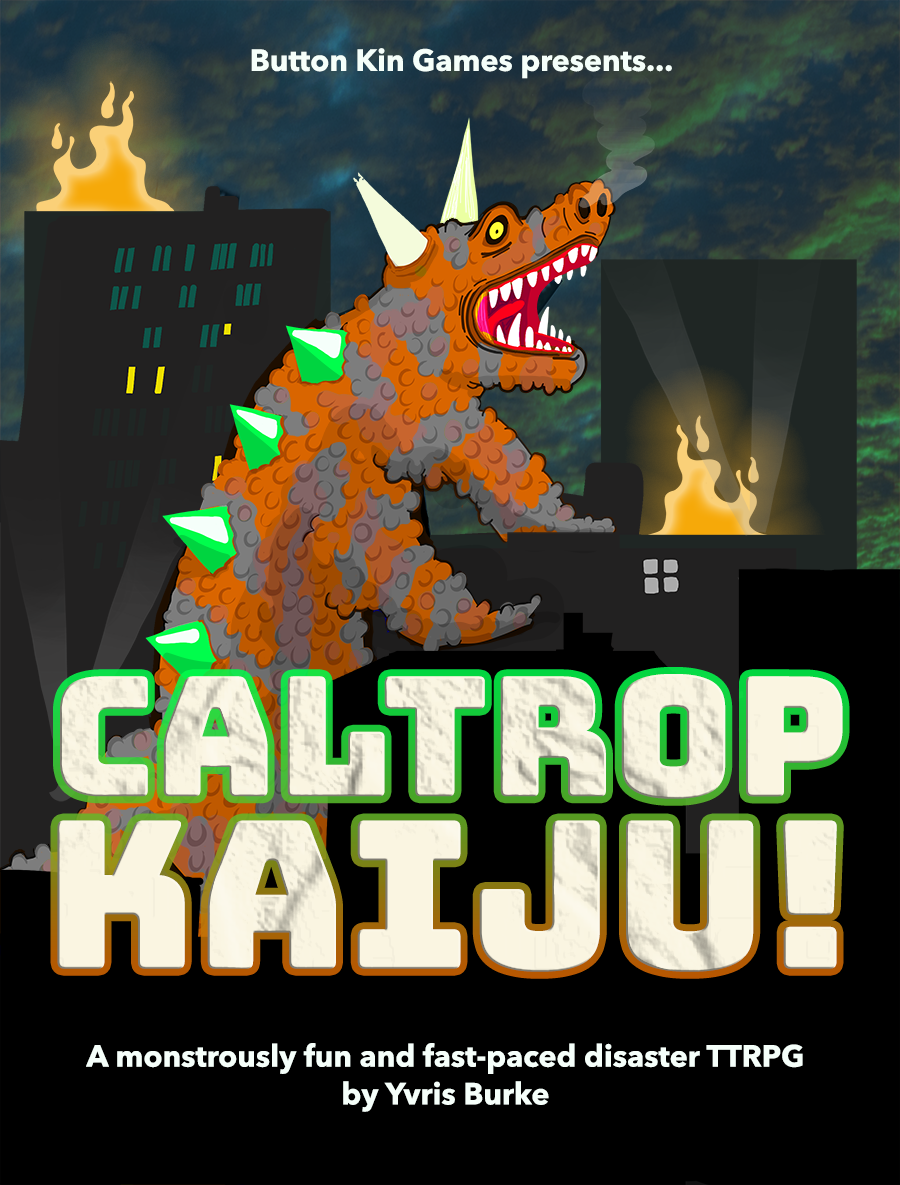
Solitaire: Caltrop Kaiju

Imagine if a giant monster, a Kaiju, attacked the city where you lived? Stormed ashore and began stomping across one neighbourhood to the next, one district to the next? Crushing cars underfoot, smashing buildings, driving thousands upon thousands out of the city to flee to safety? Do you have friends and family in the city, and can you ensure their safety, let alone your own? As you move back and forth across the city, you will see the Kaiju again and again, and perhaps discern its weakness. Armed with that knowledge there are those who bring it to bear—the military, whose forces can drive the Kaiju from the city and back into the sea! It sounds like a film starring Godzilla, or Gojira, but is in fact the set-up and play for Caltrop Kaiju: A Monstrously fun and fast-paced TTRPG published by Button Kin Games. This is a small game which can be played in two ways, both of which are in solo mode. The first is as a mini-board game, whilst the second is as a solo roleplaying game in which the player keeps a diary of both his character’s actions and those of the Kaiju, much like other solo journaling game such as Thousand-Year-Old Vampire.

Caltrop Kaiju: A Monstrously fun and fast-paced TTRPG is designed to be played by one player aged ten and up. It requires a seven-by-seven grid to represent the city, marked with locations such as the nuclear power plant, city hall, and telecommunications tower, a two four-sided dice (the ‘Caltrop’ of the game’s title comes from the use of this die type), and a token to represent the player and a token to represent the Kaiju. The Kaiju comes ashore at the harbour and the game starts from there, whilst the player begins play in his mountain home. The player moves first, then the Kaiju. The player can only move one space, but the Kaiju moves three spaces in a randomly determined direction. As the Kaiju travels, it does damage to each square or each neighbourhood it passes through. If it passes through a neighbourhood three times, it is completely destroyed and becomes impassable for the player. The player can pass through partially destroyed locations, but whether due to the falling wreckage, flailing power lines, explosions, or collapsing buildings, there is a chance that he will be wounded. This means that the player rolls at a disadvantage on all die rolls. If the Kaiju does damage to the various locations, there are extra effects. For example, destroy the nuclear power plant and all of the surrounding squares are also destroyed!

In the short term, the aim of Caltrop Kaiju is for the player to trail the Kaiju and gain sightings of the gargantuan beast—hopefully whilst avoiding being stomped on and so wounded. If the Kaiju passes through the same square as the player, there is the chance that it will wound or even kill him in a dramatic fashion. However, from the same square as the Kaiju or an adjacent square—where there is no chance of the player being stomped—the player can attempt to gain a sighting of the leviathan. With each sighting, there is a chance that the player will learn the Kaiju’s weakness (if unsuccessful, the player automatically learns this weakness on the fifth attempt). Armed with that knowledge, the player can search for the secret military base, which necessitates a die roll, and if successful, pass on the knowledge to the military whose forces will attack the Kaiju and force back into the sea. However, the Kaiju now has the player’s scent and will be actively hunting him. Although the Kaiju is slowed as it hunts, the game becomes a race to find the base and pass the knowledge of the monster’s weakness before the player is stomped on or zapped or burned to a crisp. If that happens, the player, of course, loses the game.

Caltrop Kaiju is a simple mix of puzzle and programmed movement with the player playing against the game and the Kaiju. It can be enhanced and become something else if the player records a journal of his travails across the city in the wake of the massive monster, what he sees, and what he discovers about the Kaiju. To set this up, Caltrop Kaiju suggests the player answer a few questions, such as who his character is, how he is the best person to determine the Kaiju’s weakness, what family he has in the city, and more. The player is also free to determine what sort of Kaiju the attacking beast is and what its weakness is. In this mode, the player records a journal of his character’s success or a journal of his character’s failure that will be found on his dead body in the rubble of the city long after the Kaiju has wandered back into the sea…

In comparison to other journaling games, Caltrop Kaiju is lacking in terms of tables and thus prompts. Other journaling games have numerous tables that the player can roll on or draw cards for, and use the indicated prompt to drive the narrative being recorded in the journal. Caltrop Kaiju lacks these. There are no tables for the type of Kaiju, its powers, or its weakness, or who and where the character’s loved ones are. There is a table for describing otherwise empty neighbourhoods, which though useful, seems an odd inclusion given the lack of other tables. With that lack of other tables, there is not perhaps the replayability of other journaling games because there is not the obvious variability.

Physically, Caltrop Kaiju is cleanly and tidily presented. Despite being a British game, it is written in American English which might be confusing for a younger audience. 

Caltrop Kaiju: A Monstrously fun and fast-paced TTRPG is a small game about a big event and facing a big behemoth. On one level, it is a simple puzzle, but on the other, it has the scope to tell a classic tale of man versus a colossal Kaiju tale in a modern city, done as an exercise in creative writing. However, if the player wants to return to the city and once again, face the Caltrop Kaiju, he may well want to create some random tables of his own to add a wider degree of variability.