Every Week It's Wibbley-Wobbley Timey-Wimey Pookie-Reviewery...
Showing posts with label Cats. Show all posts

Saturday, 6 June 2026

Solitaire: Be Like a Cat

There is a world out there for every cat to explore—gardens to laze in, rooftops to laze on, trees to climb, sheds to investigate, fences to scamper along, other cats to scowl and yowl at, humans to run away from and humans to properly socialise, and all in territories to mark and make that cat’s own. Be Like A Cat: a solo/two-player roleplaying game offers the opportunity for a player to explore that world from cat’s own eye level and tell the story of that exploration in a journal. By default, that story will be one set across the urban world that we are all familiar with, but options included in Be Like A Cat can take the player and his cat into other genres, including a dystopian future, ancient Egypt, the far future aboard a space station, and  even aboard a pirate ship! If this sounds familiar, then it is because it follows the format of Be Like a Crow: A Solo RPG, in which the player takes the role and tells the story of a Corvidae—crow, magpie, jackdaw, or rook—over multiple landscapes and differing genres. Indeed, Be Like A Cat is by the same author and from the same publisher, Critical Kit Ltd. Where Be Like a Crow requires a deck of ordinary playing cards to play, Be Like A Cat requires a handful of dice.

Be Like A Cat: a solo/two-player roleplaying game casts the player as either a Feral, Stray, or Domestic Kitten. The Kitten will explore a world mapped out on a Territory Tracker, adding rivers, parks, houses, trees, shops, businesses, restaurants, churches, street markets, and more, encountering all manner of creatures, including other cats, dogs, pigeons, rats, humans—old and young, and goats and llamas! Some of these encounters will be resolved with a fight, but not all of them, and as the Kitten moves from one type of territory to another, it can mark it as their own, hopefully permanently. As a Kitten explores, it will age, first into a Young Adult, and into a Mature Adult and a Senior. It will improve many of its skills when it does so at these stages of its life. The play of the game continues until a scenario’s goals have been fulfilled, all of the Territory Tracker for a scenario has been mapped out, the Kitten has reached the age of a Senior, or when it has run out of Lives.

A Kitten—and thus a cat of any age—is defined by sixteen skills, grouped into four categories. The skills are rated between one and six. The Kitten will have a Background— Feral, Stray, or Domestic—which will determine its appearance, behaviour, starting location, and bonus and weakness. For example, a Feral Kitten takes good care of itself; is unsociable and prefers to retreat or aggression; has a starting location of woodlands, countryside, a farm, or park; as a Bonus, rolls Prowl and Hunt skill checks with courage; and as a Weakness, rolls Cute and Signal skill checks with timidity. Of course, a Kitten has nine lives, each of which is lost when a Kitten loses all of his Health.

Hercule
Lifecycle Stage: Kitten
Background: Domestic
Starting Location: Back Garden
Bonus: All Social skill checks
Weakness: Balance and Jump skill checks
Health: 5
Lives: Nine
SKILLS
Survival: Prowl 1, Hunt 1, Mark 3, Preen 1
Social: Cute 3, Scare 1, Play 2, Signal 2
Travel: Jump 1, Climb 3, Balance 1, Land 1
Combat: Claw 1, Bite 1, Pounce 1, Evade 1

Mechanically, Be Like A Cat is a dice pool system. When a player wants his Kitten to undertake an action, he rolls the dice for the appropriate skill. Results of four and five count as one Success, whilst six counts as two. Rolls of one count as minuses and reduce the number of Successes rolled and if the total number Successes is negative, the Kitten loses Health. One or two Successes counts as a successful action, whilst three or more Successes is an outstanding outcome and the next roll is made with Courage. If the roll is made with Courage, a player can reroll any die that did result in a one, whilst rolls with Timidity means that results of four do not count.

Combat use the Claw, Bite, Pounce, and Evade skills. Claw and Bite are used to attack and inflict damage, whilst Evade is used to avoid attacks. Pounce is rolled to pin the defender down and if this can be done for three rounds, the defender will yield and if the defender holds territory, it also gives this up to the attacker. Social encounters are set up using the reaction table and the encounter verbs in the ‘Urban Cat’ scenario. In addition, a Young Adult and Mature Adult suffer a ‘FRAP’ or ‘Frenetic Random Activity Period’ or a ‘zoomie’. It occurs when two sixes are rolled for any action, and then the Cat rushes off in random direction.

The structure of Be Like A Cat consists of four phases. These are to move or stay, check for and resolve any encounters and any events, and then potentially take control of the location. The roleplaying game includes a cheat sheet and each scenario includes tables for locations, encounters, ‘Yes, and…’, and genre appropriate tables. The ‘Yes, and…’ table gives events that help the player add depth and detail. The genre scenarios also add objectives. For example, for ‘Brave Mew World’, the Kitten is uploaded to a corporate mainframe and sent to locate and copy eight databases, equipped with augmentations that can be salvaged from opponents the Kitten defeats, whilst the Kitten is searching for scrolls under the temple of Rameses II in ‘The Book of Bastet’, from which it can gain Boons, ultimately leading to a showdown with Bastet’s sworn enemy.

In addition, Be Like A Cat includes options for two players instead of one. These include taking it turns to control the actions of the Kitten; competitively, with each player controlling a different Kitten; and finally with a Game Master. The competitive option shifts Be Like A Cat towards being more like a board game, with the players competing for territory, whilst the option with the Game Master makes Be Like A Cat more of a traditional roleplaying game.

Physically, Be Like A Cat: a solo/two-player roleplaying game is a clean little book with some decent artwork. It is an easy read.

Be Like A Cat: a solo/two-player roleplaying game enables a player to explore the world (and other worlds) from a cat’s eye view. Some worlds are more fantastical than others, but the point of view has its own magic, that of an animal whose life we as owners and passersby we only see parts of. Be Like A Cat: a solo/two-player roleplaying game lets us imagine all of that world and in some cases, more. Be Like A Cat: a solo/two-player roleplaying game is perfect for the cat lover who roleplays and for the cat lover who wants to try something a little different.

Sunday, 10 December 2023

[Free RPG Day 2023] Animal Adventures: Apocalypse Miaow

Now in its sixteenth year, Free RPG Day for 2023 took place on Saturday, June 24th. As per usual, Free RPG Day consisted of an array of new and interesting little releases, which are traditionally tasters for forthcoming games to be released at GenCon the following August, but others are support for existing RPGs or pieces of gaming ephemera or a quick-start. Thanks to the generosity of David Salisbury of Fan Boy 3, Fil Baldowski at All Rolled Up, and others, Reviews from R’lyeh was able to get hold of many of the titles released for Free RPG Day, both in the USA and elsewhere.

—oOo—

Animal Adventures: Apocalypse Miaow
is the release from Steamforged Games Ltd for Free RPG Day 2023. It is a scenario and preview of Animal Adventures: The Faraway Sea, the new expansion to the publisher’s Animal Adventures: Secrets of Gullet Cove, the cats and dogs anthropomorphic campaign and setting for Dungeons & Dragons, Fifth Edition. Where Animal Adventures: Secrets of Gullet Cove takes place in and around an English style port, Animal Adventures: The Faraway Sea moves the action and story to sea where the Player Characters, based in the floating city of Flotsam, set sail to explore the nearby islands that shift in and out of a magical vortex which lies a few miles travel from the Flotsam. Designed for group of three to six awakened animal Player Characters of Second and Third Levels, it is a short, intriguing affair combining action and mystery that can be played in a single session or so...

Animal Adventures: Apocalypse Miaow lets the Player Characters ‘Journey to the Heart of Barkness’* on the trail of Sadie the Corgi, an explorer of legendary repute, who led an expedition to explore the recently appeared Spine Fish Island. Unfortunately, only a few of her companions have returned, battered and bruised, with strange tales of ‘Clawptain Katz’ and the ‘spine fish’. Brave adventurers—in this case the Player Characters—are wanted to sail out to the island to discover what has happened to Sadie, and hopefully rescue her.

* Publisher’s pun, not mine.

The Player Characters do have the opportunity to prepare for the voyage, both by taking some expert advice about Spine Fish Island and asking the survivors of the expedition led by Sadie the Corgi. Armed with this, the voyage itself is easy and the seas are calm. The Player Characters’ trouble begin when they reach the island, which turns out to be mostly desert, but there is a river running through it, which is only accessible by trekking overland. The initial problem is the welcoming committee, a bunch of poorly armed cats who shout at the Player Characters to leave the island, but are otherwise not aggressive. Which seems odd given that both they and Clawptain Katz want the Player Characters to leave the island. Whether the Player Characters decide to attack or negotiate, the defending cats quickly reveal their true character and turn tail, almost apologetically, as if they have no fight in them. This encounter is staged on the map included in the centre of Animal Adventures: Apocalypse Miaow.

With the knowledge gained from the cats and likely a clearer explanation of what is going on, the Player Characters can make their way to the encampment of Clawptain Katz and there confront him. This requires them to cross a short stretch of the desert and then travel along the river, on which they will have to protect their boat from the predating Spine Fish. At Clawptain Katz’s encampment, it is quickly clear that he is holding Sadie the Corgi prisoner—but not so that she is unable to shout a few hints—and that Clawptain Katz seems to have the rest of the cats held under his rather selfish and autocratic sway. Has he turned dictator whilst he has been on the island, or is there another explanation?

Animal Adventures: Apocalypse Miaow is a likeable affair. It is more about the investigation and the interaction than the fight necessarily as the confrontation when the Player Characters land on the island might not result in a fight. Overall, it showcases some of basic details to Animal Adventures: The Faraway Sea and provides a good solid, session’s worth of play.

Sunday, 24 September 2023

Lizards & Birds & Pirates, Oh My!

The Ages of Man have long since passed and the Old Ones are no more. They bequeathed the world and their relics to the ones… Well, whether it was the ones they worshipped or the ones that served them, it does not matter. For the beliefs and attitudes of the ones they worshipped and the ones that served them—in the Monarchies of Mau and the Kingdom of Pugmire respectively—matter little when you are far out on the Acid Sea, with only the plastic hull of your to protect you from the corrosive waters and your shipmates to rely upon. As pirates, sailors, and treasure hunters you set out from the ‘safety’ of pirate havens such as Waterdog Port, whose ownership has long been disputed between the Monarchies of Mau and the Kingdom of Pugmire or Port Matthew, the trade port in Monarchies of Mau, ready to keep your ship from being eaten away, hoping you do not encounter Acid Sharks or one of the dread Kraken, or worse have one of your crew possessed by a Stormcaller, a demon of the weather, but hoping that you do discover new lands, buried treasure, or a ship to capture! On your hip you have strapped a sturdy cutlass, whilst stuffed in your belt is one of the new gunpowder flintlock pistols, intricately carved from butt to the end of the barrel, and when that is not enough, your crew’s Alkalist can throw bombs that explode or heal, and your crew’s Rimer will sing you a song or tell you tale that will keep your spirits up. Many a Dog from the Kingdom of Pugmire and Cat from the Monarchies of Mau has sailed the Acid Sea, but few truly answer its call. More ready to heed the call are the transient Species, itinerant travellers and traders. They are Lizards—Geckos, Serpents, and Turtles—and Birds—Parrots, Crows, and Sparrows—and together they are the
Pirates of Pugmire.

Pirates of Pugmire is not a standalone roleplaying game, but is rather described as a ‘Chronicle’ book that works with Monarchies of Mau and Pugmire—either separately or together. Published by Onyx Path Publishing following a successful Kickstarter campaign, it expands upon the world of Pugmire, best described as a combination of the anthropomorphic, the apocalyptic, and the fantastical genres, adding new Species and Callings to play, new Knacks, plus an entirely new environment—only hinted at in either of the core books—to explore and experience. Part of that experience includes a mini-campaign set on the high seas which takes the Player Characters from First Level to Sixth Level. Like both core settings, Pirates of Pugmire does involve action, intrigue, and very much exploration, but this is an expansion setting where the Player Characters (and others) make their own families formed of different species rather than the packs of dogs or the clowders of cats. Where on land, the cats and dogs take an interest in the legacies and artefacts of the Old Ones—of Man—they do so from a primarily scientific or academic point of view. Nothing quite so dry in
Pirates of Pugmire. Pirates are only interested in treasure and there is plenty of treasure to be found—and if not found, squabbled over and stolen—if the pirates sail far enough, but in addition to facing the fearsome monsters of the Acid Sea, every treasure has a dangerous legacy and legend to it. So, the pirates had better hope that there is only a grain of truth in some of these legends.

Pirates of Pugmire includes plenty of fiction to get the tone and style of the setting—swashbuckling action, intrigue and squabbling, and so on. The book is illustrated with full colour painted artwork and the text is accompanied by commentaries from three in-game characters. These are Polly of the Seven Blazing Feathers, who is new in the Pugmire setting, and Princess Yosha Pug and Sabian Sphynx von Angora, who will be familiar from Pugmire and Monarchies of Mau, respectively. The first of the two families introduced as playable Species are the Lizards, who are primarily desert nomads, known as traders and excellent storytellers and the high value they attach to salt. This mineral is used in cooking, to aid water retention in their arid homes, in their religious rites, and as a component to their Akalist’s magics. The three Lizard families are Geckos, charismatic, agile, and able to blend into different cultures with their Chameleon Knack; Serpents are reserved, strong, and intelligent, and able to cross different terrain with their Slither Knack; and Turtles are slow and wise, but can take partial cover their Hunker Down Knack by withdrawing into their shell. All Birds dress to show off their plumage, yearn to return to the Sky Kingdom, a real place to some, more metaphysical to others, and have a difficult relationship with Cats. They are divided into three ‘nestes’ and the closer a neste is to the Sky Kingdom, the greater its influence in Bird society. Parrots are talkers and performers who Spin any tale or story to their advantage with their Spin Knack; Crows are tough and quiet, with a love of trinkets and ornaments, and have the Glide Knack; and Sparrows are flighty and prefer song as the means to tell stories, and with their Soar Knack, the only Bird capable of actual flight.

Besides new Knacks such as Sailor and Marine,
Pirates of Pugmire introduces six new Callings. These are Alkalist, Crusader, Gundog, Mystic, Rimer, and Torpedo. The Alkalist devises potions and concoctions as both balms and bombs that can both be thrown; the Crusader is a warrior with strongly held beliefs who fights for what is right; the Gundog is a warrior who uses the new gunpowder weapons and treats his weapons with reverence; the Mystic draws upon the power of the sea for his magic; the Rimer uses song and dance as misdirection; and the Torpedo uses stealth to strike hard and fast. There are some limitations in terms of Species and Calling. A Dog can only be a Crusader or Gundog and a Cat a Mystic or Torpedo, but any of the Callings from either Pugmire or Monarchies of Mau. There are no such limitations on Lizards or Birds and both have a different view on each of the Callings as explained by Polly of the Seven Blazing Feathers. All six Callings give a general view of what each thinks of the other five Callings and some sample Backgrounds.

If the mix of Species, Callings, and Knacks are engaging and fun, and make you want to play a Pirate Parrot or Gecko, the new mechanical elements of
Pirates of Pugmire are not always as successful. The good include Signed Knacks, such as the Signed Captain Knack which enables a Signed Captain to command a fellow crew member to reroll a die once per day aboard ship or the Signed Sailing Master Knacks which grants Advantage on all navigation rolls. Signed Knacks become available when the members of the crew sign the ship’s Articles and become Signed. Ship’s Articles are a way of enforcing the attitudes of a captain and his crew. Thus, Articles such as ‘Every pirate of the crew gets an equal share of the spoils’ and ‘This ship is a democracy, except when boarding or being boarded.’ represents a very different ship to one whose articles include ‘Prisoners are dead weight’ and ‘Never give an enemy comfort or mercy’. There are new seafaring spells such as Briny Deep which inflicts the sense that one is drowning on a target, Rough Seas which makes the seas around a target vessel or kraken choppy and the equivalent of rough terrain, and Suppress Gunpowder, which temporarily makes all gunpowder nearby inert. These are all great spells, flavoursome and genre suitable, as is the way that Pirates of Pugmire treats gunpowder. Originally seen as an Alkalist novelty, gunpowder and gunpowder weapons have been taken up by pirates everywhere—but not all pirates. The Gundog and Torpedo Callings are immune to the effects of Gunpowder Panic. Anyone within hearing of a gunpowder weapon being discharged who does not have the Exotic Weapon Aptitude Feat or Pistoleer Feat must make a Charisma saving throw to avoid gaining the Deaf and Scared Conditions. This keeps gunpowder scary and powerful and meaningful for the Callings that have it, without every Player Character having access to it.

Also detailed are the dangers of the Acid Sea, which constantly corrodes a ship’s plastic hull, sometimes reducing its Seaworthiness to the point where the ship is unsafe, hobbled, or simply adrift. If its Seaworthiness is reduced to zero, the ship will sink. Not every ship has a plastic hull and in game terms, a ship will need to have its Hull or Seaworthiness improved when built will outfitted with one. Ships are treated like a Player Character except their only stats are Artillery, Hull, Seaworthiness, and Speed. Only a few ships and ships weapons are detailed, but what is apparent is that these ships are small with crew numbers ranging between six and twenty, so the scale of them in
Pirates of Pugmire is actually quite small compared to that of the actual Age of Sail. As good as the other mechanical details are here, the ships are themselves underwhelming and the rules for ship-to-ship combat glossed over, relying on narrative detail perhaps more than the other rules in Pirates of Pugmire actually do. There are, however, lots of good explanations as to why a Cat, Dog, Lizard, or Bird might take up the life of a pirate or sailor, as well as what the various roles are aboard ship and what they do. In terms of piracy, Pirates of Pugmire is very much less “Yo ho ho and a bottle of rum.” and more swashbuckling and storytelling. The intent is that the Player Characters are adventurers and explorers rather than dangerous, lawless buccaneers.

One pleasing mechanic which pulls the Player Characters together in
Pirates of Pugmire, is how Fortune is used. Fortune in the game can be spent for various effects, such as rerolls or to cast a spell if the Player Character has no spell slots. In Pugmire, Fortune is a collective resource shared between the party, but in Monarchies of Mau, a Cat can have his own Fortune as well as access to collective Fortune. This remains the same in Pirates of Pugmire, which adds separate Fortune resources for Birds and Lizards, but once a ship’s crew has signed the ship’s Articles, then Fortune can become a collective resource between all of them. In this way, Fortune models the Player Characters becoming a family.

In terms of background,
Pirates of Pugmire adds a host of new creatures, such as the Acid Shark, the Globster, rotting sea life infused with necrotic magic, and Stormcallers, weather demons which possess crewmembers during storms, and crew like the Crow Lookout, Mouse Gunner, and Otter Boarder. Colossal Foes are added too, for example, the Kraken, which has two hit locations—Kraken Tentacles and Kraken Head, complete with different Hit Points and attacks. Treasure is important in Pirates of Pugmire because every artefact—major and minor—has its own legend and notoriety. Ranging between one and three, the latter represents both how well each treasure and its legend are widely known and the Notoriety that its discovery, recovery, and possession will grant a pirate. Effectively, the greater the Notoriety of an item of treasure in a pirate’s possession, the more widely known and recognised and easy to find he is. Beyond the magical effect that the treasure may bestow, this Notoriety is the only way a Lizard or Bird can benefit from a treasure. Neither can absorb a masterwork item or treasure like Cats can or Dogs can improve. Not every treasure has a beneficial effect, and as you would expect, many are also cursed.

In terms of setting,
Pirates of Pugmire describes several locations. These start with two ports. The first is Waterdog Port, whose founding triggered the War of Dogs and Cats and after numerous vicious Alleyway Skirmishes, the city’s leaders tired of the war, established the city’s independence, and made every species welcome. This includes Rats and Mice, Otters and Weasels, and Badgers, although none of them are particularly detailed in the setting. The other is Port Matthew, the Monarchies of Mau’s shipping capital, designed with a warren of tunnels and bridges to prevent successful assault by outsiders. Port Matthew is less welcoming as a city, especially to Birds, although in both cities, the Lizards have gained a reputation as arbiters when issues want to be settled. Both cities are nicely detailed, and include their history, species found there, politics and prominent leaders, and various locations. Beyond the waters of both harbours, Pirates of Pugmire details several locations far out to sea. Most notably, the more lawless archipelago of Dalmatian Cove, consisting of several islands of different character and all together shaped like a crab. In many cases, it is possible to get from one island to another via ships, ropes, and wrecks held fast between them. Several other locations are also detailed and they are followed by a number of story hooks using the previously described locations.

The three scenarios at the end of
Pirates of Pugmire, together called ‘Going on Account’, make further and more detailed use of the locations as well. Together, ‘Rotten Rats’, ‘The Race’, and ‘Heart of the Storm’ make up a loosely connected campaign that takes the Player Characters from First Level to Sixth Level. The looseness means that the Game Master will need to develop some adventures of her own, but all three scenarios end with a ‘Future Stories’ section which add more story hooks for her to use in addition to those earlier in the book. ‘Rotten Rats’ is a land-based adventure, set in Waterdog Port, in which the Player Characters are hired to recover a treasure—the Lost Flask of Bobby Golden—which can transform any liquid into something beneficial. The problem is that the city’s Rats are said to have it and they are not dealing with anyone as tensions are high in the city between the rodents of Waterdog Port. The Player Characters will need to work out the cause of the tension and perhaps ease it if they are to learn any clues. This is an investigative scenario, whereas ‘The Race’ takes them to sea—whether in their own boat or one they hired—to get to an island which is said to appear only once every ten years, find the treasures hidden in it, and come back. Of course, there are rivals racing with the Player Characters as well as those not ready to race, but ready to steal what the Player Characters have already found. Lastly, in ‘Heart of the Storm’, the Player Characters’ ship is caught up in the worst weather possible on the Acid Sea, almost shipwrecked, and forced to land on Stormheart Island where they find more shipwreck victims. The Player Characters need to delve into the island’s history to find out what is going on and perhaps a way of getting off. At the end of ‘Going on Account’ the Player Characters will be able to return with the treasure they were seeking and perhaps more. Although it does need fleshing out with extra content between the three adventures and the adventures themselves are fairly linear, ‘Going on Account’ is a nicely detailed and fun mini-campaign.

Physically,
Pirates of Pugmire is well presented. The artwork is excellent, whilst the cartography is okay. Perhaps the only thing really missing would have been maps of Waterdog Port and Port Matthew.

It does feel as if there is something missing from
Pirates of Pugmire. Perhaps it is that mechanically, it feels underwritten in places, and that it would have been fun to see Fortune used to help the Player Characters swashbuckle some action or the ship’s combat rules developed a little more. Nevertheless, Pirates of Pugmire expands the world of Pugmire in pleasing fashion, sending it out to sea and into another genre where the Player Characters have a bit more freedom and are less beholden to their families. Once aboard a plastic-hulled vessel, together with content developed herself, the Game Master has everything she needs to run anthropomorphic action adventures on the Acid Sea and let the Player Characters become Pirates of Pugmire.

Saturday, 14 January 2023

Cats & Dogs & Adventure

Standing astride the Twin Throats, the rivers known as the Malkin and the Mastin, the port town of Gullet Cove is a haven for many. With its busy harbour and its markets popular far and wide, it is a haven for thieves. With its lax attitude to mooring fees and often distracted town watch, it is a haven for pirates. With one of its founding members—the town was founded a little over three hundred years ago—being an awakened animal, though whether that awakened animal was cat or dog, none can say, the town is haven for Awakened Animals. The Thieves Guild, including the Cradle, the elite feline thieves guild within its membership, does not run the town, but it does regulate crime and criminal activities, and its influence upon the town council is undeniable. Pirates do sail from Gullet Cove and the town is a home to many others, including at The Home for Retired Pirates, Buccaneers, Swashbucklers, and Other Practitioners of Derring-do, perhaps the best ship a retired pirate could ever have on land. Whether they run on two legs or four, Awakened Animals are not only welcomed in Gullet Cove, but part of everyday life, alongside the town’s Humans, Dwarves, Elves, and others. The Order of the Golden Collar, dedicated to protecting all Awakened Animals, is a major presence in the town, whilst their particular faiths, such as the Good Mother, known to all dogs, and Urbaste, Tom o’th’Alley, the Old Striped One, and the Shadow Mover, the pantheon of the cats, all a church or other presence in the town. The Thieves Guild is not the only guild in town. The others include the Guild of Seafarers, the Guild of Adventurers and Associated Heroes (which even has its own training ground which simulates dungeon rooms), the Guild of Wizards, Ingenious Sorcerers, and Practitioners of Eldritch Ritual (or WISPER) which has a library in the town, and the Goldsmiths. Together they dominate Gullet Cove and its town council. Membership of a guild in Gullet Cove grants a degree of protection and access to guild marks, the currency used between the guilds and sometimes as bribes to those outside the guilds. This is the setting for Animal Adventures: Secrets of Gullet Cove.

Animal Adventures: Secrets of Gullet Cove is an anthropomorphic campaign and setting for Dungeons & Dragons, Fifth Edition. Published by Steamforged Games Ltd following a successful Kickstarter campaign, this is the first campaign setting for the publisher’s range of cat and dog adventurer miniatures—the Dungeons & Doggies and Cats & Catacombs series—and previously visited in Adventures RPG Starter Set: A spellbinding roleplaying game for beginners . The supplement includes full rules for creating canine and feline Player Characters, a complete setting in Gullet Cove, a bestiary, and a five-part mini-campaign, and it packages all of this with an array of fantastic artwork.

After a very short introduction, Animal Adventures: Secrets of Gullet Cove begins with a toolkit of new Race and Class features for cats and dogs. A Dog has increased Charisma, Keen Senses, a bite attack, and another attribute increase due to size. A further ability comes from a Dog’s Breed or subrace, such as Assistance Dog, Digger, Guard Dog, and so on. All Dogs have the Awakened Dog Background and like all Player Characters in Dungeons & Dragons, Fifth Edition, an Awakened Dog has a Personality Trait, Ideal, Bond, and Flaw. Instead of introducing new character Classes, Animal Adventures: Secrets of Gullet Cove gives the canine versions of the thirteen in the Player’s Handbook and the extra doggy abilities that an Awakened Dog gains. Then the supplement does exactly the same for Awakened Cats. They have greater Dexterity, Darkvision, both claws and teeth, and again, another attribute increase due to size. An Awakened Cat also access to the Welcoming Dark, which allows the Cat to slip in and out of sight, and is literally another place where the Awakened Cat can take the equivalent of a Long Rest. It is not without its dangers though and is not always as welcoming as it should be… Notable amongst this toolkit is the fact that the Breed Ability is not necessarily tied to canine species, and all of these options provide a player with the means to create the canine or feline character of his choice.

Besides details of Awakened Animal religions—Dogs follow just the one god and Cats a pantheon—and a broad explanation of guilds, Animal Adventures: Secrets of Gullet Cove provides a detailed gazetteer of the town which describes some twenty-six or so locations. This begins with The Sisters, the watchtowers which guard the sea entrance to Gullet Cove; Fang Point, the lighthouse, and the Ruin, its mysterious, possibly haunted predecessor; and the Smuggler’s Tunnels which run right under the town, a mix of mines, caves, sewers, cellars, and purpose dug tunnels. There is a cat equivalent, the Gutterings, which runs across and through the rooftops of the town. If there is a downside here, it is that these tunnels are not mapped, though that does leave the Dungeon Master to describe them as she wants. All of the town’s major locations are described in some detail as are several NPCs, including Gaius Vandel, the current Port Warden, who though not corrupt as his predecessors, does little each day, but frequent the town’s various taverns and chat; Ysandre the Tielfling pirate captain, supposedly in hiding, but being stalked by something nasty after big raid which made her wealthy, but got many of her crew killed; and Mister Pettifer of Mister Pettifer’s Emporium of Exotic Wonders and Divers’ Objects of Interest, a bespectacled, maroon-coloured smoking jacket-wearing and becapped feline wizard never without a particularly large leatherbound book, who might be a god or an immortal depending upon the speaker. The gazetteer is intended to be read by player and Dungeon Master alike, but there are details in this section that the Dungeon Master might not want her players to read, including a secret or two, and several scenario hooks.

Gullet Cove has the feel and look of a medieval English port. Perhaps on the Cornish coast like Mousehole or Falmouth, or in the north of England, like Whitby in Yorkshire, or Whitehaven in Cumbria. That said, with the horror elements of Animal Adventures: Secrets of Gullet Cove, Whitby is a good choice. Beyond Gullet Cove, the supplement describes the ‘Isle of Dogs’, a mysterious island off the coast that is not always accessible, whether due to storms or mists, which is said to contain ruins of the Elven city that once stood in the area. The island is left up to the Dungeon Master to develop, including mapping what is there. If the Dungeon Master wants to take her players and their characters away from the urban environment for some wilderness or dungeoneering—notably in the Caves of Wandering—this is a place to do it. Potentially, the ‘Isle of Dogs’ is worthy of a supplement of its own, or at least an adventure or two.

For the Dungeon Master there is an extensive bestiary of the NPCs and monsters to be found in, about, and under Gullet Cove. Several of these are deliciously nasty, such as the Effervescent Ooze, the bubbles of which can release an intoxicating aroma if burst; the Malbatross, a frighteningly undead version of the dread albatross; the Rataclysm, which needs no explanation; and the Skelly Cat and Zombie Cat. For the players, the counterpart to this is the selection of ten ready-to-play Player Characters, all based off the miniatures released by the publisher previously, and all starting at Third Level. Also given is a selection of new magical items. These include the Satchel of Ownership, which cannot successfully be stolen from or The Abyssal Eye, which when peered through highlights all of the traps in the room, though doing so may nauseate and poison the user, and in general, the theme of devices to help or thwart the thief rules though the selection. Alongside these there are several animal magic items, divided between items for cats and dogs. For the cat there is the Collar of Resilience whose bell rings whenever the user is doing a heroic deed as well as providing various benefits and the Wand of Fascination which emits a single point of vermillion light that confuses other creatures! For the dog there is the Everwater Drinking Bowl and Bun-Bun of Soothing, a tattered, stuffed rabbit toy which when chewed or stroked casts Calm Emotions on the user.

The campaign in Animal Adventures: Secrets of Gullet Cove is divided into five parts. It is supported with some short and simple advice for the Dungeon Master on how to run the campaign in terms of tone, work with the book’s content, mixing the content up, and keeping it fun. This and the advice for building adventures might be a little too short for the neophyte Dungeon Master coming to the supplement as her first campaign. One interesting point of reference here for the author is the Pixar style of film. The Player Characters are expected to experience a range of emotions and situations, some of them dangerous, but that they will prevail, and the author makes this clear, as well as the fact that the players also have to sign up to this heroic style of play. Although there are scary, even horrifying, situations and monsters in Gullet Cove as a setting and campaign, it is not a horrific setting. This combined with the Pixar references points to the intent to make Animal Adventures: Secrets of Gullet Cove accessible in terms of content and story in a more family friendly fashion. The campaign itself opens with ‘Adventure 1: A Gullet Cove Hello’, which is designed for First Level Player Characters. They arrive in the town and are soon subject to a pickpocket attempt, but as they chase the culprit, the Player Characters discover that this is just a ruse—someone wants to hire them. As outsiders, they can investigate things and situations that certain factions in the town cannot and that includes an unsanctioned burglary! In the course of the adventure, the Player Characters uncover something more going on, which leads into the second adventure, and so on and so on. There is a fun switch around in the campaign and a terrible pun—as in ‘Assault on Pawcinct 13’—or two, and ultimately revelations as to one or two of Gullet Cove’s darker secrets and even darker plots being made against the town. The campaign is not too difficult to run and it is accompanied by sidebars of advice throughout. If it is lacking in anything, it is maps of the various locations.

Lastly, Animal Adventures: Secrets of Gullet Cove comes with a pack of its own maps, done in full colour and designed to be used with the publisher’s Dungeons & Doggies and Cats & Catacombs series of miniatures. However, it is not clear if particular locations in the campaign make use of these maps. They include a map of Gullet Cove, as you might expect, but what is notable about this map is that its reverse shows the town at night. This is a nice touch, not only for adventurers who are going to be out at night, but especially for Rogue Player Characters!

Physically, Animal Adventures: Secrets of Gullet Cove is a superb looking book. Although the artwork is replicated in places, it is very good, some of it suitably scary, much of it actually joyous. The book is decently written, but annoyingly, does lack an index. It does need an edit in places, particularly when it comes to game terminology and game balance with some character and device abilities. The latter is really the only issue with Animal Adventures: Secrets of Gullet Cove where both setting and theme trump the mechanics. Consequently, the Dungeon Master may need to make some adjustments prior to play or rulings during play.

What strikes you first about Animal Adventures: Secrets of Gullet Cove is the artwork. This is inviting, in places joyous, in others scary, thus setting the tone for the town of Gullet Cove and its secrets. That tone, combined with the fact that the players are roleplaying cats and dogs makes the setting and campaign suitable for a younger, family audience. That does not mean that an experienced group could not play the campaign and enjoy it, because after all, it is intended to be fun and heroic rather than grim and gritty, and there is no reason why Animal Adventures: Secrets of Gullet Cove could not work as a lighter option. Although not without its issues, Animal Adventures: Secrets of Gullet Cove is a lovely book which presents its enchanting setting and campaign in an attractive and engaging fashion.

Sunday, 23 January 2022

Pawsome Action!

The Ages of Man have long since passed and the Old Ones are no more. They bequeathed the world and their relics to the ones that they worshipped, rather than the ones that served them. Thus to the Cats rather than the Dogs. Where the Dogs have the one kingdom, that of Pugmire, the cats have six fractious Monarchies, scheming and plotting to outdo each other. The Cats of these Monarchies sent explorers hither and thither, often looking for the Relics left behind by Man, even over the mountains to the north—though none go there today, and once the means to sail the Acid Sea was discovered, over the horizon. Trade would flourish initially between the Monarchies via House Korat and the Kingdom of Pugmire, but differences led to the relationship breaking down and war being declared. The War of Dogs and Cats could not be fought effectively, thus Trillani Persian von Mau convinced the six Monarchies to come together, sign a Treaty of Unification, and become six dynasties governed by a Ruling Council with Trillani elected as Monarch. Thus the Monarchies of Mau was formed. The Kingdom of Pugmire is its greatest rival, but despite the many differences between the two kingdoms and Cats and Dogs, there is peace. The war ended in stalemate, with Waterdog Port, the source of the initial dispute ending up a neutral city. The Monarchies of Mau still faces enemies from without and from within. Badgers raid and plunder, and monsters of all sorts are constant danger, the worst being the demons and the Unseen that threaten the existence of Cats—even impersonating them, whilst the individual Monarchies still attempt to learn each other’s secrets, and the Cult of Labo Tor, consisting of fanatical Rats and Mice—who otherwise live peacefully in the gaps between Cat society—steal the artefacts of Man to study and so discover the path through the Maze of Ignorance and so become like Man. In response to these dangers, to learn more about the world, and to foster co-operation and learning between the six Monarchies, Trillani’s Trailblazers was formed. Teams made up of Cats from all six Monarchies as well as from the unaffiliated Cats of the Shadow Bloc serve in Trillani’s Trailblazers.

The Cats of the six Monarchies of Mau are all different. House Angora is one of scholars and intellectuals, House Cymric of diplomats and negotiators, House Korat of soldiers and tacticians, House Mau of leaders and judges, House Rex of explorers and outsiders, and House Siberian of traditionalists and medics. All of these Houses have held a monarchy before Unification, but there are still many minor Houses, organisations, rebels, and outsiders who have a voice in the kingdom, and they are represented by the Shadow Bloc. However, all Cats of the Monarchies of Mau are the same. They value privacy and secrecy, they commonly believe in reincarnation and are by nature spiritual, and they fear and have a common enemy in the evil that is the Unseen. They also adhere to the Precepts of Mau—Always trust our instincts, always reward loyalty, always respect an honest duel, and always pounce upon minions of the Unseen. Without these tenets, the Cats of the Monarchies of Mau are no longer worthy of the adoration of Man.

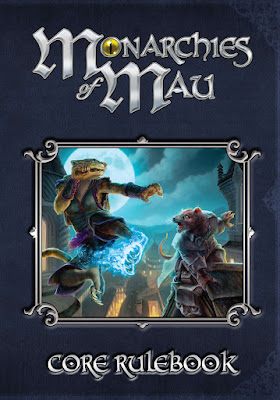
This is the setting for Monarchies of Mau, the feline sequel and companion roleplaying game to Pugmire. Published by Onyx Path Publishing following a successful Kickstarter campaign, Monarchies of Mau, like Pugmire before it, employs the Open Game Licence for Dungeons & Dragons, Fifth Edition. This makes Monarchies of Mau easy to pick up and play, which should be no surprise given the delightful accessibility of Dungeons & Dragons, Fifth Edition. Like Pugmire, it presents a streamlined version of the rules, takes Player Characters from First to Tenth Level, and it can also be played in tandem with Pugmire, so that group could play an all-Cat game, all-Dog game, or a game of Cats and Dogs.

Cats in Monarchies of Mau have a Calling, a House, and a Background. A Calling is what a Cat does and is the equivalent of a Class. Six are given—the charismatic Champions (Fighters), intelligent Footpads (Rogues), wise and intelligent Mancers (Wizards), charismatic and enduring Ministers (Clerics), wise and enduring Trackers (Rangers) who hunt the Unseen, and strong and dextrous Wanderers (Monks). Now these Classes are not the exact equivalent of those in Dungeons & Dragons, Fifth Edition, for example, Mancers do cast necromantic spells and Ministers are almost bardic in their means of spellcasting. Unlike the Dogs of Pugmire, the Cats of do not have a Breed as such, but rather the vocations of the six Houses. This neatly avoids Monarchies of Mau having to detail each and every contemporary breed and also establishes the various noble families within the kingdom. A Background is what a Cat did before becoming a hero and answering his Calling. Just eight are given, ranging from Common Folk and Criminal to Scholar and Soldier. Lastly, a Cat will have an Ideal, a Mystery, and a Flaw.

A Cat’s Calling will provide him with a view on the other Callings, on the Precepts of Mau—each Calling favours a different part of the Precepts, his Stamina Points, skills, and rucksack (equipment), plus his first Secrets. The latter are of course, a Cat’s special abilities and powers and are akin to the proficiencies or feats of Dungeons & Dragons. Another Secret and an ability bonus will come from a Cat’s House, and then more rucksack contents and skills from his Background. Six examples of each Calling are given as well as six possible Unusual Circumstances by which a Cat gained a particular item in his rucksack.

Creating a Cat involves selecting a Calling, a House, and a Background, plus skills and Secrets. Mancers and Ministers also have spells. Unlike in other roleplaying games, the core abilities are not rolled for, but assigned from a given set of values. The creation process is generally straightforward and a player is nicely guided through the process, step-by-step. One noticeable absence is that of Alignment, instead replaced by how each Calling favours a different Precept, but without laying too heavy a paw on the player’s shoulder.

Our sample character is Philomena von Angora, a Mancer who after completing her training continued conducting research in her House’s extensive libraries. Recently she was assigned to shepherd a visiting researcher from the Shadow Bloc, a Minister named Winifred von Forest. Together they conducted extensive examination of the ancient papers and they became friends, and then Philomena found herself falling in love with her. Before she could express her feelings, Winifred disappeared and nobody seemed to recall that she had been at the library. All was that left was the bone focus which Winifred von Forest said belonged to her father. With her friend missing, Philomena has left the library and joined Trillani’s Trailblazers.

Philomena von Angora
Level 1
Calling: Mancer
House: Angora
Background: Scholar
Proficiency Bonus: +2
Stamina dice: d6
Stamina Points: 6
Defence: 12
Initiative: +1
Speed: 30
Abilities: Strength -1 (08), Dexterity +1 (12), Intelligence +3 (17), Wisdom +2 (14), Constitution +0 (10), Charisma +1 (13)
Skills: Know Arcana, Know History, Know Spirituality, Search, Sense Motive
Secrets: House Secrets (Angora), Light Armour Aptitude, Mancy, Simple Weapons Aptitude, Voracious Learner
Spells: Chill, Eldritch Blast, Feather Fall, Prestidigitation, Unnatural Rebuke
Rucksack: Spear (1d8), padded light armour, Bone Focus (Borrowed from a friend who disappeared), common clothes, bottle of ink, ink pen, parchment, small collection of books, belt pouch with plastic coins

Ideal: …Studying the Unseen
Bond: …My love for a Cat of another House.
Flaw: …Return the item I know not be in my possession.

Given its Dungeons & Dragons-derived mechanics, it should be no surprise that Monarchies of Mau is a Class and Level system. Unlike Dungeons & Dragons, the Levels only go up to Tenth Level, at which point a Cat is considered to have Grey Fur and cannot advance any further, although he can still go adventuring. Unlike Dungeons & Dragons, a Cat who goes adventuring in Monarchies of Mau does not earn Experience Points, but is awarded a new Level after a few good stories and when the Guide—as the Game Master is known in Monarchies of Mau—decides is appropriate. When he does go up a Level, a Cat gains both Stamina and Stamina dice, spellcasters—Mancers and Ministers gain more spells and spell slots, and at every other Level, a Cat’s Proficiency Bonus increases. Every Level, a Cat gains an Improvement, which can be to improve an Ability score, select a new Aptitude or House Secret, or to refine a Secret the Cat already possesses. For example, a Champion can refine his Honour Challenge Secret, which enables him to force an opponent to engage in an honour duel, by using both Charisma and Strength rather than just Charisma to force the associated Saving Throw or allowing an opponent to decline and take a penalty to his Saving Throws. These tweaks and refinements give Monarchies of Mau a sense of the cinematic and heroic action as well as providing some variability in terms of Cat design.

Mechanically, Monarchies of Mau looks much like Dungeons & Dragons, Fifth Edition, but on a closer look, there are tweaks and refinements to the rules too. The most feline of tweaks is the Pouncing rule. When a Cat takes the Ready action and studies a situation, his player rolls the resulting action with Advantage! Perhaps the most notable addition is that of Fortune and the Fortune Bowl. A session begins with the Cats in an adventuring party having two Fortune in the Fortune Bowl. A player can earn more Fortune for the Bowl by roleplaying to his Cat’s personality traits in a way that makes the game interesting, by being an entertaining player, coming up with a good plan, and by playing to his Cat’s instincts. Much of this is up to the discretion of the Guide, but a player can force the Guide to add Fortune to the Bowl by having his Cat intentionally fail. However, where in Pugmire any Fortune Points acquired by a Dog are automatically added to the shared Fortune Bowl, in Monarchies of Mau, a Cat can favour himself rather than the group and keep it in his own Fortune Pile. Fortune in the Bowl can be spent—and this is a permanent spend—to gain a reroll on any dice roll and keep the higher result, to allow a spellcaster to cast a spell if he has run out of spell slots, and to interrupt the initiative order and take their turn now. Further, some Secrets require Fortune to be activated.

Again, magic in Monarchies of Mau looks like Dungeons & Dragons, but with a tweak or two. In terms of flavour, the magic of Monarchies of Mau has a darker edge, involving the unusual and the unnatural, for example, the Mancer employing necromancy. Mechanically, magic in Monarchies of Mau can go wrong. If a player rolls a botch—a critical failure—on a spellcasting roll for his Cat, intentionally fails a spell to gain Fortune, or an opponent rolls a Triumph—a critical success—on a Saving Throw, then a spell backfires. It is up to the Guide to determines the outcome and effect when this happens. Lastly, besides the Mancer and the Minister, Cats of other Callings can take the Magic Aptitude Secret and thus become a Dabbler, knowing just a handful of spells.

Another major difference between Monarchies of Mau and Pugmire is the way in which Cats and Dogs treat Masterworks, the Relics left behind by Man. They are still divided into ‘Relics’, such as the Boots of Climbing or Chameleon Cloak; ‘Fixes’ like Explosive Eggs or Potions of Haste; and ‘Wonders’, such as the Flame Twig or Picture of Health. Now, just as with Pugmire, the world of Monarchies of Mau is being a post-apocalyptic world, the conceit is that what these items really are, is items of Old-World technology. However, they cannot so easily be mapped back onto our own technology, but then the conceit is not necessarily that important in play. The big difference between Pugmire and the Monarchies of Mau is that Dogs share and even revere Masterworks, whereas Cats study them, attune to them, and they break them in just the right way so that they can absorb the powers they contain. For example, the Charged Collar provides a temporary defence against bludgeoning attacks, but when broken down in the right way and absorbed, the Cat is Resistant to such attacks. Further, when refined, the effects of the absorbed Charged Collar can make a Cat immune to bludgeoning attacks and can even manifest a lightning barrier! This has a number of effects. It both makes Masterworks more powerful and more personal to a Cat, and mechanically it partially offsets the fewer number of Secrets a Cat has versus the number of Tricks a Dog has in Pugmire. The combination of this is drive a player and his Cat to explore the ruins of the Monarchies of Mau and beyond in search of the Masterworks, providing a base motivation in addition to those born of a Cat’s Ideal, Motivation, and Flaw. However, the Masterworks section is quite small and is very likely going to be exhausted relatively quickly.

The setting for Monarchies of Mau is explored in some detail, explaining Cats and their Houses, culture, technology, and more in some detail, as well as their enemies and rivals. It also looks at the Ruling Council as well as Trillani’s Trailblazers, the organisation which by default the Player Characters are expected to join and thus adventure. Notably, it takes the reader inside the Lounges where Cats of all stripes gather over mugs of catnip tea and saucers of milk close by the fire, whilst Rats and Mice stick to the shadows of the corners. Whilst various locations in both the lands of the six Dynasties and beyond the Monarchies of Mau are described as well, there is plenty of room for the Guide to add her own setting material. Some of the secrets of the setting are explained here and also in the chapter for the Guide, which is well written and includes suggestions for running Monarchies of Mau and Pugmire together—and even for adapting the setting to other rules systems!

In addition to the advice and further examination of the setting, the Guide is provided with a decently sized Bestiary, covering Animals, Bandits, Cats, Dogs, Badgers, Rodents, and more. That more includes monsters and the Demons of the Unseen, and some of these are nasty indeed. For example, the Breathtaker steals into camps at night and steals the breath of Cats, Bone Burrs are insect-infested skulls which attack Cats, and Witch Demons possess Cats and has the power to reflect or even absorb the spells of Mancers and Ministers! Lastly, Monarchies of Mau includes an introductory adventure, ‘All Hail the Rat King!’, in which the Player Characters are sent to investigate a sudden wave of Rat immigration in the town of Strudniksburg. Designed for First Level Player Characters, it can be played using the players’ own or the six pre-generated characters given as examples at the beginning of the book.

Physically, Monarchies of Mau is, like Pugmire, a lovely book. Again, it is full colour and illustrated with some fantastic artwork. In keeping with the darker tone of the setting, the artwork also has a darker feel to it. The book is also well written and like Pugmire, commentary is given by a pair of in-game characters. One to provide guidance for those new to Monarchies of Mau, the other to explain how it differs from other roleplaying games.

Pugmire was a roleplaying game about being a ‘Good Dog’ and gaming with a pack, but Monarchies of Mau pulls away from that. There is greater sense of individuality to the Cats in Monarchies of Mau, in terms of roleplaying, the mechanics, and the setting. The Cats are caught between this individuality and the collective need for co-operation. At a personal level, this can be seen in the choice between choosing to add Fortune to his Personal Pile or the group’s Fortune Bowl, but at a national level it can be seen in the necessity of the six Monarchies of Mau to co-operate despite their scheming against each other. This scaling means that Monarchies of Mau can do dungeoneering and exploratory adventures as much as it can inter-House rivalries and politics. There is a darker tone to the roleplaying game too in the monsters the Cats face, and also in the magics, especially the necromantic magics of the Mancer, they employ. There is thus much more of the horror genre to Monarchies of Mau, and that in combination with the darker tone, makes less suitable for a younger audience. These are of course, elements which the Guide can choose to adjust up or down as is her wont.

The darker tone and horror elements of Monarchies of Mau mean that it is not quite suited to being a beginning roleplaying game, despite its Cats being cute, and the individual versus group dynamic may divide a group as much as it sets up some interesting roleplaying choices and dynamics. Monarchies of Mau is not quite as accessible as Pugmire, or necessarily as easy to play, but it does present an entirely different, but still exciting and fun point of view from which to roleplay and explore their shared world.

Friday, 24 September 2021

Furiously Purfect Felines!

There have been just a pawful of cat-themed roleplaying games, such as John Wick Presents’ Cat: A Little Game about Little Heroes and several Cthulhu-themed titles such as Sixtystone Press’ Cathulhu and Catthulhu’s Cats Of Catthulhu. The latest to join this klowder is Mew-Tants!. Published by Anima Press as part of ZineQuest #3, this is rules light roleplaying game in which the players not just take the role of cats, but as the title suggests, cats with sup-purr powers!

Mew-Tants! is published by Anima Press and takes the seemingly supernatural abilities and attitudes of cats and turns them up a knotch or two in the scratching post to turn them into superpowers. So ‘Laser Eyes’—not so much blasters as pointers with which to distract other cats; ‘If I fits I sits’—the cat can expand or shrink to fit exactly into any container; ‘Spidercat’—being able to climb down(!) and up trees, and even upside down; and ‘Keyboard Cat’—being able to use computers and keyboards because everyone believes you can! There are just twelve superpowers, along with twelve breeds of cats, which are enough for a one-shot or a mini-campaign, whilst still leaving plenty of room for the Game Master or even the players to create their own.

A cat-racter in 
Mew-Tants! is defined by his Breed, from Moggy, Scottish Fold, and Bengal to Tortoiseshell, American Ringtail, and Norwegian Forest Cat, and his superpower. A cat has four stats, defined by his Breed. These are Claws, for fighting and all physical activities, Whiskers for mental abilities and awareness, and Fucks, for how many it gives and its ability to interact with other cats and animals (including dogs). It also has nine Lives, just as you would expect. To create a Mew-Tant, a player rolls or selects a Breed and Superpower, modifies one stat for something his cat is good at and one stat for something his cat is bad at, selects his cat’s fur colour, and decides on a relationship with another cat and the reason why he joined the team of super cats.

Sasha
Siamese
Superpower – Keyboard cat
Claws 4
Whiskers 8
Fucks 1
Lives 9

Mechanically, 
Mew-Tants! is simple enough. It uses dice pools of six-sided dice, equal to one of a cat’s stats. If a player rolls a six, then his cat succeeds at a task. If opposed, the winner is the cat—or even a dog or a rat—who rolls more successes than the other. In combat, successes indicate damage inflicted on an opponent. Further dice can be added to a pool if a cat can find a box or a bed—for a nap, Kibbles so the cat can care more, or a Scratching Post to sharpen a cat’s claws. These add to a cat’s Whiskers, Fucks, and Claws respectively. Lastly, Lives represent a cat’s Hit Points, but can also be expended to reroll any dice. Catnip—or ‘nip’ if obtained from a dealer on the streets—grants bonus Lives dice.

Play in 
Mew-Tants! is supported with advice on scenario or mini-campaign, design, a detailed scenario, and a dozen ready-to-play super cats. The advice is to keep it fairly short and focused on small neighbourhood, perhaps even a neighbourhood known to the players. A table of antagonists and goals provide some ideas, and whilst the advice is limited, it is sufficient for a roleplaying with the scope of Mew-Tants! In comparison, the scenario, ‘The Catnapping’, is relatively lengthy and detailed. It is a missing moogie mystery litter box played out over nine locations, with plenty of NPCs that the Game Master can develop and roleplay. It should provide a good session or two’s worth of play.

Physically, 
Mew-Tants! is decently done and written. The artwork ranges from the realistic to the cartoonish, but works either way. Published as an A5-size booklet, it is short and easy to read, such that a Game Master could pick this up and read it through and have it ready to play in ten minutes.

Cats will be familiar to almost every player, so the combination of the subject matter and the simple mechanics make 
Mew-Tants! both easy and engaging to play. The combination also means that Mew-Tants! is suitable for younger players or play by a family—or it would be. Its use of adult language to describe a cat’s charisma and the fact that is reproduced on the character sheet on the back cover simply means that it is anything but—when it really should have been. Now the Game Master can change both, renaming the stat and redesigning the character sheet—perhaps Catrisma?—but should that have been really necessary? Maybe the publisher could provide a family-friendly character sheet?

Overall, 
Mew-Tants! is both easy and engaging, with scope aplenty for the input and invention of the players as they imagine the adventures of their cats and how they see the world around them.

Saturday, 10 July 2021

Your First Animal Adventure

Published by Steamforged Games, Animal Adventures is a roleplaying game setting of anthropomorphic cats and dogs adventuring in a magical world a la Dungeons & Dragons. It is designed to be compatible with Dungeons & Dragons, Fifth Edition and notably, is supported by the Dungeons & Doggies and Cats & Catacombs line of miniatures. The entryway for the setting and the line is the Animal Adventures RPG Starter Set: A spellbinding roleplaying game for beginners. This promises to contain everything that a gaming group needs to play a thrilling roleplaying campaign. However, it does not. Instead, it does contain a single adventure, which is ably supported by simple, easy-to-follow rules, four dog miniatures, cat miniatures, seven Player Character sheets, a double-sided game map, Game Master screen, a set of illustrated tokens, and a set of polyhedral dice.

The Animal Adventures RPG Starter Set is designed for ages thirteen and up, and intended to be played with a Game Master and up to seven players. From the outset, it is impressively presented. Everything is done in vibrant colour—perhaps a little too dark for the maps—and has a pleasing physical presence on the table. The large, double-sided map depicts a forest glade and mansion cellar on the one side, and the upper floors of the mansion on the other. They are marked with squares for use with the miniatures and the tokens also included in the box. The digest-sized Rulebook and Adventure booklet is brighter and breezier than the maps, its artwork tending towards the cute rather than the darker tones of the map. The three-panel digest-sized Game Master screen is likewise lighter on the Game Master’s side and lists in turn the roleplaying game’s combat rules, tables, monster stats, and spells and abilities of the Player Characters, all for easy reference. The thirty full-colour tokens are done on sturdy cardboard and are easy to read. The Player Character sheets are also double-sided and are clean, tidy, and again easy to read. Stats, equipment, attacks, and equipment are given on the front with a portrait of the animal, with special abilities on the back, whether that is spells or Class features. All of this fits atop a plastic tray with its own lid, the tray having space for the dice and the Animal Adventures RPG Starter Set’s miniatures. The dice are decent, with the two twenty-sided dice marked with the paw symbol where their twenty would be.

The miniatures are for the seven pre-generated Player Characters found in the Animal Adventures RPG Starter Set. They include Chantilly, a female Labrador and Fighter; Solan, a male Persian cat and Warlock; Whisper, a female Sphinx cat and Sorcerer; Elvis, a male Cavalier spaniel and Bard; Molly, a female Lyoki and Rogue; Brianna, a female Boxer and Paladin; and Kai, male Shiba Inu and Cleric. The miniatures are nicely detailed and emphasis the fact that the animals and thus the Player Characters in the world of 
Animal Adventures run on all four legs rather than on two. For example, Chantilly, a female Labrador and Fighter, wields her sword in her mouth rather than her paws!

The Rulebook and Adventure booklet is thirty-two pages long, of which six pages are devoted to the rules. These cover an introduction to and example of roleplaying, explain what the attributes are and how they work, how Advantage and Disadvantage works, and of course, combat. It is not a cursory treatment, but rather stripped down from that found in either the Dungeons & Dragons Starter Set or the Player’s Handbook. Anyone familiar with Dungeons & Dragons, or indeed any roleplaying game, will grasp and understand the rules with ease, but anyone with less experience or new to the hobby might have more difficulty. In the general, the rules and adventure lend themselves towards being run by an experienced Game Master for new players. In addition, links are included for fuller versions of the character sheets, so that a Dungeon Master and player more familiar with Dungeons & Dragons could run the adventure in the Animal Adventures RPG Starter Set.

The adventure in the Animal Adventures RPG Starter Set is ‘The Kurse of Doktor Krankensteen’. It opens with the adventurers on the road to the village of Woofburg where they plan to attend the annual Festival of Furry Friends. Unfortunately, they are ambushed by Goblin ’Nappers who attempt to kidnap them. After the battle, the adventurers discover that a mysterious ‘Dok’ wants cats and dogs, and he wants them for his experiments. Following the trail of the Goblin ’Nappers leads to a sewer pipe that ultimately opens up in the cellar of an abandoned mansion. As the adventurers explore the dilapidated building, they will come across some of the Dok’s experiments and his experiments to be, before finally facing the bad Dok himself!

The adventure is decent enough, with a summary of the setting, the map needed overview, player aim, and enemies to be faced given at the start of each scene. GM tips in the margins also give advice and helpful suggestions throughout. However, the scenario is combat and exploration focused, and as much as the GM tip that throwing the players and their adventurers into the action gets them involved is applicable, it does not leave a lot of room for anything other than action. There is very little investigation and not a lot of roleplaying and a little more of both would have been just as involving and would have showcased the fact that roleplaying games are more than just action.

If the adventure is decent enough and should provide one or two sessions of fun, where both it and the Animal Adventures RPG Starter Set come unstuck is in delivering the next step—or that is failing to deliver it. At the end of ‘The Kurse of Doktor Krankensteen’, the author suggests that the Game Master use the rules in the Animal Adventures RPG Starter Set, plus other supplements in the Animal Adventures to create a sequel. Unless the Game Master wants to run a variant of ‘The Kurse of Doktor Krankensteen’, it does not have enough content to create a sequel, and also, which Animal Adventures supplement should the Game Master be using? Writing a sequel to Animal Adventures should be a problem if the Game Master has written adventures before, but what if he has not? There is no real advice to help her in ‘The Kurse of Doktor Krankensteen’. It would have been nice if the publisher had made available a sequel on its website, even one using the contents of the Animal Adventures RPG Starter Set, so that the life of the Animal Adventures RPG Starter Set could have been extended to beyond the one adventure.

One option here would actually be to look at another roleplaying game all together. Still involving dogs and cats, and that is the Pugmire Fantasy Tabletop Roleplaying Game. This is slightly more complex than the Animal Adventures world of the Animal Adventures RPG Starter Set, but ‘The Kurse of Doktor Krankensteen’ could easily be run set in the world of Pugmire and the miniatures for the adventure would work in Pugmire too. Plus there is plenty of readily available support for it.

There can be no denying that the Animal Adventures RPG Starter Set is a fantastic looking introduction to roleplaying and the hobby. It is one that works for a family audience too and the stripped-down mechanics and rules can also serve as an introduction to Dungeons & Dragons, Fifth Edition. Ultimately though, as attractive as the Animal Adventures RPG Starter Set is, it simply does not follow through on what to do next, and consequently, it feels constrained rather than expansive.

Saturday, 15 August 2020

The 'Whose a Good Dog?' Guide

Buried Bones: Creating in the Realms of Pugmire is a supplement for the trilogy of post-Man, post-apocalypse fantasy roleplaying games—Pugmire Fantasy Tabletop Roleplaying Game, Monarchies of Mau, and Pirates of Pugmire. It is something of an odd product, not being the Realms of Pugmire Guide’s Handbook, for an example, and not really possessing a singular focus. Now it does contain advice for the Guide—as the Game Master is known in the Realms of Pugmire roleplaying games—but it also contains a whole lot more. This includes the Realms of Pugmire Style Guide, useful for example for wouldbe authors wanting to create content for the Canis Minor Community Content Program; a number of blog posts which explore the setting and reveal some of its secrets; a conversion guide between the OGL for Dungeons & Dragons, Fifth Edition and Pugmire; and a FAQ.

Buried Bones: Creating in the Realms of Pugmire opens with the Style Guide for the Realms of Pugmire roleplaying game. This not only lists the lexicon of game-related terms and their correct spellings, but also covers the game line’s tone, how magic and religion is handled, that it is ‘Inclusive Fantasy’, and it uses ‘Gendered Language’. For example, Pugmire is game of adventure and quiet morality, light-hearted with implied humour rather than out and out humour; never revealing to the characters that their magic is actually lost technology; that it is best in general to default gender-neutral terms like ‘dog’ and ‘cat’ rather than ‘he’ and ‘she’; to avoid both binary and non-binary gender terms; and so on. In some ways, this is a dull start to Buried Bones and of limited use. However, as an editor and reviewer it is interesting to see a Style Guide in print, it is actually of use to the Realms of Pugmire Guide. Especially if she wants to create content for the Canis Minor Community Content Program, but also if she wants a more explicit guide to how the designer wants Pugmire and its companion roleplaying games to feel.

‘Claws and Effect’ draws from a series of blog posts to explore various topics not necessarily explored in Pugmire Fantasy Tabletop Roleplaying Game, Monarchies of Mau, or Pirates of Pugmire. In the process, it addresses a number of topics are commonly raised when it comes to both games and setting. Most notable amongst these are the question, ‘Is this a Joke?’ and the description of Pugmire as ‘Just D&D with Dogs’. In addressing the former, it makes clear that although Pugmire Fantasy Tabletop Roleplaying Game is not necessarily a serious game, it is not a jokey one despite there being elements of implied humour in the setting. In fact, it does explore serious issues, such as loss—particularly of every Good Dog’s Master, the ethics and dogma of being a Good Dog, both cultural and racial (or rather, species) differences. Now when it comes to the latter, I have been guilty of giving Pugmire that description, but essentially not what the game is about, but rather as an elevator pitch to sell the game (verbally rather than in a written review). The chapter also discusses the nature of the different Breeds and Callings in Pugmire—the equivalent of Race and Class in Dungeons & Dragons, Fifth Edition. Here Buried Bones begins to dig into the author’s design decisions, why he created the game as he did, not just for Pugmire Fantasy Tabletop Roleplaying Game, but also for Monarchies of Mau and Pirates of Pugmire.

Other elements of the setting and rules are also explored—how money or ‘Plastic’ is handled in the setting, the implied rules of the Fortune mechanics, and the dynamics between the various species in the setting. All of this is designer commentary, giving the Guide a peek behind the curtain, answering what turns out to be not-so important questions such as, ‘Where is Humanity?’, ‘What exactly happened in the War of Cats and Dogs?’, ‘What is the exact nature of Nine Lives in Mau?’, and ‘What lies in the Lands Beyond?’. What is so pleasing here is the designer’s honesty. This is not to say that other designers are not honest, but rather that here where the designer says that he does not know something or has not decided something about the Realms of Pugmire setting, then he simply says so. There is Guide Advice too, covering different types of play like long-term and troupe play, styles of play including silly, gritty, and epic, and creating adventures. The advice emphasises the importance of the player characters, balancing types of scenes, setting jokes and humour within the setting, but letting the players get the punchline rather than have the author or scenario deliver it, and making every NPC important. All of this is solid advice, not just for the Guide wanting to create adventures for her own group, but for the Guide wanting to publish and submit them as part of the Canis Minor Community Content Program. Lastly, there is an ‘Appendix P’—the equivalent of the ‘Appendix N’ of inspiration found in the Dungeon Master’s Guide for Advanced Dungeons & Dragons—but for the Realms of Pugmire setting. This includes books such as The Amazing Maurice and his Educated Rodents and The Tao of Pooh, comics like Mouseguard and Maus, roleplaying games and supplements such as S3 Expedition to the Barrier Peaks and Tales of the Floating Vagabond. It is a good selection of books and titles and more, and there is even little explanation with some of the entries.

Rounding out Buried Bones is ‘5e OGL Changes’ and ‘Frequently Asked Questions’. The ‘5e OGL Changes’ enables a Dungeon Master to run a Dungeons & Dragons, Fifth Edition game of Pugmire. It also highlights the differences, useful if a playing group or would be author is moving between the two. The ‘Frequently Asked Questions’ does exactly what you would expect.

Physically, Buried Bones: Creating in the Realms of Pugmire is a slim book, easy to read, and illustrated with several fully painted pieces. None of the artwork is new, having appeared in previous Realms of Pugmire titles, but that does not mean that it is not good. Overall, Buried Bones is as good looking a book as you would expect for the line.

However, Buried Bones: Creating in the Realms of Pugmire is not a book that the Pugmire Guide absolutely must have. She can run or write adventures for own playing group without it, but it does contain plenty of interesting information, working as it does, as the equivalent of the Guide’s Companion—the referee’s handbook, the designer’s notes, and the style guide all in one. So not only interesting, but also useful if the Guide wants to know a little more of the context and the secrets to the setting. However, if a Guide or an author wants to write her own scenarios or content for publication as part of Canis Minor Community Content Program, Buried Bones: Creating in the Realms of Pugmire is a must-have. 

Thursday, 7 March 2019

Friday Filler: Cat Tower

If have not yet had enough of cats—and if you have, why?—there are plenty of feline themed games to go around. Whether its telling their tales in Action Cats! – Spin Tales From the Secret World of Cats or trying not to get them to detonate in the distinctly mediocre Exploding Kittens: A Card Game for people who are into kittens and explosions and laser beams and sometimes goats or whizzing them around in murderous fashion in amusingly titled Kittens in a Blender, there are more than enough games to satisfy the cat lover in you. So one more will hardly add to the clowder and the good news is that instead of blowing them up or whizzing them to death, you are only stacking them.

Published by IDW—best known as the English language publisher of Machi Koro—folloing a successful Kickstarter campaign, Cat Tower is the dice rolling, dexterity game of cat stacking designed for between two and six players, aged six and up, and playable in no more than twenty minutes. It requires no set-up and so can be brought to the table quickly and easily.

It comes in a bright and breezy cat-themed cube of a box inside of which can be found two rulebooks, forty-two stackable Cat cards, twelve Fatty Cat cards, five dice, and twelve cat tokens. One rulebook gives the full rules, the other a pair of variants, but neither runs to more than three pages. The three dice are wooden and an inch square. Out of the box they are blank, so they do require various stickers to be applied to each of their faces. Each of the cat cards measures 2¼ by 3½ inches and is scored across its width twice such that when folded, it will stand up. One of the things a player will need to do is fold his cats when it is not his turn. The Fatty Cards are the same size, but are flat and do not have the same score lines and so do not need to be folded. Both the Cat cards and the Fatty Cat cards depict a cute cat—a very cute cat.

At the start of Cat Tower each player receives seven cat cards. One cat card is placed in the middle of the table as the base of the tower. The first player is always determined by whomever has the most cats (which usually means myself or my partner). On his turn a player rolls a die and does what the symbol on the result instructs. This can be to stack ‘One Cat’ or ‘Two Cats’; to get another player to stack one of his cats with ‘Cat Paws’; to stack a cat card upside down with ‘Dried Fish’; and place a Fatty cat on the tower and flip a token. The tokens force play order to be reversed with ‘Turn Around’; the next player to skip his turn with ‘Skip’; all of the remaining unplayed Cat cards to be redistributed between the players with ‘All Cats are Equal’; or force another player to stack one the current player’s Cat cards with ‘Cat Paws’. Any token played in this fashion is placed on the Fatty card when it is added to the tower.

Play continues until one player has managed to stack all of the Cat cards from his hand. At this point, he is either declared the winner or if multiple rounds are being played, the other players receive a penalty point for each of the Cat cards they still hold in their hands. After the agreed number of rounds have been played, the player with the fewest points is declared the winner.

Of course, a game will never progress as smoothly as that. If a player knocks a Cat card off the tower whilst stacking a Cat card, he must take two cards from the tower into his hand. If he knocks a Cat token off the tower, he takes back an additional Cat card into his hand. If another player is placing the current player’s Cat card on the tower after a ‘Cat Paws’ die result or token, it is placing player not the current player who has to take the Cat cards back into his hand. 

Physically, Cat Tower is a very attractive game with simple, cute components. The only issue is with Cat cards that might not fold very well.

Cat Tower is quick and easy and very, very light. It is undemanding and simple and it is unpretentious. It is also cute and pretty and overall a lovely little package. It is certainly worth having on the shelf for games sessions with the family. More dedicated gamers though are not going to want to bring this to the table very often. Overall, fluffy feline fun, Cat Tower is a family filler game that plays quickly and easily.