Every Week It's Wibbley-Wobbley Timey-Wimey Pookie-Reviewery...
Showing posts with label Comics. Show all posts

Sunday, 9 November 2025

Review 3000: Teenage Mutant Ninja Turtles & Other Strangeness

1974 is an important year for the gaming hobby. It is the year that Dungeons & Dragons was introduced, the original RPG from which all other RPGs would ultimately be derived and the original RPG from which so many computer games would draw for their inspiration. It is fitting that the current owner of the game, Wizards of the Coast, released the new version, Dungeons & Dragons, Fifth Edition, in the year of the game’s fortieth anniversary. To celebrate this, Reviews from R’lyeh will be running a series of reviews from the hobby’s anniversary years, thus there will be reviews from 1974, from 1984, from 1994, and from 2004—the thirtieth, twentieth, and tenth anniversaries of the titles. These will be retrospectives, in each case an opportunity to re-appraise interesting titles and true classics decades on from the year of their original release.

—oOo—

In 1984 and 1985, the breakout comic was Teenage Mutant Ninja Turtles, written and drawn by Kevin Eastman and Peter Laird, and published by their Mirage Studios. It was an independent black and white comic that told the adventures of the eponymous quartet of four genetically-mutated turtles trained under a pet rat, Master Splinter, to fight rival ninja, including the Foot Clan, and other threats, such as aliens. Combining humour and stories with a darker edge than Marvel Comics like Daredevil and The New Mutants, the comic book was a hit and not only continued to be published by Mirage Studios for the next thirty years, but was heavily licensed, pushing Teenage Mutant Ninja Turtles into the mainstream. Since 1987, there have been five television series based on the Teenage Mutant Ninja Turtles and eight films. However, in the forty years since the first issue of the comic, there has only been one roleplaying game—Teenage Mutant Ninja Turtles & Other Strangeness.

Teenage Mutant Ninja Turtles & Other Strangeness was published in 1985 by Palladium Games, a company best known at that point for 1983’s Palladium Fantasy Role-Playing Game and 1984’s Heroes Unlimited. It was designed—or rather redesigned in a matter of weeks after Palladium Games was unhappy with the original submitted version—by Erick Wujcik, who most notably would go on to create Amber Diceless Role-Playing. The result was a fast-paced, engaging, if imperfect roleplaying game packed with art from Peter Laird and Kevin Eastman, that looked like it was a lot of fun. And if you were a teenager when Teenage Mutant Ninja Turtles & Other Strangeness was released, it was, because Teenage Mutant Ninja Turtles was and were cool. Perhaps because of the speed in which it was rewritten, perhaps because it is a Palladium Games book, there is ‘cookie cutter’ feel to some parts of the roleplaying game—the alignment system, the equipment list, and the weapons—which all very feel imported from Palladium Games’ other roleplaying games that used the
Megaversal system, like the earlier Ninjas & Superspies. There are certainly some parallels between the two, not least of which are the fact that they were both written by Erick Wujcik, but they do not feel like a natural fit to the comic book universe of Teenage Mutant Ninja Turtles. That aside, Teenage Mutant Ninja Turtles & Other Strangeness proved to a be a big hit for Palladium Games, selling very well until the release of the first Teenage Mutant Ninja Turtles television series and the first film, when the toning down of the edginess and darkness of the original material meant that Teenage Mutant Ninja Turtles was no longer cool.

Nevertheless, Teenage Mutant Ninja Turtles & Other Strangeness was cool in 1985. At just one-hundred-and-twelve pages, it does not have a lot of space to waste. It starts by pointing out the animal characters are common to comics, if not roleplaying games, so the roleplaying game is giving players that option. Teenage Mutant Ninja Turtles & Other Strangeness is designed as a supplement to Heroes Unlimited, the superhero roleplaying game published by Palladium Games, but can be played as a standalone game as it is complete. It also rationalises why it uses a random character generation system rather than a point buy system, which was then becoming popular, such as with Mayfair Games’ DC Heroes Roleplaying Game, Victory Games’ James Bond 007: Role-Playing In Her Majesty’s Secret Service, and Steve Jackson’s Man to Man: Fantasy Combat from GURPS, the precursor to the full release of the system the next year. What this boils down to is that “Excellent players can role-play ANYTHING…”, the Game Master can create interesting villains as much the players interesting characters, and randomness reflects real life. This is followed by quite description of what a roleplaying game is before leaping straight into character creation.

A character in Teenage Mutant Ninja Turtles & Other Strangeness is defined by eight attributes—Intelligence Quotient (I.Q.), Mental Endurance (M.E.), Mental Affinity (M.A.), Physical Strength (P.S.), Physical Prowess (P.P.), Physical Endurance (P.E.), Physical Beauty (P.B.), and Speed (Spd.). The base attributes range from three to eighteen, with results of sixteen or more granting bonuses, though low rolls do not impose any penalties. A character will also have Hit Points and Structural Damage Capacity or S.D.C., essentially stun points. He has an Animal Type, which be anything, including dog, cat, mouse, frog, monkey, cow, pig, chicken, goat, sheep, turkey, wolf, coyote, fox to elk, moose, boar, sparrow, robin, blue jay, eagle, owl, escaped pet bird, lion, tiger, leopard, baboo, camel, and buffalo. All animals found in North America, including those in zoos and safari parks. The list, of course, includes the turtle. He will have a Cause of Mutation, the reason why he is anthropomorphic and intelligent. This can be due to a random mutation or an accident, but will primarily because he was a research project of some kind, either growing up in a researcher’s home or even being deliberately trained as an assassin! This background will determine how many skills he will have and often, how good a combatant he is, and his basic attitude towards humans, the default attitude being one of distrust.

Creating a Player Character in Teenage Mutant Ninja Turtles & Other Strangeness involves fives steps. These are rolling for attributes, animal type, and cause of mutation (this will also determine the organisation that will have created the mutated animal and his degree of education), and then spending ‘Bio-E’ or ‘Biological Energy Points’ to mutate the animal. Each animal type has a pool of ‘Bio-E’ points that a player can spend to make it more anthropomorphic and give it hands that grip like a human, speech like a human, and stance like a human, as well as its own intrinsic animal abilities. For example, the aardvark has tunnelling and digging, and the elephant has a prehensile trunk, advanced hearing, and thick skin. ‘Bio-E’ points also account for size. So, if an animal is small, the player has to spend ‘Bio-E’ points to make it bigger, but is given ‘Bio-E’ points to spend if a bigger animal needs to be smaller. The aim here is to make the Player Characters roughly about the same size and of roughly the same capability. It was a way of balancing wildly different character types, but still left something to be desired. In addition, ‘Bio-E’ points can be spent on psionic powers.

After this the player chooses his character’s skills. These will include a variety of skill programmes, scholastic and physical skills, and secondary skills. From amongst these, a Player Character should definitely select a martial arts package, whether that is Hand-to-Hand Basic, Hand-to-Hand Expert, Hand-to-Hand Expert, Hand-to-Hand Assassin, Hand-to-Hand Martial Arts, or Hand-to-Hand Ninjitsu, since part of the roleplaying game’s title includes the word ‘Ninja’ and it does have an emphasis upon combat. Plus, there is a variety of Weapon Proficiencies for various weapons, many of the melee weapons drawn from Japanese culture and history. There are Modern Weapon Proficiencies too, but these tend to be the province of NPCs rather than Player Characters, in keeping with the source material, though there is nothing to stop a Player Character learning one. Lastly, the player selects an Alignment and purchases equipment. The process is not difficult, but slightly cumbersome. It does allow for players to create a group of similar characters a la the turtles of Teenage Mutant Ninja Turtles.

Name: Aaron
Level: 1
Alignment: Principled (Good)
Animal Type: Aardvark
Mutation Cause: Rescued and adopted from a private company by a friendly researcher whilst it hunted him.
Human Features: Full Hands, Full Speech, Full Stance
Natural Weapons: Claws (1d6)
Animal Powers: Digging, Tunnelling
Psionic Powers: Sixth Sense

Intelligence Quotient 12 Mental Affinity 12 Physical Strength 19
Mental Endurance 12 Physical Prowess 16 Physical Endurance 18
Physical Beauty 07 Speed 29
Hit Points: 22
S.D.C.: 32

SCHOLASTIC SKILLS
Mathematics: Basic 82%, Read/Write English 60%, Speaks English 60%

MILITARY/ESPIONAGE SKILLS
Pick Locks 35%, Tracking 35%, Wilderness Survival 45%

PHYSICAL SKILLS
Acrobatics (Sense of Balance 65%, Walk Tightrope 65%, Climb Rope 82%, Climbing 44%, Back Flip 65%), Athletics, Boxing, Prowling 64%, Running

SECONDARY SKILLS
Automotive Mechanics 53%, Cook 65%, Computer Operation 65%, Dance 45%, First Aid 55%, Hand-to-Hand: Martial Arts, Land Navigation 44%, Pilot: Basic – Automobile 80%

COMBAT BONUSES
Two attacks/round, +4 Damage, +1 to Strike, +5 Roll with Punch/Fall, +7 Parry, +11 Dodge, +2 Strike with Body Block/Tackle (1d4), +2 to Save versus Coma, Death, and Toxins

NOTES
Fearless of Heights

Mechanically, Teenage Mutant Ninja Turtles & Other Strangeness uses Palladium Games’ Megaversal system and is in general, quite straightforward. Skills are percentiles and cannot rise above 98%, with bonuses gained from high attributes, training in physical skills, and gaining Levels. Otherwise, the emphasis in Teenage Mutant Ninja Turtles & Other Strangeness is on combat. Once initiative is determined, usually by a roll of a twenty-sided die, combatants roll to attack and defendants roll parry, dodge, or entangle, and so on. A roll of five or more on a twenty-sided die always hits. If the attack roll is less then defendant’s Armour Rating (either natural body or worn armour), damage is deducted from his S.D.C. only. If the roll is over the defendant’s Armour Rating, damage is deducted from his S.D.C. first and then actual Hit Points. A roll of natural twenty is a critical hit and inflicts double damage. If a defendant is hit, his player or the Game Master if an NPC, can choose to parry, dodge, or entangle the attack. This requires a roll greater than the attack roll. This can be done automatically if parrying, but dodging uses up one of a combatant’s attacks. Bullets and energy blasts can be dodged, but not parried. If the attack is with a blunt weapon or with fists, the player or Game Master can for roll for character or NPC to roll with the punch and if successful half the damage. Hand-to-hand combat allows for a variety of different attacks, including punches, kicks, jump kicks, leaps, throws, and so on, as well as the use of various martial arts weapons. The rules for firearms allow for multiple shots per round, since a round actually lasts fifteen seconds, and also automatic fire. They add some complexity to combat and are likely to slow things down whilst melee and hand-to-hand combat is going to flow back and forth a lot more easily.

For example, Aaron the Aardvark is out on patrol one night when he spots Bill the Burglar attempting to break into a house. Aaron’s player states that the Aardvark is going to sneak up on Bill the Burglar and attempt to knock him out. The Game Master calls for Prowling roll first, but Aaron’s player fails this by rolling 83% rather the 64% needed. Since Aaron has failed, the Game Master rules that since Bill the Burglar was being quiet too, he heard the sound of Araon’s claws clicking on the slabs of path. She calls for an initiative roll. The Game Master rolls 17, but Aaron’s player rolls only a 12. With the initiative, the suddenly shocked and frightened at the sight of a five foot tall aardvark Bill the Burglar reaches into his jacket and pulls out a 9 mm Smith & Wesson Model 59 and opens fire! Bill the Burglar has done time at the range and has the Weapon Proficiency: Handgun, but in his state, he opts to blast Aaron with a burst of shots. This gives him a +1 bonus instead of the +3 for an aimed short. Aaron is wearing a vest which gives him an Armour Rating of 10 and 50 S.D.C. The Game Master rolls 16 and one of the shots from the burst hits Aaron, meaning that the damage will be deducted directly from his own S.D.C. rather than the vest’s. Instead of taking the damage, Aaron’s player opts for him to Dodge the attack. Aaron’s player rolls the die and adds his Dodge bonus of +11. He rolls 16 to get a result of 27, meaning he leaps out of the way. This uses up one of Aaron’s actions. Realising that whatever this creature is that is in front of him, Bill the Burglar realises that just blasting away at it, is not going to work. This time, he takes an aimed shot, which gives him a +3 bonus to hit. This time he rolls a 3 for a total of six, which means that Aaron’s vest has stopped the round. Aaron’s player chooses not to Dodge, but instead pounces on Bill the Burglar with a body tackle. Aaron’s player rolls 19, adds +2 to get a result of 21, which definitely means he hits. Aaron’s player rolls for damage, a four-sided dice, +4 for his damage bonus, and inflicts eight points damage to Bill the Burglar’s S.D.C. that he is not fast enough to avoid. There is an oof from Bill the Burglar as Aaron slams into him!

One aspect of Teenage Mutant Ninja Turtles & Other Strangeness that is decently handled is Experience Points. Player Characters do improve going up Levels, and so increasing their Hit Points, Skills, hand-to-hand combat skills, and Weapon Proficiencies. Experience Points are awarded not just for killing or subduing menaces, but also ideas clever and useful, performing skills, endangering your life to save others, avoiding violence, and good roleplaying. There is a lot in the list that encourages good gaming.

There is a decent equipment list drawn from other modern-set roleplaying games from Palladium Games as well as an extensive list of Japanese and Ninjitsu weapons, plus equipment for the latter. The Game Master or player wanting more is recommended to check out Heroes Unlimited or The Palladium Book of Contemporary Weapons. The list does include energy weapons since they appear in the comics. A lot of the equipment is intended for use by the police or in espionage.

In keeping with the relative shortness of Teenage Mutant Ninja Turtles & Other Strangeness, the section for the Game Master is also short. It is supported by helpful examples of combat and character creation, and there are some notes on matching the scenario to the capabilities of the Player Characters, creating villains and villainous organisations, and how to use Teenage Mutant Ninja Turtles & Other Strangeness with Heroes Unlimited. The bulk of the Game Master dedicated to five scenarios. They include ‘Caesar’s Weasels’, in which the Player Characters track down a gang that has been looting meat packing plants; ‘The Terror Bears’ in which a gang of mutated bears have using their psionic powers to terrorise and then hide in a neighbourhood; ‘Doctor Feral: The Genius of Bio-Spawn’, which details a highly respected scientist who kidnaps mutant animals to vivisect them; ‘Terror on Rural Route 5’, in which mutant animals have taken a school hostage; and ‘The Leg of the Ninja’ which details a Ninja organisation that could grow into a major threat for the Player Characters. ‘Terror on Rural Route 5’ is intended as an introductory scenario, but to be honest, none of the five are actually full scenarios, but rather, set-ups. None of them are bad per se, but rather that the Game Master will need to develop each of them further. Of the five, ‘The Terror Bears’ is the most memorable, since it introduced the four anti-Care Bears—Pain Bear, Fear Bear, Doom Bear, and Nightmare Bear—that parodied a popular animated series of the day. One thing that all five scenario seeds did was provide the Game Master with good range of sample threats.

Rounding out Teenage Mutant Ninja Turtles & Other Strangeness are the stats and write-ups for characters from the comic. This includes the four Teenage Mutant Ninja Turtles, their friend April O’Neil and others, Shredder, the leader of the Foot ninja clan, and the T.C.R.I. (or ‘Techno-Cosmic Research Institute’) aliens, as well as the Sparrow-Eagles, the sample team characters outlined earlier in the book.

Physically, Teenage Mutant Ninja Turtles & Other Strangeness feels a little scruffy around the edges, and not quite up to Palladium Games’ usual neat and tidy standards. That may be due to it being rushed or the artwork that sometimes intrudes into the page. It is engagingly written and what really stands out is the artwork. This is either taken from the Teenage Mutant Ninja Turtles comic or drawn for the roleplaying game and it really is good, including as it does a couple of short strips, one of which depicts the origins of the turtles. The artwork also gives the book a sense of energy and excitement like you really want to take up your katana and battle ninja in the sewers or aliens on the rooftops of New York. Lastly, it is short—at barely more than one hundred pages—and if not quite as well organised as it could be, its short length makes everything easy to find. It also suffers from none of the bloat or utter lack of organisation that have plagued books from the publisher since, most obviously, Rifts.

Teenage Mutant Ninja Turtles & Other Strangeness is not perfect. One problem is character generation, which though fun is very far from balanced because it is entirely random. Only very high attributes provide bonuses of any kind, and whilst taking some physical skills will improve them, any Player Character with attributes high enough to provide bonuses is at an advantage. The end results can also vary, so that one character might be a relatively mild manner creature with a college level education or a wild creature with barely any, whilst another is a super-soldier assassin killing machine trained by the military. This in addition to some Player Characters who might look humanoid, others not, and maybe not even able to talk, and given a roleplaying game as heavily focused on combat as Teenage Mutant Ninja Turtles & Other Strangeness, the super-soldier assassin killing machine trained by the military is what everyone wanted to play. Another problem is that focus on combat, means that other aspects of the game may suffer such as roleplaying. The advice for creating NPCs is underwritten and the Game Master wanting to create ordinary humans will need to work out how to do that. It is not difficult, but advice would have been useful.

Unfortunately, Teenage Mutant Ninja Turtles & Other Strangeness was not free of controversy. In the first printing of the roleplaying game, it included the option for a Player Character to start play with a form of insanity or gain a random later in play as the result of trauma, for example, demonic possession, near-death experience, or torture. Under the list of insanities, it included a list of sexual deviations, which notably featured paedophilia and homosexuality. The idea here was that one of the effects of the trauma was to compel a Player Character to change his sexual orientation. Another bizarrely, was that the Player Character would want to retrain as a psychiatrist! Even so, at the time, this was a tasteless, even offensive, treatment of sexual orientation, especially as homosexuality had been officially declassified as a mental illness for over a decade in 1975. At first, the offending section was covered up by Palladium Books, but then excised from later printings.

Alignment in Teenage Mutant Ninja Turtles & Other Strangeness is also a potential problem. An Alignment represents a Player Character or NPC’s attitudes and moral principles and can be one of seven options divided into three categories. ‘Principled’ and ‘Scrupulous’ are both ‘Good’; ‘Unprincipled’ and ‘Anarchist’ are ‘Selfish’; and ‘Miscreant’, ‘Aberrant’, and ‘Diabolic’ are ‘Evil’. The problem, specifically, is that of torture. Only the ‘Principled’ character or NPC will never resort to torture, whereas even the ‘Scrupulous’ will, but “Never torture for pleasure, but may use muscle to extract information from criminals or evil characters.”; the ‘Unprincipled’ will “Not use torture unless absolutely necessary.”; and ‘Anarchist’ “Will use torture to extract information. But not likely to do so for pleasure.” The ‘Evil’ Alignments are worse, and this treatment of Alignment was common to all roleplaying games from Palladium Games, but that does not excuse in any way the suggestion that a Player Character should or can use torture.

—oOo—

Marcus L. Rowland reviewed Teenage Mutant Ninja Turtles & Other Strangeness in ‘Open Box’ in White Dwarf Issue 78 (July 1986). He did not come to any clear conclusion, but said, “Fans of the comic will already know what to expect, other readers will need enlightenment. The heroes are exactly what the title implies: large intelligent turtles, trained in Oriental martial arts, and equipped with a variety of Ninja weaponry. Apart from this central joke, the comics pretend to take themselves very seriously. To reflect this, the style of play is completely deadpan, setting intelligent and deadly animals against a background of urban terrorism, gang warfare, juvenile delinquency and random violence.” A more positive comment was made by Robert Neville in ‘Open Box’ in White Dwarf Issue 83 (November 1986) when he reviewed Teenage Mutant Ninja Turtles Adventures!. He opened the review by saying, “TMNT has been one of the surprise hits of the last year, with multitudes of gamers snapping up copies of the rulebook as fast as importers can freight them over to the UK.”

Scott Dollinger reviewed Teenage Mutant Ninja Turtles & Other Strangeness in ‘Game Reviews’ in Different Worlds Issue 44 (November/December 1986). He awarded it three-and-a-half stars out of five, said, “What is unusual is that Eastman and Laird have not taken the easy route to fast money and licensed the characters to a combat [sic] that would produce a hastily-made product to cash in on the current popularity of the characters. Instead they have maintained the high quality of the comic by licensing the characters to a smaller but well respected gaming company that takes their time and produces an excellent product. In this case the game Teenage Mutant Ninja Turtles & Other Strangeness was created by Palladium Books and the results are fantastic.” He also added that, “…[T]he $9.95 price tag makes Teenage Mutant Ninja Turtles & Other Strangeness one of the best buys on the market.”

Arcane magazine and editor Paul Pettengale had reason to examine Teenage Mutant Ninja Turtles & Other Strangeness not once, but twice. First in Arcane Issue Twelve (November 1996) in which he made it the subject of the magazine’s regular ‘Retro’ department. He said, “Of the random character generation system and its consequently random results he said, “You can imagine how much potential this had for farcical situations.” whilst of the layout, which he said were badly organised, he added that, “The layout of the rulebook could have been clearer (the martial arts section was together with the skills rather than the combat).” Yet despite this, his conclusion was positive: “…[I]t was a quick and easy game to learn, and the rules for character generation are good ... together with Paranoia, TMNT&OS was one of the most fun, and funny games I have played.”

This was followed in Arcane Issue Fourteen (December 1996) by its inclusion in ‘The 50 favourite RPGs of all time’ based on a reader’s poll at position #36. Arcane’s editor Paul Pettengale commented that, “The rules are badly laid out, but the principles are easy to learn and combat is fluid. So, fine on that score. It’s a superbly fun game to play because of its quirkiness, and the fact that the post-apocalyptic setting has most of California under the ocean. Fantastic fun.”

—oOo—

Teenage Mutant Ninja Turtles & Other Strangeness was a big hit upon release. It was the roleplaying game that everyone wanted and just like the comics it was based on, it was cool and it was fun. Tonally though, there are elements of the roleplaying game that are at odds with the comic, even though that comic is grim and gritty and full of cartoon violence. But remove them—and at least Palladium Games removed some of them—and there is still potential for a lot of fun in its pages. If you can get them roughly balanced, then the range of character options based on the eighty animals it includes is huge and the rules are straightforward, if only a little rough. Which to be fair, is an amazing achievement for a roleplaying game designed in five weeks! It is not the greatest roleplaying game or even the best roleplaying game of 1985, but Teenage Mutant Ninja Turtles & Other Strangeness opened up the world of the original Teenage Mutant Ninja Turtles to roleplaying and let you roleplay strange mutant animals sneaking around in the shadows, fighting crime, stopping alien invasions from other dimensions, and facing off against ninja. Which was very definitely cool in the eighties, and if you want to whisper it to yourself now, it still is forty years later.

Sunday, 3 August 2025

A Gourmet Gander

It was always feared that avian influenza—or bird flu—would be the one to get us. Despite numerous outbreaks over the past few decades, the world has been lucky. No worldwide bird flu pandemic. Instead, it was a coronavirus—COVID-19—that did for us, killing millions between 2019 and 2022, and forcing the world into a series of lockdowns that brought societies to a halt. In the world of Chew, it was bird flu that killed one hundred millions, including twenty-three million in the USA. In response the US government banned chicken and other poultry and like the War on Terror declared war on terrorism and sponsors of terrorism, declared war on all fowl. It poured billions of dollars into the funding of both the U.S. Food and Drug Agency (FDA) and the U.S. Dairy and Agriculture Administration (USDA), weaponizing both of them, and taking the FDA’s Special Crimes Division with investigating all food-related crimes, especially those connected to the farming, smuggling, and selling of chicken. Narcotics are not so much of a problem in the world of Chew, when there is more money to be made from dealing in chicken and terrorists with other issues will farm and smuggle them to fund their activities. Tony Chu, former Philadelphia police detective, is an agent for the FDA, not just a highly dedicated agent, but also a ‘cibopath’, which means he psychically reads the history of anything he bites—where it has been, who touched it, what is in it, and so on. It helps him with his investigations, but it also means that eating is not something he and others with his gift can enjoy. Chew is a sixty-issue comic published by Image Comics between 2009 and 2016 and the winner of numerous comic book awards during its run.

Chew: The Roleplaying Game, ‘A Foodie Crime Drama Roleplaying’, is the roleplaying adaptation published by Imagining Games following a successful Kickstarter campaign. It is a police procedural in which the core concept, best described as ‘Poultry Prohibition’, so think Elliot Ness, but with chickens, is the least weird thing about it. There is also cannibal crime, gourmet grievances, DNA dereliction, cockfighting capers, and a whole lot more. And when that is not enough, there is office politics, inter-agency rivalries, and the complicated home lives of the agents to deal with. Chew: The Roleplaying Game is a ‘Forged in the dark’ roleplaying game, meaning that it uses the rules first seen in Blades in the Dark and is a narrative roleplaying game with an emphasis on investigation. Its play is intended to be built around a ‘Conspiracy Board’, complete with different coloured sticky notes, connected, of course, by string, which the players and their characters can follow and amend to track their current case, combined with the use of Progress Clocks to track time, challenges, danger, and more.

The Player Characters are built around a set of Playbooks. These are ‘The Expert’, ‘The Hotshot’, ‘The Inspector’, ‘The Lowlife’, ‘The Mascot’, ‘The Prodigy’, ‘The Veteran’, and ‘The Wronged’. These are all derived from the comic book series. A Player Character has four attributes. These are Charm, Guts, Instinct, and Training, and they are rated between one and three. He also has three ‘Approaches’, traits representing physical or personality traits. These are all food-related. For example, ‘100% Raw’ means that the Player Character cannot tell a lie, whilst ‘Sunny Side Up’ means that you are always, always positive about life. These will affect the ‘Position’ and ‘Effect’ of any action a Player Character takes. Then there is the Player Character’s Quirk, his special power, like Tony Chu’s cibopathy. Suggestions include ‘USDAnimal’, a specially-trained cybernetic animal assigned to partner a USA special agent and serve as a Wi-Fi hotspot, being an actual cyborg, being a celebrity of some kind, having undergone some special training, and so on. Some are detailed, but players are allowed to create and name their own, with a table being provided for this. Perks represent a Player Character’s skills and are provided by the Playbook, whilst his Appetite Dice, refreshed at the start of each new case, can be spent to improve the action roll of any Player Character, to make a Resistance roll, to propose a flashback, or to grab an unscheduled break. Trouble will bring the Player Character intermittent difficulties, suggested categories including Debt, Family, Secret, Rivalry, Romance, and Vice. Over the long term, a Player Character can overcome his Trouble and ‘Stick a Fork in it’, but will then acquire a new Trouble. A Trouble has three dice of its own, which can be spent to reroll a failed Action roll, but means he automatically acquires a Condition and a worse Position.

Creating a Player Character involves choosing three Approaches, a Playbook, two Perks from the Playbook, detailing the Playbook’s Gear, and picking a Job. Three Attribute points are assigned in addition to the one provided by the Playbook. A Quirk is selected and lastly, a look is defined for the Player Character. Tables of Approaches and Quirks are provided that the player can choose from or roll on.

Our sample Player Character is Zillah Murgia, a scientist renowned for her study of the industrial properties of the hyperbolic paraboloid in age of food terrorism. Her brilliance is offset by an unpleasant manner instilled in her by an equally bitter, if not more so, mother, who to this day, claims that her daughter will amount to nothing, and a know-it-all attitude. At the age of fifty-four, Zillah still lives at home with her mother after a failed marriage, and to keep her mother happy, still wears what her mother suggests and gets her hair cut the same way. This does nor make her mother happy. After graduating from Harvard, Zillah attended graduate school. Unfortunately, her arrogance and unpleasantness antagonised the faculty and they attempted to persuade her to leave, which only made her more bitter and feeling further betrayed. Zillah typically found that a bowl of soup seemed to change the mind of whatever member of the faculty was sent to inform her and if that did not quite work, the hint afterwards that Zillah would go to H.R. seemed to solve the problem for her. After getting her PH.D., Zillah was asked to leave Harvard, but was quietly given a letter of recommendation, a pattern that has seen her bounce from one Ivy League college after another. Currently, she is permanent sabbatical from Dartmouth College where she has tenure and is working for the FDA to do something other spend more time with her mother.

Zillah Murgia
PLAYBOOK: The Expert
JOB: FDA Egghead

ATTRIBUTES
Charm 0 Guts 1 Instinct 1 Training 2

APPROACHES
Lemonhead – Cynical and leaves a sour taste in people’s mouths
Egg Head – Tried and True Nerd
Bitter – Holds a grudge

PERKS
Knowledge Bomb
Think Tank

QUIRKS
Donepulmentar – Onlookers lust after you when you slurp soup

GEAR
Tools of the Trade, A Goddamn PH.D., Portable Lab, Sat-Link, Tenure

LOOK
How your mother would dress as a Federal Agent

Mechanically, to have his character undertake an action or attempt to gather information, a player rolls a number of dice equal to the appropriate attribute, plus any bonus dice from special action or perks. The Gourmet Master sets the Position and Effect—abbreviated to ‘PEE’—for the Action Roll. The Position represents the Threat Level, ranging from zero and ‘No Risk’ to three and ‘Nuts’, and determines how many consequences a Player Character will suffer if the roll is failed. Whereas, the Effect level is the reward, ranging from zero or ‘None’ to three and ‘Great’. The Effect can be narrative or it can advance a Progress Clock. Only the highest result is counted. A roll of six is a success, a roll of four or five is a mixed result or a result with Consequences, and a roll of one, two, or three is a bad outcome. A critical roll is made if more than a single six is rolled, whilst a fumble occurs on a roll of one when the Position is ‘Nuts’. Consequences can result in complications, a worse position, lost opportunity, and/or Conditions. There are four Conditions and they apply directly to a Player Character’s Attributes. These will make a Player Character’s Position for an Action Roll worse and if a Player Characters all four, he suffers a Knock Out. Consequences can be withstood by making a Resistance Roll, which requires the expenditure of Appetite Dice, and if they are all used up, a Player Character will also suffer a Knock Out and Burnout, meaning he will also permanently lose one of his Appetite Die.

All of this is player-facing, that is, the players make the rolls rather the Gourmet Master. This applies to combat too, the NPCs acting as consequence of the rolls and decisions made by the players, and then the players making Action or Resistance in response. The players are encouraged to add to the narrative as much as the Gourmet Master—and use as much food-based terminology as they can when doing so, and whilst the rules look more complex than they actually are, they are quite straightforward. It also helps that the book includes plenty of examples, including a thirty-four page example of play.

Play and investigation of a Case is structured into three phases. These consist of ‘Off Duty’, where the Player Characters’ can be explored away from an active case or their jobs; ‘Investigation’ beginning with a briefing and then continuing with the search for the case’s three key details in an attempt to crack the case; and the ‘Action Phase’ where the perpetrators are caught or identified. The three phases are followed by a ‘Debriefing’, which can be both in game and out.

For the Gourmet Master there is a breakdown of a Case File and how to create one, backed up with a table of crime names and tables to generate random crimes, as well as advice on handling and resolving the investigation, handling conspiracies, unscheduled breaks, and more. All covering the game play’s core phases. The background covers both the FDA and USDA as employers of the Player Characters, and advice on how to portray their boss. Numerous factions are detailed and categorised according to the threat they pose to the Player Characters, from Tier I and limited influence to Tier V and possessing global influence. For example, a Tier I threat might be the Crime Alley Ramblers and the Philly Goths, whilst an Amazon Necromantic Death Cult and the Chicken Colonels are Tier II. All of these factions are nicely detailed, with their typical looks, possible Clocks, assets, notable NPCs, allies and enemies, and so on. Some eighty or so factions are detailed in this fashion. Various places of interest, again drawn from the comic book, are also detailed, including their first appearance, locations, notable details and reasons to go there, possible NPCs and scenes, and these together with the earlier descriptions of the main characters from the comic book and the multiple factions, the Chew: The Roleplaying Game serves as a decent sourcebook for the comic book.

Rounding out the Chew: The Roleplaying Game are two scenarios. This is in addition to a couple of case file descriptions slotted earlier into the book which could be adapted for play by the Gourmet Master. The first scenario is ‘Over an Open Flame’ by Banana Chan’ in which the Player Characters have to solve the kidnapping of reality television chefs to make them cook over an open volcano whilst in Bridgett Jefferies’ ‘Thigh Man, Thigh Man’, the Player Characters have to identify and track down the mysterious prankster who has been breaking into the homes of FDA agents and broadcasting from there. This offers the opportunity for the Gourmet Master to play lots of tricks and pranks on the Player Characters, increasingly frustrating them. The Player Characters are ‘Rogue Agents’, recognising something of the prankster’s escapades and in investigating and potentially capturing him, perhaps proving themselves to be FDA agents once again. Both scenarios are entertaining, both are spiced with food puns aplenty, and both coming with plenty of cooking tips, as the advice for Gourmet Master is called.

Physically, Chew: The Roleplaying Game is a frenzy of vibrant colour and action, liberally illustrated with artwork from the comic book, alongside what is actually quite a lot of text. In places it does feel dense and lean towards being overwritten, the numerous examples and the extended example of play very much serve to counter this. What this means is that Chew: The Roleplaying Game is actually a lot simpler than it first looks.

Chicken is kind of an everyman kind of food, a meat whose flavour and texture lends itself to a multitude of ingredients, herbs, and recipes, giving a great flexibility, whereas Chew: The Roleplaying Game is very much not that. It is specifically designed to handle the weird zaniness and wacky action depicted in the comic, a world of taco terrorism, food fears given form, alien invasive plants, cannibal crime, but definitely, definitely not vampires. Which means unlike the ubiquity of chicken, it is not a roleplaying game that is going to appeal to everyone and it definitely pays to have read the comics. Of course, fans of the comic will definitely want to get their teeth into Chew: The Roleplaying Game, and they will find generous servings of everything they enjoyed about Chew.

Tuesday, 29 October 2024

1984: ElfQuest

1974 is an important year for the gaming hobby. It is the year that Dungeons & Dragons was introduced, the original RPG from which all other RPGs would ultimately be derived and the original RPG from which so many computer games would draw for their inspiration. It is fitting that the current owner of the game, Wizards of the Coast, released the new version, Dungeons & Dragons, Fifth Edition, in the year of the game’s fortieth anniversary, and the new edition of that, Dungeons & Dragons, 2024, in the year of the game’s fiftieth anniversary. To celebrate this, Reviews from R’lyeh will be running a series of reviews from the hobby’s anniversary years, thus there will be reviews from 1974, from 1984, from 1994, and from 2004—the thirtieth, twentieth, and tenth anniversaries of the titles. These will be retrospectives, in each case an opportunity to re-appraise interesting titles and true classics decades on from the year of their original release.

—oOo—

ElfQuest was first published in 1978. The comic series, created by Wendy and Richard Pini, marked the emergence of the underground comic scene into the mainstream and was among the first successful independent comics series. The setting for ElfQuest is the World of Two Moons and the first twenty issues told the initial story of a group of Elves, led by their young chief, Cutter, known as the Wolfriders. The Elves are diminutive, only a few feet tall, but known for being fierce warriors, the ability to send and receive thoughts and messages with each other, and their strong bonds with their wolves. After rescuing a tribe-member about to be sacrificed to their god by the nearby tribe of Humans, who blame and hate and fear the Elves for everything that has befallen them for previous several thousand years, the Wolfriders are forced to flee when the Humans set fire to their forest home. In the course of their travels, the Wolfriders will deal with cruel and duplicitous Trolls, find other Elves different to themselves, make a home for their tribe, and journey across the world to discover secrets about the World of Two Moons, and who the Elves really are. In the nearly fifty years since ElfQuest was first published, much more of the World of Two Moons has been explored, numerous stories told, and secrets revealed, but it is the initial story, told in the first twenty issues, that ElfQuest: The Official Roleplaying Game would be based upon.

ElfQuest: The Official Roleplaying Game was published in 1984 and would be the second licensed roleplaying game to be published by Chaosium, Inc. that year, the other being Larry Niven’s Ringworld: Roleplaying Adventure Beneath the Great Arch. It came as a boxed set, used the Basic Roleplay percentile system, and was liberally illustrated using art from the comic books. Unlike that Science Fiction roleplaying game, it would be supported with three further supplements and a second edition, published as a single book rather than the boxed set in 1989. As a roleplaying game, ElfQuest has come in for some criticism by Sandy Petersen given its complexity of mechanics versus both the nature of the setting and the audience for the ElfQuest comic book series and thus the potential audience for the roleplaying game. Some of this criticism is justified as the rules are quite complex for anyone new to the roleplaying game hobby, being on a par with RuneQuest III, also published in 1984, but by Avalon Hill rather than Chaosium, Inc. However, anyone with experience of the Basic Roleplay system will have no issue learning to play ElfQuest: The Official Roleplaying Game, the system being good enough that it plays today as well as it did in 1984.

The first edition of ElfQuest: The Official Roleplaying Game was published as a boxed set. Inside can be found the eight-page ‘ElfQuest Box Contents’ booklet, the seventy-two page ‘Elfbook’, the thirty-six page ‘Worldbook’, the four-page ‘Example of Play’ pamphlet, the ‘World of Two Moons Map’, the thirty-two-page ‘Character Sheets’ booklet, and two twenty-sided dice and three six-sided dice. The ‘ElfQuest Box Contents’ booklet is not a booklet per se, but rather a sheaf of papers that actually consist of an ‘ElfQuest Box Contents’ and errata sheet, plus the ‘Reference Sheets’ for both character creation and running the game. The ‘Example of Play’ pamphlet depicts the situation that really begins the Wolfrider sage, the rescue of Redlance from the Humans about to sacrifice him. Liberally illustrated using the art from the scene in the comic book, the example of play deftly shows the game in play with a nicely action-packed scene. The ‘World of Two Moons Map’ depicts part of the World of Two Moons explored in the first twenty issues of the comic and is marked with the travel routes of the various characters in the story. It is also the only item in the boxed set to make any use of colour. The ‘Character Sheets’ booklet contains fifteen sample character sheets. They are notable for having nude silhouettes of Elves in various poses and two Trolls that the players can then draw on to depict their characters. Lastly, the two twenty-sided dice are marked with one to ten twice to be used as percentile dice.

The rules for ElfQuest: The Official Roleplaying Game are contained in the ‘Elfbook’. This opens with an introduction from Richard Pini and an introduction to the World of Two Moons. Although the latter does mention Trolls and Humans, as well as the even tinier and odder Preservers, it of course, pays particular attention to the Elves, noting their origins, the different tribes (which of course, the Wolfriders are initially unaware of), their low birth rate, their magical abilities, customs, languages, and more. After this, the ‘Elfbook’ gives an issue synopsis for the first seventeen or so issues of the comic, before moving onto character creation.

However, one aspect of ElfQuest and ElfQuest: The Official Roleplaying Game also has to cover in the setting description is that of ‘Recognition’. This is the Elf instinct to find a mate and counter their species’ low birth rate. When two genetically compatible Elves meet, there is a chance they will form an empathic link and are driven by an inevitable and almost unavoidable biological urge to mate. This is Recognition. During character creation, there is a chance based on the age of the Elf that he begins play having undergone Recognition and may or may not still have a mate, which can be the Elf of another player. During play, there is a chance that when a Player Character Elf meets an Elf he has not met before, and is not yet Recognised, then Recognition can occur. This is represented by a roll against the Player Character’s Recognition score. It is important to note that the members of a Recognition couple do not have to like each other and so there is scope here for interesting roleplay between the two. However, the advice given for the Game Master is that this can be ignored for the purposes of the story, but the advice also states that the need to roll can be ignored and two Elves, whether a Player Character and an NPC or two Player Characters, can have Recognition between them for the needs of the story. Whilst there is plenty of story and roleplaying potential in such a situation occurring, places a great deal of power in the hands of the Game Master in terms of the emotions and relationships of both the Elves in question, and their characters. This is the one point of contention in ElfQuest: The Official Roleplaying Game compared to the comic book and where the comic book and the roleplaying game greatly differ. It is undoubtedly faithful to the comic book and fans of the comic may well simply accept as part of the setting and even expect it to happen. However, some players may feel otherwise, and in that case, the Game Master is neither Richard nor Wendy Pini, and unlike them, does not, and should not, have the control over the fate of her players’ Elves. At least not without discussing it first and explaining to her players what Recognition is likely to mean in play. Of course, this is coming to the ElfQuest: The Official Roleplaying Game with the benefit of another forty years of game design and roleplaying development, but Recognition could have been more sensitively and sensibly designed even in 1984.

An Elf in ElfQuest: The Official Roleplaying Game has seven attributes—Strength, Dexterity, Size, Constitution, Intelligence, Appearance, and Power—which range roughly between three and eighteen. Magic Points and Hit Points are derived from these as are Hit Points per location, Damage Bonus, Experience Bonus, Movement Rate, and Strike Rank values. He will also have a number of skills and Magic Powers. The latter include Sending, the telepathic ability common to most Elves; Magic Feeling, the ability to sense magic; and for the Wolfriders, Wolf-Bonding. A Wolfrider will have stats for his bonded wolf. In addition to his name known to everyone, an Elf has a Soul Name, typically only known to himself and his recognised mate. Creating an Elf involves rolling for attributes, deriving the various secondary abilities, rolling for age and determining the number of skill points to assign beyond the base values, and then rolling for magical abilities and special attributes or disabilities, effectively advantages and disadvantages. By default, the Player Characters are Wolfriders, but options are given for the Sun Folk, Gliders or Blue Mountain Folk, Go-Backs, Sea Elves, Desert Elves, Plains Elves or Plainsrunners, Trolls, and Preservers. These are further detailed in terms of the mechanics at the back of the ‘Elfbook’, along with stats and details of the many characters from the comic book series. The result can range widely in terms of skills as an Elf can range in age between two and twelve hundred years old. It is possible for older Elves to have higher characteristics, but the Game Master is given the suggestion that everyone create a younger rather than an older character.

Character Name: Seeker
Soul Name: Starbright
Species: Elf Tribe: Wolfrider Age: 60
Gender: Female
Weight: 37 lbs. Height: 2’ 11”
Special Abilities: Exact Sense of Direction, Affinity for Stargazing

Rolled Characteristics
Strength 11 Dexterity 19 Size 3 Constitution 16 Intelligence 15 Appearance 18 Power 15

Magic Points: 15
Hit Points: 10
Head (AP 0/HP 4), Left Arm (AP 0/HP 3), Right Arm (AP 0/HP 3), Chest (AP 1/HP 5), Abdomen (AP 1/HP 4), Left Leg (AP 1/HP 4), Right Leg (AP 1/HP 4)

Derived Characteristics
Damage Bonus: – Experience Bonus: +7 Movement Rate: 4
DEX Strike Rank Modifier: 1 SIZ Strike Rank Modifier: 3 Base Strike Rank: 4

Skills
Animal Lore 40%, Climb 54%, Communication 33%, Dodge 88%, Elf Lore 55%, Healing Lore 30%, Human Lore 30%, Jump 60%, Language Lore 30%, Manipulation 30%, Mechanical Lore 08%, Mineral Lore 15%, Perception 80%, Plant Lore 30%, Ride (Wolf) 76%, Stealth 84%, Swim 30%, Throw 30%, Troll Lore 15%

Magic Powers
Sending 80%, Magic Feeling 15%, Wolf-Bonding 65%

Weapon Skills
Weapon: Sword Damage: 1d6+1
SR: 1 Attack: 80% Parry: 88%
Weapon: Bow Damage: 1d6+1
Rate: 2 Attack: 80% Range: 90

Mechanically, ElfQuest: The Official Roleplaying Game uses the percentile system of Basic Roleplay. Rolls are made against a skill or on the Resistance Table—a mainstay of the basic Roleplay system—with a roll under being counted as a success. A roll under a fifth of the skill or value is a Special Success, whilst a roll under a twentieth of the skill or value is a Critical Success. A Critical Success means that a weapon will inflict maximum damage, a climber clambers up a cliff all the faster, and a crafter makes an item that is better or more valuable. A Special Success might mean that a healer heals more damage or a sage knows something extra about Elf Lore. Conversely, the reverse of a Critical Success is a Fumble, being equal to one twentieth of the skill or value, but if the player rolls very high.

Combat is straightforward and complex. It uses Strike Ranks—first introduced in RuneQuest—derived from a combatant’s Strength and Dexterity, and then modified by the length of weapon being wielded, as the means of handling when combatants act. Weapon blows can be parried, the Parry skill for any weapon being separate to the skill for the weapon, and also dodged. Damage is suffered per hit location and can be quite deadly, especially given that Elves have relatively few Hit Points, let alone Hit Points per location, and armour is light, even if worn. In practice, what this means is that an Elf should have a good Parry skill for his weapons as well as a good Dodge skill, and when that fails, definitely have a healer among the group. This is partially offset by the fact that the Player Characters can be highly skilled, ElfQuest: The Official Roleplaying Game is a roleplaying game that just like the comic book it is based on, in which a lot of combat takes place and the World of Two Moons is a brutal one. Yet it all feels too complex for what it is trying to portray and too complex for its intended audience, or at least the intended audience outside of the roleplaying hobby. There were simpler versions of the Basic Roleplay system available in 1984, such that derived for use in the Worlds of Wonder roleplaying game which might have offered an easier and faster set of rules, let alone more forgiving, especially for combat.

This is compounded by a pairing of dissonant statements from the designer. At the start of the ‘Combat and Hunting’ chapter in the ‘Elfbook’, he writes, “Combat and hunting are integral parts of the lives of the elves on the World of Two Moons.” and continues with, “The rules below attempt to recreate the excitement and wonderment of the combat and hunting in the ElfQuest story.” However, he then states, “There is an inevitable temptation to make combat the entire activity in any fantasy roleplaying game. This is contrary to the spirit of the spirit which this game attempts to emulate and unnecessarily limiting to everyone involved. Combat provides a seasoning which provides an occasional thrill, whilst the main emphasis of the game is roleplaying.” This contrasting pair of statements begs the questions, why then make the combat so complex and why devote so much space to it in the ‘Elfbook’?

Magic is divided into a number of powers. The Wolfriders have access to Sending, Magic Feeling, and Wolf-Bonding, as well as Animal Bonding, Plant Shaping, and Healing. Other tribes have access to other Magic Powers, such as the Astral Projection of the Sun Folk, Gliders, and High Ones, and the Fire-Starting of the High Ones. The Magic Powers are divided between telekinetic and telepathic categories, and in addition to skills being required to use, their practitioners have to expend Magic Points.

The ’Worldbook’ provides background and advice for the Game Master. It opens with the advice which feels painfully thin. It suggests that ElfQuest: The Official Roleplaying Game can be played as either one-shot episodes or as a campaign and that either way, the challenge for the Game Master is create content for her players that is true to the spirit of the original comic book series, whilst being entertaining and offering different adventures, but without simply replicating the plot of the comic books. A handful of campaign set-ups are suggested. It is possible for the players to take the roles of members of the Wolfrider tribe and play a campaign based around them, as stats and write-ups are given for all of them. This is either as playing them in an earlier time period prior to the events of the comic book or playing through at least some of the events of the comic book knowing that beyond the starting point, the campaign will diverge from the comic book. This approach is supported by the scenarios in the ‘Worldbook’. A third option would be to play Elves of another tribe, one of several seen in the World of Two Moons and detailed in the ‘Elfbook’. However, the fourth option is the one that gets the most attention as that is the one that was playtested by the designer. This is play as separate tribe of Wolfriders, the Game Master needing to decide what if any, connection there is between the Player Character Wolfriders and the Wolfriders of the comic book.

The rest of the Game Master advice is on running the game and is cursory at best. There is no advice on writing scenarios and adventures suitable for ElfQuest: The Official Roleplaying Game and there is no advice on themes and ideas that either the comic book series explores or that the roleplaying game could explore. For the Wolfriders, as told in the comic book series, it is about the search for a new home and finding their place in the world, discovering secrets about their origins, meeting new groups and exploring similarities and differences between them, exploring the bonds between the Elves, and so on. None of this is discussed in ElfQuest: The Official Roleplaying Game and the result is underwhelming, if not frustrating.

Elsewhere, the ‘Worldbook’ details all of the environmental hazards that the Player Characters might encounter from weather and asphyxiation to disease and exposure. The flora and fauna section covers a wide range of creatures and plants from the World of Two Moons, including bloodworms, bristle boars, dream berries, and strangleweed. Before coming to a close with a handy glossary, the ‘Worldbook’ gives the Game Master three scenarios. The first two of these are adaptations of encounters from the comic book series. Scenario One, ‘Rescue’, lets the Player Characters reenact the rescue of Redlance as told at the start of ElfQuest and also used as an example of play in the ‘Example of Play’ pamphlet. It is a simple affair, designed to get the characters into the action and show the players how combat works. ‘The Menace in the Woods’ details the hunt for the creature Madcoil and focuses on combat as well as the use of magic in combat. Both are encounters rather than full adventures and designed to get the players used to the mechanics or to be used as an addition to a campaign. The third scenario, ‘Lord of the Spiders’ is wholly new and designed to be used as part of a campaign. It begins with the forest home of the Wolfriders dying and the Player Characters being sent out to look for a new home. First, they have to cross some nearby plains, surviving and hunting as they go. One of the best entries included on the encounter table is with some hunters from the Plainsrunner tribe of Elves which will afford some opportunities for roleplaying—more than the previous two scenarios. Ideally this should have been made an optional encounter rather than a random one to highlight its potential and to bring into play the theme of meeting other peoples and the possibility of the Recognition. When the Player Characters do discover a potential new forest home, they find it twisted and changed, and overrun with spiders. If they proceed further, they will encounter one of the High Ones, the original Elves who came to the World of Two Moons, driven mad by his long life alone. The scenario does involve quite a lot of combat, but there is potential for interesting exchanges with its primary antagonist that will likely leave the players and their characters with more questions than answers. It is certainly the most sophisticated scenario of the three in the ‘Worldbook’, and certainly has the most scope for roleplaying.

Physically, ElfQuest: The Official Roleplaying Game is well presented in a clean and tidy set of books and accessories. The production values are certainly good for 1984 and everything is very readable and clearly presented. Plus, of course, the artwork of Wendy Pini shows off the World of Two Moons, the Wolfriders and their foes and allies, and their age to great effect as well as making ElfQuest: The Official Roleplaying Game one of the best-looking roleplaying games for its time.

—oOo—
ElfQuest: The Official Roleplaying Game was reviewed by Rick Swan in the ‘Capsule Reviews’ department of Fantasy Gamer Number 6 (June/July 1984). He began with the following statement: “Imagine a cross between Conan the Barbarian and the Smurfs and you’ve got an idea of what ElfQuest is all about.” He commented that, “Although a dream come true for ElfQuest fans, this is not a game for beginning roleplayers. There are over 100 pages of rules to digest, including 19 pages of relatively complex combat rules (which is strange, considering designer Steve Perrin states that combat is generally “contrary to the spirit of the story and should therefore be de-emphasized). There isn’t much in the way of magic, and the variety of creatures and encounters is also fairly limited. This is true to the setting of ElfQuest, but roleplayers used to the scope of systems like Dungeons & Dragons or Traveller may find this world too constricting. Those unfamiliar with the original sage may be at a loss as to what to do next; three scenarios are provided, but they’re actually little more than single situations used to illustrate the rules rather than full-fledged adventures.”

Rick Swan concluded that, “Familiarity with the original ElfQuest is just about a prerequisite for the complete enjoyment of the game. Check out the books first (and since they’re a delight, you won’t be sorry). For those who are already fans of ElfQuest, waste no time in investing in a copy of this game.”

It was reviewed in ‘Open Box’ by Murray Whittle in White Dwarf Issue 60 (December 1984). He said, “The game, utilising the simplicity of the RuneQuest characteristics and skills system, concentrates squarely on storytelling and the creation of atmosphere.” Before awarding the roleplaying game an overall score of nine out of ten, he concluded that, “This is not a game for the traditional wargamer, who will find a lack of emphasis on tactical or combat skills, which are relegated to the last section of the players’ book. The established RuneQuest player will also find little that he could not engineer for himself from reading the series. This is really the nicest RPG I have seen to give someone as a present. It would suit especially a new player or the parents of young children, who will undoubtedly love the elves wholeheartedly, but also any player who really cares about The Story.”

Michael DeWolfe reviewed not only ElfQuest: The Official Roleplaying Game, but also The ElfQuest Companion and The Sea Elves supplements, in the ‘Game Reviews’ section of Different Worlds Issue 46 (May/June 1987). He awarded the roleplaying game three stars out of five and said, “Overall, the entire game is well done.” and described it as an, “…[O]utstanding example of game design.” After reviewing both the roleplaying and the two supplements, he said that for the fans, “[A]ll three products add to an ElfQuest fan’s knowledge of the characters and the world.”, whilst for the gamer, “[T]his is a change of pace from normal role-playing games. It doesn’t focus on powerful sorcerers and multi-racial parties, nor does it involve towns and ancient castles. The setting is new but may become boring for not a few. A suggestion: don’t worry about rewriting the comic with your exploits, just don’t rewrite the setting or logic of the world. ElfQuest is a good game in most facets and can be recommended.”
—oOo—

Ultimately, ElfQuest: The Official Roleplaying Game is let down by its design and its mechanics that in many ways, do not fit the setting or source material. They feel too cumbersome and there is an emphasis on combat and on the intricacies of combat that not only runs counter the designer’s own advice, but makes the roleplaying game and potentially the roleplaying hobby a daunting prospect to anyone coming to ElfQuest: The Official Roleplaying Game as a fan of the comic book series. This is compounded by a lack of advice for the Game Master on running the game and the failure to explore the themes of the comic book in the roleplaying game. Arguably, whether by intent or by effect, ElfQuest: The Official Roleplaying Game is not designed at all for fans of the Richard and Wendy Pini comic book series who have never roleplayed, but for fans who do roleplay and for those who do roleplay and are intrigued enough by the roleplaying game to want to read the comic.

Nevertheless, ElfQuest: The Official Roleplaying Game is playable as written. The mechanics and rules are serviceable and tried and tested. The details of the setting are all there. It is possible to play a good, even a great campaign of ElfQuest: The Official Roleplaying Game, but that will be due to the input and development of many a great Game Master, along with her players, rather than the roleplaying game itself.

—oOo—

The Kickstarter campaign for ElfQuest Classic Deluxe, the remastered fortieth anniversary boxed set of the ElfQuest: The Official Roleplaying Game can be found here.

Friday, 8 July 2022

Friday Faction: DIE Vol. 1: Fantasy Heartbreaker

A ‘Fantasy Heartbreaker’ is a roleplaying game designed to emulate all that is good in another roleplaying game, but fixing all that is bad in said roleplaying game. Originally the term applied to the number of roleplaying games published in the wake of Dungeons & Dragons which all wanted to be better than Dungeons & Dragons. In 
DIE Vol. 1: Fantasy Heartbreaker takes the fantasy of Dungeons & Dragons and oh so many other fantasy roleplaying games and breaks both it and our hearts—and the hearts of his protagonists. DIE tells the story of six teenagers who back in the nineties played fantasy roleplaying games and when they were sixteen, on the night of one character’s sixteenth birthday they disappeared. When they returned, there were only five of them and one of them was missing her arm, and none of could talk about what happened. Twenty-five years later and they are adults, coping with adult life and still coping with the trauma of what happened to them in the past when they were missing. Then one of their number—the one on whose sixteenth birthday the roleplaying game session they were playing when they disappeared took place—receives a die on his birthday. A bloodied die. Together they know it can help them search for some answers, and perhaps heal some of their trauma. Yet it means going back to the game they were playing twenty-five years before, revisiting their youths, knowing the terrible truth is that it was never a game, it was real.

DIE Vol. 1: Fantasy Heartbreaker is written by Kieron Gillon, best known for Wicked + The Devine, and published by Image Comics. It is inspired by asking the question, “What happened to the children who were lost in the fantasy world of the Dungeons & Dragons cartoon when they got home?” Whilst the cartoon never got to answer that question, Gillon does with DIE Vol. 1: Fantasy Heartbreaker, which takes the basis of stories such as the Chronicles of Narnia, that of children visiting a fantasy world, and updates them via the vehicle of roleplaying games to ask what happens if a world created by children through their consensual roleplaying was one where they were ready to suffer the consequences of their immature actions, even though their characters were adults? What if they had to go back to that world not only to face the traumas of their past experiences, but also the traumas their actions inflicted upon that world? And traumatised they are… Ash because he took his sister, Angela, to the game to keep her happy and did not have to. Angela, who as a Cyberpunk—in a fantasy setting!—gained her powers through faerie gold, and who must constantly find more to buy her powers, all but making her addicted to gold, and who returned to our reality without her cyberarm or her actual arm. Isabelle, able to summon and call upon the power of the gods like some kind of reverse demonologist, always with a price to pay. Matthew, already heartbroken over the loss of his mother, uses the tragedy to become a mighty Grief-Knight, but in reliving memories over and over again, is literally grief-stricken, to the point where it takes Ash as the Dictator to force him to use them. And even as they return to the fantasy world of their creation to try and heal the trauma of the past, they have something to lose—the lives they have led, and the relationships created in years since their return from their original visit. Which would exacerbate the ordeals they have already suffered…

DIE Vol. 1: Fantasy Heartbreaker is horror-fantasy rather than fantasy. It approaches the latter genre and roleplaying from a different angle, subverting both as well as pulling the rug out from under that sense of nostalgia that so many of us have for the roleplaying games and the time spent roleplaying in their youth. Just as the story forces the protagonists to revisit their past and the consequences of their actions, it is asking the reader to do that same, to think about back to their youth. Yet this does not wholly work unless the reader really is a roleplayer, since the language and the nostalgia of DIE Vol. 1: Fantasy Heartbreaker is very much that of roleplaying and even though the language and ideas behind roleplaying have become vastly more prevalent in the last decade, they are not necessarily familiar to every reader—and certainly not necessarily as familiar as Kieron Gillon is with them. This comes through in the dice assigned to protagonists and their roles in the world, explored in more detail in the essays reprinted at the end of DIE Vol. 1: Fantasy Heartbreaker, of the subtle shift in gender identity of the protagonist (something that roleplaying has always possessed scope for), and of subverting the tropes of the genre. The essays are fascinating reads, exploring in turn the author’s own history with roleplaying and how that influences the story of DIE Vol. 1: Fantasy Heartbreaker, how roleplaying design and theory influences the story, and lastly, the design of a roleplaying game based around the story. These are fascinating companion pieces to the story itself and once it is released to the forthcoming roleplaying game from Rowan, Rook, and Decard.

Of couse, 
DIE Vol. 1: Fantasy Heartbreaker is a comic book and Stephanie Hans’ artwork is simply gorgeous, switching from the dark tones of both the past and the now to the bright, sunlight lands of the fantasy and the often-fiery nature of combat. So much of the sense of loss and trauma and the emotion of the characters is conveyed through her artwork, whilst at the same time depicting the magic and the wonder of the world that the players and their characters in DIE Vol. 1: Fantasy Heartbreaker create. In addition, DIE Vol. 1: Fantasy Heartbreaker includes her alternate issue covers and many of the character designs. Without her artwork, the story is underwritten in places and the speed at which it is told does undermine the intended emotional impact.

DIE Vol. 1: Fantasy Heartbreaker is not a comic book that will be readily accessible to anyone not steeped in roleplaying or roleplaying lore. Yet there is a powerful sense of anguish and regret that any reader will grasp in its story, let alone the sense of nostalgia misplaced. Where they intersect with roleplaying and roleplaying culture is where the story comes alive and even were there not a forthcoming roleplaying book, DIE Vol. 1: Fantasy Heartbreaker is a story that will be enjoyed and appreciated by many in the roleplaying hobby.

Saturday, 26 February 2022

Rogue Reports

Rogue Trooper: Tour of Nu-Earth 1
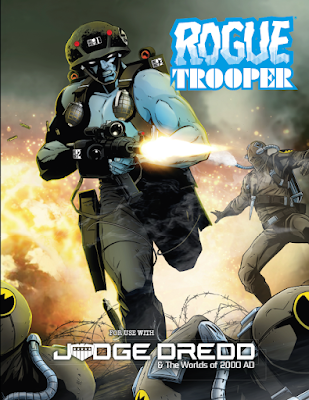
is a supplement for Rogue Trooper. Which itself is a supplement for Judge Dredd and the Worlds of 2000 AD. Published by En Publishing, Rogue Trooper is based on the 2000 AD comic strip of the same name, set in the far future. Two great empires, the Greater Nordland Republic and the Southern Cross Confederacy constantly clash, in particular on Nu Earth. In the past fifty years, this has become a world war, the planet divided between the two factions, known as the Norts and the Southers, and turned into a nuclear, biological, and chemical ravaged wasteland. In order to break the stalemate, Milli-Com of the Southern Cross Confederacy develops elite clones known as G.I.s or Genetic Infantry. When they are deployed in the year ’86, most of the G.I.s are killed in the Quartz Zone Massacre. There would be only one survivor, Rogue, who accompanied by his former squad mates, Bagman, Gunnar, and Helm, downloaded onto biochips and slotted into his gear, would ultimately unmask the traitor responsible for the massacre. With obvious parallels between with the American Civil War, but also drawing on other modern conflicts, especially the First World War and the Vietnam War, Rogue Trooper has been running as an ongoing if irregular series since 1981 and has been developed into a board game from Games Workshop and a computer game. Like many series that appear in the pages of 2000 AD, there is an element of satire to many of the stories, though not as strong as that found within the Judge Dredd stories, and the humour in the stories veers towards the gallows. Rogue Trooper from En Publishing is the first roleplaying treatment of it and enables the players to take the roles of Genetic Infantry or ordinary conscripts and get shipped down to Nu Earth as part of the war effort. The blue-skinned G.I.s are designed to survive in the toxic landscape of Nu Earth. Anyone else will need to wear a chemsuit…

Rogue Trooper: Tour of Nu-Earth 1 is sadly, the only supplement for Rogue Trooper. Like Judge Dredd: Case File Compendium 1 it is an anthology of scenarios. The seven scenarios or ‘Mission Reports’ within its pages are all set on Nu-Earth, the toxic hellhole and battleground which is the main setting for the Rogue Trooper series. Each scenario comes with a full explanation of its plot, clues, NPC stats, details of its aftermath, and a discussion of possible extra plots and developments which can be added or might come about because of the actions of the Player Characters. Many include suggestions on how to use the scenarios with the Judge Dredd setting for Judge Dredd and the Worlds of 2000 AD or the other roleplaying setting, Strontium Dog.

The anthology opens with ‘Horror At Camp Vlad’, the first of three Mission Reports by John White. The Player Characters are a team of Nort military investigators working for the Office of Public Truth sent to Camp Vlad to find out why so many Prisoners of War have been shot making escape attempts. Other options are discussed, including making Camp Vlad a mutant detention camp in Judge Dredd or Strontium Dog. Camp Vlad is located in a stifling jungle far from the frontlines and apart from the escape attempts, everyone is bored stiff and none too happy to see the Player Characters. This is a solid piece of investigation involving an interesting mystery and a fun scenario which gives the Game Master some good NPCs to portray and plays up a few clichés. Plus the players get to roleplay Nort investigators which means they have latitude in how they conduct themselves, which can be fun to roleplay.

It is followed by ‘Killer in the Night’, also by John White. The Game Master has a few NPCs to portray in this Mission Report when the Player Characters, a Southern combat team is an obvious routine mission—guard a group of Nort Prisoners of War being moved from the frontlines to internment elsewhere. The scenario is intentionally linear, since the Player Characters have to travel along a set route, but along the way, something begins to strike at the prisoners—and if not the prisoners, then the guards. Rumours fly around the convoy about ‘Baba Yaga’ stalking both prisoners and guards and so fear mounts. Backed up with random events, this is a creepy game of ‘Ten Little Indians’ on the move across hostile territory (well, almost everywhere is hostile on Nu-Earth).

Benjamin Rogers’ first Mission Report in Rogue Trooper: Tour of Nu-Earth 1 is not so much a ‘Mission Report’ as a campaign concept, but it does include a short scenario. ‘Unlucky 7s’ provides an alternative to the standard campaign set-up in Rogue Trooper which has the Player Characters as ground pounders, or infantry types. Instead of infantry, the Player Characters are the crew of a Hopper, a VTOL vehicle used for a variety of purposes. This discusses the various roles aboard the Hopper, including Commander, Medic, Engineer, EWS/SIGINT (Signals Intelligence) officer, Gunner, Navigator, Pilot, and Sysop, and suggests the skills for each of them. Equipment and several variants are listed too, as well as a table of vehicle traits and the description of the 29th Assault Hopper Squadron, 7th Souther Air Cav, which as the Unlucky 7s, has an ‘unlucky’ reputation. The sample encounter, ‘Relieving Squad Costa’ is a evacuate under fire mission which would get an air cavalry style campaign off to a good start.

‘Deep Trouble’ is John Rogers’ third and final Mission Report in Rogue Trooper: Tour of Nu-Earth 1 and it is designed for use with the previous Mission Report, ‘Unlucky 7s’. When a Souther flier vanishes near Klumpflot Lake in a remote part of the Hell Hunt Jungle with an important intelligence officer aboard, Milli-Comm assigns the recovery mission to the Unlucky 7s and the Player Characters’ vehicle. This mission ups the ante by inverting the environment and making the Player Characters explore the depths of a lake in order to find the wreck of the crashed VTOL. Since this is a lake on Nu-Earth, this is not a pleasant experience and is made all the more challenging by the local flora and fauna and the danger of Nort patrols and possible intervention. ‘Deep Trouble’ is an enjoyably inventive scenario and its inclusion suggests that a campaign revolving around air cavalry and air support could be a lot of fun.

Ben Rogers’ third and final Mission Report in Rogue Trooper: Tour of Nu-Earth 1 is ‘Black Market Shenanigans’ and it continues to support the author’s ‘Unlucky 7s’ campaign set-up. When a fellow soldier is beaten up, the Player Characters go to his aid and in doing so, bring them to the attention of the base’s black-market dealer, ‘Big Moxie’. It turns out the soldier they helped is in debt to the dealer and effectively, so are the Player Characters. Do the Player Characters help him out, and if so how? How do they deal with ‘Big Moxie’—do they pay her off, get into debt themselves, or even end up working for her? This is an entirely base set scenario. Its one weakness is whether or not the Player Characters decide to get involved—and if not, the scenario has ‘Big Moxie’ come after them until they are forced to act. Alternatively, the victim of the thugs sent by ‘Big Moxie’ could have been set up as an NPC earlier in the campaign, perhaps even be one of those rescued in the earlier ‘Relieving Squad Costa’. Apart from this, ‘Black Market Shenanigans’ makes for a nice change of pace, primarily involving social interaction skills and when combat does occur, brawling.

The final Mission Report in Rogue Trooper: Tour of Nu-Earth 1 is ‘Assault on Nu-Everest’ by Adrian Smith. This is another ‘Unlucky 7s’ scenario, more Where Eagle’s Dare than anything else as the Player Characters are assigned a covert extraction mission which turns into an assault and rescue up a mountain whilst being hunted by monsters! The Player Characters can be as loud or as quiet as they want and it should all climax in a chase back down the mountain in order to escape back to their VTOL. If the Player Characters are successful, they have the chance to redeem the reputation of their regiment. This is an entertaining scenario let down by the fact that its plot is explained in the reading rather than at the start, so the Game Master is not forewarned.

Rogue Trooper: Tour of Nu-Earth 1 is in general well written with decent maps as needed and illustrations taken from the comic. It does need an edit in places.

Rogue Trooper: Tour of Nu-Earth 1 is a solid selection of scenarios for Rogue Trooper. One issue is that the majority of the Mission Reports are for the ‘Unlucky 7s’ campaign set-up, so they are difficult to use in a general campaign set on Nu-Earth. If perhaps all of the Mission Reports in the anthology had been written for the ‘Unlucky 7s’ campaign framework, the supplement could have had more focus and some of the scenarios would have been easier to set up. In fact, the other two scenarios could have been moved elsewhere and made way for more scenarios and more development for the ‘Unlucky 7s’ campaign framework. Ultimately, Rogue Trooper: Tour of Nu-Earth 1 is one third one thing, a scenario anthology, and two third another, a campaign. Consequently, it does not as if it is one whole thing. Nevertheless, Rogue Trooper: Tour of Nu-Earth 1 does contain some entertaining and inventive scenarios, and it does come with a decent campaign starter and if a Game Master for Rogue Trooper does not have this supplement, she should definitely buy it as quickly as she can.

Saturday, 19 February 2022

Future War is Hell

Rogue Trooper
is a standalone supplement for Judge Dredd and the Worlds of 2000 AD. Published by En Publishing it is based on the 2000 AD comic strip of the same name, set in the far future. Two great empires, the Greater Nordland Republic and the Southern Cross Confederacy constantly clash, in particular on Nu Earth. In the past fifty years, this has become a world war, the planet divided between the two factions, known as the Norts and the Southers, and turned in a nuclear, biological, and chemical ravaged wasteland. In order to break the stalemate, Milli-Com of the Southern Cross Confederacy develops elite clones known as G.I.s or Genetic Infantry. When they are deployed in the year ’86, most of the G.I.s are killed in the Quartz Zone Massacre. There would be only one survivor, Rogue, who accompanied by his former squad mates, Bagman, Gunnar, and Helm, downloaded onto biochips and slotted into his gear, would ultimately unmask the traitor responsible for the massacre. With obvious parallels between with the American Civil War, but also drawing on other modern conflicts, especially the First World War the Vietnam War, Rogue Trooper has been running as an ongoing if irregular series since 1981 and been developed into a board game from Games Workshop and a computer game. Like many series that appear in the pages of 2000 AD, there is an element of satire to many of the stories, though not as strong as that found within the Judge Dredd stories, and the humour in the stories veers towards the gallows. Rogue Trooper from En Publishing is the first roleplaying treatment of it and enables the players to take the roles of Genetic Infantry or ordinary conscripts and get shipped down to Nu Earth as part of the war effort. The blue-skinned G.I.s are designed to survive in the toxic landscape of Nu Earth. Anyone else will need to wear a chemsuit…

After an overview and introduction, the Rogue Trooper supplement begins with ‘Prior Service and Future Careers’, a guide to character types for the setting. Several options are given, most obviously G.I. Clones and Humans. The first of the others includes the Strigoi, the result of genetic manipulation by the Nordland Republic to create enhanced super soldiers, the strain for which escaped into broader Nort society, enhancing some, whilst others tend towards cruelty and murderous madness. Most carry a minor cosmetic mutation, but those suffering from severe mutations are hunted down by the Office of Genetic Purity. ‘Doll’ G.I. Clones are different to G.I. Clones and have to contend with Milli-Com’s sexist attitude and have only recently been assigned military missions. Blue Mooners are an early Souther genetic experiment, a hardy, short species typically used as cheap labour in mining operations, whilst some have joined travelling bands of entertainers. Semi-Mooners are the offspring of both Humans and Blue Mooners, whilst Sims are the result of another Nort genetic programme, this time creating a simian species typically used as trackers or expendable troops. Robots are also an option and are fully detailed in the Judge Dredd and the Worlds of 2000 AD core rules, though The Robot Wars may also be of use. Each of these species comes with their own Exploits and skill choices as per the core rules.

Character creation in Judge Dredd and the Worlds of 2000 AD involves a player selecting five Careers for his characters and Rogue Trooper includes new Origins, such as Military Brat, Orphan, Survivor, and War Droid, and a variety of Careers to choose from after the Origins. Most of these Careers are Military in nature, so Boot Camp, Fifth-Columnist, Officer, Snow Trooper, Space Marine, and more, but there is the odd Civilian and Criminal Careers too, like the Bounty Hunter and the Marauder. The Explosives Expert, Guerrilla, Medic, Priest, Prisoner, and others fall under the ‘varied’ category and can be civilian or military Careers. There are suggestions too on the Careers from Judge Dredd and the Worlds of 2000 AD which can be used in Rogue Trooper. G.I. characters have their own Careers, starting with G.I. Cadet or G.I. ‘Doll’ Cadet and going on Milli-Com Advanced G.I. Programs such as Basic Mechanics, Combat Range, G.I. Officer Training, Martial Arts, and Trauma First Aid. Notably, the included ‘Rest And Recuperation’ Career enforces the sexist attitude of Milli-Com towards ‘Doll’ G.I. Clones and a gaming group may want to discuss whether it wants to include this aspect of their setting in their campaign.

As a military Science Fiction setting, Rogue Trooper comes with a lengthy equipment chapter which details the huge range of equipment seen in the comic series and fielded by the Norts and the Southers, and the others. The most notable of these are the G.I. rifle, G.I. helmet, and G.I. backpack used by Rogue himself as well as the Biochips—and related technologies—whose personality matrices can be used to store the personality of a biochipped individual. Little all of the equipment, weapons, and vehicles are illustrated, and whilst this is disappointing, obviously, both Game Master and players will need to refer to the comics to get an idea of what they look like—and that is no bad thing in itself. Plus, illustrating all of that would have greatly increased the size of the book.

Where Rogue Trooper begins to feel a little underwritten is in its description of Nu Earth. From the Ab-Yss crevasses caused by subterranean atomic-biological weaponry, Acid Pools, and Chem-Jungles to Pueblo Pyramids, Prisoner of War Camps, and Refugee Camps, the supplement has to cover a lot, but does not always do so in detail. The degree of detail here depends upon the level of detail in the source material, and some entries are accompanied by suggestions as to how the Game Master might use them in play, sometimes more than the actual description. The same applies to specific locations, whether on Nu Earth or beyond, thus Cinnabar ‘The City of Dreams’ is described in some detail, whilst Fort Ant, a Southern outpost which suffered an outbreak of a plague is accorded a single sentence (but actually accompanied by a whole paragraph on how to use it in play). In general, the specific locations are given more attention then the generic, and the same applies to the locations beyond Nu Earth too. There is a timeline here as well, and it is surprising just how short this. Again, that is down to the source material rather than the authors.

In terms of campaign, Rogue Trooper understandably focuses on military campaigns and possible variants. Primarily this is as G.I. Clones, and this has several advantages. One is that such Player Characters can fight unencumbered by armour—unlike other forces on Nu Earth, and the capacity to download a Player Character’s to a Biochip provides a form of immortality. A scenario or even a small campaign could be run with several Player Characters actually surviving as Biochips, though this does have it limitations in terms of character agency. This is supported by Exploits such as ‘All Chip Together’ which enables a G.I. and his Chipped buddies to share LUC pools, and particular features of the backpack, helmet, and rifle which come into play when a Biochip with a personality is slotted into it. Also discussed is how to involve Nort characters in a campaign as Player Characters and the possibility of taking a campaign of Nu Earth or even into other dimensions, such as a crossover with Strontium Dog. All of this is supported by tables for generating military missions, encounters on and off Nu Earth, and rules for asphyxiation—the atmosphere of Nu Earth being toxic—and Nu Earth madness, the long-term reaction to serving on the hellhole that is Nu Earth.

Rogue Trooper comes with not only a short campaign, but two scenarios and a set of mission dossiers. ‘All Hell On The Dix-I Front’ is a detailed campaign outline based on the Rogue Trooper story of the same name and can be played with or without Rogue’s involvement. Over the course of its twelve episodes, the Player Characters attempt to prevent and then survive a surprise attack on the city of Nu-Atlanta by Nort forces. As with other supplements for Judge Dredd and the Worlds of 2000 AD, such as The Robot Wars or Lunar-1, each episode includes a synopsis of the actual story for the comic and then several suggestions as to how to run for the Player Characters. The mission dossiers several detailed outlines, as well as a full scenario, ‘The Perils of Bucky Aurora’ suitable for beginning Player Characters, who are tasked with rescuing an actor who is currently starring in a new and reimagined series based on a beloved space opera video series and who has been kidnapped. Options are included for running it with different groups and set-ups, such as bounty hunters, and the Game Master should definitely let the Player Characters wonder if the actor, Rab Custer, has actually been kidnapped or this is just a new episode being staged for his benefit… The two mission dossiers set off Nu Earth are also fairly detailed. ‘Spy In The Citadel’ is actually based on The 86ers comic strip, which though set in the same universe, is not about Rogue, and involves the Norts rather than the Southers. The mission involves extracting a spy from a Souther space station and requires fewer combat skills than other missions. The set-up, especially using Nort Player Characters, makes this scenario more difficult to use than others, but the Game Master could adapt it if need be. The other scenario, ‘Hunted By Nu-Oktober’, similarly involves fewer combat and more technical skills as the Player Characters are the crew or passengers aboard a Souther scoutship which is targeted by a Nort warship. This has the tension and claustrophobia of a submarine film and should make for a welcome change of pace. Lastly, Rogue Trooper comes with write-ups of the main characters from the comic series. Not just Rogue and his Biochip buddies, but also Brass and Bland, the battlefield scavengers, Major Magnam, the G.I. Officer who hunts Rogue, the Traitor General, and more, whilst an appendix has a glossary of the various terms from the comic.

Physically, Rogue Trooper is decently presented. It uses a lot of artwork from the comic and is in general, an easy book to read. In places it feels underwritten, but that is due to the lack of source material more than anything else. It does feel as if more of the background should have been upfront rather than necessarily leaping straight in with characters and careers, and so on, just to give a little more context for the reader.

Rogue Trooper provides everything that a gaming group would want to play a campaign set in the milieu of the 2000 AD comic strip. From Careers and Exploits to Allies and Enemies via details of both equipment and Nu Earth plus scenarios, Rogue Trooper is a comprehensive guide to taking your players and their characters to war on Nu Earth.