Every Week It's Wibbley-Wobbley Timey-Wimey Pookie-Reviewery...
Showing posts with label Fantasy Flight Games. Show all posts

Saturday, 16 August 2025

[Free RPG Day 2025] Arkham Horror: Comets of Kingsport – A Quickstart Adventure

Now in its eighteenth year, Free RPG Day for 2025 took place on Saturday, June 21st. As per usual, Free RPG Day consisted of an array of new and interesting little releases, which are traditionally tasters for forthcoming games to be released at GenCon the following August, but others are support for existing RPGs or pieces of gaming ephemera or a quick-start. This included dice, miniatures, vouchers, and more. Thanks to the generosity of Waylands Forge in Birmingham, Reviews from R’lyeh was able to get hold of many of the titles released for Free RPG Day.

—oOo—

Arkham Horror: Comets of Kingsport – A Quickstart Adventure is the contribution to Free RPG Day 2025 from Edge Studio. It is a quick-start and scenario for Arkham Horror: The Roleplaying Game, the roleplaying game of Lovecraftian investigative horror derived from Arkham Horror board game and Arkham Horror Living Card game from Fantasy Flight Games, both of which are derived from the original version of the Arkham Horror board game published by Chaosium, Inc. in 1987. Ultimately, Arkham Horror: The Roleplaying Game shares a great deal of setting elements with Call of Cthulhu, but they are not the same roleplaying game. Mechanically, Arkham Horror: The Roleplaying Game has more in common with the GUMSHOE System of Trail of Cthulhu from Pelgrane Press, but plays very differently. Whilst Trail of Cthulhu leans more into a Purist style of play emphasising an atmosphere of menace and growing as a default, Arkham Horror: The Roleplaying Game—at least as far as the Arkham Horror: Comets of Kingsport – A Quickstart Adventure is concerned—is more of a Pulp affair, playing up action and adventure and including Investigators who are not only aware of the Mythos, but also know a few spells too. There are elements too, drawn from EDGE Studio’s Genesys System, used to handle the perils of investigating the Mythos.

Arkham Horror: Comets of Kingsport – A Quickstart Adventure includes everything that a gaming group needs. It explains the rules, provides a full scenario that can be played in a single session or so, and gives a set of six pre-generated Investigators. Apart from copies of the pre-generated Investigators, the only thing it needs is a set of six six-sided per player, plus a lot more for the Keeper and some dice of a different colour. Arkham Horror: Comets of Kingsport – A Quickstart Adventure and Arkham Horror: The Roleplaying Game use what is called the ‘Dynamic Pool System’. An Investigator is primarily defined by ten skills—Agility, Athletics, Intuition, Knowledge, Lore, Melee Combat, Presence, Ranged Combat, Resolve, and Wits. Of these, Lore is how much an Investigator knows about the occult and how to apply it, if necessary. Skills are rated between two and six. He has a variety of Knacks, special abilities that might grant him extra dice, alter the number of dice rolled, allow special actions, cast spells, rerolls of the dice, and more. There is a wide variety of Knacks, even presented in the six pre-generated Investigators in Arkham Horror: Comets of Kingsport – A Quickstart Adventure.

Lastly, an Investigator has a pool of six-sided dice, typically six. These are used and refreshed from one scene to the next and they represent a combination of an Investigator’s effort and health. In the case of the latter, when an Investigator is injured, he loses dice, limiting his actions until he can rest, heal, and receive medical attention.

When a player wants his Investigator to undertake a Complex action, such as climbing a fence in a chase, shooting cultist in a gunfight, researching a newspaper morgue for clues, or casting a spell, he takes as many dice as he wants from his pool and rolls them, comparing the results with the skill being used. For each die result equal to, or greater than, the value of the skill, a success is scored. In general, only a single success is required to achieve whatever an Investigator wants to do, but more successes are needed to trigger the effects of some Knacks. For example, Silas Marsh has ‘Skilled Shot’ and can throw a harpoon as a ranged combat action, and if his player rolls three successes, the target cannot use a reaction to avoid the attack. (This is in addition to the weapon itself, which inflicts a base of two damage—most weapons inflict one or two points of damage, and if three or more success are rolled on an attack, in Injury is inflicted and extra damage is inflicted per Injury, making it a very deadly weapon.) Complex actions can also be rolled with Advantage or Disadvantage, rolling with one more or one less die in either case.

In addition, an Investigator has a supply of Insight points. These can be spent to add an additional success to a complex action, take a Complex Action with Advantage, to add a narrative element to a scene, or to avoid certain trauma.

Play itself in Arkham Horror: The Roleplaying Game is handled as a series of scenes, either Narrative or Structured scenes in which Simple and Complex Actions are attempted. Narrative scenes rarely involve peril, and allow an Investigator to undertake Simple Actions without his player needing to roll dice, whereas Structured scenes do involve peril or great difficulty, such as a combat scene or a confrontation with the Mythos, require a player to roll for both Simple and Complex Actions. Although a player only has access to six dice in his pool—or less depending upon trauma and Injury, this pool refreshes from one scene to the next, and in combat, they are refreshed at the start of an Investigator’s turn. In combat, damage is inflicted in two ways. Primarily by reducing a defendant’s dice pool, limiting his capacity to act, wounding him if the dice pool is reduced to zero, after which he can strain himself to restore his dice pool to full at the cost of suffering an Injury. The other way is by a weapon specifically inflicting an Injury. Injuries are determined by rolling on the Injury Table. These are rolled on a single die, to which are added the number of injuries already suffered. Since the Injury roll is made on a single die, it takes a lot of injuries—at least five—before someone can be killed straight off. There is no little grievous Injury in the meantime, but it is difficult to kill a defendant and certainly an Investigator.

The way of handling Horror Damage or exposure to the cosmic truths of the universe is more interesting, though similar to that used for injuries. When an Investigator suffers Horror Damage—whether from a spell cast at him, seeing a creature of the Mythos, or reading a horrific tome—his player replaces a number of dice in his dice pool with Horror Dice equal to the Horror Damage suffered. Horror Dice work exactly like normal dice in a player’s dice pool and can be lost if an Investigator suffers damage. However, should a player roll a one on any single Horror Die, his Investigator gains a Trauma. The rolls a single die and consults the Trauma Table, adding one for each one rolled on the Horror Dice. Where an Investigator is physically resilient, the same cannot be said mentally. It is a lot easier in comparison to get Horror Dice, roll ones, and suffer Trauma and since there are fewer results on the Trauma Table, for an Investigator to be ‘Lost Forever’.

Horror Dice can be healed from one round to the next, as well as by certain Knacks and spells, replacing them with standard dice. This is an action though and in a Structured Scene, the Investigators might not have the opportunity. Whereas injuries can be healed though, traumas cannot, although they can recede over time. The combination of Horror Dice and Trauma is intriguing as a means of handling the escalating danger of being exposed to cosmic threat, but it does feel undercut by the ability to heal Horror Dice within a scene.

In terms of pre-generated Investigators, Arkham Horror: Comets of Kingsport – A Quickstart Adventure gives six. They include a clever and helpful postal woman; strong sailor armed with a harpoon; a student with first aid skills and good at improvising weapons; a librarian who can cast spells and draw upon the horrors she has seen to gain Horror Dice and bonus dice to a roll; a prepared researcher who is good with people; and a professor who can choose to suffer an Injury or Horror Dice and who is also a skilled shot. All also have a section of equipment and besides a short background, there is also an explanation of the basic rules and the use of Insight on the back. All of the Investigators have travelled to Kingsport, some of them from Arkham’s Miskatonic University, to conduct an anthropological survey in the New England port. Players with a bit of history with roleplaying games of Lovecraftian investigative horror will appreciate that the professor in the included Investigators is none other than Harvey Walters, who appeared as the sample Investigator for the first time all the way back in the first edition of Call of Cthulhu.

The included scenario in Arkham Horror: Comets of Kingsport – A Quickstart Adventure opens with the Investigators visiting the Hall School in Kingsport to examine its rare book collection. Both the school secretary and the headmaster are welcoming, but they are concerned about a member of staff, Cecil Blackburn, who has been behaving oddly, even erratically. When they encounter him, he is found in a bath of salt water, weirdly mishappen, and rage-fuelled! The question is, what has happened to him? The plot and clues link to other citizens of Kingsport acting strangely and ultimately to somewhere otherworldly and further confrontation with something even stranger. It is a solid mix of investigation and interaction leavened with some action, decently presented and written. The primary difficulty with the scenario is the need to make slight adjustments to the plot links with fewer players and Investigators.

Physically, Arkham Horror: Comets of Kingsport – A Quickstart Adventure is decently presented and written. The artwork is disappointingly restricted to just the front cover and the Investigator illustrations, but still very good. A map or two might have been useful, whether of Kingsport or the scene of the scenario’s climax, and it does feel odd that the scenario is presented before the rules are explained.

Arkham Horror: Comets of Kingsport – A Quickstart Adventure provides everything that a group will need to try out Arkham Horror: The Roleplaying Game. It is accessible and comes with a decent investigative and interactive scenario that has a certain weirdness to it. The rules are clearly explained and easy to grasp with a good explanation of the ‘Dynamic Pool System’ on the back of each Investigator sheet, making them also easily accessible. The ‘Dynamic Pool System’ itself lies at the lighter and Pulpier end of the Lovecraftian investigative horror spectrum, both mechanically and thematically. The Investigators are tougher and even augmented in comparison to other roleplaying games of Lovecraftian investigative horror spectrum and because of this, the likelihood is that Arkham Horror: Comets of Kingsport – A Quickstart Adventure is going to divide its intended audience very much along the Purist-Pulp faultline.

Friday, 24 December 2021

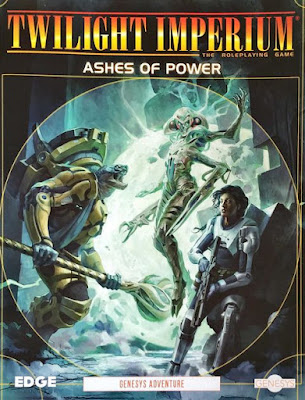
[Free RPG Day 2021] Twilight Imperium: Ashes of Power

Now in its fourteenth year, Free RPG Day in 2021, after a little delay due to the global COVID-19 pandemic, took place on Saturday, 16th October. As per usual, it came with an array of new and interesting little releases, which traditionally would have been tasters for forthcoming games to be released at GenCon the following August, but others are support for existing RPGs or pieces of gaming ephemera or a quick-start. Of course, in 2021, Free RPG Day took place after GenCon despite it also taking place later than its traditional start of August dates, but Reviews from R’lyeh was able to gain access to the titles released on the day due to a friendly local gaming shop and both Keith Mageau and David Salisbury of Fan Boy 3 in together sourcing and providing copies of the Free RPG Day 2020 titles. Reviews from R’lyeh would like to thank all three for their help.

—oOo—

For Free RPG Day 2021, EDGE Studio offered Twilight Imperium: Ashes of Power. This is a quick-start for Embers of the Imperium, the roleplaying game based on Twilight Imperium, the classic ‘4x’ (eXplore, eXpand, eXploit, and eXterminate) board game. It uses the Genesys Narrative Dice System—first seen in Warhammer Fantasy Roleplay, Third Edition—but ultimately derived from the original Doom and Descent board games. Twilight Imperium: Ashes of Power comes with everything necessary to play—an explanation of the rules, four pregenerated characters, and an exciting, action-packed scenario for the Game Master to run. What it does not come with is dice and the fact that both the Genesys Narrative Dice System and Embers of the Imperium—and therefore Twilight Imperium: Ashes of Power—use propriety dice is a small problem. Not an insurmountable one, but a small problem, nonetheless. Fortunately, EDGE Studio has made available a Genesys Dice App free to download which will alleviate that problem unless one or of the players lacks a mobile device.

Twilight Imperium: Ashes of Power opens with a rules summary. The core mechanic requires a player to roll a pool of dice to generate successes and should the roll generate enough successes, his character succeeds in the action being attempted. The complexity comes in the number of dice types and the number of symbols that the players need to keep track of. On the plus side, a player will be rolling Ability dice to represent his character’s innate ability and characteristics, Proficiency dice to represent his skill, and Boost dice to represent situational advantages such as time, assistance, and equipment. On the negative side, a player will be rolling Difficulty dice to represent the complexity of the task being undertaken, Challenge dice if it is a particularly difficult task, and Setback dice to represent hindrances such as poor lighting, difficult terrain, and lack of resources. Ability and Difficulty dice are eight-sided, Proficiency and Challenge dice are twelve-sided, and Boost and Setback dice are six-sided.

When rolling, a player wants to generate certain symbols, whilst generating as few as possible of certain others. Success symbols will go towards completing or carrying out the task involved, Advantage symbols grant a positive side effect, and Triumph symbols not only add Successes to the outcome, but indicate a spectacularly positive outcome or result. Failure symbols indicate that the character has not completed or carried out the task, and also cancel out Success symbols; Despair symbols count as Failure symbols indicate a spectacularly negative outcome or result, and cancel out Triumph symbols; and Threat symbols grant a negative side effect and cancel out Advantage symbols. Only Success and Failure results indicate whether or not a character has succeeded at an action—the effects of the Advantage, Triumph, Despair, and Threat symbols come into play regardless of whether the task was a success or not. Task difficulties range from one Difficulty die for easy tasks up to five for Formidable tasks, and in addition, certain abilities enable dice to be upgraded or downgrade, so an Ability die to a Proficiency die or a Challenge die down to a Difficulty die.

In general, the dice mechanics in the Genesys Narrative Dice System—and thus, Twilight Imperium: Ashes of Power—are straightforward enough despite their complexity. They are perhaps a little fiddly to assemble and may well require a little adjusting to, especially when it comes to narrating the outcome of each dice roll.

Combat is more complex. Initiative is handled by a skill roll—using Cool or Vigilance, and attack difficulties by range and whether or not the combatants are engaged in melee combat. Damage is inflicted as either Strain, Wounds, or Critical Injuries. Strain represents mental and emotional stress, Wounds are physical damage, as are Critical Injuries, but they have a long effect that lasts until a Player Character receives medical treatment. When a Player Character suffers more Wounds than his Wound Threshold, he suffers a Critical Injury, and when he suffers Strain greater than his Strain Threshold, he is incapacitated. The various symbols on the dice can be spent in numerous ways in combat to achieve an array of effects. So a Triumph symbol or enough Advantage symbols could inflict a Critical Injury, allow a Player Character to perform an extra manoeuvre that round, and so on, whilst Threat and Failure symbols inflict Strain on a Player Character, three Threat symbols could be spent to knock a Player Character prone, and so on. Twilight Imperium: Ashes of Power includes a table of options for spending Advantage, Triumph, Threat, and Despair in combat, as well as a table of critical Injury results. It does not, however, include a table for spending Advantage, Triumph, Threat, and Despair out of combat—a disappointing omission for anyone wanting to do a bit more with their character’s skills. That said, the Game Master should be able to adjust some of the options on the table to non-combat situations.

Lastly, the rules in Twilight Imperium: Ashes of Power cover NPCs and Story points. Apart from nemesis-type NPCs, most NPCs treat any Strain they suffer as equal to Wounds, and Minions work together as a group. In Twilight Imperium: Ashes of Power, there are two pools of Story Points—one for the Player Characters, one for the GM. They can be used to upgrade a character’s dice pool or the difficulty of a skill check targeting a character—NPC or Player Character in either case, or to add an element or aspect to the ongoing story. The clever bit is that when a Story Point is spent, it does not leave the game, but is shifted over to the pool of Story Points. So if the Game Master spends a Story Point to increase the difficulty of a Player Character’s Perception check to determine the motives of an NPC, she withdraws it from her own Game Master pool of Story Points and adds it to the players’ pool of Story Points. As a game proceeds and Story Points are spent and move back and forth, it adds an elegant narrative flow to the mechanics and will often force the players to agonise whether they should spend a Story Point or not as they know it is going to benefit the Game Master and her NPCs before it comes back to them.

A character in Twilight Imperium: Ashes of Power has six characteristics—Agility, Brawn, Cunning, Intellect, Presence, and Willpower, plus a range of skills from Charm, Computers, and Cool to Ranged (attacks), Skulduggery, and Vigilance, as well as range of special abilities. The four pre-generated Player Characters include a reptilian Xxcha, an overly optimistic liaison who carries an antique Lazax grav-mace; a Human Orbital Drop Soldier with a dislike of the L1Z1X; a curious Hylar Field Scholar who travels in an exosuit which enables him to survive out of water; and a Hacan Wayfarer merchant captain looking to restore her family fortune and is an expert negotiator with word and gun. All four Player Characters are nicely presented in a busy, but easy to access character sheet which gives a clear explanation of the character background, roleplaying notes, skills, equipment, abilities, and so on—plus each comes with a decent illustration of the character. Of note, each Player Character has an agenda, for example, the Hylar Field Scholar’s requirement to record and gather all data and samples they can of new or archaic technologies. There are boxes throughout the scenario which inform the Game Master when each of the Player Characters has an opportunity to fulfil their agenda, and notably, it is not up to the player to remember to bring it into play, but rather that the Game Master should remind the player. As such, there is no benefit in game to fulfilling an agenda, but it does provide roleplaying opportunities and motivation, and provides a chance for each player to showcase his character.

The setting for Twilight Imperium and thus for Embers of the Imperium and Twilight Imperium: Ashes of Power, is a space opera in a vast, sprawling galaxy. For twenty thousand years, the galaxy prospered under the Lazax Empire, governed by a Galactic Council which gave everyone a voice. Both the Lazax and the empire would be destroyed in a series of wars that would culminate in the bombardment of Mecatol Rex, glittering throne world of the Lazax and the seat of Council, by the reviled Mahact Kings. The subsequent Twilight Wars lasted for millennia, but more recently, the great galactic powers have come together—warily, and established a Galactic Council amidst the ruins of Mecatol City. There is peace, measured diplomacy, and careful co-operation, but in a new age when the members of the councils do not yet fully trust each other, there remain threats which would return the galaxy to chaos once more—the L1Z1X Mindnet, Vuil’Raith Cabal, Mahact Gene-Sorcerers, and Nekro Virus. In response, the Galactic Council established the Keleres, an agency dedicated to dealing with threats larger than any one faction can effectively deal with. Though dedicated to the safety of the galaxy, the Keleres is dependent on the factions for support and resources, as well as for its members—also known as Keleres—and most of them have to answer to their sponsors as well as the agency. The Player Characters are of course, members of the Keleres.

The scenario in the quick-start, ‘Ashes of Power’, sends the Keleres to Herool’s Truce, a tidally locked world which has only regained contact with the rest of galaxy in recent years and from where a Keleres informant has reported the possible discovery of unknown, Imperial-era technology and the presence of unsanctioned L1Z1X agents. There they are to investigate the possible disappearance of the informant, confirm the discovery of the ancient technology, and if they do, prevent it from falling into the hands of the L1Z1X agents. It sounds a simple enough mission, but the Player Characters will need to find the ship they have been assigned, get to the planet, deal with it bureaucracy, follow up on a rumour or two, all before facing off against the cybernetically enhanced L1Z1X agents. Divided into three acts, in the first act, the Player Characters will be briefed about their mission and find their ship; in the second, they will conduct their investigation on Herool’s Truce; whilst in the third, they will confront the L1Z1X team and discover whether or not the rumours of ancient technology are true. The scenario takes its time to help the Game Master, clearly indicating skills necessary and their possible outcomes, as well as presenting numerous ways in which the Keleres can approach the mission. They can be open about it with the local authorities, they can try and avoid getting the authorities involved, and although there are numerous opportunities for combat and conflict, with many of them, the scenario also suggests other ways of dealing with the situations. Along the way, there are opportunities for each of the Player Characters to fulfil their personal agendas and explore an interesting world which has been cut off from the rest of the galaxy for centuries and consequently has an interesting society and geography. There are lots of chances to roleplay too, which is helped by the succinctly done backgrounds for each of the Player Characters. 

The scenario concludes with notes as to what happens next. This takes into account the fact that the Player Characters might not succeed or might even side with the L1Z1X agents! There are consequences to both outcomes as well as their being successful, and these could play out should the Game Master continue with an Embers of the Imperium campaign. In addition, the PDF version of Twilight Imperium: Ashes of Power comes with support that includes two extra Player Characters, their agendas, and extra encounters for the scenario’s third act. Also included is a map—which was not in the Free RPG Day release. The extras increase the number of players possible or character choices available.

Physically, Twilight Imperium: Ashes of Power is as nicely done as you would expect from the publisher. It is well written, the full artwork is good, and the sample Player Characters are excellent. If there is a downside perhaps it is that few of the NPCs are illustrated, and there are no maps or illustrations of the world of Herool’s Truce, both of which would have helped the Game Master portray the world for her players.

Ultimately, if there is an issue with Twilight Imperium: Ashes of Power, it is that it uses the Genesys Narrative Dice System and that does take some adjusting to. Get past that though, and Twilight Imperium: Ashes of Power offers up not just a solid introduction to the system, but a thoroughly entertaining and exciting introduction to Embers of the Imperium with a really good scenario and some nicely done pre-generated Player Characters. 

Friday, 18 September 2020

[Free RPG Day 2020] Keyforge: Secrets of the Crucible – Maw of Abraxas

Now in its thirteenth year, Free RPG Day in 2020, after a little delay due to the global COVID-19 pandemic, took place on Saturday, 25th July. As per usual, it came with an array of new and interesting little releases, which traditionally would have been tasters for forthcoming games to be released at GenCon the following August, but others are support for existing RPGs or pieces of gaming ephemera or a quick-start. Again, global events meant that Gen Con itself was not only delayed, but run as a virtual event, and likewise, global events meant that Reviews from R’lyeh could not gain access to the titles released on the day as no friendly local gaming shop was participating nearby. Fortunately, Reviews from R’lyeh has been able to gain copies of many of the titles released on the day, and so can review them as is the usual practice. To that end, Reviews from R’lyeh wants to thank both Keith Mageau and David Salisbury of Fan Boy 3 in sourcing and providing copies of the Free RPG Day 2020 titles.

The contribution to Free RPG Day 2020 from Fantasy Flight Games is Keyforge: Secrets of the Crucible – Maw of Abraxas. This is a quick-start for use with Keyforge: Secrets of the Crucible, the roleplaying game based on the setting for Richard Garfield’s KeyForge: Call of the Archons, the world’s first Unique Deck Game. It uses the Genesys Narrative Dice System—first seen in Warhammer Fantasy Roleplay, Third Edition—but ultimately derived from the original Doom and Descent board games. 
Keyforge: Secrets of the Crucible – Maw of Abraxas comes with everything necessary to play—an explanation of the rules, four pregenerated characters, and an exciting, action-packed scenario for the Game Master to run. What it does not come with is dice and the fact that both the Genesys Narrative Dice System and Keyforge: Secrets of the Crucible—and therefore Keyforge: Secrets of the Crucible – Maw of Abraxas—use propriety dice is a problem. Not an insurmountable one, but a problem, nonetheless.

Keyforge: Secrets of the Crucible – Maw of Abraxas opens with a rules summary. The core mechanic requires a player to roll a pool of dice to generate successes and should the roll generate enough successes, his character succeeds in the action being attempted. The complexity comes in the number of dice types and the number of symbols that the players need to keep track of. On the plus side, a player will be rolling Ability dice to represent his character’s innate ability and characteristics, Proficiency dice to represent his skill, and Boost dice to represent situational advantages such as time, assistance, and equipment. On the negative side, a player will be rolling Difficulty dice to represent the complexity of the task being undertaken, Challenge dice if it is a particularly difficult task, and Setback dice to represent hindrances such as poor lighting, difficult terrain, and lack of resources. Ability and Difficulty dice are eight-sided, Proficiency and Challenge dice are twelve-sided, and Boost and Setback dice are six-sided.

When rolling, a player wants to generate certain symbols, whilst generating as few as possible of certain others. Success symbols will go towards completing or carrying out the task involved, Advantage symbols grant a positive side effect, and Triumph symbols not only add Successes to the outcome, but indicate a spectacularly positive outcome or result. Failure symbols indicate that the character has not completed or carried out the task, and also cancel out Success symbols; Despair symbols count as Failure symbols indicate a spectacularly negative outcome or result, and cancel out Triumph symbols; and Threat symbols grant a negative side effect and cancel out Advantage symbols. Only Success and Failure results indicate whether or not a character has succeeded at an action—the effects of the Advantage, Triumph, Despair, and Threat symbols come into play regardless of whether the task was a success or not. Task difficulties range from one Difficulty die for easy tasks up to five for Formidable tasks, and in addition, certain abilities enable dice to be upgraded or downgrade, so an Ability die to a Proficiency die or a Challenge die down to a Difficulty die.

In general, the dice mechanics in the Genesys Narrative Dice System—and thus,
Keyforge: Secrets of the Crucible – Maw of Abraxas—are straightforward enough despite their complexity. They are perhaps a little fiddly to assemble and may well require a little adjusting to, especially when it comes to narrating the outcome of each dice roll.

Combat is more complex. Initiative is handled by a skill roll—using Cool or Vigilance, and attack difficulties by range and whether or not the combatants are engaged in melee combat. Damage is inflicted as either Strain, Wounds, or Critical Injuries. Strain represents mental and emotional stress, Wounds are physical damage, as are Critical Injuries, but they have a long effect that lasts until a Player Character receives medical treatment. When a Player Character suffers more Wounds than his Wound Threshold, he suffers a Critical Injury, and when he suffers Strain greater than his Strain Threshold, he is incapacitated. The various symbols on the dice can be spent in numerous ways in combat to achieve an array of effects. So a Triumph symbol or enough Advantage symbols could inflict a Critical Injury, allow a Player Character to perform an extra manoeuvre that round, and so on, whilst Threat and Failure symbols inflict Strain on a Player Character, three Threat symbols could be spent to knock a Player Character prone, and so on. 
Keyforge: Secrets of the Crucible – Maw of Abraxas includes a table of options for spending Advantage, Triumph, Threat, and Despair in combat, as well as a table of critical Injury results. It does not, however, include a table for spending Advantage, Triumph, Threat, and Despair out of combat—a disappointing omission for anyone wanting to do a bit more with their character’s skills. That said, the Game Master should be able to adjust some of the options on the table to non-combat situations.

Lastly, the rules in 
Keyforge: Secrets of the Crucible – Maw of Abraxas cover NPCs and Story points. Apart from nemesis-type NPCs, most NPCs treat any Strain they suffer as equal to Wounds, and Minions work together as a group. In Keyforge: Secrets of the Crucible, there are two pools of Story Points—one for the Player Characters, one for the GM. They can be used to upgrade a character’s dice pool or the difficulty of a skill check targeting a character—NPC or Player Character in either case, or to add an element or aspect to the ongoing story. The clever bit is that when a Story Point is spent, it does not leave the game, but is shifted over to the pool of Story Points. So if the Game Master spends a Story Point to increase the difficulty of a Player Character’s Perception check to determine the motives of an NPC, she withdraws it from her own Game Master pool of Story Points and adds it to the players’ pool of Story Points. As a game proceeds and Story Points are spent and move back and forth, it adds an elegant narrative flow to the mechanics and will often force the players to agonise whether they should spend a Story Point or not as they know it is going to benefit the Game Master and her NPCs before it comes back to them.

A character in Keyforge: Secrets of the Crucible has six characteristics—Agility, Brawn, Cunning, Intellect, Presence, and Willpower, plus a range of skills from Charm, Computers, and Cool to Ranged (attacks), Skulduggery, and Vigilance, as well as range of special abilities. The four pregenerated Player Characters include a Saurian Crœniac with a Cybersensor Implant for better perception and a hacking rig; a Human Discoverer whose Zoomclaw is a rocket-propelled grappling hook that both climbing tool and weapon; a Spirit Arbitrator, an incorporeal being clad in containment armour who was exiled from his knightly order for bounding with a sentient sword called Vizer; and an Elf of the Shadowws whose faerie companions aid him in mechanical tasks and acts of skulduggery. All four Player Characters are nicely presented in a busy, but easy to access character sheet.

Each Player Character also has a way to use Æmber, the golden, glowing substance found only on the Crucible—the setting for Keyforge: Secrets of the Crucible—which is often processed to perform a single, specific function, such as currency. In its raw state it can be used to do strange and wondrous things. For example, Saurian Crœniac uses it to fuel a hazard field which makes attacks against more difficult, the Human Discoverer to make attacks with Zoomclaw jet-propelled, and so on. These are all one-shot abilities until the characters can obtain some more raw Æmber.

The setting for ‘Maw of Abraxas’, the scenario in
Keyforge: Secrets of the Crucible – Maw of Abraxas is Crucible, the ‘Impossible World’, a Jupiter-sized world made up of innumerable different zones, each a different environment or climate. In effect, it is a multiverse in one place, a multi-genre setting made up of multiple settings. In ‘Maw of Abraxas’, the Player Characters will see just a few of them—a glass jungle, a tightly regulated agrisector, a lake wrought with multiple storms, and the ancient ruins of a lost civilisation. In the scenario, the quartet of heroes have been asked by their boss, the tentacular Fixer, to recover the Cube of Realities, a weird artefact with the capability of warping the world around its user. He wants to ensure that it does not fall into the wrong hands. Unfortunately, the militant, xenophobic Martians already have it, but to prevent it being stolen or falling into the hands of their enemies have hidden it aboard a prototype saucer ship which even they cannot track or scan for! However, contact with the saucer has been lost, but fixer has learned that its designer created a device, the Vez Q-37 Scanulator, which can detect where the saucer is. So all the Player Characters have to do is steal the Vez Q-37 Scanulator from a Martian base and fight their way out, get across several sectors by Teleporter Cannon and then a couple more by whatever means necessary, find the lost saucer ship and grab the Cube of Realities. Easy, right? Of course not!

Consisting of just three acts, ‘Maw of Abraxas’ begins by dropping the Player Characters in media res and never lets up on the action or pacing. It should provide a session or so’s worth of play and comes with suggestions as to what each Player Character could do in a scene, and showcases a little of the diversity of the Crucible as a setting. The Player Characters all feel very different and the adventure should give them each a chance to shine.

Physically, 
Keyforge: Secrets of the Crucible – Maw of Abraxas is very nicely presented, in full vibrant colour. The artwork is excellent, if a little busy in places, and the book is well written and easy to understand.

The one downside to 
Keyforge: Secrets of the Crucible – Maw of Abraxas is that it uses the Genesys Narrative Dice System and that means using propriety dice. Now on the weekend of Free RPG Day 2020, the dice app for Genesys was available for free and that was very generous of the publisher. Of course, if a group is already playing Genesys or Keyforge: Secrets of the Crucible, and has either the dice or the app, then Keyforge: Secrets of the Crucible – Maw of Abraxas is easy enough to run and play, whether that is as extra scenario for an existing Keyforge: Secrets of the Crucible campaign or as an introduction to the setting. If not, then Keyforge: Secrets of the Crucible – Maw of Abraxas is unplayable, which is a pity because it is a fun scenario, though of course, a Game Master might be inspired to get either dice or app after reading though it so that she can run the scenario.

That issue aside, 
Keyforge: Secrets of the Crucible – Maw of Abraxas is an entertaining and fun introduction to Keyforge: Secrets of the Crucible. As a quick-start to both rules and setting, it is exactly the type of thing you want to pick up on Free RPG Day.

Saturday, 13 April 2019

The Rokugani Register

Emerald Empire – The Essential Guide to Rokugan is the second supplement to be published for the fifth edition of the Asian fantasy roleplaying game, Legend of the Five Rings, now published by Fantasy Flight Games. Its release offsets an issue with the core rulebook, the lack detail in terms of the roleplaying game’s setting of Rokugan. This supplement greatly expands upon what was given in the core rulebook, not only examining particular elements of Rokugan—geographical, political, cultural, and philosophical—but also supporting these aspects with examples, rumours, NPCs, and scenario hooks. Over the course of six chapters—‘Strongholds of Power’, ‘Centers of Trade’, ‘Heart of the Empire’, ‘Sacred Spaces’, ‘Paths to Enlightenment’, and ‘Wilds of Rokugan’—it looks at the Emerald Empire’s customs and social structure, its politics and arts, how it maintains law and order, its religion, how it educates its people, its attitudes towards money and how it conducts commerce, how it goes to war, and its attitude towards and what little it knows about the various Gaijin peoples beyond its borders. Plus a seventh chapter gives new player character options.

Emerald Empire – The Essential Guide to Rokugan opens with an extended timeline covering the time before history and then the first thousand years of Rokugan’s history. A more detailed history than that found in the core rulebook, this is not a year-by-year guide with a list of all of the emperors, but more of a story told. This is followed by the seven chapters, each a lengthy essay which covers various facets of its subject. For example, the first chapter, ‘Strongholds of Power’ explores castles in Rokugan, what daily life is like in a castle for inhabitants, guests, staff, and servants; their construction, typical buildings, and where they might be found; and what role they play in Rokugan. The latter covers lordship and governance, a lord’s duties, as well as courts, their inhabitants, and more. This also includes marking the difference between shiro and kyūden—castles and palaces—the primary difference being that kyūden are capable of hosting the hugely expensive, annual winter courts traditionally attended by the emperor, but of course, the line between the two has blurred over the centuries. Castles are typically the place where a samurai’s gempuku—his coming of age ceremony—is typically held, so this is also detailed, as is the role of jesters at court, the duties of the all but invisible servants, and private speech. Besides examining strongholds as places of power, the chapter looks at how power itself is projected through war and diplomacy, the latter tying back to the discussion of how courts are organised and run, the former also looking at specific conflicts and how each clan handles war.

The detail and background in ‘Strongholds of Power’ is supported with game specific content. This includes descriptions of particular shiro and kyūden, such as Toshi Ranbo, a site of major Lion-Crane conflict; Kyūden Bayushi, the home of the Scorpion clan’s ruling family with its infamous Traitor’s Grove; Kyūden Doji, the seat of the Crane clan’s ruling family, famous for its plateau-by-sea location and gardens; the Imperial Palace itself; and more. In each case, the locations are accompanied by sample rumours, NPCs, and detailed adventure seeds, which the Game Master can bring to her campaign. This is in addition to the ideas in the background content which could easily be developed into scenarios and campaigns. For example, the description of the Imperial Palace includes the detail that whilst the emperor is away at a Winter Court, a group of samurai is accorded the honour of serving as caretakers whilst the Imperial Court is elsewhere. This lends itself to a duty to be assigned to the player characters and indeed, the adventure seed supports this campaign set-up.

This format is followed through the rest of the supplement. Thus ‘Centers of Trade’ covers Rokugan’s economy and commerce, towns and cities and the lives of those who reside there, harbours and lighthouses, crime and punishment, and so on. As well as some interesting examples, such as the City of the Rich Frog, contested by the Dragon, Lion, and Unicorn clans whilst the Dragonfly minor clan looks on, it also looks at the lives of those outside of the Samurai class. Not just the peasantry, but for the first time, the reviled gaijin or foreigners. It includes notes on playing both Emerald magistrates and Clan magistrates, and to that end, how Rokugani investigate crime and view evidence versus testimony.

Having visited Rokugan’s towns and cities, ‘Heart of the Empire’ takes the reader beyond them along the roads and rivers of the empire to wider settled areas, mostly held in higher esteem by the samurai class because this is where the peasantry carries out the honourable task of growing the rice that the empire lives on. Notably this highlights the relationship between the peasants and their samurai masters, subservient but rarely having to interact with them and rarely wanting to. 

 ‘Sacred Spaces’ and ‘Paths to Enlightenment’ are really paired chapters, as both explore the sacred, religious, and cosmographical aspects of Rokugan. The first chapter takes the reader from ‘Ningen-dō’, the physical Rokugan, to the spiritual realms that sit above, below, and contiguous with the land, visiting each one in term, as well as examining the Kami and the Fortunes, shrines, religious practices and festivals, and sacred sites. The section on forbidden religious will probably receive particular attention by the Game Master, covering as it does corrupted shrines, curses, the practice of Mahō, and more. This is only an introduction of course and likely receive a fuller description in another supplement. The second chapter pays particular attention to the Emerald Empire’s two Imperially mandated combined faiths—Shinseism and Fortunism—and the lives of the monks who worship each. This will be of particular interest to players who wish to roleplay monks.

Penultimately, ‘Wilds of Rokugan’ goes beyond the civilised regions of Rokugan and the empire and into untamed nature. It gives reasons for going there—the coasts, forests,and mountains—and who might be found there, including gaijin as well as samurai. Notable locations include the great Kitsune and Shinomen forests, the former home to the Fox minor clan and famous for its fox spirits, the latter for its violent spirits. Lastly, the ruins section introduce the reader to some of the remnants of the civilisations which existed before the descent of the Kami to ‘Ningen-dō’. Again, this waits to be expanded upon.

Rounding out Emerald Empire is ‘New Player Options’. This introduces the Imperial Families, those which serve the Emperor directly, as player characters. They include the Miya, Otomo, and Seppun families along with the Miya Cartographer, Miya Herald, Otomo Schemer, Seppun Astrologer, and Seppun Palace Guard schools. For the most part their roles are obvious, but the Otomo Schemer actually works to maintain the power and authority of the Emperor, even at the cost of the great clans. These options tie back into the ‘Strongholds of Power’ chapter, as does the inclusion of new Titles—essentially new positions of power and influence—like Advisor, , Daimyō, and Gunsō (commander of a unit of soldiers); whereas Clan Magistrate and Yoriki (deputies to magistrates) link back to the ‘Centers of Trade’ chapter and the Monastic Acolyte and Priest (who unlike Shugenja cannot cast spells) are nods to the ‘Sacred Spaces’ and ‘Paths to Enlightenment’ chapters. Other titles, like Spy and Yōjimbō work across all of the chapters, as do two news schools which also break the rules in their own way. In Legend of the Five Rings and Rokugan, schools are well-practiced training paths and philosophies, but the two given at the end of Emerald Empire present outsiders trying to fit in for their own purposes. These are the Kitsune Impersonator Tradition and the Kolat Saboteur Conspiracy. Both require careful play if they are to be added to a campaign with any player taking either ‘school’ needing to work closely with the Game Master to make sure their roles are kept hidden. Rounding out ‘New Player Options’ is a wide range new advantages and disadvantages.

Packaged as a handsome hardback, physically, Emerald Empire is another stunning looking book, in keeping with the rest of the line. Although the book needs a much closer edit in places, the layout is clean, tidy, and attractive, and the artwork, which is excellent throughout, never feels less than appropriate. In places, there is some very clever use of the background artwork, much like the Ninjutsu Techniques being presented in the core rulebook across a two-page spread depicting city rooftops at night. So the section on mountains in the ‘Wilds of Rokugan’ is set against high, dark peaks, and the section on the coast in the same chapter is set against the rich blue of the sea sky over the sky. These are lovely touches that contrast with the standard buff-coloured pages.

As useful as the information is in Emerald Empire, some Game Masters may find it lacking in places. The timeline given at the start of the book is rather broad and any Game Master wanting specific dates will have to wait for another supplement. Similarly, elements such as lists of what major castles, cities, ports, shrines, and towns are to be found in what Clan lands will again have to wait for another supplement. Another issue is with the placement of the map in the book, just a few pages into the supplement rather than inside the front and back cover, makes referring to the map a little awkward.

Emerald Empire contains a wealth of information and background about Rokugan that the Game Master will find useful in bringing her Legend of the Five Rings campaign to life. Not just setting details, but scenario seeds and rumours, cultural mores and outlook, all of which will add flavour and feel to a campaign. Yet there is so much more to Rokugan that in places Emerald Empire can only hint at what is known about a particular location or a particular subject, so the Game Master will need to consult other supplements and sourcebooks that at time of publication are yet to see print. Nevertheless, Emerald Empire – The Essential Guide to Rokugan is solid introduction to the setting of Legend of the Five Rings and an integral companion to the roleplaying game.

Saturday, 19 January 2019

Screen Shot VII

How do you like your GM Screen?

The GM Screen is a essentially a reference sheet, comprised of several card sheets that fold out and can be stood up to serve another purpose, that is, to hide the GM's notes and dice rolls. On the inside, the side facing the GM are listed all of the tables that the GM might want or need at a glance without the need to have to leaf quickly through the core rulebook. On the outside, facing the players, is either more tables for their benefit or representative artwork for the game itself. This is both the basic function and the basic format of the screen, neither of which has changed very little over the years. Beyond the basic format, much has changed though.

To begin with the general format has split, between portrait and landscape formats. The result of the landscape format is a lower screen, and if not a sturdier screen, than at least one that is less prone to being knocked over. Another change has been in the weight of card used to construct the screen. Exile Studios pioneered a new sturdier and durable screen when its printers took two covers from the Hollow Earth Expedition core rule book and literally turned them into the game's screen. This marked a change from the earlier and flimsier screens that had been done in too light a cardstock, and many publishers have followed suit.

Once you have decided upon your screen format, the next question is what you have put with it. Do you include a poster or poster map, such as Chaosium, Inc.’s last screen for Call of Cthulhu, Sixth Edition?  Or a reference work like the GM Resource Book for Pelgrane Press’ Trail of Cthulhu? Or scenarios such as ‘Blackwater Creek’ and ‘Missed Dues’ from the Call of Cthulhu Keeper Screen for use with Call of Cthulhu, Seventh Edition? In general, the heavier and sturdier the screen, the more likely it is that the screen will be sold unaccompanied, such as those published by Cubicle Seven Entertainment for the Starblazer Adventures: The Rock & Roll Space Opera Adventure Game and Doctor Who: Adventures in Time and Space RPGs.

So how do I like my GM Screen?

I like my Screen to come with something. Not a poster or poster map, but some form of reference material. Which is why I am fond of both the Sholari Reference Pack for SkyRealms of Jorune and the GM Resource Book for Pelgrane Press’ Trail of Cthulhu. Nevertheless, I also like GM Screens when they come with a scenario, which is one reason why I like the Game Master’s Kit for Fantasy Flight Games’  Legend of the Fifth Rings Roleplaying. As the name suggests, this is the Game Master’s screen and pack for use with the roleplaying game set in a fantasy version of feudal Japan, but also heavily influenced by other Asian cultures. For what comes with the screen in the Game Master’s Kit is a scenario which builds on the campaign begun with the Legend of the Five Rings Roleplaying Beginner Game, focusing on a very different part of Rokugan.

The Game Master Screen is a four-panel affair in portrait format—as opposed to the trend for Game Master Screens to be in landscape format—done in sturdy cardboard. On the front is a panorama of a landscape, set before a wide mountain range. In the centre is a manicured garden a lake and islands connected by a bridge, whilst on the lakeshore stands a pagoda. To the left the lands become black and blighted, whilst to the right, the lands and mountains are covered in snow. What this actually depicts is Rokugan in its entirety, from the twisted Shadowlands beyond the Wall in the south to the mountains in the far north of Rokugan and the Phoenix Clan lands. In between are the delicate, almost pastoral lands of Rokugan itself. Altogether, this is a lovely illustration, if not necessarily an exciting one.

On the other side, what is clear about the layout of the screen is that despite there being a lot of information the designers could have put on here, they have opted for an open layout, so that the content is easy to read. It is also very clearly marked with the page references for when the Game Master needs to look something up in the core book. The basics of Legend of the Fifth Rings Roleplaying’s mechanics are summarised on the left-hand panel, including an explanation the five Rings, dice symbols, turn structure, how to make a check when performing an action, and skill groups, skills, and approaches. Some of this information is perhaps a little basic, but the table of skill groups, skills, and approaches is perfect. The inner left-hand panel gives sample tasks and task numbers, summarises the game’s stances for when a character is in a skirmish, duel, or intrigue, common conflict actions, silhouette sizes, unarmed combat damages, advantages and disadvantages, range bands, and examples of spending Opportunity in play. This last section feels a bit truncated and as if more explanation and examples were needed. After all, this comes up quite a lot in play and there is a whole page devoted to it in the core rules. The inclusion of the whole table would have been more useful.

On the inner right-hand side, the page numbers for commonly referenced rules are listed, along the initiative rules, NPC demeanours, the use of Void points, and Critical Strikes. On the right-hand side are explanations of common item qualities and common conditions. Overall, it is a useful and easy-to-read screen, but with a couple of issues. One is the aforementioned brevity of the Opportunity spends table and the other is that perhaps the combat information could have been better grouped together. 

The booklet which comes in the Game Master’s Kit is a sourcebook and scenario called ‘Dark Tides’. It describes a mysterious minor clan, its major holding, its strange mission, and provides a scenario set in that holding. The minor clan is the Tortoise clan, who turn out to be very un-samurai-like in comparison to the other Rokugani clans. They have regular dealings with peasants, with outsiders, and they can obtain things that other clans cannot and would consider dishonourable to do so. The Tortoise clan, its Kasuga family, and its Kasuga Smuggler School are provided should a player want to play one. In terms of design the school offers a variety of skills, both Social and Martial, but it places an emphasis on Trade skills above all else.

The clan holding is Taimana Choryū or Slow Tide Harbour, a swampy backwater port just north of the imperial city of Otosan Uchi. It is rife with crime, ships from all over dock here, and Gaijin walk the streets, but the Tortoise clan seem to give this no heed. All this will be a shock to any samurai which come to the port, which player characters will do as part of the scenario, ‘Dark Tides’. They are asked to find an imperial nobleman—described as a ‘wastrel’—who was last heard of in Slow Tide Harbour and has not been heard from recently. They will find the port bustling with commerce and business, but otherwise a sleepy little affair, the Tortoise clan content to let matters continue as they are without the need to rock the boat.

The adventure consists of three parts, each being quite different in tone. The first focuses on investigation and intrigues, the player characters discovering and following up on clues that point to various witnesses and potential suspects and attempting to get information out them. This is quite lengthy section and comprises the bulk of the scenario and may be a bit frustrating for players wanting a little more action. That all comes in the second and third parts as first the player characters track down the villains of the piece and final confront them. As well as well being a solid investigative scenario, ‘Dark Tides’ grants the Game Master the freedom to choose the villain of the piece, from a choice of three. Reasons are also given as to why they are involved and what clues point to their involvement.

The other thing that ‘Dark Tides’ does is continue from ‘The Topaz Championship’ from Legend of the Five Rings Roleplaying Beginner Game and its donload sequel, ‘In the Palace of the Emerald Champion’. Thus the player characters are expected to be Emerald Magistrates and if they are, then ‘Dark Tides’ can be their first assignment. Alternative suggestions are given if they are not though, but that will make the scenario slightly more difficult since they will not actually hold any authority when conducting the investigation. Of course, neither the Tortoise clan nor the criminal fraternity in Slow Tide Harbour will go out of its way to be too helpful.

As well as being solid investigative scenario, ‘Dark Tides’ also does the ‘fish out of water’ aspect very well too. Any overly mannered or cultured samurai is going to find themselves very much out of their depth in the skeevy little port where peasants rub shoulders with samurai who rub shoulders with Gaijin. And despite the obvious disparities between the social orders in Rokugan, there is a nod in the scenario—a simple mention, nothing more—to the equality of genders and sexual preferences. It is not necessarily part of the scenario, but it is there.

Physically, the Game Master’s Kit is nicely produced. The screen is sturdy and accessible. The booklet is done on glossy paper with full colour illustrations just as the core book. Overall, an attractive package.

Any Game Master for Legend of the Fifth Rings Roleplaying will find the Game Master’s Kit in her game. The screen itself is useful and helpful in play, the scenario is excellent, and it introduces aspects of Rokugan not seen in Legend of the Fifth Rings Roleplaying—Slow Tide Harbour could become the basis for a campaign of its own were the Game Master to develop it and the players decide to play ‘less honourable’ characters. Besides dice, the Game Master’s Kit is going to be what the Legend of the Fifth Rings Roleplaying Game Master wants at her table.

Saturday, 10 November 2018

Five Rings Get Their Fifth

It is a curious thing, but the latest iteration of the Legend of the Five Rings roleplaying game is as much a descendant of John Wick’s 1997 adaptation of the collectible card game as it is the Fantasy Flight Games boardgames, Descent and Doom. Of course, as soon as it was announced that Fantasy Flight Games was going to be publishing the new edition, we all knew that it would be a major redesign rather than a re-implementation of the mechanics seen in the First, Second, Third, and Fourth Editions and we all knew that it would eschew standard numerical polyhedral dice in favour of a proprietary design marked with symbols particular to the roleplaying game, not just in terms of its mechanics, but also as an intellectual property. After all, it is exactly what the publisher did with both Warhammer Fantasy Roleplay, Third Edition and all three iterations of its Star Wars roleplaying games—Star Wars: Edge of the Empire, Star Wars: Age of Rebellion, and Star Wars: Force and Destiny, as well as a Beginner Game for Star Wars: The Force Awakens. Thus, Legend of the Five Rings, Fifth Edition does use proprietary dice and it is a thorough redesign, but the setting remains very much the same, the five elements—or Rings—have been more tightly integrated into the mechanics, and the core ‘Roll and Keep’ mechanic remains.

The setting for Legend of the Five Rings, Fifth Edition is Rokugan. It is similar to feudal Japan, but with influences and elements of other Asian cultures, as well as magic and mythical beasts. Known as the Emerald Empire, it has been ruled for a thousand years by the Hantei emperors—the current emperor is Hantei XXXVIII—who have divided it between seven Great Clans. These are the Crab, Crane, Dragon, Lion, Phoenix, Scorpion, and Unicorn clans. Although each is comprised of Samurai—the bushi warriors, mannered courtiers, and shugenja, priests who pray to the kami, or spirits, for aid, each is different in character. The Crab Clan use its strength to man the wall that protects the Empire from the Shadowlands, but its members are regarded as uncouth and ill mannered; the Crane Clan is known as the Left Hand of the Emperor and has many wealthy and influential politicians; the Dragon Clan remains aloof from most affairs in its mountain fast, but has sallied forth to aid the empire several times; the Lion Clan is the Right Hand of the Emperor, being devoted bushi; the Phoenix Clan is known for its shugenja and primarily concerns itself with spiritual matters; the Scorpion Clan is the Emperor’s Underhand and revels in its villainous status and reputation; and lastly, the Unicorn Clan is Rokugan’s cavalry, having spent several centuries in the Gaijin lands to the West. Notably missing from this list is the Mantis clan, which was a Great Clan in some previous editions of the roleplaying game, but essentially, Legend of the Five Rings, Fifth Edition resets the timeline to before it was promoted from a minor to a Great Clan.

Our first taster of Legend of the Five Rings Roleplaying—the fifth edition of the roleplaying game—was a ‘beta’, followed by the Legend of the Five Rings Roleplaying Beginner Game, a well-appointed starter box designed to introduce players to both setting and mechanics through ‘The Topaz Championship’, a new version of the classic scenario which had been used to introduce players and Game Masters to Rokugan and roleplaying samurai in previous versions of Legend of the Five Rings. This boxed set provided an explanation of the rules as well as several sample player characters, but only to a limited extent. With the release of the Legend of the Five Rings Roleplaying Core Rulebook, both players and the Game Master have access to the full rules and the means to create and develop the Samurai—the Bushi, Courtiers, and Shugenja (plus Monks in some cases)—who the players will be roleplaying as they explore Rokugan, fulfilling their duty to their clan, their daimyo, and the emperor, all whilst adhering to the tenants of Bushidō and at times being torn between their Giri (duty) and their Ninjō (desire). This all takes place in a setting that is inspired most obviously by medieval Japan, but also by the China and Korea of the period.

A character in Legend of the Five Rings is defined by his Rings or core attributes—Air, Water, Earth, Fire, and Void; skills, organised into five categories in order of precedence—Artisan, Martial, Scholar, Social, and Trade; and Endurance representing his stamina and willingness to fight and Composure his capacity to endure mental and emotional pressure. Attached to Composure is a character’s ‘Personal Unmasking’, essentially his reaction after having suffered too much stress—or in game terms, ‘Strife’. For example, when Strife exceeds a bushi’s Composure, he might see the cause of it as a loss of face and demand an honour duel. A character’s standing in the world is represented by his Honour, Glory, and Status stats, whilst his Clan and Family represent his background and his School is his career.

Character creation is structured around ‘The Game of Twenty Questions’. This has always been part of character creation in Legend of the Five Rings. In previous editions of the roleplaying game, it has felt supplemental to the process, but in Legend of the Five Rings Roleplaying it is integral to the character creation process. So in turn, the questions ask what clan and family a character belongs to, what his role and school are and what he was like at school, who his lord is and what his duty is to him, relationship to his clan, what he thinks of Bushidō, his greatest accomplishment, what holds him back, what he does to feel at peace, what his troubles are, who he learned from the most, what is most noticeable about the character is, how he reacts to stressful situations, his relationships, what his parents think of him, who was he named to honour, the character’s personal name, and how he should die. Although lengthy, answering these questions will help a player determine his character’s core identity, role and school, honour and glory, strengths and weaknesses, personality and behaviour, ancestry and family, and death.

In addition to determining a character’s Rings, Skills, Advantages and Disadvantages, Honour, Glory, and Status, the process gives a character his School and first School Ability. It also gives several Techniques which a player can choose from, further special abilities appropriate to his character’s school. These are categorised into Kata, Kihō, Invocations, Rituals, Shūji, Mahō, and Ninjutsu. Kata are combat techniques; Kihō are used by monks to align their ki with the elements and the universe; Invocations are prayers used by shugenja to speak to the kami and engage their aid; Rituals are lengthy ceremonies conducted by priests and spiritualists for various esoteric effects, such as sanctifying a group or person; Shūji are the social and verbal equivalent of Kata; Mahō is blood magic employed by the evil followers of of Fu Leng; and Ninjitsu are the secret techniques of the honourless Ninja. Although these Techniques use the same mechanics, what matters are their differing effects and opportunities they provide a character with when they use them.

Our sample character is Doji Maruko, a loyal and honourable member of the Crane Clan. Known for his creativity at school, he is currently in the service of Lady Doji Fujie as a scribe. His duty is to write the letters she is no longer capable of due to the arthritis in her hands. He dreams of becoming an artist renowned for both his brushmanship and his poetry. There are some who say he is attempting to make up for his short stature, whereas he is actually overcompensating for a childhood fall which left him partially deaf. It did not help that his father, the poet Doji Rhihito, pushed him with little regarded for his lack of hearing. He is always finely dressed, but sometimes there are ink stains on his clothing and his grandfather’s calligraphy set is never far from his possession. Maruko is named for your grandfather, who was a famous poet in his day.

Doji Maruko, Crane Courtier
Clan: Crane Family: Doji 
School: Doji Diplomat Rank: 1
Air: 3, Earth: 1 Fire: 2, Water: 3 Void: 1
Endurance: 6 Composure: 8 Focus: 5 Vigilance: 3
Honour: 60, Status: 35, Glory: 49
School Abilities: Lady Doji’s Decree
Techniques: Speaking in Silence, Shallow Waters
Distinction: Small Stature
Adversities: Deafness
Passions: Brushwork (Air)
Anxieties: Perfectionism
Relationship: Rhihito (father, poor)
Distinctive Features: Ink stained clothing
Unmasking: Breaks into tears when overly criticised
Skills
Artisan: Aesthetics 1, Composition 3, Design 1
Martial: Martial Arts (Ranged) 1
Scholar: Culture 2
Social: Courtesy 2
Trade:
Equipment: Ceremonial outfit, wakizashi, yumi, calligraphy set, travelling pack, attendant

Mechanically, Legend of the Five Rings Roleplaying uses a ‘Roll and Keep’ system. What this means is that when a player character takes an action, his player rolls a number of dice—typically equal to a Ring and Skill or just a Ring—and keeps a number of dice equal to the Ring. For this, Legend of the Five Rings Roleplaying uses two types of dice. One type is the six-sided, black Ring dice, the other is the twelve-sided, white Skill dice. Both are marked with a mix of four symbols. These symbols are ‘Success’, which indicates a character’s effective at an action or skill; ‘Explosive Success’, which counts as a ‘Success’ and enables another die of that type to be rolled if the ‘Explosive Success’ is kept; ‘Opportunity’, which provides positive, incidental benefits; and ‘Strife’, which are primarily negative effects on a character’s emotions. Where Strife can be accumulated until a character suffers an unmasking and shows his inner emotional turmoil, Opportunity can spent to remove Strife, to spot a particular detail, to perform the task in a pleasing fashion, and so on.

Yet it is not merely a case of rolling the dice. To undertake an action, a player needs to set three things for his character. The first action is to set an Approach—or ‘Stance’ in combat—but which one is determined by a character’s Rings. An Air Approach is graceful, cunning, and precise; an Earth Approach is steady, grounded, and thorough; a Fire Approach is direct, ferocious, and inventive; a Water Approach is balanced, flexible, and perceptive; and a Void Approach is enlightened, centred, and mystical. Each Approach indicates the Ring to use as well as provide certain advantages with conflict Stances. The second is to select the skill and the third is for the player to roll the dice and decide which to keep—preferably those with the most Successes and Opportunities. If the number of Successes exceeds the Target Number, two being the average Target Number, then the character has succeeded. After that, the player spends any Opportunities rolled and totals up any Strife rolled.

This is simple enough, but it is not merely a matter of a player selecting their character’s best Ring and rolling that in combination with the skill, for although that may have advantages in terms of the more Successes and Opportunities that can be rolled, it may not be the right Approach. Thus, if a samurai needs to get across a river via a rotten log, the skill to be used would be Athletics. Using a Fire Approach would enable a character to run across quickly without any danger of it collapsing under him, but with the possibility of his slipping off into the river. Alternatively, an Earth Approach is slower and more measured, with little likelihood of the character slipping off the log, but with the possibility of the log splitting under his weight.
For example, Doji Maruko is at winter court and is engaged in a poetry competition with Ikoma Jun’ai, an Ikoma Bard of the Lion Clan. The competition involves taking it in turn to refine each participant’s composition through the turn of the season as well as assessing each refinement. Ikoma Jun’ai has already composed the first poem and Lady Fujie turns to Maruko to ask what he understands of the composition. The Game Master rules that the first is a Void or Attune Approach if Maruko is to understand Jun’ai’s deeper meaning. The Target Number is two and Maruko’s player will roll one Ring die for Maruko’s Void and three Skill dice for his Composition, but only keeping one for his Void. The results of his roll are an ‘Explosive Success’ and a ‘Strife’, a ‘Success’ and an ‘Opportunity’, a ‘Success’, and a blank. Since Maruko needs two Successes, he keeps the ‘Explosive Success’ and the ‘Strife’, and rolls another Ring die for the ‘Explosive Success’. He gets the same result—an ‘Explosive Success’ and a ‘Strife’, enabling to roll a third Ring die. This gives him an ‘Opportunity’, the final result is two Successes, two Strife, and an Opportunity. Maruko’s player notes down the Strife and the Game Master explains that Jun’ai’s winter composition has subtly alluded to the chilly reception extended to the Lion Clan at this year’s winter court. Maruko’s player says that the Strife represents Maruko’s learning of the subtle insult and that he will use the Opportunity to lower the Target Number of Maruko’s next task as it will use a Ring other than Void. 
Now it is Maruko’s turn to compose a piece of poetry, one derived from Jun’ai’s winter composition, but adapting it to the theme of Spring. This is an Adapt Approach and so will use Water. This means that his player will be rolling three Ring dice and three Skill dice as Maruko has a Water of three and a Composition skill of three. The Target Number would normally be two, but this is lowered to one by the Opportunity from the previous roll. He rolls an ‘Explosive Success’ and a ‘Strife’ twice, a ‘Success’ and a ‘Strife’ twice, and two ‘Opportunities’. From these, he elects to keep both of the ‘Explosive Success’ and ‘Strife’ results, plus a ‘Success’ and a ‘Strife’ result. He can roll more dice for the ‘Explosive Success’ and ‘Strife’ results. These generate another ‘Success’ and ‘Strife’ result plus an ‘Opportunity’ and a ‘Strife’ result. Altogether, Maruko has the following results—four successes, five Strife, and an Opportunity.
Maruko has successfully adapted Jun’ai’s winter composition into a spring poem and works in meaning that the Lion should be more energetic in his hunt for a warming welcome. Since Maruko has now accumulated a total of seven Strife through the effort, his player is concerned that Maruko will accumulate too much in the next exchange and under the critical eye of Lady Fujie and Jun’ai’s implied criticism of the Crane Clan, Maruko’s Composure will be compromised and he be unmasked. He thus decides to use the Opportunity to take a calming breath and negate some of the Strife.
In comparison to previous editions of the Legend of the Five Rings roleplaying game, the one skill missing is that of ‘Investigation’. This is covered every aspect of conducting an enquiry or spotting things and because it was coupled with the Awareness and Perception stats, it was representative of how particular Rings were attached to certain Skills. In Legend of the Five Rings Roleplaying, the old Investigation skill is replaced by a derived value, Vigilance. This becomes a Target Number for others to roll against when trying to avoid a character’s attention. Meanwhile, actual investigative actions carried out by characters are rolled for by their characters using an appropriate skill. So to determine the extent of a criminal’s crime, a bushi might roll an Earth and a Skulduggery check, but to work out why someone at court might be flustered, a courtier might roll Water and Sentiment. What this represents is the uncoupling of Rings and Skills for a more flexible approach to actions in the game. 

Another aspect of Legend of the Five Rings Roleplaying is that in terms of design and mechanics, it does not fundamentally differentiate between its types of conflict scenes. Although there are technical variations, Social conflicts or intrigues, duels between individuals, skirmishes between small groups, and mass battles are all handled by the same core rules. The participants roll initiative, then from round to round, they set their stance which will determine how they will engage in the conflict and what Ring dice they will roll, and then roll for their action and resolve its outcome. Throughout, it is not necessarily enough for a player to roll the required number of successes to equal or exceed the given Target Number—either one, two, or three—but often he needs to roll Opportunities in order to gain extra benefits. These include working as a descriptor to show how a character does something, such as Air for doing it with precision, stealth, or subtlety, or as a narrative device, to add further details, such as with Fire to discern the motivations of others, gain insight, or notice absences. Now despite Legend of the Five Rings Roleplaying employing a standardised set of mechanics and rules, supported by the Techniques which nicely provide each type of character—bushi, courtier, shugenja, and monk—with their own special abilities, it is with Opportunities where the mechanics get slightly more complex. This is because there is a plethora of different types of Opportunities to found in the mechanics, especially once the Techniques come into play, because every Technique is different.

Character progression is built around the expectations of the character’s School. A player is free to spend his character’s Experience Points on whatever Rings, Skills, and Techniques he wants for the character. The character’s School expects him to learn particular Skills and Techniques though, so if he instead learns Skills and Techniques outside of that curriculum, the Experience Points spent on those only count as half their value towards the total required to attain the next Rank in the School. For example, a Lion bushi is expected to train in Martial Arts (Melee) and particular Kata rather than the Courtesy and Sentiment skills and whilst he will gain the skills, he will not not have improved himself enough to further advance to the next Rank. The Rank by Rank—up to Rank 6—curriculum feels reminiscent of an earlier roleplaying game from Fantasy Flight Games, Warhammer Fantasy Roleplay, Third Edition, which used more complex, but not dissimilar mechanics and a progression curriculum organised career by career.

Beyond the mechanics themselves, Legend of the Five Rings Roleplaying provides a full list of equipment with which to arm and equip the player characters and their enemies. The Game Master is given good advice on her role and on running the game, with a particular focus on using social abilities—honour, glory, and status—in play. There are also suggestions as to alternative campaign styles, including campaigns where the players roleplay non-samurai or are samurai on great quests with the fate of the realm at stake. The former provides rules for creating characters of a Peasant origin, whilst the latter gives rules for creating Nemurani, the arms, armour, and artefacts infused with the kami. Lastly, there is a good bestiary of creatures, men, and monsters, both mundane and supernatural.

Understandably, much of the core rulebook for Legend of the Five Rings Roleplaying is going to focus on the rules, especially given the intricacy of those new rules in terms of narrative rather than in absolute results. As well presented as those rules are, this does not leave a great deal of room for background to the Rokugan and the setting in general. What there is, is quite broad, such that anyone new to the game and setting may have difficulty knowing where to start. Of course, this will not be an issue for anyone familiar with the setting and anyway, a playing group could play through ‘The Topaz Championship’ from Legend of the Five Rings Roleplaying Beginner Game and its sequel scenario if it has not already done so. That said, it would have been nice if Legend of the Five Rings Roleplaying had acknowledged those familiar with the setting via earlier editions of the roleplaying game, since they are actually more likely to be coming to this edition of the roleplaying game than fans of the associated card game or samurai drama. Especially as Legend of the Five Rings Roleplaying is not written as roleplaying game for anyone new to the hobby.

Another issue is that for anyone coming to Legend of the Five Rings Roleplaying from either the Legend of the Five Rings Roleplaying Beginner Game or the preceding beta version of the rulebook is that there are changes between them. Now this is to be expected, but some of those changes to the rules are between Legend of the Five Rings Roleplaying and the Legend of the Five Rings Roleplaying Beginner Game rather than the beta. This makes adapting from the latter to the former not as smooth as perhaps it should have been.

Physically, Legend of the Five Rings Roleplaying is a lovely hardback. It is clearly written and it is illustrated with some excellent artwork which captures both the serenity and the strife intrinsic to the setting of Rokugan.  One absolute well-chosen touch is that the Ninjutsu Techniques are presented not on the standard buff-coloured pages, but across a two-page spread depicting city rooftops at night. It is such a perfect touch. Another useful element to Legend of the Five Rings Roleplaying is the character sheet, which although not included in the core rulebook, is designed so that all of a character’s core stats and narrative information is recorded on the front, whilst all of the conflict information is recorded on the back, so that when the game switches to a conflict scene, all a player has to do is flip the sheet over and everything necessary is there right in front of him.

For anyone who has played a previous edition of Legend of the Five Rings, they will find a great deal that is familiar in terms of setting, background, and what they can play in the new addition. They will also find a new set of mechanics that at their core are simple and standardised across the various aspects of Legend of the Five Rings Roleplaying. The new element of being able to combine any Ring with any Skill depending on the Approach—or how a samurai wants to do something—is not quite as simple, but it does give both characters and the game great flexibility, whilst the use of Strife and Opportunities allow for narrative elements to be more emphatically brought into play via the mechanics. Although the new rules are intricate in terms of the narrative elements they are bringing into play, Legend of the Five Rings Roleplaying explains them well and does a good job of establishing the mechanics in support of the supplements and scenarios to follow.