Every Week It's Wibbley-Wobbley Timey-Wimey Pookie-Reviewery...
Showing posts with label Fanzine Focus XXX. Show all posts

Saturday, 8 April 2023

[Fanzine Focus XXXI] Loviatar No. 2

On the tail of the Old School Renaissance has come another movement—the rise of the fanzine. Although the fanzine—a nonprofessional and nonofficial publication produced by fans of a particular cultural phenomenon, got its start in Science Fiction fandom, in the gaming hobby it first started with
Chess and Diplomacy fanzines before finding fertile ground in the roleplaying hobby in the 1970s. Here these amateurish publications allowed the hobby a public space for two things. First, they were somewhere that the hobby could voice opinions and ideas that lay outside those of a game’s publisher. Second, in the Golden Age of roleplaying when the Dungeon Masters were expected to create their own settings and adventures, they also provided a rough and ready source of support for the game of your choice. Many also served as vehicles for the fanzine editor’s house campaign and thus they showed another DM and group played said game. This would often change over time if a fanzine accepted submissions. Initially, fanzines were primarily dedicated to the big three RPGs of the 1970s—Dungeons & Dragons, RuneQuest, and Traveller—but fanzines have appeared dedicated to other RPGs since, some of which helped keep a game popular in the face of no official support.

Since 2008 with the publication of Fight On #1, the Old School Renaissance has had its own fanzines. The advantage of the Old School Renaissance is that the various Retroclones draw from the same source and thus one Dungeons & Dragons-style RPG is compatible with another. This means that the contents of one fanzine will be compatible with the Retroclone that you already run and play even if not specifically written for it. Labyrinth Lord and Lamentations of the Flame Princess Weird Fantasy Roleplay have proved to be popular choices to base fanzines around, as has Swords & Wizardry. However, not every fanzine has to be for the Old School Renaissance.

Loviatar No. 2 was published in September, 2011. Written and published by Christian Walker, it follows on from, and expands upon, Loviatar No. 1, which was written as a response to the Old School Renaissance, but rather as a means to focus the author’s mind when it comes to running fantasy games. That initial issue was not written for any of the then available retroclones, such as Labyrinth Lord or Lamentations of the Flame Princess Weird Fantasy Roleplay. Instead it is a hybrid between Dungeons & Dragons and Pathfinder, First Edition. Not mechanically, but rather between rules and setting, the author’s campaign being set in the Dungeons & Dragons setting of Forgotten Realms using Pathfinder, First Edition. If that sounds like Loviatar No. 1 was a mongrel of a fanzine, there might be some truth in that, but that is the author’s choice, and anyway, the point of the early gaming fanzines of the nineteen eighties which the modern fanzine revival so heavily draws from, was to present content from the editor’s own campaign world. Which is what the author is doing in the pages of Loviatar No. 1. However, Loviatar No. 2 goes further than simply continuing support for author’s fantasy gaming by providing support for other roleplaying games in fashion not often seen in today’s fanzines, let alone those of 2011.

Loviatar No. 2 carries the tag, “a zine about tabletop role-playing games”, as did the first issue. It did not really apply to that first issue, focusing as it did upon the one roleplaying game, but it certainly apples more to Loviatar No. 2, although this second issue begins where the first left off—with a scenario set in the Forgotten Realms city of Baldur’s Gate, but written for use with Pathfinder, First Edition. ‘Number Three Pigeon Street’ describes another building in the fashion of ‘At the Corner of River Street and Craft Way’ and provides a number of reasons why the Player Characters would want to visit the rundown down dwelling which stinks of bat guano. The first reason is that neighbours of the occupant of the house, the wizard, Thaddeus Blythe, have complained about the bats and the Player Characters have been hired to rid the house and thus the neighbourhood of them. It is simple enough set-up, but the local thieves’ guild has an interest in Thaddeus Blyth and because he refuses to move, then in the house. So it will take an interest in what the Player Characters are doing. The house and its occupants have a seedy, run down feel to them that adds another slice of life to any city-based campaign. Perhaps a bit long, ‘Number Three Pigeon Street’ would work well with the Dungeon Crawl Classics Lankhmar Boxed Set too. The location includes full stats and descriptions of the NPCs as well every room in the house.

The fanzine then makes a radical change of tone and game style with ‘A Lonely Dance on the Cold, Northern Shore, Part 1’. Inspired by Saint Fina, this is a setting article for the World of Darkness, so specifically designed for storytelling play. It describes the city of Santa Fina, a California town on the Pacific coast astride the mouth of the Russian River, combination of Victorian-era architecture and blue collar industrialisation in decline, it has been designated a sort of retreat for the Kindred of San Francisco. It is also used as a dumping ground for members of the other factions which do not fit with the coteries found in San Francisco or further south in Los Angeles. Often cold and drizzly, the town is only accorded an overview here, the reader having to wait for future issues to explore any of its secrets. Nevertheless, a good start and hopefully worth the wait for the revelations.

The third and final piece in Loviatar No. 2 is ‘Eclipse, Lord of the Mountain’ and it is written for Steve Jackson Games’ GURPS! It describes the giant-like creature called Eclipse whose masters grew him in a vat and assigned him to watch over the small village of Silent Vale and its human inhabitants in the mountains and ensure that they do not explain why. He has no idea why and neither does the article really explain. Nor does it explain who the Masters are. Complete with full stats and details as you would expect for GURPS, Eclipse is and is not a monster. The task he has been set curtails the activities of the humans, but he only follows the rules as he has been programmed to do, so he is not necessarily a monster—though if the rules are broken he does do monstrous things. Eclispe is a really nicely designed NPC and should make for an interesting encounter for the Player Characters, their being none the wiser until the villagers explain how to live under the aegis of the giant so as to not antagonise him. Much like the earlier ‘Number Three Pigeon Street’, this situation is easily adapted to other settings, but the Game Master will need to supply the missing explanation as to who the Masters are.

Physically, Loviatar No. 2 is neat and tidy, and in general, well presented. Artwork is very light, but is fairly heavy in its style, as is the cartography. Photographs are used for the World of Darkness article. The oddity is that again, like Loviatar No. 1, the fanzine does carry a number of adverts for roleplaying games and things, many of them long out of print, even in 2011. These include the Dragonbone electronic dice device, Gen Con XI (from 1976!), and Car Wars. There are far fewer of them this time, so they do not give the fanzine a weird, out of time feel as they did with the first issue.

Loviatar No. 2 is better than Loviatar No. 1, reaching for a surprisingly broad audience. After all, there are few groups who would have played all three of the roleplaying games catered for the pages of the issue. ‘Number Three Pigeon Street’ is still the standout, a run down, slice of life in a seedy city that could still be run today and nobody would question it. The other entries are not as useful, but serviceable in themselves. Overall, Loviatar No. 2 is a good little read.

Monday, 26 December 2022

[Fanzine Focus XXX] Black Powder, Black Magic: A ’Zine of Six-Guns and Sorcery Volume 2

On the tail of Old School Renaissance has come another movement—the rise of the fanzine. Although the fanzine—a nonprofessional and nonofficial publication produced by fans of a particular cultural phenomenon, got its start in Science Fiction fandom, in the gaming hobby it first started with
Chess and Diplomacy fanzines before finding fertile ground in the roleplaying hobby in the 1970s. Here these amateurish publications allowed the hobby a public space for two things. First, they were somewhere that the hobby could voice opinions and ideas that lay outside those of a game’s publisher. Second, in the Golden Age of roleplaying when the Dungeon Masters were expected to create their own settings and adventures, they also provided a rough and ready source of support for the game of your choice. Many also served as vehicles for the fanzine editor’s house campaign and thus they showed another Dungeon Master and group played said game. This would often change over time if a fanzine accepted submissions. Initially, fanzines were primarily dedicated to the big three RPGs of the 1970s—Dungeons & Dragons, RuneQuest, and Traveller—but fanzines have appeared dedicated to other RPGs since, some of which helped keep a game popular in the face of no official support.

Since 2008 with the publication of Fight On #1, the Old School Renaissance has had its own fanzines. The advantage of the Old School Renaissance is that the various Retroclones draw from the same source and thus one Dungeons & Dragons-style RPG is compatible with another. This means that the contents of one fanzine will compatible with the Retroclone that you already run and play even if not specifically written for it. Labyrinth Lord and Lamentations of the Flame Princess Weird Fantasy Roleplay have proved to be popular choices to base fanzines around, as has Swords & Wizardry. Another popular choice of system for fanzines, is Goodman Games’ Dungeon Crawl Classics Roleplaying Game, such as Crawl! and Crawling Under a Broken Moon. Some of these fanzines provide fantasy support for the Dungeon Crawl Classics Roleplaying Game, but others explore other genres for use with Dungeon Crawl Classics Roleplaying Game.

Black Powder, Black Magic: A ’Zine of Six-Guns and Sorcery is one such fanzine. Published by Stormlord Publishing, it takes Dungeon Crawl Classics to the Wild West and the Weird West of the 1880s. The discovery of ‘Demon ore’ in the Dakota Territory in the 187os leads to the establishment of the town of Brimstone in South Dakota, conflict with Lakota and other Plains Indians, and a rush to work the mines soon built under the town and the Dark Territories surrounding it, to strike it rich! With it came graft and corruption and Demon Stone and Hellstones. Since Black Powder, Black Magic: A ’Zine of Six-Guns and Sorcery is published as a series of fanzines, its secrets and details are revealed issue by issue rather than in one go. Black Powder, Black Magic: A ’Zine of Six-Guns and Sorcery Volume 1 introduced the setting and got a Judge and her players playing with a ‘Character Funnel’. A feature of the Dungeon Crawl Classics Roleplaying Game, this is a scenario specifically designed for Zero Level Player Characters in which initially, a player is expected to roll up three or four Level Zero characters and have them play through a generally nasty, deadly adventure, which surviving will prove a challenge. Those that do survive receive enough Experience Points to advance to First Level and gain all of the advantages of their Class. What those Classes are, are not revealed in Black Powder, Black Magic: A ’Zine of Six-Guns and Sorcery Volume 1, but they are in Black Powder, Black Magic: A ’Zine of Six-Guns and Sorcery Volume 2.

Black Powder, Black Magic: A ’Zine of Six-Guns and Sorcery Volume 2 was published in 2015 and picked up where Black Powder, Black Magic: A ’Zine of Six-Guns and Sorcery Volume 1 left off. It includes new rules and new Classes, changes to existing Classes, magical items, a patron, and more for running a Black Powder, Black Magic campaign under the Dungeon Crawl Classics Roleplaying Game. These begin with ‘Armour and Armour Class’ which removes armour from the setting, which would be useless against firearms anyway, in favour a Defensive Bonus based on Class and Level. It represents a Player Character’s combat awareness, use of cover, and simple luck when comes to being in a gun fight. It is a simple solution, more of a fudge to account for the fact that Black Powder, Black Magic is not a realistic Wild West setting, but a pulp horror Wild West setting. Alongside the new rules are a couple of pieces of magical armour, or rather magical items which provide a bonus to Armour Class. A nice touch is that they have their downsides too. For example, the Moonstone Spectacles both protect the wearer from the effects of the midday sun and grant a +2 bonus to Armour Class because they distract opponents, but they also occasionally distract the wearer and force him to attack someone other than the intended target. This combination of a benefit and a penalty makes these magical items more interesting and gives them more than the singular effect within the game.

‘Core DCC Classes in Black Powder, Black Magic’ gives the alterations necessary to make them fit the setting. For the Cleric, there is a choice of Clerical Traditions to chose from, including Protestant Preacher, Catholic Priest, Native Shaman, Chinese Mystic, and Cultist of the Old Gods . These primarily provide choice of weapons and the unholy creatures that each Clerical Tradition acts against, and they are bare bones. Enough to get started, but the Judge may want to add detail to really flesh them out. The Thief distributes points to its Thief Skills according to player choice rather than Alignment as per the Dungeon Crawl Classics Roleplaying Game, allowing an element of specialisation. The Warrior is the least changed, being the only Class to be proficient in Buffalo Guns, Cannons, and Gatling Guns. The Wizard is the most changed since magic was but absent from the world until the discovery of Demon Ore. A Wizard in Black Powder, Black Magic requires a Patron, much like the Cleric does, and needs to know or use a True Name when casting magic. This is often the caster’s own name, which becomes woven into the effects of a spell when cast. There are some fun suggestions such as having it appear in the flames of a Fireball spell! The single spell given is True Name Ritual, which enables the caster to learn the True Name of a demon, devil, summoned creature, or even another Wizard. However, the use of the True Name in Black Powder, Black Magic is really only a narrative hook, being required to cast magic, rather then providing any mechanical benefit, that is until the True Name Ritual spell comes into play provides that benefit.

The two new Classes in Black Powder, Black Magic: A ’Zine of Six-Guns and Sorcery Volume 2 are the Gambler and the Prospector. Gamblers vary according to Alignment, Lawful being rare and mostly working licensed establishments, whilst Chaotic Gamblers are common, willing to take big risks for big rewards. The Class has Luck like the Halfling in the Dungeon Crawl Classics Roleplaying Game, several Thief skills, and in a nice nod to The Maverick always go first in round when drawing a concealed weapon. The Prospector is typically Lawful in Alignment, methodical and practical when extracting the difficult mineral, whilst Chaotic Prospectors often align with dark powers. The Class is used to working in cramped conditions, so can fight close in with the Warrior’s Mighty Deeds of Arms with mêlée weapons, have bonuses to skills related to mining, and with ‘A Nose for the Infernal’, can sense the presence of Demon Ore. The Prospector’s Luck modifier also applies to mining and hunting for Demon Ore, and for mêlée weapons used in mining. The Class can also spend it to negate the negative effects of Demon Ore. Both Classes are fairly lightly done, but come with detail and mechanics changes enough to make them interesting to play as well as fit the setting.

‘John Henry: Steel Drivin’ Patron’ is the only Patron given in the second issue of Black Powder, Black Magic: A ’Zine of Six-Guns and Sorcery. This article does reveal a minor secret to the setting, but primarily provides the folk legend and hero as a Patron. There is a pleasing physicality to the details of the Patron, such as channelling past exertions into the Steel Drivin’ Man Patron spell to gain bonuses to physical abilities for the caster and his allies and the Shake the Mountain Patron spell which with a stamp of the caster’s foot, knocks people and causes buildings to collapse. Unfortunately, having only the one Patron severely restricts player choice when it comes to selecting the Patron for their character, exacerbated by the fact that the Wizard Class also needs a Patron.

Rounding out Black Powder, Black Magic: A ’Zine of Six-Guns and Sorcery Volume 2 is the first entry in the ‘Varmits!’ series. This describes creatures suitable for the setting, and for this issue, it is the Mine Wight, an undead humanoid creature when a miner dies in the presence of Demon Ore or is killed by a Mine Wight. Quiet and cunning, the deadly claws of the Mine Wight leech Luck from a victim when struck. The description is accompanied by a table of folklore to roll on—the article actually begins with how to handle folklore and research in the game—and a basic plot hook. Overall, the monster is decent, the folklore rules useful, and the hook something for the Judge to develop. 

Physically, Black Powder, Black Magic: A ’Zine of Six-Guns and Sorcery Volume 2 is done on pale cream paper with a fittingly buff cover. It is lightly illustrated in black and white, but the illustrations are good and the issue is also well written and overall, everything feels right about this issue. Except of course, it leaves the reader, just as it will the Judge and her players, very much wanting more. There are four issues of Black Powder, Black Magic: A ’Zine of Six-Guns and Sorcery in total as well as the Brimstone Census and Fire Insurance Atlas of 1880, so there is yet more of this setting to explore. However, the actual issues of the fanzine are limited, so are difficult to find and purchase.

Black Powder, Black Magic: A ’Zine of Six-Guns and Sorcery Volume 2 is a solid continuation from Black Powder, Black Magic: A ’Zine of Six-Guns and Sorcery Volume 1. The changes to the Classes make sense to fit the setting and the new Classes good too, but where the issue comes up short is in including only the single Patron. More would have been very useful. Black Powder, Black Magic: A ’Zine of Six-Guns and Sorcery Volume 2 picks up where the first issue left off and delivers more of the same entertaining flavour and feel of a ‘Weird West’ suitable for the Dungeon Crawl Classics Roleplaying Game, but both Judge and players will be left wanting more.

[Fanzine Focus XXX] Carcass Crawler Issue #1

On the tail of the Old School Renaissance has come another movement—the rise of the fanzine. Although the fanzine—a nonprofessional and nonofficial publication produced by fans of a particular cultural phenomenon, got its start in Science Fiction fandom, in the gaming hobby it first started with 
Chess and Diplomacy fanzines before finding fertile ground in the roleplaying hobby in the 1970s. Here these amateurish publications allowed the hobby a public space for two things. First, they were somewhere that the hobby could voice opinions and ideas that lay outside those of a game’s publisher. Second, in the Golden Age of roleplaying when the Dungeon Masters were expected to create their own settings and adventures, they also provided a rough and ready source of support for the game of your choice. Many also served as vehicles for the fanzine editor’s house campaign and thus they showed another DM and group played said game. This would often change over time if a fanzine accepted submissions. Initially, fanzines were primarily dedicated to the big three RPGs of the 1970s—Dungeons & DragonsRuneQuest, and Traveller—but fanzines have appeared dedicated to other RPGs since, some of which helped keep a game popular in the face of no official support.

Since 2008 with the publication of Fight On #1, the Old School Renaissance has had its own fanzines. The advantage of the Old School Renaissance is that the various Retroclones draw from the same source and thus one Dungeons & Dragons-style RPG is compatible with another. This means that the contents of one fanzine will be compatible with the Retroclone that you already run and play even if not specifically written for it. Labyrinth Lord and Lamentations of the Flame Princess Weird Fantasy Roleplay have proved to be popular choices to base fanzines around, as has Swords & Wizardry. Then there is also Old School Essentials.

Carcass Crawler Issue #1 is ‘The Official Fanzine Old-School Essentials zine’. Published by Necrotic GnomeOld School Essentials is the retroclone based upon the version of Basic Dungeons & Dragons designed by Tom Moldvay and published in 1981, and Carcass Crawler provides content and options for it. It is pleasingly ‘old school’ in its sensibilities, being a medley of things in its content rather than just the one thing or the one roleplaying game as has been the trend in gaming fanzines, especially with ZineQuest. Like Carcass Crawler #0 before it, Carcass Crawler Issue #1 is primarily about character Classes and new options in terms of the Player Character. So it includes six new Classes and three new Races, and rules for black powder weapons, Fighter combat talents, d6 thief skills, and Adjudicating thief skills.

The six new Classes follow standard Old School Essentials rules in that it allows for ‘Race as Class’, whilst the three new Races support the separation of Race and Class as per Old School Essentials: Advanced Fantasy. The six entries of ‘Character Classes’ begin with the Acolyte, a priestly or religious Class which switches out the spell memorisation of the Cleric with percentile skills as per the Thief Class. Although the Acolyte can cast Cleric scrolls from scrolls, it cannot cast spells otherwise. Instead, the Class has Bless, Detect Magic, Know Alignment, Purify, Rally, and Turn Undead as percentile skills. In addition, the Acolyte can Lay on Hands to heal. Designed as a thought experiment, this Class is surprisingly untraditional, less divine even, and moves towards a modern presentation of the Cleric. The Gargantua is the opposite of the traditional demi-humans in Dungeons & Dragons—big humanoids rather than small. The Class is a Fighter type, capable of wielding two-handed weapons in one hand, opening doors with ease, and throwing rocks. The opposite of the Gargantua is the Goblin, which with its Defensive Bonus, Infravision, Stealth, and Wolf Affinity being a very traditional adaptation of the demi-human race.

The Hephaestan are another Race of demi-humans, tall, thin with angular features and pointed ears. They are not another version of Elves. Instead, they have mental powers including ESP, Gestalt, Healing Trance, Mind Control, Mind Shield, and Telepathy, which can be used twice per day per Level and require activation. However, they also have the Neuropressure ability, a non-lethal combat technique involving the gripping of the back of the neck, which indicates the inspiration for the Class—the Vulcans of Star Trek. The Kineticist are monk-like, but employ mind over matter to manipulate and control kinetic force. The given mental powers include Control density, Crush Life, Kinetic Fist, Kinetic Shield, Throw Weapon, and more, and the Kineticist is obviously inspired by the Jedi of Star Wars. The Mage is the arcane equivalent of the Acolyte. The Class can only cast spells from scrolls, and again, Detect Magic, Open/Close, Rally/Fear, Read Magic, and Suggestion are skills rather abilities. The Mage’s staff can radiate light once per day and can be used to harm monsters that are otherwise invulnerable to mundane attacks. In comparison to the Magic-User, the Mage is more of a physical interpretation of the arcane Class and inspired by Gandalf of The Lord of the Rings, is suitable to low magic settings.

The Acolyte, Kineticist, and Mage are designed by Gavin Norman, the designer and publisher of Old School Essentials, whilst the Gargantua, Goblin, and Hephaestan are designed by James Maliszewski of the Grognardia blog. Of the six Classes, the Gargantua and Goblin will fit easily into a standard fantasy campaign, whereas the others will change the feel of a campaign. The Acolyte and Mage feel suited to a low-powered campaign, notably because they do introduce the possibility of failure in their abilities, rather than the automatic success of casting a spell like the Cleric and the Magic-User. Whereas the Hephaestan and the Kineticist would push the campaign in a Science Fiction direction. Gavin Norman and James Maliszewski collaborate in ‘Character Races’ which present the Gargantua, Goblin, and Hephaestan as standard Races and give the available Classes and maximum Levels for each for use with Old School Essentials: Advanced Fantasy.

‘Black Powder Weapons’ by Gavin Norman and Donn Stroud provides rules for early firearms such as matchlocks, wheellocks, and flintlocks in Old School Essentials. It covers the stats for these weapons, suggests which Classes can use them—non-martial Classes can only use pistols, semi-martial Classes all firearms bar the heavy musket, and martial Classes can use all firearms—and describes the specialists, the Gunsmith and the Assistant Gunsmith, who can make and maintain them. It also includes the rules for their use with an optional rule of their being able to penetrate armour.

Lastly, Gavin Norman’s ‘Optional Rules’ adds three new ways of handling aspects of the Fighter and Thief Classes. For the Fighter Class there is a ‘Combat Talents’ such as Cleave, Defender, and Slayer, which allow the Class to specialise a little further, whilst d6 Thief Skills which scale the Class’ skill down from a percentile range to that of a six-sided die. The Thief gains Expertise Points which the player can assign to the skills, raising each skill from a one-in-six chance on a point-for-point basis. This version offers flexibility and simplicity, as well as a degree of specialisation in how the player assigns the points. If there is an issue here, it is the missed opportunity for to take this means of handling Thief skills and applying it to the earlier Acolyte and Mage Classes to give them the same flexibility. Lastly, Adjudicating Thief Skills is for the Referee, offering suggestions how they can be handled and ruled in play. So for the Climb Sheer Surfaces skill, it suggests that non-sheer surfaces do not require a skill roll, whilst non-Thief Classes will require specialist equipment for sheer surfaces and a Dexterity check under difficult situations. It does this for each of the Thief Skills and expands and explains their use in game to make the Referee’s job easier.

Physically, Carcass Crawler Issue #1 is well written and well presented. The artwork is excellent. 

Carcass Crawler Issue #1 is a pleasing collection of options and ideas, some new, some old, but here presented for Old School Essentials. They present means for the Referee to adjust her campaign and to make it what she wants—at least mechanically in terms of the Player Characters. Some of the content is too different for a standard fantasy campaign and would warrant more of a Science Fantasy setting than is traditional. Carcass Crawler Issue #1 is an enjoyably old school-style fanzine for Old School Essentials.

[Fanzine Focus XXX] The What on the Border Where?

On the tail of the Old School Renaissance has come another movement—the rise of the fanzine. Although the fanzine—a nonprofessional and nonofficial publication produced by fans of a particular cultural phenomenon, got its start in Science Fiction fandom, in the gaming hobby it first started with
Chess and Diplomacy fanzines before finding fertile ground in the roleplaying hobby in the 1970s. Here these amateurish publications allowed the hobby a public space for two things. First, they were somewhere that the hobby could voice opinions and ideas that lay outside those of a game’s publisher. Second, in the Golden Age of roleplaying when the Dungeon Masters were expected to create their own settings and adventures, they also provided a rough and ready source of support for the game of your choice. Many also served as vehicles for the fanzine editor’s house campaign and thus they showed another DM and group played said game. This would often change over time if a fanzine accepted submissions. Initially, fanzines were primarily dedicated to the big three RPGs of the 1970s—Dungeons & Dragons, RuneQuest, and Traveller—but fanzines have appeared dedicated to other RPGs since, some of which helped keep a game popular in the face of no official support.

Since 2008 with the publication of Fight On #1, the Old School Renaissance has had its own fanzines. The advantage of the Old School Renaissance is that the various Retroclones draw from the same source and thus one Dungeons & Dragons-style RPG is compatible with another. This means that the contents of one fanzine will be compatible with the Retroclone that you already run and play even if not specifically written for it. Labyrinth Lord and Lamentations of the Flame Princess Weird Fantasy Roleplay have proved to be popular choices to base fanzines around, as has Swords & Wizardry. Not every fanzine is dedicated to particular roleplaying games.

The What on the Border Where? is quite possibly the oddest fanzine possible and either the weirdest or most basic treatment of B2, Keep on the Borderlands possible—if not both. What it is not, as written, is a gameable product. None of the constituent parts of the module appear in the fanzine. Not the Keep on the Borderlands itself, not the Caves of Chaos, not the river or the wilderness. None of it. So if it is not a new treatment of the classic Basic Dungeons & Dragons module that so many of entered into the hobby by playing, then what exactly is The What on the Border Where?

The What on the Border Where? is really two things. First, it is an exercise in memory, and second, via that exercise in memory, it is a way of revisiting old modules and making them playable again. The result is a tool for the Dungeon Master that she can use to create new adventures out of old ones, a way of combining the solo play of journaling with the preparation the Dungeon Master has to do in order to ready a scenario. The example used throughout The What on the Borde Where? is based on B2, Keep on the Borderlands, since it is already familiar to so may Dungeon Masters. Hence the name. However, the process can be applied to other adventures too.

So what does The What on the Border Where? involve? It starts by suggesting two exercises. First, going to the kitchen, opening the cutlery draw and memorising what is in there. Then closing the draw and listing everything in the draw. The second is get both the prospective Dungeon Master of The What on the Border Where? and a friend to think about a film, quickly write its plot on a sheet of paper, and then compare notes. When both done, compare the list with the cutlery draw in the first case and the friend’s description of the plot and yours with each other’s, and also with the actual plot. There will be differences, and the comparison is not correct them, but to highlight them, to see what that is new and how that is interesting. Once those exercises are complete, The What on the Border Where? asks the Dungeon Master to do exactly the same with B2, Keep on the Borderlands. Look at the map of the wilderness in the module which surrounds the Keep and the Caves of Chaos. Do that for two minutes. Then put B2, Keep on the Borderlands aside and draw the map from memory. Then do it again for the Keep. And again, for the Caves of Chaos.

Once done compare the maps and begin to populate them. If the same, use the original entries for the locations. If different, then create something new, whether using wandering monster tables and taking something from other sources. However, The What on the Border Where? does have monster tables of its own, this its only actual gaming content. Then play. Options included in The What on the Border Where? suggest ways in which the Dungeon Master can turn the process from a solo process into a collaborative one with tasks being swapped round from the Wilderness to the Keep to the Caves of Chaos, and so on, so that none of the players are fully aware of what the created adventure contains.

Physically, The What on the Border Where? is cleanly and tidily presented. Much of it consists of plain map pages with notes on how to draw the maps from memory and the appropriate map symbols as you would expect for a Basic Dungeons & Dragons module from TSR, Inc.

The The What on the Border Where? never explores the obvious issue between the playthrough of the original module and the playthrough of what is a simulacrum of the original module. Just how far does the new memory-based simulacrum of the module have to deviate from the original before it is no longer what was played? How many exercises does the Dungeon Master have to conduct on new simulacra after the first, before what she is left with is not really based on her memories at all and almost exactly unlike B2, Keep on the Borderlands?

The What on the Border Where? is about nostalgia, a big feature of the Old School Renaissance. Essentially, it is not replaying the adventure that you first played forty years ago, but about recreating your memories of it and what you think you played, and playing that. It is also playing with and upon our memories of doing so, but in a way that leads to the creation of something potentially different, whether because our memories are wrong or we have forgotten things about the module. Ultimately, it is telling the Dungeon Master that the details of what was played do not matter, but the memories of what was played do. Yet, is that achieving anything, except delving into memories of what was and reliving them once created? Is that a viable alternative to reobtaining the module, in this case, B2, Keep on the Borderlands, and simply replaying again? Will that not trigger those same memories with a playthrough decades since the last or first, along with new ones based upon the playthrough again of what was originally played, rather than what might just be an idea of it?

The What on the Border Where? is at best an interesting idea in memory recreation that is never really explored and is reductive is what it creates. At worst, it is a complete waste of time, one that adds nothing to B2, Keep on the Borderlands as a module and does not guarantee that Dungeon Master will have anything worth running at the end of it. Ultimately, it might just be simpler to order a copy of B2, Keep on the Borderlands and play that and so create new memories.

Sunday, 25 December 2022

[Fanzine Focus XXX] The Electrum Archive Issue #01

On the tail of the Old School Renaissance has come another movement—the rise of the fanzine. Although the fanzine—a nonprofessional and nonofficial publication produced by fans of a particular cultural phenomenon, got its start in Science Fiction fandom, in the gaming hobby it first started with 
Chess and Diplomacy fanzines before finding fertile ground in the roleplaying hobby in the 1970s. Here these amateurish publications allowed the hobby a public space for two things. First, they were somewhere that the hobby could voice opinions and ideas that lay outside those of a game’s publisher. Second, in the Golden Age of roleplaying when the Dungeon Masters were expected to create their own settings and adventures, they also provided a rough and ready source of support for the game of your choice. Many also served as vehicles for the fanzine editor’s house campaign and thus they showed another DM and group played said game. This would often change over time if a fanzine accepted submissions. Initially, fanzines were primarily dedicated to the big three RPGs of the 1970s—Dungeons & DragonsRuneQuest, and Traveller—but fanzines have appeared dedicated to other RPGs since, some of which helped keep a game popular in the face of no official support.

Since 2008 with the publication of Fight On #1, the Old School Renaissance has had its own fanzines. The advantage of the Old School Renaissance is that the various Retroclones draw from the same source and thus one Dungeons & Dragons-style RPG is compatible with another. This means that the contents of one fanzine will be compatible with the Retroclone that you already run and play even if not specifically written for it. Labyrinth Lord and Lamentations of the Flame Princess Weird Fantasy Roleplay have proved to be popular choices to base fanzines around, as has Swords & Wizardry. Not every fanzine is dedicated to particular roleplaying games.

The Electrum Archive Issue #01 begins a Science Fantasy roleplaying game delivered in the  fanzine format, inspired by films such as Nausicaä of the Valley of the Wind, books like Dune and The Book of the New Sun, computer games such as The Elder Scrolls III: Morrowind, settings like Dark Sun, Wormskin, and Through Ultan’s Door, and roleplaying games such as Cairn and Maze Rats. Written and published by Emiel Boven and the Cult of the Lizard King, it  explores the world of Orn and its people, descended from those who were transplanted to the planet by an ancient starfaring civilisation known as the Elders. Knowledge of them was lost when their ships fell from the heavens and buried themselves in the surface of the planet long ago. Gold and silver are so abundant on Orn that they are worthless, instead the main currency is drops of Elder Ink, a magical substance that was left behind by the Elders. Further, when vaporised and inhaled, Elder Ink expands the mind and allows the user to enter the Realm Beyond, a parallel dimension inhabited by spirits, and tap into its magical energy, thus enabling Warlocks to cast their spells. Ink can also be used to power a variety of ancient constructs like golems and airships. Trade across Orn is handled by ancient Merchant Houses feuding with others in a desperate search for former glory and power, whilst their trade networks are barely recovering from the fungal parasite known as Bone Spores. Fortunately, the Order of Ilsaar works to keep the networks free of infection. Meanwhile, hidden below Orn is the Sunless Princedoms, a network of an expansive network of tunnels and caves where the insect-like Irr are locked in a cold war over control of their ancestral city and the Twin-Souled Emperor, ruler of the ancient City of Nol, claims they are a spirit from the Realm Beyond born into human flesh. Adventurers known as ‘inkseekers’ venture out into the decaying world beyond the cities ruled over by scheming Merchant Houses to look for Elder artefacts and ink.

A Player Character has five attributes—Agility, Archive, Body, Mask, and Spirit. Archive represents information, literacy, and insight, whilst Mask is both charisma and stealth. These range between one and eight, but typically start between one and six. He also has a Background and an Archetype. Backgrounds provide Talents, Attribute bonuses, and languages, whilst Archetypes grants specific features. Backgrounds include Archivist, Houseborn (member of a minor Merchant House), Muscle, Nomad, Cultist, Performer, Scavenger, and Worker. The three Archetypes are Fixer, Vagabond, and Warlock, and each has different features. The Fixer has Skills such as Swift or Network, gaining one of these at each Level or mastery in one of the previously selected Skills. The Vagabond has Manoeuvres, such as ‘Focus’, which enables a vagabond to attack and ignore an opponent’s armour, or ‘Shake It off’ which enables him to shake damage off. The Vagabond can choose more Manoeuvres at later levels, but all Manoeuvres require the expenditure of Grit, of which the Vagabond has only a few points. The Warlock can learn spell names from the spell spirits of the Realm Beyond, initially randomly, but then by crafting them. Once known, spellcasting costs Drops of ink and how any one spell works is very much open to interpretation. Creating a character is a matter of rolling for attributes and then selecting Background, Archetype, and equipment.

Inaxx
Background: Warlock
Archetype: Cultist
Attributes
Agility 2 Archive 4 Body 3 Mask 2 Spirit 6
Hit Points: 3
Talents: Religion, Spirits, Rumours
Feature: Spell Names
Spell Names Known: Blade of Diminishing Cosmos

One possible issue with The Electrum Archive Issue #01 is that it offers limited options in terms of character types. The Fixer has plenty to choose from in terms of Skills and ways to improve them, but it is difficult to make one Vagabond different from another. So perhaps the Vagabond could have the option to take a Talent in a particular weapon and then Mastery? Whilst the Warlock has plenty of flexibility in terms of his spells and no two Warlocks are likely to possess the same spells because they are all random, could the Warlock learn more Talents? Ultimately, the issue is that as with fighters and warriors in many other retroclones, the Vagabond does feel underpowered in comparison to the other Archetypes. 

Mechanically, The Electrum Archive Issue #01 is simple. For a character to undertake an action, his player rolls a ten-sided die and succeeds if he rolls equal to or under the appropriate attribute. Advantage and Disadvantage works as standard, which can be gained from the situation or equipment, or in the case of Advantage, from a Talent. Combat is simple and deadly, a roll against a weapon’s Speed value to attack before an opponent and an attack always striking an opponent. Instead of rolling to hit, a player instead rolls damage, which is reduced by the Armour Value of any armour worn. The rules allow for critical hits, dual-wielding, aiming, and stunts. If a character’s Hit Points are reduced to zero, he is at Death’s Door, there is a fifty percent chance that he will die immediately and a fifty percent chance of falling unconscious and dying later unless healed. If that happens, the character will awake with a Scar, which can be physical or spiritual.

Experience Points are awarded for finding treasure—ink drops, completing goals, learning about the world, establishing relationships, and surviving being at Death’s Door, but the number awarded is rolled randomly. Equipment is carried across the body in slots, including backpack slots, and weapons, armour, and ammunition have a usage die rolled after each combat, whilst Torches and Lumen Pods are used up on certain Exploration Events, rations on Travel Events, and tools and gear when they are used. The currency is Drops of Ink, a worker earning one Drop per day, whilst ‘inkseekers’ can search for more. The equipment list includes membrane masks, Inkdrinker Blades (a dagger which expands to three times the size and damage when fed Drops of ink), and Moonlight Rifles (recharges faster at night). Lastly there are rules for travel and exploration.

More than half of The Electrum Archive Issue #01 is dedicated to detailing the world of Orn and the first issue of the fanzine includes a separate map of the known parts of the planet, done as a point crawl rather than a sandbox. It begins with a short history and an overview of the regions, people, languages, and religions before explaining the nature of Elder Ink and the Realm Beyond. In terms of factions, it covers ‘The Blind Bank’ which stockpiles Elder Ink and influence, guarded by the eerie Stillsingers, and sponsors expeditions to both recover more and investigate the nature of Elder Ink; the merchant House Uvri, militarising because its cynical head wants to regain control of Ilsaar, the city it built up, but lost to the Order of Ilsaar, the monks who work prevent further infections of Bone Spores; and the Children of the Moon, a cult which believes that the Elders are watching them from Orn’s moon, waiting to return and judge everyone. The cult believes that inhaling ink and interaction with the Realm Beyond are both a sin.

A good third of the fanzine—and most of the background—is devoted to detailing six of the regions given on the map. These are ‘The Electrum Sea’, ‘The Mirall Delta’, ‘The Rift’, ‘The Ruinlands’, ‘The Spirit Roads’, and ‘The Spore Wilds’. Each includes a box of travel options, descriptions of its major locations, and then tables of plot hooks and encounters, for a total of four pages each. For example, ‘The Spirit Roads’ is where the Veil between Orn and the Realm Beyond is at its weakest, spirits bend and warp the laws of physics, rocks float in formation, and the great city of Nol stands at nexus of pilgrim routes, but the entire region is walled off and can only be entered by the Soulgate in its southern wall. Nol, the City of Sorcerery, is the largest in the world, once ruled by the Consortium of Nol, consisting of representatives of the city’s various spirit cults, now ruled by the Twin-Souled Emperor, whose Sorceror-Knights have been cracking down on anyone who challenges the Emperor’s claim. The Masked Apostates, consisting of disaffected members of the spirit cults, is in open rebellion.

Elsewhere, a monastery to St. Shebol sits atop Lifthold, a large floating rock formation, and houses the largest library in the world, and the Plain of Jars is a vast field scattered with thousands of burial jars, attracting unsavoury spirits and warlocks scavenging for secrets and treasures. Each of the locations is described in sufficient detail to pique the interest of the Seer—as the Game Master is known in The Electrum Archive Issue #01—and the plot hooks and encounters more than make up for the lack of a starting scenario. Rounding out the fanzine is a decent bestiary, an NPC generator, a ‘I Loot the Body’ table, and information about the dread Bone Spores. Lastly, there is a bibliography, which is surprisingly comprehensive.

Physically, The Electrum Archive Issue #01 is a lovely looking book. The artwork is excellent throughout, the writing engaging, and the cartography decent. One excellent inclusion is a full example of play, two pages long and far more than roleplaying games from actual publishers usually include. For a small roleplaying game/fanzine, The Electrum Archive Issue #01, its inclusion is a marvel.

The only thing real wrong with The Electrum Archive Issue #01 is that you wish there was more of it. This first issue of the fanzine is a roleplaying game in its own right and it has everything that the Seer and her players need to get playing, barring the lack of a scenario (but then the author is upfront about this), and yet this world is so intriguing that you want to learn more and explore more. From the moment the cover to The Electrum Archive Issue #01 and the basic background were available, it sounded fascinating and rife with possibilities, and there can be no doubt that this inaugural issue delivers on both the fascination and the possibilities. The Electrum Archive Issue #01 is a stunning first issue, opening up a weirdly inky, baroque, and alien planetary romance to our exploration. Electrum Archive Issue #02 is coming in 2023 and Reviews from R’lyeh is disappointed that it has to wait.

[Fanzine Focus XXX] Lichcraft

On the tail of the Old School Renaissance has come another movement—the rise of the fanzine. Although the fanzine—a nonprofessional and nonofficial publication produced by fans of a particular cultural phenomenon, got its start in Science Fiction fandom, in the gaming hobby it first started with 
Chess and Diplomacy fanzines before finding fertile ground in the roleplaying hobby in the 1970s. Here these amateurish publications allowed the hobby a public space for two things. First, they were somewhere that the hobby could voice opinions and ideas that lay outside those of a game’s publisher. Second, in the Golden Age of roleplaying when the Dungeon Masters were expected to create their own settings and adventures, they also provided a rough and ready source of support for the game of your choice. Many also served as vehicles for the fanzine editor’s house campaign and thus they showed another DM and group played said game. This would often change over time if a fanzine accepted submissions. Initially, fanzines were primarily dedicated to the big three RPGs of the 1970s—Dungeons & DragonsRuneQuest, and Traveller—but fanzines have appeared dedicated to other RPGs since, some of which helped keep a game popular in the face of no official support.

Since 2008 with the publication of Fight On #1, the Old School Renaissance has had its own fanzines. The advantage of the Old School Renaissance is that the various Retroclones draw from the same source and thus one Dungeons & Dragons-style RPG is compatible with another. This means that the contents of one fanzine will be compatible with the Retroclone that you already run and play even if not specifically written for it. Labyrinth Lord and Lamentations of the Flame Princess Weird Fantasy Roleplay have proved to be popular choices to base fanzines around, as has Swords & Wizardry. Not every fanzine though, is dedicated to particular roleplaying games.

Lichcraft: An RPG About Trans Necromancers is an overtly political fanzine about a controversial or difficult or political subject (or all three)—depending upon your point of view. Published by Laurie O’Connel Games following a successful Kickstarter campaign as part of ZineQuest #3, it is a dystopian satire upon (fifty) years of Conservative Party rule and access to life changing healthcare in the United Kingdom. It is a commentary upon the Conservative Party and its attitude to both the National Health Service and anyone who does not fit its white middle class ideals. It is also a game for two players which can be run as a multiplayer game and is intended to be quite light-hearted despite the seriousness of its underlying theme. The year is 2069 and the Conservatives have been in power for fifty years, and partially realised its dream of dismantling the NHS with huge cuts and sell-offs to its wealthy backers and as a result, the waiting list to access healthcare for the transgendered community is currently three centuries. So what is a trans person supposed to do? Scream and protest knowing they will be dead before receiving the healthcare they actually need or…? In the case of Lichcraft, it is taking up the study of necromancy in order to become a lich, achieve immortality, and so outlive—or rather, undead the waiting list.

Character creation in Lichcraft is simple. All it requires is that the character is transgendered and on the waiting list. After that, the player is free to decide, or they can roll on the small set of tables to determine their gender, politics, day job, and source of magic. They also assign the numbers one, two, or three to three stats—Strength, Sense, and Spells. Lastly, the character has a Health of five, although this can be lower if there are more players.

My name is Bella
I am 29 years old
I have known that I was trans since I was six
I am Non-Binary
I am a Communist
My hobby is Reading
My day job is Accountant
The source of my magic is Force of Will

Strength 1 Sense 2 Spells 3

Lichcraft is designed to be flexible in that it can be played with one player and one Game Master, one Game Master and several players, or two players without a Game Master. In fact, Lichcraft could just as easily be played by one person and written up as a journaling game. Either way, the aim is for the player to assemble the elements that they need for the ritual. These include a magic spell, some rare and valuable components, and a magically powerful place. These are determined randomly by the Game Master. For example, “The spell is scrawled on the back of envelope, hidden in a cluttered café, and guarded by vampires”,  “The components are in moss gathered from standing stones, hidden in the Houses of Parliament, and guarded by zombie Liz Truss”, and “The location for the ritual is the top of a corporate skyscraper, the catch is the strange weather phenomenon, and the locals are dangerous because they are giants”. Each of these three elements represents a challenge that the would be lich has to overcome to succeed and is done in a single scene each, so that a play through of Lichcraft should be three scenes only.

Within each scene it is the Game Master’s tasks to present obstacles derived from the prompts and objectives already created. If the Player Character needs to overcome an obstacle, then their player rolls a number of dice equal to the appropriate stat. More can be added if the Player Character’s hobby, politics, or other background elements are relevant. If the highest result on any die is a six, the Player Character succeeds and their player narrates the outcome. If three, four, or five, the Player Character succeeds, but may lose a point of Health or the stat being rolled. Lastly, on a one or two, the Player Character fails and something goes wrong. They will also learn a harsh lesson which they can learn from and bring into play later on to gain another die.

There is combat system as such, but the Player Character can lose points of both stats and Health. When all Health is lost, the Player Character is dead. Losing points in a stat represents loss of confidence and a wearing down of the will to succeed, making the challenge of the game more difficult to overcome. Alternatively, a player can decide that their character will make a sacrifice to continue on, whether that is a relationship, career, as sense of independence, and so on, in order to restore two points of Health or a stat. Once the Player Character has gathered everything necessary to perform the ritual, the player has a choice of a final encounter as one last challenge or skipping straight to the ritual. In order to complete the ritual, the rules pose some questions for the player and their character which push them to reflect upon what they have done in order to complete the ritual and how they feel now. Most are chosen by the player, but the Game Master also selects one too.

Lichcraft expands upon the core of the game—which is supported with a nicely done example of play—with multiplayer rules, with alternative settings for the Victorian era, the far future, and Ancient Rome, as well as one parodying a very far future British Science Fiction roleplaying and wargaming setting.

Physically, Lichcraft is a nicely presented. The best artwork is actually inside the front and back covers, and the writing is engaging.

Lichcraft is not about the processes and steps needed to gain gender recognition and the healthcare necessary to support that or the trans experience as it is lived of dealing with the NHS as such, whether that is in the early twenty-first century of today, or the future of the fanzine. Rather it is about overcoming those hurdles and the wait involved—especially the wait involved—in what is as ridiculous a method possible. In doing so, it is making its point in as equally a ridiculous manner possible, but letting the player—who need not be transgendered, because after all, this is a roleplaying game—roleplay that experience out and what it costs in a way that they can understand and appreciate. Ultimately, Lichcraft: An RPG About Trans Necromancers gets its message of frustration and the enormous obstacles which have to be overcome across in one single, entertaining session.

Saturday, 24 December 2022

[Fanzine Focus XXX] Ghostlike Crime #01

On the tail of the Old School Renaissance has come another movement—the rise of the fanzine. Although the fanzine—a nonprofessional and nonofficial publication produced by fans of a particular cultural phenomenon, got its start in Science Fiction fandom, in the gaming hobby it first started with
Chess and Diplomacy fanzines before finding fertile ground in the roleplaying hobby in the 1970s. Here these amateurish publications allowed the hobby a public space for two things. First, they were somewhere that the hobby could voice opinions and ideas that lay outside those of a game’s publisher. Second, in the Golden Age of roleplaying when the Dungeon Masters were expected to create their own settings and adventures, they also provided a rough and ready source of support for the game of your choice. Many also served as vehicles for the fanzine editor’s house campaign and thus they showed another DM and group played said game. This would often change over time if a fanzine accepted submissions. Initially, fanzines were primarily dedicated to the big three RPGs of the 1970s—Dungeons & Dragons, RuneQuest, and Traveller—but fanzines have appeared dedicated to other RPGs since, some of which helped keep a game popular in the face of no official support.

Since 2008 with the publication of Fight On #1, the Old School Renaissance has had its own fanzines. The advantage of the Old School Renaissance is that the various Retroclones draw from the same source and thus one Dungeons & Dragons-style RPG is compatible with another. This means that the contents of one fanzine will be compatible with the Retroclone that you already run and play even if not specifically written for it. Labyrinth Lord and Lamentations of the Flame Princess Weird Fantasy Roleplay have proved to be popular choices to base fanzines around, as has Swords & Wizardry.
Another choice is the Dungeon Crawl Classics Role Playing Game.

Ghostlike Crime #01: A Roleplaying Game Zine of Modern Weirdness is a fanzine for the Dungeon Crawl Classics Roleplaying Game published by Abiology Games as part of ZineQuest #2 in February, 2019 following a successful Kickstarter campaign. It presents a modern day setting for the Dungeon Crawl Classics Roleplaying Game which combines magical realism, the paranormal, and cryptid terrors that get reported on the six o’clock news. The streets are crowded and patrolled by emotionless cyborg beat cops, the bureaucrats answer to secret cabals, the world is scuzzy, drab, and decaying, and it is probably raining. This is a world of monster hunting in a dark dystopian twist upon today, but which could also be tomorrow, next week, or New York in the fifties. In classic Dungeon Crawl Classics style, the Player Characters begin life as office drones, shelf stackers, fast food servers, and the like, but after surviving an encounter (or two) with a terrible monster (or more), they realise that life is not for them and someone has to stop the monsters. They become monster hunters and defenders of humanity from paranormal threats because no-one else will—and particularly not the government. Ghostlike Crime #01: A Roleplaying Game Zine of Modern Weirdness includes new and adjusted Classes, equipment, suggested party set-ups, monsters, and more including three adventures!

The setting for Ghostlike Crime #01: A Roleplaying Game Zine of Modern Weirdness is lightly sketched over before the fanzine explains its Classes. The Warrior and the Thief remain largely unchanged, but the Halfling becomes the Half-Pint, the scrappy kid adventurer with very little changes. No other Classes are carried over into Ghostlike Crime #01, but two new Classes are introduced. The first of these is The Scrapper, whose second sight enables them to find ordinary objects and rubbish and both see and harness the magic imbued with them. Essentially, these scrap artefacts become the means to cast the spells of the Wizard Class of the Dungeon Crawl Classics Roleplaying Game. Thus the ‘Mini Disco Ball’ is used to cast Colour Spray, a ‘Landline Phone’ to cast Ventriloquism, and so on. Many of these artefacts have personalities which the Scrapper will need to engage with to actually cast. Inside of finding artifacts, the Paratechnologist jury-rigs weird science devices, but can only use a limited number at a time. A list of devices, such as the ‘Ecto-Flare’ which reveals ghosts and invisible creatures or the ‘Electro-Tether’ which enables the Paratechnologist to force targets to obey single-word commands for several rounds. The devices require an Action Die roll as per casting a spell to use, and the devices can break, which means that the Paratechnologist will have to repair them which can take hours or days to repair. There are elements of Ghostbusters to both Classes, but definitely Ghostbusters on a budget.

Harvey Hopkins
Occupation: Trucker
Zero Level 
STR 13 (+1) AGL 13 (+1) STM 18 (+3)
PER 04 (-2) INT 11 (-0) LCK 07 (11)
Hit Points: 7
Saving Throws
Fortitude +3 Reflex +1 Willpower -2
Alignment: Lawful
Equipment: CB Radio, Tire Iron, Leased Truck
Starting Weapon: Hockey Stick (1d6)
Trinket: Fingerless Gloves (Melee Attack Rolls)

Several options are provided for the Player Characters to be together, including Monster Hunters and Freaks, essentially suggesting the sort of campaigns that the Judge might run. The remainder of Ghostlike Crime #01 is the Judge’s eyes only. It starts with ‘A Hellish Commute’. This is a ‘Character Funnel’, a scenario specifically designed for Zero Level Player Characters in which initially, a player is expected to roll up three or four Level Zero characters and have them play through a generally nasty, deadly adventure, which surviving will prove a challenge. Those that do survive receive enough Experience Points to advance to First Level and gain all of the advantages of their Class. The scenario throws the Player Characters into the last carriage of an underground carriage, who have an encounter with a cryptid which wrecks the train and leaves them stranded and desperate to find a way out. It includes encounters with C.H.U.M.s—or Cannibalistic Homicidal Underground Molepeople—before finding a way out realising that they can go back to their old jobs. The scenario has  very New York feel to it. 

The ‘Character Funnel’ is followed by ‘Cathode Casualty’, a First Level scenario which throws the Player Characters into the middle of a dispute between two scrappers guilds. The Pigeonrot Scrappers Guild want a device retrieved which was stolen by the Opensores Scrappers Guild. The device is somewhere in a storage locker and so the Player Characters need to break in and find it. Of course, the Opensores Scrappers Guild is going to do its very best to stop the Player Characters and then there is the matter of the device and what it does… The third adventure, ‘The Unstoppable Killing Machine’ is a more open investigation into a series of strange deaths, whilst ‘Monsters, Anomalies, & Ill-advised Creations’ gives details and stats for creatures like the ‘Atmospheric Jellyfish’ and the ‘Jersey Devil’, whilst ‘Watch Out For The… Bean-Nighe’ details a modern version of the creature of Celtic folklore, seen in laundromats.

Physically, Ghostlike Crime #01 is a sturdy affair. The artwork varies in quality, but the writing is decent  and the fanzine is enjoyable to read. Above all, the setting in Ghostlike Crime #01: A Roleplaying Game Zine of Modern Weirdness is engaging and fun, and will be fun to play in a grimly gonzo style. Plus, of course, Ghostlike Crime #01: A Roleplaying Game Zine of Modern Weirdness packs a lot of immediately playable content that the Judge can bring to table and get her players roleplaying to explore this weirdly off kilter today, tomorrow, or yesterday.

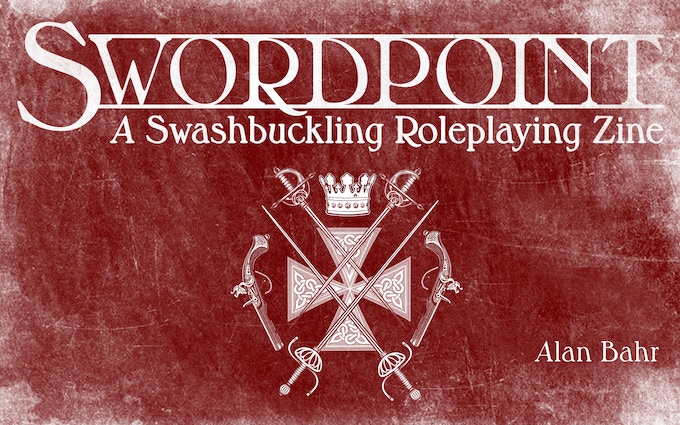
[Fanzine Focus XXX] Swordpoint: A Swashbuckling Roleplaying Zine

On the tail of the Old School Renaissance has come another movement—the rise of the fanzine. Although the fanzine—a nonprofessional and nonofficial publication produced by fans of a particular cultural phenomenon, got its start in Science Fiction fandom, in the gaming hobby it first started with Chess and Diplomacy fanzines before finding fertile ground in the roleplaying hobby in the 1970s. Here these amateurish publications allowed the hobby a public space for two things. First, they were somewhere that the hobby could voice opinions and ideas that lay outside those of a game’s publisher. Second, in the Golden Age of roleplaying when the Dungeon Masters were expected to create their own settings and adventures, they also provided a rough and ready source of support for the game of your choice. Many also served as vehicles for the fanzine editor’s house campaign and thus they showed another DM and group played said game. This would often change over time if a fanzine accepted submissions. Initially, fanzines were primarily dedicated to the big three RPGs of the 1970s—Dungeons & Dragons, RuneQuest, and Traveller—but fanzines have appeared dedicated to other RPGs since, some of which helped keep a game popular in the face of no official support.

Since 2008 with the publication of Fight On #1, the Old School Renaissance has had its own fanzines. The advantage of the Old School Renaissance is that the various Retroclones draw from the same source and thus one Dungeons & Dragons-style RPG is compatible with another. This means that the contents of one fanzine will be compatible with the Retroclone that you already run and play even if not specifically written for it. Labyrinth Lord and Lamentations of the Flame Princess Weird Fantasy Roleplay have proved to be popular choices to base fanzines around, as has Swords & Wizardry. And then there is Swordpoint: A Swashbuckling Roleplaying Zine.

Swordpoint: A Swashbuckling Roleplaying Zine is not really a fanzine, at least in the traditional sense. This is despite having the word ‘zine’ in the title. Published by Gallant Knight Games, this is a roleplaying game of swashbuckling action inspired by The Three Musketeers and Captain Alatriste as well as roleplaying games such as En Garde and Flashing Blades, all set in the Paris of the seventeenth century. Published as part of ZineQuest #3 it highlights how the fanzine and ZineQuest itself is moving from showcasing a particular game or author’s campaign—typically from the Old School Renaissance—to becoming a format for standalone mini-roleplaying games. Also, its odd format—five-by-eight inches, flipbook sized, and in landscape format, also marks it out as not being a fanzine in the very traditional sense.

Published following a successful Kickstarter campaign, Swordpoint uses a percentile system, being based on Mongoose Publishing’s Legend OGL. Players take the roles of Heroes who swashbuckle, race across rooftops, duel for honour, save the day, protect the innocent, defeat villains, and defeat villains again because they can never truly die. Games can involve military engagements, espionage, diplomacy, courtly intrigue, and both love and passion. There are rules for creating characters, action resolution, Style Points, combat, duels, grudges and revenge, spells and spellcasting, and of course, passion. These are all explained in a fairly succinct fashion, and whilst Swordpoint is not quite the bare bones of a roleplaying game, it is not far off from being so.

A Player Character has seven characteristics rated between three and eighteen—Strength, Constitution, Courage, Intelligence, Power, Dexterity, and Appeal. He has several Style Points, an Education rating for his general knowledge, and Rank. The latter represents his Social Status, derived from his social standing, position within an organisation, nobility, and wealth. Both Education and Social Status are percentile values. Rank can be increased for notable deeds, publicising those deeds, earning wealth, and so on. Rank can also be lost through misdeeds, and so on. A Player Character or NPC with a higher Rank will gain a bonus to social skills and situations. In addition, Player Character will have various skills—quite broad, and some possessions.

To create a character, a player rolls dice—typically three six-sided dice for most, but two six-sided dice to which six is added for Intelligence and Courage—to create the characteristics, or he can assign values from an array. Starting Rank is based on Power, but can be more if the character is of noble birth, determined by rolling on the appropriate table. Skill base values are derived from the characteristics and the player then assigns some bonuses, the largest being assigned to the character’s professional skill. He also has five items of equipment, which cannot include medium or large shields or armour, or shotguns, as they not suited to the genre. That said, stats for them are included should the Game Master want them in her game.

NAME: Campion Babin
CHARACTERISTICS
Strength 06 Constitution 06 Courage 17 Intelligence 15 Power 09 Dexterity 10 Appeal 12

ATTRIBUTES
Damage Modifier: -1d4
Hit Points: 23
Style Points: 5
Education: 75%
Rank: Gentlefolk

SKILLS
Athletics 26%, Craft (Specialty) 21%, Dodge 29%, Endure 33%, First Aid 35%, Lore (Religion) 70%, Melee 31%, Perception 44%, Persuasion 51%, Ride 39%, Shooting 25%, Stealth 25%, Thievery 19%

EQUIPMENT
Bible, sword, rosary beads, quill & ink

Mechanically, Swordpoint uses the percentile system of Mongoose Publishing’s Legend OGL. When a player wants his character to undertake an action, his player rolls the percentile dice and if the result is less or equal to the skill, then the character succeeds. Modifiers range between ten and forty, whether penalty or bonus, and in opposed rolls, it is the roll that succeeds and rolls highest which wins in that situation. Characteristic tests are rolled on a twenty-sided die.

Combat is not that much more complex than this. The rules cover initiative (players roll only, and go first if successful), attacking, dodging, insulting or taunting an opponent, two-weapon fighting, and so on. Successfully insulting or taunting an opponent will lose them a Style Point or Villain Point and is a nice genre touch. A character is only wounded when his Hit Points are reduced to zero, but further damage renders him first Helpless and then dead. Swordpoint being a swashbuckling game includes rules for duels, used by Heroes to settle matters of honour and resolve perceived slights and insults, whilst Villains use them as a means isolate and remove Heroes as threats to their Villainous plans. Heroes tend to duel to first blood, whilst Villains to the death. A successful Perception test allows the duellists to assess each other, learning things such as skill ratings, preferred weapons, Hit Points, Style or Villain Points, and so on.

In addition to loss of Hit Points, a Player Character can suffer a Condition. Being Wounded is a Condition, but a Player Character can also be Afraid, Confused, Exhausted, Heart-Broken, and so on. They have mechanical effect, but are primarily earned through the narrative of game play. In addition, Player Characters have Style Points, whilst the Game Master has Villain Points. Style Points can be spent to gain several benefits. These include ‘Catch Your Breath’ to regain some Hit Points, ‘Grit Your Teeth’ to reduce incoming damage, ‘Make Them Bleed’ to double the damage of an attack, ‘Redouble Your Efforts’ to reroll a test, and ‘Press Your Advantage’ to gain an extra action at the end of a round. Style Points are recovered at a rate of one per day, but a player can have his character fail a test in dramatic fashion, insult a foe in combat, accept a duel, and decide to accept a condition all to recover Style Points immediately.

Setting rules cover clubs and organisations, gambling, grudges and revenge. Having a Grudge against someone grants a slight bonus when acting against the target of the Grudge and can be settled quickly, whilst Revenge is a more determined, long-term attempt to do damage to a person and their situation. It requires Game Master approval, and enables the potential recovery of Style points when enacting said revenge. For the Game Master there are stats for various NPCs, from guards to Dangerous Villains, but oddly no feme fatale type character such as Milady de Winter. Swordpoint also includes rules for spellcasting and sorcery, plus a handful of skills, which would work in a more fantastical version of the genre. Rounding out Swordpoint are rules for Passion (and romance), which can be initiated between Player Character and Player Character or Player Character and NPC by the player or Game Master saying, “Passion, if you please.” The recipient does not have to consent, but a couple of tables follow which are rolled on to shape the romance itself. This covers the spark between them, the obstacle, and the possible fate of the relationship. When roleplayed, this all adds to the feel and genre of the game.

Swordpoint does not come with any setting. To be fair, it does not need to. This a swashbuckling film style of a roleplaying game and there are plenty of those for the Game Master to draw upon for inspiration, let alone the various works of fiction that she draw from.

Physically, Swordpoint is clearly and tidily laid out. It is well written and easy to grasp. It is very lightly illustrated. Given its length and format, Swordpoint is unsurprisingly sparse in feel and nature, and there are a lot of elements that the Game Master will need to develop, especially in terms of setting. Swordpoint: A Swashbuckling Roleplaying Zine is bare bones, but those bones are sturdy enough to provide everything, at least mechanically, that a gaming group will need to run a mini-campaign of swashbuckling action and romance.