Friday, 25 July 2025
Friday Faction: Dungeon Crawler Carl
The book opens with the destruction of the Earth, although not all of it, and not by a Vogon Constructor fleet. The Borant Corporation, an alien company from outer space, has bought the planet’s mineral rights and because no-one put in an objection, has flattened every building and turned the inside of the planet into a megadungeon with eighteen levels that the remaining fourteen million survivors of the planet must fight their way through. Of course, not everyone is going to survive, and the book maintains a running count that rapidly decreases as the secrets and lethality of the dungeon are revealed. All of which will be broadcast to the galaxy as one big reality video event—Big Brother or Survivor in a dungeon, if you will. This is how the purchasing corporation plans to recover its costs in the short term, focusing on the exploits and travails of the survivors who do well as Dungeon Crawlers. One such is Carl, ex-Coast Guard marine mechanic, who happens to be outside in the freezing winds of Seattle when the flattening occurs, wearing a leather jacket, no trousers, and a pair of crocs. His choice of clothes, certainly the lack of trousers and proper shoes, becomes a running joke throughout the book. As does his means of fighting—kicking and applying explosives to almost any situation, and his navigating his way around the interface. The latter is done as a computer roleplaying game interface that plays out in the minds of the Dungeon Crawlers.
The reason he is outside is Princess Donut the Queen Anne Chonk. This is the prize-winning show cat belonging to Beatrice, Carl’s girlfriend. Quickly after Carl finds himself in the dungeon, Princess Donut gets uplifted and turned from a pet into a Dungeon Crawler, and thus into a character in her own right, whilst Carl is classified as her bodyguard. After getting a briefing in a Safe Room, Carl and Donut set out to explore and find an entrance to the next level down, taking down mobs and bosses on the way. As they progress, Carl and Donut learn that there is much more to the dungeon than at first seems. It is built on a regular floorplan with blocks with district bosses rather than something more organic in design and the Artificial Intelligence behind the dungeon tailors the loot boxes that both Carl and Donut receive. So, Donut receives items that enhance her Charisma—after all, she is a princess—and lots of torches, whilst Carl receives items that enhance his feet and ability to stamp and kick, but is never destined to receive any trousers. There are daily updates on the dungeon that occur in response to the Dungeon Crawlers’ actions, television shows which Carl and Donut get scheduled to appear on once they begin to get famous and accrue followers, and politics playing out behind the scenes that this first book only hints at, but which will likely play out in the subsequent books in the series.
In terms of character, Carl himself, does not entirely come across as being wholly likeable. More of an everyman than a hero, in keeping with the genre, he is both aware of Dungeons & Dragons and Pathfinder and uses that knowledge to his advantage. Given the circumstances, it is understandable that he is exasperated, sometimes angry, by his situation, and that extends to his attitude to his girlfriend, Bea, who is first revealed to be cheating on him and then promiscuously cheating on him. It is a note of poor characterisation, not just in terms of Carl, but also of Bea, upon the part of the author, and it is not the only negative portrayal of women in the book. Several of the monsters, especially the boss monsters are more gross caricatures of women than monsters. Yet, Carl is driven to be the hero, to want to help the survivors from the old peoples’ home that was nearby his home and get them down to Level Two and then Level Three. To do that, he is forced to kill a lot of monsters, including a nursery of goblins, and he does feel guilty about it in exactly the opposite way that the average player of Dungeons & Dragons likely does not. The need to kill to Level up to survive almost assuages the feelings of guilt that Carl suffers from these actions, whilst the revelation that many of the monster denizens are literally waiting in fear for a dungeon crawler to turn up and kill them all, does the exact opposite.
In comparison, Princess Donut is a more interesting and likeable character even though she has the morality and attitude of a cat, uplifted to sentience and full expression. Princess Donut is often more insightful and aware than Carl is, but as a cat she is self-centred and embraces the fame of being a social media star where Carl bridles against it.
Dungeon Crawler Carl combines horror and humour, but not always effectively. The megadunegon as reality and what Carl and Donut have to do is the source for both, but it emphasises the horror more than the humour, which is from the absurdity of the situation. Both begin to weary after a while from the repetition of both and the book being just a little too long to really sustain either. The humour is also a bit too obvious and just not sharp enough to be really satirical, rarely getting above being amusing rather laugh out loud or clever.
Dungeon Crawler Carl ends almost midsentence, or at least mid-decision, rather than on definite conclusion or cliffhanger, so there is no impetus to start reading the next book if the reader has not decided already. Any reader who is not a roleplayer, whether of tabletop roleplaying games or computer games, is less likely to do so, whereas role-players are more likely to do so, since the series is squarely aimed at them, they are going to get the references, and really, there is not a lot of fiction aimed directly at them anyway. For them, the fact that they can buy this at their local bookshop is a bonus as is the fact that they might see the series adapted for television.
Dungeon Crawler Carl is an amiable read, a very knowing poke at traditional roleplaying played out on an absurd stage. It does not quite outstay its welcome, but it could have been sharper and leaner.
Sunday, 29 September 2024
The Alternative
The Player Core contains everything that a player needs to play the Pathfinder Roleplaying Game, Second Edition Remaster. Well, almost, but this review will come to that. It is a handsome sturdy volume that provides a player with an introduction to the game, an explanation of what it is, and then the means to create a variety of different characters and begin play. The explanations are clear and simple, noting that the Pathfinder Roleplaying Game is for everyone, defining what a character is and what it looks like, and describing how the game is played. This is supported by a clearly presented two-page spread of the roleplaying game’s key terms and more importantly, by an example of play that mixes in exploration, interaction, and combat. It is decently done. An experienced player will read through these pages and very quickly pick up the basics of the game, whereas a less experienced player will find himself eased into the game.
The point of the Player Core is the creation of Player Characters. Each Player Character is first defined by six attributes—Strength, Dexterity, Constitution, Intelligence, Wisdom, and Charisma. He also has an Ancestry, Background, Class, and then extra details. Ancestry represents the broad family of people that the Player Character belongs to; Background is what the Player Character before he became an adventurer; and Class is his profession as an adventurer. The Ancestry sets the Player Character’s beginning Hit Points, languages, senses, and Speed, as well as Ancestry Feats; Background gives a feat and training in one or more skills; and Class grants the Player Character his extra Hit Points at each new Level, the majority of his proficiencies, and Class Feats. Eight Ancestries and eight Classes are given in the Player Core. The eight Ancestries are Dwarf, Elf, Gnome, Goblin, Halfling, Human, Leshy, and Orc. Of these Leshy is an immortal nature spirit granted physical form, and all of the Ancestries have Heritages which define them further. For example, the Orc Ancestry offers the Badlands Orc, Battle-Ready Orc, Deep Orc, Grave Orc, Hold-Scarred Orc, Rainfall Orc, and Winter Orc. Each grant quite different abilities. For example, the Battle-Ready Orc is the descendant of very scary battle leaders and is trained in Intimidation and has the Intimidating Glare skill Feat, whilst the Winter Orc is trained in Survival and can cope with more extreme cold environments.
In addition, there are three versatile Ancestries, the Changeling, the Nephilim, and the Mixed Ancestry. These build off a base Ancestry, but offer alternative Heritages to those normally associated with the base Ancestry. The Changeling was stolen as a child and taken elsewhere; the Nephilim is a character who has had dealings with immortal beings; and the Mixed Ancestries offered are the Aiuvarin and the Dromaar. The Aiuvarin has one parent who was an Elf, whilst the Dromaar has one parent who was an Orc. An Aiuvarin Player Character can choose from both Aiuvarin and Elf Ancestry Feats and the Dromaar Player Character can choose from both Dromaar and Orc Ancestry Feats.
The eight Classes in the Player Core are the Bard, Cleric, Druid, Fighter, Ranger, Rogue, Witch, and Wizard. Notably, the Cleric, the Fighter, the Rogue, and the Wizard Classes are illustrated with signature pieces of artwork for the Pathfinder Roleplaying Game which actually predate the roleplaying game when they appeared as example Player Characters in the Rise of the Runelords Adventure Path back in 2007. Also notable is the absence of certain Classes that one would expect to see in the core rulebook for a roleplaying game such as Pathfinder. The Barbarian, Monk, and Sorcerer Classes are absent, and so the Player Core does not feel complete. However, they do appear in the Player Core 2, along with a host of other Ancestries and Classes.
Character creation in the Pathfinder Roleplaying Game, Second Edition Remaster is a matter of making a number of choices rather than rolling any dice. The lack of the latter is because once a player has selected both an Ancestry and a Class, attributes are not rolled to determine the bonuses they grant as in similar other roleplaying games. In fact, the classic three to eighteen spread for attributes is done away with entirely and instead the bonuses that the attributes might have generated in those other roleplaying games, actually become the attributes. It is not a new idea, having previously been seen in roleplaying games such as True20 Adventure Roleplaying and Fantasy AGE, both published by Green Ronin Publishing. Instead of rolling dice, a player applies Attribute Boosts to the attributes, which will come from the character’s Ancestry, Background, Class, plus some free ones. An Ancestry may also apply an Attribute Flaw, but these are rare. At First Level, no attribute can be boosted above +4 and when it can, it takes two Attribute Boosts to raise an Attribute by another full point.
Name: Eglund
Ancestry: Human
Heritage: Versatile Human
Background: Farmhand
Languages: Common
Class: Fighter
Class DC: Fighter (Trained) 16
ATTRIBUTES
Strength +4 Dexterity +2 Constitution +2 Intelligence +0 Wisdom +1 Charisma +0
Hit Points: 18
Hero Point: 1
Armour Class: 18 (20)
Melee Strike: +5 Ranged Strike: +3
Saving Throws: Fortitude (Expert) +7, Reflex (Expert) +7, Will (Trained) +4
Attacks: Simple Weapons (Expert) +5, Martial Weapons (Expert) +5, Advanced Weapons (Trained) +3, Unarmed Attacks (Expert) +5
Defences: All Armour (Trained) +3, Unarmoured Defence (Trained) +3
Class Features: Reactive Strike
Class Feats: Reactive Shield
Ancestry Feats: Co-Operative Nature
General Feats: Ride, Shield Block
Skill Feats: Assurance (Athletics)
Skills: Acrobatics (Trained) +3, Athletics (Trained) +7, Lore: Farming (Trained) +3, Intimidation (Trained) +3, Nature (Trained) +4, Perception (Expert) +6, Religion (Trained) +1, Stealth (Trained) +2, Survival (Trained) +4, Thievery (Trained) +2
One major change in the Player Core and thus the Pathfinder Roleplaying Game, Second Edition Remaster is the replacement of Alignment, an aspect of game design which has been with us from the start of the hobby, with Edicts and Anathema. Edicts suggest acts and behaviour driven by a personal code or philosophy, whilst Anathema are acts and behaviour which run counter to that personal code or philosophy. The various Ancestries suggest commonly held Edicts and Anathema amongst that particular species, whilst certain Classes more or less mandate them. The most notable of those are the Cleric Class, which will have Edicts and Anathema according to the deity worshipped by the Cleric. Violating the Edicts and Anathema can lead the Cleric to lose some Class abilities. The Player Core includes details of the gods commonly worshipped on Golarion, the setting for the Pathfinder Roleplaying Game. Of course, a Player Character need not be a Cleric to worship any of these gods.
This change from Alignment to Edicts and Anathema has a profound effect upon the player of the Pathfinder Roleplaying Game. No longer is the world around the Player Character sharply categorised according to a moral compass. Nor is there any need for the Player Character to adhere to its diktats. The player and his character is freed to make choices according to the latter’s Edicts and Anathema, which can be those shared with an Ancestry, a deity, nation, or other organisation, or they can be more individual than that. It also means that the morality of the play or the roleplayed actions of the Player Character come out through play rather than necessarily being rigidly defined. Also gone are spells like Detect Evil since they are based on Alignment, whilst Protection from Evil is simply changed to Protect which provides a bonus to Armour Class and Saving Throws.
In addition to the mechanical aspects, the Heritages and Feats for the Ancestries, the Features, Skills, and Feats for the Classes, every Ancestry and Class is accompanied with suggestions as why a player might choose it and what they might do in play. Each Ancestry also covers physical descriptions and typical society and beliefs, whilst a Class also suggests what a Player Character might during combat and social encounters, when exploring, and during downtime. It offers some possible motivations and broad ideas about what others might think of the Class. Every Class description includes some sample concepts too, which suggests Attributes, Skills, beginning Feat, and higher-Level Feats to take to recreate the concept. There are notes too on creating Multiclass Player Characters, to create archetypes, though this is a more complex option.
In terms of progression, every Class goes up to Twentieth Level—and at every Level, a Player Character will receive something. The Ancestry will provide Ancestry Feats, whilst the Class will provide its own Feats, plus options to choose Skill Feats and General Feats. Plus, Attribute Boosts as well. Since a Player Character gains a new Level every thousand Experience Points, progression is consistent between the Classes and every player will feel like he and his character is being rewarded at regular intervals. The range of Feats available across all of the categories gives a player a wealth of choice and options when designing the type of character he wants to play.
The five spell-casting Classes in the Player Core are the Bard, Cleric, Druid, Witch, and Wizard. All have access to a range of cantrips and spells defined by magical tradition. This is another change like that of Alignment. Instead of Abjuration, Alteration, Conjuration, Divination, Enchantment, Illusion, Invocation, and Necromancy, what the Pathfinder Roleplaying Game, Second Edition Remaster has is four magical traditions. These are Arcane, Divine, Occult, and Primal. The Bard can also infuse his performances to create Compositions and will be inspired by a Muse such as Enigma or Maestro; the Cleric gains extra spells from his Divine Font that can either harm or heal, as well as those from his deity; the Druid belongs to a Druidic Order such as Animal, Leaf, or Storm which grants further spells; Witches are granted hexes and taught lessons by a patron such as ‘Faith’s Flamekeeper’ or ‘Silence in Snow’; and Wizards study a thesis, such as ‘Improved Familiar Attunement’ or ‘Staff Nexus’ which changes the way in which they cast spells and attend an arcane school which grants further spells. In addition, some spellcasters, like the Witch and the Wizard, have a familiar through which they can cast their spells. Any Player Character can have an animal companion if they have the right feat, and whether the animal is a companion or familiar, it will grow and improve as the Player Character gains experience and Levels.
Name: Thulee
Ancestry: Goblin
Heritage: Unbreakable Goblin
Background: Cultist
Languages: Common, Draconic, Dwarvish, Kholo, Goblin, Orcish
Class: Witch
Class DC: Witch (Trained) 17 Spell DC: Witch (Trained) +7
ATTRIBUTES
Strength +0 Dexterity +4 Constitution +0 Intelligence +4 Wisdom -1 Charisma +2
Hit Points: 16
Hero Point: 1
Armour Class: 16
Melee Strike: +0 Ranged Strike: +5 Spell Attack (Trained): +7
Saving Throws: Fortitude (Trained) +3, Reflex (Trained) +7, Will (Expert) +4
Attacks: Simple Weapons (Trained) +3, Unarmed Attacks (Trained) +3
Defences: All Armour (Untrained) +0, Unarmoured Defence (Trained) +3
Class Features: Patron (Spinner of Threads), Witch Spellcasting
Class Feats: Cauldron
Ancestry Feats: Goblin Song
General Feats: Pet (Familiar) – Badger
Skill Feats: Schooled in Secrets
Skills: Arcana (Trained) +7, Craft (Trained) +7, Deception (Trained) +5, Lore (Spinner of Threads) (Trained) +7, Medicine (Trained) +7, Occultism (Trained) +7, Perception (Trained) +2, Performance (Trained) +5, Stealth (Trained) +7, Thievery (Trained) +7
Cantrips: Daze, Detect Magic, Know the Way, Shield, Telekinetic Hand
First Level: Grim Tendrils, Summon Undead
Equipment: Explorer’s clothing, staff, sickle, sling and 20 bullets, staff, adventurer’s backpack, cookware, healer’s toolkit, 7 gp, 1 sp, 8 cp
The Player Core includes an introduction to Golarion and the Inner Sea, the default setting for the Pathfinder Roleplaying Game, describing the various regions and their themes, and possible ideas for example characters. There is a list too of the various deities worshipped on Golarion. Besides a description, each god write-up includes areas of concern, Edicts and Anathema, and associated divine attribute. For the devotee, it gives spells for the Cleric, its Divine Font, skill, domains, and even a divine weapon. Together, this provides background details for the Player Character who wants a faith to follow and fundamental aspects of a Cleric’s worship. There are not just gods listed, but faiths and philosophies too, such as Atheism and the Green Faith. The latter two are in keeping with the Pathfinder Roleplaying Game giving a player more choice, and avoiding the diktats of Alignment.
Much of the Player Core is devoted to the numerous feats and spells within pages, so it is almost four hundred pages into the book before it looks at how to play the Pathfinder Roleplaying Game and its core mechanics. There is some guidance on the Pathfinder baseline in terms of content and tone, more detail being provided in the GM Core, but the focus here is on the core rules. It covers the three modes of play—Exploration, Encounter, and Downtime, rolling checks, attacks, damage, spellcasting, and so on. Checks are made against a Difficulty Class, the roll modified by the Attribute modifier, Proficiency bonus from skills, and circumstance modifiers. If the result is ten more than the Difficulty Class, it counts as a critical success, whilst if it is ten less than the Difficulty Class, it is a critical failure. A roll of natural twenty counts as a critical success, whilst a roll of one is a critical failure. Attacks, of course, are rolled against a target’s Armour Class, and that includes spell attack rolls. Damage and its effects work as you would expect, although Hit Points cannot be reduced below zero. If they reduced to zero, the Player Character will be dying if the damage is lethal or knocked out if the damage is nonlethal. If his character is dying, his player must make Recovery Checks, each failure increasing the character’s Dying Value, which if it reaches a value of four, the character dies.
The actual play of the Pathfinder Roleplaying Game includes two notable additions. The first is Actions. Each round, a Player Character has three Actions. Activities can either take one, two, or three Actions. (The number is indicated by an icon in the rules, so initially it is not obvious.) The basic activities are One-Action, such as Leap, Raise a Shield, Sense Motive, Stride, and Strike. Notable of these is the Raise a Shield Action, which when taken means that a Player Character raises his shield to protect himself against a possible attack against him. The default position is thus: a shield is carried, but not raised, the protection it provides is not automatic and the player has to choose to raise it. The three Actions per round gives some flexibility to what a Player Character does over the course of a round. So, a Fighter might use the Stride Action to move to attack the enemy, attack with the Strike Action, and then do the Raise a Shield Action to provide himself with further protection. Or, a Cleric might cast his Bane spell, which takes two Actions and then do the Raise a Shield Action or the Take Cover Action. The rest of the Player Core covers movement, area effects, conditions, and more.
Physically, the Player Core is a thick heavy book. But it designed for use. It eases the new player in and there is an indication where the reader is in the book on each righthand page, whilst at the back the glossary and index are combined, which is very helpful. The book is also a good-looking affair. The layout is clean and tidy, and the artwork is excellent.
Of course, the Pathfinder Roleplaying Game, Second Edition Remaster offers play that is like Dungeon & Dragons—after all, that is what it is derived from, but that play is different and, in many places, more nuanced. These include the three Action economy of the combat round, the Edicts and Anathema, and so on. Their combined effect is to give a player more choice in game and support that choice mechanically, beginning with the range of Ancestries and Classes that are just that bit different and then in the long term, reward the character and his player at every Level. The Player Core is a everything that a player needs to get started with the Pathfinder Roleplaying Game, Second Edition Remaster and makes that getting started, accessible and easy.
With thanks to Danial Scotte for the corrections to the sample Player Characters.
Monday, 5 August 2024
[Free RPG Day 2024] Lost Tome of Monsters
Now in its seventeenth year, Free RPG Day for 2024 took place on Saturday, June 22nd. As per usual, Free RPG Day consisted of an array of new and interesting little releases, which are traditionally tasters for forthcoming games to be released at GenCon the following August, but others are support for existing RPGs or pieces of gaming ephemera or a quick-start. This included dice, miniatures, vouchers, and more. Thanks to the generosity of Waylands Forge in Birmingham, Reviews from R’lyeh was able to get hold of many of the titles released for Free RPG Day.
Saturday, 22 June 2024
[Free RPG Day 2024] The Great Toy Heist
One of the perennial contributors to Free RPG Day is Paizo, Inc., a publisher whose titles for both the Pathfinder Roleplaying Game and the Starfinder Roleplaying Game have proved popular and often in demand long after the event. The emphasis in these releases have invariably been upon small species. Thus, in past years, the titles released for the Pathfinder Roleplaying Game have typically involved adventures with diminutive Player Characters, first Kobolds, then Goblins, and then with the release of A Fistful of Flowers for Free RPG Day 2022 and A Few Flowers More for Free RPG Day 2023, and now for Free RPG Day 2024, it is the turn of toys with The Great Toy Heist! This is a short adventure for Second Level Player Characters—of which four pre-generated examples are provided—who are all one of Golarion’s rare ancestries. This is ‘Poppet’. Usually in Golarion and the Pathfinder Roleplaying Game, a poppet is a small, mindless magical construct designed to serve as familiars and help with simple tasks. However, with The Great Toy Heist, all four pre-generated have achieved magical sentience and so can go adventure on their own.
To get the most out of The Great Toy Heist, the Game Master will need access to the Pathfinder Player Core, Pathfinder GM Core, Pathfinder Monster Core, Pathfinder Lost Omens Grand Bazaar, and Pathfinder Lost Omens Worlds Guide. However, a Game Master should be able to run the adventure with the core rules and further references found in the Pathfinder Reference Document.
The setting for The Great Toy Heist is the Chelish capital of Egorian, notorious for its inhabitants engaging in the practice of devil-worshipping. Not everyone is a devil-worshipper though and in-between the gothic buildings of the temples to Asmodeus, there are ordinary businesses such as The Terrific Toybox. It is famous for the quality of the toys its owner, Gettorio Galla, makes and sells. The shop is sat atop a source of occult magical energy, some of which seeps into some of those toys and so awake them to sentience. These Poppets revere their creator and help her about the shop as well as keeping an eye on when she is not there or asleep. However, a greedy, unprincipled, and wealthy noble, Baron Falgrimous Vreen, has learned about the magical source and decided to take for himself. He found a loophole in the diabolically complicated laws of the city and exploited it to seize the deed to the toyshop and now plans to evict Gettorio Galla and her fantastic creations—including the Player Characters. Loyal to Gettorio Galla, the four Player Characters have decided to break into the mansion of Baron Vreen and steal back the deed to The Terrific Toybox!
Saturday, 5 August 2023
[Free RPG Day 2023] A Few Flowers More
Now in its sixteenth year, Free RPG Day for 2023 took place on Saturday, June 24th. As per usual, Free RPG Day consisted of an array of new and interesting little releases, which are traditionally tasters for forthcoming games to be released at GenCon the following August, but others are support for existing RPGs or pieces of gaming ephemera or a quick-start. Thanks to the generosity of David Salisbury of Fan Boy 3, Fil Baldowski at All Rolled Up, and others, Reviews from R’lyeh was able to get hold of many of the titles released for Free RPG Day, both in the USA and elsewhere.
A Few Flowers More, like A Fistful of Flowers before it, begins in Verduran Forest, a large woodland in Avistan. There is a Wildwood Treaty in place between the forest and the nearby settled lands, affording the forest certain legal protections which limit what the nearby humans can harvest from under the eaves. In A Fistful of Flowers, the Player Characters traced a number of missing Leshys to a nearby village where they discovered an alchemist transforming the kidnap victims into showpieces to display at the tea parties of the snooty, venal aristocrat, Lady Constance Meliosa. Having prevailed and rescued the missing Leshys, the Player Characters have taken the chance to rest and recuperate and enjoy life in the forest. Unfortunately, the events of A Few Flowers More means that their respite is cut short and their bravery will be called upon once again.
The scenario begins with Stella, a tiny, bat-featured spirit known as a Nyktera, and also a pillar of the community, summoning the Player Characters to her home. Here, she explains that part of the forest has seen the rapid growth and spread of strange plants and this has attracted the attention of Humans harvesting them and thus annoyed the local fey. With the treaty between the humans and the forest under threat, the Player Characters are instructed to investigate. When they do, they discover that the harvesters’ is already in disarray and there are signs that somebody has already attacked the intrusive Humans. By now, the Player Characters may already be suspicious that the plants are neither native to the Verduran Forest or indeed, the prime material plane. Investigation will quickly confirm this, pointing to the First World, the primeval home of the fey, as the source of the new plant life. The question is, has there been breach between the Verduran Forest and the First World, and if so, who caused it?
A Few Flowers More is a short adventure, taking up less than half—including the maps for the scenario—of the sixteen page booklet. It effectively consists of three scenes: a roleplaying scene which introduces the scenario, followed by two combat scenes. The better and more inventive of the two combat scenes is essentially a big game of peekaboo as the Player Characters try to get into the cabin belonging to the harvesters, but since occupied by Fey who have hacked holes in the walls. The combat in the third scene is nowhere near as interesting, or even actually interesting. That said, the scenario does finish with the Player Characters needing to decide what do with the cause of the breach with the First World.
If less than half of A Few Flowers More consists of the scenario, what comprises the bulk of the booklet? Simply, the Player Characters. These consist of a Gourd Leshy Druid, Leaf Leshy Bard, a Vine Leshy Barbarian, and a Fungus Leshy Rogue. Each is neatly arranged on their own two-page spread and complete with background and clear, easy to read stats. Of course, the players do not have to use these, but could instead substitute their own characters, created using the rules in the Pathfinder Lost Omens Ancestry Guide. Otherwise though, these are a decently diverse range of characters. The Player Characters are all Third Level and highly detailed. In fact, too highly detailed. Arguably, all four Player Characters are accorded too much information given that they are designed to be played in a scenario intended to be played in a single session and in effect, the two-page spread for each Player Character becomes filler.
Physically, A Few Flowers More is as well presented as you would expect for a release from Paizo Inc. Everything is in full colour, the illustrations are excellent, and the maps attractive.
Saturday, 8 April 2023
[Fanzine Focus XXXI] Loviatar No. 2
Since 2008 with the publication of Fight On #1, the Old School Renaissance has had its own fanzines. The advantage of the Old School Renaissance is that the various Retroclones draw from the same source and thus one Dungeons & Dragons-style RPG is compatible with another. This means that the contents of one fanzine will be compatible with the Retroclone that you already run and play even if not specifically written for it. Labyrinth Lord and Lamentations of the Flame Princess Weird Fantasy Roleplay have proved to be popular choices to base fanzines around, as has Swords & Wizardry. However, not every fanzine has to be for the Old School Renaissance.
The third and final piece in Loviatar No. 2 is ‘Eclipse, Lord of the Mountain’ and it is written for Steve Jackson Games’ GURPS! It describes the giant-like creature called Eclipse whose masters grew him in a vat and assigned him to watch over the small village of Silent Vale and its human inhabitants in the mountains and ensure that they do not explain why. He has no idea why and neither does the article really explain. Nor does it explain who the Masters are. Complete with full stats and details as you would expect for GURPS, Eclipse is and is not a monster. The task he has been set curtails the activities of the humans, but he only follows the rules as he has been programmed to do, so he is not necessarily a monster—though if the rules are broken he does do monstrous things. Eclispe is a really nicely designed NPC and should make for an interesting encounter for the Player Characters, their being none the wiser until the villagers explain how to live under the aegis of the giant so as to not antagonise him. Much like the earlier ‘Number Three Pigeon Street’, this situation is easily adapted to other settings, but the Game Master will need to supply the missing explanation as to who the Masters are.
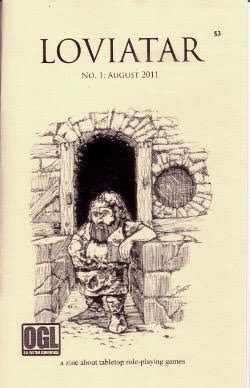
Physically, Loviatar No. 2 is neat and tidy, and in general, well presented. Artwork is very light, but is fairly heavy in its style, as is the cartography. Photographs are used for the World of Darkness article. The oddity is that again, like Loviatar No. 1, the fanzine does carry a number of adverts for roleplaying games and things, many of them long out of print, even in 2011. These include the Dragonbone electronic dice device, Gen Con XI (from 1976!), and Car Wars. There are far fewer of them this time, so they do not give the fanzine a weird, out of time feel as they did with the first issue.
Friday, 23 December 2022
[Fanzine Focus XXX] Loviatar No. 1
Since 2008 with the publication of Fight On #1, the Old School Renaissance has had its own fanzines. The advantage of the Old School Renaissance is that the various Retroclones draw from the same source and thus one Dungeons & Dragons-style RPG is compatible with another. This means that the contents of one fanzine will be compatible with the Retroclone that you already run and play even if not specifically written for it. Labyrinth Lord and Lamentations of the Flame Princess Weird Fantasy Roleplay have proved to be popular choices to base fanzines around, as has Swords & Wizardry. However, not every fanzine has to be for the Old School Renaissance.
Sunday, 4 December 2022
Less Anger, More Advice... Eventually
However, Game Angry: How to RPG The Angry Way is not without its problems which get in the way of the good advice to be found in its pages. The first of which are its price and its length. The book is simply too expensive and too long. At over one-hundred-and-seventy pages, it is far too long. It could and should have been shorter and more concise. It is often overwritten and all often feels as if it could have got to the point a lot earlier. At $15 for the PDF, there are better looking books with more focused advice on being a good Game Master for less. Similarly, there are better looking books with more focused advice on being a good Game Master in print for the same cost as the PDF. Then there is the issue with tone and remit. The title of the book suggests that the book is going to be written a sense of energy and urgency, with anger, and there is none of that. Anyone coming to the book after reading the blog with its near rants and use of deleted expletives will be severely disappointed, for the style of the book is light and chatty—often too chatty. Which leads into the issue with remit, because if the book is written by the ‘Angry GM’ and he never gets angry in the book as he does on the blog, what is the point of the title? What Game Angry: How to RPG The Angry Way really means is that the player and prospective Game Master should be playing using the advice from a writer whose nickname is ‘Angry’, not be a Game Master with that emotion in mind. Which is misleading.
Game Angry: How to RPG The Angry Way is divided into three parts. ‘Part I: The World of Role-Playing Games’ is intended for the new player, ‘Part II: Getting Your (First) Game On’ is the first time Game Master’, and ‘Part III: Running Less Worse Games’ is the Game Master who wants to improve her skills. The opening of ‘Part I: The World of Role-Playing Games’ starts with first principles, taking the reader through the first steps of a Dungeons & Dragons-style game, what options has in terms of purchasing roleplaying games and what they offer, and giving a first examination of what a Game Master is. Veteran players and Game Masters are advised to skip this, but it feels too basic for the book, too much of a focus upon being the player in a book that is primarily for the Game Master. Perhaps this could have been saved for a book of advice on how to play roleplaying games the ‘Angry Way’—that is, a book of advice for the player, or retooled for the intended audience, the Game Master?
Thankfully, ‘Part II: Getting Your (First) Game On’ does begin getting to the point and telling the reader what a Game Master is and does. It starts with simple advice, such as ‘Keep It Simple, Stupid’, preparing the first adventure, explains the basic conversation involved in playing a roleplaying game, how to be a narrator and what the four types of narration are, and how to adjudicate the rules. This though, is forty pages in… It breaks down the nature of combat, examining the four things that the Game Master has to handle in the process—as a Referee, as monster wrangler, an accountant, and as a jockey, the latter to keep the pace of the combat appropriately fast and free flowing. Then it returns to the basic conversation involved in playing a roleplaying game, but examines it from the point of view of combat. This all sets the prospective Game Master up with the basic elements of her role.
At more than half its length, ‘Part III: Running Less Worse Games’ is the longest section in the book. It includes interesting sections on player agency and the power they and their characters have within a game, breaks down the time and framing units of roleplaying—action, scene, adventure, and campaign—before using them to build back up a Game Master’s approach to the structuring her game. There is standard advice too, such as only rolling the dice when it is important and running a Session Zero, and for the most part, the advice and suggestions are rules agnostic, but the book is heavily weighted towards playing and running Dungeons & Dragons, Fifth Edition, and Pathfinder, and where it does get mechanical it is always with those roleplaying games in mind. It also includes some mechanics of its own. This includes ‘Angry’s Ten-Point Scale’, used to track a Player Character’s success or failure and potential reaction points along that scale when he attempt’s a task that takes longer than a single roll, developing that as a means to handle loner, more involved conversations, for example. It differentiates between scene and encounter, and it also provides advice and suggestions as to how to create and portray NPCs in interesting and dramatic fashion in what is one of the more enjoyable sections of the book, and it also has advice on tone, a degree of improvisation, and finally potential issues and conflicts at the table. Here Game Angry moves into the social space of gaming. Lastly, the advice takes the reader to the verge of beginning campaign, but no further. That perhaps is the subject of another supplement?
Physically, Game Angry: How to RPG The Angry Way is a plain affair interspersed by pieces of cartoon artwork, much like the author’s blog posts. Here the artwork only serves to separate the chapters and adds nothing to the content. The writing is often over blown and it could have done with tighter editing for length and focus. The book lacks an index. Similarly, the author makes references to outside sources, such as to ‘The MDA Design Approach’, but does not cite them or include a bibliography. This is inexcusably unprofessional.
As decent as the advice in Game Angry: How to RPG The Angry Way is, it has dated slightly and it does not take into account different forms of gaming. Or even ways in which it can be consumed, stating “Now, RPGs don’t have audiences.” whereas even when the book was originally published, they did. Hence Critical Role. Anyway, no convention games or online games, the latter increasingly important and common since the pandemic. Now of course, the book was written before that occurred, but a section on running convention games would have been a very useful inclusion.
The author, the ‘Angry GM’, has neutered his voice for Game Angry: How to RPG The Angry Way. Had he not, then perhaps the book might have stood out from the range of titles on how to be a good Game Master. The advice given is good, but for experienced players and Game Masters will probably be familiar, whilst for the new or prospective Game Master, Game Angry: How to RPG The Angry Way takes a while to get the point and could have been far more concise.
Friday, 5 August 2022
[Free RPG Day 2022] A Fistful of Flowers
Now in its fifteenth year, Free RPG Day in 2022, was celebrated not once, but twice. First on Saturday, 25th June in the USA, and then on Saturday, 23rd July internationally. This was to prevent problem with past events when certain books did not arrive in time to be shipped internationally and so were not available outside of the USA. As per usual, Free RPG Day consisted of an array of new and interesting little releases, which are traditionally tasters for forthcoming games to be released at GenCon the following August, but others are support for existing RPGs or pieces of gaming ephemera or a quick-start. Thanks to the generosity of David Salisbury of Fan Boy 3, Reviews from R’lyeh was get hold of many of the titles released for Free RPG Day, both in the USA and elsewhere.
Friday, 22 October 2021
[Free RPG Day 2021] Threshold of Knowledge
Threshold of Knowledge takes place at the prestigious Magaambya, the oldest school of magic in the Inner Sea region and in the nearby city of Nantambu. The Player Characters are prospective students at the Magaambya, undertaking training with Teacher Takulu Ot who is their sponsor. His initial task is for Player Characters to become part of the community and the first step in that is to help Alandri, a local fisherwoman, with whatever tasks she asks of them. This means going out into Nantambu and down to the canal where she wants them to fish for her. On the way, another student challenges them to a race to get to her stall. Presented as a series of challenges using a variety of skills and player ingenuity, this is not actually a good start to the scenario. Whilst there is no doubt that students might engage in such a race, there is no real benefit to it in terms of the story to Threshold of Knowledge, especially since when the Player Characters arrive at Alandri’s house, the first thing Alandri says is, “You’re late.”—and that is whether they win or lose the race. It feels artificial and forced, more a case of the adventure setting out to teach the players how to roll dice and use their characters’ skills than anything else. Certainly, if the Game Master wanted to shorten Threshold of Knowledge, then this section could easily be excised and the players be left none the wiser.
Fortunately, after that, Threshold of Knowledge settles down and gets on with its plot. Alandri has the Player Characters fish for her—and the intimation is that the Player Characters will be doing this daily for the first year or so of study at the Magaambya—but not with either net or rod, but by diving into the canal! This is much more fun and intriguing than the earlier race and it foreshadows events to come later in the scenario. The plot really triggers when the Player Characters return to the Magaambya. Teacher Ot’s office is awash with water and he himself is missing! The clues lead to a store room elsewhere in the Magaambya and from there back to the canal and back again to the Magaambya. There is a puzzle for the Player Characters to solve first, a series of tunnels and a grotto to explore, and some semi-aquatic combat encounters to overcome. Of these, the puzzle is the most difficult challenge to handle and will need careful study upon the part of the Game Master to really understand and then impart with her players. There are some fun encounters here, such as with a shark gliding across the floor of a partially flooded library!
To accompany the adventure, Threshold of Knowledge includes five pre-generated Player Characters. These consist of an Ekujae Elf Monk, a Human Fighter, a Grippli Rogue, a Human Cleric, and a Half-Orc Sorcerer. Each is neatly arranged on their own individual pages and complete with background and clear, easy to read stats. Of course, the players do not have to use these, but could instead substitute their own characters, especially if the Game Master is planning to run a campaign set at the Magaambya. Otherwise though, these are a decently diverse range of characters. In addition, there is a selection of magical items and spells, such Gritty Wheeze, an exhalation of abrasive sand and grit, which appear in the scenario.
Physically, Threshold of Knowledge is as well presented as you would expect for a release from Paizo Inc. Everything is in full colour, the illustrations are excellent, and the maps attractive.
Threshold of Knowledge is perhaps a little long and perhaps does not handle its single puzzle as well as it could have done, but it is a very likeable adventure. It provides a diverse range of Player Characters and has a pleasing different feel to its fantasy than that atypical of most roleplaying fantasy. As written, Threshold of Knowledge is a good introduction for Pathfinder Second Edition or a good starting adventure for a campaign based at the Magaambya.