Every Week It's Wibbley-Wobbley Timey-Wimey Pookie-Reviewery...
Showing posts with label Free RPG 2022. Show all posts

Sunday, 14 August 2022

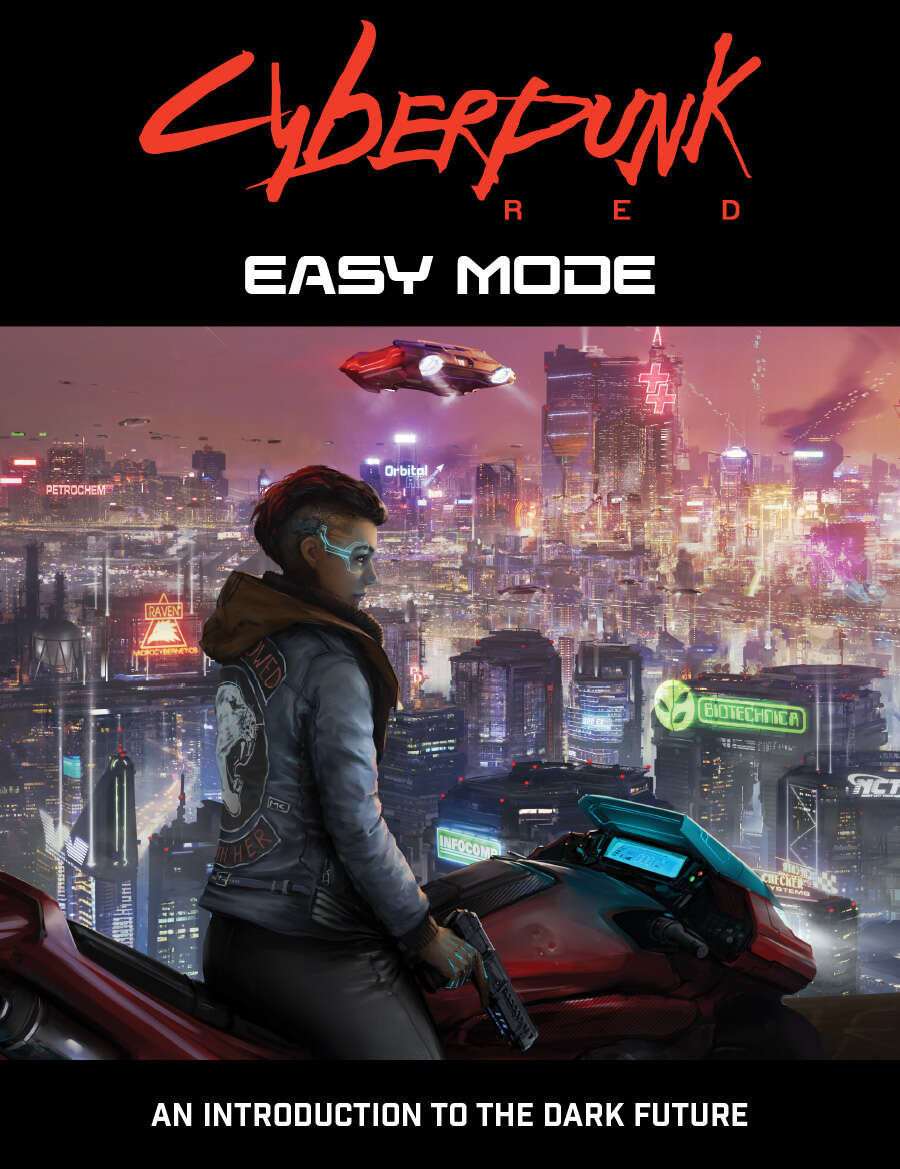
[Free RPG Day 2022] Cyberpunk Red: Easy Mode

Now in its fifteenth year, Free RPG Day in 2022, was celebrated not once, but twice. First on Saturday, 25th June in the USA, and then on Saturday, 23rd July internationally. This was to prevent problem with past events when certain books did not arrive in time to be shipped internationally and so were not available outside of the USA. As per usual, Free RPG Day consisted of an array of new and interesting little releases, which are traditionally tasters for forthcoming games to be released at GenCon the following August, but others are support for existing RPGs or pieces of gaming ephemera or a quick-start. Thanks to the generosity of David Salisbury of Fan Boy 3Reviews from R’lyeh was get hold of many of the titles released for Free RPG Day, both in the USA and elsewhere.

—oOo—

Cyberpunk Red: Easy Mode – An Introduction to the Dark Future is the new quick-start and introduction to Cyberpunk Red, the fourth edition of the Cyberpunk roleplaying game originally published by R. Talsorian Games Inc. in 1988. Inspired by the Cyberpunk literary subgenre—of which William Gibson’s Neuromancer was a leading example—Cyberpunk Red is set in a dark future ravaged by disease, ecological collapse, corporate rapaciousness, and political unrest. The massive growth of corporations as extraterritorial entities, which radically dividing the future into one of extreme haves and havenots, was shattered in 2023 when a ‘pocket nuke’ was detonated in the Arasaka headquarters in the west coast metroplex of Night City. This ended the Fourth Corporate War between Arasaka and Militech, devastated Night City, and brought economic and environmental devastation to the world, causing a depression which continues two decades on... It ended corporate domination, reducing corporations to being local and international; turned much of the USA into a new Wild West where safe travel could often be promised by the Nomad tribes. For years after the nuclear detonation, the sky was red and still is at dawn dusk, leading the new age to be known as the Time of the Red.

The world of Cyberpunk Red is violent, neon cast, and dominated by technology to the point where it has been subsumed into the body. Cyberware enables humanity to be faster, stronger, have better senses, and more. Some have reacted to this mechanical invasion of the body with technoshock, but other have embraced it, living on the edge, taking advantage of their enhancements to be able to rip doors off with their cyberarms, drive their car or aerodyne with inhuman reflexes via interface plugs, tune into the infrared with cybereyes, or even cast their consciousness into local NET architectures at the speed of data. All to survive, make money, and build their rep. They are known as Edgerunners.

The setting for Cyberpunk Red and Cyberpunk Red: Easy Mode – An Introduction to the Dark Future is Night City, the independent west coast city state where the ‘pocket nuke’ was detonated in 2023 and is still rebuilding after the effects of the bomb. Services, supplies, and law enforcement are what you pay for. The reduced corporations still supply and provide almost everything, from power to food to medical services to media, often brought in by Nomad tribes that run transport in the new North America, independents do grow real food though, and whilst the corporations have their own security, freelancers and bodyguards are available for hire, though the city maintains a Maximum Force Tactical Division or ‘Psycho Squad’ or ‘MAX–TAC’ which handles cybernetic criminals or anyone suffering from Cyberpsychosis. As inhabitants of Night City, you get your information from city wide freestanding dataterms and news from screamsheets downloaded to a personal agent helps you with your daily life from phone calls to shopping; you wear clothing able to emit sounds and video, even monitor your condition; you do your shopping at self-contained, armed and armoured Vendits; you eat kibble or good prepack food if you can; and you go armed. Either a Polymer One-shot easily bought or printed, or something bigger purchased from a Fixer after it has been scavenged from the Fourth Corporate War or smuggled into the city. The same goes for Cyberware...

Cyberpunk Red: Easy Mode – An Introduction to the Dark Future devotes the first quarter of its forty-eight pages to introducing the genre of Cyberpunk and Cyberpunk Red as a setting. The former covers the attitudes of the genre—‘Style Over Substance’, ‘Attitude is Everything’, and ‘Live on the Edge’—before the latter provides a surprisingly detailed overview of Cyberpunk Red’s dark future. This overview is of course, much shortened from the Cyberpunk Red core rulebook, but there is a lot of information here, including a timeline running from 1990 to 2045 and a description of Night City, as well as its notable megacorporations, gangs, and street slang.

The middle part of Cyberpunk Red: Easy Mode – An Introduction to the Dark Future is devoted to explaining the rules. Mechanically, both it and Cyberpunk Red uses the Interlock system. In general, for his Edgerunner to do anything, a player will roll a ten-sided die and add the Edgerunner’s Stat and Skill (or Role Ability) to the result in order to beat a Difficulty Value. This Difficult Value is thirteen for an Everyday task, fifteen for Difficult, seventeen for Professional, twenty-one for Heroic, and so on. Critical successes—rolls of ten—enable a player to keep rolling and adding to his total as long as he keeps rolling ten, whereas Critical failures—rolls of one—forces him to roll again and subtract from the total, but just the once. In combat, chases, and so on, the rolls tend to be opposed, both sides rolling and adding their character’s Stat and appropriate Skill.

Combat covers gun combat, melee combat, and brawling, including various manoeuvres such as grab, choke, hold action, and more. Weapon damage is rolled on six-sided dice, such as five six-sided dice for a shotgun and three for a heavy pistol. Whenever a damage roll includes two or more rolls of six, a critical injury is inflicted and a roll on the Critical Injuries table is required. This can result in the character having a limb dismembered, a collapsed lung, crushed fingers, or worse… Also included in the rules is another kind of combat—the facedown. This enables a character to gain a psychological advantage over an opponent.

The scenario in Cyberpunk Red: Easy Mode – An Introduction to the Dark Future is ‘Getting Paid: A First Job for Cyberpunk Red’. It is short, consisting of really only two scenes, focusing on conflict and confrontation, and it should only take a single session to play through. Designed as an introduction to Night City and Cyberpunk Red, as the scenario opens, the Player Characters or Edge Runners have made a score, having stolen some money from the South Night City Docks. However, a gang of corrupt cops have learned about the theft and sets the Edge Runners up to take the money from them after beating up their fixer. After surviving an ambush, the Edge Runners are free to take whatever approach they want in getting the money back, including diplomacy, violence, and stealth.

‘Getting Paid: A First Job for Cyberpunk Red’ is designed to be played by five players and five pre-generated Edge Runners are provided in Cyberpunk Red: Easy Mode – An Introduction to the Dark Future. They are a Rockerboy, a Solo, a Tech, a Medtech, and a Media. Rockerboys are rock and roll rebels who use performance and rhetoric to fight authority; Solos are assassins, bodyguards, killers, and soldiers for hire in a lawless new world; Techs are renegade mechanics; Medtech are doctors who patch up meat and metal alike; and Medias are reporters and journalists looking to break the big story. Each pre-generated Edgerunner is given a two-page character sheet. On the front is an illustration of the Edgerunner as well as his full stats, skills, armour, weapons, cyberware, and gear. On the back is some background, plus spaces for the Edgerunner’s Lifepath to be filled in. Once a player has selected the Edgerunner he wants to play, he rolls on the Lifepath table—a feature of Cyberpunk going all the way back to Cyberpunk 2013 and replicated in a stripped back version in the Cyberpunk Red: Easy Mode – An Introduction to the Dark Future—to determine his Background, Motivation, Goals, Friends (other than the player characters), Enemies, Romance, and Personality. This nicely adds a degree of variation between the player characters and gets them rolling dice even before play, and in addition, the Game Master is encouraged to tie the results of some of these dice rolls into the scenario.

Physically, everything in the Cyberpunk Red: Easy Mode – An Introduction to the Dark Future is presented in full colour. The layout is clean and tidy, the illustrations are fully painted pieces and excellent. The two maps provided for the encounters in ‘Getting Paid: A First Job for Cyberpunk Red’ are also nicely done. Overall, Cyberpunk Red: Easy Mode – An Introduction to the Dark Future is an enjoyably readable product.

There are two issues with Cyberpunk Red: Easy Mode – An Introduction to the Dark Future, both of which it shares with the earlier Cyberpunk Red Jumpstart Kit. One is that does not name its weapons or cyberware, so that all of the gear feels flat and generic, rather than giving flavour as it should. The second is that it does not include the Netrunner Role, the cybernetic master hackers of the post-NET world and brain burning secret stealers. This is understandable, as the Role is mechanically and conceptually far more complex than any of the Roles used in ‘Getting Paid: A First Job for Cyberpunk Red’, and its inclusion would potentially slow down game play in what is designed to be a fast-paced, action orientated scenario. That said, the Netrunner is one of Cyberpunk Red’s signature Roles and its absence is felt in Cyberpunk Red: Easy Mode – An Introduction to the Dark Future.

With its combination of background, rules, Edge Runners, and straightforward scenario, Cyberpunk Red: Easy Mode – An Introduction to the Dark Future does feel like a mini or stripped back version of the Cyberpunk Red core rule book. Essentially, as the title suggests, Cyberpunk Red on ‘Easy Mode’. Cyberpunk Red: Easy Mode – An Introduction to the Dark Future is a solid, serviceable, and succinct introduction to Cyberpunk Red that delivers a one-session taster of the Time of the Red.

Saturday, 13 August 2022

[Free RPG Day 2022] Root: Talon Hill Quickstart

Now in its fifteenth year, Free RPG Day in 2022, was celebrated not once, but twice. First on Saturday, 25th June in the USA, and then on Saturday, 23rd July internationally. This was to prevent problem with past events when certain books did not arrive in time to be shipped internationally and so were not available outside of the USA. As per usual, Free RPG Day consisted of an array of new and interesting little releases, which are traditionally tasters for forthcoming games to be released at GenCon the following August, but others are support for existing RPGs or pieces of gaming ephemera or a quick-start. Thanks to the generosity of David Salisbury of Fan Boy 3Reviews from R’lyeh was get hold of many of the titles released for Free RPG Day, both in the USA and elsewhere.

—oOo—

Published by Magpie GamesRoot: The Tabletop Roleplaying Game is a roleplaying game based on the award-winning Root: A Game of Woodland Might & Right board game, about conflict and power, featuring struggles between cats, birds, mice, and more. The Woodland consists of dense forest interspersed by ‘Clearings’ where its many inhabitants—dominated by foxes, mice, rabbits, and birds live, work, and trade from their villages. Birds can also be found spread out in the canopy throughout the forest. Recently, the Woodland was thrown into chaos when the ruling Eyrie Dynasties tore themselves apart in a civil war and left power vacuums throughout the Woodland. With no single governing power, the many Clearings of the Woodland have coped as best they can—or not at all, but many fell under the sway or the occupation of the forces of the Marquise de Cat, leader of an industrious empire from far away. More recently, the civil war between the Eyrie Dynasties has ended and is regroupings its forces to retake its ancestral domains, whilst other denizens of the Woodland, wanting to be free of both the Marquisate and the Eyrie Dynasties, have formed the Woodland Alliance and secretly foment for independence.

Between the Clearings and the Paths which connect them, creatures, individuals, and bands live in the dense, often dangerous forest. Amongst these are the Vagabonds—exiles, outcasts, strangers, oddities, idealists, rebels, criminals, freethinkers. They are hardened to the toughness of life in the forest, but whilst some turn to crime and banditry, others come to Clearings to trade, work, and sometimes take jobs that no other upstanding citizens of any Clearing would do—or have the skill to undertake. Of course, in Root: The Tabletop Roleplaying Game, Vagabonds are the Player Characters.

Root: The Tabletop Roleplaying Game is ‘Powered by the Apocalypse’, the mechanics based on the award-winning post-apocalyptic roleplaying game, Apocalypse World, published by Lumpley Games in 2010. At the heart of these mechanics are Playbooks and their sets of Moves. Now, Playbooks are really Player Characters and their character sheets, and Moves are actions, skills, and knowledges, and every Playbook is a collection of Moves. Some of these Moves are generic in nature, such as ‘Persuade an NPC’ or ‘Attempt a Roguish Feat’, and every Player Character or Vagabond can attempt them. Others are particular to a Playbook, for example, ‘Silent Paws’ for a Ranger Vagabond or ‘Arsonist’ for the Scoundrel Vagabond.

To undertake an action or Move in a ‘Powered by the Apocalypse’ roleplaying game—or Root: The Tabletop Roleplaying Game, a character’s player rolls two six-sided dice and adds the value of an attribute such as Charm, Cunning, Finesse, Luck, or Might, or Reputation, to the result. A full success is achieved on a result of ten or more; a partial success is achieved with a cost, complication, or consequence on a result of seven, eight, or nine; and a failure is scored on a result of six or less. Essentially, this generates results of ‘yes’, ‘yes, but…’ with consequences, and ‘no’. Notably though, the Game Master does not roll in ‘Powered by the Apocalypse’ roleplaying game—or Root: The Tabletop Roleplaying Game

So for example, if a Player Character wants to ‘Read a Tense Situation’, his player is rolling to have his character learn the answers to questions such as ‘What’s my best way out/in/through?’, ‘Who or what is the biggest threat?’, ‘Who or what is most vulnerable to me?’, ‘What should I be on the lookout for?’, or ‘Who is in control here?’. To make the Move, the player rolls the dice and his character’s Cunning to the result. On a result of ten or more, the player can ask three of these questions, whilst on a result of seven, eight, or nine, he only gets to ask one.

Moves particular to a Playbook can add to an attribute, such as ‘Master Thief’, which adds one to a character’s Finesse or allow another attribute to be substituted for a particular Move, for example, ‘Threatening Visage’, which enables a Player Character to use his Might instead of Charm when using open threats or naked steel on attempts to ‘Persuade an NPC’. Others are fully detailed Moves, such as ‘Guardian’. When a Player Character wants to defend someone or something from an immediate NPC or environmental threat, his player rolls the character’s Might in a test. The Move gives three possible benefits—‘ Draw the attention of the threat; they focus on you now’, ‘Put the threat in a vulnerable spot; take +1 forward to counterstrike’, and ‘Push the threat back; you and your protected have a chance to manoeuvre or flee’. On a successful roll of ten or more, the character keeps them safe and his player cans elect one of the three benefits’; on a result of seven, eight, or nine, the Player Character is either exposed to the danger or the situation is escalated; and on a roll of six or less, the Player Character suffers the full brunt of the blow intended for his protected, and the threat has the Player Character where it wants him.

Root: Talon Hill Quickstart is the Free RPG Day 2022 from Magpie Games for Root: The Tabletop Roleplaying GameIt includes an explanation of the core rules, six pregenerated Player Characters or Vagabonds and their Playbooks, and a complete setting or Clearing for them to explore. From the overview of the game and an explanation of the characters to playing the game and its many Moves, the introduction to the Root: The Tabletop Roleplaying Game in Root: Talon Hill Quickstart is well-written. It is notable that all of the Vagabonds are essentially roguish in nature, so in addition to the Basic Moves, such as ‘Figure Someone Out’, ‘Persuade an NPC’, ‘Trick an NPC’, ‘Trust Fate’, and ‘Wreck Something’, they can ‘Attempt a Roguish Feat’. This covers Acrobatics, Blindside, Counterfeit, Disable Device, Hide, Pick Lock, Pick Pocket, Sleight of Hand, and Sneak. Each of these requires an associated Feat to attempt, and each of the six pregenerated Vagabonds has one, two, or more of the Feats depending just how roguish they are. Otherwise, a Vagabond’s player rolls the ‘Trust to Fate’ Move.

The six pre-generated Vagabonds include Fineas the Champion, a Pug would-be hero who has become tired of war; Saga the Chronicler, a Possum fearless scholar whose curiosity drives them to uncover the secret of the past (and Talon Hill in particular); Shariyen the Envoy, a Bat diplomat who wants to end conflicts; Jeurgin the Heretic, a Rabbit healer and preacher wanting to found and build a faith in the Great Tree; Dona the Seeker, a Mole explorer who wants to dig into the ruins of Augustine Castle in Talon Hill; and AurĂ©lien the Exile, a Lizard former knight who seeks revenge for being betrayed many years before. Most of these Vagabonds have links to the given Clearing in Root: Talon Hill Quickstart and all are complete with Natures and Drives, stats, backgrounds, Moves, Feats, and equipment. All a player has to do is decide on a couple of connections and each Playbook is ready to play.

As its title suggests, the given Clearing in Root: Talon Hill Quickstart is Talon Hill. Its description comes with an overarching issue and conflicts within the Clearing, important NPCs, places to go, and more. The situation in Talon Hill is different to that of most Clearings. A sprawl of modern buildings below the crumbling Augustine Castle atop a great tree, its core Conflict concerns a dynastic feud which has the potential to affect all of the Woodland. Although foxes dominate the Clearing, it is ruled by the Kingfishers, an old Eyrie family which once sat on the throne of the Eyrie Dynasties. The current possessor of the silver laurel crown is Lord Thurgud II of Talon Hill. His claim though, is disputed by his sister, Theodora, a successful general, and Gaius, an ambitious merchant who believes has a stronger claim via a more traditional means of determining the succession. All three believe Augustine Castle to hold several Eyrie symbols of power, possession of which would strengthen a claim to both wear the silver laurel crown of Talon Hill and potentially, the Eyrie Dynasties. This has led to standoff between the three factions and their forces over access to Augustine Castle, but if a way could be found into the crumbling ruins, perhaps they could found and one faction or another favoured…? Elsewhere in Talon Hill, the local band of smugglers, thieves, and cutthroats known as the Moonlight Syndicate is looking to expand beyond its agreement with the local Knight Sergeant of the Guard which keeps it in balance, and a rash of murdered birds have appeared on the streets of the clearing who appear to have been killed in a manner previously used by a Lizard Cult as part of its sacrifices. Has the Lizard Cult returned or is there another faction operating in Talon Hill? There is advice on how these Conflicts might play out if the Vagabonds do not get involved and there are no set solutions to any of the situations. For example, the Moonlight Syndicate will ultimately expand its operation and come to run law enforcement in Talon Hill. If there is an issue with any one of the four Conflicts, it is perhaps that the one involving the Moonlight Syndicate and the local Knight Sergeant of the Guard is a bit too similar to Conflicts found in other Clearings. However, the Conflict involving the disputed claim to the silver laurel crown and the Eyrie Dynasties pulls Root: The Tabletop Roleplaying Game and the Vagabonds into the backstory to the current situation of the Woodland, and potentially, pushes its story forward.

Physically, Root: Talon Hill Quickstart is a fantastic looking booklet, done in full colour and printed on heavy paper stock. It is well written and the artwork, taken from or inspired by the Root: A Game of Woodland Might & Right board game, is bright and breezy, and really attractive. Even cute. Simply, just as Root: The Pellenicky Glade Quickstart was for Free RPG Day 2020 and Root: The Bertram’s Cove Quickstart was for Free RPG Day 2020, so too Root: Talon Hill Quickstart is physically the most impressive of all the releases for Free RPG Day 2022.

If there is an issue with Root: Talon Hill Quickstart it is that it looks busy and it looks complex—something that often besets ‘Powered by the Apocalypse’ roleplaying games. Not only do players need their Vagabond’s Playbooks, but also reference sheets for all of the game’s Basic Moves and Weapon Moves—and that is a lot of information. However, it means that a player has all of the information he needs to play his Vagabond to hand, he does not need to refer to the rules for explanations of the rules or his Vagabond’s Moves. That also means that there is some preparation required to make sure that each player has the lists of Moves his Vagabond needs. Another issue is that the relative complexity and the density of the information in Root: Talon Hill Quickstart means that it is not a beginner’s game and the Game Master will need a bit of experience to run Talon Hill and its conflicts.

Ultimately, the Root: Talon Hill Quickstart comes with everything necessary to play and keep the attention of a playing group for probably three or four sessions, possibly more. Although it needs a careful read through and preparation by the Game Master, Root: Talon Hill Quickstart is a very good introduction to the rules, the setting, and conflicts in Root: The Tabletop Roleplaying Game—and it looks damned good too. For the Game Master who is already running a Root: The Tabletop Roleplaying Game campaign, the Root: Talon Hill Quickstart provides another Clearing that she can add to her campaign with the others available in the proper quick-start for the roleplaying game as well as releases for previous Free RPG Days.