Every Week It's Wibbley-Wobbley Timey-Wimey Pookie-Reviewery...
Showing posts with label Loke Battle Mats. Show all posts

Friday, 29 May 2026

Drawing Dungeons

To date,
Loke BattleMats has become best known for its maps which it publishes as books. So far these have included the Big Book of Battle Mats: Rooms, Vaults, & Chambers, the Big Book of Cyberpunk Battle Mats, The Dungeon Books of Battle Mats, The Wilderness Books of Battle Mats, The Towns & Taverns Books of Battle Mats, and Castles, Crypts, & Caverns Books of Battle Mats. These are all big products, containing big maps, ready to play. Conversely, the Dungeon Designer’s Deck: 100 Cards to Level Up your Dungeon Game is quite small, but it can actually do quite a lot and is quite flexible. As its subtitle suggests, it is a deck of cards which can be used in multiple ways. This includes as a dungeon and adventure generator, a solo-adventure generator, and as a set of terrain accessories. The box does say that it is suitable for use with Player Characters of Levels One to Ten and it is compatible with Dungeons & Dragons, Fifth Edition. However, do not let the latter put you off. The Dungeon Designer’s Deck will work just as well with any retroclone.

As its subtitle suggests, Dungeon Designer’s Deck: 100 Cards to Level Up your Dungeon Game consists of one hundred cards. This includes sixty ‘Terrain Feature Cards’, ten ‘Quest Cards’, ten ‘Room Cards
, ten ‘Door Cards’, five ‘Enemy Generator Cards’, two ‘Random Loot Cards’, and three ‘How To Use Cards’. This includes sixty Terrain Feature Cards, ten Quest Cards, ten Room Cards, ten Door Cards, five Enemy Generator Cards, two Random Loot Cards, and three How to use Cards. In addition to this, there is a foldout map and a reference book. The map is double-sided and shows plain flagstones on one side and a simple room arrangement on the other. If the Game Master or player wants other room arrangements, the Terrain Feature Cards do work with other maps from the publisher.

The three ‘How To Use Cards’ are double-sided and in turn describe the card types, the core principles of using the Dungeon Designer’s Deck, how to use the ‘Random Dungeon Creation’, adjusting the deck based on party size and solo play, and explanations of the ‘Difficulty’ and ‘Damage’ keywords. For ‘Difficulty’ keywords, this sets the Difficulty Class values from First Level to Tenth Level, depending upon whether the task at hand is routine, difficult, very difficult, or near impossible. The ‘Damage’ keywords set the possible damage values in similar fashion depending upon whether it is minor, light, major, or lethal damage.

The ten ‘Quest Cards’ provide a mission, a backstory, clues and where to place them, the rooms the specific locations the missions requires and when to place them, where the finale takes place, any special rules, and rewards. They include a ‘Vault Heist’, ‘Tome Raiders’, ‘Rescue Mission’, ‘Loot and Run’, and more. Each of the ‘Room Cards’ details the ‘Encounter Cards’ to be drawn, extra ‘Clues’, and ‘Troops’ to be encountered, as well as a description of the ‘Finale Encounter’. They include a ‘Headquarters’, ‘The Kennels’, an ‘Evil Temple’, ‘Treasure Vault’, and even a ‘Sewage Plant’. The bulk of the cards in Dungeon Designer’s Deck consist of the sixty ‘Terrain Feature Cards’. Unlike the other cards, these are double-sided. One side depicts a feature of a room or furniture. For example, a ‘Stargazer Study’, ‘Sewer Pool’, ‘Reading Corner’, or ‘Skull Altar’. On the back a table of three or four random options, some flavour text, and a little extra detail. These  ‘Terrain Feature Cards’ will essentially be dressing the adventure. Lastly, each of the ten ‘Door Cards’ describes a door, such as a ‘Vault Door’ or a ‘Mossy Door’ with its stats and details on the back, whilst the five ‘Enemy Generator Cards’ have tables on them for randomly generating encounters.

The Reference Book replicates all of the content on the cards and can be used during play or during the designing of a quest or dungeon. The contents of the Dungeon Designer’s Deck can be used randomly. So ‘Encounter Cards’ can be drawn when a new room is entered and ‘Door Cards’ when a door is found, and this can be done randomly, whether the Dungeon Master is drawing it for her group of players and their adventurers or a player is drawing the cards for solo play. Unlike other solo and/or random dungeon generator tools, there is map making or drawing necessary, though there is nothing to stop the Dungeon Master or player from drawing a map. The Dungeon Master can use the cards to help her create a dungeon as part of her preparation. Alternatively, the ‘Quest Cards’ provide outlines of missions that can played solo and run for a group. These require some preparation and whilst the Dungeon Master might run the same ‘Quest Card’ more than once, there is still plenty in the box for the Dungeon Master to use, whilst a solo player might try again to see how well he can do this time.

Physically, Dungeon Designer’s Deck is a handy little boxed set. The writing is good and all of the art and cartography is excellent. The cards have a matte finish on the reference side and a gloss finish on the picture side. This does feel very slightly odd, but you get used to it.

The multi-purpose 
Dungeon Designer’s Deck: 100 Cards to Level Up your Dungeon Game has the potential to provide quite a bit of game play, whether from creating quests and dungeons for solo or group play and enhance that game play with attractive scenery that can be different each time it is drawn. The Dungeon Master will need to provide the connective tissue, that is, the narrative to the story generated and the corridors between locations, but that is her job.

—oOo—

Loke Battle Mats will be at UK Games Expo which takes place from Friday, 29th to Sunday 31st of May.

Saturday, 27 December 2025

So Whose Dare is This, Anyway?

There is a very early meme called ‘Realmen, Real Role Players, Loonies, and Munchkins’. In this meme, players are classified into the four categories and the types of roleplaying games they would play, their favourite elements of those roleplaying games, and how they would play them. It originally dates back to 1983 and so its references are all from the eighties. For example, for ‘Favourite 1920s RPG’, the responses are, ‘*Real Men* play Gangbusters’, ‘*Real Roleplayers* play Call of Cthulhu’, ‘*Loonies* play a variant Spawn of Fashan’, and ‘*Munchkins* play anything by TSR’, whilst for ‘Favourite Dungeon Activity’, the responses are ‘*Real Men* fight Dragons as old as the world itself’, ‘*Real Roleplayers* bluff the Ogres’, ‘*Loonies* tell dirty jokes to Green Slime’, and ‘*Munchkins* do whatever gives the most experience/rip each other off’. Dumb Dares & Silly Side Quests: The In Character Game for your RPG Party very much plays into that type of humour—the *Real Men* will be up for the challenge, but will probably fail to get the humour, the *Real Roleplayers* will embrace the challenge because their character is a good sport, the *Loonies* will do it just because, and the *Munchkins* will do it for the Experience points.

Dumb Dares & Silly Side Quests: The In Character Game for your RPG Party is published by Loke BattleMats. Although it has form this kind of humour, having previously published The Deck of Many Insults, the publisher is better known for its volumes of maps such as Big Book of Battle Mats: Rooms, Vaults, & Chambers and Castles, Crypts, & Caverns Books of Battle Mats. Now Dumb Dares & Silly Side Quests, as with The Deck of Many Insults, does sport a content warning in its cover and it does state it suitable for players fourteen years old and older, due to its mature content. It also states that
that it is ‘5E Compatible’. To be honest, the degree of mechanical compatibility, let alone rules, is actually very low, and the cards in this box will honestly work as well with any Dungeons & Dragons-style roleplaying game and any retroclone, not just Dungeons & Dragons, Fifth Edition.

The idea behind Dumb Dares & Silly Side Quests is simple. Each player and each NPC—important NPC—races to complete three dares and do so in-character. Completing a Dare earns the player or NPC a reward. In terms of Dungeons & Dragons, Fifth Edition, this can be Inspiration, Advantage on a roll, Experient Points, the benefits of a Short Rest, or some loot. These are suggestions only, and in terms of rules compatibility, that is about as far as Dumb Dares & Silly Side Quests goes in being ‘5E Compatible’. And even then, these suggestions work as inspiration for the Game Master of another roleplaying game.

The rules to
Dumb Dares & Silly Side Quests are just as simple. Explained on two of the game’s one-hundred card deck, at the start of the session or adventure, the players and the important NPCs receive three cards. The player or NPC who completes the most not only receives the individual rewards for completing dare cards in-game, but wins the game of Dumb Dares & Silly Side Quests too. The rules themselves are very simple and to be fair, it is what is on the Dare cards that matters.

Each Dare card is split into two parts. The top tells the player what the dare is, whilst the bottom half suggests ways in which the player might complete the dare. The player is free to follow the given suggestions or have his character complete the dare however he wants. The Dares include, “Get to know your companions in the worst possible way.” with the suggestion of, “So, whose parents are the most disappointed in them and why?; “Refer to a companion as they are not present/deceased.” with the suggestion, “It’s what Dan would have wanted”; “Translate what the pigeon are saying (it is all swears, taunts and insults).” with the suggestion, “That pigeon really hates your mother…”; “Keep a score card, ranking your companions.” with the suggestion, “That’s minus two points for not spotting that trap Dan, making you the new worst party member.”; and “Use only taste and smell to search for clues or answers.” with the suggestion, “Traps, locks, hidden keys? Lick your way to answers…” Most of these are entirely player-driven, but in some cases, like the last Dare involving searching for clues using only the senses of taste and smell, they can involve the Game Master too, as she has to tell the player what it is exactly that his character is smelling or tasting.

Physically, Dumb Dares & Silly Side Quests is simply presented. The rules are easy to grasp and the content of the cards is easy to understand.

Dumb Dares & Silly Side Quests: The In Character Game for your RPG Party is silly. So silly that it will disrupt a normal game, unless that game already includes the type and amount of ridiculous humour that Dumb Dares & Silly Side Quests is all about. So best then, to use Dumb Dares & Silly Side Quests as an occasional treat or special event. Perhaps for April’s Fools Day, a dream sequence, or when the Player Characters are all caught up in the effect of a prankster’s magic? Dumb Dares & Silly Side Quests: The In Character Game for your RPG Party will definitely encourage some fun, silly roleplaying, but is best used in moderation or ideally, under special circumstances, to avoid spoiling that fun.

Monday, 23 June 2025

[Free RPG Day 2025] Scry, Scry My Little Eye

Now in its eighteenth year, Free RPG Day for 2025 took place on Saturday, June 21st. As per usual, Free RPG Day consisted of an array of new and interesting little releases, which are traditionally tasters for forthcoming games to be released at GenCon the following August, but others are support for existing RPGs or pieces of gaming ephemera or a quick-start. This included dice, miniatures, vouchers, and more. Thanks to the generosity of Waylands Forge in Birmingham, Reviews from R’lyeh was able to get hold of many of the titles released for Free RPG Day.

—oOo—

Scry, Scry My Little Eye is a scenario for Dungeons & Dragons, Fifth Edition. It is published by Loke BattleMats and a tester, not to say a taster, for the publisher’s Dungeon Designer Cards. It is designed to be played with four Player Characters, each of Second Level, and completed in a single session, two at most. The set-up is simple. A powerful Mage offers the Player Characters a job. This is to test a dungeon that he has designed and built. All the Player Characters have to do is survive, locate ten Runes that have been hidden around the dungeon, they will be rewarded with a 1000gp for their efforts. The mage, Sazovar, explains that he will monitoring their progress and in return promises no fatalities, even in the if it would appear that the entire party has been killed. What it means is that as far as they are concerned, the Player Characters are being paid to practise their dunegeoneering skills. What it actually means is slightly creepier...

Sazovar has designed the dungeon to be watched. However, not just by himself, but by his friends and colleagues too, and to keep the tension and excitement high, he is quite happy to change things in the dungeon and thus keep the hired adventurers on their toes. This is represented by the key feature dungeon, which itself consists of several connected rooms across two maps included in the centre of the adventure. This feature consists of the Dungeon Designer Cards. These are double-sided. The front depicts a piece of dungeon furniture or dressing, such as a chest, desk, storage shelves, broken floor, pool of water, and so on. Flip them over, and they present the Dungeon Master with a set of four choices. So, the ‘Pool of Water’, “A broken section of floor has filled up with brackish foul smelling water.” The choices on the back consist of a ‘Deep Dive’, ‘Acid’, ‘Damp Coins’, and ‘Watery Dead’. The Dungeon Master can chose one or roll for one, and in the case of ‘Pool of Water’, the ‘Deep Dive’ is a narrow, deep pool containing a glinting Clue; the ‘Acid’ will inflict damage to anything or anyone which falls in; the pool contains ‘Damp Coins’, but the water stinks; and in ‘Watery Dead’, there is a Ghoul hiding just under the surface of the water! The clues in the case of Sazovar’s test dungeon all give the Player Characters a Rune which they need to complete the dungeon and gain Sazovar’s reward. There is a total of sixteen Dungeon Designer Cards, each measuring roughly fifteen-by-twenty feet.

The scenario begins with ‘5E in 5 Minutes’, a very quick guide to Dungeons & Dragons, Fifth Edition, followed by an explanation of the scenario’s adventure, the hook to get the Player Characters involved, how the Dungeon Designer Cards work, an explanation of the background for the Dungeon Master. All of this is easy to read and prepare, and there is advice too, on how to run the dungeon. In this case, it means adding audience interaction, adjusting the difficulty as necessary, and so on. There are suggestions to, as how to use the scenario once the Player Characters have through it once. There is scope here, of course, for the Player Characters to replay the dungeon with the different options on Dungeon Designer Cards, ones they have not previously encountered, or for Sazovar to populate it with tougher challenges.

The Dungeon Master is supported, not just with maps she can use and the Dungeon Designer Cards she can cut out, but also tokens for the monsters and the Player Characters. The latter also have their own character sheets and consist of a Half-Orc Barbarian, a Halfling Bard, a Human Wizard, and a Half-Elf Rogue. These are all fully fledged characters with some background as well as their stats.

Physically, Scry, Scry My Little Eye is well presented. The artwork is decent, but the maps are very good. This should no surprise given the publisher. One nice touch is that references to monsters, items—magic or not, and clues are colour-coded to make them easier to spot.

Scry, Scry My Little Eye is an easy dungeon to run with very little preparation since the Dungeon Designer Cards do the dungeon design and dressing. It can be run as a one-shot, a convention scenario, or run as part of a campaign, perhaps with the Player Characters becoming dungeon scouts and surveyors to find wilder and more extravagant encounters to implement in their patron’s dungeon, and even expanding the size of test dungeons with further maps from Loke Battle Mats.

Saturday, 14 December 2024

Insolence & Insults

There comes a point in a roleplaying game when the campaign’s villain delivers such a cutting remark that a Player Character cannot simply be the better man and shrug off the insult. Perhaps it is a matter of honour or a matter of reputation, or it could simply be that the player—and his character—has had enough and is so irked that he cannot but respond. The player clears his voice and looking at the Game Master, says in waspish fashion, “…” Or rather, he dries up. He cannot think of a suitable rejoinder and the game comes to a halt. It happens to the best of us, it happens to the most tongue-tied of us. Not all of us can respond to a jibe or taunt with a suitably derisory retort and not every player is verbally dexterous or creative. Of course, in a such a situation, a player can simply roll the dice, add bonuses from his character’s Charisma and Taunt or Fast Talk, and rely on the numerical outcome to deliver that razor sharp, witty riposte, which will cut his character’s opponent down to size. But then, where would be the fun in that?

“I find the fact that you’ve lived this long both surprising and disappointing.”

Indeed, where would the fun be in that when could simply draw something eminently suitable and appropriately insulting from a deck of cards? The Deck of Many Insults perhaps? Subtitled, “Antagonise & viciously mock your way across the adventuring world”, this is a very simple deck of cards published by Loke BattleMats, best known for publishing volumes of maps such as Big Book of Battle Mats: Rooms, Vaults, & Chambers and Castles, Crypts, & Caverns Books of Battle Mats. The Deck of Many Insults is simply a deck of cards. There are no instructions and perhaps the nearest is the suggestion that The Deck of Many Insults is intended to be compatible any fantasy roleplaying game.

“Have you considered trying your hand at competence?”

The Deck of Many Insults consists of one hundred cards. On the back of the cards, a red dragon is shown about ready to turn and face you, whilst on the front, the red dragon has already turned towards you and is pawing the ground all but ready to pounce! Also on the backs are the insults. These are mostly short and to the point, but some require a pause before the sting can be effectively delivered. The cover of the box does state, “Language Advisory Insulting Content”, which is a bit obvious, because that is The Deck of Many Insults sets out to provide, but it also states “Mature Content Age Recommendation 16+” on the back. This is appropriate because this accessory is not just insultingly rude, it is insultingly crude too, and the language is of an adult nature into the bargain. For example, “This quest reminds me of a cactus. Because everyone on it is a prick.” or “I couldn’t give a gibbering mouther’s jizz about your ill informed opinions.” or “I would have been your father, but the adventurer behind me in the queue had the exact coin”. Most are not quite so scabrous, though they are funny.

“I’d challenge to a battle of wits, but it appears you came unarmed.”

So how to use The Deck of Many Insults? One of the problems with its use, is that it replaces the player fumbling and umming and ahhing as he tries to come up with a suitable response on his own with him shuffling through a deck of cards in search of something appropriate to the situation and the target of his character’s witticism. It is quite likely quicker, but it does lose a certain degree of spontaneity, more so if the players have already pawed and guffawed their way through the cards in the already. An option might be to draw one randomly, which definitely spontaneous, but may lend itself to the player having to utter something out of kilter with the tone of the encounter. That said though, this could in itself be funny and it could lead to some interesting ramifications. Alternatively, a player could keep a handful of carefully chosen cards to keep with his character just in case he needs them or even just in case another player’s character needs them, each player keeping secret what cards he has. This would give the players some choice and allow for some spontaneity. That said, there really is no one definitive way to use these and every Game Master and her players will use them differently.

“Actions will be taken by those who know what they are doing. Not you.”

Physically, The Deck of Many Insults is simply and cleanly presented. The text on the cards is large and easy to read, though a card or two does need a slight edit.

“I’d like to help you out. Which way did you come in?”

The Deck of Many Insults is a deck of cards that everyone needs to agree to have at the table and agree on how it should be used, because it will probably change the tone of game, especially a game with a strong social aspect. Once in play though, The Deck of Many Insults is delightfully defamatory, often hilariously humiliating, and even sometimes reprehensibly rude.

Friday, 18 October 2024

Friday Fantasy: The Veiled Dungeon

Given the origins of the roleplaying hobby—in wargaming and in the drawing of dungeons that the first player characters, and a great many since, explored and plundered—it should be no surprise just how important maps are to the hobby. They serve as a means to show a tactical situation when using miniatures or tokens and to track the progress of the player characters through the dungeon—by both the players and the Dungeon Master. And since the publication of Dungeon Geomorphs, Set One: Basic Dungeon by TSR, Inc. in 1976, the hobby has found different ways in which to provide us with maps. Games Workshop published several Dungeon Floor Sets in the 1980s, culminating in Dungeon Planner Set 1: Caverns of the Dead and Dungeon Planner Set 2: Nightmare in Blackmarsh; Dwarven Forge
has supplied dungeon enthusiasts with highly detailed, three-dimensional modular terrain since 1996; and any number of publishers have sold maps as PDFs via Drivethrurpg.com. Loke BattleMats does something a little different with its maps. It publishes them as books. To date, this has included the Big Book of Battle Mats: Rooms, Vaults, & Chambers, the Big Book of Cyberpunk Battle Mats, The Dungeon Books of Battle Mats, The Wilderness Books of Battle Mats, The Towns & Taverns Books of Battle Mats, and Castles, Crypts, & Caverns Books of Battle Mats. However, The Veiled Dungeon is something a little different, something more like Dungeon Planner Set 1: Caverns of the Dead and Dungeon Planner Set 2: Nightmare in Blackmarsh.

The Veiled Dungeon is a boxed set containing a set of maps, encounter cards, and a book of encounters and monsters, all of which can be used in the adventure in the book or used by the Dungeon Master to create her own encounters. It is designed as both toolkit and ready-to-play adventure and comes decently appointed in whatever way the Dungeon Master wants to use it. The adventure itself, ‘The Raiders of the Cerulean Ruins’, is designed for Player Characters of between Third and Fifth Level for Dungeons & Dragons, Fifth Edition. It comes as a boxed set containing twenty separate maps, forty monster cards, and a reference book.

The maps are done on double-sided seventeen by eleven light card sheets, in full colour and marked with a grid of one-inch squares. All are suitable for use with both wet and dry markers. They include hallways, corridors, dormitories, storerooms, workrooms, crumbling bridges over yawning magical chasms, grand staircases, magical circles, ziggurats, shattered rooms, courtyards and entrances, and more. They are bright and colourful and done in the style recognisable from maps from Loke BattleMats. They are also compatible with them, meaning that they can be used alongside all of the publisher’s maps to expand the playing area and add variety.

The monster cards are also double-sided and done in full colour. On the front is an illustration of the creature, which of course, can be shown to the players when their characters encounter them, whilst on the back is its full stats for easy reference by the Dungeon Master. There are one or two NPCs, such as the Veteran Scholar, but the rest are all monsters. Many of them are animated objects—animated objects to be found in the scenario—and it is clear that the author has had a lot of fun naming and designing them. There is the ‘Animated Scroll Storm’, which acts like a swarm of paper that inflicts paper cuts and on a critical can cast a random cantrip; ‘Bad Dreams’ is animated bed that inflicts ‘Things that go bump’ damage and if a target is prone makes them fall asleep ‘Night, Night!’; and ‘Belligerent Bookcase’, a ‘Vindictive Teacher’ that makes attacks against targets with an Intelligence of twelve or less at Advantage and will then ‘Throw the Book’ at them! The most fun, at least in terms of names, is the ‘Chest of Jaws’, that likes to grapple its targets and steal small items with ‘’That’s Mine’ and then hangs on with ‘Lockjaw’ for both Advantage and extra damage. The animated furniture is especially fun and all of the pieces could easily be used elsewhere—as could many of the monsters.

The Reference Book for The Veiled Dungeon is initially somewhat confusing. Is it, or is it not, a scenario called ‘The Veiled Dungeon’? Well, sort of, but first what the Reference Book does is actually break down the elements of the dungeon, not necessarily to help the Dungeon Master run the pre-written version which follows later in the book, but to help the Dungeon Master create something of her own, but still similar. The elements common to both the adventure contained in the box and the one that the Dungeon Master might create include the myth of the Veiled Dungeon and its invasive fog that shifts and walls that move. How scholars keep discovering it and as they dig deeper, becoming obsessed with exploring further, arousing the interest of a deity of madness and obsession, until they make one terrible discovery, and the fog is unleashed, wreathing its way through the complex, changing and twisting the walls and rooms and letting deadly new monsters in!

The Reference Book then takes the Dungeon Master through the different elements of the adventure. This begins with the maps and then provides tables for creating motivations, persons and organisations that might employ the Player Characters, the size of the dungeon and variations upon it, and then multiple different encounters. It breaks these encounters down area by area rather than by individual locations. The last part of Reference Book consists of the bestiary for ‘The Veiled Dungeon’. From ‘Activated Rope’, ‘Animated Scroll Storm’, and ‘Arcane Golem’ to ‘Veteran Scholar’, ‘Unwelcome Rug’, and ‘Wyrmspawn’, every monster gets a decent write-up, typically a paragraph in length. The more major monsters, like the ‘Malevolent Veil Fiend’ and the ‘Sentinel Statue’, get much longer write-ups, as befitting the threats they represent.

The tools are there for the Dungeon Master to create her own version of ‘The Veiled Dungeon’, but the Reference Book also includes its own pre-written adventure, essentially the designer’s own version of ‘The Veiled Dungeon’. This is
‘The Raiders of the Cerulean Ruins’. The Cerulean Ruins are an important ‘Site of Special Arcane Interest’—or ‘SSAI’—currently being excavated by the Yore Institute. The latter hires the Player Characters to investigate the complex after contact has been lost with its staff and students. It is part-scholar, part-archaeological dig, that gets increasingly darker and weirder. The Player Characters will initially gain some information about the status of the complex from a former employee who has turned ‘ruin raider’, but it does not quite prepare them for what they find. Much of the fittings and furniture have been twisted into malevolent monstrosities and there is a growing sense of madness and chaos, the deeper the Player Characters go. Progress through the dungeon is intentionally compartmenalised. This is done by making the Player Characters need to find keys to unlock particular sections of the dungeon. This is not only a device to have the Player Characters explore every section, but also to prevent them from haring through the dungeon, so forcing the Dungeon Master to clear the table of one set of maps and then set up another.

In the epilogue to the adventure there is an interesting line: “One of the scholars also points out that they have uncovered rumours that might lead to another set of ruins similar to this one!” Which, should the players and their characters follow up on, would enable the Dungeon Master to use the tools to create a new version of ‘The Veiled Dungeon’ of her own, which almost exactly, but not like The Cerulean Ruins. What happens if the Player Characters do follow up on this lead is not explored in the Reference Book, sadly, since some overarching plot could have provided more motivation and storytelling possibilities than simple repetition. Nevertheless,
The Raiders of the Cerulean Ruins’ is a good scenario with a decent mix of exploration and combat and a few clues to help the players and their characters work out what is going on.

Physically, The Veiled Dungeon is a handsome boxed set. Everything is well presented. The artwork is excellent and the cartography is as good as you would expect.

The Veiled Dungeon is a slightly odd product, both an adventure and a toolkit to create similarly themed adventures. It perhaps could have done with advice to connect the adventures or provide a bigger plot perhaps, so that the Dungeon Master would have found it easier to create and link, if that is what she desires, the variants upon ‘The Veiled Dungeon’. Nevertheless, whether she is running the included ‘The Raiders of the Cerulean Ruins’ or a version of ‘The Veiled Dungeon’ of her own devising, the contents of The Veiled Dungeon are going to look good on the table.

Saturday, 6 July 2024

[Free RPG Day 2024] Not A Drop To Drink

Now in its seventeenth year, Free RPG Day for 2024 took place on Saturday, June 22nd. As per usual, Free RPG Day consisted of an array of new and interesting little releases, which are traditionally tasters for forthcoming games to be released at GenCon the following August, but others are support for existing RPGs or pieces of gaming ephemera or a quick-start. This included dice, miniatures, vouchers, and more. Thanks to the generosity of Waylands Forge in Birmingham, Reviews from R’lyeh was able to get hold of many of the titles released for Free RPG Day.

—oOo—

Not A Drop To Drink
is a scenario for Dungeons & Dragons, Fifth Edition. It is published by Loke BattleMats and a preview for the publisher’s The Calendar of Many Adventures 2025, which like last year’s The Calendar of Many Adventures 2024, presents twelve maps and twelve associated adventures, one pairing a month. Not A Drop To Drink is designed to be played with four Player Characters, each of Second Level, and completed in a single session, two at most. It opens with a quick ‘5e in 5 Minutes’ guide before giving an overview of the scenario, a possible hook for the Player Characters, and suggestions on how to make it easier for smaller or lover Level parties or more difficult for higher Level parties. It takes place in a region known as the Amber Vale, best known for its verdant fields of wheat and the blessings of the river goddess, Quellia. Unfortunately, this green and pleasant land has been beset by a harsh drought as the wells have run dry and the farmers of the vale are at a loss to explain it. Quick investigation will suggest that perhaps a curse has befallen the land and point the Player Characters in the direction of the shrine of Quellia, following in the footsteps of a trio of labourers who had gone to investigate themselves.

The first sign that there is more to the drought than a curse is the discovery of smashed well at the shrine and the desiccated body of the shrine keeper. With the help of a Agear puppy being raised at the shrine—Agear Hounds being sacred to Quellia—the Player Characters can push up out of the vale and into the Greenwind Caves, where they can confront the villains of the piece. This takes place in a Dammed Wellspring as cultists attempt to sacrifice the parents of the Agear puppy to a god of famine! In order to reach the cultists and their leader, the Player Characters must cross the floor of the cave which is marked by mud-covered rocks between which runs quite deep, but definitely muddy channels of water. The cultists have laid planks from one rock to another in order to get across, but if the Player Characters follow this route, they will be under fire from the cultists.

As you would expect from a publisher of battle maps, Not A Drop To Drink includes two good maps. One is of the Greenwind Caves, done in a much rougher style than is the norm for Loke Battle Maps. This does not mean that it is a poor map, rather that the style is different to that used by the publisher for maps intended as encounter or battle locations. The other map is of the Dammed Wellspring and has nice sense of space and swirling waters. It is also accompanied by a full set of counters to use for the Player Characters, the NPCs, and the monsters in this last battle scene. The scenario includes four pre-generated characters. They consist of a Fighter, a Druid, a Halfling Wizard, and a half-Elf Ranger. They include full stats and background as well as a decent thumbnail illustration. There are stats for all of the monsters and NPCs and dogs in the scenario.

Physically, Not A Drop To Drink is well presented and written. Coloured text is used to indicate that the Dungeon Master refer to the monsters and NPCs and magic items. The two maps are nicely done.

Not A Drop To Drink is quick and easy to prepare and run. The players and their characters should be able work out what is going on quite quickly, so preparing them for the final confrontation in the Dammed Wellspring. Not A Drop To Drink is good for a single session’s worth of play, whether that is as a one-shot or an addition to a campaign.

Monday, 1 January 2024

Your Adventure Calendar

Given the origins of the roleplaying hobby—in wargaming and in the drawing of dungeons that the first player characters, and a great many since, explored and plundered—it should be no surprise just how important maps are to the hobby. They serve as a means to show a tactical situation when using miniatures or tokens and to track the progress of the player characters through the dungeon—by both the players and the Dungeon Master. And since the publication of Dungeon Geomorphs, Set One: Basic Dungeon by TSR, Inc. in 1976, the hobby has found different ways in which to provide us with maps. Games Workshop published several Dungeon Floor Sets in the 1980s, culminating in Dungeon Planner Set 1: Caverns of the Dead and Dungeon Planner Set 2: Nightmare in Blackmarsh; Dwarven Forge has supplied dungeon enthusiasts with highly detailed, three-dimensional modular terrain since 1996; and any number of publishers have sold maps as PDFs via Drivethrurpg.com. Loke BattleMats does something a little different with its maps. It publishes them as books, such as the Big Book of Battle Mats: Rooms, Vaults, & Chambers, but the publisher also offers its maps in a year long, one map per month package. In other words, a calendar! However, the calendar offers a lot more than just a map per month. Every month comes with an adventure of its very own.

The Calendar of Many Adventures 2024 is almost like any other calendar that you hang on the wall. Exactly twelve inches it folds out to reveal each month as you would expect and an illustration as you would expect. The calendar is mostly as you would expect. Days of the week, month after month. One thing to note is that the traditional days and festivals are not marked. So, no Good Friday or Easter Monday, no Spring Bank Holiday, no Halloween, no Christmas Day or Boxing Day. Consequently, the user will need to add them himself. Instead, there are less traditional days, such as ‘International GM’s Day’ on March 4th and ‘Talk Like a Pirate Day’ on September 19th. However, instead of some random fantasy picture, every month we are treated to a map. An ice cold, ruined village with a bridge over a frigid river for January, a tropical beach with a ruined boat on the shoreline and a fallen moai a la Easter Island, and a mine tunnel with tracks and trucks and a work and storage area. Each map is marked with two-inch squares and is nicely detailed, such as hats and documents on a table.

In addition, each month is accompanied by a QR code. This downloads two items. First is the map itself for that month. Of course, the physical copy of the map can be used at the table, whilst the digital copy can be used online. Of course, the maps can also be combined with maps found in other Loke BattleMats products, especially the Giant Book of Battle Mats series. The second is a single adventure for that month, a PDF for use with Dungeons & Dragons, Fifth Edition, which is designed to be used with the map. They average as being suitable for Third Level Player Characters, but most can be played by Fourth Level Player Characters. Most f the adventures are eleven pages in length and come with ‘5E in 5 Minutes’, a quick primer (or remainder) of the rules, advice on running and balancing the adventure, hook to get the Player Characters involved, background for the Game Master, an introduction for the players, a description of the map and what the Player Characters will encounter, a suggestion as to what might happen next, and then the stats for both the monsters and the NPCs for the scenario. Names for monsters, NPCs, and special items are colour coded to indicate that they are given further detail at the end of the adventure.

For example, ‘Out in the Cold’ is the adventure for January, 2024. It is designed for a group of Third to Fifth Level Player Characters. The village of Derrow has fallen on hard times, its rich hunting grounds spoiled by heavy, icy winters and monsters that kill the stock and terrorise anyone who dares enter the surrounding forests. The local lord, Galfrin Albrent, hires the Player Characters to retrieve an artefact currently on display in an inn in the rundown village of Derrow. When they attempt to do so, a curse is activated throwing the Player Characters into the Winter Realm and a very snowy, ruined version of Derrow. It is here that the main events of the scenario take place on the given map. The Player Characters find themselves trapped here and as they try to find a way out—or a way back—they are attacked by wave after wave of wintery Derrow Wolves and it gets colder and colder. The Player Characters need to survive long enough to do so, and once done, the scenario ends. There are four suggestions as to what could happen next or in later adventures, and stats for an NPC who could accompany the Player Characters if they need help, another NPC, and the villain of the piece. Oddly the NPC, the bartender at the village inn, is given more detail than the villain, in terms of background.

‘Out in the Cold’ is a short adventure, offering no more than a single session’s worth of play, but it is serviceable and easy to drop into a campaign. It is followed by ‘Together We Stand’, a more complex affair for February in which the Player Characters are hired to investigate an alchemist’s lair under a tavern as part of dispute between rival guilds; ‘Fear Under the Sun’ for March opens with the Player Characters shipwrecked and washed ashore, coming to the rescue of cute creatures as the ground shakes; and for April, ‘How Green Your Garden Grows’, the Player Characters come to the aid of a local midwife and herbalist whose garden of prize-winning plants and flowers is under attack. This is important because the award for best garden is due to given very soon. Unfortunately, Granny Green, whose garden is under attack has under attack, has secrets of her own…

Physically, Calendar of Many Adventures 2024 is decently presented, bar of course, the traditional holidays on the calendar. The maps are as well done as you would expect and they are all compatible with the rest of the maps from Loke BattleMats. The adventures themselves are well written and easy to use, and short enough to drop into a Game Master’s campaign, perhaps a side quest or diversion. Plus, whilst the adventures might be written for use with Dungeons & Dragons, Fifth Edition, they are easily adapted to the retroclone of the Game Master’s choice.

The Calendar of Many Adventures 2024 is a very nice product, providing the Game Master with a selection of easy to prepare scenarios that she can drop into her campaign. The format is fun and if the scenarios are not connected this year, then perhaps for next year, the Calendar of Many Adventures 2025 could contain a linked set of adventures to form a mini campaign throughout the year
.

Friday, 24 November 2023

[Free RPG Day 2023] Heist at the Museum

Now in its sixteenth year, Free RPG Day for 2023 took place on Saturday, June 24th. As per usual, Free RPG Day consisted of an array of new and interesting little releases, which are traditionally tasters for forthcoming games to be released at GenCon the following August, but others are support for existing RPGs or pieces of gaming ephemera or a quick-start. Thanks to the generosity of David Salisbury of Fan Boy 3, Fil Baldowski at All Rolled Up, and others, Reviews from R’lyeh was able to get hold of many of the titles released for Free RPG Day, both in the USA and elsewhere.

—oOo—

Heist At The Museum! is a one-shot scenario for Dungeons & Dragons, Fifth Edition published by Loke BattleMats. It is a preview for the publisher’s Big Book of Battle Mats: Rooms, Vaults, & Chambers, it comes with two battlemats from that book, four detailed pre-generated Player Characters, tokens for the scenario’s for the Player Characters, NPCs, adversaries, and monsters, and six handouts. It also includes ‘5E in 5 Minutes’, a quicker primer on Dungeons & Dragons, Fifth Edition and there are several tips on how to run the adventure as well. A seasoned Dungeon Master will be able to prepare the adventure and run it in a single session. It could also be adapted to an ongoing campaign, especially for a group of thieves, rogues, and ne’er-do-wells, though that will require some adjustment upon the part of the Dungeon Master to fit her campaign.

The set-up for Heist At The Museum! is simple. The Player Characters are a gang of thieves known as the ‘Magpies’ which specialises in acquiring historical artefacts. They are hired Braurius Malifont, a wealthy collector of exotic antiquities. Four such items, known as the ‘Tetrad’, are being held by the ‘Storied Chronicles’, the city museum which holds and displays antiquities from all over the world. Malifont gives the four a guide to getting into the museum and the clues he has uncovered to date as to the location of the artefacts he wants. The adventure itself begins en media res, with the Player Characters about to break in. They can access various routes, but once inside they must search the main display area to locate the items and not activate the guards. Their most obvious problem is not toppling the complete dinosaur skeleton of a triceratops! The encounter involves a mix of stealth, combat, and a big puzzle. This relies very much on player general knowledge, but the scenario allows for straight skill rolls should they come up lacking. The scene is as tense as any robbery should be, and ideally, it should end as the guards swarm into the main display area…

The second scene is at the home of Braurius Malifont. He welcomes the Player Characters to his home and congratulates them on their success. There is meant to be twist here—and there is. It is, however, an obvious one. For starters, the surname of the Player Characters’ employer is ‘Malifont’. ‘M-a-l-ifont’. It just sounds evil. Then, Malifont’s other guests are all there at the reception party, sipping wine and enjoying cheesy nibbles, all wear scarlet robes. It is intentional and not designed to be particularly subtle, and of course, Braurius Malifont will turn the tables on the Player Characters and a big fight will ensue.

The four Player Characters in Heist At The Museum! are thieves, all of Third Level. They include a scholarly thief who can step into the shadows, a street blade handy with paired scimitars, a swift thief capable of hit and run attacks, and a trickster who can grant Advantage to his allies and Disadvantage to his adversaries. All four are clearly presented and easy to read, and they come with a detailed background and equipment list. Their portraits are also replicated on their tokens for the scenario.

Heist At The Museum! comes with two maps from the publisher’s Big Book of Battle Mats: Rooms, Vaults, & Chambers. One is a museum location complete with display cases, carpet, stairs, and dinosaur skeleton, the other is personal study and connected bedroom. Both maps are presented in full colour, in one-inch squares. The tokens—which the Dungeon Master will have to cut out as part of the preparation—are also done in full colour and fit the maps.

Physically, Heist At The Museum! is well presented and written. Coloured text is used to indicate that the Dungeon Master refer to the monsters and NPCs and magic items. The two handouts are nicely done.

Heist At The Museum! is quick and easy to prepare and run. If it is obvious in its plotting, Heist At The Museum! is at least short, serviceable, and exciting enough for a single session.

Saturday, 2 September 2023

Mapping Your Heists

Given the origins of the roleplaying hobby—in wargaming and in the drawing of dungeons that the first player characters, and a great many since, explored and plundered—it should be no surprise just how important maps are to the hobby. They serve as a means to show a tactical situation when using miniatures or tokens and to track the progress of the player characters through the dungeon—by both the players and the Dungeon Master. And since the publication of Dungeon Geomorphs, Set One: Basic Dungeon by TSR, Inc. in 1976, the hobby has found different ways in which to provide us with maps. Games Workshop published several Dungeon Floor Sets in the 1980s, culminating in Dungeon Planner Set 1: Caverns of the Dead and Dungeon Planner Set 2: Nightmare in Blackmarsh; Dwarven Forge
has supplied dungeon enthusiasts with highly detailed, three-dimensional modular terrain since 1996; and any number of publishers have sold maps as PDFs via Drivethrurpg.com. Loke BattleMats does something a little different with its maps. It publishes them as books.

A Loke BattleMats book comes as a spiral-bound book. Every page is a map and every page actually light card with a plastic covering. The fact that it is spiral-bound means that the book lies completely flat and because there is a map on every page, every map can be used on its own or combined with the map on the opposite page to work as one big, double-page spread map. The fact that the book is spiral bound means that it can be folded back on itself and thus just one map used with ease or the book unfolded to reveal the other half of the map as necessary. The fact that every page has a plastic covering means that every page can be drawn on using a write-on/wipe-off pen. It is a brilliantly simple concept which has already garnered the publisher the UK Games Expo 2019 People’s Choice Awards for Best Accessory for the Big Book of Battlemats and both the UK Games Expo 2019 Best Accessory and UK Games Expo 2019 People’s Choice Awards Best Accessory for Giant Book of Battle Mats.

The newest release from Loke Battle Mats is the Big Book of Battle Mats: Rooms, Vaults, & Chambers, which presents “Battle maps for Tabletop Roleplaying Ideal for Heists and Other Exciting Encounters!”, marked in either one-inch squares. Unlike other map books from Loke Battle Mats, the plain maps, simple floors without any detail or furnishings, are left until the end, so the volume gets straight to presenting interesting locations that a Game Master can add to her game. It starts with a tavern, all wood flooring and trestle tables on one page, but a stone-floored cellar, connected by a set of stairs on the opposite page. Next, there is some kind of office, which could be town hall or a minor guild hall, but next to that is a gaol with several cells, so together the two maps become a watch house or town guard station complete with its set of cells in which hold suspects or prisoners. Similarly, there are work desks and an office on the next map, but a room with shelves containing books or papers on the other, turning the location into a records office or a library, a plain series of tunnels snake around the map only to connect to room via a hole in the wall (either dug open or blown open with magic of even explosives), whilst an unremarkable work area is turned into something interesting—the backstage of a theatre—because it connects to a stage and auditorium on the opposite page, and an innocent-looking restaurant hides a gambling den complete with dueling room should satisfaction be demanded on the opposite page. Other maps depict warehouses and sections of a sewer system—the latter easy to line up with the sewer maps in other map volumes from the publisher, a sauna complex, a museum foyer complete with triceratops skeleton on display, an abandoned house complete with cobwebs, and even a banqueting hall and kitchen.

The maps are also nicely detailed in places. Food in particular features throughout, whether that is the lonely plate on the desk in the room backstage or sumptuous choice of dishes laid out on the banqueting table, but there are also numerous tools, weapons, and pieces of armour dotting the various locations as appropriate. Another feature is that the maps do not always specifically work for the fantasy genre. They will work in others too. For example, the inn and gambling den would be perfect for the nineteen twenties and thirties, the sauna complex feels very modern, and the museum foyer with its triceratops skeleton would work in numerous genres.

The main feature of the maps in the Big Book of Battle Mats: Rooms, Vaults, & Chambers is their capacity to tell stories. Want the Player Characters to tunnel into the vault of a bank? There is a tunnel and map with a broken wall for that, as well as vault on another map. Or, for a bank robbery, take the office and gaol and make the cells individual vaults. The gambling den is perfect for a raid by the police or a rival gang. The stage is ripe for an interrupted performance. All the Game Master or her players and their characters have to do is supply the details of the interruption. Essentially, depending upon the story being played out, the multiple maps can be used as the Player Characters move from one location to another as events unfold. In addition, because the maps in the Big Book of Battle Mats: Rooms, Vaults, & Chambers depict urban locations, they can often be used again and again, especially in a campaign which takes place in one town or city.

Physically, Big Book of Battle Mats: Rooms, Vaults, & Chambers is very nicely produced. The maps are clear, easy to use, fully painted, and vibrant with colour. One issue may well be with binding and the user might want to be a little careful folding the pages back and forth lest the pages crease or break around the spiral comb of the binding.

It is clear that a lot of thought of has been put into the design of the Big Book of Battle Mats: Rooms, Vaults, & Chambers. Although not every room or map in the collection is either exciting or inspirational, they can all be useful. The best of them are and many of the maps will inspire a gaming group to use them as locations and more, using them to help create the stories they roleplay. The Big Book of Battle Mats: Rooms, Vaults, & Chambers is a really useful sourcebook for city campaigns and its capacity to help tell stories is very nicely thought out.

Saturday, 25 February 2023

Mapping Your Castles, Crypts, & Caverns

Given the origins of the roleplaying hobby—in wargaming and in the drawing of dungeons that the first player characters, and a great many since, explored and plundered—it should be no surprise just how important maps are to the hobby. They serve as a means to show a tactical situation when using miniatures or tokens and to track the progress of the player characters through the dungeon—by both the players and the Dungeon Master. And since the publication of Dungeon Geomorphs, Set One: Basic Dungeon by TSR, Inc. in 1976, the hobby has found different ways in which to provide us with maps. Games Workshop published several Dungeon Floor Sets in the 1980s, culminating in Dungeon Planner Set 1: Caverns of the Dead and Dungeon Planner Set 2: Nightmare in Blackmarsh; Dwarven Forge
has supplied dungeon enthusiasts with highly detailed, three-dimensional modular terrain since 1996; and any number of publishers have sold maps as PDFs via Drivethrurpg.com. Loke Battle Mats does something a little different with its maps. It publishes them as books.

A Loke BattleMats book comes as a spiral-bound book. Every page is a map and every page actually light card with a plastic covering. The fact that it is spiral-bound means that the book lies completely flat and because there is a map on every page, every map can be used on its own or combined with the map on the opposite page to work as one big, double-page spread map. The fact that the book is spiral bound means that it can be folded back on itself and thus just one map used with ease or the book unfolded to reveal the other half of the map as necessary. The fact that every page has a plastic covering means that every page can be drawn on using a write-on/wipe-off pen. It is a brilliantly simple concept which has already garnered the publisher the UK Games Expo 2019 People’s Choice Awards for Best Accessory for the Big Book of Battlemats and both the UK Games Expo 2019 Best Accessory and UK Games Expo 2019 People’s Choice Awards Best Accessory for the Giant Book of Battle Mats.

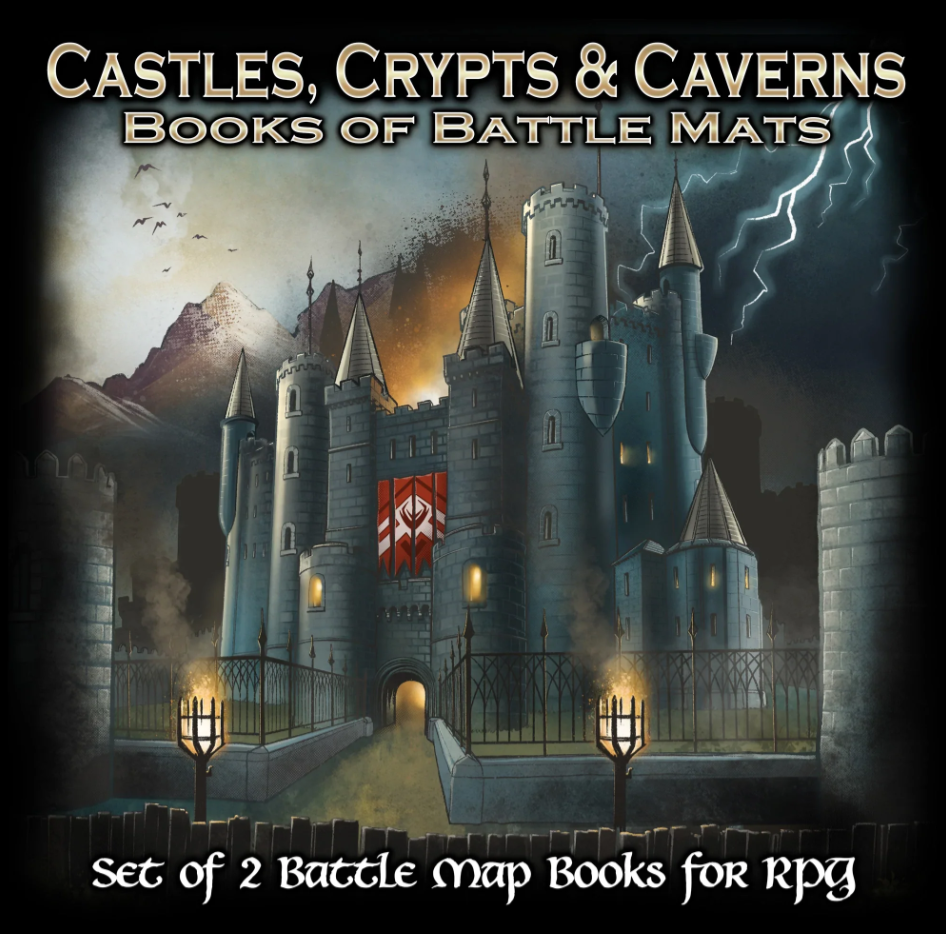
The Castles, Crypts, & Caverns Books of Battle Mats is a ‘Set of 2 Battle Map Books for RPG’. As a set, it comes as two volume set of map books in a slipcase—open ended at either side for easy access. Each of the two volumes is a twelve-inch squire square, spiral bound book, with each containing sixty maps, all marked with a square grid. These start with a pair of maps with just a plain, but quickly leap into depicting particular locations. There are castle walls with towers and stables, great spiraling stairs, a mess hall, temples and dormitories, libraries and ritual rooms, ornamental gardens, befouled sewer tunnels, and caverns set across a variety of terrain types, and much, much more. And this is more or less the same in each of the two books. This does not mean that the maps are exactly the same in each book. Rather they are thematically similar and this leads into what is perhaps the greatest feature of the Castles, Crypts, & Caverns Books of Battle Mats.

Each two-page spread of the two volumes of the Castles, Crypts, & Caverns Books of Battle Mats consists of two linked maps—physically and thematically. The Game Master can use either of the maps on the two-page spread on their own or together, as a twelve by twenty-four-inch rectangular map. That though is with the one volume. With two volumes together, the Game Master can combine any single map from one volume with any single map from the other, and if that is not flexible enough, any two-page spread from one volume can be placed next to a two-page spread from the other, in the process, creating a twenty-four by twenty-four-inch square map. What is means is that the Game Master can connect the two sections of castle walls to create a longer section, the sewers can be extended, and the mess hall, dormitories, and other sections placed together to form a barracks, for example. As with the other titles in the range, this gives the Castles, Crypts, & Caverns Books a fantastic versatility which the Game Master can take advantage of again and again in choosing a combination of map pages from the two volumes to create location after location, and then use them to build encounter after encounter.

The individual maps are excellent, being bright, vibrant, detailed, and clear. They are easy to use and easy to modify. A Game Master can easily adjust them with a write-on/wipe-off pen to add features of her own. This is especially important if the Game Master wants to use a map which has previously featured in one of her adventures. She can also add stickers if she wants new features or even actual physical terrain features.

There are four books in the seriesthe Castles, Crypts, & Caverns Books of Battle Mats, The Wilderness Books of Battle Mats, The Dungeon Books of Battle Mats, and The Towns & Taverns Books of Battle Mats. There is a difference between the Castles, Crypts, & Caverns Books of Battle Mats and the other titles which is both an advantage and a disadvantage for this set of books. The difference is that instead of focusing of one or two themes, such as dungeons or towns and taverns, the Castles, Crypts, & Caverns Books of Battle Mats obviously focuses on three. This gives its a flexibility which means it slots easily alongside a wider range of maps from the other three books in the series. For example, the castle maps from the Castles, Crypts, & Caverns Books of Battle Mats can abut against the street maps from The Towns & Taverns Books of Battle Mats or the caverns added to those in The Dungeon Books of Battle Mats. However, it is not quite possible to create a complete castle or fortress or other buildings or similar buildings with this book set. Rather, it feels as if the Castles, Crypts, & Caverns Books of Battle Mats is a book of abutments, sections that support and expand the maps in the other entries in the series, ratehr than being a standalone product. Consequently, they are not necessarily that easy to use on the fly, to ready up an encounter at a moment’s notice. Instead, they are easier to use as part of the Game Master’s preparation and then have everything necessary to play. Then obviously, the maps cannot be used over and over lest familiarity become an issue. Neither of these are issues which will prevent a Game Master from using the Castles, Crypts, & Caverns Books of Battle Mats, but rather that she should be aware of them prior to bringing them to the table.

Physically, the Castles, Crypts, & Caverns Books of Battle Mats is very nicely produced. The maps are clear, easy to use, fully painted, and vibrant with colour. One issue may well be with binding and the user might want to be a little careful folding the pages back and forth lest the pages crease or break around the spiral comb of the binding. Although there is some writing involved in the Castles, Crypts, & Caverns Books of Battle Mats, it is not really what a Game Master is looking for with this two-volume set. Fortunately, the writing is a little sharper than in previous entries in the series.

There is no denying the usefulness of maps when it comes to the tabletop gaming hobby. They help players and Game Masters alike visualise an area, they help track movement and position, and so on. If a gaming group does not regularly use miniatures in their fantasy games, the Castles, Crypts, & Caverns Books of Battle Mats might not be useful, but it will still help them visualise an area, and it may even encourage them to use them. If they already use miniatures, whether fantasy roleplaying or wargaming, then the maps in the Castles, Crypts, & Caverns Books of Battle Mats will be useful—but only to an extent and then really only best used with the other volumes in the series. Still there are so many fantasy roleplaying games which Castles, Crypts, & Caverns Books of Battle Mats will work with, almost too many to list here…

The Castles, Crypts, & Caverns Books of Battle Mats is full of attractive, ready-to-use maps that the Game Master can bring to the table for the fantasy roleplaying game of her choice. As with other entries in the series, the Castles, Crypts, & Caverns Books of Battle Mats is both practical and pretty, but its broader focus that it is not quite as useful an accessory for fantasy gaming in general with the rest of the line.

Saturday, 8 October 2022

Mapping Your Cyberpunk Game

Given the origins of the roleplaying hobby—in wargaming and in the drawing of dungeons that the first player characters, and a great many since, explored and plundered—it should be no surprise just how important maps are to the hobby. They serve as a means to show a tactical situation when using miniatures or tokens and to track the progress of the player characters through the dungeon—by both the players and the Dungeon Master. And since the publication of Dungeon Geomorphs, Set One: Basic Dungeon by TSR, Inc. in 1976, the hobby has found different ways in which to provide us with maps. Games Workshop published several Dungeon Floor Sets in the 1980s, culminating in Dungeon Planner Set 1: Caverns of the Dead and Dungeon Planner Set 2: Nightmare in Blackmarsh; Dwarven Forge
has supplied dungeon enthusiasts with highly detailed, three-dimensional modular terrain since 1996; and any number of publishers have sold maps as PDFs via Drivethrurpg.com. Loke BattleMats does something a little different with its maps. It publishes them as books.

A Loke BattleMats book comes as a spiral-bound book. Every page is a map and every page actually light card with a plastic covering. The fact that it is spiral-bound means that the book lies completely flat and because there is a map on every page, every map can be used on its own or combined with the map on the opposite page to work as one big, double-page spread map. The fact that the book is spiral bound means that it can be folded back on itself and thus just one map used with ease or the book unfolded to reveal the other half of the map as necessary. The fact that every page has a plastic covering means that every page can be drawn on using a write-on/wipe-off pen. It is a brilliantly simple concept which has already garnered the publisher the UK Games Expo 2019 People’s Choice Awards for Best Accessory for the Big Book of Battlemats and both the UK Games Expo 2019 Best Accessory and UK Games Expo 2019 People’s Choice Awards Best Accessory for Giant Book of Battle Mats.

The newest release from Loke Battle Mats is The Big Book of Cyberpunk Battle Mats, which presents “60 Pages of Battle Mats for Modern Tabletop RPGs”, marked in either one-inch squares or one-inch hexes. The first map is plain, but the second is where the volume starts getting useful. The first map is of a classic motel, consisting of an office and a ring of small rooms each with an en suite bathroom. There is a certain seediness to it. This is followed by the first of several roads and streets. Some of these have roadside businesses like a bar or café, whilst others do not. 

For fans of Cyberpunk 2077, the collection includes an underground carpark and rooftops, complete with ventilation units and grills, whilst another has a helicopter landing pad. Other sites include an underground station,  plus a street entrance, a suite of offices and a foyer, parts of a cube farm, and a penthouse apartment or suite. 
For fans of ShadowRun, there is a convenience store a la a Stuffer Shack, whilst for fans of Bladerunner, there is a high floor of an apartment building, complete with parts of the apartments of the floor, a la the Bradbury Building. This is one of the disappointments of the book in that it is only big to one half of the floor. Perhaps if there is a second volume of The Big Book of Cyberpunk Battle Mats, the other half could be included in that?

The last few maps in 
The Big Book of Cyberpunk Battle Mats move properly outside. There is a very rough, dirt race track with a couple of burnt out vehicles, a street scene again with a ruined  vehicle and buildings on either side of the street. There are also maps of ruined buildings and ruined railway platform, complete with a train on its side. The book ends with another plain grid for the Game Master to draw the details on it as she needs them, but perhaps the most disappointing map is that of plain grasslands, which seems out of keeping with the feel and tone.

Essentially, as you leaf through the maps of 
The Big Book of Cyberpunk Battle Mats, they move from bright lights to darker places and into a darker, perhaps apocalyptic future. Or just simply ruins, or dilapidated locations out in the Badlands... What this highlights is the flexibility of the maps in the book. They work for several genres, not just the the Cyberpunk one. Most obviously, the Modern genre, but also the Science Fiction and the Post-Apocalyptic genres too. The most obvious is with The Big Book of Sci-Fi Battle Mats, but for the Cyberpunk genre, this collection plugs into Cyberpunk Red, expanding easily the maps and floor plan options which come with Cyberpunk RED Data PackCyberpunk Red: Easy Mode, and the Cyberpunk Red Jumpstart Kit. Of course, not forgetting other Cyberpunk roleplaying games such as Carbon 2185: A Cyberpunk RPG or ShadowRun. Then there are modern roleplaying games and post-apocalyptic roleplaying too numerous to mention that this supplement would work well with.

Physically, The Big Book of Cyberpunk Battle Mats is very nicely produced. The maps are clear, easy to use, fully painted, and vibrant with colour. One issue may well be with binding and the user might want to be a little careful folding the pages back and forth lest the pages crease or break around the spiral comb of the binding.

There is no denying the usefulness of maps when it comes to the tabletop gaming hobby. They help players and Game Masters alike visualise an area, they help track movement and position, and so on. If a gaming group does not regularly use miniatures in their modern, post apocalyptic, Science Fiction, or Cyberpunk roleplaying games, The Big Book of Cyberpunk Battle Mats might not be useful, but it will still help them visualise an area, and it may even encourage them to use them. If they already use miniatures, whether for roleplaying or wargaming, then the maps in The Big Book of Cyberpunk Battle Mats will be undeniably useful.

The Big Book of Cyberpunk Battle Mats is full of attractive, ready-to-use maps that the Game Master can bring to the table for the roleplaying game of her choice—and do so in a surprising range of genres. Both practical and pretty, The Big Book of Cyberpunk Battle Mats is an undeniably useful accessory for a surprising range of genres. If your gaming group likes its maps, then whether playing a Modern game, Science Fiction game, a Post Apocalyptic game, or a Cyberpunk game, The Big Book of Cyberpunk Battle Mats will definitely look good when put down on the table.