Every Week It's Wibbley-Wobbley Timey-Wimey Pookie-Reviewery...
Showing posts with label Paizo Publishing. Show all posts

Friday, 11 September 2026

[Free RPG Day 2026] Things Go To Hell

Now in its nineteenth year, Free RPG Day for 2026 took place on Saturday, June 27th. As per usual, Free RPG Day consisted of an array of new and interesting little releases, which are traditionally tasters for forthcoming games to be released at GenCon the following August, but others are support for existing RPGs or pieces of gaming ephemera or a quick-start. This included dice, miniatures, vouchers, and more. Unfortunately, due to vagaries of International Customs, Free RPG Day in the UK did not take place until Saturday, 22nd August.

This review is possible due to the generosity of Waylands Forge in Birmingham.

—oOo—

One of the perennial contributors to Free RPG Day is Paizo, Inc., a publisher whose titles for both the Pathfinder Roleplaying Game and the Starfinder Roleplaying Game have proved popular and often in demand long after the event. The emphasis in these releases have invariably been upon small species. Thus, in past years, the titles released for the Pathfinder Roleplaying Game have typically involved adventures with diminutive Player Characters, first Kobolds, then Goblins, and then with the release of A Fistful of Flowers for Free RPG Day 2022 and A Few Flowers More for Free RPG Day 2023, it was Leshies, where as for Free RPG Day 2024, it was the turn of toys with The Great Toy Heist! However, for Free RPG Day 2025, The Scourge of Sheerleaf switched things up by increasing the scale of the adventure and making the 
villain of the piece even bigger! Although the situation and the villain is very different for Things Go To Hell, the entry for Free RPG Day continues to do things on a bigger scale!

Things Go To Hell is designed for four Seventh Level Player Characters and makes use of the Pathfinder Roleplaying Game Player Core, the Pathfinder Roleplaying Game GM Core, and the Pathfinder Roleplaying Game Monster Core. Barring the fact that the Player Characters are Seventh Level which means that they are quite complex in terms of what they can do and are capable of, especially the two spellcasters in the pre-generated quartet, the scenario is fairly straightforward, easy to prepare, and easy to run.

The scenario opens with the Player Characters suddenly awakening—a Halfling animating to life after being posed as a statue, the spark of life returning to the eyes of both a berobed automaton and an armed and armoured skeleton, and a human male being spat out of a strangely organic pod—to find that a lot of time has passed since their last memories and that they are still in Fanespire, a foul tower owned by the archmage, Ydris Veloch. All four realise three facts. The first is that Ydris Veloch is dead; the second that each of them was treated as an object by the late wizard; and the third is that the tower is no longer where it was. The latter is confirmed when they look out of the windows at the top of the tower and see a literal hellscape. Working their way down several floors, they encounter what is very obviously a devil. This is Gosterion, a ‘phistophilus’—a contract devil—who is quite happy to chat to the Player Characters. He will also explain the situation. Ydris Veloch had a contract with Dispater in the city of Dis which gave him possession of Fanespire in return for his soul and with his recent death during the Hellfire Crisis, and so he is currently searching the tower for the late wizard’s soul. Worse, since Ydris Veloch considered all four Player Characters to be property and at the time of his death were in the possession of the wizard, they are actually part of the contract that Ydris Veloch had with Hell and thus owned by Hell.

The good thing is that the Player Characters get to argue their case and potentially come to some kind of arrangement. Gosterion will let the Player Characters go if they can find Ydris Veloch’s soul for him. So ideally, the Player Characters will return to searching Fanespire for the soul of its former master. Unfortunately, it is not so much of search as the scenario only has three locations, but it will see the Player Character confront their former gaoler. Then once done, Gosterion will send them home, bearing in mind that the Player Characters will be making a deal with a devil.

The four Player Characters are interesting in their variety. They consist of Hila, a genderless Automaton Cleric and healer for hire who was under contract with Ydris Veloch; Klixi Halfstep, a female Halfling thief who was robbing Fanespire; Tiberius, a male Skeleton Fighter who was the head of Ydris Veloch’s security; and ‘Ydris Veloch’, a male Human Wizard and a clone of Ydris Veloch who regarded him to be a failure. All distrust each other, but given the current circumstances must work together. All four are given a two-page spread each and each includes his background, a guide to playing the character, with notes on whet he will do in combat, exploration, and when healing is required, as well as what he thinks about the other characters. The four Player Characters are very well done and easy to read, and also include references for the various abilities.

Physically, Things Go To Hell is professionally presented. The artwork is excellent and the writing is clear. The map of three of the levels of Fanespire are also decent.

Things Go To Hell has a very likeable set-up which throws four unlikely Player Characters together and forces them to work hand in hand whereas that would be unlikely to happen. Yet after the entertaining interaction with Gosterion and the legal ramifications of the situation that the Player Characters are in, the scenario cuts to a climax with a fight. The fight makes sense, but the Player Characters are not expected to do anything else because all of the rooms on the other floors are shut up. So, the Player Characters never get to explore them and never actually get to look for Ydris Veloch’s soul. There is huge potential here for roleplaying and exploration here, given that one Player Character was the head of the wizard’s security and another was robbing him, but it is ignored in favour of cutting to the chase. All it would have to develop the story and play a little more is two or three smaller encounters in the tower to take advantage of those opportunities. It does not help that each Player Character is given a two page spread which effectively presents more information than is really needed for a short one-shot like Things Go To Hell. If they could have been shortened, then perhaps room could have been made for more scenes and locations.

Ultimately, the set-up to Things Go To Hell is sophisticated and the pre-generated Player Characters in Things Go To Hell are sophisticated, but the plotting and the story potential is unsophisticated. Fortunately, an experienced Game Master should be able to detail two or three floors for the Player Characters to investigate and give the players the opportunity to roleplay and explore the search for Ydris Veloch’s soul more fully.

Saturday, 22 August 2026

[Free RPG Day 2026] Rescue on Raxil

Now in its nineteenth year, Free RPG Day for 2026 took place on Saturday, June 27th. As per usual, Free RPG Day consisted of an array of new and interesting little releases, which are traditionally tasters for forthcoming games to be released at GenCon the following August, but others are support for existing RPGs or pieces of gaming ephemera or a quick-start. This included dice, miniatures, vouchers, and more. Unfortunately, due to vagaries of International Customs, Free RPG Day in the UK did not take place until Saturday, 22nd August.

This review is possible due to the generosity of Waylands Forge in Birmingham.

—oOo—

Since its original publication in 2017, titles for the Starfinder Roleplaying Game—the Science-Fiction/Science Fantasy role-playing game published by Paizo Publishing—have been a regular feature of Free RPG Day. Free RPG Day 2026 is no exception, but this year, the scenario is for Starfinder Roleplaying Game, Second Edition. This is Rescue on Raxil, a short scenario for five Third Level Player Characters. Its plot and set-up are simple. Raxil is a peaceful, fertile world with a delicate ecology, which is suddenly threatened by the arrival of a clandestine expedition from Absolute Zero, an augmentation research group with little regard for both the effect of their research on the environment and the ethics when it comes to its experiments, and even worse secret backers, Frozen Trove! Despite the best attempts of Absolute Zero, word has got out about its operations and contact has been made off world with the mystical protectors known as the Xenowardens. They have dispatched a team of operatives to land on Raxil, get as close to the Absolute Zero laboratory as possible, and then shut its operations down as well as gathering proof of the connection between Absolute Zero and Frozen Trove.

The scenario is short and so throws the Player Characters into the action in the first of three scenes. They are dropped deep in the forest near the Absolute Zero where they suddenly see two strange creatures. These are Dracotoads, the first signs of Absolute Zero’s activities, two toads spliced with modified dragon glands. The Player Characters can fight them, but two of them have Wildwise Grafts which allows them to talk to animals, so they can use other means to get past the Dracotoads. They can do the same with the next encounter too. The scenario will climax in the laboratory with Player Characters confronting the leader of the Absolute Zero expedition, Feskagazar, a non-binary dragonkin genetic scientist. This is a nicely staged affair with the Player Characters needing to decide whether they want to fight Feskagazar or save the research data they have set to delete.

Rescue on Raxil includes five pre-generated Player Characters. They consist of an Elf Envoy, a Skittermander Witchwarper, a Raxilite Mystic, a Ryphorian Operative, and a Dragonkin Solarian. All are Third Level and all are given a two-page spread which includes a background, advice on playing the character in and out of combat, and relationship to the other Player Characters. Besides the Starfinder Player Core, the scenario also makes use of the Starfinder Galaxy Guide and Starfinder Galactic Ancestries. Maps of the two locations in the scenario are placed inside the front and back cover.

Physically, Rescue on Raxil is as professionally presented as you would expect for Paizo, Inc. It is in full colour, the art and cartography are excellent, and the adventure is well written.

Rescue on Raxil is a straightforward Science Fiction adventure. In fact, too straightforward. Even simplistic. Two of the encounters can be solved by talking and it ends with a big fight at the end. There is not enough variety in the game play or the challenges and it could have done with another encounter to give it some variety and perhaps a little less in the way of character backgrounds for what is a short adventure. Rescue on Raxil is as professional a product as you would expect from Paizo Publishing, but just too short and lacking variety to make it a good one-shot or demonstration scenario.

Monday, 7 July 2025

[Free RPG Day 2025] Battle for Nova Rush

Now in its eighteenth year, Free RPG Day for 2025 took place on Saturday, June 21st. As per usual, Free RPG Day consisted of an array of new and interesting little releases, which are traditionally tasters for forthcoming games to be released at GenCon the following August, but others are support for existing RPGs or pieces of gaming ephemera or a quick-start. This included dice, miniatures, vouchers, and more. Thanks to the generosity of Waylands Forge in Birmingham, Reviews from R’lyeh was able to get hold of many of the titles released for Free RPG Day.

—oOo—

Battle for Nova Rush
is a scenario for Starfinder, Second Edition and in terms of support for Free RPG Day 2025, feels very much like a reset. Back in 2018 for Free RPG Day, Paizo, Inc. published Starfinder: Skitter Shot, a scenario in which four of the cheerfully manic, gleefully helpful, vibrantly coloured, six-armed and furry creatures known as Skittermanders, have an adventure and find themselves in possession of their own starship. They would then have further adventures in subsequent releases for Free RPG Day. Battle for Nova Rush involves a familiar setting, though not Skittermanders. Well, almost not Skittermanders. The scenario is designed to played with four First Level Player Characters—all of which are provided—and can be played through in a single session.

The scenario begins in classic Science Fiction fashion. The Player Characters are locked up in the brig of a starship. The vessel is the Nova Rush, previously owned by a thrill-seeking amateur archaeologist, but recently captured following a violent hijack by Captain Phaedra Firestorm. The Player Characters will need to find their way out of their cell, several methods including persuasion, intimidation, and deception, being suggested. Their gaoler is surprisingly helpful and quite happy to see them go up against Captain Firestorm. The Player Characters will soon garner the aid and advice of the ship’s Virtual Intelligence, Captain Concierge, a Skittermander, who will be very helpful. As they proceed through the ship, dealing with pirates, it will quickly become apparent that the ship is under attack by the ghastly sounding ‘Corpse Fleet’, so repairs are required before the Player Characters can climb to the bridge and face the pirate captain. Once she is defeated, they can make their escape a second time, this time from the battle.

Battle for Nova Rush comes with four pre-generated Player Characters. They consist of Chk Chk, a male Shirren Mystic; Dae, a nonbinary Pahtra Solarian; Iseph, a nonbinary Android Operative; and Navasi, a female Human Envoy. All four are given a double-page spread, which includes an illustration, detailed background, advice on playing the character, explanations of how they operate in combat, exploration, and healing modes, what they think of their fellow inmates, and lastly their full stats. The Player Characters are very well presented, just as you would expect for a release for Free RPG Day from Paizo, Inc. The scenario also includes a nicely done set of deckplans for the Nova Rush.

Physically, Battle for Nova Rush is as professionally presented as you would expect for Paizo, Inc. It is in full colour, the art and cartography are excellent, and the adventure is well written.

Battle for Nova Rush is a straightforward, even clichéd Science Fiction adventure. The Player Characters begin as prisoners, have to escape, fix a few things and fight a few things before confronting the villain of the piece and escaping once again. Consequently, it is an undemanding affair, but one that still leaves room to showcase the Starfinder, Second Edition rules and let the players have a good time.

Saturday, 20 July 2024

[Free RPG Day 2024] Second Contact

Now in its seventeenth year, Free RPG Day for 2024 took place on Saturday, June 22nd. As per usual, Free RPG Day consisted of an array of new and interesting little releases, which are traditionally tasters for forthcoming games to be released at GenCon the following August, but others are support for existing RPGs or pieces of gaming ephemera or a quick-start. This included dice, miniatures, vouchers, and more. Thanks to the generosity of Waylands Forge in Birmingham, Reviews from R’lyeh was able to get hold of many of the titles released for Free RPG Day.

—oOo—

In 2017,
Paizo, Inc. published Starfinder: First Contact, a preview of and teaser for its then forthcoming Starfinder, the Science Fantasy roleplaying game which takes the Pathfinder Roleplaying Game forward thousands and thousands of years and to the stars. So it is most appropriate that as a preview of and teaser for the forthcoming Starfinder Roleplaying Game, Second Edition, Paizo, Inc. has released Starfinder: Second Contact for Free RPG 2024. Where the task of Starfinder: First contact was to introduce the new roleplaying game and highlight some of the differences between it and the Starfinder Roleplaying Game, the task of Starfinder: Second Contact is to reintroduce us to the Starfinder Roleplaying Game and highlight some of the differences between it and the Starfinder Roleplaying Game, Second Edition as seen in the Starfinder Playtest Rulebook.

The introduction highlights how the Starfinder Roleplaying Game is going to evolve to be in line with Pathfinder, Second Edition, before jumping straight into ‘What’s New?’. These start with elements and skills that appear in the monster descriptions given in the booklet’s following pages. For example, the ‘Integrated Weapons’ appears in the entry for robots and new skills include Computers and Piloting used by both the Asteray and the Glitch Gremlin. Similarly, several of the spells are used by those creatures. They include Delete, a spell used to remove a limited amount of data, whilst the cantrip, Recharge Weapon, reloads a weapon with a round’s worth of ammunition upon a touch. The new weapons are a couple of laser guns, whilst the rest of the Starfinder: Second Contact is really all about the monsters. These start with the Asteray, Fey Tricksters born where the void and the First World overlap, they wander space looking for distractions and starship crews to consume, and end with the Cybernetic Zombie, which might have an arm cannon or a shriek module or repair nanites! In between, there are Security Robots, Glitch Gremlins—which of course, want to cause mayhem, Laser Wolves, and Ferrofluid Oozes, sentient puddles of ferromagnetic fluids that interfere with technological devices of all sorts. Every creature is given a full page description, stats, and an illustration.

Like the earlier
Starfinder: First Contact, there is little to the background of the Starfinder Roleplaying Game to Starfinder: Second Contact. There is mention that Golarion, the setting for Pathfinder, is missing, that rumours arose during the Drift Crisis of super-size versions of Ferrofluid Ooze, capable of consuming whole ships, and that the AbadarCorp is responsible for the manufacture of most robots in the Pact Worlds, becoming a byword for guaranteed quality, but making their weakness commonly known so that criminals and spies can take advantage of them.

Being a release from Paizo, Inc., it should be no surprise that Starfinder: Second Contact is a slickly produced and well-presented booklet. Much like with Starfinder: First Contact for Free RPG Day 2017, Starfinder: Second Contact is very technical in nature in comparison to the other releases for Free RPG 2024. Nevertheless, Starfinder: Second Contact is a solid introduction to the technical elements of the roleplaying game, one aimed more at fans of the roleplaying game rather than the general roleplayer.

Friday, 19 July 2019

Free RPG Day 2019: Starfinder Skitter Crash

Now in its twelfth year, Saturday, June 15th is Free RPG Day and with it comes an array of new and interesting little releases. Invariably they are tasters for forthcoming games to be released at GenCon the following August, but others are support for existing RPGs or pieces of gaming ephemera or a quick-start. Starfinder Skitter Crash is a scenario for Paizo Inc.’s Science Fantasy Roleplaying Game, Starfinder. It is a scenario for four players and comes with four pre-generated characters, and further, it is a sequel to the publisher’s release for Free RPG last year, Skitter Shot.  At just sixteen pages, Starfinder Skitter Crash, like Starfinder Skitter Shot is a short adventure, playable in a good session, specifically designed for use with Starfinder Alien Archive, the supplement which details some eighty life-forms, twenty Player Character races, alien technology aplenty, and more.

Starfinder Skitter Shot introduced everyone to the cheerfully manic, gleefully helpful, vibrantly coloured, six-armed and furry creatures known as Skittermanders. It came with pre-generated Skittermanders—Dakoyo, Gazigaz, Nako, and Quonx—who then served as the crew of the Clutch, a salvage ship captained by their Vest boss, Nakonechkin Ginnady. Out in the Vast beyond the Pact Worlds, the crew of the Clutch, searching for ancient battleships and space stations to salvage, came across a derelict ship, large, ornate, and with brass accents, looking to be very much out of place... The adventure had them go in search of Captain Nakonechkin Ginnady and attempt to effect a rescue. The adventure left them in command of the spaceship they now named The Helping Hand and in search of further missions and excitement.

As Starfinder Skitter Crash begins, the crew of The Helping Hand have made a successful salvaging mission, but as they are celebrating, calamity strikes! They are hailed and then boarded by angry space pirates bound on revenge—who could have foreseen that after the events of Starfinder Skitter Shot? Then calamity strikes again! Something causes both ships to collide with each other in a really weird fashion and it becomes a race to abandon ship before it crashes into the planet below. Coming to on the strange new world, they find themselves amidst boggy surrounds, unsure of where they are, if any pirates survived their crash, where their ship is, and of course, if it managed to come down in one piece. So what the player characters will need to do is find their ship, effect repairs, avoid any piratical entanglements, and blast off back into space! Of course, it is not as easy as that. A couple of clues point to nearby encounters, one with a strange energy signature and another at a monitoring platform, the latter indicating that the planet is home to, or at least visited by, intelligent life. Of course contact will be made with said intelligent life, and the outcome of both this encounter and the previous two encounters nicely influence the outcome of the next, a juicy bit of roleplaying where Skittermanders have to be persuasive rather than just their rambunctious selves. If they can get help, then the Skittermanders should be able to get back into space and doing what they do best…

Starfinder Skitter Crash is different to Starfinder Skitter Shot in that it is not quite as linear, although still fairly linear given that it is designed to be played in a four-hour or so time slot. It is also a bit more complex in the story it is telling and there is more roleplaying involved than in Starfinder Skitter Shot. One issue with that is the rambunctious nature of the Skittermanders may play against the roleplaying required here, but the players should work all the more harder to achieve to overcome that. Other than that, there is plenty for the player characters to do, whether that is investigating or fighting, and although the scenario ends in a big confrontation, fighting it out is not the only solution covered. 

The adventure is challenging, but certainly rewarding if the players go at the adventure with the energy of the Skittermander pre-generated characters. There are four of these provided for use with Starfinder Skitter Shot. They include a Priest Mystic, a Xenoseeker Mystic, a Spacefarer Soldier, and a Scholar Mechanic, all Third Level (up one Level from Starfinder Skitter Shot). Each is detailed on a full page, complete with background and a really nice illustration, as well as the stats. Players will need to refer to the Starfinder Alien Archive for full details of the Skittermanders, but really, they should be played as they appear—bumptious, gleeful, up for a challenge, and manic!

Physically, Starfinder Skitter Shot is very nicely laid out and presented. The artwork is excellent, the writing clear, and the maps easy to use.

Starfinder Skitter Crash is a fun adventure. It throws the Skittermanders into a situation they are unprepared for, but gives them the means to get out of it and make a few friends along the way. Although Starfinder Skitter Crash can be run as a one-shot, it really works best as a sequel as some of its set-up will not quite have the same impact if the players have not played Starfinder Skitter Shot first. With a little effort, the Game Master could easily expand this adventure, but as written, Starfinder Skitter Crash is easy to run and grasp, which once again provides a few hours of play with some bouncy, energetic, and lovable player characters.

Friday, 28 June 2019

Free RPG Day 2019: We Be Heroes?

Now in its twelfth year, Saturday, June 15th was Free RPG Day and with it came an array of new and interesting little releases. Invariably they are tasters for forthcoming games to be released at GenCon the following August, but others are support for existing RPGs or pieces of gaming ephemera or a quick-start. Over the years, Paizo Inc. has supported Free RPG Day with numerous modules, the most notable of which—We Be Goblins!, We Be Goblins Too!, We Be Goblins Free!, We B4 Goblins!, and We Be 5uper Goblins!—all feature the publisher’s signature race, Goblins, for its highly popular Pathfinder Roleplaying Game. Free RPG Day 2019 is no different in that Paizo Inc. is supporting it with a scenario for First Level player characters, a scenario which involves Goblins, and a scenario designed to be played by four players, plus the Game Master. It is though, a very different module to those previous five scenarios.

First and foremost, We Be Heroes? is ‘A Pathfinder Playtest Adventure for Level 1’ and so is designed to showcase the new rules in Pathfinder Playtest, the version of the rules being tested in preparation for the forthcoming Pathfinder Roleplaying Game, Second Edition, to be released at GenCon 2019 and which are designed to be easier to learn and faster to play. To play We Be Heroes?, the Game Master will access to both the Pathfinder Playtest and the Pathfinder Playtest Bestiary, the latter as the creatures encountered in the module are all drawn from that book.

Second, the pre-generated player characters are not the Goblins of the previous five modules for Free RPG Day. Goblins in Pathfinder Roleplaying Game are raucous, rambunctious, and rapacious, green bundles of teeth and anarchy. No so in We Be Heroes? As the title suggests, the module makes its Goblins would-be heroes and thus very different in that whilst the player characters are Goblins, they are community minded, they think of others rather than just themselves, and some of them have begun to read!

Set in the Southern Fangwood forest in Nirmathas, recent events have seen the Whispering Tyrant unleash an undead army on the region, forcing both the local inhabitants and the local animals to flee in terror. This includes the goblins of the Crookedtoes tribe, survivors of the Goblinblood Wars who have retreated as far from other Goblins as possible and under the radical leadership of Velkik, they have taken up hunting rather than raiding, let their young loose instead of caging them, let their tribe members actually learn to read and write, and taken up worship of the Sun! With the local animals having fled in terror, the tribe’s members suddenly find their bellies rumbling with hunger and worse, the tribe’s best scout has gone missing. So Chief Velkik has tasked the Crookedtoes’ four brightest members to go out and search for him.

This mission is quickly fulfilled with an encounter designed to test the Pathfinder Playtest’s combat mechanics, the player characters returning after to inform Chief Velkik of both the scout’s death and the proximity of the undead army. He has another task for them, one for which any other group of Goblins would be all but impossible, but for members of the reformed Crookedtoes might just be possible. This is to locate “... [A] group of longshanks in shiny armour trapped in the valley on the other side of this hill.” By ‘longshanks, the Chief Velkik means Humans and by shiny armour, he means knights and he thinks that by working together, both the shiny armoured longshanks and the Goblins of the Crookedtoes tribe might just survive. Unfortunately, the only way to get to the valley is via set of tunnels through the hill which has not been used in years.

The main part of the adventure is thus a short dungeon crawl. Consisting of just eight locations, the encounters here are designed to be challenging rather than deadly, a mix of small combat encounters, unstable environments, and opportunities to roleplay. The tunnel complex actually packs in a lot of game play for just eight locations, and with good gameplay, the Goblins should come away with a little treasure and possibly even an ally.

We Be Heroes? saves its best encounter for last and it is a roleplaying encounter! By now the player characters will have made their way through the tunnel and into the adjacent valley where the shiny armoured longshanks are camped out. Not only do the Goblins have to work out how to get into the shiny armoured longshanks’ camp, they also have to persuade them that although they are Goblins, they are not the nasty, evil destructive Goblins that everyone knows of and hates, but good Goblins, trying to do better—trying to be heroes! This is a really fun challenge, one that any roleplayer would be keen to get his teeth into, and the module includes plenty of advice as to handle this situation and the shiny armoured longshanks’ response to the weirdly mannered Goblins.

As befitting the heroic nature of the scenario, the four pre-generated player characters are all of heroic intent, but of a Goblin nature. To anyone but a member of the Crookedtoes tribe—and even then—they are a weird lot. They include a Ranger with a heavy crossbow and penchant for tinkering, a Barbarian in a rabbit fur costume, a tuxedo-wearing Bard hated for his exceptionally fine, but non-Goblin voice, but loved for his penny-whistle, and a Druid whose animal companion is a classic French poodle, complete with ribbons! All four come with a great illustration and their own song, each of which sums up each Goblin rather smartly.

Physically, We Be Heroes? is a Paizo Inc. book. So the production values are high, the sixteen pages of the booklet being done in full colour with high quality illustrations. The writing is also good and covers most eventualities.

We Be Heroes? is a short adventure, suitable for a single four hour session. Alongside all of the action, there is plenty of opportunity for solid roleplaying within its sixteen pages and the opportunity to play Goblins is always fun. Especially if they are reformed Goblins looking to prove themselves heroes. Hopefully we will get to see the further adventures of Crimsi, Girenek, Pizaazz, and Siathorn—with her pet ‘wolf’, Mitzi—in future releases for Pathfinder Roleplaying Game, Second Edition.

—oOo—


We Be Heroes? will be available to download from the Paizo Inc. website from Monday, July 1st, 2019.

Friday, 22 June 2018

Free RPG 2018: Starfinder Skitter Shot

Now in its eleventh year, Saturday, June 16th was Free RPG Day and with it came an array of new and interesting little releases. Invariably they are tasters for forthcoming games to be released at GenCon the following August, but others are support for existing RPGs or pieces of gaming ephemera or a quick-start. In 2017, Paizo Publishing released such a preview, Starfinder: First Contact, of its then forthcoming Science Fantasy Roleplaying Game, Starfinder. This year Paizo Publishing has released the first scenario for Starfinder for Free RPG Day, Skitter Shot. At just sixteen pages, this is a short adventure, playable in a good session, specifically designed for use with Starfinder Alien Archive, the supplement which details some eighty life-forms, twenty Player Character races, alien technology aplenty, and more.

Designed to be played by four players, Starfinder Skitter Shot casts them as the cheerfully manic, gleefully helpful, vibrantly coloured, six-armed and furry creatures known as Skittermanders. Four pre-generated Skittermanders are provided in the adventure—Dakoyo, Gazigaz, Nako, and Quonx—who serve as the crew of the Clutch, a salvage ship captained by their Vest boss, Nakonechkin Ginnady. Out in the Vast beyond the Pact Worlds, the crew of the Clutch, searching for ancient battleships and space stations to salvage, come across a derelict ship, large, ornate, and with brass accents, looks to be very much out of place... As the adventure begins, Captain Nakonechkin Ginnady has been aboard the derelict ship for two hours and nothing has been heard from him. Something must have gone wrong, which means that Captain Nakonechkin Ginnady must be in trouble… Which can only mean, Skittermanders to the rescue!

Once aboard the derelict vessel, the remaining crew of the Clutch discover that she is a luxury liner called the Emerald Empyrean. Unfortunately, she has fallen under the control of a rogue artificial intelligence who has taken the well-being of both crew and passengers to an extreme. The Skittermanders need to deal with a ship who at first views them as pets and then as a threat, passengers who have no faith in their boundless energy, and everything that the computer is in control of aboard the Emerald Empyrean. It being a short booklet, the adventure only runs to some eleven locations, plus three events, but all are fully detailed and easy for the Game Master to pick up and run with. The action sequences—traps and combat—outweigh the roleplaying situations, but that is not necessarily a bad thing.

The adventure is challenging, but certainly rewarding if the players go at the adventure with the energy of the Skittermander pre-generated characters. There are four of these provided for use with Starfinder Skitter Shot. They include a Priest Mystic, a Xenoseeker Mystic, a Spacefarer Soldier, and a Scholar Mechanic, all Second Level. Each is detailed on a full page, complete with background, snatches of Skittermander slang, and a really nice illustration, as well as the stats. Players will need to refer to the Starfinder Alien Archive for full details of the Skittermanders, but really, they should be played as they appear—bumptious, gleeful, up for a challenge, and manic!

Physically, Starfinder Skitter Shot is very nicely laid out and presented. The artwork is excellent, the writing clear, and the map easy to use.

Starfinder Skitter Shot is a fun adventure. It is perhaps a bit of a cliche in terms of its plot, but for a straightforward one-shot—perhaps with room to develop into further adventures—that again, is no bad thing. It makes the adventure easy to run and grasp. Overall, Starfinder Skitter Shot nicely showcases the Starfinder setting of the Pact Worlds and provides a few hours of play with some bouncy, energetic, and lovable player characters.

Saturday, 5 August 2017

Free RPG Day 2017: Starfinder: First Contact

Now in its tenth year, Saturday, June 17th is Free RPG Day and with it comes an array of new and interesting little releases. Invariably they are tasters for forthcoming games to be released at GenCon the following August, but others are support for existing RPGs or pieces of gaming ephemera. The scenarios are of course for existing games, but whilst the quickstarts may likewise also be for existing games, many are for forthcoming games, giving gamers a chance to experience a new game or setting before they are released. One such title is neither a scenario nor a quickstart, but a teaser, introducing elements of a forthcoming roleplaying game. That title is Starfinder: First Contact.

Since 2009, Paizo Publishing has been releasing and supporting material for its Pathfinder Roleplaying Game, a Dungeons & Dragons-style roleplaying game and in fact, the Pathfinder Roleplaying Game remains one of the best supported games currently available, with innumerable supplements, scenarios, and campaigns. In previous years, Paizo Publishing has supported Free RPG Day with scenarios like We Be Goblins. For 2017, Paizo Publishing released Starfinder: First Contact. This is a teaser for Starfinder, Paizo Publishing’s Science Fantasy roleplaying game which takes the Pathfinder Roleplaying Game forward thousands and thousands of years and to the stars. To some extent, the genre of ‘Dungeons & Dragons in Space!’ has been explored before, most notably with TSR, Inc.’s Spelljammer in 1989 and then with the Dragonstar Starfarer's Handbook from Fantasy Flight Games in 2001.

As a first glance, Starfinder: First Contact does three things. First and second, it introduces us to what is different in the Starfinder Roleplaying Game in comparison to the Pathfinder Roleplaying Game and it tells us what is new in the Starfinder Roleplaying Game. Third, it introduces us to eleven monsters and creatures that are home not just to Golarion—the campaign setting for the Pathfinder Roleplaying Game—but the Golarion solar system. Much of what is different as presented in Starfinder: First Contact relates to how monsters and creatures are presented in Starfinder. So, taking its cue from Pathfinder Unchained, the monster stat block in the Starfinder Roleplaying Game is slimmed down, for example, only listing ability modifiers and not ability scores; only listing feats that let a monster do something, whilst subsuming feats that grant bonuses into the relevant statistic; and the unification of the various types of sense beyond the basics into blindsight and blindsense. The new comes in the form of Class Abilities like the Cloaking Field, a kinetically rechargeable device that grants a bonus to the Stealth skill, and Grenade Expert, being able to throw a grenade further and jury-rig a small grenade within a few minutes; Universal Monster rules such as Limited Telepathy and Unliving; and weapon abilities, like Arc, Burn, and Explode, representing how much deadlier weapons—especially guns and energy weapons—are in the Starfinder Roleplaying Game.

Perhaps though, the most interesting suggestion in Starfinder: First Contact and thus Starfinder Roleplaying Game is that the new roleplaying game is going to allow the players to roleplay a great many of the races as aliens. Now they are weaker versions of the standard interpretations of the races, but enable a player to take the role of a Space Goblin junker, a Ratfolk mechanic, spellhacking Lashunta technomancer, and so on. Eleven races are given in Starfinder: First Contact—Bloodbrother, Contemplative, Ellicoth, Haan, Ksarik, Necrovite, Orocoran, Sarcesian, Security Robot, Space Goblin, and Space Pirate. Ranging from 1/3 to 13 in terms of C/R, the Contemplative, Haan, Sarcesian, and Space Goblin are given Racial Traits to allow them to be played as Alien player characters.

Unfortunately, there is nothing of the background of the Starfinder Roleplaying Game to be found in the pages of Starfinder: First Contact. That said, a very little of the background can be gleaned from the monster and creature descriptions. For example, the importance of Absalom Station, infested as it is with Space Goblins who use it as a staging point from where they can hijack ships and travel to the stars and how security on the station is handled by Security Robots, whilst some gangs have hacked some Security Robots and used them to protect their own interests. Unfortunately, all a little too slight to give much of the flavour and the feel of the Starfinder Roleplaying Game.

Being a release from Paizo Publishing, it should be no surprise that Starfinder: First Contact is a slickly produced and well-presented booklet. In comparison to other releases for Free RPG Day 2017, Starfinder: First Contact is very technical in nature and has little to offer the casual gamer beyond perhaps being a little intriguing. For the devotee of the Pathfinder Roleplaying Game there is much in the pages of Starfinder: First Contact to entice their interest, especially if they are looking to expand their genre from fantasy to science fantasy and to see the future of Golarion pushed thousands of years into the future.

Saturday, 21 December 2013

Reviews from R'lyeh Christmas Dozen 2013

Since 2001, I have contributed to a series of lists in December at Ogrecave.com, suggesting not necessarily the best board and roleplaying games of the preceding year, but the titles that you might like to receive and give. Initiating a break with tradition – in that the following is just the one list and in that for reasons beyond its control, OgreCave.com is not running its own lists – Reviews from R’lyeh would once again like present its own list. Further, as is also traditional, Reviews from R’lyeh has not devolved into the need to cast about “Baleful Blandishments” to all concerned or otherwise based upon the arbitrary organisation of days. So as Reviews from R’lyeh presents the what is my dozenth’s Christmas List Dozen, I can only hope that the twelve below includes one of your favourites, or even better still, includes a game that you do not have and someone is happy to hide in gaudy paper and place under that dead tree for you.


Tales of the Sleepless City 
(Miskatonic River Press), $29.95/£21.99
It is sad news indeed that Tales of the Sleepless City, an anthology of scenarios set in New York during the Jazz Age, is Miskatonic River Press’ swansong for Call of Cthulhu. This beautifully presented book contains six scenarios that bring the Big Apple to life like no supplement for Call of Cthulhu before! Let your investigators discover how far reactionaries will go to preserve the fabric of New York, expose them to bloody horrors in the museum, or have them experience Harlem in mourning. Send them into Hell’s Kitchen to live in a slum tenement owned by the worst slum landlord possible, have them expose a dark future for one young child in Chinatown, or let them truly enjoy a night at the opera… Tales of the Sleepless City is the best Call of Cthulhu title of 2013 – it is such a pity that we shall not see its like again from Miskatonic River Press.


Hanabi (Cocktail Games), $11.99/£8.99
Remember how 7 Wonders made the Ogrecave.com Christmas list back in 2011 after not winning the ‘Spiel des Jahres’ (German ‘Game of the Year’), but winning its new bigger brother award, the ‘Kennerspiel des Jahres’ (roughly ‘Connoisseur-Enthusiast Game of the Year’)? Well this year we include an actual ‘Spiel des Jahres’ winner, one from the designer of 7 Wonders – Antoine Bauz. His award winning design is Hanabi, a clever game in which the players race to bring about the most impressive fireworks display. This requires that the players work together in order to launch the fireworks in the right order, which means everyone playing their cards in the right order. The twist in this co-operative card game is that everyone can see each other’s cards, but they cannot see their own! This is a clever little card game about communicating the right information with your other players in order to win the game.


13th Age (Pelgrane Press), $44.95/£39.99
What do you get when a designer of Dungeons & Dragons, Fourth Edition and a designer of Dungeons & Dragons, Third Edition decide to create a fantasy RPG together? The result is Rob Heinsoo and Jonathon Tweet’s 13th Age, a furiously fun take upon playing Dungeons & Dragons. It still uses the d20 System, but streamlines the mechanics and play style for faster game, combining well-designed character Classes with story-telling aspects that both tie the heroes into the broadly drawn setting and make them stand out as potentially epic champions. With Dungeons & Dragons Fifth Edition not out until GenCon 2014, 13th Age is the freshest take upon Dungeons & Dragons-style roleplaying in years.


Ogre Designer’s Edition
(Steve Jackson Games), $100/£85
If in 2013 the gaming hobby, the elephant in the room that is Dungeons & Dragons was on holiday, then pound for pound, its spot was occupied by a 26 lbs. tank. Big enough and heavy enough to scare your game’s collection, the Ogre Designer’s Edition brings back Steve Jackson’s first game design in a very complete combination of the original classic Ogre and G.E.V. two-player game, plus more. Five maps, hundreds of counters, and over seventy 3D Ogres and buildings, all in a big box! What’s an ‘Ogre’ you ask? A big tank, a big damned tank under the command of an A.I. and bristling with big guns, big rockets, and big nukes, all rumbling towards you… Can you stop it before it stops the units under your command…?


Pathfinder Adventure Card Game: Rise of the Runelords - Base Set 
(Paizo Publishing), $59.99/£49.99
Remember the original Adventure Path campaign for Rise of the Runelords and how we liked it last year enough to include Rise of the Runelords Adventure Path Anniversary Edition on the 2012 Ogrecave.com Christmas List? This year, you get to play it all over again with the Pathfinder Adventure Card Game: Rise of the Runelords, a game that distils the essence of both the Pathfinder Roleplaying Game and Rise of the Runelords into an elegant and quick playing deck-building card game that plays equally well for four players as it does for the single player. The game pitches a party of adventurers in a series of scenarios against various villains and their henchmen who are hidden – find the henchmen and the heroes have a chance of finding and defeating the villain. The adventurers need to have the right skills, right spells, and right equipment all at the right time – and if they succeed they get better. All represented on the cards, which makes for both slick game play and extended game play over the course of the Rise of the Runelords campaign.


Firefly: The Game
(Gale Force Nine), $50/£44.99 
If there is one RPG that we are looking forward to in 2014, it is Margaret Weis Productions’ Firefly Role-Playing Game – of which you can find a taster here – but that is coming in 2014. In the meantime, you can fly the ‘friendly’ ‘Verse in search of a profit aboard your own Firefly Class transport in this well-appointed boardgame from Gale Force Nine. Some jobs will be legal, some jobs will be illegal, and some may bring the attention of the Alliance or worse, Reavers! All you need is the right ship, the right crew, and the right job – maybe it’s a job for Badger, maybe for Niska, but it just needs to go shiny. The game does not always go smooth, but if you are a fan of the television series, then is exactly what you want. Find a crew. Find a job. Keep flying…


Fate Core System (Evil Hat Productions), $25/£16.99
In most RPGs you sit down, create a character and start playing a world of the GM’s creation (or purchase). In Fate Core System, the new edition of the Fate System first seen in Spirit of the Century, you sit down and work with your fellow players and the GM to decide upon a world and the elements in it. This presents enormous flexibility in creating the game that everyone wants to play, whether that is protecting small town Texas from the scum of the universe in 1961, strapping on a jetpack to free the Solar System from the yoke of the Mongol Horde, or wielding the arcane arts against the greatest of Napoleon Bonaparte’s sorcerers! It means that right from the start, the players have narrative control of who their characters are and what their place in the world is, the GM taking his cue from these characters and the narrative that they demand. This is a game about dramatic characters and their adventures and the means to build and run them. (Two supplements – Fate Worlds: Worlds on Fire and Fate Worlds: Worlds in Shadow each come with six ready-to-play settings should the GM and his players not have the time to create worlds of their own, or just want to cut to the chase).


Love Letter (Alderac Entertainment Group), $11.99/£7.99
Princess Annette is unhappy and has locked herself away in the castle; as a suitor can you make her happy once again? To do that you need to get a love letter to her, but between you and the Princess stands the palace bureaucracy – from the lowly guards and priests up through the barons, handmaidens, the King, and the Prince to the Countess and the Princess herself. Each and every one of these august – and not august personages – has a special ability that will advance or block your path to the Princess, but no suitor knows whose favours his rivals currently possess. This is a quick-playing game of bluff and deduction that plays perfectly between other games.


Adventures in Kaphornia 01 – Draconian Rhapsody: A Fantasy Movie For Your Game Table (Chronicle City), $19.99/£13.99
Sadly, roleplaying takes time and there are times when it would be great to have something that you can pick and play with a minimum of preparation. Originally published in German by Ulisses Spiele GmbH, Draconian Rhapsody is just one solution. It is not an RPG as such, but rather a scenario that comes with everything necessary to play – except dice of course! It includes ready-to-play characters, simple rules, and of course an adventure that everyone can jump straight into. Arriving in Kaphornia, through circumstances beyond their control the adventurers discover that Countess Esmeralda of Belzheim needs a dragon, alive and inside of a week. Can they capture the dragon for her in this definitely cinematic, if slightly humorous adventure? Draconian Rhapsody is at its heart a fantasy action movie that you can play through in an evening.


Numenera (Monte Cook Games), $59.99/£39.99
Were the people of the Ninth Age ignorant of the past, then perhaps Clarke’s Law, that “Any sufficiently advanced technology is indistinguishable from magic” might be true. In the very far future of the Ninth Age, humanity is surrounded by the fragments and remains of the previous ages – swirls of nanotechnology, impossibly manicured buildings and landscapes, creatures and peoples bio-engineered to some unknown ends, data streams from still-orbiting satellites, and devices and objects weird and wondrous. Such devices, known as the ‘numenera’, can often be used by the peoples of the Ninth Age, or if not, adapted to a new purpose – perhaps by the Amber Priests. With Numenera, the author’s first RPG of his own design, Monte Cook lets us explore a world of fantastical science to build a bright new future.


Eternal Lies (Pelgrane Press), $49.95/£32.95 
In the 1920s, doughty and stalwart men and women banded together to investigate and thwart the menace presented by threats beyond mankind’s understanding and sanity. We have played out such attempts in Masks of Nyarlathotep, Shadows of Yog-Sothoth, and The Day of the Beast, each in their own way classic campaigns for Call of Cthulhu, but there is one question that has never been asked. What if they failed? This is the set-up for Eternal Lies, the first full campaign for Trail of Cthulhu, Pelgrane Press’ RPG of clue-orientated Lovecraftian investigative horror. In this globe-spanning campaign, the investigators must follow in the footsteps of their predecessors, uncovering clues old and new, not just to reveal the nature of the menace, but to determine where their predecessors went wrong. This is superb interpretation of a classic format that promises month after month of sanity searing play around the world.


Star Wars: Edge of the Empire Roleplaying Game (Fantasy Flight Games), $59.95/£39.99
The gaming hobby feels all the better for having an RPG based in the Star Wars universe on its shelves and in Star Wars: Edge of the Empire, Fantasy Flight Games gives us the first of a trilogy of new Star Wars RPGs. In the one you play Bounty Hunters, Colonists, Explorers, Hired Guns, Smugglers, and Technicians attempting to get by on the Outer Rim, far from the centre of the galaxy, but not so far that the Empire is no longer a threat. The new mechanics use a set of dice particular to the game whose results drive the adventure onwards with results that might ensure a hero’s successes whilst upping the threat or giving him an advantage, all in support of the game’s cinematic style of play. Already supported with several supplements, the Star Wars: Edge of the Empire – Beginner Game is also available to help you get started.


Against the Slave Lords
(Wizards of the Coast), $49.95/£34.99 
With no new official Dungeons & Dragons titles of note this year, perhaps the best were the nostalgia titles repackaged and re-released by Wizards of the Coast. Against the Slave Lords collates four scenarios – A1: Slave Pits of the Undercity, A2: Secret of the Slavers Stockade, A3: Assault on the Aerie of the Slave Lords, and A4: In the Dungeons of the Slave Lords for Advanced Dungeons & Dragons First Edition. Previously released as the collection, Scourge of the Slave Lords (A1–4) which was voted the twentieth greatest Dungeons & Dragons scenario of all time, Against the Slave Lords is a campaign for characters of fourth through seventh levels set in the World of Greyhawk that pitches them against an insidious gang of slavers. Presented as a pleasing hardback that not contains the original four scenarios, but also adds a fifth scenario designed to introduce player characters to the campaign, which means that Against the Slave Lords can not only be played by us old nostalgic players, but new ones too.

Thursday, 20 December 2012

Ogre Cave Christmas List 2012


Come the end of the year and as has been vaguely traditional for the past decade that in December, OgreCave.com runs a series lists suggesting not necessarily the best board and roleplaying games of the preceding year, but the titles that you might like to receive and give. Continuing the break with tradition – in that the following is just the one list and in that for reasons beyond our control, this list is not appearing at OgreCave.com – Reviews from R’lyeh would like present its own list. Further, as is also traditional, Reviews from R’lyeh has not devolved into the need to cast about “Baleful Blandishments” to all concerned or otherwise based upon the arbitrary organisation of days.

Nevertheless, Happy Gaming and enjoy the suggestions. Consider them perfect for purchase for yourself. If the world is to end in 2012 – and the denizens of Reviews from R’lyeh doubt that the stars have come right as yet – then at least enjoy a few last rolls of the dice with a favourite new game…


Lords of Waterdeep
(Wizards of the Coast), $49.99/£39.99
One of the best and most accessible board games of the year came from the most unexpected publisher, Wizards of the Coast. Lords of Waterdeep combines the classic Dungeons & Dragons theme with tried and tested Eurogame-style “worker placement” mechanics. For between two and five players, the game casts the players as masked lords vying for control of Waterdeep, the City of Splendors, the most resplendent jewel in the Forgotten Realms. They send out their Agents to acquire Buildings and access to better resources; gain Gold to make the many purchases necessary to ensure their rise to power; the means to Intrigue with their fellow Lords; and hire Adventurers whom they can send out on missions or Quests that once completed will spread their influence and gain them true power. The game scales nicely, being as challenging to play with two players as it is with five, plays easily in an hour, and forces a player to make difficult decisions when presented with numerous options! (Read the review here).


Midgard Campaign Setting 
(Open Design) $49.99/£29.99
The bad news is that in 2012, we lost Kobold Quarterly, the only Dungeons & Dragons compatible magazine to be available on the shelves at your local friendly gaming store. The good news is that we finally got to see an introduction to Midgard, Wolfgang Baur’s home campaign previously best seen in the Zobeck Gazetteer and the numerous articles that appeared in Kobold Quarterly’s twenty-three issue run. Now with the release of the Midgard Campaign Setting, we no longer have glimpses, but a full introduction to a dark fantasy world that at its heart is steeped in a mittel-european sensibility, whilst still leaving room for fantastical, even weird elements. Designed for the Pathfinder Roleplaying Game, an appendix also includes rules for the adventure game engine, allowing players to use Green Ronin Publishing’s Dragon Age RPG to visit a very different and a very original take on the fantasy setting.


Glory to Rome Card Game: Black Box Edition (Cambridge Games Factory), $35.00/£25.00
AD 64 and Rome has been burned to the ground. Answer Emperor Nero’s call and bring Glory to Rome as you compete to rebuild the heart of the ancient world’s most powerful empire. This is a strategic card of city building and resource management in which every card can act as a building, a patron, a raw material, or a valuable resource. This clever mechanic combined with the fact that the card a player gets to play is often dictated by his rivals, gives the game a pleasing elegance and forces difficult choices on a player. Redesigned from the original edition with new art reminiscent of the 1980 classic board game, Civilisation and mechanics reminiscent of more modern games like Puerto Rico, San Juan, and Race for the Galaxy, this is a great game that should be on every gamer’s shelf.


Night’s Black Agents (Pelgrane Press), $44.95/£29.95
You are an ex-secret agent. You just discovered that your former employers are controlled by vampires. So quite possibly is your government, your bank, and that NGO you always felt great about donating money to… This is the set-up for Ken Hite’s Night’s Black Agents, the Vampire Spy Thriller RPG he describes as “The Bourne Identity meets Dracula.” It brings 007-esque high action to the clue driven GUMSHOE System, but when it comes down to it, Night’s Black Agents is not Ken Hite’s game, but yours. It gives the means and tools for the GM to create any style of espionage RPG, from James Bond to Tinker, Tailor, Soldier, Spy, and lets him it slam it up against the vampires and the vampire conspiracy of his design. As a genre mash-up, Night’s Black Agents is a combination that sells itself, but as a toolkit, Night’s Black Agents is your Schweizer Offiziersmesser. Just add dice. 

(Read the review here).

Cthulhu Fluxx (Looney Labs), $16.00/£12.99
An award-wining, classic, quick playing card game for over a decade now, Fluxx is all about chaos and winning means adapting to that chaos as the game and the rules change through play. Now Looney Labs has upped the ante and introduced the forces of H.P. Lovecraft’s Cthulhu Mythos and an almost primordial unstoppable force to the chaos of Fluxx. In Cthulhu Fluxx, you are not just up against your rivals, some of whom might be in the thrall of one of the Great Old Ones, but also the Great Old Ones too! You can win Cthulhu Fluxx, but sometimes the influence of the Mythos is just too insidious meaning that Cthulhu himself wins!
(Read the review here).


Rise of the Runelords Anniversary Edition 
(Paizo Publishing) $59.99/ £39.99
Five years ago, Paizo Publishing launched its Adventure Path series, each a campaign for the Pathfinder Roleplaying Game in six parts. To celebrate that anniversary, Paizo Publishing has collected the very first Adventure Path series, Rise of the Runelords, in hardback and in the process taking advantage of five years of player feedback and the chance to revise, and add to, a campaign that will take the adventurers from first to eighteenth level. Beginning in the sleepy coastal town of Sandpoint, in course of defending against an attack by crazed goblins, the adventurers learn of a greater evil. If they to prevent it coming to Sandpoint, they must track a cult of serial killers, fight backwoods ogres, stop an advancing army of stone giants, delve into ancient dungeons, and finally face off against a wizard-king in his ancient mountaintop city.


Snowdonia (Surprised Stare Games) £31.99
The year is 1894, and the Snowdon Mountain Tramroad and Hotels Company Limited has been formed to build a branch line from Llanberis to the summit of Snowdon. Each player controls a work gang providing the labour for the construction of the Snowdon Mountain Railway, each trying to outdo the other in excavating the railway line, laying the track, constructing stations on the way up, and fulfilling Contracts that will score them those all important Victory Points. This a well-appointed worker placement game in which the game itself demands that the gangs of labourers get busy building the line up the mountain or the game will do it all by itself and deny you Victory Points. All this and having to deal with the fog and the rain on the mountain that only slows your labourers down!


Marvel Heroic Roleplaying Basic Game 
(Margaret Weis Productions, Ltd.) $19.99
What happens when the inmates from The Raft, the island prison facility in New York City for psychopathic superhuman criminals, escape? You already found out how in early issues of Marvel Comics’ New Avengers series, but with Marvel Heroic Roleplaying Basic Game, you can team up as Captain America, Cyclops, the Human Torch, Iron Man, Spider-Man, Wolverine, and more, in order to return the escapees to prison. Or alternatively, create heroes of your own with this dice driven narrative RPG of super heroic action. Comes with the datafiles for twenty three heroes, numerous villains, powers, action, and more in a rulebook that could easily be mistaken for a Marvel graphic novel!


Escape – The Curse of the Temple (Queen Games) $59.99/£39.99
There are games about exploring ancient temples and avoiding their dangers, but Escape …from the Curse of the Temple is truly a different game. You and your fellow adventurers have been trapped – trapped in a cursed temple, and the only way to get out is by working together. IN REAL TIME. You have just ten minutes (a timer soundtrack comes with the game) to explore the temple, activate the magic gems in the temple chambers in order to banish the curse, and then escape! All this done by rolling dice as quickly and as continuously as you can in order to get the right combination of symbols that activate the gems, move from room to room, lift you from under the spell of the Black Mask (which stops you rolling dice), and more. Get the right combinations? Use them up and then starting rolling for the next. Ten minutes though, otherwise you and your fellow adventurers will find yourselves crushed inside the collapsing temple. Everyone gets out, or nobody does in this frantic game.


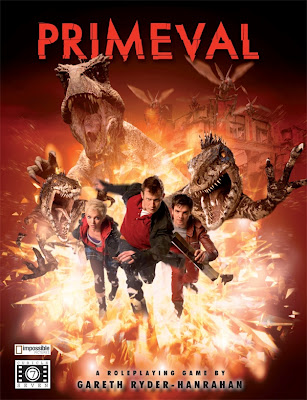
Primeval 
(Cubicle Seven Entertainment) $39.99/£26.99
Anomalies are appearing and opening everywhere, allowing us to step through doorways into the past and into the future. As amazing as they are, the anomalies are also a danger as they let others from the past and the future into our present – including dinosaurs! A mammoth on the motorway? Velociraptors in the velodrome? These threats and more have to be dealt with before the public are placed in danger or learn too much. As part of the government run Anomaly Research Centre, the characters will track dinosaurs, research the anomalies, and more to keep not just the country safe, but the timeline too. Based on the TV series of the same name, the Primeval RPG uses the same mechanics as the Doctor Who: Adventures in Time and Space RPG, and thus emphasises talking and thinking first before combat. This still leaves plenty of room for action and scares in facing down not just the dinosaurs, but those that would use the anomalies for their own ends.


Leagues of Adventure 
(Triple Ace Games) $39.99/£24.99
In Leagues of Adventure the world of the Victorian Age is as fantastic as you would imagine – H.G. Wells’ Martians invaded England, Professor Challenger has found the Lost World, Phileas Fogg made it around the world in eighty days, and Sherlock Holmes has solved untold numbers of crimes and mysteries. The player characters follow in their stead, the members of various “Leagues of Adventure,” travelling the world, unravelling mysteries, righting wrongs, and all in the name of Her Majesty. Using the Ubiquity mechanics previously seen in Hollow Earth Expedition and All For One: Régime Diabolique, this is a pulp action RPG of derring-do and honour that adds in the Steampunk and the fantastic of the era too.


RuneQuest 6e 
(The Design Mechanism) $62.00/£40.00
RuneQuest is back and in one volume! The new sixth edition updates and presents a set of rules that has been a classic for over thirty years in a single book that provides GM and players alike with everything necessary to create and build a campaign of heroic, gritty, fantasy. Characters – Barbarian, Civilised, Nomadic, and Primitive, are all covered; as well as five types of magic, ranging from the classic Runes to Theism; belonging to a Cult; and both monsters and playable character races are all covered in this thick softback book. It feels complete, and best of all, it feels loved again.