Every Week It's Wibbley-Wobbley Timey-Wimey Pookie-Reviewery...
Showing posts with label Ravensburger. Show all posts

Friday, 1 September 2023

Friday Filler: Jurassic Park: Danger! Adventure Strategy Game

Jurassic Park
is thirty years old in 2023. It was a big hit in 1993, and although it has developed into a franchise, the original is the one that is best remembered. After all, with what was then grounding breaking CGI, the dinosaurs were brought to life like never before, and the combination of a rousing score from John Williams and a new sound system in cinemas meant the impact of seeing the film in the cinema, it is still recalled today. Sadly, Jurassic Park does not have any roleplaying games based on it, but it does have a board game or two. Published in 2018—on the twenty-fifth anniversary of the film—by Ravensburger, the Jurassic Park: Danger! Adventure Strategy Game is a light, semi co-operative game for two to five, aged ten and up. In the game, the human players must work together to achieve their goals and escape the island whilst avoid being eaten by the dinosaurs, whilst the dinosaur player must eat as many humans as he can! (well, not literally, three is enough.)

The human players control one character at a time, although the game gives them a choice of ten to choose from. Every character has his or her own deck of cards, character mat, and meeple. Although every character’s deck has Run, Sneak, and Climb cards, each character’s deck also has its special cards. For example, Doctor Alan Grant has ‘Give Me Your Hand’, which lets his move another character on an adjacent tile to move to his tile and Lex Murphy has ‘Piercing Scream’ which gives her a chance to sneak and distract without being attacked. Each character has their own Character Goal which must be achieved before the character can get to the Helicopter Pad and escape. A character who achieves his goal is awarded a Goal Token. For example, Doctor Alan Grant’s goal is to distract the Tyrannosaurus Rex, Doctor Ian Malcom’s is to successfully guess whether a die roll will be odd or even, and John Hammond’s is to not have any character be eliminated whilst he is in play. He actually starts play with his Goal Token and loses it if another character dies. Even if it is Dennis Nedry.

The dinosaur player controls three dinosaurs—a velociraptor, a tyrannosaurus rex, and a dilophosaurus. Although the dinosaur player has the one deck of cards, each card gives two or three actions—Run, Sneak, or Climb—that the dinosaur player must do when drawn. No matter the number of actions on the card, a different dinosaur does each action. In addition, the dinosaurs can do two things. First, each has its own special action. The velociraptor can run two spaces in a straight line, the tyrannosaurus rex can attack twice, and the dilophosaurus can attack a character on an adjacent tile with its venomous spit. A dinosaur special action like this cannot be done on two consecutive turns. Second, a dinosaur can attack. This occurs when they are on the same tile—except for the special action of the dilophosaurus—as a human and neither are sneaking. Attacks always succeed otherwise, and force a player to discard a card from his hand. This is removed from the game and cannot be retrieved. When a character loses all ten cards in his deck, he is eliminated. Lastly, it should be noted that the meeples for the dinosaurs are attractively illustrated, but the meeples for the characters are plain and unillustrated.

What is interesting is that when a character exits the game—either because he has been eaten by a dinosaur or has managed to successfully escape via the helicopter, his player can select another character and continue playing. Either way, this keeps a player involved from start to finish and removes the element of player elimination, if not character elimination.

The game is played on a map of Isla Nublar. This requires some construction prior to play, but the coastal perimeter frame keeps everything in place. The Start Tile—for the humans—goes in the middle, whilst the perimeter and centre tiles are placed randomly. The marked Locations are the Control Centre, Visitors’ Centre, and Maintenance Shed, plus the Helicopter Pad, whilst the dinosaurs also have their own starting tiles. Some tiles have mountains on them and these need to be climbed, as do the electric fences marked on some tiles, when they are turned off. Once activated, the three marked Locations are activated, they become safe spaces for the humans.

On a turn, each player, both human and dinosaur play a card face down on their respective mats. The dinosaur player plays his first as well as any optional actions. Then the human players do the same, plus any optional actions. The Climb and Sneak actions require a successful die roll to complete, as does activation of the three Locations. Cards can be burned or permanently discarded to gain a boost to the roll.

Play in Jurassic Park: Danger! Adventure Strategy Game proceeds one card at a time. The dinosaur player is at an advantage with the choice of special actions and is aiming to prevent access to the three Locations for as long as possible whilst constantly snapping at and attacking the humans. Blocking is possible because a character cannot use his Run or Climb Cards to enter a tile with a dinosaur. Conversely, a human player can use Sneak and Distract cards to get past a blocking dinosaur. A human player can also turn on the electric fences from the Maintenance Shed, which block both human and dinosaur movement. Both human and dinosaur players have limited choice of cards to play from one turn to the next, their hands being limited to just three. Because of positioning—either dinosaur or human—and because of terrain like the electric fences and the mountains that has to be climbed, the choice of card to be played can also be restricted. The humans will often find themselves running even as they get close to their intended destination.

Jurassic Park: Danger! Adventure Strategy Game is won in two ways. For the dinosaur player, all he has to do is eliminate three humans. For the human players, they have to reach all three locations and activate them, fulfil their individual goals, and only then escape from the island. If three humans escape from the island, then the humans win.

Physically, Jurassic Park: Danger! Adventure Strategy Game is well presented, with nice artwork used to illustrate the various characters from the film. The card stock for the mats and the cards feel a little thin and whilst the dinosaurs are eye-catching, the meeples for the humans are, in comparison, bland. The rulebook is well written, easy to read and understand—clearly marking the text for the human players and the dinosaur player is a very nice touch, and includes advice on how to win for both players.

Jurassic Park: Danger! Adventure Strategy Game is okay—and for a family game, especially one that embraces modern design, is also okay. It introduces co-operative play, the humans having to work together, the options are simple, and the film will be familiar to almost everyone. With ten cards to lose humans are more resilient than at first seems, but the dinosaurs are tenacious, have more options and more powerful options as to what they can do, and at best the humans can only corral them with the electric fences or sneak past them. And that, for the human players is not very interesting, because whilst Jurassic Park: Danger! Adventure Strategy Game does have plenty of theme, it feels as if the humans are avoiding the theme as much as they are the dinosaurs. The problem is that the game ignores some of the tensions in the film. For example, Dennis Nedry, the villain, is a playable character, and his special action is that he is always attacked first by the dinosaur if there are more than the one human on a tile. Which seems appropriate, because nobody likes Dennis Nedry, but he does not get to be the villain in the game. He does not betray John Hammond and you wish that he could. Robert Muldoon is not armed and cannot act against the dinosaurs in anyway. In fact, no human can do anything to to affect the dinosaurs bar turning on bar the electric fences, so the interaction between the humans and the dinosaurs is all too often one way—the dinosaurs affecting the humans. The result is a lack of tension between the humans and the dinosaurs because the dinosaurs have a human player and their actions are going to predictable. Perhaps if the game has automated to movement of the dinosaurs, it might have made their actions less predictable and so increased the tension?

Jurassic Park: Danger! Adventure Strategy Game is a serviceable, modern family game that can be enjoyed by casual or younger board gamers. For the more experienced board gamer, Jurassic Park: Danger! Adventure Strategy Game is slightly underwhelming, leaving him wishing that it had a bit more bite.

Friday, 18 February 2022

Friday Filler: ALIEN: Fate of the Nostromo

ALIEN: Fate of the Nostromo
is the meeting of two trends. One is the development of games based on the Alien Universe, best typified by the Aliens: Another Glorious Day in the Corps and Alien: The Roleplaying Game. The other is the revisitation of older intellectual properties using modern game design and in the process create a playing experience that is true to the source material and far superior to anything which could have been done when those intellectual properties first appeared. Further, in the case of ALIEN: Fate of the Nostromo has been designed to be played by both a general board gaming audience and a fan audience. This is also the same with board games such as Jaws: A Boardgame of Strategy and Suspense and Horrified, and together the three also share a publisher, Ravensburger, and a play style in that they are co-operative board games.

Another interesting aspect of ALIEN: Fate of the Nostromo is that it is based upon Alien, the first film in the franchise, rather than on Aliens, which is the second. Aliens has been the property of choice to base a game, whether roleplaying game or board game or computer game. This is because Aliens combines action and horror, so that whilst the Xenomorphs are bent either grabbing their victims ready for implantation of eggs by the Facehuggers or simply ripping them apart, the protagonists and thus the players are armed and can fight back. As scary as Aliens is, it is not a subtle film in comparison to Alien where the atmosphere is one of isolation and of being hunted by something unknown, something alien, and something unstoppable. This is what ALIEN: Fate of the Nostromo has to capture in its play style.

ALIEN: Fate of the Nostromo is a co-operative game designed for one to five players, aged fourteen and up. They take the role of the crew of the USCSS Nostromo—Captain Dallas, Warrant Officer Ripley, Chief Engineer Parker, Engineering Technician Brett, and Navigation Officer Lambert—who must survive the invasion of their ship by a hostile alien long enough to perform a number of Objectives before performing one final Objective and successfully abandoning her. At all times, as they move around the Nostromo, they are stalked down its corridors and through its various areas by the creature, constantly thwarting the crewmembers’ efforts and effectively demoralising them. If the crew can complete both its assigned Objectives and the final Objective, the players will win the game, but if the morale of the crew is reduced to zero, the Alien wins and the players lose…

Open up the box for ALIEN: Fate of the Nostromo and the very first thing you see is a painting of Jones the Cat, frightened and hissing at something behind you. This is on the back of the board and so adds nothing to game play, but it is a great touch and adds to the atmosphere of the game if not its game play. Open up the board itself and it depicts the decks and rooms of the Nostromo connected by corridors and ladders. One of these, at the bottom of the spaceship, is the Nest where the Alien begins play, but look closely and there are some nice touches, such as the streaks of blood leading away from the table where the Chestburster burst out of Kane in the Galley and the holes in the floor burned by the Facehugger’s blood in both the Med Bay and the Lower Deck. The playing pieces of the crew—Dallas, Ripley, Brett, Parker, and Lambert, as well as the Alien—are decent depictions of the characters, such that Brett is actually smoking and you can imagine him saying, “Right, right…” and agreeing with Parker.

The other components consist of the eight-page rule book, five Crew Boards—one for each of the crew, five Player Reference Cards, a Morale Marker, thirty-six cards (twenty-one Encounter Cards, ten Objective Cards, and five Final Mission Cards), a Self-Destruct Track, fifty-five tokens (twenty Scrap Tokens, twelve Item Tokens, six Coolant Canister Tokens, six Concealed Tokens, a Self-Destruct Token, and four Countdown Tokens), and markers for both Morale and Ash, the Nostromo’s android Science Officer. All of these are of a good quality with fully painted artwork which really captures the feel of the film, the Nostromo, the Crew, and the Alien. Those of the crew on their Crew Boards are particularly good.

ALIEN: Fate of the Nostromo is quick and easy to set-up—and the rulebook takes the player through this step by step. The Alien begins in the Nest, the Crew in the Galley, Scrap, Coolant Canister, and Concealed Tokens are distributed throughout the ship, several random Objective Cards are revealed—equal to the number of players plus one, and a Final Mission Card is drawn and placed face down. It is only revealed when all of the Objectives have been completed. To complete an Objective, the Crew must bring particular Items to locations around the Nostromo. For example, ‘Where is it?’ directs the Crew to bring a Flashlight to the Med Bay and ‘Crew Meeting’ directs all of the Crew to assemble in the Galley with at least one piece of Scrap each. Scrap is a vital resource throughout the game because it is used to Craft Items such as a Motion Detector, Flashlight, Grapple Gun, the Cat Carrier, and so on. Many of the items have limited use and so may need to be manufactured more than once! The Final Mission Cards typically have several objectives, for example, ‘Escape on the Narcissus’ requires the Crew to take Coolant Canisters to the Docking Bay, have the Cat Carrier and Incinerator in their inventories, and then all assemble in the Docking Bay.

Each player’s turn consists of a Crew Action Phase and an Encounter Phase. In the Crew Action Phase, the Crewmember expends Action Points to move, pick up or drop Items or Scrap, Craft or Use Items, and Trade Items and Scrap with fellow Crewmembers. The Crew possess between three and five Action Points as well as a Special Ability. Ripley has four Action Points and can spend one to move another Crewmember one space; Dallas simply has five Action Points; Brett has three and reduces the Scrap coast when crafting Items; Parker has four and can spend one to add one Scrap to his Inventory from the pile beside the board rather than from the board; and Lambert has four and can spend one to examine the top card of the Encounter Deck and place it at the bottom of the deck.

The danger of movement is that the Crewmember will come across a Concealed Token. When revealed, this might be nothing and the Crewmember will be safe, it might be Jones the Cat who hisses at them and decreases Morale, or it might be the Alien in a Surprise Attack, who immediately moves to that location. The Crewmember then flees from that location and the player’s turn ends and there is no Encounter Phase.

If a Crewmember survives long enough to end the Crew Action Phase, the Encounter Phase takes place. An Encounter Card is drawn. Each indicates how many spaces the Alien must move towards the nearest Crewmember, how much Morale damage is inflicted if it encounters a Crewmember, and where new Scrap and Concealed Tokens should be placed, if any. As with a Surprise Attack Concealed Token, when the Alien encounters the Crewmember must flee three spaces, and whether fleeing from the Alien as the result of an encounter in the Encounter Phase or a Surprise attack, if the Crewmember runs across another Concealed Token, that too must be revealed. If that is another Surprise Attack, the Alien catches up with the Crewmember, who is forced to flee again, and so on and so on as the Alien stalks them through the bowels of the ship!

Throughout the game, the Items become really important as they provide the Crewmembers with an advantage, if only temporarily. The Motion Detector is used to reveal nearby Concealed Tokens, the Incinerator to drive the Alien back to its Nest, the Flashlight to reduce Morale loss, the Grapple Gun to drive off the Alien, and the Cat Carrier to contain Jones the Cat and stop him jumping out and scaring the Crewmembers when Concealed Tokens are revealed.

In addition to the standard game ALIEN: Fate of the Nostromo can be played solo and the challenge that the Crewmembers and their players face be made more difficult. Solo play is little different to the standard game except that some of the Final Missions are excluded, whilst the game is made more difficult with the ‘I can’t lie about your chances’ option, which adds the Science Officer and android Ash to the game. Ideally, solo play should be done with more than one Crewmember as this gives the player more options in terms of their Special Abilities, whilst when Ash is in play, he constantly confronts the Crewmembers, forcing them to drop Scrap or reduce Morale. He also picks up Scrap as he moves around the Nostromo. The lack of Scrap will make Crafting Items all the more difficult and thus Objectives harder to fulfil.

There is no denying the strength of the theme in ALIEN: Fate of the Nostromo and how it affects play. The tension never lets up, there is the constant chance of the Alien turning up, or Jones the Cat leaping out and frightening the Crewmembers, and yet… ALIEN: Fate of the Nostromo is perfectly playable and an enjoyable game to play, but it has a couple of issues. One is that it never fully follows through on its theme, which is that of something stalking the Crew Members throughout the Nostromo and killing them off a la Ten Little Indians. Nobody though, in ALIEN: Fate of the Nostromo the Alien does not kill anyone, instead its victims just flee and become further demoralised. Thus the ardent fan could complain that ALIEN: Fate of the Nostromo is not a true reflection of Alien at all, but would a true reflection actually be fun to play? Probably not, because Crewmember elimination would mean player elimination and not only make the game’s winning conditions harder to achieve, but also not fun for the players whose Crew Members have been eliminated. Then there is the audience to take into account because ALIEN: Fate of the Nostromo is designed for a family audience and a teenage audience, and a bloody horror game is not necessarily suitable for either.

This does not mean that the game ignores fans of the film. What it does mean is that the family can play this game without getting too horrified by the absentee blood or the missing gore, whilst the fans of the film can enjoy the still strong theme of game—especially in its look—as well as have chance to roleplay and table talk their Crew Members as much as they want and throw in as many of the quotes from Alien that fit.

As much fun as encountering and fleeing from the Alien is in ALIEN: Fate of the Nostromo, the actual Objectives, all ‘pick-up and deliver’ tasks are underwhelming and feel more like the means to hold off the actions of the Crewmembers until such times as they can tackle the Final Mission. And whilst each of the Final Missions does actually feel thematic, their phrasing is not always clear in meaning. What this means is that the players do need to make more of an effort to buy into the game—not much extra effort, but some…

ALIEN: Fate of the Nostromo is a solid, decently thematic lighter co-operative game. It takes a heavy horror theme and tone and builds as much of that as it can into a game that is suitable for the family. That is quite an achievement.

Saturday, 30 October 2021

Universal Horror Co-op

Monsters have arisen and the village is under attack! Dracula, The Mummy, Frankenstein’s Monster—and his Bride, the Invisible Man, the Wolf Man, and the Creature from the Black Lagoon are all on the rampage and it is up a dedicated team of heroic monster hunters to keep the villagers safe from their predations, find the means to thwart each and every one, and then put an end to their reign of terror! This is the set-up for Horrified, a co-operative board game from Ravensburger, designed for between one and five players, ages ten and up, in which they face the classic foes of the Universal monsters series of films from the nineteen thirties and nineteen forties. If you are a regular player of board games, then you will definitely spot the architecture and design elements of the first classic co-operative board game, Pandemic, but Horrified is far from a drily themed race to find the cure to four different diseases! It is a desperate race to defeat classic monsters, each of which is very different in terms of what they do and what the players need to do to defeat them, it oozes both theme and charm, and its horror is scary, but not terrifying, so it can be played by the family as well as the dedicated horror fan—and both will enjoy it.

Open up a copy of Horrified and the first thing you see is a warning about the potentially horrifying experiences to be found in the box. Of course it is a little tongue in cheek and so perfectly in keeping with the tone of the Universal Monsters, but what is clever is where this warning is placed. Not on a separate sheet of paper or the back of the rulebook, but on the back of the game’s board. It is a clever use of space and points to the degree of thought and detail which has gone into this game. The board itself depicts various locations within a village, a curious mix of the American small town and the European Gothic, so there is a precinct and a mansion as well as an abbey and a tower with an adjacent dungeon. A river runs through the village, connecting a lagoon and the waterfront. At the top of the board is the Terror Track.

The Heroes in Horrified—and there are seven of them—are each represented by a Hero Badge, essentially character cards detailing their abilities and their playing pieces. Each has good illustration, a number to indicate how many Actions he or she can take a turn, and a special action or ability. For example, the Mayor has five Actions per turn, but no special action or ability, whereas the Courier has four and can travel to any location where there is another Hero, and the Professor, also has four and can move any Hero or Villager one space.

The Universal Monsters in Horrified—and there are six of them—are each represented by plastic playing piece of a different colour and a Monster Mat. Each Monster Mat details what the Monster can do and how it is defeated, the latter requiring two steps. For example, Dracula can use his Dark Charm to pull a Hero to his space, and to advance to point where they can him, the Heroes need to visit each of the four locations where his coffins and destroy them, before confronting the vampire prince directly. At least six points of Red Item Tokens are required to destroy a coffin, and six points of Yellow Item Tokens to destroy him. The Mummy has a tablet on which Scarabs can be moved, the number of moves determined by the value of Yellow Item Token used. Move them into the right order and the curse is broken, and the Mummy can be entombed by confronting him and expending at least nine points of Red Item Tokens. However, the Mummy can fortify the curse by turning one of the Scarabs upside down! Perhaps the most interesting Monster to defeat, at least thematically, is that of Frankenstein and his Bride. Both have to taught to live peacefully together, Blue and Yellow Item Tokens being expended to increase their Humanity on a dial for each of them in their respective spaces. They constantly move towards each other, and can be ‘defeated’ if they have sufficient Humanity when they meet, if not, they flee back to their starting positions and the Terror Level goes up by one.

In addition, there are Monster tokens which are added to the game when particular Monsters are selected as the foes. For Dracula, this is his four coffins and for Frankenstein and his Bride, it is the dials to tack their Humanity, but the Creature from the Black Lagoon includes an overlay piece which replaces the Camp location and instructs a player what to do to direct the boat counter—which also comes with the Creature from the Black Lagoon—ever closer to its lair where it can be defeated. Essentially, the means of defeating each Monster is different and requires the Heroes to collect and expend the different coloured Item Tokens.

As well as the game pieces for the Heroes and the Monsters, Horrified comes with ten Villagers. When they appear on the board, they always want to reach their safe locations and the Heroes can guide them there. If they do, then they will be rewarded with a Perk Card. If a Monster reaches a Villager and defeats him, the Terror Level is increased. The Item Tokens come in three colours—red for physical items, blue for intellectual, and yellow for spiritual—and range in value between one and five. There are Markers for both Terror and Frenzy, the former used on the Terror Tracker, the latter to indicate when a Monster is Frenzied. Along with three dice, there five Reference Cards, one for each player; thirty Monster Cards to indicate Monster actions; and twenty Perk cards, awarded when a Hero gets a Villager home. Each Monster Card indicates how many Item Tokens are drawn from the game’s cloth bag and added to the board and gives an event such as ‘Thief’, in which case, the Invisible Man appears at the location where there are the most items and steals them, forcing them to be discarded. The Monster Card also reveals which of the Monsters move on a turn, including the Frenzied Monster—which can mean that a Monster can move and act twice in a turn, how many spaces, and how many dice it rolls to attack. Some Monster Cards can be beneficial, for example, the ‘Sunrise’ Monster Card will force Dracula to flee back to the Crypt, which might be away from a Hero or a Villager, and some might not have any effect, either because the Monster is not being played in the current game or because it has already been defeated. The Perk cards provide single benefits, like a ‘Taxi Ride’ which gets a Hero to any non-water location or ‘Late into the Night’, which grants the current player two further actions.

Horrified has one win condition and two loss conditions. The Heroes triumph and the players win the game if they defeat all of the Monsters. However, they lose if the Terror Level reaches its maximum level, forcing everyone in the village to flee in horror and allow the Monsters to take over. And they also lose if the Monster deck is emptied and one more Monster card needs to be drawn, the Heroes and thus the players having taken too long to save the village.

Game set-up is simple enough. The Terror Marker is set at zero and the selected Monsters set up as instructed. Then each player selects a random Hero, receives a Perk card, and the sixty Item Tokens placed in the cloth bag. Twelve of these are drawn at random and placed on the board. The rule quickly guides the players through the process, but goes not one, not two, but four steps further. It suggest that the players’ first game be against Dracula and the Creature from the Black Lagoon, any two Monsters for the Novice game, any three Monsters in the standard game, and any four in a challenging game. Thus it eases the players into the game and its play whilst showing them how to make the game more difficult.

A player’s turn has two phases. In the Hero phase, a player expends his Hero’s Action Points to move, guide a Villager to or from an adjacent location (a villager will accompany a Hero and move with him), take a Special Action, pick up Item Tokens or share them with a Hero on the same location, Advance a Monster’s task, or Defeat a Monster. The latter two task are different for each Monster and are given on their respective Monster mats, and require the Hero to be in specific places. In the Monster phase, a Monster Card is drawn from the Monster card deck, and the number of Item Tokens given on the Monster Card placed, its Event carried out, and then any movement and attacks conducted. The latter requires rolling dice, which have exclamation point and star symbols on them. Rolls of the exclamation point active a Monster’s power, such as Dracula’s Dark Charm, whilst rolls the star symbol force a Hero to discard Item Tokens, and if a Hero has none, defeats him, sending him to the Hospital and raising the Terror Level one step!

Physically, Horrified is a well-presented game. Everything is in colour, the board is painted in dark shades with pools of light to suggest that it might be midnight, the Item Tokens and cards are all easy to read, and the rules are well explained. In fact, the rules are very well written, with plenty of clarification and explanation of how each Monster works and can be defeated, along with several good examples of play. A player with some experience of playing board games could easily open up the box to Horrified, read the rules, and be playing within a relatively short time. Plus there is a little advice here and there on playing again, strategy, playing it solo—which is even more challenging, and so on. Another nice touch to the graphic design is the inclusion of an explanation of who the Monsters are on the outside of the inner box, also done in colour. However, the production values are not high as they could be. The plastic miniatures for the Monsters lack detail and the card stock for the game’s various cards is thin and will not stand up to too much handling.

In terms of game play, where in Pandemic, as members of the CDC, the players are travelling the world, visiting cities and treating diseases, and drawing and swapping city cards of the right to cure the game’s four diseases, in Horrified, the players as the Heroes, are moving round the village collecting as many Item Tokens as they can in order to have enough of the right colour to first advance the condition on each Monster Mat to the point where the Monster can be defeated. Hindering the players in Pandemic is the constant appearance of new cases the four diseases, and worse sudden outbreaks where a disease spreads to other cities, whereas in Horrified, the Heroes need to track where both the Monsters and the villagers are, because if the Monsters get to the Villagers, they kill them and so drive up the Terror Level. The Heroes also need to avoid the Monsters themselves until the time is right to confront them directly and defeat them. Of course, if a Hero can get a villager to his or her safe location, that earns him Perk card.

However, defeating two Monsters—the base difficulty in Horrified—is fairly easy. Defeating three, though—the standard difficulty—is challenging. Four is another matter altogether! The difficulty will also vary slightly depending upon the Monsters in play, plus the more players a game has, the more Monster cards are drawn and the more Villagers appear to be taken by the Monsters and so increase the Terror Level. The higher difficulty levels may not necessarily suit all players though, casual or family players potentially finding Horrified too difficult at three Monsters, and more so at four.

Horrified is a good game for a number of reasons. In terms of game play, it is relatively light, suitable for casual players and the family, but offering enough for the hobbyist player as a lighter option. Its theme is really well handled, from the different means of defeating the various Monsters and the inclusion of the villagers from the films those Monsters appeared in, to graphical design and the attention to detail which evoke a sense of nostalgia for the Universal Monsters. It offers a decent degree of replay value too, with seven Heroes and six Monsters to choose from, enabling players to mix and match both. However, it would be great to see an expansion with even more and different Monsters. In terms of value, Horrified is a game you can buy on the high street and specialised game shops, and as a mass market board game, it is not just a good game. In fact, it is fantastic game, because as a mass market board game, it is not only inexpensive, but it combines its theme and its mechanics really well. No longer do we have board games based on intellectual properties that are just throwaway ‘roll and move’ designs, but like the earlier Jaws: A Boardgame of Strategy and Suspense, we have mass market board games designed to fit their themes and make use of their themes, that are readily available and consequently, make you want to play again. Jaws does that, and so does Horrified. Lastly, it is also great to see a horror themed board game which involves neither zombies or Cthulhu, and so Horrified is not just nostalgic, it is also a refreshing change.

Thematically, Horrified is a great piece of design and it showcases just how modern game designers have been able reach beyond the hobby and bring thematically appropriate design and game play to the general audience. Horrified is a light co-operative game that horror fans will enjoy for the nostalgia and the family can play for the fun and the scares.

Wednesday, 1 January 2020

Reviews from R'lyeh Post-Christmas Dozen 2019

Since 2001, Reviews from R’lyeh have contributed to a series of Christmas lists at Ogrecave.com—and at RPGaction.com before that, suggesting not necessarily the best board and roleplaying games of the preceding year, but the titles from the last twelve months that you might like to receive and give. Continuing the break with tradition—in that the following is just the one list and in that for reasons beyond its control, OgreCave.com is not running its own lists—Reviews from R’lyeh would once again like present its own list. Further, as is also traditional, Reviews from R’lyeh has not devolved into the need to cast about ‘Baleful Blandishments’ to all concerned or otherwise based upon the arbitrary organisation of days. So as Reviews from R’lyeh presents its annual (Post-)Christmas Dozen, I can only hope that the following list includes one of your favourites, or even better still, includes a game that you did not have and someone was happy to hide in gaudy paper and place under that dead tree for you. If not, then this is a list of what would have been good under that tree and what you should purchase yourself to read and play in the months to come.


—oOo—


Ravensburger £24.99/$29.99
Can you defeat the great white shark which has been preying on swimmers and holidaymakers on Amity Island? Jaws: A Game of Strategy and Suspense is proof that game designers can take an forty-five year old intellectual property and turn it into a good game. This is a semi-co-operative game in which Brody, Quint, and Hooper must first drive off the shark—played by the fourth player—before it eats too many swimmers and go to sea aboard the Orca to face the shark as it hunts them. This is a tense game of hidden movement (by the shark) and desperate searching (by the hunters) played across two very different acts, but which together can the flavour and feel of the film. Play the game, quote the film, and see whether you can beat a great white shark before it eats you and the boat!

Chaosism, Inc. £23.95/$29.99
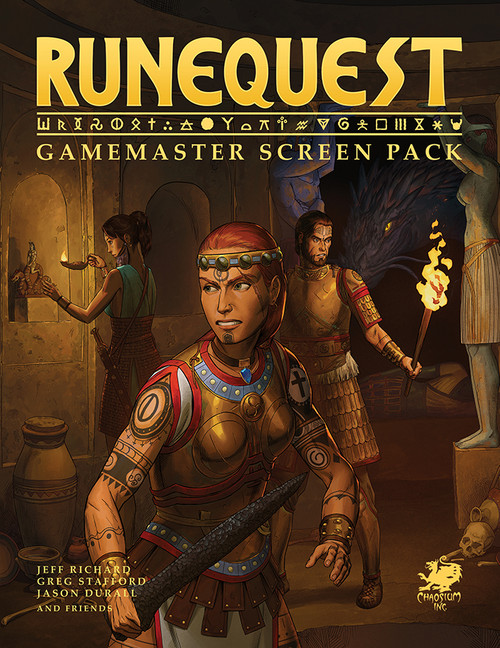
The Game Master Screen Pack for RuneQuest: Roleplaying in Glorantha is proof that you can do more with a GM screen and some reference and/or character sheets. Yes, there is a references booklet, a Gloranthan Calendar, two character sheets, seven pre-generated characters, and six full colour maps, and that in addition to the sturdy, genuinely useful GM screen. That is not all though, for the included ‘RuneQuest Gamemaster Adventures’ book provides everything that the Game Master needs to get her RuneQuest campaign going. It reintroduces the classic setting of Apple Lane as well as the surrounding lands and supports it through three scenarios and numerous scenario hooks. These tie the adventurers into the local area, events, and politics following the Dragonrise which presages the coming of the Hero Wars. Altogether, the Game Master Screen Pack will not only support a gaming group for numerous sessions, but it also sets a standard by which other Game Master screens and their supporting content should be measured.


Cubicle Seven Entertainment £22.99/$29.99
The shelves at our local gaming shop always feel better for Warhammer Fantasy Roleplay
the British fantasy roleplaying game being on them. And they feel better for the new Fourth Edition having its own starter set. Like any good starter set the Warhammer Fantasy Roleplay Starter Set includes everything necessary to play. In particular, 
ix, ready-to-play adventurers, a complete setting, and a five-part mini-campaign, plus a whole lot more for the Game Master to develop. This is a richly appointed box set which comes at very pocket friendly price and with everything necessary to get a group playing or it can be used as a scenario and setting set which can be played using the full rules of Warhammer Fantasy Roleplay, Fourth Edition. Whichever it is used, the Warhammer Fantasy Roleplay Starter Set is a perfect introduction to the Old World and a life of ‘Grim and Perilous’ adventure.

Old School Essentials Classic FantasyNecroctic Gnome £26/$40Remember a time when men were men (and Clerics, Fighters, Magic-Users, and Thieves) and Elves were Elves, Dwarves were Dwarves, and Halflings were Halflings? And what they did was delve deep into caverns and dungeons in search of adventure and danger? This is the world of Old School Essentials Classic Fantasy, a retroclone of Basic Dungeons & Dragons, the version designed by Tom Moldvay in 1981. Long out of print, this redesigned and represented version brings ‘Old School’ roleplaying back like never before in an accessible and attractive hard cover enabling gamers to experience the gaming they played back when they started or even for the very first time. The Old-School Essentials Classic Fantasy: Rules Tome is everything that a gaming group wanting to try the Basic Dungeons & Dragons’ of old will need and the perfect update that the 1981 Moldvay version of Basic Dungeons & Dragons deserved.


Published as a beautiful hardback, Liminal is an urban fantasy roleplaying game set entirely within the United Kingdom, a United Kingdom with a Hidden World populated by the strange and the otherworldly, in which magic and magicians, vampires, werewolves, the fae, and many myths of the British Isles are real. It is riven by factions, such as the conerservative Council of Merlin, the scheming vampires of the Soldality of the Crown, the Fae lords, the Queen of Hyde Park and the wife-hunting Winter King of the north, whilst the Order of St, Bede, a Christian order, is dedicated to protecting the mundane world from magic and the supernatural and keeping it and the existence of magic a secret. Where Fortean or inexplicable crimes occur, P Division, a national agency of the British police, are likely to investigate, but cannot mention magic, for fear such knowledge might leak… The players take the role of ‘Liminals’, able to stand astride the mundane and the Hidden World, working as a Crew—which the players create along with their characters—which has its own objectives and facilities, to investigate the weirdness and mysteries that seeps into the real from the Hidden World.

Alien: The Roleplaying Game
Free League/Modiphius Entertainment £39.99/$53.99

In the vast coldness of space, you might lose your life to the environment—radiation will cook you alive, black holes will rip you apart, and the void itself will freeze your blood and seize your brain; you might die as collateral damage in the cold war of aggression between rival governments; greedy corporations might enslave you or drive you into poverty in their relentless scramble for resources; or the frontier world you staked your hopes and dreams on might simply poison or starve you. Then are the things that lurk in the darkness, the things of nightmare, the things that see humanity as prey, as a resource… or worse. This is the future of 2183, a future we have seen depicted on the Silver Screen in Science Fiction Horror classics, Alien and Aliens, but now made accessible and ready for us to explore in the Alien: The Roleplaying Game. Play marines or corporate troopers, colonists, ship’s crew, scientists, company men, even synthetics in cinematic one-shots or grim sandbox campaigns in what is the definitive licensed bug hunt Science Fiction roleplaying game.


King Arthur Pendragon
Chaosium, Inc. £31.99/$39.99

The classic roleplaying game of Arthurian legend, questing, honour, passion, romance, and glory returns in a brand new, full colour edition, today very much the masterpiece it was upon first publication in 1985. King Arthur Pendragon takes place in the ‘Dark Ages’ of the Fifth Century with native Britons, the players taking roles of noble knights, holding off the Saxon invaders, sees the discovery and rise of King Arthur, inaugurating a golden age of chivalry, Christianity, and feudalism, and of honour, romance, and great quests, before the death of Arthur ushers a return of the Dark Ages with greater Saxon successes… At its heart lie a set of personality traits shared by every knight which can change and grow over time, but in play can direct a knight to a particular response or action and so further the story. Knights do not only go on quests and go to war, but they raise families too, hoping to have an heir who will continue the glorious actions of his father. This dynastic play ensures enables a gaming group to play from before, after, and throughout the whole of King Arthur’s reign. King Arthur Pendragon is one of the greatest roleplaying games ever published, the perfect combination of mechanics and theme. 

Best Left Buried
Soul Muppet Publishing £12/$17

We have been doing it for decades. We have been venturing through the cracks and breaks in the ground into the caves and crypts below and beyond in search of secrets and treasures. We were told that this was dangerous. We were told that we would face monsters, weird environments, eldritch magic, and more… We did not believe what we were told. We were fools. Deep underground we suffer constant stress, face fears hitherto unknown, and will probably return from the depths physically and mentally scarred, the strangeness we have seen and the wounds we have suffered separating us from those not so foolish as to descend into the dark. This is the background to Best Left Buried, a stripped back, simple Old School Renaissance-style roleplaying game of brutal, unforgiving underground exploration, in which Cryptdiggers plumb the depths, make discoveries if they are lucky and suffer the consequences if not… Best Left Buried is a bruising fantasy heartbreaker, presenting the old school style of play anew in which few Cryptdiggers return unscarred from their endeavours with some remaining below to become monsters that will stalk and prey on future delvers.


The world of Carbon 2185: A Cyberpunk RPG is the Earth of 2185, a world of the left behind by ‘The Scramble for the Stars’, a world where rampant environmental collapse has forced cities to build protective against the rising seas and pollution has turned the spaces between the cities into wastelands, and a world that is simply a market for corporations discovering and developing new products offworld. As Daimyo, Docs, Enforcers, Hackers, Investigators, and Scoundrels, the player characters need to find a way to survive, to make connections, to make money in this Cyberpunk roleplaying. If only to pay for the implants and cyberware whose power cells are poisoning them even as they give them an edge on their missions. Using the mechanics from Dungeons & Dragons, Fifth Edition, this is a surprisingly accessible, but gritty treatment of the Cyberpunk genre.


Nightfall Games £45/$60
SLA Industries: Cannibal Sector 1 takes SLA Industries, the roleplaying game set in a far future dystopia of corporate greed, commodification of ultraviolence, the mediatisation of murder, conspiracy, and urban horror, and serial killer sensationalism beyond the mammoth city walls and out into the poisoned, disease ridden, horror infested, dream rent, carnivorous pig romping, Carrien filled, Manchine-stalking, trench-cut quagmire-jungle-urban ruin no-go zone that is Cannibal Sector 1. Here the Shivers man outposts and send out forward patrols in an attempt to stop the incursions into Mort City by monsters, serial killers, and terrorists that would murder its citizenry—and worse, as Rangers work deep into the ruins of what was once part of the city itself to determine the nature of threats SLA Industries faces, and SLA Operatives get to the cool stuff and look good on TV! SLA Industries: Cannibal Sector 1 opens up an whole range of environments for SLA Industries along with numerous threats and dangers. It also adds new ways in which to play, including running conflicts out in Cannibal Sector 1 as squad battles using miniatures. Every monster, every threat, every item of equipment is fully illustrated in glorious colour, bringing the World of Progress to live as never before. SLA Industries: Cannibal Sector 1 is the supplement that SLA Industries has been waiting for and fully deserves. There is so much detail here, all of it rife with gaming potential that this supplement could have been a roleplaying game all of its very own.

Berlin: The Wicked City – Unveiling the Mythos in Weimar Berlin
Chaosium, Inc. £35.99/$44.99In a good year for Call of Cthulhu, with numerous supplements and plenty of support on the Miskatonic Repository, the highlight Berlin: The Wicked City – Unveiling the Mythos in Weimar Berlin, a supplement which explored the place of the Mythos in the wickedest, sexiest city during the Jazz Age. This most mature–in both tone and subject matter–of supplements for Call of Cthulhu explores Berlin as a city and its radical culture and politics and also discusses both LGBTQI investigators and LGBTQI politics. It combines all of this with three sophisticated scenarios which together form a loose campaign which begins in the decade’s political turbulence and end just as Hitler comes to power, foreshadowing the horror which was to come in the next decade and a half. These three take in history, noir, louche artistry and dissolution, and the frightening effect to which Mass Media could be utilised. There is still yet room aplenty around these scenarios for the Keeper to create her own scenarios, or indeed, for Chaosium to bring us an anthology of Berlin-set scenarios. In the meantime, Berlin: The Wicked City sets the blueprint for what a good city or setting supplement should be like for Call of Cthulhu.

Image result for Dune board game
Dune
Gale Force 9 £39.99/$50
With a film adaption of Frank Herbert’s novel, Dune coming in 2020, it is no surprise that it is being licensed out, including to games publishers. There is a Dune roleplaying game to be published by Modiphius Entertainment, but when it came to a Dune board game, instead of designing something new, Gale Force Nine turned to a classic long out of print and much sought title, the original Dune board game published in 1979 by Avalon Hill. This is a game of warfare, diplomacy, alliances, and treachery in the very far future on the planet Arrakis where highly individual six factions work to take control of the only source of the life-extending Spice. Updated and newly presented, this is a game of asymmetrical that fans of the book and film will enjoy, whilst gamers will enjoy the chance to play a board game classic.

—oOo—

And last, but not least, because after all of the fun and palaver of getting the family together, you might want to play something about bringing them together or breaking them up once and for all. Plus of course, it is traditional to not actually do a dozen.

Eve of Rebellion
March Harrier Publishing £3.81/$4.99
A Traveller adventure like no other, Eve of Rebellion, enables five players to take the roles of the great, the good, and the well-intentioned of the Third Imperium and explore the events which would lead up to the assassination of Emperor Strephon and the rebellion which would follow. Except that is not a forgone conclusion, for the cast of five—Emperor Strephon Alkhalikoi, Grand Princess Ciencia lphegenia Alkhalikoi, Prince Varian Alkhalikoi and Prince Lucan Alkhalikoi, Dulinor Astrin Ilethian, Archduke of Ilelish, and Duke Norris Aella Aledon—have their own motivations and goals, many of them conflicting, not necessarily all of them in the best interests of the empire. The scenario includes everything needed to play—five detailed characters with goals and resources, background material for all five characters (and those new to the Traveller setting), and solid advice for the Game Master in running what is all but a systemless scenario.


Saturday, 21 December 2019

Battling Bruce

If you are a board gamer, then 2019 is a good time to be alive. You are spoilt for choice and you are spoilt for choice in terms of good games and you spoilt for choice because games can be designed around a theme or an intellectual property and they can fit that theme or property. For there cannot be any other good reason why Ravensburger can get the licence for a nearly fifty-year-old blockbuster and turn that blockbuster into a game that is not models the blockbuster, but which is actually a good game. A game that could and would never have been designed or published in 1975, the year of the blockbuster’s release. A tense, desperate game of cat and mouse—or rather shark and mouse—for the blockbuster is none other than Jaws. In fact, it is the first summer blockbuster, in which a giant man-eating great white shark attacks beachgoers at a New England summer resort town, prompting the local police chief, marine biologist, and a professional shark hunter to hunt it down. The film is regarded as both a classic thriller and horror film, and has been selected by the United States Library of Congress for preservation in the National Film Registry.


Jaws: A Boardgame of Strategy and Suspense is an asymmetrical, two to four player semi-co-operative board game for ages twelve and over, which is played in two acts and lasts about an hour. One of the players takes the role of the Shark, whilst the other players take the roles of the hunters, Police Chief Martin Brody, marine biologist Matt Hooper, and shark hunter, Quint. (If there are fewer players, then the roles of Brody, Hooper, and Quint are shared between them, so that it is possible to play a two-player game). In the first act, ‘Amity Island’, the Shark hunts the waters off Amity island, eating swimmer after holiday swimmer as the hunters try to track its location and tag it. Once the Shark’s hunger is sated or it has been tagged twice, the Shark swims out to sea and the second act, ‘Orca’, begins. In ‘Orca’, the shark attacks the hunters aboard Quint’s boat, Orca, until they manage to kill the Shark or the Shark eats them or the boat.

Act One: ‘Amity Island’ is played out on a map of the island, which depicts the island’s four beaches—North, South, East, and West, two Docks, Shop, Mayor’s Office, and Amity P.D. on the island. Each Round is divided into three phases—Event, Shark, and Crew phases, which are played out in that order. In the Event phase, an Event card is drawn which determines on which beaches new swimmers will take to the water, plus an event and its special rules. For example, ‘The Fourth of July’ opens all beaches and they cannot be closed that Round; ‘Amity Island in the News’ grants one player an extra action that Round; and ‘Ben Gardner’s Boat’ enables the Shark to knock either Hooper or Quint from their boat and into the water if it passes through the same space as the boat, forcing their players to expend actions getting back aboard.

In the Shark phase, the Shark player has three actions he can undertake. Obviously, he can Move and he can Eat swimmers. He can also use one of four special abilities, represented by Power Tokens, like being able to swim faster or avoid the detection methods that the hunters are putting in his way. Each Power Token and its special ability can only be used once per game. All of this is done in complete secrecy, the Shark player tracking his movement on a pad included with the game and noting how many swimmers he has eaten on the Shark card. At the end of the Shark phase, all his player has to do is tell the hunter players how many swimmers he has eaten, whether he swam past a motion tracker, and whether or not a Power Token was used (but of course, not which).

In the Crew phase, Brody, Hooper, and Quint get to act, but they can act in any order and each has different things they can do. All three have four actions each and can Move, Rescue a Swimmer if at a beach, and Pick Up Barrels, though what each of them does with these Barrels is slightly different. Brody is famously afraid of the water and so runs around Amity Island, collecting Barrels from the Shop and carrying them, one at a time, to the Docks, but if at the Mayor’s Office or Amity P.D., can issue an order to Close a Beach, which temporarily prevents Swimmers entering the water there when directed to do so by an Event card, and when at a beach, can use his Binoculars to scan the water for the Shark.

Hooper spends this act on his fast boat which enables him to move further, but as well as picking up swimmers, his primary task is to ferry the Barrels from the Docks where Brody has dropped them off, to Quint aboard the Orca. He also has a Fish Finder, which he can drop into the water to determine if the Shark is in the zone he is in or an adjacent zone. Lastly, once Hopper has got one or more Barrels to him, Quint can Launch a Barrel into the water, either in the zone he is in, or an adjacent zone. If it hits the Shark, it sticks, and the Shark player has to tell the hunters where he is. If the Shark is not there, then the Barrels floats in the water and acts as a motion detector which will alert the hunters whenever the Shark passes through the zone it is in.

Act One: ‘Amity Island’ ends when the Shark swims out to sea. This will either because the Shark has eaten nine Swimmers or because the hunters have attached two Barrels to the Shark and forced it to flee. The number of Swimmers that the Shark has eaten by then is important because it determines the number of Shark Ability cards the Shark will have in Act Two: ‘The Orca’ and the number of equipment cards the Hunters have. The more Swimmers that the Shark has eaten, the more Shark Ability cards the Shark player will have and the fewer extra Equipment cards the Hunters will have—and vice versa.

Act One: ‘Amity Island’ is a game of hidden movement upon the part of the Shark and deduction upon the part of the Hunters. In this, it feels like the hidden movement of Fury of Dracula where the vampire hunters try and track down the vampire count, the trail narrowing and narrowing. In Jaws: A Boardgame of Strategy and Suspense the search area is narrowed by placement of the Barrels as Motion Trackers, but at least on one occasion the Shark will be able to avoid them with a Power Token. Doing so will probably be best used by the Shark to sneak past a Motion Tracker onto a beach and grab one or two last Swimmers which will increase the number of Power cards he will have in Act Two: ‘The Orca’. Another game which Act One: ‘Amity Island’ feels like is Pandemic with its turnover of Swimmers which will appear at beaches again and again as Event cards are drawn.

Act Two: ‘The Orca’ is more focused and fraught, taking aboard Quint’s boat as it withstands attack after attack by the Shark, as seen in the finale of the film. It is played on the reverse of the game’s board, the players flipping it over after completing Act One: ‘Amity Island’ and laying out the eight tiles which depict the deck plan of the Orca. Each of these tiles is also double-sided. On one is the undamaged section of the Orca’s deck plan, on the other the section after it has been damaged by the Shark. The Shark can further damage each section of the deck plan to actually destroy it and dump any of the Crew into the water. The aim of the Shark is to chew the Orca into splinters and eat the Crew, whilst they must accurately determine where the Shark will attack again and again and kill it.

In comparison to Act One: ‘Amity Island’ in which each Round has three phases, Act Two: ‘The Orca’ each Round has six phases and is consequently more complex. These phases are Resurface Options, Shark Chooses, Crew Prepares, Shark Reveals, Crew Attacks, and Shark Attacks. In Resurface Options, the Shark player draws three Resurface cards which give him the three Resurface Zones where he can attack the Orca on that Round. In addition, each Resurface Card will determine how many dice the Shark player will roll to attack that Round, how many hits the Shark can absorb that Round before it takes damage, and whether or not it can shake free of a hook, such as that from a fishing pole or the gas canister, that one of the hunters may have attached from it. All three of these factors will influence the Shark player’s decision as to where he will attack, as will how much damage the boat may have taken in those Resurface Zones. Then in the Shark Chooses, the Shark player decides which Resurface Zone to attack from the three Resurface cards and whether or not he will play a Shark Ability card, which for example, enable to completely destroy a section of the Orca if it attacks it or even take a second attack. Both of the choice of Resurface card and Shark Ability card are kept secret.

In Crew Prepares, each Crew Member decides which of the three Resurface Zones he will move to and which weapon he will use. Melee weapons have to be used in the same Resurface Zone where the Shark attacks, whilst ranged weapons can be used at a distance. Some melee weapons can be attached to the Shark which will hinder the marauder. Accessories like Ammo enable firearms to be used again, Chum can be thrown into the water to attract the Shark to a particular Resurface Zone, and the Shark Cage will protect one of the crew members. Every Crew member has his own weapons and items of equipment and will have access to more, the amount depending on the number of Swimmers the Shark ate in Act One: ‘Amity Island’. 

In Shark Reveals, the Shark player reveals which Resurface Zone the Shark is attacking followed by the Crew Attacks phase, and lastly, the Shark Attacks phase. In the former, the players take it in turns to roll the dice and inflict as much damage on the Shark as possible, or if they can, automatically attach a weapon to the Shark. In the Shark Attacks phase, the Shark player will attack the boat and if the Shark damages or destroys a section, then it is flipped or removed and any Crew Member on that section of the Orca is knocked into the water. They will have to spend their movement on the next round getting back onto the boat. The Shark can also attack a Crew Member who is in the water  and may get a bonus attack against them as well. Play continues like this until the Shark is killed and the Crew Member players win, or the Shark either destroys all of the boat or kills all three Crew Members, in which case, the Shark player wins.

Just like Act One: ‘Amity Island’, Act Two: ‘The Orca’ feels a little like another game and that is Forbidden Island with its sinking tiles. In Jaws: A Boardgame of Strategy and Suspense it is the parts of the Orca which are being attacked and damaged and then forced to sink, reducing the size of the boat and thus the play area. That said, the use of the Resurface Cards to determine where Shark comes to the surface and attacks the boat does feel new. LikeAct One: ‘Amity Island’, this has the effect of narrowing the choices in terms of where the Shark will go next, but this is fairly fraught it also increases the likelihood of the boat and potentially the Crew Members in that area being attacked.

Act One: ‘Amity Island’ and Act Two: ‘The Orca’ do feel different to each other. The first is more strategic with more planning involved as the hunters search for the Shark and the primary way of knowing where it is, is from the number of disappearing Swimmers. The second is more immediate, more tactical, the Crew Members reacting because the Shark is all but on top of them. Which is very much like the film.

Physically, Jaws: A Boardgame of Strategy and Suspense has excellent productions. The look of the game and the graphics draw very much from the look of the film and its famous poster. Where possible, stills from the film are used on the Event Cards in Act One: ‘Amity Island’, but the artwork is excellent throughout. The Meeples for Brody, Hooper, and Quint are what you would expect, but a nice touch is that the boats for both Hooper and Quint are also of wood, as is the piece for the Shark. Lastly, it should be noted that the rule is also well presented with every effort made to make it possible to learn and play the game as the players read through the rulebook on opening the box. It is not wholly perfect, but is nevertheless, very well done.

Now if you have wide experience of playing board games, then with Jaws: A Boardgame of Strategy and Suspense it is possible to spot some of the mechanics seen in other games, but this does not mean that the game is immatitive, just as it means that the game is neither radical or groundbreaking. Indeed, the mechanics have been adjusted where necessary to match both the source material and the game play. What you have in Jaws: A Boardgame of Strategy and Suspense then, is a well oiled, well tooled, design, one that really does take the source material and build a good game around it whilst being true to the source material. In fact, as a design, it transcends any novelty factor that the game might have had for being based on as famous a thriller as Jaws. Put that all together and it should be noted that the game is surprisingly inexpensive for a design of its nature and the quality of its components.

Jaws: A Boardgame of Strategy and Suspense is not absolutely perfect. It may well be too good an emulation of its source material to play more than a few times, because it does not offer a lot of variety in terms of game play. This is not to say that game is not fun—it is, how much after a few plays is another matter. In addition, you need to have seen Jaws to get the most out of the game and since Jaws is a somewhat gruesome thriller, neither film nor game may necessarily be suitable for its younger suggested age limit of twelve. 

Yet beyond those issues, Jaws: A Boardgame of Strategy and Suspense delivers exactly what you would want in a game based on Jaws the film. It is fraught and it is frantic, you do feel desperate as more and more Swimmers are eaten in Act One: ‘Amity Island’ and then the Shark comes after you in Act Two: ‘The Orca’, but that feeling can turn around as you close in on the Shark… Plus if you are a fan, you get to play out the film and see what you would have done in their place and you get to roleplay the characters, quoting all of the famous lines, and so on. If you are a Jaws fan, then Jaws: A Boardgame of Strategy and Suspense is a game you will definitely want, and if you are a board game player, then it offers semi-co-operative, heavily themed play in well-presented, solidly designed, and inexpensive package.