If you have never watched Ivor the Engine, then you should watch this video before reading the rest of this review. Made by Smallfilms, also responsible for other classics such as The Clangers and Bagpuss, this BBC children’s television classic told the tales of the adventures of a small green locomotive who lived in the “top left-hand corner of Wales” and worked for The Merioneth and Llantisilly Railway Traction Company Limited with the help of his driver, Jones the Steam. Most of us will remember the colour episodes from the 1970s, but the original six episodes were made in black and white in 1959, making the series fifty-five in 2014. So it seems as good a year as any to celebrate the series by us helping Ivor the Engine out. Which is exactly what we get to do in Ivor the Engine, a new board game designed by Tony Boydell—whose previous game, Snowdonia, also involved trains and railways, and also happened to be set in Wales—and published by Surprised Stare Games.
Illustrated by Peter Firmin, the illustrator of the Ivor the Engine television series, the Ivor the Engine game asks the players to come to the aid of Ivor the Engine and Jones the Steam in rounding up lots of lost sheep and do any number of good deeds. Designed for three to five players, aged eight and up, Ivor the Engine is a game of tidying up sheep and fulfilling tasks that can be played in about an hour or so—arguably much quicker once the players know the game. The winner is the player who at the end of the game has the most sheep—gained in rounding up sheep and completing jobs.
It is played out over a map of forgotten corner of north Wales, with various locations such as Grumbly Gasworks and Gwynaudolion Halt, Mrs Porty’s House and Pugh’s Farm, Tan-Y-Gwlch and Dinwiddy’s Gold Mine, and towns like Llangubbin, Grumbly Town, and Tewyn. All of these locations are connected by branch lines. In addition, a main line runs between Llangubbin and Tewyn which allows direct movement between the towns. Most of these locations consist of a single large hexes, although some consist of two, so the players need to be careful with their movement.
Besides the board with its map, Ivor the Engine consists of a rulebook, several cardboard Trucks (the players' pieces), cubes of gold and coal, plenty of wooden sheep (sheep meeples or ‘sheeples’!), wooden tokens to represent flocks of sheep, and various cards and cardboard pieces. The cards consist of Sheep Pens for the players and a mix of Job Cards and Event Cards. The cardboard pieces include lost sheep tokens, a pair of Sleeping idris tokens and a pair of Runaway Sheep Tokens, and an Ivor the Engine Token.
At the start of the game, the map is seeded with sheep—the number on each location determined by the random placement of the lost sheep tokens; each player receives three Job Cards, a Sheep Pen and matching Truck, plus a single piece of gold and coal each. Each player also places his Truck on the board starting with the youngest player, who also receives the Ivor the Engine Token. Three Job Cards are laid out face up alongside the board in a Card Line.
On his turn, each player does three things. The first is to take a sheep from his current location and place it on his Sheep Pen. Second, he moves his Truck. He can move from his current location to an unoccupied adjacent location along a connected single-track branch line. He cannot move into a location if another player has his Truck there and he wants to move further, he must steam up and shovel more coal into the boiler, one piece of coal for each extra location. If a player starts at either the towns of Llangubbin or Tewyn, then a player can use two coal to travel from one to the via the main line. If a player needs more coal, then he can purchase more by spending gold.
Before or after a player has moved his Truck, he can play a Job Card. Each Job Card has a task and a location, a reward for completing the task—anyway from three to six sheep, and an action that a player can do instead of completing the task on the Job Card. For example, “Fetching Mr Brangwyn’s pigeons from” … “Llangubbin” instructs a player to travel to Llangubbin where in return for fetching the pigeons, he will be rewarded with three sheep. Alternatively, the player can use the Job Card for the action, “Make 2 extra moves.” and discard the card. Other actions enable a player to take coal or sheep or gold, put sheep back onto a location (from the supply or another player’s Sheep Pen), or take cards from the Card Line. More special actions temporarily force another player to give up any sheep he collects as they run away—this is what the Runaway Sheep token denotes, or allow him to take extra Job Cards from the deck. He also takes a Sleeping Idris token to indicate that he misses a turn for taking this special action.
What is important to know is that a player cannot complete a Job Card on a particular town or village until it has been cleared of sheep—the player who does so, also receives bonus sheep. What is also important to know is that when a player completes a Job Card he must read out the details of the Job Card. (A Welsh accent is not required for this.)
Lastly, a player takes a new Job Card from the Card Line, which is then refreshed. If the new card added to the Card Line is an Event Card, it has an event that takes effect immediately, is seeded with a single sheep, and a reward that takes effect at the end of the game. To select an Event Card from the Card Line, a player must pay a single piece of gold. For example, the “Bani Moukerjee” Event Card forces each player to move his truck to Llanmad or discard a sheep—this is the only time that the players’ trucks can be on the same location. If selected, this Event Card will reward a player with an extra sheep for each Job Card completed.
The end of game is triggered when one player ends his turn with a certain number of sheep, the number dependant upon how many players there are. Then everyone else receives one further turn to ensure that everyone has the same number of turns. Once done, everyone counts up their sheep and the player with the most is the winner.
Physically, Ivor the Engine is a lovely game. The artwork is delightful—both on the cards and on the board; the rulebook—which initially looks intimidating—is well written and easy to grasp; and the wooden sheep are, of course, delightful.
There are exactly two things wrong with Ivor the Engine, both to do with the components. First, the cardboard pieces used to represent the players’ Trucks are disappointing and add little to the game—wooden locomotives would have been far more in keeping with the charm and feel of the game. Second, the flat wooden pieces used to represent the flocks of five sheep are equally disappointing, not to say dull, and add nothing to the game. It would have been nice if larger wooden sheep had been included to represent sheep. Of course, including such components would probably have increased the cost of what is otherwise a very reasonably priced game, but then, there is nothing to stop the owner of Ivor the Engine from replacing them himself.
At first glance, Ivor the Engine looks like a children’s game—no surprise given the source material. It is not that though, although it can be played by children. Given its length and subject matter, it offers a surprising degree of complexity that adult gamers will enjoy. There are plenty of choices to make—what sheep to take, which places to visit, and what Job Cards or Event Cards to select. The game is primarily competitive, although one player can block access to a location and some of the Job Cards give actions that target other players, so adult games can get cutthroat...
Unsurprisingly, given its theme, Ivor the Engine is also a train game, but in terms of complexity it lies somewhere between Ticket to Ride and a more traditional route-building, pick-up-and-deliver game such as Canalmania or Age of Steam. Although in Ivor the Engine there is no route-building, in effect a player is building a route by rounding up the sheep—once the sheep have been rounded up deliveries, or rather Job Cards, can be completed. Whilst there is no ‘pick-up’ aspect to the game, there is certainly delivery in the game in the form of the Job Cards.
The complexity of Ivor the Engine means that it is not quite an introductory game—the game is more complex than say Ticket to Ride or Settlers of Catan, but not much more. For younger players that may mean that it is is more of a challenge, but for seasoned gamers, Ivor the Engine is pleasing light filler. Utterly charming, Ivor the Engine is a delight, offering enjoyable play for casual and enthusiast gamers alike.
Showing posts with label Surprised Stare. Show all posts
Friday, 27 June 2014
Thursday, 20 December 2012
Ogre Cave Christmas List 2012
Come the end of the year and as has been vaguely traditional for the past decade that in December, OgreCave.com runs a series lists suggesting not necessarily the best board and roleplaying games of the preceding year, but the titles that you might like to receive and give. Continuing the break with tradition – in that the following is just the one list and in that for reasons beyond our control, this list is not appearing at OgreCave.com – Reviews from R’lyeh would like present its own list. Further, as is also traditional, Reviews from R’lyeh has not devolved into the need to cast about “Baleful Blandishments” to all concerned or otherwise based upon the arbitrary organisation of days.
Nevertheless, Happy Gaming and enjoy the suggestions. Consider them perfect for purchase for yourself. If the world is to end in 2012 – and the denizens of Reviews from R’lyeh doubt that the stars have come right as yet – then at least enjoy a few last rolls of the dice with a favourite new game…
Lords of Waterdeep
(Wizards of the Coast), $49.99/£39.99
One of the best and most accessible board games of the year came from the most unexpected publisher, Wizards of the Coast. Lords of Waterdeep combines the classic Dungeons & Dragons theme with tried and tested Eurogame-style “worker placement” mechanics. For between two and five players, the game casts the players as masked lords vying for control of Waterdeep, the City of Splendors, the most resplendent jewel in the Forgotten Realms. They send out their Agents to acquire Buildings and access to better resources; gain Gold to make the many purchases necessary to ensure their rise to power; the means to Intrigue with their fellow Lords; and hire Adventurers whom they can send out on missions or Quests that once completed will spread their influence and gain them true power. The game scales nicely, being as challenging to play with two players as it is with five, plays easily in an hour, and forces a player to make difficult decisions when presented with numerous options! (Read the review here).
Midgard Campaign Setting
(Open Design) $49.99/£29.99
The bad news is that in 2012, we lost Kobold Quarterly, the only Dungeons & Dragons compatible magazine to be available on the shelves at your local friendly gaming store. The good news is that we finally got to see an introduction to Midgard, Wolfgang Baur’s home campaign previously best seen in the Zobeck Gazetteer and the numerous articles that appeared in Kobold Quarterly’s twenty-three issue run. Now with the release of the Midgard Campaign Setting, we no longer have glimpses, but a full introduction to a dark fantasy world that at its heart is steeped in a mittel-european sensibility, whilst still leaving room for fantastical, even weird elements. Designed for the Pathfinder Roleplaying Game, an appendix also includes rules for the adventure game engine, allowing players to use Green Ronin Publishing’s Dragon Age RPG to visit a very different and a very original take on the fantasy setting.
Glory to Rome Card Game: Black Box Edition (Cambridge Games Factory), $35.00/£25.00
AD 64 and Rome has been burned to the ground. Answer Emperor Nero’s call and bring Glory to Rome as you compete to rebuild the heart of the ancient world’s most powerful empire. This is a strategic card of city building and resource management in which every card can act as a building, a patron, a raw material, or a valuable resource. This clever mechanic combined with the fact that the card a player gets to play is often dictated by his rivals, gives the game a pleasing elegance and forces difficult choices on a player. Redesigned from the original edition with new art reminiscent of the 1980 classic board game, Civilisation and mechanics reminiscent of more modern games like Puerto Rico, San Juan, and Race for the Galaxy, this is a great game that should be on every gamer’s shelf.
Night’s Black Agents (Pelgrane Press), $44.95/£29.95
You are an ex-secret agent. You just discovered that your former employers are controlled by vampires. So quite possibly is your government, your bank, and that NGO you always felt great about donating money to… This is the set-up for Ken Hite’s Night’s Black Agents, the Vampire Spy Thriller RPG he describes as “The Bourne Identity meets Dracula.” It brings 007-esque high action to the clue driven GUMSHOE System, but when it comes down to it, Night’s Black Agents is not Ken Hite’s game, but yours. It gives the means and tools for the GM to create any style of espionage RPG, from James Bond to Tinker, Tailor, Soldier, Spy, and lets him it slam it up against the vampires and the vampire conspiracy of his design. As a genre mash-up, Night’s Black Agents is a combination that sells itself, but as a toolkit, Night’s Black Agents is your Schweizer Offiziersmesser. Just add dice.
(Read the review here).
Cthulhu Fluxx (Looney Labs), $16.00/£12.99
An award-wining, classic, quick playing card game for over a decade now, Fluxx is all about chaos and winning means adapting to that chaos as the game and the rules change through play. Now Looney Labs has upped the ante and introduced the forces of H.P. Lovecraft’s Cthulhu Mythos and an almost primordial unstoppable force to the chaos of Fluxx. In Cthulhu Fluxx, you are not just up against your rivals, some of whom might be in the thrall of one of the Great Old Ones, but also the Great Old Ones too! You can win Cthulhu Fluxx, but sometimes the influence of the Mythos is just too insidious meaning that Cthulhu himself wins!
(Read the review here).
Rise of the Runelords Anniversary Edition
(Paizo Publishing) $59.99/ £39.99
Five years ago, Paizo Publishing launched its Adventure Path series, each a campaign for the Pathfinder Roleplaying Game in six parts. To celebrate that anniversary, Paizo Publishing has collected the very first Adventure Path series, Rise of the Runelords, in hardback and in the process taking advantage of five years of player feedback and the chance to revise, and add to, a campaign that will take the adventurers from first to eighteenth level. Beginning in the sleepy coastal town of Sandpoint, in course of defending against an attack by crazed goblins, the adventurers learn of a greater evil. If they to prevent it coming to Sandpoint, they must track a cult of serial killers, fight backwoods ogres, stop an advancing army of stone giants, delve into ancient dungeons, and finally face off against a wizard-king in his ancient mountaintop city.
Snowdonia (Surprised Stare Games) £31.99
The year is 1894, and the Snowdon Mountain Tramroad and Hotels Company Limited has been formed to build a branch line from Llanberis to the summit of Snowdon. Each player controls a work gang providing the labour for the construction of the Snowdon Mountain Railway, each trying to outdo the other in excavating the railway line, laying the track, constructing stations on the way up, and fulfilling Contracts that will score them those all important Victory Points. This a well-appointed worker placement game in which the game itself demands that the gangs of labourers get busy building the line up the mountain or the game will do it all by itself and deny you Victory Points. All this and having to deal with the fog and the rain on the mountain that only slows your labourers down!
Marvel Heroic Roleplaying Basic Game
(Margaret Weis Productions, Ltd.) $19.99
What happens when the inmates from The Raft, the island prison facility in New York City for psychopathic superhuman criminals, escape? You already found out how in early issues of Marvel Comics’ New Avengers series, but with Marvel Heroic Roleplaying Basic Game, you can team up as Captain America, Cyclops, the Human Torch, Iron Man, Spider-Man, Wolverine, and more, in order to return the escapees to prison. Or alternatively, create heroes of your own with this dice driven narrative RPG of super heroic action. Comes with the datafiles for twenty three heroes, numerous villains, powers, action, and more in a rulebook that could easily be mistaken for a Marvel graphic novel!
Escape – The Curse of the Temple (Queen Games) $59.99/£39.99
There are games about exploring ancient temples and avoiding their dangers, but Escape …from the Curse of the Temple is truly a different game. You and your fellow adventurers have been trapped – trapped in a cursed temple, and the only way to get out is by working together. IN REAL TIME. You have just ten minutes (a timer soundtrack comes with the game) to explore the temple, activate the magic gems in the temple chambers in order to banish the curse, and then escape! All this done by rolling dice as quickly and as continuously as you can in order to get the right combination of symbols that activate the gems, move from room to room, lift you from under the spell of the Black Mask (which stops you rolling dice), and more. Get the right combinations? Use them up and then starting rolling for the next. Ten minutes though, otherwise you and your fellow adventurers will find yourselves crushed inside the collapsing temple. Everyone gets out, or nobody does in this frantic game.
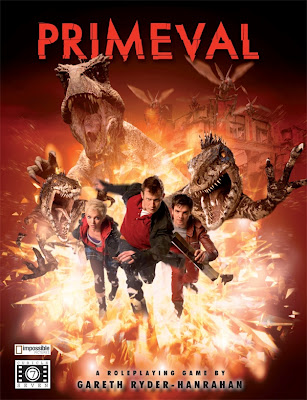
Primeval
(Cubicle Seven Entertainment) $39.99/£26.99
Anomalies are appearing and opening everywhere, allowing us to step through doorways into the past and into the future. As amazing as they are, the anomalies are also a danger as they let others from the past and the future into our present – including dinosaurs! A mammoth on the motorway? Velociraptors in the velodrome? These threats and more have to be dealt with before the public are placed in danger or learn too much. As part of the government run Anomaly Research Centre, the characters will track dinosaurs, research the anomalies, and more to keep not just the country safe, but the timeline too. Based on the TV series of the same name, the Primeval RPG uses the same mechanics as the Doctor Who: Adventures in Time and Space RPG, and thus emphasises talking and thinking first before combat. This still leaves plenty of room for action and scares in facing down not just the dinosaurs, but those that would use the anomalies for their own ends.
Leagues of Adventure
(Triple Ace Games) $39.99/£24.99
In Leagues of Adventure the world of the Victorian Age is as fantastic as you would imagine – H.G. Wells’ Martians invaded England, Professor Challenger has found the Lost World, Phileas Fogg made it around the world in eighty days, and Sherlock Holmes has solved untold numbers of crimes and mysteries. The player characters follow in their stead, the members of various “Leagues of Adventure,” travelling the world, unravelling mysteries, righting wrongs, and all in the name of Her Majesty. Using the Ubiquity mechanics previously seen in Hollow Earth Expedition and All For One: RĂ©gime Diabolique, this is a pulp action RPG of derring-do and honour that adds in the Steampunk and the fantastic of the era too.
RuneQuest 6e
(The Design Mechanism) $62.00/£40.00
RuneQuest is back and in one volume! The new sixth edition updates and presents a set of rules that has been a classic for over thirty years in a single book that provides GM and players alike with everything necessary to create and build a campaign of heroic, gritty, fantasy. Characters – Barbarian, Civilised, Nomadic, and Primitive, are all covered; as well as five types of magic, ranging from the classic Runes to Theism; belonging to a Cult; and both monsters and playable character races are all covered in this thick softback book. It feels complete, and best of all, it feels loved again.
Subscribe to:
Posts (Atom)