Every Week It's Wibbley-Wobbley Timey-Wimey Pookie-Reviewery...
Showing posts with label Trail of Cthulhu. Show all posts

Friday, 7 March 2025

Magazine Madness 34: Wyrd Science Issue 4

The gaming magazine is dead. After all, when was the last time that you were able to purchase a gaming magazine at your nearest newsagent? Games Workshop’s White Dwarf is of course the exception, but it has been over a decade since Dragon appeared in print. However, in more recent times, the hobby has found other means to bring the magazine format to the market. Digitally, of course, but publishers have also created their own in-house titles and sold them direct or through distribution. Another vehicle has been Kickststarter.com, which has allowed amateurs to write, create, fund, and publish titles of their own, much like the fanzines of Kickstarter’s ZineQuest. The resulting titles are not fanzines though, being longer, tackling broader subject matters, and more professional in terms of their layout and design.

—oOo—

Most magazines for the roleplaying hobby give the gamer support for the game of his choice, or at the very least, support for the hobby’s more popular roleplaying games. Whether that is new monsters, spells, treasures, reviews of newly released titles, scenarios, discussions of how to play, painting guides, and the like… That is how it has been all the way back to the earliest days of
The Dragon and White Dwarf magazines. Wyrd Science is different in that it is about gaming and the culture of gaming as well as the games themselves rather providing support for specific titles—and Wyrd Science Vol. 1/Issue 4 is different to the previous issues. Where both Wyrd Science Session Zero and Wyrd Science – Expert Rules adopted the ‘BECMI’ colour coding of the colours and the focus upon fantasy and the Old School Renaissance, and Wyrd Science – The Horror Issue (Wyrd Science Vol. 1/Issue 3) focused on the horror genre, Wyrd Science Vol. 1/Issue 4 comes with no announced theme. This does not mean that there are no themes with the issue, but rather that they are simply part of the issue rather than a feature. Thus, Wyrd Science Vol. 1/Issue 4 is very much more of an ordinary issue, setting the standard for future non-special issues to come.

Wyrd Science Vol. 1/Issue 4 was published in April, 2023 by Best in Show. It opens with a quartet of interviews. ‘PUBLISH AND BE DAMNED: SoulMuppet Publishing’ is with Zach Cox and explores how he co-founded the company and has developed it to the point where he began to experiment and begin to support authors from outside of the English-speaking hobby, such as with the ‘LATAM Breakout series’ for South American creators. Cox gives his views on the then changing nature of the hobby, how Kickstarter is being used by fewer and fewer would be publishers, who are then looking for other options. Nevertheless, he offers advice on how to run a successful Kickstarter project, but also highlights the difficulties in distribution that affect retail in particular. Although two years old, there is much within the interview that are still pertinent now. ‘CAST POD: What Am I Rolling?’ is part of the magazine’s regular series with podcasters, this time with Fiona Howat of the What I am Rolling? podcast, which hosts and runs one-shot games and in the process, showcases a wide variety of games. It is a nice introduction to the podcast and includes advice on trying new games and introducing new games to other players. ‘MAGIC GATHERINGS: Big Bad Con’ interviews the organisers of the California gaming convention which in recent years has shifted to offering a safer, more diverse, and inclusive space and encouraging the participation of persons from minority and LGBTQI+ groups. This showcases a fantastic effort to make the hobby a more welcoming place, one that should perhaps be looked to by other conventions.

Where the interviews are conducted by John Power Jr., Stuart Martyn kicks off the first of the issue’s themes with ‘The Game is Afoot’. As the title of the article suggests, that theme is investigative games, Martyn highlights roleplaying hobby’s fascination with mysteries and investigations. It pinpoints the issues with this type of scenario—their inherent logic puzzle nature which can frustrate some players and the capacity to miss clues. The primary solutions are twofold. First is to make the clues easy to find or automatically found, as in the GUMSHOE System, or have the solution to the mystery determined through play, as in Brindlewood Bay. Both feature heavily in the article and show how to date, the hobby has yet to come up with any better for the investigative style of scenario. ‘Scry Me a River’ by John Power Jr. neatly complements ‘The Game is Afoot’ and continues the investigative theme. This is a look at Rivers of London: The Roleplaying Game, which is based on the series of Urban Fantasy procedurals by Ben Aaronovitch and includes an interview with its creator, Lynn Hardy, exploring its genesis and development, made all the more interesting because the author has experience of gaming. There is even a list of tips from Hardy about running investigative games to go alongside it.

‘Bandes On The Run’ by Luke Frostick brings the investigative theme to a close with a look at and interview with Krister Sundelin, the creator of The Troubleshooters: An Action-Adventure Roleplaying Game, Swedish publisher Helmgast’s roleplaying game based on French and Belgian bande dessinĂ©e comics. This covers a wide range of inspirations from James Bond to the action-adventure television of the nineteen sixties and explores the heavier feeling mechanics. The Troubleshooters is a great little game that has not made the impact it deserved and it is nice to see it covered here. ‘Bad Moon Rising’, Mira Manga’s interview with Becky Annison, author of Werewolves of Britain for Liminal, continues the Urban Fantasy theme of Rivers of London: The Roleplaying Game, in exploring her inspirations for the supplement, some of it quite personal, in creating a very good expansion for the game and its setting.

‘Now is The Time of Monsters’ takes interviewer John Power Jr and Dave Allen, producer for Warhammer Fantasy Roleplay, Fourth Edition in a then totally different direction, something that the roleplaying game had been waiting decades for, despite the wargame it is based upon, visiting it more than once across its numerous editions. This is the supplement, Warhammer Fantasy Roleplay: Lustria, which details the mysterious continent far away from the Old World. It quickly catches up with the history of the current edition in publishing what is a director’s cut of the classic campaign, The Enemy Within, and then moves beyond that. It explores what an updated version of the Lustria looks like for the twenty-first century hobby and how it presents the players and their characters with a very different, but no less deadly environment to explore.

Walton Wood’s examination of the retroclone, Errant, and interview with its creator, Ava Islam, ‘Dragons Are Fucking Cool, Man’ starts off in slightly abstract fashion, explaining it pushes away from the classic design of Dungeons & Dragons-style play, attempting to be rules light, but ‘procedure heavy’ in terms of scope. The explanation is not really clear enough, but once the article begins telling you what you play—downtrodden outcasts ever wanting to improve their lifestyles and fund the lifestyles they have combined with Levelling requiring high expenditure of gold pieces in acts of ‘Conspicuous Consumption’—it does impart a sense of what the is about at the least. Ultimately, what is clear is that Errant is the designer’s commentary on the Old School Renaissance movement and it is far from a positive one. This combined with often obtuse explanations upon the part of the designer and the reader is left feeling dissatisfied.

‘Veni, Vidi, Ludo’ by Ciro Alessandro Sacco presents a fascinating history of the Italian gaming and roleplaying hobby, beginning with the importation of Avalon Hill and SPI wargames in the nineteen sixties and seventies and moving through bootleg versions of Dungeons & Dragons to early roleplaying games such as Signori del Caos—or The Lords of Chaos—published by Black Out Editrice in 1983 and then most spectacularly, the Mentzer version of Basic Dungeons & Dragons by Editrice Giochi in 1985. It is a great introduction and it is a pity that there is not scope for further examination of these early Italian roleplaying games. The breezy article comes to a close all too soon, leaving the reader with any interest in the history of roleplaying games wanting more. It is followed by a short overview of some of the Italian roleplaying games and settings then available in English, including Lex Arcana, Fabula Ultima, and Brancalonia.

The last few articles in the issue explore a handful of boardgames that are very close to the roleplaying hobby, whether that is because of their subject matter or because their publisher also publishes roleplaying games. Three of them combine to give the magazine its second theme—dungeon crawling and board games. The first, ‘Dungeon Crawling Classics’ by Matt Thrower is not, as the title might suggest about the Dungeon Crawl Classics Roleplaying Game from Goodman Games, but a history of the dungeon crawler board game, from Dungeon!, published by TSR, Inc. in 1975 to Descent: Journeys in the Dark published by Fantasy Flight Games in 2005 and its more recent 2021 update, Descent: Legends of the Dark. Also discussed here is HeroQuest, the boardgame from Milton Bradley and Games Workshop that introduced dungeon exploration-style play to a wider audience in the early nineteen nineties. It explores the enduring appeal of the format—its familiarity, excitement, and camaraderie—combined with a physical format that leans into the roleplaying style of Dungeons & Dragons, whilst providing a ready realisation of the action that Dungeons & Dragons does not (at least not without a lot of extra accessories). There are a lot of dungeon crawler board games that the article could have covered and it would have been interesting to look at those options, but overall, this is good introduction to the genre.

Matt Thrower follows this up with ‘The Big Chill’ in which he interviews Isaac Childres, the designer of the mammoth dungeon crawler and adventure game, Gloomhaven, discussing its development and that of its follow up, Frosthaven. There is some similarity between this and other interviews with the designer, such as that which has appeared in the pages of Senet magazine. What this means is that there is not much being said here that is new, but for anyone unaware of Gloomhaven and its heft and effect upon the hobby, this is worth reading. Andi Ewington returns to the classic HeroQuest with ‘Quest Drive’ and how he brought the new version of the board game from Avalon Hill into his home and got his family, some of them slightly reluctantly. It is a fun piece that brings the theme to a close with large dollop of nostalgia.

Finally, the issue comes to close with ‘Trading Places’. Here Emma Partlow talks to Max McCall from Wizards of the Coast to explore how Magic: the Gathering has with its ‘Universes Beyond’ line, produced expansions that draw on the intellectual properties of other publishers. For example, the television series, Stranger Things, and the miniatures wargame, Warhammer 40,000. It does point out that the response to these expansions have been mixed, some embracing them, others seeing them as a distraction from the more traditional fantasy releases for the collectible trading card game, but the point is made that the ‘Universes Beyond’ sets are attracting the interest of fans of the universes they are based on and thus attracting new players. The article is illustrated with some great artwork drawn from the series, but does not show how that artwork will be displayed on the cards, which would perhaps have sold the idea better.

‘LOOT DROP: Automatic Dice Roller’ and ‘LOOT DROP: More Random Treasure’ highlights some gaming knickknacks that might appeal to some gamers, the former also including an interview with the creator of the electronic dice roller from Critical Machine for those who want another means apart from rolling dice, whilst the latter includes a The Wicker Man-style effigy wax candle, complete with wax Sergeant Howe and the Win or Booze beer from brewery
Deviant + Dandy which has a game on the back of the label. The best though is the Githyanki action figure from Super7 based on the Erol Otus’s classic cover image for the Fiend Folio. More interesting though, is ‘Hit Points’, the reviews section which takes in a good mix of board games, roleplaying games, and books. The board games include Undaunted Stalingrad from Osprey Games and the magazine’s ‘Game of the Month’ and Rebellion Games’ redone Judge Dredd: The Game of Crime-Fighting in Mega-City One, whilst the roleplaying games reviewed range from Cy_Borg and The Blade Runner – The Roleplaying Game Starter Set to Out of the Ashes and A Folklore Bestiary. Of course, reviewing reviews is something of a busman’s holiday, so ultimately, although the reviews all both interesting and informative, the most interesting are those of the books, Alan Moore and Ian Gibson’s The Ballard of Halo Jones, and Michael Molcher’s I Am The Law about 2000 AD’s Judge Dredd and how it influenced modern policing, both from Rebellion, are the more intriguing.

Physically, Wyrd Science Vol. 1/Issue 4 is clean and tidy, neatly laid out and well written. The artwork is well judged too and overall, the magazine looks great.

Wyrd Science Vol. 1/Issue 4 is a good rather than great issue. It is at its best when exploring something lesser known like Big Bad Con in ‘MAGIC GATHERINGS: Big Bad Con’ and its diversity programme or the look at Italian roleplaying games in ‘Veni, Vidi, Ludo’, but also taking a sidestep to look at something familiar, the dungeon crawl style game, in a different format, the board game with ‘Dungeon Crawling Classics’ and ‘Quest Drive’.

Sunday, 22 October 2023

Terror for Two Again

Even Death Can Die is an anthology of scenarios for Cthulhu Confidential, the GUMSHOE One-2-One System version for Trail of Cthulhu, the roleplaying game of Lovecraftian investigative horror. Published by Pelgrane Press, Cthulhu Confidential is designed to be played head-to-head, with the player and his Investigator delving into a mystery, the Game Master helping to facilitate this and tell the story of the Investigator’s efforts. In addition to the new rules and a guide to Cthulhu Mythos and Cosmic Horror for beginners, Cthulhu Confidential also included three scenarios that were the highlight of the book. Each includes a different protagonist and is by a different author, and each brought noir horror and a different code of honour to a different city in the thirties and forties. The three Investigators are Dexter ‘Dex’ Raymond, a Private Investigator in Los Angeles, 1937, obviously inspired by works of Raymond Chandler and Dashiell Hammet; Vivian Sinclair, an investigative journalist and lady detective in thirties New York, inspired by Kerry Greenwood and Dorothy L. Sayers; and Langston Montgomery Wright, an African American invalided veteran Private Investigator in Washington D.C. towards the end of World War II, inspired by Walter Mosely and Chester Himes. These are created and written by Robin D. Laws for Dexter ‘Dex’ Raymond, Ruth Tillman for Vivian Sinclair, and Chris Spivey for Langston Montgomery Wright, and in each case, the authors also address the social and cultural aspects of their settings. This is where Even Death Can Die picks up.

Even Death Can Die consists of not one, but nine scenarios. Three for each of the three investigators. Over the course of the nonet, the Investigators will get thrown across time and space, back into their memories, and confront some familiar creatures and entities of the Mythos, get involved in local and national politics, and more. Each of the three scenarios for each Investigator is designed to be played as their first investigation or as sequels to the scenarios in Cthulhu Confidential for their respective Investigators. Thus, ‘The Fathomless Sleep’ in Los Angeles as Dexter ‘Dex’ Raymond, ‘Fatal Frequencies’ in New York as Vivian Sinclair, and ‘Capitol Colour’ Washington DC as Langston Montgomery Wright. All nine are complete with their own protagonists, settings, and Problems and Edges, and all the player has to do as part of his preparation is ensure that the Investigator for the scenario being played has a Problem that will make the Investigation all the more personally difficult. This can be a new one from the scenario, or the one carried over from the investigations in Cthulhu Confidential. In addition, throughout the anthology there are sections marked as ‘Handle With Care’, which are entirely optional, but which highlight a social situation or attitude that was unfortunately prevalent during the period when the individual scenarios are set.

Even Death Can Die does not waste any time in getting down to business. Following a quick explanation, it opens with ‘One For the Money’, the first of three scenarios for Langston Montgomery Wright, set in and around Washington DC. It opens with him being hired—in a menacing manner—by Rhino Jones, a local gangster, to find out who and why some attacked and killed his men just as they were conducting a robbery on a truck. This gets the anthology off to a great start as our protagonist attempts to locate the bodies of those killed, possible survivors, and whatever it was that was in the back of the truck. The scenario not so much veers into the Pulp genre as leans into it with its combination of corrupt businessmen and politicians, gangsters and the Mob, Nazi spies, and what those in the know hope is a war-winning secret weapon prototype. It all feels just a bit like a combination of The Rocketeer and ‘From Beyond’, made all the more woozy when the device gets turned on and sends everyone’s senses for a loop.

If ‘One For the Money’ is a just a bit bonkers, then for Langston Montgomery Wright ‘The Shadow Over Washington’ gets weird. He is hired to investigate why a young engineering student, placed in a sanatorium by his parents on medical grounds, is not getting better and does not appear to be receiving the treatment he should. Surprisingly, getting to the patient and to the doctor treating him is relatively easy, but only in following up on another private investigator’s enquiries does look like there are others suffering from the same problem as the student. Langston Montgomery Wright finds himself on bloody trail that leads to a strange youth movement, even stranger doings at Washington National Airport, and then an utterly weird situation in which he is both someone else and somewhere else. Similar situations have been depicted in many a scenario of Lovecraftian investigative horror, but always to NPCs. Here the author makes it both personal and desperate and it will probably the standout scene for the scenario.

If ‘One For the Money’ is bonkers and ‘The Shadow Over Washington’ weird, the third scenario for Langston Montgomery Wright gets horribly personal, delving back in his own terrible memories and those of others, depicting the terrible racism of their respective pasts. In ‘Preacher Man Blues’, Langston Montgomery Wright is hired by a number of different denomination churches to investigate a traveling fire and brimstone preacher who has come to the capitol. They want him gone because he is attracting their congregations and the police want him gone—at the very least—because he is disturbing the peace. This is a nasty scenario with some shocking scenes (with more shocking content in the optional descriptions), plus a very chilling interview with J. Edgar Hoover that results in our private investigator having the full weight of the law upon his back. Fortunately, the shocking scenes are handled with care and the cultural aspects of Langston Montgomery Wright’s own community portrayed with sensitivity. Which really does make the horror of ‘Preacher Man Blues’ that much worse…

‘The Howling Fog’ shifts the action to New York in the first of the three scenarios for investigative journalist Vivian Sinclair. An undercover investigation into the city’s mob run clipjoints where the male clientele are fleeced for as much money as possible turns nasty when the boss, a Made Man, is found dead on the street with his head all bent out of shape. As the mobsters begin to circle each other, Vivian Sinclair widens her investigation to include Harlem’s famous Cotton Club, but the investigation will ultimately lead back where she started. There is a pleasing contrast in interreacting and roleplaying with the women who work in the clipjoints and the increasingly wary members of the mob in the scenario, and as a whole, the scenario also contrasts with the previous three in being a much smaller scale investigation. It is also much grubbier and sleazier as you would expect given its setting and subject matter.

Labour relations are the subject of Vivian Sinclair’s next investigation in ‘Ex Astoria’. Reporting on a riot between striking labourers working on a big tunnelling project under New York and scab labour brought, reveals that the labour dispute is not without substance. The labourers, many of whom suffer from the bends due to rapid changes in pressure working underground are suffering from other injuries and a strange wasting disease following a badly handled demolition in the tunnel and exposure to an acidic fluid. Investigation means getting into the site itself and there Vivian Sinclair will discover the source of the corrosive liquid and a malign influence, which if not contained, will result in an environmental disaster for New York. The scenario has a neat epilogue which foreshadows a great event in the city in 1939—the World Fair—and it would be interesting to see a sequel to ‘Ex Astoria’ set at that event.

Vivian Sinclair gets some time off—or at least, she almost does—in her third and final scenario in the anthology. In ‘Boundary Waters’, she accepts an invitation to a benefit gala aboard a gambling ship out in international waters off New York, hosted by her third cousin, society heiress Tabitha ‘Tabby’ Sinclair. However, Vivian Sinclair has got wind that ship is doing more than just hosting booze, dice, and dancing parties, it is regularly making a diversion to offshore Long Island, where it locks the passengers in their cabins because of the weather and even has passengers who do not play the tables. What could the Buena Vida being doing in international waters off new York in 1938? The scenario balances dealing with Tabitha and her charity event, the private investigator hired by Tabitha’s father to keep a watch on her, a murder, and the odd activity of several illegal aliens aboard ship. It is a really good mix and having it set aboard ship—sadly without any deckplans—serves to keep everything shipshape and Bristol fashion and the investigation focused. If things do not go her way, there is a potentially nasty ending for Vivian Sinclair, but otherwise this is a nicely done period piece made all the more sparky by the presence of a noted literary wit.

The last trilogy of scenarios begins in traditional fashion when a widow walks into the offices of Dexter ‘Dex’ Raymond and asks him to confirm that the death of her husband in a car accident was not a suicide, which is what the insurance company suspects. ‘The House Up in the Hills’ looks at first to be an ordinary case, but when the private investigator visits the house of the husband’s new client, it begins to look stranger. The house itself is not only strange, but the background to its original architect took a tragic turn with a suicide attempt—as when explained by the architect from the high security cell of the psychiatric ward that is his home now—the house itself wanted to kill itself! Further investigation points toward the client’s friends and colleagues, who together once formed a sorcerous coven. Are any of them still practicing is a question that Dexter ‘Dex’ Raymond will have to answer as he suffers attacks by swarms of rats and illusions. The scenario—the only one in the anthology to include the traditional handouts of Lovecraftian investigative roleplaying—crosses elements of The Dreams in the Witch House with Rats in the Walls, but has potential to end as a weird whodunnit.

Film props are the MacGuffin in ‘High Voltage Kill’, the second scenario for Dexter ‘Dex’ Raymond in the anthology. Inspired by the film He Walked by Night and the true crime case which inspired that, the private investigator is hired to locate several key set pieces from 1931’s Frankenstein, all with an electrical theme, and all recently stolen him in a stick-up robbery. The clues all point to a desperate crook, who will stop at nothing to achieve his aims and who somehow is connected to some ordinary folks turned strangely unstoppable killers. This is the most complex of the nine scenarios in terms of its scene timing and the Game Master will have a good grasp of the options provided. More Science Fiction horror than eldritch horror, ‘High Voltage Kill’ is also the most combative scenario in the anthology.

The final scenario in Even Death Can Die is also the third of Dexter ‘Dex’ Raymond’s three cases. In ‘Skin and Teeth’, gangsters hire him to do them a favour: find out exactly what it is that a maid found under a bed of a hotel that they own. What she found looks like the completely flensed skin of a human male! From this gruesome start, connecting one crook to another, points to the involvement of a former city councillor whom the last crook is definite about said former city councillor being an imposter. He is also absolutely definite about wanting the names of board members at the city’s Department of Water and Power, likely connected to an environmental disaster about ten years before. Much like ‘The House Up in the Hills’ before it, ‘Skin and Teeth’ involves interviewing multiple persons before Dexter ‘Dex’ Raymond can locate and confront the ancient forces behind the bloody skin bag left behind, who can be found deep under the city, in a temple to an alien god. As with the scenarios before it, ‘Skin and Teeth’ is a rich and meaty investigation.

Physically, Even Death Can Die is as crisply presented a black and white book as was Cthulhu Confidential. It needs a slight edit in places, but is well written and engaging. It is very lightly illustrated and there are relatively few maps in the scenarios. The Game Master will definitely need to refer to Cthulhu Confidential for details of the three cities where the anthology’s scenarios are set.

One of the great features of Cthulhu Confidential with its use of the GUMSHOE One-2-One System, is that it makes Lovecraftian investigative horror a much more intense and personal experience in terms of both the investigative process and the horror itself. This feature is undoubtedly upheld in this anthology. The result is that Even Death Can Die makes both its horror and its roleplaying much more personal, as well as challenging because the player is on his own, and thus more intimate, and it does so with great set of scenarios, all strongly grounded in their time and place. Cthulhu Confidential, the combination of the background to Trail of Cthulhu with the GUMSHOE One-2-One System, is very well served with Even Death Can Die.

Sunday, 20 August 2023

Terror for Two

The aim of Cthulhu Confidential is to take a player and a Game Master “down these mean streets a man must go who is not himself mean, who is neither tarnished nor afraid. He is the hero; he is everything. He must be a complete man and a common man and yet an unusual man. He must be, to use a rather weathered phrase, a man of honour—by instinct, by inevitability, without thought of it, and certainly without saying it. He must be the best man in his world and a good enough man for any world.” And it is specifically a player and a Game Master, for Cthulhu Confidential is designed to be played head-to-head, with the player and his Investigator delving into a mystery, the Game Master helping to facilitate this and tell the story of the Investigator’s efforts. Published by Pelgrane Press, Cthulhu Confidential is set in the same world as the publisher’s Trail of Cthulhu, the roleplaying game of Lovecraftian investigative horror, but with major changes—most of them mechanical. This is to facilitate the change from the clue-orientated nature of Trail of Cthulhu using the GUMSHOE System and for several Investigators to the single player and single Game Master and the GUMSHOE One-2-One System. In addition to including the new rules, Cthulhu Confidential includes a guide for the Game Master to create her own GUMSHOE One-2-One System scenarios, a guide to Cthulhu Mythos and Cosmic Horror for beginners, and three scenarios. These are the highlight of Cthulhu Confidential, each with a different protagonist and by a different author, and each bringing noir horror and a different code of honour to another city in the thirties and forties.

Cthulhu Confidential assumes that the Game Master and player alike are familiar with both roleplaying and the cosmic horror of H.P. Lovecraft’s fiction. There are introductions to both in the book, but they are not its starting point. Similarly, there is a set of Starter Notes for the experienced GUMSHOE System Game Master in the appendix, but again this is not the starting point in Cthulhu Confidential. This the nature of the Investigator and the investigative process for one. Just like Trail of Cthulhu and the GUMSHOE System, an Investigator in Cthulhu Confidential and the GUMSHOE One-2-One System has two types of Abilities—Investigative Abilities and General Abilities. Investigative Abilities, such as Assess Honesty and Research, are used to gain information. If the Investigator has the Investigative Ability, he receives the information or the clue. General Abilities, like Driving and Shadowing, are more traditional in that their use requires dice to be rolled and a test passed to determine success or failure. Cthulhu Confidential then deviates from this in order to account for the fact that there is only the one Investigator rather than many as in Trail of Cthulhu. With multiple players, all of the Investigative Abilities would be accounted across the Investigators. Not so in Cthulhu Confidential. So, when an Investigator lacks an Investigative Ability, he can instead turn to an NPC or source for help. In Trail of Cthulhu, Investigative Abilities have pools of points which can be spent to gain extra clues about a situation, but in Cthulhu Confidential, the Investigator has Pushes, which the player can spend to gain the extra information or a benefit. This applies to any Investigative Ability and could be used to spring the Investigator from jail on a bogus arrest using the Law Investigative Ability, persuade the doorman at a suspect’s office that you have not been asking about his whereabouts, and so on. An Investigator begins a scenario with four Pushes and can earn more through play.

In Trail of Cthulhu, General Abilities also have pools of points, which are then expended to modify dice rolls for tests. In Cthulhu Confidential, General Abilities have one or two six-sided dice, which are also rolled on Tests. Tests are rolled when there is the possibility of failure in a situation, such as getting past a doorman to break into a suspect’s office or fleeing from the inhuman monster found in said suspect’s office, and are divided into two types. In either case, the player rolls the dice—if his Investigator has more than one—one at a time and totals their values. This is important because some Tests can be overcome with the roll of the one die rather than two dice. The Challenge is the more complex and more interesting of the two.

A Challenge gives three results—‘Advance’, ‘Hold’, and ‘Setback’. The ‘Advance’ is the equivalent of ‘Yes, and…’ and indicates a successful attempt with an extra benefit. This benefit is called an Edge and can prove useful later in the investigation. In addition, if the Challenge was overcome with the roll of a single die, then the Investigator is rewarded with an additional Push. The ‘Setback’ is the equivalent of ‘No, and…’ and indicates a failed attempt with an added Problem that will hamper the investigation. The ‘Hold’ lies somewhere in between with the Investigator no better or worse off, and also without an Edge or a Problem. It is also possible for the Investigator to suffer an Extra Problem in order to gain an additional die to roll in the hope of gaining an ‘Advance’.

For example, Dexter ‘Dex’ Raymond, the Private Investigator presented as the first protagonist in Cthulhu Confidential has been hired by the wife of Lorenzo Calderone, nightclub owner and suspected mob associate. She wants a divorce and suspects her husband of cooking the books to reduce her settlement and alimony. She does not think that the real account books are kept at home or the nightclub, but at the office of her husband’s lawyer, Crispin Grimes. To get those books, Raymond needs to get past the doorman and into the office. So, the Challenge could look like this:

COOKED BOOKS
Stealth
Advance 6+: You get past the doorman and into Grimes’ office where you find the account books. No one knows the books are missing and when they find out, who took them. Earn Edge: ‘Crooked Books.’
Hold 3-5: The doorman does his rounds just as you are about to break in and you are not going to get past him now.
Setback 2 or less: You initially get past the doorman, but just as you are about to get into Grimes’ office, he spots on his rounds. Triggers Challenge ‘Flee the Building.’
Extra Problem: ‘There was this one guy poking around…’

EDGE: ‘Crooked Books.’ You got the account books Mrs Calderone wanted, so case settled. But if you keep a copy yourself, it could keep her husband or his lawyer off your back.
PROBLEM: ‘There was this one guy poking around…’ The theft puts Lorenzo Calderone and Crispin Grimes on edge. A Push is needed to successfully use any Interpersonal skill with both.

In comparison, a Quick Test requires to simple roll to gain an ‘Advance’ result. The structure of Cthulhu Confidential and its scenarios presents Challenges as clear, black boxes of test and both Edges and Problems as essentially cards that are given to the player to add to his Investigator. Fights and both Horror and Madness, key elements of the two genres for Cthulhu Confidential—noir detective stories and Cosmic Horror—are handled as Challenges, typically using the Fighting General Ability for combat and the Stability General Ability when confronted with something horrifying. This is another place where Cthulhu Confidential differs from the multiplayer Trail of Cthulhu, because in Trail of Cthulhu, the Investigators can afford to lose one of their number, whether from a fight or madness, and such a loss is easily replaced. Not so in Cthulhu Confidential. Here a loss means the end of the investigation and the scenario, so whilst fights are dangerous, they are not lethal—and that applies to the NPCs or monsters as much as the Investigator. The investigator can suffer debilitating injury or loss, but can recover through the ‘Take Time to Recover’ action. Similarly, the antagonist, whether mundane or monstrous, is not killed, but suffers a loss that will benefit the Investigator in some way, represented by an Edge. Encounters or confrontations with horror work in the same fashion, although a ‘Setback’ will penalise the Investigator with a ‘Mythos Shock’ Problem. These cannot always be countered with the ‘Take Time to Recover’ action and instead require an Edge capable of countering a ‘Mythos Shock’ Problem. This is not to say that the Investigator cannot die or be sent mad, but this does not happen mid-story. Instead, it can become all too much at the end. This is especially so if the Investigator is left with a ‘Mythos Shock’ Problem or two or more that he has been unable to deal with in the course of the investigation. The remaining Problem cards will affect the narration of the investigation’s outcome and ending, typically in downbeat fashion to fit the twin genres of Cthulhu Confidential. If the Investigator survives, his player can retain these Problems to carry over into the next scenario—some he has to and some he can choose—and they will continue to influence the Investigator’s efforts until addressed. Even at the start of the first scenario, an Investigator has an ongoing problem, although the player is typically given a choice as to what that problem is.

For the Game Master there is advice on running the GUMSHOE One-2-One System. This covers guiding the player (gently) and avoiding the sticking points common to mystery and investigation scenarios, taking into account the nature of its single player and Investigator play style. This includes advice on running both sources and challenges and there is similar treatment on creating scenarios, building Challenges, and designing Edges. This is backed up with numerous examples which the Game Master can use for inspiration as well as model for her own scenarios. The appendix for Cthulhu Confidential includes a Rules Quick Reference, a Handout for New Roleplayers, lists of sources for all three protagonists, a guide to solving cases, sample Player Characters from other GUMSHOE System roleplaying games in the GUMSHOE One-2-One System format, such as an Ordo Veritas Agent from The Esoterrorists and a Mutant Cop from Mutant City Blues, and a set of generic Edges.

Two thirds of Cthulhu Confidential is dedicated to its three investigations and their protagonists, settings, and Problems and Edges. The three Investigators are Dexter ‘Dex’ Raymond, a Private Investigator in Los Angeles, 1937, obviously inspired by works of Raymond Chandler and Dashiell Hammet; Vivian Sinclair, an investigative journalist and lady detective in thirties New York, inspired by Kerry Greenwood and Dorothy L. Sayers; and Langston Montgomery Wright, an African American invalided veteran Private Investigator in Washington D.C. towards the end of World War II, inspired by Walter Mosely and Chester Himes. Each Investigator is accompanied by detailed descriptions of his or her sources and exceptionally good write-ups of their respective cities—Los Angeles, New York, and Washington, D.C. The write-ups are so good, they are better than the actual supplements dedicated to those cities previously published for Lovecraftian investigative roleplaying, and in the case of Washington, D.C., the definitive guide Lovecraftian investigative roleplaying, since no sourcebook has been published for the city, let alone an actual scenario. In addition, all three authors—Robin D. Laws for Dexter ‘Dex’ Raymond, Ruth Tillman for Vivian Sinclair, and Chris Spivey for Langston Montgomery Wright—address the social and cultural aspects of their settings. So, there are discussions of whether Dexter ‘Dex’ Raymond should be a ‘straight white guy’ or not; of Vivian Sinclair’s bisexuality and how to handle violence against women; of handling the racist attitudes that Langston Montgomery Wright will face. The advice is excellent throughout, being inclusive and helpful.

Then each Investigator has his or her own scenario. As Dexter ‘Dex’ Raymond, the player will investigate ‘The Fathomless Sleep’. Fast-living society girl Helen Deakin has fallen into catatonia and her smouldering sister wants to know how this happened in this classic, hardboiled tale of blackmail and dirty money with a dollop of weird mysticism. In ‘Fatal Frequencies’, Vivian Sinclair helps out Sadie Cane, whose fiancĂ©, George Preston, disappeared three days after a murder in his apartment block. What has George got himself messed up in? Langston Montgomery Wright investigates another disappearance, that of Lynette Miller, a riveter, in ‘Capitol Colour’. Last time her father saw her, she had a new job, secret, but highly paid. Where has she gone and what does her disappearance have to do with the war effort? All three scenarios are excellent, detailed and involving, and should keep the player and his Investigator intrigued and enthralled to the end.

Physically, Cthulhu Confidential is a crisply presented black and white book. It needs a slight edit in places, but is well written and engaging. It is not extensively illustrated, but what artwork there is, is not only good, but also captures the shades of grey in the three North American cities and both the protagonists and antagonists the supplement depicts. The use of period maps and other illustrations also enforces each setting’s sense of place.

Cthulhu Confidential provides an intense roleplaying experience. It has elements of classic solo play because of its set-up, especially in the structure of its Challenge mechanics and the Edges and Problems gained through play, but the intensity comes from working with the Game Master and interacting with the NPCs she depicts and doing so alone, pushing the player to rely upon himself and his Investigator’s Abilities rather than having to work with other players and their Investigators. Of course, the involvement of the Game Master means there is more flexibility and scope to adapt when investigating a mystery than there would be in a solo adventure. The end result is that Cthulhu Confidential provides an enthralling and engaging means of play and a one-on-one experience that pushes Lovecraftian investigative roleplay closer to its cinematic and literary influences and models.

Saturday, 26 November 2022

Cosmic Anarchy

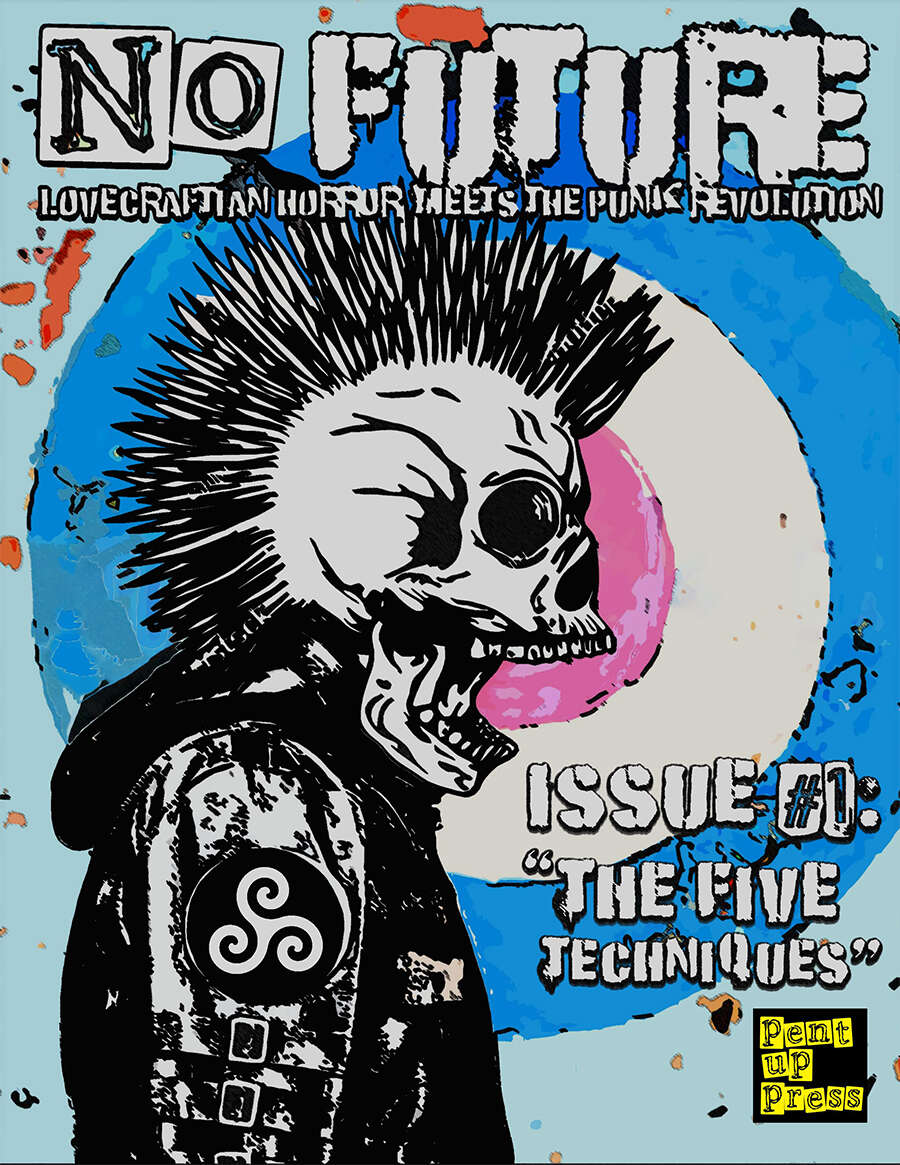
NO FUTURE: Lovecraftian Horror Meets the Punk Revolution
would normally be reviewed as part of the Fanzine Focus strand, but it is not really a fanzine. Although originally intended to be part of Kickstarter’s ZineQuest for 2022, the publisher decided to do it on its own via Itchio, when Kickstarter moved ZineQuest from march to August to coincide with Gen Con, its format—A4 rather than A5, its singular content, and the production standards all move it away from the ’zine ethos and look and towards a more professional product. As a result, it stands somewhere between a fanzine and prozine. It is a trend which has been growing with each successive ZineQuest, to the point where it is quite difficult to determine the difference between a fanzine and a publication simply using the format and the promotional support of ZineQuest to present a whole scenario or even an RPG. NO FUTURE: Lovecraftian Horror Meets the Punk Revolution does itself no favours in making a such a determination. Although the cover can be described as Punk Art and Punks are the protagonists of its scenario, the style and layout of the first issue’s content evokes neither Punk Art nor a fanzine sensibility, and the glossiness of the first issue just does not scream Punk! However, whether or not NO FUTURE: Lovecraftian Horror Meets the Punk Revolution is ’zine or not ’zine, it does not meet the criteria to fit the Fanzine Focus strand, but it does include content which is interesting and which does involve Punks.

NO FUTURE: Lovecraftian Horror Meets the Punk Revolution – Issue #1: “The Five Techniques” is published by Pent Up Press and contains a single scenario designed to be run using Trail of Cthulhu or Cthulhu Dark. The former is the clue orientated roleplaying game of Lovecraftian investigative horror from Pelgrane Press and the latter the rules light RPG of Lovecraftian investigative horror designed for simple, minimalist play. It could easily be adapted to the roleplaying game of Lovecraftian investigative horror of the Game Master’s choice. What makes the scenario stand out is its time period—the 1970s, its setting—Northern Ireland, and its protagonists—members of punk rock band. The set-up is this. The would-be Investigators are members of The Gutters which formed in London. The band’s bassist, Ciaron McCarthy, has died and his bandmate, Mickey Grayes, has persuaded everyone to give Ciaron a proper Punk wake in his home village of Conhale in County Armagh in Northern Ireland. This sets up some fantastic tensions. The Punks themselves are very much the ‘fish out of water’ amidst the tensions of the Troubles. Not just their clothes, but their anti-establishment sentiment will make them standout in the conservative society of Armagh, already tense from the locked down presence and influence of the British Army and the Royal Ulster Constabulary supposedly keeping them safe from the IRA.

The Investigators will feel and experience this tension almost from the start. The journey from London has been long and tiring when the Punks are stopped by an IRA checkpoint and questioned. The villagers are reluctant to talk to the interlopers, but will warm to them with a drink or two. The British Army will take a seemingly mild interest too—at least initially. All whilst the Investigators suffer odd dreams, or even daydreams of dreams, spiral patterns are marked here and there, and then one of their number runs off…

As written, “The Five Techniques” is systemless, but the scenario includes notes on running it in either Cthulhu Dark or the GUMSHOE System of Trail of Cthulhu. The latter comes with stats for some NPCs and new Investigative and General Abilities, all musical in nature. For either system, there is a set of tables for creating the background of the Punk, covering ‘Creating Your Punk’ and ‘Getting the Band Together’, as well the scenario’s set of dreams and four decently done handouts.

Whether run for Cthulhu Dark, Trail of Cthulhu, or another roleplaying of Lovecraftian investigative horror, “The Five Techniques” is more folk horror, more Green Room meets Junji Ito’s Uzumaki, rather than Lovecraftian horror per se. It also adheres to the style of play of Cthulhu Dark in which the Investigators can only confront the Mythos. They cannot fight it directly, for it is too powerful, too unknowable, and such efforts are doomed to end in failure, resulting in the Investigators’ deaths or insanity. Thus “The Five Techniques” is more Purist than the traditional Purist mode of Trail of Cthulhu to the point where the motivations of outrĂ© threat are never explained and the Game Master is not expected to explain them either. Only in the epilogue which each player gets to narrate for their Investigator is there time to wonder at what happened and the horror of it. Here though, is where “The Five Techniques” does not support the Game Master as the scenario does not say about the responses to what happened for those living in and around Clonhale, whether the villagers, the British Army, the R.U.C., or the I.R.A. There will be consequences and it would have been useful to be given pointers as to what they might be.

Physically, NO FUTURE: Lovecraftian Horror Meets the Punk Revolution – Issue #1: “The Five Techniques” is busily presented with plenty of decent artwork and good handouts. The writing is decent and the plot sufficiently straightforward that the Game Master can easily run this in a single session or as a convention one-shot. In addition, the scenario has a pleasing historicity, which includes the appearance of Northern Ireland’s most famous Punk band.

The seventies is a period which has been little explored in Lovecraftian investigative horror, and much of what has, has been inspired by the Grindhouse, exploitation cinema of the period. NO FUTURE: Lovecraftian Horror Meets the Punk Revolution – Issue #1: “The Five Techniques” shifts Lovecraftian investigative horror to the seventies in a historical sense and location, placing the unknowable against a framework of real-world tensions, making the already fraught situation all the more fraught, the result being a unique scenario for Lovecraftian investigative roleplaying.

Sunday, 30 October 2022

England’s Dreaming Awaits

England is falling. She stuttered after the slaughter of the Great War and the ravages of the Spanish Flu. As the Bright Young Things flung themselves into the hedonism of the Jazz Age and the working classes fomented industrial action—if not outright revolution, the fall was accelerated after the Wall Street Crash spread the Great Depression around the world. Now as Fascism rises in nearby Europe and is admired and entertained by the Upper Classes, the country is losing its way, weak and unsure of what it once was, let alone what it is now. Yet there are those who recognise the malaise, and who not only know the solution, but have the means and the power to apply it and so restore the country. Since the strange occurrences in the South Pacific in 1925, there have been men and women who have come to see there are beings and powers beyond that can be used and bargained with to ensure that England can be at least itself once again, that it can inspire great men and simple men alike, be prepared to weather the coming storm, and perhaps aspire to be the Albion of William Blake’s verse. Their means is not politics or the modern arts of mass communication, but old arts and skills—magic! Or rather Alchemy, Spiritualism, and Witchcraft, as well as the Magick of the evillest man in England, Aleister Crowley. Armed with knowledge gained from their newfound skills and researches, they will delve into the myth and folklore of the country, allay the threats they sometimes are, have dealings with creatures and persons out of fable, and encounter those non-believers, rival magicians, and fascists who do not want a return to a green and pleasant land in a secret war which will play out over the course of the Desperate Decade.

This is the setting for Fearful Symmetries, a campaign for Trail of Cthulhu, published by Pelgrane Press. This explores the clash between rationalism and romance, science and magic, Lovecraft and Blake, the Mythos and the folklore in a framework inspired by Blake’s artwork and writings, that might not involve Lovecraftian investigative horror at all! For although the often non-Euclidean mathematics of the Mythos underly the workings of the mundane magics of Alchemy, Spiritualism, Magick, and Witchcraft, as well as the existence of the Mythos creatures and races that explain many of the creatures known in folklore, this does not mean that they will be recognised as being of the Mythos. Thus, the Investigators may encounter the Mythos but not necessarily recognise as such, likely losing Stability and Sanity nevertheless, just as they will for practising magic and encountering folkloric creature. Ultimately, magic, even as it empowers the Investigators to deal with the threats to Albion and ensure its restoration, is a double-edged sword, yet one more ‘fearful symmetry’ they will face in the course of a campaign.

Fearful Symmetries begins with an introduction to William Blake and both his works and mythology, contrasting them with those of Lovecraft. This section in particular is lavishly illustrated with Blake’s paintings, but they are used throughout the book and so give it a very individual look. Here the groundwork is laid for a campaign, including whether it should be played open or closed in terms of Investigator knowledge, the style of magic the Investigators should employ—Magick is the default, the conventions of magic, what type of characters to play, and advice for the player. The counterpart to this—or symmetry—is the advice and tools for the Keeper. The Folklore Engine and the History Machine are the primary sets of tools, more a series of prompt than necessarily tools, but they enable the Keeper to build mysteries and episodes around folklore and the real world. They have their own counterpart for the players in the form of The Book of the New Jerusalem, an in-game prompt that they can draw from to direct their Investigators’ enquiries. Other tools include geographical and relationship maps, timelines, and more, the latter running all the way up to safety tools necessary for a good game. There is decent advice on setting up and running a campaign, the primary advice being that the Keeper improvise in response to her players’ and their Investigators’ actions and decisions, many of which are intended to be drawn from The Book of the New Jerusalem.

One major difference between Trail of Cthulhu and Fearful Symmetries is the power level of the Investigators. In Trail of Cthulhu—even in Pulp mode, the power level of the Investigators is low. At best, an Investigator might know a spell or two in Trail of Cthulhu, whereas in Fearful Symmetries they are magical adepts, capable of casting a variety of spells, empowering rituals, creating magical items, entreating with magical beings, and incarnating Blakean spirits. Fearful Symmetries gives ways of making the casting of Incantations—immediate spells, and the performing of rituals—longer, more involved castings, both interesting and mechanically beneficial. Magic here has to be worked, especially the rituals, which the Investigators will be regularly performing, whether this is initiation rituals to bring someone into a magical group or attunement rituals to align the casters to a magical item or node. The attunement ritual will be important throughout a Fearful Symmetries campaign as the Investigators will be working to restore and repair important locations upon England’s ley lines and this bring about a new Albion.

Although the default style of magic in Fearful Symmetries is Aleister Crowley’s Magick, three others—Alchemy, Spiritualism, and Witchcraft—are also examined in detail. Others are mentioned as an aside, but the focus on the key four means that there is a lot here for the Keeper to grasp and understand, let alone her players. Having Magick as the default offsets that, although main reason is that having the Investigators share the same magical style means that they can easier work together. The wealth of information here means that the casting of magic should never get stale.

In terms of background, Fearful Symmetries gives a good guide to life and cultures of mundane England of the thirties, details several of the occult groups operating in England in the period (these can be rivals, groups the Investigators can join, and so on), points to ordinary groups such as ramblers and potholers as useful contacts and NPCs, numerous creatures and beings from British folklore are described and given stats, as are various items and occult books. Occult England—or Albion—takes in not just the notable magical places across the country, thus tying in with The Book of the New Jerusalem, but also extends beyond into other places. These include Fairyland, the astral plane, even Death, as well as John Dee’s Aethyrs, the planes surrounding the Earth. Combined with the ley maps in the appendices at the rear of the book and The Book of the New Jerusalem and what Fearful Symmetries provides an occult sandbox which the Keeper can develop a campaign from and the players and their Investigators can explore in pursuit of a restored Albion.

The default or sample campaign in Fearful Symmetries comes oddly placed in the middle of the book. In ‘Fearful Symmetries’ the Investigators begin as newly initiated practitioners whose mentor is suddenly snatched away in front in of them by what is arguably Blake’s most well-known motif. Once the ritual is completed and now both initiated and incarnated as one of Blake’s Zoas, or primal spirits, they can begin following the clues in search of their mentor and discover who or what abducted her in front of their eyes. The plot thickens with a Lovecraftian antagonist, trips out into the English countryside and across seedy London (potential here for a crossover with Bookhounds of London and The Book of the Smoke, the London counterpart—or symmetry?—to The Book of the New Jerusalem), and in the second part or series, confrontations with England’s growing obsession with fascism. Just fifteen pages long, this is an excellent outline, which together with the background, should develop into a good campaign.

Rounding out Fearful Symmetries is a bibliography and a set of appendices that examine the ley lines network across London, worksheets, lists of alternate names for folkloric creatures, a glossary, a lengthy list of other occult books, and maps of the lay lines detailed earlier in the book. In particular, the examination of the ley lines network across London ties into the sample campaign and potentially turns Fearful Symmetries into a sequel to the earlier Bookhounds of London.

Physically, Fearful Symmetries is cleanly and tidily presented, its tight blocks of text broken up by Blake’s artwork as well as the liberal inclusion of quotes from Blake himself, plus William Shakespeare, H.P. Lovecraft, Aleister Crowley, Arthur Machen, and many more. This makes the book a lot easier to read given the wealth of information it provides. If there is a downside to the book, it is the lack of index, inexcusable given just how much information there is in Fearful Symmetries.

Fearful Symmetries is not a traditional campaign or setting book for Lovecraftian investigative roleplaying, let alone for Trail of Cthulhu. Of course, Pelgrane Press has form here with Dreamhounds of Paris, which combined Surrealism with the Dreamlands, but Fearful Symmetries is not really about the Mythos, although it is present, hidden under layers of Blake’s mysticism and the occult traditions practiced in the thirties. So the Investigators may never even encounter it. Nor is it a case of encountering a great ‘evil’ and thwarting its plans necessarily, as is the usual in a campaign of Lovecraftian investigative roleplaying, but rather of restoring and rebuilding an ideal. This is Blake’s Albion, the old Albion, as opposed to the ‘new’ Albion that the English fascists might be dreaming of, again, one more of the symmetries to be found in the supplement. One way in which Fearful Symmetries can be seen, especially in its emphasis upon Aleister Crowley’s Magick, is as a spiritual successor to Pagan Publishing’s The Golden Dawn.

Fearful Symmetries takes Trail of Cthulhu and the GUMSHOE System into the realm of occult investigative roleplaying, and whilst it does not leave Lovecraftian investigative roleplaying behind, it does prove that it is as dangerous as the Mythos. There is a bucolic richness to this realm, both in the mundane and the magical, that begs to be explored and appreciated, but there is complexity too, more so than will be found in a typical Trail of Cthulhu or Lovecraftian investigative roleplaying campaign. There is also, a sense of hope to Fearful Symmetries, a yearning for England to be a better place, and as dangerous and as difficult as the attempt will be, that the Investigators are rebuilding and restoring the country, directing her down a different path, rather than saving the country against an unknowable and uncaring foe. In hindsight, this can also be seen as restoring England as she once was spiritually and thus preparing her in time for the calamities that will come in the face of war.

As English as it can be, Fearful Symmetries is a superb set of tools for a very different type of campaign. Rife with fascinating parallels and contrasts, Fearful Symmetries presents a setting and campaign of occult investigative roleplaying that will be demanding of Keeper and player alike, but enable them to explore a rich world of the occult and the folkloric, becoming the country’s secret saviours as they master dangerous Magicks, face fascist bullyboys, and bring about a better future.

Monday, 27 June 2022

Mythos Manuals I

From Unaussprechlichen Kulten, Revelations of Gla’aki, De Vermis Mysteriis to the dread Necronomicon, the Mythos and its fiction is replete with awful tomes of all too inhuman, alien knowledge, spells or formulae whose invocation all too lead to the summoning of or contact with things and beings beyond understanding, and the ravings of madmen. Their treatment in Call of Cthulhu and other roleplaying games of Lovecraftian investigative horror has varied over the years. At worst they have been treated as treasures to be plundered from cultists as in some of the very early scenarios, but in more recent times they have been properly treated as horribly insidious works of true knowledge, with even their possession having a subtle effect upon the fragility of man, whether his mind or his very being. Perhaps their first expansive exploration in Call of Cthulhu would have been in The Keeper’s Companion Vol. 1 and The Keeper’s Companion Vol. 2, and the evocative exploration and presentation would have been in the almost mythical Masks of Nyarlathotep Companion. It is strange that given their place within the fiction and their use to both impart knowledge of the Mythos and enforce its corruptive influence, that there has never been a Call of Cthulhu supplement dedicated to just these great works within the fiction.

Tomes of Cthulhu, published by Azukail Games, is not that supplement, but it points towards such a supplement even if cannot be that supplement itself—primarily for copyright reasons, of course. It is instead a generic supplement for roleplaying game of Lovecraftian investigative horror which describes some twenty different tomes and their reprints inspired by the works of H. P. Lovecraft. Each entry follows a standard format. This includes both the name of the work and its author, a description of its format and its contents, plus size and weight, number of pages, primary language it is written in, the amount of knowledge it contains about the Mythos and the effect upon the reader once the book is read, and a suggested period of study time. This is followed by notes and perhaps discussion of copies or reprints. All of which apes the descriptions and formatting of details about the Mythos tomes in Call of Cthulhu, Seventh Edition, but Tomes of Cthulhu shies away from supplying the Game Master with actual numbers. Thus, the suggested amount of knowledge it contains about the Mythos and the effect upon the reader once the book is read runs from Least through Lesser, Moderate, and Greater to Greatest, equating to much as 2% for the Least category to as much as 15% for the Greatest. Take any of the entries in Tomes of Cthulhu and the Game Master should be able to adapt them to the Lovecraftian investigative horror roleplaying game of her choice.

The entries range from ancient stone tablets to typed reports. A Translation and Interpretation of the Pre-Minoan Tablets Found in the Aegean is an example of the latter, supposedly written in a language belonging to a pre-Minoan civilisation and discovered by adventurer Jonathan Smedlock during a dive off the coast of Crete. The tablets were regarded as fakes and his claims ridiculed, and the tablets were either lost or are in a museum, and Smedlock was last seen in Africa. The translations in Smedlock’s own cheap hardback are based on several other works, none of them on the Minoan languages, and the Game Master is free to insert whichever Mythos she wants in here. An example of the latter is A Report of the Investigation into the Events in the Punjabi Himalayan Region in 1873 by Captain James Sutton is the typed report based on The Journal of Captain James Sutton, a soldier sent to investigate strange goings on in the Punjab in the shadow of Himalayas. The diary records weird, unearthly colours, and draining, grey effect that killed man, beast, plant, and the ground itself. The official report, not wholly written by Sutton, and since mimeographed, gives poisoning as the cause. Most of the other entries in Tomes of Cthulhu are books or reports, but Giants in the Earth by Private Tommy Atkins is a volume of horrifically grim poetry published after the Great War under an obvious pseudonym, the author consequently being confined to Bedlam where he committed suicide. The second, expurgated edition was published in 1959, its often lurid and disturbing replaced with more mundane depictions of the Western Front. The second edition is thus not of interest to book collectors or Mythos scholars, but either version reveals something about the Ghouls that prowled the Western Front.

Several famous figures are given as authors of Mythos tomes. Sir Isaac Newton wrote Philosophiæ Alchimia Principia Mathematica following a possible breakdown, a treatise on mathematics, the occult, alchemy, and chemistry which describes the true nature of the universe, particularly as they relate to time, space, or dimensional travel, even as far out as the Dreamlands. Suggested entities and races covered in the volume, which is written in Latin, include Yog-Sothoth, Azathoth, Nyarlathotep, and Great Race of Yith. Notes on an Expedition to the Antarctic by Charles Darwin is perhaps the most obvious entry in its inspiration. In 1831, during the second voyage of HMS Beagle, the expedition was given maps of a southern continent, and the book describes how it sailed south and discovered a cave entrance on the frozen land. Inside there were found pieces of green soapstone worked into rounded, five-pointed stars; carvings and murals on the walls, many damaged, depicted strange creatures and maps, perhaps of the Earth; and the strange, fossilised figure of barrel-shaped creature beyond understanding. Then there was the strange piping voice which shouted, “Tekeli-li!”. It is of course, all very At the Mountains of Madness.

Tomes of Cthulhu is relatively underwritten in terms of its ideas, because primarily, it is overwritten, repetitious, and very much in need of an edit. It also suffers from being for roleplaying games of Lovecraftian investigative horror rather than for a roleplaying game of Lovecraftian investigative horror, and so is not specific enough, which is not unexpected given the fact that the author must tiptoe around the facts that he cannot supply such numbers and he must be careful of what he can and cannot include. In combination though, the result is that any attempt to extract the information from this supplement is not as easy it should or could be. There are some potentially interesting tomes and titles which the Game Master or Keeper could extract from Tomes of Cthulhu, but it is perhaps best used to inspire the creation her own, as that might be easier.

Sunday, 5 June 2022

Dread and Danger in the Desperate Decade

No Security: Horror Scenarios in the Great Depression is an anthology of five horror scenarios notable for three things. First, they are written by Caleb Stokes, best known as the author of Lover in the Ice, a horrifyingly adult body horror scenario for mature audiences for Delta Green, but which was originally released as part of the No Security Kickstarter. Second, they are systems agnostic, meaning that the Game Master, or Keeper, can and will have to adapt them to the roleplaying game of their choice, typically a roleplaying game of Lovecraftian investigative horror, such as Call of Cthulhu or Trail of Cthulhu. As an aside, it would be possible to the quintet straight from the page, but that would take a well-prepared Game Master. Third, they are all set in the Desperate Decade of the nineteen thirties, a period of turmoil and uncertainty as the banks crashed, the soil turned to dust, and the Great Depression drove millions into poverty, which is relatively unexplored in terms of Lovecraftian investigative horror, at least in terms of the preceding Jazz Age of the nineteen twenties.

No Security: Horror Scenarios in the Great Depression is published by Hebanon Games following a successful Kickstarter campaign. All five scenarios are available as ‘Pay What You Want’, but have been collected into the No Security anthology. In addition, the anthology does address the social iniquities of the period and gives advice on how to handle them in play. Even though the author does give the suggestion that the disparities and attitudes be ignored in favour of ‘game fun’, his preferred option is to include them in play, but of course, handle them with sensitivity and care. In some scenarios, he also suggests that the Player Characters (or Investigators) be from a mixed background—for two reasons. First, it enables them to access all levels of society, both African American and White. Second, it enhances and contrasts the horror of society and its disparities in the Desperate Decade against the Cosmic Horror of the anthology’s monsters and madness. It should also be noted, that as a consequence of being systems agnostic, No Security does not use of the traditional Mythos monsters or entities. Which means that whatever Cosmic Horror threat that the Investigators find themselves facing in No Security, their players will have as little clue as they do.

The anthology opens with Wives of March. This is longest scenario in No Security and takes place in Barefoot Crossing, a sharecropping community on the rural outskirts of Savannah, Georgia, in the early part of the decade. Here the Unifying Word Revival Church preaches to the community and brings much needed relief to its parishioners, but the community is sent into uproar when the pastor, Dashell March, is murdered, and worse, an African American is the prime suspect, an African American who is also suspected of corrupting a young White girl! The set-up for the Investigators’ involvement really works best with their being hired by different parties, each with an interest in solving looking into the murder, though not necessarily solving it. Local lawyers want the pastor’s will investigated, a rival church wants to prevent any retaliative violence against its African American congregation, an heir wants his claim to the will confirmed, and lastly, the local sheriff’s office do want the crime investigated, again, primarily to prevent an outbreak of violence.

This all sets up and opens numerous paths of investigation—paths that might be closed or difficult if the Investigators are not from diverse backgrounds—and leads them into multiple levels of local society. What they discover, at least initially, is that the March family, and the Unifying Word Revival Church, are incredibly interested in helping them out beyond the mere murder investigation, as well as how helpful the March family is in the community and how pervasive their presence is. Yet oddities soon become apparent—the March family and their church seems impossibly wealthy; so many of the family appear alike (perhaps due to inbreeding?); and there is a preponderance of oddly deformed people in the community. As the scenario progresses, these oddly deformed people will begin to take an intense interest in the Investigators’ activities, to the point later on in the scenario where it becomes insanely intense!

At the heart of ‘Wives of March’, which has a The Midwich Cuckoos feel, is conspiracy between a husband and wife, one which is currently confined to the immediate area, but which has tendrils which can be traced around the world and back into prehistory… The truth of the matter is that they are effectively immortal, bound to each other, but loving and loathing each other after millennia of being together. They have died again and again, but been reborn each time remembering both how they died and what they learned in their previous lives. They cannot have children together, for any offspring would be an inhuman Un-thing, due to bargains they struck with not-Gods in their original lives, and so have children with others, but these children also remember their immortal parents’ history and have their knowledge, and so are born as insane as they are. Thus the Marchs cannot effectively die and cannot truly be together lest they unleash monsters into the world. They and their family are a brilliantly intense, psychotically focussed foe—especially if the players prefer their Investigators to take a more direct or combative approach, they are really going to scare the Investigators—as well as being actually a sympathetic foe. They are monsters true, but theirs is a burden which has made them so even as they stopped worse entering the world.

‘Wives of March’ has a strong set investigative threads, each built around the four different ways of involving the Investigators and each taking the Investigators into different strands of Georgia society. The scenario also goes into some detail about how the antagonists live and operate, explaining how they became the inhuman monsters that they are, how to portray them, and more, ultimately depicting them as victims of themselves. They are very much monsters we can sympathise with to a degree—but monsters, nonetheless. However, ‘Wives of March’ is not going to be an easy scenario to run. First, the investigative strands could have been better organised, and it does not help that it fails to explain what happened to initiate the events of the scenario until four-fifths of the way into it. Which is frustrating for the Game Master. Second, the antagonists are an almost impossible threat to deal with—even they do not know how to deal with themselves and their predicament. So how are the Investigators expected to solve it? 

Ultimately, ‘Wives of March’ requires a fair degree of effort upon the past the Game Master to prepare and run effectively. It has the potential to be an incredibly intense affair, but also a frustrating one primarily because there is no real solution to the larger problem at the core of the scenario. It also has the scope to be expanded if the Game Master wants to take the March conspiracy beyond the confines of ‘Wives of March’.

‘Bryson Springs’ is the second scenario in the anthology and shifts from the Deep South to the border of California, the destination for many escaping the Dust Bowl, and actually takes place on a stop on that route, the declining town of Byron Falls. Here, ‘Okies’—farmers and others fleeing the Dustbowl in the Midwest—have established a Hoover-town around a WPA built washhouse, as they try and find work and a way to survive. Here a Chinese ex-railway worker has been found bloodily battered to death just as the Investigators arrive, perhaps as State Police or the FBI sent to investigate the murder, bank robbers being transported to Leavensworth, relatives of the ‘Okies’ in town, Socialist labour organiser trying to rally the transient population, journalists with an interest in the Hooverville or the murder, and so on. The Game Master will probably want to develop more of the ‘Okies’ than the scenario does, and prepare carefully. Again, the scenario is not presented for ease of use—for example, the initial murder scene is described at the end of the scenario rather than at the start—and portraying that information to the players and their Investigators will be challenging. This is a much shorter scenario and more confined investigation which will probably reveal some nasty secrets other than what is necessarily going on. Like ‘Wives of March’, the ‘monster’ in the scenario also is also similar implacably unstoppable, which will likely frustrate the players. Ultimately, the solution to the problem in ‘Bryson Springs’ feels opaque, but not as much as in ‘Wives of March’, and is likely to be slightly easier for the players and their Investigators to work out. ‘Bryson Springs’ does make good use of its setting and it has some horrifyingly deadly moments. 

The third scenario, ‘Revelations’, is set in the Illinois town of Toil in 1938. The town has managed to weather the effects of the Depression and the Dust Bowl due to the local farms being able to grow soybeans, but times are still hard. They get harder still as a rash of strange events—axe heads floating in the river, a teacher in school spewing water as she teaches multiplication, sacramental bread in the town’s church turning to flesh, and much, much more. The rash becomes an onslaught as the vents turn stranger and weirder, never letting up. Responding to the incidents are members of the Toil City Police Department, who the players will roleplay, directed by the voice of the elderly, but kindly police despatcher. The scenario is inspired by the Bible—as the title might suggest, unleashing a barrage of apocalyptically biblical events each given a horribly entertaining and clever modern interpretation. This potentially leads to two problems. First, is the Biblical theme, which some may find offensive or inappropriate and second is that the players may not necessarily be aware or as knowledgeable of Biblical scripture as others, and so miss some elements in the scenario. These are not the only issues. The Game Master is handed a lot of events to throw at her players and their Investigators, so unless the Investigators decide to split up and look into different reports, it is unlikely that they will get to encounter them all. It is also unlikely that they will survive them all, for whilst they are not all necessarily deadly, the near constant onslaught does stretch and strain at the Investigators’ Sanity. The players may also not necessarily be aware of the scenario’s Biblical inspirations, so may so miss much of its religious overtones. Lastly, identifying the solution is not an easy task either, and the scenario needs staging advice as to when the Game Master should being dropping clues to that solution, or at least clues that lead to it. Ultimately, Revelations takes its cosmic horror in an unexpectedly weird direction and then ramps up the weirdness and the cosmic horror again and again. For the Game Master and players who understand and appreciate its inspiration—and who do not take offence—this is likely to be a fascinating and unnerving playing experience, just wondering what is going to happen next, and how it happens next. 

‘Red Tower’, the penultimate scenario in No Security takes place in Chicago in 1931, in and around its infamous Meatpacking District in the wake of Al Capone’s arrest. It is not a gangster scenario, although the Mob is involved tangentially. Like the earlier ‘Wives of March’, the scenario has multiple means of entry—a reporter from a Socialist newspaper looking for a missing colleague, Bureau of Investigation agents looking for associates of Capone, agents of the newly formed FDA wanting to check on the local slaughterhouse operations, mobsters looking to take down rival operations that have stepped up following’s Capone’s arrest, and more. Consequently, only a few of these Investigator concepts will work together, so the Game Master will have her work cut out as she switches back and forth between players as their Investigators follow different or similar paths of enquiry. This does mean that sat round the table the players are likely to learn more than their Investigators until either they follow the same lines of enquiry or they meet up and share knowledge. That is likely to come about as they penetrate a slaughterhouse which does not seem to be quite there, but which appears to purchase a lot of cattle for slaughter, but without producing any meat… If they meet earlier in the scenario they are likely to be odds with each other rather than co-operative. One advantage of the Investigators working separately, at least initially, is that they are more likely to find the solution to the situation inside the slaughterhouse which is not there (whether they are prepared to share is another matter), but descriptions of the final encounters which would involve that solution are underwritten and not as well described as they could have been. Getting to that point and dealing with the threats surrounding the slaughterhouse is the more interesting and the more horrifying—and longer—part of the scenario though.

The last scenario in the anthology is ‘The Fall Without End’, in which the Player Characters team up in pairs to climb Mount McKinley—more recently renamed Denali—as a great story that the American government can use as a distraction from the ongoing effects of the Depression. There is advice for both players and Game Master on the types of character to create and on the skills required to climb mountains, which both will need to understand as obviously very technical in nature. Beyond a few encounters around the base of the mountain, ‘The Fall Without End’ is a linear affair, that is, straight up the mountain, via two routes. There is a plan of the chosen routes up Mount McKinley, but no illustration of the mountain, which is disappointing. In comparison to the other four scenarios in this anthology, there very little investigation involved and the scenario is primarily action-orientated. It is also much shorter, but no less deadly. This both due to the monsters and secrets to be discovered and the environment to overcome and survive as the Player Characters climb the mountain. This combination, together with the competition to be the first to reach the top of Mount McKinley, is reminiscent of Chaosium, Inc.’s Beyond the Mountains of Madness, but as a short one-shot rather than a full campaign. One advantage of this scenario is that it could be run using the rules of a non-Lovecraftian investigative horror roleplaying game so as not to forewarn them of the horrors to come up the mountain…

Physically, No Security: Horror Scenarios in the Great Depression is a black and white book, so one advantage of the PDF is that artwork is clearer and in colour. The book does need an edit in places and many of the scenarios could have been better organised.

The primary problem with No Security: Horror Scenarios in the Great Depression is that it is a set of systemless scenarios with a great deal of detail which means that it is going take a great deal of effort upon the part of the Game Master to adapt any one of the five to the roleplaying game of her choice. The primary advantage with No Security: Horror Scenarios in the Great Depression is that it is a set of systemless scenarios with a great deal of detail which means that the Game Master can freely adapt to any one of the five to the roleplaying game of her choice, and adjust them as necessary. Overall, No Security: Horror Scenarios in the Great Depression is a solidly scary set of one-shots which takes excellent advantage of their period setting and brings Cosmic Horror to the Great Depression without involving Lovecraft, which will take effort upon the part of the Game Master to prepare and run.