Every Week It's Wibbley-Wobbley Timey-Wimey Pookie-Reviewery...
Showing posts with label 13th Age. Show all posts

Sunday, 16 August 2026

Tactics & Tales (Part II)

13th Age Second Edition Gamemaster’s Guide is not the companion volume to the 13th Age Second Edition Heroes’ Handbook. Published by Pelgrane Press, it is instead a direct continuation, literally picking up with chapter eight following on from the character seven at the end of the 13th Age Second Edition Heroes’ Handbook. Together, they make up the core rules for 13th Age Second Edition, the ‘Fantasy 20’ or ‘F20’ roleplaying game derived from different editions of Dungeons & Dragons which combines the crunch of epic battles with narrative or story-telling aspects for grand adventures where the Heroes are special because of their individual ‘One Unique Thing’ which sets them apart from the inhabitants of the Dragon Empire. They are true heroes, each linked to two or three of the Icons, the great powers of the Dragon Empire in 13th Age, whose influence over the story can be positive or negative, depending upon the nature of the relationship. The 13th Age Second Edition Heroes’ Handbook contains everything necessary for the players, including rules for character creation, the place of the characters in the world and their relationships with the Icons, the great powers of the age, the core mechanics, and combat, plus a fantastic example of play and character creation. The 13th Age Second Edition Gamemaster’s Guide contains everything else, including a description of the Dragon Empire, the setting for 13th Age, advice on running the game, a bestiary, a treasury, and an introductory scenario.

The
13th Age Second Edition Gamemaster’s Guide starts with a description of its setting, the Dragon Empire. This is located at the centre of a large disc-shaped land surrounded by ocean and consists of the Land, the Underworld, and the Overworld. Seven cities line the shore of the stable Midland Sea, enabling easy travel between them, and each associated with one or more of the Icons. For example, Axis, the City of Swords, is home to the Emperor, but also has links to the Archmage, Crusader, and Great Gold Wyrm, whilst Glitterhaegen, the City of Coins is linked to Prince of Shadows, the Emperor, and the Dwarf King. It dips in and out subject matter, highlighting interesting elements of the setting, such the fact that the magic that causes the calmness of the Midland Sea forces monsters onto the nearby shores; that nobody likes to live too near the Imperial roads because they are haunted; and dungeons claw their way out of the earth and roam the land until stopped! Particular attention is paid to these dungeons as they are important and potential adventuring sites in a campaign, but for the most part, the write-up of the Dragon Empire is described by the authors as being ‘half-designed’. This is intentional as it leaves room for the Game Master to add her own details. There is a gazetteer which adds more specific details, whilst still leaving room aplenty for the Game Master’s own input.

This even applies to the history of the Dragon Empire with just a whole two pages devoted to it; or rather to the 13th Age and the past twelve Ages. Each Age began, rose and prospered before collapsing due to some catastrophe, and was replaced by a new Age. Each Age is associated with particular Icons and some Icons my appear in some Ages and not others, and so on. The overall description is brief at just two pages and so the Game Master may want to refer to one of the best supplements for the first edition of the roleplaying game, The Book of Ages.

Campaign advice discusses various topics—campaign identity, the ten-arc structure for the shorter campaign, customising the Icons to fit the campaign, and some examples. Campaign identity offers up a few other suggestions beyond the classic ‘Heroes on a Mission’, but clearly states that the ‘Forbidden Theme’ of a bait and switch theme to an Icon should never be done. The ten-arc structure is tailored to the maximum of ten Levels that a Hero in 13th Age can achieved, essentially one arc per Level, this replacing the Ten-Session Campaign concept from 13th Age First Edition. Customising the Icons to fit the campaign is intended to be a collaborative process between the Game Master and her players, starting with the Game Master selecting the Icon to her campaign’s main focus, whether as patron or villain, the players adding the Icons they want to see, and the Game Master deciding on the involvement of the unnamed Icons. This is supported by examples from each of the book’s authors. For example, ‘Servants of the Court’ sets up the Elf Queen as the primary heroic Icon with more powers and purviews than the Heroes suspect as she was also the Prince of Shadows with a combination of Archmage and Diabolist as the Icon villain. Of the other Icons, the Dwarf King had died whilst killing the Orc Lord; the Priestess championed civilisation whilst propping up a weak Emperor and was also the Dawn Captain, prophesised to die and become the Crusader; and both the High Druid and Lich King were involved elsewhere. These four examples actually better explain the concepts the customising process than the advice itself, showing the flexibility of the Icon roles in a campaign, whether that is in the 13th Age or a previous Age.

13th Age is played out in arcs, each consisting of three or four combat scenes or battles leavened with narrative scenes in between. The 13th Age Second Edition Gamemaster’s Guide discusses in detail how to design battles per arc, primarily adjusting them for the Level and number of Heroes. There is an optimal balance for the Monster Level versus the Hero Level, but the advice suggests ways in which this can be adjusted up or down, usually to fit a narrative. This might the Game Master wants the Heroes to wade through one or two hordes of monsters before they confront a bigger threat at the end of the arc, but there is plenty of scope to vary this or just simply balance all three or four of the battles that make up an arc. The advice also covers balancing the roles of monsters on the battlefield, such as archers, blockers, casters, troops, and so on; fighting a single monster type versus a single monster; ways making an encounter unfair and thus more challenging; and even making the battlefield itself dangerous as well as adding traps.

The process of designing a battle is not complex if the Game Master decides to use the suggested optimal Monster Levels, simply choosing the appropriate foes and their roles from the bestiary. However, the process does involve a little bit more arithmetic if the Game Master wants to create a battle where the Monsters Levels are not optimised to make a battle less challenging or more challenging. Fortunately, the designers have worked out the adjusted values beforehand and provide them for the Game Master in a handy table. That said, the Game Master should probably stick to the optimised Monster Levels for the first few battles and tinker with the battle design on subsequent ones. The process is pleasingly supported with a lengthy example of a Game Master designing multiple battles across the whole progress of the Heroes for First Level to Tenth Level.

Having discussed how to fit the monsters into arcs and monster roles, the 13th Age Second Edition Gamemaster’s Guide devotes half of its pages to talking about its monsters. The monster stat block is kept streamlined and as well as an explanation of the various monster abilities, there are lists of the monsters themselves by Level, strength (standard, mook, double strength, and elite), and Role. In comparison to other fantasy roleplaying games, one obvious addition to a monster stat block for 13th Age is that of an Icon symbol, indicating a specific link or relationship between a monster and an Icon. These can be positive, negative, or mixed, and not all of the Icons in 13th Age have relationships with the monsters in the 13th Age Second Edition Gamemaster’s Guide, but where they do, it enables the Game Master to tailor encounters and battles to the Icons featuring in her scenario or campaign. It is followed by more guidelines on tinkering with monsters, this on adjusting the stats of an existing monster or designing one from scratch.

The actual bestiary itself runs from Dire Rat, Giant Beetle, and Wolf to Wraith, Wyvern, and Zombie, including Demons, Dragons (notably the chromatic ones rather than the metallic ones, since the Heroes are more likely going to be fighting the former, Ghouls, Goblins, Kobolds, Oozes, Sahuagin, and Stirges, it is for the most part, very much a classic ‘F20’ style bestiary. The only new addition is the Hungry Star, but there are plenty of variations within many of the monster entries, and many have sections titled ‘Icons’, ‘In Play’, ‘In Your Campaign’ and ‘At Your Table’. For example, the Kobold entry has stats for the Kobold Recruit, Kobold Hero, Kobold Warrior, and Kobold Archer. The ‘In Your Campaign’ entry asks lots of the questions of Game Master as to the character of Kobolds in her campaign and notes that several variations appear in the 13th Age Bestiary and 13th Age Bestiary 2. The ‘Icons’ entry for the Ettin suggests that if one head has been swayed by the Diabolist, the other has been influenced by the Three. ‘In Play’ for the Otyugh states that it lives in filth and slime near the entrance to enemies’ caverns, so that it is close enough to alert the enemies if it attacks the Heroes or it joins the enemies if they are fighting the Heroes, before stating that, “Oytyughs were more common in an ancient age, when adventurers were so poor they used 10-foot poles to turn over dung heaps in search of loot.”

Some monsters get extended entries, for example, the Dragons. This makes entire sense, since as their entry notes, they are the Heroes of the monster world! Besides standard abilities, they are tough and have their own personalities, and they have dragon-ticks and campaign abilities. A dragon-trick can be used once per turn, such as its godlike reflexes that let a dragon reroll initiative or its magnificent scales to force a player to reroll an attack against its Armour Class. In comparison, campaign abilities like humanoid form or spells are intended to be used when appropriate rather than in every single battle that a dragon appears. Demons and NPCs are treated in a similar fashion adding further flexibility.

The treasure chapter divides its items into two types. These are one-use items and true magic items which are essentially alive, have their own personalities, and need to be attuned to. One-use items are typically potions—healing and resistance—and runes that apply bonuses to armour or a weapon or spellcasting, and there is a guide to their discovery per Hero Level. Similarly, the availability of magic items is tracked according to the Hero Level and by the tier of the campaign—Adventurer, Champion, or Epic. The personalities of magical items are reflected in quirks, quips, and quiddities. Quirks push the wielder of a magic item to act a certain way, such as dressing nicely at every social occasion or spouting puns; quips are phrases or comments that a magic item wants to hear its wielder say or a phase it wants the wielder to do; and a quiddity is its personality, effectively turning a magic item into a mini-NPC. A true magic will typically have one or more of these and they add individuality to each and every item. In many cases, magic items have more interesting mechanical effects than they do in other ‘F20’ roleplaying games and many are also linked to particular Icons. For example, the Boots of Elvenkind are linked to the Elf Queen and Prince of Shadows and require a skill check for the wearer to move quietly, but the player rolls twice an uses the higher roll, and in game needs a Quip such as ambiguous smile or mouthing the word ‘silent’ in Elvish. The list of magic items and also of wondrous items, is not extensive, but it is more than sufficient multiple arcs and campaigns, especially when it comes to weapons, since these are not listed by sword or spear or mace, but by the magical effect, so that weapons can be tailored to the campaign and the weapons wielded by the Heroes.

The 13th Age Second Edition Gamemaster’s Guide is rounded out with an introductory adventure, ‘A Bad Moon & The Wrong Stars’. It takes the classic ‘F20’ set-up of a ‘village-in-peril’ and gives it the 13th Age twist along with plenty of room for the Game Master’s input in form of Icon links and the details of the village. That village is Longmeadow, built on some ancient ruins. The Heroes are escorting a scholar of past Ages to Longmeadow when they are attacked by strangely dressed Elves. Investigation, again tailored to the Icons, will reveal the presence of a Living Dungeon nearby. This is the site of the adventure’s climax and what is interesting here is that the dungeon design is tiny at just four locations. In another ‘F20’ roleplaying game this would probably not be enough, but in 13th Age each room is battle, so a big encounter that all together with the fight on the road makes up a whole arc. In story terms, the play of this Living Dungeon, as much as it is in 13th Age, is not about lengthy exploration, but about getting to the action and the exciting bits. Each of the locations and the battles is detailed, some quite extensively so. Overall, ‘A Bad Moon & The Wrong Stars’ is a good introduction to the play of 13th Age and its key setting feature of Living Dungeons whilst having a lot of flexibility for the Game Master to adjust it to her players and their Heroes.

The 13th Age Second Edition Gamemaster’s Guide comes to a close with an array of appendices. These include a guide to using content from 13th Age First Edition, more options for the Game Master, a price list (if the Game Master and her players want to track Gold Pieces in their campaign, though 13th Age usually avoids this), tables for Game Master, a list of 13th Age First Edition resources, an excellent combined glossary and index, and more. All very useful.

Physically, the 13th Age Second Edition Gamemaster’s Guide is well written and an enjoyable read, though there is less input and commentary in this book than their was in the 13th Age Second Edition Heroes’ Handbook. The artwork is suitably heroic for the Heroes and monstrous for the monsters and all together, very good.

Despite its origins in two earlier editions of Dungeons & Dragons, it takes some adjustment to both play and run 13th Age since its combination of crunch and story is quite structured. The 13th Age Second Edition Heroes’ Handbook eased that process for the player and the Game Master, whilst the 13th Age Second Edition Gamemaster’s Guide does the same specifically for the Game Master in helping her in the process of setting up and running battles, arcs, and campaign.

Sunday, 18 January 2026

Tactics & Tales (Part I)

Let us be clear. 13th Age is Dungeons & Dragons. It offers a Dungeons & Dragons style of play. It is a Class and Level roleplaying game. It has the six traditional attributes, the traditional different Races of Dungeons & Dragons, and the various Classes of Dungeons & Dragons. It is even designed by the designers of Dungeons & Dragons. Not one edition of Dungeons & Dragons, but two editions of Dungeons & Dragons. It might even be called ‘Dungeons & Dragons 4.5’. What it calls itself is an ‘F20’ or ‘Fantasy 20’ roleplaying game, a roleplaying game derived from the family of Dungeons & Dragons roleplaying games. Yet it is also very much its own thing and has been from the start. When 13th Age was published in 2013, the hobby was in an uncertain place as it always is when it is between editions of Dungeons & Dragons. In 2013, Dungeons & Dragons, Fourth Edition was done, never having been as well received as its predecessors, and Dungeons & Dragons, Fifth Edition had yet to appear, yet to make the splash that it did on Dungeons & Dragons’ fortieth anniversary in 2014, and yet to make its glorious ascent into the mainstream and acceptance as legitimate pastime. What was available then, was D&D Next, the playtest version of the next edition. It was into this liminal space that 13th Age slipped in 2013. Published by Pelgrane Press, 13th Age did what Dungeons & Dragons, Fifth Edition also did. Which was to take the best features of the previous editions of Dungeons & Dragons and rework them. In the case of Dungeons & Dragons, Fifth Edition, that would be to create the next edition of the venerable roleplaying game. In the case of 13th Age, that would be to combine its style of play with a style of play that had come from another wing of the hobby, one that was radical and all but anathema to Dungeons & Dragons—storytelling games. Certainly, not a direction that Dungeons & Dragons, Fifth Edition was ever going to go in. The aim with 13th Age was to provide story and crunch, and so it is with 13th Age, Second Edition.

13th Age, Second Edition comes in two books, one a direct continuation of the other. The first is the 13th Age Second Edition Heroes’ Handbook, which provides everything necessary for the players, including rules for character creation, the place of the characters in the world and their relationships with the Icons, the great powers of the age, the core mechanics, and combat, whilst the 13th Age Second Edition Gamemaster’s Guide contains a description of the Dragon Empire, the setting for 13th Age, advice on running the game, a bestiary, a treasury, and an introductory scenario. The emphasis in 13th Age is on the Player Characters and their exploits as heroes and legendary heroes to be, not just in the epic battles they will fight—and fight from First Level to Tenth Level, but on the epic stories that will be told in the process. The battles are the focus of the roleplaying game’s self-confessed ‘crunch’, providing detail and flavour whilst also making the battles fast-paced and exciting. The epic narrative or story-telling aspect of 13th Age is handled by making every single Player Character special with his own ‘One Unique Thing’ which sets him apart from everyone else in the Dragon Empire; by replacing skills with Backgrounds that broaden player choice, add depth to the setting, and enable flexibility in how they are used; and in linking each Player Character to two or three of the Icons, the great powers of the Dragon Empire in 13th Age, whose influence over the story can be positive or negative, depending upon the nature of the relationship.
One of the great things about 13th Age, Second Edition is that it compatible with 13th Age, First Edition, which means that the Game Master and her players have access to some great supplements, such as the Book of Ages which opens up the history of the Dragon Empire and the killer dungeon, Eyes of the Stone Thief. However, 13th Age, Second Edition is a new edition and that does mean changes. Pelgrane Press actually includes a list of the major changes here for the benefit of Game Master of 13th Age, First Edition. Much of it has been to clarify the rules as much as streamline them. For example, instead of using days as a time unit to indicate the period in which certain powers work, the term is now ‘arc’. This allows the period to be used narratively rather than being constrained by time. The number of Icons has been reduced from thirteen to twelve (actually making it easier to roll for them randomly), the Orc Lord having been killed in a recent war—exactly how is up to the Game Master and her players to decide. This is the major change to the Dragon Empire and is connected to another change, which is the removal of the Half-Orc as a player choice in terms of Race—or rather Kin as 13th Age calls it. This is intentionally done to avoid the controversy surrounding the nature of the Half-Orc, and is instead replaced by the Troll-kin. It serves a similar, combat-orientated, brutish role, but is connected to the High Druid or the Emperor Icons rather than the Orc Lord. Other changes to Kin include more choices in terms of Kin powers, the removal of ability bonuses based on Kin, and the making of Player Character Kin special. The removal of ability bonuses based on Kin means that a player can place them wherever he wants—though he will probably want to place them to benefit his choice of Class, and by making Player Character Kin special, that is, they possess the special Kin Powers rather than having every member of their Kin do so, avoids stereotyping and widens player choice.
Then all of the Classes in 13th Age have been adjusted, from minor tweaks to major overhauls. For example, the simplest and easiest of Classes to play, the Barbarian and the Paladin, receive minor tweaks, the Barbarian Rage feature changed to be a wider critical hit range rather than roll two twenty-sided dice to attack and the Paladin’s ‘Lay on Hands’ becomes a feature of the Class rather than a talent, ‘Smite’ inflicts more damage, and so on. Major overhauls include the Bard Class, whose features and talents are based on the type of performance—Brass: Horn & Trumpets, Dance: Poise & Motion, Drums: Rhythm & Percussion, Flutes & Pipes & Ocarinas, and Strings: Lutes & Harps & Guitars—which also presents a greater choice for the player. The Sorcerer retains its Breath Weapon, the type of damage depending on the Dragon-type, and gaining bonuses to both to hit and Critical Range from the Escalation die, and can empower his spells in one round to cast for double the effect, including damage, the next. There are a lot of changes here of varying magnitude throughout 13th Age, Second Edition, affecting everything from Icons and Icon connections and combat rules and more, all based on a decade’s worth of play of, and feedback about, 13th Age, First Edition. The aim is to streamline and ease play, especially for the player new to 13th Age.
To that end, one big change that the roleplaying game does make to 13th Age Second Edition Heroes’ Handbook in order to help the neophyte player and Game Master is to give an extensive example of play right after the introduction. Most examples of play run throughout a rulebook, but here 13th Age frontloads it in one go, taking the reader through the process, step-by-step, of creating a character—selecting Icon connections and determining their relationships, choosing a Class and Kin, designing a One Unique Thing, setting ability scores, selecting gear, picking Talents and a Feat, creating Backgrounds, and so on. At each stage, particularly in relation to the Icon connections, One Unique Thing, and Backgrounds, the example of play shows how they can tie into the setting and into the campaign that the Game Master is running. Once done and the example Player Character is presented on a character sheet, the Player Character is taken through her first arc, her first series of battles, in the process showcasing combat and suffering damage, resting, bringing Icon connections into play, and more. It is annotated with pointers as where to learn more about each aspect of the creation process and the play, further, like any good example of play or any good example of the rules, what 13th Age is doing here is showing the reader how the roleplaying game is first intended to be set up and then played. It saves the telling of how this is done for afterwards, the reader having been prepared for it by that point.
A Player Character in 13th Age has the traditional six abilities—Strength, Constitution, Dexterity, Wisdom, Intelligence, and Charisma—plus a Kin, Class, One Unique Thing, and Backgrounds. There are fourteen Kin, which are Human, Dwarf, High Elf, Silver Elf, Wood Elf, Forgeborn, Gnome, Half-Elf, Halfling, Holy Ones, Troll-Kin, Dragonic, Holy One, and Tielfling. Of these, the Silver Elf is also known as the Drow, and the Dragonic, Forgeborn, Tielfling, and Holy One are by default less common. The nine Classes are Barbarian, Bard, Cleric, Fighter, Paladin, Ranger, Rogue, Sorcerer, and Wizard. Some obvious Classes, the Druid and the Monk, are not included, their details being in 13 True Ways, though not yet for 13th Age, Second Edition. The process is a matter of making choices rather than rolling dice, including selecting ability values.
Lottie Custard
Class: Rogue Level: 1
Kin: Halfling One Unique Thing: There isn’t a lie I haven’t heard and a truth that I haven’t hidden
Connections: Prince of Shadows (Conflicted/2), Emperor (Negative/1)
Backgrounds: I’m a Halfling, of course I can bake pies +2, My tongue is not so much silver, as golden +4, If I don’t know, I know man who can +1, Old Town Valley Girl +1 Strength 12 (+1) Constitution 15 (+2) Dexterity 17 (+3)
Wisdom 14 (+2) Intelligence 14 (+2) Charisma 17 (+3) Armour Class 15 (Light)
Physical Defence 15
Mental Defence 15
Hit Points 24
Weapons: Mother’s Third Best Flat Iron (d8), It’s just a fruit knife (1d6)
Kin Power: Evasive
Class Features: Bravado, Sneak Attack, Skulduggery
Class Talents: Shadow Walk, Shift, Wriggle, and Roll, Tumble
Class Powers: Evasive Strike (At-Will), Deadly Thrust (At-Will/1 Bravado), Flying Blade (At-Will)
Feat: Smooth Talk 13th Age is played out in arcs, each consisting of three or four combat scenes leavened with narrative scenes in between. The most basic of mechanics involves the Backgrounds, which work as skills in other roleplaying games, but narratively more flexible. A character’s Icon connections can also affect the narrative by providing knowledge, adding detail, securing help, triggering flashbacks, and other options, his player deciding what the actual effect is by working with the Game Master. This does not automatically happen every arc, a player needing to roll to see if it does for each Icon connection, and if it does, it can only happen once per arc. When an Icon comes into play, there is a chance that it will come with a ‘Twist’ and as the 13th Age Second Edition Heroes’ Handbook states, that is when, “The GM also gets to have some fun, adding a twist that improves the story by making the heroes’ lives a bit more interesting… but not so complicated that the connection turns bad for the heroes.” A twist will also occur if a player does not roll successfully to involve his character’s Icon connections, in which case the Game Master rolls for a random Icon to be involved. This is all backed up by detailed descriptions of the Icons—even the Orc Lord, helpful advice and plenty of examples and suggestions which will make the game play interesting and engaging.
Combat is comparatively much more complex and where the crunch occurs in 13th Age. It is also the focus of most of a Player Character’s Class talents, features, and feats, as well as spells for the spellcasting Classes. A Class’ talents are divided into three types that indicate their usage—at-will, once per battle, and once per arc. For example, at First Level, the Cleric Class can cast spells such as Combat Boon, Javelin of Faith, and Sacred Violence at will, Mark of Enmity and Spirits of the Righteous once per battle, and Mighty Healing and Hammer of Faith once per arc. The effects of talents increase as a Player Character rises in Level, as does total Hit Points, number of Recoveries (used for healing Hit Points) and feats, and so on up to Tenth Level. 
Where combat in 13th Age gets exciting, even exhilarating, is in the use of the Escalation Die. This sits in the middle of the table and comes into effect on the second round of the combat and then on subsequent rounds. On the second round, it gives a ‘+1’ bonus to all of the Player Characters, on the third round it gives a ‘+2’ bonus, on the fourth round, it gives a ‘+3’ bonus, and so on all the way up to the seventh round and after. It applies to the Player Characters only, not the monsters or NPCs, it can de-escalate or temporarily freeze, and it can trigger the powers of some Classes depending upon the number it is at or whether it is odd or even. The aim is to push combat forward and give it momentum once past the initially difficult rounds, rather than have it bog down in detail and unnecessary crunch.
All of the content in the 13th Age Second Edition Heroes’ Handbook (and also in the 13th Age Second Edition Gamemaster’s Guide) is supported by helpful examples, suggestions, and advice, some of which takes the form of commentary and interjections from the authors. This is where they talk directly to the players and to the Game Master, telling them how they ran their games, what worked, what did not work, what they think of some of the feedback on the changes to the new edition, and more. It adds a personal touch to what is very much not a drily academic-in-tone rulebook and escalating, a little, its engaging style.
Physically, 13th Age Second Edition Heroes’ Handbook is a great looking book. The artwork is solidly heroic fantasy, apart from the Icons, which are drawn as a cross between the decoration on Greek vases and icons for the Greek Orthodox Church. The book is well written and despite the complexity of its crunch, never less than readable. It is supported by a very decent combined index and glossary.
It is difficult to truly criticise the 13th Age Second Edition Heroes’ Handbook. The main issues are perhaps that some of the Classes are still too complex to play with ease, especially in comparison to other ‘Fantasy 20’ roleplaying games and that some fans of 13th Age, First Edition are not necessarily going to be happy with all of the changes. Yet even the designers acknowledge this and even applaud some groups that want to keep playing 13th Age their way.
The 13th Age Second Edition Heroes’ Handbook is the players’ book and the core book for 13th Age, Second Edition. It does what a new edition of a roleplaying game should do and improve and tweak the rules and the game to make it play better, in this case based on lengthy playtesting and feedback, and then make it accessible. In particular, it does this with its lengthy example of campaign set-up, character creation, and play that showcases how 13th Age is intended to be played and readies player and Game Master for the rules that follows. Yet it goes even further by having the designers explain their decisions and give alternative suggestions. 13th Age Second Edition Heroes’ Handbook is everything that the 13th Age player is going to need to help set him and his character up for some heroic fantasy.

Saturday, 27 May 2023

An Elvish Endeavour

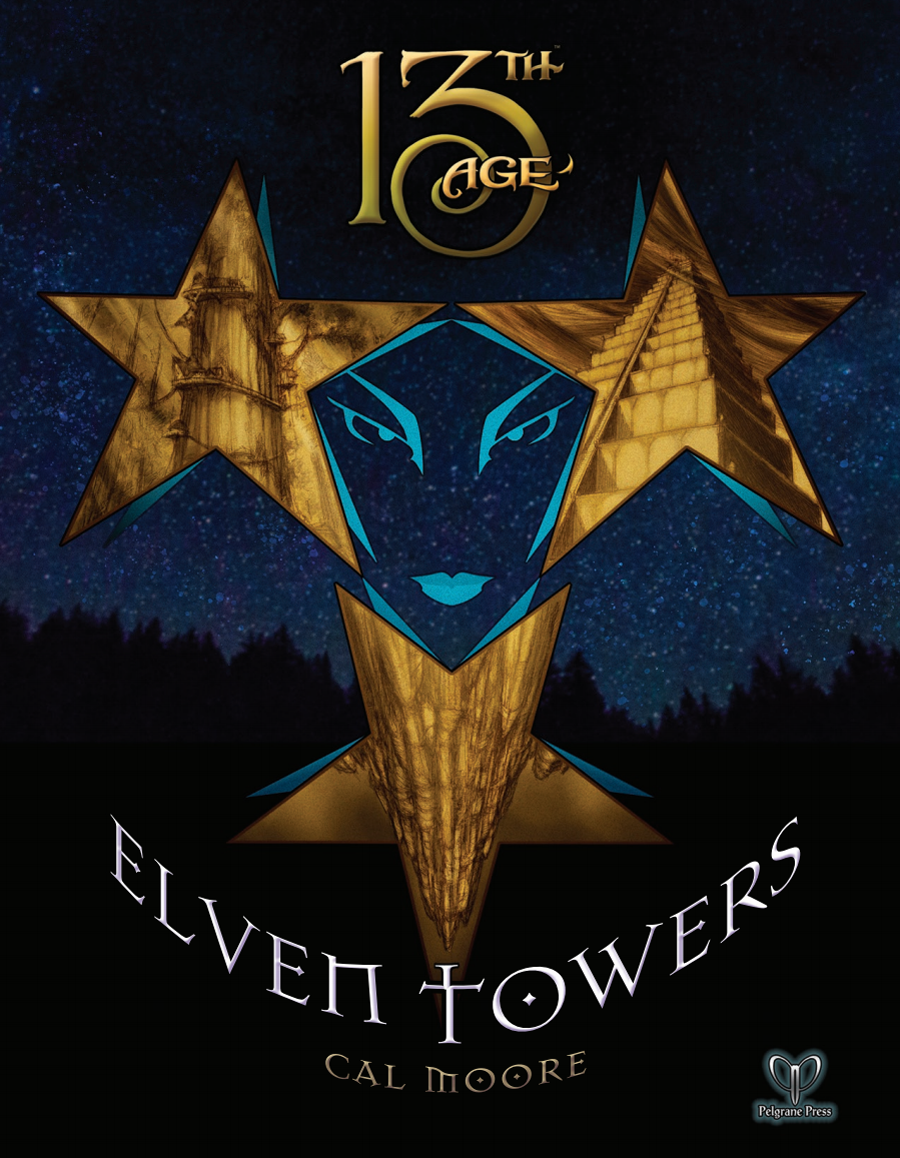
Long ago, at the beginning of the 13th Age, war raged between the Elves and the Dwarves. The Elf Queen commanded the magic of the wild and the fey capable of defeating her people’s enemy, but could not truly control it. Liris, a nature goddess, voluntarily underwent a ritual to contain this magic by binding her into a vault. The ritual was a success and it bound both the magic and the three elven districts—Greenwood, Darkwood, and Lightwood—to the Elf Queen’s own Thronewood. With the magic, the Elf Queen helped withstand the Dwarven assault and as time passed, the relationship between the Elves and the Dwarves eased and they became allies. Yet the power which Liris helped contain and control and so save the Elves corrupted her and drove her to attempt escape and wreak revenge upon those she blamed for her imprisonment—even though it had been voluntary upon her part. The Elf Queen and her greatest spellcasters from all three districts offered a Key up to perform a great ritual which would ensure that the vault imprisoning Liris would remain closed. Then the Keys were returned to their respective districts and placed in three mystical towers, hidden from those who did not know the means or routes to find them. More recently, the Elf Queen senses that the ritual keeping the vault containing Liris is weakening and needs to be performed again. For that, she needs the three Keys from each of the three districts, but relationships between the Elf Queen and the three districts were not they once were and many of those who readily knew the locations of the three towers have long since died. As the magical bindings on Liris’ vault weaken, her dark influence is being felt across the Thronewood and beyond as shadows and sorrow deepen. With her strength dedicated to withstanding Liris’ influence and preparing for the forthcoming ritual, the Elf Queen needs agents she can trust to find the three mystical towers, assail their heights (or depths), and return in time for her to perform the ritual which will save her kingdom.

This is the set-up for Elven Towers, an adventure for the Champion Tier for 13th Age, the roleplaying game from Pelgrane Press which combines the best elements of both Dungeons & Dragons, Third Edition and Dungeons & Dragons, Fourth Edition to give high action combat, strong narrative ties, and exciting play. The adventure requires access to both 13 True Ways and the 13th Age Bestiary to play and mostly obviously, will hook in Player Characters with Icon relationships with the Elf Queen or her allies. Options though are suggested for involving Player Characters with other Icon relationships, even ones so adverse to the Elf Queen that they would be prepared to betray both her and the efforts of their fellow adventurers should the need arise! Several ways of handling the interaction of the Player Characters with Court of Stars are offered, each of varying complexity or detail. The simplest is to run it as a group test, but alternatively, the Player Characters can attend the court and get involved in its activities and events, fully interacting with the various courtiers and hangers-on. There are plenty of NPCs detailed here as well as some nice means of handling the effects of Liris’ growing influence and the Player Characters being unsuccessful in their interactions with the Court of Stars. This includes increasing the amount of time it takes to get information, temporary penalties to saving throws, and temporarily delaying the increase of the Escalation Die in combat.

Once the Player Characters have worked out where the three Keys are located, they can set out to each of the locations. Consisting of the Tower of Memory in Greenwood, the Tower of Dreams in the Darkwood, and the Tower of Fate in the Lightwood, they can be tackled in any order, but they all adhere to the same format—a montage travel scene followed by three or four encounters between the Court of Stars and each tower, and each tower consists of four encounters before a finale. The encounters, inside the tower or outside of the tower, are essentially big set pieces, each different, but themed along the lines of the region the Player Characters are travelling through and the tower they are trying to reach. The format provides room for the Game Master to insert encounters of her own, if thematically appropriate, but to fair, the given encounters will be challenge enough. The Tower of Memory and the Greenwood are home to the Wood Elves and are forest-themed with the Tower of Memory being a giant tree. The Tower of Dreams and the Darkwood are home to the Dark Elves—or Drow depending upon the Game Master’s campaign—and the Tower of Dreams may be entered via a tree, but is actually in a spire protruding down into the Underworld. Many of its encounters veer between dreams and nightmares. The Tower of Fate is in the Lightwood and is home to the High Elves, with the Tower of the fate ascending to the Overworld. Many of the encounters in the Lightwood and the Tower of Fate relate to oracles, fate, and destiny.

The design of the scenarios as a series of big set pieces, means that the author gets to be inventive. For example, in the Tower of Memory, the Player Characters have to race across a rope bridge high above the forest floor, the missing slats of the rope bridge hidden by illusion, harassed by a Pixie knight and a Drunken Sprite Swarm; on the way the Tower of Dreams in the Darkwood, an ambush involves a Player Character being dragging back and forth behind an enraged wild boar and then back again after confronting equally enraged Owlbears, the whole encounter threatening to collapse into chaos; and a surprisingly creepy encounter in the Tower of Fate in the Lightwood in a cave of birthing pools left over from the Elves’ first creation of the Orcs a very long time ago, that should really resonate with any Half-Orc Player Character or Player Character with Icon Relationships with the Orc. The final encounter atop each tower always includes facing agents of one or more of the other Icons and there are stats and suggestions on how to tailor the forces of each Icon to each encounter. This allows the wider involvement of the Player Characters’ Icon Relationships, including both those with Icons who oppose the Elf Queen and those who might have interest in limiting or disrupting her power and influence.

Not all of the encounters in Elven Towers involve combat, though most of them do or will result in combat. Answering riddles or sharing secrets are a common feature, and is making trades. The sharing of secrets involves a roleplaying upon the part of the players, whilst riddles some deductive reasoning, though rules are given for skill checks and rolling dice for those players adverse to riddles. Trades will often see the Player Characters give up minor magical items, Revives, even Icon Relationship rolls—temporally!—and more. All of the encounters include advice on staging them and if necessarily, scaling them up to make a tougher battle.

Finally, the Player Characters will return to the Court of Stars with the three Keys—or not. The Player Characters may not necessarily gain all three Keys to Liris’ vault and the fewer Keys they have, the more difficult and dangerous the ritual that Elf Queen has to perform, becomes. The Player Characters get invited to a big party before the ritual to celebrate their success in obtaining the Keys and an even bigger party if the ritual is a success. The Player Characters are, of course, invited—or is that expected?—to help defend the ritual, which leads to a big boss, end of adventure-level fight. There is scope here too, for the Player Characters to betray the Elf Queen, if that is what their Icon Relationships demand. How that plays out is down to the Game Master, but if the betrayal succeeds, or the ritual as a whole fails, there could actually be a change in one of the Icons! However, if the ritual succeeds, there are rewards aplenty, including powerful magical items, the Elf Queen’s favour—which mostly means she will use them as her agents again, no matter what their Icon Relationships are, and even gaining or improving an Icon Relationship with the Elf Queen.

Physically, Elven Towers is well presented. The artwork is excellent and individual encounters are all easy to use and reference. However, some of the maps are a little dark and murky; the text requires a slight edit in places (one monster inflicts over three hundred points of damage, when it should be just over thirty); and an index would have helped. There are lists with page numbers for all of the monsters.

Elven Towers is an adventure that the Game Master will want to run if she has an Elf amongst her Player Characters or a Player Character with a strong Icon Relationship with the Elf Queen. The adventure is harder to run without either of these, but once involved in the adventure, Elven Towers is an entertaining, often exciting affair, with plenty of opportunities for roleplaying alongside the big, sometimes bigger, fights. Elven Towersis a grand quest in traditional fantasy and fantasy roleplaying style, well designed and executed with plenty of variation that reveals some of the secrets and nature of the Elf Queen and her realm.

—oOo—


Pelgrane Press will be at UK Games Expo
from Friday 2nd to Sunday 4th, 2023.

Sunday, 19 March 2023

Monster Metropolis

Drakkenhall: City of Monsters takes you right into the home of one member of the thirteen Icons of the Dragon Empire of the 13th Age—the Blue, a Blue Dragon also known as the Blue Sorceress. Once it was the city of Highrock, which protected the Midland Sea and the empire from invasion, but four centuries ago it was invaded and reduced to ruins. So, it remained until one hundred years ago, when the Blue Dragon took the city for herself and rebuilt half it, making it a haven within the empire for all of the monsters who would not normally be allowed to reside within other cities. Even as she allows the Goblin Market—famous for its deals, steals, and buyer’s remorse—to operate within the walls of Drakkenhall, an Ogre Mage to head her secret police, and numerous cults to practice their dark faiths in their profane temples—yet denying access to the city by any Orc, the Blue Sorceress serves as the Imperial Governor of Drakkenhall under geas from the Emperor and the Archmage. The question is, has the power of the Blue been constrained within the limits of Drakkenhall by making her part of the Dragon Empire’s hierarchy, or is this part of the Blue Dragon’s plan to subvert the empire from within? Ultimately, this is not question that the supplement will answer, but like other supplements in the line, it is one that is explored and multiple answers suggested.

Drakkenhall: City of Monsters is a supplement for 13th Age, the roleplaying game from Pelgrane Press which combines the best elements of both Dungeons & Dragons, Third Edition and Dungeons & Dragons, Fourth Edition to give high action combat, strong narrative ties, and exciting play. Designed for adventurer and champion-tier campaigns, it explores the various different aspects of a city infested by monsters, run by monsters, and constraining monsters. It is both radically law-abiding and radically criminal, fastidiously good mannered and rudely brutal, a half city built on the shattered remains of an old city, the ruins hiding dungeons and secrets which stretch from the former city walls into the depths of the city harbour waters. Alongside this, ordinary folk of the Dragon Empire get by and know how live alongside the turbulent nature of the city’s other, often unpleasant or difficult inhabitants, and in between New Rat City which provides a safe, if expensive underground route into Drakkenhall, the docks of Saltside where the lowlifes encountered are likely to be tourists as much as other visitors, and the Goblin Market, where getting fleeced is just part of doing business, there are points of goodness and light. The most notable of which is Pleasantville, an old Highrock city block in the rubblehood run by the Halfling, Uncle Papa Brother Knuckles, which is clean and minty fresh, covered in flowers and vines, and even has a supply of good drinking water, as well as the Scales enclave, a place of business barely tolerated by the Blue despite its normality, but such places are far and few between, and very much at odds with the rest of the city.

Drakkenhall: City of Monsters is not a conventional city guide in that it does not explore the city as a whole. Rather, it focuses on particular aspects of the city, with each chapter written by a different author, but it begins with an overview of its power brokers and pawns. It starts by highlighting the huge divide between the manors and estates of the wealthy and the surrounding shantytown ruins, little details such as the city’s odd status and high criminality making food supply and trade highly irregular, that many inhabitants of the city have to swear an oath of fealty to the Blue Sorceress, and instead of having a rat problem, Drakkenhall has an ooze problem! It divides its manors and estates—its ‘Estates of Significance’—between ‘Estates of Decadence’ and ‘Blood Houses’, connecting them to cults, demonic salons of science and discovery, fashion trends, and best of all, a social season with Enchanted Dance Cards each of which tracks the holder’s points with each of the Three. Suggestions are included too for the other Icons, but primarily it is with the Black, Blue, and Red Dragons, and the bearer can possibly earn one-time relationships with each one of them. There are even Fashionista Oozes which accompany their owners to parties and often react badly to fashions and styles their owners hold in poor regard and mechanical barber-surgeons like the Cut Monkey and the Amputation Mechanoid, which partially fill the void left by the lack of ready healing in the city. There are rules too for prosthetic limbs, so if a Player Character needs healing, the party had best keep a healing spell or two in reserve lest one of the automatons comes cutting… Much like the rest of Drakkenhall: City of Monsters, this opening chapter explores various aspects of the city, but in places, such the ‘Estates of Significance’, it leaves the specifics up the Game Master, and so in comparison, there are elements of the chapter that are not as interesting as the rest of the supplement.

‘Welcome to the Rubblehood’ hits some of the highlights of Drakkenhall’s ruins, for example, Hobtown, the fortified compound where the Jagged Company, a Hobgoblin mercenary unit drills daily, or the Float Royale, a pirate haven which floats just offshore, where the best beverages in the city can be found and the worst magical items in the empire go to be lost, whilst the bay itself is protected by a sleepy Dragon Turtle, who just happens to have a tame Kaiju-Shark at its beck and call. Every entry, as with the rest of the book is accompanied by a numerous adventure hooks and links to the Icons. There are more of the latter here than in other chapters, there being thirteen per Icon. ‘The Docks of Drakkenhall’ begins where the previous chapter left off at the shore’s edge, Saltside, the docks that are very much everyone’s idea of what dockside dives should be. There are Drakkenhall touches though, like the Dybbuk Inns, where guests get drugged of a night, their bodies possessed and put to some nefarious task, only to wake up with a terrible headache, but none the wiser or the Drowned District, an underwater remanent of Highrock just off  the coast, where the ghosts of the district’s former inhabitants, known as Lamenters, silently wail on the seabed, when they are not marching on the shore, likely with the aid of the Liche King. Accompanying these are quick and dirty rules for sea travel in the Dragon Empire, essentially handling them as travel montages as per the 13th Age Game Master’s Screen & Resource, whilst the Isles of Doom in the Midland Sea, Omen, which constantly spawns living dungeons that attack ships, and Necropolis, home to a massive army raised by the Liche King to threaten local shipping, are worthy of chapters of their own.

‘The Goblin Market’ is the standout chapter in Drakkenhall: City of Monsters. It describes the structure of the market from its outer Stalls to the deepest sections of Rock Bottom via the Underways; its own argot, a Goblinoid gang cant; and scam after scam, starting with all trades having to be in the market’s Blue Imp coins rather than Imperial coins, meaning currencies have to be exchanged, and then planting items on customers and claiming them to be stolen, drugging unsuspecting tourists and not only relieving them of their valuables, but delivering them ready to fight in the Fighting Pits, escalating a spilled drink into a demand for satisfaction which can only be settled in the fighting pit, and even demanding visitor’s fingers—especially if they are an Elf (such sweet meat)—as compensation for intruding on gang territory. Parts of the Goblin Market shift, but mostly it remains in Rubble City, run by the feudal mafia-like Organisation of goblinoid gangs, the most notable of which are the Rippers who operate the Double Draught speakeasy. This complete with gambling pits, a stage where even the most famous of the Dragon Empire’s entertainers have performed, impromptu blood brawls are set up, and a Halfling chef—so the food is good. Located in the depths of Rock Bottom, the Double Draught is going to be somewhere that the Player Characters are going to have to work to get to and get into, but once there, there are plenty of adventure hooks and ongoing plots to keep them coming back.

Drakkenhall: City of Monsters includes lots and lots of adventure hooks, but one thing it lacks until ‘Smash and Grab’ is a sense of an overarching plot that might keep the Player Characters in the city and crossing back and forth from one location to another. What ‘Smash and Grab’ suggests is a big scavenger hunt, leading to a treasure hunt. The ‘Society of Monster Archaeologists Searching for Hoards’—or ‘SMASH’—a secret society whose members possess a degree of immunity in a city of criminals. This is because members have a reputation for being tough, even mad, having delved into the deepest, darkest, most dangerous parts of Drakkenhall and the former Highrock in search of treasure and returned. Can the Player Characters join? Of course, they can! They just have to find the headquarters first, which is a hunt in itself, then when they have, they have to prove themselves worthy. This provides reasons for longer term play in Drakkenhall as well suggestions as to where to look for treasure worthy of SMASH. There are ideas too, for the Player Character who has SMASH as part of his Background during character creation.

Penultimately, Drakkenhall: City of Monsters presents some ideas as to why exactly, the Blue does not allow Orcs into the city. None of the four options are simple, but all four of them point to the deviousness of the Blue Sorceress. They are useful if the party includes an Orc Player Character. Lastly, there are stats for the Blue Dragon as the Blue Sorceress, though whether this is who she is, is open to conjecture…

Physically, Drakkenhall: City of Monsters is well written. However, the map of the city is not particularly detailed, so not as useful as it could have been, and the artwork does vary in quality.
 

As written, Drakkenhall: City of Monsters does not feel like a coherent book. There is no overview which might pull all of the book’s content and city description together and its treatment of the city is scattershot. That though is by design. Drakkenhall is far from a cohesive city, raucous and rowdy, lawless until someone steps out of line, order of a sought being maintained by fear, dread oaths of fealty, and the Blue Sorceress’ secret police and Kobold force of the Glinting Legionnaires. The result is that a Player Character is never going to quite get a true grasp of what the city is like and how it really works, and even if he did, there is no knowing quite what would be different if he left and came back. The Game Master is supported with plenty of new threats, a handful of new magical items, and too many adventure ideas and hooks and more to mention, so that each time a Player Character comes back there will be a new scam he has not run into, a new plot to get tied up in, and more. It also means that from one visit to the next, the Game Master never has to keep all of the city in mind, but can rather focus on particular locations and how the Icons might be involved. There are elements which Game Master will need to develop, but with half a city reduced to rubble, there are plenty of places to put them.

Ultimately, Drakkenhall: City of Monsters is a criminally chaotic—to a point—and an evilly entertaining city to visit for a 13th Age campaign. Probably more than once. However, full of malevolent magics and would be marauding monsters, with a government lamentably legitimate, and almost everyone ready to swindle almost everyone else, Drakkenhall: City of Monsters is probably not somewhere to stay for long.


Sunday, 8 May 2022

Superbly Subterranean

Book of the Underworld is a sourcebook for 13th Age, the roleplaying game from Pelgrane Press which combines the best elements of both Dungeons & Dragons, Third Edition and Dungeons & Dragons, Fourth Edition to give high action combat, strong narrative ties, and exciting play. It is a guide to the realms below the Dragon Empire. Not the dungeons, but further below, in the realms known as the Underworld, riddled with twisting tunnels and networks of caverns; home to lost seas, lost races, and lost gods; rife with dark secrets and darker kingdoms; and below that? Here can be found the Gnomish school of wizardry, the Arcane Academy in the Burrowdeep Warrens where the graduates swear to never reveal its location upon pain of a curse that changes from graduation year to graduation year and where all sorts of magic is studied away from the eye of the Archmage—even necromancy! Forge, the Dwarven City of Memorials to the lost ancient civilisation of Underhome which stretched across the Underworld and which the Dwarven King still claims as his—along with much of the Underworld. Drowfort, a magnificently dark fortress sphere suspended by webs amidst a circular cavern, where factions of the Drow dedicated to the Elf Queen, She Who Spins, and both without ever revealing their allegiances co-operate to impose martial law on the Underworld. The Caverns of Lost Time in the Hollow Realm where whole regions of both the Overworld of the Dragon Empire and the Underworld, as well those of previous and lost Ages have been swallowed and preserved. Below that, glimpses of Underkrakens might be caught, seas of chaos writhe and surge, gods repose in their great catacombs, and something stranger still might be found—possibly the great architect of the Living Dungeons which burrow up the Underworld to the Overworld… And he has a beard, wears glasses and Hawaiian shirts, and speaks with a Midwestern accent, that would not be the strangest thing in Book of the Underworld.

The Book of the Underworld is a slim volume of ideas, places, monsters, advice, lists of thirteen things, and more, all designed to take a Game Master’s campaign even deeper underground. It is by no means a definitive guide to the Underworld, but it contains more than enough content and ideas to fuel multiple campaigns. Some locations its fleshes out in detail, such as Forge, Dwarven City of Memorials with its multiple districts and NPCs, or Web City, the stalactite city home to two cults—the Cult of She Who Spins in Darkness and the Cult of He Who Weaves With Joy—and innumerable spiders and drow, a fantasy ’noir setting strung across the ceiling of a great cavern, whereas locations such as the Dark Temples where the darkest of gods hide from the light and the Salt Mines of the Manticore, a sprawling salt mine used in ages past as a prison with one entrance pit in manticores were free to feed on the salty inmates, get just a paragraph or two. Whilst the former are more ready to play and easier for the Game Master to bring to the table, the other locations are more ready for her input and development of her own ideas and content.

The Book of the Underworld does require access to a number of supplements for 13th Age. In addition to the core rulebook, the Game Master will need the 13th Age Bestiary, 13th Age Bestiary 2, and 13 True Ways, whilst 13th Age Glorantha, Book of Ages, Book of Demons, and others will all be useful. It divides the Underworld into three layers. These are in descending order of depth, the Underland, the Hollow Realm, and the Deeps, which correspond roughly to the three tiers of play in 13th Age—Adventurer, Champion, and Epic. As with other supplements for 13th Age, it ties in the thirteen Icons and their relationships with the Underworld, which of course can be used to spur the Player Characters into descending below either on their behalf or to stop their plans. It throws in too, several fallen, vanished, and refused Icons, such as the Explorer from the Book of Ages or the Gold King—a former Dwarf King turned undead from 13th Age Bestiary 2. It introduces the Calling, the alien desire which subverts an existing icon relationship and compels an adventurer to travel further into the Underworld…

The supplement also discusses the roles which the underworld can take in a campaign, from a source of evil or monsters to a realm which is either hidden, prosaic, or weird, if not a mixture of all three, as well as using as the setting for a quick delve or a longer sojourn across an entire tier of play. Rather than suggesting that the Game Master map out each and every tunnel or cavern, it gives guidelines on how to use travel montages and include the players’ input and descriptions to detail and enhance the various locations their characters come across to make it interesting and involving, but shies away from focusing upon the day-to-day tracking of resources such as food, water, and sources of light. It adds a few treasures, such as the Drow Poesy, made of flowers plucked from Hell and the Bezoar of the Caves, former magical items belonging to adventurers chewed up and spat out by carnivorous caves, as well as numerous new monsters, but the latter tend to be specific to their locations.

The two races to receive the most attention in Book of the Underworld are the Dwarves and the Drow. Both are well handled and nuanced, but the interpretations of the Drow are the more interesting, if only because they are not portrayed as the out and out villains they often are in other settings, but rather accorded multiple interpretations which the Game Master can pick and choose from. Also known as the Silver Folk, they are primarily divided between those loyal to the Elf Queen and those loyal to the Cult of She Who Spins in Darkness. The realm of the Silverfolk lies below and extends beyond the Queen’s Wood. Numerous options for obtaining access are given, such as via ancient fairy mounds or sigils spun by spiders, and the Silver Folk might be divided into family clans of extreme specialists, whether that is of duellists, torturers, mushroom farmers, spider herders, artists who paint living portraits, and more; operate as the Elf Queen’s secret police; be exiles from the Queen’s Wood above; or reside in cavern dens as drug-addled fiends and hedonists, or laboratories where alchemy is practised as an art. The other Drow locations detailed in the Book of the Underworld, Drowfort and Web City, are located below in the Hollow Realm and are likewise accorded options of their own from which the Game Master can choose—as with much of the supplement.

Elsewhere, the Book of the Underworld provides lists of ways to get into the Underworld—including via the Abyss for Player Characters who want to make their delvings all the more challenging and for the Game Master who wants to make use of the Book of Demons, an explanation of how druidic earthworks work—above and below ground, the Grand Dismal Swamp—complete with Troglodytes and Fungaloid monsters, and not one, but four kingdoms of the Mechanical Sun! There really is a lot for the Game Master to play with in the pages of the Book of the Underworld. Plus it need not be just for 13th Age. The ideas and settings in this supplement would work equally as well in a lot of other fantasy roleplaying games too.

Physically, the Book of the Underworld is well written, but not always well illustrated as the artwork varies widely. It presents a wealth of ideas and options as well as particular locations, some already developed, others awaiting development upon the part of the Game Master, that she can bring to her campaign. Or indeed, actually turn into a campaign! The Book of the Underworld literally adds depth to 13th Age and content that a Game Master can mine for scenario after scenario and campaign after campaign.

Saturday, 12 February 2022

Abysmally Amazing

The Book of Demons brings an enemy that everyone hates to 13th Age, the roleplaying game from Pelgrane Press which combines the best elements of both Dungeons & Dragons, Third Edition and Dungeons & Dragons, Fourth Edition to give high action combat, strong narrative ties, and exciting play. The Abyssal enemies of the 13th Age crawl and skitter beneath the earth of the Dragon Empire, seeking to break onto the surface, where they can claw out hellholes where the weird rules of the Abyss below now apply, ready to fight everyone and destroy everything! Of the thirteen Icons, the Archmage wields his might magics to banish them from whence they came, the Crusader trusts only himself to take his righteous sword to slaughter every single one of the unholy creatures, the Great Gold Wyrm died to save us from destruction at their hands, and the Diabolist cavorts on the edge of the Abyss as she both steals their power and helps them up into the world. From between the Crusader, the Great Gold Wyrm, and the Diabolist steps a new agent—the Demonologist. Somehow the Demonologist is connected to all three though the Paths they are known to follow. To the Crusader via the Path of Slaughter. To the Great Gold Wyrm via the Path of Flame. To the Diabolist via the Path of Corruption.

The Book of Demons opens with a whole new Class for 13th Age, the Demonologist. This is a complex character Class much in the vein of the Druid Class. It is first and foremost a spellcaster, and it is mostly a summoner. Except when it is not, and that depends on the path selected by the player. Two of the paths, the Path of Corruption and the Path of Flame, definitely are, and their adherents will be summoning demons which they will send against their opponents, knowing that the summoned demons can stray from the Abyss only for so long. Unlike the Druid or the Necromancer, the Demonologist does not have to spend time controlling the summoned Demons. They will simply serve him once summoned. However, Demons have a half-life and lose Hit Points at the end of every round when they vanish. The Path of Slaughter is different. Its adherents are Demonic Warriors, leaping into melee where the followers of the other Paths do anything to avoid it. They wield heavier weapons and wear heavier armour than those of the Path of Corruption and the Path of Flame do.

In terms of spells, those of the Path of Corruption and the Path of Flame are highly thematic, as obviously are the demons they can summon. So those of the Path of Flame include Burners and Hellhounds, whilst those for the Path of Corruption include Demon Toads and Hopping Toads. Those of Path of Slaughter are all about frenzy, bloodlust, and the like. Many of the spells involve curses, and these and others are highly conditional. This adds to the complexity of roleplaying the Demonologist and is thus more demanding of the player. Of the three Paths, a Demonologist is free to choose from all three or specialise in one more than another, or completely specialise in one. The first two of these options enable a player to mix and match Talents and spells, and there is a guide for multi-classing the Demonologist as well. Of course, there are some notes on playing the Class in conjunction with the Tielfling Race, which of course, a natural fit.

The description of the Demonologist takes up roughly a third of The Book of Demons and is thus for the player to read. The rest is entirely for the Game Master’s eyes. This begins with discussing the nature and uses of the demon in play. Essentially, they are what the author describes as the ‘temp agency of evil’, as there is something pleasingly utilitarian about their use—they can turn up anywhere, serve anyone, and so on. They are not constricted by environment as a great number of other monsters are. There are suggestions as to giving them distinctive features and patterns of speech, but the best feature of this chapter is devoted to showcasing how demons are liars—and notoriously so. This is done in exactly the way it should be for 13th Age, Icon by Icon, and in each case, this is an interesting and different set of opinions upon the Icons, if not necessarily true.

The Book of Demons adds a way to change the ecology of the Dragon Empire with Hellholes. Created either through arcane means or ripped through the fabric of reality at its weakest, and although they come in many forms, they nearly all contain a gate to the hells or the Abyss, often hidden. A Hellhole is initially weak, and until it stabilises, this is the best time for someone—such as the Player Characters—to strike and close it. Once it stabilises and is fortified, a Hellhole can be ferociously difficult to close and destroy, and often the response to a stabilised Hellhole is to monitor and prevent any Abyssal forces raiding too far from it. Six example Hellholes are described in detail. These are scaled from First and Second Level all the way up to Eighth to Tenth Level, from Adventurer to Epic Tier. All include a description, hooks and perils to get the Player Characters involved, and a list of the demonic denizens particular to each Hellhole—and that is in addition to the generic Demons given earlier in the book.

The Hellholes begin with ‘The Ratwood’, sat over a tiny crack into the Abyss out of which the weakest of demons squeeze themselves and make bodies for themselves out of the local vermin. They just need a spellcaster to open it properly… Where ‘The Ratwood’ is a small encounter, the ‘High Heath of Unending Woe’ is much bigger and wider, a seemingly endless and timeless blight with fluctuating boundaries which is impossible to get out off, but can be crossed. Described as one big peril, it comes with a wide selection of random encounters , including flying sets of teeth, memories (?) of the Icons (to tie in with the Player Characters’ relationships), convulsions which warp the Hellhole, an avaricious demonically transformed slug who wants out, and more! Abandoned by higher demons and thus ruled by a surprisingly lowlier demon, ‘Claw Peak’ is a mountain on which there can be upslides and sidelides as well as landslides, whilst the ‘Floating Market’ is a Hellhole in the Eastern Marsh where mortals mix and trade with demons and the Diabolist keeps the peace through a system of randomly distributed tokens which indicate absolute innocence. Of course, the right tokens can be traded and stolen… Divided into various districts, the ‘Floating Market’ is constantly changing and the whole ‘city’ moves on an army of arms on its underside, and presents somewhere where the Player Characters will have to interact with demons rather than slaughter them and the Demonologist’s knowledge and reputation can really come into play.

Similarly, ‘Red Crag Castle’, once home to the Vocnort family which was said to enjoy questionable taste in both pleasures and alliances, is also faction riven. Four factions of demons—each very different in character and each with their own random demon abilities, now vie for control of this Abyssally-infested dungeon, whilst surviving members of the Vocnort family want the castle for reasons of their own. Plus there are Paladins who also want to storm the castle. Although not mapped, the castle’s locations are described in detail so that the Game Master can run them as is, or expand them with further locations or even map them out in true dungeon style. There is scope here for numerous missions into Red Crag Castle, to take advantage of rival factions, if not ultimately clear it out. Lastly, the Abyss explodes into the Overworld as a pillar of hellfire, ripping up chunks of the land around it and flinging them into the air to orbit around and even into the fire as Abyssal magic collides with Celestial magic. Beset by burning cloud castles, crazed Celestials, earthquakes, skyquakes, and spellquakes, and besieged by armies of the Crusader and a Host of the Overworld, this is the ‘Hellgout’, and populated with demons happy to co-operate given the array of enemies they have to taunt and fight. This is a big bold scenario which will see the Player Characters island-hopping further up and around the pillar of fire. Each of the individual islands is given enough detail for the Game Master to expand on, some requiring it more than others. Otherwise, ‘Hellgout’ has a fantastic sense of scale.

Two Icons make their homes in Hellholes and ‘Citadels of the Icons’ details both of them. These are First Triumph, home to the Crusader, a city-citadel under permanent martial law where demons bound by the deleterious effect of the Iron Spike do all of the drudge work and the Diabolist’s fortress in the Hell Marsh. Exactly what form her fortress takes is unknown, but everyone, including the other Icons and her cultists has an opinion, probably based on rumours or lies. Where the description of First Triumph is appropriately written in stone—since the Crusader is a lawful icon, that of the Diabolist’s fortress is given a range of options that the Game Master can choose from or adjust as is her wont. Of course, the Game Master is free to ignore or change the description of First Triumph as the text suggests, but the style and tone is entirely appropriate to both.

Physically, The Book of Demons is well written and decently illustrated, although the art styles vary widely. In terms of content, The Book of Demons brings all of the chaos of demons into play for 13th Age like never before, presenting them as both an enemy that everyone loves to hate (obviously) and an enemy which can be summoned and manipulated (if they are not manipulating you, that is). Its six Hellholes can be used together to build a campaign around demons or individually slipped into an existing campaign for a little or a lot of demonic danger. Plus, the Demonologist is a new Class for the player who likes a challenge in terms of both mechanics and roleplaying, the latter because no one trusts demons and certainly no trusts anyone who has dealings with them!

The Book of Demons is a damnably good source and scenario book for the 13th Age Game Master who wants to take her campaign to the edge of the Abyss—and back again!

Saturday, 15 May 2021

An Onslaught of Options

One of the great features—amongst many—of 13th Age is how it handles characters, making each Player Character unique, emphasising narrative gameplay elements, and upping the action. Published by Pelgrane Press, a wide range of character Classes were presented in both 13th Age and 13 True Ways, but one of the aspects of 13th Age is that Player Characters can only advance to Tenth Level. What this means is that campaigns are relatively short and new campaigns can be begun relatively easily and relatively regularly, so having a wider range in terms of character choice is always useful. Now whilst presenting new Player Character Classes has not been the focus of titles from Pelgrane Press, it does mean that there is scope for other publishers to provide a Game Master and her players with such options. This is exactly what Kinoko Games has done with Dark Pacts & Ancient Secrets, which added the monstrous Abomination, the destiny-shaping Fateweaver, the mind-bending Psion, the berserking Savage, the dashing Swordmage and the dark-souled Warlock to 13th Age.

Dark Alleys & Twisted Paths, the second supplement from Kinoko Games also expands the number of options available in 
13th Age. However, unlike Dark Pacts & Ancient Secrets, it does not add any new Classes. Instead, it goes back to the fifteen Classes presented in 13th Age and 13 True Ways—the Barbarian, Bard, Chaos Mage, Cleric, Commander, Druid, Fighter, Monk, Necromancer, Occultist, Paladin, Ranger, Rogue, Sorcerer, and Wizard—and adds to them, sending each of the Classes in new directions. Essentially each comes with a host of new Talents and Class-specific features, but that is not all to be found in the pages of Dark Alleys & Twisted Paths. The supplement also includes new rules variants, new Races, and a whole new starting point for any 13th Age campaign, all of which will work with 13th Age, 13 True Ways, Dark Pacts & Ancient Secrets, and of course, Dark Alleys & Twisted Paths.

Dark Alleys & Twisted Paths starts with a host of new rules, clarifications, and variants. The new rules include Advantage and Disadvantage, exploding dice (rolling and adding again when the highest number on a die is rolled), and increasing or decreasing dice step-by-step, and to be honest, none of these rules are new if you are aware of Dungeons & Dragons, Fifth Edition, Dungeon Crawl Classics, and the Old School Renaissance in general. However, they are new to 13th Age and the new Class options in 
Dark Alleys & Twisted Paths makes use of them. The variant rules provide an alternative means of players rolling the abilities for their characters, suggests granting a single ability increase at every Level rather increases to three every few Levels, using Icon relationships as a bonus in skill checks, and amusingly, ‘The Plushie Rule’, in which a player who brings a stuffed toy to the table to represent his character’s familiar, receives a bonus from the Class’ usual list. Lastly, ‘Taking Risks’ allows a player to double down after failing a roll. Instead of opting to accept the consequences of the failed roll, but still succeed and thus ‘Fail Forward’, a player can ‘Take a Risk’. If he succeeds, then there are no consequences, but if he fails the roll, the consequences are bad—bad! This might be Lasting Pain which causes disadvantage on all Saving Throws; a Hand Injury, which causes disadvantage on all Melee and Ranged attacks; and so on… For the most part, this means that ‘Taking a Risk’ is a more personal option for a player and his character and a player can avoid the party-affecting consequences of the usual Fail Forward option.

Dark Alleys & Twisted Paths provides thirteen new Races—Elemental Souls, Half-Ogres, Leomars, Nyama, Orcs, Pixies, Ratkin, Shadowborn, Star Children, and the Vorhai. Elemental Souls are the descendants of followers of the Four Elemental Lords who were defeated by chromatic dragons in a past Age and infused their remaining power into them so there are Elemental Souls of Air, Earth, Fire, and Water. Half-Ogres are simply Brutal and can attack at Disadvantage to inflict double damage; the feline and proud Leomar have a greater resistance to fear; Nyama are shapeshifters, able to change into wild animals; Orcs are full-blood Orcs, dangerous because they have a greater chance of inflicting a critical strike, at least initially in a battle; and Pixies can fly, their weapons do poison damage, and they can shrink any one normal-sized object down to Pixie-size. Ratkin are rodent-like humanoids, known for their love of family, and their Stench which is strong enough to daze anyone nearby; the Shadowborn are humanoids native to the Underworld, able to slip into the shadows to escape a fight; a Star Child has come down from the stars and is simply blessed, able to freely choose a single at-will spell to cast, typically once per day; and the Vorhai or Greyskin are a race of magically created warriors from a past Age, who possess a single Adventurer-Tier Talent from the Fighter Class. Not all of these new Races are going to interest a Game Master or her players, but they do lend themselves to some interesting possibilities. How about an all Orc, Half-Orc, and Half-Ogre campaign built around serving the Orc Lord? Or an Elf, Gnome, Half-Elf, and Pixie focused campaign built around the Elf Queen or the High Druid? That said, simply throwing these thirteen into the mix with those from 13th Age and 13 True Ways is likely to dilute their abilities and those of the other Races. Perhaps it might be better to mix and match, build a campaign around them, and so on?

Dark Alleys & Twisted Paths also provides rules for mixed Race Player Characters and a selections of new Feats—both General and Racial. The former include ‘Bribery’, ‘Heirloom’, and ‘Icon Lore’, whilst the latter include ‘Ancient Grudges’ for the Dwarf, ‘Human Ingenuity’ for the Human, and ‘Pixie Dust’ for the Pixie. There are a lot of feats here and certainly the Racial feats could have been listed by Race rather than alphabetically, as they would have been easier to choose from. The bulk of Dark Alleys & Twisted Paths though, is devoted to the new Talents and features for the original fifteen Classes. Each one comes with some suggestions as to the play style that each new set of Class options offers. For example, ‘Bouncer’ provides a Barbarian brawler with a series of wrestling moves, Bulwark enables him to fight with a shield and sword like a Viking or Saxon warrior, ‘Giant Blood’ lets him be a classic two-handed sword wielding barbarian, whilst ‘Primal War Dance’ turns his battle rage into a defensive dance and ‘Raging Storm’ unleashes lightning damage upon an opponent with every melee attack! For the Cleric, there are over thirty new Domains, from ‘Air/Storm/Thunder’, ‘Animal/Beast’, and ‘Archery/Hunting’ to ‘War/Leadership’, ‘Water/Sea/River’, and ‘Winter/Ice’, each with accompanying Feats and spells, whilst the Druid undergoes a revision. It takes the six Druid Talents from 13 True Ways and replaces them with circles—Circles of Decay, the Fang, Feysong, the Land, Life, the Moon, and War—each of which has its own Talents, spells, powers, or flexible attacks. For example, the Blighted Stench Talent means that the Druid is followed everywhere by the smell of decay, and is granted a bonus Necromancer spell and the Blighted Stench spell, which inflicts poison damage on two nearby enemies. Combine this with other Talents like ‘Festering Maggot Aspect’ or ‘Life Leech’, and spells such as Summon Giant Bug or Creeping Thorn Ivy, and what you have is whole new way of playing the Druid Class, one that is just a little weird and definitely creepy, almost a Class unto itself—and that is just one of the six circles, each of which different in character and tone. This revision of the Druid is possibly one of the more complex options in Dark Alleys & Twisted Paths, but nevertheless, delightfully thematic.

The Fighter has always been a Class to make interesting, and whilst far from uninteresting in 
13th Age, in Dark Alleys & Twisted Paths the Class has even more options to make it interesting and flavoursome. ‘Air of Authority’, for example, enables a Fighter to hush a room or a mob, ‘Lock & Load’ turns a Fighter into a fast shot with a crossbow, and ‘Ultimate Combat Reflexes’ enables a Fighter to act any time in a round! The Class is accompanied by a list of new Manoeuvres, like ‘Get a Read’ which grants the Fighter’s player a question about his opponent and ‘Staredown’ which sends the Fighter into the face-off with an opponent, which either can lose. Similarly, the Necromancer is given a host of Talents and spells, such as ‘Bloodseeker’ which turns the Necromancer’s origins into vampiric, and enables him to detect heartbeats of the living, heal by drinking a cup of blood, and empower his next spell with double damage, whilst his ‘Disgusting Display of Depravity’ Talent can strike fear into his opponents! Perhaps the most fun spell will be Zombombie, which summons a zombie which can detonate with a putrid explosion! Elsewhere the Chaos Mage gets entertainingly silly spells such as Frogsplosion, which creates two exploding frogs, and Princessification, which turns a target into an Elven princess, whilst the Wizard goes back to the classic version of the Class with its magic and its many, many spells being built around the eight schools of magic—Abjuration, Conjuration, Divination, Enchantment, Evocation, Illusion, Necromancy, and Transmutation. However, there are only spells for seven of the schools, Necromancy being the province of the Lich King and a whole other Class. Every Class has options upon options, multiple ways to play them like this.

Penultimately, 
Dark Alleys & Twisted Paths presents the ‘Novice Tier’. This is a means of exploring the Player Characters’ adventures before their careers really begin, essentially taking them from Level Zero through the three mini-steps of the ‘Novice Tier’ up to First Level, and covering everything from Backgrounds and One Unique Thing to Levelling Up and Encounter Design for Novice Characters. The latter feels somewhat short, and it would be nice to see some adventures written for this mini-Level. Lastly, the new magical items consist of new musical instruments for the Bard, and does include some silly items like the Battle Didgeridoo and Lightning Kazoo.

Physically, Dark Alleys & Twisted Paths is tidily presented. The book is decently written, but the artwork does vary in quality. Much of the artwork is decent, but the black and white artwork is rarely as good. Some of the colour artwork does veer slightly towards the ‘Chainmail Bikini’ school of art, but only a few pieces.

13th Age is a roleplaying game with plenty of options in terms of character choices, and that only grows with the addition of 13 True Ways. Essentially, thirteen different Classes, each with direct ways to play them. Dark Pacts & Ancient Secrets, the previous supplement from Kinoko Games, only added to that with six new Classes. Which of course, is no bad thing, because having options—and having more options—is always good. Dark Alleys & Twisted Paths is a whole book of new options, one that returns back to the official character Classes. With just ten Levels of play in 13th Age, the choices in the core rules and 13 True Ways may not necessarily stand up to too much repeat play, but a supplement like Dark Alleys & Twisted Paths, incredibly rich in character options, provides the means to invigorate an existing campaign or build a new one.